2 Corinthians 5:10

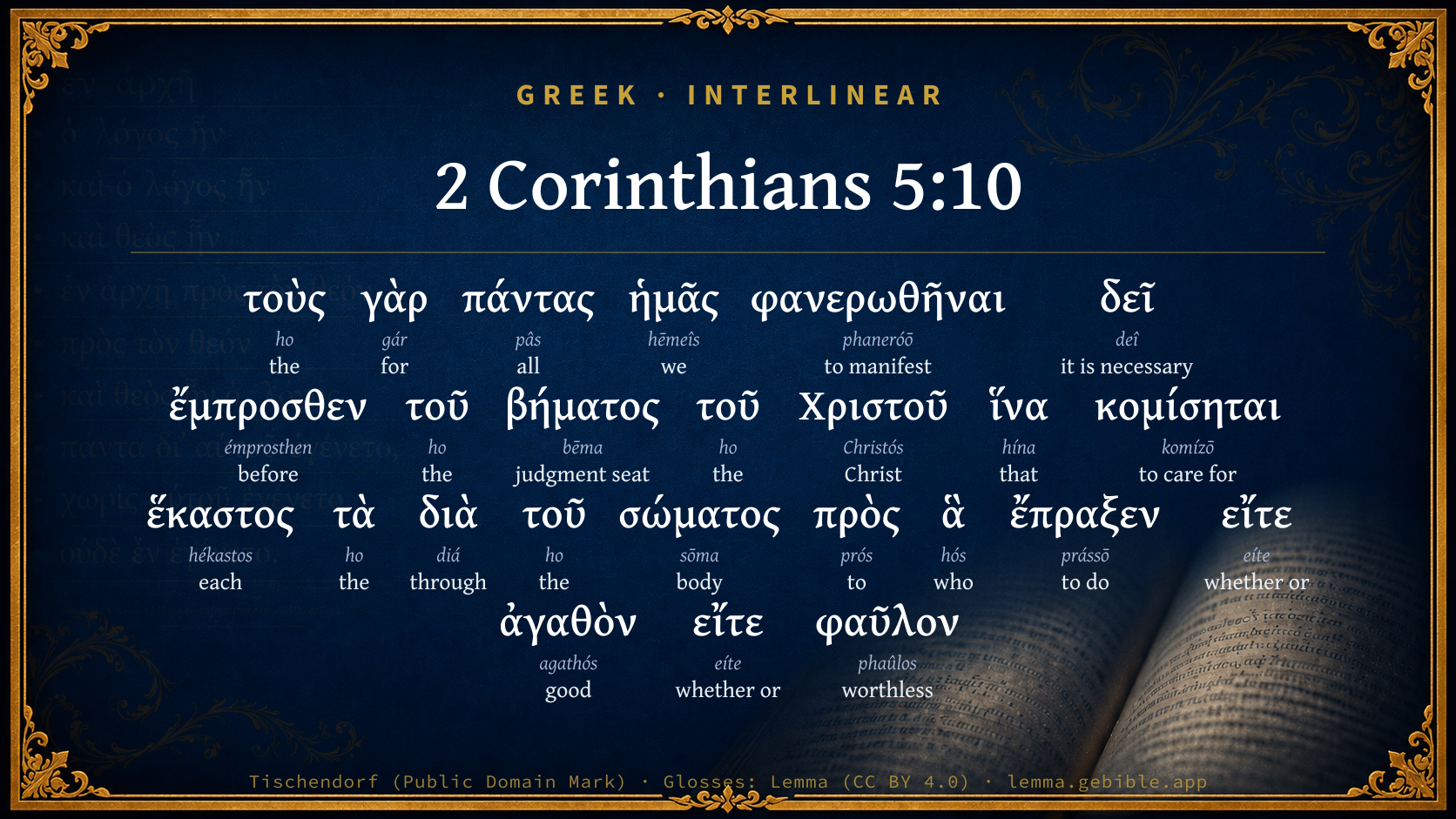
Greek (Tischendorf 8th ed.) 2 Corinthians 5:10 appears in the Greek New Testament. The text above is from the Tischendorf 8th edition. Each word links to its Strong’s number and a concise gloss. Click any word for its full Thayer’s Greek Lexicon entry.
Download image
Cite this verse

2 Corinthians 5:10 (World English Bible). Public Domain. Lemma interlinear Bible study tool, https://lemma.gebible.app/v/2-corinthians/5/10.

Show BibTeX & RIS
BibTeX
RIS
English Translation
For we must all be revealed before the judgment seat of Christ; that each one may receive the things in the body, according to what he has done, whether good or bad.
World English Bible · Public Domain
Download a study sheet

One document with this verse’s original text, its word-by-word gloss line, the meaning frame, cross-references with their text, attributed commentary, and full source and license credits — printable, and it pastes into notes with its structure intact.

This verse Autodidact and up

Study sheet (.html) Plain text (.txt)

A passage Seminary Student

Up to 50 verses in one chapter. A passage sheet keeps up to 6 commentary sources and 12 cross-references per verse, in the order this page ranks them, and says so on the sheet whenever that leaves anything out. Ask for a single verse and you get the Autodidact verse sheet above.

Everything on this page stays free to read, with no account — the sheet is a download of what is already on screen, not access to it.

Want to remove ads? Support Godless Engineer
Compare translations 3

The same verse in 3 English versions, stacked beneath the original-language interlinear above. Click any original word for its lexicon entry.

Each is an independent rendering of the whole verse — the interlinear is not word-aligned to these translations.

Highlighted words mark where these versions differ — a whole-verse word diff, not a word-by-word alignment.

  • World English Bible Public Domain
    For we must all be revealed before the judgment seat of Christ; that each one may receive the things in the body, according to what he has done, whether good or bad.
  • King James Version Public Domain
    For we must all appear before the judgment seat of Christ; that every one may receive the things done in his body, according to that he hath done, whether it be good or bad.
  • unfoldingWord Literal Text CC BY-SA 4.0
    For it is necessary for us all to be revealed before the judgment seat of Christ so that each one may receive back the through the body, with regard to what things he did, whether good or bad.

unfoldingWord Literal Text — © unfoldingWord, licensed CC BY-SA 4.0. Word-aligned USFM3 via Door43 (git.door43.org/unfoldingWord/en_ult).

Versions to compare (up to 4)

3 of 4 selected

Show all 19 translations

Every available English version of this verse, each an independent rendering of the whole verse.

  • World English Bible Public Domain
    For we must all be revealed before the judgment seat of Christ; that each one may receive the things in the body, according to what he has done, whether good or bad.
  • Berean Standard Bible Public Domain
    For we must all appear before the judgment seat of Christ, that each one may receive his due for the things done in the body, whether good or bad.
  • Majority Standard Bible Public Domain
    For we must all appear before the judgment seat of Christ, that each one may receive his due for the things done in the body, whether good or bad.
  • King James Version Public Domain
    For we must all appear before the judgment seat of Christ; that every one may receive the things done in his body, according to that he hath done, whether it be good or bad.
  • American Standard Version (1901) Public Domain
    For we must all be made manifest before the judgment-seat of Christ; that each one may receive the things `done' in the body, according to what he hath done, whether `it be' good or bad.
  • Revised Version (1885) Public Domain
    For we must all be made manifest before the judgment-seat of Christ; that each one may receive the things done in the body, according to what he hath done, whether it be good or bad.
  • Geneva Bible (1599) Public Domain
    For we must all appeare before the iudgement seate of Christ, that euery man may receiue the things which are done in his body, according to that he hath done, whether it be good or euill.
  • Douay-Rheims (1899) Public Domain
    For we must all be manifested before the judgement seat of Christ, that every one may receive the proper things of the body, according as he hath done, whether it be good or evil.
  • Young's Literal Translation Public Domain
    for all of us it behoveth to be manifested before the tribunal of the Christ, that each one may receive the things `done' through the body, in reference to the things that he did, whether good or evil;
  • Literal Standard Version CC BY-SA 4.0
    for it is necessary for all of us to have appeared before the judgment seat of the Christ, that each one may receive the things [done] through the body, in reference to the things that he did, whether good or evil;
  • Unlocked Literal Bible CC BY-SA 4.0
    For we must all appear before the judgment seat of Christ, so that each one may receive what is due for the things done in the body, whether for good or for bad.
  • unfoldingWord Literal Text CC BY-SA 4.0
    For it is necessary for us all to be revealed before the judgment seat of Christ so that each one may receive back the through the body, with regard to what things he did, whether good or bad.
  • Darby Bible Public Domain
    For we must all be manifested before the judgment-seat of the Christ, that each may receive the things [done] in the body, according to those he has done, whether [it be] good or evil.
  • World Messianic Bible Public Domain
    For we must all be revealed before the judgment seat of Messiah that each one may receive the things in the body according to what he has done, whether good or bad.
  • Webster's Bible Public Domain
    For we must all appear before the judgment-seat of Christ; that every one may receive the things done in his body, according to what he hath done, whether good or bad.
  • Free Bible Version CC BY-SA 4.0
    For all of us must appear before Christ's seat of judgment. Each of us will receive what we deserve for what we have done in this life, whether it is good or bad.
  • Bible in Basic English Public Domain
    For we all have to come before Christ to be judged; so that every one of us may get his reward for the things done in the body, good or bad.
  • Text-Critical English NT CC BY 4.0
    For we must all appear before the judgment seat of Christ, so that each of us may receive his due for what he has done in the body, whether good or evil.
  • Tyndale New Testament (1534) Public Domain
    For we must all appere before the iudgement seate of Christ that every man maye receave the workes of his body accordynge to that he hath done whether it be good or bad?

Literal Standard Version (2020), Covenant Press — licensed CC BY-SA 4.0. Text via the HelloAO Bible API (eBible.org). Unlocked Literal Bible (unfoldingWord) — licensed CC BY-SA 4.0. Text via the HelloAO Bible API (eBible.org). unfoldingWord Literal Text — © unfoldingWord, licensed CC BY-SA 4.0. Word-aligned USFM3 via Door43 (git.door43.org/unfoldingWord/en_ult). Free Bible Version, Dr. Jonathan Gallagher — licensed CC BY-SA 4.0. Text via the HelloAO Bible API (eBible.org).

Word by word

More ways to search: Search by grammar → Find every occurrence → Compare this word →

Practice this passage: Drill this verse → Learn its vocabulary →

φαῦλον
phaûlos
G5337
“worthless”
Adjective, Accusative, Singular, Neuter
Part of Speech
Adjective
Case
Accusative
Number
Singular
Gender
Neuter
Full Thayer's Definition

Origin: apparently a primary word

TDNT: None

1. easy, slight, ordinary, mean, worthless, of no account 2. ethically, bad, base, wicked
  1. τοὺς ho G3588 “the” Article, Accusative, Plural, Masculine
  2. γὰρ gár G1063 “for” Conjunction
  3. πάντας pâs G3956 “all” Adjective, Accusative, Plural, Masculine
  4. ἡμᾶς hēmeîs G2249 “we” Personal pronoun, 1st person, Accusative, Plural
  5. φανερωθῆναι phaneróō G5319 “to manifest” Verb, Aorist, Passive, Infinitive
  6. δεῖ deî G1163 “it is necessary” Verb, Present, Active, Indicative, 3rd person, Singular
  7. ἔμπροσθεν émprosthen G1715 “before” Preposition
  8. τοῦ ho G3588 “the” Article, Genitive, Singular, Neuter
  9. βήματος bēma G968 “judgment seat” Noun, Genitive, Singular, Neuter
  10. τοῦ ho G3588 “the” Article, Genitive, Singular, Masculine
  11. Χριστοῦ Christós G5547 “Christ” Noun, Genitive, Singular, Masculine
  12. ἵνα hína G2443 “that” Conjunction
  13. κομίσηται komízō G2865 “to care for” Verb, Aorist, Middle, Subjunctive, 3rd person, Singular
  14. ἕκαστος hékastos G1538 “each” Adjective, Nominative, Singular, Masculine
  15. τὰ ho G3588 “the” Article, Accusative, Plural, Neuter
  16. διὰ diá G1223 “through” Preposition
  17. τοῦ ho G3588 “the” Article, Genitive, Singular, Neuter
  18. σώματος sōma G4983 “body” Noun, Genitive, Singular, Neuter
  19. πρὸς prós G4314 “to” Preposition
  20. ἃ hós G3739 “who” Relative pronoun, Accusative, Plural, Neuter
  21. ἔπραξεν prássō G4238 “to do” Verb, Aorist, Active, Indicative, 3rd person, Singular
  22. εἴτε eíte G1535 “whether or” Conjunction
  23. ἀγαθὸν agathós G18 “good” Adjective, Accusative, Singular, Neuter
  24. εἴτε eíte G1535 “whether or” Conjunction

About this verse

These counts appear in no published source. They are computed here, from the morphology-tagged text and Lemma’s own curated glosses. What Lemma adds →

25
words
20
distinct lemmas
Pauline Epistles
section

Notable vocabulary

The rarest word here is φαῦλον worthless G5337 — appearing just 6 times in the whole Greek New Testament.

Shared distinctive vocabulary

φαῦλον worthless G5337 occurs in 6 verses of the Greek New Testament. Also found in:

Repetition

Words recur within this verse:

  • εἴτε whether or G1535 ×2
  • τοὺς the G3588 ×5

Cross-references

36

Topical passages linked to 2 Corinthians 5:10 in the Treasury of Scripture Knowledge — connected by theme and wording, ordered by reader-vote popularity; previews shown in the World English Bible.

  • Matthew 16:27 For the Son of Man will come in the glory of his Father with his angels, and then he will render to everyone according to his deeds.
  • Revelation 22:12 "Behold, I come quickly. My reward is with me, to repay to each man according to his work.
  • Ecclesiastes 12:14 For God will bring every work into judgment, with every hidden thing, whether it is good, or whether it is evil.
  • Ephesians 6:8 knowing that whatever good thing each one does, he will receive the same again from the Lord, whether he is bound or free.
  • Psalms 62:12 Also to you, Lord, belongs loving kindness, For you reward every man according to his work.
  • Romans 2:5–10 But according to your hardness and unrepentant heart you are treasuring up for yourself wrath in the day of wrath, revelation, and of the righteous judgment of God;
  • 1 Corinthians 4:5 Therefore judge nothing before the time, until the Lord comes, who will both bring to light the hidden things of darkness, and reveal the counsels of the hearts. Then each man will get his praise from God.
  • Psalms 98:9 Let them sing before Yahweh, For he comes to judge the earth. He will judge the world with righteousness, And the peoples with equity.
  • 1 Peter 4:5 who will give account to him who is ready to judge the living and the dead.
  • Romans 14:10–12 But you, why do you judge your brother? Or you again, why do you despise your brother? For we will all stand before the judgment seat of Christ.
  • Jude 1:14–15 About these also Enoch, the seventh from Adam, prophesied, saying, "Behold, the Lord came with ten thousands of his holy ones,
  • Matthew 25:31–46 "But when the Son of Man comes in his glory, and all the holy angels with him, then he will sit on the throne of his glory.
  • Acts 17:31 because he has appointed a day in which he will judge the world in righteousness by the man whom he has ordained; of which he has given assurance to all men, in that he has raised him from the dead."
  • Revelation 20:11–15 I saw a great white throne, and him who sat on it, from whose face the earth and the heaven fled away. There was found no place for them.
  • Acts 10:42 He charged us to preach to the people and to testify that this is he who is appointed by God as the Judge of the living and the dead.
  • Job 34:11 For the work of a man will he render to him, And cause every man to find according to his ways.
  • Psalms 96:10–13 Say among the nations, "Yahweh reigns." The world is also established. It can't be moved. He will judge the peoples with equity.
  • Ecclesiastes 11:9 Rejoice, young man, in your youth, And let your heart cheer you in the days of your youth, And walk in the ways of your heart, And in the sight of your eyes; But know that for all these things God will bring you into judgment.
  • Galatians 6:7–8 Don't be deceived. God is not mocked, for whatever a man sows, that will he also reap.
  • Colossians 3:24–25 knowing that from the Lord you will receive the reward of the inheritance; for you serve the Lord Christ.
  • Revelation 2:23 I will kill her children with Death, and all the assemblies will know that I am he who searches the minds and hearts. I will give to each one of you according to your deeds.
  • Psalms 9:7–8 But Yahweh reigns forever. He has prepared his throne for judgment.
  • Isaiah 3:10–11 Tell the righteous "Good!" For they shall eat the fruit of their deeds.
  • Psalms 50:3–6 Our God comes, and does not keep silent. A fire devours before him. It is very tempestuous around him.
  • Ezekiel 18:30 Therefore I will judge you, house of Israel, everyone according to his ways, says the Lord Yahweh. Return you, and turn yourselves from all your transgressions; so iniquity shall not be your ruin.
  • Romans 12:1–2 Therefore I urge you, brothers, by the mercies of God, to present your bodies a living sacrifice, holy, acceptable to God, which is your spiritual service.
  • Genesis 18:25 Be it far from you to do things like that, to kill the righteous with the wicked, that so the righteous should be as the wicked. May that be far from you. Shouldn't the Judge of all the earth do right?"
  • 1 Kings 8:32 then hear you in heaven, and do, and judge your servants, condemning the wicked, to bring his way on his own head, and justifying the righteous, to give him according to his righteousness.
  • Romans 6:12–13 Therefore don't let sin reign in your mortal body, that you should obey it in its lusts.
  • 1 Kings 8:39 then hear in heaven, your dwelling-place, and forgive, and do, and render to every man according to all his ways, whose heart you know; (for you, even you only, know the hearts of all the children of men;)
  • 1 Samuel 2:10 Those who strive with Yahweh shall be broken to pieces; Against them will he thunder in the sky: Yahweh will judge the ends of the earth; He will give strength to his king, Exalt the horn of his anointed.
  • 1 Corinthians 6:12–20 "All things are lawful for me," but not all things are expedient. "All things are lawful for me," but I will not be brought under the power of anything.
  • 1 Samuel 2:3 Talk no more so exceeding proudly; Don't let arrogance come out of your mouth; For Yahweh is a God of knowledge, By him actions are weighed.
  • Psalms 7:6–8 Arise, Yahweh, in your anger. Lift up yourself against the rage of my adversaries. Awake for me. You have commanded judgment.
  • Romans 6:19 I speak in human terms because of the weakness of your flesh, for as you presented your members as servants to uncleanness and to wickedness upon wickedness, even so now present your members as servants to righteousness for sanctification.
  • 2 Corinthians 7:3 I say this not to condemn you, for I have said before, that you are in our hearts to die together and live together.

Cross-references courtesy of OpenBible.info (CC BY 4.0).

Commentary

Notes on 2 Corinthians 5:10 from classic Christian and Jewish commentators (each source and its license shown beneath its notes). The classic Christian expositions comment on the surrounding passage and are grouped to its opening verse, so a note may address several verses; the Jewish commentaries on the Tanakh (Rashi and others) are per-verse, so they appear only where the commentator wrote on this verse.

Lemma curates 59 commentaries, every one of them public domain or Creative Commons licensed, each selected and text-cleaned for this edition rather than reprinted as found. About our sources →

The Biblical Illustrator

Joseph S. Exell

2Co_5:10

For we must all stand before the Judgment seat of Christ.

The judgment seat of Christ

The image here is the same as that in Rom_14:10, and the expression is peculiar to these two passages, being taken from the tribunal of the Roman magistrate as the most august representation of justice which the world then exhibited. The Berea was a lofty seat raised on an elevated platform, usually at the end of the Basilica, so that the figure of the judge must have been seen towering above the crowd which thronged the long nave of the building. So sacred and solemn did this seat and its platform appear in the eyes not only of the heathen, but of the Christian society of the Roman Empire, that when, two centuries later, the Basilica became the model of the Christian place of worship, the name of Berea (or tribunal) was transferred to the chair of the bishop, and this chair occupied in the apse the place of the judgment seat of the printer. The more usual figure for the Judgment is a throne (Mat_25:31; Rev_20:11; Dan_7:9). (Dean Stanley.)

The judgment seat of Christ

I. The necessity.

1. It must be so, for God hath decreed it, and reason enforceth it. But why? Not to discover anything to God, but--

(1) That grace may be glorified in and by the righteous (1Pe_1:13).

(2) That the wicked may be convinced of their sin and defect.

(3) That Gods justice may be cleared (Psa_51:4; Act_17:31).

2. It shall be so (Joh_5:28).

(1) Reason showeth that it may be, and argueth--

(a) From the nature of God. There is a God; that God is just, and it is agreeable to His justice that it should be well with them that do well, and ill with them that do evil. This does not appear so here; therefore there is a day when it shall be made conspicuous.

(b) From the providence of God. There are many judgments which are pledges of the general judgment, as the drowning of the old World, the burning of Sodom, the destruction of Jerusalem.

(c) From the feelings of conscience. After sin men are troubled, though there be none to call them to an account. Heathens are sensible of such a thing (Rom_1:32). Felix trembled at the mention of it (Act_24:25).

(2) Faith showeth that it shall be--

(a) From that revelation which God hath made in His Word (Mat_13:49-50; Joh_5:28-29; Heb_9:27; Rom_14:12; Mat_12:36-37; Rev_20:12; Jud_1:14).

(b) Christs interest is concerned in it--

(i) That the glory of His person may be seen. His first coming was obscure and without observation.

(ii.) That He may possess what He hath purchased (Heb_2:13).

(iii.) With respect to the wicked. It is part of His office to triumph over them in their final overthrow (Isa_45:23; Rom_14:10-11; Php_2:10).

(iv.) To require an account of things during His absence (Mat_25:1-46.; 1Ti_6:14; 2Th_1:8).

II. The universality. All mankind which ever were, are, and shall be. No age, no sex, no nation, nor dignity, nor power, nor wealth, nor greatness, can excuse us.

III. The judge.

1. How Christ comes to he the worlds judge, and with what agreeableness to reason this honour is put upon Him. To a judge there belong these four things--wisdom, justice, power, and authority.

(1) Wisdom is in Christ twofold--Divine and human. As Christ is God, His wisdom and His understanding are infinite (Heb_4:13). His human wisdom is such as doth far exceed the knowledge of all men and angels. When Christ was upon earth He could know whatever He would (Luk_8:45; Mat_9:3-4; Joh_2:23-25). Now, if Jesus was endowed with such an admirable wisdom even in the days of His flesh, what shall we think of Christ glorified?

(2) As there is a double knowledge in Christ, so there is also a double righteousness, the one that belongs to Him as God, the other as man, and both are exact and immutably perfect. His Divine nature is holiness itself (1Jn_1:5). And His human nature was so sanctified that it was impossible that He could sin in the days of His flesh, much more now glorified in heaven, and there will be use of both in the last judgment.

(3) His power (Mat_24:13).

(4) His authority.

IV. The manner of judging. We must so appear as to be made manifest.

1. To appear; that we must all appear, every individual person. Four things evince that.

(1) The wisdom and justice of the Judge. Such is His wisdom and perspicuity that not one sinner or sin can escape Him (Heb_4:13). It concerneth the Judge of the world to do right, which He cannot do unless all sins and persons be manifest to Him, that He may render to every one according to his deeds.

(2) The power, impartiality, and faithfulness of His ministers (Mat_24:31; Luk_16:22; Mat_13:39-41; Mat_13:49-50). There is a mixture unavoidable of good and bad in the Church, but then a perfect separation by the ministry of angels.

(3) The nature of the business requireth our appearance. Partly, because in a regular judgment no man can be judged in his absence, partly because we cannot appear by a proctor (Rom_14:12). Now we have an Advocate who appeareth for us (Heb_9:24); then the Judge will come to deal with every one in person.

(4) The ends of the judgment require our appearance.

(a) The conviction of the parties judged. God will go upon clear evidence, and they shall have a fair hearing (Mat_22:12; Jud_1:15).

(b) Satisfaction of the world in the righteousness and justice of Gods proceeding. When every person is arraigned and every work is manifest, it cleareth Gods justice in rewarding His own and in punishing the ungodly.

2. To be made manifest. Our persons must not only appear, but our hearts and ways be tried (Luk_12:2). The final doom shall repeal all the judgments of this life, and repair them abundantly; many things that are varnished with a fair gloss and pretence here shall then be found abominable, and many things disguised with an ill appearance to the world shall be found to be of God, approved (1Co_4:5). We shall be manifested--

(1) By the knowledge of the Judge. We may hide our sins from men, but not from God.

(2) The good angels may be produced as witnesses; they have an inspection over this lower world, are conversant about us in all our ways, and are conscious to our conversations (Psa_91:11; Ecc_5:6; Num_22:34; 1Ti_5:21; 1Co_11:10).

(3) Devils may accuse men in that day.

(4) The Word of God will be our accuser (Joh_5:45; Joh_12:48).

(5) The ministers of the gospel (Mat_24:14; cf. Mar_13:9; Mar_6:11; Mat_10:14-15).

(6) Conscience itself shall witness, and God will discover ourselves to ourselves, that we shall see the judgment is just. The books were opened (Rev_20:12), and one of these books is conscience, and though it be in the sinners keeping, yet it cannot be so defaced but our story will be legible enough, and forgotten sins will stare us in the face (Num_32:23).

(7) It will be made evident by the confession of offenders themselves. As their consciences will convince them, so their own tongues will accuse them, as Judas (Mat_27:4; see also Luk_19:12; Rom_2:15; Psa_64:8).

(8) Wicked men shall accuse one another. (T. Manton, D. D.)

The manifestation before the judgment seat of Christ

The language of the text conveys the idea of a manifestation rather than that of a mere presentment.

I. The tribunal of the last day will be the great final revealer of human character. There all deceptions will be at an end, and the inner life will make itself visible to the eyes of the assembled world. Now much of the popular notion of the day of judgment is drawn from the modes of procedure in our courts of law. We read in the Bible of a tribunal and a judge. Accordingly we find it believed that the destiny of the man, as in a human court of justice, remains uncertain and undecided until the sentence upon him is actually pronounced. But this theory will not bear a moments thoughtful consideration. The moment of our death is virtually the moment of the proclamation of our sentence. When the day of grace has closed and the soul and the body are divorced for a time, the spirit passes at once into a place of happiness or a place of woe. The happiness is not complete. The woe is not at the worst. Both are conditions of anticipation. But in both cases the condition is fixed and known. Then comes the day of resurrection. The body suddenly rises, but it rises that body that shall be. If the life which is to be manifested is a life with Christ and in Christ, the material frame will partake of the beauty and splendour of the appearance of the Judge who sits upon the throne. If, on the other hand, the man has not lived for Christ, the inward aversion from God will find expression in his outward appearance. It will be seen at once, beyond possibility of mistake, what the past has been. You drop a seed into the ground, and when you have done so it is an absolutely certain and settled thing what the future of the plant or the tree shall be. The seed-corn never produces a lily. The bulb of the lily never produces an oak. It is just so with ourselves. The great day of judgment determines nothing. It only makes visible and palpable what we really are.

II. In this world a process of self-manifestation is continually going on. The general opinion about a man as to the real tendency of his life is pretty sure to be the correct one. Let him go in and out amongst you, and the popular estimate of him may, generally speaking, be depended upon. You make no doubt, e.g., of the worldliness of certain person who is numbered amongst your acquaintance. But why? The man is respectable enough, a church-goer too, perhaps a communicant. You cannot put your finger upon anything and say it is absolutely faulty. No! But you have been acquainted with him for some time, and all this time he has been unconsciously manifesting himself. Little things have let you into the secret. Tones, glances, remarks, or the absence of remarks, have told you that there is a lack of spiritual life in the man. Now this process of self-manifestation, continually and inevitably going on now in all of us, comes to a culmination in the great day of judgment. What is in us comes out. If we have lived to self, it is known. If we have lived to Christ, it is known.

III. This view throws light on those passages which speak of men as being judged out of a book according to the things written therein. What is the record? I believe it to be the impression made upon the human memory by the various acts and thoughts and feelings of our lives upon earth. We are told with respect to some persons who had been recovered from drowning that, just before the state of unconsciousness came on, every event in their history, everything which they had thought, or said, or done, seemed to rise up again, and to be present to their minds in a moment of time. Wake up the memory as Eternity will wake it! And then the spectres of the past, of past neglect, of past indifference, past practical contempt of God, past rejection of the offers of Christ, come trooping in, and close round his soul, and refuse to depart. Oh, if he could only bathe his perturbed spirit in some Lethe, in some stream of forgetfulness, he might know comfort again! But they will not go. They cannot go. The books have been opened; the man has been manifested. He has seen himself. (G. Calthrop, M. A.)

Christ in judgment

I. The certainty of it. The Scriptures never say that it is something which may take place. Whatever else may fail or prosper, this will not touch the decree that has fixed one day beyond them all--the judgment. There is scarcely one human interest, institution, undertaking, of which we can predict the course for twenty-four hours; but far above all their chances, independent of them all, subject to no chance, no postponement, is the judgment. The whole framework of order in outward nature may be broken to pieces; the catastrophe will only make sure the fulfilment of the whole prophecy, and the inevitable end will be the judgment.

II. The universality of it. We must all appear. Here the individual sometimes escapes notice either by retiring from society, or by being lost in its crowd. There the one kind of concealment will be just as hopeless as the other. There will be room enough for all, and yet the personal soul of each, with its individual character, will stand out as sharply distinguished as if no other soul had ever been related to it, or shared its experience. There will be no excuse taken, and there will be no absence to be excused. Every name will be called--those that have been written in the Book of Life, and the names of those that have heard the gospel year after year, and yet would not turn to take the cross and follow Christ. Obscurity, insignificance, weakness, youth, poverty, ignorance--those natural extenuations that we so often plead for not taking up responsibilities here, will not keep any out there. Station and dignities and wealth will avail nothing to obtain an exemption or a substitution.

III. What is here kept hidden must come to light. We pray every Sunday to Him to whom all hearts are open, and from whom no secrets are hid. In that day this Searcher of our hearts will deal with us. Deception and concealment will have had their crafty way long enough. Masks will fall off. The cunning sagacity that has covered up the lurking passion, or the cool calculation, will lose its self-possession. Whatever wicked thing we hard been at most pains to conceal will be written out as with a pen of fire on our foreheads.

IV. The Judge is the Son of God and the Son of Man. Repeatedly Christ says that His work, while on earth, in His first coming, is not judgment. Here I judge no man. Here He ministers life; will we receive it? There, on His throne, all judgment is committed unto Him, because He is the Son of Man. He knows all mans infirmity, to have compassion; all mans sympathy with evil, to punish. It is not then the time of salvation. The time of salvation is now. (Bp. Huntington.)

On the general judgment

I. The certainty of judgment. Other events may be more or less doubtful. How often are the calamities which we dread, as well as the blessings which we hope for, and regard as almost within our grasp, alike arrested in their course towards us! Every thing, every event in human life is constantly subject to variation, and is deeply Stamped with the characters of uncertainty and change. The colour and features and substance of our lot may be modified, or be totally changed by a thousand precarious contingencies which we cannot provide against. How near were the Jews at one time to destruction! Their doom, both as to its time and its manner, was determined. The orders to kill were already despatched to all the provinces in which they dwelt. Their enemies were gathering themselves together to cut off the whole nation in one day. Haman has his gallows erected for Mordecai. Deliverance seems far off, and ruin unavoidable. The order to destroy the Jews is reversed. How many instances of a similar nature might easily be produced. None of us, in truth, can know the evil or the good that lies before him in life. It is altogether impossible for us to pretend to predict with certainty the issue of affairs, however penetrating our sagacity. But the day of judgment cannot be called a probable occurrence; it is fixed with a certainty over which human events can exercise no control whatever. The word of the Lord cannot be broken; the purposes of His heart never can be changed.

II. The universality of its extent, comprehending the whole human race.

III. We come now to consider the character of our judge. The Father, we are told, judgeth no man, but hath committed all judgment unto the Son. God thus has not only made known to us, in His Word, that Christ shall judge the world, but has also given us an unquestionable proof that He shall do so by His resurrection from the dead. The resurrection of Christ proves this, not only because it establishes the truth of the doctrine which He taught, and the declarations which He uttered, but also because His resurrection itself was the first step of His actual and visible advancement to that mediatorial government of which the solemnities of the general judgment shall form the triumphal close. It is, indeed, true that God is called the Judge of all the earth; and it is said that God shall judge the world in righteousness. But this is in perfect consistency with the usual language of Scripture, in which God is often said to do that Himself which He executes by another. There appears to be a peculiar fitness in Christs discharging the office of Judge of the human race. It was by Christ Jesus that the world was originally made; it was by Him that it was saved; it is by Him that its affairs are at present administered. Is there not a fitness that the same person who had conducted the scheme of mediation should also bring it to a close by openly acquitting His faithful followers? Is there not a fitness in the Judge being of the same nature with those whose conduct He shall try, and whose destiny He shall fix? Is not the triumph over Satan thus rendered more complete, or ai least more conspicuous? (A. Bullock, M. A.)

The certainty of a future judgment

I. There shall be such an appearance after this life as is here spoken of.

1. It is very agreeable to the nature of God. What can be more agreeable to the nature of the most pure and powerful agent than to draw unto itself whatsoever is like itself, as likewise to remove from itself whatsoever is unlike itself?

2. It is very agreeable to the nature of the soul of man, because otherwise the chief agent, both in good and evil, should have little or no reward for the one, and little or no punishment for the other.

3. It is necessary for the manifestation of the Divine justice: for though whatsoever God doth is just, and that because God does it, yet does it not always appear to be so. And hence it is that this general doom is called in Scripture the day of the revelation of the righteous judgment of God.

4. The strange disproportion betwixt actions and events, merits and rewards, mens parts and their fortune here in this life, cloth seem to require that there should be a day of an after-reckoning to rectify this (Ecc_9:2; Ecc_8:14; Ecc_7:15). This argument, from the seeming unequal distribution of things here below, was urged by the elder Pliny and some others to prove the non-existence of a God. And truly if my conclusions concerning the certainty of a judgment to come after this life were not true, this argument of theirs would shrewdly shake the foundation of all our creed, viz., the being of a God. But supposing such a judgment, we do at once vindicate the power, wisdom, justice, and consequently the very being of God from all contradiction.

5. There is an inborn and inbred notion and expectation which all men have by nature, that there will be a judgment. Whatsoever all men agree in is the voice of nature itself, and consequently must be true: for the dictates of nature are stronger than the probers of reason.

II. What manner of thing this judgment or last doom will be.

1. The Judge--Christ.

(1) He must be our judge as He is God--

(a) Because none but God has jurisdiction over all the parties that are to be tried at that judgment.

(b) Because none but omniscience can discern the main and principal things that shall be there called in question.

(c) Because none but God can give life and execution to the sentence pronounced.

(2) But though God only can be our judge, yet nevertheless He must be man likewise; and that--

(a) In regard of the judgment itself, to manifest the impartiality of it.

(b) In regard to the parties triable at that day. For among the just there is none so good but he might fairly be afraid to appear at that judgment if the Judge were not our Saviour. And as for the unjust, their condemnation pronounced by that Judge, who laid down His life to save sinners, and consequently cannot possibly be imagined to condemn any but such as would not be saved by Him.

(c) In regard of humanity itself--for the dignifying of human nature: that as the nature of man was debased to the lowest degree of meanness in the person of our Saviour, so the same nature, in the same person, might be exalted to so high a degree of power, majesty, and honour, that not only men that had despised Him, and devils that had tempted Him, but even the blessed angels themselves, whose comfort He once stood in need of, should fall down and tremble at His presence.

2. The parties to be judged; and those are all persons of all sorts.

3. The matters that shall be questioned; not our actions only, but our words, thoughts, inclinations, and dispositions.

4. The manner of proceeding. There will be no occasion for examination of witnesses, or reading depositions; for every man shall be indicted and cast or acquitted, by the testimony of his own conscience.

5. The sentence (Mat_25:34-41).

Conclusion: Let it be part of our daily business seriously to meditate upon--

1. The vanity and shortness of our lives.

2. The certainty and uncertainty of our deaths.

3. The great exactness and severity of the judgment to come after death.

4. The eternity of every mans condition in the other world, whether it be good or evil. (R. South, D. D.)

Human judgment the earnest of Divine

I. What is it which throws such an atmosphere of awe around human judgment? It is not the outward pageantry nor any accident in the administration of justice, but that justice is an attribute of God; that law is the representative of His majestic justice; that all justice here is an earnest of His Divine justice hereafter. The outward course of justice strikes a chord in an inward conscience. Conscience, of which even the Jews spoke under the title, the Accuser, tells us that we too are amenable to justice--if not to human, to Divine.

II. This thought it awakens alike, whether human justice comes quickly or slowly upon the offender. The rapidity with which human justice comes down, seems like the lightning discharge of Gods displeasure. Yet since this is rare, the slowness of its execution calls forth a yet more awful thought, its dread certainty. Seldom, said even heathen observation, has punishment, with limping tread, parted with the fore-hastening criminal. A class of heathenised writers, who but seldom mention God, are even fond of replacing Him with the old heathen goddess, Nemesis. So deeply inwrought in us is the thought of Gods persevering justice, which, though it seem to tarry, will surely come. Crime punished here impresses on us Gods just judgment on sin; crime which escapes here is an earnest of punishment hereafter.

III. Gods justice, by those universal laws which express the divinely-gifted reason of mankind, speaks further to the conscience by its minuteness. Men often encourage themselves in sin by the thought, It is only this; it is only that! Human law does not leave petty offences unpunished. It imitates herein God, who knows that the truest mercy to the sinner is to arrest him by light punishment (if he will be arrested) in the beginning of his sin. The law of Moses visited very heavily, sins both against the seventh and ninth commandments, which human law is now compelled to leave for the most part to the judgment seat of Christ. Yet mankind has endorsed the thought, that to rob of a good name is a worse sin than to rob of worldly goods; but human law leaves it unchecked, unrebuked. But it will not remain always unpunished, because unpunished now.

IV. Conscience, which doth make cowards of us all, is an involuntary, untaught inspired prophet of judgment to come. By conscience, I mean that eternal law written in our hearts by the finger of God, which unlettered islanders of the Pacific know as the magistrate within; that almost unextinguishable voice, which burned in David like a firebrand, drove Cain, self-condemned, a wanderer on the earth, made itself heard amid the murderers fitfulness of Saul, worked Ahabs passing humility, and Judas unloving but self-accusing remorse. Why does a word bleach a mans cheek, stop his utterance, or, if he have schooled himself to drive back all outward emotion, strike such a pang into his soul? It has awakened the voice of the silenced judge within. Whence, then, this terror? Whence but that conscience is already, in this world, a judgment seat of God? Conscience may be oerclouded, because it is not God; extinguished it cannot be, because it is from God. Judgment to come needs to be nothing new in kind; it needs to be but the intensified concentration of all those acts of judgment which God has passed upon us through ourselves, which He has made us pass upon ourselves. The final judgment is but the summary of all those particular judgments.

V. Here Paul speaks of the day of judgement as a manifestation. Of what? Plainly of what existed before, but was hidden. Here, some glimpse of us only shines through; there, what all and each of us have been is to be brought to open light. Light from Him who is Light shall lighten up all the secret corners of the soul of man, all the hidden springs and motives of his outward acts.

VI. Judgment to come, besides being a divine truth, declared from Job to revelation, is an absolute necessity. Every man is imperfect; every one is tending to a completion, of good or of evil, which here he does not reach. But more, we have each our individual responsibilities. Creation implies an end and object of that creation. We came forth from God; we return to God. God has left us to be masters over ourselves, to work out--with His grace, if we would have it, or, if not, against it--our own destiny, or alas! our own doom. We return, to give account of ourselves, to have our lives summed up, to be judged. (E. B. Pusey, D. D.)

The final assize

I. The statement respecting the future judgment with which the passage before us commences. We must all appear before the judgment seat.

II. To the account which the passage before us gives of the Person who is to sustain the office of Judge. We must all appear before the judgment seat Of Christ.

1. The sustaining of the office of future Judge will not on the part of Christ be an assumption, but a right--a right resting on Divine appointment.

2. But not merely on the ground of right--on the score of qualification Christ will sustain the office of future Judge.

III. To the manner in which the passage before us describes His mode of procedure.

1. That He will elicit every ones real character.

2. That, by His classification of them, He will impartially discriminate between the characters of all. In the worlds society, the good and the bad are so blended together, and in many instances bear so close a resemblance to each other, that the most sagacious human observer is often at a loss to say positively who they are who may be thus designated. But further, and in fine: whilst from the account given of His mode of procedure in the passage before us, it is plain that the future Judge will not only elicit every ones real character, but impartially discriminate between the characters of all, it is also undeniably plain that--

3. He will equitably apportion to all their respective allotment. He will apportion the allotment of those who have never enjoyed the light of revelation. (A. Jack.)

The great assize

1. There is no need to prove from Scripture that there will be a general judgment, for it abounds with proof-passages.

2. We infer that it must needs be, from the very fact that God is just as the Ruler over men. In all human governments there must be an assize held. Judge for yourselves: is this present state the conclusion of all things? If so, what evidence would you adduce of the Divine justice, in the teeth of the fact that the best of men are often the most afflicted, while the worst of men prosper? If there be no hereafter, then Dives has the best of it.

3. There is in the conscience of most men, if not of all, an assent to this fact. As an old Puritan says, God holds a petty session in every mans conscience, which is the earnest of the assize which He will hold by and by; for almost all men judge themselves, and their conscience knows this to be wrong and that to be right.

I. Who are they that will have to appear before the throne of judgment?

1. All. The godly will not be exempted, for the apostle here is speaking to Christians. They covet the judgment, and will be able to stand there to receive a public acquittal from the mouth of the great Judge. Who, among us, wishes to be smuggled into heaven? Who is he that shall lay anything to our charge since Christ hath died and hath risen again? Their trial will show that there has been no partiality in their case. What a day it will be for them! For some of them were lying under wrongful accusations, All will be cleared up then. There will be a resurrection of reputations as well as of bodies.

2. What a prodigious gathering! What will be the thoughts of Father Adam as he looks upon his offspring? But the most important thought to me is that I shall be there; to you, young men, that you will be there; to you, ye aged, that you shall be there. Are you rich? Your dainty dress shall be put off. Are you poor? Your rags shall not exempt you from attendance at that court.

2. Note the word appear. No disguise will be possible. Ye cannot come there dressed in masquerade of profession; off will come your garments. Oh, what a day that will be when every man shall see himself and his fellow, and the eyes of angels, of devils, and of God upon the throne, shall see us through and through!

II. Who will be the judge? That Christ should be is most fitting. British law ordains that a man shall be tried by his peers, which is just. So at the Judgment. Men shall be judged by a man. He can hold the scales of justice evenly, for He has stood in mans place. I expect no favouritism. Christ is our Friend and will be for ever; but, as a Judge, He will be impartial to all. You will have a fair trial. The Judge will not take sides against you. Men have sometimes been shielded from the punishment they deserved here because they were of a certain profession or occupied a certain position. It shall not be so there. There shall be no concealment of anything in thy favour, and no keeping back of anything against thee.

III. What will be the rule of judgment? Not our profession, our boastings, but our actions. This includes every omission as well as every commission (Mat_25:1-46.). All our words, too, will be brought up, and all our thoughts, for these lie at the bottom of our actions and give the true colour to them good or bad. Our motives, our heart sins, shall be published unreservedly. Well, saith one, who then can be saved? Ah! indeed, who? Those who have believed in Jesus (Rom_8:1).

IV. The object of this judgment. That every man may receive the things done in his body.

1. The Lord will grant unto His people an abundant reward for all that they have done. Not that they deserve any reward, but that God first gave them grace to do good works, then took their good works as evidence of a renewed heart, and then gave them a reward for what they had done.

2. But to the ungodly how terrible! They are to receive the things that they have done; that is to say, the punishment due--not every man alike, but the greater sinner the greater doom--Sodom and Gomorrah their place, Tyre and Sidon their places, and then to Capernaum and Bethsaida their place of more intolerable torment, because they had the gospel and rejected it. And the punishment will not only be meted out in proportion to the transgression, but it will be a development of the evil actions done in the evil consequences to be endured, as every man shall eat the fruit of his own ways. Oh, how dreadful it will be for the malicious man to find his malice come home to him, as birds come home to roost; for the lustful man to feel lust burning in every vein, which he can never gratify, etc., etc. (C. H. Spurgeon.)

Judged by our acts

All things are engaged in writing their history. The planet, the pebble goes attended by its shadow. The rolling rock leaves its scratches on the mountain. The river its channel in the soil, the animal its bones in the stratum, the fern and leaf their modest epitaph in the coal. The falling drop makes its sculpture in the sand or stone. Not a foot steps into the snow, or along the ground, but prints, in characters more or less lasting, a map of its march. Every act of man leaves its mark, and hereafter our life will be judged by these marks. (S. S. Chronicle.)

The Biblical Illustrator, edited by Joseph S. Exell (c. 1880s–1900s) — public domain. Text from a community e-Sword module.

Bengel's Gnomon

Johann Albrecht Bengel

2Co 5:10. Τοὺς γὰρ πάντας, for all) when treating of death, the resurrection, and eternal life, he also thinks appropriately, of the judgment. The motive is herein assigned for that holy ambition.—πάντας ἡμᾶς, that we all) even apostles, whether abiding as pilgrims here or departing.—φανερωθῆναι) not only to appear in the body, but to be made manifest along with [as well as] all our secrets, 1Co 4:5. Even the sins of believers, which have been long ago pardoned will then be laid open; for many of their good deeds, their repentance, their revenge directed against their sin, in order to be made known to the world, require the revelation of their sins. If a man has pardoned his brother an offence, the offence will also be exhibited, etc. But that will be done to them, with their will, without shame and grief; for they will be different from what they were. That revelation will be made indirectly, with a view to their greater praise [credit, honour]. Let us consider this subject more deeply.

§ 1. The words of sacred scripture respecting the remission of sins are extremely significant. Sins are covered: they will not be found: they are cast behind: sunk in the sea: scattered as a cloud and as mist: without being remembered. Therefore not even an atom of sin will cleave to any, who shall stand on the right hand in the judgment.

§ 2. On the other hand, the expressions concerning all the works of all men, which are to be brought forward in the judgment, are universal, Ecc 12:14; Rom 14:10; 1Co 3:13, etc., 2Co 4:5.

§ 3. The passage 2Co 5:10 is consistent with these, where the apostle from the manifestation of all, whether of those going home or of those remaining as pilgrims, before the tribunal of Christ, infers the TERROR of the Lord and of the Judge, 2Co 5:11-12, and declares that terror to be the occasion of anxiety not only to the reprobate, but also to himself and to those like himself. Such fear would have no existence in the case of the saints if the opinion as to their sins not being about to be revealed were assumed to be true. Furthermore Paul says, that he, and such as he, would be manifested not only so far as they have acted well on the whole, but also so far as they have failed in any particular. There is wonderful variety of rewards among those, who are saved; and demerits [of saints] have effect, though not indeed in relation to punishment [which the saints wholly escape] but to loss, as opposed to reward, 1Co 3:14-15: comp. 2Co 1:14; Php 2:16; Php 4:1. That phrase, that every one may receive, etc., shows, that the deficiencies in the case of the righteous will be also manifested. For thus and thus only will it be manifested, why each man receives neither more nor less than the reward, which he actually receives. The Lord will render to every one, AS his work shall be.

§ 4. Wherefore we ought not to press too far the words quoted in § 1. The sins of the elect, which are past, will not cease to be the objects of the Divine Omniscience for ever, although without any offence and upbraiding. And this one consideration is of more importance, than the manifestation of their sins before all creatures, though it were to continue for ever, much less as it is, in the day of judgment alone, when their sins will appear not as committed, but as retracted and blotted out in consequence of repentance.

§ 5. In the case of the elect themselves, their own sins will not cease to be the object of their remembrance, although without any uneasiness attending it. He, to whom much has been forgiven, loves much. The everlasting remembrance of a great debt, which has been forgiven, will be the fuel of the strongest love.

§ 6. So great is the efficacy of the Divine word with men in this life, that it separates the soul from the Spirit, Heb 4:12, and lays bare the secrets of the heart, 1Co 14:25. Shame for what has been committed and remitted belongs to the soul, not the spirit. Men wallowing in gross sins often throw out their secrets; in despair they conceal nothing. But grace, much more powerful, renders those, who have received it, quite ingenuous. Men truly penitent proceed with the utmost readiness to the most open confessions of their secret wickedness, Act 19:18. How much more in that day will they bear, that they be manifested, when the tenderness of the natural affections is entirely swallowed up? Comp. 1Co 6:9; 1Co 6:11. Such candour confers great peace and praise. If in the judgment there were room in the minds of the righteous, for example, for shame, I believe that those sins, which are now most covered, would cause less uneasiness, than those, of which they are less ashamed at the present time. We are most ashamed at present of the sins, which are contrary to modesty. But it is right, that we should be more ashamed of other sins, for example against the first table.

§ 7. That Adam was saved, we have no doubt, but his fall will be remembered for ever; for otherwise I do not understand, how the restitution made by Christ can be worthily celebrated in heaven. The conduct of David in the case of Uriah, the denial of Peter, the persecution of Saul, the sins of others, though they have been forgiven, have yet continued on record for so long a time in the Old and New Testament. If this fact presents no obstacle to the forgiveness long ago granted, the mention of sins will be no obstacle to their forgiveness even in the last judgment. It is not every manifestation of offences, which constitutes a part of punishment.

§ 8. Good and evil have so close a connection, as well as so inseparable a relation to each other, that the revelation of the good cannot be understood without the evil. But since certain sins of the saints shall be laid bare, it is fitting, that all the circumstances [all things] should be brought to light. This view tends to the glory of the Divine Omniscience and mercy; and in such a way as this the reasons for pronouncing a mild judgment on some, and a severe judgment on others, along with the accurate adjustment, ἀκριβείᾳ, of the retribution, will shine forth in all their brightness.

§ 9. I do not say, that all the sins of all the blessed will be actually and distinctly seen by all the creatures. Perhaps the accursed will not know them; the righteous will have no cause to fear each other. Their sins, when the light of that great day discloses all things, will not be directly manifested, as is done in the case of the guilty, who are punished, whence in Matthew 25 no mention is made of them, but indirectly, so far as it will be proper; just as in a court of justice among men, it often occurs, that many things are wont to enter into the full view [aspect] of the deed incidentally. And in some such way as this also the good works of the reprobate will be made manifest. All things may be known in the light, but all do not know all things.

§ 10. This consideration ought to inspire us with fear for the future; for it had this effect on the apostles, as this passage 2 Corinthians 5 shows. But if more tender souls shrink back from that manifestation, on account of their sins past; when they have been duly instructed from what has been said, especially at § 6, they will acquiesce [acquire confidence in regard to the manifestation of all sins in the judgment]. Often does truth, which at first appeared bitter, become sweet after closer consideration. If I love any one as myself, he may, with my full acquiescence, know all things concerning me, which I know concerning myself. We shall judge of many things differently, we shall feel differently on many subjects, until we arrive at that point.

Κομίσηται, may receive) This word is used not only regarding the reward or punishment, but also regarding the action, which the reward or punishment follows, Eph 6:8; Col 3:25; Gal 6:7.—ἕκαστος, every one) separately.—τὰ διὰ τοῦ σώματος) Man [along] with his body acts well or ill; [therefore also] man [along] with his body receives the reward; comp. Tertull. de resurr. carnis, c. 43. τὰ—πρὸς ἃ, those inmost thoughts, according to which he performed outward actions. διὰ τοῦ σώματος, while he was in the body, 2Co 5:6; 2Co 5:8 – 2Co 4:10, comp. διὰ Rom 2:27.—εἴτε ἀγαθὸν εἴτε κακὸν, whether good or bad) construed with hath done. No man can do both good and evil at the same time.

Bengel's Gnomon of the New Testament — English translation (T&T Clark, Edinburgh, 1860) — public domain. Text from a community e-Sword module.

Meyer's Critical & Exegetical Commentary

Heinrich August Wilhelm Meyer

2Co_5:10. Objective motive of this strivin.

τοὺς γὰρ πάντας ἡμᾶς] no one excepted. It applies to all Christians; comp. Rom_14:10.

δεῖ] a divine appointment, which is not to be evade.

φανερωθῆναι] This does not imply the concealment hitherto of the dead (de Wette), for the living also are judged, but means: manifestos fieri cum occultis nostris (Bengel, comp. Beza). Comp. 1Co_4:5; Rom_2:16. Thus it is distinguished from the mere παραστῆναι, 2Co_4:14, Rom_14:10, for which Grotius takes it; and it is arbitrary to declare this distinction unnecessary (Rückert), since that conception corresponds alike with the word (comp. 2Co_5:11) and the fact. Comp. Chrysostom and Theodore.

κομίσηται] Moral actions are, according to the idea of adequate requital, conceived as something deposited, which at the last judgment is carried away, received, and taken with us, namely, in the equivalent reward and punishment. Comp. Eph_6:8; Col_3:25; Gal_6:7; Mat_6:20; Rev_14:13.

τὰ διὰ τοῦ σώματος] sc. ὄντα, that which is brought about through the body, that which has been done by means of the activity of the bodily life (τὸ σῶμα as organic instrument of the Ego in its moral activity generally; hence not: τῆς σαρκός). Comp., on διὰ τοῦ σώματος, expressions like τῶν ἡδονῶν αἱ διὰ τοῦ σώματός εἰσιν, Plat. Phaed. p. 65 A; αἰσθήσεις αἱ διὰ τοῦ σώματος, Phaedr. p. 250 D, al.; Kühner, ad Xen. Mem. iv. 5. 3.[220] Instead of Luthers: in the life of the body (so also de Wette and many others), through the life of the body would be better. There is no reason for taking the διά merely of the state (2Co_3:11). The thought of the resurrection-body, with which the recompense is to be received (to which view Osiander, following the Fathers and some older commentators, is inclined), is alien to the context (2Co_5:6; 2Co_5:8-9); besides, merely διὰ τοῦ σώμ. would be used without τά.

The πρὸς ἃ ἔπραξεν contains the standard of righteousness, in accordance with which every one κομίσεται τὰ διὰ τοῦ σώματος: corresponding to what he has done.

εἴτε ἀγαθὸν, εἴτε κακόν] sc. ἔπραξε. The recompense of the wicked may take place as well by the assigning of a lower degree of the Messianic salvation (1Co_3:15; 2Co_9:6) as by exclusion from the Messianic kingdom (1Co_6:9 f.; Gal_5:21; Eph_5:5).

[220] The reading τὰ ἴδια τοῦ σώματος (Arm. Vulg. It. Goth. Or. twice, and many Fathers), which Grotius and Mill approved, is to be regarded as a gloss, in which τὰ διά was meant to be defined more precisely by τὰ ἴδια. In the Pelagian controversy the ἴδια acquired importance for combating the doctrine of original sin, because children could not have done any ἴδια peccata, and hence could not be liable to judgment. On the other hand, Augustine, Ep. 107, laid stress on the imputation of Adams sin, according to which it was the moral property even of children.

REMARK.

Our passage does not, as Flatt thought, refer to a special judgment which awaits every man immediately after death (a conception quite foreign to the apostle), but to the last judgment conceived as near; and it results from it that, according to Paul, the atonement made through the death of Jesus, in virtue of which the pre-Christian guilt of those who had become believers was blotted out, does not do away with the requital of the moral relation established in the Christian state. Comp. Rom_14:10; Rom_14:12; 1Co_4:5. They come in reality not simply before the judgment (to receive their graduated reward of grace, as Osiander thinks), but into the judgment; in Joh_3:18, the last judgment is not spoken of, and as to 1Co_6:2 f., see on that passage. Paul, however, does not thereby say that, if the Christian has fallen and turns back again to faith, the atonement through Christ does not benefit him; on the contrary, the μετάνοια of the Christian is a repetition of his passing over to faith, and the effect of the atonement (of the ἱλαστήριον) is repeated, or rather continues for the Christian individual, so that even the Christian sins are blotted out, when one returns from the life of sin into that of faith. But the immoral conduct of Christians, continuing without this μετάνοια, is liable to the punishment of the judgment, because they in such an event have frustrated as to themselves the aim of the plan of redemption. Comp. Weiss, bibl. Theol. p. 379. This in opposition to Rückerts opinion, that Paul knows nothing of a continuing effect of the merit of Christ. This continuing effect is implied not only in the general Pauline doctrine that eternal life is Gods gift of grace (Rom_6:23), and in the idea of Christs intercession (Rom_8:34; comp. Heb_7:25; Heb_9:24; 1Jn_2:1-2), but also in passages like 2Co_7:10, compared with Rom_5:9-10; Rom_5:17. We may add the apt remark of Lücke on 1 John, p 147: As a single past and concluded fact, it (Christs atoning work) would be just a mere symbol; it has full truth only in its continuing efficacy.

Meyer — Critical and Exegetical Commentary on the New Testament — English translation by Peter Christie, edited by Frederick Crombie (T&T Clark, 1880) — public domain. Text from a community e-Sword module.

Expositor's Greek Testament

ed. W. Robertson Nicoll

2Co 5:10 . τοὺς γὰρ πάντας κ . τ . λ .: for (explanatory of the reason of our desire to be “well-pleasing” to Him) we all ( τοὺς πάντας is emphatic, not only Paul who has been speaking of himself as ἡμεῖς , but “all of us” quick as well as dead ) must be made manifest . The A.V. “appear” weakens the force of the word; the Day of Judgment is to be a day when men’s characters shall be made patent to the world, and to themselves, as they have always been to God; cf. Mar 4:22 , Rom 2:16 ; Rom 14:10 , 1Co 4:5 , Rev 20:12 . ἔμπροσθεν τοῦ βήμ κ . τ . λ .: before the judgment-seat of Christ . In the N.T. (see reff.) βῆμα is always used (except in the quotation Act 7:5 ) of the official seat of a judge, although twice in the LXX (Neh 8:4 , 2Ma 13:26 ), as generally in classical Greek, it stands for the pulpit from which a formal speech is made. ἵνα κομίσηται ἕκαστος κ . τ . λ .: that each one may receive, i.e. , obtain the wages of (see reff.), the things done through the medium of the body ( cf. Plato’s phrase αἰσθήσεις αἱ διὰ τοῦ σώματος , cited by Meyer; there is no need to identify διὰ τοῦ σώματος with ἐν τῷ σώματι of 2Co 5:6 as the A.V. and R.V. do) according to what he did, sc. , in this present life (note the aorist and cf. Luk 12:47 ), whether it be good or bad ( cf. , for this constr. of εἴτε … εἴτε , Eph 6:8 , Phi 1:18 ). Similar expressions are used of a future judgment, at, e.g. , Ps. 61:13, Pro 24:12 , Jer 17:10 ; Jer 32:19 ( cf. Job 34:11 ?) in the O.T., and in the N.T. at Rom 2:6 ; Rom 14:12 , 1Pe 1:17 , in all of which passages the power of judgment is ascribed to the Eternal Father. But He “hath given all judgment unto the Son” (Joh 5:22 ), and thus Christ is repeatedly spoken of as the future Judge of men, e.g. , Mat 16:27 , Act 17:31 , Rev 2:23 ; Rev 22:12 , and esp. Mat 25:31-46 . Cf. Luk 21:36 , σταθῆναι ἔμπροσθεν τοῦ υἱοῦ τοῦ ἀνθρώπου . And so (from the present verse) the variant Χριστοῦ has crept into the parallel passage, Rom 14:10 , πάντες γὰρ παραστησόμεθα τῷ f1βήματι τοῦ Θεοῦ . A reference to the O.T. parallels makes it tolerably plain that the statement that men will be judged according to their works is a broad and general one, and that to find a difficulty, as the Fathers did, in the case of the death of infants (whether baptised or unbaptised), who are incapable of self-conscious and voluntary actions, is quite perverse.

The Expositor's Greek Testament, edited by W. Robertson Nicoll (1897–1910) — public domain. Text from a community e-Sword module.

Cambridge Greek Testament for Schools and Colleges

10. It is not easy to accept φαῦλον (אC and some cursives) as more probable than κακόν (BDFGKLP). Fathers and editors are divided. In Rom 9:11 the balance of evidence is clearly for φαῦλον.

10. τοὺς γὰρ πάντας ἡμᾶς. First with great emphasis: For all (1Co 10:17) of us must be made manifest (1Co 4:5) before the judgment seat of Christ. This is a reason for aiming at Christ’s approval; every Christian, whether Apostle or not, whether in the body or out of it at the time of His Advent, will, by Divine decree (δεῖ), have to come before Him for approbation or condemnation, there to be made manifest (2Co 3:3) by having his real character disclosed (Joh 3:21; Eph 5:13; Col 3:4; Rev 3:18; Rev 15:4). φανερωθῆναι is stronger than ‘appear’ (A.V.), which is φαίνεσθαι.

ἔμπροσθεν τοῦ βήματος. Comp. Rom 14:10. The word is used of earthly judgment-seats Mat 27:19; Joh 19:13; and often in Acts. In the LXX. it is a ‘pulpit’ or ‘platform,’ rather than a ‘judgment seat’ (1Es 9:42; Neh 8:4; 2Ma 13:26), or a ‘footstep, walk’ (Deu 2:5; Sir 19:30; Sir 45:9).

τοῦ βήματος τοῦ χριστοῦ. See also Polycarp 6. In Rom 14:10 we have τῷ βήματι τοῦ θεοῦ. “It is important to notice how easily St Paul passes from Χριστός to θεός. The Father and the Son were in his mind so united in function that they may often be interchanged. God, or Christ, or God through Christ, will judge the world. Our life is in God, or in Christ, or with Christ in God” (Sanday and Headlam ad loc.).

ἵνα κομίσηται ἕκαστος. That each one may receive. The treatment will be individual, soul by soul. From implying that what is received is one’s own or one’s due (Tob 7:12-13; 2Ma 7:11) κομίζομαι easily acquires the sense of ‘am requited for’ (Col 3:25; Eph 6:8; Lev 20:17). It is used of receiving wages and reaping a reward (2Pe 2:13; 2Ma 8:33).

τὰ διὰ τοῦ σώματος. The things (done) by means of the body as an instrument, and therefore while the agent ἐνδημεῖ ἐν τῷ σώματι. In Plato we have such expressions as ἡδοναί, or αἰσθήσεις, αἱ διὰ τοῦ σώματος.

πρὸς ἃ ἔπραξεν, εἰτε ἀγαθὸν εἴτε φαῦλον. See critical note. It is of course more probable that κακόν should have been substituted for the less common φαῦλον, than that φαῦλον should have been substituted for κακόν. But φαῦλον is so common of moral evil (Aristotle passim), that a copyist might have thought it more appropriate here than the vaguer κακόν (see on 2Co 13:7). Therefore the alteration of κακόν into φαῦλον is not impossible. For this use of πρὸς comp. Luk 12:47; Gal 2:14: according to the things which he did while in the body, whether he did good or did bad. The neuter singular sums up the single acts (τὰ διὰ τ. σ.) as one result. There are gradations of recompense (2Co 9:6); but nothing is said here either for or against the doctrine of a probation after death. There is silence as to the possibility of such probation. The Apostle says that all Christians will have to answer, each by himself, for what has been done by them in this life. The natural, but not necessary, implication is, that there will be no other period in which either reward or punishment can be earned. Nor is there anything to show whether S. Paul thought of the judgment of each person as taking place when he left this world, or as being deferred till Christ’s Return to judge all who are still in the body.

2Co 5:11 to 2Co 6:10. THE LIFE OF AN APOSTLE

It is not easy to find a suitable heading for this section, which, although consecutive, touches on a variety of topics connected with the office of an Apostle and with S. Paul’s own life and experiences. But there is a marked transition from the Sufferings and Supports of an Apostle (2Co 4:7 to 2Co 5:10) to matters which do not fall under that head. He once more makes personal explanations as to his conduct, and in particular as to his work in the capacity of a preacher (2Co 5:11-19), of an ambassador (2Co 5:20-21), and of a minister (2Co 6:1-10). All this has been of a character which ought to commend him to those among whom he has worked.

Cambridge Greek Testament for Schools and Colleges (Cambridge University Press, 1896; 21 vols, various authors incl. Carr, Maclear, Plummer, Farrar, Lumby, Moule, M. R. James, Simcox) — public domain. Text from a community e-Sword module.

Geneva Bible (1599)

Geneva Bible translators

We must all appear personally, and inquiry shall be made of us, that all may see, how we have lived.

That no man might think it to pertain to all, which he spoke of that heavenly glory, he addeth, that every one shall first render an account of his pilgrimage, after that he is departed from hence.

Geneva Bible (1599) marginal notes — public domain. Text via Bolls.life.

Jamieson, Fausset & Brown

Robert Jamieson, A. R. Fausset & David Brown

appear--rather, "be made manifest," namely, in our true character. So "appear," Greek, "be manifested" (Col 3:4; compare Co1 4:5). We are at all times, even now, manifest to God; then we shall be so to the assembled intelligent universe and to ourselves: for the judgment shall be not only in order to assign the everlasting portion to each, but to vindicate God's righteousness, so that it shall be manifest to all His creatures, and even to the conscience of the sinner himself.

receive--His reward of grace proportioned to "the things done," &c. (Co2 9:6-9; Jo2 1:8). Though salvation be of grace purely, independent of works, the saved may have a greater or less reward, according as he lives to, and labors for, Christ more or less. Hence there is scope for the holy "ambition" (see on Co2 5:9; Heb 6:10). This verse guards against the Corinthians supposing that all share in the house "from heaven" (Co2 5:1-2). There shall be a searching judgment which shall sever the bad from the good, according to their respective,deeds, the motive of the deeds being taken into account, not the mere external act; faith and love to God are the sole motives recognized by God as sound and good (Mat 12:36-37; Mat 25:35-45),

done in his body--The Greek may be, "by the instrumentality of the body"; but English Version is legitimate (compare Greek, Rom 2:27). Justice requires that substantially the same body which has been the instrument of the unbelievers' sin, should be the object of punishment. A proof of the essential identity of the natural and the resurrection body.

Jamieson, Fausset & Brown — Commentary Critical and Explanatory on the Whole Bible (1871) — public domain (CC PDM 1.0). Text via the HelloAO Bible API.

Adam Clarke's Commentary

Verse 10. For we must all appear before the judgment seat] We labour to walk so as to please him, because we know that we shall have to give a solemn account of ourselves before the judgment seat of Christ; where he, whose religion we profess, will judge us according to its precepts, and according to the light and grace which it affords.

That every one may receive the things] κομισηται εκαστος. That each may receive to himself, into his own hand, his own reward and his own wages.

The things done in his body] That is, while he was in this lower state; for in this sense the term body is taken often in this epistle. We may observe also that the soul is the grand agent, the body is but its instrument. And it shall receive according to what it has done in the body.

Adam Clarke's Commentary on the Bible (1810–1826) — public domain. Text from a community e-Sword/MySword module.

John Calvin's Commentaries

10. We must be manifested. Though this is common to all, yet all without distinction do not raise their views in such a way as to consider every moment, that they must appear before the judgment-seat of Christ. But while Paul, from a holy desire of acting aright, constantly sisted himself before the bar of Christ, he had it in view to reprove indirectly those ambitious teachers, who reckoned it enough to have the plaudits of their fellow-men. For when he says, that no one can escape, he seems in a manner to summon them to that heavenly tribunal. Farther, though the word translated to be manifested might be rendered to appear, yet Paul had, in my opinion, something farther in view — that we shall then come forth to the light, while for the present many are concealed, as it were, in the darkness. For then the books, which are now shut, will be opened. (Daniel 7:10.)

That every one may give account. As the passage relates to the recompensing of deeds, we must notice briefly, that, as evil deeds are punished by God, so also good deeds are rewarded, but for a different reason; for evil deeds are requited with the punishment that they deserve, but God in rewarding good deeds does not look to merit or worthiness. For no work is so full and complete in all its parts as to be deservedly well-pleasing to him, and farther, there is no one whose works are in themselves well-pleasing to God, unless he render satisfaction to the whole law. Now no one is found to be thus perfect. Hence the only resource is in his accepting us through unmerited goodness, and justifying us, by not imputing to us our sins. After he has received us into favor, he receives our works also by a gracious acceptance. It is on this that the reward hinges. There is, therefore, no inconsistency in saying, that he rewards good works, provided we understand that mankind, nevertheless, obtain eternal life gratuitously. On this point I have expressed myself more fully in the preceding Epistle, and my Institutes will furnish a full discussion of it. When he says in the body, I understand him to mean, not merely outward actions, but all the deeds that are done in this corporeal life.

John Calvin's Commentaries (1540-1563) — public domain. Text from the Calvin Translation Society English edition (1840s-50s) via the Christian Classics Ethereal Library (ccel.org). Calvin's coverage is partial (roughly two-thirds of the Bible); uncommented books and verses are honest gaps, never fabricated. The 19th-century editor's footnotes and remarks are omitted so the notes are faithfully Calvin's own voice.

Ellicott's Commentary for English Readers

(10) For we must all appear.—Better, must all be made manifest. The word is the same as that in 1Co_4:5 (“shall make manifest the counsels of the heart”), and is obviously used with reference to it. It may be noted that it is specially characteristic of this Epistle, in which it occurs nine times. The English version, which can only be ascribed to the unintelligent desire of the translators to vary for the sake of variation, besides being weak in itself, hinders the reader from seeing the reference to 1Co_4:5, or even the connection with the “made manifest” in the next verse.

Before the judgment seat of Christ.—The Greek word shows the influence of Roman associations. In the Gospels the imagery of the last judgment is that of a king sitting on his throne (Mat_25:31), and the word is the ever-recurring note of the Apocalypse, in which it occurs forty-nine times. Here the judgment-seat, or bema, is the tribunal of the Roman magistrate, raised high above the level of the basilica, or hall, at the end of which it stood. (Comp. Mat_27:19; Act_12:21; Act_18:12.) The word was transferred, when basilicas were turned into churches, to the throne of the bishop, and in classical Greek had been used, not for the judge’s seat, but for the orator’s pulpit.

That every one may receive the things done in his body.—It would have seemed almost impossible, but for the perverse ingenuity of the system-builders of theology, to evade the force of this unqualified assertion of the working of the universal law of retribution. No formula of justification by faith, or imputed righteousness, or pardon sealed in the blood of Christ, or priestly absolution, is permitted by St. Paul to mingle with his expectations of that great day, as revealing the secrets of men’s hearts, awarding to each man according to his works. “Whatsoever a man soweth, that shall he also reap” (Gal_6:7) was to him an eternal, unchanging law. The revelation of all that had been secret, for good or evil; the perfectly equitable measurement of each element of good or evil; the apportionment to each of that which, according to this measurement, each one deserves for the good and evil which he has done: that is the sum and substance of St. Paul’s eschatology here and in 1Co_4:5. At times his language seems to point to a yet fuller manifestation of the divine mercy as following on that of the divine righteousness, as in Rom_5:17-18; Rom_11:32. At times, again, he speaks as if sins were washed away by baptism (1Co_6:11), or forgiven freely through faith in the atoning blood (Rom_3:25; Eph_2:13); as though the judgment of the great day was anticipated for all who are in Christ by the absence of an accuser able to sustain his charge (Rom_8:3), by the certainty of a sentence of acquittal (Rom_8:1). If we ask how we can reconcile these seeming inconsistencies, the answer is, that we are not wise in attempting to reconcile them by any logical formula or ingenious system. Here, as in other truths of the spiritual life—God’s foreknowledge and man’s free-will, God’s election and man’s power to frustrate it, God’s absolute goodness and the permission of pain and evil—the highest truth is presented to us in phases that seem to issue in contradictory conclusions, and we must be content to accept that result as following from the necessary limitations of human knowledge.

A Bible Commentary for English Readers, edited by Charles John Ellicott (1878–1897) — public domain. Text from a community e-Sword module.

The Cambridge Bible for Schools and Colleges

gen. ed. J. J. S. Perowne

10. For we must all appear] Literally, be manifested, the same Greek word being used as in the next verse. A reason for what goes before. It is natural to try and please God when present with Him. But even when absent, Christians do not forget that He will judge them.

before the judgment seat of Christ] Cf. Mat_25:31-46; Rom_14:10. Observe that ‘God’ is the word used in the latter passage, as though “the two ideas were convertible.” Stanley. The βῆμα, or ‘judgment seat’ (trone, Wiclif), is in Classical Greek the pulpit from which the orators addressed the assemblies. In the N. T. it is used of the judge’s seat, which in the Roman basilica or judgment hall was “a lofty seat, raised on an elevated platform, so that the figure of the judge must have been seen towering above the crowd which thronged the long nave of the building.” Stanley. This, he adds, was “the most august representation of justice which the world at that time, or perhaps ever, exhibited.”

the things done in his body) Literally, through the body. Wiclif’s translation is more literal, ‘the propre thingis of the bodi, as he hath don.’ This is the reason why Christians are to strive during the present life to be pleasing to God. Their wages in the next world shall be according to their acts in this. Cf. Rom_2:5-10; 1Th_4:6; Judges 14, 15.

The Cambridge Bible for Schools and Colleges (gen. ed. J. J. S. Perowne; Cambridge University Press, 1878–1918) — public domain. Text from a community e-Sword module.

John Gill's Exposition

Knowing therefore the terror of the Lord,.... Or the fear of the Lord; by which is meant either the grace of the fear of the Lord, implanted in the hearts of the apostles, and in which they acted in their ministry, faithfully dispensing to men the mysteries of grace; from which they could by no means be moved, because the fear of God was before their eyes, and upon their hearts; or rather the terror of the Lord in the last judgment, which will be very great, considering the awfulness of the summons, arise ye dead, and come to judgment; the appearance of the Judge, which will be sudden, surprising, and glorious; the placing of the thrones, the opening of the books, the position of the wicked, the dreadful sentence pronounced on them, and the immediate execution of it; all which the ministers of the word know from the Scriptures of truth; they know the Judge, that there will be a general judgment, and that the day is fixed for it, though they know not the exact time: and therefore

persuade men; not that their state is good because of a little outside morality, nor to make their peace with God, or get an interest in Christ, or to convert themselves, neither of which are in the power of men to do; but they endeavour to persuade them by the best arguments they are masters of, taken from the word of God, and their own experience, that they are in a dangerous state and condition, walking in a way that leads to destruction; that they are liable to the curses of the law, the wrath of God, and everlasting ruin; that present duties of religion will not make amends for past sins, nor can their tears atone for their crimes, or any works of righteousness done by them justify them before God; and that salvation is only by Christ, who is both able and willing to save the chief of sinners: and they endeavour to persuade and encourage poor sensible sinners to venture on Christ, and believe in him to the saving of their souls. So the Arabic version reads it, "we persuade men to believe"; though when they have done all they can, these persuasions of theirs are ineffectual, without the powerful and efficacious grace of the Spirit of God; however, in so doing they discharge a good conscience, and act the faithful part to God and men:

but we are made manifest unto God; who searches the heart, and tries the reins, who knows all actions, and the secret springs of them; to him the sincerity of our hearts, and the integrity of our conduct, are fully manifest; we can appeal to him that it is his glory, and the good of souls, we have in view in all our ministrations:

and I trust also are made manifest in your consciences; that you also can bear witness to our faithfulness and honesty, to the unwearied pains we have taken, and the hearty concern we have shown for the welfare of the souls of men. One of Stephens's copies reads, "and we trust"; which agrees with the apostle's speaking in the first person plural in this, and the preceding verses.

John Gill's Exposition of the Whole Bible (1746–1763) — public domain (CC PDM 1.0). Text via the HelloAO Bible API.

Trapp's Complete Commentary

John Trapp

10 For we must all appear before the judgment seat of Christ; that every one may receive the things done in his body, according to that he hath done, whether it be good or bad.

Ver. 10. For we must all, &c.] This great assize will not be such an assembly as that of Ahasuerus, of his nobles, princes, and captains only; nor such as the biddings of rich men to their feasts, of their rich neighbours only; but like the invitation of that householder that sent his servants to compel all to come in, Luk 14:12. On that day Adam shall see all his nephews together.

Appear before, &c.] Be laid open, and have all ripped up, φανερωθηναι. Our sins that are now written as it were with the juice of lemons, shall then by the fire of the last day be made legible. And as in April both wholesome roots and poisonous discover themselves, which in the winter were not seen, so at the day of judgment good and evil actions. (Mac. Hom. 12.)

The things done in his body] That is, the just reward of those things; In die iudicii plus valebit conscientia pura, quam marsupia plena. (Bernard.) Then shall a good conscience be more worth than all the world’s good. And this was that which made Paul so sincere a preacher and so insatiable a server of God, as Chrysostom calleth him.

Whether it be good or bad] Wicked men shall give an account, 1. De bonis commissis, of goods committed to them. 2. De bonis dismissis, of good neglected by them. 3. De malis commissis, of evils committed. 4. De malis permissis, of evils done by others, suffered by them. Itaque vivamus, saith the orator. (Cic. iv. in Ver.) Let us so live as those that must render an account of all.

John Trapp, A Commentary or Exposition upon All the Books of the Old and New Testament (1647–1656) — public domain. Text from a community e-Sword module.

Albert Barnes' Notes on the Bible

For we must - (δεῖ dei). It is proper, fit, necessary that we should all appear there. This fact, to which Paul now refers, is another reason why it was necessary to lead a holy life, and why Paul gave himself with so much diligence and self-denial to the arduous duties of his office. There is a necessity, or a fitness that we should appear there to give up our account, for we are here on trial: we are responsible moral agents; we are placed here to form characters for eternity. Before we receive our eternal allotment it is proper that we should render our account of the manner in which we have lived, and of the manner in which we have improved our talents and privileges. In the nature of things, it is proper that we should undergo a trial before we receive our reward, or before we are punished; and God has made it necessary and certain, by his direct and positive appointment, that we should stand at the bar of the final judge; see Rom 14:10.

All - Both Jews and Gentiles; old and young; bond and free; rich and poor; all of every class, and every age, and every nation. None shall escape by being unknown; none by virtue of their rank, or wealth; none because they have a character too pure to be judged. All shall be arranged in one vast assemblage, and with reference to their eternal doom; see Rev 20:12. Rosenmuller supposes that the apostle here alludes to an opinion that was common among the Jews that the Gentiles only would be exposed to severe judgments in the future world, and that the Jews would be saved as a matter of course. But the idea seems rather to be, that as the trial of the great day was the most important that man could undergo, and as all must give account there, Paul and his fellow-laborers devoted themselves to untiring diligence and fidelity that they might be accepted in that great day.

Appear - (φανερωθῆναι phanerōthēnai). This word properly means, to make apparent, manifest, known; to show openly, etc. Here it means that we must be manifest, or openly shown; that is, we must be seen there, and be publicly tried. We must not only stand there, but our character will be seen, our desert will be known, our trial will be public. All will be brought, from their graves, and from their places of concealment, and will be seen at the judgment-seat. The secret things of the heart and the life will all be made manifest and known.

The judgment-seat of Christ - The tribunal of Christ, who is appointed to be the judge of quick and dead; see the Joh 5:25 note; Act 10:42; Act 17:31 notes. Christ is appointed to judge the world; and for this purpose he will assemble it before him, and assign to all their eternal allotments; see Matt. 25.

That every one may receive - The word rendered “may receive” κομίσηται komisētai means properly to take care of, to provide for; and in the New Testament, to bear, to bring Luk 7:37; to acquire, to obtain, to receive. This is the sense here. Every individual shall take, receive, or bear away the appropriate reward for the transactions of this life of probation; see Eph 6:8; Col 3:25.

The things - The appropriate reward of the actions of this life. “done in his body.” Literally, “the things by or through (διὰ dia) the body.” Tyndale renders it: “the works of his body.” The idea is, that every man shall receive an appropriate reward for the actions of this life. Observe here:

(1) That it is the works done in or through the body; not which the body itself has done. It is the mind, the man that has lived in the body, and acted by it, that is to be judged.

(2) It is to be for the deeds of this life; not for what is done after death. People are not to be brought into judgment for what they do after they die. All beyond the grave is either reward or punishment; it is not probation. The destiny is to be settled forever by what is done in this world of probation.

(3) It is to be for all the deeds done in the body; for all the thoughts, plans, purposes, words, as well as for all the outward actions of the man. All that has been thought or done must come into review, and man must give an account for all.

According to that he hath done - As an exact retribution for all that has been done. It is to be a suitable and proper recompence. The retribution is to be measured by what has been done in this life. Rewards shall be granted to the friends, and punishments to the foes of God, just in proportion to, or suitably to their deeds in this life. Every man shall receive just what, under all the circumstances, he ought to receive, and what will be impartial justice in the case. The judgment will be such that it will be capable of being seen to be right; and such as the universe at large, and as the individuals themselves will see ought to be rendered.

Whether it be good or bad - Whether the life has been good or evil. The good will have no wish to escape the trial; the evil will not be able. No power of wickedness, however great, will be able to escape from the trial of that day; no crime that has been concealed in this life will be concealed there; no transgressor of law who may have long escaped the punishment due to his sins, and who may have evaded all human tribunals, will be able to escape there.

Albert Barnes' Notes on the Bible (1834–1885) — public domain. Text from a community e-Sword/MySword module.

Matthew Poole's English Annotations

The apostle declareth, either the ground of his confidence, or, rather, the reason of his and other believers’ labour, so to behave themselves, as that, both in life and death, they might be accepted of God; that was, his knowledge and firm belief of the last judgment. It is called

the judgmentseat of Christ, because he it is whom God hath appointed to be the judge both of the quick and the dead, Act 10:42. The word translated appear, is πεφανερωσθαι, which signifieth to be made manifest, and so signifieth not only to appear, but to be inquired into, searched, and examined, and narrowly sifted: and this lets us know, that those texts which speak of believers not being judged, or not coming into judgment, must not be understood of the judgment of inquiry, (for all shall come into that judgment), but of the judgment of condemnation. And it lets us also know the vanity of their opinion, who think that pagans shall not rise again in the last day.

That every one may receive the things done in his body, according to that he hath done, whether it be good or bad: the end of this judgement is declared, that every man may receive according to what he hath done in his body; that is, according to the thoughts he hath thought, the words that he hath spoken, the actions which he hath done, during the time that his soul dwelt upon the earth in his body; whether the things which he did in that state were good, and such things as God required; or sinful, and contrary to the revealed will of God. What this receiving means, we are told, Mat 25:46; These shall go away into everlasting punishment, but the righteous into life eternal. Hence we read, Joh 5:29, of a resurrection of life, and a resurrection of damnation.

Matthew Poole's English Annotations on the Holy Bible (1683–1685) — public domain. Text from a community e-Sword/MySword module.

Whedon's Commentary on the Bible

Daniel D. Whedon

10. We strive thus to be accepted, for we must stand before his throne.

Appear—Rather, must be manifested. We must, at Christ’s judgment, be entirely exposed to view in all our moral history and character. Same Greek word as made manifest in 2Co_5:11.

The judgment seat—The bema of Christ. The bema was the seat of the Roman judge, visible at the end of the court room, high above the level of the audience. It was before such a bema that Jesus himself was arraigned. Mat_27:19. And curiously enough, St. Paul himself was arraigned before the bema of the Roman Gallio at Corinth. Act_18:12. And St. Paul is the only New Testament writer who appropriates the word to a Christian use, as he does in Rom_14:10 and this passage. Instead of the judicial bema, the regal throne is the word more ordinarily used. Mat_25:31; Rev_20:11; Dan_7:9. See Stanley on the passage.

All… every one—The presence is of all, the analysis and reward is of each individual. There is no overlooking the one in the vast whole.

Receive—Receive compensatively.

The things done in his body—The great body of modern commentators approve the sense given to these words by our translators. The best ancient ones, Tertullian, Chrysostom, and others, would render: Each may receive through (the instrumentality of) his body the things according to that he hath done. The meaning, then, would be, that the body is present at the resurrection to receive recompense for what the body has done. Grammatically, this rendering avoids a very awkward pleonasm, done, done. The objection that the apostle has all along hitherto spoken of our present body, and would not mention the resurrection body, without some distinctive term, seems trifling. The resurrection state is the scene of the whole verse, and the body there must, of course, be the resurrection body. In either interpretation the preposition of instrumentality through the body is a striking intimation that Paul holds the soul to be the person, and the body—whether brain, hands, or feet—to be its organ in wickedness or righteousness.

Whether… good or bad—Does this imply that the all includes the righteous and wicked? Meyer says there may be a judgment of lower grading in, as well as of exclusion from, the heavenly kingdom. True, but not as here, where a positive reception of compensation for bad is stated. The all evidently includes here those who receive penal evil for wickedness, the wicked, and implies a universal judgment.

Daniel D. Whedon (gen. ed.), Commentary on the Old and New Testaments (1874–1909) — public domain. Text from a community e-Sword module.

The Pulpit Commentary

We must all appear; rather, for it is necessary that we must all be made manifest; that we must be shown in our real nature and character. The verb is not the same as in Rom_14:10, which occurs 2Co_4:14. Before the judgment seat of Christ. The special final judgment is represented as taking place before the bema of Christ, although in Rom_14:10 the best reading is "of God". (Mat_25:31, Mat_25:32) St. Paul might naturally use this Roman and Greek idea of the bema, being too familiar with it in his own experience (Act_12:21 Act_18:12 Act_25:6; Rom_14:10) The things done in the body; literally, the things (done) by the instrumentality of the body. Another reading (which only differs by a single letter from this) is, "the proper things of the body" (tamatov); i.e. the things which belong to it, which it has made its own. St. Paul, always intent on one subject at a time, does not stop to coordinate this law of natural retribution and inexorable Nemesis with that of the "forgiveness of sins" (1Co_5:11; Rom_3:25) or with the apparently universal hopes which he seems sometimes to express. (Rom_5:17, 18 11:32) Omnia exeunt in mysterium. According to that he hath done; rather, with reference to the things he did. The aorist shows that all life will be as it were concentrated to one point. The Pelagians raised questions on this verse about the sinlessness of infants, etc., all of which may be left on one side, as probably nothing was more absolutely distant from the thoughts of St. Paul. Observe that each is to receive the natural issues of what he has done. There is to be an analogy between the sin and the retribution. The latter is but the ripe fruit of the former. We shall be punished by the action of natural laws, not of arbitrary inflictions. We shall reap what we have sown, not harvests of other grain (Rom_2:5-11; Rev_22:12; Gal_6:7) Whether it be good or bad. St. Paul, who always confines himself to one topic at a time, does not here enter on the question of the cutting off of the entailed curse by repentance and forgiveness. He leaves unsolved the antinomy between normal inevitable consequence and free remission.

The judgment.

I THE JUDGMENT IS CERTAIN.

1. It is a matter of most definite revelation.

2. It is necessary for the vindication of Divine justice.

II CHRIST WILL BE THE JUDGE. "The judgment seat of Christ.

1. A very solemn fact

(1) for those who have rejected his salvation and his rule;

(2) or who have treated his claims with neglect and indifference;

(3) or who have professed to believe on him, but in works have denied him.

1. A very joyous fact for those who have loved, confessed, and served him.

2. A very impressive tact that the One who died for men will judge men.

III ALL WILL STAND BEFORE CHRIST"S JUDGMENT SEAT. Not one will be missing. How vast an assemblage! A great multitude, and yet no one test in the crowd! We shall be conscious of the great number which no man can number, and yet be impressed with our own individuality. Each one" will receive (ver. 10) one by one. Every day we are brought a day nearer to that dread convocation.

IV AT THE JUDGMENT SEAT OF CHRIST THERE WILL BE A GREAT REVELATION.

1. Of character.

2. Of condition.

3. Of life.

We shall be "made manifest." Life secrets will cease. Successful deceptions will be successful no longer. All veils and disguises will be torn off. The world as well as God will see us as we are.

V AT THE JUDGMENT SEAT OF CHRIST WE SHALL RECEIVE OUR DOOM. This will be according to the deeds of our life. Will the faithful then be justified by faith? Yes; by faith which produces works. Profession will then go for very little. "Lord, Lord," will be but an empty cry. Ability to pray fluently or to preach eloquently will not come into the account. Nor the ability to look extremely pious. Nor facility of talk respecting "blessed seasons" enjoyed on earth, What faith has wrought in us will be the question. What our Christianity has amounted to really and practically. "A name to live" then will be nothing if we are found "dead." Upon the branch professedly united to the Vine fruit will then be sought. "Faith without works is dead." At the judgment it will seem very dead indeed. Yet not by the mere outward act shall we be judged. The motive will be considered as well as the actual deed. "Faith which worketh by (Gal_5:6) will be diligently sought for. Note:

1. The distinction between good and evil will be strictly drawn at thejudgment.

2. There will be degrees of reward and punishment. Some "saved as byfire;" some having an "abundant entrance;" some beaten with few stripes, some with many. It will be according to what he hath done.

3. The dependence of the future upon the present. We shall receive the things done in the body. A remarkable expression. What we do now we shall receive then. We are now writing the sentence of the judgment! Time is sowing. Judgment is reaping. "What manner of persons ought we to be? H.

The judgment seat of Christ.

It is needlessly forcing language to regard this expression as referring to the general judgment of mankind. This letter is addressed to the saints, the Church at Corinth, and it may be specially instructive to keep within the limits of St. Paul"s thought when he said, "For we that is, we Christians all appear before the judgment seat of Christ." Such a judgment,or appraisement, of our conduct is involved in the very idea of our mastership to Christ. He will be sure one day to take account of his servants, and this Jesus himself taught as in his parables of the talents and pounds. Christians are as stewards, men entrusted for a time with their Master"s goods. They are even to be thought of as "slaves," wholly the Master"s possession; and he has full power to estimate their conduct, reward faithfulness, and punish neglect and disobedience. St. Paul even loves to think of himself as the bondslave of Jesus. And the apostles long to prove so faithful in all things that they may not be ashamed, or terrified, or loth to meet their Master at his coming. "The feeling of accountability may take two forms. In a free and generous spirit it may be simply a sense of duty; in a slavish and cowardly spirit it will be a sense of compulsion." To us it should be a joy and an inspiration that our own loved Master will appraise our lives; and that, if he is true to observe our faults, he will be no less gracious to recognize what he may call our goodnesses and our obediences. The thought of his judgment can only be a terror to the rebellious, disobedient, and wilful among his servants. We notice three things.

I LOYALTY TO CHRIST IS OUR SPIRIT. "We call him Master and Lord, and we say well; for so he is." The rule of our life is the will of our glorified and ever-present Lord. We have voluntarily given ourselves to him. To him we owe our supreme allegiance. He is to us what his queen and country are to the general who leads forth his army. We must be ever true to him; and he, and he alone, is the Lord whose approval or condemnation of our work we should seek. Because I am loyal to Christ I will care about nobody"s judgment of my life until I know his.

II SERVICE OF CHRIST IN RIGHTEOUSNESS IS OUR LIFE. This is the very essence of the matter. Christ is served by righteousness, and really by nothing else. Our place of service, our kind of service, our success in service, are quite the secondary things. The first thing is the rightness with which we do the service. Was the work good? this it is that Christ asks. Herein Christ differs from all other masters. They can only judge the work; he judges the character which found expression through the work. It is that personal righteousness that Christ will search for when he judges his servants.

III THE APPRAISEMENT OF CHRIST IS OUR EXPECTATION AND OUR HOPE. A day of final judgment is men"s expectation, but not their hope. It is too often a terror to them, a thought put away in fear. Christ"s judgment of his saints is our hope; it is the first day of our glory. The thought of it may make us serious and watchful, but it never can make us sad. Christ will test and try our lives. Christ will weigh us in his balances. Christ will apportion our future place. Christ will chastise if there be found evil in us, and his chastisements shall be our joy; for we too want all the evil in us found out and put away. We even glory in this coming appraisement by our Lord; for if, in subtle disguises, evil lurks in any of our secret places of heart and life, Jesus will find it out, and will not leave us until we stand in the likeness of his own spotless purity. And upon our Lord"s judgment of us our future, our eternal location and work, must depend. Tested in this life, he will know what we can do; and it may be that he will give us trust of higher things, "authority over ten cities. R.T.

The Pulpit Commentary (1880–1919), ed. H.D.M. Spence-Jones & Joseph S. Exell — public domain. Text from a community e-Sword module.

John Wesley's Explanatory Notes

For we all - Apostles as well as other men, whether now present in the body, or absent from it. Must appear - Openly, without covering, where all hidden things will be revealed; probably the sins, even of the faithful, which were forgiven long before. For many of their good works, as their repentance, their revenge against sin, cannot other wise appear. But this will be done at their own desire, without grief, and without shame. According to what he hath done in the body, whether good or evil - In the body he did either good or evil; in the body he is recompensed accordingly.

John Wesley, Explanatory Notes Upon the Whole Bible (1754–1765) — public domain. Text via the GEBible commentary corpus.

Scofield Reference Notes

C. I. Scofield

For we must all appear

The judgment of the believer’s works, not sins, is in question here. These have been atoned for, and are "remembered no more forever" Heb 10:17 but every work must come into judgment,; Mat 12:36; Rom 14:10; Gal 6:7; Eph 6:8; Col 3:24; Col 3:25. The result is "reward" or "loss" (of the reward), "but he himself shall be saved" 1Co 3:11-15.

This judgment occurs at the return of Christ Mat 16:27; Luk 14:14; 1Co 4:5; 2Ti 4:8; Rev 22:12.

See other judgments:

(See Scofield "Joh 12:31") See Scofield "1Co 11:31" See Scofield "Mat 25:32" See Scofield "Eze 20:37" See Scofield "Jud 1:6" See Scofield "Rev 20:12"

The Scofield Reference Bible (1917 edition), notes by C. I. Scofield — public domain. Text from a community e-Sword module.

Burkitt's Expository Notes on the New Testament

William Burkitt

These words are fully descriptive of a future judgment.

In which observe, 1. The necessity of a future judgment, We must, willing or unwilling.

2. The universality of this judgment, We must all.

3. The person by whom, and before whom, we must be judged, Christ.

4. The manner of this judgment, All must appear, and be made manifest, both persons and actions.

5. The matter about which we shall be judged, The things done in the body.

6. The end of all this inquisiton, to be punished or rewarded according to our actions.

Learn, 1. That there will certainly come a day, when every person that ever lived in this world, shall be judged by Jesus Christ: We must all appear before the judgment-seat of Christ.

Learn, 2. That every man’s judgment and sentence at the great day shall proceed and be pronounced according to what he has done in the flesh, be it food or bad, that every one may receive the things done in his body, &c.

William Burkitt's Expository Notes on the New Testament (1700–1703) — public domain. Text from a community e-Sword module.

Godbey's Commentary on the New Testament

William B. Godbey

FINAL JUDGMENT

10. “For it behooveth us all to appear before the judgment-seat of Christ, in order that each one may receive according to those things which he did in the body, whether good or bad.” Here is an allusion to the final Judgment, the grand appellate court of the universe, where every one will receive according to the things done in the body, whether good or bad. The final Judgment will not be determinative of human destiny so far as Heaven and Hell are concerned, for that is settled when you leave this world; but it will be vindicatory of the Divine administration and elucidatory of the infinitesimal degrees of reward on the part of the righteous and retribution appertaining to the wicked, the latter only being judged for the evil they have done as they lived and died in the devil’s kingdom, where it was impossible to do anything for God; and the former for the good they have done, their sins all being covered with the blood and not mentioned. Hence the judgment of the righteous will be exclusively on the grace side and that of the wicked altogether on the sin side, rewards and retributions being then and there settled for all eternity.

11. “Therefore, knowing the fear of the Lord, we persuade men, and have been made manifest unto God: and we hope also to be made manifest in your consciences.” The apostles claim here to be living in the light and approval of God, and having His holy reverence in their hearts and desiring that others may have the same.

12. Here is another castigatory allusion to his enemies, whom he charges with spiritual pride.

13. “For whether we are beside ourselves, it is unto God: whether we are in our right minds, it is for you.” His enemies in that day, as in all ages, accused him of insanity. When I was sanctified thirty years ago, all professing the experience were pronounced crazy. Lord, help us to appreciate the Pauline concession. If I am crazy, it is for the Lord.

14. “For the Divine love of Christ constraineth us, judging this, that one died for all. Then were all dead.” This is an unanswerable statement, forever settling the problem of universal total depravity. When God says “dead,” depend on it there is no life left. Here He says “all dead.” Hence there is no possible evasion of the conclusion of universal total depravity. The heredity also follows as an irresistible logical sequence, from the simple fact that it is impossible to transmit what we do not possess. Adam had no posterity during the period of spiritual life. Hence all the human race are the offspring of dead Adam. Christ never died for the living. It was not necessary.

15. “And He died for all, in order that the living may no longer live unto themselves, but for Him who died in their stead, and arose again.” These passages gloriously cover the ground of the vicarious atonement. These great truths, i. e., hereditary total depravity and the complete vicarious atonement, are fundamental in the revealed Word. If you are deficient there, your foundation is insecure. The sand will give way, and your superstructure will fall, sooner or later. We live in an age flooded with heresies. Solid gospel truth is much at a premium, because very scarce.

16. This verse does not prove that Paul had met Christ before His crucifixion, as he had finished his education at Jerusalem and gone back to Cilicia before our Lord entered upon His ministry, and returned no more to Jerusalem till after Pentecost, but he saw Him on the Damascus road and three years afterward in the temple at Jerusalem, when He gave him his commission to the Gentiles, calling him to the apostleship.

17. “If any one is in Christ, he is a new creature: old things have passed away; behold, they have become new.” “All things” (E. V.) in this passage is an interpolation, hence Zinzendorfian argument founded on it falls to the ground. It does not in the least favor the dogma of getting full salvation in regeneration. It simply says when you become a new creature, “old things have passed away; behold, they have become new”; i. e., your old habits, ways and works have passed away, and you have a new life in every respect. This does not imply the complete and radical renewal of your nature, nor argue that you may not profit by a second work of grace.

William B. Godbey, Commentary on the New Testament (1896–1900) — public domain. Text from a community e-Sword module.

McGarvey & Pendleton's Commentaries

J. W. McGarvey

For we must all be made manifest before the judgment-seat of Christ; that each one may receive the things done in the body, according to what he hath done, whether it be good or bad . [Paul's aspirations caused no laxity as to duty. He tried to so live as to please Christ now, and also when summoned before him; i. e., he strove to please Christ whether conscious of his presence or not, realizing that all his deeds would come to public and open manifestation and judgment. In thus outlining his own course, the apostle gave a salutary warning to his enemies that they should follow his example, and also gave them a tacit notice that, no matter how ill they might use him, they would still find him sustaining the conflict with untiring zeal.]

J. W. McGarvey (with Philip Y. Pendleton), Commentaries on the New Testament (The Fourfold Gospel, 1914; Acts; and the epistles) — public domain. Text from a community e-Sword/MySword module.

The People's New Testament

B. W. Johnson

10–13. For we must all appear before the judgment seat. This is a stimulus to labor so as to be accepted by Christ (verse 9). The object of this judgment is that he may reap the fruits of what he has done in the body. The language here implies that our probation ends with our earthly life.

B. W. Johnson's The People's New Testament with Notes (1889–1891) — public domain. Electronic text from the Christian Classics Ethereal Library (CCEL) ThML edition.

Alford’s Greek Testament

Henry Alford

10.] Wherefore (this being so,—our confidence, in event whether of death, or of life till the coming of the Lord, being such)—it is also (besides our confidence) our aim, whether present (dwelling in the body) or absent (from the body at the time of His appearing), to be well pleasing to Him, i.e. ‘whether He find us ἐνδημ. or ἐκδημ., to meet with His approval in that day.’ That this is the sense, the next verse seems to me to shew beyond question. For there he renders a reason for the expressions, and fixes the participles as belonging to the time of His coming. But this meaning has not, that I am aware, been seen by the Commentators, and in consequence, the verse has seemed to be beset with difficulties. The ordinary rendering is represented by Chrys., p. 508, τὸ … ζητούμενον τοῦτό ἐστι, φησίν. ἄν τε ἐκεῖ ὦμεν, ἄν τε ἐνταῦθα, κατὰ γνώμην αὐτοῦ ζῆν·—the objection to which of course is, that when there with Him, there will be no striving to be εὐάρεστοι αὐτῷ, the acceptance having taken place. Nor is De Wette’s interpretation free from objection—‘whether we live till His coming, or we die:’ because no sufficient account is given of the present participles.

Of all renderings, Meyer’s is in this place the most absurd, misled as he is by his interpretation of ver. 8. He would make ἐνδημοῦντες and ἐκδ. here merely literal, the similitude being dropped:—‘whether at home, or on travel.’ But, all else aside, can he tell us where Paul’s home was, subsequently to Act_9? For this would be necessary, though he shrinks from any ‘geographische Bestimmung.’

10.] For (explanation and fixing of εὐάρεστοι αὐτῷ εἶναι, as to when, and how testified) we all (and myself among the number) must be made manifest (not merely ‘appear’ = παραστῆναι [which is a most unfortunate rendering of the E. V., giving to the reader merely the idea of “appearing before” as when summoned to a magistrate], but ‘appear in our true light,’ appear as we have never done before, as in reff., where the word is used of our Lord Himself: see also 1Co 4:5) before the judgment-seat (on βῆμα, see Stanley’s note) of Christ, that each may receive (the technical word for receiving wages) the things (done) through the body (as a medium or organ of action. Meyer cites τῶν ἡδονῶν αἱ διὰ τοῦ σώματός εἰσιν, Plato, Phædo, p. 65, and αἰσθήσεις αἱ διὰ τοῦ σώματος, Phædr, p. 250), according to the things which he did (in the body), whether (it were) good, or bad (singular, as abstract). I may observe that no more definite inference must be drawn from this verse as to the place which the saints of God shall hold in the general judgment, than it warrants; viz. that they as well as others, shall be manifested and judged by Him (Mat 25:19): when, or in company with whom, is not here so much as hinted.

I cannot pass on, without directing the student to the passage on this verse in Chrysostom’s tenth Homily, p. 510 ff., as one of the grandest extant efforts of human eloquence.

Henry Alford, The Greek Testament (1849–1861) — public domain. Text from a community e-Sword module.

International Critical Commentary

10. τοὺς γὰρ πάντας ἡμᾶς. ‘We have good reason for making this our aim, for every one of us, whether in the body or out of it, must be made manifest (1Co 4:5) before the judgment-seat of Christ.’ A desire to be persons who are acceptable to Him must abide in us, when we remember that our whole life will be laid open before Him and judged according to its exact deserts. All Christians, without exception, are summed up under τοὺς πάντας ήμᾶς. And they have not only to ‘appear’ (φαίνεσθαι), but to have their whole character ‘made manifest’ (φανερωθῆναι). It is probable that, as in the Parables of the Talents and of the Sheep and the Goats, being made manifest to one’s own conscience and to other persons is included; * but it is manifestation to the Judge whose approval is desired that is specially meant. See on 1Co 4:4, 1Co 4:5. He reminds the Corinthians, who are so prone to criticize, that a time is coming when they themselves will be laid bare to the most searching criticism. ‘Appear’ (AV) is inadequate.

δεῖ. By Divine decree which cannot be evaded.

ἔμπροσθεν τοῦ βήματος τοῦ χριστοῦ. Cf. 2Ti 4:1. In Rom 14:10 it is ‘the judgment-seat of God,’ God being said to do Himself what He does through His Son (Joh 5:22). In the Gospels, as here, Christ is the Judge. In the Apocalypse it is ‘He that sitteth upon the throne,’ i.e. the Almighty Father, who judges (Swete on Rev 20:11). Polycarp (Phil. 6) combines our verse with Rom 14:10; πάντας δεῖ παραστῆναι τῷ βήματι τοῦ Χριστοῦ, καὶ ἕκαστον ὑπὲρ ἑαντοῦ λόγον δοῦναι. See on 3:2.

The βῆμα is the tribunal, whether in a basilica for the praetor in a court of justice, † or in a camp for the commander to administer discipline and address the troops. In either case the tribunal was a platform on which the seat (sella) of the presiding officer was placed. In LXX, βῆμα commonly means a platform or scaffold rather than a seat (Neh 8:4; Neh_1 Esdr. 9:42; 2 Macc. 13:26). In N.T. it seems generally to mean the seat (Mat 27:19; Joh 19:13; Act 18:12, Act 25:6, etc. Seven times in Acts in this sense). But in some of these passages it may mean the platform on which the seat was placed. On Areopagus the βῆμα was a stone platform; ὅστις κρατεῖ νῦν τοῦ λίθου τοῦ ʼν τῇ Πυκνί (Aristoph. Pax, 680): cf. Xen. Mem. III. vi. 1. Fond as St Paul is of military metaphors, and of comparing the Christian life to warfare, he is not likely to be thinking of a military tribunal here. Other N.T. writers speak of the Divine judgment-seat as a θρόνος (Mat 19:28, Mat 19:25:31; Rev 20:11; cf. Dan 7:9, Dan 7:10). The idea of a judgment-seat is frequent in the Book of Enoch, and it is the ‘Elect One’ or the ‘Son of Man’ who sits on the throne of His glory to judge (45:3, 55:4, 62:3, 5). He has been placed thereon by the Lord of Spirits and all judgment has been committed to Him (61:3, 62:2, 69:27, 29). See Charles on 45:3. In the Assumption of Moses the Eternal God rises from His royal throne and goes forth to judge and punish (10:3, 7). Though nearer in date to St Paul (perhaps a.d. 20), this is further from him in thought.

ἵνα κομίσηται ἕκαστος τὰ διὰ τοῦ σώματος. ‘In order that each one may receive as his due the things done by means of his body.’ This corrects the false inference which might be drawn from τοὺς πάντας ἡμᾶς. We shall not be judged en masse, or in classes, but one by one, in accordance with individual merit. “St Paul does not say merely that he shall receive according to what he has done in the body, but that he shall receive the things done—the very selfsame things he did; they are to be his punishment” (F. W. Robertson, Lectures on the Epp. to the Corinthians, p. 377). Chrys. points out that men are not much influenced by the prospect of losing possible blessings; the dread of possible pains is more influential. But present gains and losses are the most influential of all. Cf. εἰδότες ὅτι ἕκαστος, ἐάν τι ποιήσͅ ἀγαθόν, τοῦτο κομίσεται παρὰ Κυρίου (Eph 6:8), and ὁ γὰρ ἀδικῶν κομίσεται ὃ ἠδίκησεν (Col 3:25). In all three passages, κομίζεσθαι, ‘to get what is one’s own,’ comes to mean ‘to get as an equivalent,’ ‘to be requited.’ Hort (on 1Pe 1:9) says that κομίζεσθαι “always in N.T. means not simply to receive but to receive back, to get what has belonged to oneself but has been lost, or promised but kept back, or what has come to be one’s own by earning.” This use is freq. in LXX also; Gen 38:20, κομίσασθαι τὸν ἀρραβῶνα: Lev 20:17, ἁμαρτίαν κομιοῦνται: Psa 40:15; Ecclus. 29:6; 2 Macc. 8:33, 13:8; etc. De Wette points out that the metonymy by which we are said to receive back what we have done is not a mere idiom, but “lies deeper in the identity of the deed and its requital.” In papyri we find the same usage. This is not always brought out in Vulg., which again varies greatly in its renderings. In the eleven passages in which κομίζεσθαι occurs it uses five different words, some of which do not bear this meaning; referre (here), percipere (Eph 6:8; 1Pe 5:4; 2Pe 2:13), recipere (Col 3:25; Mat 25:27), reportare (Heb 10:36; 1Pe 1:9), and accipere (Heb 11:13, Heb 11:19, Heb 11:39). The words from which this shade of meaning is absent are those which are most frequently employed. The renderings of this clause in Tertullian, Cyprian, and the Vulgate are worth comparing. Tert. (Adv. Marc. v. 12) ut recipiat unusquisque quae per corpus admisit, sive bonum sive malum; (De Res. Carn. 43) uti unusquisque reportet quae per corpus secundum quae gessit, bonum sive malum; (ibid. 60) ut quis referat per corpus prout gessit, where quis is probably a slip for quisque. Cypr. (Test. ii. 28 and iii. 56) ut reportet unusquisque sui corporis propria secundum quae egit sine bona sine mala. Vulg. ut referat unusquisque propria corporis prout gessit, sive bonum sive malum, where referat, grout gessit, bonum, malum agree with Tertullian, propria corporis with Cyprian. The latter expression points to a reading ἴδια for διά, a reading which is attested also by d e f g Goth. Arm., Ambrst., and several of the Fathers. In the Pelagian controversy it came to the front, because infants have no ἴδια sins, and could not be supposed to be justly liable to punishment.

τὰ διὰ τοῦ σώματος. ‘Done by means of the body,’ and therefore, as Herveius points out, dum in corpore fuit; and these include words and thoughts as well as deeds, for the tongue and the brain are instruments in producing them. In Plato we have ὁ μηδὲν φροντίζων τῶν ἡδονῶν αἵ διὰ τοῦ σώματός εἰσιν (Phaedo, 65); and again, ὄψις ἡμῖν ὀξντάτη τῶν διὰ τοῦ σώματος ἔρχεται αισθήσεων, ἧ φρόνησις οὐχ ὁρᾶται (Phaedr. 250): cf. αἱ κατὰ τὸ σῶμα ἡδοναὶ ἀπομαραίνονται (Rep. 328 D). In Xenophon (Mem. 1. v. 6) οὐ μόνον τῶν δαὶ τοῦ σώματος ἡδονῶν ἐκπάτει, ἀλλὰ καὶ τῆς διὰ τῶν χρημάτων. The διά is probably instrumental, but it may be temporal, ‘during his bodily lifetime,’ bei Leibesleben. So Aug. De Civ. Dei, xvii. 4.

πρὸς ἃ ἕπραξεν. Works are needed as well as faith, and it is habitual moral action (πράσσειν), rather than mere performance and production (ποιεῖν), that has weight. Cf. 12:21; 1Co 5:2; Rom 2:1, Rom 2:2, Rom 2:7:15, Rom 2:19, Rom 2:13:4, where πράσσειν is used of doing what is morally evil; 1Co 9:17; Php 4:9, of what is morally good; and Rom 9:11, as here, of both: see on Rom 1:32, Rom 1:7:15, Rom 1:19, Rom 1:13:4; Joh 3:20, Joh 3:21, Joh 3:5:29, where both verbs occur. Vulg. distinguishes with ago for πράσσω and facio for ποιέω. Although this cannot be pressed, for the difference between the two verbs is often very slight, yet πράσσειν is more appropriate here. With regard to both verb and preposition comp. ὁ μὴ ποιήσας πρὸς τὸ θέλημα αὐτοῦ (Luk 12:29). Noble ancestors, even righteous ancestors, says Chrys., will not count. Only a man’s own deeds will be of any value; and, as Thdrt. adds, there will be exact correspondence between action and requital (καταλλήλους τὰς ἀντιδόσεις). Cf. κατὰ τὰ ἔργα (Rom 2:6; Rom 2:23, Rom 2:20:12). See on 11:15.

εἴτε ἀγαθὸν εἴτε φαῦλον. The change to the neuter singular is significant. It seems to imply that, although persons will be judged one by one and not in groups, yet conduct in each case will be judged as a whole. In other words, it is character rather than separate acts that will be rewarded or punished. It is a mistake to suppose that any act, however heroic, can secure eternal life. We must ask, not τί ποιήσας κληρονομήσω; (Luk 10:25), but τί με δεῖ ποιεῖν; (Act 16:30). It is habitual action that will be judged. And this explains the aorist; it is what he did during his lifetime that is summed up and estimated as a total. Human tribunals deal with crime; they have punishments, but no rewards. The Divine tribunal has both. See on 1Co 3:13 and 4:5.

There are two things about which the Apostle is silent. He does not say when the φανερωθῆναι will take place, whether at death or at the Second Advent, but he seems to imply that the requital will follow immediately upon the manifestation. Moreover, while he states that the period spent in the body is a time of probation, and that there will be a scale of requitals proportionate to our conduct here (cf. 9:6), he says nothing about the possibility of further probation hereafter, and he seems to imply that there will be no further opportunity. But it is going beyond what is written to say that the idea of a ‘second chance’ is contrary to what St Paul asserts here. Here, as elsewhere in Scripture, that possibility is veiled. See on 1Co 10:22.

Here again we have Pauline doctrine partly anticipated on philosophical grounds by Plato (Gorgias, 523, 524). After telling the story how Zeus was led to decree that men must not be judged till after death, “because there are many who have evil souls clad in comely bodies,” and that they must be stripped of these misleading coverings in order to be fairly judged, Socrates continues; “This story, Callicles, I have heard and believe to be true, and from it I think that some such inference as this may be drawn. Death, it seems to me, is nothing else than the separation of two things from one another, the soul and the body. And when they are separated from one another, each of them has pretty much the same character which it had when the man was alive. If he was tall, fat, long-haired, scarred, misshapen, the same characteristics are found on the dead body, either all of them, or most of them, for some time. The very same thing, it seems to me, Callicles, holds good of the soul. When the soul is stripped of the body, all its natural qualities and all those which the man acquired through his devotion to this or that pursuit, are laid bare to view. And when the souls come to the judge, he takes that of some potentate, whose soul is full of the prints and scars of perjuries and crimes with which his conduct has marked it, and has many crooked places, because of lying and vanity, and has no straightness, because he lived without truth. This soul the judge looks at and sends away to a place where it must undergo the treatment which it requires.”

There is no doubt that ἔπραξεν, not κομίσηται, is to be understood with εἴτε ἀγαθὸν ἔιτε φαῦλον: it is the conduct, not the recompense, that is thus characterized. The recompense would not be called φαῦλον, ‘worthless,’ whether it were reward or punishment, and κομίσηται has τὰ διὰ τοῦ σώματος as its object. What a man does may be worthless, ξύλα, χόρτον, καλάμην (1Co 3:12), without being so evil as to exclude from the Kingdom. It may be doubted whether the Apostle is here taking account of those who are excluded; if so, they are quite in the background. Excepting Joh 5:29 there is perhaps no passage in N.T. in which a resurrection of the wicked is clearly indicated. St Paul seems to regard it as a blessing reserved for members of Christ. Here it is genuine Christians, τοὺς πάντας ἡμᾶς, of whom he is speaking. All their shortcomings and failures will one day be exposed, and therefore they ‘make it their aim’ to avoid such defects.

Both Orig. and Thdrt. seem to have known the reading τά ἴδια τοῦ σώματος, but it is found in no Greek MS. L omits τὰ διὰ τ. σωμ., and Balion would bracket the words as a gloss. D G have ἅ διὰ τοῦ σώματος ἔπραξεν. It is difficult to decide between φαῦλον (א C 17 and other cursives) and κακόν (B D F G K L P); but it is more probable that κακόν, as the usual antithesis to ἀγαθόν, should be substituted for the less usual φαῦλον, than vice versa. But φαῦλον might come from Rom 9:11. The word occurs in four other passages in N.T., always of what is morally bad (Joh 3:20, Joh 3:5:29; Tit 2:8; Jas 3:16); Aristotle has it often in this sense. Only in Jas 3:16 does Vulg. distinguish φαῦλον from κακόν: there it has pravum, elsewhere malum. In Ecc 12:14 we have σύμπαν τὸ ποίημα ὁ Θεὸς ἄξει ἐν κρίσει ἐὰν ἀγαθὸν καὶ ἐὰν πονηρόν.

ADDITIONAL NOTE ON 5:1-10

Two questions have been discussed, with a minuteness and fulness out of proportion to their importance; and conclusions respecting them have been asserted, with a positiveness which is not warranted by the evidence which is at our disposal. Can what is stated here be reconciled with what is stated in 1Co 15:20-55? If not, are we to suppose that the painful experiences which troubled the Apostle in the brief interval between the writing of the two Epistles caused him to modify his beliefs respecting the Resurrection, the Parousia, and the Judgment? Or it is possible that further acquaintance with Alexandrian ideas, which he may have obtained through Apollos, led him to change his views? Again, can what is said in 5:6-10 be reconciled with what is said in v. 5:1-5? If not, how can we account for the Apostle’s uttering two discordant views almost in the same breath?

It is to be remembered that in dealing with death, the condition of the departed, resurrection, and judgment, the language, not only of St Paul, but of Scripture generally, is highly symbolical, and that it is impossible to find symbols that are in all respects harmonious. Moreover, it is not justifiable to draw inferences from metaphors and treat the inferences as original statements. Thirdly, we are not to suppose that St Paul had a clearly defined theory respecting these mysterious topics, and that he kept this theory in mind and was careful to make all his statements respecting these topics in a form which would harmonize with the preconceived theory. He was fully convinced of the truth and importance of certain things. e.g. that Christ died and has been raised, that Christians who die will be raised, that they will be requited in accordance with their conduct in this life, and that neither in life nor in death are they separated from Christ; and each time that he has to handle any of these subjects he states his conviction in words which at the time seem to be forcible and fitting. The Epistles to the Corinthians are written in the glow of intense feeling, which varies according to the subject; and it is unreasonable to interpret them as if they were parts of a carefully elaborated system of theology.

“The man who wrote the great Resurrection-chapter in 1 Corinthians,” says Wernle, “did not possess the capacity for altering his opinions which belongs to the modern theologian. For him, his hope, which he there expresses, is a truth for which he is willing to live and die. … The yearning to die and to be with Christ is for him the same thing as the hope of resurrection. His yearning overleaps all between death and resurrection, and hurries to its goal for reunion with Jesus” (H. A. A. Kennedy, St Paul’s Conception of the Last Things, p. 272). That is the reasonable explanation of the apparent difference between this passage and 1Co_15. There he is dealing with those who rejected the Resurrection because it was incredible that the material body will be resuscitated. He assures these sceptics that the resurrection-body will be something quite different from the material body. The material body will be destroyed. Here he is dealing with the contrast between the Christian’s sufferings in this life and his hope of future glory. The latter is so strong that it far outweighs the sufferings, and even drives away the natural horror of leaving the material body. In 1Co_15. the argument is directed against an error which assumed an interval between death and resurrection. Here no such interval comes into view; it is neither assumed nor denied. Those who live to see the Parousia will have their material bodies changed to spiritual bodies. Those who die before the Parousia will be better off than they were in this life, for they will be nearer to Christ. Whether there will be an interval between death and the reception of a body suitable to the new conditions of life is lost sight of.* To one who believed that the Lord was near at hand, and that at His Coming all would receive spiritual bodies, the condition of those who died before His Coming was not a matter of much interest, and he tells us only one thing respecting their condition. They are happier, because they are in closer communion with Christ, than they were when they were in the body. This implies that they are conscious; they are not, in any literal sense, asleep: see on 1Co 11:30.

Jewish thought on the subject seems to have gone through several stages, which were not always logically consecutive. They may be stated roughly in some such way as this.

In Jer 51:57 the sleep is not only said to be perpetual (αἰώνιος), but one from which the sleepers shall not wake (μὴ ἐξεγερθῶσιν). All rewards and penalties are given in this life; good and bad alike go to Sheol, which is almost equivalent to annihilation.

In Isa_26. and Enoch 83-90. there is to be a resurrection of the righteous Israelites.

In Dan_12. there is to be a resurrection of the exceptionally righteous and the exceptionally wicked among the Israelites, but resurrection is of the spirit only, not of the body. This implies that Sheol is only a temporary abode for those who are to be raised, which leads to a division of Sheol.

In 2 Macc. and Enoch 37-70 there is to be a bodily resurrection of the righteous, and perhaps of all Israelites. Part of Sheol is Paradise, and part is Gehenna.

In 2 (4) Esdras and the Apocalypse of Baruch there is to be a bodily resurrection of both righteous and wicked; but retribution begins immediately after death.

With regard to bodily resurrection there are two views; (1) that the material body would be resuscitated; (2) that there would be a transfigured body. It is with this latter view that St Paul has sympathy.

But throughout his Epistles, wherever he touches upon this subject, he seems to be thinking almost (if not quite) exclusively of the resurrection of believers, of genuine, Christians. It is not easy to decide whether he expected a general resurrection. If retribution begins immediately after death, there is no necessity for a resurrection of the wicked; and if resurrection depends upon union with Christ, there is no possibility of it. St Paul says little about it. Cf. 2 (4) Esdras 8:38, 39; ‘For indeed I will not think on the fashioning of them which have sinned, or their death, their judgment, or their destruction: but I will rejoice over the framing of the righteous, their pilgrimage also, and the salvation, and the reward, that they shall have’ where AV is seriously misleading. St Paul held that all men, whether believers or not, would be judged; but it does not follow from this that he looked forward to a general resurrection.

The apparent want of harmony between the first five verses of this chapter and the next five verses lies in this, that in vv. 1-5 he seems to contemplate an immediate passage from life in the mortal body to life in an immortal body, and to have a horror of physical death, which might leave him without a body of any kind; whereas in vv. 6-10 he says that all believers must be judged before entering upon immortal life, and that it is well worth while to migrate from the mortal body. On neither point is there any real contradiction. He does not speak of a great assize in which all souls will come up simultaneously for judgment. What he is concerned to insist upon is that every individual soul will be judged; none can escape. Whether multitudes are before the judgment-seat together, and whether there is an interval between death and judgment, are questions which are not raised. They do not affect the main issue. On the other point he encourages himself and others to conquer the natural fear of death by remembering that parting from the mortal body means entering upon closer union with the Lord. On the passage generally the following remarks are worthy of consideration.

“Questions about the How of the future life, about the conditions of existence between death and the resurrection, about the process of the resurrection itself, or about the nature of the resurrection body, have little place in Paul’s doctrine. His concern is much more with the fact than with the mode of the resurrection. He suggests that there may be preservation of identity along with far-reaching change of form. Theologians have asked, What is it that makes identity? How is the new body to be provided? Out of what material shall it grow? What shall be its relation to the present body? How shall it preserve its sameness together with a difference which seems essential?

St Paul gives us to understand that the new body will be our body, related to the former body, but superior to it in incorruptibility, in power, in ability to discharge its function. He states the broad principle that ‘God gives to each its own body.’ And for his last answer he refers us to his great word ‘in Christ.’ Our union with Christ is his final solution of all difficulties, his final reason for the certain hope of a resurrection.

The doctrine of the resurrection is in essential harmony with Hebrew faith and Hebrew hope, and in essential distinction from Greek thought and Greek surmise. It is in the Pauline writings that the Biblical doctrine of a future life is seen in its sharpest contrasts with the Hellenic, which regarded the life of mind as the only real life and made man himself ultimately only a soul. It stands absolutely apart from the speculations of the great Greek sages and from the teaching of thinkers like Philo, in whom Hebrew thought was sunk in the wisdom of the Greek schools.

Paul never bases the hope of a hereafter for man on psychological considerations. He never contemplates a simple immortality of the soul. He proceeds on the O.T. view of man as a being made in God’s image, a free personality destined for life. The Pauline hope is not the Platonist hope of a release from the shackle And sepulchre of the body, not the hope of the survival of an immortal principle in man, but the hope of the endurance of the man himself. Its kinship is with the O.T. doctrine of the unity of man’s nature, the royalty of his being, his affinity with God. It reveals a consummation which is to be realized in his elevation to a condition of existence in which he shall live in the full integrity of his being, and his body, transformed and glorified, shall be the perfect instrument of a perfect life” (Abbreviated from S. D. F. Salmond, The Christian Doctrine of Immortality, pp. 570-577. See also ‘Eschatology’ in Hastings, DB., and in Enc. Bibl., and the literature there mentioned; J. A. Beet, The Last Things, 1897 and 1905; H. A. A. Kennedy, St Paul’s Conceptions of the Last Things, 1904; J. R. Cohu, S. Paul in the Light of Modern Research, 1911).

5:11-6:10. The Life of an Apostle.

I re-assert my sincerity, and 1 do so to enable you to answer those who question it. You can show them that for one’s work as an Apostle one has a high motive, a sure basis, and full credentials.

11With the thought of the Judgment in our minds, and knowing from experience what the fear of Christ as Judge means, we endeavour to convince men that they have good security against any insincerity on our part. To God, who has no prejudices against us, we have all along been laid as open as we shall be at the judgment; and I trust that to the conscience of each one of you also our characters have been equally transparent. 12Do not misunderstand me; I am not beginning again to praise myself, as some persons say that I am so fond of doing. What I am doing is giving you an opportunity of saying a word on our behalf by glorying in your own experience of us. I want you to have an opportunity of answering our opponents, who constantly boast of their superficial advantages, because they have no reality of character to boast of. 13That I am not a selfish impostor is clear from this, that when I was beside myself, as these men say, it was with zeal for God, and now when I am sane and sober, I am working for you. There is no room for selfishness in either case. 14I must be devoted to God and to you, for Christ’s love keeps me from all selfish motives. 15Long ago I came to the following conclusion. The Representative of the human race died for the sake of us all, and so His death was ours. Why did He die for all? In order that the living, now that they know that they died in Christ, should never again live for themselves, but should henceforth live for Him who for their sakes died and was raised again. There you have our motive.

16 This being understood, whatever our opponents or other people may do, we ministers of Christ, from the time that we came to this conclusion, value no one because of his external qualities. Even if there was a time when we appreciated Christ in this way, yet, since we have been united with Christ, this has quite ceased to be true, and it is futile to recall it. 17This also follows;—if any man is in Christ, he is a new creature; the old condition of things passed away when he entered into that relation, and a new condition took its place. 18But all these new conditions come from God; they are His creation. Because of the Death and Resurrection of Christ He regarded us as reconciled to Himself (we ministers needed that as much as other men) and commissioned us to make this offer of reconciliation to others. 19We are to tell them that, from the first, God was in Christ reconciling the world to Himself, namely, by forbearing to count against men their transgressions, and by depositing with us His message of reconciliation.

20 It is on behalf of Christ, therefore, that we are acting as ambassadors, seeing that it is God who entreats through us. We beseech on Christ’s behalf, Become reconciled to God. 21Do you ask how this is possible? Him who never became acquainted with sin, God for our sakes made to be sin, in order that we might become God’s righteousness by being merged in Him.

International Critical Commentary — older volumes (1896–1929), various authors — public domain. Text from a community e-Sword module.

Vincent's Word Studies in the New Testament

Marvin R. Vincent

Appear [φανερωθηναι] . Rev., better, be made manifest. Appear is not strong enough, since it implies only presence at the judgment - seat. The important fact is our being revealed as we are.

Judgment seat [βηματος] . See on Act 7:5.

May receive [κομισηται] . See on 1Pe 1:8. Compare Eph 6:8; Col 3:25.

In the body [δια] . Lit., through the body as a medium.

Bad [φαυλον] . See on Jas 3:16.

Marvin R. Vincent, Word Studies in the New Testament (1887–1900) — public domain. Text from a community e-Sword/MySword module.

Lesson kit

Teaching starters — assembled from the data on this page, not authored interpretation. Every prompt links to the verse data it draws on. Edit before teaching.

2 Corinthians, in the Pauline Epistles, opens this verse with 25 words (20 distinct Greek lemmas). Its most distinctive word is phaûlos (“worthless”). A historical commentator’s framing appears above. Read the whole chapter for the surrounding context.

Discussion questions

  1. What does “worthless” (phaûlos) contribute to the verse as a whole?
  2. John 3:20 shares the word «worthless» with this verse. How do the two illuminate each other?
  3. “whether or” occurs 2× in this one verse. What is the effect of the repetition?
  4. These translations render this verse differently; the difference is in the English rendering, not the original. What questions does that raise?
  5. Reading how The Biblical Illustrator and Bengel's Gnomon read this verse, where do the two commentators agree and where do they part?

Things to notice

  • These translations choose different wording for 16 words in this verse.
  • “whether or” occurs 2× in this single verse.
  • 20 distinct Greek lemmas span 25 words in this verse.

Reading settings

Reading text

Shown beneath each verse's original-language words.

Old Testament
Old Testament edition

Read the OT as the Masoretic Hebrew (MT) or the Greek Septuagint (LXX).

English shown for the Greek Septuagint (in the Hebrew ↔ Greek comparison).

Comparing translations? Open the Compare panel on any verse page to stack up to four side by side.