1 Corinthians 12:22

Greek (Tischendorf 8th ed.) 1 Corinthians 12:22 appears in the Greek New Testament. The text above is from the Tischendorf 8th edition. Each word links to its Strong’s number and a concise gloss. Click any word for its full Thayer’s Greek Lexicon entry.
Download image
Cite this verse

1 Corinthians 12:22 (World English Bible). Public Domain. Lemma interlinear Bible study tool, https://lemma.gebible.app/v/1-corinthians/12/22.

Show BibTeX & RIS
BibTeX
RIS
English Translation
No, much rather, those members of the body which seem to be weaker are necessary.
World English Bible · Public Domain
Download a study sheet

One document with this verse’s original text, its word-by-word gloss line, the meaning frame, cross-references with their text, attributed commentary, and full source and license credits — printable, and it pastes into notes with its structure intact.

This verse Autodidact and up

Study sheet (.html) Plain text (.txt)

A passage Seminary Student

Up to 50 verses in one chapter. A passage sheet keeps up to 6 commentary sources and 12 cross-references per verse, in the order this page ranks them, and says so on the sheet whenever that leaves anything out. Ask for a single verse and you get the Autodidact verse sheet above.

Everything on this page stays free to read, with no account — the sheet is a download of what is already on screen, not access to it.

Want to remove ads? Support Godless Engineer
Compare translations 3

The same verse in 3 English versions, stacked beneath the original-language interlinear above. Click any original word for its lexicon entry.

Each is an independent rendering of the whole verse — the interlinear is not word-aligned to these translations.

Highlighted words mark where these versions differ — a whole-verse word diff, not a word-by-word alignment.

  • World English Bible Public Domain
    No, much rather, those members of the body which seem to be weaker are necessary.
  • King James Version Public Domain
    Nay, much more those members of the body, which seem to be more feeble, are necessary:
  • unfoldingWord Literal Text CC BY-SA 4.0
    On the contrary, the members of the body appearing to be weaker are much more essential;

unfoldingWord Literal Text — © unfoldingWord, licensed CC BY-SA 4.0. Word-aligned USFM3 via Door43 (git.door43.org/unfoldingWord/en_ult).

Versions to compare (up to 4)

3 of 4 selected

Show all 19 translations

Every available English version of this verse, each an independent rendering of the whole verse.

  • World English Bible Public Domain
    No, much rather, those members of the body which seem to be weaker are necessary.
  • Berean Standard Bible Public Domain
    On the contrary, the parts of the body that seem to be weaker are indispensable,
  • Majority Standard Bible Public Domain
    On the contrary, the parts of the body that seem to be weaker are indispensable,
  • King James Version Public Domain
    Nay, much more those members of the body, which seem to be more feeble, are necessary:
  • American Standard Version (1901) Public Domain
    Nay, much rather, those members of the body which seem to be more feeble are necessary:
  • Revised Version (1885) Public Domain
    Nay, much rather, those members of the body which seem to be more feeble are necessary:
  • Geneva Bible (1599) Public Domain
    Yea, much rather those members of the body, which seeme to be more feeble, are necessarie.
  • Douay-Rheims (1899) Public Domain
    Yea, much more those that seem to be the more feeble members of the body, are more necessary.
  • Young's Literal Translation Public Domain
    But much more the members of the body which seem to be more infirm are necessary,
  • Literal Standard Version CC BY-SA 4.0
    But much more the members of the body seeming to be weaker are necessary,
  • Unlocked Literal Bible CC BY-SA 4.0
    But the members of the body that appear to be weaker are essential,
  • unfoldingWord Literal Text CC BY-SA 4.0
    On the contrary, the members of the body appearing to be weaker are much more essential;
  • Darby Bible Public Domain
    But much rather, the members of the body which seem to be weaker are necessary;
  • World Messianic Bible Public Domain
    No, much rather, those members of the body which seem to be weaker are necessary.
  • Webster's Bible Public Domain
    Nay, much more those members of the body, which seem to be more feeble, are necessary:
  • Free Bible Version CC BY-SA 4.0
    Quite the opposite: some of those parts of the body that seem the most insignificant are the most essential.
  • Bible in Basic English Public Domain
    No, those parts which seem to be feeble are the more necessary;
  • Text-Critical English NT CC BY 4.0
    On the contrary, the members of the body that seem to be weaker are essential,
  • Tyndale New Testament (1534) Public Domain
    Ye rather a greate deale those membres of the body which seme to be most feble are most necessary.

Literal Standard Version (2020), Covenant Press — licensed CC BY-SA 4.0. Text via the HelloAO Bible API (eBible.org). Unlocked Literal Bible (unfoldingWord) — licensed CC BY-SA 4.0. Text via the HelloAO Bible API (eBible.org). unfoldingWord Literal Text — © unfoldingWord, licensed CC BY-SA 4.0. Word-aligned USFM3 via Door43 (git.door43.org/unfoldingWord/en_ult). Free Bible Version, Dr. Jonathan Gallagher — licensed CC BY-SA 4.0. Text via the HelloAO Bible API (eBible.org).

Word by word

More ways to search: Search by grammar → Find every occurrence → Compare this word →

Practice this passage: Drill this verse → Learn its vocabulary →

ἀναγκαῖά
anankaîos
G316
“necessary”
Adjective, Nominative, Plural, Neuter
Part of Speech
Adjective
Case
Nominative
Number
Plural
Gender
Neuter
Full Thayer's Definition

Origin: from G318

TDNT: 06:44,6

1. necessary a. what one can not do without, indispensable b. connected by bonds of nature or friendship c. what ought according to the law of duty be done, what is required by the circumstances
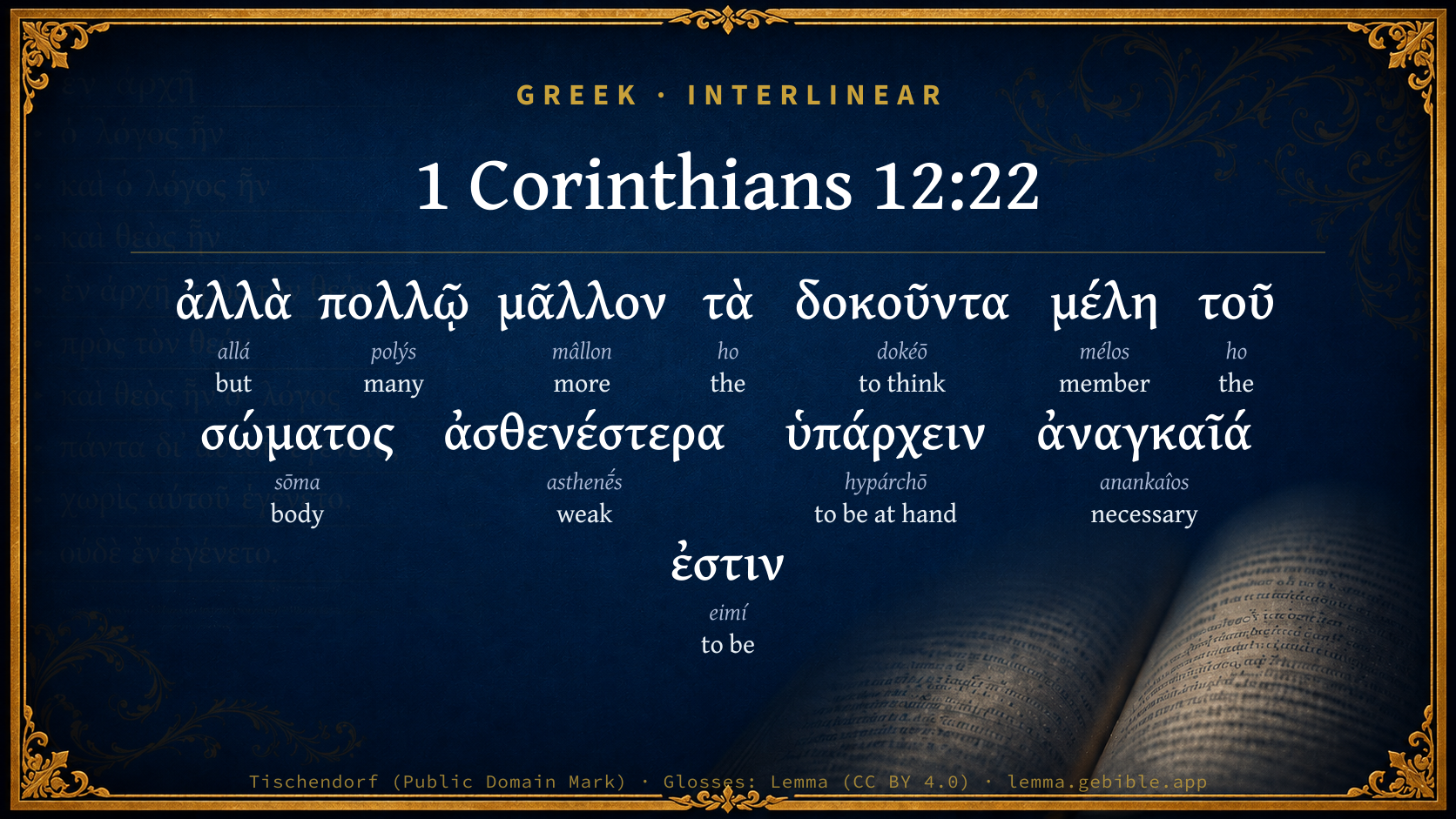
  1. ἀλλὰ allá G235 “but” Conjunction
  2. πολλῷ polýs G4183 “many” Adjective, Dative, Singular, Neuter
  3. μᾶλλον mâllon G3123 “more” Adverb
  4. τὰ ho G3588 “the” Article, Nominative, Plural, Neuter
  5. δοκοῦντα dokéō G1380 “to think” Verb, Present, Active, Participle, Nominative, Plural, Neuter
  6. μέλη mélos G3196 “member” Noun, Nominative, Plural, Neuter
  7. τοῦ ho G3588 “the” Article, Genitive, Singular, Neuter
  8. σώματος sōma G4983 “body” Noun, Genitive, Singular, Neuter
  9. ἀσθενέστερα asthenḗs G772 “weak” Adjective, Nominative, Plural, Neuter, Comparative
  10. ὑπάρχειν hypárchō G5225 “to be at hand” Verb, Present, Active, Infinitive
  11. ἐστιν eimí G1510 “to be” Verb, Present, Active, Indicative, 3rd person, Singular

About this verse

These counts appear in no published source. They are computed here, from the morphology-tagged text and Lemma’s own curated glosses. What Lemma adds →

12
words
11
distinct lemmas
Pauline Epistles
section

Notable vocabulary

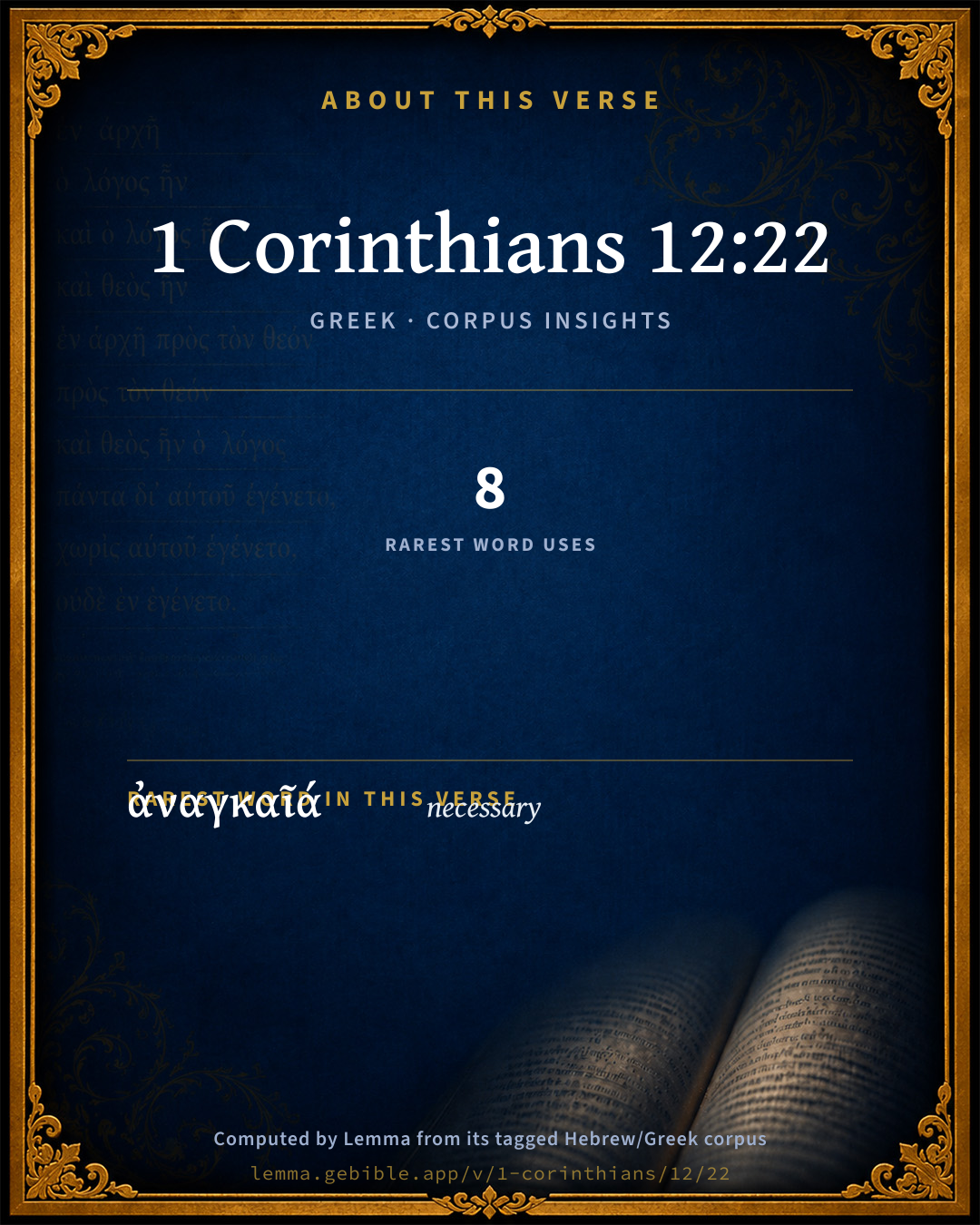
The rarest word here is ἀναγκαῖά necessary G316 — appearing just 8 times in the whole Greek New Testament.

Shared distinctive vocabulary

ἀναγκαῖά necessary G316 occurs in 8 verses of the Greek New Testament. Also found in:

Repetition

A word recurs within this verse:

Cross-references

5

Topical passages linked to 1 Corinthians 12:22 in the Treasury of Scripture Knowledge — connected by theme and wording, ordered by reader-vote popularity; previews shown in the World English Bible.

  • Proverbs 14:28 In the multitude of people is the king's glory, But in the lack of people is the destruction of the prince.
  • Ecclesiastes 9:14–15 There was a little city, and few men within it; and a great king came against it, besieged it, and built great bulwarks against it.
  • Ecclesiastes 4:9–12 Two are better than one, because they have a good reward for their labor.
  • Ecclesiastes 5:9 Moreover the profit of the earth is for all. The king profits from the field.
  • 2 Corinthians 1:11 you also helping together on our behalf by your supplication; that, for the gift bestowed on us by means of many, thanks may be given by many persons on your behalf.

Cross-references courtesy of OpenBible.info (CC BY 4.0).

Commentary

Notes on 1 Corinthians 12:22 from classic Christian and Jewish commentators (each source and its license shown beneath its notes). The classic Christian expositions comment on the surrounding passage and are grouped to its opening verse, so a note may address several verses; the Jewish commentaries on the Tanakh (Rashi and others) are per-verse, so they appear only where the commentator wrote on this verse.

Lemma curates 59 commentaries, every one of them public domain or Creative Commons licensed, each selected and text-cleaned for this edition rather than reprinted as found. About our sources →

Tyndale Open Study Notes

Tyndale Open Resources

12:22-26 The seemingly weaker and less significant parts of the body are the most necessary and should be given special attention and respect so that the whole body will function well.

Tyndale Open Study Notes — © Tyndale Open Resources, licensed CC BY-SA 4.0. Text via the HelloAO Bible API.

Bengel's Gnomon

Johann Albrecht Bengel

1Co 12:22. Ἀσθενέστερα, more feeble) the hand, compared with the eye.

Bengel's Gnomon of the New Testament — English translation (T&T Clark, Edinburgh, 1860) — public domain. Text from a community e-Sword module.

Meyer's Critical & Exegetical Commentary

Heinrich August Wilhelm Meyer

1Co_12:22-23. No; the relationship of the members is, on the contrary, of a different sort; those accounted weaker are necessary; likewise those held to be less honourable are the more honourably attired; those which are unseemly are invested with all the greater seemliness. What particular members Paul specially meant here by the weak (Theodoret, Estius, and several others hold: the brain and inward organs; Hofmann: the delicate inward parts; Bengel: the hands; most commentators, including Billroth: the eyes and ears) and by the ἀτιμοτέροις (usually: the feet; Grotius and Calovius: venter cum iis quae sub ventre sunt; Kypke: the intestines) cannot be definitely settled in detail, since he only says in a summary way: How contrary it is to the natural relation of the members, if one were to say to the other (as in the preceding illustration the eye to the hand, or the head to the feet), I have no need of thee! Such contemptuous treatment can find no warrant either in the weakness, or the less honourable character, or the unseemliness of any member; for the members which we count weak are shielded from depreciation by their necessity; those held less honourable, by their more honourable dress; and those which are unseemly, by their seemly covering. Since, however, it is of itself undoubted that he reckoned the pudenda (τὰ αἰδοῖα) and the breech among the ἀσχήμονα, we may further, without arbitrariness, set down the delicate organs of sense, such as the eye and ear, among the ἀσθενέστερα, and among the ἀτιμότερα again the members specially cared for in the way of adornment by dress, such as the trunk, hips, and shoulders.

πολλῷ μᾶλλον] the logical multo potius.

τὰ δοκοῦντα] which appear, like ἃ δοκοῦμεν, 1Co_12:23. Chrysostom aptly says, that what is conveyed is not τῆς φύσεως τῶν πραγμάτων, but τῆς τῶν πολλῶν ὑπονοίας ἡ ψῆφος. The position is, as in Plato, Rep. p. 572 B, καὶ πάνυ δοκοῦσιν ἡμῶν ἐνίοις μετρίοις εἶναι. Comp p. 334 C.

The first ΚΑΊ in 1Co_12:23 subjoins another category, the two members of which are put in order of climax (ἈΤΙΜΌΤ., ἈΣΧΉΜ.).

ἈΤΙΜΌΤΕΡΑ ΕἾΝΑΙ ΤΟῦ ΣΏΜ.] to be more dishonourable parts of the body, than others; comparativus molliens, Bengel.

τιμὴν περισσ.] honour in richer measure than others, namely, by the clothing, which is indicated by περιτίθ. (Mat_27:28; Gen_27:16; Est_1:20; Pro_12:9; 2Ma_11:13; 2Ma_12:39; 2Ma_3:32; Hom. Il. iii. 330, xiv. 187).

τὰ ἀσχήμ. ἡμ.] our unseemly parts. Theodore of Mopsuestia says well: ἀσχήμονα ὡς πρὸς τὴν κοινὴν ὄψιν ἀποκαλεῖ. Notice, too, that we have not here again the milder relative comparative.

ἜΧΕΙ] They have greater seemliness than others; it becomes their own, namely, through the more seemly covering in which they are attired. On the purport of the verse, Chrysostom remarks rightly: τί γὰρ τῶν μορίων τῶν γεννητικῶν ἀτιμότερον ἐν ἡμῖν εἶναι δοκεῖ; ἀλλʼ ὅμως πλείονος ἀπολαύει τιμῆς, καὶ οἱ σφόδρα πένητες, κἂν τὸ λοιπὸν γυμνὸν ἔχωσι σῶμα, οὐκ ἂν ἀνάσχοιντο ἐκεῖνα τὰ μέλη δεῖξαι γυμνά. According to Hofmann, we are to supply ΤΟῦ ΣΏΜΑΤΟς from what goes before in connection with ΤᾺ ἈΣΧΉΜ.; the words from ἩΜῶΝ to ἜΧΕΙ, again, are to be taken as: they bring with them a greater seemliness (a more seemly demeanour) on our part. Needlessly artificial, and contrary to the τὰ τὲ εὐσχήμ. ἡμῶν which follows.

Meyer — Critical and Exegetical Commentary on the New Testament — English translation by Peter Christie, edited by Frederick Crombie (T&T Clark, 1880) — public domain. Text from a community e-Sword module.

Expositor's Greek Testament

ed. W. Robertson Nicoll

1Co 12:22-24 a . “On the contrary” ( ἀλλά ), instead of the more powerful and dignified (1Co 12:23 ) bodily parts dispensing with the humbler (1Co 12:21 ), it is “much more” the case that these latter “the weaker” or “less honourable as they may seem to be” ( τὰ δοκοῦντα … ἀσθενέστερα ὑπάρχειν ) “are necessary” in themselves (1Co 12:22 ), and treated with “more abundant honour” in our care of the body. By πολλῷ μᾶλλον ( cf Plato, Phœdo , 80 E, ἀλλὰ πολλῷ μᾶλλον ), multo potius (Bz [1914] ) or a fortiori (Ev [1915] ), the position of 1Co 12:21 is more than negatived; the inferior members are not merely shielded from contempt, but guarded with exceptional respect. By the “weaker” and “ignobler” parts P. cannot mean the hands or feet spoken of in 1Co 12:21 , for these are strong and usually uncovered (see περιτίθεμεν , 23); but members in appearance quite subordinate and actually feeble viz ., the more delicate vital organs. Amongst these the ἀσχήμονα signify definitely τὰ αἰδοῖα , quœ inhonesta sunt (Vg [1916] ); cf. Rev 16:15 , τὴν ἀσχημοσύνην . The ἀσθενέστερα and ἀτιμότερα , the “comparatively weak” and “feeble” ( comparativus molliens , Bg [1917] ), are wide categories applicable to the same members from diff [1918] points of view. Weakness , in the case, e.g ., of the heart, is compensated by needfulness; ignobility , as in the viscera, by careful tendance shown in ample clothing “we put about them (clothe them with) a more abundant honour” (for the use of τιμή , cf. ἐξουσία in 1Co 11:10 ). The unseemliness (indecency) attaching to certain organs, always guarded from sight, “brings with it ( ἔχει , cf. Heb 10:35 ) a more abundant seemliness”. Against most commentt. (Gd [1919] , e.g ., thinks only of “les soins de la toilette”!), Ed [1920] maintains that εὐσχημοσύνη (1Co 12:23 ) has a moral sense, looking beyond the honour of apparel ; “the greater comeliness relates rather to function”. Is any office more responsible than that of parenthood, anything more sacred than the mother’s womb and mother’s breast? ( cf. Luk 11:27 ; also Heb 13:4 ). τὰ δὲ εὐσχήμονα κ . τ . λ .: But our seemly parts” head and face, e.g. ( the human face divine ) “have no need,” their distinction being conspicuous; see 1Co 11:7 a , where this visible, but also moral, εὐσχημοσύνη is raised to its highest grade. From this text Bg [1921] inferred the impiety of patches ! On ὑπάρχειν , see note to 1Co 11:7 ; δοκέω has in 1Co 12:22 f. its two meanings non-personal and personal of seem and suppose ; like methinks and I think , Germ., dünken and denken .

[1914] Beza’s Nov. Testamentum: Interpretatio et Annotationes (Cantab., 1642).

[1915] T. S. Evans in Speaker’s Commentary .

[1916] Latin Vulgate Translation.

[1917] Bengel’s Gnomon Novi Testamenti.

[1918] difference, different, differently.

[1919] F. Godet’s Commentaire sur la prem. Ép. aux Corinthiens (Eng. Trans.).

[1920] T. C. Edwards’ Commentary on the First Ep. to the Corinthians . 2

[1921] Bengel’s Gnomon Novi Testamenti.

1Co 12:24 b , 1Co 12:25 . “But God compounded ( συν - εκέρασεν , mixed together ; Vg [1922] contemperavit ) the body.” The assertion of God’s workmanship in the structure of the physical organs ( cf. 1Co 12:18 ) was necessary, when many thinkers affirmed the evil of matter and regarded physical appetites as degrading ( cf. 1Ti 4:3 , Col 2:23 ; also 1Co 6:13 ; 1Co 6:18 ff. above). This accounts for the adversative ἀλλά “Nay but”: P. tacitly contradicts those who saw nothing but ἀτιμία and ἀσχημοσύνη in vital bodily functions. For ὁ Θεὸς συνεκέρασεν , cf. Psa 139:13-16 (where the womb is “God’s laboratory,” Delitzsch), Ecc 11:5 , Job 10:8-11 . Ed [1923] reads the assertion as directed against philosophy; “where Aristotle says ‘nature,’ P. says ‘God’ ”. τῷ ὑστερουμένῳ περισσοτέραν δοὺς τιμήν , “to the part which suffers lack ( opus habenti , Cv [1924] : cf. , note, 1Co 1:7 ) having assigned more abundant honour”; so that the human instinct respecting the ignobler organs of the body (1Co 12:23 ) is the reflex of a Divine ordinance: cf. 1Co 11:14 f., to the like effect. “That there may not be division ( σχίσμα : see parls.) in the body” the manifestation of the jealousy or scorn depicted in 1Co 12:16 ; 1Co 12:21 , which have their counterpart at present in the Cor [1925] Church (1Co 1:10 ff., 1Co 4:6 , etc.). The opposite state of things ( ἀλλά ), so desirable in the spiritual organism, is realised by Divine art in the natural: “God tempered the body together” in this way, “that … the members might have the same solicitude for one another”. The physical members are obliged, by the structure of the frame, to care for one another; the hand is as anxious to guard the eye or the stomach, to help the mouth or the foot, as to serve itself; the eye is watchman for every other organ; each feels its own usefulness and cherishes its fellows; all “have the same care,” since they have the same interest that of “the one body”. This societas membrorum makes the physical order both a parable of and a basis for the spiritual. For τὸ αὐτό , cf. 1Co 1:10 , 2Co 13:11 , Phi 2:2 , etc. μεριμνῶσιν (see esp. 1Co 7:32 ff., for this shade of meaning) is in pr [1926] sbj [1927] , of habitual feeling; in pl [1928] , despite neut. subject, since the μέλη have been individually personified (1Co 12:15 f., 1Co 12:21 ).

[1922] Latin Vulgate Translation.

[1923] T. C. Edwards’ Commentary on the First Ep. to the Corinthians . 2

[1924] Calvin’s In Nov. Testamentum Commentarii .

[1925] Corinth, Corinthian or Corinthians.

[1926] present tense.

[1927] subjunctive mood.

[1928] plural.

The Expositor's Greek Testament, edited by W. Robertson Nicoll (1897–1910) — public domain. Text from a community e-Sword module.

Hodge's Commentary on Romans, Ephesians & First Corinthians

Charles Hodge

1Co_12:22, 1Co_12:23

Nay, much more those members of the body, which seem to be more feeble, are necessary: and those (members) of the body, which we think to be less honorable, upon these we bestow more abundant honor; and our uncomely (parts) have more abundant comeliness.

The fourth inference from the apostles doctrine is, that the least attractive gifts are the most important. As in the human frame the heart is more important than the tongue, so in the church the gift of prayer is more important than eloquence. Those who in the closet, however obscure, wrestle with God, often do more for his glory and for the advancement of his kingdom than those who fill the largest space in the public eye. What would the tongue do without lungs, which are neither seen nor heard? Gods thoughts are not as our thoughts. The childish Corinthians prized the gift of tongues, which, as they used it, could edify no one, to the gift of prophecy by which the whole body of Christ could be instructed and comforted. And those persons and offices in the church which are most admired or coveted, are often of little account in the sight of God. There is another idea presented in these verses. It is an instinct of nature to adorn most the least comely portions of the body; and it is an instinct of grace to honor most those members of the church who least attract admiration. Those members of the body which we think to be less honorable, i.e. less likely to be honored; on those we bestow the more abundant honor, i.e. we on that account honor them the more. It is thus with a mother. The child which is the least admired, she cherishes with special affection. And it is thus with the church. The true people of God are only the more disposed to honor those of their number who are undervalued or despised. In the body, as the apostle says, our uncomely parts have (i.e. they receive) more abundant comeliness, i.e. are specially adorned.

Charles Hodge — Commentary on Romans (1835), First Corinthians (1857), and Ephesians (1856) — public domain. Text from a community e-Sword module.

Geneva Bible (1599)

Geneva Bible translators

Of the smallest and vilest offices, and therefore finally accounted of, of the rest.

Geneva Bible (1599) marginal notes — public domain. Text via Bolls.life.

Jamieson, Fausset & Brown

Robert Jamieson, A. R. Fausset & David Brown

more feeble--more susceptible of injury: for example, the brain, the belly, the eye. Their very feebleness, so far from doing away with the need for them, calls forth our greater care for their preservation, as being felt "necessary."

Jamieson, Fausset & Brown — Commentary Critical and Explanatory on the Whole Bible (1871) — public domain (CC PDM 1.0). Text via the HelloAO Bible API.

Adam Clarke's Commentary

Verse 22. Those members - which seem to be more feeble] These, and the less honourable and uncomely, mentioned in the next verses, seem to mean the principal viscera, such as the heart, lungs, stomach, and intestinal canal. These, when compared with the arms and limbs, are comparatively weak; and some of them, considered in themselves, uncomely and less honourable; yet these are more essential to life than any of the others. A man may lose an eye by accident, and an arm or a leg may be amputated, and yet the body live and be vigorous; but let the stomach, heart, lungs, or any of the viscera be removed, and life becomes necessarily extinct. Hence these parts are not only covered, but the parts in which they are lodged are surrounded, ornamented, and fortified for their preservation and defence, on the proper performance of whose functions life so immediately depends.

Adam Clarke's Commentary on the Bible (1810–1826) — public domain. Text from a community e-Sword/MySword module.

Ellicott's Commentary for English Readers

(22) Which seem to be more feeble.—The general argument of this and the following verse (without attempting to identify the particular parts of the body referred to) is that the weakest parts of the body are as necessary to the body as the strongest; and those parts which are considered less seemly are more abundantly cared for by being carefully covered with clothes, as distinguished from the face and hands which are uncovered.

A Bible Commentary for English Readers, edited by Charles John Ellicott (1878–1897) — public domain. Text from a community e-Sword module.

The Cambridge Bible for Schools and Colleges

gen. ed. J. J. S. Perowne

22. Nay, much more those members of the body, which seem to be more feeble, are necessary] The more feeble parts of the body, those, that is, which are most delicate, least able to take care of themselves, are by no means the least valuable. The eye or the brain, for instance, are more necessary to the well-being of the body than other stronger and ruder organs.

The Cambridge Bible for Schools and Colleges (gen. ed. J. J. S. Perowne; Cambridge University Press, 1878–1918) — public domain. Text from a community e-Sword module.

John Gill's Exposition

Nay, much more those members of the body,.... The apostle, in a beautiful gradation, proceeds to take notice of such parts of the body as are more weak, dishonourable, and uncomely, showing the necessity and usefulness of them:

which seem to be more feeble; than others, do not consist of a strong bony substance, and are not fenced with sinews, as the belly and its intestines: yet these

are necessary; nor could the body be sustained, nourished, and refreshed, without them; so the more weak and feeble saints, whose hearts and hands are to be strengthened, whose infirmities are to be bore, have their usefulness; and the effectual working in the measure of every part, even of the feeble and tender, maketh increase of the body, to the edifying of itself in love: and these God has seen fit, as necessary to call by his grace, and place in the body, that his strength may be made perfect in their weakness, and to confound the mighty; and out of the mouths even of babes and sucklings to ordain strength and praise.

John Gill's Exposition of the Whole Bible (1746–1763) — public domain (CC PDM 1.0). Text via the HelloAO Bible API.

Trapp's Complete Commentary

John Trapp

22 Nay, much more those members of the body, which seem to be more feeble, are necessary:

Ver. 22. Which seem to be, &c.] As the organs of nourishment, not so noble, but more necessary than those of the senses.

John Trapp, A Commentary or Exposition upon All the Books of the Old and New Testament (1647–1656) — public domain. Text from a community e-Sword module.

Albert Barnes' Notes on the Bible

Which seem to be more feeble - Weaker than the rest; which seem less able to bear fatigue and to encounter difficulties; which are more easily injured, and which become more easily affected with disease. It is possible that Paul may here refer to the brain, the lungs, the heart, etc., as more feeble in their structure, and more liable to disease than the hands and the feet, etc., and in reference to which disease is more dangerous and fatal.

Are more necessary - The sense seems to be this. A man can live though the parts and members of his body which are more strong were removed; but not if those parts which are more feeble. A man can live if his arm or his leg be amputated; but not if his brain, his lungs or his heart be removed. So that, although these parts are more feeble, and more easily injured, they are really more necessary to life, and therefore more useful than the more vigorous portions of the frame. Perhaps the idea is - and it is a beautiful thought - that those members of the church which are most retiring and feeble apparently which are concealed from public view, unnoticed and unknown - the humble. the meek, the peaceful, and the prayerful - are often more necessary to the true welfare of the church than those who are eminent for their talent and learning. And it is so. The church can better spare many a man, even in the ministry, who is learned, and eloquent, and popular, than some obscure and humble Christian, that is to the church what the heart and the lungs are to the life. the one is strong. vigorous, active, like the hands or the feet, and the church often depends on them; the other is feeble, concealed, yet vital, like the heart or the lungs. The vitality of the church could be continued though the man of talent and learning should be removed; as the body may live when the arm or the leg is amputated; but that vitality could not continue if the saint of humble and retiring piety, and of fervent prayerfulness, were removed, any more than the body can live when there is no heart and no lungs.

Albert Barnes' Notes on the Bible (1834–1885) — public domain. Text from a community e-Sword/MySword module.

Matthew Poole's English Annotations

By feeble the apostle here doth not only mean most weak, but which seem to us most abject and contemptible; in which sense the word is used, 2Co 12:10; such are the belly and the entrails; the eye also is a feeble member, &c.; yet these parts are most necessary for the use of the body, being such without the use of which the body cannot live.

Matthew Poole's English Annotations on the Holy Bible (1683–1685) — public domain. Text from a community e-Sword/MySword module.

Whedon's Commentary on the Bible

Daniel D. Whedon

22. Nay, much more—The ruled can do without the rulers even better than the vice versa. It is for the ruled that the rulers exist. And often, in some way or other, the ruled are the real rulers. Just as the humblest parts of the human system really rule the rest.

More feeble—The most delicate nerves and fibres are most necessary to vitality.

Daniel D. Whedon (gen. ed.), Commentary on the Old and New Testaments (1874–1909) — public domain. Text from a community e-Sword module.

The Pulpit Commentary

Are necessary. This is the point of the fable of the belly and the members.

The Pulpit Commentary (1880–1919), ed. H.D.M. Spence-Jones & Joseph S. Exell — public domain. Text from a community e-Sword module.

John Wesley's Explanatory Notes

The members which appear to be weaker - Being of a more delicate and tender structure; perhaps the brains and bowels, or the veins, arteries, and other minute channels in the body.

John Wesley, Explanatory Notes Upon the Whole Bible (1754–1765) — public domain. Text via the GEBible commentary corpus.

McGarvey & Pendleton's Commentaries

J. W. McGarvey

Nay, much rather, those members of the body which seem to be more feeble are necessary:

J. W. McGarvey (with Philip Y. Pendleton), Commentaries on the New Testament (The Fourfold Gospel, 1914; Acts; and the epistles) — public domain. Text from a community e-Sword/MySword module.

Cambridge Greek Testament for Schools and Colleges

22. τὰ δοκοῦντα. Not those which are, as Chrysostom remarks, but those which are thought to be so. This remark applies with still greater force to the next verse.

ἀσθενέστερα. The more feeble parts of the body, those, that is, which are most delicate, least able to take care of themselves, are by no means the least valuable. The eye or the brain, for instance, are more necessary to the well-being of the body than other stronger and ruder organs.

Cambridge Greek Testament for Schools and Colleges (Cambridge University Press, 1896; 21 vols, various authors incl. Carr, Maclear, Plummer, Farrar, Lumby, Moule, M. R. James, Simcox) — public domain. Text from a community e-Sword module.

International Critical Commentary

22. ‘Nay, on the contrary (ἀλλά), much rather those members of the body which seem to be naturally (ὑπάρχειν) somewhat feeble, are necessary.’ The humbler parts not only are indispensable, but are as indispensable as the rest. So also in society. It is the humblest workers, the day-labourers in each trade, that are not only as necessary as the higher ones, but are more necessary. We can spare this artizan better than this poet; but we can spare all the poets better than all the artizans. With this use of the comparative to soften the meaning, comp. 2Ti 1:8; Act 17:22. St Paul does not specify the ‘somewhat feeble’ members, and we need not do so.

International Critical Commentary — older volumes (1896–1929), various authors — public domain. Text from a community e-Sword module.

Vincent's Word Studies in the New Testament

Marvin R. Vincent

Seem to be [δοκουντα - υπαρχειν] . The allusion is probably to those which seem to be weaker in their original structure, naturally. This may be indicated by the use of uJparcein to be (see on Jas 2:15); compare einai to be, in ver. 23. Others explain of those which on occasion seem to be weaker, as when a member is diseased.

Marvin R. Vincent, Word Studies in the New Testament (1887–1900) — public domain. Text from a community e-Sword/MySword module.

Godet's Commentaries

Frédéric Louis Godet

Vv. 22. Nay more, the instant we reflect, we are convinced of the absolute necessity of the members which seem to play an altogether secondary part, more secondary even than the hand or the feet. These weak parts are no doubt the sensitive organs which are protected by their position in the body, the lungs and stomach, for example, on which, above all, the life and health of the whole body depend.

The πολλῷ μᾶλλον has a logical (much rather) and not a quantitative sense (much more).

Hence it follows that the gifts and offices which have a modest appearance are necessary, no less than the others, to the prosperity of the whole.

Vers. 23, 24a. “And the members of the body, which we think to be less honourable, upon these we bestow more abundant honour; and our uncomely parts have more abundant comeliness. 24a. Whereas our comely parts have no need.”

Paul here appeals to a fact of natural instinct in man. Καί: and moreover. There is a gradation from the ἀσθενέστερα, more feeble, to the ἀτιμότερα and ἀσχήμονα, less honourable and uncomely. — These less honourable members are the arms, the throat, the breast, the belly, the legs, all the parts of the body on which chiefly the cares of the toilet are lavished.

The apostle pushes the comparison to the utmost. The second καί signifies: and even. Hofmann makes the ἡμῶν, our, dependent not on ἀσχήμονα, but on εὐσχημοσύνην ἔχει: “derive from us greater comeliness;” and similarly in 1Co 12:24 he makes the ἡμῶν depend on χρείαν ἔχει: “Those which are comely of themselves have no need of us to make them such.” This commentator sometimes seems to amuse himself with exegetical feats rather than to speak seriously. The ἡμῶν is added to the two adjectives ἀσχήμονα and εὐσχήμονα to express the solidarity which exists between the comeliness of one part of the body and that of our whole person. The shame of one of our members is ours. What the apostle wished thereby to impress on the proud Corinthians was, that it pertains to the honour of the whole Church that those who are charged with the humblest functions and the least prominent services should be the objects of the greatest marks of respect; we should say, if we dared so to paraphrase: To the brother serving in the agape, the best portion! To the brother who sweeps the floor, the most honourable place beside the president!

Frédéric Louis Godet — Commentaries on Luke, John, Romans, and 1 Corinthians — English translation (T&T Clark, Edinburgh, 1870s–1890s) — public domain. Text from a community e-Sword module.

Lesson kit

Teaching starters — assembled from the data on this page, not authored interpretation. Every prompt links to the verse data it draws on. Edit before teaching.

1 Corinthians, in the Pauline Epistles, opens this verse with 12 words (11 distinct Greek lemmas). Its most distinctive word is anankaîos (“necessary”). A historical commentator’s framing appears above. Read the whole chapter for the surrounding context.

Discussion questions

  1. How does “necessary” (anankaîos) shape what this verse is saying?
  2. Acts 10:24 shares the word «necessary» with this verse. How do the two illuminate each other?
  3. “the” occurs 2× in this one verse. What is the effect of the repetition?
  4. These translations render this verse differently. What is at stake in choosing one wording over another?
  5. Reading how Tyndale Open Study Notes and Bengel's Gnomon read this verse, where do the two commentators agree and where do they part?

Things to notice

Reading settings

Reading text

Shown beneath each verse's original-language words.

Old Testament
Old Testament edition

Read the OT as the Masoretic Hebrew (MT) or the Greek Septuagint (LXX).

English shown for the Greek Septuagint (in the Hebrew ↔ Greek comparison).

Comparing translations? Open the Compare panel on any verse page to stack up to four side by side.