Colossians 2:19

Greek (Tischendorf 8th ed.) Colossians 2:19 appears in the Greek New Testament. The text above is from the Tischendorf 8th edition. Each word links to its Strong’s number and a concise gloss. Click any word for its full Thayer’s Greek Lexicon entry.
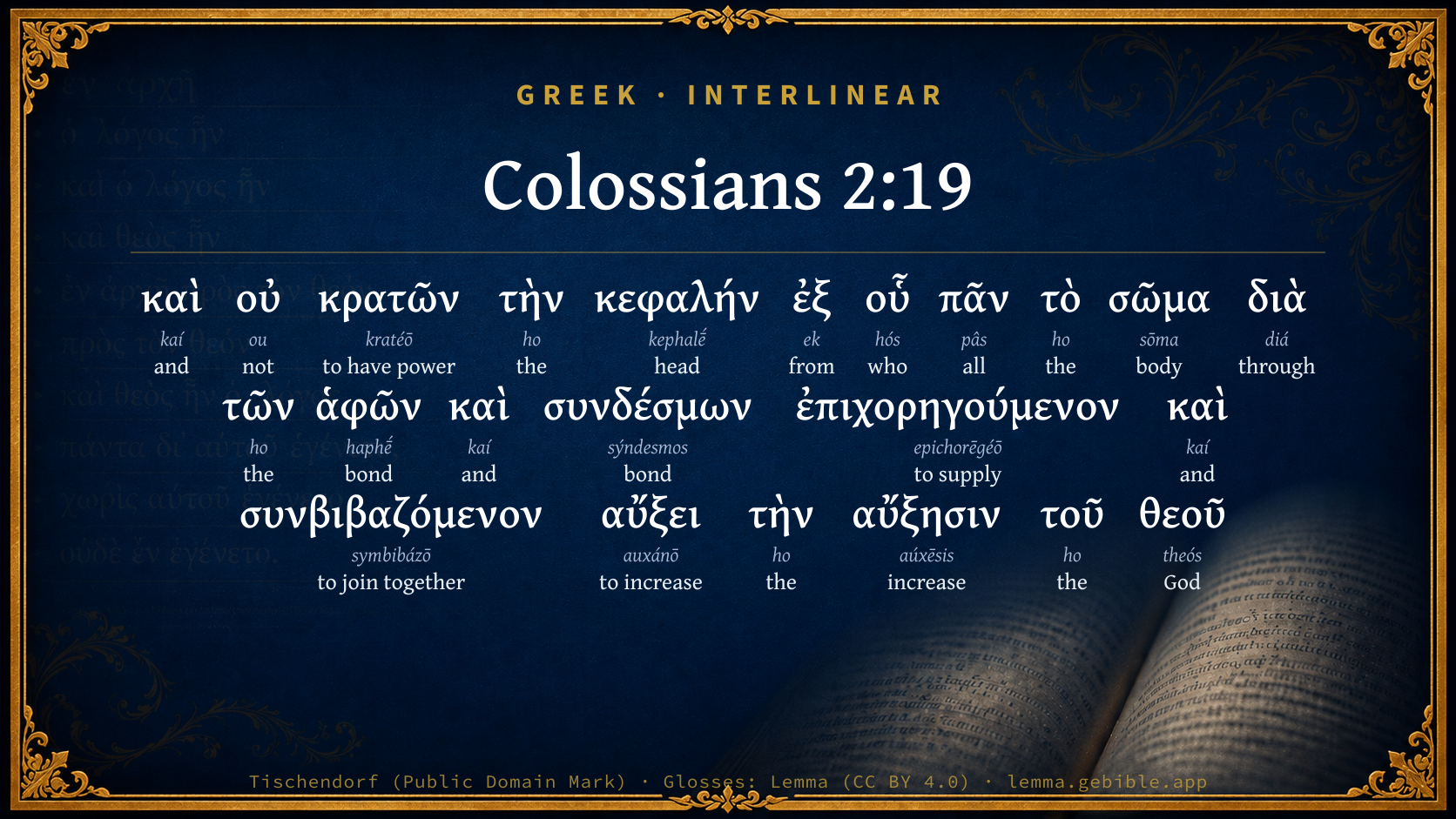
Download image
Cite this verse

Colossians 2:19 (World English Bible). Public Domain. Lemma interlinear Bible study tool, https://lemma.gebible.app/v/colossians/2/19.

Show BibTeX & RIS
BibTeX
RIS
English Translation
and not holding firmly to the Head, from whom all the body, being supplied and knit together through the joints and ligaments, grows with God's growth.
World English Bible · Public Domain
Download a study sheet

One document with this verse’s original text, its word-by-word gloss line, the meaning frame, cross-references with their text, attributed commentary, and full source and license credits — printable, and it pastes into notes with its structure intact.

This verse Autodidact and up

Study sheet (.html) Plain text (.txt)

A passage Seminary Student

Up to 50 verses in one chapter. A passage sheet keeps up to 6 commentary sources and 12 cross-references per verse, in the order this page ranks them, and says so on the sheet whenever that leaves anything out. Ask for a single verse and you get the Autodidact verse sheet above.

Everything on this page stays free to read, with no account — the sheet is a download of what is already on screen, not access to it.

Want to remove ads? Support Godless Engineer
Compare translations 3

The same verse in 3 English versions, stacked beneath the original-language interlinear above. Click any original word for its lexicon entry.

Each is an independent rendering of the whole verse — the interlinear is not word-aligned to these translations.

Highlighted words mark where these versions differ — a whole-verse word diff, not a word-by-word alignment.

  • World English Bible Public Domain
    and not holding firmly to the Head, from whom all the body, being supplied and knit together through the joints and ligaments, grows with God's growth.
  • King James Version Public Domain
    And not holding the Head, from which all the body by joints and bands having nourishment ministered, and knit together, increaseth with the increase of God.
  • unfoldingWord Literal Text CC BY-SA 4.0
    and not holding fast to the head, from which the whole body, being supplied and held together through the joints and ligaments, grows with the growth from God.

unfoldingWord Literal Text — © unfoldingWord, licensed CC BY-SA 4.0. Word-aligned USFM3 via Door43 (git.door43.org/unfoldingWord/en_ult).

Versions to compare (up to 4)

3 of 4 selected

Show all 19 translations

Every available English version of this verse, each an independent rendering of the whole verse.

  • World English Bible Public Domain
    and not holding firmly to the Head, from whom all the body, being supplied and knit together through the joints and ligaments, grows with God's growth.
  • Berean Standard Bible Public Domain
    He has lost connection to the head, from whom the whole body, supported and knit together by its joints and ligaments, grows as God causes it to grow.
  • Majority Standard Bible Public Domain
    He has lost connection to the head, from whom the whole body, supported and knit together by its joints and ligaments, grows as God causes it to grow.
  • King James Version Public Domain
    And not holding the Head, from which all the body by joints and bands having nourishment ministered, and knit together, increaseth with the increase of God.
  • American Standard Version (1901) Public Domain
    and not holding fast the Head, from whom all the body, being supplied and knit together through the joints and bands, increasing with the increase of God.
  • Revised Version (1885) Public Domain
    and not holding fast the Head, from whom all the body, being supplied and knit together through the joints and bands, increaseth with the increase of God.
  • Geneva Bible (1599) Public Domain
    And holdeth not the head, whereof all the body furnished and knit together by ioyntes and bands, increaseth with the increasing of God.
  • Douay-Rheims (1899) Public Domain
    And not holding the head, from which the whole body, by joints and bands, being supplied with nourishment and compacted, groweth unto the increase of God.
  • Young's Literal Translation Public Domain
    and not holding the head, from which all the body -- through the joints and bands gathering supply, and being knit together -- may increase with the increase of God.
  • Literal Standard Version CC BY-SA 4.0
    and not holding the Head, from which all the body—gathering supply through the joints and bands, and being knit together—may increase with the increase of God.
  • Unlocked Literal Bible CC BY-SA 4.0
    He does not hold on to the head. It is from the head that the whole body throughout its joints and ligaments is supplied and held together; it grows with the growth given by God.
  • unfoldingWord Literal Text CC BY-SA 4.0
    and not holding fast to the head, from which the whole body, being supplied and held together through the joints and ligaments, grows with the growth from God.
  • Darby Bible Public Domain
    and not holding fast the head, from whom all the body, ministered to and united together by the joints and bands, increases with the increase of God.
  • World Messianic Bible Public Domain
    and not holding firmly to the Head, from whom all the body, being supplied and knit together through the joints and ligaments, grows with God’s growth.
  • Webster's Bible Public Domain
    And not holding the head, from which all the body by joints and bands having nourishment ministered, and knit together, increaseth with the increase of God.
  • Free Bible Version CC BY-SA 4.0
    Such people are not connected to the head that directs the body, nourished and joined together through the body's sinews and muscles. As the body is united together it grows the way God wants it to grow.
  • Bible in Basic English Public Domain
    And not joined to the Head, from whom all the body, being given strength and kept together through its joins and bands, has its growth with the increase of God.
  • Text-Critical English NT CC BY 4.0
    while not holding fast to the head, from whom the entire body, being supported and knit together by its joints and tendons, grows with a growth that is from God.
  • Tyndale New Testament (1534) Public Domain
    and holdeth not the heed wherof all the body by ioyntes and couples receaveth norisshment and is knet to gedder and encreaseth with the in creasynge that commeth of god.

Literal Standard Version (2020), Covenant Press — licensed CC BY-SA 4.0. Text via the HelloAO Bible API (eBible.org). Unlocked Literal Bible (unfoldingWord) — licensed CC BY-SA 4.0. Text via the HelloAO Bible API (eBible.org). unfoldingWord Literal Text — © unfoldingWord, licensed CC BY-SA 4.0. Word-aligned USFM3 via Door43 (git.door43.org/unfoldingWord/en_ult). Free Bible Version, Dr. Jonathan Gallagher — licensed CC BY-SA 4.0. Text via the HelloAO Bible API (eBible.org).

Word by word

More ways to search: Search by grammar → Find every occurrence → Compare this word →

Practice this passage: Drill this verse → Learn its vocabulary →

ἁφῶν
haphḗ
G860
“bond”
Noun, Genitive, Plural, Feminine
Part of Speech
Noun
Case
Genitive
Number
Plural
Gender
Feminine
Full Thayer's Definition

Origin: from G680

TDNT: None

1. bond, connection
  1. καὶ kaí G2532 “and” Conjunction
  2. οὐ ou G3756 “not” Particle, Negative
  3. κρατῶν kratéō G2902 “to have power” Verb, Present, Active, Participle, Nominative, Singular, Masculine
  4. τὴν ho G3588 “the” Article, Accusative, Singular, Feminine
  5. κεφαλήν kephalḗ G2776 “head” Noun, Accusative, Singular, Feminine
  6. ἐξ ek G1537 “from” Preposition
  7. οὗ hós G3739 “who” Relative pronoun, Genitive, Singular, Masculine
  8. πᾶν pâs G3956 “all” Adjective, Nominative, Singular, Neuter
  9. τὸ ho G3588 “the” Article, Nominative, Singular, Neuter
  10. σῶμα sōma G4983 “body” Noun, Nominative, Singular, Neuter
  11. διὰ diá G1223 “through” Preposition
  12. τῶν ho G3588 “the” Article, Genitive, Plural, Feminine
  13. καὶ kaí G2532 “and” Conjunction
  14. συνδέσμων sýndesmos G4886 “bond” Noun, Genitive, Plural, Masculine
  15. ἐπιχορηγούμενον epichorēgéō G2023 “to supply” Verb, Present, Passive, Participle, Nominative, Singular, Neuter
  16. καὶ kaí G2532 “and” Conjunction
  17. συνβιβαζόμενον symbibázō G4822 “to join together” Verb, Present, Passive, Participle, Nominative, Singular, Neuter
  18. αὔξει auxánō G837 “to increase” Verb, Present, Active, Indicative, 3rd person, Singular
  19. τὴν ho G3588 “the” Article, Accusative, Singular, Feminine
  20. αὔξησιν aúxēsis G838 “increase” Noun, Accusative, Singular, Feminine
  21. τοῦ ho G3588 “the” Article, Genitive, Singular, Masculine
  22. θεοῦ theós G2316 “God” Noun, Genitive, Singular, Masculine

About this verse

These counts appear in no published source. They are computed here, from the morphology-tagged text and Lemma’s own curated glosses. What Lemma adds →

23
words
17
distinct lemmas
Pauline Epistles
section

Notable vocabulary

The rarest word here is ἁφῶν bond G860 — appearing just 2 times in the whole Greek New Testament.

Shared distinctive vocabulary

ἁφῶν bond G860 occurs in 2 verses of the Greek New Testament. Also found in:

Repetition

Words recur within this verse:

Cross-references

29

Topical passages linked to Colossians 2:19 in the Treasury of Scripture Knowledge — connected by theme and wording, ordered by reader-vote popularity; previews shown in the World English Bible.

  • Ephesians 4:15–16 but speaking truth in love, we may grow up in all things into him, who is the head, Christ;
  • John 15:4–6 Remain in me, and I in you. As the branch can't bear fruit by itself, unless it remains in the vine, so neither can you, unless you remain in me.
  • Romans 12:4–5 For even as we have many members in one body, and all the members don't have the same function,
  • Colossians 2:2 that their hearts may be comforted, they being knit together in love, and gaining all riches of the full assurance of understanding, that they may know the mystery of God, both of the Father and of Christ,
  • 1 Timothy 2:4–6 who desires all people to be saved and come to full knowledge of the truth.
  • 1 Peter 3:8 Finally, be all like-minded, compassionate, loving as brothers, tenderhearted, courteous,
  • 2 Peter 3:18 But grow in the grace and knowledge of our Lord and Savior Jesus Christ. To him be the glory both now and forever. Amen.
  • 1 Thessalonians 3:12 and the Lord make you to increase and abound in love one toward another, and toward all men, even as we also do toward you,
  • 1 Thessalonians 4:10 for indeed you do it toward all the brothers who are in all Macedonia. But we exhort you, brothers, that you abound more and more;
  • 1 Corinthians 3:6 I planted. Apollos watered. But God gave the increase.
  • 2 Thessalonians 1:3 We are bound to always give thanks to God for you, brothers, even as it is appropriate, because your faith grows exceedingly, and the love of each and every one of you towards one another abounds;
  • Psalms 139:15–16 My frame wasn't hidden from you, When I was made in secret, Woven together in the depths of the earth.
  • John 17:21 that they may all be one; even as you, Father, are in me, and I in you, that they also may be one in us; that the world may believe that you sent me.
  • Acts 4:32 The multitude of those who believed were of one heart and soul. Not one of them claimed that anything of the things which he possessed was his own, but they had all things in common.
  • Romans 11:17 But if some of the branches were broken off, and you, being a wild olive, were grafted in among them, and became partaker with them of the root and of the richness of the olive tree;
  • 1 Corinthians 1:10 Now I beg you, brothers, through the name of our Lord, Jesus Christ, that you all speak the same thing and that there be no divisions among you, but that you be perfected together in the same mind and in the same judgment.
  • 1 Corinthians 10:16–17 The cup of blessing which we bless, isn't it a communion of the blood of Christ? The bread which we break, isn't it a communion of the body of Christ?
  • 1 Corinthians 12:12–27 For as the body is one, and has many members, and all the members of the body, being many, are one body; so also is Christ.
  • Galatians 1:6–9 I marvel that you are so quickly deserting him who called you in the grace of Christ to a different gospel;
  • Galatians 5:2–4 Behold, I, Paul, tell you that if you receive circumcision, Christ will profit you nothing.
  • Ephesians 1:22 He put all things in subjection under his feet, and gave him to be head over all things for the assembly,
  • Ephesians 4:3 being eager to keep the unity of the Spirit in the bond of peace.
  • Ephesians 5:29 For no man ever hated his own flesh; but nourishes and cherishes it, even as the Lord also does the assembly;
  • Philippians 1:27 Only let your manner of life be worthy of the Gospel of Christ, that, whether I come and see you or am absent, I may hear of your state, that you stand firm in one spirit, with one soul striving for the faith of the Gospel;
  • Philippians 2:2–5 make my joy full, by being like-minded, having the same love, being of one accord, of one mind;
  • Colossians 1:10 that you may walk worthily of the Lord, to please him in all respects, bearing fruit in every good work, and increasing in the knowledge of God;
  • Colossians 1:18 He is the head of the body, the assembly, who is the beginning, the firstborn from the dead; that in all things he might have the preeminence.
  • Colossians 2:6–9 As therefore you received Christ Jesus, the Lord, walk in him,
  • Job 19:9–12 He has stripped me of my glory, And taken the crown from my head.

Cross-references courtesy of OpenBible.info (CC BY 4.0).

Commentary

Notes on Colossians 2:19 from classic Christian and Jewish commentators (each source and its license shown beneath its notes). The classic Christian expositions comment on the surrounding passage and are grouped to its opening verse, so a note may address several verses; the Jewish commentaries on the Tanakh (Rashi and others) are per-verse, so they appear only where the commentator wrote on this verse.

Lemma curates 59 commentaries, every one of them public domain or Creative Commons licensed, each selected and text-cleaned for this edition rather than reprinted as found. About our sources →

Bengel's Gnomon

Johann Albrecht Bengel

Col 2:19. Οὐ κρατῶν, not holding) He who does not hold Christ solely and above all others, does not hold Him at all.—τὴν κεφαλὴγ, the Head) Here faith has a foundation whereon it may be fixed. The opposite is, ἃ μὴ ἑώρακεν, ἐμβατεύων, he who flies beyond things placed in the middle (within reach), and tries to catch those that escape his grasp.—ἐξ οὗ, from which) [not from which Head, but from which hold] from holding the head; or else, from whom, viz. Christ, the Head.—διὰ τῶν ἁφῶν) by the joints (ties),[17] viz. of faith, Eph 4:16. It is to this word that ἐπιχορηγούμενον refers.—καὶ συνδέσμων) and bonds (bands) of ‘love’ and ‘peace,’ Eph 4:3. It is to this that συμβιβαζόμενον refers; comp. Col 2:2.—ἐπιχορηγούμενον) receiving ἐπιχορηγίαν, ministration to it (being ministered to); so 3Ma 6:38, πανθʼ ὑπὸ τοῦ βασιλέως χορηγούμενοι, supplied with all things by the king.

[17] Beng. here translates ἁφῶν, nexus; but see the somewhat different explanation in Gnom., Eph 4:16.—ED.

Bengel's Gnomon of the New Testament — English translation (T&T Clark, Edinburgh, 1860) — public domain. Text from a community e-Sword module.

Meyer's Critical & Exegetical Commentary

Heinrich August Wilhelm Meyer

Col_2:19. Καί] annexing to εἰκῆ φυσιούμενος κ.τ.λ. a further, and that a negative, modal form of the ἃ ἑώρακεν ἐμβατεύων. This ἐμβατεύειν into what is seen takes place, namely, in such a way, that one is puffed up by fleshly reason, and does not hold the Head, etc. So much is it at variance with the nature and success, as respects unity, of the church![128]

οὐ κρατῶν κ.τ.λ.] not holding fast (but letting it go, comp. Son_3:4 : ἐκράτησα αὐτὸν καὶ οὐκ ἀφῆκα αὐτόν) the Head, inasmuch, namely, as they seek angelic mediation. Bengel aptly observes: Qui non unice Christum tenet, plane non tenet.

ἐξ οὗ κ.τ.λ.] represents the whole objectionableness of this οὐ κρατῶν τ. κεφ., and the absolute necessity of the opposite. This οὗ is not to be referred to the verbal idea (Bengels suggestion: ex quo sc. tenendo caput), but applies objectively (comp. Eph_4:15 f.) to that which was designated by τὴν κεφαλ. In this view it may be masculine, according to the construction κατὰ σύνεσιν (Kühner, II. 1, p. 49), as it is usually taken, but it may alsoand this is preferable, because here the personality is not, as in Eph_4:15 f., specially markedbe neuter, so that it takes up the Head, not personally (though, it is Christ), but in accordance with the neuter idea: from which. See Matthiae, p. 988; Kühner, II. 1, p. 55. Comp. Maetzner, ad Antiph. p. 201. The τ. κεφαλ. might also be taken attributively: not holding fast as the Head Him, from whom, etc. (Ewald), which would be, however, less simple and less forcibly descriptive. ἐξ denotes the causal issuing forth of the subsequently expressed relation, comp. Eph_4:16.

τᾶν τὸ σῶμα] consequently no member is excepted, so that no member can expect from any other quarter what is destined for, and conveyed to, the whole body from the head. The conception of the church as the body of Christ, the Head, is not in our Epistle and the Ephesian letter different from that of the other Epistles (in opposition to Holtzmann, p. 239 ff.). Comp. on 1Co_12:12 f., 1Co_6:15; Rom_12:4 f.; also Rom_11:3. Any pressing contrary to the authors design of the thought of a σῶμα, which strictly taken is a trunk, is in this particular case excluded by the graphic delineation of the constantly living and active connection of the members with the Head. Every comparison, indeed, when pressed, becomes halting.

διὰ τῶν ἁφῶν κ. συνδεσμῶν ἐπιχορ. κ. συμβιβ.] The participial relation to the following verb is this: from the Head the whole body is furnished and bound together and grows in this way, so that ἐξ οὗ therefore is to be referred neither to the participles only, nor to the verb only, but to both; and διὰ τ. ἁφ. κ. συνδεσμ. specifies by what means the ἐπιχορ. κ. συμβιβ., proceeding from the Head, is brought about, viz. through the (bodily) nerve-impulses (not joints, as it is usually explained; see on Eph_4:16), which are conveyed from the Head to the body, and through the bands, which, proceeding from the Head, place the whole in organic connection. Observe that ἐπιχορ. refers to διὰ τ. ἁφῶν, and συμβιβ. to κ. συνδεσμ. Theophylact (comp. Theodoret) has aptly illustrated the former by the action of the nerves which is diffused from the head through the entire body, so that ἀπὸ τῆς κεφαλῆς ἐστι πᾶσα αἴσθησις κ. πᾶσα κίνησις. As, therefore, the body receives its efficiency from the head through the contact of impulses effected by means of the network of nerves, so would the church, separated from Christfrom whom the feelings and impulses in a spiritual sense, the motions and activities of the higher ζωή, are conveyed to itbe without the supply in question. Comp. the idea of the figure of the vine. Further: as, starting from the head, the whole body, by means of the bands which bind member to member, is bound together into one organic whole; so also is the entire church, starting from Christ, by means of the bands of Christian communion (κοινωνία), which give to the union of individuals the coherence of articulate unity. Faith is the inner ground of the ἁφαί, not the latter themselves (in opposition to Bengel); so also is love the inner ground of the συνδεσμοί of the mystical body, not these latter themselves (in opposition to Tertullian, Zanchius, Estius, Bengel, and others); and the operative principle on the part of Christ the Head is the Holy Spirit (Eph_4:4; 1Co_12:3 f., 7, et al.). Theodoret erroneously (comp. Ewald) explains the συνδεσμοί as the ἀπόστολοι κ. προφῆται κ. διδάσκαλοι, and Böhmer takes the ἁφαί and συνδεσμ. as the believers. The latter, as also the teachers, are in fact the members, and share in experiencing what is here asserted of the entire body.

ἐπιχορηγούμ.] receiving supply, being furnished. Comp. on the passive expression, which is not un-Pauline (Holtzmann), but in harmony with the general passive usage (Kühner, II. 1, p. 109), Polyb. iv. 77. Colossians 2 : πολλαῖς ἀφορμαῖς ἐκ φύσεως κεχορηγημένος, iii. 75. 3, et al.; Diod. Sic. i. 73; Sir_44:6; 3Ma_6:40. The compound, not expressing in addition besides (Bleek), denotes that the χορηγία is coming to, is being conveyed towards. Comp. 2Co_9:10; Gal_3:5; Dion. Hal. x. 54. But it is not said with what the body is provided, as χορηγεῖν (comp. also ἐπιχορ., Sir_25:22) is often used absolutely (see e.g. the passages from Polybius in Schweighäuser, Lex. p. 663), and admits of its more precise definition being supplied from the context, which, however, here points not to nourishment (Grotius, de Wette), but to that which is accomplished through the feelings (ἁφῶν), namely, the vital activity, of which the body would be destitute in the absence of the different impulses. Comp. Chrysostom: τὸ εἶναι καὶ το καλῶς εἶναι, Theophylact: πᾶσα αἴσθησις κ. πᾶσα κίνησις, and in the application: λαμβάνει τὸ ζῇν κ. αὔξειν πνευματικῶς.

τὴν αὔξησιν τοῦ Θεοῦ] denoted by the article as the divine growth absolutely; τοῦ Θεοῦ is the genitive auctoris: which God confers (1Co_3:6-7), with which ἐξ οὗ is not at variance (as Bähr thinks), since God is ranked above Christ (1Co_11:3), and is the supreme operating principle in the church (1Co_12:6; Eph_4:6). At once weak, and suggested by nothing in the text, is the view: incrementum, quod Deus probat (Calvin, Bähr[129]). What is meant is the gradual growth of Christians collectively toward Christian perfection. The circumstance that αὔξει as an intransitive only occurs again in Eph_2:21, comp. Col_4:15, and αὔξησις only in Eph_4:16, cannot prove it to be an un-Pauline mode of expression (Holtzmann). Respecting the connection of the verb with the more precisely defined cognate noun, see Winer, p. 210 [E. T. 281]; Lobeck, Paralip. p. 507 f.; Kühner, II. 2, p. 262 f.

[128] The conduct of those men is the negation of this holy relation, a separation from the organism of the body of Christ as an unity. The compressed characterizing of this articulated organism is therefore as suitable here as in Eph_4:16, and by no means an opus supererogationis on the part of the author (Holtzmann).

[129] Comp. Chrysostom and Oecumenius, who explain τοῦ Θεοῦ by κατὰ Θεόν.

Meyer — Critical and Exegetical Commentary on the New Testament — English translation by Peter Christie, edited by Frederick Crombie (T&T Clark, 1880) — public domain. Text from a community e-Sword module.

Expositor's Greek Testament

ed. W. Robertson Nicoll

Col 2:19 . Largely parallel to Eph 4:15-16 . Paul proceeds to point out that so far from securing spiritual growth of a higher order, the false teaching, by loosening the hold on Christ, prevented any growth at all, since it obstructed or severed the very channel of spiritual life. καὶ οὐ κρατῶν τὴν κεφαλήν : “and not holding fast the head”. For this sense of κρ . with the accusative cf. Son 3:4 , ἐκράτησα αὐτὸν καὶ οὐκ ἀφήκα αὐτόν . It is clear from this that the false teachers were Christians. They did not profess to have no hold upon Christ, but their hold was not firm. All the supplies of life and energy flow from the Head, so that loose connexion with it involves serious loss and not progress in the spiritual life. It is significant that here each member is recognised as having an immediate relation to the Head. ἐξ οὗ : not neuter, referring to κεφ ., for ἐξ ἧς would have been more natural, but “from whom”. It should be connected with both participles. πᾶν τὸ σῶμα : “the whole body”. Alford takes it “the body in its every part,” but Ellicott denies that any distinction between τὸ πᾶν σῶνα . and πᾶν τὸ σῶνα can be safely drawn. It is the body as a whole that increases, and thus Paul condemns the tendencies to intellectual or spiritual exclusiveness, which cripple alike the body and the members who exhibit such tendencies. As this increase continues each member shares in the body’s progress. διὰ τῶν ἁφῶν καὶ συνδέσμων . Lightfoot gives a very full discussion of these terms and their use in medical writers. He translates “through the junctures and ligaments”. No doubt Paul’s language is popular, not technical. He is speaking of the means by which the various parts of the body are supplied and knit together. Meyer takes ἁφ . to mean sensations or nerve impulses, but we have no evidence for this meaning; nor is it suitable here, for there is no reason for referring ἁφ . to ἐπιχορ . and συνδ . to συνβιβ . No explanation is given of ἁφ . κ . συνδ . Some think of the Holy Spirit, others of brotherly love, others of ministers. But probably in Paul’s mind they did not correspond to anything definitely. ἐπιχορηγούμενον καὶ συνβιβαζόμενον . “being supplied and united”. Often the supply is thought to be of nourishment, but perhaps we should interpret more generally of life. ἁφ . κ . συν . are thus the media through which life is communicated and the unity of the organism secured. αὔξει τὴν αὔξησιν τοῦ Θεοῦ : “increaseth with the increase of God”. Generally αὔξ . τ . Θ . is explained to mean the growth which God gives ( cf. 1Co 3:6 ). Against this is the fact that Christ is referred to as the source of growth. We may better take it “a growth such as God requires” (Ol., Haupt).

The Expositor's Greek Testament, edited by W. Robertson Nicoll (1897–1910) — public domain. Text from a community e-Sword module.

Geneva Bible (1599)

Geneva Bible translators

Christ.

With the increasing which cometh from God.

The fourth argument, which is of great weight, because they spoil Christ of his dignity, who only is sufficient both to nourish, and also to increase his whole body.

Geneva Bible (1599) marginal notes — public domain. Text via Bolls.life.

Jamieson, Fausset & Brown

Robert Jamieson, A. R. Fausset & David Brown

Translate, "Not holding fast the Head." He who does not hold Christ solely and supremely above all others, does not hold Him at all [BENGEL]. The want of firm holding of Christ has set him loose to (pry into, and so) "tread haughtily on (pride himself on) things which he hath seen." Each must hold fast the Head for himself, not merely be attached to the other members, however high in the body [ALFORD].

from which--rather, "from whom."

the body--that is, all the members of the body (Eph 4:16).

joints--the points of union where the supply of nourishment passes to the different members, furnishing the body with the materials of growth.

bands--the sinews and nerves which bind together limb and limb. Faith, love, and peace, are the spiritual bands. Compare "knit together in love" (Col 2:2; Col 3:14; Eph 4:3).

having nourishment ministered--that is, supplied to it continually. "Receiving ministration."

knit together--The Greek is translated, "compacted," Eph 4:16 : implying firm consolidation.

with the increase of God-- (Eph 4:16); that is, wrought by God, the Author and Sustainer of the believer's spiritual life, in union with Christ, the Head (Co1 3:6); and tending to the honor of God, being worthy of Him, its Author.

Jamieson, Fausset & Brown — Commentary Critical and Explanatory on the Whole Bible (1871) — public domain (CC PDM 1.0). Text via the HelloAO Bible API.

Adam Clarke's Commentary

Verse 19. And not holding the Head] Not acknowledging Jesus Christ as the only Saviour of mankind, and the only Head or chief of the Christian Church, on whom every member of it depends, and from whom each derives both light and life. For a farther explanation of these words See Clarke on Eph 4:16, where the figures and phraseology are the same.

Adam Clarke's Commentary on the Bible (1810–1826) — public domain. Text from a community e-Sword/MySword module.

John Calvin's Commentaries

19. Not holding the Head. He condemns in the use of one word whatever does not bear a relation to Christ. He also confirms his statement on the ground that all things flow from him, and depend upon him. Hence, should any one call us anywhere else than to Christ, though in other respects he were big with heaven and earth, he is empty and full of wind: let us, therefore, without concern, bid him farewell. Observe, however, of whom he is speaking, namely, of those who did not openly reject or deny Christ, but, not accurately understanding his office and power, by seeking out other helps and means of salvation, (as they commonly speak,) were not firmly rooted in him.

From whom the whole body by joints. He simply means this, that the Church does not stand otherwise than in the event of all things being furnished to her by Christ, the Head, and, accordingly, that her entire safety consists in him. The body, it is true, has its nerves, its joints, and ligaments, but all these things derive their vigor solely from the Head, so that the whole binding of them together is from that source. What, then, must be done? The constitution of the body will be in a right state, if simply the Head, which furnishes the several members with everything that they have, is allowed, without any hinderance, to have the pre-eminence. This Paul speaks of as the increase of God, by which he means that it is not every increase that is approved by God, but only that which has a relation to the Head. For we see that the kingdom of the Pope is not merely tall and large, but swells out into a monstrous size. As, however, we do not there see what Paul here requires in the Church, what shall we say, but that it is a humpbacked body, and a confused mass that will fall to pieces of itself.

John Calvin's Commentaries (1540-1563) — public domain. Text from the Calvin Translation Society English edition (1840s-50s) via the Christian Classics Ethereal Library (ccel.org). Calvin's coverage is partial (roughly two-thirds of the Bible); uncommented books and verses are honest gaps, never fabricated. The 19th-century editor's footnotes and remarks are omitted so the notes are faithfully Calvin's own voice.

Ellicott's Commentary for English Readers

(19) Not holding the Head.—In this lay the fatal error. All these speculations and superstitions interfered with the direct hold of the soul on the mediation of Christ, as the Head, from whom alone, as being “the image of the invisible God,” come all spiritual life and growth. Therefore they had a practical and spiritual importance.

From which all the body . . .—Comp Eph_4:15-16, and see Note there. The agreement is nearly verbal, but the characteristic difference of idea, so often noted, is still traceable. There the body “maketh increase unto the building up of itself in love;” here the increase is simply “the increase of God”—the increase which God gives, and which grows into His likeness. In this passage there is also a greater scientific exactness: the “joints and bands” are the “articulations and ligaments;” the two functions thereof are the diffusion of nourishment and the knitting together of organic unity.

A Bible Commentary for English Readers, edited by Charles John Ellicott (1878–1897) — public domain. Text from a community e-Sword module.

The Cambridge Bible for Schools and Colleges

gen. ed. J. J. S. Perowne

19. holding] Holding fast (R.V.). The word is used Act_3:11 of the healed cripple’s grasp of the Apostles who had healed him.—The erring teacher is said “not to hold” the Head, not only as a man but as a teacher.

the head] “Regarded as a title, so that a Person is at once suggested” (Lightfoot). Angel-worship, and all its ways, was ipso facto a slackening of the soul’s contact with Christ.

On this sacred word “Head” see Col_1:18 and notes; and cp. the close and full parallel, Eph_4:15-16.

from which] Better, out of Whom. The relative pronoun is masculine, while the Greek word for “head” is feminine.

“Out of”:—so in Eph_4:16. The thought conveyed is at once of vital connexion and derivation.

all the body] Verbatim as Eph_4:16.—The emphasis is on the “all.” No part, no member, must be for a moment out of direct life-contact with the Head.

by joints and bands] Better, through the (its) joints and ligatures. The phrase is closely akin to that of Eph_4:16, where “compacting” and “joints” are mentioned. Here as there (see our notes) the thought is of the direct coherence of every part of the Body with the Head. The other cognate thought, of the cohesion of the parts and limbs with each other, is not present, at least not prominent. The Christian has here to be warned that nothing must make him lose or loosen his own direct communion with Christ his Head.—The physical imagery must not be pressed. In our body, doubtless, the central forces of the organism affect the remoter structures through the nearer. But the mystical Body is such that, while it is a true organism as a whole, yet all the while individually “the Head of every man” (in Christ) “is Christ” (1Co_11:3; cp. ibid. 1Co_6:17). And this was what the Colossian errors tended to obscure.

having nourishment ministered] Better, simply, being supplied (R.V.).—The cognate noun to the (one) Greek word here, a present participle, appears Eph_4:16; “every joint of the supply.” The thing “supplied” is all the Virtue of the Head; grace in all its forms.

knit together] Another present participle, indicating a continuing and developing process. The Greek is identical with that rendered “compacted,” Eph_4:16.—The constant “supply” of the life and power of the Head tends to a constant closer and firmer internal cohesion of the body, in its spiritual development.

increaseth with the increase of God] Lit., groweth the growth of God.—The growth contemplated may mean in part the numerical growth, the attraction of new converts to the manifestly living and holy community. But the more immediate reference is to development from within; the individual’s and the community’s “growth in the grace and knowledge” (2Pe_3:18) of the Head.

“The increase of God”:—His, because He is its Origin, and Secret, and as it were Atmosphere. The brief pregnant phrase conveys this truth with a peculiar grandeur and force.

Lightfoot suggests that we have here also an implied caution against the Jewish errors. “Thus the finite is truly united with the Infinite”; not through intermediate orders of being, but in Christ. In an interesting note he goes on to explain the perfect fitness of St Paul’s imagery of the Head and Body, in the light of modern physiological discoveries. “The volition communicated from the brain to the limbs, the sensations of the extremities telegraphed back to the brain, the absolute mutual sympathy between the head and the members, the instantaneous paralysis ensuing on the interruption of continuity, all these add to the completeness and life of the image.” He then gives instances of ancient scientific speculation on the seat and distribution of vital power in the human body; and concludes: “Bearing in mind all this diversity of opinion among ancient physiologists, we cannot fail to be struck in the text not only with the correctness of the image but also with the propriety of the terms; and we are forcibly reminded that among the Apostle’s most intimate companions at this time was one whom he calls ‘the beloved physician’ (Col_4:14).”—Such subsidiary assistance, if used by the Apostle, would leave untouched the authority of inspiration in the resulting language.

The Cambridge Bible for Schools and Colleges (gen. ed. J. J. S. Perowne; Cambridge University Press, 1878–1918) — public domain. Text from a community e-Sword module.

John Gill's Exposition

And not holding the head,.... Christ, as some copies express it; for by making use of angels as mediators and intercessors, Christ the only Mediator, the Lord and head of angels, and of the church, was dropped and laid aside; which is another reason the apostle gives, why such men, and their principles and practices, should be shunned and avoided by all those that had a regard for Christ the head:

from which all the body by joints and bands having nourishment ministered, and knit together, increaseth with the increase of God: by "all the body", or the whole body, is meant the church, the mystical body of Christ; which, like an human body, consists of various members, all in union with one another, and with Christ the head: and "by joints and bands" are intended, either the grace of Christian charity, or love, the bond of perfectness; which is that in Christ's mystical body, as joints and bands are in an human body; for by this the members of Christ are joined, united, and knit together, and make increase: or else the ordinances of the Gospel, by which the saints are kept together in order, and through which is spiritual "nourishment ministered", from Christ the head to them; who hates not his own flesh, the members of his body, but nourishes and cherishes them, with the wine of divine love, with the water of life, with himself the bread of life, with his flesh which is meat indeed, and with his blood which is drink indeed; with his own wholesome words, even the words of faith and sound doctrine: and it is from him, that the saints "are knit together": both to one another in him the cornerstone, and also to him, being made one body and one spirit with him; and so from and through him, this body "increaseth with the increase of God": that which God has appointed for his church, and which he gives; and which it will arrive unto, when all the elect are gathered in, and they are filled with all the gifts and graces of the Spirit, and these are brought to their proper pitch and full degree; all which is had from, and owing to Christ: for if Christ the head is not held, the body will have no nourishment, but soon become a skeleton; the members of it will soon loosen from one another and fall into pieces, and there will be no spiritual increase or edification: all which are so many reasons, why the saints should be upon their guard against these false teachers, and judaizing Christians, and which argument and exhortation the apostle further pursues in the following verses.

John Gill's Exposition of the Whole Bible (1746–1763) — public domain (CC PDM 1.0). Text via the HelloAO Bible API.

Trapp's Complete Commentary

John Trapp

19 And not holding the Head, from which all the body by joints and bands having nourishment ministered, and knit together, increaseth with the increase of God.

Ver. 19. And not holding the head] This is worse than all the former, that they despoiled Christ of his dignity; as if he alone were not sufficient to cherish and increase his Church.

With the increase of God] That proceeds from God, that is, from the Spirit of Christ the head; to which growth is opposed that vain puffing up, Col 2:18, whereby men do not increase, but swell; grow bigger indeed, but weaker, as a gouty hand.

John Trapp, A Commentary or Exposition upon All the Books of the Old and New Testament (1647–1656) — public domain. Text from a community e-Sword module.

Albert Barnes' Notes on the Bible

And not holding the Head - Not holding the true doctrine respecting the Great Head of the church, the Lord Jesus Christ; Notes, Eph 1:22. This is regarded here as essential to the maintenance of all the other doctrines of religion. He who has just views of the Redeemer will not be in much danger of erring respecting the other points of religious belief.

From which all the body ... - This passage is almost word for word the same as in Eph 4:15-16. See it explained in the notes there.

Albert Barnes' Notes on the Bible (1834–1885) — public domain. Text from a community e-Sword/MySword module.

Matthew Poole's English Annotations

And not holding the Head: here the apostle suggests, that those things he had before taxed did proceed from hence, that they let go the Lord Christ himself, Col 2:8,9, from whom all truths are to be derived, and consequently he is all truth itself, Joh 14:6; not to adhere to him is the spring of all apostacies, lie being the Head: see Eph 4:15,16.

From which all the body; whence is communicated and distributed such influence to the body, the church, as is necessary to all the sensations and motions thereof.

By joints and bands having nourishment ministered; being in all its members fitly framed together by the Spirit, Eph 2:21,22, and united by faith, Eph 3:17, hath a continual subsidy of life and vigour.

And knit together; and fastened together in a spiritual union, which joineth all believers to their Head, and each of them to the other in him, 1Co 10:17; 12:12,20,25,27.

Increaseth with the increase of God; whereupon, to mutual edification in love, it groweth with a Divine growth and spiritual increase, arising from the efficacy of God, and tending to his glory; being filled with the influences of his grace, 1Co 3:6, it is established and strengthened by little and little, in light and purity, and all graces, till it attain to the measure of its perfect stature in Christ Jesus our Lord; whereas an increase in the traditions of men, and the inventions of flesh, do only blow it up with wens and imposthumes, to the disfiguring, deforming, and destroying of it.

Matthew Poole's English Annotations on the Holy Bible (1683–1685) — public domain. Text from a community e-Sword/MySword module.

Whedon's Commentary on the Bible

Daniel D. Whedon

19. Not holding—A fourth particular is, he does not hold fast the Head, who is Christ, and so not only derives no life from him, but exalts his creatures to a level with him, thus denying him his rightful eminence.

Increaseth—As the human body strengthens and grows by its joints and sinews being properly nourished and knit together, so the body of Christ, from him as the source, and holding him fast as the means, grows with the increase which God works.

Daniel D. Whedon (gen. ed.), Commentary on the Old and New Testaments (1874–1909) — public domain. Text from a community e-Sword module.

The Pulpit Commentary

And not holding fast the Head (vers. 6, 8; Col_1:15-20; Eph_1:20-23; Php_2:9-11; Rom_9:5; 1Co_8:6; Rev_19:16) In the last verse the errorist was judged "out of his own mouth," and the intrinsic hollowness of his pretensions was exposed. Now" he appears before the judgment seat of Christ," charged with high treason against him, the Lord alike of the kingdoms of nature and of grace. So the apostle falls back once more (comp. ver. 10) on the foundation laid down in Col_1:15-20, on which his whole polemic rests. Both in creation and redemption, the philosophic Judaists assigned to the angels a role inconsistent with the sovereign mediatorship of Christ (see notes on vers. 10 and 15). From whom all the body, through its joinings and bands being supplied and knit together, increaseth with the increase of God. (Eph_1:22, 23 4:15, 16; Joh_15:1-6; 1Co_3:6) Disloyalty to "the head" works destruction to "the body," which in this case "proceeds from" ("grows out of," ejx... au) its Head, while it depends upon him. Gnosticism from the beginning tended to disintegrate the Church, by the caste feeling (Col_1:28, note; 3:11) and the sectarian spirit to which it gave birth. (ver. 8; Act_20:30) Its vague and subjective doctrines were ready to assume a different form with each new exponent, Here lies the connection between this and the Ephesian letter, the doctrine of the Church following upon and growing out of that of the person of Christ, each being threatened the latter immediately, the former more remotely by the rise of the new Judaeo-Christian mystic rationalism. Colossians asserts the "thou in me" of Joh_17:23; Ephesians the corresponding "I in them;" and both the consequent "they made perfect in one" (comp., especially. (Eph_3:14-21 and Eph_4:7-16 with Col_1:15-20 and Eph_2:9-15) (On "body," see note, Col_1:18) Afai signifies, not "joints "as parts of the bony skeleton, but includes all points of contact and connection in the body; Latin nexus, junetura (see Lightfoot). Bengel and Meyer, following Chrysostom, interpret it as "senses," or "nerves;" but this does not commend itself either lexically or contextually. The sundesmoi (Col_3:14) are the "ligaments," the stronger and more distinct connections that give the bodily framework unity and solidity. So, by the organic cooperation of the whole structure, the body of Christ is furnished with its supplies, enabled to receive and dispense to each member the needed sustenance; and "knit together" (ver. 2), drawn into a close and firm unity. "Supplied" (comp. 2Co_9:10; Gal_3:5) indicates a sustenance both required and due. In Col_1:6 we read of the increase of the gospel, in Col_1:10 of the individual believer, and now of the Church as a body) (Eph_2:21 Eph_4:16) "The increase of God" is that which God bestows, (1Co_3:6) as it proceeds "from Christ" (ejx ou=: ver. 10; Col_3:11; Joh_1:16) in whom is "the fulness of the Godhead". (ver. 9: comp. Eph_1:23 and Eph_3:17-19) In Eph_4:16 the same idea is expressed in almost the same terms. There, however, the growth appears as proper to the body, resulting from its very constitution; here, as a bestowment of God, dependent, therefore, upon Christ, and ceasing if the Church ceases to hold fast to him.

The Pulpit Commentary (1880–1919), ed. H.D.M. Spence-Jones & Joseph S. Exell — public domain. Text from a community e-Sword module.

John Wesley's Explanatory Notes

And not holding the head - He does not hold Christ, who does not trust in him alone. All the members are nourished by faith, and knit together by love and mutual sympathy.

John Wesley, Explanatory Notes Upon the Whole Bible (1754–1765) — public domain. Text via the GEBible commentary corpus.

The People's New Testament

B. W. Johnson

19. Not holding the Head. Not clinging to Christ the Head, from whence the whole body, the church, derives its nourishment and increase.

B. W. Johnson's The People's New Testament with Notes (1889–1891) — public domain. Electronic text from the Christian Classics Ethereal Library (CCEL) ThML edition.

Cambridge Greek Testament for Schools and Colleges

19. καὶ οὐ κρατῶν τὴν κεφαλήν. Apparently σάρξ suggested the true body to which Christians belong, with its Head. For a fuller elaboration of the figure cf. Eph 4:15-16.

“οὐ not μή, the negation here becoming direct and objective, and designed to be specially distinct” (Ell.). Cf. 2Co 4:8-9, ἐν παντὶ θλιβόμενοι ἀλλʼ οὐ στενοχωρούμενοι κ.τ.λ. Compare also Moulton, Gram. Proleg. 1906, pp. 231 sq.

κρατῶν, “holding fast.” So the bride in Son 3:4, ἐκράτησα αὐτὸν καὶ οὐκ ἀφῆκα αὐτόν. In Mar 7:3-4; Mar 7:8; 2Th 2:15 it is used of the tenacious grasp of human teaching, evil or good. The false teachers here combated by St Paul have slackened their hold on the one and only source of growth, whatever they may themselves think.

τὴν κεφαλήν, see Col 1:18 and Col 2:10, notes.

ἐξ οὗ. Almost certainly masculine, thus interpreting τὴν κεφαλήν of Christ, as is expressly the case in the parallel, Eph 4:15-16. Cod. Clarom. and one or two other authorities add χριστόν after κεφαλήν. He is the one and only source of supply and so of growth.

πᾶν with τὸ σῶμα only here and Eph 4:16.

St Paul is probably attacking the superior claims of the false teachers. They profess to be in “the body” indeed, but to have found a method of growth superior to that available for the οἱ πολλοί of Christians. Not so, says St Paul, they are not exempt from the general law that only from Christ directly all the members of Christ are nourished.

διὰ τῶν ἁφῶν κ. συνδέσμων, “by the bands and sinews.”

ἁφή, Eph 4:16†, where see J. A. R. He considers that ἁφή here is not derived from ἅπτομαι, “touch,” but from ἅπτω, “fasten” or “tie.” Thus it is used of a wrestler’s grip, e.g. Dion. H., de Dem. 18, τοῖς ἀθληταῖς τῆς ἀληθινῆς λέξεως ἰσχυρὰς τὰς ἁφὰς προσεῖναι δεῖ καὶ ἀφυκτοὺς τὰς λαβάς: and metaphorically of the union of Democritean atoms, Plut. Moral. 769 F, ταῖς κατʼ Ἐπίκουρον ἁφαῖς καὶ περιπλοκαῖς. Further, in the sense of a band or ligament it may have been a term of ancient physiology, cf. Galen’s lexicon of words used by Hippocrates (Gal. XIX. p. 87), ἁφάς· τὰ ἅμματα παρὰ τὸ ἅψαι, i.e. bands, from the verb “to bind.” In our passage its close connexion with the recognised physiological term σύνδεσμος would appear to leave no doubt as to the legitimacy of this interpretation.

καὶ συνδέσμων. Elsewhere in the N.T. (Col 3:14; Eph 4:3; Act 8:23†) it = “bond” in a purely metaphorical meaning. But in Dan. (Theod.) Col 2:6 as a semi-medical term, καὶ οἱ σύνδεσμοι τῆς ὀσφύος αὐτοῦ διελύοντο. So in Son 7:2, Aq. (or Sym.) has σύνδεσμοι, apparently understanding ḥammuqê yrçkayik (lit. the curved lines of thy thighs) as meaning the joints or the sinews. So in Eur. Hipp. 199, μελέων σύνδεσμα = sinews or joints, and in Galen (quoted by Lightfoot) σύνδεσμοι are the ligaments properly so called. But it is hardly probable that St Paul had this more technical and limited meaning in his mind, if indeed he had heard of it.

ἐπιχορηγούμενον, “being supplied.”

An interesting word. For χορηγεῖν instead of meaning “to lead a chorus” came to mean “defray the cost of bringing out a chorus,” and hence sometimes “supply freely and bountifully,” or even “supply” and “equip.” In Hellenistic Greek the thought of the Chorus is wholly forgotten, but hardly that of freeness and bountifulness; cf. 2Co 9:10; also Gal 3:5; 2Pe 1:11; Sir 25:22; and 3Ma 6:40, εὐωχοῦντο δὲ πάνθʼ ὑπὸ τοῦ βασιλέως χορηγούμενοι. Aristotle speaks of σῶμα κάλλιστα πεφυκὸς καὶ κεχορηγημένον (Pol. IV. i. 1).

“The force of ἐπί is not intensive, but directive, pointing to the accession of the supply” (Ell.).

What is supposed to be supplied by means of the joints and sinews is not stated. The apostle did not intend his words to be so pressed as to make him say that nutriment is conveyed to the physical body directly by such means. Rather he takes these as being the more evident means of the union of the body—without which it would fall to pieces—and for this reason the means of its receiving strength. The latest discussion of the word is in J. A. R. Eph 4:16.

καὶ συνβιβαζόμενον “and being compacted,” “knit together,” see Col 2:2, note.

Of the two participles ἐπιχορ. would appear to refer chiefly to ἁφῶν and συμβιβ. to συνδέσμων (Beng.). Thus συμβιβ. regards especially the external unity of believers. St Paul could not foresee the anomaly of Christian communities separated by external organisation, and in any case would have considered such a state of things a cause of weakness.

αὔξει. For αὐξάνω cf. Col 1:6; Col 1:10.

Both αὔξω and αὐξάνω are usually intrans. in the N.T. (as here), e.g. Eph 2:21; Eph 4:15, but not in 2Co 9:10; 1Co 3:6-7.

τὴν αὔξησιν. Accus. of the “inner object” or “content” which generally has, as here, a further definition by means of an adjective or genitive (see Blass, Gram. § 34. 3); cf. Mat 2:10.

τοῦ θεοῦ. Primarily increase which comes from God (so probably even 2Co 1:12) but probably also designating the character of the true growth. Growth from God, and in conformity with Him, is only to be obtained by holding fast to Christ.

Cambridge Greek Testament for Schools and Colleges (Cambridge University Press, 1896; 21 vols, various authors incl. Carr, Maclear, Plummer, Farrar, Lumby, Moule, M. R. James, Simcox) — public domain. Text from a community e-Sword module.

Alford’s Greek Testament

Henry Alford

19.] and not (objective negative source of his error) holding fast (see ref. Cant. The want of firm holding of Christ has set him loose to ἐμβατεύειν ἃ ἑόρακεν) the Head (Christ: see on Eph 1:22. Each must hold fast the Head for himself, not merely be attached to the other members, however high or eminent in the Body), from whom (better than with Mey., ‘from which,’ viz. the Head,—Christ, according to him, being referred to ‘nicht personlich, sondern sächlich:’ but if so, why not ἐξ ἧς—what reason would there be for any change of gender? The only cause for such change must be sought in personal reference to Christ, as in ref. 1 Tim.; and this view is confirmed by the τ. αὕξησιν τ. θεοῦ below, shewing that the figure and reality are mingled in the sentence. Beng. gives as his first alternative, ‘ex quo, sc. tenendo caput:’ but this would be διʼ οὗ, not ἐξ οὗ. The Head itself is the Source of increase: the holding it, the means) all the body (in its every part: not exactly = ‘the whole body,’ in its entirety, which would, if accurately expressed, be τὸ πᾶν σῶμα, cf. τὸν πάντα χρόνον, Act 20:18,—ὁ πᾶς νόμος, Gal 5:14. On the whole passage see Eph 4:16, an almost exact parallel) by means of the joints (see against Meyer’s meaning, ‘nerves,’ on Eph. l. c.) and bands (sinews and nerves which bind together, and communicate between, limb and limb) being supplied (the passive of the simple verb is found in 3 Macc. 6:40, Polyb. iv. 77. 2, πολλαῖς ἀφορμαῖς ἐκ φύσεως κεχορηγημένος πρὸς πραγμάτων κατάκτησιν: ib. iii. 75. 3; vi. 15. 4, al. The ἐπι, denoting continual accession, suits the αὔξει below) and compounded (see on Eph. Notice, as there, the present participles, denoting that the process is now going on. Wherewith the body is supplied and compounded, is here left to be inferred, and need not be, as by some Commentators, minutely pursued into detail. It is, as Thl., τὸ ζῆν κ. αὔξειν πνευματικῶς,—as Chrys.,—understanding it however after πᾶν τὸ σῶμα,—ἔχει τὸ εἷναι, κ. τὸ καλῶς εἶναι. The supply is as the sap to the vine—as the πᾶσα αἴσθησις κ. πᾶσα κίνησις (Thl.) to the body) increaseth with (accusative of the cognate substantive, see Ellic. and Winer, § 32. 2) the increase of God (i.e. ‘the increase wrought by God,’—God being the first cause of life to the whole, and carrying on this growth in subordination to and union with the Head, Jesus Christ: not as Chrys., merely = κατὰ θεόν, τὴν ἀπὸ τῆς πολιτείας τῆς ἀρίστης,—nor to be tamed down with Calv., al., to “significat, non probari Deo quodvis augmentum, sed quod ad caput dirigitur.” Still less must we adopt the adjectival rendering, ‘godly growth,’ Conyb., making that an attribute of the growth, which is in reality its condition of existence).

The Roman Catholic Commentators, Corn, -a-lap., Estius, Bisping, endeavour by all kinds of evasions to escape the strong bearing of this passage on their following (and outdoing) of the heretical practices of the Judaizing teachers in this matter of the θρησκεία τῶν ἀγγέλων. The latter (Bisp.) remarks,—“It is plain from this passage, as indeed from the nature of things, that the Apostle is not blaming every honouring of the angels, but only such honouring as put them in the place of Christ. The true honouring of the angels and saints is after all in every case an honouring of Christ their Head.” On this I may remark 1) that the word ‘honouring’ (Verehrung) is simply disingenuous, there being no question of honouring, but of worship in the strict sense (θρησκεία). 2) That whatever a Commentator may say in his study, and Romanists may assert when convenient to them, the honour and worship actually and practically paid by them to angels and saints does by very far exceed that paid to Christ their Head. Throughout Papal Europe, the worship of Christ among the body of the middle and lower orders is fast becoming obliterated, and supplanted by that of His Mother.

Henry Alford, The Greek Testament (1849–1861) — public domain. Text from a community e-Sword module.

International Critical Commentary

19. καὶ οὐ κρατῶν. “And not holding fast.” For this sense of κρατεῖν with accus., compare Mar 7:3, Mar 7:4, Mar 7:8, κρ. τὴν παράδοσιν: Act 2:24, οὐκ ἦν δυνατὸν κρατεῖσθαι αὐτὸν ὑπʼ αὐτοῦ: 3:11, κρατοῦντος δὲ αὐτοῦ τὸν Πέτρον καὶ Ἰωάννην: 2Th 2:15; Rev 2:1, Rev 2:13, Rev 2:14, Rev 2:15, Rev 2:25, Rev 2:3:11, Rev 2:7:1. Frequently, however, it means “to seize”; but that sense is inapplicable here.

τὴν κεφαλήν, ἐξ οὗ. The relative is masculine, because it is a person that is referred to as the Head; not because Χριστοῦ is implied; cf. ver. 15. Meyer, however, followed by Eadie, regards οὗ as neuter, referring to the Head, not personally, but in an abstract sense “from which source.” To understand it as referring to Christ, Eadie thinks, would destroy the harmony of the figure. The objection does not apply to the explanation just given. It is to be noted that D*, Syr-Harcl., Arm. add Χριστόν.

ἐξ is causal, “from who as the source,” and the relative clause expresses the perverseness of the οὐ κρατῶν, κ.τ.λ., as much as to say “whereas from this,” etc.

διὰ τῶν ἁφῶν καὶ συνδέσμων. For the meaning of these words see note on Eph 4:16. σύνδεσμος means in general any of the connecting bands in the body, whether ligaments proper, or tendons, or muscles; but in its special sense is limited to the “ligaments,” as appears from a passage in Galen quoted by Lightfoot. But in a passage like the present this technical sense is not to be pressed; the purpose of the figure is to express the complete dependence of the Church as a whole, and of all its members as parts of an organised body, on Christ directly, angels not intervening.

ἐπιχορηγούμενον καὶ συμβιβαζόμενον. Compare Eph 4:16, συναρμολογούμενον καὶ συμβιβαζόμενον. There, the main purpose was to insist on the vital cohesion and union of the parts with each other; here, on dependence on the Head. Here as there the present participles are to be noted; the process is a continuing one. For ἐπιχορ. cf. 2Co 9:10; Gal 3:5; 2Pe 1:5 2Pe 1:11, ἐπι indicates rather direction than intensity. ἐπιχορ. seems to be the function of the ἁφαί, συμβιβ. of the σύνδεσμοι. For the passive of ἐπιχορ., compare Polyb. iv. 77. 2, πολλαῖς ἀφορμαῖς ἐκ φύσεως κεχορηγημένος. Arist. Pol. iv. 1, σῶμα κάλλιστα πεφυκὸς καὶ κεχορηγημένον.

αὔξει τὴν αὔξησιν, cognate accusative; not a periphrasis, nor added “to give force to the meaning of the verb,” but because it was desired to define the nature of the αὔξησις as τοῦ Θεοῦ, a growth having its root in God, belonging to God; cf. 1Co 3:6, ὁ Θεὸς ηὔξανεν. In Eph 4:16 also “growth” is the result aimed at; but there, in accordance with the difference in the points of view just referred to, it is τὸ σῶμα itself which τὴν αὔξησιν τοῦ σώματος ποιεῖται εἰς οἰκοδομὴν ἑαυτοῦ ἐν ἀγάπῃ. Lightfoot remarks that the discoveries of modern physiology have invested the apostle’s language with far greater distinctness and force than it can have worn to his own contemporaries. “The volition communicated from the brain to the limbs, the sensations of the extremities telegraphed back to the brain, the absolute mutual sympathy between the head and the members, the instantaneous paralysis ensuing on the interruption of continuity,—all these add to the completeness and life of the image.” He quotes several very interesting passages from Hippocrates, Galen, and others as illustrating ancient speculation on the subject, and he reminds us that one of the apostle’s most intimate companions at this time was “the beloved physician” (iv. 14). It may be remarked, however, that the apostle is speaking of supply and binding together rather than of volition and sensation (unless we adopt Meyer’s view of ἁφαί (see on Eph.)). Theophylact also remarks: ἀπὸ τῆς κεφαλῆς πᾶα αἴσθησις καὶ πᾶσα κίνησις.

International Critical Commentary — older volumes (1896–1929), various authors — public domain. Text from a community e-Sword module.

Vincent's Word Studies in the New Testament

Marvin R. Vincent

Holding the head [κρατων την κεφαλην] . Holding by or fast, as commonly in the New Testament. Compare Sophocles : "If thou art to rule [αρξεις] this land, even as thou holdest it (krateiv" Oedipus Tyrannus, " 54). The head, Christ as contrasted with the angelic mediators.

From whom [εξ ου] . Fixing the personal reference of the head to Christ. Compare Eph 4:16.

By joints and bands [δια των αφων και συνδεσμων] . Joints [αφων] only here and Eph 4:16. The word means primarily touching, and is used in classical Greek of the touch upon harpstrings, or the grip of a wrestler. Not quite the same as joints in the sense of the parts in contact, but the relations between the adjacent parts. The actual connection is expressed by bands 202 or ligaments.

Ministered [επιχορηγουμενον] . See on add, 2Pe 1:5. Rev., supplied. Knit together. See on ver. 2. "The discoveries of modern physiology have invested the apostle 's language with far greater distinctness and force than it can have worn to his own contemporaries. Any exposition of the nervous system more especially reads like a commentary on the image of the relations between the body and the head. At every turn we meet with some fresh illustration which kindles it with a flood of light. The volition communicated from the brain to the limbs, the sensations of the extremities telegraphed back to the brain, the absolute mutual sympathy between the head and the members, the instantaneous paralysis ensuing, on the interruption of continuity, all these add to the completeness and life of the image" (Lightfoot).

Marvin R. Vincent, Word Studies in the New Testament (1887–1900) — public domain. Text from a community e-Sword/MySword module.

Lightfoot's Colossians and Philemon

J. B. Lightfoot

εἰκῇ φυσιούμενος] ‘vainly puffed up.’ Their profession of humility was a cloke for excessive pride: for, as St Paul says elsewhere (1 Cor. viii. 1), ἡ γνῶσις φυσιοῖ. It may be questioned whether εἰκῇ should be connected with the preceding or the following words. Its usual position in St Paul, before the words which it qualifies (Rom. xiii. 4, 1 Cor. xv. 2, Gal. iv. 11; there is an exceptional reason for the exceptional position in Gal. iii. 4), points to the latter construction.

τοῦ νοὸς κ.τ.λ.] ‘the mind of his flesh’, i.e. unenlightened by the Spirit; comp. Rom. viii. 7 τὸ φρόνημα τῆς σαρκός. It would seem that the Apostle is here taking up some watchword of the false teachers. They doubtless boasted that they were directed ὑπὸ τοῦ νόος. Yes, he answers, but it is ὁ νοῦς τῆς σαρκὸς ὑμῶν. Compare Rev. ii. 24, where the favourite Gnostic boast γινώσκειν τὰ βαθέα is characterized by the addition of τοῦ Σατανᾶ (see Galatians p. 298 note 3). Comp. August. Conf. x. 67 ‘Quem invenirem qui me reconciliaret tibi? Ambiendum mihi fuit ad angelos? Qua prece? quibus sacramentis? Multi conantes ad te redire, neque per se ipsos valentes, sicut audio, tentaverunt hæc et inciderunt in desiderium curiosarum visionum et digni habiti sunt illusionibus. Elati enim te quærebant doctrinæ fastu, etc.’

19. οὐ κρατῶν] ‘not holding fast.’ This is the most common construction and meaning of κρατεῖν in the New Testament; e.g. Mark vii. 8 ἀφέντες τὴν ἐντολὴν τοῦ Θεοῦ κρατεῖτε τὴν παράδοσιν τῶν ἀνθρώπων; comp. Cant. iii. 4 ἑῦρον ὃν ἠγάπησεν ἡ ψυχή μου, ἐκράτησα αὐτὸν καὶ οὐκ ἀφῆκα αὐτόν.

τὴν κεφαλήν] ‘the Head’ regarded as a title, so that a person is at once suggested, and the relative which follows is masculine, ἐξ οὗ; comp. the parallel passage, Ephes. iv. 16 ὅς ἐστιν ἡ κεφαλή, Χριστὸς ἐξ οὗ πᾶν τὸ σῶμα κ.τ.λ. The supplication and worship of angels is a substitution of inferior members for the Head, which is the only source of spiritual life and energy. See the introduction pp. 34, 78, 101 sq., 181 sq.

διὰ τῶν ἁφῶν κ.τ.λ.] ‘through the junctures and ligaments.’ Galen, when describing the structure of the human frame, more than once specifies the elements of union as twofold: the body owes its compactness partly to the articulation, partly to the attachment; e.g. Op. II. p. 734 (ed. Kühn) ἔστι δὲ ὁ τρόπος τῆς συνθέσεως αὐτῶν διττὸς κατὰ γένος, ὁ μὲν ἕτερος κατὰ ἄρθρον , ὁ δὲ ἕτερος κατὰ σύμφυσιν . Similarly, though with a more general reference, Aristotle speaks of two kinds of union, which he describes as ἁφή ‘contact’ and σύμφυσις ‘cohesion’ respectively; Metaph. iv. 4 (p. 1014) διαφέρει δὲ σύμφυσις ἁφῆς · ἕνθα μὲν γὰρ οὐθὲν παρὰ τὴν ἁφὴν ἕτερον ἀνάγκη εἶναι, ἐν δὲ τοῖς συμπεφύκοσιν ἐστί τι ἓν τὸ αὐτὸ ἐν ἀμφοῖν ὃ ποιεῖ ἀντὶ τοῦ ἅπτεσθαι συμπεφυκέναι καὶ εἶναι ἓν κ.τ.λ., Phys. Ausc. iv. 6 (p. 213) τούτοις ἁφή ἐστιν· σύμφυσις δέ, ὅταν ἄμφω ἐνεργείᾳ ἓν γένωνται (comp. ib. v. 3, p. 227), Metaph. x. 3 (p. 1071) ὅσα ἐστιν ἁφῇ καὶ μὴ συμφύσει. The relation of contiguous surfaces and the connexion of different parts together effect structural unity. This same distinction appears in the Apostle’s language here. Contact and attachment are the primary ideas in ἁφαί and σύνδεσμοι respectively.

Of the function of ἁφή, ‘contact’, in physiology (περὶ ἁφῆς τῆς ἐν τοῖς φυσικοῖς) Aristotle speaks at some length in one passage, de Gen. et Corr. i. 6 (p. 322 sq.). It may be mentioned, as illustrating St Paul’s image, that Aristotle in this passage lays great stress on the mutual sympathy and influence of the parts in contact, describing them as παθητικὰ καὶ ποιητικά and as κινητικὰ καὶ κινητὰ ὑπ’ ἀλληλῶν. Elsewhere, like St Paul here, he uses the plural αἱ ἁφαί; de Cælo i. 11 (p. 280) τὸ ἄνευ φθορᾶς ὁτὲ μὲν ὂν ὁτὲ δὲ μὴ ὄν, οἷον τὰς ἁφάς, ὅτι ἄνευ τοῦ φθείρεσθαι πρότερον οὖσαι ὕστερον οὐκ εἰσίν, de Gen. et Corr. i. 8 (p. 326) ὄυτε γὰρ κατὰ τὰς ἁφὰς ἐνδέχεται διιέναι διὰ τῶν διαφανῶν ὄυτε διὰ τῶν πόρων , ib. § 9 (p. 327) εἰ γὰρ διακρίνεσθαι δύναται

κατὰ τὰς ἁφάς , ὥσπερ φασί τινες, κἂν μήπω ᾖ διηρημένον, ἔσται διηρημένον· δυνατὸν γὰρ διαιρεθῆναι: comp. [Plat.] Axioch. p. 365 A συνειλεγμένον τὰς ἁφὰς καὶ τῷ σώματι ῥωμαλέον. It is quite clear from these passages of Aristotle, more especially from the distinction of ἁφαί and πόροι, that αἱ ἁφαί are the joinings, the junctures. When applied to the human body they would be ‘joints,’ provided that we use the word accurately of the relations between contiguous limbs, and not loosely (as it is often used) of the parts of the limbs themselves in the neighbourhood of the contact. Hippocrates indeed used ἁφαί as a physiological term in a different sense, employing it as a synonyme for ἅμματα i.e. the fasciculi of muscles (see Galen Op. XIX. p. 87), but this use was quite exceptional and can have no place here. Thus αἱ ἁφαί will be almost a synonyme for τὰ ἄρθρα, differing however (1) as being more wide and comprehensive, and (2) as not emphasizing so strongly the adaptation of the contiguous parts.

The considerations just urged seem decisive as to the meaning of the word. Some eminent modern critics however explain αἱ ἁφαί to be ‘the senses’, following Theodoret on Ephes. iv. 16 ἁφὴν δὲ τὴν ἄισθησιν προσηγόρευσεν, ἐπειδὴ καὶ αὕτη μία τῶν πέντε αἰσθήσεων, καὶ ἀπὸ τοῦ μέρους τὸ πᾶν ὠνόμασε. St Chrysostom had led the way to this interpretation, though his language is less explicit than Theodoret’s. To such a meaning however there are fatal objections. (1) This sense of ἁφή is wholly unsupported. It is true that touch lies at the root of all sensations, and that this fact was recognised by ancient physiologists: e.g. Aristot. de Anim. i. 13 (p. 435) ἄνευ μὲν γὰρ ἁφῆς οὐδεμίαν ἐνδέχεται ἄλλην ἄισθησιν ἔχειν. But here the connexion ends; and unless more cogent examples not hitherto adduced are forthcoming, we are justified in saying that αἱ ἁφαί could no more be used for αἱ αἰσθήσεις, than in English ‘the touches’ could be taken as a synonyme for ‘the senses.’ (2) The image would be seriously marred by such a meaning. The ἁφαί and σύνδεσμοι would no longer be an exhaustive description of the elements of union in the anatomical structure; the conjunction of things so incongruous under the vinculum of the same article and preposition, διὰ τῶν ἁφῶν καὶ συνδέσμων, would be unnatural; and the intrusion of the ‘senses’ would be out of place, where the result specified is the supply of nourishment (ἐπιχορηγούμενον) and the compacting of the parts (συμβιβαζόμενον). (3) All the oldest versions, the Latin, the Syriac, and the Memphitic, explain it otherwise, so as to refer in some way to the connexion of the parts of the body; e.g. in the Old Latin it is rendered nexus here and junctura in Ephes. iv. 16.

συνδέσμων] ‘bands,’ ‘ligaments.’ The Greek σύνδεσμος, like the English ‘ligament,’ has a general and a special sense. In its general and comprehensive meaning it denotes any of the connecting bands which strap the body together, such as muscles or tendons or ligaments properly so called; in its special and restricted use it is a ‘ligament’ in the technical sense; comp. Galen Op. IV. p. 369 σύνδεσμος γάρ ἐστιν, ὁ γοῦν ἰδίως, οὐ κοινῶς ὀνομαζόμενος, σῶμα νευρῶδες ἐξ ὀστοῦ μὲν ὁρμώμενον πάντως διαπεφυκὸς δὲ ἢ εἰς ὀστοῦν ἢ εἰς μῦν. Of the σύνδεσμοι or ligaments properly so called Galen describes at length the several functions and uses, more especially as binding and holding together the διαρθρώσεις; Op. I. 236, II. 268, 739, III. 149, IV. 2, etc., comp. Tim. Locr. de An. Mund. p. 557 συνδέσμοις ποττὰν κίνασιν τοῖς νεύροις συνᾶψε τὰ ἄρθρα (Opusc. Mythol. etc. ed. Gale). In our text indeed σύνδεσμοι must be taken in its comprehensive sense; but the relation of the ἁφαί to the σύνδεσμοι in St Paul still remains the same as that of the διαρθρώσεις to the σύνδεσμοι in Galen.

ἐπιχορηγούμενον κ.τ.λ.] The two functions performed by the ἁφαί and σύνδεσμοι are first the supply of nutriment etc. (ἐπιχορηγούμενον), and secondly the compacting of the frame (συνβιβαζόμενον). In other words they are the communication of life and energy, and the preservation of unity and order. The source of all (ἐξ οὗ) is Christ Himself the Head; but the channels of communication (διὰ τῶν κ.τ.λ.) are the different members of His body, in their relation one to another. For ἐπιχορηγούμενον ‘bountifully furnished’ see the note on Gal. iii. 5. Somewhat similarly Aristotle speaks of σῶμα κάλλιστα πεφυκὸς καὶ κεχορηγημένον, Pol. iv. 1 (p. 1288). For examples of χορηγία applied to functions of the bodily organs, see Galen Op. III. p. 617 ἐν ταῖς εἰσπνοαῖς χορηγίᾳ ψυχρᾶς ποίοτητος, Alex. Probl. i. 81 τὸ πλεῖστον τῆς τροφῆς ἐξυδαρούμενον χορηγεῖται πρὸς γένεσιν τοῦ πάθους. For συνβιβαζόμενον, ‘joined together, compacted’, see the note on ii. 2. In the parallel passage, Ephes. iv. 16, this part of the image is more distinctly emphasized, συναρμολούμενον καὶ συνβιβαζόμενον. The difference corresponds to the different aims of the two epistles. In the Colossian letter the vital connexion with the Head is the main theme; in the Ephesian, the unity in diversity among the members.

J. B. Lightfoot, St Paul's Epistles to the Colossians and Philemon: a revised text with introductions, notes and dissertations (London: Macmillan, 1875) — public domain. Electronic text from Project Gutenberg (ebook #50857). Covers Colossians and Philemon only (the verse-by-verse notes; introductions and dissertations are omitted); Lightfoot's companion Galatians and Philippians volumes are not included, as the available public-domain scans carry garbled Greek that cannot be faithfully reproduced.

Lesson kit

Teaching starters — assembled from the data on this page, not authored interpretation. Every prompt links to the verse data it draws on. Edit before teaching.

Colossians, in the Pauline Epistles, opens this verse with 23 words (17 distinct Greek lemmas). Its most distinctive word is haphḗ (“bond”). A historical commentator’s framing appears above. Read the whole chapter for the surrounding context.

Discussion questions

  1. What does “bond” (haphḗ) contribute to the verse as a whole?
  2. Ephesians 4:16 shares the word «bond» with this verse. How do the two illuminate each other?
  3. “the” occurs 5× in this one verse. What is the effect of the repetition?
  4. These translations render this verse differently. What is at stake in choosing one wording over another?
  5. Reading how Bengel's Gnomon and Meyer's Critical & Exegetical Commentary read this verse, where do the two commentators agree and where do they part?

Things to notice

Reading settings

Reading text

Shown beneath each verse's original-language words.

Old Testament
Old Testament edition

Read the OT as the Masoretic Hebrew (MT) or the Greek Septuagint (LXX).

English shown for the Greek Septuagint (in the Hebrew ↔ Greek comparison).

Comparing translations? Open the Compare panel on any verse page to stack up to four side by side.