Revelation 18:13

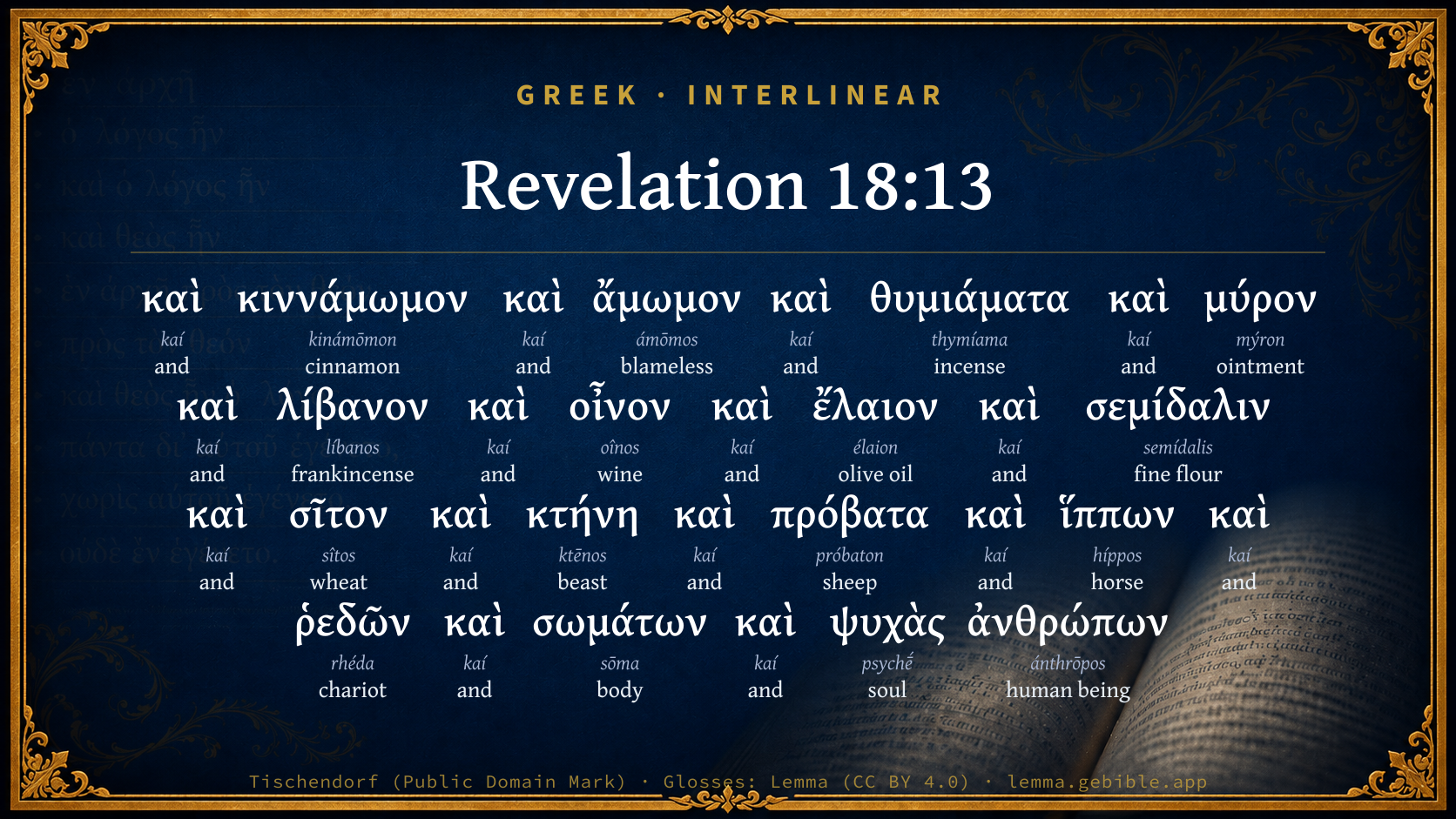
Greek (Tischendorf 8th ed.) Revelation 18:13 appears in the Greek New Testament. The text above is from the Tischendorf 8th edition. Each word links to its Strong’s number and a concise gloss. Click any word for its full Thayer’s Greek Lexicon entry.
Download image
Cite this verse

Revelation 18:13 (World English Bible). Public Domain. Lemma interlinear Bible study tool, https://lemma.gebible.app/v/revelation/18/13.

Show BibTeX & RIS
BibTeX
RIS
English Translation
and cinnamon, incense, perfume, frankincense, wine, olive oil, fine flour, wheat, sheep, horses, chariots, bodies, and people's souls.
World English Bible · Public Domain
Highlights
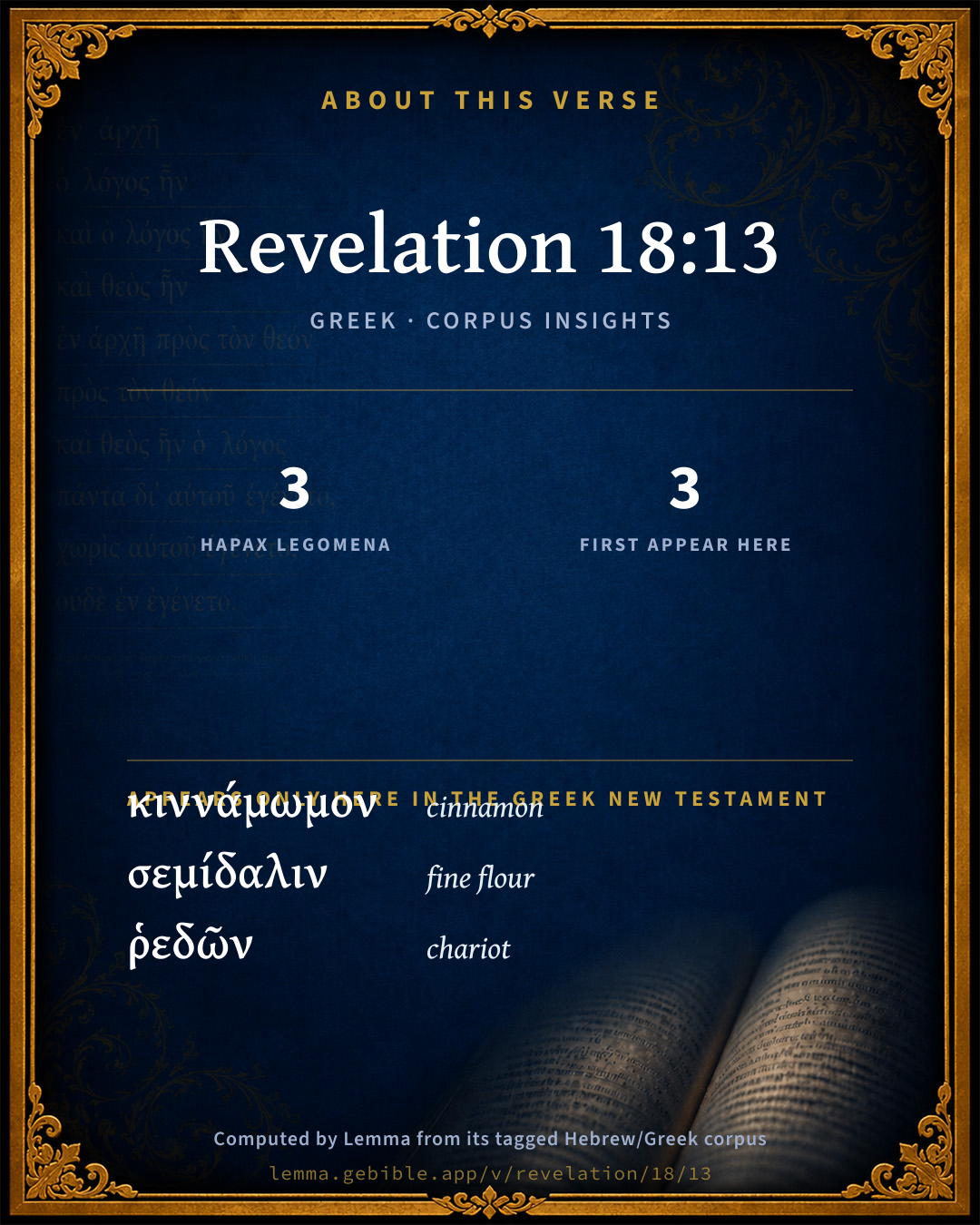
  • 3 hapax legomena — only here in the Greek New Testament
  • 3 first appearances in the Greek New Testament
Full analysis ↓
Download a study sheet

One document with this verse’s original text, its word-by-word gloss line, the meaning frame, cross-references with their text, attributed commentary, and full source and license credits — printable, and it pastes into notes with its structure intact.

This verse Autodidact and up

Study sheet (.html) Plain text (.txt)

A passage Seminary Student

Up to 50 verses in one chapter. A passage sheet keeps up to 6 commentary sources and 12 cross-references per verse, in the order this page ranks them, and says so on the sheet whenever that leaves anything out. Ask for a single verse and you get the Autodidact verse sheet above.

Everything on this page stays free to read, with no account — the sheet is a download of what is already on screen, not access to it.

Want to remove ads? Support Godless Engineer
Compare translations 3

The same verse in 3 English versions, stacked beneath the original-language interlinear above. Click any original word for its lexicon entry.

Each is an independent rendering of the whole verse — the interlinear is not word-aligned to these translations.

Highlighted words mark where these versions differ — a whole-verse word diff, not a word-by-word alignment.

  • World English Bible Public Domain
    and cinnamon, incense, perfume, frankincense, wine, olive oil, fine flour, wheat, sheep, horses, chariots, bodies, and people's souls.
  • King James Version Public Domain
    And cinnamon, and odours, and ointments, and frankincense, and wine, and oil, and fine flour, and wheat, and beasts, and sheep, and horses, and chariots, and slaves, and souls of men.
  • unfoldingWord Literal Text CC BY-SA 4.0
    and cinnamon and spice and incense and myrrh and frankincense and wine and oil and fine flour and wheat and cattle and sheep and horses and chariots and bodies and souls of men.

unfoldingWord Literal Text — © unfoldingWord, licensed CC BY-SA 4.0. Word-aligned USFM3 via Door43 (git.door43.org/unfoldingWord/en_ult).

Versions to compare (up to 4)

3 of 4 selected

Show all 19 translations

Every available English version of this verse, each an independent rendering of the whole verse.

  • World English Bible Public Domain
    and cinnamon, incense, perfume, frankincense, wine, olive oil, fine flour, wheat, sheep, horses, chariots, bodies, and people's souls.
  • Berean Standard Bible Public Domain
    of cinnamon, spice, incense, myrrh, and frankincense; of wine, olive oil, fine flour, and wheat; of cattle, sheep, horses, and chariots; of slaves and souls of men.
  • Majority Standard Bible Public Domain
    of cinnamon, incense, myrrh, and frankincense; of wine, olive oil, fine flour, and wheat; of cattle, sheep, horses, and carriages; of bodies and souls of slaves.
  • King James Version Public Domain
    And cinnamon, and odours, and ointments, and frankincense, and wine, and oil, and fine flour, and wheat, and beasts, and sheep, and horses, and chariots, and slaves, and souls of men.
  • American Standard Version (1901) Public Domain
    and cinnamon, and spice, and incense, and ointment, and frankincense, and wine, and oil, and fine flour, and wheat, and cattle, and sheep; and `merchandise' of horses and chariots and slaves; and souls of men.
  • Revised Version (1885) Public Domain
    and cinnamon, and spice, and incense, and ointment, and frankincense, and wine, and oil, and fine flour, and wheat, and cattle, and sheep; and merchandise of horses and chariots and slaves; and souls of men.
  • Geneva Bible (1599) Public Domain
    And of cinamon, and odours, and ointments, and frankincense, and wine, and oyle, and fine floure, and wheate, and beastes, and sheepe, and horses, and charets, and seruants, and soules of men.
  • Douay-Rheims (1899) Public Domain
    And cinnamon, and odours, and ointment, and frankincense, and wine, and oil, and fine flour, and wheat, and beasts, and sheep, and horses, and chariots, and slaves, and souls of men.
  • Young's Literal Translation Public Domain
    and cinnamon, and odours, and ointment, and frankincense, and wine, and oil, and fine flour, and wheat, and cattle, and sheep, and of horses, and of chariots, and of bodies and souls of men.
  • Literal Standard Version CC BY-SA 4.0
    and cinnamon, and amomum, and incense, and ointment, and frankincense, and wine, and oil, and fine flour, and wheat, and cattle, and sheep, and of horses, and of chariots, and of bodies and souls of men.
  • Unlocked Literal Bible CC BY-SA 4.0
    cinnamon, spice, incense, myrrh, frankincense, wine, oil, fine flour, wheat, cattle and sheep, horses and chariots, and slaves and human souls.
  • unfoldingWord Literal Text CC BY-SA 4.0
    and cinnamon and spice and incense and myrrh and frankincense and wine and oil and fine flour and wheat and cattle and sheep and horses and chariots and bodies and souls of men.
  • Darby Bible Public Domain
    and cinnamon, and amomum, and incense, and unguent, and frankincense, and wine, and oil, and fine flour, and wheat, and cattle, and sheep, and of horses, and of chariots, and of bodies, and souls of men.
  • World Messianic Bible Public Domain
    and cinnamon, incense, perfume, frankincense, wine, olive oil, fine flour, wheat, cattle, sheep, horses, chariots, and people’s bodies and souls.
  • Webster's Bible Public Domain
    And cinnamon, and odors, and ointments, and frankincense, and wine, and oil, and fine flour, and wheat, and beasts, and sheep, and horses, and chariots, and slaves, and souls of men.
  • Free Bible Version CC BY-SA 4.0
    shipments of cinnamon, spice, incense, myrrh, frankincense, wine, olive oil, fine flour and wheat, cattle and sheep, horses and wagons, and slaves and prisoners.
  • Bible in Basic English Public Domain
    And sweet-smelling plants, and perfumes, and wine, and oil, and well crushed grain, and cattle and sheep; and horses and carriages and servants; and souls of men.
  • Text-Critical English NT CC BY 4.0
    cargo of cinnamon, incense, myrrh, frankincense, wine, oil, fine flour, wheat, sheep, cattle, horses and chariots, and bodies and souls of men.
  • Tyndale New Testament (1534) Public Domain
    and synamon and odours and oyntmentes and frankynsence and wyne and oyle and fyne floure and wheate bestes and shepe and horsys and charrettes and boddyes and soules of men.

Literal Standard Version (2020), Covenant Press — licensed CC BY-SA 4.0. Text via the HelloAO Bible API (eBible.org). Unlocked Literal Bible (unfoldingWord) — licensed CC BY-SA 4.0. Text via the HelloAO Bible API (eBible.org). unfoldingWord Literal Text — © unfoldingWord, licensed CC BY-SA 4.0. Word-aligned USFM3 via Door43 (git.door43.org/unfoldingWord/en_ult). Free Bible Version, Dr. Jonathan Gallagher — licensed CC BY-SA 4.0. Text via the HelloAO Bible API (eBible.org).

Word by word

More ways to search: Search by grammar → Find every occurrence → Compare this word →

Practice this passage: Drill this verse → Learn its vocabulary →

κιννάμωμον
kinámōmon
G2792
“cinnamon”
Noun, Accusative, Singular, Neuter
Part of Speech
Noun
Case
Accusative
Number
Singular
Gender
Neuter
Full Thayer's Definition

Origin: of foreign origin cf G7076

TDNT: None

1. cinnamon was a well known aromatic substance, the rind of "Laurus cinnamonum" called "Korunda-gauhah" in Ceylon
  1. καὶ kaí G2532 “and” Conjunction
  2. καὶ kaí G2532 “and” Conjunction
  3. ἄμωμον ámōmos G299 “blameless” Noun, Accusative, Singular, Neuter
  4. καὶ kaí G2532 “and” Conjunction
  5. θυμιάματα thymíama G2368 “incense” Noun, Accusative, Plural, Neuter
  6. καὶ kaí G2532 “and” Conjunction
  7. μύρον mýron G3464 “ointment” Noun, Accusative, Singular, Neuter
  8. καὶ kaí G2532 “and” Conjunction
  9. λίβανον líbanos G3030 “frankincense” Noun, Accusative, Singular, Masculine
  10. καὶ kaí G2532 “and” Conjunction
  11. οἶνον oînos G3631 “wine” Noun, Accusative, Singular, Masculine
  12. καὶ kaí G2532 “and” Conjunction
  13. ἔλαιον élaion G1637 “olive oil” Noun, Accusative, Singular, Neuter
  14. καὶ kaí G2532 “and” Conjunction
  15. σεμίδαλιν semídalis G4585 “fine flour” Noun, Accusative, Singular, Feminine
  16. καὶ kaí G2532 “and” Conjunction
  17. σῖτον sîtos G4621 “wheat” Noun, Accusative, Singular, Masculine
  18. καὶ kaí G2532 “and” Conjunction
  19. κτήνη ktēnos G2934 “beast” Noun, Accusative, Plural, Neuter
  20. καὶ kaí G2532 “and” Conjunction
  21. πρόβατα próbaton G4263 “sheep” Noun, Accusative, Plural, Neuter
  22. καὶ kaí G2532 “and” Conjunction
  23. ἵππων híppos G2462 “horse” Noun, Genitive, Plural, Masculine
  24. καὶ kaí G2532 “and” Conjunction
  25. ῥεδῶν rhéda G4480 “chariot” Noun, Genitive, Plural, Feminine
  26. καὶ kaí G2532 “and” Conjunction
  27. σωμάτων sōma G4983 “body” Noun, Genitive, Plural, Neuter
  28. καὶ kaí G2532 “and” Conjunction
  29. ψυχὰς psychḗ G5590 “soul” Noun, Accusative, Plural, Feminine
  30. ἀνθρώπων ánthrōpos G444 “human being” Noun, Genitive, Plural, Masculine

About this verse

These counts appear in no published source. They are computed here, from the morphology-tagged text and Lemma’s own curated glosses. What Lemma adds →

31
words
17
distinct lemmas
Revelation
section

Notable vocabulary

3 hapax legomena — words that appear only here in the entire Greek New Testament:

  • κιννάμωμον cinnamon G2792
  • σεμίδαλιν fine flour G4585
  • ῥεδῶν chariot G4480

First appearance in Scripture

These words make their first canonical appearance in the Greek New Testament here:

  • κιννάμωμον cinnamon G2792
  • σεμίδαλιν fine flour G4585
  • ῥεδῶν chariot G4480

Shared distinctive vocabulary

λίβανον frankincense G3030 occurs in 2 verses of the Greek New Testament. Also found in:

Repetition

A word recurs within this verse:

Cross-references

20

Topical passages linked to Revelation 18:13 in the Treasury of Scripture Knowledge — connected by theme and wording, ordered by reader-vote popularity; previews shown in the World English Bible.

  • Ezekiel 27:13 Javan, Tubal, and Meshech, they were your traffickers; they traded the persons of men and vessels of brass for your merchandise.
  • Amos 2:6 Thus says Yahweh: "For three transgressions of Israel, yes, for four, I will not turn away its punishment; Because they have sold the righteous for silver, And the needy for a pair of shoes;
  • Nehemiah 5:8 I said to them, We after our ability have redeemed our brothers the Jews, that were sold to the nations; and would you even sell your brothers, and should they be sold to us? Then held they their peace, and found never a word.
  • 2 Peter 2:3 In covetousness they will exploit you with deceptive words: whose sentence now from of old doesn't linger, and their destruction will not slumber.
  • Exodus 21:16 "Anyone who kidnaps someone and sells him, or if he is found in his hand, he shall surely be put to death.
  • Deuteronomy 24:7 If a man be found stealing any of his brothers of the children of Israel, and he deal with him as a slave, or sell him; then that thief shall die: so shall you put away the evil from the midst of you.
  • Isaiah 50:1 Thus says Yahweh, Where is the bill of your mother's divorce, with which I have put her away? or which of my creditors is it to whom I have sold you? Behold, for your iniquities were you sold, and for your transgressions was your mother put away.
  • 1 Timothy 1:10 for the sexually immoral, for homosexuals, for slave-traders, for liars, for perjurers, and for any other thing contrary to the sound doctrine;
  • Deuteronomy 28:68 Yahweh will bring you into Egypt again with ships, by the way of which I said to you, You shall see it no more again: and there you shall sell yourselves to your enemies for bondservants and for bondmaids, and no man shall buy you.
  • 1 Kings 10:10 She gave the king one hundred twenty talents of gold, and of spices very great store, and precious stones: there came no more such abundance of spices as these which the queen of Sheba gave to king Solomon.
  • 1 Kings 10:15 besides [that which] the traders [brought], and the traffic of the merchants, and of all the kings of the mixed people, and of the governors of the country.
  • 1 Kings 10:25 They brought every man his tribute, vessels of silver, and vessels of gold, and clothing, and armor, and spices, horses, and mules, a rate year by year.
  • 2 Chronicles 9:9 She gave the king one hundred and twenty talents of gold, and spices in great abundance, and precious stones: neither was there any such spice as the queen of Sheba gave to king Solomon.
  • Proverbs 7:17 I have perfumed my bed with myrrh, aloes, and cinnamon.
  • Song of Solomon 5:5 I rose up to open for my beloved. My hands dripped with myrrh, My fingers with liquid myrrh, On the handles of the lock.
  • Amos 6:6 Who drink wine in bowls, And anoint themselves with the best oils; But they are not grieved for the affliction of Joseph.
  • Amos 8:6 That we may buy the poor for silver, And the needy for a pair of shoes, And sell the sweepings with the wheat?'"
  • John 12:3–8 Mary, therefore, took a pound of ointment of pure nard, very precious, and anointed the feet of Jesus, and wiped his feet with her hair. The house was filled with the fragrance of the ointment.
  • Nehemiah 5:4–5 There were also that said, We have borrowed money for the king's tribute [on] our fields and our vineyards.
  • Song of Solomon 4:13–14 Your shoots are an orchard of pomegranates, with precious fruits: Henna with spikenard plants,

Cross-references courtesy of OpenBible.info (CC BY 4.0).

Where the printed editions differ

1 variant

Places in this verse where the major printed Greek editions disagree on the wording in a way that affects the translation — a comparison of editions, not a manuscript-by-manuscript collation. The editions are the modern critical texts (Nestlé-Aland 28/27, SBL, Westcott-Hort, Tregelles, Tyndale House) and the traditional texts behind the KJV (the Textus Receptus and the Byzantine/Majority text). It is not a claim about which reading is original.

  1. Extra text
    καὶ ἄμωμον

    “and spice”

    In NA28NA27TynSBLWHTreg Not in TRByz

    καὶ ἄμωμον (kai amōmon) 'and spice' is only in older manuscripts (NA28+NA27+Tyn+SBL+WH+Treg)

Textual data: Translators Amalgamated Greek New Testament (STEPBible TAGNT) · CC BY 4.0.

Commentary

Notes on Revelation 18:13 from classic Christian and Jewish commentators (each source and its license shown beneath its notes). The classic Christian expositions comment on the surrounding passage and are grouped to its opening verse, so a note may address several verses; the Jewish commentaries on the Tanakh (Rashi and others) are per-verse, so they appear only where the commentator wrote on this verse.

Lemma curates 59 commentaries, every one of them public domain or Creative Commons licensed, each selected and text-cleaned for this edition rather than reprinted as found. About our sources →

Tyndale Open Study Notes

Tyndale Open Resources

18:13 bodies: Rome developed a huge slave market, which some historians have estimated at nearly 20% of the population.

Tyndale Open Study Notes — © Tyndale Open Resources, licensed CC BY-SA 4.0. Text via the HelloAO Bible API.

Bengel's Gnomon

Johann Albrecht Bengel

Rev 18:13. Ἄμωμον, amomum) A kind of shrub, the wood of which affords a sweet odour. [This reading is not to be omitted. Amomum is pleasing to the people of Italy.[202]—Not. Crit.]— καὶ κτήνη, καὶ πρόβατα, and beasts of burden, and sheep) These kinds differ, as בקר and צאן among the Hebrews. Thus צאן ובקר, Jeremiah 31 (Gr. 38) 12, ΚΑῚ ΚΤΗΝῶΝ ΚΑῚ ΠΡΟΒΆΤΩΝ. One of the LXX., or, as the Talmudical treatise respecting the scribes teaches, according to the number or the books of Moses, one of the five, translators has plainly expressed the passage of Gen 46:34, ἐρεῖτε, ἄνδρες κτηνοτρόφοι ἐσμὲν—βδέλυγμα γὰρ ἐστιν Αἰγυπτίοις πᾶς ποιμὴν προβάτων.—ῥεδῶν) Vulg. rhedarum. רכב, LXX., ἍΡΜΑ, which noun is found also, ch. Rev 11:9. עגלה is rendered by LXX. often, ἍΜΑΞΑ. But ῬΈΔΗ is to be found in no writer, who wrote in Greek before John. Nor does the particular object itself appear to have been known to the Greeks: for different nations delight in different forms of vehicles. Neither is rheda, or, according to Isidore, reda, a Greek word, as Andreas of Cæsareia sufficiently teaches on this passage, explaining ῬΈΔΑΝ, for the sake of the Greeks, by ὌΧΗΜΑ, as Theophylact does ΚΟΥΣΤΩΔΊΑΝ, by ΦΥΛΑΚῊΝ, Mat 27:65. Nor did rheda sound with less novelty among the Greeks, than that word ὄχημα would sound in the Latin language. It is owing to this that the Greek copyists wrote in this place ῥεδῶν with such variations.[203] The modern Greek version, ἀμάξια. Many Gallic words prevailed, as rheda, which Cicero uses, says Quintil. l. i. c. 5; but Isidore: the reda is a kind of four-wheeled carriage; these the ancients called retæ, because they had rotæ [wheels]: l. xx. 12. The Arabian version, better acquainted with Greek than with Latin, substituted of mules and camels. The word thus introduced into the Latin state, and therefore become Latin, is not without design used in this passage. This stricture indeed attacks Rome, and the luxury which is peculiar to Rome. Jerome on Isaiah 66 : With Gallic waggon, and war-chariots, and horses of Cappadocia and Spain; and carriages of Italy [REDIS ITALIÆ], etc. On the Hebrews, meant by the use of Hebrew words, comp. note on ch. Rev 7:4.— καὶ σωμάτων, καὶ ψυχὰς ἀνθρώπων) The Greeks often say σώματα instead of slaves: Tob 10:10 (11), σώματα καὶ κτήνη καὶ ἀργύριον: and thus LXX., Gen 36:6, πάντα τὰ σώματα τοῦ οἴκου αὐτοῦ. The same again, Eze 27:13, ἐνεμπορεύονταί σοι ἐν ψυχαῖς ἀνθρώπων. In both these passages נפש and אדם נפש are the words in the Hebrew. Ψυχαὶ ἀνθρώπων are used for carcases, the dead, Num 9:6; Num 19:11, but also for the living, Lev 24:17, especially captives or slaves, Num 31:35; Num 31:40; Num 31:46. In this passage, where merchants are introduced complaining, the bodies are slaves, used for carrying merchandise or their masters: the souls of men are slaves, in so far as they are in themselves counted as merchandise.

[202] AC Vulg. Syr. read ἄμωμον. B Memph. h omit it.—E.

[203] Many wrote it ῥαιδῶν. But ABC ῥεδῶν.—E.

Bengel's Gnomon of the New Testament — English translation (T&T Clark, Edinburgh, 1860) — public domain. Text from a community e-Sword module.

Expositor's Greek Testament

ed. W. Robertson Nicoll

Rev 18:13 . “Cinnamon,” an aromatic spice (the inner bark of the tree) exported from E. Asia and S. China; ἄμωμον , aromatic balsam for the hair, made from the seeds of some Fastern shrub (Verg. Ecl. iv. 25, “assyrium uolgo nascetur amomum; from Harran, Jos. Ant. xx. 2, 2) for the form, cf. Levy’s die Semit. Fremdwörter im Griech. (1895), p. 37; θυμιάματα , “incense,” in its ingredients of aromatic spices; λίβανον = “frankincense,” a fragrant gum-resin exported from S. Arabia (Isa 60:6 , Jer 6:20 ); enormous quantities of perfume were employed by the Romans, chiefly in the care of the body, but also to mix with wine at their banquets ( e.g. , Juv. vi. 303, etc.; E. Bi. 5320); σεμίδαλιν = “fine flour,” wheaten meal (LXX for סלת , cf. Deu 32:14 ; Psa 81:16 ) of the choicest kind; wine, flour, and incense were all used in sacrifices. ῥεδῶν , a Gallic word = four-wheeled “carriages” used by the well-to-do ( cf. Jerome on Isa 66 ). σωμάτων = “slaves” (later Greek, dropping the qualifying adj. δούλων or οἰκετικῶν , cf. Deissm. 160, Dittenberger’s Sylloge , 2 845, etc.). καὶ ψυχὰς (reverting awkwardly to accus.) ἀνθρώπων = “and souls of men” (from Eze 27:13 , “they traded the persons of men for thy merchandise”: ἐνεπορεύοντό σοι ἐν ψυχαῖς ἀνθρώπων , LXX, cf. 1Ch 5:21 ). The double expression is strange. If καὶ is not to be taken as “even,” identifying both, we must suppose that some distinction is intended, and that of the two σωμάτων is the more specific. Prostitutes, or female slaves, or gladiators, or even grooms and drivers ( ἵπποι καὶ ἱππεῖς , Eze 27:14 ) have been more or less convincingly suggested as its meaning. Slave-dealing (Friedländer, iii. 87 f.; Dobschütz, 266 269) was a lucrative trade under the empire, with Delos as its centre, and Asiatic youths especially were in large demand as pages, musicians, and court-attendants. Thousands of captives, after the siege of Jerusalem, were sent into slavery by the Roman government; and early Christians at this period (Clem. Rom. lv.) voluntarily went into slavery either as substitutes for others or “that with the price got for themselves they might furnish others with food”.

The Expositor's Greek Testament, edited by W. Robertson Nicoll (1897–1910) — public domain. Text from a community e-Sword module.

Jamieson, Fausset & Brown

Robert Jamieson, A. R. Fausset & David Brown

cinnamon--designed by God for better purposes: being an ingredient in the holy anointing oil, and a plant in the garden of the Beloved (Sol 4:14); but desecrated to vile uses by the adulteress (Pro 7:17).

odours--of incense. A, C, Vulgate, and Syriac prefix "and amomium" (a precious hair ointment made from an Asiatic shrub). English Version reading is supported by Coptic and ANDREAS, but not oldest manuscripts.

ointments--Greek, "ointment."

frankincense--Contrast the true "incense" which God loves (Psa 141:2; Mal 1:11).

fine flour--the similago of the Latins [ALFORD].

beasts--of burden: cattle.

slaves--Greek, "bodies."

souls of men-- (Eze 27:13). Said of slaves. Appropriate to the spiritual harlot, apostate Christendom, especially Rome, which has so often enslaved both bodies and souls of men. Though the New Testament does not directly forbid slavery, which would, in the then state of the world, have incited a slave revolt, it virtually condemns it, as here. Popery has derived its greatest gains from the sale of masses for the souls of men after death, and of indulgences purchased from the Papal chancery by rich merchants in various countries, to be retailed at a profit [MOSHEIM, III, 95, 96].

Jamieson, Fausset & Brown — Commentary Critical and Explanatory on the Whole Bible (1871) — public domain (CC PDM 1.0). Text via the HelloAO Bible API.

Adam Clarke's Commentary

Verse 13. And cinnamon] "By the sinamon is ment all maner of costly spyces, wherewith they bury their byshops and founders, lest they shoulde stinke when they translate them agayne to make them saintes for advauntage.

"By the smellynge odours, the swete herbes that they strewe abrode at theyr dedications and burials; besydes the damaske waters, bawmes, muskes, pomaunder, civet, and other curious confections they yet bestow upon theyr owne precious bodyes.

"The oyntments are such oyles as they mingle with rose water, aloes, and spike, with other mery conceits, wherwith they anoynt their holy savours and roods, to make them to sweat, and to smell sweete when they are borne abrod in procession upon their high feastfull dayes.

"Frankinsence occupye they ofte as a necessarie thinge in the sensyng of their idols, hallowinge of their paschal, conjuringe of their ploughes; besydes the blessing of their palmes, candles, ashes, and their dead men's graves, with requiescant in pace.

"With wine synge they theyr masses for money, they housell the people at Easter, they wash their aultar stones upon Maundy Thursday; they fast the holy imber dayes, besydes other banketinges all the whole years, to kepe theyr flesh chaste.

"With oyle smere they yonge infantes at baptisme and bishopping; they grease their massmongers, and gere them the mark of madian; they anele their cattell that starveth; and do many other feates els.

"Fyne floure is suche a merchandyse of theirs as far excedeth all other, and was first geven them by Pope Alexander the first, thinkinge Christes institution not sufficient, nor comly in using the common breade in that ministerie. For that ware hath brought them in their plentifull possessions, their lordshippes, fatte benifices, and prebendaries, with innumerable plesures els.

"Wheat have thei of their farms, whereof they make pardon bread and cakes, to draw people to devocion towardes them.

"Cattell receive they, offered unto their idols by the idiots of the countries, for recover of sondrye diseases; besides that they have of their tithes.

"Shepe have they, sometime of their owne pastures, sometime of begginge, sometime of bequestes for the dead, to cry them out of their feareful purgatorye, when they be asleepe at midnight.

"Great horses have they, for mortuaries, for offices, for favers, giftes, and rewardes, to be good lords unto them, that they may holde still their farmes, and to have saunder waspe their sonne and their heire a priest; or to admitte him unto a manerly benefice, that he may be called 'maister person,' and suche lyke.

"Charets have they also, or horse litters, of al manner of sorts, specially at Rome, with foote men runninge on both sides of them, to make roome for the holy fathers. Of whom some carye their owne precious bodyes, some theyr treasure, some the blessed sacramente, some holy reliques and ornamentes, some their whores, and some their bastardes. The bodyes of men must needes be judged to be at their pleasure, so long as Christen provinces be tributaries unto them, princes obediente, people subject, and their lawes at their commaundement to slea and to kyll. And to make this good, who hath not in England payd his Peter peny, sometime to acknowledge hymselfe a bondman of theirs, at the receit of his yerely howsell? Furthermore yet, besides their market muster of monkes, fryars, and priestes, they have certayne bondmen, of whom some they sell to the Venicians, some to the Genues, some to the Portingales, and some to the Turks, to row in their galleis. And laste of all, to make up their market, least any thing should escape theyr hands, these unmercifull bribers maketh marchaundise of the soules of men, to deprive Christe of his whole right, sending many unto hell, but not one unto heaven, (unlesse they maliciously murther them for the truths sake,) and all for mony. After many other sortes els, abuse they these good creatures of God, whom the Holy Ghost heere nameth. Much were it to shew here by the cronicles severally of what Pope they have received authorytie, power, and charge, to utter these wares to advauntage, and how they came firste by the old idolatrous."

Several of the most reputable MSS. versions, and some of the fathers, after cinnamon, add καιαμωμον, and amomum. What this shrub was is not easy to say, though mentioned and partially described by Pliny and Dioscorides. Some think it was a species of geranium; others, the rose of Jericho. It was an odoriferous plant supposed to be a native of Assyria; and is thus mentioned by Virgil, Eclog. iv., ver. 25:-

_________ Assyrium vulgo nascetur amomum.

"The Assyrian amomum shall grow in every soil." This is translated by some spikenard; by others lady's rose.

Thyine wood] The Thyne or Thyin is said to be a tree whose boughs, leaves, stalks, and fruit, resemble the cypress. It is mentioned by Homer, Odyss, lib. v., ver. 60; by Theophrastes, Hist. Plant, v. 5; and by Pliny, Hist. Nat. lib. xiii. c. 16. How much the different articles mentioned in the 12th and 13th verses were in request among the ancients, and how highly valued, every scholar knows.

Slaves] σωματων The bodies of men; probably distinguished here from ψυχας, souls of men, to express bondmen and freemen.

Adam Clarke's Commentary on the Bible (1810–1826) — public domain. Text from a community e-Sword/MySword module.

The Cambridge Bible for Schools and Colleges

gen. ed. J. J. S. Perowne

13. and cinnamon] Add “and amomum,”—a precious oriental ointment. The word was accidentally omitted by copyists, from its likeness to the latter part of the preceding one.

and horses] Lit., of horses,—the genitive dependent on “merchandise” is resumed.

chariots] Not war-chariots like those mentioned in the O. T., but luxurious carriages.

slaves] Comparing Eze_27:14, perhaps we are to understand grooms or coachmen, attached to the horses and chariots. The word means literally bodies, but the sense “slaves” was recognised in Greek, though not strictly classical.

souls of men] Eze_27:13. As “horses and chariots and bodies” are genitives, and “souls” accusative, we can hardly connect the last two words, “bodies and souls of men.” But while we never find in the Bible an Englishman’s horror of slavery as an institution, we are no doubt to understand that St John—perhaps even that Ezekiel—felt it to be cruel and unnatural to regard human beings as mere merchandise.

The Cambridge Bible for Schools and Colleges (gen. ed. J. J. S. Perowne; Cambridge University Press, 1878–1918) — public domain. Text from a community e-Sword module.

John Gill's Exposition

And the fruits that thy soul lusted after are departed from thee,.... Or "the autumn of the desire of thy soul"; the desirable fruits which are then in season; the Vulgate Latin and Ethiopic versions render it "apples", which are ripe in autumn; and may design all such fruit as Italy abounds with, which will now be destroyed; and seems to point at the time of year when Babylon's destruction will be: but, in the mystical sense, these fruits may intend universal dominion over nations and churches, the obedience of kings and princes, riches, honours, and pleasures of all sorts; things greatly affected by the Papacy, and of which a large harvest was expected, but now all will be at an end:

and all things which were dainty and goodly are departed from thee; all that were palatable to the taste, and pleasant to the sight, that were excellent and desirable; as the triple crown, cardinalships, archbishoprics, bishoprics, deanaries, fat benefices, and good livings:

and thou shalt find them no more at all; for this will be an utter destruction; at the Reformation these desirable things were taken from her in several nations, and in some places she has recovered them again, as in Germany and other places; and the outward court, or the reformed church, sinking into an outward show and form, will be wholly given to the Gentiles, the Papists, and they will have these things in their hands again before Rome's utter destruction, but after that they will no more be regained.

John Gill's Exposition of the Whole Bible (1746–1763) — public domain (CC PDM 1.0). Text via the HelloAO Bible API.

Trapp's Complete Commentary

John Trapp

13 And cinnamon, and odours, and ointments, and frankincense, and wine, and oil, and fine flour, and wheat, and beasts, and sheep, and horses, and chariots, and slaves, and souls of men.

Ver. 13. And cinnamon] Galen writes that in his time cinnamon was very rare, and hard to be found, except in the storehouses of great princes. And Pliny reports, that a pound of cinnamon was worth 1000 denarii, that is, 150 crowns of our money.

And chariots] Or sedans, {a} as we call them.

And slaves] Gr. σωματα, bodies, so slaves are called, because their master’s commands reach only to their bodies, and not to their souls.

And the souls of men] Tecelius, the pope’s pardon monger, persuaded the people in Germany, that whosoever would give ten shillings should at his pleasure deliver one soul out of the pains of purgatory; and as soon as the money rang in the basin, that soul was set at liberty. But if it were one jot less than ten shillings, it would profit them nothing. This gainful gullery Luther decried with all his might, and so marred the market. This gave occasion to that saying of Erasmus, whom when the Elector of Saxony asked, why Luther was so generally hated? He answered, For two faults especially; he hath been too busy with the pope’s crown and the monks’ paunches. (Scultet. Annal. dec. i.)

{a} A closed vehicle to seat one person, borne on two poles by two bearers, one in front and one behind. In fashionable use during the 17th, 18th, and early 19th cent. ŒD

John Trapp, A Commentary or Exposition upon All the Books of the Old and New Testament (1647–1656) — public domain. Text from a community e-Sword module.

Albert Barnes' Notes on the Bible

And cinnamon - Cinnamon is the aromatic bark of the Laurus Cinnamomam, which grows in Arabia, India, and especially in the island of Ceylon. It was formerly, as it is now, a valuable article in the Oriental trade.

And odours - Aromatics employed in religious worship, and for making perfumes. Mr. Gibbon (vol. i. p. 34) mentions, among the articles of commerce and luxury, in the age of the Antonines, “a variety of aromatics that were consumed in religious worship and the pomp of funerals.” It is unnecessary to say that the use of such odors has been always common at Rome.

And ointments - Unguents - as spikenard, etc. These were in common use among the ancients. See the Mat 14:7 note; Mar 14:3 note.

And frankincense - See the notes on Mat 2:11. It is unnecessary to say that incense has been always much used in public worship in Rome, and that it has been, therefore, a valuable article of commerce there.

And wine - An article of commerce and luxury in all ages.

And oil - That is, olive oil. This, in ancient times, and in Oriental countries particularly, was an important article of commerce.

And fine flour - The word here means the best and finest kind of flour.

And beasts, and sheep, and horses - Also important articles of merchandise.

And chariots - The word used here - ῥεδῶν redōn - means, properly a carriage with four wheels, or a carriage drawn by mules (Prof. Stuart). It was properly a traveling carriage. The word is of Gallic origin (Quinctil. 1:9; Cic. Mil. 10; Att. v. 17; 6:1. See Adam’s Rom. Ant. p. 525). It was an article of luxury.

And slaves - The Greek here is σωμάτων sōmatōn - “of bodies.” Prof. Stuart renders it “grooms,” and supposes that it refers to a particular kind of slaves who were employed in taking care of horses and carriages. The word properly denotes body - an animal body - whether of the human body, living or dead, or the body of a beast; and then the external man - the person, the individual. In later usage, it comes to denote a slave (see Robinson, Lexicon), and in this sense it is used here. The traffic in slaves was common in ancient times, as it is now. We know that this traffic was carried on to a large extent in ancient Rome, the city which John probably had in his eye in this description. See Gibbon, Dec. and Fall, vol. 1, pp. 25, 26. Athenaeus, as quoted by Mr. Gibbon (p. 26), says that “he knew very many Romans who possessed, not for use, but for ostentation, ten, and even twenty thousand slaves.” It should be said here, however, that although this refers evidently to traffic in slaves, it is not necessary to suppose that it would be literally characteristic of papal Rome. All this is symbolical, designed to exhibit the papacy under the image of a great city, with what was customary in such a city, or with what most naturally presented itself to the imagination of John as found in such a city; and it is no more necessary to suppose that the papacy would be engaged in the traffic of slaves, than in the traffic of cinnamon, or fine flour, or sheep and horses.

And souls of men - The word used and rendered “souls” - ψυχὰς psuchas - though commonly denoting the “soul” (properly the “breath” or “vital principle”), is also employed to denote the living thing - the animal - in which the soul or vital principle resides; and hence may denote a person or a man. Under this form it is used to denote a “servant” or “slave.” See Robinson, Lexicon. Prof. Robinson supposes that the word here means “female slaves,” in distinction from those designated by the previous word. Prof. Stuart (in loco) supposes that the previous word denotes a particular kind of slaves - those who had the care of horses - and that the word here is used in a generic sense, denoting slaves in general. This kind of traffic in the “persons” or souls of people is mentioned as characterizing ancient Tyre, in Eze 27:13; “Javan, Tubal, and Meshech, they were thy merchants; they traded in the persons of men.” It is not quite clear why, in the passage before us, this traffic is mentioned in two forms, as that of the bodies and the souls of people but it would seem most probable that the writer meant to designate all that would properly come under this traffic, whether male or female slaves were bought and sold; whether they were for servitude, or for the gladiatorial sports (see Wetstein, in loco); whatever might be the kind of servitude that they might be employed in, and whatever might be their condition in life. The use of the two words would include all that is implied in the traffic, for, in most important senses, it extends to the body and the soul. In slavery both are purchased; both are supposed, so far as he can avail himself of them, to become the property of the master.

Albert Barnes' Notes on the Bible (1834–1885) — public domain. Text from a community e-Sword/MySword module.

Haydock's Catholic Bible Commentary

We see here enumerated the articles of the luxury of the pagan Romans in dress, in ornaments, in furniture, in equipage, in the sumptuousness of their tables, &c. &c. Nothing is more remarkable than the extravagant luxury and profusion of some of the Roman emperors at their tables. Caligula once spent (according to Seneca) for a supper, 150,000 crowns. Suetonius tells us, that the emperor Vitellius would feast himself thrice, and often four times in a day, spending 10,000 crowns at each meal. But now they are all gone; they are now the fuel of fire, and in one hour brought to naught. (Haydock)

George Leo Haydock (1774–1849), Haydock's Catholic Family Bible and Commentary, 1859 edition — public domain. Excludes Psalms (Douay-Rheims chapter numbering differs from Protestant) and Deuterocanonical books (Catholic canon only).

Whedon's Commentary on the Bible

Daniel D. Whedon

13. Cinnamon… odours… ointments, and frankincense—The most refined perfumeries.

Wine… oil… fine flour… wheat—Luxuries of drink and food.

Beasts—Of burden.

Sheep… horses… chariots… slaves—Or, as Stuart well renders, grooms. Mostly the means of conveyance.

And souls of men—The phrase in Eze_27:13, rendered in our translation “persons of men,” is literally, in the Hebrew, “souls of men,” who, as being then “traded,” were clearly slaves. The same phrase is used by St. Paul, (Rom_2:9,) “every soul of man,” in an elevated sense; and it is here used with an aggravating and condemnatory emphasis.

Daniel D. Whedon (gen. ed.), Commentary on the Old and New Testaments (1874–1909) — public domain. Text from a community e-Sword module.

The Pulpit Commentary

And cinnamon, and odours, and ointments, and frankincense; and cinnamon, and amomon, and incense, and ointment, and frankincense. These constitute the third class (see on ver. 12). Cinnamon, an Indian tree, was in use in the Levitical ritual. (Exo_30:23) It is referred to as a perfume in Pro_7:17. Amomon, which is emitted in the Textus Receptus, is found in a, A, C. P, etc. It is rendered in the Revised Version by "spice. Its use was similar to that of cinnamon. Its seeds are used under the name "cardamoms. And wine, and oil, and fine flour, and wheat. These form the fourth class. (see on ver. 12; cf. Lev_2:1, Lev_2:2) And beasts, and sheep, and horses, and chariots, and slaves; and cattle, etc. The word rendered "slaves" is swmatwn , "bodies," i.e. slaves. At the word "horses" the nouns are again placed in the genitive (see on ver. 12). These form the fifth class (see on ver. 12). "Chariots," dedh , is not the word used in Rev_9:9. It is a word probably of Gaulish origin. And souls of men. The accusative again. Not in the ordinary acceptation of the word "souls," but rather "lives of men," as the Revised Version margin; that is, "living men." It is probable that the two expressions, "bodies" (vide supra) and "souls of men," refer to two classes of slaves.

The Pulpit Commentary (1880–1919), ed. H.D.M. Spence-Jones & Joseph S. Exell — public domain. Text from a community e-Sword module.

John Wesley's Explanatory Notes

Amomum - A shrub whose wood is a fine perfume. And beasts - Cows and oxen. And of chariots - a purely Latin word is here inserted in the Greek. This St. John undoubtedly used on purpose, in describing the luxury of Rome. And of bodies - A common term for slaves. And souls of men - For these also are continually bought and sold at Rome. And this of all others is the most gainful merchandise to the Roman traffickers.

John Wesley, Explanatory Notes Upon the Whole Bible (1754–1765) — public domain. Text via the GEBible commentary corpus.

The People's New Testament

B. W. Johnson

13. Slaves and souls of men. The Greek reads, “the bodies and souls of men.” The first seems to refer to the traffic in slaves, a common traffic until modern times and sanctioned by the Papacy. The latter expression seems to me to refer to a spiritual traffic. What is the whole system of masses for the dead, paid for out of the money drawn from mourning relatives, but a traffic in the souls of men?

B. W. Johnson's The People's New Testament with Notes (1889–1891) — public domain. Electronic text from the Christian Classics Ethereal Library (CCEL) ThML edition.

Cambridge Greek Testament for Schools and Colleges

13. καὶ κιννάμωμον, καὶ ἄμωμον. אB2 Primas[665] (?) read καὶ κινναμώμου. אCB2 Primas[666] omit καὶ ἄμωμον.

[665] Primasius, edited by Haussleiter.

[666] Primasius, edited by Haussleiter.

θυμιάματα. 1 Primas[667] read θυμίαμα, B2 θυμιάματος.

[667] Primasius, edited by Haussleiter.

καὶ μύρον. C omits.

καὶ ψυχὰς ἀνθρώπων. Primas[668] omits (mancipia = σωμάτων).

[668] Primasius, edited by Haussleiter.

13. κιννάμωμον yielded a scented oil, and was also used for burning.

ἄμωμον. Chiefly used like μύρον for scenting the person.

θυμιάματα. Used for burning like λίβανον: the demand was large, as it was the commonest act of worship to cast incense on public or domestic altars.

ῥεδῶν. It is a little remarkable that travelling carriages, though the name is Gallic, were imported by sea.

σωμάτων. Eze 27:14 ἵπποι καὶ ἱππεῖς (compared with ἴππων … σωμάτων here) suggests that this may mean “drivers,” or “grooms.”

ψυχὰς ἀνθρώπων. Eze 27:13 (where E. V[689] translates ‘persons of men’). While we never find in the Bible an Englishman’s horror of slavery as an institution, we are no doubt to understand that St John—perhaps even that Ezekiel—felt it to be cruel and unnatural to regard human beings as mere merchandise.

[689] V. English Version.

Cambridge Greek Testament for Schools and Colleges (Cambridge University Press, 1896; 21 vols, various authors incl. Carr, Maclear, Plummer, Farrar, Lumby, Moule, M. R. James, Simcox) — public domain. Text from a community e-Sword module.

Vincent's Word Studies in the New Testament

Marvin R. Vincent

Cinnamon [κιναμωμον] . Mentioned as one of the ingredients of the holy oil for anointing (Exo 30:23), and as a perfume for the bed (Pro 7:17).

And spice [και αμωμον] . These words are added by the best texts. A fragrant Indian plant, with seed in grape - like clusters, from which ointment was made. Preparations for the hair were made from it. Virgil, describing the coming golden age, says : "The Assyrian amomum shall spring up as a common plant" (" Eclogue "4, 25; Compare" Eclogue " 3, 89). Forbiger (Virgil) says that the best was raised in Armenia, a poorer quality in Media and Pontus.

Fine flour [σεμιδαλιν] . Only here in the New Testament.

Cattle [κτηνη] . See on Luk 10:34.

Merchandise of horses. Merchandise is not in the text. It resumes the construction of gomon merchandise with the genitive in ver. 12.

Chariots [ρεδων] . A Latin word though of Gallic origin, rheda. It had four wheels.

Marvin R. Vincent, Word Studies in the New Testament (1887–1900) — public domain. Text from a community e-Sword/MySword module.

Lesson kit

Teaching starters — assembled from the data on this page, not authored interpretation. Every prompt links to the verse data it draws on. Edit before teaching.

Revelation, in the Revelation, opens this verse with 31 words (17 distinct Greek lemmas). Its most distinctive word is kinámōmon (“cinnamon”). A historical commentator’s framing appears above. Read the whole chapter for the surrounding context.

Discussion questions

  1. The word kinámōmon carries the sense “cinnamon.” How does it shape the verse?
  2. This verse holds 3 words here found nowhere else in the Greek New Testament. What might the rare words draw attention to?
  3. 3 words here appear for the first time in Scripture. What is being introduced at this debut?
  4. Matthew 2:11 shares the word «frankincense» with this verse. How do the two illuminate each other?
  5. “and” occurs 15× in this one verse. What is the effect of the repetition?
  6. The translations on this page render this verse differently — a whole-verse word diff, not a word-by-word alignment. What might account for the different wordings?
  7. Reading how Tyndale Open Study Notes and Bengel's Gnomon read this verse, where do the two commentators agree and where do they part?

Things to notice

  • 3 words in this verse appear nowhere else in the Greek New Testament.
  • 3 words make their first canonical appearance in Scripture here.
  • These translations choose different wording for 13 words in this verse.
  • “and” occurs 15× in this single verse.
  • 17 distinct Greek lemmas span 31 words in this verse.

Reading settings

Reading text

Shown beneath each verse's original-language words.

Old Testament
Old Testament edition

Read the OT as the Masoretic Hebrew (MT) or the Greek Septuagint (LXX).

English shown for the Greek Septuagint (in the Hebrew ↔ Greek comparison).

Comparing translations? Open the Compare panel on any verse page to stack up to four side by side.