
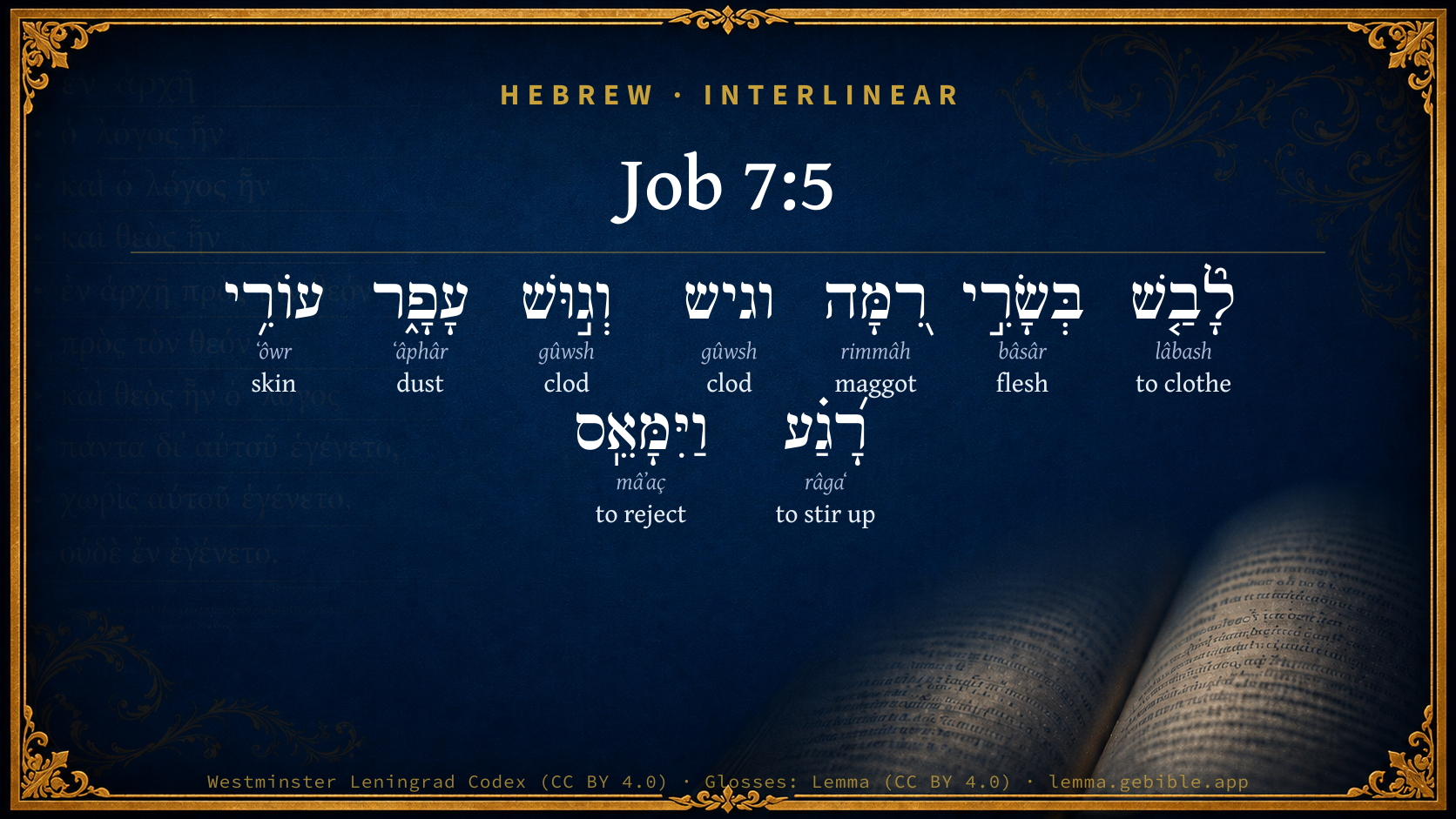
Job 7:5

Hebrew (Westminster Leningrad Codex) Job 7:5 appears in the Hebrew Old Testament. The text above is from the Westminster Leningrad Codex. Each word links to its Strong’s number, a concise gloss, and parsing drawn from the Open Scriptures Hebrew Bible morphology. Click any word for its full Brown-Driver-Briggs (BDB) entry.
Download image
Cite this verse

Job 7:5 (World English Bible). Public Domain. Lemma interlinear Bible study tool, https://lemma.gebible.app/v/job/7/5.

Show BibTeX & RIS
BibTeX
RIS
English Translation
My flesh is clothed with worms and clods of dust. My skin closes up, and breaks out afresh.
World English Bible · Public Domain
Highlights
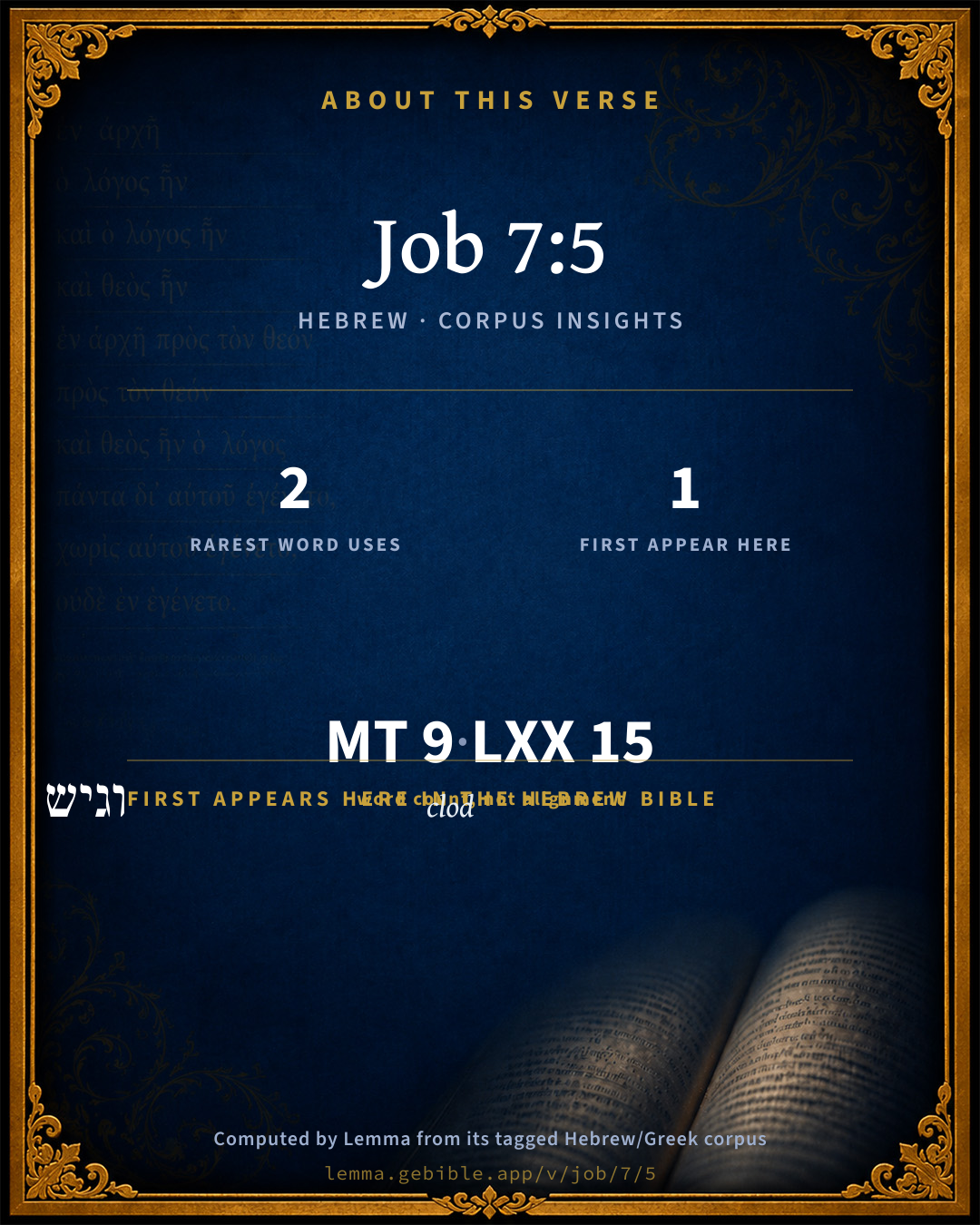
  • 1 first appearance in the Hebrew Bible
Full analysis ↓
Download a study sheet

One document with this verse’s original text, its word-by-word gloss line, the meaning frame, cross-references with their text, attributed commentary, and full source and license credits — printable, and it pastes into notes with its structure intact.

This verse Autodidact and up

Study sheet (.html) Plain text (.txt)

A passage Seminary Student

Up to 50 verses in one chapter. A passage sheet keeps up to 6 commentary sources and 12 cross-references per verse, in the order this page ranks them, and says so on the sheet whenever that leaves anything out. Ask for a single verse and you get the Autodidact verse sheet above.

Everything on this page stays free to read, with no account — the sheet is a download of what is already on screen, not access to it.

Want to remove ads? Support Godless Engineer
Compare translations 3

The same verse in 3 English versions, stacked beneath the original-language interlinear above. Click any original word for its lexicon entry.

Each is an independent rendering of the whole verse — the interlinear is not word-aligned to these translations.

Highlighted words mark where these versions differ — a whole-verse word diff, not a word-by-word alignment.

  • World English Bible Public Domain
    My flesh is clothed with worms and clods of dust. My skin closes up, and breaks out afresh.
  • King James Version Public Domain
    My flesh is clothed with worms and clods of dust; my skin is broken, and become loathsome.
  • unfoldingWord Literal Text CC BY-SA 4.0
    My flesh wears the worm and the clod of dust; my skin breaks and festers.

unfoldingWord Literal Text — © unfoldingWord, licensed CC BY-SA 4.0. Word-aligned USFM3 via Door43 (git.door43.org/unfoldingWord/en_ult).

Versions to compare (up to 4)

3 of 4 selected

Show all 18 translations

Every available English version of this verse, each an independent rendering of the whole verse.

  • World English Bible Public Domain
    My flesh is clothed with worms and clods of dust. My skin closes up, and breaks out afresh.
  • Berean Standard Bible Public Domain
    My flesh is clothed with worms and encrusted with dirt; my skin is cracked and festering.
  • Majority Standard Bible Public Domain
    My flesh is clothed with worms and encrusted with dirt; my skin is cracked and festering.
  • King James Version Public Domain
    My flesh is clothed with worms and clods of dust; my skin is broken, and become loathsome.
  • American Standard Version (1901) Public Domain
    My flesh is clothed with worms and clods of dust; My skin closeth up, and breaketh out afresh.
  • Revised Version (1885) Public Domain
    My flesh is clothed with worms and clods of dust; my skin closeth up and breaketh out afresh.
  • Geneva Bible (1599) Public Domain
    My flesh is clothed with wormes and filthinesse of the dust: my skinne is rent, and become horrible.
  • Douay-Rheims (1899) Public Domain
    My flesh is clothed with rottenness and the filth of dust, my skin is withered and drawn together.
  • Young's Literal Translation Public Domain
    Clothed hath been my flesh `with' worms, And a clod of dust, My skin hath been shrivelled and is loathsome,
  • Literal Standard Version CC BY-SA 4.0
    My flesh has been clothed [with] worms, || And a clod of dust, || My skin has been shriveled and is loathsome,
  • Unlocked Literal Bible CC BY-SA 4.0
    My flesh is clothed with worms and clods of dust; the sores in my skin harden up and then dissolve and run afresh.
  • unfoldingWord Literal Text CC BY-SA 4.0
    My flesh wears the worm and the clod of dust; my skin breaks and festers.
  • Darby Bible Public Domain
    My flesh is clothed with worms and clods of dust; my skin is broken, and suppurates.
  • World Messianic Bible Public Domain
    My flesh is clothed with worms and clods of dust. My skin closes up, and breaks out afresh.
  • Webster's Bible Public Domain
    My flesh is clothed with worms and clods of dust; my skin is broken and become lothsome.
  • Free Bible Version CC BY-SA 4.0
    My body is covered with maggots and caked in dirt; my skin is cracked, with oozing sores.
  • Bible in Basic English Public Domain
    My flesh is covered with worms and dust; my skin gets hard and then is cracked again.
  • JPS Tanakh (1917) Public Domain
    My flesh is clothed with worms and clods of dust; my skin closeth up and breaketh out afresh.

Literal Standard Version (2020), Covenant Press — licensed CC BY-SA 4.0. Text via the HelloAO Bible API (eBible.org). Unlocked Literal Bible (unfoldingWord) — licensed CC BY-SA 4.0. Text via the HelloAO Bible API (eBible.org). unfoldingWord Literal Text — © unfoldingWord, licensed CC BY-SA 4.0. Word-aligned USFM3 via Door43 (git.door43.org/unfoldingWord/en_ult). Free Bible Version, Dr. Jonathan Gallagher — licensed CC BY-SA 4.0. Text via the HelloAO Bible API (eBible.org).

Word by word

More ways to search: Search by grammar → Find every occurrence → Compare this word →

Practice this passage: Drill this verse → Learn its vocabulary →

וגיש
gûwsh
H1487
“and · clod of”
Conjunction + Noun, Common, Masculine, Singular, Construct
Part of Speech
Conjunction + Noun
Type
Common
Gender
Masculine
Number
Singular
State
Construct
Full BDB Definition

Origin: of uncertain derivation

TWOT: 333a

clod, lump
  1. לָ֘בַ֤שׁ lâbash H3847 “to clothe” Verb, Qal, Perfect, 3rd Person, Masculine, Singular
  2. בְּשָׂרִ֣י bâsâr H1320 “flesh · my” Noun, Common, Masculine, Singular, Construct + Suffix, Personal, 1st Person, Common, Singular
  3. רִ֭מָּה rimmâh H7415 “maggot” Noun, Common, Feminine, Singular, Absolute
  4. וְג֣וּשׁ gûwsh H1487 “and · clod of” Conjunction + Noun, Common, Masculine, Singular, Construct
  5. עָפָ֑ר ʻâphâr H6083 “dust” Noun, Common, Masculine, Singular, Absolute
  6. עוֹרִ֥י ʻôwr H5785 “skin · my” Noun, Common, Masculine, Singular, Construct + Suffix, Personal, 1st Person, Common, Singular
  7. רָ֝גַ֗ע râgaʻ H7280 “to stir up” Verb, Qal, Perfect, 3rd Person, Masculine, Singular
  8. וַיִּמָּאֵֽס mâʼaç H3988 “and · to reject” Conjunction + Verb, Niphal, Sequential Imperfect, 3rd Person, Masculine, Singular

About this verse

These counts appear in no published source. They are computed here, from the morphology-tagged text and Lemma’s own curated glosses. What Lemma adds →

9
words
8
distinct lemmas
Wisdom
section

Notable vocabulary

The rarest word here is וגיש clod H1487 — appearing just 2 times in the whole Hebrew Bible.

First appearance in Scripture

This word makes its first canonical appearance in the Hebrew Bible here:

Grammatical profile

  • 3 verbs
  • 6 nouns

Verb forms

  • לָ֘בַ֤שׁ Qal · Perfect
  • רָ֝גַ֗ע Qal · Perfect
  • וַיִּמָּאֵֽס Niphal · Sequential Imperfect

Repetition

A word recurs within this verse — often emphatic in Hebrew:

  • וגיש clod H1487 ×2

Hebrew & Septuagint length

In English translation the verse runs 18 words from the Hebrew and 20 from the Septuagint (LXX English) — closely comparable.

A rough comparison of the two English renderings, which tokenize alike — not a word-level alignment.

Word counts can differ between the Hebrew and the Greek without any difference in meaning — e.g. the Hebrew direct-object marker אֵת has no separate Greek word, and Greek often adds the article ὁ.

In the original languages it is 9 Hebrew tokens and 15 Greek tokens — but the two are counted differently (Hebrew bundles its prefixes and suffixes into one token; the Greek is in lemma form), so that isn’t a like-for-like length.

Cross-references

12

Topical passages linked to Job 7:5 in the Treasury of Scripture Knowledge — connected by theme and wording, ordered by reader-vote popularity; previews shown in the World English Bible.

  • Job 17:14 If I have said to corruption, 'You are my father;' To the worm, 'My mother,' and 'my sister;'
  • Isaiah 14:11 Your pomp is brought down to Sheol, [and] the noise of your viols: the worm is spread under you, and worms cover you.
  • Job 2:7–8 So Satan went forth from the presence of Yahweh, and struck Job with painful sores from the sole of his foot to his head.
  • Job 9:31 Yet you will plunge me in the ditch. My own clothes shall abhor me.
  • Job 19:26 After my skin is destroyed, Then in my flesh shall I see God,
  • Job 24:20 The womb shall forget him. The worm shall feed sweetly on him. He shall be no more remembered. Unrighteousness shall be broken as a tree.
  • Job 30:18–19 By great force is my garment disfigured. It binds me about as the collar of my coat.
  • Psalms 38:5–7 My wounds are loathsome and corrupt, Because of my foolishness.
  • Isaiah 1:6 From the sole of the foot even to the head there is no soundness in it: Wounds, welts, and open sores. They haven't been closed, neither bandaged, neither soothed with oil.
  • Isaiah 66:24 They shall go forth, and look on the dead bodies of the men who have transgressed against me: for their worm shall not die, neither shall their fire be quenched; and they shall be an abhorring to all flesh.
  • Ezekiel 20:43 There shall you remember your ways, and all your doings, in which you have polluted yourselves; and you shall loathe yourselves in your own sight for all your evils that you have committed.
  • Acts 12:23 Immediately an angel of the Lord struck him, because he didn't give God the glory, and he was eaten by worms and died.

Cross-references courtesy of OpenBible.info (CC BY 4.0).

Hebrew and Greek witnesses Masoretic Hebrew ↔ Greek Septuagint

The same verse in the two great witnesses to the Old Testament, shown verse-for-verse.

These are two independent witnesses, not word-aligned to each other, and the Septuagint is shown in lemma (dictionary) form.

Hebrew Job 7:5 Masoretic · Westminster Leningrad Codex

לָ֘בַ֤שׁ בְּשָׂרִ֣י רִ֭מָּה וגיש וְג֣וּשׁ עָפָ֑ר עוֹרִ֥י רָ֝גַ֗ע וַיִּמָּאֵֽס

My flesh is clothed with worms and clods of dust. My skin closes up, and breaks out afresh.

World English Bible · Public Domain

Greek LXX Job 7:5 Septuagint · lemma form

φύρομαι δέ ἐγώ ὁ σῶμα ἐν σαπρία σκώληξ τήκω δέ βῶλαξ γῆ ἀπό ἰχώρ ξύω

And my body is covered with loathsome worms; and I waste away, scraping off clods of dust from my eruption.

LXX2012 (modern English Septuagint) · Public Domain

On this verse, Albert Barnes' Notes on the Bible discusses the Septuagint’s reading. Read the note in Commentary ↓

Hebrew: Westminster Leningrad Codex (CC BY 4.0). Greek: Septuagint (public domain); English from LXX2012 (modern English Septuagint) (Public Domain). How the Septuagint differs from the Hebrew →

Commentary

Notes on Job 7:5 from classic Christian and Jewish commentators (each source and its license shown beneath its notes). The classic Christian expositions comment on the surrounding passage and are grouped to its opening verse, so a note may address several verses; the Jewish commentaries on the Tanakh (Rashi and others) are per-verse, so they appear only where the commentator wrote on this verse.

Lemma curates 59 commentaries, every one of them public domain or Creative Commons licensed, each selected and text-cleaned for this edition rather than reprinted as found. About our sources →

Trapp's Complete Commentary

John Trapp

Job 7:5 My flesh is clothed with worms and clods of dust; my skin is broken, and become loathsome.

Ver. 5. My flesh is clothed with worms] Here Job showeth how and whence his nights were so wearisome and restless; he was in his grave clothes before he died (saith Mr Caryl), viz. a gown of worms set or embroidered with clods of dust. Covered he was with sores, and putrefied ulcers full of worms, which made him abhorring to himself.

And clods of dust] A fit dress for a dying man. The word signifieth the filings of any metal, or the scrapings of an unclean thing. He meaneth then the scurf, scraped off from him, or the dust contracted by his sitting upon the ground, Job 2:8.

My skin is broken] Or, cleft and chapped (as the earth is in drought), in most loathsome and formidable manner.

And become loathsome] Or melted, as in that distemper which physicians call corruptionem totius substantiae; or as in the leprosy or gangrene, when the flesh falleth off from the bones. Hinc igitur disce patientiam in morbis, saith Lavater. Hence, then, learn to be patient under the most noisome and troublesome diseases. What though thou be in such a pickle all over, that thou canst neither stand, nor walk, nor sit, nor lie, nor live, nor die: was not this holy Job’s condition, and worse? Remember that there are not a few sick as heart can hold, sore all over, and want necessary food and physic which thou dost not; consider that God could, and justly might, lay more and heavier plagues upon thee, &c. When Dr Munster was sick, and some friends came to visit him, being very sorry for pains he was put to by the ulcers of his body; O my dear friends, said he, these boils and blains, gemmae sunt et pretiosa ornamenta Dei, are God’s gems and jewels wherewith he adorneth his friends, that he may draw them to himself; which ornaments let us esteem far more precious than all the gold and wealth of this whole world. Soon after which speech he piously and peaceably fell asleep in the Lord. Craterus also, when he saw his body begin to swell with a dropsy, and other distempers, Euge Dee sit laus et gloria, said he, Oh, blessed be God, that my deliverance is at hand, et horula gratissima, and that sweet hour that shall put an end to all my miseries (Melch. Adam).

John Trapp, A Commentary or Exposition upon All the Books of the Old and New Testament (1647–1656) — public domain. Text from a community e-Sword module.

Joseph Benson's Commentary

Job 7:5-6. My flesh is clothed with worms — Which were bred out of his corrupted flesh and sores, and which, it seems, covered him all over like a garment. And clods of dust — The dust of the earth on which he lay. My skin is broken — By ulcers breaking out in all parts of it. My days are swifter than a weaver’s shuttle — Which passes in a moment from one side of the web to the other. So the time of my life hastens to a period; and therefore vain are those hopes which you would give me of a restoration to my former prosperity in this world. And are spent without hope — Of enjoying any good day here.

Joseph Benson's Commentary on the Old and New Testaments (1811–1818) — public domain. Text from a community e-Sword module.

Tyndale Open Study Notes

Tyndale Open Resources

7:5 Job’s reference to maggots signified mortality (25:6) and the rampant corruption of Sheol (17:14; 21:26; 24:20; see Isa 14:11).

Tyndale Open Study Notes — © Tyndale Open Resources, licensed CC BY-SA 4.0. Text via the HelloAO Bible API.

Geneva Bible (1599)

Geneva Bible translators

This signifieth that his disease was rare and most horrible.

Geneva Bible (1599) marginal notes — public domain. Text via Bolls.life.

Jamieson, Fausset & Brown

Robert Jamieson, A. R. Fausset & David Brown

In elephantiasis maggots are bred in the sores (Act 12:23; Isa 14:11).

clods of dust--rather, a crust of dried filth and accumulated corruption (Job 2:7-8).

my skin is broken and . . . loathsome--rather, comes together so as to heal up, and again breaks out with running matter [GESENIUS]. More simply the Hebrew is, "My skin rests (for a time) and (again) melts away" (Psa 58:7).

Jamieson, Fausset & Brown — Commentary Critical and Explanatory on the Whole Bible (1871) — public domain (CC PDM 1.0). Text via the HelloAO Bible API.

Adam Clarke's Commentary

Verse 5. My flesh is clothed with worms] This is perhaps no figure, but is literally true: the miserably ulcerated state of his body, exposed to the open air, and in a state of great destitution, was favourable to those insects that sought such places in which to deposit their ova, which might have produced the animals in question. But the figure is too horrid to be farther illustrated.

Clods of dust] I believe all the commentators have here missed the sense. I suppose Job to allude to those incrustations of indurated or dried pus, which are formed on the tops of pustules in a state of decay: such as the scales which fall from the pustules of the smallpox, when the patient becomes convalescent. Or, if Job's disease was the elephantiasis, it may refer to the furfuraceous scales which are continually falling off the body in that disorder. It is well known, that in this disease the skin becomes very rigid, so as to crack across, especially at the different joints, out of which fissures a loathsome ichor is continually exuding. To something like this the words may refer, My SKIN is BROKEN, and become LOATHSOME.

Adam Clarke's Commentary on the Bible (1810–1826) — public domain. Text from a community e-Sword/MySword module.

Ellicott's Commentary for English Readers

(5) With worms and clods of dust.—It is characteristic of Elephantiasis that the skin becomes hard and rugous, and then cracks and becomes ulcerated.

A Bible Commentary for English Readers, edited by Charles John Ellicott (1878–1897) — public domain. Text from a community e-Sword module.

The Cambridge Bible for Schools and Colleges

gen. ed. J. J. S. Perowne

5. with worms and clods of dust] His ulcers bred worms; and the hard earthy-like crust of his sores he calls lumps of dust.

is broken, and become loathsome] Rather, my skin closes and breaks afresh—the allusion being to the alternate gathering and running of his sores, which went on continually.

Job_7:1-5 describe the pain of life; the following verses, 6–10, its brevity and utter extinction in death. There is no break, however, in the connexion, for it is the exhausting pains described in Job_7:3-5 that naturally suggest the hopeless brevity of his life. Job has been thought inconsistent in complaining that life being evil is also brief. But in his view life itself is the highest good; it should be free of evil and prolonged. And his complaint is that human life has been made by God both evil and brief; cf. ch. Job_14:1 seq.

The Cambridge Bible for Schools and Colleges (gen. ed. J. J. S. Perowne; Cambridge University Press, 1878–1918) — public domain. Text from a community e-Sword module.

John Gill's Exposition

My flesh is clothed with worms and clods of dust,.... Not as it would be at death, and in the grave, as Schmidt interprets it, when it would be eaten with worms and reduced to dust; but as it then was, his ulcers breeding worms, or lice, as some (y); these spread themselves over his body: some think it was the vermicular or pedicular disease that was upon him, and the scabs of them, which were all over him like one continued crust, were as a garment to him; or those sores of his, running with purulent matter, and he sitting and rolling himself in dust and ashes, and this moisture mingling therewith, and clotted together, formed clods of dust, which covered him all over; a dismal spectacle to look upon! a precious saint in a vile body!

my skin is broken: with the boils and ulcers in all parts, and was parched and cleft with the heat and breaking of them:

and become loathsome; to himself and others; exceeding nauseous, and extremely disagreeable both to sight and smell: or "liquefied" (z); moistened with corrupt matter flowing from the ulcers in all parts of his body; the word in Arabic signifies a large, broad, and open wound, as a learned man (a) has observed; and it is as if he should say, whoever observes all this, this long time of distress, night and day, and what a shocking figure he was, as here represented, could blame him for wishing for death in the most passionate manner?

(y) So Sephorno and Bar Tzemach. (z) "liquefit", Junius & Tremellius; "colliquefacta est", Piscator, Mercerus. (a) Hinckelman. Praefat. ad Alcoran. p. 30.

John Gill's Exposition of the Whole Bible (1746–1763) — public domain (CC PDM 1.0). Text via the HelloAO Bible API.

Albert Barnes' Notes on the Bible

My flesh is clothed with worms - Job here undoubtedly refers to his diseased state, and this is one of the passages by which we may learn the nature of his complaint; compare the notes at Job 2:7. There is reference here to the worms which are produced in ulcers and in other forms of disease. Michaelis remarks that such effects are produced often in the elephantiasis. Bochart, Hieroz. P. II, Lib. IV. c. xxvi. pp. 619–621, has abundantly proved that such effects occur in disease, and has mentioned several instances where death ensued from this cause; compare Act 12:23. The same thing would often happen - and particularly in hot climates - if it were not for the closest care and attention in keeping running sores as clean as possible.

And clods of dust - Accumulated on the ulcers which covered his whole body. This effect would be almost unavoidable. Dr. Good renders this, “worms and the imprisoning dust,” and supposes that the image is taken from the grave, and that the idea in the whole passage is that of one who is “dead while he lives;” that is, of one who is undergoing putrefaction before he is buried. But the more common and correct interpretation is that which refers it to the accumulated filth attending a loathsome disease; see Job 2:8. The word which is used here and rendered clods (גוּשׁ gûsh) means a lump of earth or dust. Septuagint, βώλακας γῆς bōlakas gēs; Vulgate, sordes pulveris,” clods of earth.” The whole verse is rendered by the Septuagint,” My body swarms with the putrefaction of worms, and I moisten the clods of earth with the ichor (ἰχῶρος ichōros) of ulcers.”

My skin is broken - - רגע râga‛. This word means, to make afraid, to terrify; and then to shrink together from fear, or to contract. Here it means, according to Gesenius, that “the skin came together and healed, and then broke forth again and ran with pus.” Jerome renders it, aruit - dries up. Herder, “my skin becometh closed.” Dr. Good, “my skin becometh stiff;” and carries out his idea that the reference here is to the stiffened and rigid appearance of the body after death. Doederlin supposes that it refers to the rough and horrid appearance of the skin in the elephantiasis, when it becomes rigid and frightful by the disease. Jarchi renders it, cutis mea corrugata - my skin is rough, or filled with wrinkles. This seems to me to be the idea, that it was filled with wrinkles and corrugations; that it became stiff, fixed, frightful, and was such as to excite terror in the beholder.

And become loathsome - Gesenius, “runs again with pus.” The word here used מאס mâ'as means properly to reject, contemn, despise. A second sense which it has is, to melt, to run like water; Psa 58:7, “Let them melt away (ימאסוּ yı̂mâ'asû) as waters.” But the usual meaning is to be preferred here. His skin became abhorrent and loathsome in the sight of others.

Albert Barnes' Notes on the Bible (1834–1885) — public domain. Text from a community e-Sword/MySword module.

Matthew Poole's English Annotations

Clothed, i.e. covered all over as with a garment.

With worms; which oft breed and break forth in divers parts of living bodies, as history and experience witnesseth, and which were easily bred out of Job’s corrupted flesh and sores.

Clods of dust; either the dust of the earth upon which he lay, which his sores would quickly lick up; or the scabs of his sores, which by degrees mouldered away into dust.

My skin is broken, by ulcers breaking forth in all parts of it.

Matthew Poole's English Annotations on the Holy Bible (1683–1685) — public domain. Text from a community e-Sword/MySword module.

Whedon's Commentary on the Bible

Daniel D. Whedon

5. Worms — In the decaying sores, worms were engendered. “In cases of elephantiasis the body is covered with boils, in some of which maggots are bred, while others are covered over with a crust of dried corruption which often breaks out again.” — Justin.

Clod of dust — Crusts of earth. Earth-coloured crust, or scabs of hardened sores, cover up the wholebody like a garment. (Dillmann.)

Is broken — My skin heals and breaks open again. (Dillmann, Hitzig.) The meaning of רגע accords, according to Furst, with our Authorized Version, but Gesenius and others render it as above, heals; literally, “closes together.” In this disease the skin comes together and heals, and then breaks forth again and runs with pus. The incidental remarks of Job here and there in his speeches quite satisfactorily determine his disease to be the elephantiasis.

Daniel D. Whedon (gen. ed.), Commentary on the Old and New Testaments (1874–1909) — public domain. Text from a community e-Sword module.

The Pulpit Commentary

My flesh is clothed with worms. The leas et origo mall in elephantiasis is a worm called filaria sanguinis hominid. It is a long, fine, thread-like creature, of a white colour, smooth; and devoid of markings (Quain"s "Dictionary of Medicine," vol. 1, pp. 512, 513). And clods of dust. This is rather poetical than strictly medical. The special characteristic of elephantiasis, from which it derives its name, is that the integument, or outer skin, is "formed into large masses or folds, with a rugose condition of the surface, not unlike the appearance of an elephant"s leg" (Quain, vol. 1. p. 431). But the swellings do not contain clods of dust. My skin is broken, and become loathsome. A common feature in elephantiasis is the development and gradual growth of solid papules or tubercles in the skin. These enlarge as the disease progresses, and after a time soften and break up; and nicer is then formed, and a discharge follows of a virulent and loathsome character. Presently the discharge steps; the ulcer heals; but only to break out again in another place. In the Revised Version the passage is rendered, My skin closeth up, and breaketh afresh.

The Pulpit Commentary (1880–1919), ed. H.D.M. Spence-Jones & Joseph S. Exell — public domain. Text from a community e-Sword module.

John Wesley's Explanatory Notes

Worms - Which were bred out of Job's corrupted flesh and sores. Dust - The dust of the earth upon which he lay. Broken - By ulcers in all parts of it.

John Wesley, Explanatory Notes Upon the Whole Bible (1754–1765) — public domain. Text via the GEBible commentary corpus.

Rashi

Rabbi Shlomo Yitzchaki (Rashi)

and clods of earth Clods of earth (?) Now this is the development of rust, because it is the custom of clods of earth to moisten and cause rust.

wrinkled Heb. רגע wrinkled, as in (Isa. 51:15), “Who wrinkles (רגע) the sea.” Another explanation: עוֹרִי רָגַע is an expression of resting a wave after a wave, like wrinkles (?).

Rashi on the Tanakh — English translations: “The Judaica Press complete Tanach with Rashi, translated by A. J. Rosenberg” (CC BY 4.0); “Pentateuch with Rashi's commentary by M. Rosenbaum and A.M. Silbermann, 1929-1934” (public domain); “The Metsudah Tanach series, Lakewood, N.J” (CC BY 4.0); and “The Book of Joshua, Metsudah Publications, 1997” (CC BY 4.0). Text via Sefaria.

Lesson kit

Teaching starters — assembled from the data on this page, not authored interpretation. Every prompt links to the verse data it draws on. Edit before teaching.

Job, in the Wisdom, opens this verse with 9 words (8 distinct Hebrew lemmas). Its most distinctive word is gûwsh (“clod”). A historical commentator’s framing appears above. Read the whole chapter for the surrounding context.

Discussion questions

  1. How does “clod” (gûwsh) shape what this verse is saying?
  2. This is the first place “clod” appears in Scripture (first appears here). What does its debut here establish?
  3. How does Job 17:14, which shares this passage’s theme, read alongside this verse?
  4. What does the repetition of “clod” (2× in this one verse) do in this verse?
  5. These translations render this verse differently. What is at stake in choosing one wording over another?
  6. «לָ֘בַ֤שׁ» is a Qal Perfect verb. How does that grammatical form shape the action described?
  7. Compare how Trapp's Complete Commentary and Joseph Benson's Commentary read this verse. Where do they agree or differ?

Things to notice

Reading settings

Reading text

Shown beneath each verse's original-language words.

Old Testament
Old Testament edition

Read the OT as the Masoretic Hebrew (MT) or the Greek Septuagint (LXX).

English shown for the Greek Septuagint (in the Hebrew ↔ Greek comparison).

Comparing translations? Open the Compare panel on any verse page to stack up to four side by side.