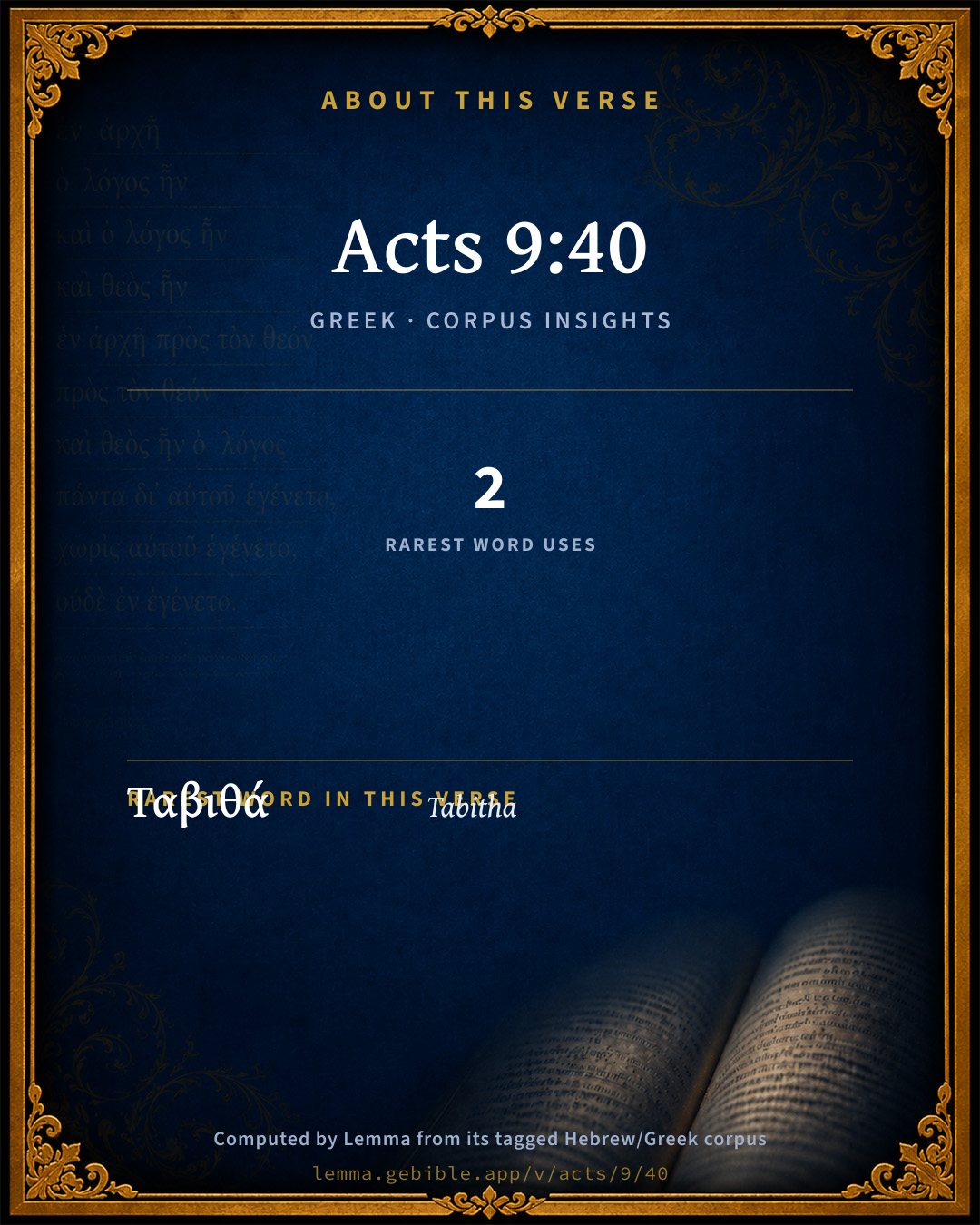
Acts 9:40

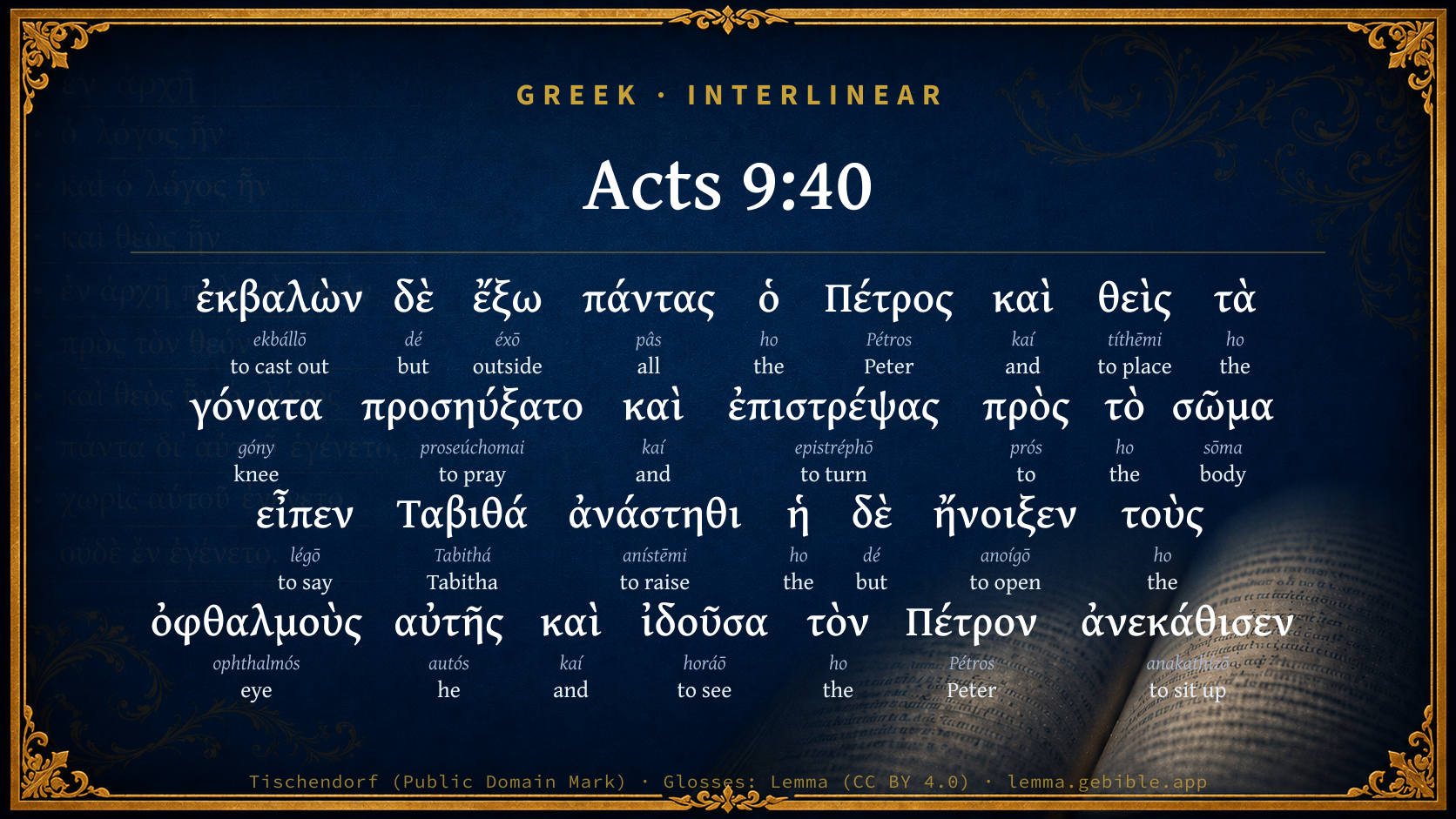
Greek (Tischendorf 8th ed.) Acts 9:40 appears in the Greek New Testament. The text above is from the Tischendorf 8th edition. Each word links to its Strong’s number and a concise gloss. Click any word for its full Thayer’s Greek Lexicon entry.
Download image
Cite this verse

Acts 9:40 (World English Bible). Public Domain. Lemma interlinear Bible study tool, https://lemma.gebible.app/v/acts/9/40.

Show BibTeX & RIS
BibTeX
RIS
English Translation
Peter put them all out, and kneeled down and prayed. Turning to the body, he said, "Tabitha, get up!" She opened her eyes, and when she saw Peter, she sat up.
World English Bible · Public Domain
Download a study sheet

One document with this verse’s original text, its word-by-word gloss line, the meaning frame, cross-references with their text, attributed commentary, and full source and license credits — printable, and it pastes into notes with its structure intact.

This verse Autodidact and up

Study sheet (.html) Plain text (.txt)

A passage Seminary Student

Up to 50 verses in one chapter. A passage sheet keeps up to 6 commentary sources and 12 cross-references per verse, in the order this page ranks them, and says so on the sheet whenever that leaves anything out. Ask for a single verse and you get the Autodidact verse sheet above.

Everything on this page stays free to read, with no account — the sheet is a download of what is already on screen, not access to it.

Want to remove ads? Support Godless Engineer
Compare translations 3

The same verse in 3 English versions, stacked beneath the original-language interlinear above. Click any original word for its lexicon entry.

Each is an independent rendering of the whole verse — the interlinear is not word-aligned to these translations.

Highlighted words mark where these versions differ — a whole-verse word diff, not a word-by-word alignment.

  • World English Bible Public Domain
    Peter put them all out, and kneeled down and prayed. Turning to the body, he said, "Tabitha, get up!" She opened her eyes, and when she saw Peter, she sat up.
  • King James Version Public Domain
    But Peter put them all forth, and kneeled down, and prayed; and turning him to the body said, Tabitha, arise. And she opened her eyes: and when she saw Peter, she sat up.
  • unfoldingWord Literal Text CC BY-SA 4.0
    But Peter, having put them all out and having put down knees, prayed, and having turned to the body, he said, “Tabitha, arise!” Then she opened her eyes and, seeing Peter, she sat up.

unfoldingWord Literal Text — © unfoldingWord, licensed CC BY-SA 4.0. Word-aligned USFM3 via Door43 (git.door43.org/unfoldingWord/en_ult).

Versions to compare (up to 4)

3 of 4 selected

Show all 19 translations

Every available English version of this verse, each an independent rendering of the whole verse.

  • World English Bible Public Domain
    Peter put them all out, and kneeled down and prayed. Turning to the body, he said, "Tabitha, get up!" She opened her eyes, and when she saw Peter, she sat up.
  • Berean Standard Bible Public Domain
    Then Peter sent them all out of the room. He knelt down and prayed, and turning toward her body, he said, “Tabitha, get up!” She opened her eyes, and seeing Peter, she sat up.
  • Majority Standard Bible Public Domain
    Then Peter sent them all out of the room. He knelt down and prayed, and turning toward her body, he said, “Tabitha, get up!” She opened her eyes, and seeing Peter, she sat up.
  • King James Version Public Domain
    But Peter put them all forth, and kneeled down, and prayed; and turning him to the body said, Tabitha, arise. And she opened her eyes: and when she saw Peter, she sat up.
  • American Standard Version (1901) Public Domain
    But Peter put them all forth, and kneeled down and prayed; and turning to the body, he said, Tabitha, arise. And she opened her eyes; and when she saw Peter, she sat up.
  • Revised Version (1885) Public Domain
    But Peter put them all forth, and kneeled down, and prayed; and turning to the body, he said, Tabitha, arise. And she opened her eyes; and when she saw Peter, she sat up.
  • Geneva Bible (1599) Public Domain
    But Peter put them all forth, and kneeled downe, and prayed, and turned him to the body, and sayd, Tabitha, arise. And she opened her eyes, and when she sawe Peter, sate vp.
  • Douay-Rheims (1899) Public Domain
    And they all being put forth, Peter kneeling down prayed, and turning to the body, he said: Tabitha, arise. And she opened her eyes; and seeing Peter, she sat up.
  • Young's Literal Translation Public Domain
    And Peter having put them all forth without, having bowed the knees, did pray, and having turned unto the body said, `Tabitha, arise;' and she opened her eyes, and having seen Peter, she sat up,
  • Literal Standard Version CC BY-SA 4.0
    And Peter having put them all forth outside, having bowed the knees, prayed, and having turned to the body, said, “Tabitha, arise”; and she opened her eyes, and having seen Peter, she sat up,
  • Unlocked Literal Bible CC BY-SA 4.0
    Peter put them all out of the room, knelt down, and prayed; then, turning to the body, he said, “Tabitha, arise.” Then she opened her eyes, and seeing Peter she sat up.
  • unfoldingWord Literal Text CC BY-SA 4.0
    But Peter, having put them all out and having put down knees, prayed, and having turned to the body, he said, “Tabitha, arise!” Then she opened her eyes and, seeing Peter, she sat up.
  • Darby Bible Public Domain
    But Peter, putting them all out, and kneeling down, prayed. And, turning to the body, he said, Tabitha, arise. And she opened her eyes, and, seeing Peter, sat up.
  • World Messianic Bible Public Domain
    Peter sent them all out, and knelt down and prayed. Turning to the body, he said, “Tavita, get up!” She opened her eyes, and when she saw Peter, she sat up.
  • Webster's Bible Public Domain
    But Peter put them all forth, and kneeled down, and prayed; and turning to the body, said, Tabitha, arise. And she opened her eyes: and when she saw Peter, she sat up.
  • Free Bible Version CC BY-SA 4.0
    Peter told them all to leave, kneeled down, and prayed. He turned to the body and said, “Tabitha, get up.” She opened her eyes, and when she saw Peter she sat up.
  • Bible in Basic English Public Domain
    But Peter made them all go outside, and went down on his knees in prayer; and turning to the body, he said, Tabitha, get up. And, opening her eyes, she saw Peter and got up.
  • Text-Critical English NT CC BY 4.0
    But Peter sent them all outside, knelt down, and prayed. Turning toward the body, he said, “Tabitha, arise.” Then she opened her eyes, and seeing Peter, she sat up.
  • Tyndale New Testament (1534) Public Domain
    And Peter put the all forth and kneled doune and prayde and turned him to the body and sayde: Tabitha aryse. And she opened her eyes and when she sawe Peter she sat vp.

Literal Standard Version (2020), Covenant Press — licensed CC BY-SA 4.0. Text via the HelloAO Bible API (eBible.org). Unlocked Literal Bible (unfoldingWord) — licensed CC BY-SA 4.0. Text via the HelloAO Bible API (eBible.org). unfoldingWord Literal Text — © unfoldingWord, licensed CC BY-SA 4.0. Word-aligned USFM3 via Door43 (git.door43.org/unfoldingWord/en_ult). Free Bible Version, Dr. Jonathan Gallagher — licensed CC BY-SA 4.0. Text via the HelloAO Bible API (eBible.org).

Word by word

More ways to search: Search by grammar → Find every occurrence → Compare this word →

Practice this passage: Drill this verse → Learn its vocabulary →

Ταβιθά
Tabithá
G5000
“Tabitha”
Noun, Proper, indeclinable
Part of Speech
Noun · Proper, indeclinable
Full Thayer's Definition

Origin: of Aramaic origin cf G6646

TDNT: None

Tabitha = "female gazelle" 1. the name of the woman that Peter raised from the dead
  1. ἐκβαλὼν ekbállō G1544 “to cast out” Verb, Aorist, Active, Participle, Nominative, Singular, Masculine
  2. δὲ dé G1161 “but” Conjunction
  3. ἔξω éxō G1854 “outside” Adverb
  4. πάντας pâs G3956 “all” Adjective, Accusative, Plural, Masculine
  5. ὁ ho G3588 “the” Article, Nominative, Singular, Masculine
  6. Πέτρος Pétros G4074 “Peter” Noun, Nominative, Singular, Masculine
  7. καὶ kaí G2532 “and” Conjunction
  8. θεὶς títhēmi G5087 “to place” Verb, Aorist, Active, Participle, Nominative, Singular, Masculine
  9. τὰ ho G3588 “the” Article, Accusative, Plural, Neuter
  10. γόνατα góny G1119 “knee” Noun, Accusative, Plural, Neuter
  11. προσηύξατο proseúchomai G4336 “to pray” Verb, Aorist, Middle deponent, Indicative, 3rd person, Singular
  12. καὶ kaí G2532 “and” Conjunction
  13. ἐπιστρέψας epistréphō G1994 “to turn” Verb, Aorist, Active, Participle, Nominative, Singular, Masculine
  14. πρὸς prós G4314 “to” Preposition
  15. τὸ ho G3588 “the” Article, Accusative, Singular, Neuter
  16. σῶμα sōma G4983 “body” Noun, Accusative, Singular, Neuter
  17. εἶπεν légō G3004 “to say” Verb, Aorist, Active, Indicative, 3rd person, Singular
  18. ἀνάστηθι anístēmi G450 “to raise” Verb, Aorist, Active, Imperative, 2nd person, Singular
  19. ἡ ho G3588 “the” Article, Nominative, Singular, Feminine
  20. δὲ dé G1161 “but” Conjunction
  21. ἤνοιξεν anoígō G455 “to open” Verb, Aorist, Active, Indicative, 3rd person, Singular
  22. τοὺς ho G3588 “the” Article, Accusative, Plural, Masculine
  23. ὀφθαλμοὺς ophthalmós G3788 “eye” Noun, Accusative, Plural, Masculine
  24. αὐτῆς autós G846 “he” Personal pronoun, Genitive, Singular, Feminine
  25. καὶ kaí G2532 “and” Conjunction
  26. ἰδοῦσα horáō G3708 “to see” Verb, Aorist, Active, Participle, Nominative, Singular, Feminine
  27. τὸν ho G3588 “the” Article, Accusative, Singular, Masculine
  28. Πέτρον Pétros G4074 “Peter” Noun, Accusative, Singular, Masculine
  29. ἀνεκάθισεν anakathízō G339 “to sit up” Verb, Aorist, Active, Indicative, 3rd person, Singular

About this verse

These counts appear in no published source. They are computed here, from the morphology-tagged text and Lemma’s own curated glosses. What Lemma adds →

30
words
21
distinct lemmas
Acts
section

Notable vocabulary

The rarest word here is Ταβιθά Tabitha G5000 — appearing just 2 times in the whole Greek New Testament.

Shared distinctive vocabulary

Ταβιθά Tabitha G5000 occurs in 2 verses of the Greek New Testament. Also found in:

Repetition

Words recur within this verse:

Cross-references

11

Topical passages linked to Acts 9:40 in the Treasury of Scripture Knowledge — connected by theme and wording, ordered by reader-vote popularity; previews shown in the World English Bible.

  • Matthew 9:25 But when the crowd was put out, he entered in, took her by the hand, and the girl arose.
  • Mark 5:40–42 They ridiculed him. But he, having put them all out, took the father of the child and her mother and those who were with him, and went in where the child was lying.
  • Luke 8:54 But he put them all outside, and taking her by the hand, he called, saying, "Child, arise!"
  • 2 Kings 4:32–36 When Elisha was come into the house, behold, the child was dead, and laid on his bed.
  • Acts 7:60 He kneeled down, and cried with a loud voice, "Lord, don't hold this sin against them!" When he had said this, he fell asleep.
  • 1 Kings 17:19–23 He said to her, Give me your son. He took him out of her bosom, and carried him up into the chamber, where he abode, and laid him on his own bed.
  • Mark 9:25 When Jesus saw that a multitude came running together, he rebuked the unclean spirit, saying to him, "You mute and deaf spirit, I command you, come out of him, and never enter him again!"
  • John 11:43–44 When he had said this, he cried with a loud voice, "Lazarus, come out!"
  • Luke 22:41 He was withdrawn from them about a stone's throw, and he knelt down and prayed,
  • Acts 20:36 When he had spoken these things, he knelt down and prayed with them all.
  • Acts 21:5 When it happened that we had accomplished the days, we departed and went on our journey. They all, with wives and children, brought us on our way until we were out of the city. Kneeling down on the beach, we prayed.

Cross-references courtesy of OpenBible.info (CC BY 4.0).

Commentary

Notes on Acts 9:40 from classic Christian and Jewish commentators (each source and its license shown beneath its notes). The classic Christian expositions comment on the surrounding passage and are grouped to its opening verse, so a note may address several verses; the Jewish commentaries on the Tanakh (Rashi and others) are per-verse, so they appear only where the commentator wrote on this verse.

Lemma curates 59 commentaries, every one of them public domain or Creative Commons licensed, each selected and text-cleaned for this edition rather than reprinted as found. About our sources →

Bengel's Gnomon

Johann Albrecht Bengel

Act 9:40. Ἑκβαλὼν, having put out) Solitude was in all respects suited to the ardour of his prayer and the greatness of the miracle: and the astonished admiration and faith on the part of all afterwards was the greater on that account.—ἀνεκάθισε) she sat up: Luk 7:15, “He that was dead sat up” (the young man at Nain).

Bengel's Gnomon of the New Testament — English translation (T&T Clark, Edinburgh, 1860) — public domain. Text from a community e-Sword module.

Meyer's Critical & Exegetical Commentary

Heinrich August Wilhelm Meyer

Act_9:40-43. The putting out (comp. Mat_9:25; Mar_5:40; Luk_8:54) of all present took place in order to preserve the earnestness of the prayer and its result from every disturbing influence.

τὸ σῶμα] the dead body. See on Luk_17:37. On ἀνεκάθισε, comp. Luk_7:15.

The explanation of the fact as an awakening from apparent death (see particularly Eck, Versuch d. Wundergesch. d. N. T. aus natürl. Urs. z. erklären, p. 248 ff.) is exegetically at decided variance with Act_9:37, but is also to be rejected historically, as the revival of the actually dead Tabitha has its historical precedents in the raisings of the dead by Jesus.[253] Ewalds view also amounts ultimately to an apparent death (p. 245), placing the revival at that boundary-line, where there may scarcely be still the last spark of life in a man. Baur, in accordance with his foregone conclusions, denies all historical character to the miracles at Lydda and Joppa, holding that they are narratives of evangelical miracles transferred to Peter (comp. also Zeller, p. 177 f.); and that the very name Ταβιθά is probably derived simply from the ταλιθά κοῦμι, Mar_5:40, for Ταβιθά properly (?) denotes nothing but maiden.

καί] and in particular.

Act_9:42. ἐπί] direction of the faith, as in Act_9:17, Act_16:31, Act_22:19; Rom_4:24.

Act_9:43. βυρσεῖ] although the trade of a tanner, on account of its being occupied with dead animals, was esteemed unclean (Wetstein and Schoettgen); which Peter now disregarded.

The word βυρσεύς (in Artemidorus and others) has also passed into the language of the Talmud (בורסי). The more classical term is βυρσοδέΨης, Plat. Conv. p. 221 E; Aristoph. Plut. 166.

[253] Hence it is just as unnecessary as it is arbitrary to assume, with Lange, apost. Zeitalt. II. p. 129, that Tabitha had for a considerable time stood in spiritual rapport with Peter, and that this was the vehicle of the reviving agency.

Meyer — Critical and Exegetical Commentary on the New Testament — English translation by Peter Christie, edited by Frederick Crombie (T&T Clark, 1880) — public domain. Text from a community e-Sword module.

Expositor's Greek Testament

ed. W. Robertson Nicoll

Act 9:40 . ἐκβαλὼν δὲ ἔξω πάντας : nothing could be more natural than this action of St. Peter as a reminiscence of his Master’s action, when He was about to perform a similar miracle, cf. Mat 9:25 , Mar 5:40 ( cf. 2Ki 4:33 , and 2Ki 4:4-5 in same chapter), but in Luk 8:54 it is noteworthy that the similar words are omitted by W.H [234] and the revisers, see above. In St. Matthew the multitude ὁ ὄχλος is put out, but in St. Mark (and St. Luke), whilst all are described as put out (the same verb), Peter, James and John, with the parents, are allowed to be present at the miracle. Weiss points out the reminiscence of Mar 5:40 , but this we might expect if St. Mark’s Gospel comes to us through St. Peter. St. Chrysostom marks the action of St. Peter as showing how entirely free he was from any attempt at display. θεὶς τὰ γόνατα , see note on Act 7:60 , “hoc Dominus ipse non fecerat” Blass. St. Peter had been present on each of the three occasions recorded in the Gospels when his Master had raised the dead, but he does not venture at once to speak the word of power, but like Elijah or Elisha kneels down in prayer (see Rendall’s note). Τ . ἀνάστηθι , cf. Mar 5:41 . Here again we note the close agreement with St. Mark’s narrative the words to the damsel are not given at all by Mat 9:25 , and by St. Luke in Greek, Luk 8:54 , not in Aramaic as by Mark. On the absurdity of identifying the Ταβιθά here with the Ταλιθά of Mar 5:41 see Nösgen and Zöckler, in loco . It may suffice to note with Lumby that in each case an interpretation of the word used is given. ἀνεκάθισε : not found in LXX, and used only by St. Luke in this passage and in his Gospel, Act 7:15 (but [235] has ἐκάθισεν , which W.H [236] reads only in margin), in both cases of a person restored to life and sitting up. In this intransitive sense it is almost entirely confined to medical writers, to describe patients sitting up in bed. It occurs in Plato, Phædo , 60 B, but in the middle voice, and with the words ἐπὶ τὴν κλίνην expressed: in Xen., Cvr. , v., 7, it is also used, but in a different sense (to sit down again), cf. Hobart, pp. 11, 40, 41, who also notices that the circumstantial details of the gradual recovery of Tabitha are quite in the style of medical description. τὸ σῶμα , Luk 17:37 , the word is quite classical for a dead body, so too in LXX, cf. Deu 21:23 , 1Ki 13:24 , 1Ma 11:4 , 2Ma 9:29 . Everything, as Wendt admits (1888), points to the fact that no apparent death, or a raising by natural means, is thought of by the narrator. Holtzmann and Pfleiderer can only find a parallel here with Act 20:9-12 , but none can read the two narratives without seeing their independence, except in the main fact that both narrate a similar miracle. ἤνοιξε τοὺς ὀφθ .: to this there is nothing corresponding in the details given by the Gospel narratives, as Blass points out.

[234] Westcott and Hort’s The New Testament in Greek: Critical Text and Notes.

[235] Codex Vaticanus (sæc. iv.), published in photographic facsimile in 1889 under the care of the Abbate Cozza-Luzi.

[236] Westcott and Hort’s The New Testament in Greek: Critical Text and Notes.

The Expositor's Greek Testament, edited by W. Robertson Nicoll (1897–1910) — public domain. Text from a community e-Sword module.

Jamieson, Fausset & Brown

Robert Jamieson, A. R. Fausset & David Brown

Peter put them all forth, and kneeled down--the one in imitation of his Master's way (Luk 8:54; and compare Kg2 4:33); the other, in striking contrast with it. The kneeling became the lowly servant, but not the Lord Himself, of whom it is never once recorded that he knelt in the performance of a miracle.

opened her eyes, and when she saw Peter, she sat up--The graphic minuteness of detail here imparts to the narrative an air of charming reality.

Jamieson, Fausset & Brown — Commentary Critical and Explanatory on the Whole Bible (1871) — public domain (CC PDM 1.0). Text via the HelloAO Bible API.

Adam Clarke's Commentary

Verse 40. Peter put them all forth, and kneeled down and prayed] It was not even known to Peter that God would work this miracle: therefore he put all the people out, that he might seek the will of God by fervent prayer, and during his supplications be liable neither to distraction nor interruption, which he must have experienced had he permitted this company of weeping widows to remain in the chamber.

And turning - to the body] σωμα, The lifeless body, for the spirit had already departed.

Said, Tabitha, arose.] During his wrestling with God, he had, undoubtedly, received confidence that she would be raised at his word.

And when she saw Peter, she sat up.] As Dorcas was a woman so eminently holy, her happy soul had doubtless gone to the paradise of God. Must she not therefore be filled with regret to find herself thus called back to earth again? And must not the remembrance of the glories she had now lost fill her with dislike to all the goods of earth? No: for,

1. As a saint of God, her Maker's will must be hers; because she knew that this will must be ever best.

2. It is very likely that, in the case of the revivescence of saint or sinner, God mercifully draws a veil over all they have seen or known, so that they have no recollection of what they have either seen or heard. Even St. Paul found it impossible to tell what he had heard in the third heaven, though he was probably not in the state of the dead. Of the economy of the invisible world God will reveal nothing. We walk here by faith, and not by sight.

Adam Clarke's Commentary on the Bible (1810–1826) — public domain. Text from a community e-Sword/MySword module.

John Calvin's Commentaries

40. When they were all put forth. When as he taketh a time to pray, he seemeth as yet to doubt what will be the end. When he healed AEneas he brake out into these words, without making any stop, AEneas, Jesus Christ make thee whole. But as the operation of the Spirit is not always alike and the same, it may be that though he knew the power of God, yet he went forward unto the miracle by degrees. Yet it seemeth to be an absurd thing, that he putteth all the saints out of the chamber, for whom it had been better to have seen it with their eyes. But because the Lord had not as yet revealed the time when, and the manner how, he would show forth his power, he desired to be alone, that he might the more fitly pray. Also it might be, that he knew some other reason which moved him to do this, which we know not. It is recorded in the Sacred History, (1 Kings 17:23,) that Elias did the same. For he being alone, and not so much as the mother of the child with him, doth stretch himself thrice upon the dead corpse. For the Spirit of God hath his vehement motions, which, if any man will square out according to the common use of men, or measure by the sense of the flesh, he shall do wickedly and unjustly. We must this think, when as Peter, as it were doubting, seeketh a by place, he preventeth superstition, lest any man should ascribe to his power the work of God, whereof he was only a minister, For he which withdrew himself from company, and did pray so instantly, did plainly confess that the matter was not in his own hand. Therefore, when Peter wisheth to know what pleaseth the Lord, he confesseth that he alone was the author of the work. Kneeling in time of prayer is a token of humility, which hath a double profit, that all our members may be applied unto the worship of God, and that the external exercise of the body may help the weakness of the mind; but we must take heed so often as we kneel down, that the inward submission of the heart be answerable to the ceremony, that it be not vain and false.

Turning towards the corpse. This seemeth also to be contrary to reason, that he speaketh unto a corpse without feeling; but this speaking unto the dead corpse was one point of the vehemency whereunto the Spirit of God enforced Peter. And if any man desire a reason, this form of speech doth more lively express the power of God in raising the dead, than if it should be said in the third person, let this body receive life again and live. Therefore, when as Ezekiel doth shadow the deliverance of the people under a figure of the resurrection:

“O dead bones,” (saith he,) “hear the word of the Lord,” (Ezekiel 37:4.)

And Christ saith,

“The time shall come when the dead shall hear the voice of the Son of God,” (John 5:25.)

For this was indeed the voice of Christ, which was uttered by the mouth of Peter, and gave [back] breath to the body of Tabitha. The circumstances following serve to confirm the certainty of the miracle.

John Calvin's Commentaries (1540-1563) — public domain. Text from the Calvin Translation Society English edition (1840s-50s) via the Christian Classics Ethereal Library (ccel.org). Calvin's coverage is partial (roughly two-thirds of the Bible); uncommented books and verses are honest gaps, never fabricated. The 19th-century editor's footnotes and remarks are omitted so the notes are faithfully Calvin's own voice.

Ellicott's Commentary for English Readers

(40) Peter put them all forth.—We may, perhaps, trace in Peter’s action his recollection of what our Lord had done in the case of the daughter of Jairus (see Notes on Mat_9:23-24), at which he had been present. The work was one not to be accomplished by the mere utterance of a name, nor as by his “own power or holiness” (Act_3:12), but by the power of the prayer of faith, and this called for the silence and solitude of communion with God. Even the very words which were uttered, if he spoke in Aramaic, must have been, with the change of a single letter, the same as the Talitha cumi of Mar_5:41. The utterance of the words implied the internal assurance that the prayer had been answered.

A Bible Commentary for English Readers, edited by Charles John Ellicott (1878–1897) — public domain. Text from a community e-Sword module.

The Cambridge Bible for Schools and Colleges

gen. ed. J. J. S. Perowne

40. But Peter put them all forth] As Christ had done (Mat_9:25) at the raising of Jairus’ daughter, on which occasion Peter had been present.

and kneeled down, and prayed] Asking God that the consolation to be given to these mourners might be the restoration of the dead woman to life.

and turning him to the body] When by the Spirit’s admonition he knew that his prayer was heard.

said, Tabitha, arise] If he spake in the Aramaic dialect, as is most probable, his utterance must have been nearly the same as that of our Lord (Mar_5:41), Talitha cumi, at the raising of the daughter of Jairus. But when both these utterances are interpreted in the places where they occur, it is astonishing to find those who would suggest that the Tabitha of this verse is an adaptation of the Talitha of the Gospel.

The Cambridge Bible for Schools and Colleges (gen. ed. J. J. S. Perowne; Cambridge University Press, 1878–1918) — public domain. Text from a community e-Sword module.

John Gill's Exposition

And he gave her his hand, and lift her up,.... Off of the bed or bier where she was:

and when he had called the saints and widows; the disciples, brethren and sisters, who were come together on this occasion, as well as the poor widows she had been kind to; the Ethiopic version reads without a copulative, "the holy widows"; and so might these widows be, even such as are described in Ti1 5:10

presented her alive; as Christ did the widow's son of Naam to her, Luk 7:15 and which no doubt was matter of great joy as well as astonishment to all the saints, and especially to the poor widows.

John Gill's Exposition of the Whole Bible (1746–1763) — public domain (CC PDM 1.0). Text via the HelloAO Bible API.

Trapp's Complete Commentary

John Trapp

40 But Peter put them all forth, and kneeled down, and prayed; and turning him to the body said, Tabitha, arise. And she opened her eyes: and when she saw Peter, she sat up.

Ver. 40. Put them all forth] That he might pray with more privacy and freedom. For he knew well that the prayer of faith could not heal the sick only, as Aeneas, Act 9:34, but raise the dead too, Heb 11:35.

John Trapp, A Commentary or Exposition upon All the Books of the Old and New Testament (1647–1656) — public domain. Text from a community e-Sword module.

Albert Barnes' Notes on the Bible

But Peter put them all forth - From the room. See a similar case in Mat 9:25. Why this was done is not said. Perhaps it was because he did not wish to appear as if seeking publicity. If done in the presence of many persons, it might seem like ostentation. Others suppose it was that he might offer more fervent prayer to God than he would be willing they should witness Compare 2Ki 4:33.

Tabitha, arise - Compare Mar 5:41-42.

Albert Barnes' Notes on the Bible (1834–1885) — public domain. Text from a community e-Sword/MySword module.

Haydock's Catholic Bible Commentary

And having put them all out, not to disturb him while he prayed. --- Sat up, raised herself a little: and Peter taking her by the hand, lifted her quite up, and calling in the company, presented her to them alive and well. (Witham)

George Leo Haydock (1774–1849), Haydock's Catholic Family Bible and Commentary, 1859 edition — public domain. Excludes Psalms (Douay-Rheims chapter numbering differs from Protestant) and Deuterocanonical books (Catholic canon only).

Matthew Poole's English Annotations

Peter put them all forth; Peter put them out, that he might pray the more earnestly, without distraction or interruption; thus Elisha shut the door to him when he prayed for the Shunammite’s son, 2Ki 4:33.

Kneeled down; this his kneeling is mentioned, to recommend reverence in our praying unto God.

And prayed: Peter, by his betaking himself unto prayer, would show, that he could do nothing by his own power, but it must come from above; and he had every mercy as much precariously, and by prayer, as any others.

Matthew Poole's English Annotations on the Holy Bible (1683–1685) — public domain. Text from a community e-Sword/MySword module.

The Pulpit Commentary

Turning for turning him, A.V.; he said for said, A.V. Peter"s action in putting them all forth seems to have been framed on the model of that scene at which he had been present when Jesus raised the daughter of Jairus; (see Luk_8:54 T.R.) (Mat_9:25; Mar_5:40) Privacy for the more earnest concentrated prayer was doubtless what he sought. Kneeled down; qeiv tanata. The same expression as in Act_7:60 Act_20:36 Act_21:5; Luk_22:41. It occurs also in Mar_15:19. Tabitha, arise. Exactly the same address as our Lord"s "Talitha", (Mar_5:40) but, as Lange observes, with this difference, that in the case of Peter it was preceded by prayer; comp. also; Luk_7:14 (where the Aramean address was probably in the same form) Joh_11:43.

Apostolic and other resurrections.

There are only eight cases of resurrection from the dead recorded in the Bible. Elijah raised the widow"s son at Zarephath. Elisha raised the Shunammite"s son. By contact with Elisha"s body in his grave, a dead man was quickened. Our Lord raised the daughter of Jairus; the son of the widow of Nain; and Lazarus of Bethany. St. Peter raised the charitable Dorcas. St. Paul restored the fallen Eutychus. Keeping these cases in mind, we may compare them with the resurrection of our Lord, and learn much from the distinct peculiarities of his resurrection.

I IN ALL OTHER CASES DEATH TOOK PLACE UNDER THE QUIET CONDITIONS OF ORDINARY DISEASE, BUT OUR LORD DIED BY A DEATH OF VIOLENCE. The little lad at Shunem was smitten by a sunstroke. The maiden at Jairus"s house was struck down by fever. Over the fading hours of Lazarus"s sickness loving sisters watched. Dorcas was for some days at least ill. Eutychus alone seems to have died by sudden accident. But our Lord"s was death in the prime of life, in the fullness of health and strength; death borne when all the human faculties were in full vigor and exercise; death by the band of violence; death judicially arranged; death voluntarily submitted to. Show that the difference is explained by our Lord"s relation to human sin.

II OTHER RESURRECTIONS WERE EFFECTED THROUGH SOME HUMAN AGENCY, THE DIVINE POWER WORKED BY SOME HUMAN MEDIUM; IN THE CASE OF OUR LORD THERE WAS NO HUMAN AGENCY WHATEVER. At Zarephath and at Shunem there were prophets, prayers, and painful efforts, to which alone returning life responded. St. Peter went into the death-chamber of Dorcas, prayed, and spoke words of faith and power. Paul fell on and embraced the dead Eutychus. But our Lord "had life in himself," and so he rose. In the gray of the dawning of that glorious Easter morn, he rose. No hand of power, no wizard"s wand, no prophet"s outstretched body, touched the sleeping King. He rose; that is all. Show what of his Divine nature is declared to us in this unique and sublime fact. He was "God manifest in the flesh.

III ALL OTHER RESURRECTIONS WERE MERELY TEMPORARY RENEWALS OF EARTHLY LIFE UNDER THE SAME OLD EARTHLY CONDITIONS. Lazarus was restored for just a few more years to his home and brotherhood, by-and-by to die again even as he died at first. Dorcas came back but to make a few more garments for the widows and the poor, and then to die again, and be hopelessly laid out for burial a second time in that upper chamber. Nobody was ever raised from the dead to live afresh sort of life under new conditions. They simply took up the thread of their old lives, as if there had been no strange break in them. The little lad ran out to his father among the reapers, just as he had done before that sad sunstroke. The maiden grew on into her womanhood as if she had never closed her eyes to the light in that time of burning fever. And the lad went to work again at Nain, to keep a home for his poor widowed mother. But in the case of our Lord there was no mere continuation of the old earthly life. The Resurrection links on to the Ascension, and Jesus risen is Jesus glorified.

IV ALL OTHER PERSONS WERE BROUGHT BACK FROM THE GRAVE ONLY TO FALL INTO ITS POWER AGAIN. We think of them with feelings in which much sadness mingles; for they were twice dead. But "Christ being raised from the dead dieth no more; death hath no more dominion over him." He liveth again; and now he liveth for ever. Man"s power to bless his fellow man is sorely limited; for he must die. Christ"s power to bless is unlimited; for he will never die. His resurrection was to a deathless and eternal life; there are no limitations that can ever check, on Christ"s side, the beneficent operations of his grace. "Wherefore he is able also to save them to the uttermost who come unto God by him, seeing he ever liveth to make intercession for them. R.T.

The Pulpit Commentary (1880–1919), ed. H.D.M. Spence-Jones & Joseph S. Exell — public domain. Text from a community e-Sword module.

John Wesley's Explanatory Notes

Peter having put them all out - That he might have the better opportunity of wrestling with God in prayer, said, Tabitha, arise. And she opened her eyes, and seeing Peter, sat up - Who can imagine the surprise of Dorcas, when called back to life? Or of her friends, when they saw her alive? For the sake of themselves, and of the poor, there was cause of rejoicing, and much more, for such a confirmation of the Gospel. Yet to herself it was matter of resignation, not joy, to be called back to these scenes of vanity: but doubtless, her remaining days were still more zealously spent in the service of her saviour and her God. Thus was a richer treasure laid up for her in heaven, and she afterward returned to a more exceeding weight of glory, than that from which so astonishing a providence had recalled her for a season.

John Wesley, Explanatory Notes Upon the Whole Bible (1754–1765) — public domain. Text via the GEBible commentary corpus.

Godbey's Commentary on the New Testament

William B. Godbey

40. We find here, and uniformly throughout the Scriptures, Peter, in harmony with the saints of all ages, kneeling in prayer. The Bible is our only guide. God help us to stick close to it. It is shocking to witness the stiff, formal worship of popular churches, not even the preacher kneeling. As Satan is doing his best to snow under the holiness movement, it is truly alarming now to frequently see people claiming sanctification sitting up during prayers. It is a withering burlesque on the profession. Good Lord, help us to remember that profession and possession are different words. “Brother Godbey, do you believe that persons are ever raised from the dead nowadays?” That the days of miracles are past is one of Satan’s buncombe lies palmed off on a backslidden church. “Lo, I am with you all the days, even unto the end of the age” (Mat 28:20). We are living in the age in which Jesus delivered this affirmation. Hence we still have with us the miracle-worker. In this case, the interment had not taken place. History authenticates not a few parallels even down to the present day. About thirty years ago a very godly young lady, by the name of Marietta Davis, died in Elmira, New York. The family was divinely impressed to retain the corpse and postpone interment till nine days had elapsed, when, to the surprise of the city, she revived, convalesced and wrote a book describing her visit to heaven during the nine days of her absence from the body. I have read the book. I remember well seeing in the introductory the name of the pastor of the Baptist Church of which she was a member, also the name of her physician, and the sworn affidavits of both, who testified under one oath of affirmation administered by a magistrate, whose name was also given, all certifying to the above stated facts. Our Savior has all power over disease and even death. I doubt not but many cases have occurred in which the human spirit has evacuated the body, as in the event of Paul’s martyrdom at Lystra, when he spent an hour in heaven and returned to reanimate his body.

William B. Godbey, Commentary on the New Testament (1896–1900) — public domain. Text from a community e-Sword module.

McGarvey & Pendleton's Commentaries

J. W. McGarvey

See notes on verse 36

J. W. McGarvey (with Philip Y. Pendleton), Commentaries on the New Testament (The Fourfold Gospel, 1914; Acts; and the epistles) — public domain. Text from a community e-Sword/MySword module.

The People's New Testament

B. W. Johnson

40. Peter put them all forth. Compare 1 Kings 17:19–23; 2 Kings 4:32–36; Matt. 9:25. Perhaps that his whole soul might be fixed on the Lord in prayer. It was on his knees that he was made to feel that the Lord had given him power. In his prayer he called on the name of Christ, was answered, and only needed to say, “Tabitha, arise,” and “she opened her eyes.” It was the first miracle in which death was overcome at the hands of an apostle.

B. W. Johnson's The People's New Testament with Notes (1889–1891) — public domain. Electronic text from the Christian Classics Ethereal Library (CCEL) ThML edition.

unfoldingWord translationNotes

Door43 World Missions Community

Connecting Statement:

The story of Tabitha ends in verse 42. Verse 43 tells us what happens to Peter after the story ends. (See: End of Story)

put them all out of the room

"told them all to leave the room." Peter had everyone leave so he could be alone to pray for Tabitha.

gave her his hand and lifted her up

Peter took hold of her hand and helped her stand up.

the believers and the widows

The widows were possibly also believers but are mentioned specifically because Tabitha was so important to them.

This matter became known throughout all Joppa

This refers to the miracle of Peter's raising Tabitha from the dead. It can be stated in active form. AT: "People throughout all Joppa heard about this matter" (See: Active or Passive)

believed on the Lord

"believed in the gospel of the Lord Jesus"

It happened that

"It came about that." This introduces the beginning of the next event in the story. (See: Introduction of a New Event)

Simon, a tanner

"a man named Simon who made leather from animal skins"

translationWords

Peter

pray

believe

Joppa

believe

lord

unfoldingWord translationNotes — © Distant Shores Media and the Door43 World Missions Community, licensed CC BY-SA 4.0. Source: git.door43.org/Door43/en_tn.

Cambridge Greek Testament for Schools and Colleges

40. ἐκβαλὼν δὲ … ὁ Πέτρος, but Peter put them all forth. Cf. Christ’s action (Mat 9:25) at the raising of Jaïrus’ daughter, on which occasion Peter had been present.

καὶ θεὶς τὰ γόνατα προσηύξατο, and kneeled down and prayed. For the first part of the phrase, cf. Act 7:60. St Peter’s request no doubt here was that the consolation to be given to these mourners might be the restoration of the dead woman to life.

καὶ ἐπιστρέψας πρὸς τὸ σῶμα, and turning him to the body. When he felt within him that his prayer would be answered.

Ταβιθὰ ἀνάστηθι, Tabitha, arise. If St Peter spake in the Aramaic dialect, as is most probable, his utterance Tabitha cumi must have been nearly the same as that of our Lord (Mar 5:41), Talitha cumi, at the raising of the daughter of Jaïrus. But when we find both these utterances interpreted in the places where they occur, it is astonishing that some should suggest that the Tabitha of this verse is an adaptation of the Talitha of the Gospel.

Cambridge Greek Testament for Schools and Colleges (Cambridge University Press, 1896; 21 vols, various authors incl. Carr, Maclear, Plummer, Farrar, Lumby, Moule, M. R. James, Simcox) — public domain. Text from a community e-Sword module.

Alford’s Greek Testament

Henry Alford

40. ἐκβαλών] After the example of his divine Master, see ref. Mark.

Henry Alford, The Greek Testament (1849–1861) — public domain. Text from a community e-Sword module.

Lesson kit

Teaching starters — assembled from the data on this page, not authored interpretation. Every prompt links to the verse data it draws on. Edit before teaching.

Acts, in the Acts, opens this verse with 30 words (21 distinct Greek lemmas). Its most distinctive word is Tabithá (“Tabitha”). A historical commentator’s framing appears above. Read the whole chapter for the surrounding context.

Discussion questions

  1. How does “Tabitha” (Tabithá) shape what this verse is saying?
  2. Acts 9:36 shares the word «Tabitha» with this verse. How do the two illuminate each other?
  3. “Peter” occurs 2× in this one verse. What is the effect of the repetition?
  4. These translations render this verse differently. What is at stake in choosing one wording over another?
  5. Reading how Bengel's Gnomon and Meyer's Critical & Exegetical Commentary read this verse, where do the two commentators agree and where do they part?

Things to notice

Reading settings

Reading text

Shown beneath each verse's original-language words.

Old Testament
Old Testament edition

Read the OT as the Masoretic Hebrew (MT) or the Greek Septuagint (LXX).

English shown for the Greek Septuagint (in the Hebrew ↔ Greek comparison).

Comparing translations? Open the Compare panel on any verse page to stack up to four side by side.