Ephesians 5:30

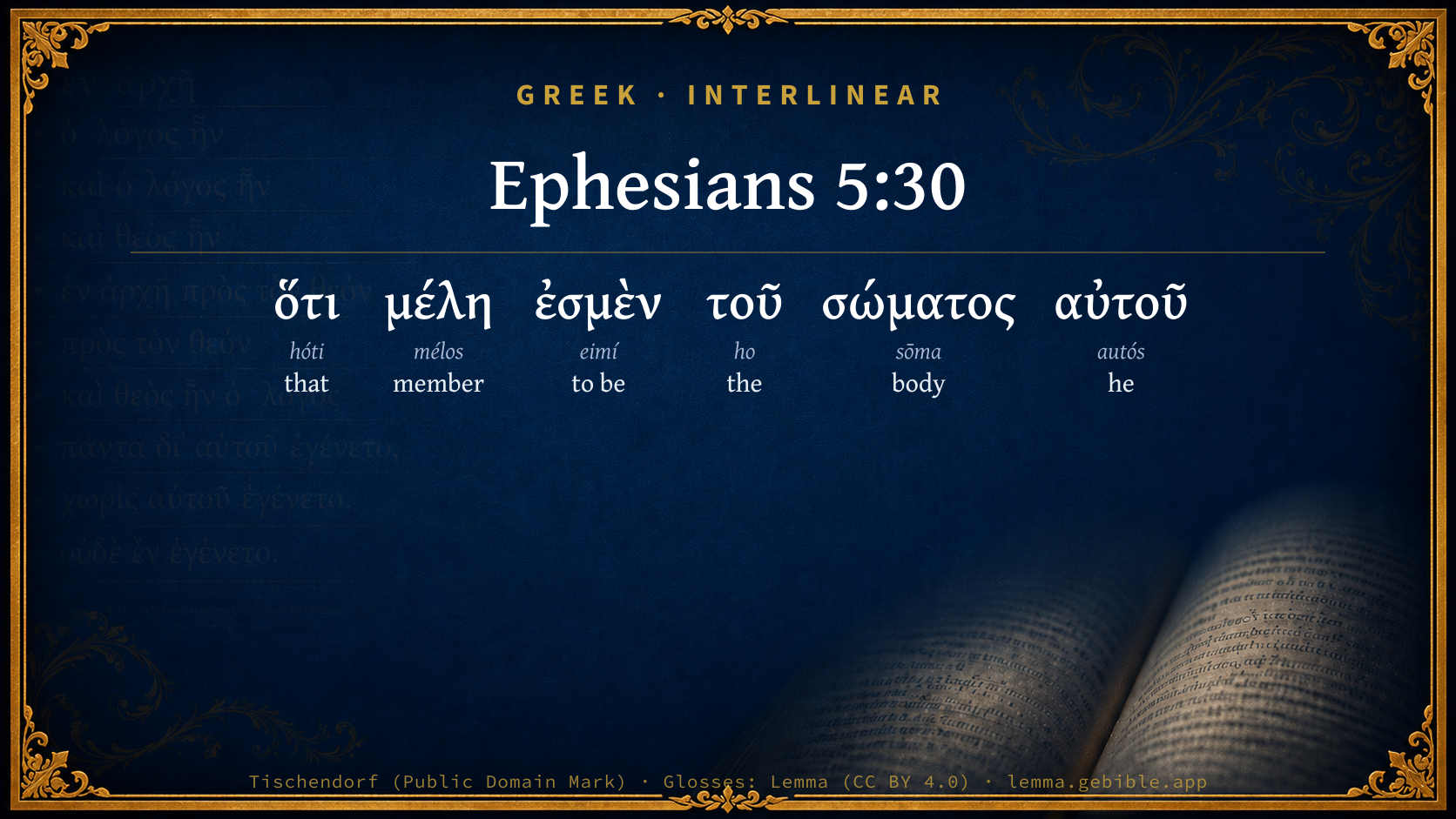
Greek (Tischendorf 8th ed.) Ephesians 5:30 appears in the Greek New Testament. The text above is from the Tischendorf 8th edition. Each word links to its Strong’s number and a concise gloss. Click any word for its full Thayer’s Greek Lexicon entry.
Download image
Cite this verse

Ephesians 5:30 (World English Bible). Public Domain. Lemma interlinear Bible study tool, https://lemma.gebible.app/v/ephesians/5/30.

Show BibTeX & RIS
BibTeX
RIS
English Translation
because we are members of his body, of his flesh and bones.
World English Bible · Public Domain
Download a study sheet

One document with this verse’s original text, its word-by-word gloss line, the meaning frame, cross-references with their text, attributed commentary, and full source and license credits — printable, and it pastes into notes with its structure intact.

This verse Autodidact and up

Study sheet (.html) Plain text (.txt)

A passage Seminary Student

Up to 50 verses in one chapter. A passage sheet keeps up to 6 commentary sources and 12 cross-references per verse, in the order this page ranks them, and says so on the sheet whenever that leaves anything out. Ask for a single verse and you get the Autodidact verse sheet above.

Everything on this page stays free to read, with no account — the sheet is a download of what is already on screen, not access to it.

Want to remove ads? Support Godless Engineer
Compare translations 3

The same verse in 3 English versions, stacked beneath the original-language interlinear above. Click any original word for its lexicon entry.

Each is an independent rendering of the whole verse — the interlinear is not word-aligned to these translations.

Highlighted words mark where these versions differ — a whole-verse word diff, not a word-by-word alignment.

  • World English Bible Public Domain
    because we are members of his body, of his flesh and bones.
  • King James Version Public Domain
    For we are members of his body, of his flesh, and of his bones.
  • unfoldingWord Literal Text CC BY-SA 4.0
    because we are members of his body.

unfoldingWord Literal Text — © unfoldingWord, licensed CC BY-SA 4.0. Word-aligned USFM3 via Door43 (git.door43.org/unfoldingWord/en_ult).

Versions to compare (up to 4)

3 of 4 selected

Show all 19 translations

Every available English version of this verse, each an independent rendering of the whole verse.

  • World English Bible Public Domain
    because we are members of his body, of his flesh and bones.
  • Berean Standard Bible Public Domain
    For we are members of His body.
  • Majority Standard Bible Public Domain
    For we are members of His body—of His flesh and of His bones.
  • King James Version Public Domain
    For we are members of his body, of his flesh, and of his bones.
  • American Standard Version (1901) Public Domain
    because we are members of his body.
  • Revised Version (1885) Public Domain
    because we are members of his body.
  • Geneva Bible (1599) Public Domain
    For we are members of his bodie, of his flesh, and of his bones.
  • Douay-Rheims (1899) Public Domain
    Because we are members of his body, of his flesh, and of his bones.
  • Young's Literal Translation Public Domain
    because members we are of his body, of his flesh, and of his bones;
  • Literal Standard Version CC BY-SA 4.0
    because we are members of His body, [[of His flesh, and of His bones.]]
  • Unlocked Literal Bible CC BY-SA 4.0
    because we are members of his body.
  • unfoldingWord Literal Text CC BY-SA 4.0
    because we are members of his body.
  • Darby Bible Public Domain
    for we are members of his body; [we are of his flesh, and of his bones.]
  • World Messianic Bible Public Domain
    because we are members of his body, of his flesh and bones.
  • Webster's Bible Public Domain
    For we are members of his body, of his flesh, and of his bones.
  • Free Bible Version CC BY-SA 4.0
    for we are parts of his body.
  • Bible in Basic English Public Domain
    Because we are parts of his body.
  • Text-Critical English NT CC BY 4.0
    because we are members of his body, of his flesh and of his bones.
  • Tyndale New Testament (1534) Public Domain
    For we are members of his body of his flesshe and of his bones.

Literal Standard Version (2020), Covenant Press — licensed CC BY-SA 4.0. Text via the HelloAO Bible API (eBible.org). Unlocked Literal Bible (unfoldingWord) — licensed CC BY-SA 4.0. Text via the HelloAO Bible API (eBible.org). unfoldingWord Literal Text — © unfoldingWord, licensed CC BY-SA 4.0. Word-aligned USFM3 via Door43 (git.door43.org/unfoldingWord/en_ult). Free Bible Version, Dr. Jonathan Gallagher — licensed CC BY-SA 4.0. Text via the HelloAO Bible API (eBible.org).

Word by word

More ways to search: Search by grammar → Find every occurrence → Compare this word →

Practice this passage: Drill this verse → Learn its vocabulary →

About this verse

These counts appear in no published source. They are computed here, from the morphology-tagged text and Lemma’s own curated glosses. What Lemma adds →

6
words
6
distinct lemmas
Pauline Epistles
section

Cross-references

6

Topical passages linked to Ephesians 5:30 in the Treasury of Scripture Knowledge — connected by theme and wording, ordered by reader-vote popularity; previews shown in the World English Bible.

  • 1 Corinthians 6:15 Don't you know that your bodies are members of Christ? Shall I then take the members of Christ, and make them members of a prostitute? May it never be!
  • 1 Corinthians 12:12–27 For as the body is one, and has many members, and all the members of the body, being many, are one body; so also is Christ.
  • Romans 12:5 so we, who are many, are one body in Christ, and individually members one of another.
  • Genesis 2:23 The man said, "This is now bone of my bones, and flesh of my flesh. She will be called Woman, because she was taken out of Man."
  • Ephesians 1:23 which is his body, the fullness of him who fills all in all.
  • Colossians 2:19 and not holding firmly to the Head, from whom all the body, being supplied and knit together through the joints and ligaments, grows with God's growth.

Cross-references courtesy of OpenBible.info (CC BY 4.0).

Where the printed editions differ

1 variant

Places in this verse where the major printed Greek editions disagree on the wording in a way that affects the translation — a comparison of editions, not a manuscript-by-manuscript collation. The editions are the modern critical texts (Nestlé-Aland 28/27, SBL, Westcott-Hort, Tregelles, Tyndale House) and the traditional texts behind the KJV (the Textus Receptus and the Byzantine/Majority text). It is not a claim about which reading is original.

  1. Extra text
    ἐκ τῆς σαρκός αὐτοῦ καί ἐκ τῶν ὀστέων αὐτοῦ.

    “from the flesh of Him and from the of bones of Him.”

    In TRByz Not in NA28NA27TynSBLWHTreg

    ἐκ τῆς σαρκός αὐτοῦ καί ἐκ τῶν ὀστέων αὐτοῦ. (ek tēs sarkos autou kai ek tōn osteōn autou) 'from the flesh of Him and from the of bones of Him.' is only in traditional manuscripts (TR+Byz)

Textual data: Translators Amalgamated Greek New Testament (STEPBible TAGNT) · CC BY 4.0.

Commentary

Notes on Ephesians 5:30 from classic Christian and Jewish commentators (each source and its license shown beneath its notes). The classic Christian expositions comment on the surrounding passage and are grouped to its opening verse, so a note may address several verses; the Jewish commentaries on the Tanakh (Rashi and others) are per-verse, so they appear only where the commentator wrote on this verse.

Lemma curates 59 commentaries, every one of them public domain or Creative Commons licensed, each selected and text-cleaned for this edition rather than reprinted as found. About our sources →

The Biblical Illustrator

Joseph S. Exell

Eph_5:30

For we are members of His body, of His flesh, and of His bones.

Membership in Christs body

I. The nature of membership with the body of Christ.

1. Members of the Church of Christ are such nominally and professedly. The Church is a visible organization--a city set on a hill, which cannot be hid--the light of the world, which must shine wherever it exists. Membership in Christs body supposes that we have been baptized, and are in the habit of receiving holy communion; also that we obey the laws, regulations, and discipline which have been made for the orderly government of the Church.

2. To be a member of the body of Christ implies that we are such spiritually and sincerely--in the homage of our minds, the devotion of our lives, and the affections of our hearts.

3. To be a member of the body of Christ implies pardon and regeneration.

II. The importance of becoming members of the body of Christ.

1. Membership with the visible Church of Christ is necessary in order to the existence and perpetuity of the Christian Church. A Church naturally supposes members, just as the whole supposes parts; there must be members, or there can be no Church.

2. Membership with the visible Church of Christ is necessary in order to a right understanding of some very important passages in the Word of God. The Bible knows nothing of solitary religion.

3. Membership with the body of Christ is necessary in order to the full and entire performance of ones religious duties.

(1) Sympathy.

(2) Mutual edification.

4. Membership with the body of Christ is necessary as it may help to assist us against our spiritual enemies.

5. Membership with the body of Christ is necessary to give some proof of our attachment to Jesus Christ and His cause.

6. Membership with the body of Christ is necessary if you consider the spiritual benefits to be derived from it. (P. Cooper.)

Members of Christs body

I. The doctrine. A difficult subject, liable to misrepresentation and abuse.

1. The apostle is speaking of believers only.

2. We must put away all sensual and carnal ideas from the consideration of this subject. It is a spiritual union that is here spoken of.

3. We must put away from the consideration of this subject all narrow-mindedness and bigotry. Now let us notice that the text conveys to us three ideas, as characteristic of the relation in which the Church stands to the Redeemer, viz.,

(1) Union;

(2) Dependence;

(3) Sympathy.

II. Duties resulting from this relation.

1. Love.

2. Reverence.

3. Obedience. (Dr. Raffles.)

The Biblical Illustrator, edited by Joseph S. Exell (c. 1880s–1900s) — public domain. Text from a community e-Sword module.

Bengel's Gnomon

Johann Albrecht Bengel

Eph 5:30. Ὅτι, because) The reason why the Lord nourishes and cherishes the Church, is the very close relationship, which is here expressed in the words of Moses regarding Eve, accommodated to the present subject. The Church is propagated from Christ, as Eve was from Adam; and this propagation is the foundation of the spiritual marriage: for this cause, Eph 5:31.—τοῦ σώματος αὐτοῦ, of His body) The body here does not mean the Church, which is contained in the subject, we are, but the body of Christ Himself.—ἐκ, of) Gen 2:23-24, in the LXX.—εἶπενʼ Αδὰμ, τοῦτο νῦν ὀστοῦν ἐκ τῶν ὀστέων μου, καὶ σὰρξ ἐκ τῆς σαρκός μου. Αὕτη κληθήσεται γυνὴ, ὅτι ἐκ τοῦ ἀνδρὸς αὐτῆς ἐλήφθη. Ἕνεκεν τούτου καταλείψει ἄνθρωπος τὸν πατέρα αὐτοῦ καὶ τὴν μητέρα καὶ προσκολληθήσεται τῇ γυναικὶ αὐτοῦ, καὶ ἔσονται οἱ δύο εἰς σάρκα μίαν.—ἐκ τῆς σαρκὸς αὐτοῦ, κ.τ.λ., of His flesh) Moses mentions bones first, Paul flesh; because it is the bones chiefly that support the natural structure, of which the former (Moses) is speaking; but in the new creation [of which Paul is speaking], the flesh of Christ is more considered. Moreover, Moses speaks more fully; Paul omits what does not so much belong to the subject in hand. It is not our bones and our flesh, but we, that are spiritually propagated from the humanity of Christ, which has flesh and bones.

Bengel's Gnomon of the New Testament — English translation (T&T Clark, Edinburgh, 1860) — public domain. Text from a community e-Sword module.

Meyer's Critical & Exegetical Commentary

Heinrich August Wilhelm Meyer

Eph_5:30. Reason why Christ ἐκτρέφει καὶ θάλπει the church: because we are members of His body. μέλη is prefixed with emphasis; for we are not an accidens, but integral parts of His body. Comp. 1Co_12:27.

ἐκ τῆς σαρκὸς αὐτοῦ κ. ἐκ τῶν ὀστέων αὐτοῦ] More precise definition of the μέλη τοῦ σώματος αὐτοῦ just said, in order to express this relation as strongly as possible: (proceeding) from His flesh and from His bones. This form of expression is a reminiscence of Gen_2:23,[283] where Adam expresses the origin of Eve out of his bones and out of his flesh,[284]to which origin the derivative relation of Christians to Christ is analogous, of course not physically, but in the spiritual, mystical sense, inasmuch as the Christian existence as suchthe specific being and spiritual nature of Christiansproceeds from Christ, has in Christ its principle of origination, as in a physical manner Eve proceeded from Adam. The at any rate non-literal expressions are not intended to bear minuter interpretation. They do not affirm that believers are produced and taken out of Christs glorified body (Gess, Person Christi, p. 274 ff.; comp. Bisping), which is already forbidden by the expression flesh and bones. Rather is the same thing intendedonly brought, in accordance with the connection, into the definite sensuously genetic form of presentation suggested by Gen. l.c.which elsewhere is denoted by καινὴ κτίσις (2Co_5:17; Gal_6:15), as well as by ζῶ δὲ οὐκέτι ἐγὼ, ζῇ δὲ ἐν ἐμοὶ Χριστός (Gal_2:20), by Χριστὸν ἐνεδύσασθε (Gal_3:27), by the relation of the ἓν πνεῦμα εἶναι to Christ (1Co_6:17), and in general by the expressions setting forth the Christian παλιγγενεσία.[285] Comp. the ΚΟΙΝΩΝῸΝ ΓΊΝΕΣΘΑΙ ΘΕΊΑς ΦΎΣΕΩς, 2Pe_1:4. With various modifications it has been explained of the spiritual origination from Christ already by Chrysostom (who understood the regeneration by baptism), Ambrosiaster, Theodoret, Oecumenius (ἐξ αὐτοῦ δὲ, καθὸ ἀπαρχὴ ἡμῶν ἐστι τῆς δευτέρας πλάσεως, ὥσπερ ἐκ τοῦ Ἀδὰμ διὰ τὴν πρώτην), Theophylact, Erasmus, Beza, Vorstius (spirituali tantum ratione ex ipso Christo quasi procreatos esse), Calvin (qui spiritus sui virtute nos in corpus suum inserit, ut vitam ex eo hauriamus), Calovius, Bengel, Matthies, de Wette (who, however, in the second edition, regards the words as spurious), Hofmann, Reiche, and others; while, withal, Koppe (so also Meier) thought only arctissimam quamlibet conjunctionem to be denoted, whereby justice is not done to the genetic signification of the ἐκ. Others explained it: in so far as we have the same human nature as He. So Irenaeus, Jerome, Augustine, Thomas, Michaelis; comp. also Stolz and Rosenmüller. Decidedly erroneous, partly because Paul could not in this sense say: we are of Christs flesh and bone, but only the converse: Christ is of our flesh and bone (Rom_1:3; Rom_9:5; Joh_1:14); partly because the element of having like nature with Christ would apply not merely to Christians, but to men as such generally. Others refer it to the crucifixion of Christ: ex carne ejus et ossibus crucifixis, i.e. ex passione ejus predicata et credita ortum habuit ecclesia, Grotius. Comp. already Cajetanus, as also Zanchius, Zachariae, Schenkel, having reference to Joh_6:51 f., Joh_14:18 ff. But the crucifixis is purely imported, and could the less be guessed here, inasmuch as from the words the history of Adam and Eve inevitably came to be recalled; and there is nothing to remind us (in opposition to Schenkel) of the martyr-stake of the cross, upon which Christ gave up His flesh and bones and suffered them to be broken (? see Joh_19:33; Joh_19:36). Others, finally, have explained it of the real communion with the body of Christ in the Lords Supper. So recently,[286] in addition to Kahnis and Thomasius, III. 2, p. 73, also Harless and Olshausen, the latter of whom says: it is the self-communication of His divine-human nature, by which Christ makes us to be His flesh and bone; He gives His people His flesh to eat and His blood to drink. But not even the semblance of a plea for explaining it of the Supper lies in the words; since Paul has not written καὶ ἐκ τοῦ αἵματος αὐτοῦ, which would have been specific in the case of the Supper, but καὶ ἐκ τῶν ὀστέων αὐτοῦ! Rückert has renounced any attempt at explanation, and doubts whether Paul himself thought of anything definite in the words. A very needless despair of exegesis!

[283] This reminiscence the more readily suggested itself to the apostle, not only in general, because he was wont to think of Christ as the second Adam (Rom_5:12 ff.), but also specially because he was just treating of the subject of marriage.

[284] That Paul should not prefix ἐκ τῶν ὀστέων, as in Gen_2:23, but ἐκ τῆς σαρκός, was quite naturally suggested to him by ver. 29. The explanation of Bengel is arbitrary and far-fetched.

[285] Philo also, p. 1094, applies the words of Gen. l.c. to a spiritual relationto the relation of the soul to God. If the soul were better and more like God, it would be able to make use of those words, because, namely, it οὐκ ἐστὶν ἀλλοτρία αὐτοῦ, ἀλλὰ σφόδρα οἰκεῖα.

[286] Many of the older expositors, following Theodoret and Theophylact, at least mixed up the Supper in various ways in their interpretation. So Beza and Calvin say that it is obsignatio et symbolum of the mystic fellowship with Christ here meant. Grotius found an allusion to the Supper; while, on the other hand, Calovius maintained that we were ex Christo not only by regeneration, but also by the communication of His body and blood in the Lords Supper.

Meyer — Critical and Exegetical Commentary on the New Testament — English translation by Peter Christie, edited by Frederick Crombie (T&T Clark, 1880) — public domain. Text from a community e-Sword module.

Expositor's Greek Testament

ed. W. Robertson Nicoll

Eph 5:30 . ὅτι μέλη ἐσμὲν τοῦ σώματος αὐτοῦ : for we are members of His body . The μέλη , which is the heart of the statement, has the emphatic position. We are not something apart from Christ, nor do we occupy only an accidental relation to Him. We are veritable parts of that body of which He is head, and this is the reason why He nourishes and cherishes the Church; cf. the detailed description in 1Co 12:12-27 . ἐκ τῆς σαρκὸς αὐτοῦ , καὶ ἐκ τῶν ὀστέων αὐτοῦ : being of His flesh and of His bones . This sentence, which is added by the TR, has considerable documentary testimony [679] [680] [681] [682] [683] [684] , most cursives, such Versions as the Syr. and the Arm., and such Fathers as Iren., Jer., etc. If it is retained, as is done by Mey., Ell., Reiche, Alf., etc., it will be an explanation of the affirmation that we are μέλη τοῦ σώματος αὐτοῦ , drawn from the thought of our origin ( ἐκ ). We are members of Christ’s body, as having the source of our spiritual being in Him. This statement of our spiritual origin is expressed in terms like those used of the origin of our physical life, the allusion being probably to the record of the formation of Eve in Gen 2:23 . As the first woman derived her physical being from Adam in the way there recorded, so we Christians draw our spiritual being from Christ. The evidence, however, is decidedly adverse, the clause not appearing in [685] [686] [687] [688] , 17, 67 2 , Boh., Eth., Method., Euthal., Origen (prob.), etc. The internal evidence may be said to be against it, in so far, e.g. , as a new figure is suddenly introduced, the statement is carried beyond the idea of relationship , and no clear or congruous meaning can be readily attached to the new terms, flesh and bones . Nor is it easy in face of evidence so old and so various to suppose that the words were mistakenly omitted by homœoteleuton. The clause, therefore, is deleted from the text by LTTrWHRV; Tr., however, giving it a place on the margin.

[679] Codex Sinaiticus (sæc. iv.), now at St. Petersburg, published in facsimile type by its discoverer, Tischendorf, in 1862.

[680] Codex Sinaiticus (sæc. iv.), now at St. Petersburg, published in facsimile type by its discoverer, Tischendorf, in 1862.

[681] Codex Claromontanus (sæc. vi.), a Græco-Latin MS. at Paris, edited by Tischendorf in 1852.

[682] Codex Boernerianus (sæc. ix.), a Græco-Latin MS., at Dresden, edited by Matthæi in 1791. Written by an Irish scribe, it once formed part of the same volume as Codex Sangallensis ( δ ) of the Gospels. The Latin text, g, is based on the O.L. translation.

[683] Codex Angelicus (sæc. ix.), at Rome, collated by Tischendorf and others.

[684] Codex Porphyrianus (sæc. ix.), at St. Petersburg, collated by Tischendorf. Its text is deficient for chap. Eph 2:13-16 .

[685] Codex Vaticanus (sæc. iv.), published in photographic facsimile in 1889 under the care of the Abbate Cozza-Luzi.

[686] Autograph of the original scribe of א .

[687] Autograph of the original scribe of א .

[688] Codex Alexandrinus (sæc. v.), at the British Museum, published in photographic facsimile by Sir E. M. Thompson (1879).

The Expositor's Greek Testament, edited by W. Robertson Nicoll (1897–1910) — public domain. Text from a community e-Sword module.

Hodge's Commentary on Romans, Ephesians & First Corinthians

Charles Hodge

Eph_5:30

This verse assigns the reason of the preceding declaration. Christ acts towards his church as a man does towards his body, for we are members of his body. This might mean simply that we stand to him in the same intimate and vital union, that a mans body sustains to the man himself. But the meaning is rendered more definite by the words which follow, ἐκ τῆς σαρκὸς αὐτοῦ καὶ ἐκ τῶν ὀστέων αὐτοῦ.‹24› not members of, but derived from, and partakers of, his flesh and his bones. This is the signification of the words, whatever their meaning may be. Ἐκ expresses derivation and participation. This is one of the most difficult passages in the Bible. The doctrine which it teaches is declared by the apostle, in the following verse, to be a great mystery. Any explanation, therefore, which dispels that mystery, and makes the doctrine taught perfectly intelligible, must be false. All that can properly be attempted is to guard against false interpretations, and leave the matter just where the apostle leaves it, as something to be believed and reverenced but not understood.

The lowest explanation of the passage before us is that which departs entirely from the signification of the words, and supposes that the apostle intended to teach nothing at all as to the nature of our union with Christ, but simply to affirm the fact. Husbands and wives are intimately united, and so are Christ and his church. This is no explanation at all. It is simply saying that: the apostle meant nothing, or nothing specific, by what he says. The Scriptures teach in general terms that Christ and his people are one. When our Lord says they are one as the vine and its branches are one, he teaches something more than the mere fact of union between himself and his people. So, too, when the apostle says the union in question is analogous to that between Adam and his posterity, he teaches not only the fact but also one aspect of its nature. In like manner, when he illustrates it by a reference to the conjugal relation, and says that the point of analogy is that as Eve was formed out of the flesh and bone of Adam, so we are partakers of the flesh and bones of Christ, it is impossible that nothing more should be meant than that we are united to him.

A second interpretation takes the words figuratively, and supposes the apostle meant that as Eve derived her physical existence from Adam, so we derive our spiritual existence from Christ. This interpretation has many advocates from Chrysostom downwards, but it is liable to the same objection as the preceding. It refuses to admit what the apostle asserts. He says not merely that we derive our life from Christ, which is true; but also that we derive our life from his flesh, and are partakers of it. This must mean something more specific than simply that Christ is the author of our life, and that he lives in us.‹25›

A third view of the passage assumes that the reference is to the incarnation. We are partakers of the flesh of Christ because we have the same human nature which he assumed. In Heb_2:10, it is said, Both he that sanctifieth and they who are sanctified are all of one, i.e. of one nature; and in Heb_2:14, For as much then as the children were partakers of flesh and blood, he also himself likewise took part of the same. These and similar passages do indeed prove that one of the essential elements of the union with Christ is this community of nature. And it is also true that the more specific union indicated in the text presupposes and rests upon the fact of the incarnation. But the incarnation cannot be what Paul here refers to. The incarnation consists in the eternal Son of God taking to himself a true body and a reasonable soul; but the union here spoken of arises from our participation of Christs body; that is, of his flesh and of his bones. It is not his taking our flesh and blood, but our partaking of his, after he had assumed them, that is here asserted. Besides, so far as the mere assumption of human nature is concerned, it is a bond of union between Christ and the whole human race; whereas the apostle is here speaking of a union with Christ peculiar to his people.

Fourth; Romanists, Lutherans, and the elder Calvinists, as Calvin himself and Beza, seek a solution of this passage in the Lords Supper. As in that ordinance we are said to partake of the body and blood of Christ, it is assumed that the union here spoken of is that which is thereby effected. We are one flesh with him, because we partake of his flesh. This of course is differently understood according to the different views entertained of that sacrament. Romanists, believing that by the act of consecration the whole substance of the bread is transmuted into the substance of Christs body, which is received by the communicant, of course believe that in the most literal sense of the words, we are flesh of his flesh. Lutherans, although they believe that the bread remains bread in the Eucharist after consecration, yet as they hold that the true body of Christ is locally present in, with and under the bread, and is received by the mouth, come to the same conclusion as to the nature of the union thereby effected. Partaking literally of Christs flesh, Christians are literally of one flesh with him. Calvin did not hold that Christs body was locally present in the Lords Supper, nor that it was received by the mouth, nor that it was received in any sense by unbelievers. He did hold, however, that the substance of Christs glorified body, as enthroned in heaven, was in some miraculous way communicated to believers together with the bread in that ordinance. He, therefore, understands the apostle as here referring to that fact, and asserting that we are members of Christs body because the substance of his body is in the Eucharist communicated to us.‹26› There are two objections to these interpretations:

l. That, according to the common belief of the Reformed churches, the Bible teaches no such doctrine concerning the Lords Supper, as either of these several views of the passage supposes.

2. That there is not only no allusion to the Lords Supper in the whole context, but the terms here employed are never used in Scripture when treating of that ordinance. Body and blood are the sacramental words always used, and never flesh and bones. The reference is to the creation of woman and to the marriage relation, and not to the Eucharist.

Fifth; The advocates of that philosophical form of theology of which Schleiermacher was the founder, understand the passage before us to teach that we are partakers of the theanthropic life of Christ. The leading idea of that system, so far as the person of Christ is concerned, is the denial of all dualism. He has but one life. That life is not human, and not divine, but divine and human, or human made divine. Neither is there any dualism as to soul and body. These are the same life under different manifestations. To partake of Christ, is to partake of his life. To partake of his life, is to partake of his theanthropic nature. To partake of his theanthropic nature, is to partake of his human, as well as of his divine nature; and to partake of his human nature is to partake of his body as well as of his soul and divinity. We partake of the theanthropic nature of Christ, as we partake of the corrupt human nature of Adam. The life of Adam is the general life of his race, manifested in the individuals composing that race. The theanthropic life of Christ is the general life of the church, manifested in its members. The church is the development of Christ, as the human race is the development of Adam; or as the oak or forest is the development of an acorn. As, therefore, we are said to be flesh of Adams flesh and bone of his bones, in the same sense and with the same propriety, are we said to be flesh of Christs flesh and bone of his bones.‹27› The correctness of this explanation depends on the correctness of the system on which it is founded. As a theology, that system is a revival of the Sabellian and Eutychian heresies; and as a philosophy, it is in the last resort pantheistic. It makes the life of God and the life of man identical. God lives only in his creatures.

Sixth; We must content ourselves with briefly stating what the apostle affirms, guarding against a perversion of his language, and making some approximation to its meaning without pretending to dissipate the mystery which he teaches us rests upon the subject.

The text asserts

1. That we are members of Christs body.

2. That we are partakers of his flesh and of his bones, in such a sense that our relation to Christ is analogous to Eves relation to Adam.

The three general interpretations of the passage are,

1. That as Eve derived her physical life from Adam, so we derive our spiritual life from Christ. This says too little, as it leaves out of view the specific affirmation of the text.

2. That as Eve was formed out of the substance of Adams body, so we are partakers of the substance of Christs body. This is Calvins interpretation, which includes the views given by Romanists, by Lutherans, and Transcendentalists. This goes beyond the declaration of the text, and imposes a meaning upon it inconsistent with the analogy of Scripture.

3. The third interpretation takes a middle ground, and understands the apostle to teach, that as Eve derived her life from the body of Adam, so we derive our life from the body of Christ, and as she was partaker of Adams life, so we are partakers of the life of Christ. The doctrine taught, therefore, is not community of substance between Christ and his people, but community of life. and that the source of life to his people is Christs flesh.

In support of this interpretation it may be urged:

1. That it leaves the passage in its integrity. It neither explains it away, nor does it make it assert more than the words necessarily imply. The doctrine taught remains a great mystery, as the apostle declares it to be.

2. It takes the terms employed in their ordinary and natural sense. To partake of ones flesh and blood, does not, in ordinary life nor according to scriptural usage, mean to partake of his substance, but it does mean to partake of his life. The substance of which the body of any adult is composed is derived exclusively from his food and from the atmosphere. A few years after the formation of Eve not a particle of Adams body entered into the composition of her frame; and yet she was then as truly as at the beginning, bone of his bone and flesh of his flesh, because derived from him and partaker of his life. For the same reasons and in the same sense we are said to be flesh of Adams flesh and bone of his bones, although in no sense partakers of the substance of his body. In like manner nothing is more common than to speak of the blood of a father flowing in the veins of his descendants, and of their being his flesh. This means, and can only mean, that they are partakers of his life. There is no community of substance possible in the case. What life is no man knows. But we know that it is not matter; and, therefore, there may be community of life, where there is no community of substance. There is a form of life peculiar to nations, tribes, families, and individuals; and this peculiar type is transmitted from generation to generation, modifying the personal appearance, the physical constitution, and the character of those who inherit it. When we speak of the blood of the Hapsburghs, or of the Bourbons, it is this family type that is intended and nothing material. The present Emperor of Austria derives his peculiar type of physical life from the head of his race, but not one particle of the substance of his body. Husband and wife are in Scripture declared to be one flesh. But here again it is not identity of substance, but community of life that is intended. As, therefore, participation of ones flesh does not in other connections, mean participation of his substance, it cannot be fairly understood in that sense when spoken of our relation to Christ. And as in all analogous cases it does express derivation or community of life, it must be so understood here.

3. It is clearly taught in Scripture that the union with Christ here described is essential to salvation. It is also clearly taught in the word of God, and held by all Protestants, though not by Romanists, that believers under the Old Dispensation were fully saved. Whatever, therefore, is the nature of the union with Christ here taught, it must be such as is common to believers who lived before and to those who live after the advent of Christ. It is possible that the saints under the Old Dispensation should have derived their life from the body of Christ, as he was the Lamb slain from the foundation of the world, but it is not possible that they could be partakers of the substance of his body, or of his glorified humanity. The passage before us, therefore, cannot teach any such community of substance.

4. The community of life with Christ and derivation of life from his flesh, which is the doctrine this interpretation supposes the passage before us to teach, is a doctrine elsewhere taught in Scripture. We are not only said to be saved by his body, Rom_7:4; by his blood, Eph_2:13; by his flesh, Eph_2:15; by the body of his flesh, Col_1:22; but his flesh is said to be our life, and participation of it is said to be the source of eternal life. Except ye eat the flesh of the Son of Man, and drink his blood, ye have no life in you. Whoso eateth my flesh and drinketh my blood, hath eternal life. Joh_6:53, Joh_6:54.

The union, therefore, between Christ and his people is mysterious. It may be illustrated, but cannot be fully explained. It is analogous to the union between husband and wife, who are declared to be one flesh to express their community of life; and especially to the union between Adam and Eve because she derived her life from his flesh. As the relations are thus analogous, what is said of the one may be said of the other. To prove this, and to justify the use of the language which he had employed, the apostle cites the language of God in Gen_2:24.

Charles Hodge — Commentary on Romans (1835), First Corinthians (1857), and Ephesians (1856) — public domain. Text from a community e-Sword module.

Geneva Bible (1599)

Geneva Bible translators

He alludeth to the making of the woman, which signifieth our coupling together with Christ, which is wrought by faith, but is sealed by the Sacrament of the Supper.

Geneva Bible (1599) marginal notes — public domain. Text via Bolls.life.

Jamieson, Fausset & Brown

Robert Jamieson, A. R. Fausset & David Brown

For--Greek, "Because" (Co1 6:15). Christ nourisheth and cherisheth the Church as being of one flesh with Him. Translate, "Because we are members of His body (His literal body), being OF His flesh and of His bones" [ALFORD] (Gen 2:23-24). The Greek expresses, "Being formed out of" or "of the substance of His flesh." Adam's deep sleep, wherein Eve was formed from out of his opened side, is an emblem of Christ's death, which was the birth of the Spouse, the Church. Joh 12:24; Joh 19:34-35, to which Eph 5:25-27 allude, as implying atonement by His blood, and sanctification by the "water," answering to that which flowed from His side (compare also Joh 7:38-39; Co1 6:11). As Adam gave Eve a new name, Hebrew, "Isha," "woman," formed from his own rib, Ish, "man," signifying her formation from him, so Christ, Rev 2:17; Rev 3:12. Gen 2:21, Gen 2:23-24 puts the bones first because the reference there is to the natural structure. But Paul is referring to the flesh of Christ. It is not our bones and flesh, but "we" that are spiritually propagated (in our soul and spirit now, and in the body hereafter, regenerated) from the manhood of Christ which has flesh and bones. We are members of His glorified body (Joh 6:53). The two oldest existing manuscripts, and Coptic or Memphitic version, omit "of His flesh and of His bones"; the words may have crept into the text through the Margin from Gen 2:23, Septuagint. However, IRENÆUS, 294, and the old Latin and Vulgate versions, with some good old manuscripts, have them.

Jamieson, Fausset & Brown — Commentary Critical and Explanatory on the Whole Bible (1871) — public domain (CC PDM 1.0). Text via the HelloAO Bible API.

Adam Clarke's Commentary

Verse 30. We are members of his body] He has partaken of our nature, as we have partaken of the nature of Adam. And as he is the head of the Church and the Saviour of this body; so we, being members of the Church, are members of his mystical body. That is, we are united to him by one Spirit in the closest intimacy, even similar to that which the members have with the body.

Adam Clarke's Commentary on the Bible (1810–1826) — public domain. Text from a community e-Sword/MySword module.

John Calvin's Commentaries

30. For we are members of his body, of his flesh, and of his bones. First, this is no exaggeration, but the simple truth. Secondly, he does not simply mean that Christ is a partaker of our nature, but expresses something higher (καὶ ἐμφατικώτερον) and more emphatic.

John Calvin's Commentaries (1540-1563) — public domain. Text from the Calvin Translation Society English edition (1840s-50s) via the Christian Classics Ethereal Library (ccel.org). Calvin's coverage is partial (roughly two-thirds of the Bible); uncommented books and verses are honest gaps, never fabricated. The 19th-century editor's footnotes and remarks are omitted so the notes are faithfully Calvin's own voice.

The Cambridge Bible for Schools and Colleges

gen. ed. J. J. S. Perowne

30. members] Limbs; the word used above Eph_4:25; and cp. Rom_12:4-5; 1Co_6:15 (a strict parallel), 1Co_12:27.

of his flesh, and of his bones] Three important MSS. (ABא) supported by other but not considerable authority, omit these words. It has been suggested that they were inserted by transcribers from Gen_2:23, as the next verse is certainly quoted from Gen_2:24. But the phrase here is not verbally close enough to that in Gen. to make this likely. A transcriber would probably have given word for word, while the Apostle would as probably quote with a difference, such as we find here. And the difference is significant. “We” are not said here to be “bone of His bone &c.,” which might have seemed to imply that our physical frame is derived from that of the Incarnate Lord, but, more generally, “limbs of His body, out of His flesh and out of His bones.” Our true, spiritual, life and being is the derivative of His as He is our Second Adam, in a sense so strong and real as to be figured by the physical derivation of Eve from Adam. “As for any mixture of the substance of His flesh with ours,” says Hooker (Eccl. Pol. v. 56, end), “the participation which we have of Christ includeth no such gross surmise[40]”.

[40] The remarkable chapter which thus closes deserves very careful study. It will be seen that Hooker’s view of “Christ’s body in ours as a cause of immortality” is that it is “a cause by removing, through the death and merit of His own flesh, that which hindered the life of ours.”

In brief, this statement, in the light of other Scripture, amounts to the assertion that “we,” the believing Church, as such, are, as in the Case of Eve and Adam, at once the product of our Incarnate Lord’s existence as Second Adam, and His Bride. This profound and precious truth is not dwelt upon, however. Strictly speaking, it is only incidental here.

The Cambridge Bible for Schools and Colleges (gen. ed. J. J. S. Perowne; Cambridge University Press, 1878–1918) — public domain. Text from a community e-Sword module.

John Gill's Exposition

Nevertheless, let everyone of you in particular,.... The apostle returns to his former subject, and recapitulates the mutual duties of husband and wife, after he had enforced them from the instance and example of Christ, and his church; and would have every married person in particular take the directions and instructions given, to themselves: as that the husband

so love his wife even as himself; since they two are one flesh:

and the wife see that she reverence her husband; since he leaves father and mother for her, and is the head of her; See Gill on Eph 5:22.

Next: Ephesians Chapter 6

John Gill's Exposition of the Whole Bible (1746–1763) — public domain (CC PDM 1.0). Text via the HelloAO Bible API.

Trapp's Complete Commentary

John Trapp

30 For we are members of his body, of his flesh, and of his bones.

Ver. 30. Of his flesh, and of his bones] While he that is joined to the Lord is one spirit, 1Co 6:17. This union is neither natural, nor corporal, nor political, nor personal, but mystical and spiritual; and yet it is no less true and real than that of God the Father and God the Son, Joh 17:21-22. For as the Holy Ghost did unite in the Virgin’s womb the Divine and human natures of Christ, and made them one person; by reason whereof Christ is of our flesh and of our bones; so the Spirit unites that person of Christ, his whole person, God-man, with our persons, by reason whereof we are of his flesh and of his bones.

John Trapp, A Commentary or Exposition upon All the Books of the Old and New Testament (1647–1656) — public domain. Text from a community e-Sword module.

Albert Barnes' Notes on the Bible

For we are members of his body - Of the body of Christ; see 1Co 11:3, note; 1Co 12:27, note; Joh 15:1-6, notes, and Eph 1:23, note. The idea here is, that there is a close and intimate union between the Christian and the Saviour - a union so intimate that they may be spoken of as “one”.

Of his flesh, and of his bones - There is an allusion here evidently to the language which Adam used respecting Eve. “This is now bone of my bones, and flesh of my flesh;” Gen 2:23. It is language which is employed to denote the closeness of the marriage relation, and which Paul applies to the connection between Christ and his people. Of course, it cannot be understood “literally.” It is not true literally that our bones are a part of the bones of Christ, or our flesh of his flesh; nor should language ever be used that would imply a miraculous union. It is not a physical union, but a union of attachment; of feeling; of love. If we avoid the notion of a “physical” union, however, it is scarcely possible to use too strong language in describing the union of believers with the Lord Jesus. The Scriptures make use of language which is stronger than that employed to describe any other connection; and there is no union of affection so powerful as that which binds the Christian to the Saviour. So strong is it, that he is willing for it to forsake father, mother, and home; to leave his country, and to abandon his possessions; to go to distant lands and dwell among barbarians to make the Redeemer known; or to go to the cross or the stake from simple love to the Saviour. Account for it as people may, there has been manifested on earth nowhere else so strong an attachment as that which binds the Christian to the cross. It is stronger love that that which a man has for his own flesh and bones; for it makes him willing that his flesh should be consumed by fire, or his bones broken on the wheel rather than deny him. Can the infidel account for this strength of attachment on any other principle than that it has a divine origin?

(See the supplementary note, Rom 8:10, on the union between Christ and his people, in which it is shown that a mere union of feeling and love is far beneath the truth.)

Albert Barnes' Notes on the Bible (1834–1885) — public domain. Text from a community e-Sword/MySword module.

Matthew Poole's English Annotations

We are members of his body; his mystical body.

Of his flesh, and of his bones; as Eve was of Adam’s, Gen 2:23; only that was in a carnal way, this in a spiritual, as by the communication of Christ’s flesh and blood to us by the Spirit we are united to him, and members of him.

Matthew Poole's English Annotations on the Holy Bible (1683–1685) — public domain. Text from a community e-Sword/MySword module.

Whedon's Commentary on the Bible

Daniel D. Whedon

30. Members of his body—Conceptually, but not literally; just as husband and wife are one flesh; not, in fact, one single material hermaphrodite body, but so imaged in fancy as thereby to illustrate literal truth more forcibly than any mere literal statement can. We are, also, members of Christ’s body, not as offspring derived from him, (as Eve from Adam,) but as one with him in love, as are man and wife.

Of his flesh, and of his bones—These words are of doubtful genuineness. They are an evident allusion to Gen_2:23 : “This is now bone of my bones, and flesh of my flesh.” Bengel says, Moses names “bones” first and Paul “flesh;” the former so because the bones are the supports of the natural frame; but in the new creation the “flesh” of Christ is the main element. Thus far, well; but, unfortunately, he adds: “Not our bones and flesh, but we ourselves are spiritually propagated from the humanity of Christ, which has flesh and bones.” It is not of propagation or derivation that St. Paul speaks, but of conceptual identity.

Daniel D. Whedon (gen. ed.), Commentary on the Old and New Testaments (1874–1909) — public domain. Text from a community e-Sword module.

The Pulpit Commentary

For we are members of his body being, of his flesh, and of his bones (the last seven words omitted in many manuscripts and in the R.V). The reference is to the original formation of woman as narrated in Ge 2. Her very name indicated that she was "taken from man." She was taken from him and given to him. So the Church is taken from Christ and given to him. Taken from his body, sprung from his incarnation and his crucifixion and resurrection, the spiritual offspring of his humanity, and then given to him, to be his servant, nay, above a servant, his companion, friend, and confidant for evermore. If it had not been for the body of Christ (Heb_10:5) the Church could have had no existence. No bride fit for the King of heaven could have sprung from the earth. As Eve came from the opened side of Adam, so figuratively the Church springs from the pierced side of Jesus.

The Pulpit Commentary (1880–1919), ed. H.D.M. Spence-Jones & Joseph S. Exell — public domain. Text from a community e-Sword module.

John Wesley's Explanatory Notes

For we - The reason why Christ nourishes and cherishes the church is, that close connection between them which is here expressed in the words of Moses, originally spoken concerning Eve. Are members - Are as intimately united to Christ, in a spiritual sense, as if we were literally "flesh of his flesh, and bone of his bone."

John Wesley, Explanatory Notes Upon the Whole Bible (1754–1765) — public domain. Text via the GEBible commentary corpus.

Godbey's Commentary on the New Testament

William B. Godbey

30. Because we are members of His body, as I freely use all of my members conservatively of my body, so Christ has a perfect right to use every saint in perfect harmony with his sovereign will and infinite wisdom conservatively of his glory.

William B. Godbey, Commentary on the New Testament (1896–1900) — public domain. Text from a community e-Sword module.

The People's New Testament

B. W. Johnson

30. We are members of his body. We are all members of Christ's body, the church. But the church is his Bride. Hence the language of Gen. 2:23, where Adam declares that his wife “is bone of his bone and flesh of his flesh,” applies to our relation to Christ.

B. W. Johnson's The People's New Testament with Notes (1889–1891) — public domain. Electronic text from the Christian Classics Ethereal Library (CCEL) ThML edition.

Cambridge Greek Testament for Schools and Colleges

30. ὅτι μέλη ἐσμὲν τοῦ σώματος αὐτοῦ. Cf. Eph 4:16; 1Co 6:15; 1Co 12:27. In Rom 12:5 we are ‘members one of another.’

Cambridge Greek Testament for Schools and Colleges (Cambridge University Press, 1896; 21 vols, various authors incl. Carr, Maclear, Plummer, Farrar, Lumby, Moule, M. R. James, Simcox) — public domain. Text from a community e-Sword module.

Alford’s Greek Testament

Henry Alford

30.] For (again a link is omitted; ‘the church, which stands in the relation of marriage to Him: for, &c.’) members we are of His Body [,—(being) of His flesh, and of His bones (see Gen 2:23. As the woman owed her natural being to the man, her source and head, so we owe our entire spiritual being to Christ, our source and head: and as the woman was one flesh with the man in this natural relation, so we in our entire spiritual relation, body, soul, and Spirit, are one with Christ, God manifested in our humanity,—parts and members of His glorified Body. Bengel well remarks, that we are not, as in Gen., l. c. ὀστοῦν ἐκ τῶν ὀστέων αὐτοῦ, καὶ σὰρξ ἐκ τῆς σαρκὸς αὐτ.:—‘non ossa et caro nostra, sed nos spiritualiter propagamur ex humanitate Christi, carnem et ossa habente’)]: wherefore (the allusion, or rather free citation, is still carried on: cf. Gen 2:24:—i.e. because we are members of Him in the sense just insisted on. This whole verse is said (see on ver. 32 below) not of human marriages, but of Christ and the church. He is the ἄνθρωπος in the Apostle’s view here, the Church is the γυνή. But for all this, I would not understand the words, as Meyer, in a prophetical sense of the future coming of Christ:—the omission of the article before ἄνθρωπος sufficiently retains the general aphorismatic sense:—but would regard the saying as applied to that, past, present, and future, which constitutes Christ’s Union to His Bride the Church: His leaving the Father’s bosom, which is past—His gradual preparation of the union, which is present: His full consummation of it, which is future. This seems to me to be necessary, because we are as truly now εἰς σάρκα μίαν with Him, as we shall be, when heaven and earth shall ring with the joy of the nuptials;—and hence the exclusive future sense is inapplicable. In this allegorical sense (see below), Chrys., Jer., and most of the ancients: Beng., Grot., Mey. (as above), al., interpret: and Eadie would have done well to study more deeply the spirit of the context before he characterized it as ‘strange romance,’ ‘wild and visionary,’ and said, ‘there is no hint that the Apostle intends to allegorize.’ That allegory, on the contrary, is the key to the whole) shall a man leave father and mother and shall be closely joined to his wife, and they two shall become (see Mat 19:5, note) one flesh (‘non solum uti antea, respectu ortus: sed respectu novæ conjunctionis.’ Beng.).

Henry Alford, The Greek Testament (1849–1861) — public domain. Text from a community e-Sword module.

International Critical Commentary

30. ὅτι μέλη ἐσμὲν τοῦ σώματος αῦτοῦ. Rec. adds ἐκ τῆς σαρκὸς αὐτοῦ καὶ ἐκ τῶν ὀστέων αὐτοῦ.

For the insertion are אc D G L P (K has τοῦ σώματος for τῶν ὀστέων) nearly all cursive MSS., It, Vulg., Syr. (both), Arm., Iren., Jerome, etc.

For the omission א* A B 17 672, Boh., Eth., Method., Euthal., Ambrst. and apparently Origen.

It will be seen that the MSS. which omit decidedly outweigh those that insert. Ellicott speaks of the testimony of א as “divided,” which seems a singular way of neutralising the evidence of the earlier scribe by that of a seventh-century corrector.

It is an obvious suggestion that the words might have been omitted by homoeoteleuton. Reiche, who accepted the words (writing before the discovery of א), rightly observes that this can hardly be admitted in the case of so many witnesses. He prefers to suppose that they were omitted in consequence of offence being taken at the apparently material conception presented; and some other critics have adopted the same view. The objection must have been very strong which would lead to such a deliberate omission. But there is no reason to suppose that the words would have given offence, especially considering such words as “a spirit hath not flesh and bones as ye see Me have,” not to mention “eating My flesh and drinking My blood.” Nor do the ancient commentators indicate that any such difficulty was felt. Irenaeus, after quoting the words, adds: “non de spirituali aliquo et invisibili homine dicens haec; spiritus enim neque ossa neque carnes habet,” etc. Indeed, an ancient reader would be much more likely to regard the words as a natural expansion of μέλη τοῦ σώματος αὐτοῦ. On the other hand, nothing was more likely than that the words should be added from recollection of the passage in Genesis, quoted in ver. 31. It is objected to this, that the words are not quoted with exactness, “bone” preceding “flesh” in Gen. This is to assume an exactness of memory which is at least questionable. Once added, the ordinary copyist would, of course, prefer the longer text.

As to the internal evidence, on careful consideration it will be found strongly in favour of the shorter text. When Christ is called the Head or Foundation, and the Church the Body or House, the language is that of analogy, i.e. it suggests, not resemblance of the objects, but of relations; Christ in Himself does not resemble a Head or a Foundation-stone, but His relation to the Church resembles the relation of the head to the body and of the foundation-stone to the building. But what relation is suggested by the bones of Christ? Or if σώματος be understood of the figurative or mystical body, what conceivable meaning can be attached to the bones thereof? This fundamental difficulty is not faced by any commentator. While trying to attach some meaning to the clause, they do not attempt to show any appropriateness in the language. The utmost that could be said is that the words express an intimate connexion; but unless this was a proverbial form of expression, of which there is no evidence, this, besides losing the force of ἐκ, would leave the difficulty unsolved. Moreover, the clause is so far from carrying out the μέλη τοῦ ς., that it introduces an entirely different figure. This is disguised in the AV.

Had the words been “of His flesh and of His blood,” we might have understood them as alluding to the Eucharist; and it is worth noting that several expositors have supposed that there is such an allusion; but the mention of “flesh and bones” instead of “flesh and blood” is fatal to this.

The reader may desire to know how the omitted clause has been interpreted. Chrysostom, in the first instance, explains it of the incarnation, by which, however, Christ might rather be said to be “from our flesh.” It is no answer to this to say, with Estius, “in hac natura ipse caput est,” which is to change the figure. Besides, it is true of all men, not only of Christians, that in this sense they are of the same flesh as Christ; but this again is not the meaning of ἐκ. Alford says: “As the woman owed her natural being to the man, her source and head, so we owe our spiritual being to Christ, our Source and Head”; and similarly Ellicott, Meyer, etc. Surely a strange way of saying that our spiritual being is derived from Christ, to say that we are from His bones! Others, as above mentioned, interpret of communion in the Eucharist (so in part Theodoret and Theophylact, also Harless and Olshausen).

Not without reason did Rückert come to the conclusion that it was doubtful whether St. Paul had any definite meaning in the words at all.

International Critical Commentary — older volumes (1896–1929), various authors — public domain. Text from a community e-Sword module.

Vincent's Word Studies in the New Testament

Marvin R. Vincent

Omit of His flesh and of His bones.

Marvin R. Vincent, Word Studies in the New Testament (1887–1900) — public domain. Text from a community e-Sword/MySword module.

Lesson kit

Teaching starters — assembled from the data on this page, not authored interpretation. Every prompt links to the verse data it draws on. Edit before teaching.

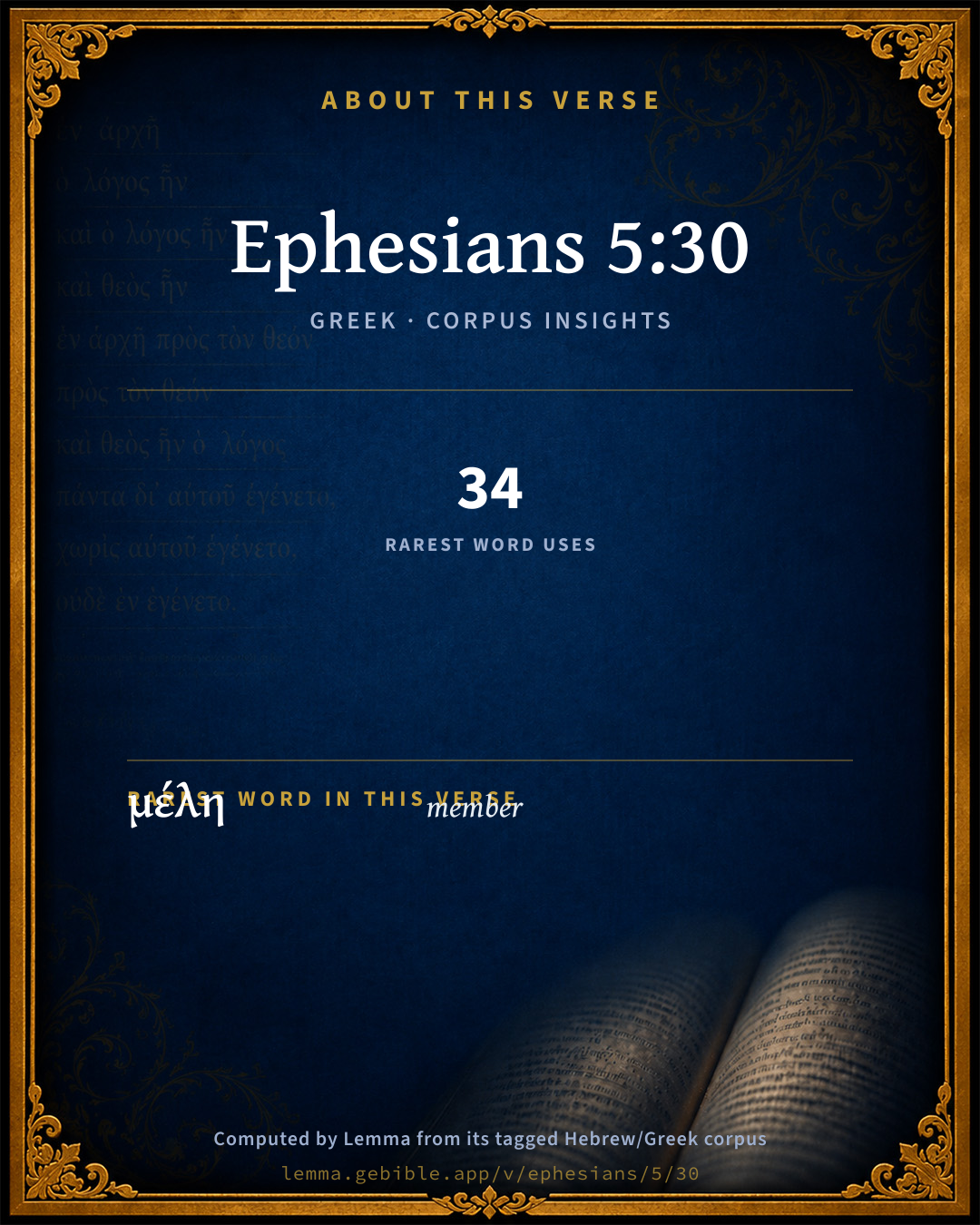
Ephesians, in the Pauline Epistles, opens this verse with 6 words (6 distinct Greek lemmas). Its most distinctive word is mélos (“member”). A historical commentator’s framing appears above. Read the whole chapter for the surrounding context.

Discussion questions

  1. The word mélos carries the sense “member.” How does it shape the verse?
  2. Matthew 5:29 shares the word «member» with this verse. How do the two illuminate each other?
  3. These translations render this verse differently; the difference is in the English rendering, not the original. What questions does that raise?
  4. Reading how The Biblical Illustrator and Bengel's Gnomon read this verse, where do the two commentators agree and where do they part?

Things to notice

Reading settings

Reading text

Shown beneath each verse's original-language words.

Old Testament
Old Testament edition

Read the OT as the Masoretic Hebrew (MT) or the Greek Septuagint (LXX).

English shown for the Greek Septuagint (in the Hebrew ↔ Greek comparison).

Comparing translations? Open the Compare panel on any verse page to stack up to four side by side.