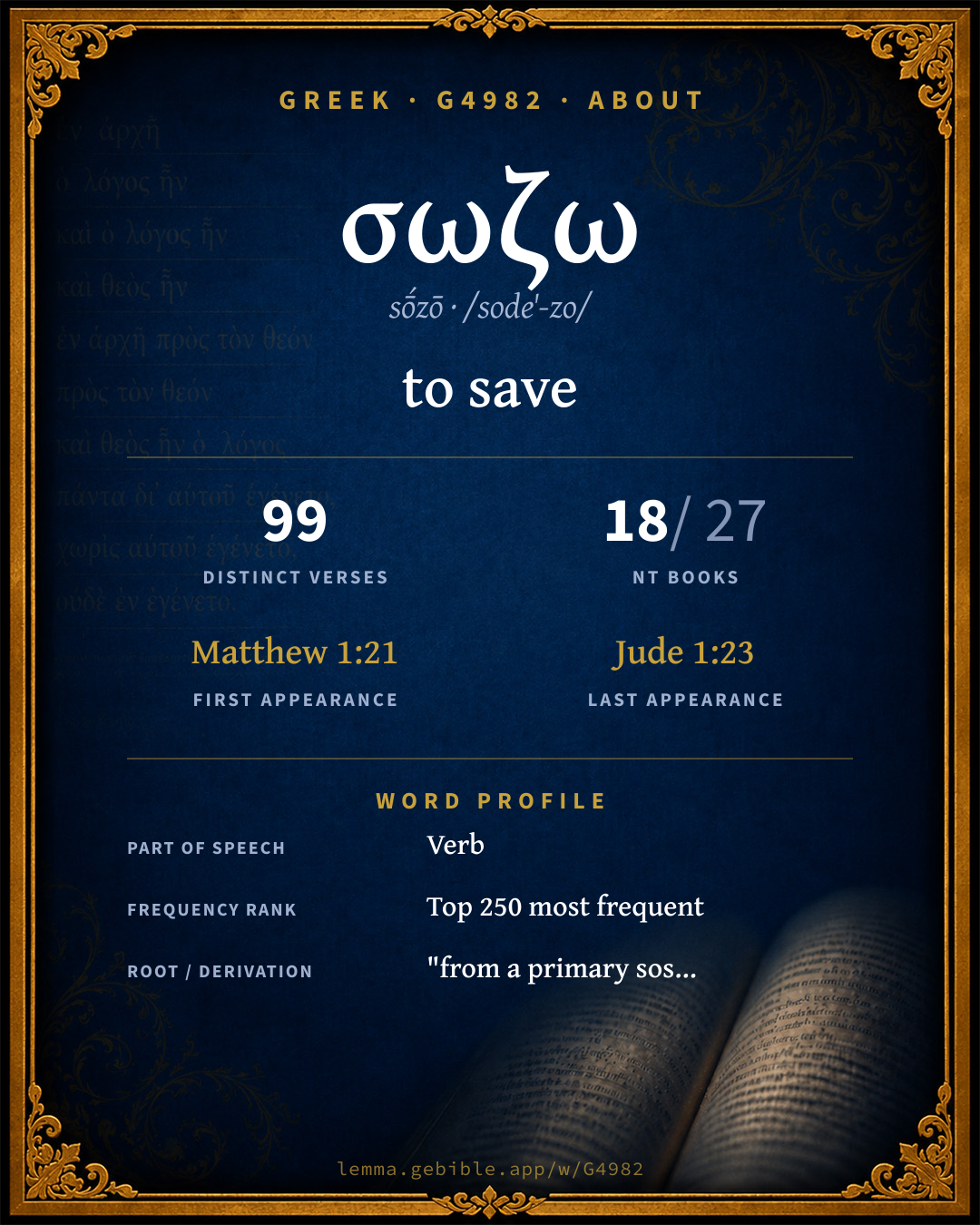
σώζω
to save
Full lexicon entry — Thayer's Greek Lexicon
From Thayer's Greek Lexicon
Where this word appears
See every Aorist-tense verb in the Greek New Testament →
Grammar key — what these labels mean
Part of speech
- Verb
- An action or state-of-being word.
Tense
- Aorist
- Action viewed as a simple whole, without regard to duration — often past (perfective aspect).
- Future
- Action expected in future time.
- Perfect
- A completed past action with continuing present results.
- Present
- Ongoing or general action in present time (imperfective aspect).
- Imperfect
- Continuous or repeated action in past time (“was writing”).
Voice
- Active
- The subject performs the action.
- Passive
- The subject receives the action.
Mood
- Infinitive
- A verbal noun (“to write”), unmarked for person or number.
- Indicative
- States a fact or asks a factual question (the mood of reality).
- Imperative
- Expresses a command or request.
- Subjunctive
- Expresses probability, purpose, or possibility (the mood of contingency).
- Participle
- A verbal adjective (“writing,” “having written”).
Case
- Dative
- The case of the indirect object, means, or location — “to / for / with / in.”
- Nominative
- The case of the subject (and the predicate nominative).
- Genitive
- The case of source, possession, or “of” — answers “whose / from what.”
- Accusative
- The case of the direct object and of extent.
Person
- 3rd person
- The one spoken about (“he / she / it / they”).
- 2nd person
- The one addressed (“you”).
- 1st person
- The speaker (“I / we”).
Gender
- Masculine
- Grammatically masculine.
Number
- Singular
- One.
- Plural
- More than one.
Grammatical forms 35 distinct
- Verb, Aorist, Active, Infinitive 13 times (12%)
- Verb, Future, Passive, Indicative, 3rd person, Singular 13 times (12%)
- Verb, Aorist, Passive, Infinitive 10 times (9%)
- Verb, Aorist, Active, Imperative, 2nd person, Singular 7 times (7%)
- Verb, Perfect, Active, Indicative, 3rd person, Singular 7 times (7%)
- Verb, Future, Active, Indicative, 3rd person, Singular 6 times (6%)
- Verb, Aorist, Active, Indicative, 3rd person, Singular 4 times (4%)
- Verb, Aorist, Passive, Indicative, 3rd person, Singular 4 times (4%)
+27 more forms (42 occurrences)
Parsed forms decoded from the imported morphology (Robinson–Tischendorf, public domain), counted across 106 parsed occurrences — not distinct verses.
Every verse where G4982 appears — 99 distinct verses across 18 books. Click any verse to open its interlinear word-by-word view. Verse text shown in the World English Bible for context — . Each verse’s Greek form is shown with its reference; the English is not keyword-highlighted, since the data carries no word-level English alignment. Use “Compare translations” on any verse to read it across multiple English versions. This concordance covers the Greek New Testament; Septuagint (Greek Old Testament) occurrences of this word are not indexed here.
Matthew 13 verses
- Matthew 1:21 σώσει fut act ind 3sg She shall bring forth a son. You shall call his name Jesus, for it is he who shall save his people from their sins."
- Matthew 8:25 σῶσον aor act impv 2sg They came to him, and woke him up, saying, "Save us, Lord! We are dying!"
- Matthew 9:21 σωθήσομαι fut pass ind 1sg for she said within herself, "If I just touch his garment, I will be made well."
- Matthew 9:22 σέσωκέν ἐσώθη perf act ind 3sg aor pass ind 3sg But Jesus, turning around and seeing her, said, "Daughter, cheer up! Your faith has made you well." And the woman was made well from that hour.
- Matthew 10:22 σωθήσεται fut pass ind 3sg You will be hated by all men for my name's sake, but he who endures to the end will be saved.
- Matthew 14:30 σῶσόν aor act impv 2sg But when he saw that the wind was strong, he was afraid, and beginning to sink, he cried out, saying, "Lord, save me!"
- Matthew 16:25 σῶσαι aor act inf For whoever desires to save his life will lose it, and whoever will lose his life for my sake will find it.
- Matthew 19:25 σωθῆναι aor pass inf When the disciples heard it, they were exceedingly astonished, saying, "Who then can be saved?"
- Matthew 24:13 σωθήσεται fut pass ind 3sg But he who endures to the end, the same will be saved.
- Matthew 24:22 ἐσώθη aor pass ind 3sg Unless those days had been shortened, no flesh would have been saved. But for the sake of the chosen ones, those days will be shortened.
- Matthew 27:40 σῶσον aor act impv 2sg and saying, "You who destroy the temple, and build it in three days, save yourself! If you are the Son of God, come down from the cross!"
- Matthew 27:42 ἔσωσεν σῶσαι aor act ind 3sg aor act inf "He saved others, but he can't save himself. If he is the King of Israel, let him come down from the cross now, and we will believe in him.
- Matthew 27:49 σώσων fut act ptcp nom sg masc The rest said, "Let him be. Let's see whether Elijah comes to save him."
Mark 13 verses
- Mark 3:4 σῶσαι aor act inf He said to them, "Is it lawful on the Sabbath day to do good, or to do harm? To save a life, or to kill?" But they were silent.
- Mark 5:23 σωθῇ aor pass subj 3sg and begged him much, saying, "My little daughter is at the point of death. Please come and lay your hands on her, that she may be made healthy, and live."
- Mark 5:28 σωθήσομαι fut pass ind 1sg For she said, "If I just touch his clothes, I will be made well."
- Mark 5:34 σέσωκέν perf act ind 3sg He said to her, "Daughter, your faith has made you well. Go in peace, and be cured of your disease."
- Mark 6:56 ἐσώζοντο impf pass ind 3pl Wherever he entered, into villages, or into cities, or into the country, they laid the sick in the marketplaces, and begged him that they might touch just the fringe of his garment; and as many as touched him were made well.
- Mark 8:35 σῶσαι σώσει aor act inf fut act ind 3sg For whoever wants to save his life will lose it; and whoever will lose his life for my sake and the Gospel's will save it.
- Mark 10:26 σωθῆναι aor pass inf They were exceedingly astonished, saying to him, "Then who can be saved?"
- Mark 10:52 σέσωκέν perf act ind 3sg Jesus said to him, "Go your way. Your faith has made you well." Immediately he received his sight, and followed Jesus in the way.
- Mark 13:13 σωθήσεται fut pass ind 3sg You will be hated by all men for my name's sake, but he who endures to the end, the same will be saved.
- Mark 13:20 ἐσώθη aor pass ind 3sg Unless the Lord had shortened the days, no flesh would have been saved; but for the sake of the chosen ones, whom he picked out, he shortened the days.
- Mark 15:30 σῶσον aor act impv 2sg save yourself, and come down from the cross!"
- Mark 15:31 ἔσωσεν σῶσαι aor act ind 3sg aor act inf Likewise, also the chief priests mocking among themselves with the scribes said, "He saved others. He can't save himself.
- Mark 16:16 σωθήσεται fut pass ind 3sg He who believes and is baptized will be saved; but he who disbelieves will be condemned.
Luke 15 verses
- Luke 6:9 σῶσαι aor act inf Then Jesus said to them, "I will ask you something: Is it lawful on the Sabbath to do good, or to do harm? To save a life, or to kill?"
- Luke 7:50 σέσωκέν perf act ind 3sg He said to the woman, "Your faith has saved you. Go in peace."
- Luke 8:12 σωθῶσιν aor pass subj 3pl Those along the road are those who hear, then the devil comes, and takes away the word from their heart, that they may not believe and be saved.
- Luke 8:36 ἐσώθη aor pass ind 3sg Those who saw it told them how he who had been possessed by demons was healed.
- Luke 8:48 σέσωκέν perf act ind 3sg He said to her, "Daughter, cheer up. Your faith has made you well. Go in peace."
- Luke 8:50 σωθήσεται fut pass ind 3sg But Jesus hearing it, answered him, "Don't be afraid. Only believe, and she will be healed."
- Luke 9:24 σῶσαι σώσει aor act inf fut act ind 3sg For whoever desires to save his life will lose it, but whoever will lose his life for my sake, the same will save it.
- Luke 13:23 σῳζόμενοι pres pass ptcp nom pl masc One said to him, "Lord, are they few who are saved?" He said to them,
- Luke 17:19 σέσωκέν perf act ind 3sg Then he said to him, "Get up, and go your way. Your faith has healed you."
- Luke 18:26 σωθῆναι aor pass inf Those who heard it said, "Then who can be saved?"
- Luke 18:42 σέσωκέν perf act ind 3sg Jesus said to him, "Receive your sight. Your faith has healed you."
- Luke 19:10 σῶσαι aor act inf For the Son of Man came to seek and to save that which was lost."
- Luke 23:35 ἔσωσεν σωσάτω aor act ind 3sg aor act impv 3sg The people stood watching. The rulers with them also scoffed at him, saying, "He saved others. Let him save himself, if this is the Christ of God, his chosen one!"
- Luke 23:37 σῶσον aor act impv 2sg and saying, "If you are the King of the Jews, save yourself!"
- Luke 23:39 σῶσον aor act impv 2sg One of the criminals who was hanged insulted him, saying, "If you are the Christ, save yourself and us!"
John 6 verses
- John 3:17 σωθῇ aor pass subj 3sg For God didn't send his Son into the world to judge the world, but that the world should be saved through him.
- John 5:34 σωθῆτε aor pass subj 2pl But the testimony which I receive is not from man. However, I say these things that you may be saved.
- John 10:9 σωθήσεται fut pass ind 3sg I am the door. If anyone enters in by me, he will be saved, and will go in and go out, and will find pasture.
- John 11:12 σωθήσεται fut pass ind 3sg The disciples therefore said, "Lord, if he has fallen asleep, he will recover."
- John 12:27 σῶσόν aor act impv 2sg "Now my soul is troubled. What shall I say? 'Father, save me from this time?' But for this cause I came to this time.
- John 12:47 σώσω aor act subj 1sg If anyone listens to my sayings, and doesn't believe, I don't judge him. For I came not to judge the world, but to save the world.
Acts 13 verses
- Acts 2:21 σωθήσεται fut pass ind 3sg It will be, that whoever will call on the name of the Lord will be saved.'
- Acts 2:40 σώθητε aor pass impv 2pl With many other words he testified, and exhorted them, saying, "Save yourselves from this crooked generation!"
- Acts 2:47 σῳζομένους pres pass ptcp acc pl masc praising God, and having favor with all the people. The Lord added to the assembly day by day those who were being saved.
- Acts 4:9 σέσωται perf pass ind 3sg if we are examined today concerning a good deed done to a crippled man, by what means this man has been healed,
- Acts 4:12 σωθῆναι aor pass inf There is salvation in none other, for neither is there any other name under heaven, that is given among men, by which we must be saved!"
- Acts 11:14 σωθήσῃ fut pass ind 2sg who will speak to you words by which you will be saved, you and all your house.'
- Acts 14:9 σωθῆναι aor pass inf He was listening to Paul speaking, who, fastening eyes on him, and seeing that he had faith to be made whole,
- Acts 15:1 σωθῆναι aor pass inf Some men came down from Judea and taught the brothers, "Unless you are circumcised after the custom of Moses, you can't be saved."
- Acts 15:11 σωθῆναι aor pass inf But we believe that we are saved through the grace of the Lord Jesus, just as they are."
- Acts 16:30 σωθῶ aor pass subj 1sg and brought them out and said, "Sirs, what must I do to be saved?"
- Acts 16:31 σωθήσῃ fut pass ind 2sg They said, "Believe in the Lord Jesus Christ, and you will be saved, you and your household."
- Acts 27:20 σώζεσθαι pres pass inf When neither sun nor stars shone on us for many days, and no small tempest pressed on us, all hope that we would be saved was now taken away.
- Acts 27:31 σωθῆναι aor pass inf Paul said to the centurion and to the soldiers, "Unless these stay in the ship, you can't be saved."
Romans 8 verses
- Romans 5:9 σωθησόμεθα fut pass ind 1pl Much more then, being now justified by his blood, we will be saved from God's wrath through him.
- Romans 5:10 σωθησόμεθα fut pass ind 1pl For if, while we were enemies, we were reconciled to God through the death of his Son, much more, being reconciled, we will be saved by his life.
- Romans 8:24 ἐσώθημεν aor pass ind 1pl For we were saved in hope, but hope that is seen is not hope. For who hopes for that which he sees?
- Romans 9:27 σωθήσεται fut pass ind 3sg Isaiah cries concerning Israel, "If the number of the children of Israel are as the sand of the sea, It is the remnant who will be saved;
- Romans 10:9 σωθήσῃ fut pass ind 2sg that if you will confess with your mouth the Lord Jesus, and believe in your heart that God raised him from the dead, you will be saved.
- Romans 10:13 σωθήσεται fut pass ind 3sg For, "Whoever will call on the name of the Lord will be saved."
- Romans 11:14 σώσω aor act subj 1sg if by any means I may provoke to jealousy those who are my flesh, and may save some of them.
- Romans 11:26 σωθήσεται fut pass ind 3sg and so all Israel will be saved. Even as it is written, "There will come out of Zion the Deliverer, And he will turn away ungodliness from Jacob.
1 Corinthians 8 verses
- 1 Corinthians 1:18 σῳζομένοις pres pass ptcp dat pl masc For the word of the cross is foolishness to those who are dying, but to us who are saved it is the power of God.
- 1 Corinthians 1:21 σῶσαι aor act inf For seeing that in the wisdom of God, the world through its wisdom didn't know God, it was God's good pleasure through the foolishness of the preaching to save those who believe.
- 1 Corinthians 3:15 σωθήσεται fut pass ind 3sg If any man's work is burned, he will suffer loss, but he himself will be saved, but as through fire.
- 1 Corinthians 5:5 σωθῇ aor pass subj 3sg are to deliver such a one to Satan for the destruction of the flesh, that the spirit may be saved in the day of the Lord Jesus.
- 1 Corinthians 7:16 σώσεις σώσεις fut act ind 2sg fut act ind 2sg For how do you know, wife, whether you will save your husband? Or how do you know, husband, whether you will save your wife?
- 1 Corinthians 9:22 σώσω aor act subj 1sg To the weak I became as weak, that I might gain the weak. I have become all things to all men, that I may by all means save some.
- 1 Corinthians 10:33 σωθῶσιν aor pass subj 3pl even as I also please all men in all things, not seeking my own profit, but the profit of the many, that they may be saved.
- 1 Corinthians 15:2 σῴζεσθε pres pass ind 2pl by which also you are saved, if you hold firmly the word which I preached to you--unless you believed in vain.
2 Corinthians 1 verse
Ephesians 2 verses
- Ephesians 2:5 σεσῳσμένοι perf pass ptcp nom pl masc even when we were dead through our trespasses, made us alive together with Christ (by grace you have been saved),
- Ephesians 2:8 σεσῳσμένοι perf pass ptcp nom pl masc for by grace you have been saved through faith, and that not of yourselves; it is the gift of God,
1 Thessalonians 1 verse
2 Thessalonians 1 verse
1 Timothy 4 verses
- 1 Timothy 1:15 σῶσαι aor act inf The saying is faithful and worthy of all acceptance, that Christ Jesus came into the world to save sinners; of whom I am chief.
- 1 Timothy 2:4 σωθῆναι aor pass inf who desires all people to be saved and come to full knowledge of the truth.
- 1 Timothy 2:15 σωθήσεται fut pass ind 3sg but she will be saved through her child-bearing, if they continue in faith, love, and sanctification with sobriety.
- 1 Timothy 4:16 σώσεις fut act ind 2sg Pay attention to yourself, and to your teaching. Continue in these things, for in doing this you will save both yourself and those who hear you.
2 Timothy 2 verses
- 2 Timothy 1:9 σώσαντος aor act ptcp gen sg masc who saved us and called us with a holy calling, not according to our works, but according to his own purpose and grace, which was given to us in Christ Jesus before times eternal,
- 2 Timothy 4:18 σώσει fut act ind 3sg And the Lord will deliver me from every evil work, and will preserve me for his heavenly Kingdom; to whom be the glory forever and ever. Amen.
Titus 1 verse
Hebrews 2 verses
- Hebrews 5:7 σῴζειν pres act inf He, in the days of his flesh, having offered up prayers and petitions with strong crying and tears to him who was able to save him from death, and having been heard for his godly fear,
- Hebrews 7:25 σῴζειν pres act inf Therefore he is also able to save to the uttermost those who draw near to God through him, seeing he ever lives to make intercession for them.
James 5 verses
- James 1:21 σῶσαι aor act inf Therefore, putting away all filthiness and overflowing of wickedness, receive with humility the implanted word, which is able to save your souls.
- James 2:14 σῶσαι aor act inf What good is it, my brothers, if a man says he has faith, but has no works? Can faith save him?
- James 4:12 σῶσαι aor act inf Only one is the lawgiver, who is able to save and to destroy. But who are you to judge another?
- James 5:15 σώσει fut act ind 3sg and the prayer of faith will heal him who is sick, and the Lord will raise him up. If he has committed sins, he will be forgiven.
- James 5:20 σώσει fut act ind 3sg let him know that he who turns a sinner from the error of his way will save a soul from death, and will cover a multitude of sins.
1 Peter 2 verses
- 1 Peter 3:21 σῴζει pres act ind 3sg This is a symbol of baptism, which now saves you-- not the putting away of the filth of the flesh, but the answer of a good conscience toward God, through the resurrection of Jesus Christ,
- 1 Peter 4:18 σῴζεται pres pass ind 3sg "If it is hard for the righteous to be saved, what will happen to the ungodly and the sinner?"
Jude 2 verses
- Jude 1:5 σώσας aor act ptcp nom sg masc Now I desire to remind you, though you already know this, that the Lord, having saved a people out of the land of Egypt, afterward destroyed those who didn't believe.
- Jude 1:23 σῴζετε pres act impv 2pl and some save, snatching them out of the fire with fear, hating even the clothing stained by the flesh.
About this entry
At a glance — auto-summarized from this page’s data, not written by a person. Every figure links to its source below. This summary describes the numbers; it doesn’t interpret them.
At its core, σωζω (sṓzō) means “to save.” It first appears in Matthew 1:21. It turns up in 99 verses across 18 books, a moderately common footprint. It clusters with σωμα, σωτηρ and σωφρων under a shared root. Dig into 99-verse concordance and the renderings breakdown below.
Gloss history
Strong's 1890 vs modern scholarship

About this word
Strong's G4982 catalogs a Greek word from the Greek New Testament.
These counts are not copied from any lexicon or concordance. They are computed here, from the morphology-tagged Greek New Testament. What Lemma adds →
- 99
- distinct verses
- The word appears in 99 distinct verses.
- 18 / 27
- NT books
- The word appears in 18 of 27 New Testament books.
- #156
- by frequency
- Top 250 most frequent Greek words (rank 156 of 5,347 Greek words by occurrence).
View all 99 occurrences in the concordance →
By section of the New Testament
By traditional corpus
Conventional, traditional groupings — biblical authorship is debated, so this is a traditional corpus grouping, not an authorship claim. Some books belong to more than one corpus (Luke is in both the Gospels and the Lukan corpus, and so on), so these shares overlap and need not total 100%. Each figure is a share of the word’s 99 distinct verses.
- Gospels 47 verses · 47%
- Lukan (Luke–Acts) 28 verses · 28%
- Pauline corpus 28 verses · 28%
- General (Catholic) Epistles 9 verses · 9%
- Johannine 6 verses · 6%
- Hebrews 2 verses · 2%
How translations render this word
Counts come from each version’s own published word-to-Strong’s tagging or interlinear alignment — an approximate guide to how each version renders this word, not a word-level alignment the data otherwise carries. Because each total is that version’s own tagged count, the per-version totals vary from one another and need not match the appearance or distinct-verse counts above. These counts may also differ from a printed concordance because Lemma counts each distinctly tagged rendering and does not collapse phrase taggings into a single head-word total. This is a fixed set of word-tagged versions (KJV, ASV, BSB, ULT) and does not change with the reading translation you choose elsewhere. Each version’s license is shown beside its name below (and on Sources).
- King James Version: Save 30×, Be saved 11×, Shall be saved 10×
- American Standard Version: Save 29×, Shall be saved 8×, Saved 7×
- Berean Standard Bible: Save 26×, Be saved 12×, Will be saved 10×
- unfoldingWord Literal Text: Save 24×, Be saved 12×, Will be saved 9×
King James Version Public Domain
Renders G4982 across 118 tagged occurrences — most commonly:
Plus other, less common renderings. Plus 26 renderings that appear only once — usually multi-word phrases or single function words the recovered tagging swept in, not distinct renderings.
American Standard Version Public Domain
Renders G4982 across 113 tagged occurrences — most commonly:
Plus other, less common renderings. Plus 25 renderings that appear only once — usually multi-word phrases or single function words the recovered tagging swept in, not distinct renderings.
Berean Standard Bible Public Domain
Renders G4982 across 106 tagged occurrences — most commonly:
Plus other, less common renderings. Plus 19 renderings that appear only once — usually multi-word phrases or single function words the recovered tagging swept in, not distinct renderings.
unfoldingWord Literal Text CC BY-SA 4.0
Renders G4982 across 111 tagged occurrences — most commonly:
Plus other, less common renderings. Plus 24 renderings that appear only once — usually multi-word phrases or single function words the recovered tagging swept in, not distinct renderings.
Senses in Thayer's
The 1 sense Thayer's distinguishes for this word, in lexicon order (not ranked by frequency or importance). The full entry — with sub-senses — is in the Lexicon Entry tab.
- to save, keep safe and sound, to rescue from danger or destruction
Word origin
Origin: "from a primary sos (contraction for obsolete saoz, "safe")"
From a primary word σῶς sō s̄ (contraction for the obsolete σάος saos safe); to save that is deliver or protect (literally or figuratively): - heal preserve save (self) do well be (make) whole.
— Strong’s Exhaustive Concordance (1890), public domain.
Forms in the corpus
The 36 distinct written forms G4982 takes in the Greek New Testament, most frequent first — each parse links to that tense’s occurrences in the concordance.
Same root — word family
Other Thayer's entries built from the same root as G4982, grouped by Strong’s listed origin. These share a root / origin per the lexicon — not necessarily a shared meaning. Each links to that word’s own entry.
Derived from this word
Proper names from this root
People and places named from this root — a name, not an additional meaning of the word.
Compare all same-root words → Showing 4 of 6 — not the complete family. 2 of the same-root words are proper names (people or places). They share a root, not necessarily a meaning.
Septuagint usage
The same Greek word σωζω appears 288 times in the Greek Old Testament (Septuagint), across 273 verses in 30 books.
- 288
- LXX occurrences
- Tagged occurrences of this Greek word in the Septuagint.
- 273
- verses
- Distinct Septuagint verses containing this word.
- 30 / 39
- OT books
- The word appears in 30 of the 39 Old Testament books.
Sample Septuagint occurrences
- Genesis 19:17 σώζω
- Numbers 24:19 σώζω
- Deuteronomy 33:29 σώζω
- Joshua 8:22 σώζω
- Judges 2:16 σώζω
- 1 Samuel 4:3 σώζω
- 2 Samuel 3:18 σώζω
- 1 Kings 13:31 σώζω
- 2 Kings 6:26 σώζω
- 1 Chronicles 11:14 σώζω
- 2 Chronicles 14:10 σώζω
- Ezra 8:22 σώζω
Septuagint occurrences (same lexeme)
Every verse where the same Strong’s number (G4982) appears in the Greek Septuagint — showing the first 50 of 273. Verse text shown in the World English Bible for context; the Greek form is the matched word — the English is not keyword-highlighted.
- Genesis 19:17 σώζω It came to pass, when they had taken them out, that he said, "Escape for your life! Don't look behind you, neither stay anywhere in the plain. Escape to the mountain, lest you be consumed!"
- Genesis 19:20 σώζω See now, this city is near to flee to, and it is a little one. Oh let me escape there (isn't it a little one?), and my soul will live."
- Genesis 19:22 σώζω Hurry, escape there, for I can't do anything until you get there." Therefore the name of the city was called Zoar.
- Genesis 32:9 σώζω Jacob said, "God of my father Abraham, and God of my father Isaac, Yahweh, who said to me, 'Return to your country, and to your relatives, and I will do you good.'
- Genesis 32:31 σώζω The sun rose on him as he passed over Peniel, and he limped because of his thigh.
- Genesis 47:25 σώζω They said, "You have saved our lives! Let us find favor in the sight of my lord, and we will be Pharaoh's servants."
- Numbers 24:19 σώζω Out of Jacob shall one have dominion, Shall destroy the remnant from the city.
- Deuteronomy 33:29 σώζω Happy are you, Israel: Who is like you, a people saved by Yahweh, The shield of your help, The sword of your excellency! Your enemies shall submit themselves to you; You shall tread on their high places.
- Joshua 8:22 σώζω The others came forth out of the city against them; so they were in the midst of Israel, some on this side, and some on that side: and they struck them, so that they let none of them remain or escape.
- Joshua 10:33 σώζω Then Horam king of Gezer came up to help Lachish; and Joshua struck him and his people, until he had left him none remaining.
- Joshua 10:40 σώζω So Joshua struck all the land, the hill-country, and the South, and the lowland, and the slopes, and all their kings: he left none remaining, but he utterly destroyed all that breathed, as Yahweh, the God of Israel, commanded.
- Judges 2:16 σώζω Yahweh raised up judges, who saved them out of the hand of those who despoiled them.
- Judges 2:18 σώζω When Yahweh raised them up judges, then Yahweh was with the judge, and saved them out of the hand of their enemies all the days of the judge: for it repented Yahweh because of their groaning by reason of those who oppressed them and vexed them.
- Judges 3:9 σώζω When the children of Israel cried to Yahweh, Yahweh raised up a savior to the children of Israel, who saved them, even Othniel the son of Kenaz, Caleb's younger brother.
- Judges 3:31 σώζω After him was Shamgar the son of Anath, who struck of the Philistines six hundred men with an ox-goad: and he also saved Israel.
- Judges 6:14 σώζω Yahweh looked at him, and said, Go in this your might, and save Israel from the hand of Midian: have not I sent you?
- Judges 6:15 σώζω He said to him, Oh, Lord, with which shall I save Israel? behold, my family is the poorest in Manasseh, and I am the least in my father's house.
- Judges 6:31 σώζω Joash said to all who stood against him, Will you contend for Baal? Or will you save him? he who will contend for him, let him be put to death while [it is yet] morning: if he be a god, let him contend for himself, because one has broken down his altar.
- Judges 6:36 σώζω Gideon said to God, If you will save Israel by my hand, as you have spoken,
- Judges 6:37 σώζω behold, I will put a fleece of wool on the threshing floor; if there be dew on the fleece only, and it be dry on all the ground, then shall I know that you will save Israel by my hand, as you have spoken.
- Judges 7:2 σώζω Yahweh said to Gideon, The people who are with you are too many for me to give the Midianites into their hand, lest Israel vaunt themselves against me, saying, My own hand has saved me.
- Judges 7:7 σώζω Yahweh said to Gideon, By the three hundred men who lapped will I save you, and deliver the Midianites into your hand; and let all the people go every man to his place.
- Judges 8:22 σώζω Then the men of Israel said to Gideon, Rule you over us, both you, and your son, and your son's son also; for you have saved us out of the hand of Midian.
- Judges 10:1 σώζω After Abimelech there arose to save Israel Tola the son of Puah, the son of Dodo, a man of Issachar; and he lived in Shamir in the hill-country of Ephraim.
- Judges 10:12 σώζω The Sidonians also, and the Amalekites, and the Maonites, did oppress you; and you cried to me, and I saved you out of their hand.
- Judges 10:13 σώζω Yet you have forsaken me, and served other gods: therefore I will save you no more.
- Judges 10:14 σώζω Go and cry to the gods which you have chosen; let them save you in the time of your distress.
- Judges 12:2 σώζω Jephthah said to them, I and my people were at great strife with the children of Ammon; and when I called you, you didn't save me out of their hand.
- Judges 13:5 σώζω for, behold, you shall conceive, and bear a son; and no razor shall come on his head; for the child shall be a Nazirite to God from the womb: and he shall begin to save Israel out of the hand of the Philistines.
- 1 Samuel 4:3 σώζω When the people were come into the camp, the elders of Israel said, Why has Yahweh struck us today before the Philistines? Let us get the ark of the covenant of Yahweh out of Shiloh to us, that it may come among us, and save us out of the hand of our enemies.
- 1 Samuel 7:8 σώζω The children of Israel said to Samuel, "Don't cease to cry to Yahweh our God for us, that he will save us out of the hand of the Philistines."
- 1 Samuel 9:16 σώζω Tomorrow about this time I will send you a man out of the land of Benjamin, and you shall anoint him to be prince over my people Israel; and he shall save my people out of the hand of the Philistines: for I have looked on my people, because their cry is come to me.
- 1 Samuel 10:1 σώζω Then Samuel took the vial of oil, and poured it on his head, and kissed him, and said, Isn't it that Yahweh has anointed you to be prince over his inheritance?
- 1 Samuel 10:27 σώζω But certain worthless fellows said, How shall this man save us? They despised him, and brought him no present. But he held his peace.
- 1 Samuel 11:3 σώζω The elders of Jabesh said to him, Give us seven days' respite, that we may send messengers to all the borders of Israel; and then, if there be none to save us, we will come out to you.
- 1 Samuel 14:6 σώζω Jonathan said to the young man who bore his armor, Come, and let us go over to the garrison of these uncircumcised: it may be that Yahweh will work for us; for there is no restraint to Yahweh to save by many or by few.
- 1 Samuel 14:23 σώζω So Yahweh saved Israel that day: and the battle passed over by Beth Aven.
- 1 Samuel 14:39 σώζω For, as Yahweh lives, who saves Israel, though it be in Jonathan my son, he shall surely die. But there was not a man among all the people who answered him.
- 1 Samuel 14:47 σώζω Now when Saul had taken the kingdom over Israel, he fought against all his enemies on every side, against Moab, and against the children of Ammon, and against Edom, and against the kings of Zobah, and against the Philistines: and wherever he turned himself, he put [them] to the worse.
- 1 Samuel 17:27 σώζω The people answered him after this manner, saying, So shall it be done to the man who kills him.
- 1 Samuel 19:11 σώζω Saul sent messengers to David's house, to watch him, and to kill him in the morning: and Michal, David's wife, told him, saying, If you don't save your life tonight, tomorrow you will be slain.
- 1 Samuel 19:12 σώζω So Michal let David down through the window: and he went, and fled, and escaped.
- 1 Samuel 23:2 σώζω Therefore David inquired of Yahweh, saying, Shall I go and strike these Philistines? Yahweh said to David, Go, and strike the Philistines, and save Keilah.
- 1 Samuel 23:5 σώζω David and his men went to Keilah, and fought with the Philistines, and brought away their cattle, and killed them with a great slaughter. So David saved the inhabitants of Keilah.
- 1 Samuel 25:26 σώζω Now therefore, my lord, as Yahweh lives, and as your soul lives, seeing Yahweh has withheld you from blood guiltiness, and from avenging yourself with your own hand, now therefore let your enemies, and those who seek evil to my lord, be as Nabal.
- 1 Samuel 25:31 σώζω that this shall be no grief to you, nor offense of heart to my lord, either that you have shed blood without cause, or that my lord has avenged himself. When Yahweh shall have dealt well with my lord, then remember your handmaid.
- 1 Samuel 25:33 σώζω and blessed be your discretion, and blessed be you, that have kept me this day from blood guiltiness, and from avenging myself with my own hand.
- 1 Samuel 27:1 σώζω David said in his heart, I shall now perish one day by the hand of Saul: there is nothing better for me than that I should escape into the land of the Philistines; and Saul will despair of me, to seek me any more in all the borders of Israel: so shall I escape out of his hand.
- 1 Samuel 30:17 σώζω David struck them from the twilight even to the evening of the next day: and there not a man of them escaped, except four hundred young men, who rode on camels and fled.
- 2 Samuel 3:18 σώζω now then do it; for Yahweh has spoken of David, saying, By the hand of my servant David I will save my people Israel out of the hand of the Philistines, and out of the hand of all their enemies.
These are occurrences of the same Greek lexeme (G4982) in the Septuagint — not a translation of any one Hebrew word. The store carries no word-level Hebrew↔Greek alignment, so no Hebrew original is asserted here. Counts come from the recovered LXX Strong's tagging — high-frequency vocabulary is well covered, while rare or late forms may be untagged — so they reflect tagged occurrences and may slightly undercount.