Leviticus 15:16

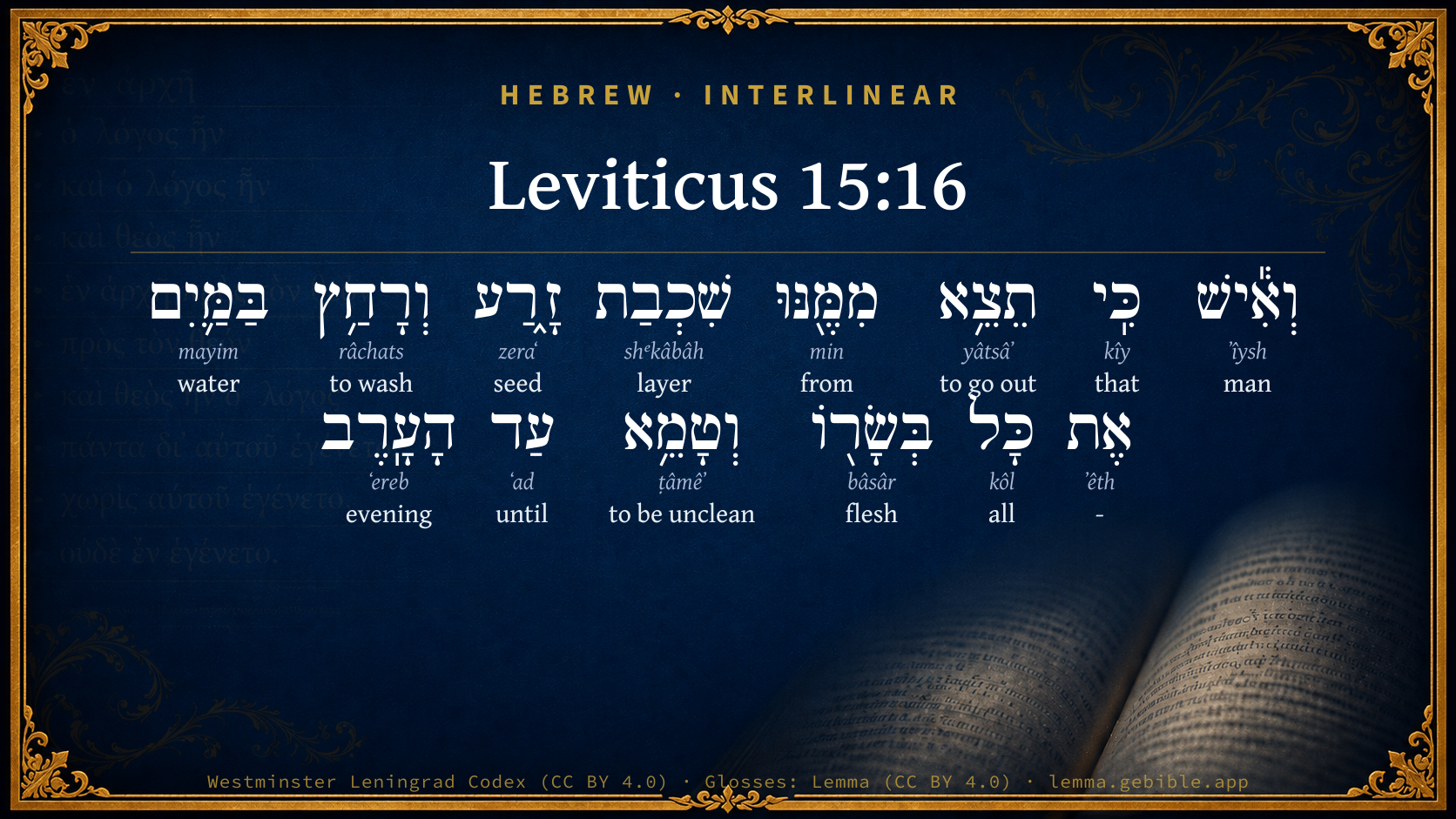
Hebrew (Westminster Leningrad Codex) Leviticus 15:16 appears in the Hebrew Old Testament. The text above is from the Westminster Leningrad Codex. Each word links to its Strong’s number, a concise gloss, and parsing drawn from the Open Scriptures Hebrew Bible morphology. Click any word for its full Brown-Driver-Briggs (BDB) entry.
Download image
Cite this verse

Leviticus 15:16 (World English Bible). Public Domain. Lemma interlinear Bible study tool, https://lemma.gebible.app/v/leviticus/15/16.

Show BibTeX & RIS
BibTeX
RIS
English Translation
"'If any man has an emission of semen, then he shall bathe all his flesh in water, and be unclean until the evening.
World English Bible · Public Domain
Download a study sheet

One document with this verse’s original text, its word-by-word gloss line, the meaning frame, cross-references with their text, attributed commentary, and full source and license credits — printable, and it pastes into notes with its structure intact.

This verse Autodidact and up

Study sheet (.html) Plain text (.txt)

A passage Seminary Student

Up to 50 verses in one chapter. A passage sheet keeps up to 6 commentary sources and 12 cross-references per verse, in the order this page ranks them, and says so on the sheet whenever that leaves anything out. Ask for a single verse and you get the Autodidact verse sheet above.

Everything on this page stays free to read, with no account — the sheet is a download of what is already on screen, not access to it.

Want to remove ads? Support Godless Engineer
Compare translations 3

The same verse in 3 English versions, stacked beneath the original-language interlinear above. Click any original word for its lexicon entry.

Each is an independent rendering of the whole verse — the interlinear is not word-aligned to these translations.

Highlighted words mark where these versions differ — a whole-verse word diff, not a word-by-word alignment.

  • World English Bible Public Domain
    "'If any man has an emission of semen, then he shall bathe all his flesh in water, and be unclean until the evening.
  • King James Version Public Domain
    And if any man's seed of copulation go out from him, then he shall wash all his flesh in water, and be unclean until the even.
  • unfoldingWord Literal Text CC BY-SA 4.0
    And a man, when a lying of seed goes out from him, then he shall bathe all his flesh with water. And he shall be unclean until the evening.

unfoldingWord Literal Text — © unfoldingWord, licensed CC BY-SA 4.0. Word-aligned USFM3 via Door43 (git.door43.org/unfoldingWord/en_ult).

Versions to compare (up to 4)

3 of 4 selected

Show all 18 translations

Every available English version of this verse, each an independent rendering of the whole verse.

  • World English Bible Public Domain
    "'If any man has an emission of semen, then he shall bathe all his flesh in water, and be unclean until the evening.
  • Berean Standard Bible Public Domain
    When a man has an emission of semen, he must bathe his whole body with water, and he will be unclean until evening.
  • Majority Standard Bible Public Domain
    When a man has an emission of semen, he must bathe his whole body with water, and he will be unclean until evening.
  • King James Version Public Domain
    And if any man's seed of copulation go out from him, then he shall wash all his flesh in water, and be unclean until the even.
  • American Standard Version (1901) Public Domain
    And if any man's seed of copulation go out from him, then he shall bathe all his flesh in water, and be unclean until the even.
  • Revised Version (1885) Public Domain
    And if any man’s seed of copulation go out from him, then he shall bathe all his flesh in water, and be unclean until the even.
  • Geneva Bible (1599) Public Domain
    Also if any mans issue of seede depart from him, he shall wash all his flesh in water, and be vncleane vntill the euen.
  • Douay-Rheims (1899) Public Domain
    The man from whom the seed of copulation goeth out, shall wash all his body with water: and he shall be unclean until the evening.
  • Young's Literal Translation Public Domain
    `And when a man's seed of copulation goeth out from him, then he hath bathed with water all his flesh, and been unclean till the evening.
  • Literal Standard Version CC BY-SA 4.0
    And when a man’s seed [from] intercourse goes out from him, then he has bathed all his flesh with water, and been unclean until the evening.
  • Unlocked Literal Bible CC BY-SA 4.0
    If any man has an emission of semen, then he must bathe his whole body in water; he will be unclean until evening.
  • unfoldingWord Literal Text CC BY-SA 4.0
    And a man, when a lying of seed goes out from him, then he shall bathe all his flesh with water. And he shall be unclean until the evening.
  • Darby Bible Public Domain
    And if any man's seed of copulation pass from him, then he shall bathe his whole flesh in water, and be unclean until the even.
  • World Messianic Bible Public Domain
    “‘If any man has an emission of semen, then he shall bathe all his flesh in water, and be unclean until the evening.
  • Webster's Bible Public Domain
    And if any man's seed of copulation shall go from him, then he shall wash all his flesh in water, and be unclean until the evening.
  • Free Bible Version CC BY-SA 4.0
    When a man has a release of semen, he must wash his whole body with water, and he will be unclean until the evening.
  • Bible in Basic English Public Domain
    And if a man's seed goes out from him, then all his body will have to be bathed in water and he will be unclean till evening.
  • JPS Tanakh (1917) Public Domain
    And if the flow of seed go out from a man, then he shall bathe all his flesh in water, and be unclean until the even.

Literal Standard Version (2020), Covenant Press — licensed CC BY-SA 4.0. Text via the HelloAO Bible API (eBible.org). Unlocked Literal Bible (unfoldingWord) — licensed CC BY-SA 4.0. Text via the HelloAO Bible API (eBible.org). unfoldingWord Literal Text — © unfoldingWord, licensed CC BY-SA 4.0. Word-aligned USFM3 via Door43 (git.door43.org/unfoldingWord/en_ult). Free Bible Version, Dr. Jonathan Gallagher — licensed CC BY-SA 4.0. Text via the HelloAO Bible API (eBible.org).

Word by word

More ways to search: Search by grammar → Find every occurrence → Compare this word →

Practice this passage: Drill this verse → Learn its vocabulary →

שִׁכְבַת
shᵉkâbâh
H7902
“layer of”
Noun, Common, Feminine, Singular, Construct
Part of Speech
Noun
Type
Common
Gender
Feminine
Number
Singular
State
Construct
Full BDB Definition

Origin: from H7901

TWOT: 2381a

act of lying, layer, coating - act of lying (of sexual relations) - layer
  1. וְאִ֕ישׁ ʼîysh H376 “and · man” Conjunction + Noun, Common, Masculine, Singular, Absolute
  2. כִּֽי kîy H3588 “that” Conjunction
  3. תֵצֵ֥א yâtsâʼ H3318 “to go out” Verb, Qal, Imperfect, 3rd Person, Feminine, Singular
  4. מִמֶּ֖נּוּ min H4480 “from · us” Preposition + Suffix, Personal, 1st Person, Common, Plural
  5. זָ֑רַע zeraʻ H2233 “seed” Noun, Common, Masculine, Singular, Absolute
  6. וְרָחַ֥ץ râchats H7364 “and · to wash” Conjunction + Verb, Qal, Sequential Perfect, 3rd Person, Masculine, Singular
  7. בַּמַּ֛יִם mayim H4325 “in/at the · water(s)” Preposition, Determined + Noun, Common, Masculine, Plural, Absolute
  8. אֶת ʼêth H853 “-” Particle, Direct Object
  9. כָּל kôl H3605 “all of” Noun, Common, Masculine, Singular, Construct
  10. בְּשָׂר֖וֹ bâsâr H1320 “flesh · his” Noun, Common, Masculine, Singular, Construct + Suffix, Personal, 3rd Person, Masculine, Singular
  11. וְטָמֵ֥א ṭâmêʼ H2930 “and · to be unclean” Conjunction + Verb, Qal, Sequential Perfect, 3rd Person, Masculine, Singular
  12. עַד ʻad H5704 “until” Preposition
  13. הָעָֽרֶב ʻereb H6153 “the · evening” Particle, Definite Article + Noun, Common, Masculine, Singular, Absolute

About this verse

These counts appear in no published source. They are computed here, from the morphology-tagged text and Lemma’s own curated glosses. What Lemma adds →

14
words
14
distinct lemmas
Pentateuch
section

Notable vocabulary

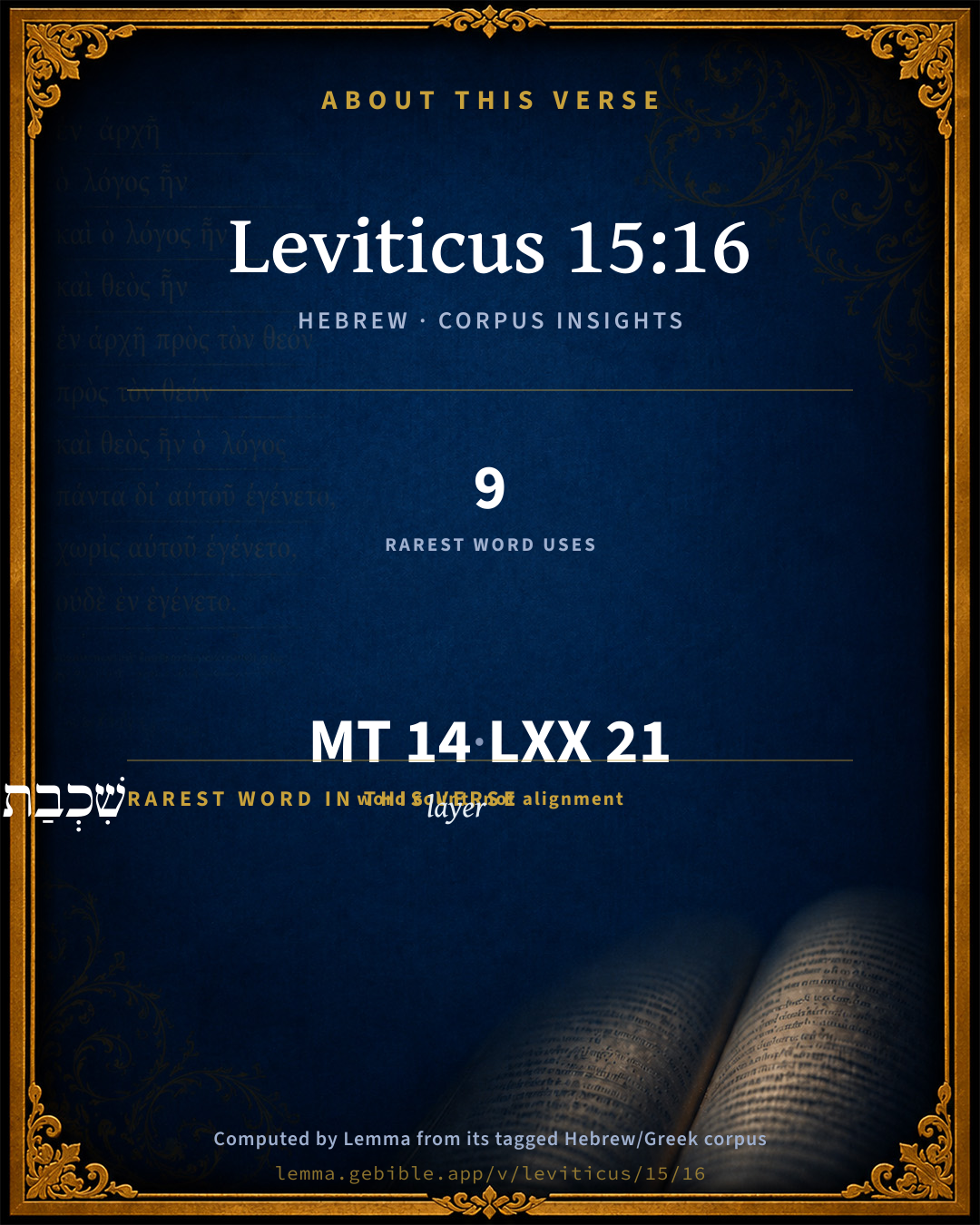
The rarest word here is שִׁכְבַת layer H7902 — appearing just 9 times in the whole Hebrew Bible.

Shared distinctive vocabulary

שִׁכְבַת layer H7902 occurs in 9 verses of the Hebrew Bible. Also found in:

Grammatical profile

  • 3 verbs
  • 7 nouns
  • 2 prepositions
  • 1 conjunction
  • 1 particle

Verb forms

  • תֵצֵ֥א Qal · Imperfect
  • וְרָחַ֥ץ Qal · Sequential Perfect
  • וְטָמֵ֥א Qal · Sequential Perfect

Hebrew & Septuagint length

In English translation the verse runs 23 words from the Hebrew and 26 from the Septuagint (LXX English) — closely comparable.

A rough comparison of the two English renderings, which tokenize alike — not a word-level alignment.

Word counts can differ between the Hebrew and the Greek without any difference in meaning — e.g. the Hebrew direct-object marker אֵת has no separate Greek word, and Greek often adds the article ὁ.

In the original languages it is 14 Hebrew tokens and 21 Greek tokens — but the two are counted differently (Hebrew bundles its prefixes and suffixes into one token; the Greek is in lemma form), so that isn’t a like-for-like length.

Cross-references

4

Topical passages linked to Leviticus 15:16 in the Treasury of Scripture Knowledge — connected by theme and wording, ordered by reader-vote popularity; previews shown in the World English Bible.

  • Deuteronomy 23:10–11 If there be among you any man, who is not clean by reason of that which happens him by night, then shall he go abroad out of the camp, he shall not come within the camp:
  • Leviticus 22:4 "'Whoever of the seed of Aaron is a leper or has an issue; he shall not eat of the holy things, until he is clean. Whoever touches anything that is unclean by the dead, or a man whose seed goes from him;
  • Leviticus 15:5 Whoever touches his bed shall wash his clothes, and bathe himself in water, and be unclean until the evening.
  • 1 John 1:7 But if we walk in the light, as he is in the light, we have fellowship with one another, and the blood of Jesus Christ, his Son, cleanses us from all sin.

Cross-references courtesy of OpenBible.info (CC BY 4.0).

Hebrew and Greek witnesses Masoretic Hebrew ↔ Greek Septuagint

The same verse in the two great witnesses to the Old Testament, shown verse-for-verse.

These are two independent witnesses, not word-aligned to each other, and the Septuagint is shown in lemma (dictionary) form.

Hebrew Leviticus 15:16 Masoretic · Westminster Leningrad Codex

וְאִ֕ישׁ כִּֽי תֵצֵ֥א מִמֶּ֖נּוּ שִׁכְבַת זָ֑רַע וְרָחַ֥ץ בַּמַּ֛יִם אֶת כָּל בְּשָׂר֖וֹ וְטָמֵ֥א עַד הָעָֽרֶב

"'If any man has an emission of semen, then he shall bathe all his flesh in water, and be unclean until the evening.

World English Bible · Public Domain

Greek LXX Leviticus 15:16 Septuagint · lemma form

καί ἄνθρωπος ὅς ἐάν ἐκἔρχομαι ἐκ αὐτός κοίτη σπέρμα καί λούω ὕδωρ πᾶς ὁ σῶμα αὐτός καί ἀκάθαρτος εἰμί ἕως ἑσπέρα

And the man whose seed of copulation shall happen to go forth from him, shall then wash his whole body, and shall be unclean until evening.

LXX2012 (modern English Septuagint) · Public Domain

Hebrew: Westminster Leningrad Codex (CC BY 4.0). Greek: Septuagint (public domain); English from LXX2012 (modern English Septuagint) (Public Domain). How the Septuagint differs from the Hebrew →

Targum (Aramaic paraphrase)

2

The Targum is the ancient Jewish Aramaic paraphrase of the Hebrew Scriptures — an interpretive translation, not the Hebrew text itself. Onkelos (literal) and Pseudo-Jonathan (expansive) render the Torah, and Jonathan the Prophets. Coverage is partial: where no permissively-licensed English translation exists for a verse, only the Aramaic is shown. This is verse-level text, not a word-by-word alignment to the Hebrew.

  1. Targum Onkelos Torah (Genesis–Deuteronomy)
    וּגְבַר אֲרֵי תִפוֹק מִנֵהּ שִׁכְבַת זַרְעָא וְיַסְחֵי בְמַיָא יָת כָּל בִּשְׂרֵהּ וִיהֵי מְסָאָב עַד רַמְשָׁא

    (no public-domain English translation for this verse)

    Targum Onkelos — Aramaic: “Onkelos Genesis” (public domain); “Onkelos Exodus” (public domain); “Onkelos Leviticus” (public domain); “Onkelos Numbers” (public domain); “Onkelos Deuteronomy” (public domain). English: “Sefaria Community Translation” (CC0 1.0 (public-domain dedication)); “J.W. Etheridge. The Targums of Onkelos and Jonathan Ben Uzziel on the Pentateuch. London: Longmans, Green, 1862” (public domain). Text via Sefaria.

  2. Targum Pseudo-Jonathan Torah (Genesis–Deuteronomy)
    וּגְבַר אֲרוּם אִישְׁתְּלֵי וְיִפּוֹק מִינֵיהּ שׁוּכְבַת זַרְעָא וְיַסְחֵי בְּאַרְבְּעִין סְאִין דְמוֹי יַת כָּל בִּישְרֵיהּ וִיהֵי מְסָאָב עַד רַמְשָׁא

    But if a man sin through ignorance and seed goeth from him, let him wash all his flesh in forty seahs of water, and be unclean until evening.

    Targum Pseudo-Jonathan — Aramaic: “Targum Jonathan on Genesis” (public domain); “Targum Jonathan on Exodus” (public domain); “Targum Jonathan on Leviticus” (public domain); “Targum Jonathan on Numbers” (public domain); “Targum Jonathan on Deuteronomy” (public domain). English: “The Targum of Jonathan ben Uzziel, trans. J. W. Etheridge, London, 1862” (public domain). Text via Sefaria.

Commentary

Notes on Leviticus 15:16 from classic Christian and Jewish commentators (each source and its license shown beneath its notes). The classic Christian expositions comment on the surrounding passage and are grouped to its opening verse, so a note may address several verses; the Jewish commentaries on the Tanakh (Rashi and others) are per-verse, so they appear only where the commentator wrote on this verse.

Lemma curates 59 commentaries, every one of them public domain or Creative Commons licensed, each selected and text-cleaned for this edition rather than reprinted as found. About our sources →

Trapp's Complete Commentary

John Trapp

Lev 15:16 And if any man’s seed of copulation go out from him, then he shall wash all his flesh in water, and be unclean until the even.

Ver. 16. Go out from him.] By nocturnal pollutions, filthy dreams, &c.

John Trapp, A Commentary or Exposition upon All the Books of the Old and New Testament (1647–1656) — public domain. Text from a community e-Sword module.

Joseph Benson's Commentary

Lev 15:16-18. And be unclean until the even — So as that they should not dare to approach the sanctuary for that day; until even — That is, till next day began. This law served both to preserve a due regard to natural purity, and to restrain the immoderate use of the marriage-bed.

Joseph Benson's Commentary on the Old and New Testaments (1811–1818) — public domain. Text from a community e-Sword module.

Tyndale Open Study Notes

Tyndale Open Resources

15:16-17 In the case of an emission of semen, the discharge was not a sign of illness (see study note on 15:1-33). Still, the same rule applied; the man must wash and be considered unclean until the next evening.

Tyndale Open Study Notes — © Tyndale Open Resources, licensed CC BY-SA 4.0. Text via the HelloAO Bible API.

Geneva Bible (1599)

Geneva Bible translators

Meaning, all his body.

Geneva Bible (1599) marginal notes — public domain. Text via Bolls.life.

Ellicott's Commentary for English Readers

(16) And if any man’s seed.—The second case, discussed in this and the following verses, is that of an involuntary emission, as in Deu_23:10. The man who sustained it had simply to immerse his whole body in water the following morning, and remain unclean till sundown. Similar rites were performed by the ancients under the same circumstances. Thus the Egyptian priests when they were defiled by a dream purified themselves by bathing their bodies; and, according to the directions of the Koran, any faithful Mahommedan who meets with such an accident must not perform his prayers till he has gone through the prescribed oblation. (Koran, 4:46.)

A Bible Commentary for English Readers, edited by Charles John Ellicott (1878–1897) — public domain. Text from a community e-Sword module.

The Cambridge Bible for Schools and Colleges

gen. ed. J. J. S. Perowne

16. A similar precept is found in Deu_23:10.

The Cambridge Bible for Schools and Colleges (gen. ed. J. J. S. Perowne; Cambridge University Press, 1878–1918) — public domain. Text from a community e-Sword module.

John Gill's Exposition

And if any man's seed of copulation go out from him,.... Not in lawful cohabitation, nor voluntarily, but involuntarily, as Aben Ezra observes; not through any disorder, which came by an accident, or in any criminal way, but through a dream, or any lustful imagination; what is commonly called nocturnal pollution (c):

then he shall wash all his flesh in water, and be unclean until the even; and so the Egyptian priests, when it happened that they were defiled by a dream, they immediately purified themselves in a laver (d) so the Jewish priests did when the like happened to them asleep in the temple (e); see Deu 23:10.

(c) "----& noctem flumine purgas." Pers. Satyr. 2. (d) Chaeremon. apud Porphyr. de Abstinentia, l. 4. c. 7. (e) Misn. Tamid. c. 1. sect. 1.

John Gill's Exposition of the Whole Bible (1746–1763) — public domain (CC PDM 1.0). Text via the HelloAO Bible API.

Albert Barnes' Notes on the Bible

Most of the ancient religions made a similar recognition of impurity and of the need of purfication.

Lev 15:17

Every garment - Compare Jud 1:23.

Albert Barnes' Notes on the Bible (1834–1885) — public domain. Text from a community e-Sword/MySword module.

Haydock's Catholic Bible Commentary

Evening, whether the action were lawful or not. (Menochius) --- Some explain this verse, of nocturnal inconveniences; and ver. 18, of the act of marriage. The latter rendered unclean only in as much as it hindered a person from partaking of any thing sacred, though he might perform the duties of life. (Calmet) --- This law was to lay some restraint on the too frequent use of marriage. (Theodoret) (Du Hamel)

George Leo Haydock (1774–1849), Haydock's Catholic Family Bible and Commentary, 1859 edition — public domain. Excludes Psalms (Douay-Rheims chapter numbering differs from Protestant) and Deuterocanonical books (Catholic canon only).

Matthew Poole's English Annotations

Go out from him; not through weakness of the parts, as that Lev 15:3; but in his sleep, which is called nightly pollution, which, though involuntary, might arise from some lustful dream or imagination. But if it was voluntary, and by a man’s own procurement when awake, it was esteemed abominable, and a degree of murder. See Gen 38:9.

Matthew Poole's English Annotations on the Holy Bible (1683–1685) — public domain. Text from a community e-Sword/MySword module.

Whedon's Commentary on the Bible

Daniel D. Whedon

16. Seed of copulation — In the restatement of this law in Deu_23:10, the impurity is described as involuntary. It is not an infusion, but an effusion. In Luther’s version the words im schlaf, in the sleep, are added. In the light of this precept of the law it would not seem that “the sexual impulses, and their dream images in sleep, are morally wholly indifferent.” The spirit feels disgraced, as though it had lost its kingly sceptre and had been involuntarily dragged about by the wheel of nature, as Hector was dishonoured when his feet were bound to the axle of Achilles’s chariot. Antiquity, from India to Egypt, loathes the dreamer who defiles the flesh. The form of expression, go out from him, does not seem to refer to the solitary vice, masturbation, improperly called Onanism, (Gen_38:9,) one of the most destructive crimes ever committed by fallen man; and yet it must include this vice. “In many respects,” says Dr.

A. Clarke, “it is several degrees worse than common whoredom, and has in its train more awful consequences, though practised by numbers who would shudder at the thought of criminal connexion with a prostitute. It excites the powers of nature to undue action, and produces violent secretions, which necessarily and speedily exhaust the vital energy. Appetite ceases; nutrition fails, tremors are generated; and the wretched victim, superannuated even before he had time to arrive at man’s estate, debilitated in mind to idiotism, tumbles into the grave, and his guilty soul (guilty of self-murder) is hurried into the awful presence of its Judge.”

Daniel D. Whedon (gen. ed.), Commentary on the Old and New Testaments (1874–1909) — public domain. Text from a community e-Sword module.

The Pulpit Commentary

Vers. 16, 17. The second case of an issue. (cf. Lev_22:4 Deu_23:10 Gen_38:9, Gen_38:10)

The Pulpit Commentary (1880–1919), ed. H.D.M. Spence-Jones & Joseph S. Exell — public domain. Text from a community e-Sword module.

Keil & Delitzsch

C. F. Keil & F. Delitzsch

Involuntary emission of seed. - This defiled for the whole of the day, not only the man himself, but any garment or skin upon which any of it had come, and required for purification that the whole body should be bathed, and the polluted things washed.

Keil & Delitzsch — Biblical Commentary on the Old Testament (1861–1891) — public domain (CC PDM 1.0). Text via the HelloAO Bible API. (Old Testament only.)

unfoldingWord translationNotes

Door43 World Missions Community

unclean until evening

People and objects that other people must not touch are spoken of as if they were physically unclean. (See: Metaphor)

until evening

"until sunset"

Every garment ... must be washed with water

This can be translated in active form. AT: "Someone must wash with water every garment or leather on which there is semen" (See: Active or Passive)

translationWords

seed

had relations with

unfoldingWord translationNotes — © Distant Shores Media and the Door43 World Missions Community, licensed CC BY-SA 4.0. Source: git.door43.org/Door43/en_tn.

Lesson kit

Teaching starters — assembled from the data on this page, not authored interpretation. Every prompt links to the verse data it draws on. Edit before teaching.

Leviticus, in the Pentateuch, opens this verse with 14 words (14 distinct Hebrew lemmas). Its most distinctive word is shᵉkâbâh (“layer”). A historical commentator’s framing appears above. Read the whole chapter for the surrounding context.

Discussion questions

  1. How does “layer” (shᵉkâbâh) shape what this verse is saying?
  2. How does Exodus 16:13, which shares the word «layer», read alongside this verse?
  3. The translations on this page render this verse differently — a whole-verse word diff, not a word-by-word alignment. What might account for the different wordings?
  4. «תֵצֵ֥א» is a Qal Imperfect verb. How does that grammatical form shape the action described?
  5. Compare how Trapp's Complete Commentary and Joseph Benson's Commentary read this verse. Where do they agree or differ?

Things to notice

Reading settings

Reading text

Shown beneath each verse's original-language words.

Old Testament
Old Testament edition

Read the OT as the Masoretic Hebrew (MT) or the Greek Septuagint (LXX).

English shown for the Greek Septuagint (in the Hebrew ↔ Greek comparison).

Comparing translations? Open the Compare panel on any verse page to stack up to four side by side.