Job 20:25

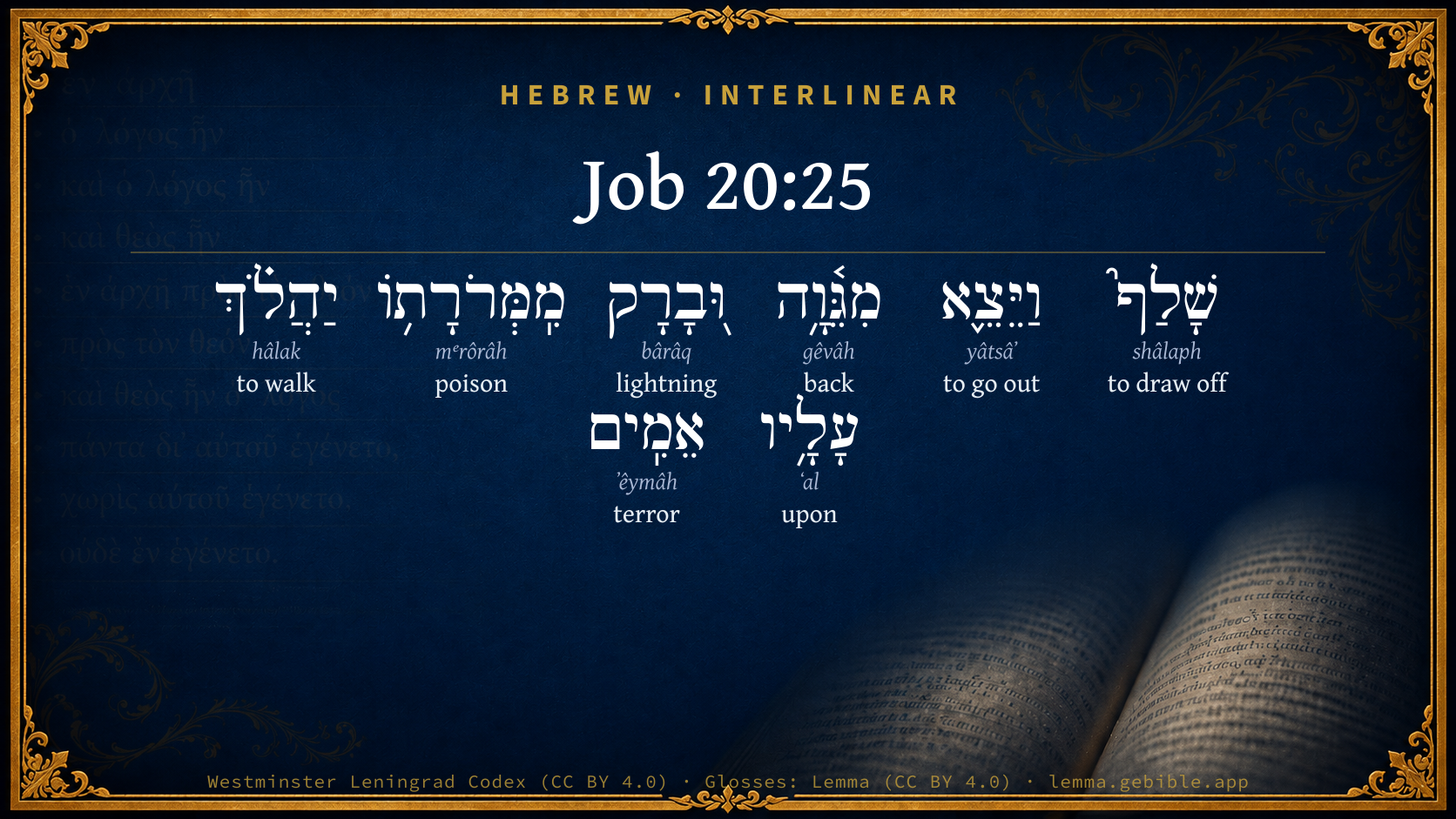
Hebrew (Westminster Leningrad Codex) Job 20:25 appears in the Hebrew Old Testament. The text above is from the Westminster Leningrad Codex. Each word links to its Strong’s number, a concise gloss, and parsing drawn from the Open Scriptures Hebrew Bible morphology. Click any word for its full Brown-Driver-Briggs (BDB) entry.
Download image
Cite this verse

Job 20:25 (World English Bible). Public Domain. Lemma interlinear Bible study tool, https://lemma.gebible.app/v/job/20/25.

Show BibTeX & RIS
BibTeX
RIS
English Translation
He draws it forth, and it comes out of his body. Yes, the glittering point comes out of his liver. Terrors are on him.
World English Bible · Public Domain
Highlights
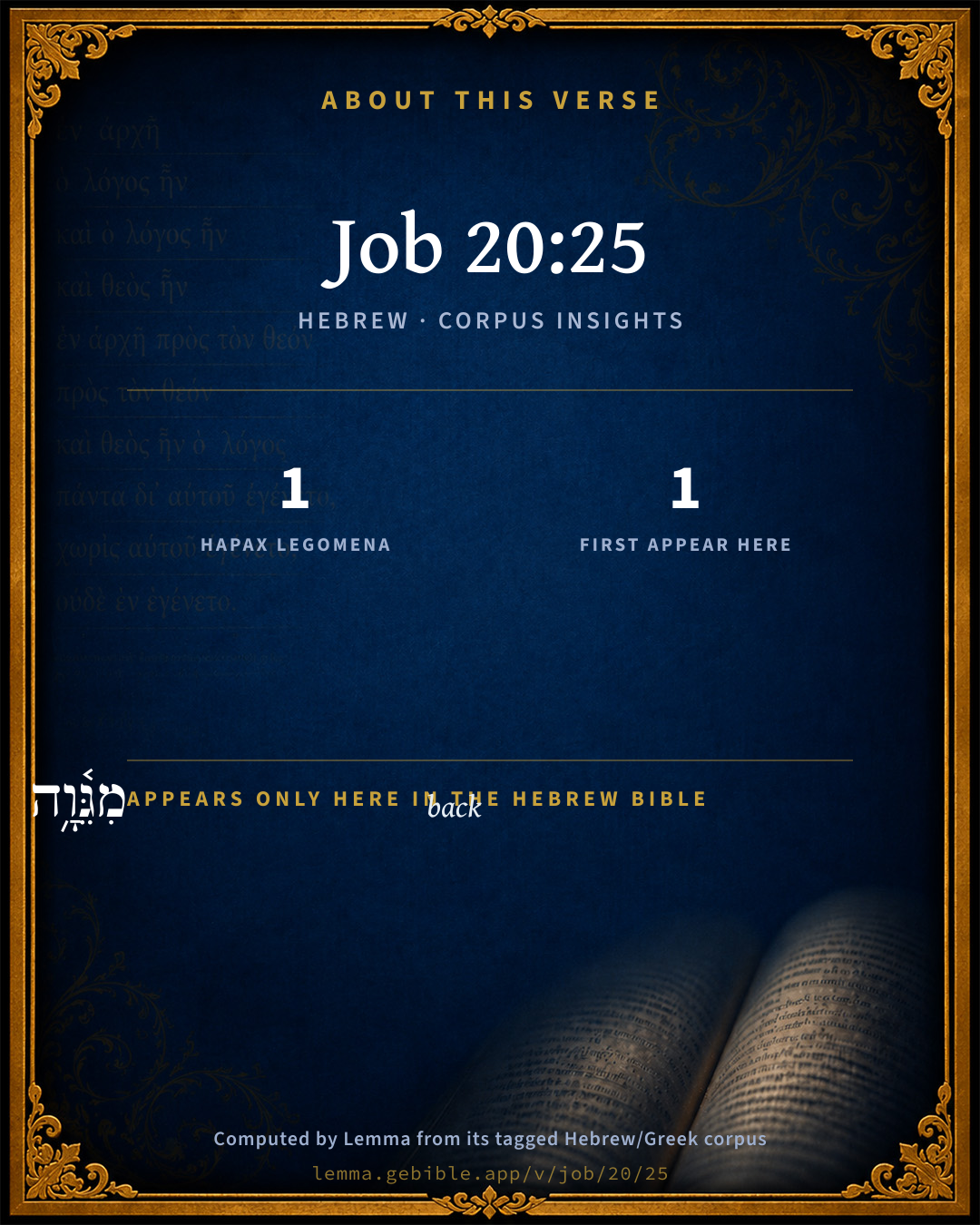
  • 1 hapax legomenon — only here in the Hebrew Bible
  • 1 first appearance in the Hebrew Bible
Full analysis ↓
Download a study sheet

One document with this verse’s original text, its word-by-word gloss line, the meaning frame, cross-references with their text, attributed commentary, and full source and license credits — printable, and it pastes into notes with its structure intact.

This verse Autodidact and up

Study sheet (.html) Plain text (.txt)

A passage Seminary Student

Up to 50 verses in one chapter. A passage sheet keeps up to 6 commentary sources and 12 cross-references per verse, in the order this page ranks them, and says so on the sheet whenever that leaves anything out. Ask for a single verse and you get the Autodidact verse sheet above.

Everything on this page stays free to read, with no account — the sheet is a download of what is already on screen, not access to it.

Want to remove ads? Support Godless Engineer
Compare translations 3

The same verse in 3 English versions, stacked beneath the original-language interlinear above. Click any original word for its lexicon entry.

Each is an independent rendering of the whole verse — the interlinear is not word-aligned to these translations.

Highlighted words mark where these versions differ — a whole-verse word diff, not a word-by-word alignment.

  • World English Bible Public Domain
    He draws it forth, and it comes out of his body. Yes, the glittering point comes out of his liver. Terrors are on him.
  • King James Version Public Domain
    It is drawn, and cometh out of the body; yea, the glittering sword cometh out of his gall: terrors are upon him.
  • unfoldingWord Literal Text CC BY-SA 4.0
    He pulls, and it comes out of his back, and the gleaming goes out of his liver. Terrors upon him!

unfoldingWord Literal Text — © unfoldingWord, licensed CC BY-SA 4.0. Word-aligned USFM3 via Door43 (git.door43.org/unfoldingWord/en_ult).

Versions to compare (up to 4)

3 of 4 selected

Show all 18 translations

Every available English version of this verse, each an independent rendering of the whole verse.

  • World English Bible Public Domain
    He draws it forth, and it comes out of his body. Yes, the glittering point comes out of his liver. Terrors are on him.
  • Berean Standard Bible Public Domain
    It is drawn out of his back, the gleaming point from his liver. Terrors come over him.
  • Majority Standard Bible Public Domain
    It is drawn out of his back, the gleaming point from his liver. Terrors come over him.
  • King James Version Public Domain
    It is drawn, and cometh out of the body; yea, the glittering sword cometh out of his gall: terrors are upon him.
  • American Standard Version (1901) Public Domain
    He draweth it forth, and it cometh out of his body; Yea, the glittering point cometh out of his gall: Terrors are upon him.
  • Revised Version (1885) Public Domain
    He draweth it forth, and it cometh out of his body: yea, the glittering point cometh out of his gall; terrors are upon him.
  • Geneva Bible (1599) Public Domain
    The arrowe is drawen out, and commeth forth of the body, and shineth of his gall, so feare commeth vpon him.
  • Douay-Rheims (1899) Public Domain
    The sword is drawn out, and cometh forth from its scabbard, and glittereth in his bitterness: the terrible ones shall go and come upon him.
  • Young's Literal Translation Public Domain
    One hath drawn, And it cometh out from the body, And a glittering weapon from his gall proceedeth. On him `are' terrors.
  • Literal Standard Version CC BY-SA 4.0
    One has drawn, || And it comes out from the body, || And a glittering weapon proceeds from his gall. Terrors [are] on him.
  • Unlocked Literal Bible CC BY-SA 4.0
    He pulls it out of his back and the gleaming point comes out of his liver. Terrors come over him.
  • unfoldingWord Literal Text CC BY-SA 4.0
    He pulls, and it comes out of his back, and the gleaming goes out of his liver. Terrors upon him!
  • Darby Bible Public Domain
    He draweth it forth; it cometh out of his body, and the glittering point out of his gall: terrors are upon him.
  • World Messianic Bible Public Domain
    He draws it out, and it comes out of his body. Yes, the glittering point comes out of his liver. Terrors are on him.
  • Webster's Bible Public Domain
    It is drawn, and cometh out of the body; yes, the glittering sword cometh out of his gall: terrors are upon him.
  • Free Bible Version CC BY-SA 4.0
    The arrow is pulled out of their gall bladder, glistening with blood. They are absolutely terrified!
  • Bible in Basic English Public Domain
    He is pulling it out, and it comes out of his back; and its shining point comes out of his side; he is overcome by fears.
  • JPS Tanakh (1917) Public Domain
    He draweth it forth, and it cometh out of his body; yea, the glittering point cometh out of his gall; terrors are upon him.

Literal Standard Version (2020), Covenant Press — licensed CC BY-SA 4.0. Text via the HelloAO Bible API (eBible.org). Unlocked Literal Bible (unfoldingWord) — licensed CC BY-SA 4.0. Text via the HelloAO Bible API (eBible.org). unfoldingWord Literal Text — © unfoldingWord, licensed CC BY-SA 4.0. Word-aligned USFM3 via Door43 (git.door43.org/unfoldingWord/en_ult). Free Bible Version, Dr. Jonathan Gallagher — licensed CC BY-SA 4.0. Text via the HelloAO Bible API (eBible.org).

Word by word

More ways to search: Search by grammar → Find every occurrence → Compare this word →

Practice this passage: Drill this verse → Learn its vocabulary →

About this verse

These counts appear in no published source. They are computed here, from the morphology-tagged text and Lemma’s own curated glosses. What Lemma adds →

8
words
8
distinct lemmas
Wisdom
section

Notable vocabulary

1 hapax legomenon — a word that appears only here in the entire Hebrew Bible:

  • מִגֵּ֫וָ֥ה back H1465

First appearance in Scripture

This word makes its first canonical appearance in the Hebrew Bible here:

  • מִגֵּ֫וָ֥ה back H1465

Shared distinctive vocabulary

מִֽמְּרֹרָת֥וֹ poison H4846 occurs in 4 verses of the Hebrew Bible. Also found in:

Grammatical profile

  • 3 verbs
  • 4 nouns
  • 1 preposition

Verb forms

  • שָׁלַף֮ Qal · Perfect
  • וַיֵּצֵ֪א Qal · Sequential Imperfect
  • יַהֲלֹ֗ךְ Qal · Imperfect

Hebrew & Septuagint length

In English translation the verse runs 24 words from the Hebrew and 21 from the Septuagint (LXX English) — closely comparable.

A rough comparison of the two English renderings, which tokenize alike — not a word-level alignment.

Word counts can differ between the Hebrew and the Greek without any difference in meaning — e.g. the Hebrew direct-object marker אֵת has no separate Greek word, and Greek often adds the article ὁ.

Cross-references

12

Topical passages linked to Job 20:25 in the Treasury of Scripture Knowledge — connected by theme and wording, ordered by reader-vote popularity; previews shown in the World English Bible.

  • Job 16:13 His archers surround me. He splits my kidneys apart, and does not spare. He pours out my gall on the ground.
  • Job 18:11 Terrors shall make him afraid on every side, And shall chase him at his heels.
  • Deuteronomy 32:41 If I whet my glittering sword, My hand take hold on judgment; I will render vengeance to my adversaries, Will recompense those who hate me.
  • Job 15:21 A sound of terrors is in his ears; In prosperity the destroyer shall come on him.
  • Job 27:20 Terrors overtake him like waters; A tempest steals him away in the night.
  • Psalms 7:12 If a man doesn't relent, he will sharpen his sword; He has bent and strung his bow.
  • 2 Samuel 18:14 Then said Joab, I may not wait thus with you. He took three darts in his hand, and thrust them through the heart of Absalom, while he was yet alive in the midst of the oak.
  • Job 6:4 For the arrows of the Almighty are within me, My spirit drinks up their poison. The terrors of God set themselves in array against me.
  • Psalms 73:19 How they are suddenly destroyed! They are completely swept away with terrors.
  • Psalms 88:15 I am afflicted and ready to die from my youth up. While I suffer your terrors, I am distracted.
  • Jeremiah 20:3–4 It happened on the next day, that Pashhur brought forth Jeremiah out of the stocks. Then said Jeremiah to him, Yahweh has not called your name Pashhur, but Magormissabib.
  • 2 Corinthians 5:11 Knowing therefore the fear of the Lord, we persuade men, but we are revealed to God; and I hope that we are revealed also in your consciences.

Cross-references courtesy of OpenBible.info (CC BY 4.0).

Hebrew and Greek witnesses Masoretic Hebrew ↔ Greek Septuagint

The same verse in the two great witnesses to the Old Testament, shown verse-for-verse.

These are two independent witnesses, not word-aligned to each other, and the Septuagint is shown in lemma (dictionary) form.

Hebrew Job 20:25 Masoretic · Westminster Leningrad Codex

שָׁלַף֮ וַיֵּצֵ֪א מִגֵּ֫וָ֥ה וּ֭בָרָק מִֽמְּרֹרָת֥וֹ יַהֲלֹ֗ךְ עָלָ֥יו אֵמִֽים

He draws it forth, and it comes out of his body. Yes, the glittering point comes out of his liver. Terrors are on him.

World English Bible · Public Domain

Greek LXX Job 20:25 Septuagint · lemma form

δια ἐκἔρχομαι δέ διά σῶμα αὐτός βέλος ἀστραπή δέ ἐν δίαιτα αὐτός περιπατέω ἐπί αὐτός φόβος

And let the arrow pierce through his body; and let the stars be against his dwelling-place: let terrors come upon him.

LXX2012 (modern English Septuagint) · Public Domain

Hebrew: Westminster Leningrad Codex (CC BY 4.0). Greek: Septuagint (public domain); English from LXX2012 (modern English Septuagint) (Public Domain). How the Septuagint differs from the Hebrew →

Commentary

Notes on Job 20:25 from classic Christian and Jewish commentators (each source and its license shown beneath its notes). The classic Christian expositions comment on the surrounding passage and are grouped to its opening verse, so a note may address several verses; the Jewish commentaries on the Tanakh (Rashi and others) are per-verse, so they appear only where the commentator wrote on this verse.

Lemma curates 59 commentaries, every one of them public domain or Creative Commons licensed, each selected and text-cleaned for this edition rather than reprinted as found. About our sources →

Trapp's Complete Commentary

John Trapp

Job 20:25 It is drawn, and cometh out of the body; yea, the glittering sword cometh out of his gall: terrors [are] upon him.

Ver. 25. It is drawn, and cometh out of the body] That is, the arrow out of the quiver, or the sword out of the sheath, as the Vulgate translateth it. By a like metaphor the body is called the soul’s sheath, Dan 7:15. But I rather take it properly: It cometh out of his body that is, out of the wicked man’s body, who is under such a deep and deadly wound as Jehoram was, whom Jehu shot through the heart; and as William Rufus was by Walter Tyrrel, who in hunting mistook him for a deer.

Yea, the glittering sword cometh out of his gall] And so the wound must needs be mortal, since none can come at the gall to cure it. The wicked shall be double slain (first with God’s bow, and then with his sword), rather than he shall escape. How much better were it to fall down as Paul did, Rom 7:11, slain with the sword of the Spirit! Bernard told his brother, a soldier, that because he would not listen to the word of exhortation, God would shortly open a way to his hard heart by his glistering sword; which accordingly befell him.

Terrors are upon him] Heb. The terrible upon him; which some interpret of devils or hell hags. The Vulgate rendereth it, Then horrible ones shall come upon him. The word is used for giants, Deu 2:10. The Emims shall fall upon him, that is, men of fierce and cruel spirits. But better take it for terrors, as we render it; and so the sense is, That the wicked, when he sees he must needs die, is surprised with greatest anxieties and perplexities of spirit, as beholding that threefold dreadful spectacle, death, judgment, hell, and all to be passed through by his poor soul.

John Trapp, A Commentary or Exposition upon All the Books of the Old and New Testament (1647–1656) — public domain. Text from a community e-Sword module.

Tyndale Open Study Notes

Tyndale Open Resources

20:25 terrors of death: Although the words “of death” are not in the Hebrew, they are implied because the arrowhead glistens with blood (literally with gall), indicating a deadly hit on a vital organ (6:4; 16:13; Ps 7:12).

Tyndale Open Study Notes — © Tyndale Open Resources, licensed CC BY-SA 4.0. Text via the HelloAO Bible API.

Geneva Bible (1599)

Geneva Bible translators

Some read, of the quiver.

Geneva Bible (1599) marginal notes — public domain. Text via Bolls.life.

Jamieson, Fausset & Brown

Robert Jamieson, A. R. Fausset & David Brown

It is drawn--Rather, "He (God) draweth (the sword, Jos 5:13) and (no sooner has He done so, than) it cometh out of (that is, passes right through) the (sinner's) body" (Deu 32:41-42; Eze 21:9-10). The glittering sword is a happy image for lightning.

gall--that is, his life (Job 16:13). "Inflicts a deadly wound."

terrors--Zophar repeats Bildad's words (Job 17:11; Psa 88:16; Psa 55:4).

Jamieson, Fausset & Brown — Commentary Critical and Explanatory on the Whole Bible (1871) — public domain (CC PDM 1.0). Text via the HelloAO Bible API.

Adam Clarke's Commentary

Verse 25. It is drawn, and cometh out] This refers to archery: The arrow is drawn out of the sheaf or quiver, and discharged from the bow against its mark, and pierces the vitals, and passes through the body. So Coverdale. - The arowe shal be taken forth, and go out at his backe.

Adam Clarke's Commentary on the Bible (1810–1826) — public domain. Text from a community e-Sword/MySword module.

Ellicott's Commentary for English Readers

(25) Yea, terrors overtake him.—Even when he has escaped a second and a third calamity, terrors shall still be upon him. This was all perfectly true in a sense, yea, even a truism, but it was utterly false in its application to Job himself.

A Bible Commentary for English Readers, edited by Charles John Ellicott (1878–1897) — public domain. Text from a community e-Sword module.

The Cambridge Bible for Schools and Colleges

gen. ed. J. J. S. Perowne

25. It is drawn] Rather, he draweth it forth—that is, the arrow (Job_20:24).

the glistering sword] Rather, the glittering shaft (Isa_49:2), or, more generally, the glittering steel; what is meant is the arrow that strikes the sinner through (Job_20:24). He draws it out hoping to save himself, not knowing that he is mortally stricken, but with the drawing of it out there fall on him the terrors of death. The picture, particularly the last isolated sentence “terrors are upon him,” is graphic.

The Cambridge Bible for Schools and Colleges (gen. ed. J. J. S. Perowne; Cambridge University Press, 1878–1918) — public domain. Text from a community e-Sword module.

John Gill's Exposition

It is drawn, and cometh out of the body,.... That is, the arrow with which a wicked man is stricken through; either it is drawn, and comes out of the quiver, as Broughton; or rather is drawn out of the body of a wicked man, being shot into it, and that in order that he may be cured of his wound if possible, but to no purpose, since it follows:

yea, the glittering sword cometh out of his gall; being thrust into it, which being pierced and poured out, is certain and immediate death, see Job 16:13. Some render it, yea, "the glittering sword out of his gall, he shall go away", or "is gone" (f); that is, he shall die, or is a dead man, there is no hope of him, when the arrow has transfixed his body, and the sword has penetrated into his gall, and divided that:

terrors are upon him; the terrors of death, the plain symptoms of it being upon him; the terrors of an awful judgment, which follows after it; the terrors of the dreadful sentence of condemnation that will then be pronounced, "go, ye cursed", &c. and the terrors of hell and eternal death, signified by utter darkness, unquenchable fire, and the never ceasing torments of it. Some by them understand devils, those terrible spirits which haunt wicked men in their dying moments, and are ready to carry them to the lake which burns with fire and brimstone, where they are to be companions with them for ever. The word is sometimes used of gigantic persons, who are sometimes terrible to others; and since these are mentioned along with weapons of war, Bar Tzemach interprets them of men of strength and power, men of war or soldiers, whose fear falls on others.

(f) "abibit e vivis"; so some in Michaelis; "abit", Schultens.

John Gill's Exposition of the Whole Bible (1746–1763) — public domain (CC PDM 1.0). Text via the HelloAO Bible API.

Albert Barnes' Notes on the Bible

It is drawn - Or rather, “he draws” - that is, he draws out the arrow that has been shot at him; or it may mean, as Prof. Lee supposes, that he draws, that is, “someone” draws the arrow from its quiver, or the sword from its sheath, in order to smite him. The object is to describe his death, and to show that he should be certainly overtaken with calamity. Zophar, therefore, goes through the process by which he would be shot down, or shows that he could not escape.

And cometh out of the body - That is, the arrow, or the glittering blade. It has penetrated the body, and passed through it. He shall be pierced through and through.

The glittering sword - Hebrew ברק bârâq - “the glittering;” scil. thing, or weapon, and is given to the sword, because it is kept bright.

Cometh out of his gall - Supposed to be the seat of life. See the notes, Job 16:13.

Terrors are upon him - The terrors of death.

Albert Barnes' Notes on the Bible (1834–1885) — public domain. Text from a community e-Sword/MySword module.

Haydock's Catholic Bible Commentary

The sword is, occurs not in the Vulgate, (Haydock) though it be in the Complutensian and Sixtine editions. (Calmet) --- Hebrew, "It is drawn, and cometh out of the body; the glittering sword cometh out of his gall; terrors are upon him." Protestants, "May likewise the dart come out through his body," &c. (Haydock) --- Ones. Hebrew, "Enim; giants, who formerly inhabited the land of Moab, near the eastern Idumea. Their name might be placed for any cruel enemies. (Calmet)

George Leo Haydock (1774–1849), Haydock's Catholic Family Bible and Commentary, 1859 edition — public domain. Excludes Psalms (Douay-Rheims chapter numbering differs from Protestant) and Deuterocanonical books (Catholic canon only).

Matthew Poole's English Annotations

It is drawn; either,

1. A sword, which may be understood out of this Hebrew verb, which is for the most part used of that weapon, as Num 22:23,31; Jdg 8:20, &c., and out of the following branch of the verse. Or,

2. The arrow last mentioned, which had entered into his body, and now was drawn out of it either by himself, or by some other person, as is frequent in that case, if peradventure he might be cured.

Out of the body; or, out of his body, i.e. the body of the wounded man; as appears both by the next clause of the verse, which is added to explain the former; where it is

out of his gall; and from the use of this Hebrew word, which signifies a man’s body or carcass, as Jdg 14:8; 1Sa 31:12; Isa 5:25; Nah 3:3.

The glittering sword: the word properly signifies lightning, and thence a glittering weapon, the bright sword or spear, as Deu 32:41; Eze 21:10,15; Na 3:3; Hab 3:11; whereby it is implied that he was doubly wounded; first, by the arrow, and then, to make more sure work, with the sword or spear thrust into him. But the word may as well signify the bright and sharp point of an arrow, of which he spoke hitherto; and having in the general said that it came out of his body, now he determines the part of the body, the gall; which showeth that the wound was both deep and deadly, as they are in that part. It is probable he mentions this in reference to the like expression of Job, Job 16:13.

Cometh out of his gall; into which it had entered, and wherewith it was coloured.

Terrors are upon him, to wit, the terrors of death, because he perceived by the tincture of his gall upon the weapon that his wound was incurable; or horrors of conscience, because he cannot live, and dare not die.

Matthew Poole's English Annotations on the Holy Bible (1683–1685) — public domain. Text from a community e-Sword/MySword module.

Whedon's Commentary on the Bible

Daniel D. Whedon

25. It is drawn, etc. — Literally, He draweth it, (the arrow.)

The glittering sword cometh… gall — Better, It cometh forth from the body, (some read back;) even the glittering blade from out his gall.

Terrors upon him — Rather, He goeth, terrors upon him. The drawing of the glittering sword (literally, lightning) from the gall must have been fatal. Thus he goeth — dies; the Arab would say, “Departs to his own place.” Act_1:25. Schultens says, “The word ‘goeth,’ standing by itself, adds new weight.”

Daniel D. Whedon (gen. ed.), Commentary on the Old and New Testaments (1874–1909) — public domain. Text from a community e-Sword module.

The Pulpit Commentary

It is drawn, and cometh out of the body; rather, he draweth it forth, and it cometh out of his body (see the Revised Version). The stricken man draws the arrow from his flesh, the natural action of every one so wounded. If the arrow was simply tipped with a smooth iron point, it would be easy to withdraw it; but a barbed arrow could only be cut out. Yea, the glittering sword cometh out of his gall; rather, the glittering point. The arrow is supposed to have pierced the gall-bladder, and to be drawn forth from it. There would be little chance of recovery in such a case. Hence terrors are upon him.

The Pulpit Commentary (1880–1919), ed. H.D.M. Spence-Jones & Joseph S. Exell — public domain. Text from a community e-Sword module.

John Wesley's Explanatory Notes

It - The arrow, which had entered into his body, and now was drawn out of it either by himself or some other person; having in general said, that it came out of his body, he determines also the part of the body, the gall; which shews that the wound was both deep and deadly. Terrors - The terrors of death; because he perceived his wound was incurable.

John Wesley, Explanatory Notes Upon the Whole Bible (1754–1765) — public domain. Text via the GEBible commentary corpus.

Rashi

Rabbi Shlomo Yitzchaki (Rashi)

drew The one who drew the weapon upon him.

and it emerged [i.e.,] the weapon.

and its glittering blade Splendeur, or splendor (?) in French, like (Ezek. 21: 15), “in order that it glitter (ברק).” Fourbir in Old French, to polish.

from its bitterness [From the bitterness] of the weapon it shall come forth, and from there shall be terrors and fear upon the wicked.

Rashi on the Tanakh — English translations: “The Judaica Press complete Tanach with Rashi, translated by A. J. Rosenberg” (CC BY 4.0); “Pentateuch with Rashi's commentary by M. Rosenbaum and A.M. Silbermann, 1929-1934” (public domain); “The Metsudah Tanach series, Lakewood, N.J” (CC BY 4.0); and “The Book of Joshua, Metsudah Publications, 1997” (CC BY 4.0). Text via Sefaria.

Lesson kit

Teaching starters — assembled from the data on this page, not authored interpretation. Every prompt links to the verse data it draws on. Edit before teaching.

Job, in the Wisdom, opens this verse with 8 words (8 distinct Hebrew lemmas). Its most distinctive word is gêvâh (“back”). A historical commentator’s framing appears above. Read the whole chapter for the surrounding context.

Discussion questions

  1. What does “back” (gêvâh) contribute to the verse as a whole?
  2. This verse holds 1 word here found nowhere else in the Hebrew Bible. What might the rare word draw attention to?
  3. The word “back” first appears here in Scripture. What is being introduced at this debut?
  4. Deuteronomy 32:32 shares the word «poison» with this verse. How do the two illuminate each other?
  5. The translations on this page render this verse differently — a whole-verse word diff, not a word-by-word alignment. What might account for the different wordings?
  6. The verb «שָׁלַף֮» is Qal Perfect. How does its form color the action?
  7. Reading how Trapp's Complete Commentary and Tyndale Open Study Notes read this verse, where do the two commentators agree and where do they part?

Things to notice

  • 1 word in this verse appears nowhere else in the Hebrew Bible.
  • 1 word makes its first canonical appearance in Scripture here.
  • These translations choose different wording for 18 words in this verse.
  • 8 distinct Hebrew lemmas span 8 words in this verse.

Reading settings

Reading text

Shown beneath each verse's original-language words.

Old Testament
Old Testament edition

Read the OT as the Masoretic Hebrew (MT) or the Greek Septuagint (LXX).

English shown for the Greek Septuagint (in the Hebrew ↔ Greek comparison).

Comparing translations? Open the Compare panel on any verse page to stack up to four side by side.