2 Corinthians 4:10

Greek (Tischendorf 8th ed.) 2 Corinthians 4:10 appears in the Greek New Testament. The text above is from the Tischendorf 8th edition. Each word links to its Strong’s number and a concise gloss. Click any word for its full Thayer’s Greek Lexicon entry.
Download image
Cite this verse

2 Corinthians 4:10 (World English Bible). Public Domain. Lemma interlinear Bible study tool, https://lemma.gebible.app/v/2-corinthians/4/10.

Show BibTeX & RIS
BibTeX
RIS
English Translation
always carrying in the body the putting to death of the Lord Jesus, that the life of Jesus may also be revealed in our body.
World English Bible · Public Domain
Download a study sheet

One document with this verse’s original text, its word-by-word gloss line, the meaning frame, cross-references with their text, attributed commentary, and full source and license credits — printable, and it pastes into notes with its structure intact.

This verse Autodidact and up

Study sheet (.html) Plain text (.txt)

A passage Seminary Student

Up to 50 verses in one chapter. A passage sheet keeps up to 6 commentary sources and 12 cross-references per verse, in the order this page ranks them, and says so on the sheet whenever that leaves anything out. Ask for a single verse and you get the Autodidact verse sheet above.

Everything on this page stays free to read, with no account — the sheet is a download of what is already on screen, not access to it.

Want to remove ads? Support Godless Engineer
Compare translations 3

The same verse in 3 English versions, stacked beneath the original-language interlinear above. Click any original word for its lexicon entry.

Each is an independent rendering of the whole verse — the interlinear is not word-aligned to these translations.

Highlighted words mark where these versions differ — a whole-verse word diff, not a word-by-word alignment.

  • World English Bible Public Domain
    always carrying in the body the putting to death of the Lord Jesus, that the life of Jesus may also be revealed in our body.
  • King James Version Public Domain
    Always bearing about in the body the dying of the Lord Jesus, that the life also of Jesus might be made manifest in our body.
  • unfoldingWord Literal Text CC BY-SA 4.0
    always carrying around in the body the dying of Jesus so that the life of Jesus also might be revealed in our body;

unfoldingWord Literal Text — © unfoldingWord, licensed CC BY-SA 4.0. Word-aligned USFM3 via Door43 (git.door43.org/unfoldingWord/en_ult).

Versions to compare (up to 4)

3 of 4 selected

Show all 19 translations

Every available English version of this verse, each an independent rendering of the whole verse.

  • World English Bible Public Domain
    always carrying in the body the putting to death of the Lord Jesus, that the life of Jesus may also be revealed in our body.
  • Berean Standard Bible Public Domain
    We always carry around in our body the death of Jesus, so that the life of Jesus may also be revealed in our body.
  • Majority Standard Bible Public Domain
    We always carry around in our body the death of the Lord Jesus, so that the life of Jesus may also be revealed in our body.
  • King James Version Public Domain
    Always bearing about in the body the dying of the Lord Jesus, that the life also of Jesus might be made manifest in our body.
  • American Standard Version (1901) Public Domain
    always bearing about in the body the dying of Jesus, that the life also of Jesus may be manifested in our body.
  • Revised Version (1885) Public Domain
    always bearing about in the body the dying of Jesus, that the life also of Jesus may be manifested in our body.
  • Geneva Bible (1599) Public Domain
    Euery where we beare about in our bodie the dying of the Lord Iesus, that the life of Iesus might also be made manifest in our bodies.
  • Douay-Rheims (1899) Public Domain
    Always bearing about in our body the mortification of Jesus, that the life also of Jesus may be made manifest in our bodies.
  • Young's Literal Translation Public Domain
    at all times the dying of the Lord Jesus bearing about in the body, that the life also of Jesus in our body may be manifested,
  • Literal Standard Version CC BY-SA 4.0
    at all times carrying around in the body the dying of the Lord Jesus, that the life of Jesus may also be revealed in our body,
  • Unlocked Literal Bible CC BY-SA 4.0
    We always carry in our body the death of Jesus, so that the life of Jesus also may be shown in our bodies.
  • unfoldingWord Literal Text CC BY-SA 4.0
    always carrying around in the body the dying of Jesus so that the life of Jesus also might be revealed in our body;
  • Darby Bible Public Domain
    always bearing about in the body the dying of Jesus, that the life also of Jesus may be manifested in our body;
  • World Messianic Bible Public Domain
    always carrying in the body the putting to death of the Lord Yeshua, that the life of Yeshua may also be revealed in our body.
  • Webster's Bible Public Domain
    Always bearing about in the body the dying of the Lord Jesus, that the life also of Jesus may be made manifest in our body.
  • Free Bible Version CC BY-SA 4.0
    In our bodies we always share in the death of Jesus, so that we can also demonstrate the life of Jesus in our bodies.
  • Bible in Basic English Public Domain
    In our bodies there is ever the mark of the death of Jesus, so that the life of Jesus may be seen in our bodies.
  • Text-Critical English NT CC BY 4.0
    always carrying about in our bodies the death of the Lord Jesus, so that the life of Jesus may also be revealed in our bodies.
  • Tyndale New Testament (1534) Public Domain
    And we all wayes beare in oure bodyes the dyinge of the Lorde Iesus that the lyfe of Iesu myght appere in oure bodyes.

Literal Standard Version (2020), Covenant Press — licensed CC BY-SA 4.0. Text via the HelloAO Bible API (eBible.org). Unlocked Literal Bible (unfoldingWord) — licensed CC BY-SA 4.0. Text via the HelloAO Bible API (eBible.org). unfoldingWord Literal Text — © unfoldingWord, licensed CC BY-SA 4.0. Word-aligned USFM3 via Door43 (git.door43.org/unfoldingWord/en_ult). Free Bible Version, Dr. Jonathan Gallagher — licensed CC BY-SA 4.0. Text via the HelloAO Bible API (eBible.org).

Word by word

More ways to search: Search by grammar → Find every occurrence → Compare this word →

Practice this passage: Drill this verse → Learn its vocabulary →

νέκρωσιν
nékrōsis
G3500
“death”
Noun, Accusative, Singular, Feminine
Part of Speech
Noun
Case
Accusative
Number
Singular
Gender
Feminine
Full Thayer's Definition

Origin: from G3499

TDNT: 18:55,6

1. putting to death, killing 2. being put to death 3. the dead state, utter sluggishness a. of bodily members and organs
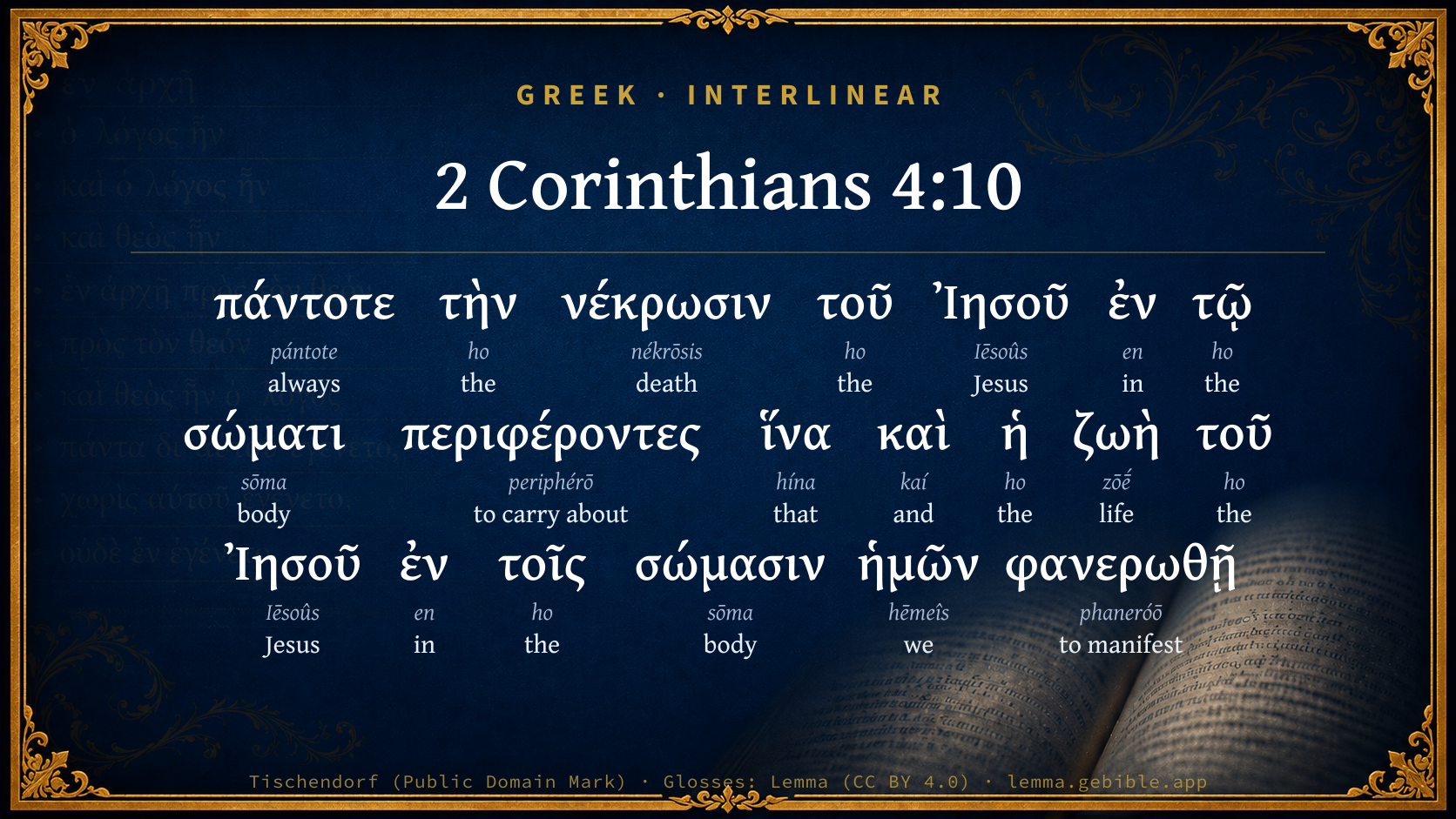
  1. πάντοτε pántote G3842 “always” Adverb
  2. τὴν ho G3588 “the” Article, Accusative, Singular, Feminine
  3. τοῦ ho G3588 “the” Article, Genitive, Singular, Masculine
  4. Ἰησοῦ Iēsoûs G2424 “Jesus” Noun, Genitive, Singular, Masculine
  5. ἐν en G1722 “in” Preposition
  6. τῷ ho G3588 “the” Article, Dative, Singular, Neuter
  7. σώματι sōma G4983 “body” Noun, Dative, Singular, Neuter
  8. περιφέροντες periphérō G4064 “to carry about” Verb, Present, Active, Participle, Nominative, Plural, Masculine
  9. ἵνα hína G2443 “that” Conjunction
  10. καὶ kaí G2532 “and” Conjunction
  11. ἡ ho G3588 “the” Article, Nominative, Singular, Feminine
  12. ζωὴ zōḗ G2222 “life” Noun, Nominative, Singular, Feminine
  13. τοῦ ho G3588 “the” Article, Genitive, Singular, Masculine
  14. Ἰησοῦ Iēsoûs G2424 “Jesus” Noun, Genitive, Singular, Masculine
  15. ἐν en G1722 “in” Preposition
  16. τοῖς ho G3588 “the” Article, Dative, Plural, Neuter
  17. σώμασιν sōma G4983 “body” Noun, Dative, Plural, Neuter
  18. ἡμῶν hēmeîs G2249 “we” Personal pronoun, 1st person, Genitive, Plural
  19. φανερωθῇ phaneróō G5319 “to manifest” Verb, Aorist, Passive, Subjunctive, 3rd person, Singular

About this verse

These counts appear in no published source. They are computed here, from the morphology-tagged text and Lemma’s own curated glosses. What Lemma adds →

20
words
12
distinct lemmas
Pauline Epistles
section

Notable vocabulary

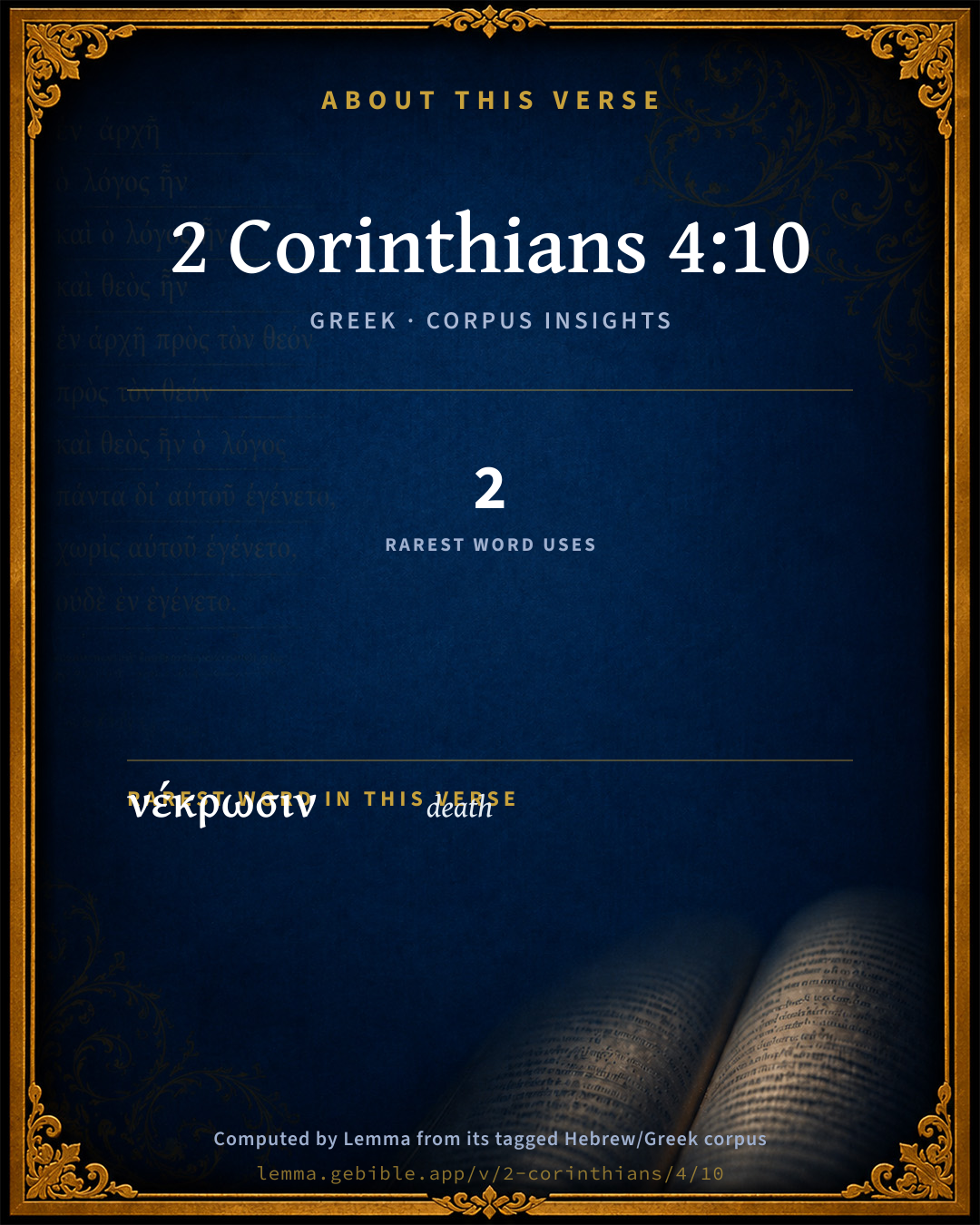
The rarest word here is νέκρωσιν death G3500 — appearing just 2 times in the whole Greek New Testament.

Shared distinctive vocabulary

νέκρωσιν death G3500 occurs in 2 verses of the Greek New Testament. Also found in:

Repetition

Words recur within this verse:

Cross-references

15

Topical passages linked to 2 Corinthians 4:10 in the Treasury of Scripture Knowledge — connected by theme and wording, ordered by reader-vote popularity; previews shown in the World English Bible.

  • Romans 6:5 For if we have become united with him in the likeness of his death, we will also be part of his resurrection;
  • 2 Timothy 2:11 This saying is faithful: For if we died with him, We will also live with him.
  • 1 Peter 4:13 But because you are partakers of Christ's sufferings, rejoice; that at the revelation of his glory also you may rejoice with exceeding joy.
  • Romans 6:8 But if we died with Christ, we believe that we will also live with him;
  • Philippians 3:10–11 that I may know him, and the power of his resurrection, and the fellowship of his sufferings, becoming conformed to his death;
  • Romans 8:17–18 and if children, then heirs; heirs of God, and joint-heirs with Christ; if indeed we suffer with him, that we may also be glorified with him.
  • 2 Corinthians 13:4 For he was crucified through weakness, yet he lives through the power of God. For we also are weak in him, but we will live with him through the power of God toward you.
  • Romans 8:36 Even as it is written, "For your sake we are killed all day long. We were accounted as sheep for the slaughter."
  • Colossians 1:24 Now I rejoice in my sufferings for your sake, and fill up on my part that which is lacking of the afflictions of Christ in my flesh for his body's sake, which is the assembly;
  • 2 Corinthians 1:9 Yes, we ourselves have had the sentence of death within ourselves, that we should not trust in ourselves, but in God who raises the dead,
  • 2 Corinthians 1:5 For as the sufferings of Christ abound to us, even so our comfort also abounds through Christ.
  • Galatians 6:17 From now on, let no one cause me any trouble, for I bear the marks of the Lord Jesus branded on my body.
  • John 14:19 Yet a little while, and the world will see me no more; but you will see me. Because I live, you will live also.
  • Acts 18:9–10 The Lord said to Paul in the night by a vision, "Don't be afraid, but speak and don't be silent;
  • Revelation 1:17 When I saw him, I fell at his feet like a dead man. He laid his right hand on me, saying, "Don't be afraid. I am the first and the last,

Cross-references courtesy of OpenBible.info (CC BY 4.0).

Where the printed editions differ

1 variant

Places in this verse where the major printed Greek editions disagree on the wording in a way that affects the translation — a comparison of editions, not a manuscript-by-manuscript collation. The editions are the modern critical texts (Nestlé-Aland 28/27, SBL, Westcott-Hort, Tregelles, Tyndale House) and the traditional texts behind the KJV (the Textus Receptus and the Byzantine/Majority text). It is not a claim about which reading is original.

  1. Extra text
    κυρίου

    “Lord”

    In TRByz Not in NA28NA27TynSBLWHTreg

    κυρίου (kuriou) 'Lord' is only in traditional manuscripts (TR+Byz)

Textual data: Translators Amalgamated Greek New Testament (STEPBible TAGNT) · CC BY 4.0.

Commentary

Notes on 2 Corinthians 4:10 from classic Christian and Jewish commentators (each source and its license shown beneath its notes). The classic Christian expositions comment on the surrounding passage and are grouped to its opening verse, so a note may address several verses; the Jewish commentaries on the Tanakh (Rashi and others) are per-verse, so they appear only where the commentator wrote on this verse.

Lemma curates 59 commentaries, every one of them public domain or Creative Commons licensed, each selected and text-cleaned for this edition rather than reprinted as found. About our sources →

The Biblical Illustrator

Joseph S. Exell

2Co_4:10-12

Always bearing about in the body the dying of the Lord Jesus.

Bearing about the dying of Christ

The first and literal meaning of these words is that Paul and his friends were in daily peril of such a death as Christs was, and that their trials left sorrowful trace upon form and feature. It is not so that we are called to be conformable to the death of our Redeemer. The days of martyrdom are gone. There are those who think to exemplify the text by bearing about with them the material representation of the Redeemers death--the crucifix. Ah! you may do that, and yet be hundreds of miles away from any compliance with the spirit of the text. Our Lord requires of us the devotion of the heart; it is spiritually that we are to bear about our Saviours dying.

I. We may bear about the memory of it.

1. Nothing can be more plain than that we ought never to forget our Redeemers death. When some one very near to you died, even after the first shock was past, and you could once more with some measure of calmness set yourself to your common duties again, did you not still feel, in the greater sympathy with the sorrows of others, in the quieter mood, that you had not quite got over your trial, that you were still bearing about with you the dying of the dear one that was gone?

2. The remembrance of our Lords death should influence all our views and doings. The kind mother who wore out her life in toiling for her child might well think that the child might sometimes come and stand by her grave, and remember her living kindness and her dying words when she was far away. And oh! when we think what our Saviour Christ has done for us by His dying--when we think that every hope, every blessing, was won for us by that great sacrifice--surely we might well determine that we never shall live as if that death had never been! You hear people say--truly enough, perhaps--that this world has never been the same to them since such a loved one died--that their whole life has been changed since then. It is sad to see a Christian living in such a fashion as to show plainly that he has quite forgot how his Redeemer died!

(1) When we think of sin, let us see it in the light of Christs death, and hate it because it nailed Him to the tree.

(2) Or is it suffering and sorrow that come to us, and are we ready to repine and to rebel? Then let us call to mind the dying of our Redeemer, and it will not seem so hard that the servant should fare no better than the Master.

(3) Or are we pressed with the sense of our sinfulness and the fear of Gods wrath for sin? Then let us remember how Jesus died for us, the just for the unjust--how His blood can take all sin away.

II. We may show in our daily life its transforming power. Our whole life, changed and affected in its every deed by the fact that Christ died, may be a standing testimony that there is a real power to affect the character in the death of the Saviour; and thus we may, in a very true and solemn sense, be always bearing about with us His death by bearing about with us a soul which is what it is mainly because He died.

1. When in the view of the Cross we see how bitterly and mysteriously evil and ruinous sin is, surely the practical lesson is plain that we should resolutely tread it down, and earnestly seek for deliverance from the curse of that fearful thing which brought such unutterable agony upon our Redeemer, and constantly pray for that blessed Spirit who will breathe new life into every good resolution, and vivify into sunlight clearness every sound and true belief.

2. When sorrow and suffering come, think of them as in the presence of the Redeemers death, and you will learn the lesson of practical resignation.

3. And in days of fear and anxiety, when you do not know how it will go with you, look to Jesus on the Cross, and learn the lesson of practical confidence in Gods disposing love and wisdom.

4. And, to sum up all, let us daily bear about His dying by dying to sin and living to holiness. That is the grand conformity which is open to all of us--that is the fashion in which we may be crucified with Christ. Conclusion: Always. Yes, always bear it; never lay that burden down. Always bear it; not in sourness--not in that hard, severe type of religion which we may see in some mistaken and narrow-hearted believers. Bear it in humility, kindness, charity, hopefulness, and cheerfulness. (A. K. H. Boyd, D. D.)

The Christians fellowship in the death of Christ

How do we bear about daily the dying of the Lord Jesus?

I. By cherishing faith in a crucified saviour.

1. The death of Christ is--

(1) The most wonderful of all facts, and we should not be warranted to believe it unless it were authenticated to us by Divine testimony.

(2) The most interesting. It is the foundation of all that is dear to man. It is the most interesting of all the facts that are recorded, not only in human narrative, but in the Book of God and in the annals of the universe.

(3) The most influential. It spreads itself through the whole revelation and economy of God, and pervades the moral government of the Most High. It is in the Book of God the first, if not in point of order, yet of importance. I delivered to you, first of all, how that Christ died for our sins, etc.

2. To cherish faith in this fact, then, is the first duty of man, and by so doing we become partakers of the sufferings of Christ.

II. By a continued remembrance of this great event. That which we believe most assuredly, in which we feel the deepest interest, and to which we give the highest placed will be best remembered by us; and the death of Christ, possessing all those requisites, with a good man will impress itself deeply on his mind. To help us in this great exercise is the most obvious design of the Lords Supper. If we forget Jesus who died for us, whom and what shall we rationally and religiously remember?

III. By a progressive improvement of this great event. The decease of our Lord is set forth in the Word of God and in the Lords Supper, not merely for contemplation, or for curious inquiry, but for deep meditation and practical improvement. Now, a good man is anxious to improve this death for all the purposes for which it was appointed of God and endured by Christ. Others may gaze upon the Cross; he glories in it. Others may cast a passing glance upon the Divine Sufferer; he hangs upon the Cross--he lives by it.

IV. By imbibing more and more of his spirit. And what was this spirit? It was a spirit--

1. Of holy love. He loved us with an everlasting love, and thence gave Himself for us.

2. Of holy submission to the Divine appointment. Lo, I come to do Thy will, O My God; and He well knew all that that involved.

3. Of determined decision in His great work. I have a baptism to he, baptized with, and how am I straitened till it be accomplished!

4. Of holy purity. He was the Lamb of God, without blemish and without spot.

5. Of invincible faith. My God, My God! He cried, claiming an interest in Him when the waters overwhelmed His soul.

6. Of entire resignation to God amid the agonies of death and the prospect of dying. Father, into Thy hands I commend My spirit. Now, a good man bears about the dying of the Lord Jesus by seeking to drink continually into Christs spirit, and by exemplifying it more and more.

V. By a practical illustration of that great decease, of its character and power. Although it was not the only, or even the main, end of His coming in the flesh to exhibit a sublime example of perfect morality, yet doubtless He came to present to us a pattern of all goodness and godliness. Hence we are told that He hath set us an example that we should follow His steps.

VI. By a frequent solemn commemoration of him. (J. Mitchell, D. D.)

That the life also of Jesus might be made manifest in our body.--

The manifestation of the life of Christ

1. There is something beautifully emphatic in the idea that it is the life of Jesus that is manifested in the Christian. Century after century hath rolled away, and He who won to Himself, by agony and death, the lordship of this lower creation hath not visibly interfered with the administration of its concerns. The time, indeed, will come when sensible proof shall be given, and every eye shall gaze on the Son of Man seated on the clouds and summoning to judgment. But we are free to own that, since under the present dispensation there are no visible exhibitions of the kingship of Christ, it is not easy, if the authority of Scripture be questioned, to bring forward satisfactory proof that Jesus is alive.

2. Yet we are not ready to admit the total absence of direct, positive, practical witness. We thus bring the statement of our text, that there is such a thing as the manifestation of the life of the Redeemer. It was possible enough that the malice of persecutors might wear down to the wreck the body of the apostle; but there were such continued miracles in his being sustained in the battle with principalities and powers that, if challenged to prove that his Lord was alive, he could point to the shattered tabernacle, and answer triumphantly, the life also of Jesus, as well as the death, was made manifest in that his body.

3. The doctrine of Christs living for us is every whir as closely bound up with our salvation as that of His having died for us. The resurrection was Gods attestation to the worth of the atonement.

I. The persecutions which the apostles underwent, as well as the proclamations which they uttered, went to the proving that Jesus was alive.

1. The rulers said the body was stolen; the apostles said the body was quickened. Who sees not that, by persecuting the apostles in place of proving them liars, the rulers themselves bore witness to the fact that Jesus was alive? They had no evidence to produce of the truth of their own statement, and they set themselves therefore to get rid by force of the counter-statement. Power was substituted for proof, cruelty for argument. We therefore contend that no stronger attestation could have been given to the fact of Christs life than the persecutions to which the apostles were subjected for maintaining that fact.

2. We may yet further argue that by submitting to persecutions the apostles showed their own belief that Jesus was alive. There is a limit which enthusiasm cannot pass. Had not the apostles believed Christ alive they would not have joyfully exposed themselves to peril and death.

II. The grand manifestation of the life of jesus lies in the supports and consolations vouchsafed to the persecuted.

1. When the malice of the ungodly was allowed to do its worst, there was administered so much of supernatural assistance that all but the reprobate must have seen that the power of the Lord was sustaining the martyrs. They went out of the world with gladness in the eye and with triumph on the lip, confident that their Master lived to welcome them, and therefore able to cry out with Stephen, Lord Jesus, receive my spirit.

2. Now, we maintain that, whenever God directly interposes to preserve an individual while publishing a doctrine, God virtually gives testimony to the truth of that doctrine. If the published doctrine were the reverse of truth He would never mark the publisher with His approval; and thus we have a decisive and vivid manifestation of the life of Christ in the sufferings of the apostles.

3. Whilst Christ sojourned on earth He told His disciples that persecution would be their lot, but also that He would be alive to act as their protector. When, therefore, all occurred as Christ had predicted, when the supports were administered which He had pointed out as the result of His life, what can be fairer than maintaining that the supports were a proof of the life?

III. We would not have you think that the manifestation of the life of the redeemer was confined to the apostles. Take any one who now is walking by faith, and not by sight. He will tell you that his whole conduct is ordered on the supposition that he has a Saviour ever living to intercede in his behalf. He will tell you, further, that never has he found the supposition falsified by experience. He goes to Christ sorrowful, believing that He lives; he comes away comforted, and thus proves that He lives. He carries his burdens to Christ, supposing Him alive; he finds them taken away, and thus demonstrates Him alive. All, in short, that is promised as the result of Christs life comes into his possession, and is, therefore, an evidence of Christs life. If I am a believer, I look to Christ as living for me; I go and pray to Christ as living for me; and, if I am never disappointed in my reference to Christ as living for me, is there no strong testimony in my own experience that Jesus lives? In short, if the Christian live only by faith in the living Saviour, his life must be the manifestation of the life of the Saviour. If Christ be not alive, how comes it that they who act upon the supposition that He is alive find the supposition perpetually verified and in no instance falsified--verified by the assistance vouchsafed, by the promises fulfilled, by the consolations enjoyed in these mortal bodies, which are the theatres of truceless warfare with a corrupt nature and apostate spirits? Conclusion: What we wish for you is that you might manifest the life of the Redeemer--manifest it in the vigour with which you resist the devil, break loose from the world, and set yourself to the culture of holiness. (H. Melvill, B. D.)

The Biblical Illustrator, edited by Joseph S. Exell (c. 1880s–1900s) — public domain. Text from a community e-Sword module.

Bengel's Gnomon

Johann Albrecht Bengel

2Co 4:10. Πάντοτε, always) ἀεὶ in the next verse differs from this word. πάντοτε, throughout the whole time; ἀεὶ, any time whatever [at every time]: comp. Mar 15:8. The words, bearing about, we are delivered, in this ver. and in 2Co 4:11 agree.—τὴν νέκρωσιν, the dying) This is as it were the act, life the habit.—τοῦ Κυρίου, of the Lord) This name must be thrice supplied in this and the following verse,[24] and advantageously softens in this first passage the mention of dying. It is called the dying of the Lord, and the genitive intimates communion, [joint participation of Christ and believers in mutual suffering] as 2Co 1:5.—Ἰησοῦ, of Jesus) Paul employs this name alone [without Χριστοῦ or Κυρίου accompanying it] more frequently in this whole passage, 2Co 4:5, than is his wont elsewhere; therefore here he seems peculiarly to have felt its sweetness.—περιφέροτες, carrying about) in all lands.—ἵνα καὶ, that also) Consolation here takes an increase. Just before [2Co 4:8-9], we had, but, four times.—ἐν τῷ σώματι ἡμῶν φανερωθῇ, in our body might be made manifest) might be made manifest in our mortal [dead] flesh, in the next verse. In the one passage the noun, in the other the verb is put first, for the sake of emphasis. In 2Co 4:10, glorification is referred to; in 2Co 4:9, preservation in this life, and strengthening: the word, our, is added here [ἐν τῷ σέματι ἡμῶν], rather than at the beginning of the verse [ἐν τῷ σώματι without ἡμῶν.] The body is ours, not so much in death as in life. May be made manifest is explained, 2Co 4:14; 2Co 4:17-18.

[24] Comp. marginal note on 2Co 4:6.—E. B.

Bengel's Gnomon of the New Testament — English translation (T&T Clark, Edinburgh, 1860) — public domain. Text from a community e-Sword module.

Meyer's Critical & Exegetical Commentary

Heinrich August Wilhelm Meyer

2Co_4:10. Extreme concentration of all suffering, as of all victory through the power of God. In this πάντοτε, corresponding to the ἐν παντί of 2Co_4:8 and the ἀεί of 2Co_4:11, is with great emphasis placed first. The νέκρωσις is the putting to death, like the classic θανάτωσις (Thucyd. v. 9. 7). In this case the context decides whether it is to be taken in a literal or, as in Rom_4:19, in a figurative sense. Comp. Astrampsychus in Suidas: νεκροὺς ὁρῶν νέκρωσιν ἕξεις πραγμάτων, Porphyr. de Abstin. iv. p. 418; Aret. pp. 23, 48; also ἀπονέκρωσις in Arrian, Epict. i. 5. Here it stands, as 2Co_4:11 proves, in a literal sense: At all times we bear about the putting to death of Jesus in our body, i.e. at all times, in our apostolic movements, our body is exposed to the same putting to death which Jesus suffered, i.e. to violent deprivation of life for the gospels sake. The constant supreme danger of this death, and the constant actual persecutions and maltreatments, make the νέκρωσις τοῦ Ἰησοῦ, in the conception of the sufferer as of the observer, appear as something clinging to the body of the person concerned, which he carries about with it, although, till the final actual martyrdom, it remains incomplete and, in so far, resting on a prolepsis of the conception. On the subject-matter, comp. Rom_8:35 f.; 1Co_15:31; Php_3:10. The gen. τοῦ Ἰησοῦ, however, is not to be taken as propter Jesum (Vatablus and others, including Emmerling), nor ad exemplum Christi (Grotius, Flatt), but quite as in τὰ παθήματα τοῦ Χριστοῦ, 2Co_1:5; and it is altogether arbitrary to understand anything more special than the great danger to life generally involved in the continual persecutions and afflictions (2Co_11:23 ff.),as e.g. Eichhorn takes it to refer to wounds received in the apostolic ministry (Gal_6:17), and Rückert, here again (see on 2Co_1:8), to the alleged sickness, from which Paul had not yet fully recovered. The right view is already given in Chrysostom: οἱ θάνατοι οἱ καθημερινοὶ, διʼ ὧν καὶ ἡ ἀνάστασις ἐδείκνυτο. Comp. Pelagius. But τ. νέκρωσιν is chosen (not τ. θάνατον), because Paul has in mind the course of events leading to the death suffered by Jesus, which is mirrored in his own sufferings for Christs sak.

ἵνα καὶ ἡ ζωὴ κ.τ.λ.] in order that also the life of Jesus, etc. This is the blessed relation supervening according to Gods purpose. Just as, namely, the continual sufferings and peril of death appear as the νέκρωσις of Jesus in the body of those persecuted, so, in keeping with that view, their rescued life appears as the same ζωή, which, in the case of Jesus, followed after His dying, through the resurrection from death (Rom_5:10). The victorious surmounting of the sufferings and perils of death, from which one emerges saved as regards the body, is, according to the analogy of the conception of the νέκρωσις τοῦ Ἰησοῦ, resurrection; and thus there becomes manifest, in the body of him that is rescued, the same life which Jesus entered on at His bodily resurrection. If, with Chrysostom, Cajetanus, Estius, Mosheim, and others (comp. Flatt and also Hofmann), we should regard the preservation and rescuing as evincing the effectual operation of the bodily glorified Jesus, there would be unnecessarily introduced a different position of matters in the two parts of the verse; as the νέκρωσις itself is thought of in the one case, we must in the other also understand the ζωή itself (not an effect of it). According to de Wette and Osiander, the thought of the apostle is, that in his ineradicable energy of spirit in suffering there is revealed Christs power of suffering, in virtue of which He has risen and lives for ever; comp. Beza. In that case a moral revelation of life would be meant, and to this ἐν τῷ σώματι ἡμῶν (comp. 2Co_4:11) would not be suitable.

Notice, further, how, in 2Co_4:10 f., Paul names only the name Ἰησοῦς, and how repeatedly he uses it. Singulariter sensit dulcedinem ejus, Bengel. As bearer of the dying and living of the Lord in his body, he has before his eyes and in his heart, with the deepest feeling of fellowship, the concrete human manifestation, Jesus. Even the exalted One is, and remains to him, Jesus. A contrast between the earthly Jesus and the heavenly Christ, for whom the former is again deprived of life (Holsten), is, as the clause of purpose shows, not to be thought of.

Meyer — Critical and Exegetical Commentary on the New Testament — English translation by Peter Christie, edited by Frederick Crombie (T&T Clark, 1880) — public domain. Text from a community e-Sword module.

Expositor's Greek Testament

ed. W. Robertson Nicoll

2Co 4:10-11 . The climax of the preceding antithesis is now reached: “Dying, yet living” ( cf. 2Co 6:9 ). πάντοτε τὴν νέκρωσιν κ . τ . λ .: always bearing about in the body the dying of Jesus, that the Life also of Jesus may be manifested in our body; for we which live are ever being delivered over to death ( cf. 2Co 11:23 below) for Jesus’ sake, that the Life also of Jesus may be manifested in our mortal flesh . The key to the interpretation of 2Co 4:10 is to observe that 2Co 4:11 is the explanation of it ( ἀεὶ γὰρ κ . τ . λ .); the two verses are strictly parallel: “our mortal flesh” of 2Co 4:11 is only a more emphatic and literal way of describing “our body” of 2Co 4:10 . Hence the bearing about of the νέκρωσις of Jesus must be identical with the continual deliverance to death for His sake. Now the form νέκρωσις (see reff.) is descriptive of the process of “mortification”; and the νέκρωσις τοῦ Ἰησοῦ must mean the νέκρωσις to which He was subject while on earth ( gen. subjecti ). The phrase περιφέρειν τὴν νέκρωσιν τοῦ Ἰησοῦ conveys, then, an idea comparable to that involved in other Pauline phrases, e.g. , “to die daily” (1Co 15:31 ), “to be killed all the day long” (Rom 8:36 , a quotation from Ps. 43:22), “to know the fellowship of His sufferings, becoming conformed unto His death” (Phi 3:10 ), “to fill up that which is lacking of the afflictions of Christ in my flesh” (Col 1:24 ), the conception of the intimate union in suffering between Christ and the Christian having been already touched on in 2Co 1:5 . And such union in suffering involves a present manifestation in us of the Life of Christ, as well as ultimate union with Him in glory (Rom 8:17 , cf. Joh 14:19 ). The phrases “if we have become united with Him by the likeness of His death, we shall be also by the likeness of His resurrection,” and “if we died with Christ, we believe that we shall also live with Him” (Rom 6:5 ; Rom 6:8 ), though verbally similar, are not really parallel to the verse before us, for they speak of a death to sin in baptism, while this has reference to actual bodily suffering in the flesh. And the inspiring thought of 2Co 4:10-11 of the present chapter is that Union with Christ, unto death, in life, has as its joyful consequence Union with Christ, unto life, in death. It is the paradox of the Gospel over again, ὁ ἀπολέσας τὴν ψυχὴν αὐτοῦ ἕνεκεν ἐμοῦ εὑρήσει αὐτήν (Mat 10:39 ). It will be observed that the best MSS. give in 2Co 4:10 τοῦ Ἰησοῦ . It is worth noticing that while in the Gospels the proper name’ Ιησοῦς generally takes the article, in the Epistles it is generally anarthrous. In addition to the example before us, the only other passage where St. Paul writes ὁ Ἰησοῦς is Eph 4:21 ( cf. Blass, Gram. of N.T. Greek , § 46. 10).

The Expositor's Greek Testament, edited by W. Robertson Nicoll (1897–1910) — public domain. Text from a community e-Sword module.

Cambridge Greek Testament for Schools and Colleges

10. The two illustrations in 2Co 4:8 refer to the difficulties of his position; the two in 2Co 4:9 to those brought upon him by his opponents. The fifth and last is different from both pairs. He shares in the dying, and also in the life, of Jesus Christ.

πάντοτε. First with emphasis, like ἐν παντί (2Co 4:8) and ἀεί (2Co 4:11): at all times (2Co 2:14, 2Co 5:6, 2Co 9:8), to distinguish from ἀεί (2Co 6:10).

τὴν νέκρωσιν τοῦ Ἰησοῦ. This ‘making a corpse’ or ‘putting to death,’ as θανάτωσις (Thuc. v. ix. 7), is given here as a process leading to death or deadness, rather than as a result. In Rom 4:19 it is used of the result, the deadness of Sarah’s womb; comp. Heb 11:12; Col 3:5. Here, as in 2Co 1:5, the sufferings of the Apostle are identified with the sufferings of Christ, both being caused by the enmity of the world and endured for the furtherance of the will of God. As in the case of the Master, the Apostle’s body is in the end to be made a corpse. But, at the present, what he ceaselessly has with him is the suffering which leads to this result. As Christ’s Passion began long before Gethsemane, so the martyrdom of S. Paul began long before his condemnation to death. It is possible that ἐν τῷ σώματι περιφέροντες keeps up the metaphor of the earthen vessels, but the expression is natural enough without that. For the verb comp. Mar 6:55; Eph 4:14; for the meaning Gal 6:17; ‘go where he will (περι-), everywhere.’ The κυρίου before Ἰησοῦ (KL), ‘The Lord Jesus’ (A.V.), is certainly to be omitted (אABCDFGP); and note that throughout (2Co 4:10-14) Christ is designated by the name which He bore as man (1Th 4:14).

ἵνα καὶ ἡ ζωὴ τοῦ Ἰησοῦ ἐν τῷ σώματι ἡμῶν φανερωθῇ. The fragile body is charged with the sufferings which tend to deprive it of life, in order that the life of Jesus may be manifested in it. This perhaps means that S. Paul’s frequent deliverances from death were manifestations of the life-giving power of the risen Christ. Like Christ’s Resurrection, they were a witness to the truth of the Gospel, for they showed that Jesus is still alive and able to save. But ἡ ζωὴ τοῦ Ἰησοῦ probably includes more than deliverance from physical death; and ἑν τῷ σώματι ἡμῶν does not limit us to what is physical. Even in the body the moral power of the living Christ may be manifested; as when Christians are enabled to endure prolonged suffering of the worst kind with cheerfulness. See Bigg on 1Pe 3:18.

Cambridge Greek Testament for Schools and Colleges (Cambridge University Press, 1896; 21 vols, various authors incl. Carr, Maclear, Plummer, Farrar, Lumby, Moule, M. R. James, Simcox) — public domain. Text from a community e-Sword module.

Geneva Bible (1599)

Geneva Bible translators

An amplification of the former sentence, wherein he compareth his afflictions to a daily death, and the virtue of the Spirit of God in Christ, to life, which oppresseth that death.

So Paul calleth that miserable estate and condition, that the faithful, but especially the minsters, are in.

Geneva Bible (1599) marginal notes — public domain. Text via Bolls.life.

Jamieson, Fausset & Brown

Robert Jamieson, A. R. Fausset & David Brown

bearing about in the body the dying of the Lord Jesus--that is, having my body exposed to being put to death in the cause of Jesus (the oldest manuscripts omit "the Lord"), and having in it the marks of such sufferings, I thus bear about wheresoever I go, an image of the suffering Saviour in my own person (Co2 4:11; Co2 1:5; compare Co1 15:31). Doubtless, Paul was exposed to more dangers than are recorded in Acts (compare Co2 7:5; Co2 11:26). The Greek for "the dying" is literally, "the being made a corpse," such Paul regarded his body, yet a corpse which shares in the life-giving power of Christ's resurrection, as it has shared in His dying and death.

that the life also of Jesus might be made manifest in our body--rather, "may be." The name "Jesus," by itself is often repeated here as Paul seems, amidst sufferings, peculiarly to have felt its sweetness. In Co2 4:11 the same words occur with the variation, "in our mortal flesh. The fact of a dying, corpse-like body being sustained amidst such trials, manifests that "the (resurrection) life also," as well as the dying, "of Jesus," exerts its power in us. I thus bear about in my own person an image of the risen and living, as well as of the suffering, Saviour. The "our" is added here to "body," though not in the beginning of the verse. "For the body is ours not so much in death, as in life" [BENGEL].

Jamieson, Fausset & Brown — Commentary Critical and Explanatory on the Whole Bible (1871) — public domain (CC PDM 1.0). Text via the HelloAO Bible API.

Adam Clarke's Commentary

Verse 10. Always bearing about in the body, c.] Being every moment in danger of losing our lives in the cause of truth, as Jesus Christ was. We, in a word, bear his cross, and are ready to offer up our lives for him. There is probably an allusion here to the marks, wounds, and bruises which the contenders in those games got, and continued to carry throughout life.

That the life also of Jesus might be made manifest] That in our preservation, the success of our ministry, and the miracles we work, we might be able to give the fullest demonstration that Jesus is risen again from the dead and that we are strengthened by him to do all these mighty works.

Adam Clarke's Commentary on the Bible (1810–1826) — public domain. Text from a community e-Sword/MySword module.

John Calvin's Commentaries

10. The mortification of Jesus He says more than he had done previously, for he shows, that the very thing that the false apostles used as a pretext for despising the gospel, was so far from bringing any degree of contempt upon the gospel, that it tended even to render it glorious. For he employs the expression — the mortification of Jesus Christ — to denote everything that rendered him contemptible in the eyes of the world, with the view of preparing him for participating in a blessed resurrection. In the first place, the sufferings of Christ, however ignominious they may be in the eyes of men, have, nevertheless, more of honor in the sight of God, than all the triumphs of emperors, and all the pomp of kings. The end, however, must also be kept in view, that we suffer with him, that we may be glorified together with him. (Romans 8:17.) Hence he elegantly reproves the madness of those, who made his peculiar fellowship with Christ a matter of reproach. At the same time, the Corinthians are admonished to take heed, lest they should, while haughtily despising Paul’s mean and abject appearance, do an injury to Christ himself, by seeking an occasion of reproach in his sufferings, which it becomes us to hold in the highest honor.

The word rendered mortification, is taken here in a different sense from what it bears in many passages of Scripture. For it often means self-denial, when we renounce the lusts of the flesh, and are renewed unto obedience to God. Here, however, it means the afflictions by which we are stirred up to meditate on the termination of the present life. To make the matter more plain, let us call the former the inward mortification, and the latter the outward. Both make us conformed to Christ, the one directly, the other indirectly, so to speak. Paul speaks of the former in Colossians 3:5, and in Romans 6:6, where he teaches that

our old man is crucified, that we may walk in newness of life

He treats of the second in Romans 8:29, where he teaches, that we were predestinated by God to this end — that we might be conformed to the image of his Son. It is called, however, a mortification of Christ only in the case of believers, because the wicked, in the endurance of the afflictions of this present life, share with Adam, but the elect have participation with the Son of God, so that all those miseries that are in their own nature accursed, are helpful to their salvation. All the sons of God, it is true, have this in common, that they bear about the mortification, of Christ; but, according as any one is distinguished by a larger measure of gifts, he, in that proportion, comes so much the nearer to conformity with Christ in this respect.

That the life of Jesus. Here is the best antidote to adversity — that as Christ’s death is the gate of life, so we know that a blessed resurrection will be to us the termination of all miseries, inasmuch as Christ has associated us with himself on this condition, that we shall be partakers of his life, if in this world we submit to die with him.

The sentence that immediately follows may be explained in two ways. If you understand the expression delivered unto death as meaning to be incessantly harassed with persecutions and exposed to dangers, this would be more particularly applicable to Paul, and those like him, who were openly assailed by the fury of the wicked. And thus the expression, for Jesus’ sake, will be equivalent to for the testimony of Christ. (Revelation 1:9.) As, however, the expression to be daily delivered unto death, means otherwise — to have death constantly before our eyes, and to live in such a manner, that our life is rather a shadow of death, I have no objection, that this passage, also, should be expounded in such a way as to be applicable to all believers, and that, too, to every one in his order. Paul himself, in Romans 8:36, explains in this manner Psalm 44:22. In this way for Christ’s sake would mean — because this condition is imposed upon all his members. Erasmus, however, has rendered it, with not. so much propriety, we who live. The rendering that I have given is more suitable — while we live. For Paul means that, so long as we are in the world, we resemble the dead rather than the living.

John Calvin's Commentaries (1540-1563) — public domain. Text from the Calvin Translation Society English edition (1840s-50s) via the Christian Classics Ethereal Library (ccel.org). Calvin's coverage is partial (roughly two-thirds of the Bible); uncommented books and verses are honest gaps, never fabricated. The 19th-century editor's footnotes and remarks are omitted so the notes are faithfully Calvin's own voice.

Ellicott's Commentary for English Readers

(10) Always bearing about in the body the dying of the Lord Jesus.—The word for “dying” (again, probably, a distinctly medical term) is literally “deadness,” “the state of a corpse.” Comp. Rom_4:19 for the word itself, and Rom_4:19, Col_3:5 (“mortify”), Heb_11:12 (“as good as dead”) for the cognate verb. The word describes, as by a bold hyperbole, the condition of one whose life was one long conflict with disease: “dying daily” (1Co_15:31); having in himself “the sentence,” or, possibly, the very symptoms, “of death” (2Co_1:8-9). He was, as it were, dragging about with him what it was scarcely an exaggeration to call a “living corpse;” and this he describes as “the dying” (or death-state) “of the Lord Jesus.” The thought implied in these words is not formally defined. What seems implied is that it brought him nearer to the likeness of the Crucified; he was thus made a sharer in the sufferings of Christ, filling up what was lacking in the measure of those sufferings (Col_1:24), dying as He died, crucified with Him (Gal_2:20). It may be noted that Philo (2 Alleg. p. 73) uses almost the same word to express the natural frailty and weakness of man’s body—“What, then, is our life but the daily carrying about of a corpse?”

That the life also of Jesus . . .—The life of Jesus is the life of the new man, “created in righteousness and true holiness” (Eph_4:24). It is not that the Apostle is merely looking forward to the resurrection life, when we shall bear the image of the heavenly; he feels that the purpose of his sufferings now is that the higher life may, even in this present state, be manifested in and through them; and accordingly, as if to guard against the possibility of any other interpretation, he changes the phrase in the next verse, and for “our body” substitutes “our mortal flesh.”

A Bible Commentary for English Readers, edited by Charles John Ellicott (1878–1897) — public domain. Text from a community e-Sword module.

The Cambridge Bible for Schools and Colleges

gen. ed. J. J. S. Perowne

10. always bearing about in the body the dying of the Lord Jesus] Rather, the slaying (Vulg. mortificatio) of the Lord Jesus. So Wiclif. The word is only to be found in Rom_4:19, where it signifies the process by which a thing became dead, i.e. age. The same spirit of hostility to good which put Jesus to death is still at work in the world against His servants. Their sufferings, therefore, for His sake, are a kind of slaying Him anew. Cf. Col_1:24.

that the life also of Jesus might be made manifest in our body] The life of Jesus dwelling in the hearts of His saints is shewn in the power they possess of enduring, in their often feeble frames, sufferings and toils such as might daunt the strongest men, as well as in the unselfishness which welcomes such sufferings and toils for the glory of God and the well-being of man. Meyer cites Ignatius ad Magnes. 6, “If we do not of our own accord accept death after the manner of His Passion, His Life is not in us.”

The Cambridge Bible for Schools and Colleges (gen. ed. J. J. S. Perowne; Cambridge University Press, 1878–1918) — public domain. Text from a community e-Sword module.

John Gill's Exposition

Always bearing about in the body,.... The Vulgate Latin, Arabic, and Ethiopic versions, read, "in our body"; and the Syriac version, in this and the next clause, reads, "in our bodies", and some copies in this read, "bodies"; continually carrying about with us, in these mortal bodies of ours, wherever we go,

the dying of the Lord Jesus; by which is meant, not the doctrine of the sufferings and death of Christ, and of salvation by a crucified Saviour, which they bore and carried about with them in a ministerial way, wherever they came and preached, but the sufferings they themselves underwent: so called, because of the likeness there is between the sufferings of Christ, and theirs; as he was traduced as a wicked man, a deceiver, and a stirrer up of sedition, so were they; as he was persecuted, so were they; as he was liable to death, and at last was delivered up to it, so were they: and also because of the union and sympathy which were between them; Christ and they were one body and one Spirit; so that what was endured by the members, the head had a fellow feeling of, and sympathy with; and reckoned what was done to them, as done to himself: and besides, the sufferings they underwent, and death they were exposed unto, were for his sake, as it is explained in the next verse:

for we which live; who are still in the land of the living, though it is almost a miracle we are, considering the circumstances we are in:

are always delivered; that is, continually exposed

to death for Jesus' sake: and the end of all these sufferings, which is expressed alike in both verses is,

that the life also of Jesus might be made manifest in our body, or "mortal flesh"; the meaning of which is, that it might appear that Jesus, though he died, is risen again from the dead, and lives at the Father's right hand, and ever lives to make intercession for us; of which there is a full proof, inasmuch as we are supported by him under all the trials and sufferings we endure for his sake; for because he lives, we live also, amidst so many dangers and deaths, which attend us.

John Gill's Exposition of the Whole Bible (1746–1763) — public domain (CC PDM 1.0). Text via the HelloAO Bible API.

Trapp's Complete Commentary

John Trapp

10 Always bearing about in the body the dying of the Lord Jesus, that the life also of Jesus might be made manifest in our body.

Ver. 10. The dying of the Lord] A condition obnoxious to daily deaths and dangers.

Might be made manifest] As it was in Paul, when being stoned, he started up with a Sic, sic oportet intrare, So so proper to enter. Thus, thus must heaven be had, and no otherwise.

John Trapp, A Commentary or Exposition upon All the Books of the Old and New Testament (1647–1656) — public domain. Text from a community e-Sword module.

Albert Barnes' Notes on the Bible

Always bearing about in the body - The expression used here is designed to show the great perils to which Paul was exposed. And the idea is, that he had on his body the marks, the stripes and marks of punishment and persecution, which showed that he was exposed to the same violent death which the Lord Jesus himself endured; compare Gal 6:17; “I bear in my body the marks of the Lord Jesus.” It is a strong energetic mode of expression, to denote the severity of the trials to which he was exposed, and the meaning is, that his body bore the marks of his being exposed to the same treatment as the Lord Jesus was; and evidence that he was probably yet to die in a similar manner under the hands of persecutors; compare Col 1:24.

The dying of the Lord Jesus - The death; the violent death. A death similar to that of the Lord Jesus. The idea is, that he was always exposed to death, and always suffering in a manner that was equivalent to dying. The expression is parallel to what he says in 1Co 15:31. “I die daily;” and in 2Co 11:23, where he says, “in deaths oft.” It does not mean that he bore about literally the dying of the Lord Jesus, but that he was exposed to a similar death. and had marks on his person which showed that he was always exposed to the same violent death. This did not occur once only, or at distant intervals, but it occurred constantly, and wherever he was it was still true that he was exposed to violence, and liable to suffer in the same manner that the Lord Jesus did.

That the life also of Jesus ... - This passage has received a considerable variety of interpretation. Grotius renders it, “such a life as was that of Christ, immortal, blessed, heavenly.” Locke, “That also the life of Jesus, risen from the dead, may be made manifest by the energy that accompanies my preaching in this frail body.” Clarke supposes that it means, that he might be able in this manner to show that Christ was risen from the dead. But perhaps, Paul does not refer to one single thing in the life of the Lord Jesus, but means that he did this in order that in all things the same life, the same kind of living which characterized the Lord Jesus might be manifested in him; or that he resembled him in his sufferings and trials, in order that in all things he might have the same life in his body. Perhaps, therefore, it may include the following things as objects at which the apostle aimed:

(1) A desire that his “life” might resemble that of the Lord Jesus. That there might be the same self-denial; the same readiness to suffer; the same patience in trials; the same meekness, gentleness, zeal, ardor, love to God, and love to people evinced in his body which was in that of the Lord Jesus. Thus understood, it means that he placed the Lord Jesus before him as the model of his life, and deemed it an object to be attained even by great self-denial and sufferings to be conformed to him.

(2) A desire to attain to the same life in the resurrection which the Lord Jesus had attained to. A desire to be made like him, and that in his body which bore about the dying of the Lord Jesus, he might again live after death as the Lord Jesus did. Thus understood, it implies an earnest wish to attain to the resurrection of the dead, and accords with what he says in Phi 3:8-11, which may perhaps be considered as Paul’s own commentary on this passage, which has been so variously, and so little understood by expositors. “Yea, doubtless, and I count all things but loss, for the excellency of the knowledge of Jesus Christ my Lord; for whom I have suffered the loss of all things, and do count them but dung that I may win Christ. That I may know him, and the power of his resurrection, and the fellowship of his sufferings, being made conformable unto his death; if by any means I might attain unto the resurrection of the dead;” compare Col 1:24. It intimates Paul’s earnest desire and longing to be made like Christ in the resurrection (compare Phi 3:21); his longing to rise again in the last day (compare Act 26:7); his sense of the importance of the doctrine of the resurrection and his readiness to suffer anything if he might at last attain to the resurrection of the just, and be ready to enter with the Redeemer into a world of glory. The attainment of this is the high object before the Christian, and to be made like the Redeemer in heaven, to have a body like his, is the grand purpose for which they should live; and sustained by this hope they should be willing to endure any trials, and meet any sufferings, if they may come to that same “life” and blessedness above.

Albert Barnes' Notes on the Bible (1834–1885) — public domain. Text from a community e-Sword/MySword module.

Haydock's Catholic Bible Commentary

That the life also of Jesus may be made manifest in our bodies, when we suffer, and undertake voluntary sufferings for his sake. (Witham)

George Leo Haydock (1774–1849), Haydock's Catholic Family Bible and Commentary, 1859 edition — public domain. Excludes Psalms (Douay-Rheims chapter numbering differs from Protestant) and Deuterocanonical books (Catholic canon only).

Matthew Poole's English Annotations

A Christian beareth about with him the dying of the Lord Jesus in his mind and soul, while he fetches strength from it to deaden his heart unto sin; being buried with Christ into death, and planted in the likeness of his death; having his old man crucified with him, that the body of sin might be destroyed, that henceforth he may not serve sin, Rom 6:4-6. He also beareth about with him the dying of the Lord Jesus in his body; either in a representation, while in his sufferings he is made conformable to the death of Christ, Phi 3:10; or in his own real sufferings, which he calleth the dying of the Lord Jesus, because they were for Christ’s sake, and because Christ sympathizeth with them therein, he being afflicted in all their afflictions; yea, and Christ (as the apostle expresseth it, Phi 1:20), is magnified in their body, by death, as well as by life. This the apostle tells us he did, that the life also of Jesus might be made manifest in his body: by the life of Christ must be here understood, either the resurrection of Christ, and that life which he now liveth in heaven with his Father; or that quickening power of the Spirit of Christ, which then mightily showeth itself in believers, when they are not overwhelmed by the waters of affliction, nor conquered by their sufferings; but in, and over all, are more than conquerors, through that mighty power of Christ which showeth forth itself in them: or (as some think) that lively virtue and power of Christ, which showeth itself in the efficacy of the apostles’ ministry; by which so many thousands of souls were brought in to Christ, which was not the effect of their own virtue, but of the life of Christ manifested in their body. But the apostle having before spoken of his sufferings, it seems best interpreted of that living power put forth by Christ, in upholding the earthly vessels of his apostles, notwithstanding all the knocks they met with, to carry about that heavenly treasure with which God had intrusted them.

Matthew Poole's English Annotations on the Holy Bible (1683–1685) — public domain. Text from a community e-Sword/MySword module.

Whedon's Commentary on the Bible

Daniel D. Whedon

10. Always bearing a virtual martyrdom in the body; which martyrdom is truly one with the dying of the Lord; that the death-defying life of Jesus might be made manifest.

Daniel D. Whedon (gen. ed.), Commentary on the Old and New Testaments (1874–1909) — public domain. Text from a community e-Sword module.

The Pulpit Commentary

The dying of the Lord Jesus; literally, the putting to death (Vulgate, mortificatio). This is even stronger than 2Co_1:5. It is not only "the sufferings," but even "the dying," of Christ of which his true followers partake. Rom_8:36, "For thy sake are we killed all the day long St. Paul, who was "in deaths of", (2Co_11:23) was thus being made conformable unto Christ"s death. (Php_3:10) Philo, too, compares life to "the daily carrying about of a corpse," and the Cure d"Ars used to speak of his body as "ce cadavre." That the life also of Jesus, etc. The thought is exactly the same 2Ti_2:11, "If we be dead with him, we shall also live with him.

Suffering showing forth character.

It has been said that "affliction" is the one predominant word in the Second Epistle to the Corinthians. And perhaps no other Epistle is so charged with wounded personal feeling and reminiscences of varied suffering. This may be explained by the circumstances under which this letter was written. Perhaps we do not sufficiently realize how much personal suffering, from disease and bodily infirmity, the apostle had to endure; and yet this is evidently the key to many of his intense expressions. Either from constitutional weakness, or in consequence of his many exposures, he had upon him some painful and humiliating form of disease, which was incurable; and this his enemies made the occasion of scorn and insult, until they wounded him to the very quick, and drove him to the throne of grace, seeking, with threefold importunity, to have the "thorn in the flesh" removed. When we apprehend this, we begin to feel the meaning of our text; he was "always bearing about in the body the dying of the Lord Jesus:" pain, disease, suffering like a daily dying brought on him in the fulfilment of his ministry for the Lord Jesus. But St. Paul never dwelt long on the merely sad side of things, and so he goes on to say Even if our life on earth be like the dying of the Lord Jesus, this also is true, through our very suffering and dying, the life of Jesus is made manifest in our mortal flesh and earthly spheres. "St. Paul felt that every true human soul must repeat Christ"s existence. He could bear to look on his decay; it was but the passing of the human; and, meantime, there was ever going on within him the strengthening of the Divine. Pain was sacred, since Christ also had suffered. And life became grand when viewed as a repetition of the life of Christ.

I ST. PAUL"S CONCEPTION OF OUR LORD"S LIFE. It had been a daily dying which nevertheless showed up himself, in the glory of his character and spirit. The dying manifested to men the life that was in him. St. Paul had, probably, never seen Christ in the flesh, but it was given to him, by his fellowship of suffering, to understand better than all the rest what a suffering Saviour Jesus was. It is St. Paul who writes so much about the cross of the Lord Jesus. He dwells oftener than any other early teacher upon our Lord"s death, but when you apprehend his meaning, you find that he looked upon Christ"s whole life as a dying. He saw that Jesus was every day dying to self, dying with shame, pain, exhaustion, conflict, and agony. And you do not read Christ"s life aright unless you can see in it what St. Paul saw., even humiliation, limitation, suffering, burdening it every day, But that was not all St, Paul"s conception of Christ. In that, standing alone, he could have found no rest, no inspiration. He saw also this, that our Lord"s sufferings were just the dark background that threw out so perfectly, with such well-defined lines and graceful forms, his noble spirit, his Divine character, his sublime sonship, his blessed life. And so he could speak calmly, even triumphantly, of the suffering Saviour, and glory in the dying of the Lord Jesus, through which the life of Jesus found its highest and best manifestations. How much a picture depends upon its background! Fill the front with the most exquisite figures or landscape, still all the tone and character and impression of the figure will depend upon its background. You may so paint as to leave the forms and figures indistinct and uncertain. You may throw out into prominence the special thought or truth which you seek to embody in form; your picture may be calm morning, hot noonday, flushed evening, tender twilight, or gathering night, according to your background. St. Paul felt what shadows of suffering and woe lay all behind that life of his Lord; but they helped him to see the glory of Christ himself; they seemed to bring out so clearly the Divine and blessed life that was in him. Illustrate by the language of Isaiah 53. and Php_2:5-11. Also from the scenes of Gethsemane and Calvary. The Captain of our salvation was made perfect, to our view, through suffering.

II ST. PAUL"S CONCEPTION OF HIS OWN LIFE. He could wish nothing better for himself than that what was true of Christ might be true of him, and that his sufferings, too, might show up his character and help to make him a blessing and a power for good. St. Paul never could glory in mere suffering. Suffering is grievance and loss. But if they could be like Christ"s sufferings, not merely borne for him, and in the doing of his work, but actually like his, and ordained by God to be the same to him, and to others through him, as Jesus" sufferings did! The apostle felt he could glory in that. And this is the view of suffering that we also need to gain. Our troubles and sorrows are as the dying of the Lord Jesus. Once laying hold of this, we find that we have one thing to be supremely anxious about it is that our dying shall show up Christ"s life in us, shall make the Christly virtues and graces manifest in our mortal flesh. We have our sorrows. Does our character shine out clearly on the darkness of them? Do men see and feel our "whiteness" by the contrast of them? Are we beautiful with a Divine patience, and fragrant with a Divine sweetness, in the very darkness? On the background of our pain do men see our submission? In the hour of our disappointment do we show up to men our trust in God? When heart and flesh fail does the sanctifying Spirit of Christ make our very faces glow with the heavenly light? Is it true of us that the "life of Jesus is manifested in our mortal flesh"? R.T.

The Pulpit Commentary (1880–1919), ed. H.D.M. Spence-Jones & Joseph S. Exell — public domain. Text from a community e-Sword module.

John Wesley's Explanatory Notes

Always - Wherever we go. Bearing about in the body the dying of the Lord Jesus - Continually expecting to lay down our lives like him. That the life also of Jesus might be manifested in our body - That we may also rise and be glorified like him.

John Wesley, Explanatory Notes Upon the Whole Bible (1754–1765) — public domain. Text via the GEBible commentary corpus.

Scofield Reference Notes

C. I. Scofield

dying

Lit. putting to death, i.e. crucifixion. 11 1Co 15:31.

The Scofield Reference Bible (1917 edition), notes by C. I. Scofield — public domain. Text from a community e-Sword module.

McGarvey & Pendleton's Commentaries

J. W. McGarvey

always bearing about in the body the dying of Jesus, that the life also of Jesus may be manifested in our body .

J. W. McGarvey (with Philip Y. Pendleton), Commentaries on the New Testament (The Fourfold Gospel, 1914; Acts; and the epistles) — public domain. Text from a community e-Sword/MySword module.

The People's New Testament

B. W. Johnson

10–12. Always bearing about in the body the dying of the Lord Jesus. Always bearing sufferings and danger of death, as the Lord died, so that we may carry the life which the Lord gives to others. In constant suffering and peril of death the apostle was the messenger of life.

B. W. Johnson's The People's New Testament with Notes (1889–1891) — public domain. Electronic text from the Christian Classics Ethereal Library (CCEL) ThML edition.

Alford’s Greek Testament

Henry Alford

10.] always carrying about in our body (i.e. ever in our apostolic work having our body exposed to and an example of: or perhaps even, as Stanley, “bearing with us, wherever we go, the burden of the dead body.” But see below) the killing (the word seems only to occur besides, in ref. Rom., where it signifies, figuratively, utter lack of strength and vital power, in a fragment of the Oneirocritica of Astrampsychus (Meyer), νεκροὺς ὁρῶν, νέκρωσιν ἕξεις πραγμάτων, where the sense is also figurative, and in its primary physical sense in the medical works of Aretæus and Galen. But here the literal sense, ‘the being put to death,’ must evidently be kept, and the expression understood as 1Co 15:31, and as Chrys.: οἱ θάνατοι οἱ καθημερινοί, διʼ ὧν καὶ ἡ ἀνάστασις ἐδείκνυτο Hom. ix. p. 498. The rendering, ‘the deadness of Jesus to the flesh, as opposed to the vitality, ἡ ζωὴ τοῦ Ἰησοῦ below,’—see Dr. Peile’s Annotations on the Epistles, i. 383,—is beside the present purpose, and altogether inconsistent with ἀεὶ εἰς θάνατον παραδιδόμεθα διὰ Ἰησοῦν, ver. 11. See Stanley’s note) of Jesus (as τὰ παθήματα τοῦ χριστοῦ, ch. 1:5:—not ‘ad exemplum Christi,’ as Grot., al.), in order that also the life of Jesus may be manifested in our body: i.e. ‘that in our bodies, holding up against such troubles and preserved in such dangers, may be shewn forth that mighty power of God which is a testimony that Jesus lives and is exalted to be a Prince and a Saviour:’—not, ‘that our repeated deliverances might resemble His Resurrection, as our sufferings His Death,’ as Meyer, who argues that the literal meaning must be retained, as in the other member of the comparison, owing ἐν τῷ σώματι ἡμ. But, as De W. justly observes, the bodily deliverance is manifestly a subordinate consideration, and the ζωή of far higher significance, testified indeed by the body’s preservation, but extending far beyond it.

Henry Alford, The Greek Testament (1849–1861) — public domain. Text from a community e-Sword module.

International Critical Commentary

10. The fifth illustration sums up the preceding four, and carries the climax to the supreme point, ‘always dying, yet always alive.’ The four kinds of suffering are condensed as ἡ νέκρωσις τοῦ Ἰησοῦ, and the four kinds of deliverance as ἡ ζωὴ τ. Ἰ. The emphatic παντοτε repeats the emphatic παντί (v. 8) and anticipates the emphatic ἀεί (v. 11), from which it should be distinguished in translation; ‘at all times’ (2:14, 5:6, 9:8).

τὴν νέκρωσιν τ. Ἰ. The meaning of this ‘putting to death of Jesus’ is explained (γάρ) in the next verse. The missionaries were perpetually being delivered unto death for Christ’s sake. They were never free from peril. Enemies were always seeking their lives, as they sought His life, and to a large extent the enemies in both cases were Jews. All this He and they endured, because it was so decreed in accordance with the will of God. They shared His sufferings, including the process which in His case ended in death, and which at any time might so end in their case (see on Php 3:10 and 1Co 15:31). This shows that St Paul taught his converts details in the history of Jesus, especially His sufferings ending in death. Here he assumes that they know. In this late Greek the different shades of meaning attached to terminations become somewhat indistinct. See on 1:12, 14 and on 9:10. Here νέκρωσις has the old force of indicating a process, whereas in Rom 4:19 νέρωσις means ‘deadness’ rather than ‘putting to death’ or ‘deadening.’ Epictetus says that most people take all means to prevent the mortification (ἀπονέκρωσις) of the body, while few care much about the mortification of the soul (Dis. 1:5). The Apostle’s life, like the Lord’s, was a perpetual martyrdom, ending at last in actual putting to death; with this difference, that Christ knew, up to the arrest in Gethsemane, that His hour was not yet come, whereas St Paul had no such knowledge.

Here again the Apostle expresses in mystic and paradoxical language his union with Christ. In his frail, weary, battered person he ever bears the dying of Jesus, in order that the life also of Jesus may be exhibited to the world. This may mean that the frequent deliverances from difficulty, danger, and death are evidence that the Crucified is still alive and has Divine power; cf. 1:5; Col 1:24; 2Ti 2:12; 1Pe 4:13, 1Pe 5:1.* See on 1Pe 3:18, p. 161. Thdrt. and others explain the ἵνα … φανερεθῇ of the hope of a future resurrection and immortality. But ἐν τῇ φνητῇ σαρκὶ ἡμῶν in v. 11, which paraphrases v. 10, compels us to confine the explanation to this life. From the repetition of τοῦ Ἰησοῦ (see on v. 5) we see that St Paul does not separate the historic Jesus from the glorified Christ. To him it is the same Jesus. † Bengel thinks that St Paul repeats the name Jesus, because singularitur sensit dulcedinem ejus. That thought inspired St Bernard’s “Joyful Rhythm,” Jesus dulcis memoria, well known through Caswall’s translation, “Jesu, the very thought of Thee,” and the Jesu dulcedo cordium of the Paris Breviary; to which we may add Newton’s “How sweet the name of Jesus sounds” (Olney Hymns, No. 57, ed. 1779): but it may be doubted whether it is the cause of the repetition here. The point here is that the dying and living of one and the same Jesus are found in one and the same servant of Jesus. In περιφέροντες we have an allusion to missionary journeys.

For the first τοῦ Ἰησοῦ, D* F G, d e f g have τοῦ Χριστοῦ, and between τοῦ and Ἰησοῦ, K L, Syr-Hark. insert Κυρίον. See Blass, § 46. 10, who points out that the art. with Ἰησοῦς is usual in the Gospels, but rare in the Epistles and Rev. After the first τῷ σώματι, D E F G Latt. Syr-Pesh. Copt. add ἠμῶν. For the second τῷ σώματι, א, Vulg. have τοῖς σώμασιν.

International Critical Commentary — older volumes (1896–1929), various authors — public domain. Text from a community e-Sword module.

Vincent's Word Studies in the New Testament

Marvin R. Vincent

Bearing about. Ignatius, addressing the Ephesians, says : "Ye are God - bearers, shrine - bearers, Christ - bearers" (" Epistle to Ephesians, "9.). In the Antiochene Acts, Trajan alludes to Ignatius as" the one who declares that he bears about the crucified. " Ignatius was known as Qeoforov God bearer, and so styles himself in the introductions of his epistles.

Dying [νεκρωσιν] . Only here and Rom 4:19. Primarily a putting to death, and thence the state of deadness, as Rom 4:19. Here in the former sense. Paul says, in effect, "our body is constantly exposed to the same putting to death which Jesus suffered. The daily liability to a violent death is something, which we carry about with us." Compare 1Co 14:31; Rom 8:36. This parallel with Christ 's death is offset by the parallel with Christ 's triumph - life through resurrection.

That the life also [ινα] . In order that. The purport, according to God 's purpose, of this daily dying is to set forth the resurrection - life through Christ in us. Compare Rom 5:10.

Marvin R. Vincent, Word Studies in the New Testament (1887–1900) — public domain. Text from a community e-Sword/MySword module.

Lesson kit

Teaching starters — assembled from the data on this page, not authored interpretation. Every prompt links to the verse data it draws on. Edit before teaching.

2 Corinthians, in the Pauline Epistles, opens this verse with 20 words (12 distinct Greek lemmas). Its most distinctive word is nékrōsis (“death”). A historical commentator’s framing appears above. Read the whole chapter for the surrounding context.

Discussion questions

  1. The word nékrōsis carries the sense “death.” How does it shape the verse?
  2. How does Romans 4:19, which shares the word «death», read alongside this verse?
  3. What does the repetition of “Jesus” (2× in this one verse) do in this verse?
  4. The translations on this page render this verse differently — a whole-verse word diff, not a word-by-word alignment. What might account for the different wordings?
  5. Compare how The Biblical Illustrator and Bengel's Gnomon read this verse. Where do they agree or differ?

Things to notice

Reading settings

Reading text

Shown beneath each verse's original-language words.

Old Testament
Old Testament edition

Read the OT as the Masoretic Hebrew (MT) or the Greek Septuagint (LXX).

English shown for the Greek Septuagint (in the Hebrew ↔ Greek comparison).

Comparing translations? Open the Compare panel on any verse page to stack up to four side by side.