
Ephesians 2:16

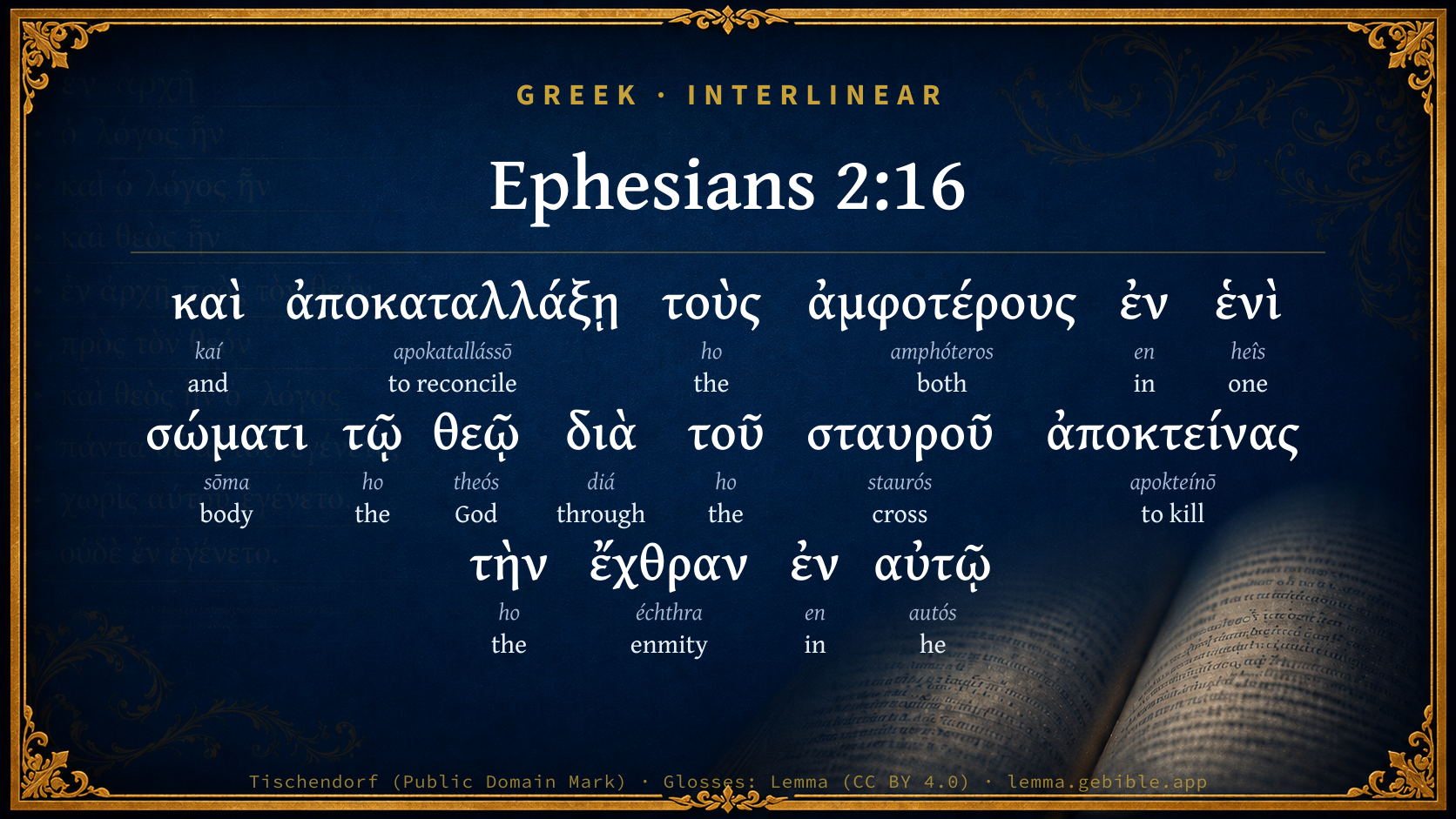
Greek (Tischendorf 8th ed.) Ephesians 2:16 appears in the Greek New Testament. The text above is from the Tischendorf 8th edition. Each word links to its Strong’s number and a concise gloss. Click any word for its full Thayer’s Greek Lexicon entry.
Download image
Cite this verse

Ephesians 2:16 (World English Bible). Public Domain. Lemma interlinear Bible study tool, https://lemma.gebible.app/v/ephesians/2/16.

Show BibTeX & RIS
BibTeX
RIS
English Translation
and might reconcile them both in one body to God through the cross, having killed the hostility thereby.
World English Bible · Public Domain
Highlights
  • 1 first appearance in the Greek New Testament
Full analysis ↓
Download a study sheet

One document with this verse’s original text, its word-by-word gloss line, the meaning frame, cross-references with their text, attributed commentary, and full source and license credits — printable, and it pastes into notes with its structure intact.

This verse Autodidact and up

Study sheet (.html) Plain text (.txt)

A passage Seminary Student

Up to 50 verses in one chapter. A passage sheet keeps up to 6 commentary sources and 12 cross-references per verse, in the order this page ranks them, and says so on the sheet whenever that leaves anything out. Ask for a single verse and you get the Autodidact verse sheet above.

Everything on this page stays free to read, with no account — the sheet is a download of what is already on screen, not access to it.

Want to remove ads? Support Godless Engineer
Compare translations 3

The same verse in 3 English versions, stacked beneath the original-language interlinear above. Click any original word for its lexicon entry.

Each is an independent rendering of the whole verse — the interlinear is not word-aligned to these translations.

Highlighted words mark where these versions differ — a whole-verse word diff, not a word-by-word alignment.

  • World English Bible Public Domain
    and might reconcile them both in one body to God through the cross, having killed the hostility thereby.
  • King James Version Public Domain
    And that he might reconcile both unto God in one body by the cross, having slain the enmity thereby:
  • unfoldingWord Literal Text CC BY-SA 4.0
    and so that he might reconcile both to God as one body through the cross, putting to death the hostility in it.

unfoldingWord Literal Text — © unfoldingWord, licensed CC BY-SA 4.0. Word-aligned USFM3 via Door43 (git.door43.org/unfoldingWord/en_ult).

Versions to compare (up to 4)

3 of 4 selected

Show all 19 translations

Every available English version of this verse, each an independent rendering of the whole verse.

  • World English Bible Public Domain
    and might reconcile them both in one body to God through the cross, having killed the hostility thereby.
  • Berean Standard Bible Public Domain
    and reconciling both of them to God in one body through the cross, by which He extinguished their hostility.
  • Majority Standard Bible Public Domain
    and reconciling both of them to God in one body through the cross, by which He put to death their hostility.
  • King James Version Public Domain
    And that he might reconcile both unto God in one body by the cross, having slain the enmity thereby:
  • American Standard Version (1901) Public Domain
    and might reconcile them both in one body unto God through the cross, having slain the enmity thereby:
  • Revised Version (1885) Public Domain
    and might reconcile them both in one body unto God through the cross, having slain the enmity thereby:
  • Geneva Bible (1599) Public Domain
    And that he might reconcile both vnto God in one body by his crosse, and slay hatred thereby,
  • Douay-Rheims (1899) Public Domain
    And might reconcile both to God in one body by the cross, killing the enmities in himself.
  • Young's Literal Translation Public Domain
    and might reconcile both in one body to God through the cross, having slain the enmity in it,
  • Literal Standard Version CC BY-SA 4.0
    and might reconcile both in one body to God through the Cross, having slain the enmity by it,
  • Unlocked Literal Bible CC BY-SA 4.0
    Christ reconciles both peoples into one body to God through the cross, putting to death the hostility.
  • unfoldingWord Literal Text CC BY-SA 4.0
    and so that he might reconcile both to God as one body through the cross, putting to death the hostility in it.
  • Darby Bible Public Domain
    and might reconcile both in one body to God by the cross, having by it slain the enmity;
  • World Messianic Bible Public Domain
    and might reconcile them both in one body to God through the cross, having killed the hostility through it.
  • Webster's Bible Public Domain
    And that he might reconcile both to God in one body by the cross, having by it slain the enmity:
  • Free Bible Version CC BY-SA 4.0
    and completely reconcile both of them to God through the cross as if they were just one body, having destroyed our hostility towards each other.
  • Bible in Basic English Public Domain
    And that the two might come into agreement with God in one body through the cross, so putting an end to that division.
  • Text-Critical English NT CC BY 4.0
    He reconciled both groups to God in one body through the cross, by which he put the hostility to death.
  • Tyndale New Testament (1534) Public Domain
    and to reconcile both vnto god in one body thorow his crosse and slewe hatred therby:

Literal Standard Version (2020), Covenant Press — licensed CC BY-SA 4.0. Text via the HelloAO Bible API (eBible.org). Unlocked Literal Bible (unfoldingWord) — licensed CC BY-SA 4.0. Text via the HelloAO Bible API (eBible.org). unfoldingWord Literal Text — © unfoldingWord, licensed CC BY-SA 4.0. Word-aligned USFM3 via Door43 (git.door43.org/unfoldingWord/en_ult). Free Bible Version, Dr. Jonathan Gallagher — licensed CC BY-SA 4.0. Text via the HelloAO Bible API (eBible.org).

Word by word

More ways to search: Search by grammar → Find every occurrence → Compare this word →

Practice this passage: Drill this verse → Learn its vocabulary →

ἀποκαταλλάξῃ
apokatallássō
G604
“to reconcile”
Verb, Aorist, Active, Subjunctive, 3rd person, Singular
Part of Speech
Verb
Tense
Aorist
Voice
Active
Mood
Subjunctive
Person
3rd person
Number
Singular
Full Thayer's Definition

Origin: from G575 and G2644

TDNT: 05:18,4

1. to reconcile completely 2. to reconcile back again 3. bring back a former state of harmony
  1. καὶ kaí G2532 “and” Conjunction
  2. τοὺς ho G3588 “the” Article, Accusative, Plural, Masculine
  3. ἀμφοτέρους amphóteros G297 “both” Adjective, Accusative, Plural, Masculine
  4. ἐν en G1722 “in” Preposition
  5. ἑνὶ heîs G1520 “one” Adjective, Dative, Singular, Neuter
  6. σώματι sōma G4983 “body” Noun, Dative, Singular, Neuter
  7. τῷ ho G3588 “the” Article, Dative, Singular, Masculine
  8. θεῷ theós G2316 “God” Noun, Dative, Singular, Masculine
  9. διὰ diá G1223 “through” Preposition
  10. τοῦ ho G3588 “the” Article, Genitive, Singular, Masculine
  11. σταυροῦ staurós G4716 “cross” Noun, Genitive, Singular, Masculine
  12. ἀποκτείνας apokteínō G615 “to kill” Verb, Aorist, Active, Participle, Nominative, Singular, Masculine
  13. τὴν ho G3588 “the” Article, Accusative, Singular, Feminine
  14. ἔχθραν échthra G2189 “enmity” Noun, Accusative, Singular, Feminine
  15. ἐν en G1722 “in” Preposition
  16. αὐτῷ autós G846 “he” Personal pronoun, Dative, Singular, Masculine

About this verse

These counts appear in no published source. They are computed here, from the morphology-tagged text and Lemma’s own curated glosses. What Lemma adds →

17
words
13
distinct lemmas
Pauline Epistles
section

Notable vocabulary

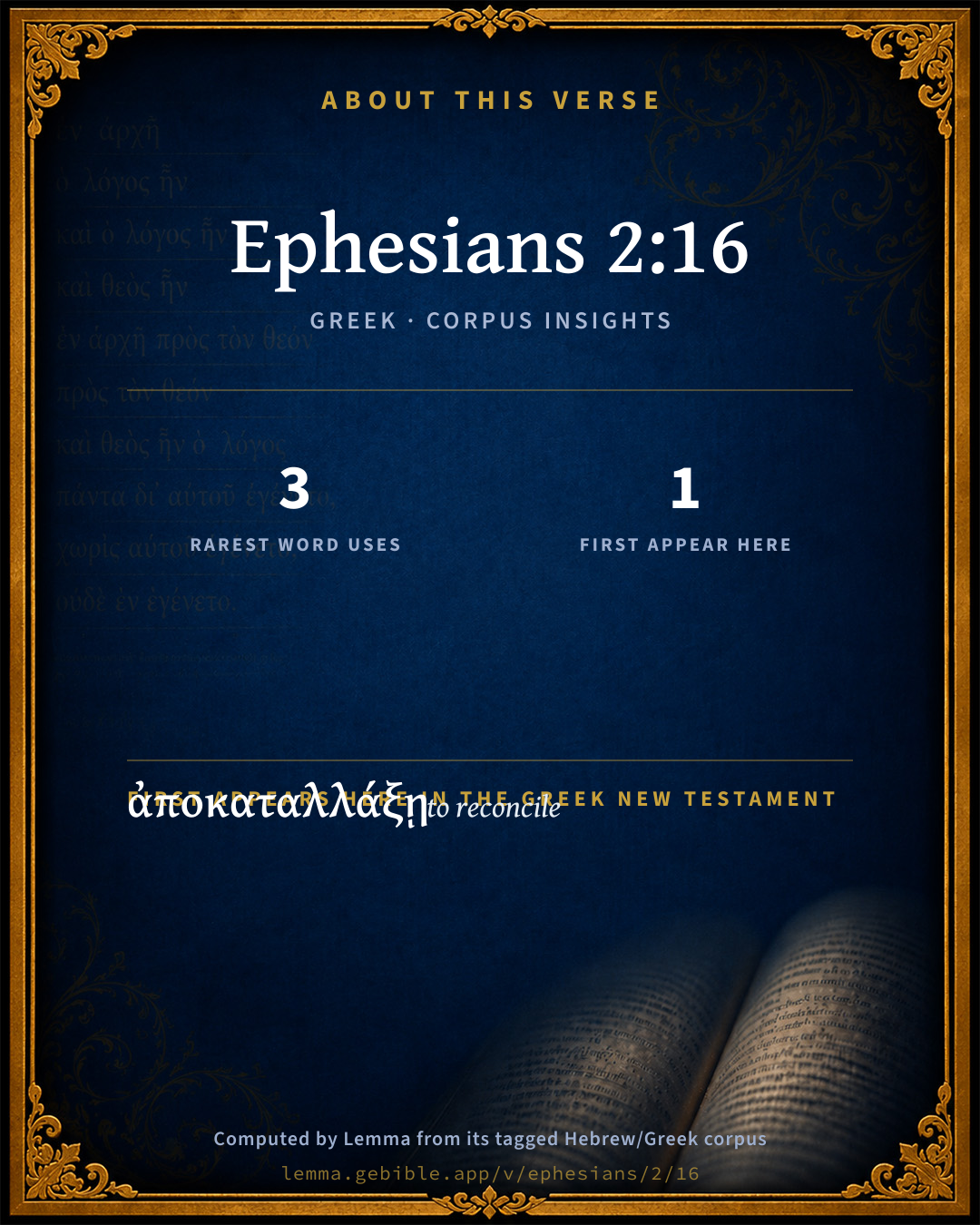
The rarest word here is ἀποκαταλλάξῃ to reconcile G604 — appearing just 3 times in the whole Greek New Testament.

First appearance in Scripture

This word makes its first canonical appearance in the Greek New Testament here:

  • ἀποκαταλλάξῃ to reconcile G604

Shared distinctive vocabulary

ἀποκαταλλάξῃ to reconcile G604 occurs in 3 verses of the Greek New Testament. Also found in:
Repetition

Words recur within this verse:

Cross-references

10

Topical passages linked to Ephesians 2:16 in the Treasury of Scripture Knowledge — connected by theme and wording, ordered by reader-vote popularity; previews shown in the World English Bible.

  • Colossians 1:20–22 and through him to reconcile all things to himself, by him, whether things on the earth, or things in the heavens, having made peace through the blood of his cross.
  • Romans 5:10 For if, while we were enemies, we were reconciled to God through the death of his Son, much more, being reconciled, we will be saved by his life.
  • 2 Corinthians 5:18–21 But all things are of God, who reconciled us to himself through Jesus Christ, and gave to us the ministry of reconciliation;
  • Colossians 2:14 wiping out the handwriting in ordinances which was against us; and he has taken it out of the way, nailing it to the cross;
  • Galatians 2:20 I have been crucified with Christ, and it is no longer I that live, but Christ living in me. That life which I now live in the flesh, I live by faith in the Son of God, who loved me, and gave himself up for me.
  • Ephesians 2:15 having abolished in the flesh the hostility, the law of commandments contained in ordinances, that he might create in himself one new man of the two, making peace;
  • 1 Peter 4:1–2 Forasmuch then as Christ suffered for us in the flesh, arm yourselves also with the same mind; for he who has suffered in the flesh has ceased from sin;
  • Romans 6:6 knowing this, that our old man was crucified with him, that the body of sin might be done away with, so that we would no longer be in bondage to sin.
  • Romans 8:3 For what the law couldn't do, in that it was weak through the flesh, God did, sending his own Son in the likeness of sinful flesh and for sin, he condemned sin in the flesh;
  • Romans 8:7 because the mind of the flesh is hostile towards God; for it is not subject to God's law, neither indeed can it be.

Cross-references courtesy of OpenBible.info (CC BY 4.0).

Commentary

Notes on Ephesians 2:16 from classic Christian and Jewish commentators (each source and its license shown beneath its notes). The classic Christian expositions comment on the surrounding passage and are grouped to its opening verse, so a note may address several verses; the Jewish commentaries on the Tanakh (Rashi and others) are per-verse, so they appear only where the commentator wrote on this verse.

Lemma curates 59 commentaries, every one of them public domain or Creative Commons licensed, each selected and text-cleaned for this edition rather than reprinted as found. About our sources →

The Biblical Illustrator

Joseph S. Exell

Eph_2:16

And that He might reconcile both unto God in one body by the Cross, having slain the enmity thereby.

Reconciliation

1. Our reconciliation itself.

2. The order of it.

(1) Incorporate in Christ.

(2) Concorporate with His members.

3. To whom.

4. The cause.

(1) More remote--Himself crucified.

(2) More immediate--the abolishing of hatred in Himself.

I. By nature we are at enmity with God.

1. Note and bewail thy natural condition.

2. To become Gods friend, become a new creature.

II. In Christ is reconciliation made.

1. The removal of that which was hateful.

2. The love of God is procured.

3. The fruits of His love are communicated.

(1) Make sure of such reconcilement.

(2) Renew it after each breach.

III. We must be incorporated with Christ before we can be reconciled to God. This incorporation is in the Church, which is Christs body. Let us take care that we have it.

IV. Christ, by offering himself upon the cross, has made peace between God and us.

1. We see what we must look to, if the wrath of God stings us. Christ crucified is the propitiatory sacrifice.

2. It confirms our faith, that the Lord Jesus will bring us to glory (Rom_5:10).

3. A ground of exhortation to all, that they seek to be reconciled. We make the blood of Christ a vain thing, when we will not be reconciled to God. It is as if a traitor, in prison for treason, should still plot and practise more villainy; and when the prince has procured his pardon, should still conspire, and not listen to the benefit, nor set his heart to return into the kings favour. (Paul Bayne.)

The power of the gospel to dissolve the enmity of the human heart against God

Let us consider from this text, how it is that the gospel of Jesus Christ suits its application to the great moral disease of mans enmity to God. The necessity of some singular expedient for restoring the love of God to the alienated heart of man, will appear from the utter impossibility of bringing this about by any direct application of authority whatever. For, do you think, that the delivery of the law of love in his hearing, as a positive and indispensable enactment coming forth from the legislature of heaven, will do it? You may as well pass a law making it imperative upon him to delight in pain, and to feel comfort on a bed of torture. Or, do you think, that you will ever give a practical establishment to the law of love, by surrounding it with accumulated penalties? This may irritate or it may terrify; but for the purpose of begetting anything like attachment, one may as well think of lashing another into tender regard for him. Or, do you think, that the terrors of the coming vengeance will ever incline a human being to love the God who threatens him? Powerful as these terrors are in persuading man to turn from the evil of his ways; they most assuredly do not form the artillery by which the heart of man can be carried. They draw not forth a single affection, but the affection of fear. They never can charm the human bosom into a feeling of attachment to God. And it goes to prove the necessity of some singular expedient for restoring man to fellowship with his Maker, that the only obedience on which this fellowship can be perpetuated, is an obedience which no threatenings can force; to which no warnings of displeasure can reclaim; which all the solemn proclamations of law and justice cannot carry; and all the terrors and severities of a sovereignty resting on power as its only foundation can never subdue. This, then, is a case of difficulty; and, in the Bible, God is said to have lavished all the riches of His unsearchable wisdom on the business of managing it. No wonder that to His angels it appeared a mystery, and that they desired to look into it. It appears a matter of direct and obvious facility to intimidate man; and to bring his body into a forced subordination to all their requirements. But the great matter was how to attach man; how to work in him a liking to God and a relish for His character; or, in other words, how to communicate to human obedience that principle, without which it is no obedience at all; to make him serve God because he loved Him; and to run in the way of all His commandments, because this was the thing in which he greatly delighted himself. To lay upon us the demand of satisfaction for His violated law could not do it. To press home the claims of justice upon any sense of authority within us could not do it. To bring forward, in threatening array, the terrors of His judgment and of His power against us could not do it. To unveil the glories of that throne where He sitteth in equity, and manifest to His guilty creatures the awful inflexibilities of His truth and righteousness, could not do it. To look out from the cloud of vengeance, and trouble our darkened souls as He did those of the Egyptians of old, with the aspect of a menacing Deity, could not do it. To spread the field of an undone eternity before us; and tell us of those dreary abodes where each criminal hath his bed in hell, and the centuries of despair which pass over him are not counted, because there no seasons roll, and the unhappy victims of the tribulation, and the wrath, and the anguish, know, that for the mighty burden of the sufferings which weigh upon them, there is no end and no mitigation; this prospect, appalling as it is, and coming home upon the belief, with all the characters of the most immutable certainty, could not do it. The affections of the inner man remain as unmoved as ever, under the successive and repeated influence of all these dreadful applications. How, then, is this regeneration to be wrought, if no threatenings can work it; if no terrors of judgment can soften the heart into that love of God which forms the chief feature of repentance; if all the direct applications of law and of righteous authority, and of its tremendous and immutable sanctions, so far from attaching man in tenderness to his God, have only the effect of impressing a violent recoil upon all his affections, and, by the hardening influence of despair, of stirring up in his bosom a more violent antipathy than ever? Will the high and solemn proclamations of a menacing Deity not do it? This is not the way in which the heart of man can be carried. He is so constituted, that the law of love can never, never be established within him by the engine of terror; and here is the barrier to this regeneration on the part of man. But if a threat of justice cannot do it, will an act of forgiveness do it? This, again, is not the way in which God can admit the guilty to acceptance. He is so constituted, that His truth cannot be trampled upon; and His government cannot be despoiled of its authority: and its sanctions cannot, with impunity, be defied; and every solemn utterance of the Deity cannot but find its accomplishment in such a way as may vindicate His glory, and make the whole creation He has formed stand in awe of its Almighty Sovereign. And here is another barrier on the part of God; and that economy of redemption in which a dead and undiscerning world see no skilfulness to admire, and no feature of graciousness to allure, was so planned, in the upper counsels of heaven, that it maketh known to principalities and powers the manifold wisdom of Him who devised it. The men of this infidel generation, whose every faculty is so bedimmed by the grossness of sense, that they cannot lay hold of the realities of faith and cannot appreciate them; to them the barriers we have now insisted on, which lie in the way of man taking God into his love, and of God taking man into His acceptance, may appear to be so many faint and shadowy considerations, of which they feel not the significancy; but, to the pure and intellectual eye of angels, they are substantial obstacles, and One mighty to save had to travail in the greatness of His strength, in order to move them away. The Son of God descended from heaven, and He took upon Him the nature of man, and He suffered in his stead, and He consented that the whole burden of offended justice should fall upon Him, and He bore in His own body on the tree the weight of all those accomplishments by which His Father behoved to be glorified; and after having magnified the law and made it honourable, by pouring out His soul unto the death for us, He went up on high, and, by an arm of everlasting strength, levelled that wall of partition which lay across the path of acceptance; and thus it is, that the barrier on the part of God is done away, and He, with untarnished glory, can dispense forgiveness over the whole extent of a guilty creation, because He can be just, while He is the justifier of them who believe in Jesus. And if the barrier, on the part of God, is thus moved aside, why not the barrier on the part of man? Does not the wisdom of redemption show itself here also? Does it not embrace some skilful contrivance by which it penetrates those mounds that beset the human heart, and ward the entrance of the principle of love away from it, and which all the direct applications of terror and authority, have only the effect of fixing more immovably upon their basis? Yes, it does; for it changes the aspect of the Deity towards man; and were men only to have faith in the announcements of the gospel, so as to see God with the eye of his mind under this new aspect--love to God would spring up in his heart as the unfailing consequence. Let man see God as He sets Himself forth in this wonderful revelation, and let him believe the reality of what he sees, and he cannot but love the Being he is employed in contemplating. And thus it is, that the goodness of God destroyeth the enmity of the human heart. When every other argument fails, this, if perceived by the eye of faith, finds its powerful and persuasive way through every barrier of resistance. Try to approach the heart of man by the instruments of terror and of authority, and it will disdainfully repel you. There is not one of you, skilled in the management of human nature, who does not perceive, that though this may be a way of working on the other principles of our constitution--of working on the fears of man, or on his sense of interest, this is not the way of gaining by a single hairbreadth on the attachments of his heart. Such a way may force, or it may terrify, but it never can endear; and after all the threatening array of such an influence as this is brought to bear upon man, there is not one particle of service it can extort from him, but what is all rendered in the spirit of a painful and reluctant bondage. Now, this is not the service which prepares for heaven. This is not the service which assimilates men to angels. This is not the obedience of those glorified spirits, whose every affection harmonizes with their every performance; and the very essence of whose piety consists of delight in God, and the love they bear to Him. To bring up man to such an obedience as this, his heart behoved to be approached in a peculiar way; and no such way is to be found, but within the limits of the Christian revelation. There alone you see God, without injury to His other attributes, plying the heart of man with the irresistible argument of kindness. There alone do you see the great Lord of heaven and of earth, setting Himself forth to the most worthless and the most wandering of His children; putting forth His own hand to the work of healing the breach which sin hath made between them; telling him that His word could not be set aside, and His threatenings could not be mocked, and His justice could not be defied and trampled on, and that it was not possible for His perfections to receive the slightest taint in the eyes of the creation He had thrown around Him; but that all this was provided for, and not a single creature within the compass of the universe He had formed could now say, that forgiveness to man was degrading to the authority of God; and that by the very act of atonement, which poured a glory over all the high attributes of His character, His mercy might now burst forth without limit and without control upon a guilty world, and the broad flag of invitation be unfurled in the sight of all its families. (T. Chalmers, D. D.)

Reconciliation through the Cross

I do not know whether there is any truth in the statement of a correspondent that whatever part of the earth the lightning once strikes it never strikes again, but whether it be so or not, it is certain that wherever the lightning of Gods vengeance has once struck the sinners substitute it will not strike the sinner. The best preservative for the Israelites house was this--vengeance had struck there and could not strike again. There was the insurance mark, the blood streak. Death had been there, it had fallen upon a victim of Gods own appointment, and in His esteem it had fallen upon Christ, the Lamb slain before the foundation of the world. (C. H. Spurgeon.)

Peace at the Cross

When the Mohawk Indians desired to be on friendly terms with the white man once again, they sought an interview with the Governor of New York, and their spokesman began by saying, Where shall I seek the chair of peace? Where shall I find it but upon our path? and whither does our path lead us but unto this house? Is it not so that men come into the sanctuary and approach the throne of grace, desiring peace, asking peace, and feeling that peace is to be found nowhere else but there?

Christs Cross

Krummacher describes the mysterious Cross as a rock, against which the very waves of the curse break: as a lightning conductor, by which the destroying, fluid descends, which would have otherwise destroyed the world with its fire. And Jesus, who mercifully engaged to direct the thunderbolt against Himself, does so while hanging yonder in profound darkness upon the Cross. There He is, as the connecting link between heaven and earth; His bleeding arms extending wide, stretched out to every sinner: hands pointed to the east and west, indicating the gathering in of the world of man to His fold. The Cross is directed to the sky, as the place of His final triumph of the work in redemption; and its foot fixed in the earth like a tree, from whose wondrous branches we gather the precious fruit of an eternal reconciliation to God and the Father. (Caughey.)

The Biblical Illustrator, edited by Joseph S. Exell (c. 1880s–1900s) — public domain. Text from a community e-Sword module.

Tyndale Open Study Notes

Tyndale Open Resources

2:16 Christ’s death on the cross reconciles humans to God, and also Jews and Gentiles to each other.

Tyndale Open Study Notes — © Tyndale Open Resources, licensed CC BY-SA 4.0. Text via the HelloAO Bible API.

Bengel's Gnomon

Johann Albrecht Bengel

Eph 2:16. Ἐν ἑνὶ σώματι, in one body) fixed to the cross. To this is to be referred in (by) one spirit, Eph 2:18; comp. Eph 4:4.—ἀποκτείνας τὴν ἔχθραν, having slain the enmity) By His death, He slew the enmity against God Himself.—ἐν αὐτῷ) in Him, viz. in His body.[33] Comp. what goes before.

[33] Engl. Vers. has thereby, seemingly referring to the cross; “by it.” But Eph 2:15, “Having abolished the enmity in His flesh” shows Bengel’s view to be correct.—ED.

Bengel's Gnomon of the New Testament — English translation (T&T Clark, Edinburgh, 1860) — public domain. Text from a community e-Sword module.

Meyer's Critical & Exegetical Commentary

Heinrich August Wilhelm Meyer

Eph_2:16. Continuation of the sentence expressive of the design. Christ has by His death done away with the law, in order to make the Jew and the Gentile into one new man (Eph_2:15), and (and consequently) so to accomplish the reconciliation of both with God, that they should as one body be reconciled with God through the cross, after He has slain thereon the enmity which hitherto existed between them.

καί] is the and of the sequence of thought; from what was before said resulted the way and manner of the reconciliation of the two with God; hence also ἀποκαταλλ. is prefixed.

ἀποκαταλλάσσω, only here and Col_1:20; in the other Greek writings only καταλλάσσω is preserved, which is not distinguished from διαλλάσσω (in opposition to Tittmann, Synon. p. 101; see Fritzsche, ad Rom. I. p. 276 ff.). The composition with ἀπό may, after the analogy of other compounds with ἀπό (comp. ἀποκαθίστημι, ἀποκατορθόω, al.), denote again (Calvin: reduxerit in unum grogem, also Harless), but it may also (comp. ἀποθαυμάζω, ἀποθεραπεύω, al.) strengthen the notion of the reconciliation. The latter is better adapted to the context (ἐν ἑνὶ σώματι; and see Eph_2:18). In opposition to Hofmanns conversion of the notion into that of the restoration of fellowship with God, see on Col_1:20. We may add that ἀποκαταλλ. does not apply to the mutual reconciliation of Jews and Gentiles (Grotius, according to whom τῷ Θεῷ is then equivalent to ut Deo serviant!), but, as the express τῷ Θεῷ says (Rom_5:10; 2Co_5:18; 2Co_5:20), to the reconciliation of both with God, whose wrath, namely, against sinners Christ has by His ἱλαστήριον changed into grace. Comp. on Col_1:21; 2Co_5:18; Rom_5:10.

τοὺς ἀμφοτέρους] not again τοὺς δύο, because they are now conceived as united, comp. Eph_2:14; Eph_2:18.

ἐν ἑνὶ σώματι] is held by Chrysostom, Theodoret, Theophylact, Beza, Calovius, Calixtus, Wolf, Bengel, Zachariae, Koppe, Flatt, Rückert, Matthies, Harless, Hofmann, Lechler, and others, to be the body of Christ; by the offering up of one body both are reconciled with God. But how superfluous in that case would the διὰ τοῦ σταυροῦ be![154] Moreover, Christ is in fact the subject, and how could it be said of Christ that by a single body He has reconciled both with God, oras Hofmann gives to the meaning a turn quite departing from the N.T. and especially the Pauline doctrine of atonementthat He has made a single body (His body, namely) to be their unity embracing them in the like fellowship of God,[155] since in fact the case of a plurality of bodies on the part of Christ was not even as an abstraction conceivable? This inappropriateness, hardly excusable by the reference to τοὺς ἀμφοτέρους, and not removed by the pure invention of a contrast to the many bodies offered up under the O. T. (Calovius), would only cease to be felt, if God were the subject, so that Paul might say that God had by the surrender of one body reconciled the two (2Co_5:18; Col_1:21) with Himself. Hence Ambrosiaster, Oecumenius, Photius, Anselm, Erasmus, Bucer, Calvin, Piscator, Cornelius a Lapide, Estius, Grotius, Michaelis, Morus, and others, including Meier, Holzhausen, Olshausen, Baumgarten-Crusius, de Wette, Winer, Bleek, have rightly found in ἓν σῶμα the unum corpus, which is formed of the Jews and Gentiles united into a εἷς καινὸς ἄνθρωπος. Comp. on ἓν σῶμα, Rom_5:12; 1Co_10:17; Eph_4:4; Col_3:15. Christ has reconciled the two in one body, i.e. constituting one body without further separationthe two portions of humanity as one wholeunto God. How entirely is this mode of taking it in keeping with the whole context! See especially Eph_2:15; Eph_2:14.

ἀποκτείνας τὴν ἔχθραν ἐν αὐτῷ] after he shall have slain, etc.; for it is inserted in the second half of the affirmation of design which begins with the ἵνα of Eph_2:15, so that it is correlative to the ποιῶν εἰρήνην of the first half. On ἀποκτ. Grotius correctly observes: idem hie valet, quod modo λύσας, sed crucis facta mentione, aptior fuit translatio verbi ἀποκτείνας, quia crux mortem adfert. And the ἔχθρα (here personified) is not to be explained otherwise than in Eph_2:14; hence not the law (Michaelis, Koppe, Holzhausen), nor the hostile relation of the Jews and Gentiles towards God (most expositors, including Rückert, Meier, Harless, Hofmann), but the enmity of the two towards each other. The aim of the apostle was not to explain the nature of the atonement in general as such, but to show how Christ has reconciled with God the Jews and Gentiles combined into unity, and to this end it was pertinent to say that He had cancelled the enmity which had hitherto subsisted between them. The aorist participle, we may add, affirms not something simultaneous with ἀποκαταλλ. (ita ut interficeret), but something preceding (after that He has slain), so that the relation of time is conceived of otherwise than in the case of the correlative ποιῶν εἰρήνην, Eph_2:15. Paul, namely, has conceived the matter thus: Christ has desired by His death on the cross to cancel the mutual enmity between Jews and Gentiles (see on Eph_2:15), and then by means of this death to reconcile both, who should now in this manner be united into one aggregate, ἐν ἑνὶ σώματι with God. In reality these are indeed only different sides of the effect of the death of Christ on the cross, not separate and successive effects; but in the representation unfolding the subject, in which Paul will here, as in a picture, set the matter before us in its various elements, they appear so, and this is in keeping with the whole solemn pathos which is shed over the passage.

ἐν αὐτῷ i.e. on the cross. The reference to σώματι (Bengel, Semler, Hofmann, following Tertullian) falls with the correct explanation of ἐν ἐνὶ σώματι. The reading ἐν ἑαυτῷ (F G, 115, codd. in Jer. Arab. pol Vulg. It. Goth. Syr. p. Ambr. Aug.) would yield the same sense as that reference to σώματι, but is a conformation to Eph_2:15, in accordance with which Luther also translated through Himself.

[154] Hofmann, after Tertull. c. Marc. v. 17, attaches it to the following ἀποκτ., by which, however, the emphasis that manifestly lies on ἀποκτ. is pushed forward to διὰ τοῦ σταυροῦ.

[155] In His person subsists the newness of human nature for them, and in His body, wherein [as a bodily living man] He has gone unto God, they have the place where mankind is restored to communion with God, Hofmann, p. 380. With this explaining away of the atonement it was no doubt consistent to connect διὰ τοῦ σταυροῦ with ἀποκτ., and to refer back ἐν αὐτῷ to the ἓν εῶμα. The simply correct rendering is given, e.g., in the version of Castalio: ut in sese ex duobus conderet unum novum hominem faciendo pacem, et ambos uno in corpore reconciliaret Deo per crucem peremtis in ea inimicitiis.

Meyer — Critical and Exegetical Commentary on the New Testament — English translation by Peter Christie, edited by Frederick Crombie (T&T Clark, 1880) — public domain. Text from a community e-Sword module.

Expositor's Greek Testament

ed. W. Robertson Nicoll

Eph 2:16 . καὶ ἀποκαταλλάξῃ τοὺς ἀμφοτέρους : and that He might reconcile them both . Further statement of object, the καί continuing and extending it. Only at this point is the prior and larger idea of the reconciliation to God introduced, and even now it is in connection with the idea of the reconciliation of Jew and Gentile. For τοὺς δύο we now have τοὺς ἀμφοτέρους , not “the two” but “both of them together,” unity being the aspect in which they are now presented. The ἀπο - in such compounds has sometimes simply an intensive meaning ( ἀποθαρρεῖν , ἀποθαυμάζειν , ἀποκαραδοκεῖν , ἀπεκδέχεσθαι , etc.); sometimes, though less frequently, the sense of again ( ἀποδίδωμι , ἀποκαθίστημι , ἀποκατορθόω , ἀποκαταλαμβάνω ). It is doubtful which is the force of the ἀπο - here. In the context, it is true, so far as the relations of Jew and Gentile to each other are dealt with, we have simply the idea of a state of separation into two hostile camps giving place to a state of unity. But in the present clause the larger truth of a reconciliation to God is in view, and this favours the idea of a restoration to a condition which had been lost. The form ἀποκαταλλάσσειν occurs in the NT only here and in Col 1:20-21 . In the LXX and once in the NT (Mat 5:24 ) we have also διαλλάττεσθαι . But the two appear to be practically indistinguishable. As derivatives of ἀλλάσσειν they both convey the idea of a change, not primarily in feeling (which is expressed by ἱλάσκεσθαι and its compounds), but in relation , and in mutual relation, on the side of God to man and on the side of man to God ( cf. Rom 5:9-11 ; 2Co 5:18-20 ). ἐν ἑνὶ σώματι διὰ τοῦ σταυροῦ ; in one body through the cross . This cannot refer to Christ’s body (Chrys., Beng., Harl., Hofm.), as if the point were either the reconciliation of two parties by one body , or the one offering of Christ that needed no repetition (Heb 7:27 , etc.), or, again, the one sacrifice as contrasted with the multitude of the Levitical oblations. These are ideas alien to the context, and they are the less appropriate because Christ Himself is the subject of the ἀποκαταλλάξῃ . The reference is to the Jews and Gentiles now making one body; cf. the ἒν σῶμα in 1Co 10:17 ; Eph 4:4 ; and especially in Col 3:15 . His object was to bring the two long-sundered and antagonistic parties as one whole, one great body, into right relation to God by His cross. The διὰ τοῦ σταυροῦ belongs rather to the ἀποκαταλλάξῃ than to the following ἀποκτείνας (von Soden). ἀποκτείνας τὴν ἔχθραν ἐν αὐτῷ : having slain the enmity thereby . For ἐν αὐτῷ there is a variant reading ἐν ἑαυτῷ , slenderly supported (F 115, etc.); and some propose ἐν αὑτῷ (von Soden). But this ἐν αὐτῷ refers to the σταυροῦ , and the idea is not that Christ slew the enmity in Himself, but that He did it “by the cross,” or, as some take it (Alf., etc.), “on the cross”. The ἔχθρα here, again, is not the Law itself, nor the enmity of Jew and Gentile to God (though most take it so), but rather the ἔχθρα previously mentioned the enmity between Jew and Gentile. Further, the ἀποκτείνας which might denote an action coincident with that denoted by the main verb, or might define the way in which the latter was made good, seems to have its proper sense of priority “after He had killed”. He had first to kill this enmity between the two before He could bring them both into right relations to God in the way indicated, viz. , in one body, as one great, united whole.

The Expositor's Greek Testament, edited by W. Robertson Nicoll (1897–1910) — public domain. Text from a community e-Sword module.

Hodge's Commentary on Romans, Ephesians & First Corinthians

Charles Hodge

Eph_2:16

The second part of Christs purpose is expressed in this verse. It was that he might reconcile (ἀποκαταλλάξῃ) the two, united in one body, unto God, by means of the cross, having thereby slain the enmity. The end effected was reconciliation with God; the subjects of this reconciliation are the church, the one body into which Jews and Gentiles are merged (so that the one is σύσσωμα with the other, Eph_3:6); the means of this reconciliation is the cross, because the crucifixion of our Lord removes the enmity which prevented the reconciliation here spoken of.

To reconcile is to effect peace and union between parties previously at variance. Neither the English nor Greek terms (διαλλάσσειν, καταλλάσσειν) indicate whether the change effected is mutual or only on one side. A child is reconciled to an offended father who received him into favor, though the fathers feelings only have been changed. Whether the reconciliation effected by Christ between man and God results from an inward change in men, or from the propitiation of God or whether both ideas are to be included, is determined not by the signification of the word, but by the context and the analogy of Scripture. When Christ is said to reconcile men to God, the meaning is that he propitiated God, satisfied the demands of his justice, and thus rendered it possible that he might be just and yet justify the ungodly. This is plain, because the reconciliation is always said to be effected by the death, the blood, the cross of Christ; and the proximate design of a sacrifice is to propitiate God, and not to convert the offerer or him for whom the offering is made. What in one place is expressed by saying Christ reconciled us to God, is in another place expressed by saying, he was a propitiation, or made propitiation for our sins.

The subjects of this reconciliation are the Jews and Gentiles united in one body, i.e. the church τοὺς ἀμφοτέρους ἐν ἑνὶ σώματι. His death had not reference to one class to the exclusion of the other. It was designed to bring unto God, the whole number of the redeemed, whether Jews or Gentiles, as one living body, filled with his Spirit as well as washed in his blood.

Many commentators understand the words in one body to refer to Christs own body, and the words by the cross, at the close of the sentence, to be merely explanatory. The sense would then be, That he might reconcile both unto God, by one body, i.e. by the one offering of himself, i.e. by his cross. The obvious objection to this interpretation is, that one body cannot naturally be explained to mean one offering of his body. Besides this, the passage, Eph_2:13-16, would then repeat five times the idea: the sacrifice of Christ reconciled us to God. The natural opposition between the two and the one body, favors the common interpretation. Christ created the two into one new man, and as thus united in one body, he reconciled both unto God.

The means by which this reconciliation was effected as the cross because on it he slew the enmity which separated us from God. The latter clause of the verse is therefore explanatory of what precedes. He reconciled both to God, having, by the cross, slain the enmity. The enmity in this place, as in Eph_2:15, many understand to be the enmity between the Jews and Gentiles, and make the apostle say: Christ by his crucifixion has destroyed the enmity between the Jews and Gentiles and then reconciled them thus united in one body to God. It is urged in favor of this interpretation that it is unnatural to make the word enmity in this verse and in Eph_2:15 refer to different things. The great doctrine in the whole context is the unity of all believers, and therefore, that is to be kept in view. It is the enmity between the Jews and Gentiles and their union of which the apostle is treating. But that idea had just before been expressed. It is perfectly pertinent to the apostles object to show that the union between the Jews and Gentiles was effected by the reconciliation of both, by his atoning death, to God. The former flows from the latter. In this connection the words having slain the enmity on it, serve to explain the declaration that the cross of Christ reconciles us to God. His death satisfied justice, it propitiated God, i.e. removed his wrath, or his enmity to sinners; not hatred, for God is love, but the calm and holy purpose to punish them for their sins. This view is sustained by the constantly recurring representations of Scripture. In Col_1:20-22, we have a passage which is exactly parallel to the one before us. It is there said, that God, having made peace by the blood of the cross, reconciled by Christ all things unto himself, and you, the apostle adds, that were sometime alienated and enemies in your mind by wicked works, yet now hath he reconciled in the body of his flesh through death. Here it is obvious that the peace intended is peace between God and man. So too in Col_2:13, Col_2:14, it is said: You being dead … hath he quickened together with him, having forgiven you all trespasses; blotting out the handwriting of ordinances that was against us, which was contrary to us, and took it out of the way, nailing it to his cross. Here again the reconciliation is between man and God; the means, the cross the mode, the abrogation or satisfaction of the law. The epistles to the Ephesians and to the Colossians are so much a reflection the one of the other, that they serve for mutual illustration. As there can be no doubt as to what Paul meant in the passages addressed to the Colossians, they serve to determine his meaning in the parallel passages to the Ephesians. The context, so far from opposing, favors the interpretation given above. Reconciliation involves the removal of enmity; the reconciliation is to God, therefore the enmity is that which subsisted between God and man the peace announced in consequence of this reconciliation, Eph_2:17, is peace with God; it consists in the liberty of access to him spoken of in Eph_2:18. Thus all is natural in the relation of the several clauses to each other.

Charles Hodge — Commentary on Romans (1835), First Corinthians (1857), and Ephesians (1856) — public domain. Text from a community e-Sword module.

Geneva Bible (1599)

Geneva Bible translators

He alludeth to the sacrifices of the Law, which represented that true and only sacrifice.

For he destroyed death by death, and fastened it as it were to the cross.

Geneva Bible (1599) marginal notes — public domain. Text via Bolls.life.

Jamieson, Fausset & Brown

Robert Jamieson, A. R. Fausset & David Brown

Translate, "might altogether reconcile them both in one body (the Church, Col 3:15) unto God through His cross." The Greek for "reconcile" (apocatalaxe), found only here and in Col 1:20, expresses not only a return to favor with one (catallage), but so to lay aside enmity that complete amity follows; to pass from enmity to complete reconciliation [TITTMANN].

slain the enmity--namely, that had been between man and God; and so that between Jew and Gentile which had resulted from it. By His being slain, He slew it (compare Heb 2:14).

thereby--Greek, "therein"; "in" or "by the cross," that is, His crucifixion (Col 2:15).

Jamieson, Fausset & Brown — Commentary Critical and Explanatory on the Whole Bible (1871) — public domain (CC PDM 1.0). Text via the HelloAO Bible API.

Adam Clarke's Commentary

Verse 16. That he might reconcile both - in one body] That the Jews and Gentiles, believing on the Lord Jesus, might lay aside all their causes of contention, and become one spiritual body, or society of men, influenced by the Spirit, and acting according to the precepts of the Gospel.

Having slain the enmity thereby] Having, by his death upon the cross, made reconciliation between God and man, and by his Spirit in their hearts removed the enmity of their fallen, sinful nature. Dr. Macknight thinks that abolishing the enmity is spoken of the removal of the hatred which the Jews and Gentiles mutually bore to each other, because of the difference of their respective religious worship; and that slaying the enmity refers to the removal of evil lusts and affections from the heart of man, by the power of Divine grace. This is nearly the sense given above.

Adam Clarke's Commentary on the Bible (1810–1826) — public domain. Text from a community e-Sword/MySword module.

John Calvin's Commentaries

16. And that he might reconcile both. The reconciliation between ourselves which has now been described is not the only advantage which we derive from Christ. We have been brought back into favor with God. The Jews are thus led to consider that they have not less need of a Mediator than the Gentiles. Without this, neither the Law, nor ceremonies, nor their descent from Abraham, nor all their dazzling prerogatives, would be of any avail. We are all sinners; and forgiveness of sins cannot be obtained but through the grace of Christ. He adds, in one body, to inform the Jews, that to cultivate union with the Gentiles will be well-pleasing in the sight of God.

By the cross. The word cross is added, to point out the propitiatory sacrifice. Sin is the cause of enmity between God and us; and, until it is removed, we shall not be restored to the Divine favor. It has been blotted out by the death of Christ, in which he offered himself to the Father as an expiatory victim. There is another reason, indeed, why the cross is mentioned here, as it is through the cross that all ceremonies have been abolished. Accordingly, he adds, slaying the enmity thereby. These words, which unquestionably relate to the cross, may admit of two senses, — either that Christ, by his death, has turned away from us the Father’s anger, or that, having redeemed both Jews and Gentiles, he has brought them back into one flock. The latter appears to be the more probable interpretation, as it agrees with a former clause, abolishing in his flesh the enmity. (Ephesians 2:15.)

John Calvin's Commentaries (1540-1563) — public domain. Text from the Calvin Translation Society English edition (1840s-50s) via the Christian Classics Ethereal Library (ccel.org). Calvin's coverage is partial (roughly two-thirds of the Bible); uncommented books and verses are honest gaps, never fabricated. The 19th-century editor's footnotes and remarks are omitted so the notes are faithfully Calvin's own voice.

Ellicott's Commentary for English Readers

(16) And that he might reconcile both unto God in one body.—In this verse the latter subject opens—the reconciliation of all to God. On the reconciliation of man to God, see the great passage 2Co_5:18-21. But it should be noted that in the original the word used here and in Col_1:20-21 (and nowhere else) is a compound signifying not simply to “conciliate,” but properly to “reconcile,”—that is to reunite those who were originally united, but afterwards separated by the sin of man. This brings out the profound idea, which so especially characterises these Epistles, of a primeval unity of all created being in Christ, marred and broken by sin, and restored by His manifestation in human flesh. Note that the passage in the Colossians (on which see Notes) has a far wider scope than this passage—“having made peace through the blood of His cross, by Him to reconcile all things to Himself; by Him (I say), whether they be things on earth or things in heaven.” On the other hand, this passage characteristically still lays stress on the idea “in one body”—that is, as throughout, His mystical body, the Church—although probably the phrase is suggested here by the thought of the natural body of the Lord offered on the cross, which is clearly referred to in Col_1:21. There is a similar connection of thought in 1Co_10:16-17, “The bread which we break, is it not the communion of the body of Christ? For we are all one bread, and one body.”

By the cross, having slain the enmity thereby.—In this verse (in accordance with the context) “the enmity,” which by His death He “slew,” is the barrier between God and man, created by sin, but brought out by the Law, as hard and rigid law, “in ordinances” of which St. Paul does not hesitate to say that “sin took occasion by it,” and “by it slew” man (Rom_7:11). This is illustrated by the cognate, though different, metaphor of Col_2:14, where it is said of Christ that He “blotted out the handwriting of ordinances which was against us, which was contrary unto us, and took it out of the way, nailing it to His cross.” Compare also, in Gal_2:19-20, the connection of spiritual “death to the Law” with our partaking of our Lord’s crucifixion: “I, through the Law, am dead to the Law, that I might live unto God. I am crucified with Christ, nevertheless I live. . . . by the faith of the Son of God, who loved me and gave Himself for me.” By His death Christ has both redeemed us from sin, and also “redeemed (properly, bought) us from the curse of the Law” (Gal_3:13).

A Bible Commentary for English Readers, edited by Charles John Ellicott (1878–1897) — public domain. Text from a community e-Sword module.

The Cambridge Bible for Schools and Colleges

gen. ed. J. J. S. Perowne

16. reconcile both unto God] The Gr. verb here rendered “reconcile” occurs elsewhere (in exactly the same form) only Col_1:20-21; but a form nearly identical occurs e. g. Rom_5:10; 1Co_7:11; 2Co_5:18-20. The idea of the verb is on the whole that of the propitiation of an alienated superior, to whom offending inferiors are, with his consent, led back as accepted suppliants. God (2Co_5:19) “reconciled the world unto Himself” by providing, in His Son, the Divine pacification of the Divine displeasure against the world. Christ “reconciles us to God” by being and effecting that pacification. Hence Reconciliation, in practice, nearly approaches to both the ideas, Atonement and Justification. The Lord, here, “by the cross,” reconciles the Church to God; effects its acceptance; secures the “non-imputation of trespasses” (2Co_5:19).

“Both”:—here in the masculine plural; both great groups, Jewish and Gentile believers.

in one body] A phrase in contrast (see last note) to “both;” the two groups become the One Body, the One Man, of Eph_2:15.

by the cross] The only mention of it in this Epistle. Observe here, as consistently in the N. T., the isolation of the Lord’s Death from His Life-work, where ideas of atonement are in view; a fact most suggestive of the doctrine that that Death was a true and proper propitiatory Sacrifice, an altar-work, and not only a supreme act of self-sacrificing sympathy with man’s need and God’s holiness. For on the latter view there is no clear line of demarcation between the Death and the self-sacrificing Life.—Cp. the parallel, Col_1:20 (“the blood of the Cross”), and see above on Eph_1:7.

having slain the enmity thereby] I.e. by the Cross, the Atoning Death.—“The enmity:”—that spoken of Eph_2:15; immediately, that between Jew and Gentile; ultimately (for this underlies the conditions of the existence of that other) that between man and God (Rom_8:7).—“Slain:”—a word chosen, instead of e. g. “cancelled,” “abolished,” because the work was done through death. What was really, in final effect, executed at Calvary was the obstacle to peace; whether peace in the sense of the harmony of redeemed souls, or peace in the sense of reconciliation to God, the basis of the other. Cp. Col_2:14.

The Cambridge Bible for Schools and Colleges (gen. ed. J. J. S. Perowne; Cambridge University Press, 1878–1918) — public domain. Text from a community e-Sword module.

John Gill's Exposition

And that he might reconcile both unto God,.... This is another end of the abrogation of the ceremonial law: the Jews had run up a long score against the ceremonial law, as well as against the moral law; and Christ by fulfilling it for them, and thereby abrogating it, reconciled them; and the Gentiles could not be reconciled together with them, without the abrogation of it: and this reconciliation of them is made to God, who was the person offended; and who yet first set on foot a reconciliation, in which his glory is greatly concerned; and reconciliation with others depends upon reconciliation with him: and this is made

in one body by the cross; by which "body" is meant, the human body of Christ, which the Father prepared for him, and he assumed, and that in order to make reconciliation for his people; and is said to be "one" body, because it was in one and the same body, which he reconciled both Jews and Gentiles unto God, and in or by one sacrifice of that body; reconciliation being so effectually made by it that there is no need of a reiteration: or the sense is, he reconciled them into "one body"; into one mystical body, the church, of which he is head; and this he did "by the cross", that is, by his blood shed on the cross, or by his suffering the death of the cross; which shows that reconciliation is made in a way of satisfaction to the law and justice of God, by Christ's bearing the penalty of the law, and suffering the strokes of justice on the cross; and expresses the efficacy of his blood and sacrifice, and the greatness of his condescension and love:

having slain the enmity thereby; the ceremonial law, as before; and the slaying it is the same with abolishing it; unless the enmity between God and man is meant, which was slain by removing the cause of it, sin; and which laid a foundation for the slaying of it in the hearts of his people in regeneration, when sin is made odious to them, and they are reconciled to God's way of salvation; hence being slain in both senses, peace with God can never be broken.

John Gill's Exposition of the Whole Bible (1746–1763) — public domain (CC PDM 1.0). Text via the HelloAO Bible API.

Trapp's Complete Commentary

John Trapp

16 And that he might reconcile both unto God in one body by the cross, having slain the enmity thereby:

Ver. 16. In one body] Ubi igitur Separatistae? Therefore, where are the separatists? saith one. All other sins destroy the Church consequentially; but division and separation demolish it directly.

Having slain the enmity] Not the ceremonies only, as Eph 2:15, but sin, that great makebate (mischief-maker), that sets God at odds with his own creature.

John Trapp, A Commentary or Exposition upon All the Books of the Old and New Testament (1647–1656) — public domain. Text from a community e-Sword module.

Albert Barnes' Notes on the Bible

And that he might reconcile both unto God - This was another of the effects of the work of redemption, and indeed the main effect. It was not merely to make them harmonious, but it was that both, who had been alienated from God, should be reconciled to “him.” This was a different effect from that of producing peace between themselves, though in some sense the one grew out of the other. They who are reconciled to God will be at peace with each other. They will feel that they are of the same family, and are all brethren. On the subject of reconciliation, see the notes on 2Co 5:18.

In one body - One spiritual personage - the church; see the notes at Eph 1:23.

By the cross - By the atonement which he made on the cross; see Col 1:20; compare the notes at Rom 3:25. It is by the atonement only that men ever become reconciled to God.

Having slain the enmity - Not only the enmity between Jews and Gentiles, but the enmity between the sinner and God. He has by that death removed all the obstacles to reconciliation on the part of God and on the part of man. It is made efficacious in removing the enmity of the sinner against God, and producing peace.

Thereby - Margin, “in himself.” The meaning is, in his cross, or by means of his cross.

Albert Barnes' Notes on the Bible (1834–1885) — public domain. Text from a community e-Sword/MySword module.

Matthew Poole's English Annotations

And that he might reconcile both unto God; another end of Christ’s abolishing the ceremonial law, viz. that he might reconcile both Jew and Gentile (all the elect together) unto God: and in this respect especially he is our peace.

In one body; either both people united as one mystical body, or rather this one body here, is the body of Christ offered up to God as the means of reconciliation, Col 1:22.

By the cross; i.e. by the sacrifice of himself upon the cross.

Having slain the enmity thereby; the enmity between God and man, by the expiation of sin, the cause of it. Of this enmity the ceremonial law was a witness, Col 2:14, as well as a sign of that between Jew and Gentile.

Matthew Poole's English Annotations on the Holy Bible (1683–1685) — public domain. Text from a community e-Sword/MySword module.

Whedon's Commentary on the Bible

Daniel D. Whedon

16. Reconcile—The anticipation and commencement of the final reconciliation, (Col_1:20,) which is identical with the gather together of Eph_1:10.

In one body—Threefold of Jew and Gentile in Christ.

Enmity—As above.

Thereby—By the cross.

Daniel D. Whedon (gen. ed.), Commentary on the Old and New Testaments (1874–1909) — public domain. Text from a community e-Sword module.

The Pulpit Commentary

And that he might reconcile both to God in one body by the cross. Exegetical of preceding statements, and making emphatic the fact of reconciliation to God on the same footing and by the same means; both were to be reconciled in, one body. (see Eph_4:4) and by the cross. No preference was to be given to the Jew facilitating his union to Christ: the Gentile was to be taken into Christ"s body as readily as the Jew. In reference to the sense in which reconciliation was effected by the cross of Jesus, some say it was only as the cross demonstrated to men the love of God and his willingness to bless them; while others maintain very strongly that it was as providing a satisfaction to God"s justice for their guilt, and thus enabling him to receive and bless the sinner. Not only the analogy of other passages of Scripture as well as of this Epistle justifies the latter view, but preeminently the words, "by the cross." If Christ had only to proclaim God"s friendship toward sinners, why should he have suffered on the cross? The cross as a mere pulpit is hideous; as an altar it is glorious. The love of God is ill revealed, if it subjected Jesus to unnecessary agony. The love of both Father and Son is indeed commended, if the agony was voluntarily borne by the Son, and permitted by the Father, as being indispensable for the pardon of the sinner. "Apokatallaxh denotes the whole process of reconciliation (see Eadie). Having slain the enmity thereby (or, thereon). "The enmity" is the same as at the beginning of ver. 15 the enmity of man to God. The destruction of this enmity is one of the effects of the cross, though not the only effect; it is necessary to root out the enmity of the carnal mind. That this is the meaning here seems plain Rom_5:10, "If, when we were enemies, we were reconciled to God by the death of his Son." The apostle there makes no allusion to the enmity of Jew and Gentile to each other, but to this wider fact tonhma thv sarkon. If any words can denote the result of a propitiatory sacrifice, it is surely "reconciled to God by the death of his Son."

The Pulpit Commentary (1880–1919), ed. H.D.M. Spence-Jones & Joseph S. Exell — public domain. Text from a community e-Sword module.

John Wesley's Explanatory Notes

In one body - One church. Having slain - By his own death on the cross. The enmity - Which had been between sinners and God.

John Wesley, Explanatory Notes Upon the Whole Bible (1754–1765) — public domain. Text via the GEBible commentary corpus.

Burkitt's Expository Notes on the New Testament

William Burkitt

1. Our apostle had declared in the foregoing verses, that one end of Christ’s death was, to make peace between Jew and Gentile; here he assures us, a second end was to make peace between God and man, that he might reconcile both Jew and Gentile, thus united, to an offended God. This he did by the sacrifice of himself upon the cross; whereby he did destroy that enmity which was betwixt God and man, by undergoing the punishment of sin, the cause of that enmity.

Learn hence, That in order to our reconciliation with God, and being at peace with him, a price was paid by Christ upon the cross, to satisfy divine justice, and atone divine displeasure.

Observe next, that Christ’s having purchased peace, he came and preached peace to both Jews and Gentiles; to the Gentiles, said here to be afar off, and to the Jews, that were nigh.

But how did Christ preach to the Gentiles?

Ans. Though he did not in his own person preach peace to the Gentiles, yet he gave commission to the apostles to preach to them, Mat 28:19-20, and they and their successors, pursuant to such commission, did preach peace unto them, even to them that were afar off, and to them that were nigh.

Learn hence, That when the ministers of Christ do come in his name, and by a commission received from him, to preach peace, and offer terms of reconciliation unto lost sinners, it is all one as if Christ himself did come and preach; he expects the same readiness from them in receiving the message, as if it were delivered to them from his own mouth; and will treat the despisers of his ministers, and the contemners of their message, as if the affront were offered immediately to his own person.

Observe, 3. The apostle’s argument to prove that the Gentiles, as well as the Jews, were effectually called, by the preaching of the gospel, to partake of peace and reconciliation with God; because they had both equal access and liberty to approach unto God in all holy duties, as unto a Father, by the manuduction of the Spirit: Through him, that is, through Jesus Christ, we, both Jews and Gentiles, have access, that is, liberty of approach, by one and the same Spirit, unto the Father.

Learn hence, That through Jesus Christ, all believers, of what denomination soever, have access to God by the Spirit of grace.

Quest. What doth this access to the Father denote?

Ans. It supposes a distance between God and us, both a natural and a moral distance, as creatures and as sinners: it denotes a propinquity and nearness unto God, in opposition to this distance; and that our approach to God is free and voluntary, friendly and complacential, peculiar and privilegeous, fruitful and advantageous.

Quest. 2. In what respects have believers access to God as to a Father?

Ans. In this life they have access to the Father’s heart and love, to the Father’s ear and audience, to the Father’s care and protection; to his providing care, to his guiding and counseling care, to his comforting and supporting care, but especially to his sanctifying care.

Quest. 3. Through whom have we this access to God?

Ans. Through Jesus Christ, through his mediation and manuduction, we have access to God’s heart, to God’s ear, to his fatherly care on earth, and to his gracious presence in heaven.

Quest. 4. What influence gives the Holy Spirit unto this access unto the Father?

Ans. It is by his influence that they are at first brought home to the Father: he prepares them for this access unto the Father: he stirs up holy affections, and enkindles holy desires, in them after God, and helps them to make improvement, an holy, fruitful, and advantageous improvement, of all their access unto God.

William Burkitt's Expository Notes on the New Testament (1700–1703) — public domain. Text from a community e-Sword module.

The People's New Testament

B. W. Johnson

16. That he might reconcile both to God. First, the cross makes peace between Jew and Gentile; and second, the blood of the cross cleanses both before God, and makes peace between them and God. Having slain the enmity. Not only of Jew for Gentile, but of the sinner for God. When the sinner once fixes his mind on the bleeding Savior, the “goodness of God leads him to repentance.”

B. W. Johnson's The People's New Testament with Notes (1889–1891) — public domain. Electronic text from the Christian Classics Ethereal Library (CCEL) ThML edition.

Cambridge Greek Testament for Schools and Colleges

16. καὶ ἀποκαταλλάξη τοὺς ἀμφοτέρους ἐν ἑνὶ σώματι τῷ θεῷ διὰ τοῦ σταυροῦ. Cf. Col 1:22 ἀποκατήλλαξεν ἐν τῷ σώματι τῆς σαρκὸς αὐτοῦ διὰ τοῦ θανάτου. The difference between these passages should be noticed as well as the resemblance. In Col. the reference is to a single act of reconciliation wrought by our Lord when He died in His earthly body. In Ephes. the reference is to the application of the power of that act in bringing Jew and Gentile now united in one body, Christ’s mystical body, into a state of reconciliation with God. The reconciliation of man to man is a condition precedent to reconciliation to God. Cf. Mat 5:24; Mat 18:35.

ἀποκτείνας τὴν ἔχθραν ἐν αὐτῷ. St Paul now comes back to the point from which he had digressed. ἐν αὐτῷ sc. τῷ στ. as in Col 2:15.

Cambridge Greek Testament for Schools and Colleges (Cambridge University Press, 1896; 21 vols, various authors incl. Carr, Maclear, Plummer, Farrar, Lumby, Moule, M. R. James, Simcox) — public domain. Text from a community e-Sword module.

International Critical Commentary

16. καὶ ἀποκαταλλάξῃ. The καί is not the mere copula, but indicates a logical sequence, “and consequently reconcile both, now one body, to God by the Cross, having on it slain the enmity previously existing between them.”

ἀποκαταλλάσσειν is found only here and Col 1:20. It seems to be only an intensified form of the usual Greek word ἀλλάσσειν. ἀπό in composition frequently has this intensive meaning; cf. ἀπεκδέχεσθαι, ἀποκαραδοκεῖν, to await patiently; so ἀποθαρρεῖν, ἀποθαυμάζειν, ἀποθεᾶσθαι, etc In a few instances, indeed, it seems to be equivalent to re- and to mean “again,” as in ἀποδίδωμι, ἀπολαμβάνω, ἀποκαθίστημι, ἀποκατορθόω. In the first two of these the idea is rather to give or take what belongs of right to the receiver, as ἀποδ. χάριν, ὑπόσχεσιν. Here it is the idea of remotion from, that explains the meaning of the verb. In the other two examples also this local idea is involved.

In any case, as this use of ἀπο- is much less common than the intensive use, we are not justified in assuming it in a compound that does not elsewhere occur.

ἐν ἑνὶ σώματι is interpreted by Chrysostom as referring to the human body of Christ. So Bengel: “in uno corpore cruci affixo.” But in that case we should expect “His body.” Nor is it easy to see why that should be designated ἓν σῶμα. The order of the words indicates the correct interpretation, “both now united in one body.” The ἓν σῶμα is the εἷς καινὸς ἄνθρωπος. So most commentators. It is not the Church, for it is only as reconciled that Jews and Greeks belong to the Church. But when reconciled they become the body of Christ, and so, the Church.

διὰ τοῦ σταυροῦ is joined by Soden with the following, αὑτῷ being read for αὐτῷ (so G, Vulg. and some Latin codices with other authorities). The connexion with the two notions, ἀποκτείνας and ἔχθρα, gives it a subtle point. “By His death He was slain; by death on the Cross, in which the ἔχθρα showed itself, He has overcome the ἔχθρα.” We have a parallel in Col 1:20, only that there, instead of the negative ἀποκτείνειν τὴν ἐ., we have the positive εἰρηνοποιεῖν; also in connexion with διὰ τοῦ σταυροῦ. ἐν αὑτῷ, then, as in 15b, echoes with emphasis the fundamental thought: “He Himself is our peace.” If we read ἐν αὐτῷ, it could not be referred to σῶμα, because this ς. was just mentioned as the medium of reconciliation to God, whereas here it is the enmity between Jews and Gentiles that is in question.

International Critical Commentary — older volumes (1896–1929), various authors — public domain. Text from a community e-Sword module.

Vincent's Word Studies in the New Testament

Marvin R. Vincent

Might reconcile [αποκαταλλαξη] . Only here and Col 1:20,

Eph 2:21See on Col 1:20. The new man precedes the reconciling in Paul 's statement, though, as a fact, the order is the reverse. The verb contains a hint of restoration to a primal unity. See on ver. 12.

Thereby [εν αυτω] . Or upon it - the cross.

Eph 2:17You which were afar off. Gentiles.

Them that were nigh. Jews. See on Rom 3:30. As children of the messianic covenant. See on ver. 12. Compare Isa 57:9, where the Septuagint reads, peace upon peace to those who are far and to those who are near.

Marvin R. Vincent, Word Studies in the New Testament (1887–1900) — public domain. Text from a community e-Sword/MySword module.

Lesson kit

Teaching starters — assembled from the data on this page, not authored interpretation. Every prompt links to the verse data it draws on. Edit before teaching.

Ephesians, in the Pauline Epistles, opens this verse with 17 words (13 distinct Greek lemmas). Its most distinctive word is apokatallássō (“to reconcile”). A historical commentator’s framing appears above. Read the whole chapter for the surrounding context.

Discussion questions

  1. How does “to reconcile” (apokatallássō) shape what this verse is saying?
  2. This is the first place “to reconcile” appears in Scripture (first appears here). What does its debut here establish?
  3. How does Colossians 1:20, which shares the word «to reconcile», read alongside this verse?
  4. What does the repetition of “the” (4× in this one verse) do in this verse?
  5. The translations on this page render this verse differently — a whole-verse word diff, not a word-by-word alignment. What might account for the different wordings?
  6. Compare how The Biblical Illustrator and Tyndale Open Study Notes read this verse. Where do they agree or differ?

Things to notice

  • 1 word makes its first canonical appearance in Scripture here.
  • These translations choose different wording for 9 words in this verse.
  • “the” occurs 4× in this single verse.
  • 13 distinct Greek lemmas span 17 words in this verse.

Reading settings

Reading text

Shown beneath each verse's original-language words.

Old Testament
Old Testament edition

Read the OT as the Masoretic Hebrew (MT) or the Greek Septuagint (LXX).

English shown for the Greek Septuagint (in the Hebrew ↔ Greek comparison).

Comparing translations? Open the Compare panel on any verse page to stack up to four side by side.