2 Corinthians 5:8

Greek (Tischendorf 8th ed.) 2 Corinthians 5:8 appears in the Greek New Testament. The text above is from the Tischendorf 8th edition. Each word links to its Strong’s number and a concise gloss. Click any word for its full Thayer’s Greek Lexicon entry.
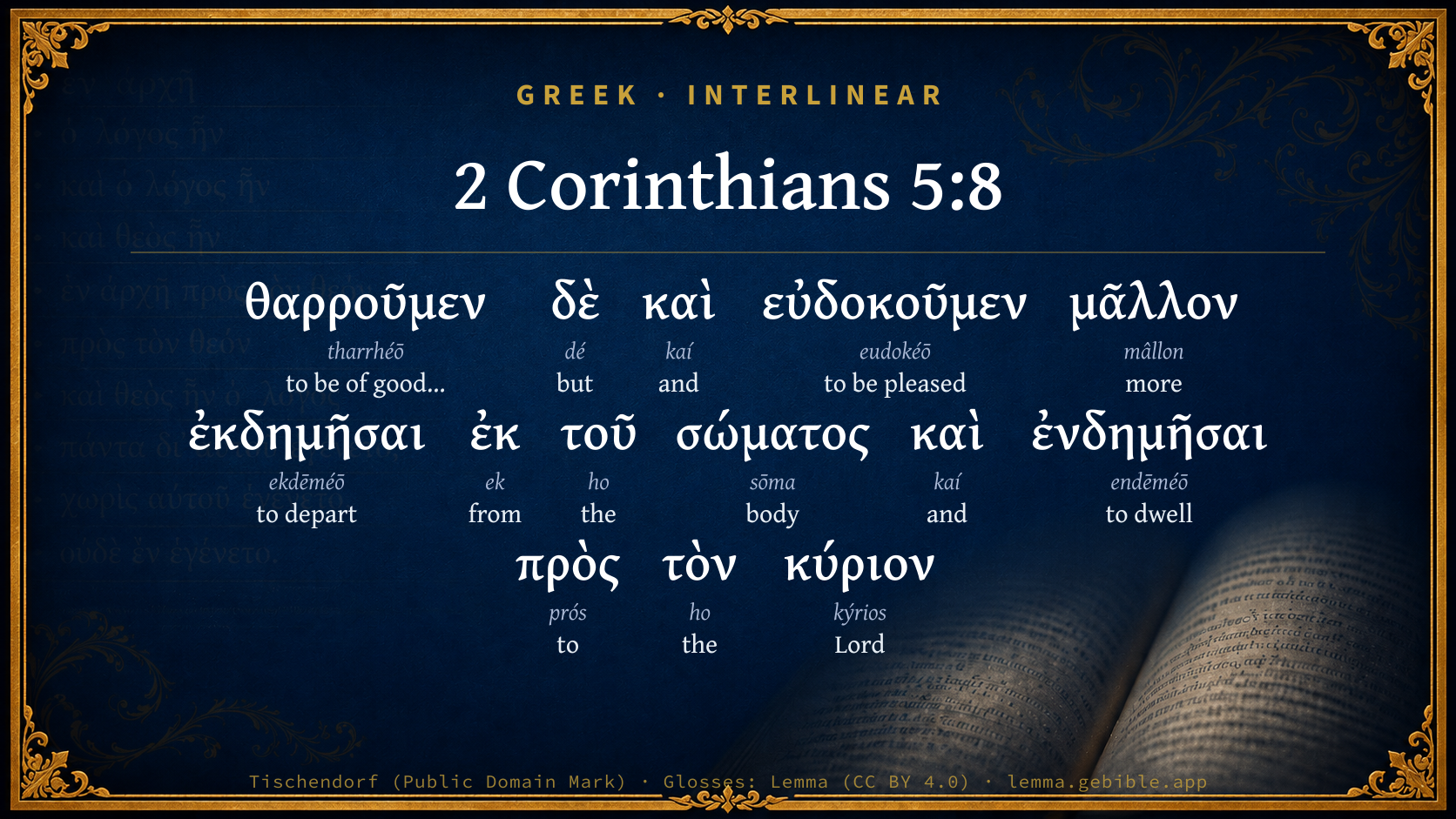
Download image
Cite this verse

2 Corinthians 5:8 (World English Bible). Public Domain. Lemma interlinear Bible study tool, https://lemma.gebible.app/v/2-corinthians/5/8.

Show BibTeX & RIS
BibTeX
RIS
English Translation
We are of good courage, I say, and are willing rather to be absent from the body, and to be at home with the Lord.
World English Bible · Public Domain
Download a study sheet

One document with this verse’s original text, its word-by-word gloss line, the meaning frame, cross-references with their text, attributed commentary, and full source and license credits — printable, and it pastes into notes with its structure intact.

This verse Autodidact and up

Study sheet (.html) Plain text (.txt)

A passage Seminary Student

Up to 50 verses in one chapter. A passage sheet keeps up to 6 commentary sources and 12 cross-references per verse, in the order this page ranks them, and says so on the sheet whenever that leaves anything out. Ask for a single verse and you get the Autodidact verse sheet above.

Everything on this page stays free to read, with no account — the sheet is a download of what is already on screen, not access to it.

Want to remove ads? Support Godless Engineer
Compare translations 3

The same verse in 3 English versions, stacked beneath the original-language interlinear above. Click any original word for its lexicon entry.

Each is an independent rendering of the whole verse — the interlinear is not word-aligned to these translations.

Highlighted words mark where these versions differ — a whole-verse word diff, not a word-by-word alignment.

  • World English Bible Public Domain
    We are of good courage, I say, and are willing rather to be absent from the body, and to be at home with the Lord.
  • King James Version Public Domain
    We are confident, I say, and willing rather to be absent from the body, and to be present with the Lord.
  • unfoldingWord Literal Text CC BY-SA 4.0
    Now we are confident and think it good rather to be away from the body and to be at home with the Lord.

unfoldingWord Literal Text — © unfoldingWord, licensed CC BY-SA 4.0. Word-aligned USFM3 via Door43 (git.door43.org/unfoldingWord/en_ult).

Versions to compare (up to 4)

3 of 4 selected

Show all 19 translations

Every available English version of this verse, each an independent rendering of the whole verse.

  • World English Bible Public Domain
    We are of good courage, I say, and are willing rather to be absent from the body, and to be at home with the Lord.
  • Berean Standard Bible Public Domain
    We are confident, then, and would prefer to be away from the body and at home with the Lord.
  • Majority Standard Bible Public Domain
    We are confident, then, and would prefer to be away from the body and at home with the Lord.
  • King James Version Public Domain
    We are confident, I say, and willing rather to be absent from the body, and to be present with the Lord.
  • American Standard Version (1901) Public Domain
    we are of good courage, I say, and are willing rather to be absent from the body, and to be at home with the Lord.
  • Revised Version (1885) Public Domain
    we are of good courage, I say, and are willing rather to be absent from the body, and to be at home with the Lord.
  • Geneva Bible (1599) Public Domain
    Neuerthelesse, we are bolde, and loue rather to remoue out of the body, and to dwell with the Lord.
  • Douay-Rheims (1899) Public Domain
    But we are confident, and have a good will to be absent rather from the body, and to be present with the Lord.
  • Young's Literal Translation Public Domain
    we have courage, and are well pleased rather to be away from the home of the body, and to be at home with the Lord.
  • Literal Standard Version CC BY-SA 4.0
    we have courage, and are well pleased, rather, to be away from the home of the body, and to be at home with the LORD.
  • Unlocked Literal Bible CC BY-SA 4.0
    So we have confidence. We would rather be away from the body and at home with the Lord.
  • unfoldingWord Literal Text CC BY-SA 4.0
    Now we are confident and think it good rather to be away from the body and to be at home with the Lord.
  • Darby Bible Public Domain
    we are confident, I say, and pleased rather to be absent from the body and present with the Lord.
  • World Messianic Bible Public Domain
    We are courageous, I say, and are willing rather to be absent from the body and to be at home with the Lord.
  • Webster's Bible Public Domain
    We are confident, I say, and willing rather to be absent from the body, and to be present with the Lord.
  • Free Bible Version CC BY-SA 4.0
    As I say, we are confident, wanting to be away from the body so we can be at home with the Lord.
  • Bible in Basic English Public Domain
    We are without fear, desiring to be free from the body, and to be with the Lord.
  • Text-Critical English NT CC BY 4.0
    Yes, we have courage and would rather be away from the body and at home with the Lord.
  • Tyndale New Testament (1534) Public Domain
    Neverthelesse we are of good comforte and had lever to be absent from the body and to be present with the lorde.

Literal Standard Version (2020), Covenant Press — licensed CC BY-SA 4.0. Text via the HelloAO Bible API (eBible.org). Unlocked Literal Bible (unfoldingWord) — licensed CC BY-SA 4.0. Text via the HelloAO Bible API (eBible.org). unfoldingWord Literal Text — © unfoldingWord, licensed CC BY-SA 4.0. Word-aligned USFM3 via Door43 (git.door43.org/unfoldingWord/en_ult). Free Bible Version, Dr. Jonathan Gallagher — licensed CC BY-SA 4.0. Text via the HelloAO Bible API (eBible.org).

Word by word

More ways to search: Search by grammar → Find every occurrence → Compare this word →

Practice this passage: Drill this verse → Learn its vocabulary →

About this verse

These counts appear in no published source. They are computed here, from the morphology-tagged text and Lemma’s own curated glosses. What Lemma adds →

14
words
12
distinct lemmas
Pauline Epistles
section

Notable vocabulary

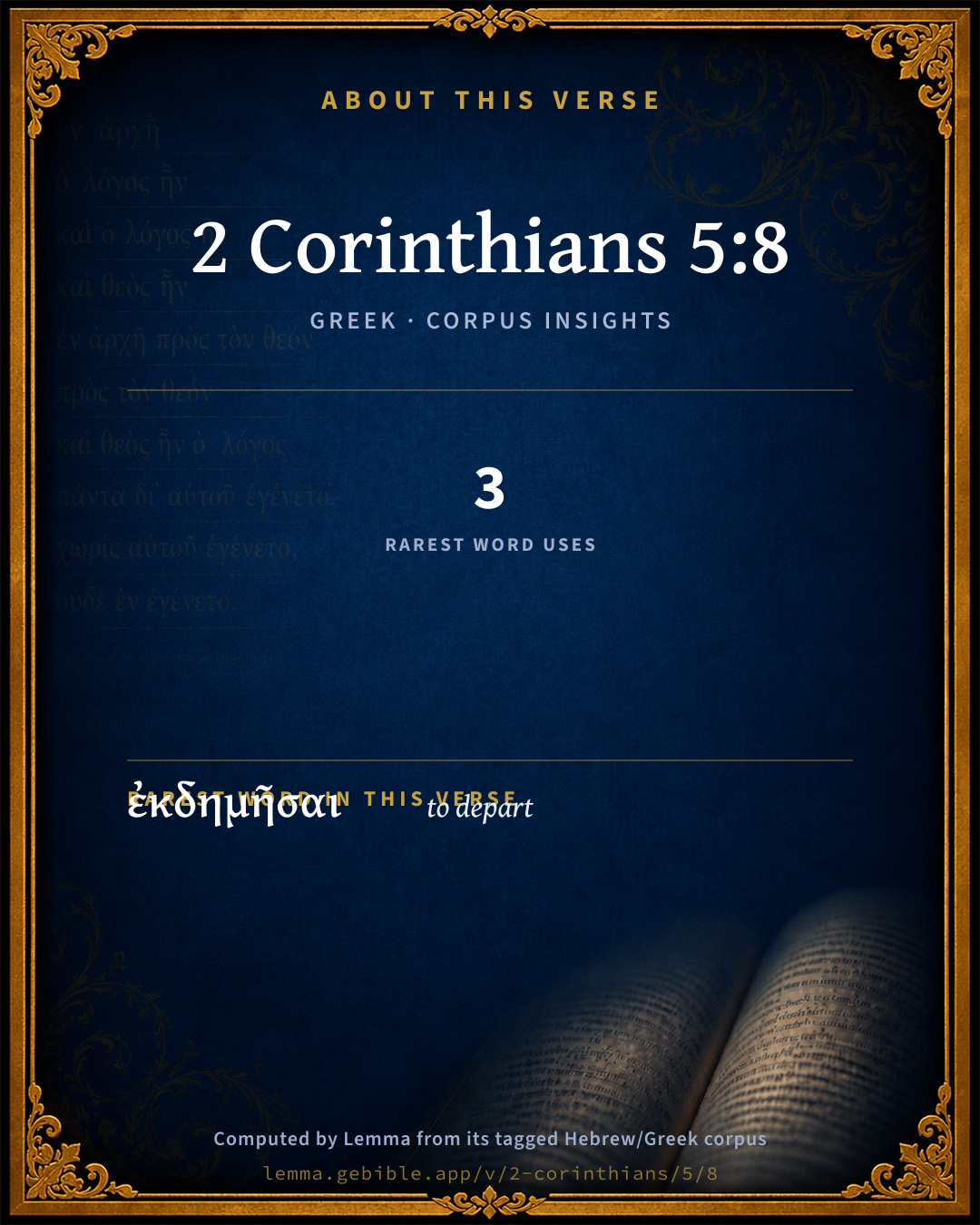
The rarest word here is ἐκδημῆσαι to depart G1553 — appearing just 3 times in the whole Greek New Testament.

Shared distinctive vocabulary

ἐκδημῆσαι to depart G1553 occurs in 3 verses of the Greek New Testament. Also found in:

Repetition

Words recur within this verse:

Cross-references

20

Topical passages linked to 2 Corinthians 5:8 in the Treasury of Scripture Knowledge — connected by theme and wording, ordered by reader-vote popularity; previews shown in the World English Bible.

  • Philippians 1:20–24 according to my earnest expectation and hope, that I will in no way be disappointed, but with all boldness, as always, now also Christ will be magnified in my body, whether by life, or by death.
  • 2 Corinthians 5:6 Being therefore always of good courage, and knowing that, while we are at home in the body, we are absent from the Lord;
  • John 14:3 If I go and prepare a place for you, I will come again, and will receive you to myself; that where I am, you may be there also.
  • 1 John 3:2 Beloved, now we are children of God, and it is not yet revealed what we will be. But we know that, when he is revealed, we will be like him; for we will see him just as he is.
  • 2 Corinthians 12:2–3 I know a man in Christ, fourteen years ago (whether in the body, I don't know, or whether out of the body, I don't know; God knows), such a one caught up into the third heaven.
  • Psalms 16:11 You will show me the path of life. In your presence is fullness of joy. In your right hand there are pleasures forevermore.
  • Psalms 17:15 As for me, I shall see your face in righteousness; I shall be satisfied, when I awake, with seeing your form.
  • Psalms 73:23–26 Nevertheless, I am continually with you. You have held my right hand.
  • 2 Corinthians 5:9 Therefore also we make it our aim, whether at home or absent, to be well pleasing to him.
  • 2 Timothy 4:7–8 I have fought the good fight. I have finished the course. I have kept the faith.
  • John 17:24 Father, I desire that they also whom you have given me be with me where I am, that they may see my glory, which you have given me, for you loved me before the foundation of the world.
  • 1 Thessalonians 4:17–18 then we who are alive, who are left, will be caught up together with them in the clouds, to meet the Lord in the air. So we will be with the Lord forever.
  • 2 Peter 3:11–12 Therefore since all these things are thus to be destroyed, what manner of persons ought you to be in holy living and godliness,
  • Matthew 25:21 "His lord said to him, 'Well done, good and faithful servant. You have been faithful over a few things, I will set you over many things. Enter into the joy of your lord.'
  • Matthew 25:23 "His lord said to him, 'Well done, good and faithful servant. You have been faithful over a few things, I will set you over many things. Enter into the joy of your lord.'
  • Luke 2:29 "Now you are releasing your servant, Master, According to your word, in peace;
  • Revelation 7:14–17 I told him, "My lord, you know." He said to me, "These are those who came out of the great tribulation. They washed their robes, and made them white in the Lamb's blood.
  • Acts 21:13 Then Paul answered, "What are you doing, weeping and breaking my heart? For I am ready not only to be bound, but also to die at Jerusalem for the name of the Lord Jesus."
  • 2 Peter 1:14–15 knowing that the putting off of my tent comes swiftly, even as our Lord Jesus Christ made clear to me.
  • Revelation 22:3 There will be no curse any more. The throne of God and of the Lamb will be in it, and his servants serve him.

Cross-references courtesy of OpenBible.info (CC BY 4.0).

Commentary

Notes on 2 Corinthians 5:8 from classic Christian and Jewish commentators (each source and its license shown beneath its notes). The classic Christian expositions comment on the surrounding passage and are grouped to its opening verse, so a note may address several verses; the Jewish commentaries on the Tanakh (Rashi and others) are per-verse, so they appear only where the commentator wrote on this verse.

Lemma curates 59 commentaries, every one of them public domain or Creative Commons licensed, each selected and text-cleaned for this edition rather than reprinted as found. About our sources →

MacLaren's Expositions of Holy Scripture

Alexander MacLaren

2 Corinthians

THE OLD HOUSE AND THE NEW

2Co 5:8.

There lie in the words of my text simply these two things; the Christian view of what death is, and the Christian temper in which to anticipate it.

I. First, the Christian view of what death is.

Now it is to be observed that, properly speaking, the Apostle is not here referring to the state of the dead, but to the act of dying. The language would more literally and accurately be rendered ‘willing to go from home, from the body, and to go home, to the Lord.’ The moment of transition of course leads to a permanent state, but it is the moment of transition which is in view in the words. I need not remind you, I suppose, that the metaphor of the home is one which has already been dwelt upon in the early part of the chapter, where the contrast is drawn between the transitory house of ‘this tent,’ and the ‘building of God,’ the body of incorruption and glory which the saints at the Resurrection day shall receive. So, then, the Christian view of the act of death is that it is simply a change of abode.

Very clearly and firmly does Paul draw the line between the man and his dwelling-place. Life is more than a result of organisation. Consciousness, thought, feeling, are more than functions of matter. No materialist philosopher has ever been, or ever will be, able to explain within the limits of his system the strange difference between the cause and the effect; how it comes to pass that at the one end of the chain there is an impression upon a nerve, and at the other there is pain; how at the one end there is the throb of an inch of matter in a man’s skull, and at the other end there are thoughts that breathe and words that burn, and that live for ever. That brings us up to the edge of a gulf over which no materialist philosopher has ever been able to cast a bridge. The scalpel cannot cut deep enough to solve this mystery. Conscience as well as instinct cry out against the theory that the worker and the tools are inseparable. For such a theory reduces human actions to mechanical results, and shatters all responsibility. Man is more than his dwelling-place. You crush a shell on the beach with your heel, and you slay its tiny inhabitant. But you can pull down the tent, and pluck up its pegs, and roll up its canvas, and put it away in a dark corner, and the tenant is untouched. The foolish senses crown Death as last, and lord of all. But wisdom says, ‘Life and thought have gone away side by side, leaving doors and windows wide,’ and that is all that has happened.

Still further, my text suggests that to the Christian soul the departure from the one house is the entrance into the other. The home has been the body; the home is now to be Jesus Christ. And very beautiful and significant with meanings, which only experience will fully unfold, is the representation that the Lord Christ Himself assumes the place which the bodily environment has hitherto held.

That teaches us, at all events, that there is a new depth and closeness of union with Jesus waiting the Christian soul, when it lays aside the separating film of flesh. Here the bodily organisation, with its limitations, necessarily shuts us off from the closeness of intercourse which is possible for a naked soul. We know not how much separation may depend upon the immersing of the spirit in the fleshly tabernacle, but this we know, that, though here and now, by faith which dominates sense, souls can live in Christ even whilst they live in the body; yet there shall come a form of union so much more close, intimate, all-pervading, and all-encircling, as that the present union with Him by faith, precious as it is, shall be, as the Apostle calls it in our context, ‘absence from the Lord.’ ‘We have to be discharged,’ says an old thinker, ‘of a great deal of what we call body, and then we shall be more truly ourselves,’ and more truly united to Him who, if we are Christian people at all, is the self of ourselves and the life of our lives. No man knows how close he can nestle to the bosom of Christ when the film of flesh is rent away. Just as when in some crowded street of a great city some grimy building is pulled down, a sudden daylight fills the vacant space, and all the site that had been shut out from the sky for many years is drenched in sunshine, so when ‘the earthly house of this tabernacle’ is ruinated and falls, the light will flood the place where it stood, and to be ‘absent from the body’ shall be to be ‘present with the Lord.’

May we go a step further and suggest that, perhaps, in the bold metaphor of my text, there is an answer to the questions which so often rack loving and parted hearts? ‘Do the dead know aught of what affects us here? and can they do aught but gaze on Him, and love, and rest?’ If it be that there is any such analogy as seems to be dimly shadowed in my text, between the relation of the body on earth to the spirit that inhabits it, and that of Jesus Christ to him who dwells in Him, and is clothed by Him, then it may be that, as the flesh, so the Christ transmits to the spirit that has Him for its home impressions from the outside world, and affords a means of action upon that world. Christ may be, if I might so say, the sensorium of the disembodied spirit; and Christ may be the hand of the man who hath no other instrument by which to express himself. But all that is fancy perhaps, speculation certainly; and yet there seems to be a shadow of a foundation for at least entertaining the possibility of such a thought as that Jesus is the means of knowing and the means of acting to those who rest from their labours in Him, and dwell in peace in His arms. But be that as it may, the reality of a close communion and encircling by the felt presence of Jesus Christ, which, in its blessed closeness, will make the closest communion here seem to be obscure, is certainly declared in the words before us.

Then this transition is regarded in my text as being the work of a moment. It is not a long journey of which the beginning is ‘to go from home, from the body,’ and the end is ‘to go home, to the Lord.’ But it is one and the same motion which, looked at from the one side, is departure, and looked at from the other is arrival. The old saying has it, ‘there is but a step between me and death.’ The truth is, there is but a step between me and life. The mighty angel in the Apocalypse, that stood with one foot on the firm land and the other on the boundless ocean, is but the type of the spirit in the brief moment of transition, when the consciousness of two worlds blends, and it is clothed upon with the house which is from heaven, in the very act of stripping off the earthly house of this tabernacle.

Nor need I remind you, I suppose, in more than a sentence, that this transition obviously leads into a state of conscious communion with Jesus Christ. The dreary figment of an unconscious interval for the disembodied spirit has no foundation, either in what we know of spirit, or in what is revealed to us in Scripture. For the one thing that seems to make it probable-the use of that metaphor of ‘sleeping in Jesus’-is quite sufficiently accounted for by the notions of repose, and cessation of outward activity, and withdrawal of capacity of being influenced by the so-called realities of this lower world, without dragging in the unfounded notion of unconsciousness. My text is incompatible with it, for it is absurd to say of an unconscious spirit, clear of a bodily environment, that it is anywhere; and there is no intelligible sense in which the condition of such a spirit can be called being ‘with the Lord.’

So, then, I think a momentary transition, with uninterrupted consciousness, which leads to a far deeper and more wonderful and blessed sense of unity with Jesus Christ than is possible here on earth, is the true shape in which the act of death presents itself to the Christian thinker.

And remember, dear brethren, that is all we know. Nothing else is certain-nothing but this, ‘with the Lord,’ and the resulting certainty that therefore it is well with them. It is enough for our faith, for our comfort, for our patient waiting. They live in Christ, ‘and there we find them worthier to be loved,’ and certainly lapped in a deeper rest. ‘Blessed are the dead that die in the Lord.’

II. In the next place, note the Christian temper in which to anticipate the transition.

‘We are always courageous, and willing rather to leave our home in the body, and to go home to the Lord.’ Now I must briefly remind you of how the Apostle comes to this state of feeling. He has been speaking about the natural shrinking, which belongs to all humanity, from the act of dissolution, considered as being the stripping off of the garment of the flesh. And he has declared, on behalf of himself and the early Christian Church, his own and their personal desire that they might escape from that trial by the path which seemed possible to the early Christians-viz. that of surviving until the return of Jesus Christ from Heaven, when they would be ‘clothed upon with the house which is from Heaven,’ without the necessity of stripping off that with which at present they are invested. Then he says-and this is a very remarkable thought-that just because this instinctive shrinking from death and yearning for the glorified body is so strong in the Christian heart, that is a sign that there is such a glorified body waiting for us. He says, ‘we know that if our house . . . were dissolved, we have a building of God.’ And his reason for knowing it is this, ‘for in this we groan.’ That is a bold position to say that a yearning in the Christian consciousness prophesies its own fulfilment. Our desires are the prophecies of His gifts. Then, on this certainty-which he deduces from the fact of the longing for it-on this certainty of the glorious, ultimate body of the Resurrection he bases his willingness expressed in the text, to go through the unwelcome process of leaving the old house, although he shrinks from it.

So, then, Christian faith does not destroy the natural reluctance to put aside the old companion of our lives. The old house, though it be smoky, dimly lighted, and, by our own careless keeping, sluttish and grimy in many a corner, yet is the only house we have ever known, and to be absent from it is untried and strange. There is nothing wrong in saying ‘we would not be unclothed but clothed upon.’ Nature speaks there. We may reverently entertain the same feelings which our Pattern acknowledged, when He said, ‘I have a baptism to be baptized with, and how am I straitened until it be accomplished.’ And there would be nothing sinful in repeating His prayer with His conditions, ‘If it be possible, let this cup pass from Me.’

But then the text suggests to us the large Christian possessions and hope which counterwork this reluctance, in the measure in which we live lives of faith. There is the assurance of that ultimate home in which all the transiency of the present material organisation is exchanged for the enduring permanence which knows no corruption. The ‘tent’ is swept away to make room for the ‘building.’ The earthly house is dissolved in order that there may be reared round the homeless tenant the house eternal, ‘not made with hands,’ God’s own work, which is waiting in the heavens; because the power that shall frame it is there. Not only that great hope of the ‘body of His glory,’ with which at the last all true souls shall be invested, but furthermore, ‘the earnest of the spirit,’ and the blessed experiences therefrom, resulting even here, ought to make the unwelcome necessity less unwelcome. If the firstfruits be righteousness and peace and joy of the Holy Ghost, what shall the harvest be? If the ‘earnest,’ the shilling given in advance, be so precious, what will the whole wealth of the inheritance which it heralds be when it is received?

For such reasons the transitory passage becomes less painful and unwelcome. Who is there that would hesitate to dip his foot into the ice-cold brook if he knew that it would not reach above his ankles, and that a step would land him in blessedness unimagined till experienced?

Therefore the Christian temper is that of quiet willingness and constant courage. There is nothing hysterical here, nothing morbid, nothing overstrained, nothing artificial. The Apostle says: ‘I would rather not. I should like if I could escape it. It is an unwelcome necessity; but when I see what I do see beyond,’ I am ready. Since so it must be, I will go, not reluctantly, nor dragged away from life, nor clinging desperately to it as it slips from my hands, nor dreading anything that may happen beyond; but always courageous, and prepared to go whithersoever the path may take me, since I am sure that it ends in His bosom. He is willing to go from the home of the body, because to do that is to go home to Christ.

There are other references of our Apostle’s, substantially of the same tone as that of my text, but with very beautiful and encouraging differences. When he was nearer his end, when it seemed to him as if the headsman’s block was not very far off, his willingness had intensified into ‘having a desire to depart and to be with Christ, which is far better.’ And when the end was all but reached, and he knew that death was waiting just round the next turn in the road, he said, with the confidence that in the midst of the struggle would have been vainglory, but at the end of it was a foretaste of the calm of Heaven, ‘I have finished my course, I have kept the faith; henceforth there is laid up for me a crown of righteousness.’ That is our model, dear brethren,-’always courageous,’ afraid of nothing in life, in death, or beyond, and therefore willing to go from home from the body and to go home to the Lord.

Think of this man thus fronting the inevitable, with no excitement and with no delusions. Remember what Paul believed about death, about sin, about his own sin, about judgment, about hell. And then think of how to him death had made its darkness beautiful with the light of Christ’s face, and all the terror was gone out of it. Do you think so about death? Do you shrink from it? Why? Why do you not take Paul’s cure for the shrinking? If you can say, ‘To me to live is Christ,’ you will have no difficulty in saying, ‘and to die is gain.’ That is the only way by which you can come to such a temper, and then you will be willing to move from the cottage to the palace, and to wait in peace till you are shifted again into ‘the building of God, the house not made with hands, eternal in the heavens.’

Alexander MacLaren, Expositions of Holy Scripture (1904–1910) — public domain. Text from a community e-Sword module.

Bengel's Gnomon

Johann Albrecht Bengel

2Co 5:8. Δὲ, indeed) An epitasis [Repetition of a previous enunciation with some strengthening word added; Append.]; comp. 2Co 5:6, note.—εὐδοκοῦμεν) we have so determined [we regard it as a fixed thing], that it will be well-pleasing to us.—ἐνδημῆσαι, to go home) 2Co 5:6, note.—πρὸς τὸν Κυρίον, to the Lord) Php 1:23.

Bengel's Gnomon of the New Testament — English translation (T&T Clark, Edinburgh, 1860) — public domain. Text from a community e-Sword module.

Meyer's Critical & Exegetical Commentary

Heinrich August Wilhelm Meyer

2Co_5:8. But we have good courage and are well pleased, etc. With this Paul resumes the thought of 2Co_5:6, and carries it on, yet without keeping to the construction there begun. The idea of the θαῤῥοῦμεν must in this resumption be the same as that of the θαῤῥοῦντες in 2Co_5:6, namely, the idea of confident courage in suffering. This in opposition to Hofmann, who takes θαῤῥοῦντες rightly of courage in suffering, but θαῤῥοῦμεν of courage in death, making the infinitive ἐκδημῆσαι depend also on θαῤῥοῦμεν (see below).

δέ, no doubt, links on again the discourse interrupted by the parenthesis (Hermann, ad Viger. p. 847; Pflugk, ad Eurip. Hec. 1211; Fritzsche, Diss. II. p. 21), which may also happen, where no δέ has preceded (Klotz, ad Devar. p. 377); since, however, θαῤῥοῦντες is not repeated here, we must suppose that Paul has quite dropped the plan of the discourse begun in 2Co_5:6 and broken off by 2Co_5:7, and returns by the way of contrast to what was said in 2Co_5:6. Accordingly there occurs an adversative reference to the previous διὰ πιστ. περιπατοῦμεν, οὐ διὰ εἴδους, in so far as this state of things as to the course of his temporal life does not make the apostle at all discontented and discouraged, but, on the contrary, leaves his θαῤῥεῖν, already expressed in 2Co_5:6, quite untouched, and makes his desire tend rather towards being from home, etc. Comp. Hartung, I. p. 173. 2; Klotz, l.c. Thus there is a logical reason why Paul has not written οὖν. Comp. on Eph_2:4.

εὐδοκεῖν in the sense of being pleased, of placet mihi, comp. 1Co_1:21; Gal_1:15; Col_1:19; 1Th_2:8; Fritzsche, ad Rom. II. p. 370.

ἐκδημῆσαι ἐκ τοῦ σώματος] to be-from-home out of the body, is not to be understood of the change at the Parousia (Kaeuffer, ζωὴ αἰών., p. 80 f.), but, in accordance with the context, must be the opposite of ἐνδημοῦντες ἐν τῷ σώματι, 2Co_5:6; consequently in substance not different from ἐκδύσασθαι, 2Co_5:4. Hence the only right interpretation is the usual one of dying, in consequence of which we are-from-home out of the body. Comp. Php_1:23; Plato, Phaed. p. 67, B, C. The infinitive is dependent only on εὐδοκοῦμεν, not also on θαῤῥοῦμεν (Hofmann), since θαῤῥεῖν with the infinitive means to venture something, to undertake to do something, which would not suit here (comp. Xen. Cyr. viii. 8. 6; Herodian. ii. 10. 13),even apart from the fact that this use of θαῤῥεῖν (equivalent to τολμᾶν) is foreign to the N. T. and rare even among Greek writers. The εὐδοκοῦμεν κ.τ.λ. is something greater than the θαῤῥοῦμεν. This passage stands to 2Co_5:4, where Paul has expressed the desire not to die but to be transformed alive, in the relation not of contradiction, but of climax; the shrinking from the process of dying is, through the consideration contained in 2Co_5:5 and in the feeling of the courage which it gives (2Co_5:6), now overcome, and in place of it there has now come the inclination rather (μᾶλλον) to see the present relation of ἐνδημεῖν ἐν τῷ σώματι and ἐκδημεῖν ἀπὸ τοῦ κυρίου (2Co_5:6) reversed, rather,[218] therefore, ἐκδημῆσαι ἐκ τοῦ σώματος καὶ ἐνδημῆσαι πρὸς τὸν κύριον, which will take place through death, if this should be appointed to him in his apostolic conflicts and sufferings (2Co_4:7 ff.), for in that case his spirit, having migrated from his body, will not, separated from Christ, come into Hades, but will be at home with the Lord in heavena state the blessedness of which will later, at the day of the Parousia, receive the consummation of glory. The certainty of coming by martyrdom into heaven to Christ is consequently not to be regarded as a certainty only apprehended subsequently by Paul. See Php_1:26, Remark.

[218] μᾶλλον therefore belongs neither to εὐδοκοῦμεν nor to θαῤῥ. κ. εὐδοκ., as if Paul would say that he has this courage still more than that meant in ver. 6 (Hofmann), but to ἐκδημῆσαι … κύριον. We wish that, instead of the present home in the body, etc., there may rather (potius) set in the being-from-home out of the body and the being-at-home with the Lord. This rather no more yields an awkward idea here (as Hofmann objects) than it does in all other passages where it is said that one wills, ought to do, or does, instead of one thing rather the other. Comp. e.g. 1Co_5:2; 1Co_6:7; Rom_14:13; Joh_3:19.

Meyer — Critical and Exegetical Commentary on the New Testament — English translation by Peter Christie, edited by Frederick Crombie (T&T Clark, 1880) — public domain. Text from a community e-Sword module.

Expositor's Greek Testament

ed. W. Robertson Nicoll

2Co 5:8 . θαρροῦμεν δὲ κ . τ . λ .: nay (the δέ is resumptive of the thought in 2Co 5:6 , which has been interrupted by 2Co 5:7 , the grammatical structure involving an anacoluthon), we are of good courage (for this is demanded even of the most faithful by the prospect of death) and are well-pleased (see reff. for cases where εὐδοκεῖν is used of men, not of God) rather to be away from the home of the body and to be at home with the Lord ( cf. Joh 1:1 for such a use of πρός ). Even if we must die before the Second Advent, we would say, we are content, for this absence from the body will be presence with Christ ( cf Luk 23:43 , Phi 1:21-23 ), though the glory of that Presence shall not be fully manifested until the Day of the Parousia.

The Expositor's Greek Testament, edited by W. Robertson Nicoll (1897–1910) — public domain. Text from a community e-Sword module.

Geneva Bible (1599)

Geneva Bible translators

And yet we are in such sort bold and do so pass on our pilgrimage with a valiant and quiet mind, that yet notwithstanding, we had rather depart hence to the Lord.

Geneva Bible (1599) marginal notes — public domain. Text via Bolls.life.

Jamieson, Fausset & Brown

Robert Jamieson, A. R. Fausset & David Brown

willing--literally, "well content." Translate also, "To go (literally, migrate) from our home in the body, and to come to our home with the Lord." We should prefer to be found alive at the Lord's coming, and to be clothed upon with our heavenly body (Co2 5:2-4). But feeling, as we do, the sojourn in the body to be a separation from our true home "with the Lord," we prefer even dissolution by death, so that in the intermediate disembodied state we may go to be "with the Lord" (Phi 1:23). "To be with Christ" (the disembodied state) is distinguished from Christ's coming to take us to be with Him in soul and body (Th1 4:14-17, "with the Lord"). Perhaps the disembodied spirits of believers have fulness of communion with Christ unseen; but not the mutual recognition of one another, until clothed with their visible bodies at the resurrection (compare Th1 4:13-17), when they shall with joy recognize Christ's image in each other perfect.

Jamieson, Fausset & Brown — Commentary Critical and Explanatory on the Whole Bible (1871) — public domain (CC PDM 1.0). Text via the HelloAO Bible API.

Adam Clarke's Commentary

Verse 8. We are confident] We are of good courage, notwithstanding our many difficulties; because we have this earnest of the Spirit, and the unfailing testimony of God. And notwithstanding this, we are willing rather to be absent from the body-we certainly prefer a state of glory to a state of suffering, and the enjoyment of the beatific vision to even the anticipation of it by faith and hope; but, as Christians, we cannot desire to die before our time.

Adam Clarke's Commentary on the Bible (1810–1826) — public domain. Text from a community e-Sword/MySword module.

John Calvin's Commentaries

8. We are confident, I say He again repeats, what he had said respecting the confidence of the pious — that they are so far from breaking down under the severity of the cross, and from being disheartened by afflictions, that they are made thereby more courageous. For the worst of evils is death, yet believers long to attain it, as being the commencement of perfect blessedness. Hence and may be regarded as equivalent to because, in this way: “Nothing can befall us, that can shake our confidence and courage, since death (which others so much dread) is to us great gain. (Philippians 1:21.) For nothing is better than to quit the body, that we may attain near intercourse with God, and may truly and openly enjoy his presence. Hence by the decay of the body we lose nothing that belongs to us.”

Observe here — what has been once stated already — that true faith begets not merely a contempt of death, but even a desire for it, and that it is, accordingly, on the other hand, a token of unbelief, when dread of death predominates in us above the joy and consolation of hope. Believers, however, desire death — not as if they would, by an importunate desire, anticipate their Lord’s day, for they willingly retain their footing in their earthly station, so long as their Lord may see good, for they would rather live to the glory of Christ than die to themselves, (Romans 14:7,) and for their own advantage; for the desire, of which Paul speaks, springs from faith. Hence it is not at all at variance with the will of God. We may, also, gather from these words of Paul, that souls, when released from the body, live in the presence of God, for if, on being absent from the body, they have God present, they assuredly live with him.

Here it is asked by some — “How then did it happen that the holy fathers dreaded death so much, as for example David, Hezekiah, and the whole of the Israelitish Church, as appears from Psalm 4, from Isaiah 38:3, and from Psalm 115:17?” I am aware of the answer, that is usually returned — that the reason, why death was so much dreaded by them was, that the revelation of the future life was as yet obscure, and the consolation, consequently, was but small. Now I acknowledge, that this, in part, accounts for it, but not entirely, for the holy fathers of the ancient Church did not in every case tremble, on being forewarned of their death. Nay more, they embraced death with alacrity, and with joyful hearts. For Abraham departed without regret, full of days. (Genesis 25:8.) We do not read that Isaac was reluctant to die. (Genesis 35:29.) Jacob, with his last breath, declares that he is

waiting for the salvation of the Lord. (Genesis 49:18.)

David himself, too, dies peacefully, without any regrets, (1 Kings 2:10,) and in like manner Hezekiah. As to the circumstance, that David and Hezekiah did, each of them, on one occasion deprecate death with tears, the reason was, that they were punished by the Lord for certain sins, and, in consequence of this, they felt the anger of the Lord in death. Such was the cause of their alarm, and this believers might feel even at this day, under the reign of Christ. The desire, however, of which Paul speaks, is the disposition of a well-regulated mind.

John Calvin's Commentaries (1540-1563) — public domain. Text from the Calvin Translation Society English edition (1840s-50s) via the Christian Classics Ethereal Library (ccel.org). Calvin's coverage is partial (roughly two-thirds of the Bible); uncommented books and verses are honest gaps, never fabricated. The 19th-century editor's footnotes and remarks are omitted so the notes are faithfully Calvin's own voice.

Ellicott's Commentary for English Readers

(8) We are confident, I say.—The sentence begun in 2Co_5:6 and half broken off is resumed. The apparent sense is that he prefers death to life, because it brings him to the presence of his Lord. At first, this seems at variance with what he had said in 2Co_5:4, as to his not wishing to put off the garment of the present body. Here, however, the expression is not so strong. “We are content,” he says, “if death comes before the Coming of the Lord, to accept death; for even though it does not bring with it the glory of the resurrection body, it does make us at home with Christ among the souls who wait for the resurrection.” If there still seems to us some shadow of inconsistency, we may look upon it as the all but inevitable outcome of the state which he describes in Php_1:21-25, as “in a strait between two,” and of the form of life in which he now finds himself. The whole passage presents a striking parallelism, and should be compared with this. This is, it is believed, an adequate explanation. Another may, however, be suggested. We find the Apostle speaking of certain “visions and revelations of the Lord,” of which he says he knows not whether they are “in the body or out of the body” (2Co_12:1). May we not think of him as referring here also to a like experience? “We take pleasure,” he says, if we adopt this interpretation, wholly or in part, “even here, in that state which takes us, as it were, out of the body, or seems to do so, because it is in that state that our eyes are open to gaze more clearly on the unseen glories of the eternal world.” The fact that both verbs are in the tense which indicates a single act, and not a continuous state, is, as far as it goes, in favour of this explanation.

A Bible Commentary for English Readers, edited by Charles John Ellicott (1878–1897) — public domain. Text from a community e-Sword module.

The Cambridge Bible for Schools and Colleges

gen. ed. J. J. S. Perowne

8. we are confident, I say, and willing rather to be absent from the body, and to be present with the Lord] Our confidence is not even disturbed by death, though it is not (2Co_5:4) death in itself that we seek. But even in death we ‘sleep in Jesus’ (1Th_4:14; cf. 1Co_15:18), and though removed from our earthly tenement we are still at home with God. Cf. also Luk_23:43. The word translated ‘present’ here is translated ‘at home’ in 2Co_5:6, a variation which commenced with Tyndale. He returns however to ‘at home’ in the next verse.

The Cambridge Bible for Schools and Colleges (gen. ed. J. J. S. Perowne; Cambridge University Press, 1878–1918) — public domain. Text from a community e-Sword module.

John Gill's Exposition

Wherefore we labour, that whether present or absent,.... This may be understood either of the ministers of the Gospel in particular, who labour in the word and doctrine, are ambitious, as the word here used signifies, and strive to preach the Gospel, not to please men, but their Lord and master; or of saints in general, who are intent upon this, and whose highest ambition is, that whether living or dying they

may be accepted of him; both persons and services: such who are born again, who are believers in Christ, and truly love him, are earnestly desirous of doing those things which are pleasing to him; and do in the strength of Christ endeavour to perform them. Faith is a diligent, industrious, and operative grace, and makes persons like itself. As none ought to be, so none are more careful to perform good works, or more ambitious to excel others in them, and thereby please their Lord, than believers. And these are the only persons that can please him, for without faith it is impossible to please him; for these act from a principle of love to him, and with a view to his glory; and may they be but accepted of him, living and dying, both in this and the other world, they have the highest favour they can wish for and desire.

John Gill's Exposition of the Whole Bible (1746–1763) — public domain (CC PDM 1.0). Text via the HelloAO Bible API.

Trapp's Complete Commentary

John Trapp

8 We are confident, I say, and willing rather to be absent from the body, and to be present with the Lord.

Ver. 8. And willing rather] Death is not to be desired as a punishment of sin, but as a period of sin; not as a postern gate to let out our temporal, but as a street door to let in eternal life.

To be present with the Lord] This Bernard calleth Repatriasse. Plotinus the philosopher could say when he died, that which is divine in me I carry back, επι το πρωτογονον θειον, to the original divine, that is, to God. (Synes. Eph 139.) But whether this man believed himself or not, I greatly doubt.

John Trapp, A Commentary or Exposition upon All the Books of the Old and New Testament (1647–1656) — public domain. Text from a community e-Sword module.

Albert Barnes' Notes on the Bible

We are confident - 2Co 5:6. We are cheerful, and courageous, and ready to bear our trial. Tyndale renders it: “we are of good comfort.”

And willing rather to be absent from the body - We would prefer to die. The same idea occurs in Phi 1:23. “Having a desire to depart and to be with Christ; which is far better.” The sense is, that Paul would have preferred to die, and to go to heaven; rather than to remain in a world of sin and trial.

To be present with the Lord - The Lord Jesus; see the note on Act 1:24; compare Phi 1:23. The idea of Paul is, that the Lord Jesus would constitute the main glory of heaven, and that to be with him was equivalent to being in a place of perfect bliss. He had no idea of any heaven where the Lord Jesus was not; and to be with him was to be in heaven. That world where the Redeemer is, is heaven. This also proves that the spirits of the saints, when they depart, are with the Redeemer; that is, are at once taken to heaven. It demonstrates:

That they are not annihilated.

(2)That they do not sleep, and remain in an unconscious state, as Dr. Priestley supposes.

(3)That they are not in some intermediate state, either in a state of purgatory, as the Papists suppose, or a state where all the souls of the just and the unjust are assembled in a common abode, as many Protestants have supposed; but,

That they dwell with Christ; they are with the Lord (πρὸς τὸν Κυρίον pros ton Kurion). They abide in his presence; they partake of his joy and his glory; they are permitted to sit with him in his throne; Rev 3:21.

The same idea the Saviour expressed to the dying thief, when he said, “today shalt thou be with me in paradise;” Luk 23:43.

Albert Barnes' Notes on the Bible (1834–1885) — public domain. Text from a community e-Sword/MySword module.

Matthew Poole's English Annotations

We are confident of such a blessed state, and this makes us willing to be out of this body, that we might have the glorious presence and enjoyment of God to all eternity.

Matthew Poole's English Annotations on the Holy Bible (1683–1685) — public domain. Text from a community e-Sword/MySword module.

Whedon's Commentary on the Bible

Daniel D. Whedon

8. Are confident—Free from disheartening misgivings.

Rather—The whole passage is an important exhibit of Paul’s view: 1. Of the soul, as being an independent entity, the central personality; 2. Of the need of the body to the wholeness and unity of the human person; 3. Of the real existence of an intermediate conscious state of the soul between death and resurrection; 4. Of the superior happiness of that disembodied state to our present state in the body, yet of its inferior happiness to the resurrection glory; and, 5. That a main element of the happiness of that intermediate state is the attainment of some association with Christ.

Daniel D. Whedon (gen. ed.), Commentary on the Old and New Testaments (1874–1909) — public domain. Text from a community e-Sword module.

The Pulpit Commentary

To be absent, etc.; literally, to be away from the home of the body, but to be at home with the Lord. To be present with the Lord. The hope expressed is exactly the same as in Php_1:23, except that here (as in ver. 4) he expresses a desire not "to depart," but to be quit of the body without the necessity for death.

Vers. 8-10.

The philosophy of courage.

are confident, I say," etc. Paul says we are courageous, or of good courage. Courage is often confounded with recklessness of life, a brutal insensibility to danger. True course always implies two things.

1. The existence of unavoidable dangers. He who rushes into danger is not courageous, but reckless. Paul had unavoidable dangers: "We are troubled on every side.

2. True convictions of being. Ignorance of existence may make men reckless, but never courageous. What was Paul"s view of life?

(1) He regarded the body as the organ of himself. He speaks of it as a "house," a "tabernacle," etc.

(2) The soul he regards as the personality of his being. "We that are in this tabernacle," etc. The soul, not the body, is the "I," or self.

(3) He regarded death as a mere change in the mode of his being. Death changes the house and the garment; it is not the extinction of the tenant or the wearer.

(4) He regarded heaven as the perfection of his being. "The house not made with hands, eternal in the heavens." The courage of which the apostle here speaks seems to have been based on three things.

I A consciousness that his death would not ENDANGER THE INTERESTS of his being. Notice:

1. His view of the interests of being. It was being "present with the Lord.

2. His view of the bearing of death upon the interests of being. Heregarded it as the flight of the spirit into the presence of the Lord. "Absent from the body, present with the Lord." A view of death this antagonistic to the ideas of purgatory, annihilation, soul sleep.

3. His state of mind under the influence of these thoughts. "Willing ratherto be absent from the body.

II A consciousness that death would not DESTROY THE GREAT PURPOSES of being. It is the characteristic of a rational being that he has some purpose in life the purpose is that in which he lives, it makes life valuable to him. To a man who has no purpose in life or has lost his purpose, life is deemed of little worth. What was Paul"s purpose in life? "Wherefore we labour, that, whether present or absent, we may be accepted of him." Is not this purpose sublimely reasonable? If there be a God, does not reason teach that to please him should be the supreme purpose of all intelligent creatures? Now, Paul felt that death would not destroy this purpose. It destroys the purpose of the voluptuous, avaricious, etc.; and hence to them it is terrible. But it does not destroy the chief purpose of the Christian. In all worlds and times his chief purpose will be to be "accepted of him.

III A consciousness that death would not PREVENT THE REWARDS of being. "We must all appear or, "be made manifest" before the judgment seat of Christ." Success, while it should never be regarded either as a rule of conduct or a test of character, must ever have an influence on the mind of man in every department of labour. Non-success discourages. Paul felt that his labour hero would appear and be recognized hereafter. "We must all appear," etc.

1. Every one shall receive the recompense of labour after death. "Must allappear." None absent.

2. Every one shall receive a reward forevery deed. "That every one may receive the things done in his body." No lost labour. With this consciousness we may well be courageous amidst all the dangers here and in view of the great hereafter. Dread of death is a disgrace to the Christian. "If," says Cicero, "I were now disengaged from my cumbrous body, and on my way to Elysium; and some superior being should meet me in my flight and make me the offer of returning and remaining in my body, I should, without hesitation, reject the offer; so much should I prefer going into Elysium to be with Socrates and Plato and all the ancient worthies, and to spend my time in converse with them." How much more should the Christian desire to be "absent from the body, and present with the Lord"!

The Pulpit Commentary (1880–1919), ed. H.D.M. Spence-Jones & Joseph S. Exell — public domain. Text from a community e-Sword module.

John Wesley's Explanatory Notes

Present with the Lord - This demonstrates that the happiness of the saints is not deferred till the resurrection.

John Wesley, Explanatory Notes Upon the Whole Bible (1754–1765) — public domain. Text via the GEBible commentary corpus.

Burkitt's Expository Notes on the New Testament

William Burkitt

The original words, for we are confident and willing, denote first, courage and undaunted boldness with respect to death, and complacency and satifaction in it. We are willing; the translation is too flat; evdoxdmev, we are well pleased. It is a grateful and desirable thing to us to leave the body: yet not in an absolute, but comparative consideration. We are willing rather; that is, rather than not see and enjoy the Lord, rather than be always here sinning and groaning, we had rather be absent from the body, and present with the Lord.

Learn, 1. That our happiness in the world to come lies in our being present with the Lord.

2. That we are present with the Lord as soon as the soul quits and takes its leave and farewell of the body.

3. That a state of separation from the body is much more preferable to the saints than that of dwelling in the body.

4. That this desire, preference, and choice, arises from that confident assurance which they have of a better state, and of their interest in it; We are confident, I say, &c.

William Burkitt's Expository Notes on the New Testament (1700–1703) — public domain. Text from a community e-Sword module.

McGarvey & Pendleton's Commentaries

J. W. McGarvey

we are of good courage, I say, and are willing rather to be absent from the body, and to be at home with the Lord . [The soul has two homes, a bodily and a spiritual, and the latter is preferable; but the latter is not attained before the resurrection day. In the state between death and resurrection, of which Paul speaks in 2Co_5:4 ; the spirit is with Christ, as we are here informed. Though Christ is with us now while we are in the flesh, yet we walk by faith and have no perception of him. After death we have a spiritual perception of his presence, as Paul's language indicates; but it is only at the resurrection, when we are fully incorporated in our spiritual body, that we shall see him as he is ( 1Jo_3:2 ), and know as we are known ( 1Co_13:12 ). The disembodied state, though inferior in happiness to the resurrection glory, is yet preferable to our present state. Though such a condition may be lower than the highest heaven, yet it is "home" and "with the Lord."]

J. W. McGarvey (with Philip Y. Pendleton), Commentaries on the New Testament (The Fourfold Gospel, 1914; Acts; and the epistles) — public domain. Text from a community e-Sword/MySword module.

The People's New Testament

B. W. Johnson

8. We are confident. In the face of every peril, because we know that death, an absence from the body, would be to be present with the Lord. Note here the doctrine of the immaterial nature of the human spirit. It puts aside the body to be clothed with a new garment. It is absent from the body but present with the Lord. The body is not essential to its conscious existence. It does not sleep because the body sleeps. To Paul, death meant to be present at once with Christ, leaving the body behind.

He labored (verse 9) so that, whether present in the body or absent from it, he might be accepted with Christ.

B. W. Johnson's The People's New Testament with Notes (1889–1891) — public domain. Electronic text from the Christian Classics Ethereal Library (CCEL) ThML edition.

Cambridge Greek Testament for Schools and Colleges

8. The δέ marks the resumption of θαρροῦντες in θαρροῦμεν, and this is well rendered by ‘I say’ (A.V.).

εὐδοκοῦμεν. Are well pleased (2Co 12:10; Mat 3:17; Mat 12:18; Mat 17:5; Luk 12:32; 1Co 1:21; &c.): stronger than θέλομεν. The Apostle is more than willing to migrate out of the body; which shows that though there may be natural awe, there is no fear of death in 2Co 5:4. As at a later period (Php 1:20-25), he is ‘in a strait betwixt the two.’ For some reasons he would like to remain alive; for others he would prefer to depart. But the reasons for wishing to remain have changed. Here it is for his own sake that he desires not to die: he believes that the Lord will come soon, and he longs to see Him without dying. There it is for the sake of the Philippians that he desires to remain alive: they can ill do without him. Probably, when he wrote to them, he was less confident that Christ would come soon, and therefore had ceased for this reason to wish to live longer. In both cases the reason for his desire to migrate from the body is that he may come home to the Lord. Comp. Cic. Tusc. I. 41. 98.

Cambridge Greek Testament for Schools and Colleges (Cambridge University Press, 1896; 21 vols, various authors incl. Carr, Maclear, Plummer, Farrar, Lumby, Moule, M. R. James, Simcox) — public domain. Text from a community e-Sword module.

International Critical Commentary

8. θαρροῦμεν δὲ καὶ εὐδοκοῦμεν. After the parenthetical explanation in v. 7 the θαρροῦντες of v. 6. is taken up again by the δέ, for which ‘I say’ (AV, RV) is a good equivalent. Without the injected explanation the sentence would have run θαρροῦντες … εὐδοκοῦμεν, but in his emotion at the thought the Apostle forgets the original construction and resumes with θαρροῦμεν καὶ εὐδοκοῦμεν, ‘we are confident and are well pleased.’ The emphatic word, as is shown in both places by its position and here by its repetition, is θαρρεῖν. It takes the place of στενάζειν in vv. 4 and 6. The thought which there suggested sighing and groaning, now that it is further considered, suggests confidence. Even the possibility of being left γυμνός for a time loses its terrors, when it is remembered that getting away from the temporary shelter furnished by the body means getting home to closer converse with the Lord.† The change from presents (ἐνδημοῦντες, ἐκδημοῦμεν) to aorists (ἐκδημῆσαι, ἐνδημῆσαι) must be observed, and the force of the aorists may be expressed by ‘getting.’ With ἐκδημῆσαι comp. ‘He has got away,’ which in the North of England is a common expression for ‘He is dead’; and with ἐνδημῆσαι comp. the German heimgegangen.

εὐδοκοῦμεν. ‘We are well pleased, ’ as both AV and RV in Mat 3:17, Mat 3:12:18, Mat 3:17:5; Mar 1:11; Luk 3:22; 1Co 10:5; 2Pe 1:17; and as RV. in 1Th 2:8. The verb is used both of God and of men. When used of men (12:10; Rom 15:26, Rom 15:27; 1Th 2:8, 1Th 2:3:1; 2Th 2:12), it expresses hearty goodwill and perfect contentment, and it is often used of giving consent, especially in legal transactions. This goodwill and contentment is not quite the same as θέλομεν (v. 4) or ἐπιπθοῦντες (v. 2). It is possible to long for one thing, and yet be content with, or even prefer, another, because one knows that the latter is well worth having, and perhaps better for one. St Paul longed to have a spiritual body, in exchange for his material body, without dying: but rather than remain in his material body he was quite ready to die. It was better to see the Lord than to be deprived of this bliss through being in the body: and to be sure of seeing Him robbed death of its terrors. Comp. Proinde intrepidus horam illam decretoriam prospice: non est animo suprema, sed corpori. Quidquid circa te jacet rerum, tanquam hospitalis loci sarcinas specta: transeundum est. Detrahetur tibi haec circumjecta, novissimum velamentum tui cutis: detrahetur caro et suffusus sanguis. Dies iste, quem tanquam extremum reformidas aeterni natalis est (Seneca, Ep. ciii. 24, 25).

Perhaps in no other case is the caprice of the Vulg. so conspicuous as in the translation of εὐδοκεῖν. The verb occurs fifteen times in the Epistles, and it is translated in ten different ways;— bonam voluntatem habemus (here), placeo mihi (12:10), placuit with a dat. (1Co 1:21; Rom 15:27; Gal 1:15; 1Th 3:1; Heb 10:6, Heb 10:38), beneplacitum est Deo (1Co 10:5), probaverunt (Rom 15:26), complacuit (Col 1:19), cupide volebamus (1Th 2:8), consensuerunt (2Th 2:12), placita sunt tibi (Heb 10:8), mihi complacui (2Pe 1:17). And in this case the Gospels are not more uniform than the Epistles. The verb occurs six times in them, and it is translated in five different ways, three of which differ from all the renderings in the Epistles; mihi complacui (Mat 3:17), bene placuit animae meae (Mat 12:18), mihi bene complacui (Mat 17:5), complacui (Mar 1:11), complacuit with a dat. (Luk 3:22, Luk 12:32).

πρὸς τὸν Κύριον. Here, as in Php 1:23-25, his reason for wishing to depart from the body is the same, viz. to be with the Lord, σὺν χριστῷ εἶναι· πολλῷ μᾶλλον κρεῖσσον. But his reasons for wishing to remain in the body differ. There it is for the sake of others, because his beloved Philippians still need him. Here it is for his own sake, because he desires to be alive when the Lord comes, and thus to escape dying. In both passages he implies that at death there is immediate entrance into closer fellowship with Christ. Comp. Seneca, Ep. cii. 22; Cum venerit dies ille qui mixtum hoc divini humanique secernat, corpus hoc, ubi inveni, relinquam: ipse me diis reddam. Nec nunc sine illis, sum, sed terreno detineor carcere.

Once more Plato (Apol. 40, 41), followed by Cicero (Tusc. 1. xli. 98), to some extent anticipates Christian thought. “If indeed when the pilgrim arrives in the world below, he finds sons of God who were righteous in their own life, that pilgrimage will be worth making. What would not a man give if he might converse with Orpheus and Musaeus and Hesiod and Homer? What infinite delight would there be in conversing with them and asking them questions!” Still more closely Philo (Leg. Alleg. 3:14), “It is not possible for one who is dwelling in the body, in a race that is mortal, to hold communion with God, but God floods one who is free from the prison.” And again (De Migr. Abr. § 34, 466 Mang.); “Rouse yourselves and seek for that migration hence which proclaims to us, not death, but deathlessness.” Non est vivere, sed valere, vita (Mart. vi. lxx. 15).

For θαρροῦμεν, א 17, Orig. Tert. have θαρροῦντες. For Κύριον, D* 17, Vulg. have θεόν.

International Critical Commentary — older volumes (1896–1929), various authors — public domain. Text from a community e-Sword module.

Vincent's Word Studies in the New Testament

Marvin R. Vincent

Are willing [ευδοκουμεν] . The translation might well be made stronger as well as more literal : we are well - pleased.

To be absent - present [εκδημησαι - ενδημησαι] . The same verbs as in ver 6 to be from home, at home.

Marvin R. Vincent, Word Studies in the New Testament (1887–1900) — public domain. Text from a community e-Sword/MySword module.

Lesson kit

Teaching starters — assembled from the data on this page, not authored interpretation. Every prompt links to the verse data it draws on. Edit before teaching.

2 Corinthians, in the Pauline Epistles, opens this verse with 14 words (12 distinct Greek lemmas). Its most distinctive word is ekdēméō (“to depart”). A historical commentator’s framing appears above. Read the whole chapter for the surrounding context.

Discussion questions

  1. How does “to depart” (ekdēméō) shape what this verse is saying?
  2. How does 2 Corinthians 5:6, which shares the word «to depart», read alongside this verse?
  3. What does the repetition of “and” (2× in this one verse) do in this verse?
  4. These translations render this verse differently. What is at stake in choosing one wording over another?
  5. Compare how MacLaren's Expositions of Holy Scripture and Bengel's Gnomon read this verse. Where do they agree or differ?

Things to notice

Reading settings

Reading text

Shown beneath each verse's original-language words.

Old Testament
Old Testament edition

Read the OT as the Masoretic Hebrew (MT) or the Greek Septuagint (LXX).

English shown for the Greek Septuagint (in the Hebrew ↔ Greek comparison).

Comparing translations? Open the Compare panel on any verse page to stack up to four side by side.