
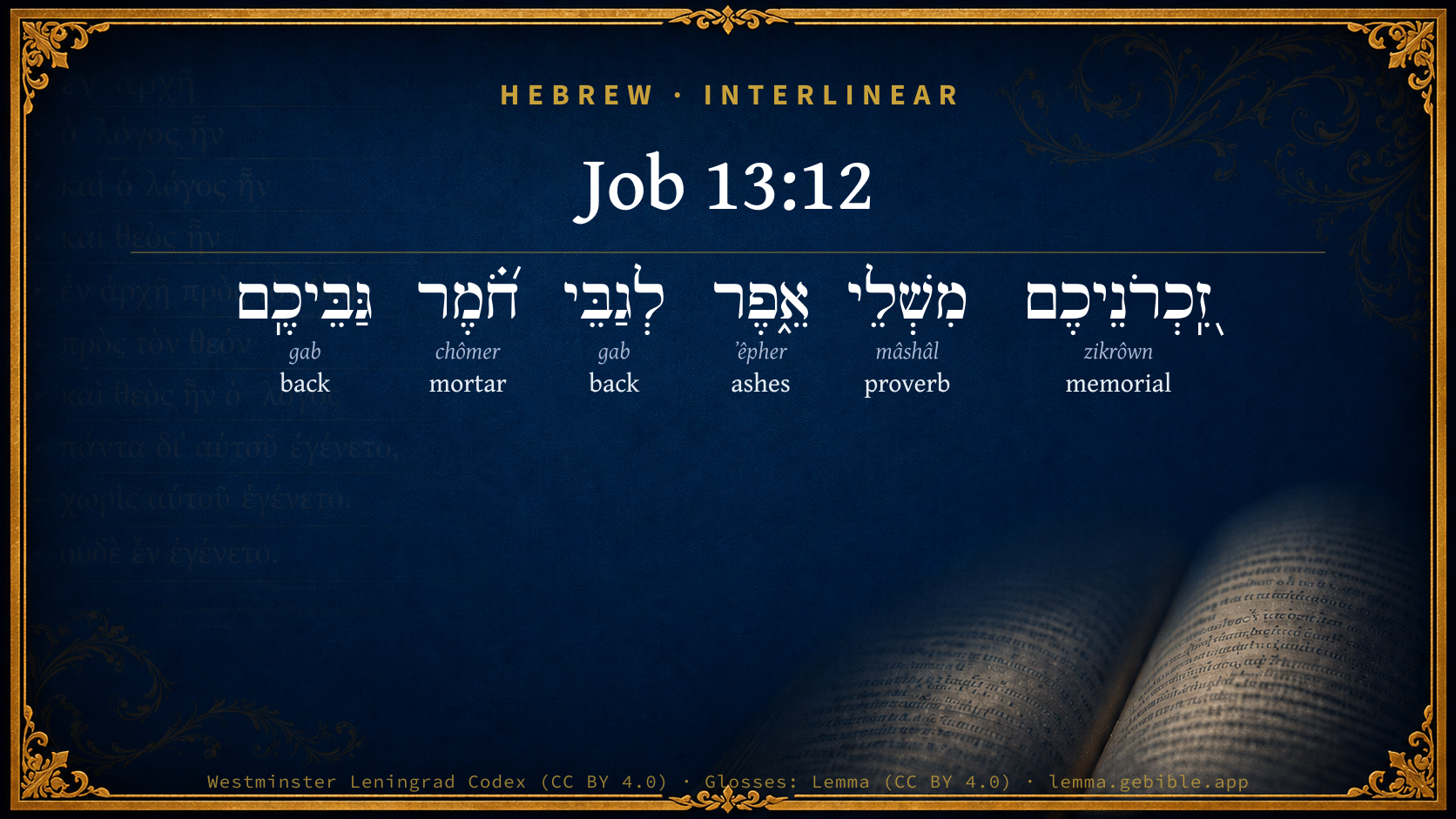
Job 13:12

Hebrew (Westminster Leningrad Codex) Job 13:12 appears in the Hebrew Old Testament. The text above is from the Westminster Leningrad Codex. Each word links to its Strong’s number, a concise gloss, and parsing drawn from the Open Scriptures Hebrew Bible morphology. Click any word for its full Brown-Driver-Briggs (BDB) entry.
Download image
Cite this verse

Job 13:12 (World English Bible). Public Domain. Lemma interlinear Bible study tool, https://lemma.gebible.app/v/job/13/12.

Show BibTeX & RIS
BibTeX
RIS
English Translation
Your memorable sayings are proverbs of ashes, Your defenses are defenses of clay.
World English Bible · Public Domain
Download a study sheet

One document with this verse’s original text, its word-by-word gloss line, the meaning frame, cross-references with their text, attributed commentary, and full source and license credits — printable, and it pastes into notes with its structure intact.

This verse Autodidact and up

Study sheet (.html) Plain text (.txt)

A passage Seminary Student

Up to 50 verses in one chapter. A passage sheet keeps up to 6 commentary sources and 12 cross-references per verse, in the order this page ranks them, and says so on the sheet whenever that leaves anything out. Ask for a single verse and you get the Autodidact verse sheet above.

Everything on this page stays free to read, with no account — the sheet is a download of what is already on screen, not access to it.

Want to remove ads? Support Godless Engineer
Compare translations 3

The same verse in 3 English versions, stacked beneath the original-language interlinear above. Click any original word for its lexicon entry.

Each is an independent rendering of the whole verse — the interlinear is not word-aligned to these translations.

Highlighted words mark where these versions differ — a whole-verse word diff, not a word-by-word alignment.

  • World English Bible Public Domain
    Your memorable sayings are proverbs of ashes, Your defenses are defenses of clay.
  • King James Version Public Domain
    Your remembrances are like unto ashes, your bodies to bodies of clay.
  • unfoldingWord Literal Text CC BY-SA 4.0
    Your maxims proverbs of ashes; your defenses are defenses of clay.

unfoldingWord Literal Text — © unfoldingWord, licensed CC BY-SA 4.0. Word-aligned USFM3 via Door43 (git.door43.org/unfoldingWord/en_ult).

Versions to compare (up to 4)

3 of 4 selected

Show all 18 translations

Every available English version of this verse, each an independent rendering of the whole verse.

  • World English Bible Public Domain
    Your memorable sayings are proverbs of ashes, Your defenses are defenses of clay.
  • Berean Standard Bible Public Domain
    Your maxims are proverbs of ashes; your defenses are defenses of clay.
  • Majority Standard Bible Public Domain
    Your maxims are proverbs of ashes; your defenses are defenses of clay.
  • King James Version Public Domain
    Your remembrances are like unto ashes, your bodies to bodies of clay.
  • American Standard Version (1901) Public Domain
    Your memorable sayings are proverbs of ashes, Your defences are defences of clay.
  • Revised Version (1885) Public Domain
    Your memorable sayings are proverbs of ashes, your defences are defences of clay.
  • Geneva Bible (1599) Public Domain
    Your memories may be compared vnto ashes, and your bodyes to bodyes of clay.
  • Douay-Rheims (1899) Public Domain
    Your remembrance shall be compared to ashes, and your necks shall be brought to clay.
  • Young's Literal Translation Public Domain
    Your remembrances `are' similes of ashes, For high places of clay your heights.
  • Literal Standard Version CC BY-SA 4.0
    Your remembrances [are] allegories of ashes, || For high places of clay [are] your heights.
  • Unlocked Literal Bible CC BY-SA 4.0
    Your memorable sayings are proverbs made of ashes; your defenses are defenses made of clay.
  • unfoldingWord Literal Text CC BY-SA 4.0
    Your maxims proverbs of ashes; your defenses are defenses of clay.
  • Darby Bible Public Domain
    Your memorable sayings are proverbs of ashes, your bulwarks are bulwarks of mire.
  • World Messianic Bible Public Domain
    Your memorable sayings are proverbs of ashes. Your defenses are defenses of clay.
  • Webster's Bible Public Domain
    Your remembrances are like to ashes, your bodies to bodies of clay.
  • Free Bible Version CC BY-SA 4.0
    Your sayings are as helpful as ashes; your arguments as weak as clay.
  • Bible in Basic English Public Domain
    Your wise sayings are only dust, and your strong places are only earth.
  • JPS Tanakh (1917) Public Domain
    Your memorials shall be like unto ashes, your eminences to eminences of clay.

Literal Standard Version (2020), Covenant Press — licensed CC BY-SA 4.0. Text via the HelloAO Bible API (eBible.org). Unlocked Literal Bible (unfoldingWord) — licensed CC BY-SA 4.0. Text via the HelloAO Bible API (eBible.org). unfoldingWord Literal Text — © unfoldingWord, licensed CC BY-SA 4.0. Word-aligned USFM3 via Door43 (git.door43.org/unfoldingWord/en_ult). Free Bible Version, Dr. Jonathan Gallagher — licensed CC BY-SA 4.0. Text via the HelloAO Bible API (eBible.org).

Word by word

More ways to search: Search by grammar → Find every occurrence → Compare this word →

Practice this passage: Drill this verse → Learn its vocabulary →

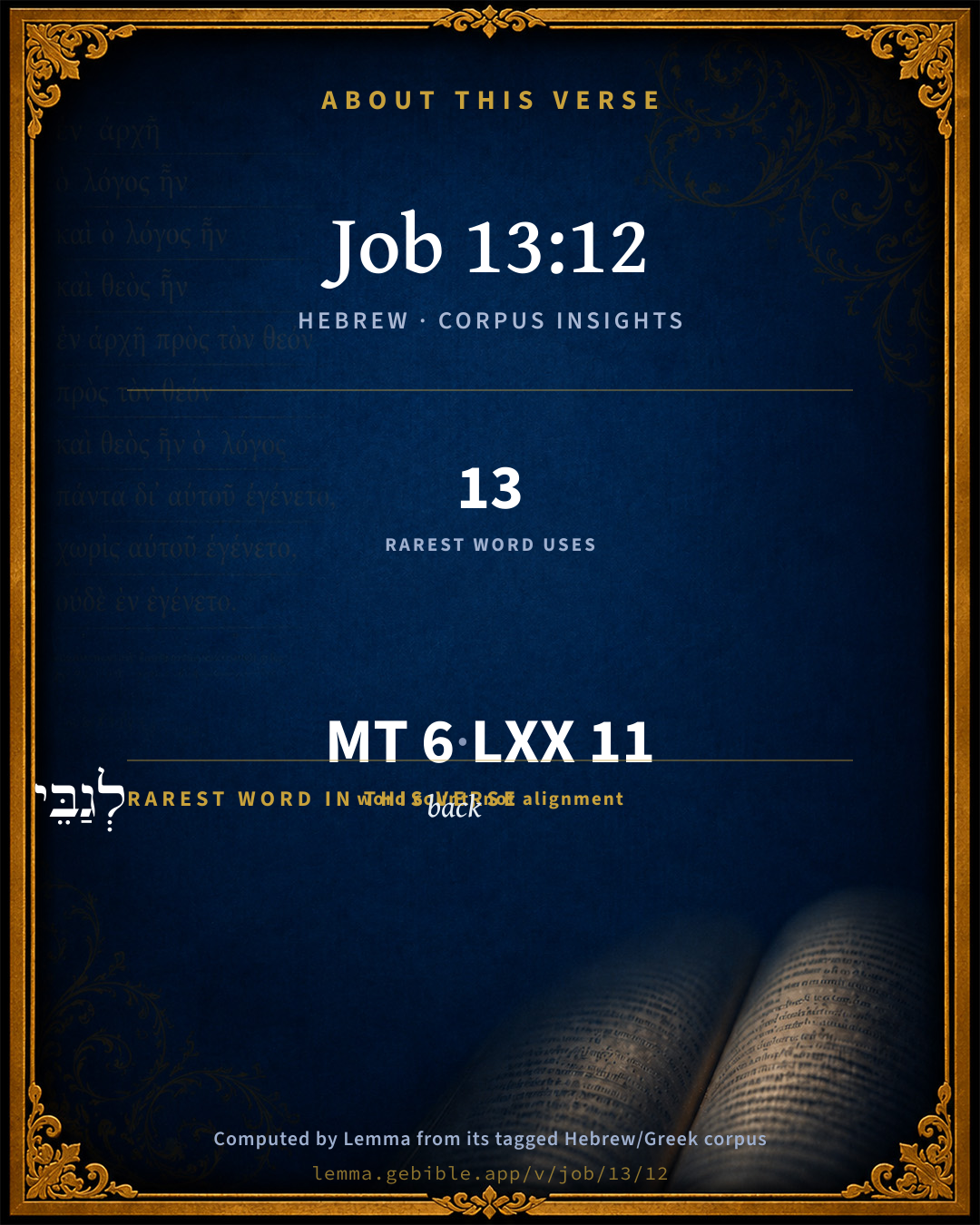
About this verse

These counts appear in no published source. They are computed here, from the morphology-tagged text and Lemma’s own curated glosses. What Lemma adds →

6
words
5
distinct lemmas
Wisdom
section

Notable vocabulary

The rarest word here is לְגַבֵּי back H1354 — appearing just 13 times in the whole Hebrew Bible.

Shared distinctive vocabulary

לְגַבֵּי back H1354 occurs in 11 verses of the Hebrew Bible. Also found in:

Grammatical profile

  • 6 nouns

Repetition

A word recurs within this verse — often emphatic in Hebrew:

  • לְגַבֵּי back H1354 ×2

Hebrew & Septuagint length

In English translation the verse runs 13 words from the Hebrew and 20 from the Septuagint (LXX English) — the Septuagint runs noticeably longer here. See the side-by-side →

A rough comparison of the two English renderings, which tokenize alike — not a word-level alignment.

Word counts can differ between the Hebrew and the Greek without any difference in meaning — e.g. the Hebrew direct-object marker אֵת has no separate Greek word, and Greek often adds the article ὁ.

In the original languages it is 6 Hebrew tokens and 11 Greek tokens — but the two are counted differently (Hebrew bundles its prefixes and suffixes into one token; the Greek is in lemma form), so that isn’t a like-for-like length.

Cross-references

11

Topical passages linked to Job 13:12 in the Treasury of Scripture Knowledge — connected by theme and wording, ordered by reader-vote popularity; previews shown in the World English Bible.

  • Genesis 2:7 Yahweh God formed man from the dust of the ground, and breathed into his nostrils the breath of life; and man became a living soul.
  • Genesis 18:27 Abraham answered, "See now, I have taken it on myself to speak to the Lord, who am but dust and ashes.
  • Exodus 17:14 Yahweh said to Moses, "Write this for a memorial in a book, and rehearse it in the ears of Joshua: that I will utterly blot out the memory of Amalek from under the sky."
  • Job 4:19 How much more, those who dwell in houses of clay, Whose foundation is in the dust, Who are crushed before the moth!
  • Job 18:17 His memory shall perish from the earth. He shall have no name in the street.
  • Psalms 34:16 Yahweh's face is against those who do evil, To cut off the memory of them from the earth.
  • Psalms 102:12 But you, Yahweh, will abide forever; Your renown endures to all generations.
  • Psalms 109:15 Let them be before Yahweh continually, That he may cut off the memory of them from the earth;
  • Proverbs 10:7 The memory of the righteous is blessed, But the name of the wicked will rot.
  • Isaiah 26:14 [They are] dead, they shall not live; [they are] deceased, they shall not rise: therefore have you visited and destroyed them, and made all memory of them to perish.
  • 2 Corinthians 5:1 For we know that if the earthly house of our tent is dissolved, we have a building from God, a house not made with hands, eternal, in the heavens.

Cross-references courtesy of OpenBible.info (CC BY 4.0).

Hebrew and Greek witnesses Masoretic Hebrew ↔ Greek Septuagint

The same verse in the two great witnesses to the Old Testament, shown verse-for-verse.

Here the Septuagint runs noticeably longer than the Hebrew — LXX2012 (modern English Septuagint) 20 words vs World English Bible 13. A rough length comparison of the two English translations, not a word-level alignment — read both below.

These are two independent witnesses, not word-aligned to each other, and the Septuagint is shown in lemma (dictionary) form.

Hebrew Job 13:12 Masoretic · Westminster Leningrad Codex

זִֽ֭כְרֹנֵיכֶם מִשְׁלֵי אֵ֑פֶר לְגַבֵּי חֹ֝֗מֶר גַּבֵּיכֶֽם

Your memorable sayings are proverbs of ashes, Your defenses are defenses of clay.

World English Bible · Public Domain

Greek LXX Job 13:12 Septuagint · lemma form

ἀποβαίνω δέ σύ ὁ ἀγαυρίαμα ἴσος σποδός ὁ δέ σῶμα πήλινος

And your glorying shall prove in the end to you like ashes, and your body like a body of clay.

LXX2012 (modern English Septuagint) · Public Domain

On this verse, Keil & Delitzsch discusses the Septuagint’s reading. Read the note in Commentary ↓

Hebrew: Westminster Leningrad Codex (CC BY 4.0). Greek: Septuagint (public domain); English from LXX2012 (modern English Septuagint) (Public Domain). How the Septuagint differs from the Hebrew →

Commentary

Notes on Job 13:12 from classic Christian and Jewish commentators (each source and its license shown beneath its notes). The classic Christian expositions comment on the surrounding passage and are grouped to its opening verse, so a note may address several verses; the Jewish commentaries on the Tanakh (Rashi and others) are per-verse, so they appear only where the commentator wrote on this verse.

Lemma curates 59 commentaries, every one of them public domain or Creative Commons licensed, each selected and text-cleaned for this edition rather than reprinted as found. About our sources →

Trapp's Complete Commentary

John Trapp

Job 13:12 Your remembrances [are] like unto ashes, your bodies to bodies of clay.

Ver. 12. Your remembrances are like unto ashes, &c.] Mr Beza readeth the whole verse thus: Your speeches are the words of ashes, and your stately bulwarks are but bulwarks of clay. And thus he paraphraseth: For these things which you allege as matters gathered by long observations, and which you thunder out against me as if they were most certain and grounded axioms, are indeed no more sound and substantial than ashes; and those your high forts, as it were, and turrets, out of which you assail me, are made but of dirt and mire. Others, by "your remembrances," understand with Mercer, quicquid in vobis memorabile est, whatsoever it is for the which you are so often remembered and mentioned by others, as your wealth, dignity, power, splendour, name, and fame, yea, your very life, is nothing else but ashes, and all shall return to ashes, and come to nought, according to that of Abraham, I am but dust and ashes, Gen 18:27; such an infinite distance there is between God’s unconceiveable highness and your extreme meanness, or rather, utter nothingness.

Your bodies to bodies of clay] i.e. To images made of clay or earth; or, that which is highest in you, even your best enjoyments, your chiefest eminences, or greatest elevations, are like to a lump of clay, terrae quam terimus, terrae quam gerimus. See Job 4:19. {See Trapp on "Job 4:19"}

John Trapp, A Commentary or Exposition upon All the Books of the Old and New Testament (1647–1656) — public domain. Text from a community e-Sword module.

Keil & Delitzsch

C. F. Keil & F. Delitzsch

12 Your memorable words are proverbs of dust,

Your strongholds are become strongholds of clay!

13 Leave me in peace, and I will speak,

And let what will come on me.

14 Wherefore should I bear my flesh in my teeth?

I take my soul in my hands.

15 Behold, He slayeth me-I wait for Him:

I will only prove my way before Him.

16 Even this would by my salvation,

That a hypocrite dare not appear before Him.

The words by which they exhort and warn him are called זכרנים, not because they recall the experience and teaching of the ancients (Hirz.), but as sayings to which attention and thought should be given, with the tone of זכר־נא, Job 4:7 (Hahn); as ספר זכרון, Mal 3:16, the book of remembrance; and ספר זכרנות, Est 6:1, the book of memorabilia or memoranda. These their loci communes are proverbs of ashes, i.e., proverbs which in respect to the present case, say nothing, passing away like ashes (אפר = vanity, Isa 44:20). While Job 13:12 says what their speeches, with the weighty nota bene, are, Job 13:12 says what their גּבּים become; for ל always denotes a κίνησις = γένεσις, and is never the exponent of the predicate in a simple clause.

(Note: The Jewish expositors compare Ch1 3:2 on לגבי, but the ל there in לאבשׁלום is a clerical error (comp. Sa2 3:3). Reiske conjectures רגבי (lumps of clay), one of the best among his most venturesome conjectures.)

Like the Arabic dahr, גּב signifies a boss, back, then protection, bulwark, rampart: their arguments or proofs are called גבים (עצּמות, Isa 41:21; comp. ὀχυρώματα, Co2 10:4); these ramparts which they throw up become as ramparts of clay, will be shown to be such by their being soon broken through and falling in. Their reasons will not stand before God, but, like clay that will not hold together, fall to pieces.

Job 13:13

Be silent therefore from me, he says to them, i.e., stand away from me and leave me in peace (opp. החרישׁ אל, Isa 41:1): then will I speak, or: in order that I may speak (the cohortative usual in apod. imper.) - he, and he alone, will defend (i.e., against God) his cause, which they have so uncharitably abandoned in spite of their better knowledge and conscience, let thereby happen (עבר, similar to Deu 24:5) to him מה, whatever may happen (מה שׁיעבר); or more simply: whatever it may be, quidquid est, as Sa2 18:22 ויהי מה, let happen whatever may happen; or more simply: whatever it may be, like מה דּבר quodcunque, Num 23:3; מי occurs also in a similar sense, thus placed last (Ewald, 104, d).

Job 13:14

Wherefore should he carry away his flesh in his teeth, i.e., be intent upon the maintenance of his life, as a wild beast upon the preservation of its prey, by holding it between its teeth (mordicus tenet) and carrying it away? This is a proverbial phrase which does not occur elsewhere; for Jer 38:2 (thy life shall become as spoil, לשׁלל, to thee) is only similar in outward appearance. It may be asked whether Job 13:14 continues the question begun with על־מה (vid., on Isa 1:5): and wherefore should I take my soul in my hands, i.e., carefully protect it as a valuable possession? (Eichh., Umbr., Vaih.). But apart from Psa 119:109 (my soul is continually in my hand), - where it may be asked, whether the soul is not there regarded as treasure (according to the current religious phrase: to carry his soul in his hand = to work out the blessedness of his soul with fear and trembling), - בכפּיו נפשׁו שׂים signifies everywhere else (Jdg 12:3; Sa1 19:5; Sa1 28:21) as much as to risk one's life without fear of death, properly speaking: to fight one's way through with one's fist, perishing so soon as the strength of one's fist is gone (Ewald); comp. the expression for the impending danger of death, Deu 28:66. If this sense, which is in accordance with the usage of the language, be adopted, it is unnecessary with Hirz., after Ewald, 352, b, to take ונפשׁי for נפשׁי גם: also, even my soul, etc., although it cannot be denied that ו, like καὶ and et, sometimes signifies: also, etiam (Isa 32:7; Ch2 27:5; Ecc 5:6, and according to the accents, Hos 8:6 also; on the contrary, Sa2 1:23; Psa 31:12, can at least by explained by the copulative meaning, and Amo 4:10 by "and indeed"). The waw joins the positive to the negative assertion contained in the question of Job 13:14 (Hahn): I will not eagerly make my flesh safe, and will take my soul in my hand, i.e., calmly and bravely expose myself to the danger of death. Thus Job 13:15 is most directly connected with what precedes.

Job 13:15

This is one of eighteen passages in which the Chethib is לא and the Keri לו; Job 6:21 is another.

(Note: In Frst, Concord. p. 1367, col. 1, the following passages are wanting: Sa1 2:3; Kg2 8:10; Psa 100:3; Psa 139:16; Pro 19:7; Pro 26:2; Ch1 11:20, which are to be supplied from Aurivillius, diss. p. 469, where, however, on the other hand, Sa2 19:7 is wanting. Exo 21:8 also belongs to these passages. In this last passage Mhlau proposes a transposition of the letters thus: לא ידעה (if she displease her master, so that he knows her not, does not like to make her his concubine, then he shall cause her to be redeemed, etc.). In his volume on Isaiah just published (1866), Dr. Delitzsch appends the following note on Isa 63:9 : - "There are fifteen passages in which the Keri substitutes לו for לא, vid., Masora magna on Lev 11:21 (Psalter, ii. 60). If we include Isa 49:5; Ch1 11:20; Sa1 2:16 also, there are then eighteen (comp. on Job 13:15); but the first two of these passages are very doubtful, and are therefore intentionally omitted, and in the third it is לא that is substituted for לו (Ges. Thes. 735, b). Sa2 19:7 also does not belong here, for in this passage the Keri is לוּ." - Tr.])

In the lxx, which moreover changes איחל into החל, ἄρχεσθαι, the rendering is doubtful, the Cod. Vat. Translating ἐάν με χειρώσηται, the Cod. Alex. ἐὰν μή με χειρ. The Mishna b. Sota, 27, b, refers to the passage with reference to the question whether Job had served God from love or fear, and in favour of the former appeals to Job 27:5, since here the matter is doubtful (הדבר שׁקול), as the present passage may be explained, "I hope in Him," or "I hope not." The Gemara, ib. 31, a, observes that the reading לא does not determine the sense, for Isa 63:9 is written לא, and is not necessarily to be understood as לו, but can be so understood.

(Note: Vid., Geiger, Lesestcke aus der Mischnah (1845), S. 37f.)

Among the ancient versions, the Targ., Syr., and Jerome (etiamsi occiderit me, in ipso sperabo) are in favour of לו. This translation of the Vulgate is followed by the French, English, Italian, and other versions. This utterance, in this interpretation, has a venerable history. The Electoress Louise Henriette von Oranien (died 1667), the authoress of the immortal hymn, "Jesus meine Zuversicht" the English translation begins, "Jesus Christ, my sure defence," chose these words, "Though the Lord should slay me, yet will I hope in Him," for the text of her funeral oration. And many in the hour of death have adopted the utterance of Job in this form as the expression of their faith and consolation.

(Note: Vid., Gschel, Die Kurfrstinnen zu Brandenburg aus dem Hause Hohenzollern (1857), S. 28-32.)

Among these we may mention a Jewess. The last movement of the wasted fingers of Grace Aguilar was to spell the words, "Though He slay me, yet will I trust in Him."

(Note: Marie Henriquez Morales, bearbeitet von Piza (1860), X. 12.)

The words, so understood, have an historic claim in their favour which we will not dispute. Even the apostles do not spurn the use of the Greek words of the Old Testament, though they do not accord with the proper connection in the original text, provided they are in accordance with sacred Scripture, and give brief and pregnant expression to a truth taught elsewhere in the Scriptures. Thus it is with this utterance, which, understood as the Vulgate understands it, is thoroughly Job-like, and in some measure the ultimate solution of the book of Job. It is also, according to its most evident meaning, an expression of perfect resignation. We admit that if it is translated: behold, He will slay me, I hope not, i.e., I await no other and happier issue, a thought is obtained that also agrees with the context. But יחל does not properly mean to hope, but to wait for; and even in Job 6:11; Job 14:14, where it stands as much without an object as here, it has no other meaning but that of waiting; and Luther is true to it when he translates: behold, He will destroy me, and I cannot expect it; it is, however, strange; and Bttch. translates: I will not wait to justify myself, which is odd. The proper meaning of יחל, praestolari, gives no suitable sense. Thus, therefore, the writer will have written or meant לו, since יחל ל is also elsewhere a familiar expression with him, Job 29:21, Job 29:23; Job 30:26. The meaning, then, which agrees both with the context and with the reality, is: behold, He will slay me, I wait for Him, i.e., I wait what He may do, even to smite with death, only I will (אך, as frequently, e.g., Psa 49:16, does not belong to the word which immediately follows, but to the whole clause) prove my ways to Him, even before His face. He fears the extreme, but is also prepared for it. Hirzel, Heiligst., Vaihinger, and others, think that Job regards his wish for the appearing of God as the certain way of death, according to the belief that no one can behold God and not die. But יקטלני has reference to a different form of idea. He fears the risk of disputing with God, and being obliged to forfeit his life; but, as לו איחל implies, he resigns himself even to the worst, he waits for Him to whom he resigns himself, whatever He may do to him; nevertheless (אך restrictive, or as frequently אכן adversative, which is the same thing here) he cannot and will not keep down the inward testimony of his innocence, he is prepared to render Him an account of the ways in which he has walked (i.e., the way of His will) - he can succumb in all respects but that of his moral guiltlessness. And in Job 13:16 he adds what will prove a triumph for him, that a godless person, or (what is suitable, and if it does not correspond to the primary idea,

(Note: The verb חנף signifies in the Arabic to deviate, to go on one side (whence, e.g., ahhnaf, bandy-legged): hhanı̂f, which is derived from it, is a so-called Arab. ḍidd, ἐναντιόσημον, which may mean both one inclining to the good and true (one who is orthodox), and in this sense it is a surname of Abraham, and one inclining to evil. Beidhwi explains it by ml, inclining one's self to; the synonym, but used only in a good sense, is Arab. 'l-‛âdl, el-‛âdil.)

still accords with the use of the word) a hypocrite, one who judges thus of himself in his own heart, would not so come forward to answer for himself before God (Hahn). It can be explained: that a godless person has no access to God; but the other explanation givers a truer thought. הוא is here used as neuter, like Job 15:9; Job 31:28 comp. Job 41:3, Exo 34:10. Correctly lxx, καὶ τοῦτό μοι ἀποβήσεται εἰς σωτηρίαν. ישׁוּעה here (comp. Job 30:15) has not, however, the usual deeper meaning which it has in the prophets and in Psalms. It means here salvation, as victory in a contest for the right. Job means that he has already as good as won the contest, by so urgently desiring to defend himself before God. This excites a feeling in favour of his innocence at the onset, and secures him an acquittal.

Keil & Delitzsch — Biblical Commentary on the Old Testament (1861–1891) — public domain (CC PDM 1.0). Text via the HelloAO Bible API. (Old Testament only.)

Tyndale Open Study Notes

Tyndale Open Resources

13:12 Ashes are worthless (cp. Isa 44:20).

Tyndale Open Study Notes — © Tyndale Open Resources, licensed CC BY-SA 4.0. Text via the HelloAO Bible API.

Geneva Bible (1599)

Geneva Bible translators

Your fame shall come to nothing.

Geneva Bible (1599) marginal notes — public domain. Text via Bolls.life.

Jamieson, Fausset & Brown

Robert Jamieson, A. R. Fausset & David Brown

remembrances--"proverbial maxims," so called because well remembered.

like unto ashes--or, "parables of ashes"; the image of lightness and nothingness (Isa 44:20).

bodies--rather, "entrenchments"; those of clay, as opposed to those of stone, are easy to be destroyed; so the proverbs, behind which they entrench themselves, will not shelter them when God shall appear to reprove them for their injustice to Job.

Jamieson, Fausset & Brown — Commentary Critical and Explanatory on the Whole Bible (1871) — public domain (CC PDM 1.0). Text via the HelloAO Bible API.

Adam Clarke's Commentary

Verse 12. Your remembrances are like unto ashes] Your memorable sayings are proverbs of dust. This is properly the meaning of the original: זכרניכם משלי אפר zichroneycem mishley epher. This he speaks in reference to the ancient and reputedly wise sayings which they had so copiously quoted against him.

Your bodies to bodies of clay.] This clause is variously translated: Your swelling heaps are swelling heaps of mire. That is, Your high-flown speeches are dark, involved, and incoherent; they are all sound, no sense; great swelling words, either of difficult or no meaning, or of no point as applicable to my case.

Adam Clarke's Commentary on the Bible (1810–1826) — public domain. Text from a community e-Sword/MySword module.

Ellicott's Commentary for English Readers

(12) Remembrances—i.e. “Wise and memorable saws of garnered wisdom are proverbs of ashes, worthless as the dust, and fit for bodies of clay like your bodies.” Or, as some understand it, “Your high fabrics, or defences, are fabrics of clay,” as an independent parallelism.

A Bible Commentary for English Readers, edited by Charles John Ellicott (1878–1897) — public domain. Text from a community e-Sword module.

The Cambridge Bible for Schools and Colleges

gen. ed. J. J. S. Perowne

12. This verse reads,

Your remembrances shall be proverbs of ashes,

Your defences defences of dust.

The term “remembrances” means their traditional sayings, remembered from antiquity, their maxims, such as Bildad adduced, ch. 8, and Eliphaz with his Remember now! ch. Job_4:7; these shall be found to be but ashes, easily dissipated, and not able to resist. The word “defences” is used of the boss of the buckler, ch. Job_15:26, and may refer to some sort of breastwork or cover from which men assailed the enemy. These shall turn out defences of dust, lit clay, i. e. dried clay, which crumbles into dust. “Defences” here are not works for defence strictly but for offence, they are the arguments of the friends; cf. Isa_41:21, “strong reasons.” These great arguments which the friends used in defence of God against Job shall be found by them, when God searches them out, to be mere ashes and crumbling clay. So it turned out, cf. ch. Job_42:7 seq.

The Cambridge Bible for Schools and Colleges (gen. ed. J. J. S. Perowne; Cambridge University Press, 1878–1918) — public domain. Text from a community e-Sword module.

John Gill's Exposition

Your remembrances are like unto ashes,.... Either of things they put Job in remembrance of, the mementos which they had suggested to him; see Job 4:7; or the things which they had brought forth out of their memories, the instances they had given of what had been in the world, the arguments, objections, and reasonings, they had made use of in this controversy; their "memorable sentences" (e), as some render it, were of no more moment and importance than ashes, and easily blown away like them; or whatsoever was memorable in them, or they thought would perpetuate their memory hereafter, as their houses and lands, and towns and cities, called by their names, these memorials should perish, Psa 49:11; or their wealth and riches, their honour and glory, their learning, wisdom, and knowledge, all should fade, and come to nothing; the memory of the just indeed is blessed, the righteous are had in everlasting remembrance, because of their everlasting righteousness; but as anything else, that may be thought to be a remembrance of man, it is but as ashes, of little worth, gone, and often trampled upon; and men should remember that they are but dust and ashes, as Aben Ezra (f) observes, even in their best estate, in comparison of the excellency of God, before spoken of; and as Abraham confessed in the presence of God, Gen 18:27;

your bodies to bodies of clay; that is, are like to bodies of clay, to such as are made of clay after the similitude of human bodies; and such are the bodies of men themselves, they are of the earth, earthly, they are houses of clay, which have their foundation in the dust; earthen vessels, and earthly houses of this tabernacle, poor, mean, frail, brittle things, are crushed before the moth, and much more before the Almighty; the word is by some rendered "eminencies", the most eminent men; what is most eminent in them are like to "eminences of clay" (g), or heaps of dirt: some interpret this, as the former expression, of their words, reasonings, arguments, and objections; which though great swelling words, were vain and empty, mere bubbles, and though reckoned strong reasonings, unanswerable arguments, and objections, had no strength in them, but were to be easily thrown down like hillocks of clay; and though thought to be like shields, or high and strong fortresses, as some (h) take the word to signify, yet are but clayey ones.

(e) "sententiae vestrae memorabiles", Schultens. (f) So the Tigurine version, "meminisse oportebat vos similea esse cineri". (g) "eminentiae vestrae, eminentiae luteae", Beza; so Bolducius. (h) So Cocceius, Beza.

John Gill's Exposition of the Whole Bible (1746–1763) — public domain (CC PDM 1.0). Text via the HelloAO Bible API.

Albert Barnes' Notes on the Bible

Your remembrances are like unto ashes - There has been a considerable variety in the interpretation of this verse. The meaning in our common version is certainly not very clear. The Vulgate renders it, Memoria vestra comparabitur cineri. The Septuagint, Ἀποβήσεται δὲ ὑμῶν τὸ γαυρίαμα Ἶσα σποδᾷ Apobēsetai de humōn to gauriama isa spodō - “your boasting shall pass away like ashes.” Dr. Good renders it, “Dust are your stored-up sayings.” Noyes, “Your maxims are words of dust.” The word rendered “remembrances” זכרון zı̂krôn means properly “remembrance, memory,” Jos 4:7; Eze 12:14; then a “memento,” or “record;” then a “memorable saying, a maxim.” This is probably the meaning here; and the reference is to the apothegms or proverbs which they had so profusely uttered, and which they regarded as so profound and worthy of attention, but which Job was disposed to regard as most common-place, and to treat with contempt.

Are like unto ashes - That is, they are valueless. See the notes at Isa 44:20. Their maxims had about the same relation to true wisdom which ashes have to substantial and nutritious food. The Hebrew here (אפר משׁלי mâshaly 'êpher) is rather, “are parables of ashes;” - the word משׁל mâshâl meaning similitude, parable, proverb. This interpretation gives more force and beauty to the passage.

Your bodies - - גביכם gabēykem Vulgate, “cervices.” Septuagint, τὸ δὲ σῶμα πήλινον to de sōma pēlinon - but the body is clay. The Hebrew word גב gab, means something gibbous (from where the word “gibbous” is derived), convex, arched; hence, the “back” of animals or human beings, Eze 10:12; the boss of a shield or buckler - the “gibbous,” or exterior convex part - Job 15:26; and then, according to Gesenius, an entrenchment, a fortress, a strong-hold. According to this interpretation, the passage here means, that the arguments behind which they entrenched themselves were like clay. They could not resist an attack made upon them, but would be easily thrown down, like mud walls. Grotius renders it, “Your towers (of defense) are tumult of clay.” Rosenmuller remarks on the verse that the ancients were accustomed to inscribe sentences of valuable historical facts on pillars. If these were engraved on stone, they would be permanent; if on pillars covered with clay, they would soon be obliterated. On a pillar or column at Aleandria, the architect cut his own name at the base deep in the stone. On the plaster or stucco with which the column was covered, he inscribed the name of the person to whose honor it was reared. The consequence was, that that name became soon obliterated; his own then appeared, and was permanent. But the meaning here is rather, that the apothegms and maxims behind which they entrenched themselves were like mud walls, and could not withstand an attack.

Albert Barnes' Notes on the Bible (1834–1885) — public domain. Text from a community e-Sword/MySword module.

Haydock's Catholic Bible Commentary

Necks. Septuagint, "body." Hebrew also, (Haydock) "heights," (Calmet) or "fortifications." (Grotius)

George Leo Haydock (1774–1849), Haydock's Catholic Family Bible and Commentary, 1859 edition — public domain. Excludes Psalms (Douay-Rheims chapter numbering differs from Protestant) and Deuterocanonical books (Catholic canon only).

Matthew Poole's English Annotations

Your remembrances; either,

1. Actively, i.e. your memorials, or your discourses and arguments, by which you design to bring things to my remembrance. So he might possibly allude to that passage, Job 4:7. Remember, I pray thee, &c. That and all your other mementos are like unto ashes, i.e. contemptible and unprofitable, Heb. are parables, or speeches, of dust, or ashes. Or,

2. Passively; all that which is most excellent and memorable in you, your wealth, and dignity, and wit, and reputation, or whatsoever it is for which you expect or desire to be remembered, it is all but poor despicable dust and ashes. And therefore you have just reason to abhor yourselves, and to dread the Divine Majesty, as I now advised you.

Your bodies; though they be not full of sores and boils as mine is, yet they are but dust, and to dust they shall return as well as mine. Heb. your backs, which, being the strongest part of the body, is put for the whole body. Or, your eminencies, or excellencies, as this word most properly signifies, as Hebricians observe; so it answers to their memorables. All those things wherein you do, or think that you do, excel others, are but like eminencies, or lumps, or heaps of clay, vain and useless things, if compared with the excellencies of God. Or, your heights, i.e. your lofty discourses, are like clay, i.e. without solidity and strength.

Matthew Poole's English Annotations on the Holy Bible (1683–1685) — public domain. Text from a community e-Sword/MySword module.

Whedon's Commentary on the Bible

Daniel D. Whedon

12. Remembrances — Memorable sayings.

Like unto ashes — Are maxims of ashes. In the East, ashes are regarded as of no value, fit only to be trodden under foot, (Mal_4:3,) hence an image of worthlessness, Gen_18:27. Bodies — Strongholds. The original is נב, gab, a back, the boss of a shield, thence a bulwark, etc. “Bulwarks of clay” were easily demolished. In those days the tower of stone was the symbol of strength. The “old saws” of the friends were “proverbs of ashes,” their glittering bulwarks, “bulwarks of mud;” a strict parallelism of thought. In this contemptuous setting of their “remembrances,” zikronim, in similitudes of ashes and mud, there is a keen verbal thrust at the stately “Remember, I pray thee,” of Eliphaz. (Zekorna, Job_4:7.) Compare chap. Job_8:8.

Daniel D. Whedon (gen. ed.), Commentary on the Old and New Testaments (1874–1909) — public domain. Text from a community e-Sword module.

The Pulpit Commentary

Your remembrances are like unto ashes. The "remembrances" intended are probably the wise saws, embodiments of the ancient wisdom, on which Job"s adversaries have relied in their disputations with him. (Job_4:7, 8 8:8-11, etc.) These Job declares to be mere dust and ashes useless, worthless, such as the first breath of air wilt blow away. Your bodies to bodies of clay; rather, your mounds"or your defences (see the Revised Version). These defences, Job saysi.e, the arguments by which his opponents support their views are no better than "defences of clay easy to batter down and destroy. The ancient defences of a town were usually either of stone, as at Khorsabad ("Ancient Monarchies," vol. 1. pp. 278, 279), or of crude brick faced with burnt brick, as at Babylon and elsewhere. But Job seems to be speaking of something more primitive than either of these mere earthworks, like the Roman aggera"hastily thrown up and easy to level with the ground.

The Pulpit Commentary (1880–1919), ed. H.D.M. Spence-Jones & Joseph S. Exell — public domain. Text from a community e-Sword module.

John Wesley's Explanatory Notes

Remembrance - Mouldering and coming to nothing. And the consideration of our mortality should make us afraid of offending God. Your mementos are like unto ashes, contemptible and unprofitable.

John Wesley, Explanatory Notes Upon the Whole Bible (1754–1765) — public domain. Text via the GEBible commentary corpus.

Rashi

Rabbi Shlomo Yitzchaki (Rashi)

your memorials are compared to ashes Your memorials are compared to ashes. You expect to be compared to Abraham, who said (Genesis 18:27), “I am only dust and ashes.”

are like eminences of clay Your eminences ore equal to eminences of clay, compared to Him. The word גביכם means, your height, like (Ezek. 16:24), “and you built for yourself a platform (גב).”

Rashi on the Tanakh — English translations: “The Judaica Press complete Tanach with Rashi, translated by A. J. Rosenberg” (CC BY 4.0); “Pentateuch with Rashi's commentary by M. Rosenbaum and A.M. Silbermann, 1929-1934” (public domain); “The Metsudah Tanach series, Lakewood, N.J” (CC BY 4.0); and “The Book of Joshua, Metsudah Publications, 1997” (CC BY 4.0). Text via Sefaria.

Lesson kit

Teaching starters — assembled from the data on this page, not authored interpretation. Every prompt links to the verse data it draws on. Edit before teaching.

Job, in the Wisdom, opens this verse with 6 words (5 distinct Hebrew lemmas). Its most distinctive word is gab (“back”). The Greek Septuagint runs longer here. A historical commentator’s framing appears above. Read the whole chapter for the surrounding context.

Discussion questions

  1. What does “back” (gab) contribute to the verse as a whole?
  2. Leviticus 14:9 shares the word «back» with this verse. How do the two illuminate each other?
  3. “back” occurs 2× in this one verse. What is the effect of the repetition?
  4. Compared with the Hebrew, the Septuagint runs longer here. What questions does that raise?
  5. These translations render this verse differently. What is at stake in choosing one wording over another?
  6. Reading how Trapp's Complete Commentary and Keil & Delitzsch read this verse, where do the two commentators agree and where do they part?

Things to notice

Reading settings

Reading text

Shown beneath each verse's original-language words.

Old Testament
Old Testament edition

Read the OT as the Masoretic Hebrew (MT) or the Greek Septuagint (LXX).

English shown for the Greek Septuagint (in the Hebrew ↔ Greek comparison).

Comparing translations? Open the Compare panel on any verse page to stack up to four side by side.