1 Corinthians 6:20

Greek (Tischendorf 8th ed.) 1 Corinthians 6:20 appears in the Greek New Testament. The text above is from the Tischendorf 8th edition. Each word links to its Strong’s number and a concise gloss. Click any word for its full Thayer’s Greek Lexicon entry.
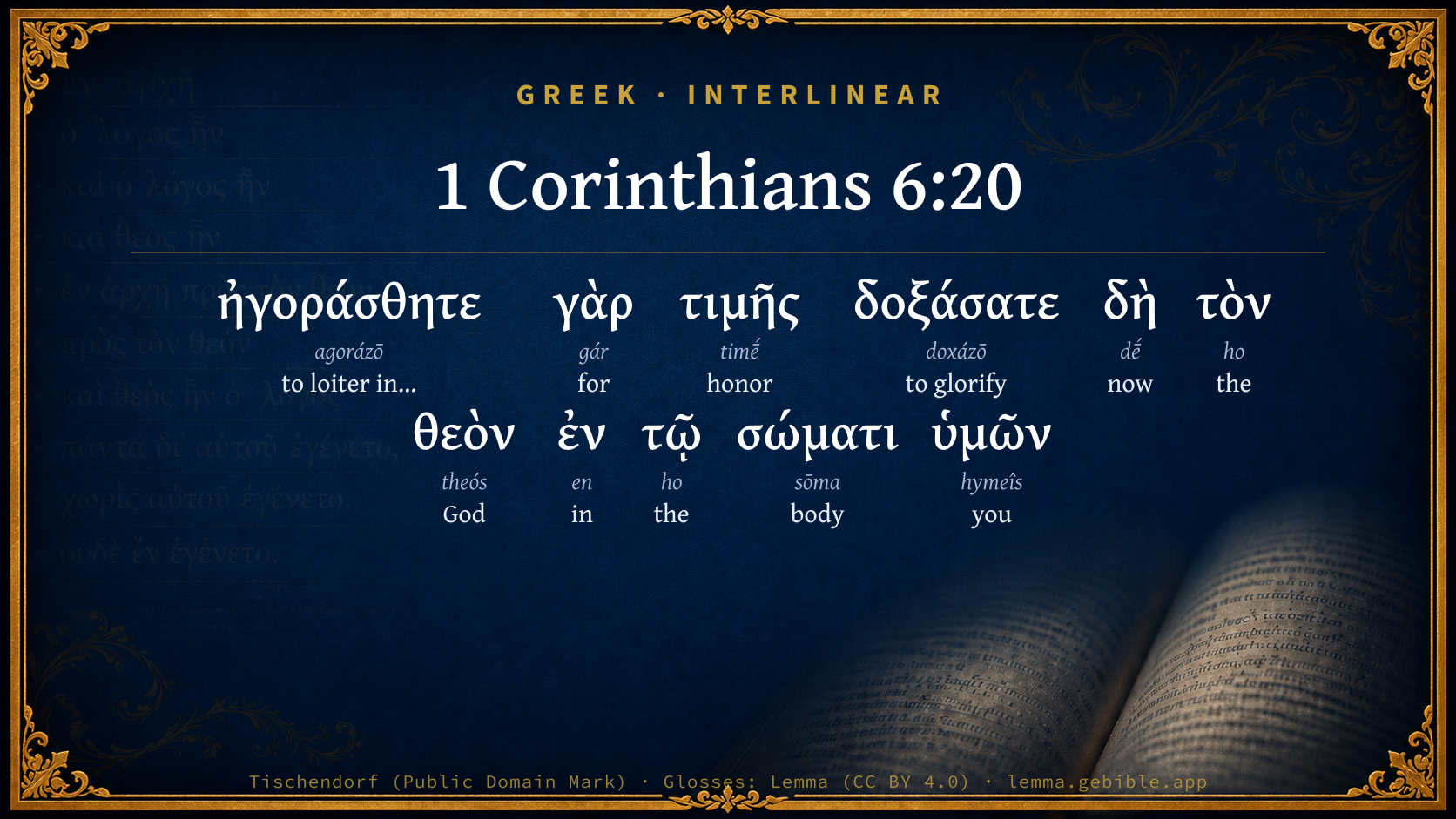
Download image
Cite this verse

1 Corinthians 6:20 (World English Bible). Public Domain. Lemma interlinear Bible study tool, https://lemma.gebible.app/v/1-corinthians/6/20.

Show BibTeX & RIS
BibTeX
RIS
English Translation
for you were bought with a price. Therefore glorify God in your body and in your spirit, which are God's.
World English Bible · Public Domain
Download a study sheet

One document with this verse’s original text, its word-by-word gloss line, the meaning frame, cross-references with their text, attributed commentary, and full source and license credits — printable, and it pastes into notes with its structure intact.

This verse Autodidact and up

Study sheet (.html) Plain text (.txt)

A passage Seminary Student

Up to 50 verses in one chapter. A passage sheet keeps up to 6 commentary sources and 12 cross-references per verse, in the order this page ranks them, and says so on the sheet whenever that leaves anything out. Ask for a single verse and you get the Autodidact verse sheet above.

Everything on this page stays free to read, with no account — the sheet is a download of what is already on screen, not access to it.

Want to remove ads? Support Godless Engineer
Compare translations 3

The same verse in 3 English versions, stacked beneath the original-language interlinear above. Click any original word for its lexicon entry.

Each is an independent rendering of the whole verse — the interlinear is not word-aligned to these translations.

Highlighted words mark where these versions differ — a whole-verse word diff, not a word-by-word alignment.

  • World English Bible Public Domain
    for you were bought with a price. Therefore glorify God in your body and in your spirit, which are God's.
  • King James Version Public Domain
    For ye are bought with a price: therefore glorify God in your body, and in your spirit, which are God's.
  • unfoldingWord Literal Text CC BY-SA 4.0
    for you were bought with a price. Therefore, glorify God in your body.

unfoldingWord Literal Text — © unfoldingWord, licensed CC BY-SA 4.0. Word-aligned USFM3 via Door43 (git.door43.org/unfoldingWord/en_ult).

Versions to compare (up to 4)

3 of 4 selected

Show all 19 translations

Every available English version of this verse, each an independent rendering of the whole verse.

  • World English Bible Public Domain
    for you were bought with a price. Therefore glorify God in your body and in your spirit, which are God's.
  • Berean Standard Bible Public Domain
    you were bought at a price. Therefore glorify God with your body.
  • Majority Standard Bible Public Domain
    you were bought at a price. Therefore glorify God with your body and with your spirit, which belong to God.
  • King James Version Public Domain
    For ye are bought with a price: therefore glorify God in your body, and in your spirit, which are God's.
  • American Standard Version (1901) Public Domain
    for ye were bought with a price: glorify God therefore in your body.
  • Revised Version (1885) Public Domain
    for ye were bought with a price: glorify God therefore in your body.
  • Geneva Bible (1599) Public Domain
    For yee are bought for a price: therefore glorifie God in your bodie, and in your spirit: for they are Gods.
  • Douay-Rheims (1899) Public Domain
    For you are bought with a great price. Glorify and bear God in your body.
  • Young's Literal Translation Public Domain
    for ye were bought with a price; glorify, then, God in your body and in your spirit, which are God's.
  • Literal Standard Version CC BY-SA 4.0
    for you were bought with a price; glorify, then, God in your body and in your spirit, which are God’s.
  • Unlocked Literal Bible CC BY-SA 4.0
    For you were bought with a price. Therefore glorify God with your body.
  • unfoldingWord Literal Text CC BY-SA 4.0
    for you were bought with a price. Therefore, glorify God in your body.
  • Darby Bible Public Domain
    for ye have been bought with a price: glorify now then God in your body.
  • World Messianic Bible Public Domain
    for you were bought with a price. Therefore glorify God in your body and in your spirit, which are God’s.
  • Webster's Bible Public Domain
    For ye are bought with a price: therefore glorify God in your body, and in your spirit, which are God's.
  • Free Bible Version CC BY-SA 4.0
    You don't belong to yourself—a price was paid for you! So glorify God in your body!
  • Bible in Basic English Public Domain
    For a payment has been made for you: let God be honoured in your body.
  • Text-Critical English NT CC BY 4.0
    for you were bought with a price. Therefore glorify God with your body and with your spirit, which belong to God.
  • Tyndale New Testament (1534) Public Domain
    For ye are dearly bought. Therfore glorifie the God in youre bodyes and in youre spretes for they are goddes.

Literal Standard Version (2020), Covenant Press — licensed CC BY-SA 4.0. Text via the HelloAO Bible API (eBible.org). Unlocked Literal Bible (unfoldingWord) — licensed CC BY-SA 4.0. Text via the HelloAO Bible API (eBible.org). unfoldingWord Literal Text — © unfoldingWord, licensed CC BY-SA 4.0. Word-aligned USFM3 via Door43 (git.door43.org/unfoldingWord/en_ult). Free Bible Version, Dr. Jonathan Gallagher — licensed CC BY-SA 4.0. Text via the HelloAO Bible API (eBible.org).

Word by word

More ways to search: Search by grammar → Find every occurrence → Compare this word →

Practice this passage: Drill this verse → Learn its vocabulary →

About this verse

These counts appear in no published source. They are computed here, from the morphology-tagged text and Lemma’s own curated glosses. What Lemma adds →

11
words
10
distinct lemmas
Pauline Epistles
section

Notable vocabulary

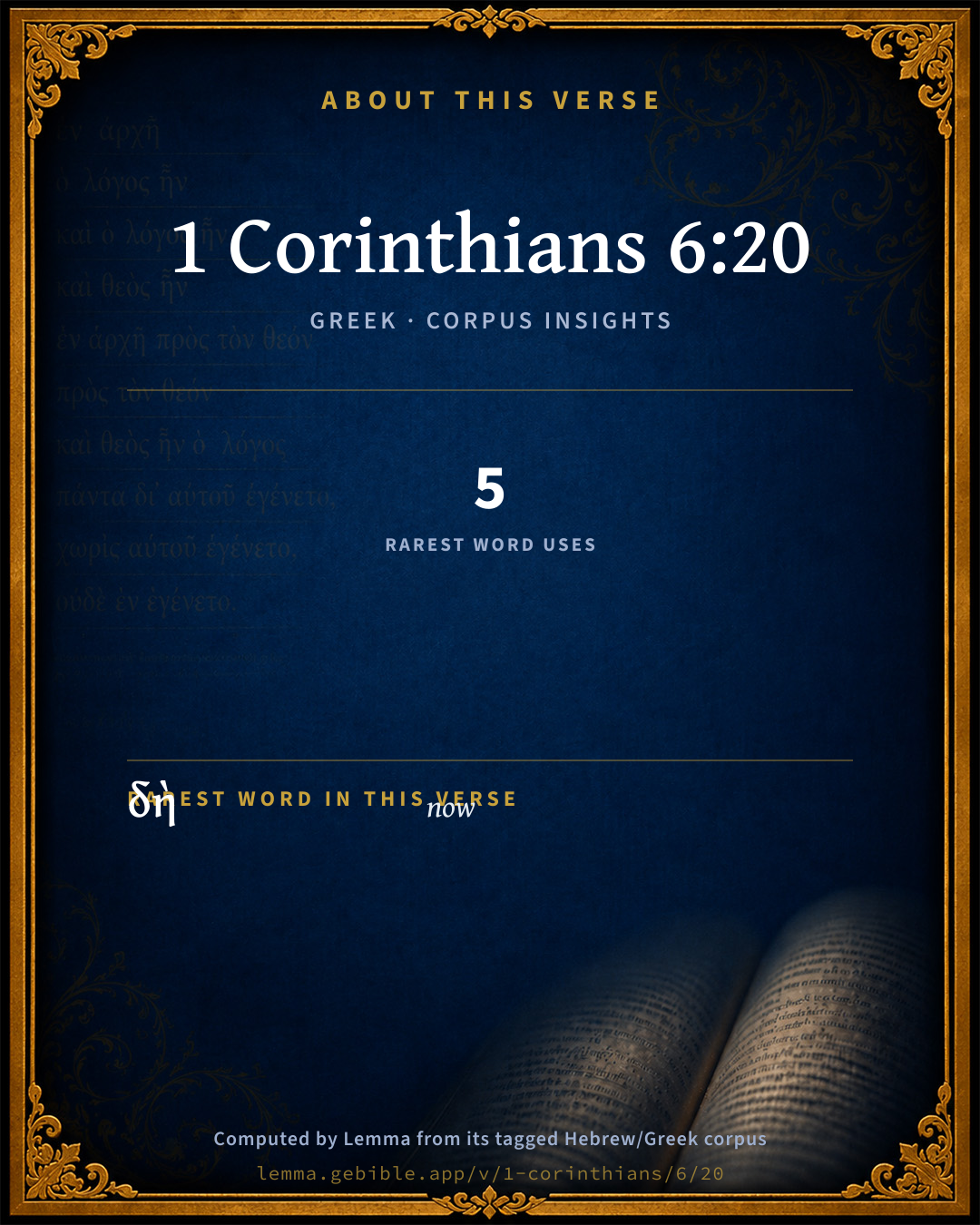
The rarest word here is δὴ now G1211 — appearing just 5 times in the whole Greek New Testament.

Shared distinctive vocabulary

δὴ now G1211 occurs in 5 verses of the Greek New Testament. Also found in:

Repetition

A word recurs within this verse:

Cross-references

13

Topical passages linked to 1 Corinthians 6:20 in the Treasury of Scripture Knowledge — connected by theme and wording, ordered by reader-vote popularity; previews shown in the World English Bible.

  • 1 Corinthians 7:23 You were bought with a price. Don't become bondservants of men.
  • Romans 12:1 Therefore I urge you, brothers, by the mercies of God, to present your bodies a living sacrifice, holy, acceptable to God, which is your spiritual service.
  • 1 Peter 2:9 But you are a chosen race, a royal priesthood, a holy nation, a people for God's own possession, that you may show forth the excellencies of him who called you out of darkness into his marvelous light:
  • 1 Peter 1:18 knowing that you were redeemed, not with corruptible things, with silver or gold, from the useless way of life handed down from your fathers,
  • Hebrews 9:12 nor yet through the blood of goats and calves, but through his own blood, entered in once for all into the Holy Place, having obtained eternal redemption.
  • Philippians 1:20 according to my earnest expectation and hope, that I will in no way be disappointed, but with all boldness, as always, now also Christ will be magnified in my body, whether by life, or by death.
  • Acts 20:28 Take heed, therefore, to yourselves, and to all the flock, in which the Holy Spirit has made you overseers, to shepherd the assembly of the Lord and God which he purchased with his own blood.
  • Galatians 3:13 Christ redeemed us from the curse of the law, having become a curse for us. For it is written, "Cursed is everyone who hangs on a tree,"
  • 1 Corinthians 10:31 Whether therefore you eat, or drink, or whatever you do, do all to the glory of God.
  • Revelation 5:9 They sang a new song, saying, "You are worthy to take the book, And to open its seals: For you were killed, And bought us for God with your blood, Out of every tribe, language, people, and nation,
  • Matthew 5:16 Even so, let your light shine before men; that they may see your good works, and glorify your Father who is in heaven.
  • Romans 6:19 I speak in human terms because of the weakness of your flesh, for as you presented your members as servants to uncleanness and to wickedness upon wickedness, even so now present your members as servants to righteousness for sanctification.
  • 2 Peter 2:1 But there also arose false prophets among the people, as among you also there will be false teachers, who will secretly bring in destructive heresies, denying even the Master who bought them, bringing on themselves swift destruction.

Cross-references courtesy of OpenBible.info (CC BY 4.0).

Where the printed editions differ

1 variant

Places in this verse where the major printed Greek editions disagree on the wording in a way that affects the translation — a comparison of editions, not a manuscript-by-manuscript collation. The editions are the modern critical texts (Nestlé-Aland 28/27, SBL, Westcott-Hort, Tregelles, Tyndale House) and the traditional texts behind the KJV (the Textus Receptus and the Byzantine/Majority text). It is not a claim about which reading is original.

  1. Extra text
    καὶ ἐν τῷ πνεύματι ὑμῶν ἅτινά ἐστιν τοῦ θεοῦ.¶

    “and in the spirit of you which is <the> of God.”

    In TRByz Not in NA28NA27TynSBLWHTreg

    καὶ ἐν τῷ πνεύματι ὑμῶν ἅτινά ἐστιν τοῦ θεοῦ.¶ (kai en tō pneumati humōn hatina estin tou theou) 'and in the spirit of you which is of God.' is only in traditional manuscripts (TR+Byz)

Textual data: Translators Amalgamated Greek New Testament (STEPBible TAGNT) · CC BY 4.0.

Commentary

Notes on 1 Corinthians 6:20 from classic Christian and Jewish commentators (each source and its license shown beneath its notes). The classic Christian expositions comment on the surrounding passage and are grouped to its opening verse, so a note may address several verses; the Jewish commentaries on the Tanakh (Rashi and others) are per-verse, so they appear only where the commentator wrote on this verse.

Lemma curates 59 commentaries, every one of them public domain or Creative Commons licensed, each selected and text-cleaned for this edition rather than reprinted as found. About our sources →

Albert Barnes' Notes on the Bible

For ye are bought - Ye Christians are purchaseD; and by right of purchase should therefore be employed as he directs. This doctrine is often taught in the New Testament, and the argument is often urged that, therefore, Christians should be devoted to God; see 1Co 7:23; 1Pe 1:18-19; 1Pe 2:9; 2Pe 2:1; Rev 5:9; see the note at Act 20:28.

With a price - τίμῇ timē. A price is that which is paid for an article, and which, in the view of the seller, is a fair compensation, or a valuable consideration why he should part with it; that is the price paid is as valuable to him as the thing itself would be. It may not be the same thing either in quality or quantity, but it is that which to him is a sufficient consideration why he should part with his property. When an article is bought for a valuable consideration, it becomes wholly the property of the purchaser. He may keep it, direct it, dispose of it. Nothing else is to be allowed to control it without his consent - The language here is figurative. It does not mean that there was strictly a commercial transaction in the redemption of the church, a literal “quid pro quo,” for the thing spoken of pertains to moral government, and not to commerce. It means:

(1) That Christians have been redeemed, or recovered to God;

(2) That this has been done by a “valuable consideration,” or that which, in his view, was a full equivalent for the sufferings that they would have endured if they had suffered the penalty of the law;

(3) That this valuable consideration was the blood of Jesus, as an atoning sacrifice, an offering, a ransom, which “would accomplish the same great ends in maintaining the truth and honor of God, and the majesty of his law, as the eternal condemnation of the sinner would have done;” and which, therefore, may be called, figuratively, the price which was paid. For if the same ends of justice could be accomplished by his atonement which would have been by the death of the sinner himself, then it was consistent for God to pardon him.

(4) Nothing else could or would have done this. There was no price which the sinner could pay, no atonement which he could make; and consequently, if Christ had not died, the sinner would have been the slave of sin, and the servant of the devil forever.

(5) As the Christian is thus purchased, ransomed, redeemed, he is bound to devote himself to God only, and to keep his commands, and to flee from a licentious life.

Glorify God - Honor God; live to him; see the Mat 5:16 note; Joh 12:28; Joh 17:1 notes.

In your body ... - Let your entire person be subservient to the glory of God. Live to him; let your life tend to his honor. No stronger arguments could be adduced for purity of life, and they are such as all Christians must feel.

Remarks On 1 Corinthians 6

1. We see from this chapter 1CO 6:1-8. The evils of lawsuits, and of contentions among Christians. Every lawsuit between Christians is the means of greater or less dishonor to the cause of religion. The contention and strife; the time lost and the money wasted; the hard feelings engendered, and bitter speeches caused; the ruffled temper, and the lasting animosities that are produced, always injure the cause of religion, and often injure it for years. Probably no lawsuit was ever engaged in by a Christian that did not do some injury to the cause of Christ. Perhaps no lawsuit; was ever conducted between Christians that ever did any good to the cause of Christ.

2. A contentious spirit, a fondness for the agitation, the excitement, and the strife of courts, is inconsistent with the spirit of the gospel. Religion is supposed to be retiring, peaceful, and calm. It seeks the peace of all, and it never rejoices in contentions.

3. Christians should do nothing that will tend to injure the cause of religion in the eye of the world, 1Co 6:7-8. How much better is it that I should lose a few pounds, than that my Saviour should lose his honor! How much better that my purse should be empty of glittering dust, even by the injustice of others, than that a single gem should be taken from his diadem! And how much better even that I should lose all, than that “my” hand should be reached out to pluck away one jewel, by my misconduct, from his crown! Can silver, can gold, can diamonds be compared in value to the honor of Christ and of his cause?

4. Christians should seldom go to law, even with others; never, if they can avoid it. Every other means should be tried first, and the law should be resorted to only when all else fails. How few lawsuits there would be if man had no bad passions! How seldom is the law applied to from the simple love of justice; how seldom from pure benevolence; how seldom foe the glory of God! In nearly all cases that occur between men, a friendly reference to others would settle all the difficulty; always if there were a right spirit between the parties. Comparatively few suits at law will be approved of, when people come to die; and the man who has had the least to do with the law, will have the least, usually, to regret when he enters the eternal world.

5. Christians should be honest - strictly honest - always honest, 1Co 6:8. They should do justice to all; they should defraud none. Few things occur that do more to disgrace religion than the suspicions of fraud, and overreaching, and deception, that often rest on professors of religion. How can a man be a Christian, and not be an honest man? Every man who is not strictly honest and honorable in his dealings, should be regarded, whatever may be his pretensions, as an enemy of Christ and his cause.

6. The unholy cannot be saved, 1Co 6:9-10. So God has determined; and this purpose cannot be evaded or escaped. It is fixed; and men may think of it as they please, still it is true that there are large classes of people who, if they continue such, cannot inherit the kingdom of God. The fornicator, the idolater, the drunkard, and the covetous, cannot enter heaven. So the Judge of all has said, and who can unsay it? So he has decreed, and who can change his fixed decree? And so it should be. What a place would heaven be if the drunkard, and the adulterer, and the idolater were there! How impure and unholy would it be! How would it destroy all our hopes, dim all our prospects, mar all our joys, if we were told that they should sit down with the just in heaven! Is it not one of our fondest hopes that heaven will be pure, and that all its inhabitants shall be holy? And can God admit to his eternal embrace, and treat as his eternal friend, the man who is unholy; whose life is stained with abomination; who loves to corrupt others; and whose happiness is found in the sorrows, and the wretchedness, and vices of others? No, true religion is pure, and heaven is pure; and whatever people may think. Of one thing they may be assured, that the fornicator, and the drunkard, and the reviler shall not inherit the kingdom of God.

7. If none of these can be saved as they are, what a host are traveling down to hell! How large a part of every community is made up of such persons! How vast is the number of drunkards that are known! How vast the host of extortioners, and of covetous people, and revilers of all that is good! How many curse their God and their fellow man! How difficult to turn the corner of a street without hearing an oath! How necessary to guard against the frauds and deceptions of others! How many men and women are known to be impure in their lives! In all communities how much does this sin abound! and how many shall be revealed at the great Day as impure, who are now unsuspected! how many disclosed to the universe as all covered with pollution, who now boast even of purity, and who are received into the society of the virtuous and the lovely! Verily, the broad road to hell is thronged! And verily, the earth is pouring into hell a most dense and wretched population, and rolling down a tide of sin and misery that shall fill it with groans and gnashing of teeth forever.

8. It is well for Christians to reflect on their former course of life, as contrasted with their present mercies, 1Co 6:11. Such were they, and such they would still have been but for the mercy of God. Such as is the victim of uncleanness and pollution, such as is the profane man and the reviler, such we should have been but for the mercy of God. That alone has saved us, and that only can keep us. How should we praise God for his mercy, and how are we bound to love and serve him for his amazing compassion in raising us from our deep pollution, and saving us from hell?

9. Christians should be pure; 1Co 6:11-19. They should be above suspicion. They should avoid the appearance of evil. No Christian can be too pure; none can feel too much the obligation to he holy. By every sacred and tender consideration God urges it on us; and by a reference to our own happiness as well as to his own glory, he calls on us to be holy in our lives.

10. May we remember that we are not our own; 1Co 6:20. We belong to God. We have been ransomed by sacred blood. By a reference to the value of that blood; by all its preciousness and worth; by all the sighs, and tears, and groans that bought us; by the agonies of the cross, and the bitter pains of the death of God’s own Son, we are bound to live to God, and to him alone. When we are tempted to sin, let us think of the cross. When Satan spreads out his allurements, let us recall the remembrance of the sufferings of Calvary, and remember that all these sorrows were endured so that we might be pure. O how would sin appear were we beneath the cross, and did we feel the warm blood from the Saviour’s open veins trickle upon us? Who would dare indulge in sin there? Who could do otherwise than devote himself, body, and soul, and spirit, unto God?

Albert Barnes' Notes on the Bible (1834–1885) — public domain. Text from a community e-Sword/MySword module.

Bengel's Gnomon

Johann Albrecht Bengel

1Co 6:20. Ἠγοράσθητε, ye are bought) You are entirely in the power of another. To sell is used for to alienate; to buy for to claim for one’s self, and here too with propriety; for the mention of a price is added.—τιμῆς, with a price) This word has thus much greater force, than if an epithet were added. So also 1Co 7:23.—δοξάσατε, glorify) An Epiphonema [an exclamation subjoined to a weighty argument.—Appen.] They are in error, who think that God should be only internally, or only externally worshipped.—ἐν τῷ σώματι ὑμῶν,[55] in your body) Rom 12:1; Php 1:20.

[55] The words which follow to the end of this clause, are declared by the margin of both Ed. as a reading not genuine; wherefore, also, in the German Vers., they are only within a parenthesis. Not. Crit. on this passage agrees to it: ὑμῶν, περὶ) a sure reading; the question here is about the use and abuse of the body.—E. B.

Rec. Text adds καὶ ἐν τῷ πνεύματι ὑμῶν ἅτινα ἐστὶν τοῦ Θεοῦ. Both Syr. Vers. alone of the oldest authorities support this reading. But ABC corrected later, D corr. lat., G Vulg. fg Iren. Cypr. Lucif. Memph. omit the words.—ED.

Bengel's Gnomon of the New Testament — English translation (T&T Clark, Edinburgh, 1860) — public domain. Text from a community e-Sword module.

Meyer's Critical & Exegetical Commentary

Heinrich August Wilhelm Meyer

1Co_6:20. For (proof of the οὐκ ἐστὲ ἑαυτ.) ye were bought, i.e. redeemed from the curse of the law, Gal_3:13; from the wrath of God, Eph_2:3; from the bond of the guilt of sin, Rom_3:19-21; and acquired as Gods property (Eph_2:19; Eph_1:14), for a price, which was paid to God for your reconciliation with Him, namely, the blood of Christ, Mat_26:28; Rom_3:24 f.; 2Co_5:18 ff.; Eph_1:7; 1Pe_1:18 f.; Rev_5:9. We have the same conception in Act_20:28, although there, as also in 1Co_7:23, and Tit_2:14, the church is represented as the property of Christ; but see Joh_17:9.

τιμῆς] strengthens the ἠγοράσθ. as the opposite of acquiring without an equivalent. Comp 1Co_7:23. The common exposition (following the Vulgate): magno pretio, inserts without warrant what is not in the text (so, too, Pott, Flatt, Rückert, Osiander, Olshausen, Ewald).[1008] Comp Herod. vii. 119, and the passages in Wetstein; and see already Valla.

δοξάσατε δὴ κ.τ.λ[1010]] Do but glorify, etc. This is the moral obligation arising out of the two things grasped by faith as certainties, 1Co_6:19. Regarding the δή of urgency with imperatives, see on Act_13:2

ἘΝ Τῷ ΣΏΜ. ὙΜ.] not instrumental, nor as in Php_1:20 (comp Rom_12:1), but so expressed, because the exhortation proceeds upon the footing of the whole tenor of 1Co_6:19, in which the body is described as a temple; in your body, namely, practically by chastity, the opposite of which would be an ἀτιμάζειν τὸν Θεόν (Rom_2:23) in His own sanctuary!

[1008] How high a price it was (1Pe_1:19) would suggest itself readily to the readers, but is not implied in the word itself.

[1010] .τ.λ. καὶ τὰ λοιπά.

Meyer — Critical and Exegetical Commentary on the New Testament — English translation by Peter Christie, edited by Frederick Crombie (T&T Clark, 1880) — public domain. Text from a community e-Sword module.

Hodge's Commentary on Romans, Ephesians & First Corinthians

Charles Hodge

1Co_6:20

For ye are bought with a price: therefore glorify God in your body, and in your Spirit, which are Gods. ‹6›

Ye are bought. The verb is in the past tense, ἠγοράσθητε, ye were bought, i.e. delivered by purchase. The deliverance of men from the power and condemnation of sin was not effected by power or by truth, but by a ransom. We were justly held in bondage. We were under the penalty of the law, and until that penalty was satisfied, we could not be delivered. The blood of Christ is our ransom, because it met all the demands of justice.

The proprietorship in believers asserted at the close of the preceding verse, does not arise from creation or preservation, but from redemption. Ye are not your own, for ye are bought with a price, Rom_6:17; Gal_3:13; Eph_3:13; Act_20:28. The price of redemption is the blood of Christ, Mat_20:28; Rom_3:24. Eph_1:7; 1Pe_1:18, 1Pe_1:19, and everywhere where the subject is spoken of in Scripture. Therefore, i.e. because redeemed, and because redeemed at such a price; glorify God, i.e. honor him, and so act as to cause him to be honored by others. In your body as a temple consecrated to his worship, and employed only in his service.

The following words, and in your spirit, which are Gods, may have been added, because the body alone is not the object of redemption, and therefore the obligation of the redeemed to be devoted to the service of God pertains also to the soul. As however these words are not found in the great majority of the oldest manuscripts, most modern editors omit them.

Charles Hodge — Commentary on Romans (1835), First Corinthians (1857), and Ephesians (1856) — public domain. Text from a community e-Sword module.

Jamieson, Fausset & Brown

Robert Jamieson, A. R. Fausset & David Brown

bought with a price--Therefore Christ's blood is strictly a ransom paid to God's justice by the love of God in Christ for our redemption (Mat 20:28; Act 20:28; Gal 3:13; Heb 9:12; Pe1 1:18-19; Pe2 2:1; Rev 5:9). While He thus took off our obligation to punishment, He laid upon us a new obligation to obedience (Co1 7:22-23). If we accept Him as our Prophet to reveal God to us, and our Priest to atone for us, we must also accept Him as our King to rule over us as wholly His, presenting every token of our fealty (Isa 26:13).

in your body--as "in" a temple (compare Joh 13:32; Rom 12:1; Phi 1:20).

and in your spirit, which are God's--not in the oldest manuscripts and versions, and not needed for the sense, as the context refers mainly to the "body" (Co1 6:16, Co1 6:18-19). The "spirit" is incidentally mentioned in Co1 6:17, which perhaps gave rise to the interpolation, at first written in the Margin, afterwards inserted in the text.

Next: 1 Corinthians Chapter 7

Jamieson, Fausset & Brown — Commentary Critical and Explanatory on the Whole Bible (1871) — public domain (CC PDM 1.0). Text via the HelloAO Bible API.

Adam Clarke's Commentary

Verse 20. Ye are bought with a price] As the slave who is purchased by his master for a sum of money is the sole property of that master, so ye, being bought with the price of the blood of Christ, are not your own, you are his property. As the slave is bound to use all his skill and diligence for the emolument of his master, so you should employ body, soul, and spirit in the service of your Lord; promoting, by every means in your power, the honour and glory of your God, whom you must also consider as your Lord and Master.

There are strange discordances in MSS., versions, and fathers, on the conclusion of this verse; and the clauses και εν τῳ πνευματι ὑμων, ἁτινα εστι του Θεου, and in your spirit, which is God's, is wanting in ABC*D*EFG, some others, Coptic, AEthiopic, Vulgate, and Itala, and in several of the primitive fathers. Almost every critic of note considers them to be spurious. Whether retained or expunged the sense is the same. Instead of price simply, the Vulgate and some of the Latin fathers, read, pretio magno, with a great price; and instead of glorify, simply, they read glorificate et portate, glorify and carry God in your bodies. These readings appear to be glosses intended to explain the text. Litigious Christians, who will have recourse to law for every little difference, as well as the impure, may read this chapter either to their conviction or confusion.

Adam Clarke's Commentary on the Bible (1810–1826) — public domain. Text from a community e-Sword/MySword module.

John Calvin's Commentaries

20. Glorify God From this conclusion, it appears that the Corinthians took a liberty to themselves in outward things, that it was necessary to restrain and bridle. The reproof therefore is this he allows that the body is subject to God no less than the soul, and that accordingly it is reasonable that both be devoted to his glory. “As it is befitting that the mind of a believer should be pure, so there must be a corresponding outward profession also before men, inasmuch as the power of both is in the hands of God, who has redeemed both.” With the same view he declared a little ago, that not only our souls but our bodies also are temples of the Holy Spirit, that we may not think that we discharge our duty to him aright, if we do not devote ourselves wholly and entirely to his service, that he may by his word regulate even the outward actions of our life.

John Calvin's Commentaries (1540-1563) — public domain. Text from the Calvin Translation Society English edition (1840s-50s) via the Christian Classics Ethereal Library (ccel.org). Calvin's coverage is partial (roughly two-thirds of the Bible); uncommented books and verses are honest gaps, never fabricated. The 19th-century editor's footnotes and remarks are omitted so the notes are faithfully Calvin's own voice.

The Cambridge Bible for Schools and Colleges

gen. ed. J. J. S. Perowne

20. ye are (lit. were) bought with a price] the “one sufficient Sacrifice, Oblation and Satisfaction made for the sins of the whole world” by the Death and Passion of our Saviour Christ. Cf. Act_20:28; 1Pe_1:19; 2Pe_2:1; Rev_5:9, &c.

and in your spirit, which are God’s] These words are not found in many of the best MSS. and versions, and they somewhat weaken the force of the argument, which is intended to assert the dignity of the body. They were perhaps inserted by some who, missing the point of the Apostle’s argument, thought that the worship of the spirit was unduly passed over.

The Cambridge Bible for Schools and Colleges (gen. ed. J. J. S. Perowne; Cambridge University Press, 1878–1918) — public domain. Text from a community e-Sword module.

John Gill's Exposition

For ye are bought with a price,.... Not with gold and silver, but with the precious blood of Christ, as the whole church, and all the elect of God are. This proves them to be the Lord's, not only his redeemed ones, being ransomed by a price from the bondage of the law, sin, Satan, and the world; but his espoused ones, and which is chiefly designed here; for one way of obtaining and espousing a wife among the Jews was by a price (p);

"a woman (they say) is obtained or espoused three ways; "by silver", by a writing, and by lying with; by silver, the house of Shammai say, by a penny, and the value of a penny; the house of Hillel say, by a "pruta", and the value of a "pruta": how much is a "pruta?" the eighth part of an Italian farthing.''

That is, be it ever so small a price, yet if given and taken on the account of espousals, it made them valid; and it was an ancient rite in marriage used among other nations (q) for husband and wife to buy each other: Christ, indeed, did not purchase his church to be his spouse, but because she was so; but then his purchasing of her with his blood more clearly demonstrated and confirmed his right unto her, as his spouse; he betrothed her to himself in eternity, in the everlasting covenant of grace; but she, with the rest of the individuals of human nature, fell into sin, and so, under the sentence of the law, into the hands of Satan, and the captivity of the world; to redeem her from whence, and by so doing to own and declare her his spouse, and his great love to her, he gave himself a ransom price for her; which lays her under the greatest obligation to preserve an inviolable chastity to him, and to love and honour him.

Therefore glorify God in your body and in your spirit, which are God's; by "God" is here meant more especially the Lord Jesus Christ, by the price of whose blood the bodies and souls of his people are bought, which lays the obligation on them to glorify him in and with both; and contains a very considerable proof of the deity of Christ; who is "glorified", when all the perfections of the divine nature are ascribed to him; when the whole of salvation is attributed to him, and he is looked unto, received, trusted in and depended on as a Saviour, and praise and thanks are given unto him on that account; and when his Gospel is embraced and professed, and walked worthy of, and his ordinances submitted to, and his commandments kept in love to him: and he is to be glorified both in body and spirit; "in body", by an outward attendance on his worship, and a becoming external conversation; by confessing and speaking well of him; by acting for him, laying out and using time, strength, and substance, for his honour and interest; and by patient suffering for his name's sake: "in spirit", which is done when the heart or spirit is given up to him, and is engaged in his service, and when his glory lies near unto it; the reason enforcing all this, is because both are his; not only by creation, but by his Father's gift of both unto him; by his espousal of their whole persons to himself; and by his redemption of both soul and body from destruction: the Vulgate version reads, "bear" or "carry God in your body", and leaves out the next words, "and in your spirit", which are God's; and which also are left out in the Ethiopic and in the Alexandrian copy, and some others.

(p) Misn. Kiddushin, c. 1. sect. 1. (q) Servius, in Virgil. Georg. l. 1. lin. 31.

Next: 1 Corinthians Chapter 7

John Gill's Exposition of the Whole Bible (1746–1763) — public domain (CC PDM 1.0). Text via the HelloAO Bible API.

Trapp's Complete Commentary

John Trapp

20 For ye are bought with a price: therefore glorify God in your body, and in your spirit, which are God’s.

Ver. 20. Ye are bought] Shall I drink the blood of these men? saith David. So, shall I abuse my body, the price of Christ’s blood, abandon it to venery? &c.

Glorify God in your body] The very Manichees that denied God to be the author of the body, fasted on sabbath days, and in fasting exercised a humiliation of the body. Pone in pectore dextram. (Pers.) Let God have heart and hand, mind and mouth, faith and feet, spirit, soul, and body, 1Th 5:23, all which are his by a manifold right.

John Trapp, A Commentary or Exposition upon All the Books of the Old and New Testament (1647–1656) — public domain. Text from a community e-Sword module.

Matthew Poole's English Annotations

For ye are bought with a price; what price this is that is here mentioned Peter tells us, both negatively and positively, 1Pe 1:18,19; Forasmuh as ye know that ye were not redeemed with corruptible things, as silver and gold, from your vain conversation received by tradition from your fathers; but with the precious blood of Christ, as of a lamb without blemish and without spot. So he argueth with them against this sin from their redemption, it being suitable to reason, that those who are redeemed out of any slavery or captivity, should be the servants of him who redeemed them, not of those tyrants from whom they are redeemed; such are our lusts and corruptions, from which we are redeemed, as well as from that curse and wrath, which is the consequent of them.

Therefore glorify God in your body, and in your spirit, which are God’s; therefore, (saith the apostle), you who are redeemed with a price, and with such a price, are bound to glorify God, as by speaking well of his name, so by obeying his will, Mat 5:16. And this you are bound to do, not with your bodies or your spirits only, but in or with your bodies and spirits also, that is, with your whole man; for both of them are God’s, by a manifold right, not that of creation and providence only, but that of redemption also: with which exhortation the apostle finisheth this discourse, and cometh to give them an answer to some questions about which they had wrote unto him.

Matthew Poole's English Annotations on the Holy Bible (1683–1685) — public domain. Text from a community e-Sword/MySword module.

Whedon's Commentary on the Bible

Daniel D. Whedon

20. With a price—Directing their thoughts to the blood of the atonement.

Therefore glorify God—Honour, and spread the honour, of the holy God by the spirit of purity in your body. So that holiness is not confined to the soul. It must reign in the body and act forth in its actions.

Daniel D. Whedon (gen. ed.), Commentary on the Old and New Testaments (1874–1909) — public domain. Text from a community e-Sword module.

The Pulpit Commentary

Ye are bought with a price. That price is the blood of Christ, wherewith he purchased the Church (Act_20:28; Heb_9:12; 1Pe_1:18, 1Pe_1:19; Rev_5:9) This metaphor of ransom (1Co_7:23; 2Pe_2:1) has its full and absolute applicability to man. The effect of Christ"s death for us is that we are redeemed from slavery and prison, and the right of our possession is with Christ. Thus by various metaphors the effects of redemption are revealed to us on the human side. When we unduly press the metaphor, and ask from whom we were purchased, and to whom the price was paid, we build up scholastic systems which have only led to error, and respecting which the Church has never sanctioned any exclusive opinion. The thoughts touched upon in this verse are fully developed in the Epistle to the Romans. Glorify God; by behaving as his redeemed children, and therefore by keeping yourselves pure. In these few brief words St. Paul sums up all he has said, as he did in 1Co_5:13. In your body. The following words, "and in your spirit, which are God"s," are a perfectly correct and harmless gloss, but are not found in the best manuscripts, and are foreign to the drift of the passage. Your body is a temple, and in that temple God must be honoured. (As Augustine says, "Dost thou wish to pray in a temple? pray in thyself. But first be a temple of God. "Unchastity dishonours God, and that in his own temple" (Rom_2:23) (Meyer). In these clauses St. Paul has touched on three subjects which occupy important sections of the remainder of the Epistle, namely,

(1) the relation between the sexes (ch. 7.);

(2) the question of idol offerings (ch. 8.); and

(3) the doctrine of the resurrection (ch. 15.).

Glorify God.

heavens declare the glory of God." Hosts of angelic and glorified spirits give "glory, honour, and thanksgiving unto him." "All nations whom he hath made shall come and glorify his Name.

And shall man alone be dumb Till this glorious kingdom come? No! the Church delights to raise Psalms and hymns and songs of praise.

I ON WHAT GROUNDS SHOULD CHRISTIANS GLORIFY GOD? This is a reasonable service, a reasonable requirement.

1. God has a natural right over us, i.e. by his creative power and providential care. "Man"s chief end," says a famous Catechism, "is to glorify God.

2. Redemption is the great reason adduced why Christians should glorify God. This is the doctrine of the context. The claim of purchase is added to the claim of creation.

II FROM WHAT MOTIVES SHOULD CHRISTIANS GLORIFY GOD?

1. From a remembrance of the danger and ruin consequent upon any other end in life. Exemplified in Scripture history, as in the instance of Belshazzar, to whom it was said, "The God, etc., hast thou not glorified," and in the instance of Herod, who "gave not God the glory.

2. From a grateful acknowledgment of the love and grace to which they are indebted for their redemption. The ransom and redemption do indeed avail for all men; but multitudes are insensible to the loving kindness of the Lord. They who have tasted and seen that the Lord is good are prompted by their experience to yield themselves to the service of their Saviour.

3. From a desire to secure their own highest happiness. They have learned how every other principle of life fails to yield a deep and lasting satisfaction; and now they are learning, by happy experience, how truly blessed is the life which is unto the Lord of love and glory. This is exemplified in the history of this very Apostle Paul.

4. From a delight in the Divine commands. It is an invitation, bat it is also a behest: "Glorify God." And nothing is so congenial to the Christian as what is enjoined upon him by his Lord"s authority.

III IS WHAT MANNER MAY CHRISTIANS GLORIFY GOD?

1. By praise, "Whoso offereth praise glorifieth me." "Confess that Jesus Christ is Lord, to the glory of God the Father." Public, cordial, unceasing praises should ascend from every company of the redeemed.

2. By obedience and service; and that not only of spirit, as is presumed, but of body, as is here expressed. The occasion of this chapter, the prevalence of sensual sin, seems to give an especially appositeness and force to this admonition, "Glorify God in your body." That which had been the instrument of unrighteousness and uncleanness, becomes, through the redemption of Christ, the instrument of obedience and holiness. T.

The Pulpit Commentary (1880–1919), ed. H.D.M. Spence-Jones & Joseph S. Exell — public domain. Text from a community e-Sword module.

John Wesley's Explanatory Notes

Glorify God with your body, and your spirit - Yield your bodies and all their members, as well as your souls and all their faculties, as instruments of righteousness to God. Devote and employ all ye have, and all ye are, entirely, unreservedly, and forever, to his glory.

John Wesley, Explanatory Notes Upon the Whole Bible (1754–1765) — public domain. Text via the GEBible commentary corpus.

Scofield Reference Notes

C. I. Scofield

and in your

Some authorities end verse with "body."

The Scofield Reference Bible (1917 edition), notes by C. I. Scofield — public domain. Text from a community e-Sword module.

Godbey's Commentary on the New Testament

William B. Godbey

20. “For ye are bought with a price: therefore glorify God in your body;” E.V. adds, “and in your spirit which is the Lord’s,” this clause not appearing in the original; doubtless some transcriber interpolated it, thinking to augment the beauty of the text. Paul is not speaking of the human spirit, but simply of the body.

William B. Godbey, Commentary on the New Testament (1896–1900) — public domain. Text from a community e-Sword module.

McGarvey & Pendleton's Commentaries

J. W. McGarvey

for ye were bought with a price [sold to sin ( 1Ki_21:20 ; Rom_7:14 ), we have been redeemed by the blood of Christ-- Act_20:28 ; Rom_6:16-22 ; Heb_9:12 ; 1Pe_1:18-19 ; Rev_5:9 ]: glorify God therefore in your body . [Since our bodies belong to God, they should be used to glorify him. The whole passage confutes the slander of those materialists who contend that Christianity depreciates the body.]

J. W. McGarvey (with Philip Y. Pendleton), Commentaries on the New Testament (The Fourfold Gospel, 1914; Acts; and the epistles) — public domain. Text from a community e-Sword/MySword module.

The People's New Testament

B. W. Johnson

20. Ye are bought with a price. Christ paid the price, even his blood. Hence, since both body and spirit are God's, both should be used to glorify him. The fact that we are his, purchased, parts of his spiritual temple, makes the obligation imperative to consecrate the body and spirit to his service.

B. W. Johnson's The People's New Testament with Notes (1889–1891) — public domain. Electronic text from the Christian Classics Ethereal Library (CCEL) ThML edition.

Cambridge Greek Testament for Schools and Colleges

20. [καὶ ἐν πνεύματι ὑμῶν ἅτινά ἐστιν τοῦ θεοῦ, at end of verse.] Omit אABCDEFG Vetus Lat. and Vulg. Rec. inserts them with Peshito. The words are not found in the earlier Fathers. Thus Irenaeus in his work on heresies, Book 1Co 6:15, leaves out the words. Tertullian, De Resurrectione Carnis, ch. 10, also omits them, and still more distinctly in his De Pudicitia, chap. 16. But by the time of St Chrysostom they had found their way into the text, and he comments upon them. They seem clearly to have been added by some ascetic who thought that without an addition of some kind undue honour would seem to be paid to the body. Alterations and additions are made for similar reasons in ch. 1Co 7:5.

20. ἠγοράσθητε γὰρ τιμῆς. Ye were bought with a price, the ‘one sufficient Sacrifice, Oblation and Satisfaction made for the sins of the whole world’ by the Death and Passion of our Saviour Christ. Cp. Act 20:28; 1Pe 1:19; 2Pe 2:1; Rev 5:9, &c. For the construction see Winer § 30 and Mat 10:29; Mat 26:9; Act 7:16.

δοξάσατε δή. Cf. ch. 1Co 5:13, note. δή with the imperative gives urgency to the command. ‘Now glorify,’ not ‘therefore,’ as in A.V.

ἐν τῷ σώματι. It is impossible to help seeing how much the insertion of the words in the rec. text has weakened the force of the exhortation here. After a most striking passage deprecating the misuse of that body which God created and which He has promised to raise, St Paul concludes with the two forcible arguments that the body is the shrine of the Holy Ghost, and that the most precious price was paid for its redemption. And he then ends with the emphatic and somewhat abrupt summing up of the whole argument, ‘Glorify God, I beg, in your body.’

Cambridge Greek Testament for Schools and Colleges (Cambridge University Press, 1896; 21 vols, various authors incl. Carr, Maclear, Plummer, Farrar, Lumby, Moule, M. R. James, Simcox) — public domain. Text from a community e-Sword module.

Alford’s Greek Testament

Henry Alford

20.] Proof, that ye are not your own. The possession of your body as His temple, by the Holy Ghost, is a presumptive proof that ye are not; but there is also a proof in matter of fact: For ye were bought (not, as E. V. are bought, which destroys the historic reference) with a price (viz. the blood of Christ, see 1Pe 1:18, 1Pe 1:19; Mat 20:28; Gal 3:13,—not as Vulg. prelio magno: τιμῆς merely recalls the fact here, that a price was paid and so the purchase completed). This buying is here mentioned mainly with reference to the right of possession, which Christ has thereby acquired in us. In other places it is alleged as a freeing from other services: e.g. that of sin (Rom 6:17, Rom 6:18), of the law and its curse (Gal_3.), of Satan (Col 1:13).

δοξάς. δὴ.…] Glorify then (δή, not exactly an inference from the foregoing, but = ‘eja,’ ‘agedum,’ tending to enforce and intensify the command: “as a cheering or hortatory expression,” Stanley. So Od. v. 17, τέτλαθι δή, κραδίη; see Hartung, Partikellehre, i. 284 f.) God (i.e. not praise God, but glorify Him by your acts) in your body (not, by means of your body, but in your body, as the temple of God; see Joh 13:32).

Henry Alford, The Greek Testament (1849–1861) — public domain. Text from a community e-Sword module.

International Critical Commentary

20. ἠγοράσθητε γὰρ τιμῆς. This ‘buying with a price,’ which causes a change of ownership, is a different metaphor from ‘paying a ransom’ (λύτρον, ἀντίλυτρον: λύτρωσις, ἀπολύτρωσις), which causes freedom. There is no need to state the price; οὐκ ἀργυρίῳ ἢ χρυσίῳ, ἀλλὰ τιμίῳ αἵματι (1Pe 1:19, where see Hort). The Vulgate has pretio only in 7:23, but here has pretio magno, and the epithet weakens the effect. And there is no person from whom we are ‘bought’ (Abbott, The Son of Man, p. 702).

δοξάσατε δὴ τ. Θ. ἐν τ. σώματι ὑμ. As in v. 18, we have a sharp practical injunction which carries us a great deal further, and this same injunction is given in still more comprehensive terms to close the question about partaking of idol-meats (10:31). Habitually to keep the body free from unchastity is imperative; but we must do more than that. Seeing that we belong, not to ourselves, but to God, we must use the body, in which He has placed His Spirit, to His glory. This verse goes far beyond the negative injunction in v. 18, and hence the δή enforcing the imperative, as in Act 13:2; Luk 2:15; Judith 13:11, ‘Ἀνοίξατε, ἀνοίξατε δὴ τὴν πύλην: Hom. Od. xx. 18, Τέτλαθι δή, κραδίη. The ‘Therefore’ of AV. and RV. is not quite right; ‘therefore’ would be οὖν, as in 10:31: ‘Be sure to glorify,’ ‘I urge you to glorify’ is the force of the particle used here.

א*, d e Copt. omit δή. Vulg., Tert. Cypr. Lucif. Ambrst. have glorificate (or clarificate) et portate (or tollite) deum (or dominum) in corpore vestro. Lightfoot suggests that portate (or tollite) may have arisen from a reading ἄραγε (Mat 7:20, Mat 7:17:26; Act 17:27?) which was confused with ἄρατε. Marcion read δοξάσατε ἄρατε τὸν Θεόν, which may be mere dittography, or from ἄρα δέ = ἄρα δή (Nestle, p. 307). Methodius read ἆρά γε δοξάσατε, omitting δή. Chrys, seems to have read δοξάσατε δὴ ἄρα τὸν Θεόν.

The addition καὶ ἐν τῷ πνεύματι ὐμῶν ἄτινά ἐστιν τοῦ Θεοῦ (C 3 D 2 D 3 K L P, Syrr. A V.) is rejected by all editors. The words are wanfing in all the best witnesses and are not required for the argument. The Apostle is concerned with the sanctity of the body: the spirit is beside the mark. Lightfoot thinks that this may possibly be a liturgical insertion, like that of the doxology to the Lord’s Prayer (Mat 6:13) and the baptismal formula. (Act 8:37). But the words do not occur in any liturgy that is known to us, and the addition may be due to a wish to make the conclusion less abrupt and more complete.

* There may be another link. In 5:10, 11 St Paul twice brackets the πόρνος with the πλεονέκτης, and he now passes from the one to the other. It was desire to have more than one had a right to (πλεονεξία) which led to this litigation in heathen courts. See on Eph 4:19.

* Augustine (De doct. Christ. iv. 18) seems to have read ὑπὸ τ. ἀδ. He has, judicari ab iniquis et non apud sanctos. Vulg. has apud with both words, as also has Augustine, Enchir. ad Laurent. 78.

* To bring a lawsuit before a court of idolaters was regarded as blasphemy against the Law.

† Polycarp quotes the question, ‘Know we not that the saints shall judge the world?” as the doctrine of Paul (Phil. 11).

D D (Sixth century.) Codex Clarmontanus; now at Paris. A Graeco-Latin MS. 14:13 διο͂ ὁ λαλῶν-22 σημεῖον ἐστίν is supplied by a later but ancient hand. Many subsequent hands (sixth to ninth centuries) have corrected the MS. (See Gregory, Prolegomena , pp. 418-422).

E E (Ninth century). At Petrograd. A copy of D, and unimportant

L L (Ninth century). Codex Angelicus; At Rome.

* Godet remarks that Paul ne veut pas désigner tels ou tels anges; il veut réveiller dans Péglise le sentiment de sa compétence et de sa dignité, en lui rappelasit que des êtres dune nature aussi élevée serout un jour soumis à sa jurisdiction. See also Milligan on 1Th 3:13, and Findlay here.

* It is evident that καθίζετε is a word which is more suitable for constituting simple Christians as arbitrators than for adopting heathen magistrates, already appointed, as judges of Christians.

*

There is yet another way, suggested by J. C. K. Hofmann and accepted by Findlay; ‘Well then, as for secular tribunals—if you have men that are made of no account in the Church, set these on the bench!’ The punctuation does not seem to be very probable.

With the use of τούτους here we may compare τοὐτους in 16:3 and τόστον in 2Th 3:4.

* Cicero (Ad Fam, ix:25) writes to Papirius Paetus, Noli pati litigare fratres, et judiciis turpibus conflictari.

אԠא (Fourth century.) The Sinaitic MS., now at St Petersburg, the only MS. containing the whole N.T.

F F (Late ninth century). Codex Augiensis (from Reichenau); now at Trin. Coll. Cambr. Probably a copy of G in any case, secondary to G, from which it very rarely varies (see Gregory, p. 429).

G G (Late ninth century). Codex Boernerianus; at Dresden. Interlined with the Latin (in minluscules). Lacks 1Co 3:8-16, 1Co 6:7-14 (F).

P P (Ninth century). Porfirianus Chiovensis. A palimpsest acquired in the East by Porphyrius Bishop of Kiew. Lacks 7:15 ὑμᾶς ὁ θεός-17 περιπάτει: 12:23 τοῦ σώματος-13:5 οὐ λογί-: 14:23 τὸ λαλεῖν μή. A good type of text in St Paul’s Epistles.

B B (Fourth century.) The Vatican MS.

C C (Fifth century). The Codex Ephraem, a Palimpsest; now at Paris. Lacks 7:18 ἐν ἀκροβυστίᾳ-9:6 τοῦ μὴ ἐργάζεσθαι: 13:8 παύσονται-14:40 ἀλλὰ ἕτερα.

17 17. (Ev. 33, Act_13. Ninth century.) At Paris (Nat. Gr. 14). See Westcott and Hort., Introd. §§ 211, 212.

*

He says that the man who accepts injury without retaliating νενίκηκεν, while the man who brings an action against a fellow-Christian ἡττᾶται. He is worsted, has lost his cause, by the very fact of entering a law-court. Similarly, Clem. Alex. Strom. 7:14, which is a commentary on this section;

“To say then that the wronged man goes to law before the wrong-doers is nothing else than to say that he desires to retaliate and wishes to do wrong to the second in return, which is likewise to do wrong also himself.”

A A (Fifth century.) The Codex Alexandrinus; now at the British Museum.

* It is remarkable that in six verses we have four cases in which there is doubt whether the sentence is interrogative or not; vv. 3, 4, 6, 8. In this last case the interrogative is very improbable. See also on v. 13.

* Origen illustrates thus; “Let no one lead you astray with persuasive words, saying that God is merciful, kind, and loving, and ready to forgive sins”.

† Duchesne thinks that there is nothing in 1 or 2 Corinthians “to lead to the conclusion that the Apostle’s rivals had introduced Judaizing tendencies in Corinth” (Early Hist. of the Chr. Church, p. 23). That can hardly be maintained respecting 2 Corinthians, and is very disputable about this Epistle.

*

There is a manifest reproduction of vv. 9, 10 in Ign. Eph. 16; also in Ep. of Polycarp, 5. On the general sense of the two verses see Sanday on St Paul’s Equivalent for the Kingdom of Heaven, JTS. July 1900, pp. 481 f.

Aristot. (Eth. Nic. 7. 4. 4) says that people are called μαλακοί in reference to the same things as they are called ἀκόλαστο, viz. περὶ τἀς σωμαατικας ἀπολαὐσεις: Plato (Rep. 8. 556 B) πρὸς ἡδονάς τε καὶ λύπας Origen here gives the word a darker meaning. See Deissmann, Light, p. 150. He gives a striking illustration of the list of vices here and elsewhere, derived from counters in an ancient game. Each counter had the name of a vice or a virtue on it; and in the specimens in museums the vices greatly preponderate (pp. 320f.).

d d The Latin text of D

e e The Latin text of E

f f The Latin text of F

* In 10:23 f., where St Paul again twice quotes his own πάντα μοι ἔξεστιν, he is certainly thinking chiefly of the people influenced.

† Nowhere else does the possive occur. But in late Greek the rule that only verbs which have an accusative can be used in the passive is not observed. See Lightfoot on δογματίζεσθε (Col 2:20).

K K (Ninth century). Codex S. Synod. xcviii. Lacks 1:1-6:13 ταύτην καί: 8:7 τινὲς δὲ—8:11 ἀπέθανεν.

* Origen says, μέλη τότε γινεται Χριστοῦ, ὅτε πάντα κατὰ τὸν αὐτοῦ λόγον κινοῦμεν.

* Alford puts a similar view somewhat differently. The Apostle’s assertion “is strictly true. Drunkeness and gluttony are sins done in any by the body, and are sins by abuse of the body, but they are introduced from without, sinful in their effect, which effect it is each man’s duty to foresee and avoid. But fornication is the alienating that body which is the Lord’s, and making it a harlot’s body; it is not an effect on their body from participation of things without, but a contradiction of the truth of the body, wrought within itself.”

* On ἐάν in relative sentences see Deissmann, Bible Studies, pp. 201 f.

International Critical Commentary — older volumes (1896–1929), various authors — public domain. Text from a community e-Sword module.

Lesson kit

Teaching starters — assembled from the data on this page, not authored interpretation. Every prompt links to the verse data it draws on. Edit before teaching.

1 Corinthians, in the Pauline Epistles, opens this verse with 11 words (10 distinct Greek lemmas). Its most distinctive word is dḗ (“now”). A historical commentator’s framing appears above. Read the whole chapter for the surrounding context.

Discussion questions

  1. What does “now” (dḗ) contribute to the verse as a whole?
  2. How does Matthew 13:23, which shares the word «now», read alongside this verse?
  3. What does the repetition of “the” (2× in this one verse) do in this verse?
  4. These translations render this verse differently. What is at stake in choosing one wording over another?
  5. Compare how Albert Barnes' Notes on the Bible and Bengel's Gnomon read this verse. Where do they agree or differ?

Things to notice

Reading settings

Reading text

Shown beneath each verse's original-language words.

Old Testament
Old Testament edition

Read the OT as the Masoretic Hebrew (MT) or the Greek Septuagint (LXX).

English shown for the Greek Septuagint (in the Hebrew ↔ Greek comparison).

Comparing translations? Open the Compare panel on any verse page to stack up to four side by side.