

Job 33:24

Hebrew (Westminster Leningrad Codex) Job 33:24 appears in the Hebrew Old Testament. The text above is from the Westminster Leningrad Codex. Each word links to its Strong’s number, a concise gloss, and parsing drawn from the Open Scriptures Hebrew Bible morphology. Click any word for its full Brown-Driver-Briggs (BDB) entry.
Download image
Cite this verse

Job 33:24 (World English Bible). Public Domain. Lemma interlinear Bible study tool, https://lemma.gebible.app/v/job/33/24.

Show BibTeX & RIS
BibTeX
RIS
English Translation
Then God is gracious to him, and says, 'Deliver him from going down to the pit, I have found a ransom.'
World English Bible · Public Domain
Highlights
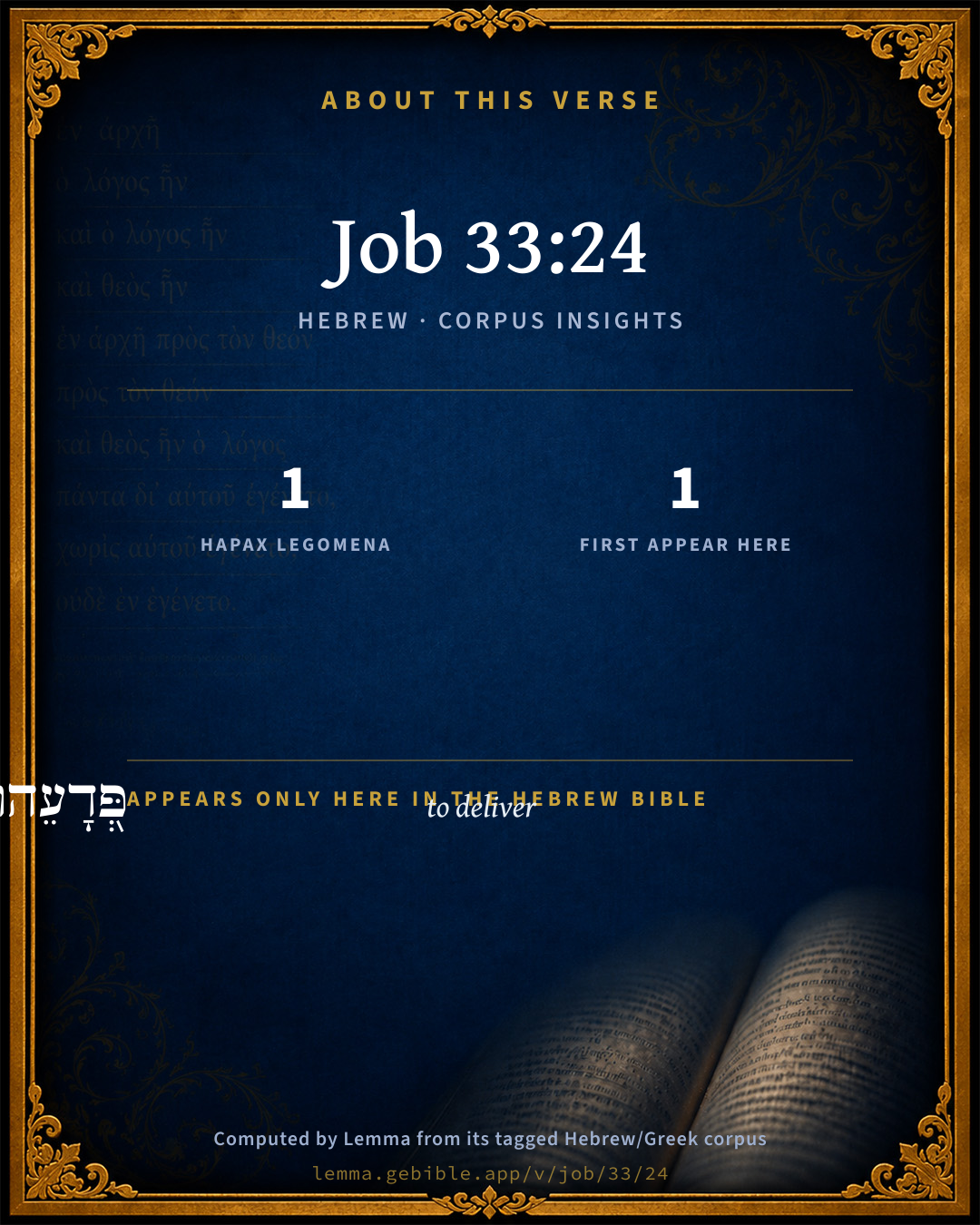
  • 1 hapax legomenon — only here in the Hebrew Bible
  • 1 first appearance in the Hebrew Bible
Full analysis ↓
Download a study sheet

One document with this verse’s original text, its word-by-word gloss line, the meaning frame, cross-references with their text, attributed commentary, and full source and license credits — printable, and it pastes into notes with its structure intact.

This verse Autodidact and up

Study sheet (.html) Plain text (.txt)

A passage Seminary Student

Up to 50 verses in one chapter. A passage sheet keeps up to 6 commentary sources and 12 cross-references per verse, in the order this page ranks them, and says so on the sheet whenever that leaves anything out. Ask for a single verse and you get the Autodidact verse sheet above.

Everything on this page stays free to read, with no account — the sheet is a download of what is already on screen, not access to it.

Want to remove ads? Support Godless Engineer
Compare translations 3

The same verse in 3 English versions, stacked beneath the original-language interlinear above. Click any original word for its lexicon entry.

Each is an independent rendering of the whole verse — the interlinear is not word-aligned to these translations.

Highlighted words mark where these versions differ — a whole-verse word diff, not a word-by-word alignment.

  • World English Bible Public Domain
    Then God is gracious to him, and says, 'Deliver him from going down to the pit, I have found a ransom.'
  • King James Version Public Domain
    Then he is gracious unto him, and saith, Deliver him from going down to the pit: I have found a ransom.
  • unfoldingWord Literal Text CC BY-SA 4.0
    and he is gracious to him and says, ‘Redeem him from going down to the pit, I have found a ransom,’

unfoldingWord Literal Text — © unfoldingWord, licensed CC BY-SA 4.0. Word-aligned USFM3 via Door43 (git.door43.org/unfoldingWord/en_ult).

Versions to compare (up to 4)

3 of 4 selected

Show all 18 translations

Every available English version of this verse, each an independent rendering of the whole verse.

  • World English Bible Public Domain
    Then God is gracious to him, and says, 'Deliver him from going down to the pit, I have found a ransom.'
  • Berean Standard Bible Public Domain
    to be gracious to him and say, ‘Spare him from going down to the Pit; I have found his ransom,’
  • Majority Standard Bible Public Domain
    to be gracious to him and say, ‘Spare him from going down to the Pit; I have found his ransom,’
  • King James Version Public Domain
    Then he is gracious unto him, and saith, Deliver him from going down to the pit: I have found a ransom.
  • American Standard Version (1901) Public Domain
    Then `God' is gracious unto him, and saith, Deliver him from going down to the pit, I have found a ransom.
  • Revised Version (1885) Public Domain
    Then he is gracious unto him, and saith, Deliver him from going down to the pit, I have found a ransom.
  • Geneva Bible (1599) Public Domain
    Then will he haue mercie vpon him, and will say, Deliuer him, that he go not downe into the pit: for I haue receiued a reconciliation.
  • Douay-Rheims (1899) Public Domain
    He shall have mercy on him, and shall say: Deliver him, that he may not go down to corruption: I have found wherein I may be merciful to him.
  • Young's Literal Translation Public Domain
    Then He doth favour him and saith, `Ransom him from going down to the pit, I have found an atonement.'
  • Literal Standard Version CC BY-SA 4.0
    Then He favors him and says, || Ransom him from going down to the pit, || I have found an atonement.
  • Unlocked Literal Bible CC BY-SA 4.0
    and if the angel is kind to him and says to God, 'Save this person from going down to the pit; I have found a ransom for him,'
  • unfoldingWord Literal Text CC BY-SA 4.0
    and he is gracious to him and says, ‘Redeem him from going down to the pit, I have found a ransom,’
  • Darby Bible Public Domain
    Then he will be gracious unto him, and say, Deliver him from going down to the pit: I have found a ransom.
  • World Messianic Bible Public Domain
    then God is gracious to him, and says, ‘Deliver him from going down to the pit, I have found a ransom.’
  • Webster's Bible Public Domain
    Then he is gracious to him, and saith, Deliver him from going down to the pit: I have found a ransom.
  • Free Bible Version CC BY-SA 4.0
    he will be gracious to them. He will say, ‘Save them from going down into the grave, for I have found a way to free them.’
  • Bible in Basic English Public Domain
    And if he has mercy on him, and says, Let him not go down to the underworld, I have given the price for his life:
  • JPS Tanakh (1917) Public Domain
    Then He is gracious unto him, and saith: 'Deliver him from going down to the pit, I have found a ransom.'

Literal Standard Version (2020), Covenant Press — licensed CC BY-SA 4.0. Text via the HelloAO Bible API (eBible.org). Unlocked Literal Bible (unfoldingWord) — licensed CC BY-SA 4.0. Text via the HelloAO Bible API (eBible.org). unfoldingWord Literal Text — © unfoldingWord, licensed CC BY-SA 4.0. Word-aligned USFM3 via Door43 (git.door43.org/unfoldingWord/en_ult). Free Bible Version, Dr. Jonathan Gallagher — licensed CC BY-SA 4.0. Text via the HelloAO Bible API (eBible.org).

Word by word

More ways to search: Search by grammar → Find every occurrence → Compare this word →

Practice this passage: Drill this verse → Learn its vocabulary →

About this verse

These counts appear in no published source. They are computed here, from the morphology-tagged text and Lemma’s own curated glosses. What Lemma adds →

7
words
7
distinct lemmas
Wisdom
section

Notable vocabulary

1 hapax legomenon — a word that appears only here in the entire Hebrew Bible:

  • פְּ֭דָעֵהוּ to deliver H6308

First appearance in Scripture

This word makes its first canonical appearance in the Hebrew Bible here:

  • פְּ֭דָעֵהוּ to deliver H6308

Shared distinctive vocabulary

כֹֽפֶר ransom H3724 occurs in 17 verses of the Hebrew Bible. Also found in:

Grammatical profile

  • 5 verbs
  • 2 nouns

Verb forms

  • וַיְחֻנֶּ֗נּוּ Qal · Sequential Imperfect
  • וַיֹּ֗אמֶר Qal · Sequential Imperfect
  • פְּ֭דָעֵהוּ Qal · Imperative
  • מֵרֶ֥דֶת Qal · Infinitive Construct
  • מָצָ֥אתִי Qal · Perfect

Hebrew & Septuagint length

In English translation the verse runs 21 words from the Hebrew and 28 from the Septuagint (LXX English) — closely comparable.

A rough comparison of the two English renderings, which tokenize alike — not a word-level alignment.

Word counts can differ between the Hebrew and the Greek without any difference in meaning — e.g. the Hebrew direct-object marker אֵת has no separate Greek word, and Greek often adds the article ὁ.

Cross-references

25

Topical passages linked to Job 33:24 in the Treasury of Scripture Knowledge — connected by theme and wording, ordered by reader-vote popularity; previews shown in the World English Bible.

  • Psalms 49:7–8 None of them can by any means redeem his brother, Nor give God a ransom for him.
  • Job 33:18 He keeps back his soul from the pit, And his life from perishing by the sword.
  • Matthew 20:28 even as the Son of Man came not to be served, but to serve, and to give his life as a ransom for many."
  • 1 Peter 1:18–19 knowing that you were redeemed, not with corruptible things, with silver or gold, from the useless way of life handed down from your fathers,
  • Exodus 33:19 He said, "I will make all my goodness pass before you, and will proclaim the name of Yahweh before you. I will be gracious to whom I will be gracious, and will show mercy on whom I will show mercy."
  • Job 22:21 "Acquaint yourself with him, now, and be at peace. Thereby good shall come to you.
  • Hosea 14:4 "I will heal their waywardness. I will love them freely; For my anger is turned away from him.
  • Micah 7:18–20 Who is a God like you, who pardons iniquity, And passes over the disobedience of the remnant of his heritage? He doesn't retain his anger forever, Because he delights in loving kindness.
  • Zechariah 9:11 As for you also, Because of the blood of your covenant, I have set free your prisoners from the pit in which is no water.
  • Romans 5:20–21 The law came in besides, that the trespass might abound; but where sin abounded, grace did abound more exceedingly;
  • 1 Timothy 2:6 who gave himself as a ransom for all; the testimony in its own times;
  • Exodus 34:6–7 Yahweh passed by before him, and proclaimed, "Yahweh! Yahweh, a merciful and gracious God, slow to anger, and abundant in loving kindness and truth,
  • Job 36:10–11 He also opens their ears to instruction, And commands that they return from iniquity.
  • Job 36:18 Don't let riches entice you to wrath, Neither let the great size of a bribe turn you aside.
  • Psalms 22:4 Our fathers trusted in you. They trusted, and you delivered them.
  • Psalms 30:9–12 "What profit is there in my destruction, if I go down to the pit? Shall the dust praise you? Shall it declare your truth?
  • Psalms 40:2 He brought me up also out of a horrible pit, Out of the miry clay. He set my feet on a rock, And gave me a firm place to stand.
  • Psalms 71:3 Be to me a rock of refuge to which I may always go. Give the command to save me, For you are my rock and my fortress.
  • Psalms 86:5 For you, Lord, are good, and ready to forgive; Abundant in loving kindness to all those who call on you.
  • Psalms 86:13 For your loving kindness is great toward me. You have delivered my soul from the lowest Sheol.
  • Psalms 86:15 But you, Lord, are a merciful and gracious God, Slow to anger, and abundant in loving kindness and truth.
  • Isaiah 38:17–19 Behold, [it was] for [my] peace [that] I had great bitterness: But you have in love to my soul delivered it from the pit of corruption; For you have cast all my sins behind your back.
  • Jeremiah 31:20 Is Ephraim my dear son? is he a darling child? for as often as I speak against him, I do earnestly remember him still: therefore my heart yearns for him; I will surely have mercy on him, says Yahweh.
  • Romans 3:24–26 being justified freely by his grace through the redemption that is in Christ Jesus;
  • Hosea 14:2 Take words with you, and return to Yahweh. Tell him, "Forgive all our sins, And accept that which is good: So we offer like bulls our lips.

Cross-references courtesy of OpenBible.info (CC BY 4.0).

Hebrew and Greek witnesses Masoretic Hebrew ↔ Greek Septuagint

The same verse in the two great witnesses to the Old Testament, shown verse-for-verse.

These are two independent witnesses, not word-aligned to each other, and the Septuagint is shown in lemma (dictionary) form.

Hebrew Job 33:24 Masoretic · Westminster Leningrad Codex

וַיְחֻנֶּ֗נּוּ וַיֹּ֗אמֶר פְּ֭דָעֵהוּ מֵרֶ֥דֶת שָׁ֗חַת מָצָ֥אתִי כֹֽפֶר

Then God is gracious to him, and says, 'Deliver him from going down to the pit, I have found a ransom.'

World English Bible · Public Domain

Greek LXX Job 33:24 Septuagint · lemma form

ἀντιἔχω ὁ μή πίπτω αὐτός εἰς θάνατος ἀνανεόω δέ αὐτός ὁ σῶμα ὥσπερ ἀλοιφή ἐπί τοῖχος ὁ δέ ὀστέον αὐτός ἐνπίμπλημι μυελός

he will support him, that he should not perish, and will restore his body as fresh plaster upon a wall; and he will fill his bones with morrow.

LXX2012 (modern English Septuagint) · Public Domain

On this verse, Albert Barnes' Notes on the Bible discusses the Septuagint’s reading. Read the note in Commentary ↓

Hebrew: Westminster Leningrad Codex (CC BY 4.0). Greek: Septuagint (public domain); English from LXX2012 (modern English Septuagint) (Public Domain). How the Septuagint differs from the Hebrew →

Commentary

Notes on Job 33:24 from classic Christian and Jewish commentators (each source and its license shown beneath its notes). The classic Christian expositions comment on the surrounding passage and are grouped to its opening verse, so a note may address several verses; the Jewish commentaries on the Tanakh (Rashi and others) are per-verse, so they appear only where the commentator wrote on this verse.

Lemma curates 59 commentaries, every one of them public domain or Creative Commons licensed, each selected and text-cleaned for this edition rather than reprinted as found. About our sources →

Trapp's Complete Commentary

John Trapp

Job 33:24 Then he is gracious unto him, and saith, Deliver him from going down to the pit: I have found a ransom.

Ver. 24. Then is he gracious unto him, and saith] If the sick man, thus counselled and comforted, repent and believe the gospel, delivering himself up to God, and to that his messenger by the will of God, mercy and truth shall be with him, he shall be cured on both sides, as that palsy man was, Mat 9:2, the Lord shall raise him up, if it may stand with his eternal welfare. But howsoever, if he have committed sins, it shall be forgiven him, Jas 5:15. Both the guilt and filth of them shall be taken away, so that he shall be able to look death in the face with everlasting comfort, as being made to him ianua vitae, porta coeli; a postern, to let out temporal, but a street door, to let in eternal, life.

Deliver him from going down to the pit] Tell him from me, that he shall not die, but live, and declare the works of the Lord, as Psa 118:17. Nay, say to this righteous man, tell him so from me, that it shall be well with him, and very well, Isa 3:10. Redeem him from going down to the infernal pit; that is, declare that redemption to him wrought for him by Christ, and apply it to his conscience, pour the oil of grace into his broken vessel, and assure him in my name, and by mine authority, that I am his salvation. Whose sins soever ye, my faithful ministers, remit, they are remitted unto them; and whatsoever ye loose on earth, shall be loosed in heaven, Mat 18:18 Job 20:23. But all this ministerially and declaratively, not absolutely and out of a full liberty and power, as Popish priests arrogate. I have known one (saith a very grave divine, Mr Ley, in his Pattern of Piety) who neither by education nor affection was disposed to Popery, who having the ill hap when his conscience was perplexed to fall into the hands of a Popish priest, for this reason (because, as the priest suggested, that religion afforded more comfort, because it had, and exercised, a power to pardon sin, which our ministers neither did, nor dared assume unto themselves) he became a Papist. But it is honour enough to ministers, and may be comfort enough to their hearers, that God gives them commission to deliver a penitent man from hell; not as the means (for that is Christ alone), but as instruments: 1. To apply Christ crucified, or rather risen again, unto him. 2. To pronounce his safety and salvation, upon the due use of that means. And this is the greatest honour that ever was done to any mere creature. Angels never had such a commission. They indeed are ministers for the good of those that shall be heirs of salvation, Heb 1:14; but ministers are called Saviours, Oba 1:21 1Ti 4:16 Jas 5:20.

I have found a ransom] Or, an atonement; a cover for his sin; as a thing is covered with plaster; or as, under the law, the ark covered the decalogue, the mercy seat upon it, and over them two cherubims covering one another; all which showed Christ covering the curses of the law, and expiating the sins of his people: which things the angels desire to pry into, as into the patterns of God’s deep wisdom, who hath found out such a ransom, which he now professeth to accept for this penitent man, 1Ti 2:6 Psa 32:1.

John Trapp, A Commentary or Exposition upon All the Books of the Old and New Testament (1647–1656) — public domain. Text from a community e-Sword module.

Tyndale Open Study Notes

Tyndale Open Resources

33:24 The ransom is ultimately found in Christ (Matt 20:28; Rom 3:24-25; 1 Tim 2:6; 1 Pet 1:18-19).

Tyndale Open Study Notes — © Tyndale Open Resources, licensed CC BY-SA 4.0. Text via the HelloAO Bible API.

Geneva Bible (1599)

Geneva Bible translators

He showeth that it is a sure token of God’s mercy toward sinners, when he causeth his word to be preached unto them.

That is, the minister shall by the preaching of the word pronounce unto him the forgiveness of his sins.

Geneva Bible (1599) marginal notes — public domain. Text via Bolls.life.

Jamieson, Fausset & Brown

Robert Jamieson, A. R. Fausset & David Brown

Apodosis to Job 33:23.

he--God.

Deliver--literally, "redeem"; in it and "ransom" there is reference to the consideration, on account of which God pardons and relieves the sufferers; here it is primarily the intercession of Elihu. But the language is too strong for its full meaning to be exhausted by this. The Holy Ghost has suggested language which receives its full realization only in the "eternal redemption found" by God in the price paid by Jesus Christ for it; that is, His blood and meritorious intercession (Heb 9:12). "Obtained," literally, "found"; implying the earnest zeal, wisdom, and faithfulness of the finder, and the newness and joyousness of the finding. Jesus Christ could not but have found it, but still His seeking it was needed [BENGEL], (Luk 15:8). God the Father, is the Finder (Psa 89:19). Jesus Christ the Redeemer, to whom He saith, Redeem (so Hebrew) him from going, &c. (Co2 5:19).

ransom--used in a general sense by Elihu, but meant by the Holy Ghost in its strict sense as applied to Jesus Christ, of a price paid for deliverance (Exo 21:30), an atonement (that is, means of selling at once, that is, reconciling "two" who are estranged), a covering, as of the ark with pitch, typical of what covers us sinners from wrath (Gen 6:14; Psa 32:1). The pit is primarily here the grave (Isa 38:17), but the spiritual pit is mainly shadowed forth (Zac 9:11).

Jamieson, Fausset & Brown — Commentary Critical and Explanatory on the Whole Bible (1871) — public domain (CC PDM 1.0). Text via the HelloAO Bible API.

Adam Clarke's Commentary

Verse 24. Then he is gracious unto him] He exercises mercy towards fallen man, and gives command for his respite and pardon.

Deliver him from going down to the pit] Let him who is thus instructed, penitent, and afflicted, and comes to me, find a pardon; for:-

VI. I have found a ransom.] כפר copher, an atonement. Pay a ransom for him, פדעהו pedaehu, that he may not go down to the pit-to corruption or destruction, for I have found out an atonement. It is this that gives efficacy to all the preceding means; without which they would be useless, and the salvation of man impossible. I must think that the redemption of a lost world, by Jesus Christ, is not obscurely signified in Job 33:23-24.

While the whole world lay in the wicked one, and were all hastening to the bottomless pit, God so loved the world that he gave his only-begotten Son, that whosoever believeth on him might not perish, but have everlasting life. Jesus Christ, the great sacrifice, and head of the Church, commissions his messengers-apostles and their successors-to show men the righteousness of God, and his displeasure at sin, and at the same time his infinite love, which commands them to proclaim deliverance to the captives, and that they who believe on him shall not perish, shall not go down to the pit of destruction, for he has found out an atonement; and that whoever comes to him, through Christ, shall have everlasting life, in virtue of that atonement or ransom price.

Should it be objected against my interpretation of אלף aleph, that it cannot be translated chief or head, because it is without the vau shurek, אלוף alluph, which gives it this signification; I would answer, that this form of the word is not essential to the signification given above, as it occurs in several places without the vau shurek, where it most certainly signifies a chief, a leader, captain, c., e.g., Zec 9:7 Jer 13:21, and Ge 36:30; in the first of which we translate it governor; in the second, captain; and in the third, duke. And although we translate alluph an ox or beeve, (and it most certainly has this meaning in several places,) yet in this signification it is written without the vau shurek in Pr 14:4; Ps 8:7; Isa 30:24; and in De 7:13; De 28:4; De 28:18; De 28:51; which all show that this letter is not absolutely necessary to the above signification.

Adam Clarke's Commentary on the Bible (1810–1826) — public domain. Text from a community e-Sword/MySword module.

Ellicott's Commentary for English Readers

(24) Then he is gracious unto him—i.e., God is gracious; He accepts the mediation of the mediating angel. These words of Elihu’s must have fallen on Job’s ear with a grateful and refreshing sound, confirming to him his longing for the daysman (Job_9:33).

And saith—i.e., to the destroying angels of Job_33:22. It is remarkable that it is God who finds the ransom, as it was by God’s grace that the interpreting angel was forthcoming. It is not man’s righteousness that has saved him, but the ransom that God has found, even though God, who judgeth the actions, may have justly recognised what of righteousness there was in man.

A Bible Commentary for English Readers, edited by Charles John Ellicott (1878–1897) — public domain. Text from a community e-Sword module.

The Cambridge Bible for Schools and Colleges

gen. ed. J. J. S. Perowne

24. then he is gracious] God is gracious; God, not the angel, is the speaker in the rest of the verse. It is assumed that when the sufferer is shewn what is right (Job_33:23) he follows it; then God is gracious unto him, and commands that he be delivered from his affliction and saved from death. It is hardly of consequence to enquire what the ransom is which God has found. It may be the sinner’s repentance and return to rectitude; or it may be that the affliction is held sufficient (Isa_40:2; Job_36:18); or possibly the words may mean nothing more than that God is pleased of His goodness to hold the sinner as ransomed and delivered from the consequences of his sin.

The Cambridge Bible for Schools and Colleges (gen. ed. J. J. S. Perowne; Cambridge University Press, 1878–1918) — public domain. Text from a community e-Sword module.

John Gill's Exposition

Then he is gracious to him,.... To the sick man; either the messenger or the minister that is with him, who pities his case and prays for him; and by some the following words are supposed to be a prayer of his, "deliver me", &c. since one find in the Gospel there is a ransom for such persons. Rather Christ, who is gracious to man, as appears by his assumption of their nature and becoming a ransom for them, and who upon the foot of redemption which he has "found" or obtained, see Heb 9:12; pleads for the present comfort and future happiness of his people, in such language as after expressed, "deliver him", &c. Or rather God the Father is gracious to the sick man for his Son's sake,

and saith, deliver him from going down to the pit; addressing either the disease, so Mr. Broughton renders the word, "spare him (O killing malady) from descending into the pit", the grave, for the present his disease threatened him with. Or the minister of the word attending the sick man, who is bid to declare to him, as Nathan to David, and Isaiah to Hezekiah, that he should live longer, and not die for the present: or rather the address is to law and justice, to let the redeemed of the Lord go free, and particularly the sick man being one of them; and not thrust him down into the bottomless pit of everlasting ruin and destruction, for the reason following:

I have found a ransom; which is no other than Christ the Son of God; whom Jehovah, in his infinite wisdom, found out and settled upon to be the ransomer of his people; to which he agreed, and in the fulness of time came to give his life a ransom for many, and for whom he has given himself as a ransom price, which has been testified in due time: and this ransom is for all the elect of God, and is of them from sin, Satan, law, hell, and death; and the finding of it is not of man, nor is the scheme of propitiation, peace and reconciliation by Christ, or of atonement and satisfaction (s) by the sacrifice of Christ, as the word here used signifies, an invention of men; but is the effect of infinite wisdom, and a scheme drawn in the eternal mind, and formed in Christ from everlasting; see Co2 5:19. Some take these words to be spoken by the Father to the Son, upon his appointment and agreement to be the ransomer and Redeemer, saying, "go, redeem him", &c. for so the words (t) may be rendered; and others think they are the words of the Son the messenger to his Father, the advocate with him for his people, as before observed.

(s) "propitiationem", Beza, Pagninus, Montanus, Munster, Bolducius, Vatablus; "expiationem", Tigurine version; "lytrum", Cocceius; "satisfactionem", Schmidt. (t) "redime eum", Pagninus, Montanus &c.

John Gill's Exposition of the Whole Bible (1746–1763) — public domain (CC PDM 1.0). Text via the HelloAO Bible API.

Albert Barnes' Notes on the Bible

Then he is gracious unto him - That is, on the supposition that he hears and regards what the messenger of God communicates. If he rightly understands the reasons of the divine administration, and acquiesces in it, and if he calls upon God in a proper manner Job 33:26, he will show him mercy, and spare him. Or it may mean, that God is in fact gracious to him by sending him a messenger who can come and say to him that it is the divine purpose to spare him; that he is satisfied, and will preserve him from death. If such a messenger should come, and so announce the mercy of God, then he would return to the rigoar of his former days, and be fully restored to his former prosperity. Elihu refers probably to some method of communication, by which the will of God was made known to the sufferer, and by which it was told him that it was God’s design not to destroy, but to discipline and save him.

Deliver him - Hebrew, פדעהו pâda‛hû, “redeem him”. The word used here (פדע pâda‛) properly means “to let loose, to cut loose”; and then “to buy loose”; that is, “to redeem, to ransom for a price.” Sometimes it is used in the general sense of freeing or delivering, without reference to a price, compare Deu 7:8; Jer 15:21; Psa 34:22; Job 6:23; but usually there is a reference to a price, or to some valuable consideration, either expressed or implied; compare the notes at Isa 43:3. Here the appropriate idea is expressed, for it is said, as a reason for redeeming or rescuing him, “I have found a ransom.” That is, the “ransom” is the valuable consideration on account of which he was to be rescued from death.

From going down to the pit - The grave, the world of darkness. Notes, Job 33:18. That is, he would keep him alive, and restore him again to health. It is possible that by the word pit here, there may be a reference to a place of punishment, or to the abodes of the dead as places of gloom and horror especially in the case of the wicked but the more probable interpretation is, that it refers to death alone.

I have found - That is, there is a ransom; or, I have seen a reason why he should not die. The idea is, that God was looking for some reason on account of which it would be proper to release the sufferer, and restore him to the accustomed tokens of his favor and that such a ransom had now appeared. There was now no necessity why those sufferings should be prolonged, and he could consistently restore him to health.

A ransom - Margin, or, “an atonement.” Hebrew, כפר kôpher. On the meaning of this word, see the notes at Isa 43:3. The expression here means that there was something which could be regarded as a valuable consideration, or a reason why the sufferer should not be further afflicted, and why he should be preserved from going down to the grave. What that price, or valuable consideration was, is not specified; and what was the actual idea which Elihu attached to it, it is now impossible with certainty to determine. The connection would rather lead us to suppose that it was something seen in the sufferer himself; some change done in his mind by his trials; some evidence of acquiescence in the government of God, and some manifestation of true repentance, which was the reason why the stroke of punishment should be removed, and why the sufferer should be saved from death. This might be called by Elihu “a ransom” - using the word in a very large sense.

There can be no doubt that such “a fact” often occurs. God lays his hand on his erring and wandering children. He brings upon them afflictions which would consign them to the grave, if they were not checked. Those afflictions are effectual in the case. They are the means of true repentance; they call back the wanderer; they lead him to put his trust in God, and to seek his happiness again in him; and this result of his trials is a reason why they should extend no further. The object of the affliction has been accomplished, and the penitence of the sufferer is a sufficient reason for lightening the hand of affliction, and restoring him again to health and prosperity. This is not properly an atonement, or a ransom, in the sense in which the word is now technically used, but the Hebrew word used here would not be inappropriately employed to convey such an idea. Thus, in Exo 32:30, the intercession of Moses is said to be that by which an atonement would be made for the sin of the people.

“Moses said unto the people, Ye have sinned a great sin; and now I will go up unto the Lord; peradventure I shall make an atonement (אכפרה 'ekâpharâh, from כפר kâphar), for your sin.” Here, it is manifest that the act of Moses in making intercession was to be the public reason, or the “ransom,” why they were not to be punished. So the boldness, zeal, and fidelity of Phinehas in resisting idolatry, and punishing those who had been guilty of it, are spoken of as the atonement or ransom on account of which the plague was stayed, and the anger of God removed from his people; Num 25:12-13, “Behold, I give unto him my covenant of peace - because he was zealous for his God, and made an atonement (ויכפר vaykâphar) for the children of Israel.” Septuagint, ἐξιλάσατο exilasato. In this large sense, the sick man’s repentance might be regarded as the covering, ransom, or public reason why he should be restored.

That word literally means that which covers, or overlays any thing; and then an atonement or expiation, as being such a covering. See Gen. 20, 16; Exo 21:30. Cocceius, Calovius, and others suppose that the reference here is to the Messiah, and to the atonement made by him. Schultens supposes that it has the same reference by anticipation - that is, that God had purposed such a ransom, and that in virtue of the promised and pre-figured expiation, he could now show mercy. But it cannot be demonstrated that Elihu had such a reference; and though it was undoubtedly true that God designed to show mercy to people only through that atonement, and that it was, and is, only by this that release is ever given to a sufferer, still, it does not follow that Elihu fully understood this. The general truth that God was merciful, and that the repentance of the sick man would be followed by a release from suffering, was all that can reasonably be supposed to have been understood at that. period of the world. Now, we know the reason, the mode, and the extent of the ransom; and taking the words in their broadest sense, we may go to all sufferers, and say, that they may be redeemed from going down to the dark chambers of the eternal pit, for God has found a ransom. A valuable consideration has been offered, in the blood of the Redeemer, which is an ample reason why they should not be consigned to hell, if they are truly penitent.

Albert Barnes' Notes on the Bible (1834–1885) — public domain. Text from a community e-Sword/MySword module.

Matthew Poole's English Annotations

Then; in that case, or upon the sick man’s knowledge and practice of his duty.

He; either,

1. The messenger or interpreter last mentioned, who is pitiful unto the sick man, and in companion to him doth all that he can for him, counselling and comforting him, and praying to God for his recovery in the following words,

Deliver him, & c. for the sake of that ransom which thou hast revealed and I have discovered to him. Or rather,

2. God, who is oft in this book designed by this particle he, or him; whose property and prerogative it is to be gracious unto man, and who alone can speak the following words with power and authority.

Is gracious unto him; pardoning his sins, and delivering him from his dangerous disease, and from death and from the hell which attends upon it.

And saith, to the angel or messenger.

Deliver him, to wit, ministerially and declaratively; in which sense the acts of forgiving sins, and reconciling sinners, and saving souls, are ascribed to God’s ministers; as Joh 20:23; 2Co 5:19,20; 1Ti 4:16. Declare to him that I have pardoned and will heal him.

I have found a ransom: although I might justly destroy him, and should do it, if I were severe to mark what is amiss in him; yet I will spare him, for I have found out an expedient and a way of ransoming and redeeming sinners from death, both temporal and eternal, which they by their sins have deserved, which is by the death of my Son, the Redeemer of the world, which shall be in the fulness of time, and with respect to which I will pardon this sick man, and others that shall repent and sue to me for mercy, as he hath done.

Matthew Poole's English Annotations on the Holy Bible (1683–1685) — public domain. Text from a community e-Sword/MySword module.

Whedon's Commentary on the Bible

Daniel D. Whedon

24. I have found — The finding alluded to in מצאתי is, primarily, that which comes from search or effort. The use of the word is similar to that of ευραμενος in Heb_9:12 : “Having obtained (found) eternal redemption.” Compare “find grace,” Heb_4:16. A ransom — Margin, an atonement, כפר, kopher, that which covers, is generally used with respect to sin in the sense of making expiation. It is the substitutive consideration, whether of money, (Exo_30:12,) blood, or life, by which guilt is regarded as covered up, and in a certain sense concealed from the eye of God. In the ancient economy of grace God was pleased to accept the propitiatory offering, (ransom,) or, more properly, the motive implied in its presentation, and to look propitiously upon weak and erring man. The great angel here intervenes with his ransom, the nature of which Elihu does not disclose, and saves man from going down to the pit. Elihu again alludes to this ransom under the same term, kopher. when the danger is in like manner indescribably great. Comp. Job_36:18, on which see note. The fact that the great ransom (kopher) there (Job_36:18) cannot be repentance, is quite decisive against the view of Hengstenberg, that the ransom spoken of here is repentance.

Daniel D. Whedon (gen. ed.), Commentary on the Old and New Testaments (1874–1909) — public domain. Text from a community e-Sword module.

The Pulpit Commentary

Then he is gracious unto him; and saith. Some interpret, "Then he (i.e. God) is gracious unto him, and he (i.e. the angel) saith. Others make God the subject of both clauses. But the angel is the natural subject. Deliver him from going down to the pit. The mediating angel thus addresses God, and adds, I have found a ransom, leaving the nature of the ransom unexplained. Some notion of ransom, or atonement, underlay the whole idea of sacrifice, which appears to have been universally practised from the remotest times, by the Oriental nations.

The Pulpit Commentary (1880–1919), ed. H.D.M. Spence-Jones & Joseph S. Exell — public domain. Text from a community e-Sword module.

John Wesley's Explanatory Notes

He - God. A ransom - Although I might justly destroy him, yet I will spare him, for I have found out a way of ransoming sinners from death, which is the death of my son, the redeemer of the world, and with respect to which I will pardon them that repent and sue for mercy. Observe how God glories in the invention! I have found, I have found a ransom; a ransom for poor, undone sinners! I, even I am he that hath done it.

John Wesley, Explanatory Notes Upon the Whole Bible (1754–1765) — public domain. Text via the GEBible commentary corpus.

Rashi

Rabbi Shlomo Yitzchaki (Rashi)

He is gracious to him i.e., the Omnipresent.

Redeem him Heb. פדעהו, like פְדָאֵהוּ. The “alef” is replaced by an “ayin.” The context proves it. “I found ransom,” which is redemption.

Rashi on the Tanakh — English translations: “The Judaica Press complete Tanach with Rashi, translated by A. J. Rosenberg” (CC BY 4.0); “Pentateuch with Rashi's commentary by M. Rosenbaum and A.M. Silbermann, 1929-1934” (public domain); “The Metsudah Tanach series, Lakewood, N.J” (CC BY 4.0); and “The Book of Joshua, Metsudah Publications, 1997” (CC BY 4.0). Text via Sefaria.

Lesson kit

Teaching starters — assembled from the data on this page, not authored interpretation. Every prompt links to the verse data it draws on. Edit before teaching.

Job, in the Wisdom, opens this verse with 7 words (7 distinct Hebrew lemmas). Its most distinctive word is pâdaʻ (“to deliver”). A historical commentator’s framing appears above. Read the whole chapter for the surrounding context.

Discussion questions

  1. What does “to deliver” (pâdaʻ) contribute to the verse as a whole?
  2. 1 word here appears nowhere else in the Hebrew Bible. Why might the author reach for such rare wording?
  3. This is the first place “to deliver” appears in Scripture (first appears here). What does its debut here establish?
  4. How does Genesis 6:14, which shares the word «ransom», read alongside this verse?
  5. These translations render this verse differently. What is at stake in choosing one wording over another?
  6. «וַיְחֻנֶּ֗נּוּ» is a Qal Sequential Imperfect verb. How does that grammatical form shape the action described?
  7. Compare how Trapp's Complete Commentary and Tyndale Open Study Notes read this verse. Where do they agree or differ?

Things to notice

  • 1 word in this verse appears nowhere else in the Hebrew Bible.
  • 1 word makes its first canonical appearance in Scripture here.
  • These translations choose different wording for 4 words in this verse.
  • 7 distinct Hebrew lemmas span 7 words in this verse.

Reading settings

Reading text

Shown beneath each verse's original-language words.

Old Testament
Old Testament edition

Read the OT as the Masoretic Hebrew (MT) or the Greek Septuagint (LXX).

English shown for the Greek Septuagint (in the Hebrew ↔ Greek comparison).

Comparing translations? Open the Compare panel on any verse page to stack up to four side by side.