1 Corinthians 10:17

Greek (Tischendorf 8th ed.) 1 Corinthians 10:17 appears in the Greek New Testament. The text above is from the Tischendorf 8th edition. Each word links to its Strong’s number and a concise gloss. Click any word for its full Thayer’s Greek Lexicon entry.
Download image
Cite this verse

1 Corinthians 10:17 (World English Bible). Public Domain. Lemma interlinear Bible study tool, https://lemma.gebible.app/v/1-corinthians/10/17.

Show BibTeX & RIS
BibTeX
RIS
English Translation
Because we, who are many, are one bread, one body; for we all partake of the one bread.
World English Bible · Public Domain
Download a study sheet

One document with this verse’s original text, its word-by-word gloss line, the meaning frame, cross-references with their text, attributed commentary, and full source and license credits — printable, and it pastes into notes with its structure intact.

This verse Autodidact and up

Study sheet (.html) Plain text (.txt)

A passage Seminary Student

Up to 50 verses in one chapter. A passage sheet keeps up to 6 commentary sources and 12 cross-references per verse, in the order this page ranks them, and says so on the sheet whenever that leaves anything out. Ask for a single verse and you get the Autodidact verse sheet above.

Everything on this page stays free to read, with no account — the sheet is a download of what is already on screen, not access to it.

Want to remove ads? Support Godless Engineer
Compare translations 3

The same verse in 3 English versions, stacked beneath the original-language interlinear above. Click any original word for its lexicon entry.

Each is an independent rendering of the whole verse — the interlinear is not word-aligned to these translations.

Highlighted words mark where these versions differ — a whole-verse word diff, not a word-by-word alignment.

  • World English Bible Public Domain
    Because we, who are many, are one bread, one body; for we all partake of the one bread.
  • King James Version Public Domain
    For we being many are one bread, and one body: for we are all partakers of that one bread.
  • unfoldingWord Literal Text CC BY-SA 4.0
    Because one bread, we the many one body; for we all partake from the one bread.

unfoldingWord Literal Text — © unfoldingWord, licensed CC BY-SA 4.0. Word-aligned USFM3 via Door43 (git.door43.org/unfoldingWord/en_ult).

Versions to compare (up to 4)

3 of 4 selected

Show all 19 translations

Every available English version of this verse, each an independent rendering of the whole verse.

  • World English Bible Public Domain
    Because we, who are many, are one bread, one body; for we all partake of the one bread.
  • Berean Standard Bible Public Domain
    Because there is one loaf, we who are many are one body; for we all partake of the one loaf.
  • Majority Standard Bible Public Domain
    Because there is one loaf, we who are many are one body; for we all partake of the one loaf.
  • King James Version Public Domain
    For we being many are one bread, and one body: for we are all partakers of that one bread.
  • American Standard Version (1901) Public Domain
    seeing that we, who are many, are one bread, one body: for we are all partake of the one bread.
  • Revised Version (1885) Public Domain
    seeing that we, who are many, are one bread, one body: for we all partake of the one bread.
  • Geneva Bible (1599) Public Domain
    For we that are many, are one bread and one body, because we all are partakers of one bread.
  • Douay-Rheims (1899) Public Domain
    For we, being many, are one bread, one body, all that partake of one bread.
  • Young's Literal Translation Public Domain
    because one bread, one body, are we the many -- for we all of the one bread do partake.
  • Literal Standard Version CC BY-SA 4.0
    Because one bread, one body, are we the many—for we all partake of the one bread.
  • Unlocked Literal Bible CC BY-SA 4.0
    Because there is one loaf of bread, we who are many are one body. We all take of one loaf of bread together.
  • unfoldingWord Literal Text CC BY-SA 4.0
    Because one bread, we the many one body; for we all partake from the one bread.
  • Darby Bible Public Domain
    Because we, [being] many, are one loaf, one body; for we all partake of that one loaf.
  • World Messianic Bible Public Domain
    Because there is one loaf of bread, we, who are many, are one body; for we all partake of the one loaf of bread.
  • Webster's Bible Public Domain
    For we being many are one bread, and one body: for we are all partakers of that one bread.
  • Free Bible Version CC BY-SA 4.0
    By eating from one loaf of bread, we show that even though we are many, we are one body.
  • Bible in Basic English Public Domain
    Because we, being a number of persons, are one bread, we are one body: for we all take part in the one bread.
  • Text-Critical English NT CC BY 4.0
    Because we, who are many, are one bread and one body; for we all partake of the one bread.
  • Tyndale New Testament (1534) Public Domain
    because that we (though we be many) yet are one breed and one bodye in as moch as we all are partetakers of one breed.

Literal Standard Version (2020), Covenant Press — licensed CC BY-SA 4.0. Text via the HelloAO Bible API (eBible.org). Unlocked Literal Bible (unfoldingWord) — licensed CC BY-SA 4.0. Text via the HelloAO Bible API (eBible.org). unfoldingWord Literal Text — © unfoldingWord, licensed CC BY-SA 4.0. Word-aligned USFM3 via Door43 (git.door43.org/unfoldingWord/en_ult). Free Bible Version, Dr. Jonathan Gallagher — licensed CC BY-SA 4.0. Text via the HelloAO Bible API (eBible.org).

Word by word

More ways to search: Search by grammar → Find every occurrence → Compare this word →

Practice this passage: Drill this verse → Learn its vocabulary →

μετέχομεν
metéchō
G3348
“to partake”
Verb, Present, Active, Indicative, 1st person, Plural
Part of Speech
Verb
Tense
Present
Voice
Active
Mood
Indicative
Person
1st person
Number
Plural
Full Thayer's Definition

Origin: from G3326 and G2192

TDNT: 15:50,3

1. to be or become partaker 2. to partake
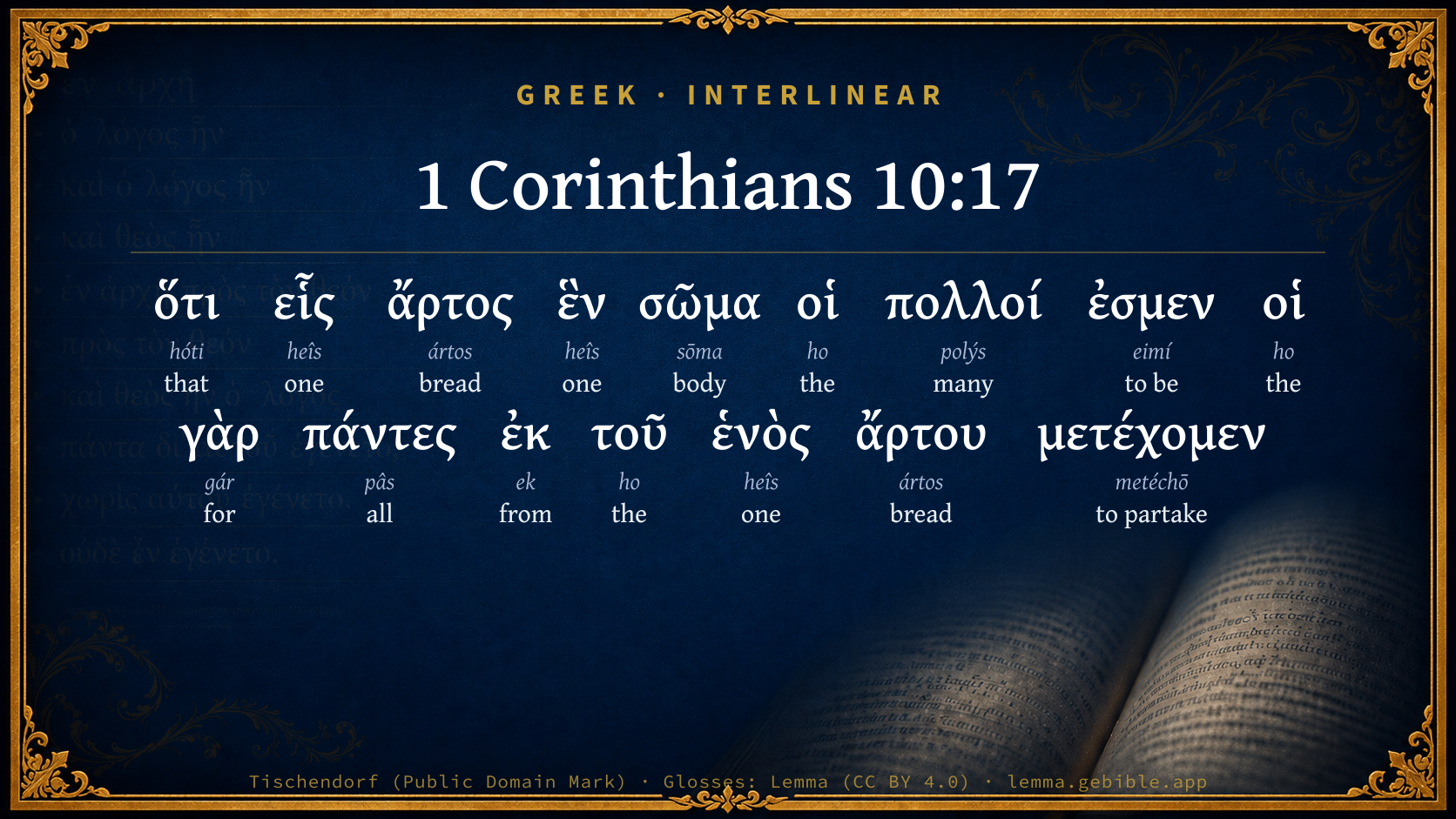
  1. ὅτι hóti G3754 “that” Conjunction
  2. εἷς heîs G1520 “one” Adjective, Nominative, Singular, Masculine
  3. ἄρτος ártos G740 “bread” Noun, Nominative, Singular, Masculine
  4. ἓν heîs G1520 “one” Adjective, Nominative, Singular, Neuter
  5. σῶμα sōma G4983 “body” Noun, Nominative, Singular, Neuter
  6. οἱ ho G3588 “the” Article, Nominative, Plural, Masculine
  7. πολλοί polýs G4183 “many” Adjective, Nominative, Plural, Masculine
  8. ἐσμεν eimí G1510 “to be” Verb, Present, Active, Indicative, 1st person, Plural
  9. οἱ ho G3588 “the” Article, Nominative, Plural, Masculine
  10. γὰρ gár G1063 “for” Conjunction
  11. πάντες pâs G3956 “all” Adjective, Nominative, Plural, Masculine
  12. ἐκ ek G1537 “from” Preposition
  13. τοῦ ho G3588 “the” Article, Genitive, Singular, Masculine
  14. ἑνὸς heîs G1520 “one” Adjective, Genitive, Singular, Masculine
  15. ἄρτου ártos G740 “bread” Noun, Genitive, Singular, Masculine

About this verse

These counts appear in no published source. They are computed here, from the morphology-tagged text and Lemma’s own curated glosses. What Lemma adds →

16
words
11
distinct lemmas
Pauline Epistles
section

Notable vocabulary

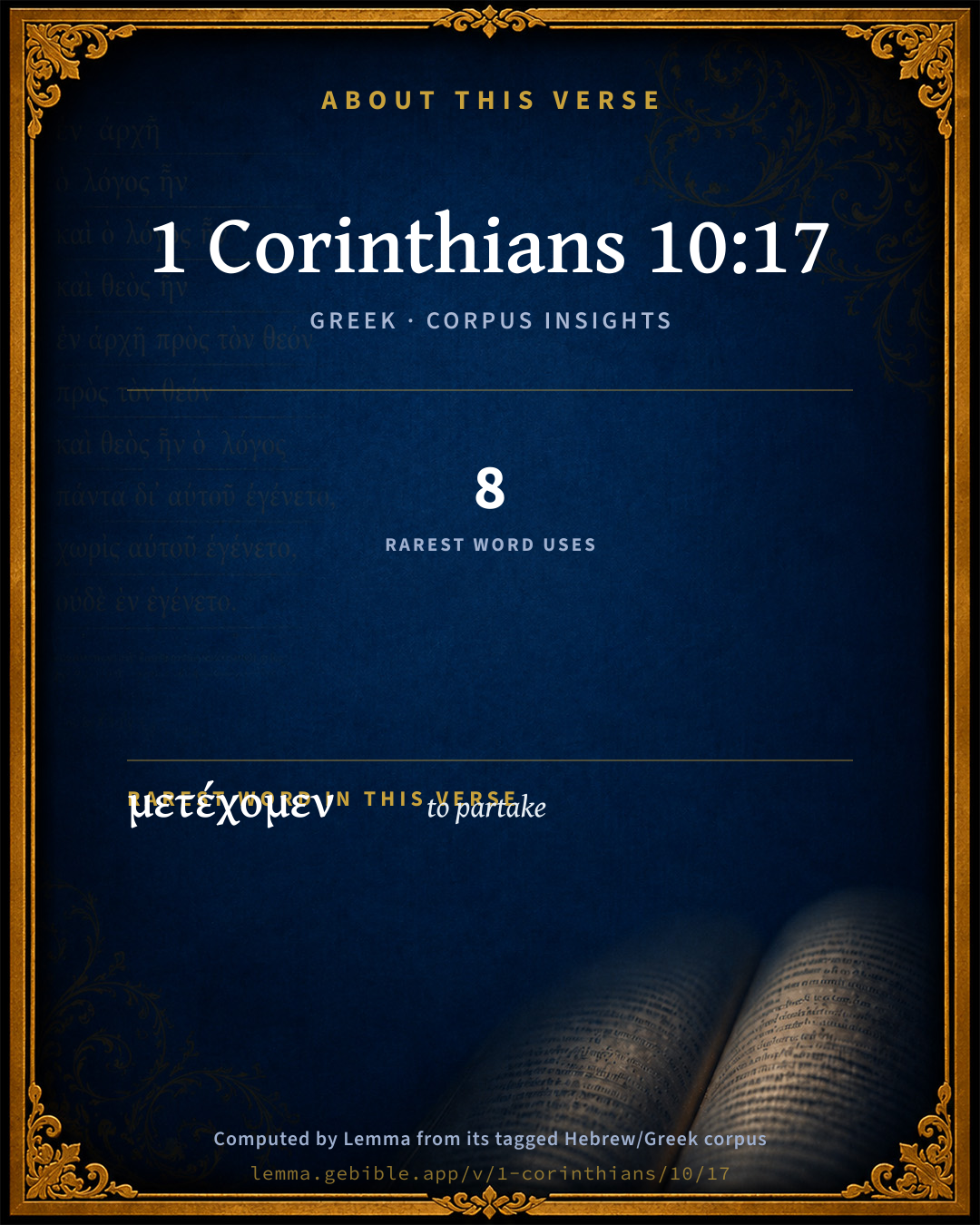
The rarest word here is μετέχομεν to partake G3348 — appearing just 8 times in the whole Greek New Testament.

Shared distinctive vocabulary

μετέχομεν to partake G3348 occurs in 8 verses of the Greek New Testament. Also found in:

Repetition

Words recur within this verse:

  • εἷς one G1520 ×3
  • ἄρτος bread G740 ×2
  • οἱ the G3588 ×3

Cross-references

17

Topical passages linked to 1 Corinthians 10:17 in the Treasury of Scripture Knowledge — connected by theme and wording, ordered by reader-vote popularity; previews shown in the World English Bible.

  • Romans 12:5 so we, who are many, are one body in Christ, and individually members one of another.
  • Colossians 3:15 And let the peace of God rule in your hearts, to which also you were called in one body; and be thankful.
  • 1 Corinthians 12:12 For as the body is one, and has many members, and all the members of the body, being many, are one body; so also is Christ.
  • 1 Corinthians 12:27 Now you are the body of Christ, and members individually.
  • Ephesians 4:4 There is one body, and one Spirit, even as you also were called in one hope of your calling;
  • Ephesians 4:12–13 for the perfecting of the saints, to the work of serving, to the building up of the body of Christ;
  • Ephesians 4:16 from whom all the body, being fitted and knit together through that which every joint supplies, according to the working in measure of each individual part, makes the body increase to the building up of itself in love.
  • Ephesians 4:25 Therefore, putting away falsehood, speak truth each one with his neighbor. For we are members one of another.
  • Galatians 3:26–28 For you are all children of God, through faith in Christ Jesus.
  • Ephesians 2:15–16 having abolished in the flesh the hostility, the law of commandments contained in ordinances, that he might create in himself one new man of the two, making peace;
  • Ephesians 3:6 that the Gentiles are fellow heirs, and fellow members of the body, and fellow partakers of his promise in Christ Jesus through the Gospel,
  • Colossians 3:11 where there can't be Greek and Jew, circumcision and uncircumcision, barbarian, Scythian, bondservant, freeman; but Christ is all, and in all.
  • 1 Corinthians 10:3–4 and all ate the same spiritual food;
  • 1 Corinthians 10:21 You can't both drink the cup of the Lord and the cup of demons. You can't both partake of the table of the Lord, and of the table of demons.
  • 1 Corinthians 11:26–28 For as often as you eat this bread and drink this cup, you proclaim the Lord's death until he comes.
  • Ephesians 1:22–23 He put all things in subjection under his feet, and gave him to be head over all things for the assembly,
  • Colossians 2:19 and not holding firmly to the Head, from whom all the body, being supplied and knit together through the joints and ligaments, grows with God's growth.

Cross-references courtesy of OpenBible.info (CC BY 4.0).

Commentary

Notes on 1 Corinthians 10:17 from classic Christian and Jewish commentators (each source and its license shown beneath its notes). The classic Christian expositions comment on the surrounding passage and are grouped to its opening verse, so a note may address several verses; the Jewish commentaries on the Tanakh (Rashi and others) are per-verse, so they appear only where the commentator wrote on this verse.

Lemma curates 59 commentaries, every one of them public domain or Creative Commons licensed, each selected and text-cleaned for this edition rather than reprinted as found. About our sources →

Bengel's Gnomon

Johann Albrecht Bengel

1Co 10:17. Ὅτι, since) He proves, that the cup and the bread are the communion; for the bread by itself does not make them that eat it, become one body; but the bread does so, in so far as it is communion, etc.—εἷς ἄρτος (one bread), viz. there is [and indeed it is such bread as is broken, and carries with it (implies in the participation of it) the communion of the body of Christ.—V. g.]—οἱ πολλοὶ, the many) believers [Eng. Vers. is different, “We being many are one bread and one body”].—ἐκ τοῦ ἑνὸς ἄρτου, of the one bread) and therefore also of the one cup.

Bengel's Gnomon of the New Testament — English translation (T&T Clark, Edinburgh, 1860) — public domain. Text from a community e-Sword module.

Meyer's Critical & Exegetical Commentary

Heinrich August Wilhelm Meyer

1Co_10:17 confirms the statement that the bread is a communion of the body of Christ. For it is one bread; one body are we, the many, i.e. for through one bread being eaten in the Supper, we Christians, although as individuals we are many, form together one (ethical) body. This union into one body through participation in the one bread could not take place unless this bread were κοινωνία of the body of Christ, which is just that which produces the one bodythat which constitutes the many into this unity. The proof advances ab effectu (which participating in the one bread in and of itself could not have) ad causam (which can only lie in this, that this bread is the communion of Christs body). The argument[1665] does not imply a logical conversion (as Rodatz objects); but either the effect or the cause might be posited from the Christian consciousness as premiss, according as the case required. See a similar process of reasoning ab effectu ad causam in 1Co_12:12. Comp also Luk_7:47. According to this, ὅτι is just the since, because (for), so common in argument, and there is no need whatever to substitute γάρ for it (Hofmanns objection); ἐστί is to be supplied after εἷς ἄρτος; and the two clauses are placed side by side asyndetically so as to make the passage alacrior et nervosior (Dissen, a[1667] Pind. Exc. II. p. 276), and, in particular, to bring out with more emphasis the idea of unity (εἷς … ἕν) (comp Act_25:12). The οἱ γὰρ πάντες κ.τ.λ[1669] which follows leaves us no room to doubt how the asyndeton should logically be filled up (and therefore also); for this last clause of the verse excludes the possibility of our assuming a mere relation of comparison (as there is one bread, so are we one body; comp Heydenreich, de Wette, Osiander, Neander, al[1671]). The ΟἹ ΓᾺΡ ΠΆΝΤΕς, too, forbids our supplying ἘΣΜΈΝ after ἌΡΤΟς (Zwingli, Piscator, Mosheim, Stolz, Schrader, comp Ewald); for these words indicate the presence of another conception, inasmuch as, repeating the idea conveyed in ΕἿς ἌΡΤΟς, they thereby show that that ΕἿς ἌΡΤΟς was said of literal bread. This holds against Olshausen also, who discovers here the church as being the bread of life for the world! Other expositors take ὅτι (comp 1Co_12:15 f.; Gal_4:6) as introducing a protasis, and ἛΝ Σ. Κ.Τ.Λ[1674] as being the apodosis: because it is one bread, therefore are we, the many, one body (Flatt, Rückert, Kahnis, Maier, Hofmann, following the Vulgate, Castalio, Calvin, Beza, Bengel, al[1675] [1676]). In that case either we should have a further exposition about the bread (Hofmann), no sign of which, however, follows; or else this whole thought would be purely parenthetical, a practical conclusion being drawn in passing from what had just been stated. But how remote from the connection would such a side-thought be! And would not Paul have required to interpose an οὖν, or some such word, after the ὅτι, in order to avoid misunderstanding? Interpreters would not have betaken themselves to a device so foreign to the scope of the passage, had they not too hastily assumed that 1Co_10:17 contained no explanation at all of what preceded it (Rückert). Rodatz agrees with the rest in rendering: because there is one bread, therefore are we, the many, one body, but makes this not a subordinate thought brought in by the way, but an essentially new point in the argument; he does this, however, by supplying after ἓν σῶμα, with Christ the Head (comp also van Hengel, Annot. p. 167 f.), and finding the progress of the thought in the words supplied. But in this way the very point on which all turned would be left to be filled in, which is quite unwarrantable; Paul would have needed to write ἓν σῶμα αὐτοῦ τῆς κεφαλῆς, or something to that effect, in order to be understood.

οἱ πολλοί] correlative to the ἓν σῶμα (comp 1Co_10:15; 1Co_10:19): the many, who are fellow-participants in the Lords Supper, the Christian multitude. The very same, viewed, however, in the aspect of their collective aggregate, not, as here, of their multitudinousness, are οἱ πάντες, the whole; comp Rom_5:15; Rom_5:18. The unity of bread is not to be understood numerically (Grotius, who, from that point of view, lays stress upon its size), but qualitatively, as one and the same bread of the Supper. The thought of the bread having become a unity out of many separate grains of corn is foreign to the connection, although insisted on by many expositors, such as Chrysostom, Augustine, Erasmus, Calovius, al[1680]

ἐκ τοῦ ἑνὸς ἄρτου μετέχ. is interpreted by some as if there were no ἐκ: since we are all partakers of one bread (Luther). This is contrary to the linguistic usage, for μετέχειν is joined with the genitive (1Co_10:21; 1Co_9:12) or accusative (Bernhardy, p. 149), but never with ἐκ; and the assumption that Paul, in using ἐκ, was thinking of the verb ἐσθίειν (1Co_11:28), is altogether arbitrary. The linguistically correct rendering is: for we all have a share from the one bread, so that in analysing the passage we have to supply, according to a well-known usage (Buttmann, neut. Gr. p. 138 [E. T. 158]), the indefinite indication of a part, τί or τινός, before ἐκ τοῦ ἑνὸς ἄρτου. Hofmann, too, gives the correct partitive sense to the expression. The article before ἑνός points back to what has been already said.

[1665] Comp. Bengel: Probat poculum et panem esse communionem. Nam panis per se non facit, ut vescentes sint unum corpus, sed panis id facit quatenus est communio, etc.

[1667] d refers to the note of the commentator or editor named on the particular passage.

[1669] .τ.λ. καὶ τὰ λοιπά.

[1671] l. and others; and other passages; and other editions.

[1674] .τ.λ. καὶ τὰ λοιπά.

[1675] l. and others; and other passages; and other editions.

[1676] Rückert, however, has since assented (Abendm. p. 229 ff.) to the modifications proposed by Rodatz, of which mention is presently to be made.

[1680] l. and others; and other passages; and other editions.

Meyer — Critical and Exegetical Commentary on the New Testament — English translation by Peter Christie, edited by Frederick Crombie (T&T Clark, 1880) — public domain. Text from a community e-Sword module.

Expositor's Greek Testament

ed. W. Robertson Nicoll

1Co 10:17 unfolds the assertion virtually contained in the question just asked: “Seeing that ( ὅτι ) there is one bread, we, the many, are one body”; so Vg [1511] , “Quoniam unus panis, unum corpus multi sumus,” Cv [1512] , Bz [1513] , Bg [1514] , Hf [1515] , Bt [1516] , Hn [1517] , Gd [1518] , El [1519] , R.V. marg.; cf. the mutually supporting unities of Eph 4:4 ff. The saying is aphoristic: One bread makes one body (Hn [1520] ) a maxim of hospitality (equally true of “the cup”) that applies to all associations cemented by a common feast. “The bread” suggests the further, kindred idea of a common nourishment sustaining an identical life, the loaf on the table symbolising the ἀληθινὸς ἄρτος of Joh 6 , which feeds the Church in every limb (1Co 12:13 ). “For ( γὰρ of explanation) we all partake from (partitive ἐκ , cf. 1Co 9:7 ) the one bread”; eating from the common loaf attests and seals the union of the participants in Christ.

[1511] Latin Vulgate Translation.

[1512] Calvin’s In Nov. Testamentum Commentarii .

[1513] Beza’s Nov. Testamentum: Interpretatio et Annotationes (Cantab., 1642).

[1514] Bengel’s Gnomon Novi Testamenti.

[1515] J. C. K. von Hofmann’s Die heilige Schrift N.T. untersucht , ii. 2 (2te Auflage, 1874).

[1516] J. A. Beet’s St. Paul’s Epp. to the Corinthians (1882).

[1517] C. F. G. Heinrici’s Erklärung der Korintherbriefe (1880), or 1 Korinther in Meyer’s krit.-exegetisches Kommentar (1896).

[1518] F. Godet’s Commentaire sur la prem. Ép. aux Corinthiens (Eng. Trans.).

[1519] C. J. Ellicott’s St. Paul’s First Epistle to the Corinthians .

[1520] C. F. G. Heinrici’s Erklärung der Korintherbriefe (1880), or 1 Korinther in Meyer’s krit.-exegetisches Kommentar (1896).

1Co 10:17 is parenthetical, but no interpolation as Sm [1521] thinks; it is necessary to develop the idea of κοινωνία in 1Co 10:16 , showing how vital to the Church is the fellowship of the Lord’s Table, that was being violated by attendance at idolfeasts. The elliptical ὅτι … ἐσμεν is often construed as a continued dependent clause under the regimen of ὅτι : either ( a ) “Since we, who are many, are one bread (loaf), one body” (A.V., R.V. txt., with several ancient Verss., Est., Al [1522] , Sm [1523] ); or ( b ) “Since there (is) one bread, (and) we, the many, are one body” (D.W [1524] , Mr [1525] ) these renderings making the two statements a double reason for the κοινωνία of 1Co 10:16 , instead of seeing in the εἶς ἄρτος an evidence of the ἓν σῶμα . But ( a ) confuses two distinct figures, and identifies unsuitably “the bread” with the Church itself, ( b ) escapes this error by reading into the first clause the ἐστὶν required to match ἐσμὲν in the second; but the copulative “and” is artificially supplied; moreover, Mr [1526] ’s interpretation reverses the contextual relation of the ἄρτος and σῶμα , making the latter the ground of the former, whereas Paul argues that the bread assures the oneness of the body; through loaf and cup we realise our communion in Christ.

[1521] P. Schmiedel, in Handcommentar zum N.T. (1893).

[1522] Alford’s Greek Testament .

[1523] P. Schmiedel, in Handcommentar zum N.T. (1893).

[1524].W. De Wette’s Handbuch z. N. T.

[1525] Meyer’s Critical and Exegetical Commentary (Eng. Trans.).

[1526] Meyer’s Critical and Exegetical Commentary (Eng. Trans.).

The Expositor's Greek Testament, edited by W. Robertson Nicoll (1897–1910) — public domain. Text from a community e-Sword module.

Hodge's Commentary on Romans, Ephesians & First Corinthians

Charles Hodge

1Co_10:17

For we (being) many are one bread, (and) one body: for we are all partakers of that one bread.

Literally rendered this verse reads: Since it is one bread, we the many are one body; for we are all partakers of one bread. We are not said to be one bread; but we are one body because we partake of one bread. The design of the apostle is to show that every one who comes to the Lords supper enters into communion with all other communicants. They form one body in virtue of their joint participation of Christ. This being the case, those who attend the sacrificial feasts of the heathen form one religious body. They are in religious communion with each other, because in communion with the demons on whom their worship terminates. Many distinguished commentators, however, prefer the following interpretation. For we, though many, are one bread (and) one body. The participation of the same loaf makes us one bread, and the joint participation of Christs body makes us one body. This is, to say the least, an unusual and harsh figure. Believers are never said to be one bread; and to make the ground of comparison the fact that the loaf is the joint product of many grains of wheat is very remote. And to say that we are literally one bread, because by assimilation the bread passes into the composition of the bodies of all the communicants, is to make the apostle teach modern physiology.

In the word κοινωνία communion, as used in the preceding verse, lies the idea of joint participation. The bread which we break is a joint participation of the body of Christ; because (ὅτι) it is one bread, so are we one body. The thing to be proved is the union of all partakers of that one bread. Instead of connecting this verse with the 16th, as containing a confirmation of what is therein stated, many commentators take it as an independent sentence introducing a passing remark. The Lords supper brings us into communion with Christ. Because this is the case, we are one body and should act accordingly. But this not only breaks the connection, but introduces what is not in the text. The idea is, Partaking of the sacrament is a communion, because we the many all partake of one bread.

Charles Hodge — Commentary on Romans (1835), First Corinthians (1857), and Ephesians (1856) — public domain. Text from a community e-Sword module.

Jamieson, Fausset & Brown

Robert Jamieson, A. R. Fausset & David Brown

one bread--rather, "loaf." One loaf alone seems to have been used in each celebration.

and one body--Omit "and"; "one loaf [that is], one body." "We, the many (namely, believers assembled; so the Greek), are one bread (by our partaking of the same loaf, which becomes assimilated to the substance of all our bodies; and so we become), one body" (with Christ, and so with one another).

we . . . all--Greek, "the whole of us."

Jamieson, Fausset & Brown — Commentary Critical and Explanatory on the Whole Bible (1871) — public domain (CC PDM 1.0). Text via the HelloAO Bible API.

Adam Clarke's Commentary

Verse 17. For we, being many, are one bread] The original would be better translated thus: Because there is one bread, or loaf; we, who are many, are one body. As only one loaf was used at the passover, and those who partook of it were considered to be one religious body; so we who partake of the eucharistical bread and wine, in commemoration of the sacrificial death of Christ, are one spiritual society, because we are all made partakers of that one Christ whose blood was shed for us to make an atonement for our sins; as the blood of the paschal lamb was shed and sprinkled in reference to this of which it was the type.

Adam Clarke's Commentary on the Bible (1810–1826) — public domain. Text from a community e-Sword/MySword module.

John Calvin's Commentaries

17. For we are one bread. I have already stated above, that it was not Paul’s particular design here to exhort us to love, but he mentions this by the way, that the Corinthians may understand that we must, even by external profession, maintain that unity which subsists between us and Christ, inasmuch as we all assemble together to receive the symbol of that sacred unity. In this second part of the statement, he makes mention only of the one part of the Sacrament, and it is the manner of Scripture to describe by Synecdoche the entire Supper by the breaking of bread It is necessary to warn my readers, in passing, as to this, lest any less experienced person should be put off his guard by the foolish cavil that is brought forward by certain sycophants — as if Paul, by mentioning merely the bread, had it in view to deprive the people of the one half of the Sacrament.

John Calvin's Commentaries (1540-1563) — public domain. Text from the Calvin Translation Society English edition (1840s-50s) via the Christian Classics Ethereal Library (ccel.org). Calvin's coverage is partial (roughly two-thirds of the Bible); uncommented books and verses are honest gaps, never fabricated. The 19th-century editor's footnotes and remarks are omitted so the notes are faithfully Calvin's own voice.

Ellicott's Commentary for English Readers

(17) For we being many are one bread.—Better, For it is one bread, and we, the many, are one body, for we all take a portion of that one bread. This verse explains how “the breaking” of the bread was the significant act which expressed sacramentally the communion of the body of Christ. There is one bread, it is broken into many pieces, and as we all (though each receives only a fragment) partake of the one bread which unbroken consisted of these pieces, we though many individuals are one body, even the Body of Christ with whom, as well as with each other, we have communion in that act.

A Bible Commentary for English Readers, edited by Charles John Ellicott (1878–1897) — public domain. Text from a community e-Sword module.

The Cambridge Bible for Schools and Colleges

gen. ed. J. J. S. Perowne

17. For we being many are one bread, and one body] “As one loaf is made up of many grains, and one body is composed of many members, so the Church of Christ is joined together of many faithful ones, united in the bonds of charity.” Augustine. So Chrysostom and Theodoret, and our English bishops Andrewes and Hall. Cf. ch. 1Co_12:12; Gal_3:28; Eph_4:4; Col_3:15.

for we are all partakers of that one bread] Literally, for we all partake of the one bread. See St Joh_6:35-58. As the bread passes into our bodies and becomes a part of each of us, so the Body of Christ, which the bread is the means of conveying, enters into and becomes part of each of us. Calvin reminds us that here St Paul is not dealing so much with our love towards and fellowship with one another, as with our spiritual union with Christ, in order to draw the inference that it is an unendurable sacrilege for Christians to be polluted by communion with idols.

The Cambridge Bible for Schools and Colleges (gen. ed. J. J. S. Perowne; Cambridge University Press, 1878–1918) — public domain. Text from a community e-Sword module.

John Gill's Exposition

For we being many, are one bread and one body,.... The several members of the church of Christ; particular believers are indeed many, considered in themselves, in their own persons; yet by virtue of their union to Christ, which is manifested by their communion with him, they are one bread with him, the bread of life, and one body with his, signified by the bread; they are of one and the same mass and lump, they are incorporated together, they are flesh of his flesh, and one spirit with him: or they are one bread and body among themselves; as bread consists of many grains of corn which have been ground and kneaded together, and make up one loaf; and as the members of an human body are many, and make up one body; so believers, though they are many, yet are one body, of which Christ is the head; one in union with him and one another, and one in their communion together at the Lord's table; and so the Syriac, Arabic, and Ethiopic versions read, "as therefore the bread is one, so we all are one body"; having communion with Christ and one another:

for we are all partakers of that one bread; in the supper, which is all of the same nature and kind, and is a symbol of the body of Christ, and our fellowship with him and each other. The application designed is this, that as believers, by partaking of the same bread, appear to be the same body, and of the same mass and lump with one another; so such as eat things sacrificed unto idols, appear to be of the same mass and lump with Heathen idolaters: Dr. Lightfoot has very pertinently produced some passages out of Maimonides, concerning mixing, associating, or communion of neighbours in courts on sabbath eves, that so they may enter into each other's houses on the sabbath day, for the illustration of this passage; of which mixing the Jews have a whole treatise in their Misna and Talmud, which they call Erubin; and of which they say (h).

"but how is this mixture or association? it is thus, they mix together, , "in one food", which they prepare on the eve of the sabbath; and it is as if they should say, for we are all mixed together, and have all one food; nor does anyone of us divide the right from his neighbour--they do not mix in courts, but "with a whole loaf" only; though the mass or lump baked may be the quantity of a "seah", yet if it is broken, they do not associate with it; but if it is whole, though it be but the value of a farthing, they mix with it--how do they mix or associate together in the courts? they collect , "one whole cake", out of every house, and put all in one vessel, in one of the houses of the court--and the whole association being gathered together, blesses the Lord--and eats:''

upon which the above learned writer observes, that if it were customary among the Israelites, to join together in one political or economical body, by the eating of many loaves collected from this, and that, and the other man; we are much more associated together into one body, by eating one and the same bread, appointed us by our Saviour.

(h) Maimon. Hilch. Erubin, c. 1. sect. 6, 8, 16.

John Gill's Exposition of the Whole Bible (1746–1763) — public domain (CC PDM 1.0). Text via the HelloAO Bible API.

Trapp's Complete Commentary

John Trapp

17 For we being many are one bread, and one body: for we are all partakers of that one bread.

Ver. 17. And one body] By the force of faith and love. Son 6:9; "My dove is but one; the daughters saw her, and blessed her." No such oneness, entireness, anywhere as among the saints. Other societies are but as the clay in the toes of Nebuchadnezzar’s image, they may cleave together, but not incorporate one into another.

John Trapp, A Commentary or Exposition upon All the Books of the Old and New Testament (1647–1656) — public domain. Text from a community e-Sword module.

Albert Barnes' Notes on the Bible

For we - We Christians. “Being many.” Greek “The many” (οἱ πολλοί hoi polloi). This idea is not, as our translation would seem to indicate, that Christians were numerous, but that “all” (for οἱ πολλοί hoi polloi is here evidently used in the sense of παντες pantes, “all”) were united, and constituted one society.

Are one bread - One loaf; one cake. That is, we are united, or are one. There is evident allusion here to the fact that the loaf or cake was composed of many separate grains of wheat, or portions of flour united in one; or, that as one loaf was broken and partaken by all, it was implied that they were all one. We are all one society; united as one, and for the same object. Our partaking of the same bread is an emblem of the fact that we are one. In almost all nations the act of eating together has been regarded as a symbol of unity or friendship.

And one body - One society; united together.

For we are all partakers ... - And we thus show publicly that we are united, and belong to the same great family. The argument is, that if we partake of the feasts in honor of idols with their worshippers, we shall thus show that we are a part of their society.

Albert Barnes' Notes on the Bible (1834–1885) — public domain. Text from a community e-Sword/MySword module.

Haydock's Catholic Bible Commentary

We being many, are one bread. Or, as it may be rendered, agreeably both to the Latin and Greek, because the bread is one, all we, being many, are one body, who partake of that one bread. For it is by our communicating with Christ and with one another, in this blessed Sacrament, that we are formed into one mystical body; and made, as it were, one bread, compounded of many grains of corn, closely united together. (Challoner) --- From the sacrament of the real body of Christ in the eucharist, he passeth to the effect of this sacrament, which is to unite all those who partake of it, as members of the same mystical body of Christ, which is his Church: and from hence he presently draws this consequence, that such as are members of that body, of which Christ is the head, cannot have any communication with idolaters, or with those that offer sacrifices to idols and devils. (Witham)

George Leo Haydock (1774–1849), Haydock's Catholic Family Bible and Commentary, 1859 edition — public domain. Excludes Psalms (Douay-Rheims chapter numbering differs from Protestant) and Deuterocanonical books (Catholic canon only).

Matthew Poole's English Annotations

Believers, though many, yet are one body, and declare themselves to be one body mystical, by their fellowship together in the ordinance of the Lord’s supper; as the bread they there eat is one bread, though it be made up of many grains of corn, which come into the composition of that loaf or piece of bread which is so broken, distributed, and eaten; and the wine they drink is one cup, one body of wine, though it be made up of many particular grapes. And they declare themselves to be one body, by their joint partaking of that one bread. Some have from hence fetched an argument to prove the unlawfulness of communicating with scandalous sinners at the Lord’s table, because we declare ourselves one body with those that communicate: but whether it will (if examined) be cogent enough, I doubt; for one body signifieth no more than one church, and that not invisible, but visible. So as we only declare ourselves to be fellow members of the visible church with those with whom we partake in that ordinance, and the visible church may consist of persons that are bad mixed with the good. So as though, undoubtedly, scandalously wicked persons ought to be excluded from the holy table, yea, and no unbeliever hath a right to it; yet it may reasonably be doubted, whether those that partake with unbelievers, do by it own themselves to be unbelievers; they only own themselves members of that church wherein there are some unbelievers. But the scope of the apostle is from hence to argue, that by a parity of reason, those that communicated with an idolatrous assembly in their sacrifices, declared themselves by that action to be one body with those idolaters.

Matthew Poole's English Annotations on the Holy Bible (1683–1685) — public domain. Text from a community e-Sword/MySword module.

Whedon's Commentary on the Bible

Daniel D. Whedon

17. One bread—The bread is one, not by being a single loaf, as some suppose, but by being one species or substance, and so one emblem. We are one bread, as all the particles of the bread are one composite whole.

One body—Being members of an organic whole, which is Christ’s body.

Partakers—Note on 1Co_10:16.

Daniel D. Whedon (gen. ed.), Commentary on the Old and New Testaments (1874–1909) — public domain. Text from a community e-Sword module.

The Pulpit Commentary

We being many are one bread, and one body. It is easy to see how we are "one body, of which Christ is the Head, and we are the members. This is the metaphor used in 1Co_12:12, 13 and Rom_12:5. The more difficult expression, we are one bread, is explained in the next clause. The meaning seems to be We all partake of the loaf, and thereby become qualitatively, as it were, a part of it, as it of us, even as we all become members of Christ"s one body, which that loaf sacramentally represents Some commentators, disliking the harshness of the expression, render it, "Because there is one bread, we being many are one body;" or, "For there is one bread. We being many are one body." But the language and context support the rendering of our version; and the supposed "physiology" is not so modern as to be at all surprising.

The Pulpit Commentary (1880–1919), ed. H.D.M. Spence-Jones & Joseph S. Exell — public domain. Text from a community e-Sword module.

John Wesley's Explanatory Notes

For it is this communion which makes us all one. We being many are yet, as it were, but different parts of one and the same broken bread, which we receive to unite us in one body.

John Wesley, Explanatory Notes Upon the Whole Bible (1754–1765) — public domain. Text via the GEBible commentary corpus.

Burkitt's Expository Notes on the New Testament

William Burkitt

The apostles argument lies thus: As Christians, though many, yet by virtue of their society in the same worship, are compacted together as it were into one loaf or lump, that is, into one mystical body, in that they partake of one and the same sacramental bread; so those that communicate with idolaters, in eating things offered unto idols, are compacted together as it were into one body, forasmuch as they communicate in one and the same sacrifice: as many grains of corn moulded together make one loaf, and the juice of many grapes make one cup; so Christians, though many, yet are one visible church, one mystical body, and declare themselves so to be by their fellowship together at the Lord’s table.

William Burkitt's Expository Notes on the New Testament (1700–1703) — public domain. Text from a community e-Sword module.

McGarvey & Pendleton's Commentaries

J. W. McGarvey

seeing that we, who are many, are one bread, one body: for we all partake of the one bread . [Paul here points out the nature of the Lord's Supper, showing how it unites us with each other and with the Lord. We all partake of the loaf and thereby become qualitatively, as it were, a part of it, as it of us; and even thus we all become members of Christ's one body which it represents and Christ becomes part of us. Such is the unity of the church: Paul had no conception of a divided church. Though there may be more than one loaf at the communion, yet the bread is one in substance, and is one emblem.]

J. W. McGarvey (with Philip Y. Pendleton), Commentaries on the New Testament (The Fourfold Gospel, 1914; Acts; and the epistles) — public domain. Text from a community e-Sword/MySword module.

The People's New Testament

B. W. Johnson

17. For we being many are one bread. One loaf. There being one loaf implies that we Christians, though many, are all one body, and joint participators of the one body of Christ. Paul had no conception of a divided church.

B. W. Johnson's The People's New Testament with Notes (1889–1891) — public domain. Electronic text from the Christian Classics Ethereal Library (CCEL) ThML edition.

Cambridge Greek Testament for Schools and Colleges

17. ὅτι εἷς ἄρτος, ἓν σῶμα οἱ πολλοί ἐσμεν. Either, with R.V., seeing that we, who are many, are one bread, one body, or, because there is one loaf, we, the many, are one body, i.e. the loaf, in its oneness, is the type of the One Christ, and of His Body it is also the communion or joint participation. ‘As one loaf is made up of many grains, and one body is composed of many members, so the Church of Christ is joined together of many faithful ones, united in the bonds of charity.’ Augustine. So Chrysostom and Theodoret, and our English bishops Andrewes and Hall. Cf. ch. 1Co 12:12; Gal 3:28; Eph 4:4; Col 3:15. See next note.

οἱ γὰρ πάντες ἐκ τοῦ ἑνὸς ἄρτου μετέχομεν. For we all partake from the one loaf. As the one loaf was partaken of by the whole community, and its substance passed into each of them, and became part of themselves, so with that spiritual reality of which the outward ordinance was a type. All believers partook of the Body of Christ and were knit together into one body in It. Calvin reminds us that here St Paul is not dealing so much with our love towards and fellowship with one another, as with our spiritual union with Christ, in order to draw the inference that it is an unendurable sacrilege for Christians to be polluted by communion with idols.

Cambridge Greek Testament for Schools and Colleges (Cambridge University Press, 1896; 21 vols, various authors incl. Carr, Maclear, Plummer, Farrar, Lumby, Moule, M. R. James, Simcox) — public domain. Text from a community e-Sword module.

Alford’s Greek Testament

Henry Alford

17.] Because we, the (assembled) many, are one bread (by the assimilation of that one bread partaken: not ‘one loaf’), one Body (by the κοινωνία of the Body of Christ, of which that bread is the vehicle); for the whole of us partake of that one bread. Meyer and De Wette and many other Commentators take εἷς ἄρτος alone, ‘there is one bread;’ and impugn the interpretation given above by saying that it is evidently not so, because the following clause uses ἄρτος in its literal sense. But it is for that very reason, that I adhere to the interpretation given. By partaking of that bread, we become, not figuratively but literally, one bread: it passes into the substance of our bodies, and there is in every one who partakes, a portion of himself which is that bread. The bread which was before, is now ἡμεῖς. But that loaf, broken and blessed, is the medium of κοινωνία of the Body of Christ; we then, being that one bread, are one Body; for we all partake of that one bread. So that there is no logical inversion, and no arguing (Meyer) from the effect to the cause. The argument is a very simple and direct one;—the bread is the Body of Christ; we partake of the bread: therefore we partake of the Body of Christ. Of these propositions, the conclusion is implied in the form of a question in ver. 16: the minor stated in the latter clause of ver. 17; its connexion with the major producing the conclusion given in the former clause ὅτι … ἐσμέν. The major itself, τοῦτό ἐστιν τὸ σῶμά μου, is suppressed, as axiomatic. The above remarks shew also the untenableness of the rendering of Calv., Beza, Bengel, al.,—“because there is one bread (antecedent), we being many are one body” (consequent): for this would parenthesize ver. 17, and take it altogether out of the argument, giving it a sense which, as occurring here, would be vapid—“obiter hoc dicit, ut intelligant Corinthii, externa quoque professione colendam esse illam unitatem quæ nobis est cum Christo,” Calv. Meyer objects to rendering ἐκ τοῦ ἑνὸς ἄρτου μετέχομεν, we partake of that one bread: saying rightly that μετέχω is always found with a gen. or an acc., never with ἐκ. He would render, for we all, by means of that one bread, partake (viz. in the one Body: so μετέχ. is absol. ver. 30). This is exceedingly harsh, besides as it seems to me (see above) confusing the whole argument: and we may safely say would not have been thus expressed by the Apostle, leaving the most important words to be supplied from the context,—but would have been οἱ γὰρ πάντες ἐν τῷ ἑνὶ ἄρτῳ τοῦ ἑνὸς σώματος μετέχομεν. The usage of ἐκ, too, would, though perhaps barely allowable, be very harsh, especially when it is remembered that the ἄρτος is not (by the hypothesis) the ultimate, but only the mediate object of participation. None of the examples given in Bernhardy, Syntax, p. 230, which Meyer quotes for his sense of ἐκ, seem to justify it. They apply mostly to the subjective source, ἐκ προνοίας, or the circumstances originating, ὡς ἐκ τούτων,—not to the medial instrument, which it appears to me would require διὰ. (In a subsequent edn. Meyer seems to have slightly modified his view, rendering, for from the one bread we all receive a portion.)

Henry Alford, The Greek Testament (1849–1861) — public domain. Text from a community e-Sword module.

International Critical Commentary

17. ὅτι εἷς ἄρτος, ἓν σῶμα οἱ πολλοί ἐσμεν. It is not difficult to get good sense out of these ambiguous words, but it is not easy to decide how they should be translated. Fortunately the meaning is much the same, whichever translation is adopted. The ὅτι may = ‘because’ and introduce the protasis, of which ἓν σῶμα … ἐσμεν is the apodosis; ‘Because there is one bread, one body are we the many,’ i.e. Because the bread, although broken into many pieces, is yet one bread, we, although we are many, are one body. Vulg. seems to take it in this way; quoniam unus panis, unum corpus multi sumus.* The awkwardness of this is that there is no particle to connect the statement with what precedes. The Syriac inserts a ‘therefore’; ‘as, therefore, that bread is one, so are we one body.’ Or (better) ὅτι may = ‘for’ (AV.), or ‘seeing that’ (RV.), and be the connecting particle that is required; ‘Seeing that we, who are many, are one bread, one body’ (RV.). But, however we unravel the construction, we have the parallel between many fragments, yet one bread, and many members, yet one body. See Lightfoot on Ign. Eph. 20, where we have πάντες συνέρχεσθε ἐν μιᾷ πίστει καὶ ἑνὶ Ἰησοῦ Χριστῷ followed by ἕνα ἄρτον κλῶντες. See also Philad. 4. The Apostle’s aim is to show that all who partake of the one bread have fellowship with Christ. This is plain from what follows. See Abbott, The Son of Man, p. 496.

οἱ γὰρ πάντες ἐκ τοῦ ἑνὸς ἄρτου μετέχομεν. ‘For we all have our share from the one bread,’ i.e. the bread which is the means of fellowship with Christ. Nowhere else have we μετέχειν with ἐκ: the usual construction is the simple genitive (21, 9:12), which may be understood (30, 9:10); but compare ἐκ in 11:28. The meaning seems to be that we all have a share which is taken from the one bread, and there is possibly a suggestion that the one bread remains after all have received their shares. All have communion with the Body, but the Body is not divided. The idea of Augustine, that the one loaf composed of many grains of corn is analogous to the one body composed of many members, however true in itself, is foreign to this passage. We have the same idea in the Didache 9; “As this broken bread was scattered (as grain) upon the mountains and gathered together became one, etc.” “How the sacramental bread becomes in its use and effects the body of Christ, is a thing that passes all understanding: the manner is a mystery” (Evans). He adds that οἱ πάντες = ‘all as one,’ ‘all the whole congregation.’ It is remarkable how St Paul insists upon the social aspect of both the sacraments; ‘For in one Spirit were we all baptized into one body’ (12:13).

International Critical Commentary — older volumes (1896–1929), various authors — public domain. Text from a community e-Sword module.

Vincent's Word Studies in the New Testament

Marvin R. Vincent

For [οτι] . Better, seeing that. It begins a new sentence which is dependent on the following proposition : Seeing that there is one bread, we who are many are one body. Paul is deducing the mutual communion of believers from the fact of their communion with their common Lord. By each and all receiving a piece of the one loaf, which represents Christ 's body, they signify that they are all bound in one spiritual body, united to Christ and therefore to each other. So Rev., in margin. Ignatius says : "Take care to keep one eucharistic feast only; for there is one flesh of our Lord Jesus Christ, and one cup unto unity of His blood;" i e., that all may be one by partaking of His blood (Philadelphia, 4.).

Body. Passing from the literal sense, the Lord 's body (ver. 16), to the figurative sense, the body of believers, the Church.

Partake of [εκ μετεχομεν] . Or partake from. That which all eat is taken from [εκ] the one loaf, and they eat of it mutually, in common, sharing it among them [μετα] . So Ignatius : "That ye come together ena arton klwntev breaking one loaf" (Ephesians, 20.).

Marvin R. Vincent, Word Studies in the New Testament (1887–1900) — public domain. Text from a community e-Sword/MySword module.

Lesson kit

Teaching starters — assembled from the data on this page, not authored interpretation. Every prompt links to the verse data it draws on. Edit before teaching.

1 Corinthians, in the Pauline Epistles, opens this verse with 16 words (11 distinct Greek lemmas). Its most distinctive word is metéchō (“to partake”). A historical commentator’s framing appears above. Read the whole chapter for the surrounding context.

Discussion questions

  1. The word metéchō carries the sense “to partake.” How does it shape the verse?
  2. 1 Corinthians 9:10 shares the word «to partake» with this verse. How do the two illuminate each other?
  3. “one” occurs 3× in this one verse. What is the effect of the repetition?
  4. These translations render this verse differently. What is at stake in choosing one wording over another?
  5. Reading how Bengel's Gnomon and Meyer's Critical & Exegetical Commentary read this verse, where do the two commentators agree and where do they part?

Things to notice

Reading settings

Reading text

Shown beneath each verse's original-language words.

Old Testament
Old Testament edition

Read the OT as the Masoretic Hebrew (MT) or the Greek Septuagint (LXX).

English shown for the Greek Septuagint (in the Hebrew ↔ Greek comparison).

Comparing translations? Open the Compare panel on any verse page to stack up to four side by side.