Esther 9:14

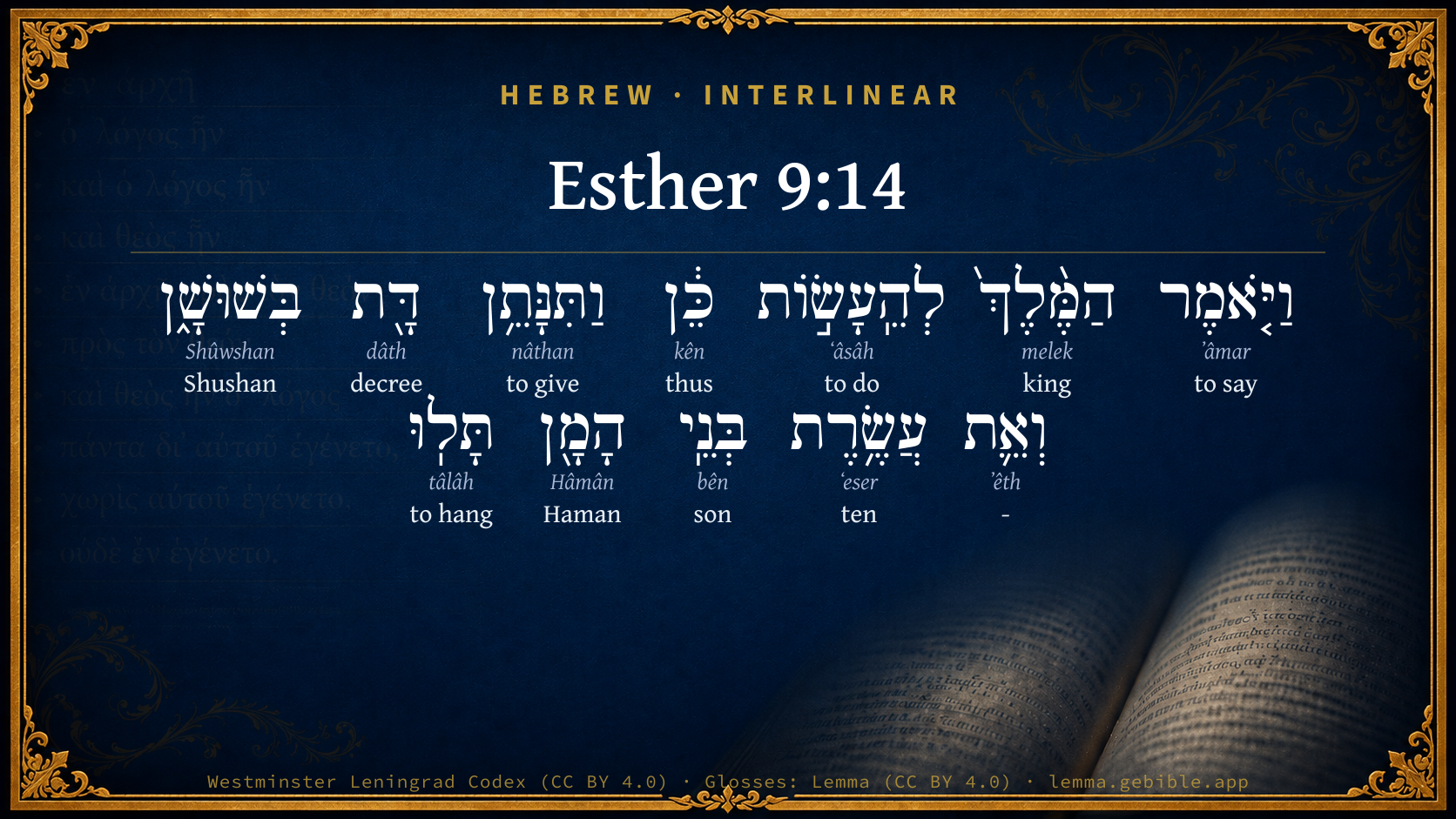
Hebrew (Westminster Leningrad Codex) Esther 9:14 appears in the Hebrew Old Testament. The text above is from the Westminster Leningrad Codex. Each word links to its Strong’s number, a concise gloss, and parsing drawn from the Open Scriptures Hebrew Bible morphology. Click any word for its full Brown-Driver-Briggs (BDB) entry.
Download image
Cite this verse

Esther 9:14 (World English Bible). Public Domain. Lemma interlinear Bible study tool, https://lemma.gebible.app/v/esther/9/14.

Show BibTeX & RIS
BibTeX
RIS
English Translation
The king commanded it so to be done: and a decree was given out in Shushan; and they hanged Haman's ten sons.
World English Bible · Public Domain
Download a study sheet

One document with this verse’s original text, its word-by-word gloss line, the meaning frame, cross-references with their text, attributed commentary, and full source and license credits — printable, and it pastes into notes with its structure intact.

This verse Autodidact and up

Study sheet (.html) Plain text (.txt)

A passage Seminary Student

Up to 50 verses in one chapter. A passage sheet keeps up to 6 commentary sources and 12 cross-references per verse, in the order this page ranks them, and says so on the sheet whenever that leaves anything out. Ask for a single verse and you get the Autodidact verse sheet above.

Everything on this page stays free to read, with no account — the sheet is a download of what is already on screen, not access to it.

Want to remove ads? Support Godless Engineer
Compare translations 3

The same verse in 3 English versions, stacked beneath the original-language interlinear above. Click any original word for its lexicon entry.

Each is an independent rendering of the whole verse — the interlinear is not word-aligned to these translations.

Highlighted words mark where these versions differ — a whole-verse word diff, not a word-by-word alignment.

  • World English Bible Public Domain
    The king commanded it so to be done: and a decree was given out in Shushan; and they hanged Haman's ten sons.
  • King James Version Public Domain
    And the king commanded it so to be done: and the decree was given at Shushan; and they hanged Haman's ten sons.
  • unfoldingWord Literal Text CC BY-SA 4.0
    And the king said for this to be done. And a law was given in Susa, and they hanged the ten sons of Haman.

unfoldingWord Literal Text — © unfoldingWord, licensed CC BY-SA 4.0. Word-aligned USFM3 via Door43 (git.door43.org/unfoldingWord/en_ult).

Versions to compare (up to 4)

3 of 4 selected

Show all 18 translations

Every available English version of this verse, each an independent rendering of the whole verse.

  • World English Bible Public Domain
    The king commanded it so to be done: and a decree was given out in Shushan; and they hanged Haman's ten sons.
  • Berean Standard Bible Public Domain
    So the king commanded that this be done. An edict was issued in Susa, and they hanged the ten sons of Haman.
  • Majority Standard Bible Public Domain
    So the king commanded that this be done. An edict was issued in Susa, and they hanged the ten sons of Haman.
  • King James Version Public Domain
    And the king commanded it so to be done: and the decree was given at Shushan; and they hanged Haman's ten sons.
  • American Standard Version (1901) Public Domain
    And the king commanded it so to be done: and a decree was given out in Shushan; and they hanged Haman's ten sons.
  • Revised Version (1885) Public Domain
    And the king commanded it so to be done: and a decree was given out in Shushan; and they hanged Haman’s ten sons.
  • Geneva Bible (1599) Public Domain
    And the King charged to doe so, and the decree was giuen at Shushan, and they hanged Hamans ten sonnes.
  • Douay-Rheims (1899) Public Domain
    And the king commanded that it should be so done. And forthwith the edict was hung up in Susan, and the ten sons of Aman were hanged.
  • Young's Literal Translation Public Domain
    And the king saith -- `to be done so;' and a law is given in Shushan, and the ten sons of Haman they have hanged.
  • Literal Standard Version CC BY-SA 4.0
    And the king commands [for it] to be done so; and a law is given in Shushan, and they have hanged the ten sons of Haman.
  • Unlocked Literal Bible CC BY-SA 4.0
    So the king commanded that this be done. A decree was issued in Susa, and they hanged the ten sons of Haman.
  • unfoldingWord Literal Text CC BY-SA 4.0
    And the king said for this to be done. And a law was given in Susa, and they hanged the ten sons of Haman.
  • Darby Bible Public Domain
    And the king commanded it so to be done: and the decree was given at Shushan; and they hanged Haman's ten sons.
  • World Messianic Bible Public Domain
    The king commanded this to be done. A decree was given out in Susa; and they hanged Haman’s ten sons.
  • Webster's Bible Public Domain
    And the king commanded it so to be done: and the decree was given at Shushan; and they hanged Haman's ten sons.
  • Free Bible Version CC BY-SA 4.0
    The king ordered this to be done. A decree was issued in Susa, and they impaled the bodies of Haman's ten sons.
  • Bible in Basic English Public Domain
    And the king said that this was to be done, and the order was given out in Shushan, and the hanging of Haman's ten sons was effected.
  • JPS Tanakh (1917) Public Domain
    And the king commanded it so to be done; and a decree was given out in Shushan; and they hanged Haman's ten sons.

Literal Standard Version (2020), Covenant Press — licensed CC BY-SA 4.0. Text via the HelloAO Bible API (eBible.org). Unlocked Literal Bible (unfoldingWord) — licensed CC BY-SA 4.0. Text via the HelloAO Bible API (eBible.org). unfoldingWord Literal Text — © unfoldingWord, licensed CC BY-SA 4.0. Word-aligned USFM3 via Door43 (git.door43.org/unfoldingWord/en_ult). Free Bible Version, Dr. Jonathan Gallagher — licensed CC BY-SA 4.0. Text via the HelloAO Bible API (eBible.org).

Word by word

More ways to search: Search by grammar → Find every occurrence → Compare this word →

Practice this passage: Drill this verse → Learn its vocabulary →

בְּשׁוּשָׁ֑ן
Shûwshan
H7800
“in/at · Shushan”
Preposition + Noun, Proper
Part of Speech
Preposition + Noun
Type
Proper
Full BDB Definition

Origin: the same as H7799

TWOT: None

Shushan or Susa = "lily" - the winter residence of the Persian kings; located on the river Ulai or Choaspes
  1. וַיֹּ֤אמֶר ʼâmar H559 “and · to say” Conjunction + Verb, Qal, Sequential Imperfect, 3rd Person, Masculine, Singular
  2. הַמֶּ֨לֶךְ֙ melek H4428 “the · king” Particle, Definite Article + Noun, Common, Masculine, Singular, Absolute
  3. לְהֵֽעָשׂ֣וֹת ʻâsâh H6213 “to do” Preposition + Verb, Niphal, Infinitive Construct
  4. כֵּ֔ן kên H3651 “thus” Particle, Demonstrative
  5. וַתִּנָּתֵ֥ן nâthan H5414 “and · to give” Conjunction + Verb, Niphal, Sequential Imperfect, 3rd Person, Feminine, Singular
  6. דָּ֖ת dâth H1881 “decree” Noun, Common, Feminine, Singular, Absolute
  7. וְאֵ֛ת ʼêth H853 “and · -” Conjunction + Particle, Direct Object
  8. עֲשֶׂ֥רֶת ʻeser H6235 “ten” Adjective, Cardinal number, Masculine, Singular, Construct
  9. בְּנֵֽי bên H1121 “sons of” Noun, Common, Masculine, Plural, Construct
  10. הָמָ֖ן Hâmân H2001 “Haman” Noun, Proper
  11. תָּלֽוּ tâlâh H8518 “to hang” Verb, Qal, Perfect, 3rd Person, Common, Plural

About this verse

These counts appear in no published source. They are computed here, from the morphology-tagged text and Lemma’s own curated glosses. What Lemma adds →

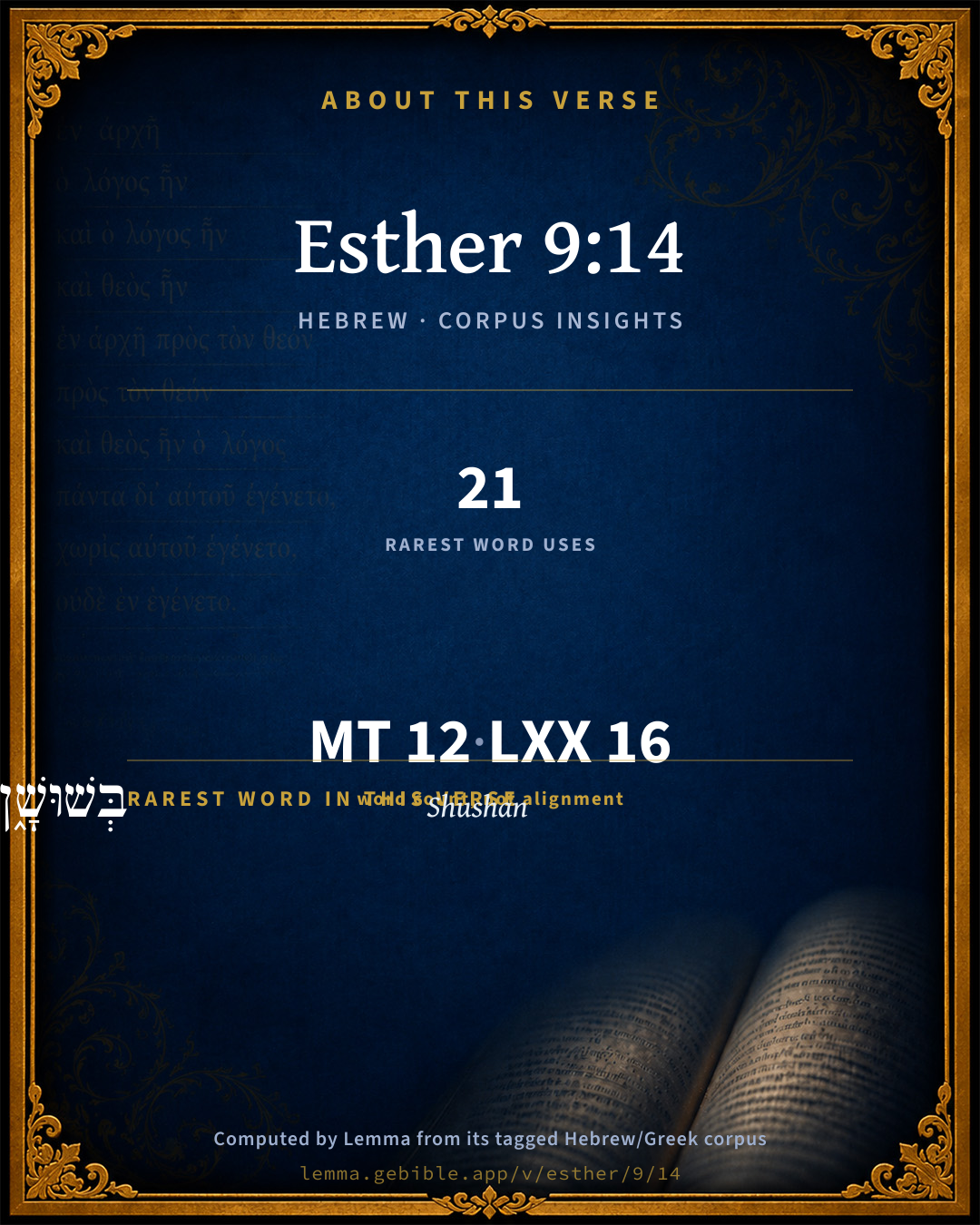
12
words
12
distinct lemmas
Historical
section

Notable vocabulary

The rarest word here is בְּשׁוּשָׁ֑ן Shushan H7800 — appearing just 21 times in the whole Hebrew Bible.

Shared distinctive vocabulary

בְּשׁוּשָׁ֑ן Shushan H7800 occurs in 19 verses of the Hebrew Bible. Also found in:

Grammatical profile

  • 4 verbs
  • 5 nouns
  • 1 adjective
  • 2 particles

Verb forms

  • וַיֹּ֤אמֶר Qal · Sequential Imperfect
  • לְהֵֽעָשׂ֣וֹת Niphal · Infinitive Construct
  • וַתִּנָּתֵ֥ן Niphal · Sequential Imperfect
  • תָּלֽוּ Qal · Perfect

Hebrew & Septuagint length

In English translation the verse runs 22 words from the Hebrew and 27 from the Septuagint (LXX English) — closely comparable.

A rough comparison of the two English renderings, which tokenize alike — not a word-level alignment.

Word counts can differ between the Hebrew and the Greek without any difference in meaning — e.g. the Hebrew direct-object marker אֵת has no separate Greek word, and Greek often adds the article ὁ.

In the original languages it is 12 Hebrew tokens and 16 Greek tokens — but the two are counted differently (Hebrew bundles its prefixes and suffixes into one token; the Greek is in lemma form), so that isn’t a like-for-like length.

Hebrew and Greek witnesses Masoretic Hebrew ↔ Greek Septuagint

The same verse in the two great witnesses to the Old Testament, shown verse-for-verse.

These are two independent witnesses, not word-aligned to each other, and the Septuagint is shown in lemma (dictionary) form.

Hebrew Esther 9:14 Masoretic · Westminster Leningrad Codex

וַיֹּ֤אמֶר הַמֶּ֨לֶךְ֙ לְהֵֽעָשׂ֣וֹת כֵּ֔ן וַתִּנָּתֵ֥ן דָּ֖ת בְּשׁוּשָׁ֑ן וְאֵ֛ת עֲשֶׂ֥רֶת בְּנֵֽי הָמָ֖ן תָּלֽוּ

The king commanded it so to be done: and a decree was given out in Shushan; and they hanged Haman's ten sons.

World English Bible · Public Domain

Greek LXX Esther 9:14 Septuagint · lemma form

καί ἐπιτρέπω οὕτως γίγνομαι καί ἐκτίθημι ὁ ἰουδαῖος ὁ πόλις ὁ σῶμα ὁ υἱός αμαν κρεμάζω

And he permitted it to be so done; and he gave up to the Jews of the city the bodies of the sons of Aman to hang.

LXX2012 (modern English Septuagint) · Public Domain

Hebrew: Westminster Leningrad Codex (CC BY 4.0). Greek: Septuagint (public domain); English from LXX2012 (modern English Septuagint) (Public Domain). How the Septuagint differs from the Hebrew →

Commentary

Notes on Esther 9:14 from classic Christian and Jewish commentators (each source and its license shown beneath its notes). The classic Christian expositions comment on the surrounding passage and are grouped to its opening verse, so a note may address several verses; the Jewish commentaries on the Tanakh (Rashi and others) are per-verse, so they appear only where the commentator wrote on this verse.

Lemma curates 59 commentaries, every one of them public domain or Creative Commons licensed, each selected and text-cleaned for this edition rather than reprinted as found. About our sources →

Trapp's Complete Commentary

John Trapp

Est 9:14 And the king commanded it so to be done: and the decree was given at Shushan; and they hanged Haman’s ten sons.

Ver. 14. And the king commanded it so to be done] He feared not that thereupon the people would rise and call him tyrant to his teeth; as when Bajazet II had cast Achmetes Bassa into prison, the janizaries in an uproar insolently answered the Great Turk, that they would by and by teach him, as a drunkard, a beast, and a rascal, to use his great place and calling with more sobriety and discretion (Turk. Hist. fol. 444). Ahasuerus well enough knew his own power, and was therefore the more bold in disposing, after this manner, of the lives of his subjects, who were ready to say to him, as once Tiberius did to Justinus, Si tu volueris, ego sum; si tu non vis, ego non sum; If you are willing, I am, if you are not willing, I am not. I am wholly yours to command.

And the decree was given at Shushan] Dictum, concessum, illico factum. Spoken, agreed, immediately done. The king was not willing to cross Esther in anything, saith Josephus.

And they hanged Haman’s ten sons] For greater ignominy and terror to others. Thus God commanded the heads of the twelve princes of Israel to be hanged up against the sun, Num 25:4. Joshua hanged the king of Ai upon a gallows until the evening, Jos 8:29, and after that the five kings of the Amorites, Jos 10:27 God hanged up Absalom with his own bare hand.

Absalon marte furens pensilis arbore obit.

Absalon died in a tree fighting punished for his rage.

John Trapp, A Commentary or Exposition upon All the Books of the Old and New Testament (1647–1656) — public domain. Text from a community e-Sword module.

Tyndale Open Study Notes

Tyndale Open Resources

9:14 So the king agreed, and the decree was announced in Susa: It was not in the king’s interest for there to be warring parties within the palace plotting to kill one another.

Tyndale Open Study Notes — © Tyndale Open Resources, licensed CC BY-SA 4.0. Text via the HelloAO Bible API.

John Gill's Exposition

But the other Jews that were in the king's provinces gathered themselves together,.... In a body, in their respective provinces and cities:

and stood for their lives; defended themselves against those that attacked them:

and had rest from their enemies; that selfsame day; all being destroyed by them, and none daring to appear against them:

and slew of their foes 75,000 men; that is, in all the provinces put together:

but they laid not their hands on the prey; See Gill on Est 9:7.

John Gill's Exposition of the Whole Bible (1746–1763) — public domain (CC PDM 1.0). Text via the HelloAO Bible API.

The Pulpit Commentary

They hanged the ten sons of Haman. Exposure on a cross was regarded as a deep disgrace, and was a punishment often inflicted by the Persians on persons killed in some other way (see Herod., 3:125; 7:238; Xen., "Anab.," 3. 1, Pint., "Vit. Artax.,"

The Pulpit Commentary (1880–1919), ed. H.D.M. Spence-Jones & Joseph S. Exell — public domain. Text from a community e-Sword module.

Keil & Delitzsch

C. F. Keil & F. Delitzsch

The king commanded it so to be done. "Then was a decree given at Susa, and they hanged the ten sons of Haman." The decree given in Susa does not refer to the hanging of the sons of Haman, but to the permission given to the Jews to fight against their enemies on the morrow also. This is required not only by a comparison of Est 8:13, but also by the connection of the present verse; for in consequence of this decree the Jews assembled on the 14th Adar (comp. ויּקּהלוּ, then they assembled themselves, Est 9:15), while the hanging of the sons of Haman, on the contrary, is related in an accessory clause by a simple perfect, תּלוּ.

Keil & Delitzsch — Biblical Commentary on the Old Testament (1861–1891) — public domain (CC PDM 1.0). Text via the HelloAO Bible API. (Old Testament only.)

Rashi

Rabbi Shlomo Yitzchaki (Rashi)

and a decree was given a statute was decreed.

Rashi on the Tanakh — English translations: “The Judaica Press complete Tanach with Rashi, translated by A. J. Rosenberg” (CC BY 4.0); “Pentateuch with Rashi's commentary by M. Rosenbaum and A.M. Silbermann, 1929-1934” (public domain); “The Metsudah Tanach series, Lakewood, N.J” (CC BY 4.0); and “The Book of Joshua, Metsudah Publications, 1997” (CC BY 4.0). Text via Sefaria.

Lesson kit

Teaching starters — assembled from the data on this page, not authored interpretation. Every prompt links to the verse data it draws on. Edit before teaching.

Esther, in the Historical, opens this verse with 12 words (12 distinct Hebrew lemmas). Its most distinctive word is Shûwshan (“Shushan”). A historical commentator’s framing appears above. Read the whole chapter for the surrounding context.

Discussion questions

  1. The word Shûwshan carries the sense “Shushan.” How does it shape the verse?
  2. How does Nehemiah 1:1, which shares the word «Shushan», read alongside this verse?
  3. These translations render this verse differently. What is at stake in choosing one wording over another?
  4. «וַיֹּ֤אמֶר» is a Qal Sequential Imperfect verb. How does that grammatical form shape the action described?
  5. Compare how Trapp's Complete Commentary and Tyndale Open Study Notes read this verse. Where do they agree or differ?

Things to notice

Reading settings

Reading text

Shown beneath each verse's original-language words.

Old Testament
Old Testament edition

Read the OT as the Masoretic Hebrew (MT) or the Greek Septuagint (LXX).

English shown for the Greek Septuagint (in the Hebrew ↔ Greek comparison).

Comparing translations? Open the Compare panel on any verse page to stack up to four side by side.