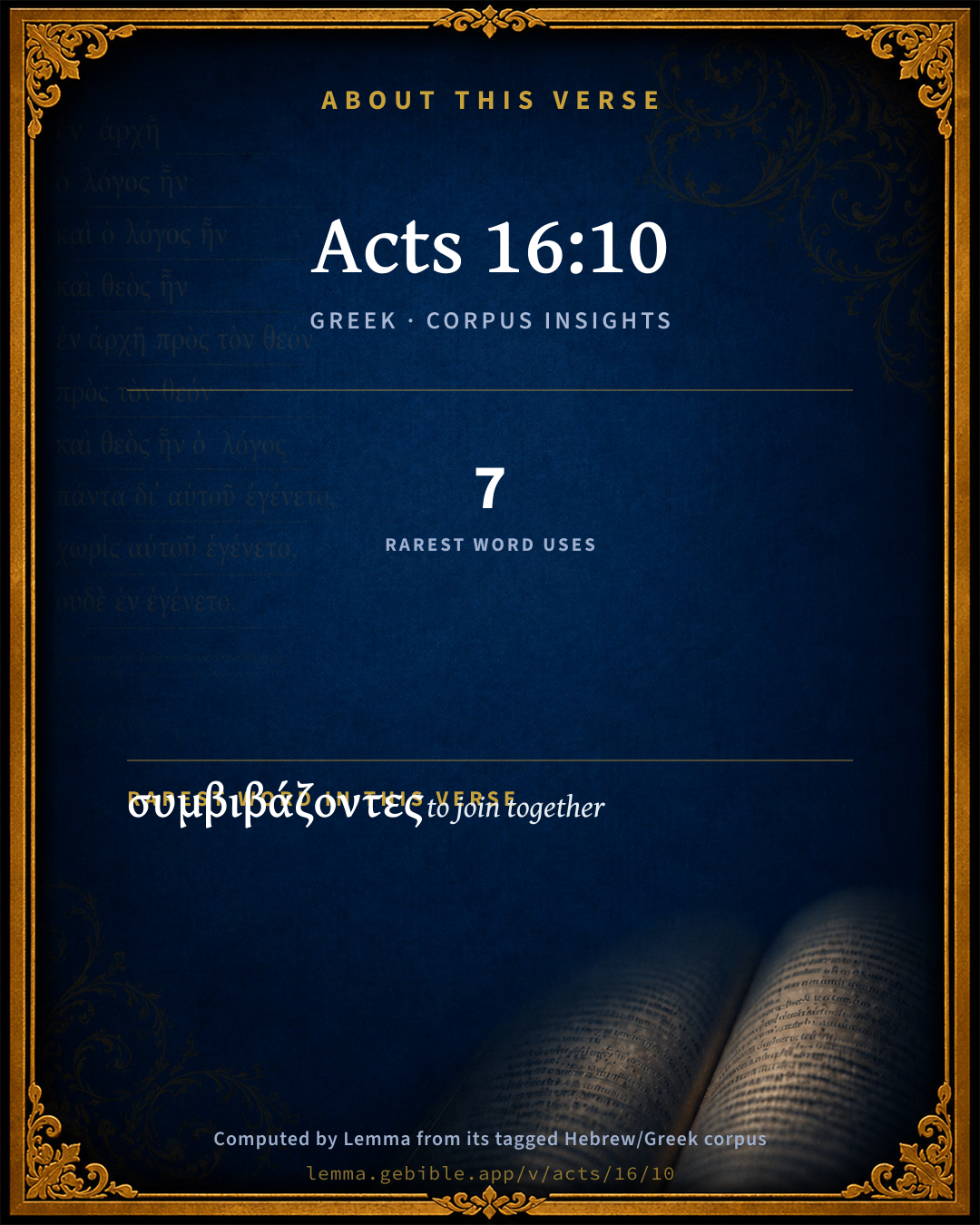
Acts 16:10

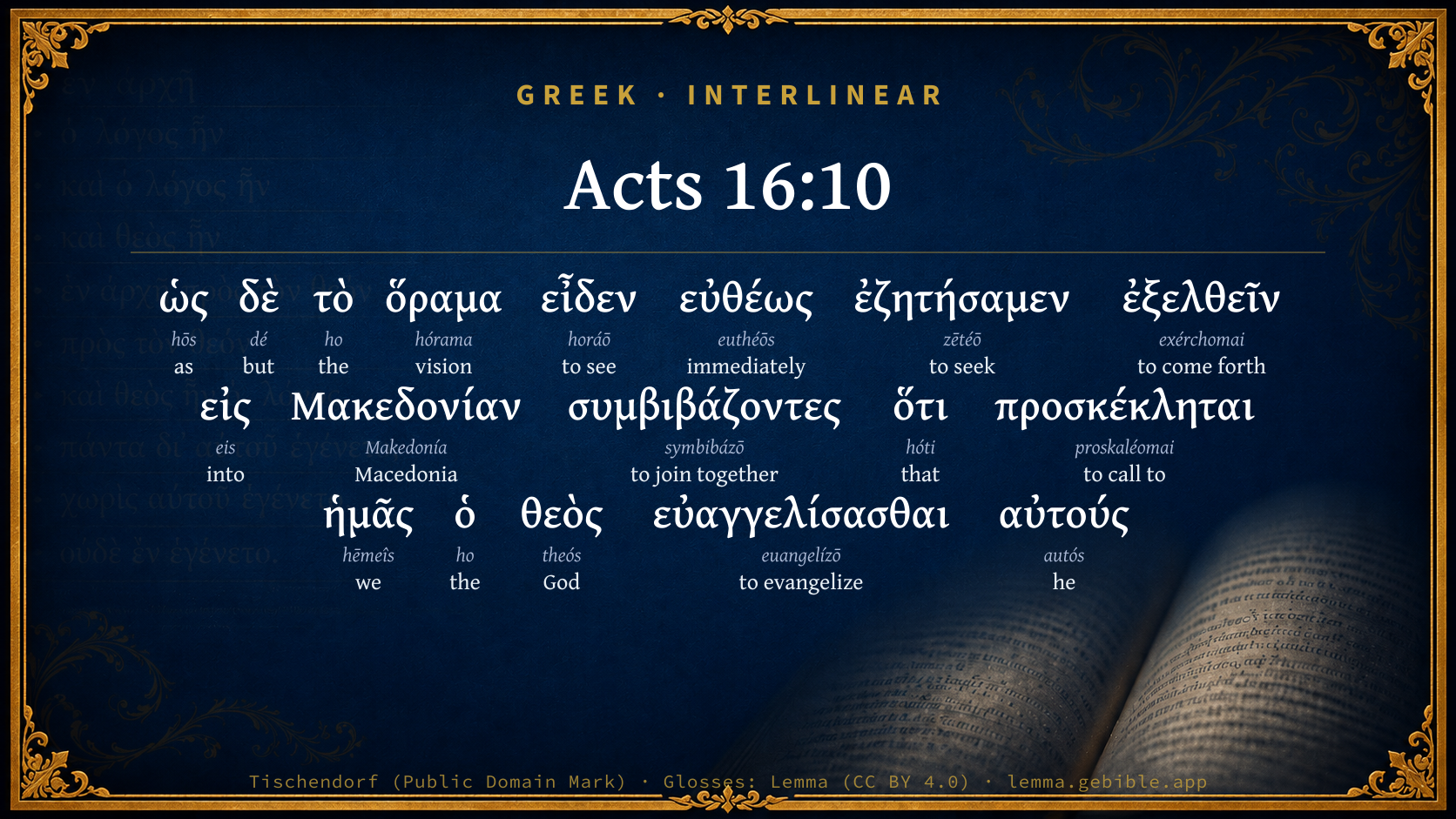
Greek (Tischendorf 8th ed.) Acts 16:10 appears in the Greek New Testament. The text above is from the Tischendorf 8th edition. Each word links to its Strong’s number and a concise gloss. Click any word for its full Thayer’s Greek Lexicon entry.
Download image
Cite this verse

Acts 16:10 (World English Bible). Public Domain. Lemma interlinear Bible study tool, https://lemma.gebible.app/v/acts/16/10.

Show BibTeX & RIS
BibTeX
RIS
English Translation
When he had seen the vision, immediately we sought to go out to Macedonia, concluding that the Lord had called us to preach the Gospel to them.
World English Bible · Public Domain
Download a study sheet

One document with this verse’s original text, its word-by-word gloss line, the meaning frame, cross-references with their text, attributed commentary, and full source and license credits — printable, and it pastes into notes with its structure intact.

This verse Autodidact and up

Study sheet (.html) Plain text (.txt)

A passage Seminary Student

Up to 50 verses in one chapter. A passage sheet keeps up to 6 commentary sources and 12 cross-references per verse, in the order this page ranks them, and says so on the sheet whenever that leaves anything out. Ask for a single verse and you get the Autodidact verse sheet above.

Everything on this page stays free to read, with no account — the sheet is a download of what is already on screen, not access to it.

Want to remove ads? Support Godless Engineer
Compare translations 3

The same verse in 3 English versions, stacked beneath the original-language interlinear above. Click any original word for its lexicon entry.

Each is an independent rendering of the whole verse — the interlinear is not word-aligned to these translations.

Highlighted words mark where these versions differ — a whole-verse word diff, not a word-by-word alignment.

  • World English Bible Public Domain
    When he had seen the vision, immediately we sought to go out to Macedonia, concluding that the Lord had called us to preach the Gospel to them.
  • King James Version Public Domain
    And after he had seen the vision, immediately we endeavoured to go into Macedonia, assuredly gathering that the Lord had called us for to preach the gospel unto them.
  • unfoldingWord Literal Text CC BY-SA 4.0
    So when he had seen the vision, immediately we sought to go out into Macedonia, reasoning together that God had summoned us to proclaim the gospel to them.

unfoldingWord Literal Text — © unfoldingWord, licensed CC BY-SA 4.0. Word-aligned USFM3 via Door43 (git.door43.org/unfoldingWord/en_ult).

Versions to compare (up to 4)

3 of 4 selected

Show all 19 translations

Every available English version of this verse, each an independent rendering of the whole verse.

  • World English Bible Public Domain
    When he had seen the vision, immediately we sought to go out to Macedonia, concluding that the Lord had called us to preach the Gospel to them.
  • Berean Standard Bible Public Domain
    As soon as Paul had seen the vision, we got ready to leave for Macedonia, concluding that God had called us to preach the gospel to them.
  • Majority Standard Bible Public Domain
    As soon as Paul had seen the vision, we got ready to leave for Macedonia, concluding that the Lord had called us to preach the gospel to them.
  • King James Version Public Domain
    And after he had seen the vision, immediately we endeavoured to go into Macedonia, assuredly gathering that the Lord had called us for to preach the gospel unto them.
  • American Standard Version (1901) Public Domain
    And when he had seen the vision, straightway we sought to go forth into Macedonia, concluding that God had called us to preach the gospel to them.
  • Revised Version (1885) Public Domain
    And when he had seen the vision, straightway we sought to go forth into Macedonia, concluding that God had called us for to preach the gospel unto them.
  • Geneva Bible (1599) Public Domain
    And after he had seene the vision, immediatly we prepared to goe into Macedonia, being assured that the Lord had called vs to preache the Gospel vnto them.
  • Douay-Rheims (1899) Public Domain
    And as soon as he had seen the vision, immediately we sought to go into Macedonia, being assured that God had called us to preach the gospel to them.
  • Young's Literal Translation Public Domain
    and when he saw the vision, immediately we endeavoured to go forth to Macedonia, assuredly gathering that the Lord hath called us to preach good news to them,
  • Literal Standard Version CC BY-SA 4.0
    And when he saw the vision, immediately we endeavored to go forth to Macedonia, assuredly gathering that the LORD has called us to preach good news to them,
  • Unlocked Literal Bible CC BY-SA 4.0
    When Paul had seen the vision, immediately we set out to go to Macedonia, concluding that God had called us to proclaim the gospel to them.
  • unfoldingWord Literal Text CC BY-SA 4.0
    So when he had seen the vision, immediately we sought to go out into Macedonia, reasoning together that God had summoned us to proclaim the gospel to them.
  • Darby Bible Public Domain
    And when he had seen the vision, immediately we sought to go forth to Macedonia, concluding that the Lord had called us to announce to them the glad tidings.
  • World Messianic Bible Public Domain
    When he had seen the vision, immediately we sought to go out to Macedonia, concluding that the Lord had called us to proclaim the Good News to them.
  • Webster's Bible Public Domain
    And after he had seen the vision, immediately we endeavored to go into Macedonia, assuredly gathering, that the Lord had called us to preach the gospel to them.
  • Free Bible Version CC BY-SA 4.0
    After Paul saw this vision, we immediately made arrangements to go to Macedonia, since we concluded that God had called us to share the good news with them.
  • Bible in Basic English Public Domain
    And when he had seen the vision, straight away we made the decision to go into Macedonia, for it seemed certain to us that God had sent us to give the good news to them.
  • Text-Critical English NT CC BY 4.0
    After Paul saw the vision, we immediately endeavored to go on to Macedonia, concluding that the Lord had called us to preach the gospel to them.
  • Tyndale New Testament (1534) Public Domain
    After he had sene the vision immediatly we prepared to goo into Macedonia certified that the lorde had called vs for to preache the gospell vnto them.

Literal Standard Version (2020), Covenant Press — licensed CC BY-SA 4.0. Text via the HelloAO Bible API (eBible.org). Unlocked Literal Bible (unfoldingWord) — licensed CC BY-SA 4.0. Text via the HelloAO Bible API (eBible.org). unfoldingWord Literal Text — © unfoldingWord, licensed CC BY-SA 4.0. Word-aligned USFM3 via Door43 (git.door43.org/unfoldingWord/en_ult). Free Bible Version, Dr. Jonathan Gallagher — licensed CC BY-SA 4.0. Text via the HelloAO Bible API (eBible.org).

Word by word

More ways to search: Search by grammar → Find every occurrence → Compare this word →

Practice this passage: Drill this verse → Learn its vocabulary →

συμβιβάζοντες
symbibázō
G4822
“to join together”
Verb, Present, Active, Participle, Nominative, Plural, Masculine
Part of Speech
Verb
Tense
Present
Voice
Active
Mood
Participle
Case
Nominative
Number
Plural
Gender
Masculine
Full Thayer's Definition

Origin: from G4862 and bibazo (to force, causative [by reduplication] of the base of G939 )

TDNT: 19:43,1

1. to cause to coalesce, to join together, put together a. to unite or knit together: in affection 2. to put together in one's mind a. to compare b. to gather, conclude, consider 3. to cause a person to unite with one in a conclusion or come to the same opinion, to prove, demonstrate a. to teach, instruct, one
  1. ὡς hōs G5613 “as” Adverb
  2. δὲ dé G1161 “but” Conjunction
  3. τὸ ho G3588 “the” Article, Accusative, Singular, Neuter
  4. ὅραμα hórama G3705 “vision” Noun, Accusative, Singular, Neuter
  5. εἶδεν horáō G3708 “to see” Verb, Aorist, Active, Indicative, 3rd person, Singular
  6. εὐθέως euthéōs G2112 “immediately” Adverb
  7. ἐζητήσαμεν zētéō G2212 “to seek” Verb, Aorist, Active, Indicative, 1st person, Plural
  8. ἐξελθεῖν exérchomai G1831 “to come forth” Verb, Aorist, Active, Infinitive
  9. εἰς eis G1519 “into” Preposition
  10. Μακεδονίαν Makedonía G3109 “Macedonia” Noun, Accusative, Singular, Feminine
  11. ὅτι hóti G3754 “that” Conjunction
  12. προσκέκληται proskaléomai G4341 “to call to” Verb, Perfect, Middle or Passive deponent, Indicative, 3rd person, Singular
  13. ἡμᾶς hēmeîs G2249 “we” Personal pronoun, 1st person, Accusative, Plural
  14. ὁ ho G3588 “the” Article, Nominative, Singular, Masculine
  15. θεὸς theós G2316 “God” Noun, Nominative, Singular, Masculine
  16. εὐαγγελίσασθαι euangelízō G2097 “to evangelize” Verb, Aorist, Middle, Infinitive
  17. αὐτούς autós G846 “he” Personal pronoun, Accusative, Plural, Masculine

About this verse

These counts appear in no published source. They are computed here, from the morphology-tagged text and Lemma’s own curated glosses. What Lemma adds →

18
words
17
distinct lemmas
Acts
section

Notable vocabulary

The rarest word here is συμβιβάζοντες to join together G4822 — appearing just 7 times in the whole Greek New Testament.

Shared distinctive vocabulary

συμβιβάζοντες to join together G4822 occurs in 7 verses of the Greek New Testament. Also found in:

Repetition

A word recurs within this verse:

Cross-references

11

Topical passages linked to Acts 16:10 in the Treasury of Scripture Knowledge — connected by theme and wording, ordered by reader-vote popularity; previews shown in the World English Bible.

  • 2 Corinthians 2:12–13 Now when I came to Troas for the Gospel of Christ, and when a door was opened to me in the Lord,
  • Acts 14:7 There they preached the Gospel.
  • Psalms 119:60 I will hurry, and not delay, To obey your commandments.
  • Proverbs 3:27–28 Don't withhold good from those to whom it is due, When it is in the power of your hand to do it.
  • Acts 10:29 Therefore also I came without complaint when I was sent for. I ask therefore, why did you send for me?"
  • Acts 16:10–17 When he had seen the vision, immediately we sought to go out to Macedonia, concluding that the Lord had called us to preach the Gospel to them.
  • Acts 20:5–8 But these had gone ahead, and were waiting for us at Troas.
  • Acts 20:13–15 But we who went ahead to the ship set sail for Assos, intending to take Paul aboard there, for he had so arranged, intending himself to go by land.
  • Acts 21:1–18 When it happened that we had parted from them and had set sail, we came with a straight course to Cos, and the next day to Rhodes, and from there to Patara.
  • Acts 26:13 at noon, O King, I saw on the way a light from the sky, brighter than the sun, shining around me and those who traveled with me.
  • Acts 27:1–28:16 When it was determined that we should sail for Italy, they delivered Paul and certain other prisoners to a centurion named Julius, of the Augustan band.

Cross-references courtesy of OpenBible.info (CC BY 4.0).

Where the printed editions differ

1 variant

Places in this verse where the major printed Greek editions disagree on the wording in a way that affects the translation — a comparison of editions, not a manuscript-by-manuscript collation. The editions are the modern critical texts (Nestlé-Aland 28/27, SBL, Westcott-Hort, Tregelles, Tyndale House) and the traditional texts behind the KJV (the Textus Receptus and the Byzantine/Majority text). It is not a claim about which reading is original.

  1. Different wording
    θεὸς

    “God”

    In NA28NA27TynSBLWHTreg Not in TRByz

    κύριος (kurios) 'Lord' occurs in traditional manuscripts (TR+Byz) instead of θεὸς (theos) 'God' in older manuscripts (NA28+NA27+Tyn+SBL+WH+Treg)

Textual data: Translators Amalgamated Greek New Testament (STEPBible TAGNT) · CC BY 4.0.

Commentary

Notes on Acts 16:10 from classic Christian and Jewish commentators (each source and its license shown beneath its notes). The classic Christian expositions comment on the surrounding passage and are grouped to its opening verse, so a note may address several verses; the Jewish commentaries on the Tanakh (Rashi and others) are per-verse, so they appear only where the commentator wrote on this verse.

Lemma curates 59 commentaries, every one of them public domain or Creative Commons licensed, each selected and text-cleaned for this edition rather than reprinted as found. About our sources →

Whedon's Commentary on the Bible

Daniel D. Whedon

10. We—This is the first of what have been called “the we passages;” that is, passages where the use of the first person plural seems to indicate that the writer was present and engaged in the transactions. The passages are Act_16:10-17; Act_20:5-15; Act_21:1-18; Act_27:1 to Act_28:16. These passages indicate that Paul found Luke here at Troas, and retaining him as far as Philippi, there leaves him; and that six years afterward Luke again joins him at Philippi, passes with him to Jerusalem, and thence to Rome. The “we” is not in all this route uniformly used, for he still speaks of Paul in the third person in those transactions in which the writer himself is less or not at all included.

Called us for to preach—This us indicates that Luke was not only “the beloved physician,” and Paul’s “fellow-labourer,” and the most eminent historian of Christ and the Church, but that he was “called for to preach,” and so was a minister of the word. When he was left, therefore, by Paul at Philippi, there is no fair room to doubt that he was left as minister to the Churches in Macedonia. (See note on Act_16:40, and Act_20:1.)

Daniel D. Whedon (gen. ed.), Commentary on the Old and New Testaments (1874–1909) — public domain. Text from a community e-Sword module.

MacLaren's Expositions of Holy Scripture

Alexander MacLaren

Acts

HOW TO SECURE A PROSPEROUS VOYAGE

Act 16:10 - Act 16:11.

This book of the Acts is careful to point out how each fresh step in the extension of the Church’s work was directed and commanded by Jesus Christ Himself. Thus Philip was sent by specific injunction to ‘join himself’ to the chariot of the Ethiopian statesman. Thus Peter on the house-top at Joppa, looking out over the waters of the western sea, had the vision of the great sheet, knit at the four corners. And thus Paul, in singularly similar circumstances, in the little seaport of Troas, looking out over the narrower sea which there separates Asia from Europe, had the vision of the man of Macedonia, with his cry, ‘Come over and help us!’ The whole narrative before us bears upon the one point, that Christ Himself directs the expansion of His kingdom. And there never was a more fateful moment than that at which the Gospel, in the person of the Apostle, crossed the sea, and effected a lodgment in the progressive quarter of the world.

Now what I wish to do is to note how Paul and his little company behaved themselves when they had received Christ’s commandment. For I think there are lessons worth the gathering to be found there. There was no doubt about the vision; the question was what it meant. So note three stages. First, careful consideration, with one’s own common sense, of what God wants us to do-’Assuredly gathering that the Lord had called us.’ Then, let no grass grow under our feet- immediate obedience-’Straightway we endeavoured to go into Macedonia.’ And then, patient pondering and instantaneous submission get the reward-’We came with a straight course.’ He gave the winds and the waves charge concerning them. Now there are three lessons for us. Taken together, they are patterns of what ought to be in our experience, and will be, if the conditions are complied with.

I. First, Careful Consideration.

Paul had no doubt that what he saw was a vision from Christ, and not a mere dream of the night, born of the reverberation of waking thoughts and anxieties, that took the shape of the plaintive cry of the man of Macedonia. But then the next step was to be quite sure of what the vision meant. And so, wisely, he does not make up his mind himself, but calls in the three men who were with him. And what a significant little group it was! There were Timothy, Silas, and Luke -Silas, from Jerusalem; Timothy, half a Gentile; Luke, altogether a Gentile; and Paul himself-and these four shook the world. They come together, and they talk the matter over. The word of my text rendered ‘assuredly gathering’ is a picturesque one. It literally means ‘laying things together.’ They set various facts side by side, or as we say in our colloquial idiom, ‘They put this and that together,’ and so they came to understand what the vision meant.

What had they to help them to understand it? Well, they had this fact, that in all the former part of their journey they had been met by hindrances; that their path had been hedged up here, there, and everywhere. Paul set out from Antioch, meaning a quiet little tour of visitation amongst the churches that had been already established. Jesus Christ meant Philippi and Athens and Corinth and Ephesus, before Paul got back again. So we read in an earlier portion of the chapter that the Spirit of Jesus forbade them to speak the Word in one region, and checked and hindered them when, baffled, they tried to go to another. There then remained only one other road open to them, and that led to the coast. Thus putting together their hindrances and their stimuluses, they came to the conclusion that unitedly the two said plainly, ‘Go across the sea, and preach the word there.’

Now it is a very commonplace and homely piece of teaching to remind you that time is not wasted in making quite sure of the meaning of providences which seem to declare the will of God, before we begin to act. But the commonest duties are very often neglected; and we preachers, I think, would very often do more good by hammering at commonplace themes than by bringing out original and fresh ones. And so I venture to say a word about the immense importance to Christian life and Christian service of this preliminary step-’assuredly gathering that the Lord had called us.’ What have we to do in order to be quite sure of God’s intention for us?

Well, the first thing seems to me to make quite sure that we want to know it, and that we do not want to force our intentions upon Him, and then to plume ourselves upon being obedient to His call, when we are only doing what we like. There is a vast deal of unconscious insincerity in us all; and especially in regard to Christian work there is an enormous amount of it. People will say, ‘Oh, I have such a strong impulse in a given direction, to do certain kinds of Christian service, that I am quite sure that it is God’s will.’ How are you sure? A strong impulse may be a temptation from the devil as well as a call from God. And men who simply act on untested impulses, even the most benevolent which spring directly from large Christian principles, may be making deplorable mistakes. It is not enough to have pure motives. It is useless to say, ‘Such and such a course of action is clearly the result of the truths of the Gospel.’ That may be all perfectly true, and yet the course may not be the course for you. For there may be practical considerations, which do not come into our view unless we carefully think about them, which forbid us to take such a path. So remember that strong impulses are not guiding lights; nor is it enough to vindicate our pursuing some mode of Christian service that it is in accordance with the principles of the Gospel. ‘Circumstances alter cases’ is a very homely old saying; but if Christian people would only bring the common sense to bear upon their religious life which they need to bring to bear upon their business life, unless they are going into the Gazette, there would be less waste work in the Christian Church than there is to-day. I do not want less zeal; I want that the reins of the fiery steed shall be kept well in hand. The difference between a fanatic, who is a fool, and an enthusiast, who is a wise man, is that the one brings calm reason to bear, and an open-eyed consideration of circumstances all round; and the other sees but one thing at a time, and shuts his eyes, like a bull in a field, and charges at that. So let us be sure, to begin with, that we want to know what God wants us to do; and that we are not palming our wishes upon Him, and calling them His providences.

Then there is another plain, practical consideration that comes out of this story, and that is, Do not be above being taught by failures and hindrances. You know the old proverb, ‘It is waste time to flog a dead horse.’ There is not a little well-meant work flung away, because it is expended on obviously hopeless efforts to revivify, perhaps, some moribund thing or to continue, perhaps, in some old, well-worn rut, instead of striking out into a new path. Paul was full of enthusiasm for the evangelisation of Asia Minor, and he might have said a great deal about the importance of going to Ephesus. He tried to do it, but Christ said ‘No.’ and Paul did not knock his head against the stone wall that lay between him and the accomplishment of his purpose, but he gave it up and tried another tack. He next wished to go up into Bithynia, and he might have said a great deal about the needs of the people by the Euxine; but again down came the barrier, and he had once more to learn the lesson, ‘Not as thou wilt, but as I will.’ He was not above being taught by his failures. Some of us are; and it is very difficult, and needs a great deal of Christian wisdom and unselfishness, to distinguish between hindrances in the way of work which are meant to evoke larger efforts, and hindrances which are meant to say, ‘Try another path, and do not waste time here any longer.’

But if we wish supremely to know God’s will, He will help us to distinguish between these two kinds of difficulties. Some one has said, ‘Difficulties are things to be overcome.’ Yes, but not always. They very often are, and we should thank God for them then; but they sometimes are God’s warnings to us to go by another road. So we need discretion, and patience, and suspense of judgment to be brought to bear upon all our purposes and plans.

Then, of course, I need not remind you that the way to get light is to seek it in the Book and in communion with Him whom the Book reveals to us as the true Word of God: ‘He that followeth Me shall not walk in darkness, but shall have the light of life.’ So careful consideration is a preliminary to all good Christian work. And, if you can, talk to some Timothy and Silas and Luke about your course, and do not be above taking a brother’s advice.

II. The next step is Immediate Submission.

When they had assuredly gathered that the Lord had called them, ‘immediately’-there is great virtue in that one word-’we endeavoured to go into Macedonia.’ Delayed obedience is the brother- and, if I may mingle metaphors, sometimes the father-of disobedience. It sometimes means simple feebleness of conviction, indolence, and a general lack of fervour. It means very often a reluctance to do the duty that lies plainly before us. And, dear brethren, as I have said about the former lesson, so I say about this. The homely virtue, which we all know to be indispensable to success in common daily life and commercial undertakings, is no less indispensable to all vigour of Christian life and to all nobleness of Christian service. We have no hours to waste; the time is short. In the harvest-field, especially when it is getting near the end of the week, and the Sunday is at hand, there are little leisure and little tolerance of slow workers. And for us the fields are white, the labourers are few, the Lord of the harvest is imperative, the sun is hurrying to the west, and the sickles will have to be laid down before long. So, ‘immediately we endeavoured.’

Delayed duty is present discomfort. As long as a man has a conscience, so long will he be restless and uneasy until he has, as the Quakers say, ‘cleared himself of his burden,’ and done what he knows that he ought to do, and got done with it. Delayed obedience means wasted possibilities of service, and so is ever to be avoided. The more disagreeable anything is which is plainly a duty, the more reason there is for doing it right away. ‘I made haste, and delayed not, but made haste to keep Thy commandments.’

Did you ever count how many ‘straightways’ there are in the first chapter of Mark’s Gospel? If you have not, will you do it when you go home; and notice how they come in? In the story of Christ’s opening ministry every fresh incident is tacked on to the one before it, in that chapter, by that same word ‘straightway.’ ‘Straightway’ He does that; ‘anon’ He does this; ‘immediately’ He does the other thing. All is one continuous stream of acts of service. The Gospel of Mark is the Gospel of the servant, and it sets forth the pattern to which all Christian service ought to be conformed.

So if we take Jesus Christ for our Example, unhasting and unresting in the work of the Lord, we shall let no moment pass burdened with undischarged duty; and we shall find that all the moments are few enough for the discharge of the duties incumbent upon us.

III. So, lastly, careful consideration and unhesitating obedience lead to a Straight Course.

Well, it is not so always, but it is so generally. There is a wonderful power in diligent doing of God’s known will to smooth away difficulties and avoid troubles. I do not, of course, mean that a man who thus lives, patiently ascertaining and then promptly doing what God would have him do, has any miraculous exemption from the ordinary sorrows and trials of life. But sure I am that a very, very large proportion of all the hindrances and disappointments, storms and quicksands, calms which prevent progress and headwinds that beat in our faces, are directly the products of our negligence in one or other of these two respects, and that although by no means absolutely, yet to an extent that we should not believe if we had not the experience of it, the wish to do God’s will and the doing of it with our might when we know what it is have a talismanic power in calming the seas and bringing us to the desired haven.

But though this is not always absolutely true in regard of outward things, it is, without exception or limitation, true in regard of the inward life. For if my supreme will is to do God’s will then nothing which is His will, and comes to me because it is can be a hindrance in my doing that.

As an old proverb says, ‘Travelling merchants can never be out of their road.’ And a Christian man whose path is simple obedience to the will of God can never be turned from that path by whatever hindrances may affect his outward life. So, in deepest truth, there is always a calm voyage for the men whose eyes are open to discern, and whose hands are swift to fulfil, the commandments of their Father in heaven. For them all winds blow them to their port; for them ‘all things work together for good’; with them God’s servants who hearken to the voice of His commandments, and are His ministers to do His pleasure, can never be other than in amity and alliance. He who is God’s servant is the world’s master. ‘All things are yours if ye are Christ’s.’

So, brethren, careful study of providences and visions, of hindrances and stimulus, careful setting of our lives side by side with the Master’s, and a swift delight in doing the will of the Lord, will secure for us, in inmost truth, a prosperous voyage, till all storms are hushed, ‘and they are glad because they be quiet; so He bringeth them to their desired haven.’

Alexander MacLaren, Expositions of Holy Scripture (1904–1910) — public domain. Text from a community e-Sword module.

Tyndale Open Study Notes

Tyndale Open Resources

16:10 we: The most natural interpretation of the shift from “they” to “we” is that Luke accompanied Paul from Troas to Philippi (16:10-17). Later Luke joined Paul again at Philippi and sailed with him to Troas, then to Miletus (20:5-15), then from Miletus to Jerusalem (21:1-18). After Paul’s two-year imprisonment in Caesarea, Luke traveled with him to Rome (27:1–28:16).

Tyndale Open Study Notes — © Tyndale Open Resources, licensed CC BY-SA 4.0. Text via the HelloAO Bible API.

Bengel's Gnomon

Johann Albrecht Bengel

Act 16:10. Εἶδε, he saw) Paul alone saw it: all however are guided by his direction.—ἐζητήσαμεν, we sought) having sought out a ship. Here the language begins in the first person, plural number. Therefore the writer of this itinerary, Luke, was present on the occasion. From Troas he accompanied Paul to Philippi: and afterwards from Philippi to Troas, ch. Act 20:6, and still farther.—συμβιβάζοντες, feeling assured) They felt, owing to this vision, as much assured as they needed to be for undertaking the journey. Justus Jonas says, “Now even though such a vision is not vouchsafed, each one will be taught by his own faith and by the Spirit, even though his call be through the instrumentality of men, whether his call be of GOD, and whether he pleases GOD.”—προσκέκληται, hath called to, summoned us) Therefore the Lord was already there; and the vision in Act 16:9 adumbrated His previous (anticipatory) presence among the Macedonians.

Bengel's Gnomon of the New Testament — English translation (T&T Clark, Edinburgh, 1860) — public domain. Text from a community e-Sword module.

Expositor's Greek Testament

ed. W. Robertson Nicoll

Act 16:10 . εἰς Μ .: It is easy to understand St. Paul’s eagerness to follow the vision after he had been twice hindered in his purpose, although it may well be that neither he nor St. Luke regarded the journey from Troas to Philippi as a passage from one continent to another continent Macedonia and Asia were two provinces of the Roman empire, Ramsay, p. 199. But in the good Providence of Him Who sees with larger other eyes than ours St. Paul’s first European Church was now founded, although perhaps it is venturesome to say that the Gospel was now first preached on the continent of Europe, as the good tidings may have reached Rome through the Jews and proselytes who heard St. Peter on the day of Pentecost, cf. Act 2:9 ; see McGiffert’s remarks, pp. 235, 236, on the providential guidance of St. Paul at this juncture, and Lightfoot, Biblical Essays “The Churches of Macedonia”. συμβιβάζοντες , see on Act 9:22 .

The Expositor's Greek Testament, edited by W. Robertson Nicoll (1897–1910) — public domain. Text from a community e-Sword module.

Geneva Bible (1599)

Geneva Bible translators

The Saints did not easily believe every vision.

Geneva Bible (1599) marginal notes — public domain. Text via Bolls.life.

Jamieson, Fausset & Brown

Robert Jamieson, A. R. Fausset & David Brown

And after he had seen the vision, immediately we endeavoured to go into Macedonia--The "we," here first introduced, is a modest intimation that the historian himself had now joined the missionary party. (The modern objections to this are quite frivolous). Whether Paul's broken health had anything to do with this arrangement for having "the beloved physician" with him [WIES], can never be known with certainty; but that he would deem himself honored in taking care of so precious a life, there can be no doubt.

Jamieson, Fausset & Brown — Commentary Critical and Explanatory on the Whole Bible (1871) — public domain (CC PDM 1.0). Text via the HelloAO Bible API.

Adam Clarke's Commentary

Verse 10. We endeavoured to go into Macedonia] This is the first place that the historian St. Luke refers to himself: WE endeavoured, c. And, from this, it has been supposed that he joined the company of Paul, for the first time, at Troas.

Assuredly gathering] συμβιβαζοντες, Drawing an inference from the vision that had appeared.

That the Lord had called us for to preach] That is, they inferred that they were called to preach the Gospel in Macedonia, from what the vision had said, come over and help us the help meaning, preach to us the Gospel. Instead of οκυριος, the Lord, meaning JESUS, several MSS., such as ABCE, several others, with the Coptic, Vulgate, Theophylact, and Jerome, have οθεος, GOD. Though this stands on very reputable authority, yet the former seems to be the better reading; for it was the SPIRIT of JESUS, Ac 16:7, that would not suffer them to go into Bithynia, because he had designed that they should immediately preach the Gospel in Macedonia.

Adam Clarke's Commentary on the Bible (1810–1826) — public domain. Text from a community e-Sword/MySword module.

John Calvin's Commentaries

10. Being fully persuaded. Hence we gather, that is was not bare vision, but that it was also confirmed by the testimony of the Spirit. For Satan doth oftentimes abuse ghosts and visures [masks] to deceive withal, that he may mock and cozen the unbelievers. Whereby it cometh to pass, that the bare vision leaveth man’s mind in doubt; but such as are divine indeed, those doth the Spirit seal by a certain mark, that those may not doubt nor waver whom the Lord will have certainly addicted to himself. A wicked spirit appeared to Brutus, inviting him to enter that unhappy combat and battle which he had at Philippi, even in the very same place whereunto Paul was afterwards called. But as the cause was far unlike, so the Lord dealt far otherwise with his servant, so that he put him out of doubt, and left him not astonished with fear. Now, in Paul and his companions the desire to obey ensued immediately upon the certainty; for, so soon as they understand that the Lord called them, they address themselves to their journey. The termination of the participle which is here used is active; and though it have divers significations, I do not doubt but that Luke’s meaning is, that Paul and the rest, after that they had conferred [compared] this vision with the former oracles, were fully persuaded that the Lord had called them into Macedonia.

John Calvin's Commentaries (1540-1563) — public domain. Text from the Calvin Translation Society English edition (1840s-50s) via the Christian Classics Ethereal Library (ccel.org). Calvin's coverage is partial (roughly two-thirds of the Bible); uncommented books and verses are honest gaps, never fabricated. The 19th-century editor's footnotes and remarks are omitted so the notes are faithfully Calvin's own voice.

Ellicott's Commentary for English Readers

(10) Immediately we endeavoured . . .—The natural inference from the sudden appearance of the first person in a narrative previously in the third, is that the author became at this point an actor in the events which he records. (See Introduction to St. Luke’s Gospel.) The other hypothesis, that he incorporates a narrative written by Silas or Timotheus, is not probable in itself, and would naturally have involved an earlier change in the form of the narrative. Accepting the received view, it seems to follow, as there is no mention of the conversion of the Evangelist, that St. Paul and St. Luke must have been already known to each other, probably either at Tarsus or Antioch, the fulness with which the history of the latter Church is given pointing to it as the scene of their previous intimacy. On this assumption, the narrator must have left Antioch after the Council of Jerusalem, probably after the dispute between Paul and Barnabas, and travelled through the interior of Asia Minor, in part, perhaps, in the track of St. Paul’s earlier journey; and so gathered materials for his history till he came to Troas, and there carried on his work as an evangelist. The manner in which St. Luke introduces himself (“the Lord had called us”) implies, it may be noted, that he too was a preacher of the gospel. There is no record here of any mission-work done by St. Paul; but the language in 2Co_2:12, and, yet more, the facts of Act_20:6, imply the existence of a Christian community. We may look, accordingly, on St. Luke as the founder of the Church of Troas, and place this among the “labours in the gospel” to which St. Paul refers in 2Co_8:18. The “we endeavoured” (literally, we sought) implies an immediate inquiry as to what ship was sailing, bound for any port of Macedonia. Such a call as that which had been given in the vision admitted of no delay. It came from the Lord Jesus, as the sequel of that given in the vision in the Temple (Act_22:17-21), and was, therefore, to be obeyed at once.

A Bible Commentary for English Readers, edited by Charles John Ellicott (1878–1897) — public domain. Text from a community e-Sword module.

The Cambridge Bible for Schools and Colleges

gen. ed. J. J. S. Perowne

10. we endeavoured] More literally and better, we sought. (So R. V.) The steps taken would be in the way of enquiry how and when they could get across the sea to Europe. Here the writer begins to speak in the first person as if at this point he became a sharer in St Paul’s labours. This he continues till Act_16:17.

to go into Macedonia] The word is stronger than the ordinary verb “to go” and = go forth, an expression very suitable to the first missionary journey from Asia into Europe. This is also as R. V.

assuredly gathering] The verb has the sense of “coming to a conclusion from putting things side by side.” So it is rendered “proving” in Act_9:22 and elsewhere. Here it means “deeming it to be proved.”

The Cambridge Bible for Schools and Colleges (gen. ed. J. J. S. Perowne; Cambridge University Press, 1878–1918) — public domain. Text from a community e-Sword module.

John Gill's Exposition

And after he had seen the vision,.... And considered it, and related it to his companions: and when they had well weighed it, and the circumstances of it:

immediately we endeavoured to go into Macedonia; they determined upon it, and took all the proper methods, and made the necessary provisions for it. Here Luke, the writer of this history, first appears, saying, "we endeavoured"; whether he came with the apostle from Antioch, since he is commonly said to have been a physician of Antioch; or whether he met the apostle at Troas, since here is the first hint of him, is not certain:

assuredly gathering, that the Lord had called us for to preach the Gospel unto them; they concluded from the vision with great certainty, that they had a manifest call from God to go into Macedonia, and preach the Gospel to the inhabitants of it, not doubting but that they should meet with success. The Alexandrian copy, the Vulgate Latin and Ethiopic versions, read "God", instead of "Lord".

John Gill's Exposition of the Whole Bible (1746–1763) — public domain (CC PDM 1.0). Text via the HelloAO Bible API.

Trapp's Complete Commentary

John Trapp

10 And after he had seen the vision, immediately we endeavoured to go into Macedonia, assuredly gathering that the Lord had called us for to preach the gospel unto them.

Ver. 10. Assuredly gathering] It was not therefore a bare vision, but set on upon their spirits by the testimony of the Holy Spirit, as all visions are that come from God. We read in the Roman history of a vision that Brutus had the night before that ill fated battle at Philippi, calling him into Macedonia too, but for his utter ruin. This was a vision from the devil, doubtless, that old man slayer. Cuthbert Simpson’s vision, and afterwards Mr Laremouth’s (who was chaplain to Queen Anne of Cleve), whereby they were comforted in and delivered out of prison, we may read of in the Book of Martyrs. Cardinal Cusan foretold, by some vision that he had, a reformation of religion that should occur A.D. 1507, which was over fifty years after his death. John Trithemius foretold the same A. D. 1508. Genius vero qui Trithemio haec dictavit, albus an ater fuerit, ego non facile dixerim. Merito suspectum est piis, &c., saith Bucholcerus. Who told him so much I cannot tell; but it was the devil in all likelihood. But what a strange conference was that which Luther had with the devil, by his own confession; whereby he was admonished of many abuses of the mass, which thereupon he wrote against. Is Satan divided against himself? Comes any good out of such a Nazareth? Need we not to prove the spirits, whether they be of God? How many have we today (our modern enthusiasts) that dream their Midianitish dreams, and then tell it for gospel to their neighbours as wise as themselves! that lead men into the lion’s mouth (that roaring lion, I mean), under pretence of a revelation; as that old impostor did the young prophet, 1Ki 13:11-18.

John Trapp, A Commentary or Exposition upon All the Books of the Old and New Testament (1647–1656) — public domain. Text from a community e-Sword module.

Albert Barnes' Notes on the Bible

We endeavored - This is the first instance in which Luke refers to himself as being in company with Paul. It is hence probable that he joined Paul and Silas about this time, and it is evident that he attended Paul in his travels, as recorded throughout the remainder of the Acts .

Assuredly gathering - Being certainly convinced.

Albert Barnes' Notes on the Bible (1834–1885) — public domain. Text from a community e-Sword/MySword module.

Haydock's Catholic Bible Commentary

We. This change in the narration from the third, to the first person, we sought, &c. is remarkable. It is hence inferred, that St. Luke, the author of this book, joined St. Paul at Troas, and became his inseparable companion. (Calmet) --- It is, however, probable, that as the narrative in the first person changes again at the end of this chapter, and is not resumed, till the fifth verse of the 20th chapter, that St. Luke was absent on some mission during the time that elapsed between this and their sailing from Philippi, as mentioned hereafter. (Chap. xx. ver. 6) (Tirinus)

George Leo Haydock (1774–1849), Haydock's Catholic Family Bible and Commentary, 1859 edition — public domain. Excludes Psalms (Douay-Rheims chapter numbering differs from Protestant) and Deuterocanonical books (Catholic canon only).

Matthew Poole's English Annotations

Immediately; as soon as God’s will was manifested, they make no delay, not objecting against the journey.

We endeavoured to go; St. Luke, the penman of this book was one of them that went, (the others were Paul, Silas, and Timotheus), and therefore speaks in the plural number.

Matthew Poole's English Annotations on the Holy Bible (1683–1685) — public domain. Text from a community e-Sword/MySword module.

The Pulpit Commentary

When for after, A.V.; straightway for immediately, A.V.; sought for endeavored, A.V.; go forth for go, A.V.; concluding fur assuredly gathering, A.V.; God for the Lord, A.V. and T.R. Concluding; sumbibazontev, only here in the sense of "concluding or "gathering." in Act_9:22 it is "proving." in Eph_4:16 and Col_2:2 it means to "join together." In classical Greek to "bring together" in the sense of" reconciling," sometimes of" agreeing" to a proposition. In the LXX, to," instruct," "teach". (1Co_2:16) In this verse we first remark the very important introduction of the pronoun we into the narrative, marking the presence of the historian himself, and showing that he first joined St. Paul at Tread He went with him to Philippi (ver. 12), and there he appears to have stopped till St. Paul returned there in his third missionary journey on his way from Achaia to Jerusalem, (Act_20:5, Act_20:6) where we find him still with the apostle. (Act_20:17, Act_20:18) We again find him with St. Paul at Caesarea, while he was a prisoner there, (Act_27:1) and he accompanied him on the voyage to Rome, which is the last place where we heir of him. (Act_27:2, Act_27:3. etc.; 28:2, 11, 14-16; Col_4:14; Phm_1:24) It is quite characteristic of Holy Scripture that things are told, or appear on the face of the narrative, without any explanation. Who Luke was, what brought him to Troas, how he became a companion of St. Paul, whether as his medical adviser or otherwise, we know not. His Christian modesty forbade his speaking about himself.

The Pulpit Commentary (1880–1919), ed. H.D.M. Spence-Jones & Joseph S. Exell — public domain. Text from a community e-Sword module.

John Wesley's Explanatory Notes

We sought to go into Macedonia - This is the first place in which St. Luke intimates his attendance on the apostle. And here he does it only in an oblique manner. Nor does he throughout the history once mention his own name, or any one thing which he did or said for the service of Christianity; though Paul speaks of him in the most honourable terms, Colossians iv, 14; 2 Tim. iv, 11; and probably as the brother whose praise in the Gospel went through all the Churches, 2 Cor. viii, 18. The same remark may be made on the rest of the sacred historians, who every one of them show the like amiable modesty.

John Wesley, Explanatory Notes Upon the Whole Bible (1754–1765) — public domain. Text via the GEBible commentary corpus.

Scofield Reference Notes

C. I. Scofield

we

The change here from "they," as in the preceding verses, to "we" indicates that at Troas Luke, the narrator, joined Paul’s company.

The Scofield Reference Bible (1917 edition), notes by C. I. Scofield — public domain. Text from a community e-Sword module.

Godbey's Commentary on the New Testament

William B. Godbey

10. This clear and unmistakable open vision, both seen and heard, sweeps away all defalcation as to their evangelistic call to preach the gospel in Europe. For this reason, Christian Europe and America are the spiritual children of Paul. No sooner is the vision seen, and the Macedonian voice heard ringing over the sea, than they all prepare for an immediate embarkation.

William B. Godbey, Commentary on the New Testament (1896–1900) — public domain. Text from a community e-Sword module.

McGarvey & Pendleton's Commentaries

J. W. McGarvey

See notes on verse 9

J. W. McGarvey (with Philip Y. Pendleton), Commentaries on the New Testament (The Fourfold Gospel, 1914; Acts; and the epistles) — public domain. Text from a community e-Sword/MySword module.

The People's New Testament

B. W. Johnson

10. We endeavored to go into Macedonia. Sought to find a ship to carry them across. There is no intimation that they preached at this time of Troas, but a few years later we find here a church (20:6–12). Here, first, the writer of Acts speaks of himself as one of the company and adopts the style of an eye witness. It is supposed that Luke joined the missionary band at Troas.

B. W. Johnson's The People's New Testament with Notes (1889–1891) — public domain. Electronic text from the Christian Classics Ethereal Library (CCEL) ThML edition.

Cambridge Greek Testament for Schools and Colleges

10. θεὸς for κύριος with אABCE. Vulg. ‘Deus.’

10. ἐζητήσαμεν, we sought. The steps taken would be in the way of inquiry how and when they could cross into Europe. For ζητεῖν with a verb of going, cf. LXX. 1Ki 11:22, ἰδοὺ σὺ ζητεῖς ἀπελθεῖν εἰς τὴν γῆν σου.

At this point the writer begins to speak in the first person as if now he became a sharer in St Paul’s labours. This he continues till Act 16:17.

ἐξελθεῖν, to go forth. A word suitable for the first step in the next extension of missionary work from Asia into Europe.

συμβιβάζοντες, assuredly gathering. The verb has the sense of ‘coming to a conclusion from putting things side by side.’ So it is rendered ‘proving’ in Act 9:22 and elsewhere. Here it means ‘deeming it to be proved.’

Chrysostom explains thus: τί ἐστι συμβιβάζοντες; στοχαζόμενοι, φησί. τῷ τε γὰρ Παῦλον ἰδεῖν καὶ μηδένα ἕτερον, καὶ τῷ κωλυθῆναι ὑπὸ τοῦ πνεύματος καὶ τῷ πρὸς τοῖς ὅροις εἶναι, ἀπὸ τούτων ἁπάντων ταῦτα συνῆγον.

Cambridge Greek Testament for Schools and Colleges (Cambridge University Press, 1896; 21 vols, various authors incl. Carr, Maclear, Plummer, Farrar, Lumby, Moule, M. R. James, Simcox) — public domain. Text from a community e-Sword module.

Alford’s Greek Testament

Henry Alford

10. ἐζητήσαμεν] by immediate enquiry for a ship. This word is remarkable as the introduction of the first person in the narrative: which however is dropped at ver. 40, on Paul’s leaving Philippi, and resumed again, ch. 20:5, on occasion of sailing from Philippi. Thence it continues (in all places where we have reason to expect it: see below) to the end of the book. On the question, what is implied by this, we may remark, (1) That while we safely conclude from it that the writer was in company with Paul when he thus speaks, we cannot with like safety infer that he was not, where the third person is used. This latter must be determined by other features of the history. For it is conceivable that a narrative, even where it concerns all present, might be, in its earlier parts, written as of others in the third person, but might, when more intimacy had been established, or even by preference only, be at any point changed to the first. And again, the episodes where the chief person alone, or with his principal companion or companions, is concerned, would be many, in which the narrator would use the third person, not because he was not present, but because he was not concerned. This has not been enough attended to. If it be thought fanciful, I may refer to an undoubted instance in the episode, ch. 21:17, γενομένων ἡμῶν εἰς Ἰερ., to ch. 27:1, ὡς δὲ ἐκρίθη τ. ἀποπλεῖν ἡμᾶς, …; during the whole of which time the writer was with or in the neighbourhood of Paul, and drops the we, merely because he is speaking of Paul alone. (2) One objection raised by De Wette to the common view, that Luke accompanied Paul from this time (except as above), is, that several times Paul’s companions are mentioned, but Luke is never among them. On examining however one of the passages where this is done, we find that after the enumeration of Sopater, Aristarchus, Secundus, Gaius, Timotheus, Tychicus, and Trophimus, we are told, οὗτοι προελθόντες ἔμενον ἡμᾶς ἐν Τρωάδι: so that the writer evidently regards himself as being closely associated with Paul, and does not think it requisite to enumerate himself among the companions of the Apostle. This may serve as a key to his practice on other occasions. On the whole, and after careful consideration of the subject, I see no reason to doubt the common view, that Luke here joined the Apostle (whether, as Wieseler suggests, as a physician, on account of his broken health, must of course be matter of conjecture, but is not improbable), and from this time (except from ch. 17:1-20:5) accompanies him to the end of the history. See the question of the authorship of the Acts further discussed in the Prolegg. § i. 12-14.

Henry Alford, The Greek Testament (1849–1861) — public domain. Text from a community e-Sword module.

Vincent's Word Studies in the New Testament

Marvin R. Vincent

We sought. Note the introduction, for the first time here, of the first person, intimating the presence of the author with Paul.

Assuredly gathering [συμβιβαζοντες] . See on proving, ch. 9 22.

Marvin R. Vincent, Word Studies in the New Testament (1887–1900) — public domain. Text from a community e-Sword/MySword module.

Lesson kit

Teaching starters — assembled from the data on this page, not authored interpretation. Every prompt links to the verse data it draws on. Edit before teaching.

Acts, in the Acts, opens this verse with 18 words (17 distinct Greek lemmas). Its most distinctive word is symbibázō (“to join together”). A historical commentator’s framing appears above. Read the whole chapter for the surrounding context.

Discussion questions

  1. What does “to join together” (symbibázō) contribute to the verse as a whole?
  2. How does Acts 9:22, which shares the word «to join together», read alongside this verse?
  3. What does the repetition of “the” (2× in this one verse) do in this verse?
  4. The translations on this page render this verse differently — a whole-verse word diff, not a word-by-word alignment. What might account for the different wordings?
  5. Compare how Whedon's Commentary on the Bible and MacLaren's Expositions of Holy Scripture read this verse. Where do they agree or differ?

Things to notice

Reading settings

Reading text

Shown beneath each verse's original-language words.

Old Testament
Old Testament edition

Read the OT as the Masoretic Hebrew (MT) or the Greek Septuagint (LXX).

English shown for the Greek Septuagint (in the Hebrew ↔ Greek comparison).

Comparing translations? Open the Compare panel on any verse page to stack up to four side by side.