
Acts 10:14

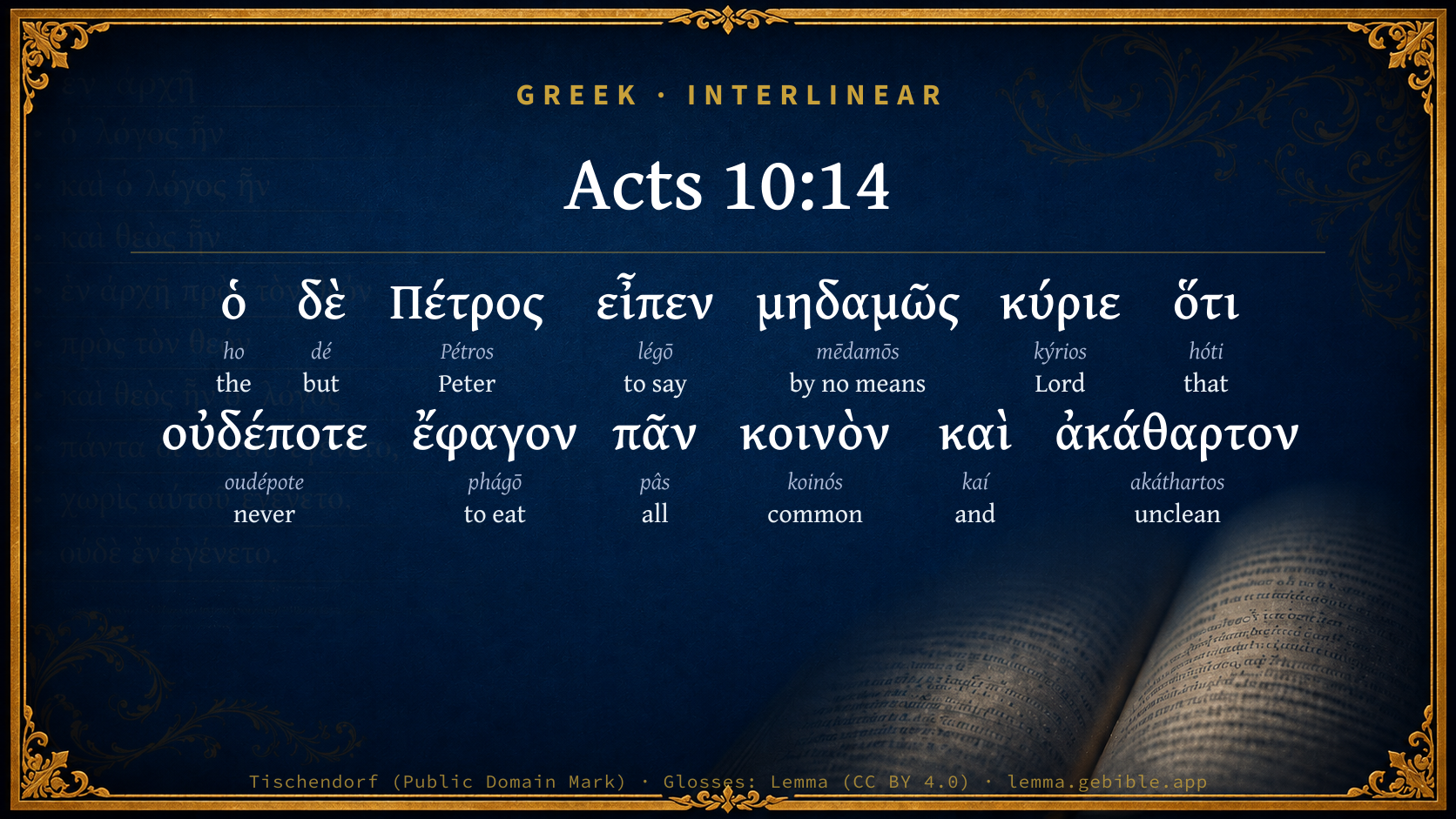
Greek (Tischendorf 8th ed.) Acts 10:14 appears in the Greek New Testament. The text above is from the Tischendorf 8th edition. Each word links to its Strong’s number and a concise gloss. Click any word for its full Thayer’s Greek Lexicon entry.
Download image
Cite this verse

Acts 10:14 (World English Bible). Public Domain. Lemma interlinear Bible study tool, https://lemma.gebible.app/v/acts/10/14.

Show BibTeX & RIS
BibTeX
RIS
English Translation
But Peter said, "Not so, Lord; for I have never eaten anything that is common or unclean."
World English Bible · Public Domain
Highlights
  • 1 first appearance in the Greek New Testament
Full analysis ↓
Download a study sheet

One document with this verse’s original text, its word-by-word gloss line, the meaning frame, cross-references with their text, attributed commentary, and full source and license credits — printable, and it pastes into notes with its structure intact.

This verse Autodidact and up

Study sheet (.html) Plain text (.txt)

A passage Seminary Student

Up to 50 verses in one chapter. A passage sheet keeps up to 6 commentary sources and 12 cross-references per verse, in the order this page ranks them, and says so on the sheet whenever that leaves anything out. Ask for a single verse and you get the Autodidact verse sheet above.

Everything on this page stays free to read, with no account — the sheet is a download of what is already on screen, not access to it.

Want to remove ads? Support Godless Engineer
Compare translations 3

The same verse in 3 English versions, stacked beneath the original-language interlinear above. Click any original word for its lexicon entry.

Each is an independent rendering of the whole verse — the interlinear is not word-aligned to these translations.

Highlighted words mark where these versions differ — a whole-verse word diff, not a word-by-word alignment.

  • World English Bible Public Domain
    But Peter said, "Not so, Lord; for I have never eaten anything that is common or unclean."
  • King James Version Public Domain
    But Peter said, Not so, Lord; for I have never eaten any thing that is common or unclean.
  • unfoldingWord Literal Text CC BY-SA 4.0
    But Peter said, “Not at all, Lord; for I have never eaten anything common and unclean.”

unfoldingWord Literal Text — © unfoldingWord, licensed CC BY-SA 4.0. Word-aligned USFM3 via Door43 (git.door43.org/unfoldingWord/en_ult).

Versions to compare (up to 4)

3 of 4 selected

Show all 19 translations

Every available English version of this verse, each an independent rendering of the whole verse.

  • World English Bible Public Domain
    But Peter said, "Not so, Lord; for I have never eaten anything that is common or unclean."
  • Berean Standard Bible Public Domain
    “No, Lord!” Peter answered. “I have never eaten anything impure or unclean.”
  • Majority Standard Bible Public Domain
    “No, Lord!” Peter answered. “I have never eaten anything impure or unclean.”
  • King James Version Public Domain
    But Peter said, Not so, Lord; for I have never eaten any thing that is common or unclean.
  • American Standard Version (1901) Public Domain
    But Peter said, Not so, Lord; for I have never eaten anything that is common and unclean.
  • Revised Version (1885) Public Domain
    But Peter said, Not so, Lord; for I have never eaten anything that is common and unclean.
  • Geneva Bible (1599) Public Domain
    But Peter sayd, Not so, Lord: for I haue neuer eaten any thing that is polluted, or vncleane.
  • Douay-Rheims (1899) Public Domain
    But Peter said: Far be it from me; for I never did eat any thing that is common and unclean.
  • Young's Literal Translation Public Domain
    And Peter said, `Not so, Lord; because at no time did I eat anything common or unclean;'
  • Literal Standard Version CC BY-SA 4.0
    And Peter said, “Not so, Lord; because at no time did I eat anything common or unclean”;
  • Unlocked Literal Bible CC BY-SA 4.0
    But Peter said, “Not so, Lord; for I have never eaten anything that was defiled and unclean.”
  • unfoldingWord Literal Text CC BY-SA 4.0
    But Peter said, “Not at all, Lord; for I have never eaten anything common and unclean.”
  • Darby Bible Public Domain
    And Peter said, In no wise, Lord; for I have never eaten anything common or unclean.
  • World Messianic Bible Public Domain
    But Peter said, “Not so, Lord; for I have never eaten anything that is common or unclean.”
  • Webster's Bible Public Domain
    But Peter said, Not so, Lord; for I have never eaten any thing that is common or unclean.
  • Free Bible Version CC BY-SA 4.0
    But Peter replied, “Certainly not, Lord! I have never eaten anything that is impure and unclean.”
  • Bible in Basic English Public Domain
    But Peter said, No, Lord; for I have never taken food which is common or unclean.
  • Text-Critical English NT CC BY 4.0
    But Peter said, “Surely not, Lord! For I have never eaten anything that is defiled or unclean.”
  • Tyndale New Testament (1534) Public Domain
    But Peter sayde: God forbyd Lorde for I have never eaten eny thinge that is comen or vnclene.

Literal Standard Version (2020), Covenant Press — licensed CC BY-SA 4.0. Text via the HelloAO Bible API (eBible.org). Unlocked Literal Bible (unfoldingWord) — licensed CC BY-SA 4.0. Text via the HelloAO Bible API (eBible.org). unfoldingWord Literal Text — © unfoldingWord, licensed CC BY-SA 4.0. Word-aligned USFM3 via Door43 (git.door43.org/unfoldingWord/en_ult). Free Bible Version, Dr. Jonathan Gallagher — licensed CC BY-SA 4.0. Text via the HelloAO Bible API (eBible.org).

Word by word

More ways to search: Search by grammar → Find every occurrence → Compare this word →

Practice this passage: Drill this verse → Learn its vocabulary →

About this verse

These counts appear in no published source. They are computed here, from the morphology-tagged text and Lemma’s own curated glosses. What Lemma adds →

13
words
13
distinct lemmas
Acts
section

Notable vocabulary

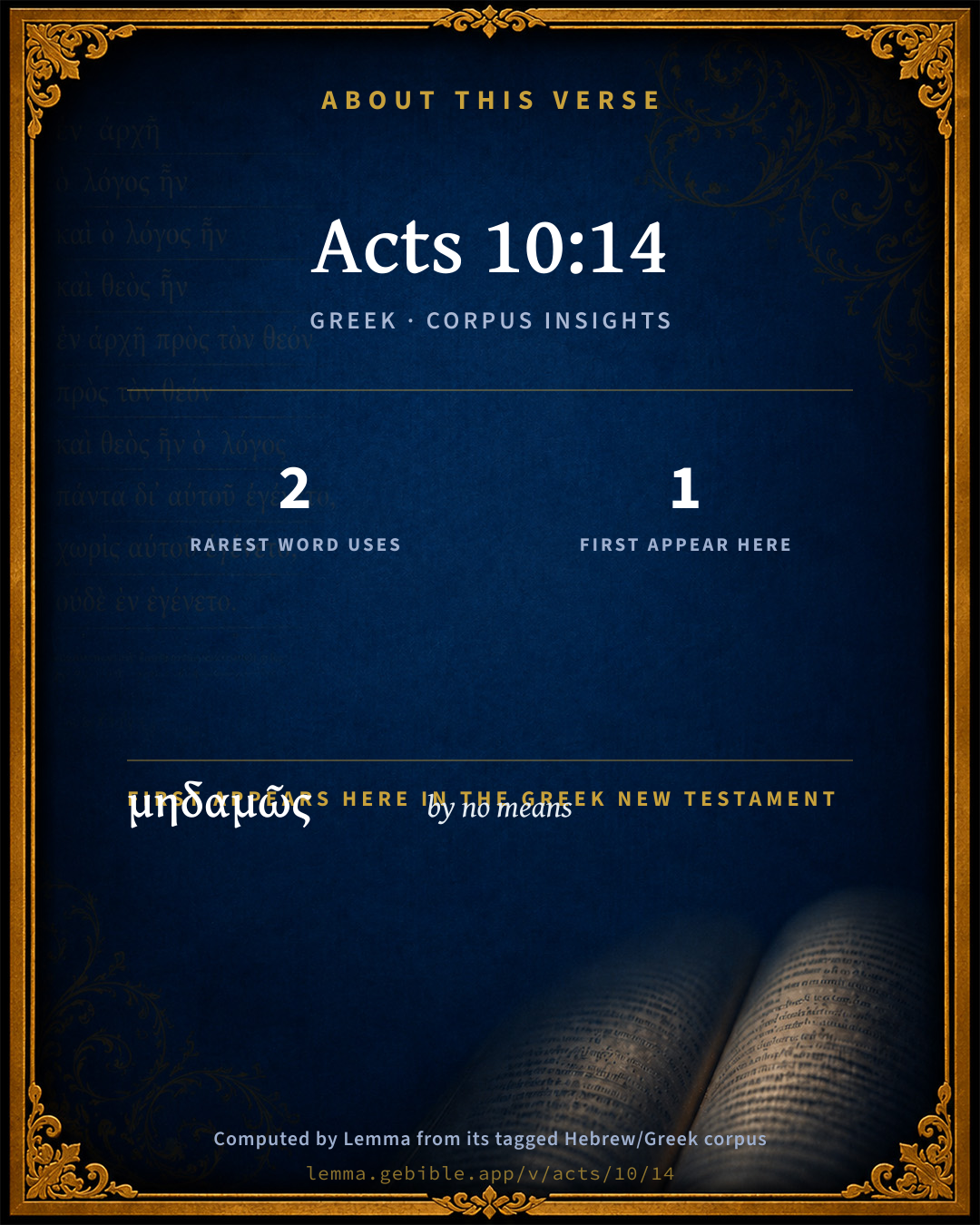
The rarest word here is μηδαμῶς by no means G3365 — appearing just 2 times in the whole Greek New Testament.

First appearance in Scripture

This word makes its first canonical appearance in the Greek New Testament here:

  • μηδαμῶς by no means G3365

Shared distinctive vocabulary

μηδαμῶς by no means G3365 occurs in 2 verses of the Greek New Testament. Also found in:
Cross-references

12

Topical passages linked to Acts 10:14 in the Treasury of Scripture Knowledge — connected by theme and wording, ordered by reader-vote popularity; previews shown in the World English Bible.

  • Leviticus 20:25 "'You shall therefore make a distinction between the clean animal and the unclean, and between the unclean fowl and the clean: and you shall not make yourselves abominable by animal, or by bird, or by anything with which the ground teems, which I have separated from you as unclean for you.
  • Ezekiel 4:14 Then said I, Ah Lord Yahweh! behold, my soul has not been polluted; for from my youth up even until now have I not eaten of that which dies of itself, or is torn of animals; neither came there abominable flesh into my mouth.
  • Leviticus 11:1–25 Yahweh spoke to Moses and to Aaron, saying to them,
  • Deuteronomy 14:1–29 You are the children of Yahweh your God: you shall not cut yourselves, nor make any baldness between your eyes for the dead.
  • Daniel 1:8 But Daniel purposed in his heart that he would not defile himself with the king's dainties, nor with the wine which he drank: therefore he requested of the prince of the eunuchs that he might not defile himself.
  • Exodus 10:11 Not so! Go now you who are men, and serve Yahweh; for that is what you desire!" They were driven out from Pharaoh's presence.
  • Ezekiel 44:31 The priests shall not eat of anything that dies of itself, or is torn, whether it be bird or animal.
  • Matthew 16:22 Peter took him aside, and began to rebuke him, saying, "Far be it from you, Lord! This will never be done to you."
  • Matthew 25:9 But the wise answered, saying, 'What if there isn't enough for us and you? You go rather to those who sell, and buy for yourselves.'
  • Luke 1:60 His mother answered, "Not so; but he will be called John."
  • Acts 9:5 He said, "Who are you, Lord?" The Lord said, "I am Jesus, whom you are persecuting.
  • Acts 10:28 He said to them, "You yourselves know how it is an unlawful thing for a man who is a Jew to join himself or come to one of another nation, but God has shown me that I shouldn't call any man unholy or unclean.

Cross-references courtesy of OpenBible.info (CC BY 4.0).

Commentary

Notes on Acts 10:14 from classic Christian and Jewish commentators (each source and its license shown beneath its notes). The classic Christian expositions comment on the surrounding passage and are grouped to its opening verse, so a note may address several verses; the Jewish commentaries on the Tanakh (Rashi and others) are per-verse, so they appear only where the commentator wrote on this verse.

Lemma curates 59 commentaries, every one of them public domain or Creative Commons licensed, each selected and text-cleaned for this edition rather than reprinted as found. About our sources →

Tyndale Open Study Notes

Tyndale Open Resources

10:14 See Lev 11 for a description of animals that Jewish laws have declared impure and unclean.

Tyndale Open Study Notes — © Tyndale Open Resources, licensed CC BY-SA 4.0. Text via the HelloAO Bible API.

Bengel's Gnomon

Johann Albrecht Bengel

Act 10:14. Μηδαμῶς, by no means) A trance leaves a man liberty in respect to that particular thing which is vividly set before him: ch. Act 22:19. But besides, it is a sign of the power being strengthened, even though the senses are bound, for example, in a dream, to maintain one’s conscientiousness. The first objection started by a man, when GOD orders something difficult, sometimes has an indulgence, ch. Act 22:19-20: but there ought to be no repetition of it: Joh 13:8: Exo 4:13; Deu 3:26; Eze 4:14. From the delay (reluctance) of Peter, the will of GOD shines forth the more clearly. And on that account the more easily could Peter bear the doubts (hesitation) of the brethren: ch. Act 11:2-3, “They that were of the circumcision contended with him, saying, Thou wentest in to men uncircumcised, and didst eat with them.”—οὐδέποτε, never) He who has once done anything, more easily repeats his act. See therefore that thou doest no evil for the first time (even once). Peter had always been observant of the law.

Bengel's Gnomon of the New Testament — English translation (T&T Clark, Edinburgh, 1860) — public domain. Text from a community e-Sword module.

Meyer's Critical & Exegetical Commentary

Heinrich August Wilhelm Meyer

Act_10:14-16. Peter correctly recognises in the summons θῦσον κ. φάγε, Act_10:13, the allowance of selection at his pleasure among all the animals, by which, consequently, the eating of the unclean without distinction was permitted to him. Hence, and not because only unclean animals were seen in the vessel, his strongly declining μηδαμῶς κύριε! This κύριε is the address to theto him unknownauthor of the voice, not to Christ (Schwegler, Zeller).

Concerning the animals which the Jews were forbidden to eat, see Leviticus 11; Deu_14:1 ff.; Ewald, Alterth. p. 194 ff.; Saalschütz, Mos. B. p. 251 ff.

ὅτι οὐδέποτε ἔφαγον πᾶν κοινὸν ἢ ἀκάθαρτ.] for never ate I anything common or unclean (the Talmudic פסול או טמא), i.e. for any profane thing I have always left uneaten. ἤ does not stand for καί (which Lachm. and Tisch. read, after A B א, min. VSS. Clem. Or.; perhaps correctly, see Act_11:8), but appends for the exhaustion of the idea another synonymous expression. Fritzsche, ad Marc. p. 277; Bornemann, Schol. in Luc. p. xl. f. κοινός = βέβηλος; the opposite of ἅγιος (Eze_42:20).

καὶ φωνή] and a voice (not ἡ φωνή, because here other words were heard) came again the second time to him (πάλιυ ἐκ δευτέρου, pleonastically circumstantial; see on Mat_26:42; comp. on Joh_4:54).

ἃ ὁ Θεὸς ἐκαθάρισε, σὺ μὴ κοίνου] what God has cleansed, make not thou common (unclean). The miraculous appearance with the divine voice (Act_10:13) had done away the Levitical uncleanness of the animals in question; they were now divinely cleansed; and thus Peter ought not, by his refusal to obey that divine bidding, to invest them with the character of what is unholyto transfer them into the category of the κοινόν (Rom_14:14). This were mans doing in opposition to Gods deed.

ἐπὶ τρίς] for thrice, which ad confirmationem valuit (Calvin); ἐπί, denotes the terminus ad quem. Bernhardy, p. 252. Comp. ἐς τρίς, Herod, i. 86; Xen. Anab. vi. 4. 16; and Wetstein.

The object aimed at in the whole vision was the symbolical divine announcement that the hitherto subsisting distinction between clean and unclean men (that hedge between Jews and Gentiles!) was to cease in Christianity, as being destined for all men without distinction of nation (Act_10:34-35). But in what relation does the ἃ ὁ Θεὸς ἐκαθάρισε stand to the likewise divine institution of the Levitical laws about food? This is not answered by reference to the effected and accomplished redemption, which is regarded as a restitution of the whole creation (Olshausen), for this restoration is only promised for the world-period commencing with the Parousia (Act_3:20; Mat_19:28 : Rom_8:19 ff.); but rather by pointing out that the institution of those laws of food was destined only for the duration of the old theocracy. They were a divine institution for the particular people of God, with a view to separate them from the nations of the world; their abolition could not therefore but be willed by God, when the time was fully come at which the idea of the theocracy was to be realized through Christ in the whole of humanity (Act_10:35; Romans 3.; Gal_3:28; Col_3:11; Joh_10:16). Comp. Mat_15:17-18. The abolition therefore does not conflict with Mat_5:17, but belongs to the fulfillment of the law effected by Christ, by which the distinction of clean and unclean was removed from the Levitical domain and (comp. Rom_2:28-29) raised into the sphere of the moral idea. See also on Rom_15:14; Mat_5:17.

Meyer — Critical and Exegetical Commentary on the New Testament — English translation by Peter Christie, edited by Frederick Crombie (T&T Clark, 1880) — public domain. Text from a community e-Sword module.

Expositor's Greek Testament

ed. W. Robertson Nicoll

Act 10:14 . Μηδαμῶς : absit (LXX for חָלִילָה ), 1Sa 20:2 ; 1Sa 22:15 (Weiss). Κύριε : Weiss refers to Act 1:24 , and takes it as meaning Jehovah, but others refer the expression here to Christ; the next verse shows us that there was still the same element of self-will in the Apostle which had misled the Peter of the Gospels. οὐδέποτε … πᾶν : the words of strong negation, characteristic of the vehement and impulsive Peter Hebraistic, cf. Exo 20:10 , Jdg 13:4 , and in N.T., Mat 24:22 , Luk 1:37 , Rom 3:12 , 1Co 1:29 ; Simcox, Language of the N. T. , pp. 72, 73, and Blass, Gram. , p. 174. κοινὸν = βέβηλος ; 1Ma 1:62 , opposed to ἅγιος , Lev 10:10 , cf. Eze 22:26 , often used in N.T. for unclean, cf. Mar 7:2 . ἀκάθαρτος , Lev 20:25 , of clean and unclean animals; κοινός in 1 Macc. above is used, as ver. 63 shows, for defilement from meats.

The Expositor's Greek Testament, edited by W. Robertson Nicoll (1897–1910) — public domain. Text from a community e-Sword module.

Geneva Bible (1599)

Geneva Bible translators

Peter profiteth daily in the knowledge of the benefit of Christ, yea, after that he had received the holy Ghost.

Geneva Bible (1599) marginal notes — public domain. Text via Bolls.life.

Jamieson, Fausset & Brown

Robert Jamieson, A. R. Fausset & David Brown

Not so, Lord--See Marginal reference.

I have never eaten anything that is common--that is, not sanctified by divine permission to eat of it, and so "unclean." "The distinction of meats was a sacrament of national distinction, separation, and consecration" [WEBSTER and WILKINSON].

Jamieson, Fausset & Brown — Commentary Critical and Explanatory on the Whole Bible (1871) — public domain (CC PDM 1.0). Text via the HelloAO Bible API.

Adam Clarke's Commentary

Verse 14. Common or unclean.] By common, κοινον, whatever was in general use among the Gentiles is to be understood; by ακαθαρτον, unclean, every thing that was forbidden by the Mosaic law. However, the one word may be considered as explanatory of the other. The rabbins themselves, and many of the primitive fathers, believed that by the unclean animals forbidden by the law the Gentiles were meant.

Adam Clarke's Commentary on the Bible (1810–1826) — public domain. Text from a community e-Sword/MySword module.

John Calvin's Commentaries

14. Not so, Lord. This is the voice of him which doth as well refuse, as also object to God his own commandment; for he is afraid, for good causes, to touch that which he knew was forbidden him in the law of God, (Leviticus 11:21, etc.) Therefore he objecteth to God the law which he himself made, lest he should break the same unadvisedly. There was a certain show of repugnancy between the law and the vision; therefore Peter is not hasty, but desireth first to have his doubt dissolved before he depart from observing the law. Yet it is a strange matter why Peter resisted more in meats than did Abraham in killing his son; for Abraham [might have] had more things to object, (Genesis 22:9, 10.) I dare not here say that that befell Peter which is too common among men, to stand more about outward and small matters than about the chief points of the law; I rather make that answer which is out of doubt, that Abraham’s mind was so persuaded, and that he was furnished with such power of the Spirit, that he overcame with 1ofty and heroical fortitude all those things which might have hindered him. But the Spirit of God wrought slenderly, in Peter; whereby we are taught that every small or light thing doth cause us to doubt, unless the Lord do furnish us with counsel and constancy to overcome all fear. Yet Peter dealeth very godly and very religiously, in that being in doubt amidst divers cogitations, he dare do nothing until it better appear what he ought to follow. Common signifieth in this place profane. For because the Lord (as we have said) had chosen the Jews to be a peculiar people, he had prescribed unto them this rite and manner of living, that it might distinguish them from the profane Gentiles. Therefore, whatsoever the Gentiles did use contrary to the rule of the law, that did they call common, because there was nothing pure or holy but that which God had appointed for the use of his people.

John Calvin's Commentaries (1540-1563) — public domain. Text from the Calvin Translation Society English edition (1840s-50s) via the Christian Classics Ethereal Library (ccel.org). Calvin's coverage is partial (roughly two-thirds of the Bible); uncommented books and verses are honest gaps, never fabricated. The 19th-century editor's footnotes and remarks are omitted so the notes are faithfully Calvin's own voice.

Ellicott's Commentary for English Readers

(14) Not so, Lord . . .—The emphatic resistance even to a voice from heaven is strikingly in harmony with the features of St. Peter’s character, as portrayed in the Gospels, with the “Be it far from thee, Lord,” when he heard of the coming Passion (Mat_16:22), with “Thou shalt never wash my feet,” in Joh_13:8. He had been taught that that which “goeth into the mouth cannot defile the man” (Mar_7:15), but he had not taken in that truth in its fulness, either in its literal or symbolic meaning.

Any thing that is common or unclean.—“Common” is used, as in Mar_7:2, in the sense of “defiled” or “impure,” that which excludes the idea of consecration to a special service.

A Bible Commentary for English Readers, edited by Charles John Ellicott (1878–1897) — public domain. Text from a community e-Sword module.

The Cambridge Bible for Schools and Colleges

gen. ed. J. J. S. Perowne

14. Not so, Lord] Cp. Eze_4:14, where the prophet being shewn that the children of Israel shall eat defiled bread among the Gentiles, exclaims in words very like St Peter’s: “There never came abominable flesh into my mouth.” For the care with which the devout Jew observed the ceremonial distinction between clean and unclean, see Dan_1:8-12; 2Ma_6:18.

common or unclean] The oldest authorities read “common and unclean.” The use of “common” in the sense of impure according to the Mosaic ritual is, as were the ordinances about which this language was employed, peculiar to the Jews. But it is easy to trace the steps by which the word came to be used thus. All persons who were not Jews were viewed as the “common” rabble, shut out from God’s covenant, then whatever practices of these outcasts differed from those of the chosen people were called “common” things, and as these “common” things were those forbidden by the Law, all such prohibited things or actions became known as “common.” Cp. Mar_7:2, where the margin explains that “defiled hands” is in the original “common hands.”

The Cambridge Bible for Schools and Colleges (gen. ed. J. J. S. Perowne; Cambridge University Press, 1878–1918) — public domain. Text from a community e-Sword module.

John Gill's Exposition

But Peter said, not so, Lord,.... God forbid I should do this, so contrary to the law of God, and to my own practice, throughout the whole course of my life:

for I have never eaten anything that is common or unclean; in a ceremonial sense, which was in common use with Gentiles, but unclean by the law of Moses: this shows that Peter as yet closely adhered to the ceremonial law, nor did he know that it was abolished by Christ; and notwithstanding the commission given to him and the rest of the apostles to preach the Gospel to every creature, and the extraordinary gifts of speaking with divers tongues for that purpose, bestowed on them at the day of Pentecost; yet he and they remained greatly strangers to the calling of the Gentiles, and the admitting of them to a civil and religious conversation with them; the knowledge of every truth was not at once communicated to them, but gradually, as it pressed the Lord to enlighten their minds.

John Gill's Exposition of the Whole Bible (1746–1763) — public domain (CC PDM 1.0). Text via the HelloAO Bible API.

Trapp's Complete Commentary

John Trapp

14 But Peter said, Not so, Lord; for I have never eaten any thing that is common or unclean.

Ver. 14. Common or unclean] By commonness there is contracted an uncleanness. It is hard to deal in the world, and not be defiled with the corruption that is in the world through lust.

John Trapp, A Commentary or Exposition upon All the Books of the Old and New Testament (1647–1656) — public domain. Text from a community e-Sword module.

Albert Barnes' Notes on the Bible

I have never eaten ... - In the Old Testament God had made a distinction between clean and unclean animals. See Lev. 11:2-27; Deut. 14:3-20. This law remained in the Scriptures, and Peter pled that he had never violated it, implying that he could not now violate it, as it was a law of God, and that, as it was unrepealed, he did not dare to act in a different manner from what it required. Between that law and the command which he now received in the vision there was an apparent variation, and Peter naturally referred to the well known and admitted written Law. One design of the vision was to show him that that Law was now to pass away.

That is common - This word properly denotes “what pertains to all,” but among the Jews, who were bound by special laws, and who were prohibited from many things that were freely indulged in by other nations, the word “common” came to be opposed to the word “sacred,” and to denote what was in common use among the pagans, hence, that which was “profane,” or “polluted.” Here it means the same as “profane,” or “forbidden.”

Unclean - Ceremonially unclean; that is, what is forbidden by the ceremonial law of Moses.

Albert Barnes' Notes on the Bible (1834–1885) — public domain. Text from a community e-Sword/MySword module.

Matthew Poole's English Annotations

These words may signify one and the same thing, and the latter explain the former; showing that those things are said to be common, which the law, by forbidding them, had made unclean. Others make some difference; and by things common, understand all sorts of creatures, which were forbidden to the Jews, but were commonly fed upon by all nations round about them; and by things unclean, they understand such as by accident became so, as when any of the creatures permitted for use was strangled.

Matthew Poole's English Annotations on the Holy Bible (1683–1685) — public domain. Text from a community e-Sword/MySword module.

Whedon's Commentary on the Bible

Daniel D. Whedon

14. Unclean—Even under the patriarchal dispensation the distinction of animals into clean and unclean was religiously established. (Gen_7:2.) Man, indeed, by nature makes a distinction. Some animals are so repugnant to human tastes and health that we are disgusted at the very thought of eating them. Early in the divine education of man God so used this natural distinction which he had made, as the basis of a moral discrimination, as to impress the minds of fallen men with the difference between the pure and the impure in spirit and life, and between the righteous and the wicked among men. And when God set apart the posterity of Abraham from the idolatries and licentiousness into which the nations were sinking, he made such a distinction of meats as separated Jew and heathen from the same table, and thus struck out one of the most powerful points of union between men. Thus was Israel alone amid the nations; the lonely maintainer of the true God until the time of the God incarnate should come, and then the distinction should be abolished, and all the world be called to the knowledge of Jehovah.

Common or unclean— ”One term,” says Grotius, “defines the other. For the swine (Lev_11:7) is called unclean, and the same (1Ma_10:50; 1Ma_10:65) is called common, that is, commonly used by Gentiles, a people not sanctified to God. Seneca narrates that ‘In the time of the Emperor Tiberius foreign religious systems were forbidden at Rome, and the test was abstinence from certain animals.’”

Daniel D. Whedon (gen. ed.), Commentary on the Old and New Testaments (1874–1909) — public domain. Text from a community e-Sword module.

The Pulpit Commentary

And unclean for or unclean, A.V. and T.R. It is rather a striking testimony to Peter"s religious character as a Jew before his call to the apostolate, that, poor Galilaean fisherman as he was, unlearned and ignorant, he had yet always conscientiously obeyed the Law of Moses in regard to things clean and unclean. (comp. Dan_1:8-15) The address, Lord (Kurie), seems certainly to recognize the voice as that of Christ, which also agrees with the descent of the vessel from heaven. The answer is very similar to the refusals in Mat_16:22; Joh_13:8.

Vers. 14, 15. Nothing common in God"s sight.

Introduce by an account of St. Peter"s vision, observing how it affected the mind of one who was so thoroughly imbued with Jewish notions. In our Lord"s time the laws of the clean and unclean were scrupulously observed, and the apostles had not yet realized how the new spirit of Christ"s kingdom was to set them free from the bondages and the limitations of the Jewish ceremonial. God would, by this vision, correct two of the prevailing mistakes.

1. That his favor was granted only to certain defined classes and individuals of mankind. He "so loved the world.

2. That his service was found in the obedience of merely external regulations, that once had their usefulness and their meaning, but were not necessarily expressions of heart-love and devotion. The first mistake was corrected, in the vision, by the outstretched sheet, which was a figure of the wide world, and the four corners as the directions into which the gospel was now to be borne forth into all the world. The second mistake was corrected by the obliteration of all formal distinctions in the announcement that what God has cleansed man may not call common, for God will receive the love and trust and worship of "whosoever will." Dean Plumptre says, In the interpretation of the vision, all that belongs to humanity had been taken up into heaven,

(1) when man"s nature was assumed by the eternal Word in the Incarnation, (Joh_1:14) and

(2) when that nature had been raised in the Ascension to the heaven of heavens." We may consider

I THE UNIVERSAL TRUTH AS HERE STATED AND ILLUSTRATED. "What God hath cleansed, that call not thou common." God affirms that the whole earth is free to receive the message of the gospel, all disabilities and barriers are for ever removed, and he recognizes no longer the distinctions of elect and non-elect; "To the Gentiles also is granted repentance unto life." It may be shown

(1) that God, as Creator and Preserver, cares for his whole world;

(2) that, as the fatherly Ruler, he is concerned for the moral well-being of the whole world;

(3) that, as dealing with willful and rebellious children, we must conceive that he seeks to accomplish the salvation of all. This truth is the very life of our missionary labor. We are bidden to preach the gospel "to every creature," with a perfect assurance that God would have "all men to be saved, and to come to the knowledge of the truth." This truth is often embraced with difficulty, after strong conflict with limiting prejudices; it is often held as mere sentiment; and perhaps on few men is it the inspiration to noble labors and sacrifices that it was designed to be. How it would urge us to missionary work, if we really believed that Christ wants every man to come to him, and would have us bring them!

II THE LIMITATIONS OF THIS TRUTH FOUND IN JUDAISM. Special favor to one particular race or, as we may better express it, the special call of one race to a particular work or witness does not assume or involve the Divine indifference to the rest; we might more wisely say that all special calls of the few were made for the sake of the whole, and God"s love to the world made him commit a special revelation to the trust of the Jew. The distinction between "clean and unclean" in the food represented a distinction of clean and unclean between Jew and Gentile. But "unclean" things were still God"s, and used by him for other purposes, though not just for food. They were not despised or rejected things, but each had its mission. And so Gentiles were not out of God"s care and favor because Jews were in. They too occupied the places he assigned and did the work he willed. It may further be shown that the Jewish limitations were designedly

(1) temporary,

(2) educational

preparatory to the advent of Christ, in whom and by whom the Divine thought for the whole race could be fully revealed.

III THE REMOVAL OF THE LIMITATIONS UNDER THE CHRISTIAN SYSTEM. Which deals with man as man, apart from any local and temporary distinctions of

(1) nationality,

(2) class,

(3) genius,

(4) location, or

(5) ceremonial cleanness.

The gospel is for the "sons of men." Jew and Gentile, Greek and Roman, bend and free, meet as sinners at the feet of Christ, to receive the forgiveness of sins and the life everlasting. Now there is nothing common in God"s sight. Every soul is a priceless soul, for it has been bought with precious blood, the infinite sacrifice of the Son of God. R.T.

The Pulpit Commentary (1880–1919), ed. H.D.M. Spence-Jones & Joseph S. Exell — public domain. Text from a community e-Sword module.

John Wesley's Explanatory Notes

But Peter said, In nowise, Lord - When God commands a strange or seemingly improper thing, the first objection frequently finds pardon. But it ought not to be repeated. This doubt and delay of St. Peter had several good effects. Hereby the will of God in this important point was made more evident and incontestable. And Peter also, having been so slow of belief himself, could the more easily bear the doubting of his brethren, chap. xi, 2, &c.

John Wesley, Explanatory Notes Upon the Whole Bible (1754–1765) — public domain. Text via the GEBible commentary corpus.

McGarvey & Pendleton's Commentaries

J. W. McGarvey

See notes on verse 9

J. W. McGarvey (with Philip Y. Pendleton), Commentaries on the New Testament (The Fourfold Gospel, 1914; Acts; and the epistles) — public domain. Text from a community e-Sword/MySword module.

Cambridge Greek Testament for Schools and Colleges

14. μηδαμῶς, κύριε, not so (by no means), Lord. Cf. Eze 4:14, where the prophet being shewn that the children of Israel shall eat defiled bread among the Gentiles, exclaims in words very like St Peter’s, ‘There never came abominable flesh into my mouth.’ For the care with which the devout Jew observed the ceremonial distinction between clean and unclean, see Dan 1:8-12; 2Ma 6:18.

οὐδέποτε … πᾶν. From the usage of the Hebrew, the N.T. writers frequently use οὐ (μὴ) … πᾶς where the classical authors would use οὐδείς and μηδείς. Cf. Mat 24:22, οὐκ ἂν ἐσώθη πᾶσα σάρξ. So Rom 3:20; Eph 4:29, &c. In the LXX. cf. Exo 20:10 (of the Sabbath-day), οὐ ποιήσεις ἐν αὐτῇ πᾶν ἔργον. Also, with another case than the nominative or accusative, 2Ch 32:15, οὐ μὴ δύνηται ὁ θεὸς παντὸς ἔθνους καὶ βασιλείας τοῦ σῶσαι τὸν λαὸν αὐτοῦ.

κοινὸν καὶ ἀκάθαρτον, common and unclean. The use of κοινός in the sense of ‘impure’ according to the Mosaic code is, as were all the ordinances about which this language was employed, peculiar to the Jews. But it is easy to trace the steps by which the word came to be used thus. All persons who were not Jews were viewed as the ‘common’ rabble, shut out from God’s covenant (cf. κοινοὶ ἄνθρωποι, Joseph. Ant. J. XII. 2, 14), then whatever practices of these outcasts differed from those of the chosen people were called ‘common’ things, and as these ‘common’ things were those forbidden by the Law, all such prohibited things or actions became known as ‘common.’ Cf. Mar 7:2, where ‘defiled hands’ is the rendering of χεῖρες ἄνιπτοι. κοινός is not used by the LXX. as the rendering of any passage where unclean beasts are spoken of, but appears first in this sense in that version, 1Ma 1:50; 1Ma 1:64 τοῦ μὴ φαγεῖν κοινά.

Cambridge Greek Testament for Schools and Colleges (Cambridge University Press, 1896; 21 vols, various authors incl. Carr, Maclear, Plummer, Farrar, Lumby, Moule, M. R. James, Simcox) — public domain. Text from a community e-Sword module.

Alford’s Greek Testament

Henry Alford

14.] Peter rightly understands the command as giving him free choice of all the creatures shewn to him. We cannot infer hence that the sheet contained unclean animals only. It was a mixture of clean and unclean,—the aggregate, therefore, being unclean.

κύριε] So Cornelius to the angel, ver. 4. It is here addressed to the unknown heavenly speaker.

On the clean and unclean beasts, &c., see Lev_11.

Henry Alford, The Greek Testament (1849–1861) — public domain. Text from a community e-Sword module.

Vincent's Word Studies in the New Testament

Marvin R. Vincent

Not so [μηδαμως] . Stronger : by no means. "With that simple and audacious self - confidence which in his (Peter's) character was so singularly mingled with fits of timidity and depression, he boldly corrects the voice which orders him, and reminds the divine Interlocutor that he must, so to speak, have made an oversight" (Farrar, " Life and Works of Paul "). Compare Mt 16:22.

Common [κοινον] . Unholy.

Marvin R. Vincent, Word Studies in the New Testament (1887–1900) — public domain. Text from a community e-Sword/MySword module.

Lesson kit

Teaching starters — assembled from the data on this page, not authored interpretation. Every prompt links to the verse data it draws on. Edit before teaching.

Acts, in the Acts, opens this verse with 13 words (13 distinct Greek lemmas). Its most distinctive word is mēdamōs (“by no means”). A historical commentator’s framing appears above. Read the whole chapter for the surrounding context.

Discussion questions

  1. How does “by no means” (mēdamōs) shape what this verse is saying?
  2. This is the first place “by no means” appears in Scripture (first appears here). What does its debut here establish?
  3. How does Acts 11:8, which shares the word «by no means», read alongside this verse?
  4. These translations render this verse differently; the difference is in the English rendering, not the original. What questions does that raise?
  5. Compare how Tyndale Open Study Notes and Bengel's Gnomon read this verse. Where do they agree or differ?

Things to notice

  • 1 word makes its first canonical appearance in Scripture here.
  • These translations choose different wording for 4 words in this verse.
  • 13 distinct Greek lemmas span 13 words in this verse.

Reading settings

Reading text

Shown beneath each verse's original-language words.

Old Testament
Old Testament edition

Read the OT as the Masoretic Hebrew (MT) or the Greek Septuagint (LXX).

English shown for the Greek Septuagint (in the Hebrew ↔ Greek comparison).

Comparing translations? Open the Compare panel on any verse page to stack up to four side by side.