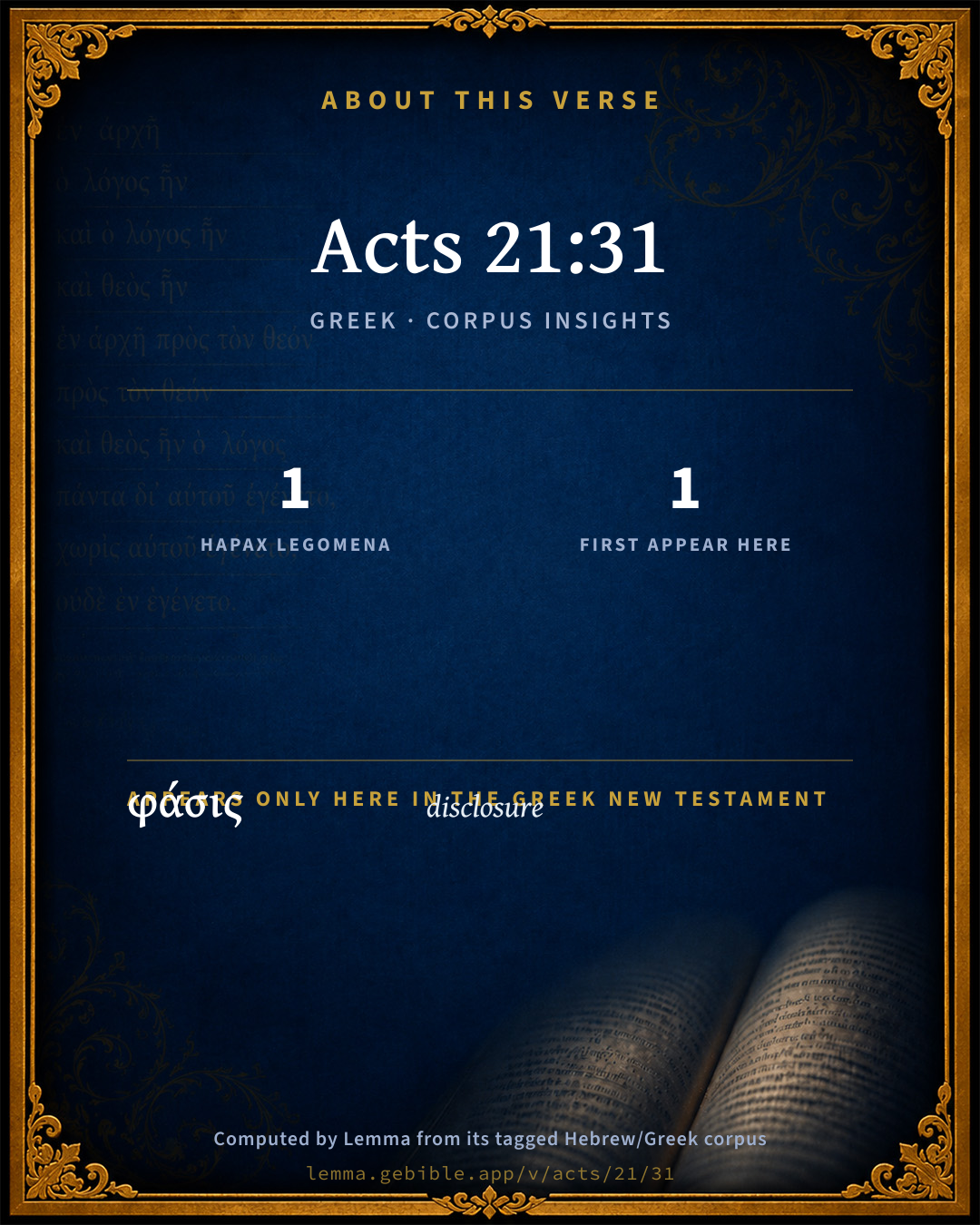
Acts 21:31

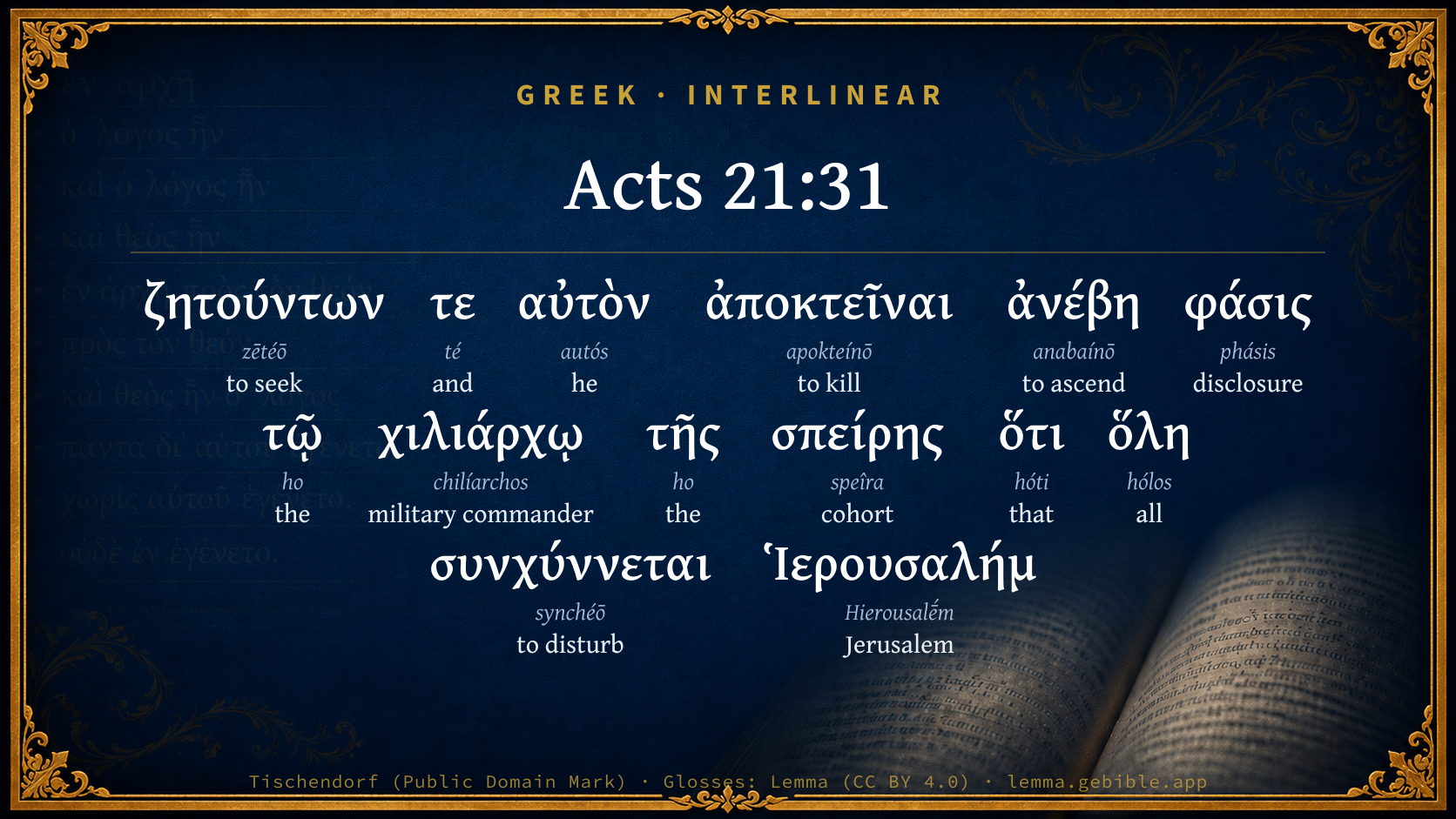
Greek (Tischendorf 8th ed.) Acts 21:31 appears in the Greek New Testament. The text above is from the Tischendorf 8th edition. Each word links to its Strong’s number and a concise gloss. Click any word for its full Thayer’s Greek Lexicon entry.
Download image
Cite this verse

Acts 21:31 (World English Bible). Public Domain. Lemma interlinear Bible study tool, https://lemma.gebible.app/v/acts/21/31.

Show BibTeX & RIS
BibTeX
RIS
English Translation
As they were trying to kill him, news came up to the commanding officer of the regiment that all Jerusalem was in an uproar.
World English Bible · Public Domain
Highlights
  • 1 hapax legomenon — only here in the Greek New Testament
  • 1 first appearance in the Greek New Testament
Full analysis ↓
Download a study sheet

One document with this verse’s original text, its word-by-word gloss line, the meaning frame, cross-references with their text, attributed commentary, and full source and license credits — printable, and it pastes into notes with its structure intact.

This verse Autodidact and up

Study sheet (.html) Plain text (.txt)

A passage Seminary Student

Up to 50 verses in one chapter. A passage sheet keeps up to 6 commentary sources and 12 cross-references per verse, in the order this page ranks them, and says so on the sheet whenever that leaves anything out. Ask for a single verse and you get the Autodidact verse sheet above.

Everything on this page stays free to read, with no account — the sheet is a download of what is already on screen, not access to it.

Want to remove ads? Support Godless Engineer
Compare translations 3

The same verse in 3 English versions, stacked beneath the original-language interlinear above. Click any original word for its lexicon entry.

Each is an independent rendering of the whole verse — the interlinear is not word-aligned to these translations.

Highlighted words mark where these versions differ — a whole-verse word diff, not a word-by-word alignment.

  • World English Bible Public Domain
    As they were trying to kill him, news came up to the commanding officer of the regiment that all Jerusalem was in an uproar.
  • King James Version Public Domain
    And as they went about to kill him, tidings came unto the chief captain of the band, that all Jerusalem was in an uproar.
  • unfoldingWord Literal Text CC BY-SA 4.0
    And as they were seeking to kill him, a report came up to the chiliarch of the cohort that all Jerusalem was agitated,

unfoldingWord Literal Text — © unfoldingWord, licensed CC BY-SA 4.0. Word-aligned USFM3 via Door43 (git.door43.org/unfoldingWord/en_ult).

Versions to compare (up to 4)

3 of 4 selected

Show all 19 translations

Every available English version of this verse, each an independent rendering of the whole verse.

  • World English Bible Public Domain
    As they were trying to kill him, news came up to the commanding officer of the regiment that all Jerusalem was in an uproar.
  • Berean Standard Bible Public Domain
    While they were trying to kill him, the commander of the Roman regiment received a report that all Jerusalem was in turmoil.
  • Majority Standard Bible Public Domain
    While they were trying to kill him, the commander of the Roman regiment received a report that all Jerusalem was in turmoil.
  • King James Version Public Domain
    And as they went about to kill him, tidings came unto the chief captain of the band, that all Jerusalem was in an uproar.
  • American Standard Version (1901) Public Domain
    And as they were seeking to kill him, tidings came up to the chief captain of the band, that all Jerusalem was in confusion.
  • Revised Version (1885) Public Domain
    And as they were seeking to kill him, tidings came up to the chief captain of the band, that all Jerusalem was in confusion.
  • Geneva Bible (1599) Public Domain
    But as they went about to kill him, tydings came vnto the chiefe captaine of the band, that all Hierusalem was on an vproare.
  • Douay-Rheims (1899) Public Domain
    And as they went about to kill him, it was told the tribune of the band, That all Jerusalem was in confusion.
  • Young's Literal Translation Public Domain
    and they seeking to kill him, a rumour came to the chief captain of the band that all Jerusalem hath been thrown into confusion,
  • Literal Standard Version CC BY-SA 4.0
    and they seeking to kill him, a rumor came to the chief captain of the band that all Jerusalem has been thrown into confusion,
  • Unlocked Literal Bible CC BY-SA 4.0
    As they were trying to kill him, news came up to the chief captain of the guard that all Jerusalem was in an uproar.
  • unfoldingWord Literal Text CC BY-SA 4.0
    And as they were seeking to kill him, a report came up to the chiliarch of the cohort that all Jerusalem was agitated,
  • Darby Bible Public Domain
    And as they were seeking to kill him, a representation came to the chiliarch of the band that the whole of Jerusalem was in a tumult;
  • World Messianic Bible Public Domain
    As they were trying to kill him, news came up to the commanding officer of the regiment that all Jerusalem was in an uproar.
  • Webster's Bible Public Domain
    And as they went about to kill him, tidings came to the chief captain of the band, that all Jerusalem was in an uproar.
  • Free Bible Version CC BY-SA 4.0
    As they tried to kill him, news came to the Roman troop commander that the whole of Jerusalem was in an uproar.
  • Bible in Basic English Public Domain
    And while they were attempting to put him to death, news came to the chief captain of the band that all Jerusalem was out of control.
  • Text-Critical English NT CC BY 4.0
    But as they were trying to kill him, a report went up to the commander of the Roman cohort that all Jerusalem was in an uproar.
  • Tyndale New Testament (1534) Public Domain
    As they went about to kyll him tydinges came vnto the hye captayne of the soudiers that all Ierusalem was moved.

Literal Standard Version (2020), Covenant Press — licensed CC BY-SA 4.0. Text via the HelloAO Bible API (eBible.org). Unlocked Literal Bible (unfoldingWord) — licensed CC BY-SA 4.0. Text via the HelloAO Bible API (eBible.org). unfoldingWord Literal Text — © unfoldingWord, licensed CC BY-SA 4.0. Word-aligned USFM3 via Door43 (git.door43.org/unfoldingWord/en_ult). Free Bible Version, Dr. Jonathan Gallagher — licensed CC BY-SA 4.0. Text via the HelloAO Bible API (eBible.org).

Word by word

More ways to search: Search by grammar → Find every occurrence → Compare this word →

Practice this passage: Drill this verse → Learn its vocabulary →

φάσις
phásis
G5334
“disclosure”
Noun, Nominative, Singular, Feminine
Part of Speech
Noun
Case
Nominative
Number
Singular
Gender
Feminine
Full Thayer's Definition

Origin: "from G5346 (not the same as "phase", which is from G5316 )"

TDNT: None

1. in the Attic orators, the exposure of (informing against) those who have embezzled the property of the state, or violated the laws respecting the importation or exporting of merchandise, or defrauded their wards 2. the disclosure of secret crime
  1. ζητούντων zētéō G2212 “to seek” Verb, Present, Active, Participle, Genitive, Plural, Masculine
  2. τε té G5037 “and” Particle
  3. αὐτὸν autós G846 “he” Personal pronoun, Accusative, Singular, Masculine
  4. ἀποκτεῖναι apokteínō G615 “to kill” Verb, Aorist, Active, Infinitive
  5. ἀνέβη anabaínō G305 “to ascend” Verb, Aorist, Active, Indicative, 3rd person, Singular
  6. τῷ ho G3588 “the” Article, Dative, Singular, Masculine
  7. χιλιάρχῳ chilíarchos G5506 “military commander” Noun, Dative, Singular, Masculine
  8. τῆς ho G3588 “the” Article, Genitive, Singular, Feminine
  9. σπείρης speîra G4686 “cohort” Noun, Genitive, Singular, Feminine
  10. ὅτι hóti G3754 “that” Conjunction
  11. ὅλη hólos G3650 “all” Adjective, Nominative, Singular, Feminine
  12. συνχύννεται synchéō G4797 “to disturb” Verb, Present, Passive, Indicative, 3rd person, Singular
  13. Ἱερουσαλήμ Hierousalḗm G2419 “Jerusalem” Noun, Proper, indeclinable

About this verse

These counts appear in no published source. They are computed here, from the morphology-tagged text and Lemma’s own curated glosses. What Lemma adds →

14
words
13
distinct lemmas
Acts
section

Notable vocabulary

1 hapax legomenon — a word that appears only here in the entire Greek New Testament:

  • φάσις disclosure G5334

First appearance in Scripture

This word makes its first canonical appearance in the Greek New Testament here:

  • φάσις disclosure G5334

Shared distinctive vocabulary

συνχύννεται to disturb G4797 occurs in 5 verses of the Greek New Testament. Also found in:

Repetition

A word recurs within this verse:

Cross-references

16

Topical passages linked to Acts 21:31 in the Treasury of Scripture Knowledge — connected by theme and wording, ordered by reader-vote popularity; previews shown in the World English Bible.

  • 2 Corinthians 11:23–33 Are they servants of Christ? (I speak as one beside himself) I am more so; in labors more abundantly, in prisons more abundantly, in stripes above measure, in deaths often.
  • Acts 17:5 But the unpersuaded Jews took along some wicked men from the marketplace, and gathering a crowd, set the city in an uproar. Assaulting the house of Jason, they sought to bring them out to the people.
  • Acts 26:9–10 "I myself most assuredly thought that I ought to do many things contrary to the name of Jesus of Nazareth.
  • 1 Kings 1:41 Adonijah and all the guests who were with him heard it as they had made an end of eating. When Joab heard the sound of the trumpet, he said, Why is this noise of the city being in an uproar?
  • Matthew 26:5 But they said, "Not during the feast, lest a riot occur among the people."
  • Mark 14:2 For they said, "Not during the feast, because there might be a riot of the people."
  • John 16:2 They will put you out of the synagogues. Yes, the time comes that whoever kills you will think that he offers service to God.
  • John 18:12 So the detachment, the commanding officer, and the officers of the Jews, seized Jesus and bound him,
  • Acts 10:1 Now there was a certain man in Caesarea, Cornelius by name, a centurion of what was called the Italian Regiment,
  • Acts 19:40 For indeed we are in danger of being accused concerning this day's riot, there being no cause. Concerning it, we wouldn't be able to give an account of this commotion."
  • Acts 21:38 Aren't you then the Egyptian, who before these days stirred up to sedition and led out into the wilderness the four thousand men of the Assassins?"
  • Acts 22:22 They listened to him until he said that; then they lifted up their voice, and said, "Rid the earth of this fellow, for he isn't fit to live!"
  • Acts 23:17 Paul summoned one of the centurions, and said, "Bring this young man to the commanding officer, for he has something to tell him."
  • Acts 24:6 He even tried to profane the temple, and we arrested him.
  • Acts 24:22 But Felix, having more exact knowledge concerning the Way, deferred them, saying, "When Lysias, the commanding officer, comes down, I will decide your case."
  • Acts 25:23 So on the next day, when Agrippa and Bernice had come with great pomp, and they had entered into the place of hearing with the commanding officers and principal men of the city, at the command of Festus, Paul was brought in.

Cross-references courtesy of OpenBible.info (CC BY 4.0).

Commentary

Notes on Acts 21:31 from classic Christian and Jewish commentators (each source and its license shown beneath its notes). The classic Christian expositions comment on the surrounding passage and are grouped to its opening verse, so a note may address several verses; the Jewish commentaries on the Tanakh (Rashi and others) are per-verse, so they appear only where the commentator wrote on this verse.

Lemma curates 59 commentaries, every one of them public domain or Creative Commons licensed, each selected and text-cleaned for this edition rather than reprinted as found. About our sources →

Joseph Benson's Commentary

Act 21:31-36. And as they went about to kill him — It was a rule among the Jews, that any uncircumcised person who came within the separating wall, mentioned above, might be stoned to death without any further process. And they seemed to think Paul, who, as they supposed, had brought such in thither, deserved no better treatment. Tidings came unto the chief captain of the band — Greek, τω χιλιαρχω της σπειρης, to the tribune of the cohort, called Lysias. A cohort, or detachment of soldiers, belonging to the Roman legion which lodged in the adjacent castle of Antonia, were stationed on feast days near the temple, to prevent disorders. It is evident Lysias himself was not present when the tumult began. Probably he was the oldest Roman tribune then at Jerusalem, and, as such, was the commanding officer of the legion quartered at the castle. Who immediately took soldiers, &c. — And ran down unto them, namely, to suppress the riot, knowing how much it was his concern to check such proceedings. And when they saw the chief captain and soldiers, they left beating of Paul — Which it appears they had begun to do in such a manner, that, had he not been thus seasonably rescued in this critical moment, his life must soon have fallen a sacrifice to their rage. Then the chief captain — Having made his way through the multitude, came near and took him — Into his custody. And how many great ends of Providence were answered by this imprisonment! It was not only a means of preserving his life, (after he had suffered severely for worldly prudence,) but it gave him an opportunity of preaching the gospel safely, in spite of all tumult, Act 22:22; yea, and that in those places to which otherwise he could have had no access, Act 21:40. And commanded him to be bound with two chains — Taking it for granted he was some notorious offender. And thus the prophecy of Agabus was fulfilled, though by the hands of a Roman. And demanded — Of those that seemed most enraged against him; who he was — Against whom such a general outcry was raised; and what he had done — To deserve it. And some cried one thing and some another — So great was the confusion of this riotous assembly, who neither knew one another’s mind, nor their own; though every one pretended to give the sense of the whole body. And when he could not know the certainty for the tumult — For the noise, clamour, and contradictory speeches that were uttered; he commanded him to be carried into the castle — The tower of Antonia, where the Roman soldiers kept garrison. And when he came upon the stairs — Leading to the castle. It was situated on a rock, fifty cubits high, at that corner of the outward temple where the western and northern porticoes joined, to each of which there were stairs descending from it. So it was that he was borne of the soldiers — Up from the ground; for the violence of the people — Who, if they could, would have pulled him limb from limb. And, when they could not reach him with their hands, they pursued him with their clamorous invectives: crying, Away with him — Observe, reader, how the most excellent persons and things are often run down by a popular clamour: Christ himself was so treated, while they cried, Crucify him, crucify him, though they could not mention any evil he had done.

Joseph Benson's Commentary on the Old and New Testaments (1811–1818) — public domain. Text from a community e-Sword module.

Tyndale Open Study Notes

Tyndale Open Resources

21:31 commander: Or tribune, a Roman officer who commanded 1,000 men.

Tyndale Open Study Notes — © Tyndale Open Resources, licensed CC BY-SA 4.0. Text via the HelloAO Bible API.

Bengel's Gnomon

Johann Albrecht Bengel

Act 21:31. Ἀποκτεῖναι, to kill) with strokes and blows: Act 21:32.—ἀνέβη, came up) to the Antonian tower, where there was wont to be a garrison and camp of the Romans.—φάσις, a report) sudden.

Bengel's Gnomon of the New Testament — English translation (T&T Clark, Edinburgh, 1860) — public domain. Text from a community e-Sword module.

Meyer's Critical & Exegetical Commentary

Heinrich August Wilhelm Meyer

Act_21:31-33. But while they sought to kill him (to beat him to death, Act_21:32), information came up (to the castle of Antonia, bordering on the north-west side of the temple) to the tribune of the (Roman) cohort (Claudius Lysias, xxiii. 26). On φάσις, comp. Dem. 793. 16, 1323. 6; Pollux, viii. 6. 47 f.; Susannah 55; and see Wetstein.

τῷ χιλιάρχῳ] a simple dative, not for πρὸς τὸν χ. See Bornemann and Rosenmüller, Repert. II. p. 253.

ἐπʼ αὐτούς] upon them. On κατατρέχειν, to run down, comp. Xen. Anab. v. 4. 23, vii. 1. 20.

ἐκέλ. δεθῆναι] because he took Paul to be an at that time notorious insurgent (Act_21:38), abandoned to the self-revenge of the people. In order, however, to have certainty on the spot, he asked (the crowd): τίς ἂν εἴη καὶ τί ἐστι πεποιηκ.] who he might be (subjective possibility), and of what he was doer (that he had done something, was certain to the inquirer). Comp. Winer, p. 281 [E. T. 375]; Kühner, ad Xen. Anab. i. 3. 14.

εἰς τὴν παρεμβολήν] in castra (see Sturz, Dial. Al. p. 30; Lobeck, ad Phryn. p. 377), i.e. to the fixed quarters of the Roman soldiery, the military barracks of the fortress. So Act_22:24; Act_23:10; Act_23:16; Act_23:32.

Meyer — Critical and Exegetical Commentary on the New Testament — English translation by Peter Christie, edited by Frederick Crombie (T&T Clark, 1880) — public domain. Text from a community e-Sword module.

Expositor's Greek Testament

ed. W. Robertson Nicoll

Act 21:31 . ἀνέβη φάσις : “tidings came up,” R.V., vividly, of the report which would reach the Roman officer in the tower of Antonia, overlooking and connected with the Temple at two points by stairs. The ἀνέβη seems to indicate that the writer was well acquainted with the locality. Stier supposes that a report was brought to the Roman authorities by the Christians, or the word may refer to an official report. The troops would be in readiness as always during the Festivals in case of riot, Jos., Ant. , xx., 5, 3, B.J. , v., 5, 8, etc. φάσις : only here in N.T. Blass and Grimm derive it from φαίνω (in classical Greek, especially of information against smugglers, and also quite generally), but in Susannah ver. 55 (Theod.) φάσις is derived by some from φημί , see Speaker’s Commentary, in loco , while Grimm classes it there also under the same derivation as here. τῷ χιλ .: “military tribune,” R.V. margin; his thousand men consisted of 760 infantry and 240 cavalry, cf. Act 23:23 , Blass, in loco. This officer who was evidently in command at Fort Antonia is called by Josephus φρούραρχος , Ant. , xv., 11, 4, xviii., 4, 3; Schürer, Jewish People , div, ii., vol. ii., p. 55, E.T. τῆς σπείρης , cf. Act 10:1 , “cohort,” R.V. margin. συγκέχυται , see p. 238, and also critical note, “was in confusion,” R.V., lit [362] (so Rhem.).

[362] literal, literally.

The Expositor's Greek Testament, edited by W. Robertson Nicoll (1897–1910) — public domain. Text from a community e-Sword module.

Geneva Bible (1599)

Geneva Bible translators

God findeth some even amongst the wicked and profane themselves, to hinder the endeavors of the rest.

Geneva Bible (1599) marginal notes — public domain. Text via Bolls.life.

Jamieson, Fausset & Brown

Robert Jamieson, A. R. Fausset & David Brown

tidings came--literally, "went up," that is, to the fortress of Antonia, where the commandant resided. See on Act 21:32. This part of the narrative is particularly graphic.

Jamieson, Fausset & Brown — Commentary Critical and Explanatory on the Whole Bible (1871) — public domain (CC PDM 1.0). Text via the HelloAO Bible API.

Adam Clarke's Commentary

Verse 31. The chief captain of the band] The Roman tribune, who had a troop of soldiers under him, which lodged in general in the castle of Antonia, which was built at the angle where the northern and western porticoes of the outer court of the temple were joined together. This castle was built by John Hyrcanus, high priest of the Jews: it was at first called Baris, and was the royal residence of the Asmoneans, as long as they reigned in Jerusalem. It was beautified by Herod the Great, and called Antonia, in honour of his friend Mark Antony. By this castle the temple was commanded, as it stood on higher ground. Josephus describes this castle, War, b. v. chap. 5, sec. 8, "as having four towers, from one of which the whole temple was overlooked; and that one of the towers was joined to the porticoes of the temple, and had a double pair of stairs from it, by which soldiers in the garrison were used to come down with their arms to the porticoes, on the festival days, to keep the people quiet; for, as the temple was a guard to the city, so this castle was a guard to the temple." "It seems, therefore," says Bp. Pearce, "to me very plain, that the place where the Jews were about to kill Paul was the court of the Gentiles, the porticoes being there; and that the chief captain came down there to his rescue." The name of this chief captain, or tribune, was Claudius Lysias, as we learn from Ac 23:26.

Adam Clarke's Commentary on the Bible (1810–1826) — public domain. Text from a community e-Sword/MySword module.

John Calvin's Commentaries

31. As they sought to kill him. Assuredly the force of Satan appeareth therein, in that he driveth the people headlong into such rage, that when they have shut the doors of the temple, being not content with mean punishment, they conspire to put Paul to death. We must thus think with ourselves that Satan doth prick forward the enemies of godliness, lest their rage, how cruel and troublesome soever it be, trouble us. On the other side appeareth the wonderful goodness of God, when as he raiseth up the chief captain at a sudden, that he may deliver Paul from death. He himself thought upon no such thing, but he came to appease the tumult which was raised among the people; but the Lord showeth a more evident token of his providence, because Paul’s life was delivered from such present danger without man’s counsel. Thus doth he suffer the faithful not only to labor, but to be almost oppressed, that he may deliver them from death more wonderfully. Luke calleth him the chief captain [tribune] of the band improperly, seeing every chief captain was set over a thousand, which cloth also appear by the text, where he saith that the chief captain took with him under captains?

John Calvin's Commentaries (1540-1563) — public domain. Text from the Calvin Translation Society English edition (1840s-50s) via the Christian Classics Ethereal Library (ccel.org). Calvin's coverage is partial (roughly two-thirds of the Bible); uncommented books and verses are honest gaps, never fabricated. The 19th-century editor's footnotes and remarks are omitted so the notes are faithfully Calvin's own voice.

Ellicott's Commentary for English Readers

(31) The chief captain of the band.—On the word “band,” and its relation to the Latin “cohort,” see Notes on Act_10:1; Mat_27:27. On the word for “chief captain” (literally, chiliarch, or “captain of a thousand men,” the cohort being the sixth part of the legion, which consisted of 6, 000), see Note on Mat_8:29. They were stationed in the tower known as Antonia, built by Herod the Great, and named in honour of the Triumvir, which stood on the north-west side of the Temple area, on a rock, with a turret at each corner, and two flights of stairs leading to the arcades on the northern and western sides of the Temple. The Roman garrison was obviously stationed there to command the crowds of pilgrims, and was likely to be on the alert at a time like the Pentecost Feast. The Procurator Felix, however, was for the time at Cæsarea. The next verse shows that their appearance was sufficient at once to strike some kind of awe into the turbulent mob. Once again the Apostle owed his safety from violence to the interposition of the civil power, (See Notes on Act_18:14-17.) The “beating” would seem to have been rough treatment with the fists rather than any regular punishment.

A Bible Commentary for English Readers, edited by Charles John Ellicott (1878–1897) — public domain. Text from a community e-Sword module.

The Cambridge Bible for Schools and Colleges

gen. ed. J. J. S. Perowne

31. And as they went about (Rev. Ver. “were seeking”) to kill him] The object of the mob was clearly, now that they had the Apostle in their power, to beat him to death in the crowd, and thus avoid a charge of murder against any individual.

tidings came unto (Better with Rev. Ver. up to) the chief captain of the band] The chief military officer of the Romans in Jerusalem was stationed in the tower of Antonia, which was situate on the N.W. of the Temple on the hill Acra. It had been built by Herod and was so close to the scene of the tumult that news would be brought at once. The military officer (probably a tribune) is called in the Greek, chiliarch, that is, officer over a thousand men. On the word “band” for a Roman cohort, or troop of soldiers, cf. Act_10:1. The verb “came up to” shews that the writer was familiar with the locality and had the whole scene in his mind.

that all Jerusalem was in an uproar] Rev. Ver. “in confusion.” At the time of the feast religious party feeling would run very high, and the multitudes of strangers visiting the city would think to shew their zeal for the temple and the law by their eagerness to avenge any supposed profanation.

The Cambridge Bible for Schools and Colleges (gen. ed. J. J. S. Perowne; Cambridge University Press, 1878–1918) — public domain. Text from a community e-Sword module.

John Gill's Exposition

And as they went about to kill him,.... In the manner as zealots did, without bringing him before any court of judicature, without any charge, trial, and condemnation:

tidings came unto the chief captain of the band; the Roman band of soldiers, who were placed near the temple, to keep the peace of the city, and persons in order; and who were more especially needful, at such a time as the feast of Pentecost, when there was such a great concourse of people in the city, and indeed always were in arms at such times (b); this chief captain was Claudius Lysias, as appears from Act 23:26 to him the report of the disturbance was brought; or as it is in the Greek text, the "fame ascended" to him; who very likely might be in the tower of Antonia, which joined to the temple:

that all Jerusalem was in an uproar; or in confusion, and therefore it became him, as a Roman officer, to take care to quell it, lest it should issue in sedition and rebellion.

(b) Joseph. de Bello Jud. l. 2. c. 12. sect. 1. & l. 5. c. 5. sect. 8.

John Gill's Exposition of the Whole Bible (1746–1763) — public domain (CC PDM 1.0). Text via the HelloAO Bible API.

Trapp's Complete Commentary

John Trapp

31 And as they went about to kill him, tidings came unto the chief captain of the band, that all Jerusalem was in an uproar.

Ver. 31. And as they went about to kill him] The devil was first a liar and then a murderer. The persecutors ever first belied the Church, and then did their worst against her. Slander is a kind of murder, and makes way for it, Eze 22:9, as in the massacre of Paris. The monks had given out before that the Protestants met for no other purpose but to feast their carcases, and then (the lights being put out) to satisfy their unlawful lusts promiscuously. Thus they prepared and provoked the people to that bloody butchery, and so slew the innocent Huguenots twice; like as it is said of Humphrey, Duke of Gloucester, that he was thought by the people of England to be doubly murdered, viz. by detraction and deadly practice.

John Trapp, A Commentary or Exposition upon All the Books of the Old and New Testament (1647–1656) — public domain. Text from a community e-Sword module.

Albert Barnes' Notes on the Bible

And as they went about to kill him - Greek: they seeking to kill him. This was evidently done in a popular tumult, as had been done in the case of Stephen, Acts 7: They could not pretend that they had a right to do it by law.

Tidings came - The news, or rumour came; he was told of it.

The chief captain of the band - This band or body of Roman soldiers was stationed in the castle Antonia, on the north of the temple. This was built by John Hyrcanus, high priest of the Jews, and was by him called Baris. It was beautified and strengthened by Herod the Great, and was called Antonia in honor of his friend, Mark Antony. Josephus describes this castle as consisting of four towers, one of which overlooked the temple, and which he says was 70 cubits high (Jewish Wars, book 5, chapter 5, section 8). In this castle a guard of Roman soldiers was stationed to secure the temple and to maintain the peace. The commander of this cohort is here called “the chief captain.” Reference is made to this guard several times in the New Testament, Mat 27:65-66; Joh 18:12; Act 5:26. The word translated “chief captain” denotes properly “one who commanded 1,000 men.” The band σπεῖρα speira was the tenth part of a legion, and consisted sometimes of four hundred and twenty-five soldiers, at others of five hundred, and at others of six hundred, according to the size of the legion. The name of this captain was Claudius Lysias, Act 23:26.

In an uproar - That the whole city was in commotion.

Albert Barnes' Notes on the Bible (1834–1885) — public domain. Text from a community e-Sword/MySword module.

Matthew Poole's English Annotations

The chief captain; the commander-in-chief over all the soldiers there; or one that had the command over a thousand. At the three great feasts there was usually a considerable number of soldiers at Jerusalem; the confluence from all parts being then so great, and the Jews so impatient of any yoke or government, the Romans durst not trust such multitudes without some check upon them. Thus at the passover, when they took and crucified our Saviour, these soldiers were made use of, Joh 18:12.

Matthew Poole's English Annotations on the Holy Bible (1683–1685) — public domain. Text from a community e-Sword/MySword module.

Whedon's Commentary on the Bible

Daniel D. Whedon

31. Went about to kill him—Were seeking to kill him; that is, dragging him to a place where bloodshed was permissible, and beating him. The surprise of some commentators that the Christians did not come to the rescue of Paul is absurd. Nothing could have been more rash than thus to have drawn on their own heads the vengeance of the Jewish government and people.

Tidings came unto—The commotion would be visible to the Roman sentries stationed on the cloisters at the Fort Antonia, and report would be instantly made to the commander. (See note on Mat_21:12.)

Chief captain of the band—The χιλιαρχος, chiliarch, or commander of a thousand men, nearly equivalent to our colonel. Forthwith a large share of his force (which in full would consist of a thousand soldiers led by ten centurions) is upon the mob in the court of the Gentiles near the gate.

Daniel D. Whedon (gen. ed.), Commentary on the Old and New Testaments (1874–1909) — public domain. Text from a community e-Sword module.

The Pulpit Commentary

Were seeking for went about, A.V.; up to for unto, A.V.; confusion for an uproar, A.V. Tidings; fasiv, only here in the New Testament. The legal use of the word in Greek is an "information" against any one laid before a magistrate. Here it is the information conveyed to the tribune by the sentinels on guard (Lange; see Hist. of Susanna 55). Came up; viz. to the castle of Antonia, to which steps led up from the temple area on the north-west side (see vers. 32 and 35). The chief captain; the chiliarch, or tribune; literally, the commander of a thousand men. (see Joh_18:12) The band (thv speirhv); the cohort which formed the Roman garrison of Antonia (see Act_10:1, note; also vers. 32, 33, etc.; Act_22:24, Act_22:26, etc.)

The Pulpit Commentary (1880–1919), ed. H.D.M. Spence-Jones & Joseph S. Exell — public domain. Text from a community e-Sword module.

John Wesley's Explanatory Notes

And as they went about to kill him - It was a rule among the Jews, that any uncircumcised person who came into the inner temple, might be stoned without farther process. And they seemed to think Paul, who brought such in thither, deserved no better treatment. Word came to the tribune - A cohort or detachment of soldiers, belonging to the Roman legion, which lodged in the adjacent castle of Antonia, were stationed on feast days near the temple, to prevent disorders. It is evident, Lysias himself was not present, when the tumult began. Probably he was the oldest Roman tribune (or colonel) then at Jerusalem. And as such he was the commanding officer of the legion quartered at the castle.

John Wesley, Explanatory Notes Upon the Whole Bible (1754–1765) — public domain. Text via the GEBible commentary corpus.

Kretzmann's Popular Commentary

Paul E. Kretzmann

The captain of the Roman band interferes:

v. 31. And as they went about to kill him, tidings came unto the chief captain of the band that all Jerusalem was in an uproar.

v. 32. Who immediately took soldiers and centurions, and ran down unto them; and when they saw the chief captain and the soldiers, they left beating of Paul.

v. 33. Then the chief captain came near, and took him, and commanded him to be bound with two chains; and demanded who he was and what he had done.

v. 34. And some cried one thing, some another, among the multitude; and when he could not know the certainty for the tumult, he commanded him to be carried into the castle.

It was a typical mob, without reason and sense, that was surging back and forth in the Court of the Gentiles, every one trying to lay hold on the prisoner and do violence to him, all of them eager to kill him. But now someone brought the report to the Roman officer in the Tower of Antonia, which overlooked the Temple and its courts, that the entire city of Jerusalem was in confusion, that a riot had taken hold of all the inhabitants. And this officer, the military tribune, or chiliarch, having a thousand men under his command in the garrison, lost no time, but took several hundred men with their centurions, or officers, with him and ran down upon the seething mob, from the castle to the lower platform of the court, where the center of the riot was situated. This quick action probably saved Paul’s life; for when the people saw the tribune, they stopped beating their prisoner. As the commanding officer then came nearer, he saw that Paul was the center and, in some way, the occasion of the disturbance, and therefore very naturally concluded that he was a criminal upon whom the Jews were inflicting speedy punishment. Since this was not the time to make inquiry, he took the prisoner in charge and gave command that he be bound with two chains. Having secured him thus and shielding him at least in part against the furious onslaught of the mob, the chiliarch now tried to determine who he was and what he had done. But, as usual with mobs, there no longer was any clear notion of what it was all about; one yelled one thing, someone else another, and it soon became clear to the officer that it was impossible to learn the facts on account of the tumult. So he commanded that Paul be led to the barracks of the Tower Antonia. Thus God had once more saved the life of His servant, since He wanted him to give testimony of the Gospel before some of the mighty ones of this earth.

Paul E. Kretzmann, Popular Commentary of the Bible (1921–1924) — public domain. Text from a community e-Sword module.

Burkitt's Expository Notes on the New Testament

William Burkitt

Note here, 1. How the great and gracious God provideth seasonable rescues for his persecuted and perplexed saints and servant: When they went about to kill Paul, God raises him up a deliverer.

Note, 2. The unexpected instrument of the apostle’s deliverance, and that was an heathen governor. The Romans never durst trust such vast multitudes at Jewish festivals without a strong garrison to be a check upon them; accordingly the governor, having tidings of the tumult, brings down a band of soldiers, to see the peace kept; he rescues the injured apostle out of their hands, commands him to be bound with two chains, as Agabas had foretold, and the soldiers bear him up in their arms from the violence of the people.

Hence we learn, 1. That a bad government, even an heathenish government, is better than anarchy. Under a tyrannical government many may be uneasy, but under popular rage none can be long at rest.

Learn, 2. That heathens are oftentimes the protectors of Christians against the blind rage of those that profess to worship the same God. St. Paul and thest believing Jews worshipped the same God, and yet the heathen soldiers were fain by force to carry and guard the apostle from the fury of the bloody unbelieving Jews.

Thus God raiseth up what instruments he pleaseth to subserve his own gracious ends and designs in the preservation of his people. The barbarous heathen soldiers protect St. Paul, and keep him from being torn in pieces by the Jews, who worshipped the same God with him.

William Burkitt's Expository Notes on the New Testament (1700–1703) — public domain. Text from a community e-Sword module.

Godbey's Commentary on the New Testament

William B. Godbey

31-38. Lysias, the Roman kiliarch, commander-in-chief at Castle Antonia on Mt. Moriah near the temple, the Roman citadel for the protection of Jerusalem, in all of his treatment of Paul shows up a very beautiful character of sterling integrity, fidelity and magnanimity, especially for a heathen. If he had not fortunately been present at the castle and run with all his might when he heard the uproar, they would have killed Paul on the spot, so Lysias was sent of God to prolong his life. Having secured the prisoner, and unable, amid the heterogeneous clamor of the mob, to ascertain the crime with which he is charged, he orders the soldiers to carry him into the castle, transporting him in their arms to save his life. The kiliarch is surprised when Paul speaks to him in Greek, thinking that he is a notable Egyptian robber chief who had recently caused great trouble. Of this impression, however, Lysias is relieved when he hears him speak Greek. Consequently he permits the soldiers to stand him on the threshold of the castle, while he proceeds to address the people in Hebrew, which was not only the better understood by the Jews, but calculated to soften their animosities.

William B. Godbey, Commentary on the New Testament (1896–1900) — public domain. Text from a community e-Sword module.

McGarvey & Pendleton's Commentaries

J. W. McGarvey

31-34. For the second time in his history the Roman authorities came to Paul's rescue from the hands of his countrymen. (31) " And as they were seeking to kill him, word came to the chiliarch of the cohort that all Jerusalem was in an uproar, (32) who immediately took soldiers and centurions, and ran down upon them. And when they saw the chiliarch and the soldiers, they quit striking Paul. (33) Then the chiliarch drew near and seized him, and commanded him to be bound with two chains, and inquired who he was, and what he had done. (34) But some of the multitude cried out one thing, and some another; and not being able to know the certainty on account of the tumult, he commanded him to be led into the castle. " The inability of the mob to agree upon any charge against him shows the precipitancy with which they had rushed upon him, while the multiplicity of charges which they vociferated shows the intensity of their hatred. The chiliarch was indifferent through total ignorance of the case, and desired to act prudently; hence he determined to protect the prisoner, and hold him for examination under more favorable circumstances.

J. W. McGarvey (with Philip Y. Pendleton), Commentaries on the New Testament (The Fourfold Gospel, 1914; Acts; and the epistles) — public domain. Text from a community e-Sword/MySword module.

Cambridge Greek Testament for Schools and Colleges

31. ζητούντων τε αὐτὸν ἀποκτεῖναι, and as they were seeking to kill him.

For the omission of the pronoun, which is not rare with the genitive absolute of the third person, see on Act 21:10 above and cf. 1Ch 17:24, μεγαλυνθήτω τὸ ὄνομά σου ἕως αἰῶνος λεγόντων Κύριε, κύριε παντοκράτωρ.

For ζητεῖν in the sense of ‘wishing’ as here cf. Exo 4:24, συνήντησεν αὐτῷ ἄγγελος κυρίου, καὶ ἐζήτει αὐτὸν ἀποκτεῖναι. The desire of the mob was clearly, now that they had the Apostle in their power, to beat him to death in the crowd, and thus avoid a charge of murder against any individual.

ἀνέβη φάσις τῷ χιλιάρχῳ τῆς σπείρης, tidings came up to the chief captain of the band. The chief military officer of the Romans in Jerusalem was stationed in the tower of Antonia, which was situate on the N.W. of the Temple on the hill Acra. This tower had been built by Herod, and was so close to the scene of the tumult that news would be brought at once. The military officer (probably a tribune) is called χιλίαρχος, that is, officer over a thousand men. On the word σπεῖρα for a Roman cohort, or troop of soldiers, cf. Act 10:1. The verb ἀνέβη ‘came up to’ shews that the writer was familiar with the locality and had the whole scene in his mind. On the Tower of Antonia, see Josephus, Vita, 5.

φάσις is used in classical Greek for a formal accusation laid before a law court. It is only found once in the LXX. where φάσις θεοῦ is the order from God given for the punishment of an offender, Susanna 55. The name of the χιλίαρχος is from the further history (Act 23:26) found to have been Claudius Lysias, but nothing is known of him beyond what we read in the Acts.

συγχύννεται, was in confusion. Cf. the σύγχυσις at Ephesus, Act 19:29. At the time of the feast religious party feeling was sure to run very high, and the multitudes of strangers visiting the city would think to shew their zeal for the Temple and the Law by their eagerness to avenge any supposed profanation.

Cambridge Greek Testament for Schools and Colleges (Cambridge University Press, 1896; 21 vols, various authors incl. Carr, Maclear, Plummer, Farrar, Lumby, Moule, M. R. James, Simcox) — public domain. Text from a community e-Sword module.

Alford’s Greek Testament

Henry Alford

31. ζητούντων κ.τ.λ.] By beating him: see ver. 32.

ἀνέβη] went (was carried) up; up, either because of his high station, as commanding officer, or because he was locally stationed in the tower Antonia, overlooking (from the N.W.) the temple, where the riot was.

τῷ χιλιάρχῳ τ. σπ.] Claudius Lysias (ch. 23:26), the tribune of the cohort (whose proper complement was 1000 men).

Henry Alford, The Greek Testament (1849–1861) — public domain. Text from a community e-Sword module.

Vincent's Word Studies in the New Testament

Marvin R. Vincent

Chief captain [χιλιαρχω] . A commander of a thousand men. See on Mr 6:21; and on centurion, Luk 7:2.

Band [σπειρης] . Or cohort. See on Mr 14:16. These troops were quartered in the tower of Antonia, which was at the northwestern corner of the temple - area, and communicated with the temple - cloisters by staircases.

Marvin R. Vincent, Word Studies in the New Testament (1887–1900) — public domain. Text from a community e-Sword/MySword module.

Lesson kit

Teaching starters — assembled from the data on this page, not authored interpretation. Every prompt links to the verse data it draws on. Edit before teaching.

Acts, in the Acts, opens this verse with 14 words (13 distinct Greek lemmas). Its most distinctive word is phásis (“disclosure”). A historical commentator’s framing appears above. Read the whole chapter for the surrounding context.

Discussion questions

  1. How does “disclosure” (phásis) shape what this verse is saying?
  2. This verse holds 1 word here found nowhere else in the Greek New Testament. What might the rare word draw attention to?
  3. The word “disclosure” first appears here in Scripture. What is being introduced at this debut?
  4. Acts 2:6 shares the word «to disturb» with this verse. How do the two illuminate each other?
  5. “the” occurs 2× in this one verse. What is the effect of the repetition?
  6. These translations render this verse differently. What is at stake in choosing one wording over another?
  7. Reading how Joseph Benson's Commentary and Tyndale Open Study Notes read this verse, where do the two commentators agree and where do they part?

Things to notice

  • 1 word in this verse appears nowhere else in the Greek New Testament.
  • 1 word makes its first canonical appearance in Scripture here.
  • These translations choose different wording for 18 words in this verse.
  • “the” occurs 2× in this single verse.
  • 13 distinct Greek lemmas span 14 words in this verse.

Reading settings

Reading text

Shown beneath each verse's original-language words.

Old Testament
Old Testament edition

Read the OT as the Masoretic Hebrew (MT) or the Greek Septuagint (LXX).

English shown for the Greek Septuagint (in the Hebrew ↔ Greek comparison).

Comparing translations? Open the Compare panel on any verse page to stack up to four side by side.