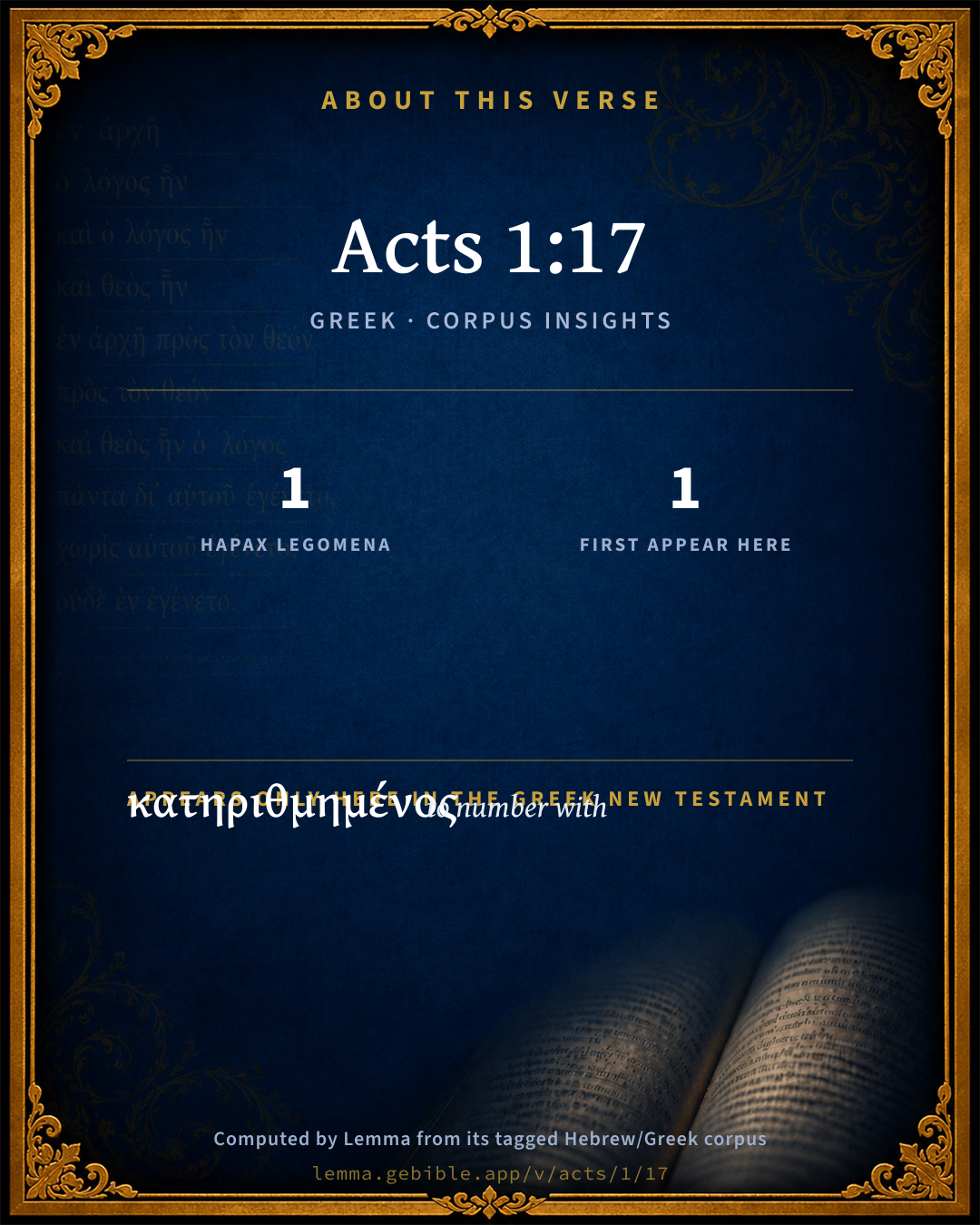
Acts 1:17

Greek (Tischendorf 8th ed.) Acts 1:17 appears in the Greek New Testament. The text above is from the Tischendorf 8th edition. Each word links to its Strong’s number and a concise gloss. Click any word for its full Thayer’s Greek Lexicon entry.
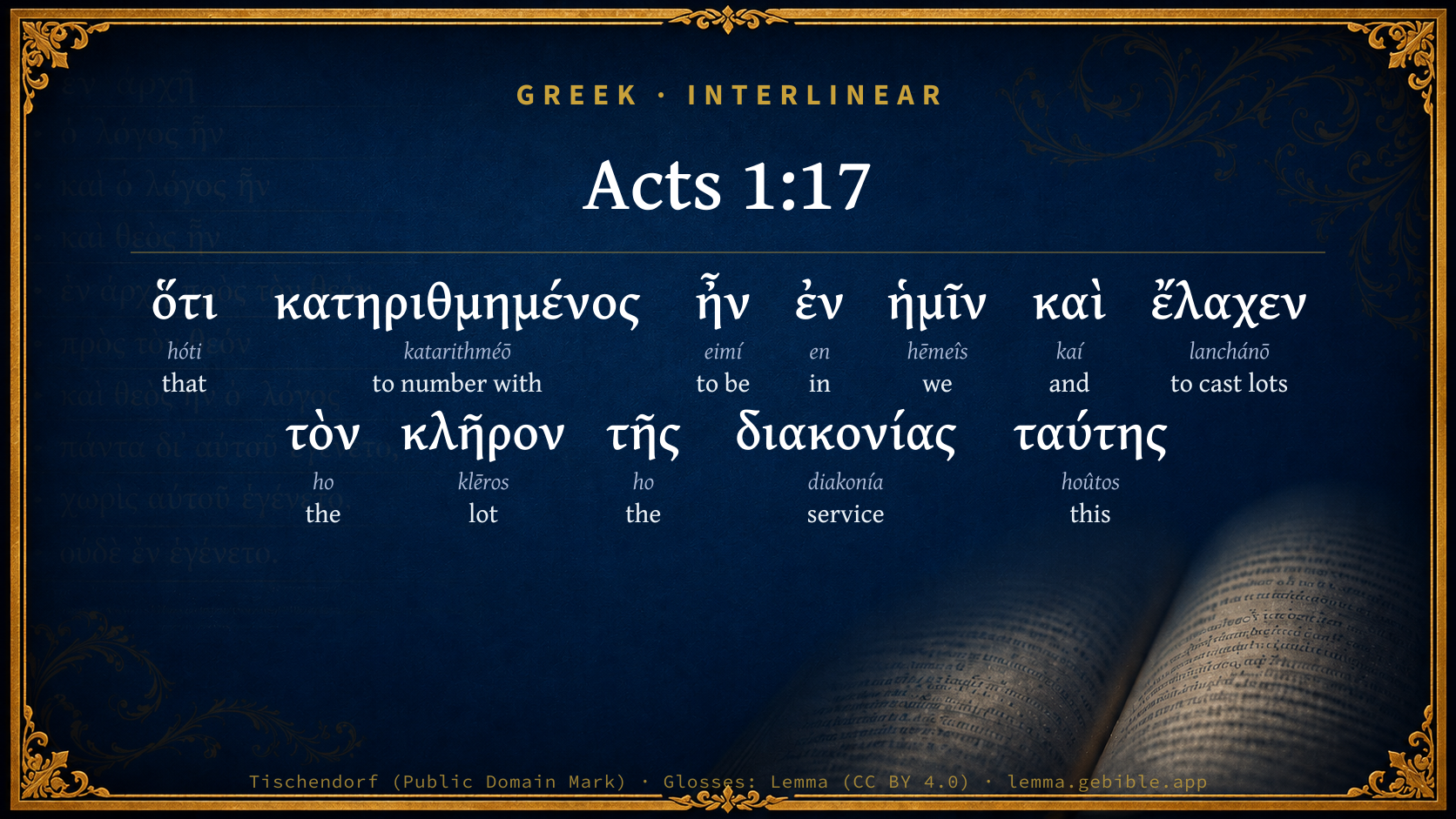
Download image
Cite this verse

Acts 1:17 (World English Bible). Public Domain. Lemma interlinear Bible study tool, https://lemma.gebible.app/v/acts/1/17.

Show BibTeX & RIS
BibTeX
RIS
English Translation
For he was numbered with us, and received his portion in this ministry.
World English Bible · Public Domain
Highlights
  • 1 hapax legomenon — only here in the Greek New Testament
  • 1 first appearance in the Greek New Testament
Full analysis ↓
Download a study sheet

One document with this verse’s original text, its word-by-word gloss line, the meaning frame, cross-references with their text, attributed commentary, and full source and license credits — printable, and it pastes into notes with its structure intact.

This verse Autodidact and up

Study sheet (.html) Plain text (.txt)

A passage Seminary Student

Up to 50 verses in one chapter. A passage sheet keeps up to 6 commentary sources and 12 cross-references per verse, in the order this page ranks them, and says so on the sheet whenever that leaves anything out. Ask for a single verse and you get the Autodidact verse sheet above.

Everything on this page stays free to read, with no account — the sheet is a download of what is already on screen, not access to it.

Want to remove ads? Support Godless Engineer
Compare translations 3

The same verse in 3 English versions, stacked beneath the original-language interlinear above. Click any original word for its lexicon entry.

Each is an independent rendering of the whole verse — the interlinear is not word-aligned to these translations.

Highlighted words mark where these versions differ — a whole-verse word diff, not a word-by-word alignment.

  • World English Bible Public Domain
    For he was numbered with us, and received his portion in this ministry.
  • King James Version Public Domain
    For he was numbered with us, and had obtained part of this ministry.
  • unfoldingWord Literal Text CC BY-SA 4.0
    For he was numbered with us and received a share of this ministry.”

unfoldingWord Literal Text — © unfoldingWord, licensed CC BY-SA 4.0. Word-aligned USFM3 via Door43 (git.door43.org/unfoldingWord/en_ult).

Versions to compare (up to 4)

3 of 4 selected

Show all 19 translations

Every available English version of this verse, each an independent rendering of the whole verse.

  • World English Bible Public Domain
    For he was numbered with us, and received his portion in this ministry.
  • Berean Standard Bible Public Domain
    He was one of our number and shared in this ministry.”
  • Majority Standard Bible Public Domain
    He was one of our number and shared in this ministry.”
  • King James Version Public Domain
    For he was numbered with us, and had obtained part of this ministry.
  • American Standard Version (1901) Public Domain
    For he was numbered among us, and received his portion in this ministry.
  • Revised Version (1885) Public Domain
    For he was numbered among us, and received his portion in this ministry.
  • Geneva Bible (1599) Public Domain
    For hee was nombred with vs, and had obteined fellowship in this ministration.
  • Douay-Rheims (1899) Public Domain
    Who was numbered with us, and had obtained part of this ministry.
  • Young's Literal Translation Public Domain
    because he was numbered among us, and did receive the share in this ministration,
  • Literal Standard Version CC BY-SA 4.0
    because he was numbered among us, and received the share in this ministry.
  • Unlocked Literal Bible CC BY-SA 4.0
    For he was one of us and received his share of the benefits of this ministry.”
  • unfoldingWord Literal Text CC BY-SA 4.0
    For he was numbered with us and received a share of this ministry.”
  • Darby Bible Public Domain
    for he was numbered amongst us, and had received a part in this service.
  • World Messianic Bible Public Domain
    For he was counted with us, and received his portion in this ministry.
  • Webster's Bible Public Domain
    For he was numbered with us, and had obtained part of this ministry.
  • Free Bible Version CC BY-SA 4.0
    He was counted as one of us, and shared in this ministry.”
  • Bible in Basic English Public Domain
    For he was numbered among us, and had his part in our work.
  • Text-Critical English NT CC BY 4.0
    For he was numbered with us and received his share in this ministry.”
  • Tyndale New Testament (1534) Public Domain
    For he was noubred with vs and had obtayned fellouship in this ministracion.

Literal Standard Version (2020), Covenant Press — licensed CC BY-SA 4.0. Text via the HelloAO Bible API (eBible.org). Unlocked Literal Bible (unfoldingWord) — licensed CC BY-SA 4.0. Text via the HelloAO Bible API (eBible.org). unfoldingWord Literal Text — © unfoldingWord, licensed CC BY-SA 4.0. Word-aligned USFM3 via Door43 (git.door43.org/unfoldingWord/en_ult). Free Bible Version, Dr. Jonathan Gallagher — licensed CC BY-SA 4.0. Text via the HelloAO Bible API (eBible.org).

Word by word

More ways to search: Search by grammar → Find every occurrence → Compare this word →

Practice this passage: Drill this verse → Learn its vocabulary →

About this verse

These counts appear in no published source. They are computed here, from the morphology-tagged text and Lemma’s own curated glosses. What Lemma adds →

12
words
11
distinct lemmas
Acts
section

Notable vocabulary

1 hapax legomenon — a word that appears only here in the entire Greek New Testament:

  • κατηριθμημένος to number with G2674

First appearance in Scripture

This word makes its first canonical appearance in the Greek New Testament here:

  • κατηριθμημένος to number with G2674

Shared distinctive vocabulary

ἔλαχεν to cast lots G2975 occurs in 4 verses of the Greek New Testament. Also found in:

Repetition

A word recurs within this verse:

Cross-references

13

Topical passages linked to Acts 1:17 in the Treasury of Scripture Knowledge — connected by theme and wording, ordered by reader-vote popularity; previews shown in the World English Bible.

  • Acts 1:25 to take part in this ministry and apostleship from which Judas fell away, that he might go to his own place."
  • Mark 3:19 and Judas Iscariot, who also betrayed him. He came into a house.
  • John 6:70–71 Jesus answered them, "Didn't I choose you, the twelve, and one of you is a devil?"
  • John 17:12 While I was with them in the world, I kept them in your name. Those whom you have given me I have kept. None of them is lost, except the son of destruction, that the Scripture might be fulfilled.
  • Acts 20:24 But these things don't count; nor do I hold my life dear to myself, so that I may finish my race with joy, and the ministry which I received from the Lord Jesus, to fully testify to the Gospel of the grace of God.
  • Matthew 10:4 Simon the Canaanite; and Judas Iscariot, who also betrayed him.
  • Luke 6:16 Judas the son of James; and Judas Iscariot, who also became a traitor.
  • Luke 22:47 While he was still speaking, behold, a multitude, and he who was called Judas, one of the twelve, was leading them. He came near to Jesus to kiss him.
  • Acts 21:19 When he had greeted them, he reported one by one the things which God had worked among the Gentiles through his ministry.
  • Ephesians 4:11–12 He gave some to be apostles; and some, prophets; and some, evangelists; and some, shepherds and teachers;
  • Acts 12:25 Barnabas and Saul returned to Jerusalem, when they had fulfilled their service, also taking with them John whose surname was Mark.
  • 2 Corinthians 4:1 Therefore seeing we have this ministry, even as we obtained mercy, we don't faint.
  • 2 Corinthians 5:18 But all things are of God, who reconciled us to himself through Jesus Christ, and gave to us the ministry of reconciliation;

Cross-references courtesy of OpenBible.info (CC BY 4.0).

Commentary

Notes on Acts 1:17 from classic Christian and Jewish commentators (each source and its license shown beneath its notes). The classic Christian expositions comment on the surrounding passage and are grouped to its opening verse, so a note may address several verses; the Jewish commentaries on the Tanakh (Rashi and others) are per-verse, so they appear only where the commentator wrote on this verse.

Lemma curates 59 commentaries, every one of them public domain or Creative Commons licensed, each selected and text-cleaned for this edition rather than reprinted as found. About our sources →

Bengel's Gnomon

Johann Albrecht Bengel

Act 1:17. Ὄτι, because) This expresses the reason for which Judas is here mentioned, because he had held an office.—κατηριθμημένος, numbered with us) It is sad to be numbered, and yet not continue.—κλῆρον, [‘part’] the allotment) Lot or allotment is said of whatever falls to the share of one without any exertion on his part.—τῆς διακονίας, the ministry) So most frequently, in this and the following books, the ministry of the New Testament is termed: but in the Old Testament the LXX. translators for the most part use λειτουργεῖν for שרת, to attend on the service of the sanctuary; an expression which of itself conveys to the mind the idea of something rather magnificent: whereas the apostles followed (adopted) an easy humility.[6]—ταύτης, of this) viz. our.

[6] “Expeditam humilitatem,” a lowliness unencumbered by the state and magnificence which marked the Aaronic priesthood.—E. and T.

Bengel's Gnomon of the New Testament — English translation (T&T Clark, Edinburgh, 1860) — public domain. Text from a community e-Sword module.

Expositor's Greek Testament

ed. W. Robertson Nicoll

Act 1:17 . ὅτι κατηριθμημένος ἦν κ . τ . λ . For the construction see Act 1:10 . ὅτι introduces the ground upon which the Scripture to be cited, which speaks of the vacancy in the Apostolic office, found its fulfilment in Judas; “he was numbered,” “triste est numerari non manere,” Bengel. καὶ ἔλαχεν τὸν κλῆρον : lit [106] , “and obtained by lot the lot”: κλῆρος , a lot, that which is assigned by lot, the portion or share so assigned; so amongst the Greeks, and somewhat similarly in English, cf. in LXX Wis 2:9 ; Wis 5:5 , Sir 25:19 . The word is used elsewhere in Acts three times, Act 1:26 , Act 8:21 , Act 26:18 ; cf. with the last passage its use by St. Paul elsewhere, Col 1:12 . Here the word no doubt may be used by St. Peter with reference to the actual selection by lot which was about to follow. The same word is used elsewhere by the same Apostle, 1Pe 5:3 , “neither as lording it over the charge allotted to you,” τῶν κλήρων . Tyndale and Cranmer render the word here “parishes,” which really gives a good interpretation of it = the “lots” assigned to the elders as their portions in God’s heritage; and so we have by an easy transition clerici = clergy, those to whom such “lots” are assigned: Humphry, Commentary on R. V. , p. 446, Lightfoot, Philippians , p. 246 ff. ἔλαχεν : here and in 2Pe 1:1 with an accusative, as in classical Greek, “received his portion” R.V. On the construction of the verb with the genitive, cf. Blass, Grammatik des N. G. , pp. 100, 230, and Plummer’s St. Luke , p. 11; with Luk 1:9 , cf. 1Sa 14:47 . In classical Greek it is used as the opposite of χειροτονηθῆναι , to be elected , more commonly with the infinitive. διακονίας : “Apostleship the highest form of ministration is repeatedly designated thus,” Hort, Ecclesia , p. 204, e.g. , Act 1:25 , Act 20:24 , Act 21:19 , 2Co 4:1 ; 2Co 5:18 ; 2Co 6:3 , Rom 11:13 , and see further on the word, chap. 6. below. It would be difficult to find in such a general term, or in any part of the speech, any reference to a hierarchical constitution of the Church (Zeller, Overbeck). Jüngst cannot derive any such view from this verse, although he sees in the description of διακονία as ἀποστολή , Act 1:25 , the mark of a later period than that of the delivery of the speech (so too Wendt).

[106] literal, literally.

The Expositor's Greek Testament, edited by W. Robertson Nicoll (1897–1910) — public domain. Text from a community e-Sword module.

Adam Clarke's Commentary

Verse 17. Obtained part of this ministry.] ελαχε τον κληρον, He obtained the lot of this ministry-not that he or any of the twelve apostles, was chosen to this ministry by lot, but as lot signifies the portion a man has in life, what comes to him in the course of the Divine providence, or as an especial gift of God's goodness, it is used here, as in many other parts of the sacred writings, to signify office or station. On this subject the reader is referred to on Le 16:8, Le 16:9 (note); Jos 14:2 (note): see also Ac 1:26 (note).

Adam Clarke's Commentary on the Bible (1810–1826) — public domain. Text from a community e-Sword/MySword module.

John Calvin's Commentaries

17. Adopted. It is word for word reckoned. And he saith that he was one of the number, that he might signify unto them that it was needful that the empty place should be filled, to the end that the number might continue whole. And to this propose serveth that which followeth, that he had obtained a part in the ministry. For thereupon it doth follow that the body should be, as it were, lame, if that part should be wanting. Surely it was a thing which might make them greatly amazed, that he whom Christ had extolled unto so high dignity should fall headlong into such destruction. Which circumstance doth increase the cruelty of the fact, and teacheth the rest to take heed unto themselves. Neither is it to be doubted but that the disciples did remember Judas with great grief and sorrow. But Peter doth here express by name the excellency of his function, that he might make them more attentive and more careful to provide a remedy.

John Calvin's Commentaries (1540-1563) — public domain. Text from the Calvin Translation Society English edition (1840s-50s) via the Christian Classics Ethereal Library (ccel.org). Calvin's coverage is partial (roughly two-thirds of the Bible); uncommented books and verses are honest gaps, never fabricated. The 19th-century editor's footnotes and remarks are omitted so the notes are faithfully Calvin's own voice.

Ellicott's Commentary for English Readers

(17) For he was numbered with us.—Literally, he had been numbered.

Had obtained part of this ministry.—Better, the portion, or inheritance. The Greek has the article, and the noun (cleros) is one which afterwards acquired a special half-technical sense in the words, clerus, clericus, “clerk,” “clergy.” In 1Pe_5:3, as being “lords over the heritage,” we find it in a transition sense. (See Note on Act_1:25.)

A Bible Commentary for English Readers, edited by Charles John Ellicott (1878–1897) — public domain. Text from a community e-Sword module.

The Cambridge Bible for Schools and Colleges

gen. ed. J. J. S. Perowne

17. For he was numbered with [among] us, and had obtained part of this ministry] Literally, had received the lot of, &c. Judas fulfils the conditions of the prophecy (Psa_109:2-5). His was the mouth of the deceitful, the lying tongue, the groundless enmity, the requital of evil for good. But though numbered among the twelve that was not his true place.

The Cambridge Bible for Schools and Colleges (gen. ed. J. J. S. Perowne; Cambridge University Press, 1878–1918) — public domain. Text from a community e-Sword module.

John Gill's Exposition

For he was numbered with us,.... He was chosen an apostle with: the rest, and was ordained into that office when they were, and was always reckoned one of the twelve, and stands in the catalogue when they are mentioned:

and had obtained part of this ministry; by lot, as the word signifies; the providence of God so ordering it, according to his eternal purpose and decree, that he was not only called an apostle, and enrolled among them, but he really had a part in that ministry; he preached, and baptized, and wrought miracles; and besides all this, carried the bag, was the treasurer, and a sort of a steward in Christ's family, and provided for it.

John Gill's Exposition of the Whole Bible (1746–1763) — public domain (CC PDM 1.0). Text via the HelloAO Bible API.

Albert Barnes' Notes on the Bible

He was numbered with us - He was chosen as an apostle by the Lord Jesus, Luk 6:13-16. This does not mean that he was a true Christian, but that he was reckoned among the apostles. Long before he betrayed him, Jesus declared that he was a devil, Joh 6:70. He knew his whole character when he chose him, Joh 2:25. If it be asked why he chose such a man to be an apostle; why he was made the treasurer of the apostles, and was admitted to the fullest confidence; we may reply, that a most important object was gained in having such a man - a spy - among them. It might be pretended, when the apostles bore testimony to the purity of life, of doctrine, and of purpose of the Lord Jesus, that they were interested and partial friends; that they might be disposed to suppress some of his real sentiments, and represent him in a light more favorable than the truth. Hence, the testimony of such a man as Judas, if favorable, must be invaluable.

It would be free from the charge of partiality. If Judas knew anything unfavorable to the character of Jesus, he would have communicated it to the Sanhedrin. If he knew of any secret plot against the government, or seditious purpose, he had every inducement to declare it. He had every opportunity to know it; he was with him; heard him converse; was a member of his family, and admitted to terms of familiarity. Yet even Judas could not be bought or bribed, to testify against the moral character of the Saviour. If he had done it, or could have done it, it would have preserved him from the charge of treason; would have entitled him to the reputation of a public benefactor in discovering secret sedition; and would have saved him from the pangs of remorse, and from self-murder. Judas would have done it if he could. But he alleged no such charge; he did not even dare to lisp a word against the pure designs of the Lord Jesus; and his own reproofs of conscience Mat 27:4, and his voluntary death Mat 27:5, furnish the highest proof that can be desired of his conviction that the betrayed Redeemer was innocent.

Judas would have been just the witness which the Jews desired of the treasonable purposes of Jesus. But that could not be procured, even by gold; and they wore compelled to suborn other men to testify against the Son of God, Mat 26:60. We may add here, that the introduction of such a character as that of Judas Iscariot into the number of the apostles, and the use to be made of his testimony, would never have occurred to the author of a forged book. He would have said that they were all the true friends of the Lord Jesus. To have invented such a character as that of Judas, and to make him perform such a part in the plan as the sacred writers do, would have required too much art and cunning - was too refined and subtle a device, to have been thought of unless it had actually occurred.

Albert Barnes' Notes on the Bible (1834–1885) — public domain. Text from a community e-Sword/MySword module.

Matthew Poole's English Annotations

Numbered with us; being one of the twelve apostles.

Had obtained, elace; not as if Judas was made an apostle by lot, as Matthias afterwards; but by the providence of God, by which every lot and casual matter is governed: and to show that the dignity did not befall him, or any of the other apostles, because of their descent, (from Aaron), or from nature, or from any desert whatsoever, but merely from God’s good will and pleasure.

Part of this ministry; then the apostles office is ministerial, and they were not lords over God’s heritage.

Matthew Poole's English Annotations on the Holy Bible (1683–1685) — public domain. Text from a community e-Sword/MySword module.

Whedon's Commentary on the Bible

Daniel D. Whedon

17. Numbered—Chosen, counted and registered as one of the sacred twelve.

Obtained part—Rather, received lot. Intimating that the apostolic office was no mere human choice, but a divine allotment.

Daniel D. Whedon (gen. ed.), Commentary on the Old and New Testaments (1874–1909) — public domain. Text from a community e-Sword module.

The Pulpit Commentary

Among for with, A.V; received his portion in for had obtained part of, A.V. For he was numbered, etc. This is said in order to show that the passage in the Psalms applied strictly to Judas, seeing he had held his portion in the ministry and office of an apostle. (see Joh_6:71) His portion; literally, his lot; i.e. the portion which fell to him by lot. The language is taken from the Old Testament (see e.g. Jos_18:10, 11 19:1, 10, etc.) Those who received such a portion (klhron) were clergy.

Vers. 17-19. The history, character, and end of Judas Iscariot.

I An instance of SELF-DECEPTION, its power and fruits.

1. The possibility that only gradually Judas fell away original basis of narrow-mindedness and self-indulgence leading to love of money and dishonesty.

2. The light turned into darkness. Near to Jesus, but the conscience, once perverted, becoming rapidly its own tempter, kicking against convictions, till convictions themselves become impossible, and the Master, once revered, is hated.

3. The higher the elevation of privilege, the deeper the fall. When remorse lays hold of such a mind it devours all hope, and casts down headlong.

Warning against the beginning of evil. Appeal to those who have still opportunity of repentance to listen to the voice of remonstrance. Jesus gave Judas many times the clear note of pitiful admonition, which was rejected.

II A GREAT LESSON ON THE DUTY OF GOD"S PEOPLE IN THEIR RELATION TO CHURCH DISCIPLINE. The supreme principle must be, not that the Church punishes, but that it solemnly recognizes the Divine jurisdiction. Judas was in God"s hands, and God dealt with him. The place was left vacant, to be filled up in dependence on Divine guidance. We can cut off a name and fill up an office, but we must not lay our hand on persons. The great error which has worked so fatally in Christendom has been the Church"s usurping the Divine office of punishment, and calling in the secular arm to do its evil will. We should deal with backsliders in the tenderest spirit. At the same time, this conspicuous instance serves to keep us in mind that the kingdom of Christ is a real reign of sovereign power, and that the events of men"s lives, their happiness or misery, and what the world calls their fate, all are appointed in harmony with the Divine purpose which is being fulfilled in the Church. The appeal to God by lot was a recognition of the same truth. Though an old Jewish custom, it was sanctioned by God as helping his people to remember the universality of his rule. It was not a blind appeal to chance, but was accompanied with believing prayer and an exercise of human wisdom so far as it went. As at the beginning, so still and always, the Church can be purged of its evil only by God, not by man. We must expect a mingled state, while we aim at purity and maintain a spiritual oversight and watchful discipline in the Church itself. There are two extremes to be avoided:

(1) the latitudinarian indifference which says, "Let the world and the Church intermingle without attempt at distinction;

(2) the Pharisaical censoriousness which would be constantly pulling up tares, and wheat with them, and so tends to disintegrate the Church by endless divisions and separations. Let God be the Judge; for he has said, "Vengeance is mine." Let the prevailing spirit be the charity which "hopeth all things. R.

The Pulpit Commentary (1880–1919), ed. H.D.M. Spence-Jones & Joseph S. Exell — public domain. Text from a community e-Sword module.

McGarvey & Pendleton's Commentaries

J. W. McGarvey

See notes on verse 15

J. W. McGarvey (with Philip Y. Pendleton), Commentaries on the New Testament (The Fourfold Gospel, 1914; Acts; and the epistles) — public domain. Text from a community e-Sword/MySword module.

unfoldingWord translationNotes

Door43 World Missions Community

Connecting Statement:

In verse 17 Peter continues his speech to the believers that he began in Acts 1:16.

General Information:

In verses 18-19 the author tells the reader background information about how Judas died and what people called the field where he died. This is not part of Peter's speech. (See: Background Information)

General Information:

Although Peter is addressing the entire group of people, here the word "us" refers only to the apostles. (See: Exclusive and Inclusive "We")

Now this man

The words "this man" refers to Judas Iscariot.

the earnings he received for his wickedness

"the money that he earned from the evil thing that he did." The words "his wickedness" refer to Judas Iscariot's betraying Jesus to the people who killed him. (See: Assumed Knowledge and Implicit Information)

there he fell headfirst, and his body burst open, and all his intestines poured out

This suggests that Judas fell from a high place, rather than just falling down. The fall was severe enough to cause his body to burst open. Other passages of scripture mention that he hanged himself. (See: Assumed Knowledge and Implicit Information)

Field of Blood

When the people living in Jerusalem heard of the way in which Judas died, they renamed the field.

translationWords

to minister

evil

Jerusalem

blood

unfoldingWord translationNotes — © Distant Shores Media and the Door43 World Missions Community, licensed CC BY-SA 4.0. Source: git.door43.org/Door43/en_tn.

Cambridge Greek Testament for Schools and Colleges

17. ἐν for σὺν with all the most ancient authorities. The Vulg. has ‘in.’

17. ἐν ἡμῖν. This preposition is supported by the ‘in nobis’ of the Vulgate, and seems to give, more than is done by the σὺν of the Text. recept. the sense that though Judas was counted in the Twelve, he was not truly of them.

τὸν κλῆρον. The article is best rendered by the possessive pronoun ‘his part.’

Cambridge Greek Testament for Schools and Colleges (Cambridge University Press, 1896; 21 vols, various authors incl. Carr, Maclear, Plummer, Farrar, Lumby, Moule, M. R. James, Simcox) — public domain. Text from a community e-Sword module.

Alford’s Greek Testament

Henry Alford

17.] ὅτι, not ‘although’ (Kuinoel), but because: it gives the reason of the previous assertion, viz. that Judas held, and had betrayed, that place of high trust of which the prophecy spoke. Thus the ὅτι has reference to the substance of the prophecy, already in Peter’s mind, and serves to explain ἡ ἔπαυλις αὐτοῦ and ἡ ἐπισκοπὴ αὐτοῦ.

ἔλαχεν τὸν κλῆρον] not literally, but inasmuch as the lot of every man is regarded as being cast and appointed by God.

κλῆρος, first, the lot itself; then, that apportioned by lot; then, any species of apportionment, whether possession, or office, as here.

Henry Alford, The Greek Testament (1849–1861) — public domain. Text from a community e-Sword module.

Vincent's Word Studies in the New Testament

Marvin R. Vincent

Numbered [κατηριθμημενος] . Only here in New Testament.

With [συν] . The best texts read ejn, among. So Rev.

Obtained [ελαχε] . Strictly, "received by lot." Rev., better, received. Compare Luk 1:9. In classical Greek, of receiving public magistracies. Part [τον κληρον] . The A. V. does not give the force of the article, the lot which was his. So Rev., "his portion :" lit., lot..

Ministry. See on minister, Mt 20:26. Compare bishopric, ver. 20.

Marvin R. Vincent, Word Studies in the New Testament (1887–1900) — public domain. Text from a community e-Sword/MySword module.

Lesson kit

Teaching starters — assembled from the data on this page, not authored interpretation. Every prompt links to the verse data it draws on. Edit before teaching.

Acts, in the Acts, opens this verse with 12 words (11 distinct Greek lemmas). Its most distinctive word is katarithméō (“to number with”). A historical commentator’s framing appears above. Read the whole chapter for the surrounding context.

Discussion questions

  1. How does “to number with” (katarithméō) shape what this verse is saying?
  2. This verse holds 1 word here found nowhere else in the Greek New Testament. What might the rare word draw attention to?
  3. The word “to number with” first appears here in Scripture. What is being introduced at this debut?
  4. Luke 1:9 shares the word «to cast lots» with this verse. How do the two illuminate each other?
  5. “the” occurs 2× in this one verse. What is the effect of the repetition?
  6. These translations render this verse differently; the difference is in the English rendering, not the original. What questions does that raise?
  7. Reading how Bengel's Gnomon and Expositor's Greek Testament read this verse, where do the two commentators agree and where do they part?

Things to notice

  • 1 word in this verse appears nowhere else in the Greek New Testament.
  • 1 word makes its first canonical appearance in Scripture here.
  • These translations choose different wording for 6 words in this verse.
  • “the” occurs 2× in this single verse.
  • 11 distinct Greek lemmas span 12 words in this verse.

Reading settings

Reading text

Shown beneath each verse's original-language words.

Old Testament
Old Testament edition

Read the OT as the Masoretic Hebrew (MT) or the Greek Septuagint (LXX).

English shown for the Greek Septuagint (in the Hebrew ↔ Greek comparison).

Comparing translations? Open the Compare panel on any verse page to stack up to four side by side.