אֵת
-
Full lexicon entry — Brown-Driver-Briggs (BDB)
From Brown-Driver-Briggs (BDB)
Where this word appears
Grammar key — what these labels mean
Part of speech
- Particle
- A short function word — article, negation, interrogative, the sign of the direct object, and the like.
Every verse where H853 appears in the Book of Ecclesiastes — 56 distinct verses. Click any verse to open its interlinear word-by-word view. Verse text shown in the World English Bible for context — . Each verse’s Hebrew form is shown with its reference; the English is not keyword-highlighted, since the data carries no word-level English alignment. Use “Compare translations” on any verse to read it across multiple English versions. This concordance covers the Hebrew Bible; Septuagint (Greek Old Testament) occurrences are not indexed here.
Ecclesiastes
- Ecclesiastes 1:13 אֶת ptcl do I applied my heart to seek and to search out by wisdom concerning all that is done under the sky. It is a heavy burden that God has given to the sons of men to be afflicted with.
- Ecclesiastes 1:14 אֶת ptcl do I have seen all the works that are done under the sun; and, behold, all is vanity and a chasing after wind.
- Ecclesiastes 2:3 אֶת ptcl do I searched in my heart how to cheer my flesh with wine, my heart yet guiding me with wisdom, and how to lay hold of folly, until I might see what it was good for the sons of men that they should do under heaven all the days of their lives.
- Ecclesiastes 2:10 אֶת ptcl do Whatever my eyes desired, I didn't keep from them. I didn't withhold my heart from any joy, for my heart rejoiced because of all my labor, and this was my portion from all my labor.
- Ecclesiastes 2:12 אֵ֥ת ptcl do I turned myself to consider wisdom, madness, and folly: for what can the king's successor do? Just that which has been done long ago.
- Ecclesiastes 2:14 אֶת ptcl do The wise man's eyes are in his head, and the fool walks in darkness--and yet I perceived that one event happens to them all.
- Ecclesiastes 2:17 אֶת ptcl do So I hated life, because the work that is worked under the sun was grievous to me; for all is vanity and a chasing after wind.
- Ecclesiastes 2:18 אֶת ptcl do I hated all my labor in which I labored under the sun, seeing that I must leave it to the man who comes after me.
- Ecclesiastes 2:20 אֶת ptcl do Therefore I began to cause my heart to despair concerning all the labor in which I had labored under the sun.
- Ecclesiastes 2:24 אֶת ptcl do There is nothing better for a man than that he should eat and drink, and make his soul enjoy good in his labor. This also I saw, that it is from the hand of God.
- Ecclesiastes 3:10 אֶת ptcl do I have seen the burden which God has given to the sons of men to be afflicted with.
- Ecclesiastes 3:11 אֶת אֶת אֶת ptcl do ptcl do ptcl do He has made everything beautiful in its time. He has also set eternity in their hearts, yet so that man can't find out the work that God has done from the beginning even to the end.
- Ecclesiastes 3:15 אֶת ptcl do That which is has been long ago, and that which is to be has been long ago: and God seeks again that which is passed away.
- Ecclesiastes 3:17 אֶת וְ/אֶת ptcl do conj + ptcl do I said in my heart, "God will judge the righteous and the wicked; for there is a time there for every purpose and for every work."
- Ecclesiastes 4:1 אֶת ptcl do Then I returned and saw all the oppressions that are done under the sun: and, behold, the tears of those who were oppressed, and they had no comforter; and on the side of their oppressors there was power; but they had no comforter.
- Ecclesiastes 4:2 אֶת ptcl do Therefore I praised the dead who have been long dead more than the living who are yet alive.
- Ecclesiastes 4:3 אֵ֥ת אֶת ptcl do ptcl do Yes, better than them both is him who has not yet been, who has not seen the evil work that is done under the sun.
- Ecclesiastes 4:4 אֶת וְ/אֵת֙ ptcl do conj + ptcl do Then I saw all the labor and achievement that is the envy of a man's neighbor. This also is vanity and a striving after wind.
- Ecclesiastes 4:5 אֶת אֶת ptcl do ptcl do The fool folds his hands together and ruins himself.
- Ecclesiastes 4:8 אֶת ptcl do There is one who is alone, and he has neither son nor brother. There is no end to all of his labor, neither are his eyes satisfied with wealth. For whom then, do I labor, and deprive my soul of enjoyment? This also is vanity, yes, it is a miserable business.
- Ecclesiastes 4:10 אֶת ptcl do For if they fall, the one will lift up his fellow; but woe to him who is alone when he falls, and doesn't have another to lift him up.
- Ecclesiastes 4:15 אֶת ptcl do I saw all the living who walk under the sun, that they were with the youth, the other, who succeeded him.
- Ecclesiastes 5:4 אֵ֥ת ptcl do When you vow a vow to God, don't defer to pay it; for he has no pleasure in fools. Pay that which you vow.
- Ecclesiastes 5:6 אֶת אֶת אֶת ptcl do ptcl do ptcl do Don't allow your mouth to lead you into sin. Don't protest before the messenger that this was a mistake. Why should God be angry at your voice, and destroy the work of your hands?
- Ecclesiastes 5:7 אֶת ptcl do For in the multitude of dreams there are vanities, as well as in many words: but you must fear God.
- Ecclesiastes 5:19 אֶת ptcl do Every man also to whom God has given riches and wealth, and has given him power to eat of it, and to take his portion, and to rejoice in his labor--this is the gift of God.
- Ecclesiastes 5:20 אֶת ptcl do For he shall not often reflect on the days of his life; because God occupies him with the joy of his heart.
- Ecclesiastes 7:7 אֶת ptcl do Surely extortion makes the wise man foolish; and a bribe destroys the understanding.
- Ecclesiastes 7:13 אֶת אֵ֖ת ptcl do ptcl do Consider the work of God, for who can make that straight, which he has made crooked?
- Ecclesiastes 7:14 אֶת ptcl do In the day of prosperity be joyful, and in the day of adversity consider; yes, God has made the one side by side with the other, to the end that man should not find out anything after him.
- Ecclesiastes 7:15 אֶת ptcl do All this have I seen in my days of vanity: there is a righteous man who perishes in his righteousness, and there is a wicked man who lives long in his evil-doing.
- Ecclesiastes 7:18 אֶת אֶת ptcl do ptcl do It is good that you should take hold of this. Yes, also from that don't withdraw your hand; for he who fears God will come forth from them all.
- Ecclesiastes 7:21 אֶֽת ptcl do Also don't take heed to all words that are spoken, lest you hear your servant curse you;
- Ecclesiastes 7:26 אֶת ptcl do I find more bitter than death the woman whose heart is snares and traps, whose hands are chains. Whoever pleases God shall escape from her; but the sinner will be ensnared by her.
- Ecclesiastes 7:29 אֶת ptcl do Behold, this only have I found: that God made man upright; but they search for many schemes.
- Ecclesiastes 8:8 אֶת אֶת ptcl do ptcl do There is no man who has power over the spirit to contain the spirit; neither does he have power over the day of death. There is no discharge in war; neither shall wickedness deliver those who practice it.
- Ecclesiastes 8:9 אֶת אֶת ptcl do ptcl do All this have I seen, and applied my mind to every work that is done under the sun. There is a time in which one man has power over another to his hurt.
- Ecclesiastes 8:15 אֶת ptcl do Then I commended mirth, because a man has no better thing under the sun, than to eat, and to drink, and to be joyful: for that will accompany him in his labor all the days of his life which God has given him under the sun.
- Ecclesiastes 8:16 אֶת אֶת ptcl do ptcl do When I applied my heart to know wisdom, and to see the business that is done on the earth (for also there is that neither day nor night sees sleep with his eyes),
- Ecclesiastes 8:17 אֶת אֶת ptcl do ptcl do then I saw all the work of God, that man can't find out the work that is done under the sun, because however much a man labors to seek it out, yet he won't find it. Yes even though a wise man thinks he can comprehend it, he won't be able to find it.
- Ecclesiastes 9:1 אֶת אֶת ptcl do ptcl do For all this I laid to my heart, even to explore all this: that the righteous, and the wise, and their works, are in the hand of God; whether it is love or hatred, man doesn't know it; all is before them.
- Ecclesiastes 9:7 אֶֽת ptcl do Go your way--eat your bread with joy, and drink your wine with a merry heart; for God has already accepted your works.
- Ecclesiastes 9:11 אֶת ptcl do I returned, and saw under the sun, that the race is not to the swift, nor the battle to the strong, neither yet bread to the wise, nor yet riches to men of understanding, nor yet favor to men of skill; but time and chance happen to them all.
- Ecclesiastes 9:12 אֶת ptcl do For man also doesn't know his time. As the fish that are taken in an evil net, and as the birds that are caught in the snare, even so are the sons of men snared in an evil time, when it falls suddenly on them.
- Ecclesiastes 9:14 אֹתָ֔/הּ ptcl do + sfx pers 3fs There was a little city, and few men within it; and a great king came against it, besieged it, and built great bulwarks against it.
- Ecclesiastes 9:15 אֶת אֶת ptcl do ptcl do Now a poor wise man was found in it, and he by his wisdom delivered the city; yet no man remembered that same poor man.
- Ecclesiastes 10:19 אֶת ptcl do A feast is made for laughter, And wine makes the life glad; And money is the answer for all things.
- Ecclesiastes 10:20 אֶת ptcl do Don't curse the king, no, not in your thoughts; And don't curse the rich in your bedchamber: For a bird of the sky may carry your voice, And that which has wings may tell the matter.
- Ecclesiastes 11:5 אֶת אֶת ptcl do ptcl do As you don't know what is the way of the wind, Nor how the bones grow in the womb of her who is with child; Even so you don't know the work of God who does all.
- Ecclesiastes 11:6 אֶת ptcl do In the morning sow your seed, And in the evening don't withhold your hand; For you don't know which will prosper, whether this or that, Or whether they both will be equally good.
- Ecclesiastes 11:7 אֶת ptcl do Truly the light is sweet, And a pleasant thing it is for the eyes to see the sun.
- Ecclesiastes 11:8 אֶת ptcl do Yes, if a man lives many years, let him rejoice in them all; But let him remember the days of darkness, for they shall be many. All that comes is vanity.
- Ecclesiastes 12:1 אֶת ptcl do Remember also your Creator in the days of your youth, Before the evil days come, and the years draw near, When you will say, "I have no pleasure in them;"
- Ecclesiastes 12:9 אֶת ptcl do Further, because the Preacher was wise, he still taught the people knowledge. Yes, he pondered, sought out, and set in order many proverbs.
- Ecclesiastes 12:13 אֶת וְ/אֶת ptcl do conj + ptcl do This is the end of the matter. All has been heard. Fear God, and keep his commandments; for this is the whole duty of man.
- Ecclesiastes 12:14 אֶת ptcl do For God will bring every work into judgment, with every hidden thing, whether it is good, or whether it is evil.
About this entry
At a glance — auto-summarized from this page’s data, not written by a person. Every figure links to its source below. This summary describes the numbers; it doesn’t interpret them.
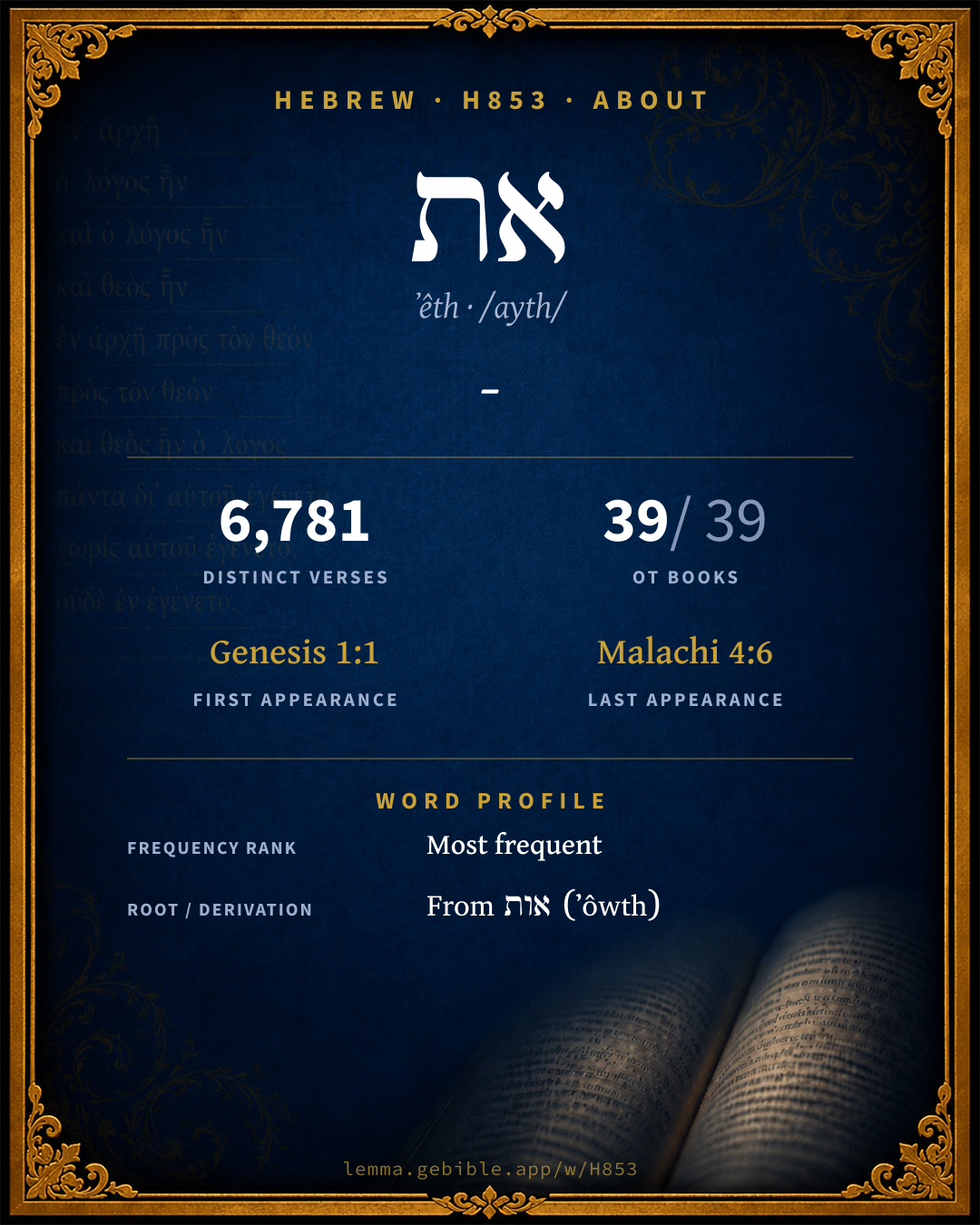
The Hebrew word את centers on the idea of “-.” Its earliest occurrence is Genesis 1:1. It turns up in 6,781 verses across 39 books, one of the most common footprint. It shares a root with אות, את and אתמול. For the data behind this summary, explore the sense tree and the renderings breakdown below.
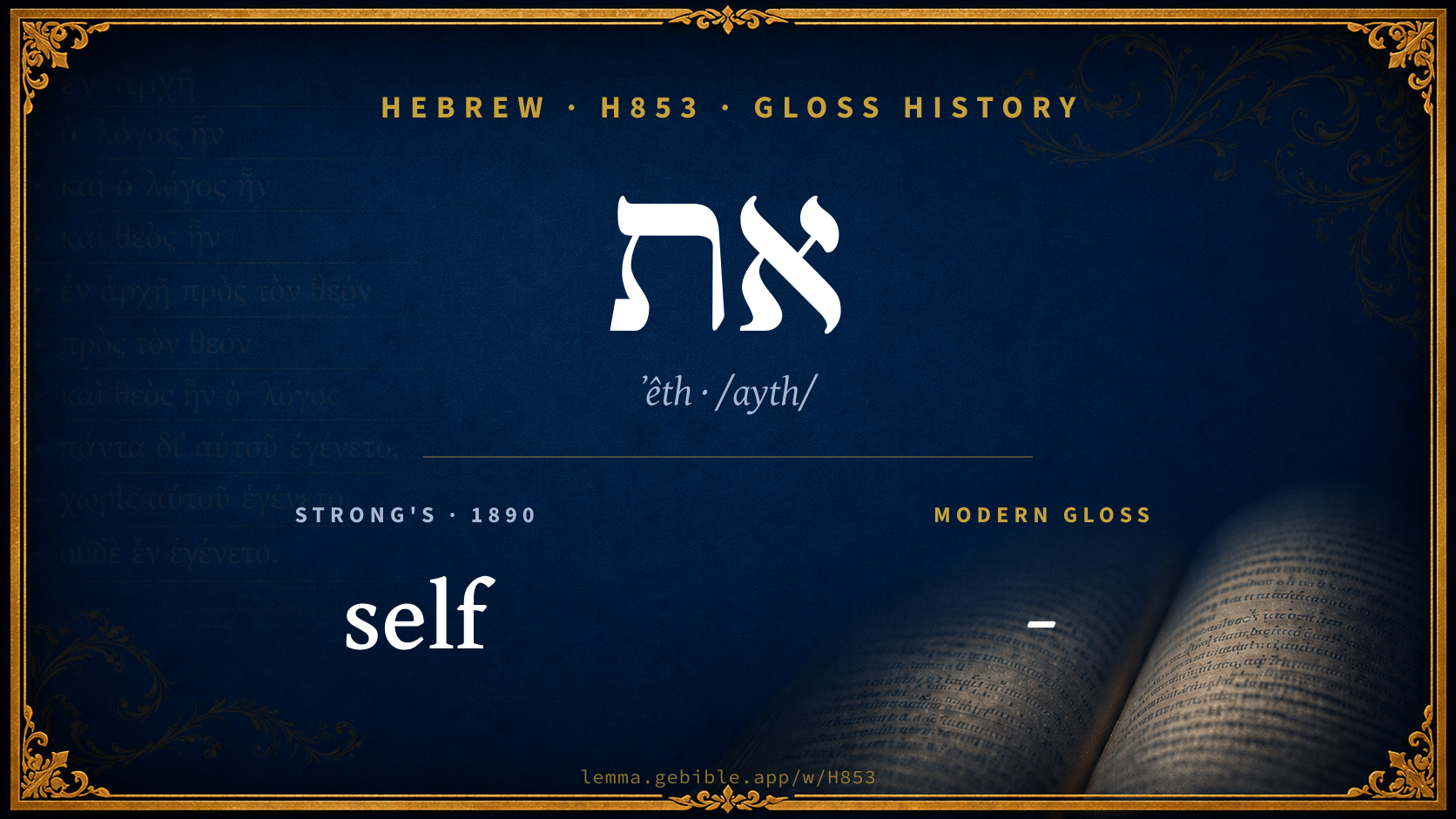
Gloss history
Strong's 1890 vs modern scholarship
About this word
Strong's H853 catalogs a Hebrew word from the Hebrew Old Testament.
These counts are not copied from any lexicon or concordance. They are computed here, from the morphology-tagged Hebrew Old Testament. What Lemma adds →
- 6,781
- distinct verses
- The word appears in 6,781 distinct verses.
- 39 / 39
- OT books
- The word appears in 39 of 39 Old Testament books.
- #1
- by frequency
- Most frequent Hebrew word — of 8,640 Hebrew words by occurrence.
View all 6,781 occurrences in the concordance →
By section of the Old Testament
By traditional corpus
Conventional, traditional groupings — biblical authorship is debated, so this is a traditional corpus grouping, not an authorship claim. Each share is this word’s portion of its verses in that division of the Hebrew canon. Each figure is a share of the word’s 6,781 distinct verses.
- Prophets (Nevi'im) 3,224 verses · 48%
- Torah (Pentateuch) 2,492 verses · 37%
- Writings (Ketuvim) 1,065 verses · 16%
How translations render this word
Counts come from each version’s own published word-to-Strong’s tagging or interlinear alignment — an approximate guide to how each version renders this word, not a word-level alignment the data otherwise carries. Because each total is that version’s own tagged count, the per-version totals vary from one another and need not match the appearance or distinct-verse counts above. These counts may also differ from a printed concordance because Lemma counts each distinctly tagged rendering and does not collapse phrase taggings into a single head-word total. This is a fixed set of word-tagged versions (KJV, ASV, BSB, ULT) and does not change with the reading translation you choose elsewhere. Each version’s license is shown beside its name below (and on Sources).
BDB lists this Strong’s number as 3 distinct words (homographs). Each count above pools all of them and is not split by sense — see the Senses section below. A low-frequency rendering may belong to a different one of those words, not the primary meaning.
- King James Version†: And 2×
- American Standard Version†: And 2×
- Berean Standard Bible†: And 347×, Them 244×, You 213×
- unfoldingWord Literal Text†: And 1,771×, Them 422×, You 319×
King James Version Public Domain
Renders H853 across 4† tagged occurrences — most commonly:
Plus 2 renderings that appear only once — usually multi-word phrases or single function words the recovered tagging swept in, not distinct renderings. Not rendered by a distinct English word in 18 further occurrences.
American Standard Version Public Domain
Renders H853 across 4† tagged occurrences — most commonly:
Plus 2 renderings that appear only once — usually multi-word phrases or single function words the recovered tagging swept in, not distinct renderings.
Berean Standard Bible Public Domain
Renders H853 across 1,490† tagged occurrences — most commonly:
Plus other, less common renderings. Plus 53 renderings that appear only once — usually multi-word phrases or single function words the recovered tagging swept in, not distinct renderings. Not rendered by a distinct English word in 9,434 further occurrences.
unfoldingWord Literal Text CC BY-SA 4.0
Renders H853 across 10,766† tagged occurrences — most commonly:
Plus other, less common renderings. Plus 1,001 renderings that appear only once — usually multi-word phrases or single function words the recovered tagging swept in, not distinct renderings. Not rendered by a distinct English word in 6 further occurrences.
25 senses and sub-senses in the full BDB
What do BDB’s symbols mean?
BDB uses these scholarly abbreviations:
| Symbol | Meaning |
|---|---|
| 𝔊 | the Septuagint (the ancient Greek translation, LXX) |
| 𝔙 | the Vulgate (the Latin translation) |
| 𝔖 | the Syriac version (the Peshitta) |
| 𝔗 | the Targum (the Aramaic translation) |
| ψ | the Psalms |
| √ | root (the underlying root or stem) |
| ‖ | parallel passage (a synonymous or contrasted parallel) |
| † | the dagger: every passage where the word occurs is cited |
The 25 senses and sub-senses the full Brown-Driver-Briggs lexicon distinguishes for this word, in lexicon order (not ranked by frequency), with BDB’s own verbatim wording and sub-sense lettering. Shown in Hebrew script with BDB’s own scholarly abbreviations. The condensed entry is in the Lexicon Entry tab. See also the Forms in the corpus table below.
את I with makk. אֶת־, with suff. אֹתִי
- 1. As mark of the accus. prefixed to substs. defined either by the art. (or כֹּל), or by a genitive or pron. affix, or in virtue of being proper names:
- a. with transitive verbs, Gn 1:1, 16, 29, 30; 2:11; 4:1, 2; 9:3 (אֶת־כֹּֽל׃) etc. Similarly אֶת־מִי whom (in particular), Jos 24:15; 1 S 12:3; 28:11; Is 6:8 al. (but never אֶת־מָה); also with זֶה Gn 29:33; 44:29; 1 S 21:16; 1 K 22:27 +, זֹאת Gn 29:27; 2 S 13:17 +, אֵלֶּה Gn 46:18; Lv 11:22; Is 49:21 +. So pretty uniformly in prose; but in poetry את is commonly dispensed with. By the use of את with the pron. affix, a pron. can at once, if required, be placed in a position of emphasis; let the order of words from this point of view be carefully noticed in the foll. passages: Gn 7:1; 24:14; 37:4; Lv 10:17; 11:33; Nu 22:23 thee I had slain, and her I had kept alive (cf. Gn 41:13), Dt 4:14; 6:13, 23; 13:5; Ju 14:3 אוֹתָהּ קַח לִי take for me her, 1 S 14:35; 15:1; 18:17; 21:10 אִם־אֹתָהּ תִּקַּח־לְךָ קָ֔ח if thou wilt take that, take it, 1 K 1:35; 14:19; Is 43:22; 57:11 Je 9:2. So הַאוֹתִי †Je 5:22; 7:19. It also sometimes enables the reflexive sense to be expressed (elsewhere נַפְשָׁם) Je 7:19 Ez 34:2. Rarely with a subst. which is undefined (Ew§ 277 d 2 Ges§ 117, 1 R. 2), as Ex 21:28; Nu 21:9; Lv 20:14; 1 S 24:6 (but v. Dr) 2 S 4:11; 18:18; 23:21; or which, though definite, is without the art., Gn 21:30; 2 S 15:16; Lv 26:5; 1 S 9:3 (so Nu 16:15) Is 33:19; 41:7; Ez 43:10 (for further exx. v. Ew l.c.) e.g. Genesis 1:1
- b. with a passive verb (Ges§ 121.1 Ew§ 295 b) conceived as expressing neutrally the action in question, and construed accordingly with an accus. of that which is its real object: exx. occur with tolerable frequency from Gn 4:18 (J) וַיִּקָּרֵא אֶת־שְׁמוֹ חֲנֹךְ, and there was called (= one called) his name Enoch,17:5 (P) there shall not be called (= one shall not call) thy name any more Abram, 21:5 (E), 27:42 2 S 21:11; 1 K 18:13; Ho 10:6 etc., to Je 35:14; 38:4; 50:20 Ez 16:4, 5 Est 2:13 (cf. DrJPhl. xi. 227 f.): also with pass. vbs. of filling (Ew§ 281 b), as Ex 1:7 +. e.g. Genesis 4:18
- c. with neuter verbs or expressions, especially such as involve the idea of regarding, or treating, appy. by a constr. κατὰ σύνεσιν (rare), Jos 22:17; 2 S 11:25; Ne 9:32 (cf. 1 S 20:13 Dr 1 K 8:31). Once after אֵין, Hg 2:17 אֵין אֶתְכֶם אֵלַי. e.g. Joshua 22:17
- d. poet. (si vera l.), after an abstr. noun used with a verbal force, †Hb 3:13 (Am 4:11; Is 13:19; Je 50:40 מַהְפֵּכָה exerts a verbal force, like the Arabic nom. verbi [v. WAG i. § 196, 43]; and Nu 10:2; Ez 17:9 לְמַסַּע, לְמַשְׂאוֹת are Aramaizing infinitives: cf. Ew§ 239 a). e.g. Habakkuk 3:13
- 2. את marks an accus. in other relations than that of direct obj. to a verb:
- a. with verbs of motion (very rare) Nu 13:17; Dt 1:19; 2:7 (to ‘walk the wilderness’); denoting the goal Ju 19:18; Ez 21:25 (Ew§ 281 d, n., 282 a 1). e.g. Numbers 13:17
- b. denoting time (duration), also very rare: Ex 13:7 Lv 25:22 Dt 9:25. e.g. Exodus 13:7
- c. expressing the accus. of limitation (rare): Gn 17:11, 14; 1 K 15:23. e.g. Genesis 17:11
- 3. Chiefly in an inferior or later style, אֵת (or וְאֵת) is used irregularly, partly (α), as it would seem, to give greater definiteness (so especially וְאֵת) at the mention of a new subject (when it may sometimes be renderes as regards), or through the influence of a neighbouring verb (a cstr. κατὰ σύνεσιν), or by an anacoluthon, partly (β) as resuming loosely some other prep. Thus (α) Ex 1:14; Nu 3:26, 46; 5:10 (with הָיָה: so Ez 35:10) Nu 18:21b Dt 11:2 (anacol.), 14:13 Jos 17:11; Ju 20:44, 46 (contr. v 25, 35) 1 S 17:34 (v. Dr) 26:16; 2 S 21:22; 2 K 6:5; Is 53:8 (prob.), 57:12; Je 23:33 (but read rather with 𝔊 𝔙 אַתֶּם הַמַּשָּׂא) 27:8; 36:22; 38:16 Kt, 45:4b Ez 16:22; 17:21; 20:16; 29:4b; 43:7 (𝔊 Co prefix הֲרָאִיתָ) 44:3; Zc 8:17; Ec 4:3; Dn 9:13; Ne 9:19, 34; 1 Ch 2:9; 2 Ch 31:17. In 1 S 30:23; Hg 2:5 prob. some such word as remember is to be understood. (β) Je 38:9; Ez 14:22b; 37:19b Zc 12:10; סָבִיב אֵת 1 K 6:5; Ez 43:17 strangely (in 1 K 𝔊 om. the clause: so StaZAW 1883, 135).—In 1 K 11:1 וְ is merely and also, and especially (v. וְ); v 25 is corrupt (read with 𝔊 זֹאת הָרָעָה אֲשֶׁר עָשָׂה הֲדָד); Ez 47:17, 18, 19 read similarly for ואת, זֹאת: see v 20.—For some particulars as to the use of את, see A. M. WilsonHbr. vi. 139 ff. 212 ff. (who, however, confuses it sometimes with II. אֵת). For denoting the pron. obj. of a vb., את with suff. preponderates relatively much above the verbal affix in P, as compared with JE Dt Ju S K (v. GiesebrechtZAW 1881, 285 f.),—partly, probably, on account of the greater distinctness and precision which P loves. e.g. Exodus 1:14
את II with
- 1. Of companionship, together with: Gn 6:13 behold, I destroy them אֶת־הָאָרֶץ together with the earth, 11:31; 12:4 + often, especially with verbs of dwelling, abiding, going, etc., as Ju 1:3; 14:11; 19:4, & in the phrase הָעָם אֲשֶׁר אִתּוֹ Ju 4:13; 7:1; 9:33, 48; 1 S 14:20; 30:4 etc.; thou, and thy sons אִתָּֽךְ ׃ … with thee Gn 6:18; similarly (3rd pers.) 7:7, 13; 8:18; 9:8 al. (charact. of P: DrIntr. 124); הִתְהַלֵּךְ אֶת־הָאֱלֹהִים to walk with God, i.e. to have him as a companion (sc. by adopting a course of life pleasing to him) Gn 5:22, 24; 6:9 (cf. הִתְהַלֵּךְ אֵת lit. 1 S 25:15);—by the side of, like Is 45:9, equally with Lv 26:39, in common with Je 23:28b (cf. עִם 1 e, f). Hence, in partic.— e.g. Genesis 6:13
- a. with for the purpose of help: Nu 14:9 וי׳ אִתָּנוּ, Jos 14:12 (אוֹתִי, as Je 20:11) Ju 1:19; 2 K 6:16; 9:32 מִי אִתִּי מִי who is on my side, who? כִּי אִתְּךָ אֲנִי Is 43:5 Je 1:8, 19 +; Is 63:3 ψ 12:5 our lips are with us, on our side (s. 3 a); in the phrase יַד פּ׳ אֵת (הָֽיְתָה) 2 S 14:19 2 K 15:19 (ידיו) Je 26:24; נָשָׂא אֵת to bear together with, i.e. to assist Ex 18:22 Nu 11:17. Exceptionally, = with the help of: Gn 4:1 for I have gotten a man אֶת־י׳ with the help of י׳ (cf. עם 1 S 14:45) 49:25 (where, however, the parallelism, & 𝔊 𝔖 Sam. favour וְאֵל שַׁדַּי for וְאֵת שַׁדַּי) Mi 3:8; cf. Est 9:29. e.g. Numbers 14:9
- b. beside (Germ. neben): Gn 39:6 לֹא יָדַע אִתּוֹ מְאוּמָה he knew not with him, beside him, aught (i.e. Joseph managed everything), v 8 Ex 20:23 לֹא תַעֲשׂוּן אִתִּ֑י ye shall not make (aught) beside me. e.g. Genesis 39:6
- c. beside = in the presence of (rare): Gn 20:16b and before all thou shalt be righted, Is 30:8 Mi 6:1. In this sense אֶת־פְּנֵי פּ׳ is more freq., v. sub פָּנִים. e.g. Genesis 20:16
- d. of intercourse of different kinds with another, e.g. after verbs of making a covenant or contract, or (less often) of speaking or dealing: (α) Gn 9:9; 15:18; 17:4 (Ez 16:60 Is 59:21 אוֹת-) Jos 10:4 1 K 3:1 etc.; cf. 1 S 2:13 (but here הַכֹּהֵן מֵאֶת־ is prob. to be read with 𝔊 𝔖 𝔗 Ke We etc., cf. Dt 18:3). (β) Gn 17:3; 42:30 דִּבֶּר אִתָּנוּ קָשׁוֹת, 1 K 8:15 ψ 109:2, & especially in Je and Ez (as Je 1:16; 4:12 [52:9 אִתּוֹ] 5:5; 12:1; Ez 2:1; 3:22, 24, 27; 14:4; 44:5—all אוֹת-); Gn 24:49 to perform kindness אֵת (עִם is here more genl.), 2 S 16:17 זֶה חַסְדְּךָ אֶת־רֵעֶ֑ךָ, Ru 2:20 Zc 7:9; Ju 11:27 וְאַתָּה עשֶֹׁה אִתִּי רָעָה, Dt 1:30; 10:21 1 S 12:7b, (אוֹת-) Je 21:2; 33:9 Ez 7:27; 16:59; 22:14; 23:25, 29; 39:24; abs. Ez 17:17; 20:44 ψ 109:21 Zp 3:19; (γ) in a pregn. sense, (in dealing) with, i.e. towards (rare): Is 66:14 ψ 67:2 יָאֵר פָּנָיו אִתָּנוּ make his face to shine with (= toward) us (varied from אֶל Nu 6:25) Dt 28:8; faithful with ψ 78:8 (cf. v 37 נָכוֹן עִם); Ez 2:6 (אוֹתָ֑ךְ); Ju 16:15 וְלִבְּךָ אֵין אִתִּי. (δ) often with verbs of fighting, striving, contending, as Gn 14:2, 8, 9 Nu 20:13 Is 45:9a; 50:8 ψ 35:1 Pr 23:11; with בָּא בְמִשְׁפָּט ψ 143:2 (Is 3:14 al. עִם). e.g. Genesis 9:9
- 2. Of localities, especially in the phrase אֲשֶׁר אֵת describing a site: Ju 3:19; 4:11 אֲשֶׁר אֶת־קֶדֶשׁ which is near Kedesh, 1 K 9:26 2 K 9:27 (cf. עם 2, which is commoner in this sense); Ez 43:8; Ex 33:21 הִנֵּה מָקוֹם אִתִּי. Perhaps, anomalously, 1 S 7:16 at or by all those places (but v. Dr); in 2 S 15:23 עַל־פְּנֵי דֶרֶךְ אֶת־הַמִּדְבָּר, אֵת = towards is against anal.: read with 𝔊L עַל־פָּנָיו דֶּרֶךְ הַזַּיִת אֲשֶׁר בַּמִּדְבָּר; 1 K 9:25 אִתּוֹ beside it (sc. the altar); but עָלָיו 13:1 etc. would be idiomatic, & for אִתּוֹ אֲשֶׁר Klo proposes plausibly אֶת־אִשּׁוֹ (v. Ex 30:20). e.g. Judges 3:19
- 3. אֵת פּ׳ denotes specially,
- a. in one’s possession or keeping: Gn 27:15; 30:29 thou knowest אֵת אֲשֶׁר הָיָה מִקְנְךָ אִתִּי … how thy cattle fared with me, v 33; 42:16 Lv 5:23; 19:13 Dt 15:3 Ju 17:2 1 S 9:7 מָה אִתָּנוּ = what have we? 25:29 Is 49:4 my right is with Jehovah (contr. 40:27), Je 8:8 ψ 38:11 the light of mine eyes also אֵין אִתִּי i.e. is gone from me, Pr 3:28; 8:18; in his power, Je 10:5 הֵיטֵיב אֵין אוֹתָם is not in their power, perhaps ψ 12:5. A dream, or the word of י׳, is said to be אֵת with a prophet, 2 K 3:12 Je 23:28; 27:18. Metaph. of a mental quality, Pr 11:2; 13:10. e.g. Genesis 27:15
- b. in one’s knowledge or memory: Is 59:12 פְּשָׁעֵינוּ אִתָּנוּ our transgressions are with us, i.e. present to our minds (‖ וַעֲוֹנֹתֵינוּ יְדַעֲנוּם), Jb 12:3 אֶת־מִי־אֵין כְּמוֹ־אֵלֶּה with whom are not (i.e. who knoweth not? τίς οὐ σύνοιδε;) things like these? 14:5 אִתָּךְ i.e. known to thee, Pr 2:1 Gn 40:14 Je 12:3 (Ew Gf towards thee, as 1 d γ). So אִם־יֵשׁ אֶת־נַפְשְׁכֶם Gn 23:8 [2 K 9:15 נ׳ alone], אֶת־לְבָבְךָ 2 K 10:15. Comp. עם 4 b, which is more frequent in this sense. e.g. Isaiah 59:12
- 4. מֵאֵת (מֵאִתִּי, etc.; also מֵאוֹת-, v. p. 85) from proximity with (like Gk. παρά with a genit., Fr de chez; in Syriac ܡܶܢ ܠܘܳܬ Arabic مِنْ عِنْدَ correspond. Synon. מֵעִם; see below): coupled almost always with persons (contrast מֵעִם, a). Thus
- a. with קָנָה to buy Gn 25:10 + often; (cf. 17:27); לָקַח Gn 42:24 Ex 25:2 Lv 25:36 Nu 17:17 + often; נָשָׂא ψ 24:5; שִׁלַּח, as Gn 8:8 וַיְשַׁלַּח אֶת־הַיּוֹנָה מֵאִתּוֹ and he sent forth the dove from with him 26:27; הָלַךְ Gn 26:31 1 K 18:12; 20:36 Je 9:1, of a wife deserting her husband Ju 19:2 וַתֵּלֶךְ מֵאִתּוֹ, Je 3:1 (cf. Is 57:8); with sim. words Gn 38:1 Dt 2:8 1 K 11:23 Je 2:37 (v. Ex 5:20); Is 54:10 ψ 66:20; with שָׁאַל Ju 1:14 1 K 2:16 ψ 27:4 +, דָּרַשׁ 1 K 22:7 al., שָׁמַע 1 S 2:23.—מֵאֵת פְּנֵי פּ׳ Gn 27:30; 43:34 Ex 10:11 Jb 2:7; Lv 10:4 (הַקֹּדֶשׁ), 2 K 16:14 (הַבַּיִת). Hence e.g. Genesis 25:10
- b. of rights or dues, handed over from, given on the part of, any one: Gn 47:22 חֹק מֵאֵת פַּרְעֹה; often in P, as Gn 23:20 Ex 27:21 a perpetual due מֵאֵת בְּנֵי יִשְׂרָאֵל from, or on the part of, the children of Israel, Lv 7:34b; 24:8 Nu 3:9; 7:84 +; Dt 18:3 1 S 2:13 (𝔊, etc.; v. 1 d) 2 S 15:3 וְשֹׁמֵעַ אֵין־לְךָ מֵאֵת הַמֶּלֶךְ but there is none to hear thee deputed of the king, 1 K 5:14. e.g. Genesis 47:22
- c. expressing origination: 1 K 1:27 אִם מֵאֵת אֲדֹנִי הַמֶּלֶךְ נִהְיָה Especially מֵאֵת י׳—of a concrete object proceeding from him: Gn 19:24 (brimstone), Nu 11:31 (a wind), 16:35 (fire), 1 S 16:14 (evil spirit), Is 38:7 (a sign), Je 51:53 (wasters), Mi 5:6 (dew); of wrath Zc 7:12 (cf. Nu 17:11), teaching Is 51:4, the word of prophecy Je 7:1 (so 11:1; 18:1 + often in Je) 37:17 Ez 33:30; with ‘have I (we) heard’ Is 21:10; 28:22 Je 49:14 (= Ob 1); of an event, or phase of history Jos 11:20 מֵאֵת י׳ הָֽיְתָה it came of י׳ to …, 1 K 12:24 Hb 2:13 ψ 118:23 מֵאֵת י׳ הָֽיְתָה זֹאת (𝔊 παρὰ Κυρίου) Ezr 9:8 Ne 6:16; of trouble (רָעָה) 2 K 6:33 Mi 1:12 (יָרַד); of a good or evil lot, having its source in י׳ Je 13:25 Is 54:17 ψ 109:20, cf. Jb 2:10; ψ 22:26 מֵאִתְּךָ תְהִלָּתִי from thee cometh my praise (thou art the source of it); Is 44:24 Qr מֵאִתִּי of myself (cf. ἀπʼ ἐμαυτοῦ John 5:30; Kt is מִי אִתִּי who was with me?), 54:15 אֶפֶס מֵאוֹתִי not at my instance (cf. לֹא מִנִּי 30:1, לֹא מִמֶּנִּי Ho 8:4). e.g. 1 Kings 1:27
- d. of a place †1 K 6:33 (corrupt: read with 𝔊 𝔖 𝔙 [partly] מְזוּזֹת רְבֻעוֹת, & cf. Ez 41:21). e.g. 1 Kings 6:33
- אֵת expresses closer association than עִם: hence while מֵעִם sometimes denotes hardly more than from the surroundings or belongings of, מֵאֵת expresses from close proximity to. Thus Saul asks, מִי הָלַךְ מֵעִמָּנוּ who has gone from (those) about us? but Jacob, speaking of the loss of Joseph, says, Gn 44:28 וַיֵּצֵא הָאֶחָד מֵאִתִּי and the one is gone from with me. מֵאֵת is accordingly preferred to מֵעִם in the sense of origination or authorship; מאת is not usual in the sense of מֵעִם c, nor מֵעִם in the sense of מֵאֵת b. e.g. Genesis 44:28
את III [m.] a cutting instrument of iron, usually transl. ploughshare
Senses from the full Brown-Driver-Briggs lexicon (Brown, Driver, Briggs; Oxford 1906 — public domain), digitized via Sefaria, supplemented by the OpenScriptures HebrewLexicon (CC BY 4.0). Full attribution on Sources.
Word origin
I. with makk. אֶת־, with suff. אֹתִי; אֹֽתְךָ, אֹֽתְכָה †Nu 22:33, אֹתָ֑ךְ, אֹתָ֑כָה †Ex 29:35, fem. אֹתָךְ; אֹתוֹ etc.; 2 pl. אֶתְכֶם, once אֽוֹתְכֶם Jos 23:15; 3 mpl. regularly אֹתָם, rarely אֶתְהֶם †Gn 32:1; Ex 18:20; Nu 21:3; Ez 34:12; 1 Ch 6:50, once אֽוֹתְהֶם Ez 23:45; 3 fpl., on the contrary, regularly אֶתְהֶן (13 times), once אֹתָ֑ן Ez 16:54 (also אֽוֹתְהֶן Ez 23:47, אֹתָ֖נָה Ex 35:26, אוֹתָ֖נָה Ez 34:21); forms with cholem also often written plene:—the mark of the accusative, prefixed as a rule only to nouns that are definite (Moab. id., Ph. אית i.e. אִיַּת (Schröd p. 213 f.); Aramaic יָת freq. in 𝔗; Syriac ܝܳܬ very rare as mark of accus. (for which ܠ is prefered), but used often in the sense of substance οὐσία, also in that of self, e.g. ܒܝܳܬܶܗ per se, reapse, ܠܝܳܬܶܗ sibi ipsi, PS 1640 f., Sam. ࠉࠕ; Arabic إِيَّا, only used with sf., when it is desired to emphasize the pronoun, e.g. Qor 1:4 WAG i. § 189. [Ethiopic uses ኪያ kīyā similarly, Di § 150 a; but it is dub. if this is etymologically akin.] The primitive form will have been ’iwyath, orig. a subst. with foll. gen., Ol p. 432; whether ultim. a parallel development with אוֹת sign from √ אוה is uncertain: Ol WAG i. § 188 LagM i. 226 affirm, NöZMG 1886, 738 doubts. In Heb. the ground-form is אוֹת; the forms with ē, e being abbreviated. In postB Heb., used in combination with another prep.: thus בְּאוֹתוֹ הַיּוֹם = Bibl. בַּיּוֹם הַהוּא, בְּאוֹתָהּ הַשָּׁעָה; or as a nomin., e.g. אוֹתוֹ הָאִישׁ = Bibl. הָאִישׁ הַהוּא).
II. prep. with—with makk. אֶת־, with suff. אִתִּי, אִתְּךָ, אִתְּכֶם etc., also, however, אֽוֹתְךָ, אוֹתוֹ, and similarly מֵאֽוֹתְךָ, מֵאוֹתוֹ etc., first in Jos 10:25; 14:12, next 2 S 24:24; then repeatedly (but not exclusively) 1 K 20–2 K 8, & in Je Ez, e.g. 1 K 20:25 (but v 23 אִתָּם) 22:7, 8, 24 (beside מֵאתִּי) 2 K 1:15; 3:11, 12, 26; 6:16 (beside אִתָּנוּ) 8:8; Je 2:35; 10:5; 16:8; 19:10; 20:11; Ez 2:6; 10:17; 23:23; 37:26 (v. infr. 1 d.; also Is 59:21, contr. Gn 17:4: on שָׁכַב אֹתָהּ, Gn 34:2 al., v. sub שָׁכֵב & cf. DrSm ii. 13, 14)—prep. denoting proximity (syn. עִם; Ph. את, e.g. CIS i. 3, 8 לא יכן לם משכב את רפאם let there not be for them a resting-place with the shades; Assyrian itti (perhaps akin to ittu ‘side,’ DlPr 115 Hpt KAT2. 498; but cf. NöZMG ’86, 738 f.). Not found as yet in the other cogn. languages: but cf. Ethiopic እንተ ʾenta, towards, which supports the view that אֵת is for ʾint [cf. תֵּת, תִּתִּי], perhaps from √ אנה to meet Olp. 431 PrätZMG ’73, 643, LagM i. 226).
IV. n.[m.] a cutting instrument of iron, usually transl. ploughshare—sg. sf. אֵתוֹ 1 S 13:20; pl. אֵתִים 1 S 13:21, אִתִּים Is 2:4 = Mi 4:3; sf. אִתֵּיכֶם Jo 4:10; according to Klo al. also 2 K 6:5 אֶת־הַבַּרְזֶל, i.e. the axe of iron.
— Brown-Driver-Briggs (Oxford 1906, public domain), digitized via Sefaria, supplemented by the OpenScriptures HebrewLexicon (CC BY 4.0). See Sources.
Derived from אות (ʼôwth) (H226) — sign.
Jastrow Dictionary
A second Hebrew/Aramaic lexicon for comparison, covering Aramaic and post-biblical (Talmudic, Targumic, Midrashic) usage that the biblical-Hebrew BDB does not. Matched by lemma rather than by Strong’s number, so a lemma may carry more than one Jastrow headword (shown separately below), and the entries cover usage well beyond the Bible.
אִתְ־
- formative prefix of the Ithpa., Ithpe. and Ithpo., and corresponding nouns; in Talmud mostly אִיתְ־; cmp. אִסְ־ a. אִיסְ־. [For words not to be found here v. sub. אִיתְ־, a. vice versa.]
אַתְּ
- c. (b. h. אַתְּ f.; contr. of אנת) thou. Targ. Gen. III, 11; a. fr.—Y. Snh. I, 19ᵃ top ואת מר הכן and thou sayest so?—[In Talmudic argumentation (אתה) את אומר; Chald. את אמר, את מר thou sayest, את צווח ליה thou callest it, frequently applied to Scripture texts as though addressing an opponent.] Lev. R. s. 10, end ואת אומר אל פתח וכ׳ and yet the Scripture says, ‘To the entrance of the Tabernacle’! i.e. how is this possible?—Y. Pes. V, 32ᶜ את מר והיה לאבק Scripture says ‘And it shall turn into dust’.—Y. Kil. VIII, 31ᵇ top הן דאת אמר לא אמרה למה את אמר, [add the respective bibl. verses after each אמר a. read אמרת for אמרה] there where it reads, ‘thou shalt not’ &c. (Lev. XIX, 19), the text gives no reason why; therefore it is repeated (Deut. XXII, 9 adding the reason); a. fr.—[דאת אמר contr. דַּתְּ מַר q. v.]—Pl. (תּוּן) אַתּוּן, (אַתּוּ) m. אַתֵּין f. ye. Targ. Ps. CXIV, 6 דאתון Ms. (omitted in ed., and third person). Targ. Is. III, 14. Targ. Ezek. XIII, 20; a. fr.—Y. Snh. VI, 23ᵈ top ומה תון בעון (read בעתון) and what is it ye want? Y. Keth. XII, 35ᵃ אתון אמרתון ye said so; a. fr.—Snh. 109ᵃ דאַתּוּ גנבי (v. Rashi a. l., Ms. דגנבי אית בכו, v. Rabb. D. S. a. l. note) that ye are thieves. V. אַתָּה, אַנְתְּ. e.g. Leviticus 19:19
אָת
- c. (= b. h. אוֹת; fr. תאה, or תאו, sec. r. of אה or או; as to reject. of radical ו or ה, cmp. אב, אח &c.) sign, type; letter (v. אוֹת II). Targ. Ex. XIII, 16; a. fr.—Targ. Is. VII, 11; a. fr.—Pl. אָתִין, אָתַיָּא. Targ. Gen. I, 14. Targ. Ps. LXXIV, 4; a. e.—אַתְוָון, אַתְיָין, אַתְוָותָא, אַתְוָאן, (אָתָן) אַתְיָיתָא. Targ. Ps. l. c. Targ. O. Num. II, 2 ed. Berl. אַתְיַן, Var. אָתְיָן, אַתְוָון; Y. אתוון (v. Berl. Targ. O. II, p. 39); a. fr.—Koh. R. to I, 13 ה׳ אתואן five letters of acrostics.—אַתְוָיֵי (אַתְוֵוי, אִיתְוֵי). Num. R. s. 13, end א׳ דידין וכ׳ the letters composing the one word (קערת) are the same as those composing the other (קרעת).
אֵת
- [essence], a particle of the objective case, but also used as a noun, the thing (which) (cmp. Koh. IV, 3, v. אוֹת III). Ohol. II, 4 את ש … עליו that upon which … Zeb. 72ᵇ; Bets. 3ᵇ את שדרכו למנות שנינו we read (Orl. III, 7) that which it is customary to count singly, opp. כל שדרכו וכ׳ whatever is sometimes counted singly; a. fr.—Ber. I, 1 קורין את שמע we read the Sh’ma’, a. v. fr.—[The fact that את as a particle of the objective case may be dispensed with, and that את (fr. אתת to join) may have the meaning of with, gave rise to a method of Biblical interpretation by which, wherever את occurs in the Bible, esp. in laws, an amplification by implication is looked for.] Pes. 22ᵇ את לרבות וכ׳ the word eth (Deut. X, 20 [with] the Lord thy God thou shalt fear [some one else] intimates that we must pay reverence to the scholars next to God. Ib. ואידך את לא דריש and as to the other authority (that differs)? He does not interpret eth (as having a particular meaning); a. fr.—Pl. אֵתִים, אֵתִין the word eth occurring in Scripture, as a substratum for interpretation. Ib. היה דורש כל א׳ וכ׳ used to interpret every eth in the Law; a. fr. Num. R. s. 10 זו אחת מג׳ א׳ וכ׳ this is one of the three eths &c. e.g. Ecclesiastes 4:3
A Dictionary of the Targumim, the Talmud Babli and Yerushalmi, and the Midrashic Literature (Marcus Jastrow; London, Luzac, 1903) — Public Domain. Digitized via Sefaria. Digitized via Sefaria. Full attribution on Sources.
Forms in the corpus
The 288 distinct written forms H853 takes in the Hebrew Bible, most frequent first — each parse links to that state’s occurrences in the concordance. Hebrew forms include their vowel points and cantillation, so a single lemma takes many written forms.
| Form | Parsing | Example | Uses |
|---|---|---|---|
| אֶת | Particle, Direct Object | Amos 1:3 | 6,227 |
| וְ/אֶת | Particle, Direct Object | Amos 4:11 | 1,671 |
| אֶֽת | Particle, Direct Object | Daniel 2:3 | 227 |
| אֵ֖ת | Particle, Direct Object | Amos 3:2 | 171 |
| וְ/אֵת֙ | Particle, Direct Object | Deuteronomy 1:22 | 126 |
| אֵ֚ת | Particle, Direct Object | Amos 5:26 | 118 |
| וְ/אֵ֖ת | Particle, Direct Object | Amos 5:26 | 109 |
| אֹת֖/וֹ | Particle, Direct Object | Deuteronomy 1:3 | 106 |
| אֵ֣ת | Particle, Direct Object | Deuteronomy 1:19 | 92 |
| אֵ֥ת | Particle, Direct Object | Daniel 8:19 | 81 |
| אֶתְ/כֶ֖ם | Particle, Direct Object | Amos 2:10 | 81 |
| אֹתָ֖/ם | Particle, Direct Object | Deuteronomy 12:2 | 70 |
| אֹת֔/וֹ | Particle, Direct Object | Deuteronomy 3:2 | 63 |
| אֵ֛ת | Particle, Direct Object | Daniel 9:13 | 57 |
| וְ/אֵ֣ת | Particle, Direct Object | Esther 2:1 | 56 |
| אֹת/וֹ֙ | Particle, Direct Object | Exodus 2:2 | 55 |
| אֶתְ/כֶ֔ם | Particle, Direct Object | Deuteronomy 1:11 | 51 |
| אֹתָ֔/ם | Particle, Direct Object | Deuteronomy 4:14 | 46 |
| אֶתְ/כֶם֙ | Particle, Direct Object | Amos 4:2 | 45 |
| אֹתֽ/וֹ | Particle, Direct Object | Deuteronomy 8:6 | 43 |
| אֹת֛/וֹ | Particle, Direct Object | Deuteronomy 2:33 | 42 |
| וְ/אֵ֨ת | Particle, Direct Object | Exodus 9:25 | 41 |
| וְ/אֶֽת | Particle, Direct Object | Deuteronomy 11:3 | 41 |
| אֹתָ/ם֙ | Particle, Direct Object | Exodus 26:37 | 39 |
| וְֽ/אֶת | Particle, Direct Object | Deuteronomy 9:21 | 35 |
| אוֹתָ֖/ם | Particle, Direct Object | Deuteronomy 12:29 | 34 |
| אוֹתָ֔/ם | Particle, Direct Object | Deuteronomy 3:6 | 33 |
| אֶתְ/כֶֽם | Particle, Direct Object | Deuteronomy 1:9 | 31 |
| אֹתָ֖/הּ | Particle, Direct Object | Deuteronomy 11:31 | 31 |
| אוֹתָ/ם֙ | Particle, Direct Object | Exodus 14:9 | 31 |
| אֹת֑/וֹ | Particle, Direct Object | Exodus 22:23 | 30 |
| וְ/אֵ֛ת | Particle, Direct Object | Esther 9:13 | 30 |
| אֵת֩ | Particle, Direct Object | Deuteronomy 3:21 | 29 |
| אֹתָֽ/ם | Particle, Direct Object | Deuteronomy 7:24 | 28 |
| אֹת֗/וֹ | Particle, Direct Object | Deuteronomy 19:12 | 24 |
| אֹתָ֑/ם | Particle, Direct Object | Deuteronomy 7:12 | 24 |
| אֶתְ/כֶ֑ם | Particle, Direct Object | Deuteronomy 1:10 | 23 |
| אֹתָ֛/ם | Particle, Direct Object | Deuteronomy 1:15 | 23 |
| אוֹתָ֑/ם | Particle, Direct Object | Deuteronomy 10:15 | 22 |
| וְ/אֵ֥ת | Particle, Direct Object | Deuteronomy 14:14 | 22 |
| אוֹתָֽ/ם | Particle, Direct Object | Deuteronomy 31:7 | 20 |
| אֵ֤ת | Particle, Direct Object | Deuteronomy 7:12 | 19 |
| אֶתְ/כֶ֛ם | Particle, Direct Object | Amos 6:14 | 19 |
| אֹת֜/וֹ | Particle, Direct Object | Deuteronomy 22:19 | 18 |
| אֹתָ֔/הּ | Particle, Direct Object | Amos 9:8 | 18 |
| אֹתָ֜/ם | Particle, Direct Object | Exodus 28:41 | 16 |
| אֹת֤/וֹ | Particle, Direct Object | Deuteronomy 9:21 | 15 |
| וְ/אֵת֩ | Particle, Direct Object | Esther 5:11 | 15 |
| אֹת֥/וֹ | Particle, Direct Object | Deuteronomy 12:32 | 14 |
| אֶתְ/כֶ֜ם | Particle, Direct Object | Deuteronomy 24:8 | 13 |
| אֹתִ֖/י | Particle, Direct Object | Ezekiel 8:7 | 13 |
| אֹתָ֛/הּ | Particle, Direct Object | Ezekiel 21:11 | 13 |
| אֹת֣/וֹ | Particle, Direct Object | Deuteronomy 1:38 | 12 |
| אֹתִ֗/י | Particle, Direct Object | Deuteronomy 4:10 | 12 |
| אֹתָ/הּ֙ | Particle, Direct Object | Exodus 30:35 | 12 |
| אֹתָ֑/הּ | Particle, Direct Object | Deuteronomy 11:12 | 12 |
| אוֹתָ֖/הּ | Particle, Direct Object | Ezekiel 4:1 | 12 |
| אוֹתָ֛/ם | Particle, Direct Object | Ezekiel 4:9 | 12 |
| וְ/אֵ֗ת | Particle, Direct Object | Deuteronomy 1:4 | 11 |
| וְ/אֵ֤ת | Particle, Direct Object | Deuteronomy 11:6 | 11 |
The 60 most common forms are shown; 228 rarer forms follow in the full concordance.
Same root — word family
Other BDB entries built from the same root as H853, grouped by Strong’s listed origin. These share a root / origin per the lexicon — not necessarily a shared meaning. Each links to that word’s own entry.
Derives from
Shares the same root
Derived from this word
Compare all same-root words → Showing 4 of 5 — not the complete family. They share a root, not necessarily a meaning.
Septuagint verse parallels
Most of the 6,781 Hebrew verses this word occurs in also exist in the Greek Old Testament (Septuagint), so the same passages can be read in Greek by switching the Old Testament edition to the Septuagint.
Read these verses in the Septuagint
- Genesis 1:1
- Exodus 1:7
- Leviticus 1:2
- Numbers 1:2
- Deuteronomy 1:3
- Joshua 1:2
- Judges 1:2
- Ruth 1:6
- 1 Samuel 1:5
- 2 Samuel 1:1
- 1 Kings 1:3
- 2 Kings 1:6
This is a verse-level parallel only — the same verses exist in both the Hebrew and Greek Old Testaments. No word-level Hebrew↔Greek correspondence is claimed: the data carries no such alignment, so no Greek word is shown as this Hebrew word’s translation. Coverage is not total — the Septuagint omits the deuterocanon and renumbers the Psalms, so some Hebrew verses have no direct Greek parallel.