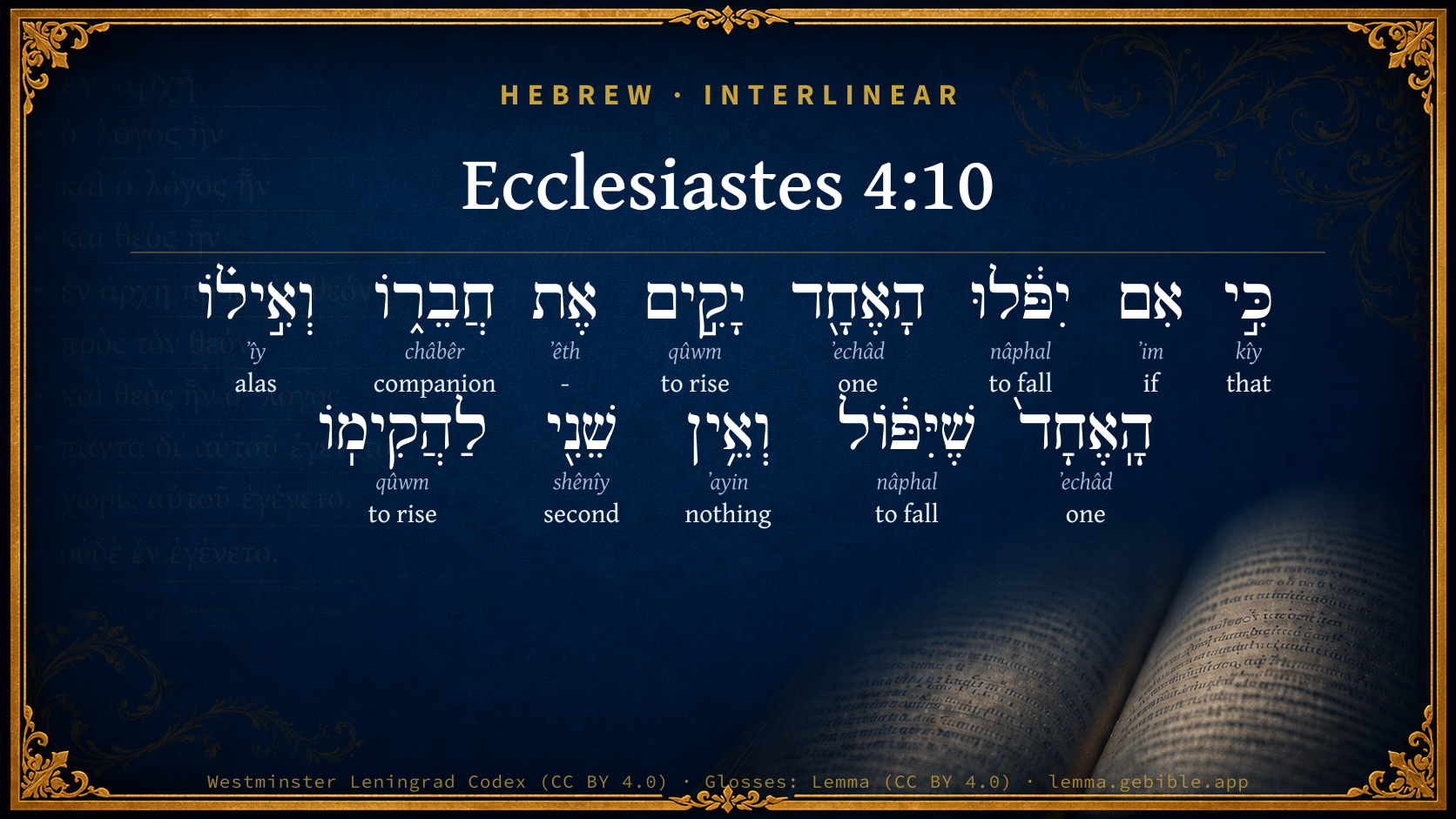
Ecclesiastes 4:10

Hebrew (Westminster Leningrad Codex) Ecclesiastes 4:10 appears in the Hebrew Old Testament. The text above is from the Westminster Leningrad Codex. Each word links to its Strong’s number, a concise gloss, and parsing drawn from the Open Scriptures Hebrew Bible morphology. Click any word for its full Brown-Driver-Briggs (BDB) entry.
Download image
Cite this verse

Ecclesiastes 4:10 (World English Bible). Public Domain. Lemma interlinear Bible study tool, https://lemma.gebible.app/v/ecclesiastes/4/10.

Show BibTeX & RIS
BibTeX
RIS
English Translation
For if they fall, the one will lift up his fellow; but woe to him who is alone when he falls, and doesn't have another to lift him up.
World English Bible · Public Domain
Highlights
  • 1 first appearance in the Hebrew Bible
Full analysis ↓
Download a study sheet

One document with this verse’s original text, its word-by-word gloss line, the meaning frame, cross-references with their text, attributed commentary, and full source and license credits — printable, and it pastes into notes with its structure intact.

This verse Autodidact and up

Study sheet (.html) Plain text (.txt)

A passage Seminary Student

Up to 50 verses in one chapter. A passage sheet keeps up to 6 commentary sources and 12 cross-references per verse, in the order this page ranks them, and says so on the sheet whenever that leaves anything out. Ask for a single verse and you get the Autodidact verse sheet above.

Everything on this page stays free to read, with no account — the sheet is a download of what is already on screen, not access to it.

Want to remove ads? Support Godless Engineer
Compare translations 3

The same verse in 3 English versions, stacked beneath the original-language interlinear above. Click any original word for its lexicon entry.

Each is an independent rendering of the whole verse — the interlinear is not word-aligned to these translations.

Highlighted words mark where these versions differ — a whole-verse word diff, not a word-by-word alignment.

  • World English Bible Public Domain
    For if they fall, the one will lift up his fellow; but woe to him who is alone when he falls, and doesn't have another to lift him up.
  • King James Version Public Domain
    For if they fall, the one will lift up his fellow: but woe to him that is alone when he falleth; for he hath not another to help him up.
  • unfoldingWord Literal Text CC BY-SA 4.0
    For if they fall, the one will lift up his companion, but woe his—the one that will fall, but there is no second to lift him up.

unfoldingWord Literal Text — © unfoldingWord, licensed CC BY-SA 4.0. Word-aligned USFM3 via Door43 (git.door43.org/unfoldingWord/en_ult).

Versions to compare (up to 4)

3 of 4 selected

Show all 18 translations

Every available English version of this verse, each an independent rendering of the whole verse.

  • World English Bible Public Domain
    For if they fall, the one will lift up his fellow; but woe to him who is alone when he falls, and doesn't have another to lift him up.
  • Berean Standard Bible Public Domain
    For if one falls down, his companion can lift him up; but pity the one who falls without another to help him up!
  • Majority Standard Bible Public Domain
    For if one falls down, his companion can lift him up; but pity the one who falls without another to help him up!
  • King James Version Public Domain
    For if they fall, the one will lift up his fellow: but woe to him that is alone when he falleth; for he hath not another to help him up.
  • American Standard Version (1901) Public Domain
    For if they fall, the one will lift up his fellow; but woe to him that is alone when he falleth, and hath not another to lift him up.
  • Revised Version (1885) Public Domain
    For if they fall, the one will lift up his fellow: but woe to him that is alone when he falleth, and hath not another to lift him up.
  • Geneva Bible (1599) Public Domain
    For if they fal, the one wil lift vp his felow: but wo vnto him that is alone: for he falleth, and there is not a second to lift him vp.
  • Douay-Rheims (1899) Public Domain
    If one fall he shall be supported by the other: woe to him that is alone, for when he falleth, he hath none to lift him up.
  • Young's Literal Translation Public Domain
    For if they fall, the one raiseth up his companion, but wo to the one who falleth and there is not a second to raise him up!
  • Literal Standard Version CC BY-SA 4.0
    For if they fall, the one raises up his companion, but woe to the one who falls and there is not a second to raise him up!
  • Unlocked Literal Bible CC BY-SA 4.0
    For if one falls, the other can lift up his friend. However, sorrow follows the one who is alone when he falls if there is no one to lift him up.
  • unfoldingWord Literal Text CC BY-SA 4.0
    For if they fall, the one will lift up his companion, but woe his—the one that will fall, but there is no second to lift him up.
  • Darby Bible Public Domain
    For if they fall, the one will lift up his fellow; but woe to him that is alone when he falleth, and who hath not another to lift him up!
  • World Messianic Bible Public Domain
    For if they fall, the one will lift up his fellow; but woe to him who is alone when he falls, and doesn’t have another to lift him up.
  • Webster's Bible Public Domain
    For if they fall, the one will lift up his fellow: but woe to him that is alone when he falleth; for he hath not another to help him to rise.
  • Free Bible Version CC BY-SA 4.0
    If one of them falls down, the other can help them up, but how sad it is for someone who falls down and doesn't have anyone to help them up.
  • Bible in Basic English Public Domain
    And if one has a fall, the other will give him a hand; but unhappy is the man who is by himself, because he has no helper.
  • JPS Tanakh (1917) Public Domain
    For if they fall, the one will lift up his fellow; but woe to him that is alone when he falleth, and hath not another to lift him up.

Literal Standard Version (2020), Covenant Press — licensed CC BY-SA 4.0. Text via the HelloAO Bible API (eBible.org). Unlocked Literal Bible (unfoldingWord) — licensed CC BY-SA 4.0. Text via the HelloAO Bible API (eBible.org). unfoldingWord Literal Text — © unfoldingWord, licensed CC BY-SA 4.0. Word-aligned USFM3 via Door43 (git.door43.org/unfoldingWord/en_ult). Free Bible Version, Dr. Jonathan Gallagher — licensed CC BY-SA 4.0. Text via the HelloAO Bible API (eBible.org).

Word by word

More ways to search: Search by grammar → Find every occurrence → Compare this word →

Practice this passage: Drill this verse → Learn its vocabulary →

וְאִ֣יל֗וֹ
ʼîy
H337
“and · to/for · alas · him”
Conjunction + Particle, Interjection + Preposition + Suffix, Personal, 3rd Person, Masculine, Singular
Part of Speech
Conjunction + Particle + Preposition
Full BDB Definition

Origin: short from H188

TWOT: 76

alas!, woe!
  1. כִּ֣י kîy H3588 “that” Conjunction
  2. אִם ʼim H518 “if” Conjunction
  3. יִפֹּ֔לוּ nâphal H5307 “to fall” Verb, Qal, Imperfect, 3rd Person, Masculine, Plural
  4. הָאֶחָ֖ד ʼechâd H259 “the · one” Particle, Definite Article + Adjective, Cardinal number, Masculine, Singular, Absolute
  5. יָקִ֣ים qûwm H6965 “to rise” Verb, Hiphil, Imperfect, 3rd Person, Masculine, Singular
  6. אֶת ʼêth H853 “-” Particle, Direct Object
  7. חֲבֵר֑וֹ châbêr H2270 “companion · his” Noun, Common, Masculine, Singular, Construct + Suffix, Personal, 3rd Person, Masculine, Singular
  8. הָֽאֶחָד֙ ʼechâd H259 “the · one” Particle, Definite Article + Adjective, Cardinal number, Masculine, Singular, Absolute
  9. שֶׁיִּפּ֔וֹל nâphal H5307 “who/which · to fall” Particle, Relative + Verb, Qal, Imperfect, 3rd Person, Masculine, Singular
  10. וְאֵ֥ין ʼayin H369 “and · nothing” Conjunction + Particle, Negative
  11. שֵׁנִ֖י shênîy H8145 “second” Adjective, Ordinal number, Masculine, Singular, Absolute
  12. לַהֲקִימֽוֹ qûwm H6965 “to rise · him” Preposition + Verb, Hiphil, Infinitive Construct + Suffix, Personal, 3rd Person, Masculine, Singular

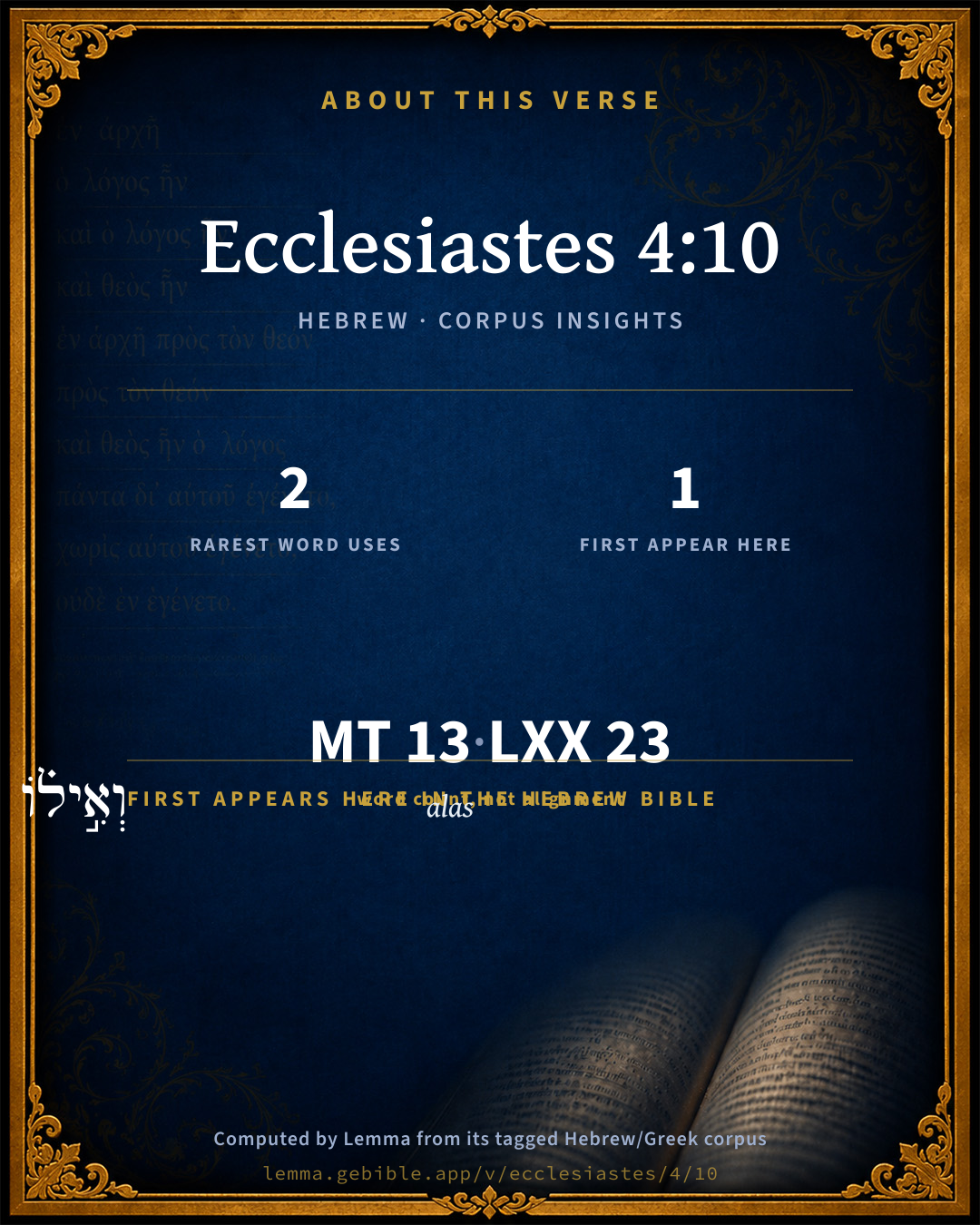
About this verse

These counts appear in no published source. They are computed here, from the morphology-tagged text and Lemma’s own curated glosses. What Lemma adds →

13
words
10
distinct lemmas
Wisdom
section

Notable vocabulary

The rarest word here is וְאִ֣יל֗וֹ alas H337 — appearing just 2 times in the whole Hebrew Bible.

First appearance in Scripture

This word makes its first canonical appearance in the Hebrew Bible here:

  • וְאִ֣יל֗וֹ alas H337

Shared distinctive vocabulary

וְאִ֣יל֗וֹ alas H337 occurs in 2 verses of the Hebrew Bible. Also found in:

Grammatical profile

  • 4 verbs
  • 1 noun
  • 3 adjectives
  • 1 preposition
  • 2 conjunctions
  • 2 particles

Verb forms

  • יִפֹּ֔לוּ Qal · Imperfect
  • יָקִ֣ים Hiphil · Imperfect
  • שֶׁיִּפּ֔וֹל Qal · Imperfect
  • לַהֲקִימֽוֹ Hiphil · Infinitive Construct

Repetition

Words recur within this verse — often emphatic in Hebrew:

  • יִפֹּ֔לוּ to fall H5307 ×2
  • הָאֶחָ֖ד one H259 ×2
  • יָקִ֣ים to rise H6965 ×2

Hebrew & Septuagint length

In English translation the verse runs 29 words from the Hebrew and 31 from the Septuagint (LXX English) — closely comparable.

A rough comparison of the two English renderings, which tokenize alike — not a word-level alignment.

Word counts can differ between the Hebrew and the Greek without any difference in meaning — e.g. the Hebrew direct-object marker אֵת has no separate Greek word, and Greek often adds the article ὁ.

In the original languages it is 13 Hebrew tokens and 23 Greek tokens — but the two are counted differently (Hebrew bundles its prefixes and suffixes into one token; the Greek is in lemma form), so that isn’t a like-for-like length.

Cross-references

7

Topical passages linked to Ecclesiastes 4:10 in the Treasury of Scripture Knowledge — connected by theme and wording, ordered by reader-vote popularity; previews shown in the World English Bible.

  • 1 Thessalonians 5:11 Therefore exhort one another, and build each other up, even as you also do.
  • 1 Thessalonians 4:18 Therefore comfort one another with these words.
  • Isaiah 35:3–4 Strengthen you the weak hands, and confirm the feeble knees.
  • Galatians 6:1 Brothers, even if a man is caught in some fault, you who are spiritual must restore such a one in a spirit of gentleness; looking to yourself so that you also aren't tempted.
  • Job 4:3–4 Behold, you have instructed many, You have strengthened the weak hands.
  • 1 Samuel 23:16 Jonathan, Saul's son, arose, and went to David into the wood, and strengthened his hand in God.
  • Luke 22:31–32 The Lord said, "Simon, Simon, behold, Satan asked to have you, that he might sift you as wheat,

Cross-references courtesy of OpenBible.info (CC BY 4.0).

Hebrew and Greek witnesses Masoretic Hebrew ↔ Greek Septuagint

The same verse in the two great witnesses to the Old Testament, shown verse-for-verse.

These are two independent witnesses, not word-aligned to each other, and the Septuagint is shown in lemma (dictionary) form.

Hebrew Ecclesiastes 4:10 Masoretic · Westminster Leningrad Codex

כִּ֣י אִם יִפֹּ֔לוּ הָאֶחָ֖ד יָקִ֣ים אֶת חֲבֵר֑וֹ וְאִ֣יל֗וֹ הָֽאֶחָד֙ שֶׁיִּפּ֔וֹל וְאֵ֥ין שֵׁנִ֖י לַהֲקִימֽוֹ

For if they fall, the one will lift up his fellow; but woe to him who is alone when he falls, and doesn't have another to lift him up.

World English Bible · Public Domain

Greek LXX Ecclesiastes 4:10 Septuagint · lemma form

ὅτι ἐάν πίπτω ὁ εἷς ἐγείρω ὁ μέτοχος αὐτός καί οὐαί αὐτός ὁ εἷς ὅταν πίπτω καί μή εἰμί δεύτερος ὁ ἐγείρω αὐτός

For if they fall, the one will lift up his fellow: but woe to him that is alone when he falls, and there is not a second to lift him up.

LXX2012 (modern English Septuagint) · Public Domain

Hebrew: Westminster Leningrad Codex (CC BY 4.0). Greek: Septuagint (public domain); English from LXX2012 (modern English Septuagint) (Public Domain). How the Septuagint differs from the Hebrew →

Commentary

Notes on Ecclesiastes 4:10 from classic Christian and Jewish commentators (each source and its license shown beneath its notes). The classic Christian expositions comment on the surrounding passage and are grouped to its opening verse, so a note may address several verses; the Jewish commentaries on the Tanakh (Rashi and others) are per-verse, so they appear only where the commentator wrote on this verse.

Lemma curates 59 commentaries, every one of them public domain or Creative Commons licensed, each selected and text-cleaned for this edition rather than reprinted as found. About our sources →

Trapp's Complete Commentary

John Trapp

Ecc 4:10 For if they fall, the one will lift up his fellow: but woe to him [that is] alone when he falleth; for [he hath] not another to help him up.

Ver. 10. For if they fall, the one will lift up his fellow.] Provided that they hold together and be both of a mind. That which is stronger shoreth up that which is weaker. While Latimer and Rid ley lived, they kept up Cranmer, by intercourse of letters and otherwise, from entertaining counsels of revolt. Bishop Ridley, being prisoner in the Tower, had the liberty of the same, to prove, belike, whether he would go to mass or not, which once he did. And Mr Bradford, being there prisoner, and hearing thereof, wrote an effectual letter to persuade him from the same, which did Mr Ridley no little good, for he repented, &c. {a} Bishop Farrar also being in the King’s Bench prisoner, was travailed with by the Papists at the end of Lent to receive the sacrament at Easter in one kind, who, after much persuading, yielded to them, and promised so to do. But, by God’s good providence, the Easter evening, the day before he should have done it, was Bradford brought to the same prison, where, the Lord making him his instrument, Bradford only was the means that the said bishop revoked his promise, and would never after yield to be spotted with that Papistical pitch. {b} Dr Taylor for like cause rejoiced that ever he came into prison, there to be acquainted with that angel of God, John Bradford: so he called him, for the good he received from him. {c} One man may be an angel to another in regard of counsel and comfort; nay, a God to another, as Moses was to Aaron. "Though he fall, he shall arise," for the Lord puts under his hand. {Psa 37:24}

But woe to him that is alone.] Because Satan is readiest to assault when none is by to assist. Solitariness, therefore, is not to be affected, because it is "the hour of temptation."

For he hath not a second to help him up.] As Elizabeth Cowper, the martyr, in Queen Mary’s days had, who, being condemned, and at the stake with Simon Miller, when the fire came unto her she a little shrank thereat, crying once, Ah! When Simon heard the same, he put his hand behind him toward her, and willed her to be strong and of good cheer; for, ‘Good sister,’ said he, ‘we shall soon have a joyful and sweet supper. It is but winking a little, and you are in heaven.’ With these and the like speeches, she, being strengthened, stood still and quiet, as one most glad to finish that good work. {d} It was therefore a devilish policy in Julian and other heathen persecutors to banish Christians into far countries one from another, and to confine them to isles and mines, where they could not have access one to another.

{a} Acts and Mon., fol. 1930.

{b} Ibid., 1457.

{c} Ibid.

{d} Ibid., 1981.

John Trapp, A Commentary or Exposition upon All the Books of the Old and New Testament (1647–1656) — public domain. Text from a community e-Sword module.

Joseph Benson's Commentary

Ecc 4:10-12. For, if they fall — If one or more of them fall in any way; as into any mistakes, and errors, or sins, dangers, or distresses. The one will lift up his fellow — Will hold him up, if he be falling, or raise him up, if he be fallen. If two lie together, then they have heat — They will be sooner warm in a cold bed and a cold season. So virtuous and gracious affections are excited by good society; and Christians warm one another, by provoking one another to love and good works. But how can one be warm alone? — How can the warmth and fervency of true Christian love and zeal be retained by him who stands aloof from, and has no intercourse with, his fellow-Christians? If one prevail against him — If an enemy, visible or invisible, might easily prevail against either or any of them, if not associated with others, two or more, uniting their counsels and efforts, will be able to withstand him; and a three-fold cord is not quickly broken — If a man have not only one, but two or more friends to assist him, he is so much the more secure against all assaults, and therefore the more happy. Thus, in our spiritual warfare, we may be helpful to each other as well as in our spiritual work. And next to the comfort of communion with God, is that of the communion of saints. For they that dwell in love dwell in God, and God in them.

Joseph Benson's Commentary on the Old and New Testaments (1811–1818) — public domain. Text from a community e-Sword module.

Jamieson, Fausset & Brown

Robert Jamieson, A. R. Fausset & David Brown

if they fall--if the one or other fall, as may happen to both, namely, into any distress of body, mind, or soul.

Jamieson, Fausset & Brown — Commentary Critical and Explanatory on the Whole Bible (1871) — public domain (CC PDM 1.0). Text via the HelloAO Bible API.

Ellicott's Commentary for English Readers

(10) Woe.—The word occurs only here and in Ecc_10:16, but is common in post-Biblical Hebrew.

A Bible Commentary for English Readers, edited by Charles John Ellicott (1878–1897) — public domain. Text from a community e-Sword module.

John Gill's Exposition

For if they fall, the one will lift up his fellow,.... That is, if anyone of them fall, the other will lift him up, as they are travelling together, in whatsoever manner; if one falls from his horse, or out of his carriage, or into a ditch, the other will endeavour to raise him up again: this, as it is true in a natural, so in a figurative and metaphorical sense, with religious persons especially;

"if one of them falls upon the bed, and lies sick,''

as the Targum paraphrases it, his friend and brother in a religions community will visit him, and sympathize with him, and speak a word of comfort to him, and pray with him, which may issue in his restoration. So the Targum,

"the other will cause his friend to rise by his prayer;''

or if he fall into outward distress, poverty, and want, his spiritual friend or friends will distribute to his necessity; if he falls into errors, as a good man may, such as are of the same religious society with him will take some pains to convince him of the error of his way, and to convert him from it, and to save a soul from death, and cover a multitude of sins; and if he falls into sin, to which the best of men are liable, such as are spiritual will endeavour to restore him in a spirit of meekness;

but woe to him that is alone when he falleth! for he hath not another to help him up; no companion to raise him up when fallen; no Christian friend to visit and comfort him when sick, to relieve him under his necessities, when poor and afflicted, or to recover him from errors in judgment, or immoralities in practice; and especially if he has not Christ with him to raise him up, keep, and uphold him.

John Gill's Exposition of the Whole Bible (1746–1763) — public domain (CC PDM 1.0). Text via the HelloAO Bible API.

Haydock's Catholic Bible Commentary

Fall into sickness, poverty, or sin. The saints have withdrawn people from the dangers of the world into monasteries, where they may fight together against the devil.

George Leo Haydock (1774–1849), Haydock's Catholic Family Bible and Commentary, 1859 edition — public domain. Excludes Psalms (Douay-Rheims chapter numbering differs from Protestant) and Deuterocanonical books (Catholic canon only).

Matthew Poole's English Annotations

They; one of them, the plural being put for the singular, as Jon 1:5; Mat 21:7; 1Ti 2:15. Or both of them successively.

Fall, in any kind, into any mistakes and errors, or sins, or dangers and distresses.

Will lift up his fellow; hold him up if he be falling, or raise him up if he be fallen.

Matthew Poole's English Annotations on the Holy Bible (1683–1685) — public domain. Text from a community e-Sword/MySword module.

Whedon's Commentary on the Bible

Daniel D. Whedon

10. For if they fall — Better, “For if one fall.” The illustration is drawn from travelling, but it may be applied to any of the numerous mishaps of life. “God never made an independent man.” Each depends on another.

Daniel D. Whedon (gen. ed.), Commentary on the Old and New Testaments (1874–1909) — public domain. Text from a community e-Sword module.

The Pulpit Commentary

Koheleth illustrates the benefit of association by certain familiar examples. For if they fall, the one will lift up his fellow. If one or the other fall, the companion will aid him. The idea is that two travelers are making their way over a rough road an experience that every one must have had in Palestine. Vulgate, Si unus ceciderit. Of course, if both fell at the same time, one could not help the other. Commentators quote Homer, "Iliad," 10:220-226, thus rendered by Lord Derby

Nestor, that heart is mine; I dare alone Enter the hostile camp, so close at hand; Yet were one comrade giv"n me, I should go With more of comfort, more of confidence. Where two combine, one before other sees The better course; and ev"n though one alone The readiest way discover, yet would be His judgment slower, his decision less.

Woe to him that is alone. The same interjection of sorrow, yai, occurs in Ecc_10:16, but elsewhere only in late Hebrew. The verse may be applied to moral falls as well as to stumbling at natural obstacles. Brother helps brother to resist temptation, while many have failed when tried by isolation who would have manfully withstood if they had had the countenance and support of others.

Clear before us through the darkness Gleams and burns the guiding light; Brother clasps the hand of brother, Stepping fearless through the night.

The Pulpit Commentary (1880–1919), ed. H.D.M. Spence-Jones & Joseph S. Exell — public domain. Text from a community e-Sword module.

John Wesley's Explanatory Notes

They - One of them. Fall - Into any mistake, or sin, or danger.

John Wesley, Explanatory Notes Upon the Whole Bible (1754–1765) — public domain. Text via the GEBible commentary corpus.

Keil & Delitzsch

C. F. Keil & F. Delitzsch

"For if they fall, the one can raise up his fellow: but woe to the one who falleth, and there is not a second there to lift him up." Only the Targ., which Grtz follows, confounds אילו

(Note: With Munach and Rebia in one word, which, according to the masora, occurs in only four other places. Vid., Mas. magna under this passage, and Mishpete hateamin 26a.)

with אילוּ; it is equivalent to אוי לו, Isa 3:9, or הוי לו, Eze 13:18. Haehhad is appos. connecting itself to the pronominal suff., as, e.g., in a far more inappropriate manner, Psa 86:2; the prep. is not in appos. usually repeated, Gen 2:19; Gen 9:4 (exceptions: Ps. 18:51; Psa 74:14). Whether we translate שׁיּפּל by qui ceciderit (Ecc 11:3), or by quum ceciderit (Jerome), is all one. יקים is potential: it is possible and probable that it will be done, provided he is a טוב חבר, i.e., a true friend (Pirke aboth, ii. 13).

Keil & Delitzsch — Biblical Commentary on the Old Testament (1861–1891) — public domain (CC PDM 1.0). Text via the HelloAO Bible API. (Old Testament only.)

Rashi

Rabbi Shlomo Yitzchaki (Rashi)

For if they fall [To be explained] according to its apparent meaning. And regarding studies, if his studies were too difficult for him, his companion will restore them to him, or if he stumbles and was not exact in what he heard from his mentor, his companion will set him on the truthful course.

but woe Heb. וְאִילוּ, but woe is to him.

Rashi on the Tanakh — English translations: “The Judaica Press complete Tanach with Rashi, translated by A. J. Rosenberg” (CC BY 4.0); “Pentateuch with Rashi's commentary by M. Rosenbaum and A.M. Silbermann, 1929-1934” (public domain); “The Metsudah Tanach series, Lakewood, N.J” (CC BY 4.0); and “The Book of Joshua, Metsudah Publications, 1997” (CC BY 4.0). Text via Sefaria.

Lesson kit

Teaching starters — assembled from the data on this page, not authored interpretation. Every prompt links to the verse data it draws on. Edit before teaching.

Ecclesiastes, in the Wisdom, opens this verse with 13 words (10 distinct Hebrew lemmas). Its most distinctive word is ʼîy (“alas”). A historical commentator’s framing appears above. Read the whole chapter for the surrounding context.

Discussion questions

  1. What does “alas” (ʼîy) contribute to the verse as a whole?
  2. This is the first place “alas” appears in Scripture (first appears here). What does its debut here establish?
  3. How does Ecclesiastes 10:16, which shares the word «alas», read alongside this verse?
  4. What does the repetition of “to fall” (2× in this one verse) do in this verse?
  5. These translations render this verse differently. What is at stake in choosing one wording over another?
  6. «יִפֹּ֔לוּ» is a Qal Imperfect verb. How does that grammatical form shape the action described?
  7. Compare how Trapp's Complete Commentary and Joseph Benson's Commentary read this verse. Where do they agree or differ?

Things to notice

Reading settings

Reading text

Shown beneath each verse's original-language words.

Old Testament
Old Testament edition

Read the OT as the Masoretic Hebrew (MT) or the Greek Septuagint (LXX).

English shown for the Greek Septuagint (in the Hebrew ↔ Greek comparison).

Comparing translations? Open the Compare panel on any verse page to stack up to four side by side.