
Exodus 28:41

Hebrew (Westminster Leningrad Codex) Exodus 28:41 appears in the Hebrew Old Testament. The text above is from the Westminster Leningrad Codex. Each word links to its Strong’s number, a concise gloss, and parsing drawn from the Open Scriptures Hebrew Bible morphology. Click any word for its full Brown-Driver-Briggs (BDB) entry.
Download image
Cite this verse

Exodus 28:41 (World English Bible). Public Domain. Lemma interlinear Bible study tool, https://lemma.gebible.app/v/exodus/28/41.

Show BibTeX & RIS
BibTeX
RIS
English Translation
You shall put them on Aaron your brother, and on his sons with him, and shall anoint them, and consecrate them, and sanctify them, that they may minister to me in the priest's office.
World English Bible · Public Domain
Download a study sheet

One document with this verse’s original text, its word-by-word gloss line, the meaning frame, cross-references with their text, attributed commentary, and full source and license credits — printable, and it pastes into notes with its structure intact.

This verse Autodidact and up

Study sheet (.html) Plain text (.txt)

A passage Seminary Student

Up to 50 verses in one chapter. A passage sheet keeps up to 6 commentary sources and 12 cross-references per verse, in the order this page ranks them, and says so on the sheet whenever that leaves anything out. Ask for a single verse and you get the Autodidact verse sheet above.

Everything on this page stays free to read, with no account — the sheet is a download of what is already on screen, not access to it.

Want to remove ads? Support Godless Engineer
Compare translations 3

The same verse in 3 English versions, stacked beneath the original-language interlinear above. Click any original word for its lexicon entry.

Each is an independent rendering of the whole verse — the interlinear is not word-aligned to these translations.

Highlighted words mark where these versions differ — a whole-verse word diff, not a word-by-word alignment.

  • World English Bible Public Domain
    You shall put them on Aaron your brother, and on his sons with him, and shall anoint them, and consecrate them, and sanctify them, that they may minister to me in the priest's office.
  • King James Version Public Domain
    And thou shalt put them upon Aaron thy brother, and his sons with him; and shalt anoint them, and consecrate them, and sanctify them, that they may minister unto me in the priest's office.
  • unfoldingWord Literal Text CC BY-SA 4.0
    And you shall clothe them, your brother Aaron and his sons with him. And you shall anoint them, and you shall fill their hand, and you shall set them apart to be priests to me.

unfoldingWord Literal Text — © unfoldingWord, licensed CC BY-SA 4.0. Word-aligned USFM3 via Door43 (git.door43.org/unfoldingWord/en_ult).

Versions to compare (up to 4)

3 of 4 selected

Show all 18 translations

Every available English version of this verse, each an independent rendering of the whole verse.

  • World English Bible Public Domain
    You shall put them on Aaron your brother, and on his sons with him, and shall anoint them, and consecrate them, and sanctify them, that they may minister to me in the priest's office.
  • Berean Standard Bible Public Domain
    After you put these garments on your brother Aaron and his sons, anoint them, ordain them, and consecrate them so that they may serve Me as priests.
  • Majority Standard Bible Public Domain
    After you put these garments on your brother Aaron and his sons, anoint them, ordain them, and consecrate them so that they may serve Me as priests.
  • King James Version Public Domain
    And thou shalt put them upon Aaron thy brother, and his sons with him; and shalt anoint them, and consecrate them, and sanctify them, that they may minister unto me in the priest's office.
  • American Standard Version (1901) Public Domain
    And thou shalt put them upon Aaron thy brother, and upon his sons with him, and shalt anoint them, and consecrate them, and sanctify them, that they may minister unto me in the priest's office.
  • Revised Version (1885) Public Domain
    And thou shalt put them upon Aaron thy brother, and upon his sons with him; and shalt anoint them, and consecrate them, and sanctify them, that they may minister unto me in the priest’s office.
  • Geneva Bible (1599) Public Domain
    And thou shalt put them vpon Aaron thy brother, and on his sonnes with him, and shalt anoint them, and fill their handes, and sanctifie them, that they may minister vnto me in the Priestes office.
  • Douay-Rheims (1899) Public Domain
    And with all these things thou shalt vest Aaron thy brother, and his sons with him. And thou shalt consecrate the hands of them all, and shalt sanctify them, that they may do the office of priesthood unto me.
  • Young's Literal Translation Public Domain
    and thou hast clothed Aaron thy brother with them, and his sons with him, and hast anointed them, and hast consecrated their hand, and hast sanctified them, and they have been priests to Me.
  • Literal Standard Version CC BY-SA 4.0
    and you have clothed your brother Aaron with them, and his sons with him, and have anointed them, and have consecrated their hand, and have sanctified them, and they have been priests to Me.
  • Unlocked Literal Bible CC BY-SA 4.0
    You must clothe Aaron your brother, and his sons with him. You must anoint them, ordain them, and set them apart to me, so that they may serve me as priests.
  • unfoldingWord Literal Text CC BY-SA 4.0
    And you shall clothe them, your brother Aaron and his sons with him. And you shall anoint them, and you shall fill their hand, and you shall set them apart to be priests to me.
  • Darby Bible Public Domain
    And thou shalt clothe with them Aaron thy brother, and his sons with him; and shalt anoint them, and consecrate them, and hallow them, that they may serve me as priests.
  • World Messianic Bible Public Domain
    You shall put them on Aaron your brother, and on his sons with him, and shall anoint them, and consecrate them, and sanctify them, that they may minister to me in the priest’s office.
  • Webster's Bible Public Domain
    And thou shalt put them upon Aaron thy brother, and on his sons with him: and shalt anoint them, and consecrate them, and sanctify them, that they may minister to me in the priest's office.
  • Free Bible Version CC BY-SA 4.0
    Put these clothes on your brother Aaron and his sons and then anoint them and ordain them. Dedicate them so that they can serve me as priests.
  • Bible in Basic English Public Domain
    These you are to put on Aaron, your brother, and on his sons, putting oil on them, separating them and making them holy, to do the work of priests to me.
  • JPS Tanakh (1917) Public Domain
    And thou shalt put them upon Aaron thy brother, and upon his sons with him; and shalt anoint them, and consecrate them, and sanctify them, that they may minister unto Me in the priest's office.

Literal Standard Version (2020), Covenant Press — licensed CC BY-SA 4.0. Text via the HelloAO Bible API (eBible.org). Unlocked Literal Bible (unfoldingWord) — licensed CC BY-SA 4.0. Text via the HelloAO Bible API (eBible.org). unfoldingWord Literal Text — © unfoldingWord, licensed CC BY-SA 4.0. Word-aligned USFM3 via Door43 (git.door43.org/unfoldingWord/en_ult). Free Bible Version, Dr. Jonathan Gallagher — licensed CC BY-SA 4.0. Text via the HelloAO Bible API (eBible.org).

Word by word

More ways to search: Search by grammar → Find every occurrence → Compare this word →

Practice this passage: Drill this verse → Learn its vocabulary →

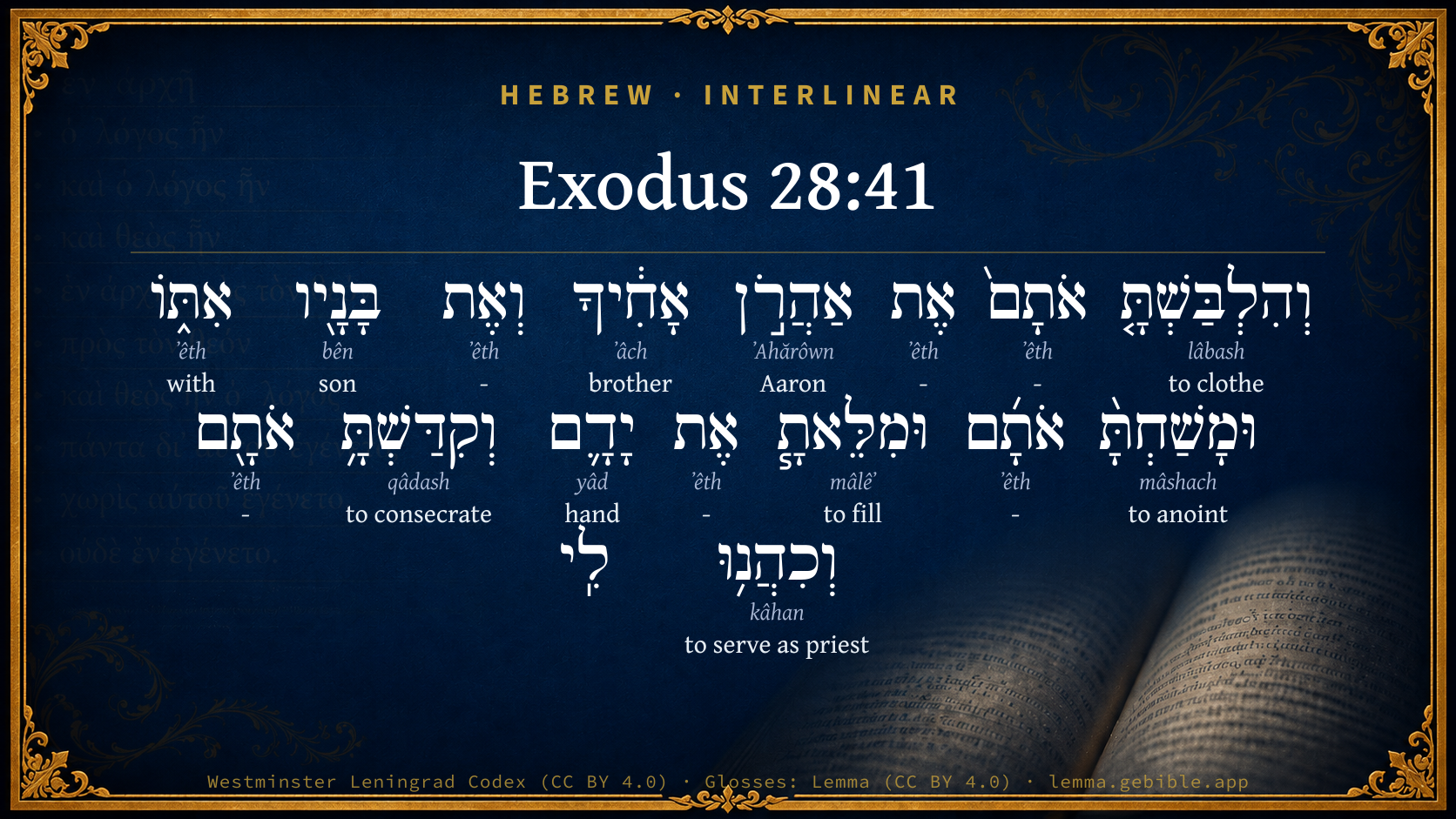
וְכִהֲנ֥וּ
kâhan
H3547
“and · to serve as priest”
Conjunction + Verb, Piel, Sequential Perfect, 3rd Person, Common, Plural
Part of Speech
Conjunction + Verb
Stem
Piel
Form
Sequential Perfect
Person
3rd Person
Gender
Common
Number
Plural
Full BDB Definition

Origin: a primitive root, apparently meaning to mediate in religious services

TWOT: 959

to act as a priest, minister in a priest's office - (Piel) - to minister as a priest, serve as a priest - to be or become a priest - to play the priest
  1. וְהִלְבַּשְׁתָּ֤ lâbash H3847 “and · to clothe” Conjunction + Verb, Hiphil, Sequential Perfect, 2nd Person, Masculine, Singular
  2. אֹתָם֙ ʼêth H853 “- · them” Particle, Direct Object + Suffix, Personal, 3rd Person, Masculine, Plural
  3. אֶת ʼêth H853 “-” Particle, Direct Object
  4. אַהֲרֹ֣ן ʼAhărôwn H175 “Aaron” Noun, Proper
  5. אָחִ֔יךָ ʼâch H251 “brother · your” Noun, Common, Masculine, Singular, Construct + Suffix, Personal, 2nd Person, Masculine, Singular
  6. וְאֶת ʼêth H853 “and · -” Conjunction + Particle, Direct Object
  7. בָּנָ֖יו bên H1121 “sons · his” Noun, Common, Masculine, Plural, Construct + Suffix, Personal, 3rd Person, Masculine, Singular
  8. אִתּ֑וֹ ʼêth H854 “with · him” Preposition + Suffix, Personal, 3rd Person, Masculine, Singular
  9. וּמָשַׁחְתָּ֨ mâshach H4886 “and · to anoint” Conjunction + Verb, Qal, Sequential Perfect, 2nd Person, Masculine, Singular
  10. אֹתָ֜ם ʼêth H853 “- · them” Particle, Direct Object + Suffix, Personal, 3rd Person, Masculine, Plural
  11. וּמִלֵּאתָ֧ mâlêʼ H4390 “and · to fill” Conjunction + Verb, Piel, Sequential Perfect, 2nd Person, Masculine, Singular
  12. אֶת ʼêth H853 “-” Particle, Direct Object
  13. יָדָ֛ם yâd H3027 “hand · their” Noun, Common, Both, Singular, Construct + Suffix, Personal, 3rd Person, Masculine, Plural
  14. וְקִדַּשְׁתָּ֥ qâdash H6942 “and · to consecrate” Conjunction + Verb, Piel, Sequential Perfect, 2nd Person, Masculine, Singular
  15. אֹתָ֖ם ʼêth H853 “- · them” Particle, Direct Object + Suffix, Personal, 3rd Person, Masculine, Plural

About this verse

These counts appear in no published source. They are computed here, from the morphology-tagged text and Lemma’s own curated glosses. What Lemma adds →

17
words
11
distinct lemmas
Pentateuch
section

Notable vocabulary

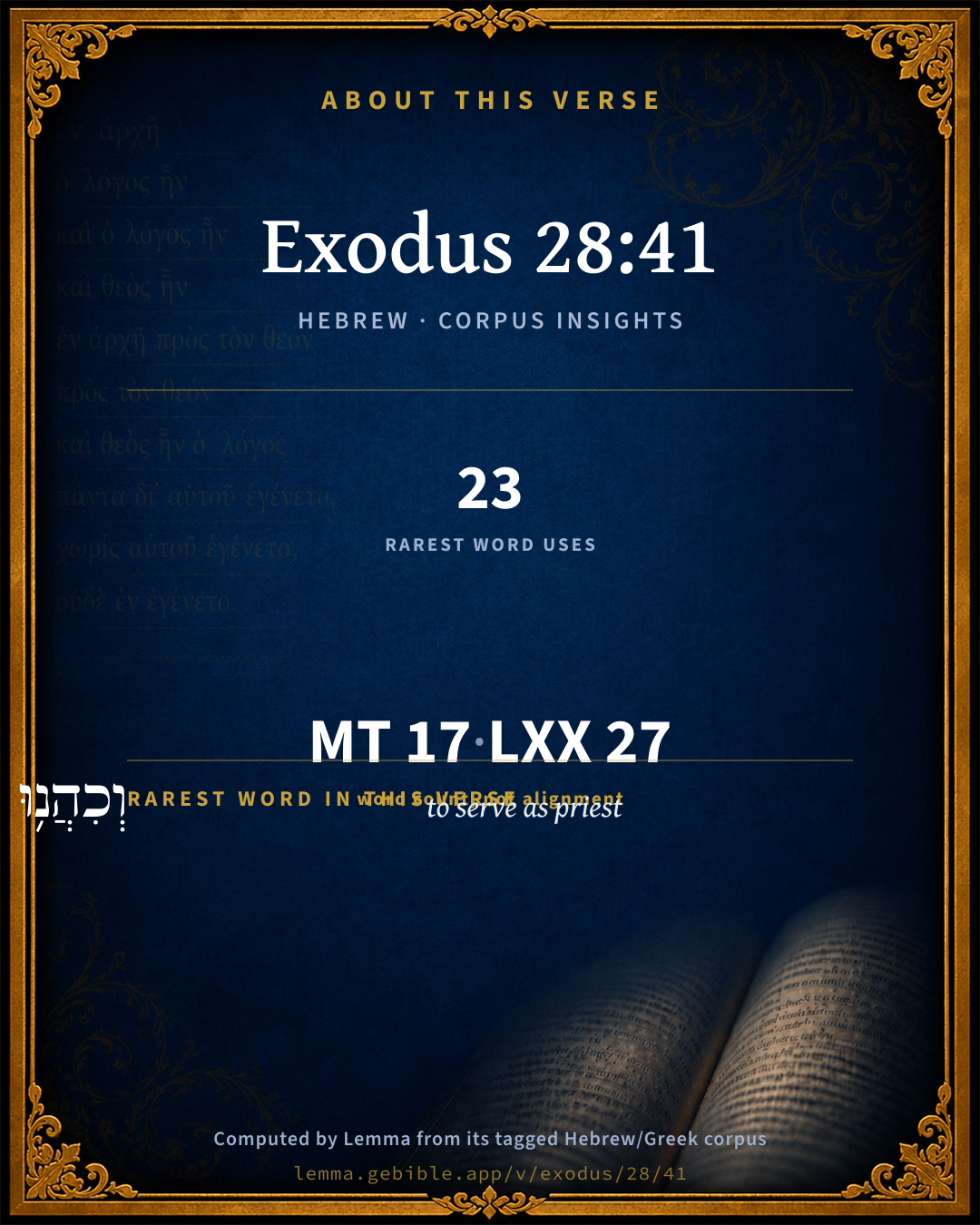
The rarest word here is וְכִהֲנ֥וּ to serve as priest H3547 — appearing just 23 times in the whole Hebrew Bible.

Shared distinctive vocabulary

וְכִהֲנ֥וּ to serve as priest H3547 occurs in 23 verses of the Hebrew Bible. Also found in:

Grammatical profile

  • 5 verbs
  • 4 nouns
  • 2 prepositions
  • 6 particles

Verb forms

  • וְהִלְבַּשְׁתָּ֤ Hiphil · Sequential Perfect
  • וּמָשַׁחְתָּ֨ Qal · Sequential Perfect
  • וּמִלֵּאתָ֧ Piel · Sequential Perfect
  • וְקִדַּשְׁתָּ֥ Piel · Sequential Perfect
  • וְכִהֲנ֥וּ Piel · Sequential Perfect

Hebrew & Septuagint length

In the original languages it is 17 Hebrew tokens and 27 Greek tokens — but the two are counted differently (Hebrew bundles its prefixes and suffixes into one token; the Greek is in lemma form), so that isn’t a like-for-like length.

Cross-references

20

Topical passages linked to Exodus 28:41 in the Treasury of Scripture Knowledge — connected by theme and wording, ordered by reader-vote popularity; previews shown in the World English Bible.

  • Exodus 29:7 Then you shall take the anointing oil, and pour it on his head, and anoint him.
  • Exodus 29:9 You shall dress them with belts, Aaron and his sons, and bind headbands on them: and they shall have the priesthood by a perpetual statute: and you shall consecrate Aaron and his sons.
  • Exodus 40:15 You shall anoint them, as you anointed their father, that they may minister to me in the priest's office. Their anointing shall be to them for an everlasting priesthood throughout their generations.
  • Leviticus 8:1–36 Yahweh spoke to Moses, saying,
  • Leviticus 10:7 You shall not go out from the door of the Tent of Meeting, lest you die; for the anointing oil of Yahweh is on you." They did according to the word of Moses.
  • Hebrews 7:28 For the law appoints men as high priests who have weakness, but the word of the oath which came after the law appoints a Son forever who has been perfected.
  • Exodus 28:1 "Bring Aaron your brother, and his sons with him, near to you from among the children of Israel, that he may minister to me in the priest's office, even Aaron, Nadab and Abihu, Eleazar and Ithamar, Aaron's sons.
  • Exodus 28:4 These are the garments which they shall make: a breastplate, and an ephod, and a robe, and a coat of checker work, a turban, and a sash: and they shall make holy garments for Aaron your brother, and his sons, that he may minister to me in the priest's office.
  • Exodus 29:24 You shall put all of this in Aaron's hands, and in his sons' hands, and shall wave them for a wave-offering before Yahweh.
  • Exodus 29:35 "Thus shall you do to Aaron, and to his sons, according to all that I have commanded you. Seven days shall you consecrate them.
  • Exodus 30:23–30 "Also take fine spices: of liquid myrrh, five hundred shekels; and of fragrant cinnamon half as much, even two hundred and fifty; and of fragrant cane, two hundred and fifty;
  • Numbers 3:3 These are the names of the sons of Aaron, the priests who were anointed, whom he consecrated to minister in the priest's office.
  • Isaiah 10:27 It shall happen in that day, that his burden shall depart from off your shoulder, and his yoke from off your neck, and the yoke shall be destroyed by reason of fatness.
  • Isaiah 61:1 The Spirit of the Lord Yahweh is on me; because Yahweh has anointed me to preach good news to the humble; he has sent me to bind up the broken-hearted, to proclaim liberty to the captives, and the opening [of the prison] to those who are bound;
  • Ezekiel 43:26 Seven days shall they make atonement for the altar and purify it; so shall they consecrate it.
  • John 3:34 For he whom God has sent speaks the words of God; for God gives the Spirit without measure.
  • 2 Corinthians 1:21–22 Now he who establishes us with you in Christ, and anointed us, is God;
  • Hebrews 5:4 Nobody takes this honor on himself, but he is called by God, just like Aaron was.
  • 1 John 2:20 You have an anointing from the Holy One, and you know the truth.
  • 1 John 2:27 As for you, the anointing which you received from him remains in you, and you don't need for anyone to teach you. But as his anointing teaches you concerning all things, and is true, and is no lie, and even as it taught you, you will remain in him.

Cross-references courtesy of OpenBible.info (CC BY 4.0).

Hebrew and Greek witnesses Masoretic Hebrew ↔ Greek Septuagint

The same verse in the two great witnesses to the Old Testament, shown verse-for-verse.

These are two independent witnesses, not word-aligned to each other, and the Septuagint is shown in lemma (dictionary) form.

Hebrew Exodus 28:41 Masoretic · Westminster Leningrad Codex

וְהִלְבַּשְׁתָּ֤ אֹתָם֙ אֶת אַהֲרֹ֣ן אָחִ֔יךָ וְאֶת בָּנָ֖יו אִתּ֑וֹ וּמָשַׁחְתָּ֨ אֹתָ֜ם וּמִלֵּאתָ֧ אֶת יָדָ֛ם וְקִדַּשְׁתָּ֥ אֹתָ֖ם וְכִהֲנ֥וּ לִֽי

You shall put them on Aaron your brother, and on his sons with him, and shall anoint them, and consecrate them, and sanctify them, that they may minister to me in the priest's office.

World English Bible · Public Domain

Greek LXX Exodus 28:41 Septuagint · lemma form

καί ἐνδύω αὐτός ααρων ὁ ἀδελφός σύ καί ὁ υἱός αὐτός μετά αὐτός καί χρίω αὐτός καί ἐνπίμπλημι αὐτός ὁ χείρ καί ἁγιάζω αὐτός ἵνα ἱερατεύω ἐγώ

No English rendering of this Greek verse — the small residue in the structurally divergent books.

On this verse, Haydock's Catholic Bible Commentary discusses the Septuagint’s reading. Read the note in Commentary ↓

Hebrew: Westminster Leningrad Codex (CC BY 4.0). Greek: Septuagint (public domain); English from a public-domain English Septuagint. How the Septuagint differs from the Hebrew →

Targum (Aramaic paraphrase)

2

The Targum is the ancient Jewish Aramaic paraphrase of the Hebrew Scriptures — an interpretive translation, not the Hebrew text itself. Onkelos (literal) and Pseudo-Jonathan (expansive) render the Torah, and Jonathan the Prophets. Coverage is partial: where no permissively-licensed English translation exists for a verse, only the Aramaic is shown. This is verse-level text, not a word-by-word alignment to the Hebrew.

  1. Targum Onkelos Torah (Genesis–Deuteronomy)
    וְתַלְבֵּש יָתְהוֹן יָת אַהֲרֹן אָחוּךְ וְיָת בְּנוֹהִי עִמֵהּ וּתְרַבֵּי יָתְהוֹן וּתְקָרֵב יָת קֻרְבָּנְהוֹן וּתְקַדֵשׁ יָתְהוֹן וִישַׁמְשׁוּן קֳדָמַי:

    (no public-domain English translation for this verse)

    Targum Onkelos — Aramaic: “Onkelos Genesis” (public domain); “Onkelos Exodus” (public domain); “Onkelos Leviticus” (public domain); “Onkelos Numbers” (public domain); “Onkelos Deuteronomy” (public domain). English: “Sefaria Community Translation” (CC0 1.0 (public-domain dedication)); “J.W. Etheridge. The Targums of Onkelos and Jonathan Ben Uzziel on the Pentateuch. London: Longmans, Green, 1862” (public domain). Text via Sefaria.

  2. Targum Pseudo-Jonathan Torah (Genesis–Deuteronomy)
    וְתַלְבֵּשׁ יַתְהוֹן יַת אַהֲרן אָחוּךְ וְיַת בְּנוֹי עִמֵיהּ וּתְרַבֵּי יַתְהוֹן וּתְקָרֵב יַת קוּרְבָּנֵיהוֹן וּתְקַדֵּשׁ יַתְהוֹן וִישַׁמְשׁוּן קֳדָמַי

    And with them thou shalt invest Aharon thy brother, and his sons with him, and anoint them, that they may offer their oblations; and sanctify them to minister before Me.

    Targum Pseudo-Jonathan — Aramaic: “Targum Jonathan on Genesis” (public domain); “Targum Jonathan on Exodus” (public domain); “Targum Jonathan on Leviticus” (public domain); “Targum Jonathan on Numbers” (public domain); “Targum Jonathan on Deuteronomy” (public domain). English: “The Targum of Jonathan ben Uzziel, trans. J. W. Etheridge, London, 1862” (public domain). Text via Sefaria.

Commentary

Notes on Exodus 28:41 from classic Christian and Jewish commentators (each source and its license shown beneath its notes). The classic Christian expositions comment on the surrounding passage and are grouped to its opening verse, so a note may address several verses; the Jewish commentaries on the Tanakh (Rashi and others) are per-verse, so they appear only where the commentator wrote on this verse.

Lemma curates 59 commentaries, every one of them public domain or Creative Commons licensed, each selected and text-cleaned for this edition rather than reprinted as found. About our sources →

Joseph Benson's Commentary

Exo 28:41. And shalt anoint them — He anointed Aaron by pouring the holy oil upon his head, Lev 8:12; but his sons only by sprinkling some of it upon their garments, as he did upon Aaron’s also, together with some blood of the sacrifice, Exo 29:21; Lev 8:30. And consecrate them — In the Hebrew it is, Thou shalt fill their hands; alluding, probably, to the ceremony of putting into their hands the ensigns of their office, or to that of putting the wave-offering into their hands, that they might wave it before the Lord, Exo 29:24; Lev 8:27.

Joseph Benson's Commentary on the Old and New Testaments (1811–1818) — public domain. Text from a community e-Sword module.

Geneva Bible (1599)

Geneva Bible translators

That is, consecrate them, by giving them things to offer and thereby admit them to their office.

Geneva Bible (1599) marginal notes — public domain. Text via Bolls.life.

Ellicott's Commentary for English Readers

(41) Thou shalt put them upon Aaron . . . and his sons.—Moses was by these words commanded to take the part in the consecration of Aaron and his sons which he is related to have taken in Lev_8:6-30.

And shalt anoint them.—See the comment on Exo_29:7-9.

A Bible Commentary for English Readers, edited by Charles John Ellicott (1878–1897) — public domain. Text from a community e-Sword module.

The Cambridge Bible for Schools and Colleges

gen. ed. J. J. S. Perowne

41. An anticipation of Exo_29:1 a, 5–9, not very exactly expressed; for the garments for Aaron and his ‘sons’ were not in all cases the same (v. 40). The words, and shalt anoint them, are probably a later addition; for Exo_29:7, like Lev_8:12, speaks only of Aaron himself, and not his ‘sons’ also, as being anointed: see on Exo_30:30.

consecrate them] install them would be a more distinctive rendering. The Heb. is lit. fill their hand, a technical term for install or institute to a priestly office—originally, perhaps, meaning to fill the priest’s hand with the first sacrifices (cf. Exo_29:24; and see Moore, Judges, p. 380)—occurring also Jdg_17:5; Jdg_17:12, Exo_32:29 (fig.), Eze_43:26 (fig. of altar); Exo_29:9; Exo_29:29; Exo_29:33; Exo_29:35, Lev_8:33; Lev_16:32; Lev_21:10, Num_3:3 (all P); 2Ch_13:9; also (fig.) 1Ch_29:5, 2Ch_29:31. Cf. also Exo_29:22 ‘the ram of installation’ (lit. of filling).

The Cambridge Bible for Schools and Colleges (gen. ed. J. J. S. Perowne; Cambridge University Press, 1878–1918) — public domain. Text from a community e-Sword module.

John Gill's Exposition

And thou shalt make them linen breeches to cover their nakedness,.... Or "the flesh of nakedness" (q), that part of the body which ought not to be naked and exposed to view, and which, when it is, causes shame and ridicule; what part is designed is easily gathered from the next clause; great care was taken, in the service of God's house, to preserve decency, prevent immodesty, and to guard against laughter and levity, and the like care should be always taken; see Gill on Exo 28:2,

from the loins even unto the thigh they shall reach; they were to reach above the navel near the heart, and to the end of the thigh, which is the knee, as Maimonides says (r); who also observes, that they had strings, but had no opening before or behind, but were drawn up round like a purse; they were a sort of drawers, and somewhat like our sailors' trousers.

(q) "carnem nuditatis", Montanus, Vatablus, Drusius; "carnem nudam", Junius & Tremellius; "carnem verendorum", Tigurine version; "carnem pudendorum", Piscator. (r) Cele Hamikdash, c. 8. sect. 18.

John Gill's Exposition of the Whole Bible (1746–1763) — public domain (CC PDM 1.0). Text via the HelloAO Bible API.

Haydock's Catholic Bible Commentary

Consecrate. Hebrew and Septuagint, "thou shalt anoint and fill their hands" with oil, and the instruments of their office.

George Leo Haydock (1774–1849), Haydock's Catholic Family Bible and Commentary, 1859 edition — public domain. Excludes Psalms (Douay-Rheims chapter numbering differs from Protestant) and Deuterocanonical books (Catholic canon only).

Matthew Poole's English Annotations

Consecrate them, Heb. fill their hand, i.e. present them to God with part of the sacrifice in their hands, as we find, Exo 29:24, by that rite putting them into their office.

Matthew Poole's English Annotations on the Holy Bible (1683–1685) — public domain. Text from a community e-Sword/MySword module.

Whedon's Commentary on the Bible

Daniel D. Whedon

41. Put them upon… anoint… consecrate… sanctify — The formal consecration of Aaron and his sons is more fully given in chap. 29, and Leviticus 8, where see notes.

Daniel D. Whedon (gen. ed.), Commentary on the Old and New Testaments (1874–1909) — public domain. Text from a community e-Sword module.

The Pulpit Commentary

Thou shalt put them upon Aaron thy brother, etc. These words serve to connect the present chapter with the following one. They contain the first intimation that Moses is not only to cause the holy garments to be made, but to invest the priests in them, and further to consecrate both Aaron and his sons by anointing. On this point, see the comment on Exo_29:7-9.

The Pulpit Commentary (1880–1919), ed. H.D.M. Spence-Jones & Joseph S. Exell — public domain. Text from a community e-Sword module.

Rashi

Rabbi Shlomo Yitzchaki (Rashi)

והלבשת אתם את אהרן AND THOU SHALT PUT THEM ON AARON — i. e. those which are mentioned in connection with Aaron: the breast-plate, the ephod, the Robe, the inner garment of checker-work, the mitre, the girdle and the Plate, and the breeches which are prescribed later for all of them (for all the priest’s and therefore for Aaron also).

ואת בניו אתו [AND THOU SHALT PUT THEM ON AARON …] AND ON HIS SONS WITH HIM — i. e. put on them those garments which are prescribed for them.

ומשחת אתם AND THOU SHALT ANOINT THEM — viz., Aaron and his sons, with the oil of anointing.

ומלאת את ידם AND THOU SHALT CONSECRATE THEM (more lit., fill their hand) — wherever the term “filling the hand” is used it denotes the installation ceremony performed when one enters for the first time into an office, as a sign that he is entitled to it from that day and henceforth. And in the old French language — when a person is appointed to the charge of a matter, the Prince puts into his hand a leathern glove which they call “gant” in old French and by that means he gives him a right to the matter, and they term that transmission of the glove and the office, revestir in old French This is the connection between the literal and the metaphorical meaning of “filling the hand”.

Rashi on the Tanakh — English translations: “The Judaica Press complete Tanach with Rashi, translated by A. J. Rosenberg” (CC BY 4.0); “Pentateuch with Rashi's commentary by M. Rosenbaum and A.M. Silbermann, 1929-1934” (public domain); “The Metsudah Tanach series, Lakewood, N.J” (CC BY 4.0); and “The Book of Joshua, Metsudah Publications, 1997” (CC BY 4.0). Text via Sefaria.

Ramban (Nachmanides)

Rabbi Moshe ben Nachman (Ramban / Nachmanides)

AND THOU SHALT PUT THEM UPON AARON THY BROTHER AND UPON HIS SONS WITH HIM — “those which are mentioned in connection with them.” This is Rashi’s language. The meaning of with him is that they were all clothed with the priestly garments and anointed on the same day.

AND THOU SHALT ANOINT THEM ‘UMILEITHA ETH YADAM’ [literally: “and fill their hands”]. “Every expression of ‘filling the hand’ denotes installation, when one enters for the first time into an office which one is to hold from that day onwards.” This is Rashi’s language. But I have not understood his words. How does the expression of “filling the hand” come to mean “installation?” And as to that which the Rabbi said that “in the [old] French language — when a person is appointed to be in charge of any matter, the ruler puts into his hand a leather glove which they call gant, and by means of that glove gives him the right to that matter, and it is this which is called ‘filling the hand,’” — I do not know whether the Rabbi’s intent is to state that because of that glove the installation is called “filling the hand,” and to this he brought proof from a custom [in France]! Know that this custom they derived from the Torah, as to them this form of taking possession is [what is meant by] the acquisition by exchange mentioned in connection with Boaz, for so they translated: [Now this was the custom in former time in Israel concerning redeeming and concerning exchanging…] a man drew off ‘na’alo’ (his shoe) — “a man drew off his gant,” and they say and gives it to the recipient. that it was the near kinsman that gave it to Boaz. This custom of theirs is mentioned in the books of their scholars. Thus we have engaged in vain talk!The correct interpretation of milui yadayim in the Torah is that it is an expression of perfection, similar in usage to these verses: ‘ki malu yamai’ (for my days are completed); ‘ubimloth’ hayamim ha’eileh’ (and when these days were fulfilled); until the days ‘m’loth’ — be fulfilled. Similarly, ‘b’keseph malei’ means “for the full price.” And the reason for this expression is that one might say of a stranger [i.e., a non-priest] who cannot perform the offering for his cleansing, or of any person who is not empowered to perform some royal service, that his hand misses that function; and when he becomes empowered to do it, his hand has thereby been perfected and made fit for all kinds of work and service. Thus, ‘milu yedchem hayom’ [generally translated: consecrate yourselves today] means that: “now your hands are full with the whole service of G-d, for even every man upon his son, and upon his brother have you served Him [that day].” Or it may be that Moses was hinting to the sons of Levi that by virtue of this merit they would be chosen to perform the Divine Service in the Tabernacle, as it is said, At that time the Eternal separated the tribe of Levi. Similarly King David said to Israel on the occasion of the donations for the House [of G-d], Because I have set my affection on the house of my G-d, seeing that I have a treasure of mine own of gold and silver, I give it into the house of my G-d, and then he continued saying, Who then offereth willingly ‘l’maloth yado’ this day unto the Eternal?, Verse 5. — meaning “to perfect his hand [this day unto the Eternal],” for by doanting towards the building of the House [of G-d] their hands become full with all the sacrifices and all manner of services, for Israel’s worship of G-d is only a complete one in the Sanctuary. Similarly, the ram of ‘milu’im’ mentioned in this section is so called because the filling of the priests’ duties was accomplished through this offering, for the sin-offering and the burnt-offering, Verse 25. were to effect atonement, and this ram was to fill the priest’s hand with [the right to] sacrifice. I have also found that in Targum Yerushalmi the ram of ‘milu’im’ is translated: d’ashlamutha, (of perfection); similarly also in all expressions of milui yadayim it translated “perfection.” Onkelos, however, [in translating umileitha eth yadam — ‘and you will bring their sacrifices’ ] followed the sense of the subject and was not pedantic as to the literal language, as is his custom in many places. Some scholars. explain umileitha eth yadam as meaning that he will fill their hands [with the gifts] from the sacrifices. Similarly: whosoever would, he [Jeroboam] ‘yemalei eth yado’ means that he could fill his hands at will from the sacrifices. But the correct interpretation [of the term milui yadayim] is as I have explained. And the meaning of the expression, whosoever would, ‘yemalei eth yado’ that he might be one of the priests of the high places is that he would bring for himself an offering of installation as he devised of his own heart, 12:33. in order to initiate himself into his office, and thereby he became one of the priests of the high places, for they acted in a manner similar to the ways of the Torah. (high places) he adopted the ways of the Torah as explained, in order to give the appearance of his remaining loyal to the commandments of the Torah.

Ramban (Nachmanides) on the Tanakh — English translation: “Commentary on the Torah by Ramban (Nachmanides). Translated and annotated by Charles B. Chavel. New York, Shilo Pub. House, 1971-1976” (CC BY 4.0). Text via Sefaria.

Lesson kit

Teaching starters — assembled from the data on this page, not authored interpretation. Every prompt links to the verse data it draws on. Edit before teaching.

Exodus, in the Pentateuch, opens this verse with 17 words (11 distinct Hebrew lemmas). Its most distinctive word is kâhan (“to serve as priest”). A historical commentator’s framing appears above. Read the whole chapter for the surrounding context.

Discussion questions

  1. What does “to serve as priest” (kâhan) contribute to the verse as a whole?
  2. How does Exodus 28:1, which shares the word «to serve as priest», read alongside this verse?
  3. These translations render this verse differently. What is at stake in choosing one wording over another?
  4. «וְהִלְבַּשְׁתָּ֤» is a Hiphil Sequential Perfect verb. How does that grammatical form shape the action described?
  5. Compare how Joseph Benson's Commentary and Geneva Bible (1599) read this verse. Where do they agree or differ?

Things to notice

Reading settings

Reading text

Shown beneath each verse's original-language words.

Old Testament
Old Testament edition

Read the OT as the Masoretic Hebrew (MT) or the Greek Septuagint (LXX).

English shown for the Greek Septuagint (in the Hebrew ↔ Greek comparison).

Comparing translations? Open the Compare panel on any verse page to stack up to four side by side.