
Exodus 22:23

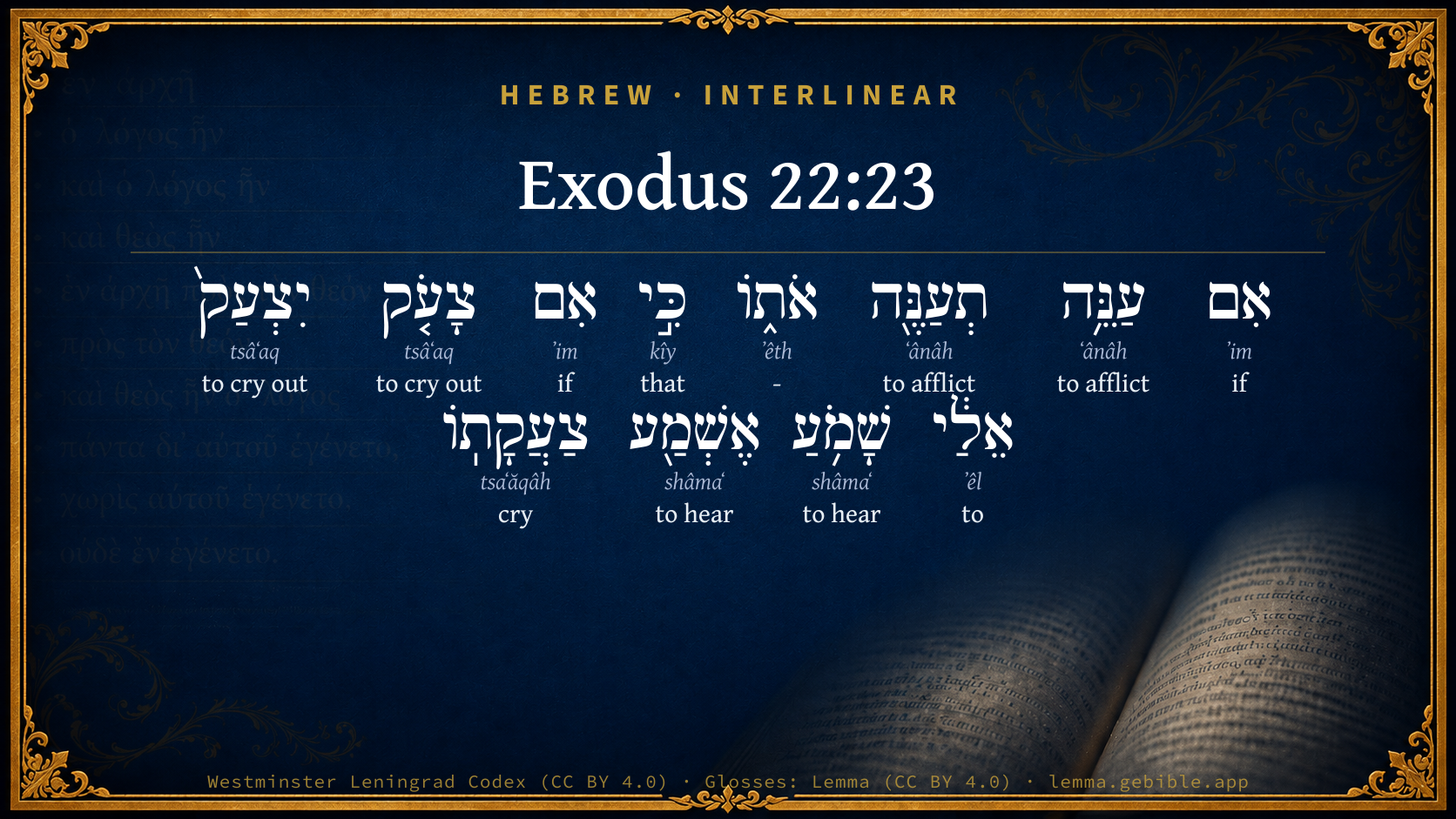
Hebrew (Westminster Leningrad Codex) Exodus 22:23 appears in the Hebrew Old Testament. The text above is from the Westminster Leningrad Codex. Each word links to its Strong’s number, a concise gloss, and parsing drawn from the Open Scriptures Hebrew Bible morphology. Click any word for its full Brown-Driver-Briggs (BDB) entry.
Download image
Cite this verse

Exodus 22:23 (World English Bible). Public Domain. Lemma interlinear Bible study tool, https://lemma.gebible.app/v/exodus/22/23.

Show BibTeX & RIS
BibTeX
RIS
English Translation
If you take advantage of them at all, and they cry at all to me, I will surely hear their cry;
World English Bible · Public Domain
Download a study sheet

One document with this verse’s original text, its word-by-word gloss line, the meaning frame, cross-references with their text, attributed commentary, and full source and license credits — printable, and it pastes into notes with its structure intact.

This verse Autodidact and up

Study sheet (.html) Plain text (.txt)

A passage Seminary Student

Up to 50 verses in one chapter. A passage sheet keeps up to 6 commentary sources and 12 cross-references per verse, in the order this page ranks them, and says so on the sheet whenever that leaves anything out. Ask for a single verse and you get the Autodidact verse sheet above.

Everything on this page stays free to read, with no account — the sheet is a download of what is already on screen, not access to it.

Want to remove ads? Support Godless Engineer
Compare translations 3

The same verse in 3 English versions, stacked beneath the original-language interlinear above. Click any original word for its lexicon entry.

Each is an independent rendering of the whole verse — the interlinear is not word-aligned to these translations.

Highlighted words mark where these versions differ — a whole-verse word diff, not a word-by-word alignment.

  • World English Bible Public Domain
    If you take advantage of them at all, and they cry at all to me, I will surely hear their cry;
  • King James Version Public Domain
    If thou afflict them in any wise, and they cry at all unto me, I will surely hear their cry;
  • unfoldingWord Literal Text CC BY-SA 4.0
    If you actually afflict them, and if they actually cry out to me, I will surely hear their cry,

unfoldingWord Literal Text — © unfoldingWord, licensed CC BY-SA 4.0. Word-aligned USFM3 via Door43 (git.door43.org/unfoldingWord/en_ult).

Versions to compare (up to 4)

3 of 4 selected

Show all 18 translations

Every available English version of this verse, each an independent rendering of the whole verse.

  • World English Bible Public Domain
    If you take advantage of them at all, and they cry at all to me, I will surely hear their cry;
  • Berean Standard Bible Public Domain
    If you do mistreat them, and they cry out to Me in distress, I will surely hear their cry.
  • Majority Standard Bible Public Domain
    If you do mistreat them, and they cry out to Me in distress, I will surely hear their cry.
  • King James Version Public Domain
    If thou afflict them in any wise, and they cry at all unto me, I will surely hear their cry;
  • American Standard Version (1901) Public Domain
    If thou afflict them at all, and they cry at all unto me, I will surely hear their cry;
  • Revised Version (1885) Public Domain
    If thou afflict them in any wise, and they cry at all unto me, I will surely hear their cry;
  • Geneva Bible (1599) Public Domain
    If thou vexe or trouble such, and so he call and cry vnto me, I will surely heare his cry.
  • Douay-Rheims (1899) Public Domain
    If you hurt them they will cry out to me, and I will hear their cry:
  • Young's Literal Translation Public Domain
    if thou dost really afflict him, surely if he at all cry unto Me, I certainly hear his cry;
  • Literal Standard Version CC BY-SA 4.0
    if you really afflict him, surely if he cries to Me at all, I certainly hear his cry;
  • Unlocked Literal Bible CC BY-SA 4.0
    If you afflict them at all, and if they call out to me, I will surely hear their call.
  • unfoldingWord Literal Text CC BY-SA 4.0
    If you actually afflict them, and if they actually cry out to me, I will surely hear their cry,
  • Darby Bible Public Domain
    If thou afflict him in any way, if he cry at all unto me, I will certainly hear his cry;
  • World Messianic Bible Public Domain
    If you take advantage of them at all, and they cry at all to me, I will surely hear their cry;
  • Webster's Bible Public Domain
    If thou shalt afflict them in any wise, and they cry at all to me, I will surely hear their cry:
  • Free Bible Version CC BY-SA 4.0
    If you mistreat them, and they call out to me for help, I will definitely respond to their cry.
  • Bible in Basic English Public Domain
    If you are cruel to them in any way, and their cry comes up to me, I will certainly give ear;
  • JPS Tanakh (1917) Public Domain
    (22-22) If thou afflict them in any wise — for if they cry at all unto Me, I will surely hear their cry —

Literal Standard Version (2020), Covenant Press — licensed CC BY-SA 4.0. Text via the HelloAO Bible API (eBible.org). Unlocked Literal Bible (unfoldingWord) — licensed CC BY-SA 4.0. Text via the HelloAO Bible API (eBible.org). unfoldingWord Literal Text — © unfoldingWord, licensed CC BY-SA 4.0. Word-aligned USFM3 via Door43 (git.door43.org/unfoldingWord/en_ult). Free Bible Version, Dr. Jonathan Gallagher — licensed CC BY-SA 4.0. Text via the HelloAO Bible API (eBible.org).

Word by word

More ways to search: Search by grammar → Find every occurrence → Compare this word →

Practice this passage: Drill this verse → Learn its vocabulary →

צַעֲקָתֽוֹ
tsaʻăqâh
H6818
“cry · his”
Noun, Common, Feminine, Singular, Construct + Suffix, Personal, 3rd Person, Masculine, Singular
Part of Speech
Noun
Type
Common
Gender
Feminine
Number
Singular
State
Construct
Full BDB Definition

Origin: from H6817

TWOT: 1947a

cry, outcry - outcry (against) - cry of distress (especially as heard by God)
  1. אִם ʼim H518 “if” Conjunction
  2. עַנֵּ֥ה ʻânâh H6031 “to afflict” Verb, Piel, Infinitive Absolute
  3. תְעַנֶּ֖ה ʻânâh H6031 “to afflict” Verb, Piel, Imperfect, 2nd Person, Masculine, Singular
  4. אֹת֑וֹ ʼêth H853 “- · him” Particle, Direct Object + Suffix, Personal, 3rd Person, Masculine, Singular
  5. כִּ֣י kîy H3588 “that” Conjunction
  6. אִם ʼim H518 “if” Conjunction
  7. צָעֹ֤ק tsâʻaq H6817 “to cry out” Verb, Qal, Infinitive Absolute
  8. יִצְעַק֙ tsâʻaq H6817 “to cry out” Verb, Qal, Imperfect, 3rd Person, Masculine, Singular
  9. אֵלַ֔י ʼêl H413 “to · me” Preposition + Suffix, Personal, 1st Person, Common, Singular
  10. שָׁמֹ֥עַ shâmaʻ H8085 “to hear” Verb, Qal, Infinitive Absolute
  11. אֶשְׁמַ֖ע shâmaʻ H8085 “to hear” Verb, Qal, Imperfect, 1st Person, Common, Singular

About this verse

These counts appear in no published source. They are computed here, from the morphology-tagged text and Lemma’s own curated glosses. What Lemma adds →

12
words
8
distinct lemmas
Pentateuch
section

Notable vocabulary

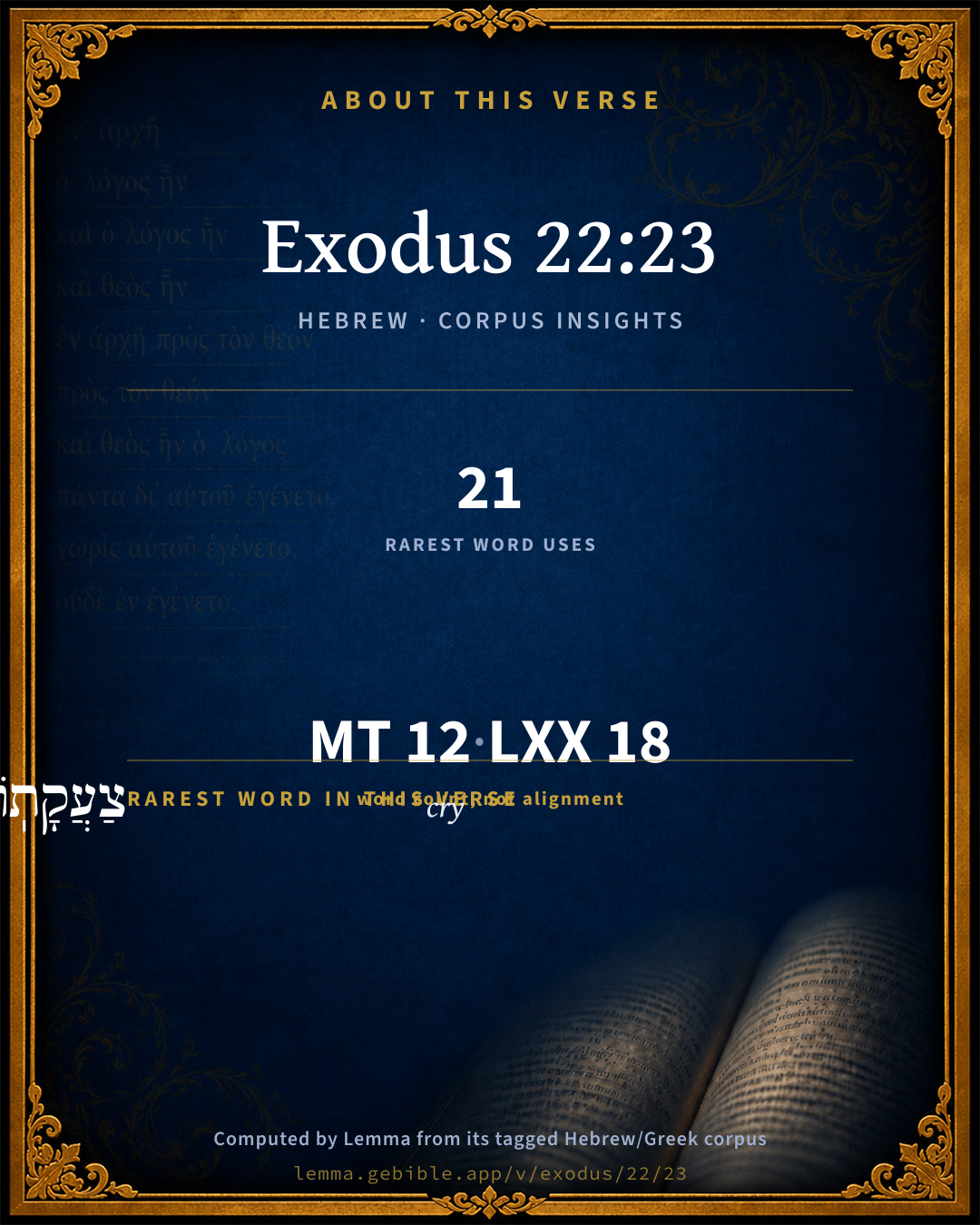
The rarest word here is צַעֲקָתֽוֹ cry H6818 — appearing just 21 times in the whole Hebrew Bible.

Shared distinctive vocabulary

צַעֲקָתֽוֹ cry H6818 occurs in 20 verses of the Hebrew Bible. Also found in:

Grammatical profile

  • 6 verbs
  • 1 noun
  • 1 preposition
  • 3 conjunctions
  • 1 particle

Verb forms

  • עַנֵּ֥ה Piel · Infinitive Absolute
  • תְעַנֶּ֖ה Piel · Imperfect
  • צָעֹ֤ק Qal · Infinitive Absolute
  • יִצְעַק֙ Qal · Imperfect
  • שָׁמֹ֥עַ Qal · Infinitive Absolute
  • אֶשְׁמַ֖ע Qal · Imperfect

Repetition

Words recur within this verse — often emphatic in Hebrew:

  • עַנֵּ֥ה to afflict H6031 ×2
  • צָעֹ֤ק to cry out H6817 ×2
  • שָׁמֹ֥עַ to hear H8085 ×2
  • אִם if H518 ×2

Hebrew & Septuagint length

In English translation the verse runs 21 words from the Hebrew and 21 from the Septuagint (LXX English) — the same length.

A rough comparison of the two English renderings, which tokenize alike — not a word-level alignment.

Word counts can differ between the Hebrew and the Greek without any difference in meaning — e.g. the Hebrew direct-object marker אֵת has no separate Greek word, and Greek often adds the article ὁ.

In the original languages it is 12 Hebrew tokens and 18 Greek tokens — but the two are counted differently (Hebrew bundles its prefixes and suffixes into one token; the Greek is in lemma form), so that isn’t a like-for-like length.

Cross-references

14

Topical passages linked to Exodus 22:23 in the Treasury of Scripture Knowledge — connected by theme and wording, ordered by reader-vote popularity; previews shown in the World English Bible.

  • Job 34:28 So that they caused the cry of the poor to come to him, He heard the cry of the afflicted.
  • Psalms 10:17–18 Yahweh, you have heard the desire of the humble. You will prepare their heart. You will cause your ear to hear,
  • Psalms 18:6 In my distress I called on Yahweh, And cried to my God. He heard my voice out of his temple, My cry before him came into his ears.
  • Luke 18:7 Won't God avenge his chosen ones, who are crying out to him day and night, and yet he exercises patience with them?
  • Deuteronomy 15:9 Beware that there not be a base thought in your heart, saying, The seventh year, the year of release, is at hand; and your eye be evil against your poor brother, and you give him nothing; and he cry to Yahweh against you, and it be sin to you.
  • Job 35:9 "By reason of the multitude of oppressions they cry out; They cry for help by reason of the arm of the mighty.
  • James 5:4 Behold, the wages of the laborers who mowed your fields, which you have kept back by fraud, cry out, and the cries of those who reaped have entered into the ears of the Lord of Hosts.
  • Psalms 145:19 He will fulfill the desire of those who fear him. He also will hear their cry, and will save them.
  • Psalms 146:7–9 Who executes justice for the oppressed; Who gives food to the hungry. Yahweh frees the prisoners.
  • Deuteronomy 24:15 in his day you shall give him his hire, neither shall the sun go down on it; for he is poor, and sets his heart on it: lest he cry against you to Yahweh, and it be sin to you.
  • Job 31:38–39 If my land cries out against me, And the furrows of it weep together;
  • Psalms 140:12 I know that Yahweh will maintain the cause of the afflicted, And justice for the needy.
  • Proverbs 22:22–23 Don't exploit the poor, because he is poor; And don't crush the needy in court;
  • Proverbs 23:10–11 Don't move the ancient boundary stone. Don't encroach on the fields of the fatherless:

Cross-references courtesy of OpenBible.info (CC BY 4.0).

Hebrew and Greek witnesses Masoretic Hebrew ↔ Greek Septuagint

The same verse in the two great witnesses to the Old Testament, shown verse-for-verse.

These are two independent witnesses, not word-aligned to each other, and the Septuagint is shown in lemma (dictionary) form.

Hebrew Exodus 22:23 Masoretic · Westminster Leningrad Codex

אִם עַנֵּ֥ה תְעַנֶּ֖ה אֹת֑וֹ כִּ֣י אִם צָעֹ֤ק יִצְעַק֙ אֵלַ֔י שָׁמֹ֥עַ אֶשְׁמַ֖ע צַעֲקָתֽוֹ

If you take advantage of them at all, and they cry at all to me, I will surely hear their cry;

World English Bible · Public Domain

Greek LXX Exodus 22:23 Septuagint · lemma form

καί ὀργίζω θυμός καί ἀποκτείνω σύ μάχαιρα καί εἰμί ὁ γυνή σύ χήρα καί ὁ παιδίον σύ ὀρφανός

And if you⌃ should afflict them by ill-treatment, and they should cry aloud to me, I will surely hear their voice.

LXX2012 (modern English Septuagint) · Public Domain

Hebrew: Westminster Leningrad Codex (CC BY 4.0). Greek: Septuagint (public domain); English from LXX2012 (modern English Septuagint) (Public Domain). How the Septuagint differs from the Hebrew →

Targum (Aramaic paraphrase)

2

The Targum is the ancient Jewish Aramaic paraphrase of the Hebrew Scriptures — an interpretive translation, not the Hebrew text itself. Onkelos (literal) and Pseudo-Jonathan (expansive) render the Torah, and Jonathan the Prophets. Coverage is partial: where no permissively-licensed English translation exists for a verse, only the Aramaic is shown. This is verse-level text, not a word-by-word alignment to the Hebrew.

  1. Targum Onkelos Torah (Genesis–Deuteronomy)
    וְיִתְקֵף רוּגְזִי וְאֶקְטוֹל יָתְכוֹן בְּחַרְבָּא וִיהֶוְיָן נְשֵׁיכוֹן אַרְמְלִין וּבְנֵיכוֹן יַתְמִין:

    (no public-domain English translation for this verse)

    Targum Onkelos — Aramaic: “Onkelos Genesis” (public domain); “Onkelos Exodus” (public domain); “Onkelos Leviticus” (public domain); “Onkelos Numbers” (public domain); “Onkelos Deuteronomy” (public domain). English: “Sefaria Community Translation” (CC0 1.0 (public-domain dedication)); “J.W. Etheridge. The Targums of Onkelos and Jonathan Ben Uzziel on the Pentateuch. London: Longmans, Green, 1862” (public domain). Text via Sefaria.

  2. Targum Pseudo-Jonathan Torah (Genesis–Deuteronomy)
    וְיִתְקַף רוּגְזִי וְאֶקְטוֹל יַתְכוֹן בְּחַרְבָּא דְמוֹתָא וִיהוֹן נְשֵׁיכוֹן אַרְמְלָן וּבְנֵיכוֹן יַתְמִין

    and My anger will be kindled, and I will slay you with the sword, and your wives shall be widows, and your children be orphans.

    Targum Pseudo-Jonathan — Aramaic: “Targum Jonathan on Genesis” (public domain); “Targum Jonathan on Exodus” (public domain); “Targum Jonathan on Leviticus” (public domain); “Targum Jonathan on Numbers” (public domain); “Targum Jonathan on Deuteronomy” (public domain). English: “The Targum of Jonathan ben Uzziel, trans. J. W. Etheridge, London, 1862” (public domain). Text via Sefaria.

Commentary

Notes on Exodus 22:23 from classic Christian and Jewish commentators (each source and its license shown beneath its notes). The classic Christian expositions comment on the surrounding passage and are grouped to its opening verse, so a note may address several verses; the Jewish commentaries on the Tanakh (Rashi and others) are per-verse, so they appear only where the commentator wrote on this verse.

Lemma curates 59 commentaries, every one of them public domain or Creative Commons licensed, each selected and text-cleaned for this edition rather than reprinted as found. About our sources →

Trapp's Complete Commentary

John Trapp

Exo 22:23 If thou afflict them in any wise, and they cry at all unto me, I will surely hear their cry;

Ver. 23. And they cry at all unto me.] A vine whose root is uncovered thrives not: so a widow, whose covering of eyes is taken away, joys not. In Hebrew she is called Almanach, from Alam, to be dumb; because she hath none to speak for her, {a} But if she call and cry to God, he will speak for her in the hearts of her oppressors.

{a} Mercer, in Proverb.

John Trapp, A Commentary or Exposition upon All the Books of the Old and New Testament (1647–1656) — public domain. Text from a community e-Sword module.

Ellicott's Commentary for English Readers

(23) If thou afflict them in any wise, and they cry at all unto me.—Rather, If thou afflict them sore, and they cry earnestly unto me. On the transgression of the laws against oppression by the later Israelites, see Jer_5:28; Jer_7:6; Jer_22:3; Jer_22:17; Zech. 7:20; Mal_3:5; Mat_23:14, &c. The sword of the Babylonians and the sword of the Romans avenged the sufferers, according to the prophecy of Exo_22:24.

A Bible Commentary for English Readers, edited by Charles John Ellicott (1878–1897) — public domain. Text from a community e-Sword module.

The Cambridge Bible for Schools and Colleges

gen. ed. J. J. S. Perowne

23. If thou afflict him in any wise, and he cry at all unto me, I will surely hear his cry] so the Heb., making it probable that vv. 21b, 22 (which are moreover distinguished from the context by the plur. ye), 24 (which will naturally go with v. 22) are an addition to the original text. It is true, there are not unfrequent cases in poetry, when a class of persons has been spoken of, of their being referred to individually by a sing. pronoun (see G.-K. § 145m; and the passages collected in the writer’s Jeremiah, p. 362); but this is very unusual in prose: such passages as Gen_2:19, Lev_21:7; Lev_25:31, Deu_7:3, Jos_24:7, Jdg_12:5; Jdg_21:6, are hardly parallel to the present one.

cry … unto me] cf. Deu_15:9; Deu_24:15; also Jas_5:4.

23, 24. If the Israelite does this, Jehovah will treat him with a just retribution.

The Cambridge Bible for Schools and Colleges (gen. ed. J. J. S. Perowne; Cambridge University Press, 1878–1918) — public domain. Text from a community e-Sword module.

John Gill's Exposition

If thou lend money to any of my people that is poor by thee, Such only need to borrow money, and to whom it should be freely lent, when it may be to the good of the borrower, and not any injury to the lender: this law, according to the Jewish writers, only respects Israelites, and not Gentiles; agreeably to which is Jarchi's note,"if thou lend, that is, not to a Gentile; and to which of my people? the poor, and to which of the poor? that is with thee:"

thou shalt not be to him as an usurer; that will not lend without usury, nor without an exorbitant interest, and deals very hardly with the borrower if he is not punctual in the payment of it; the Israelites were not only not to be usurers, but they were not to be like them; they were not to require anything for lending a poor man a little money; as not any settled interest, so neither were they to take any previous gift or reward later, see Luk 6:34.

neither shalt thou lay upon him usury; or oblige him to give interest for money borrowed: it is in the plural, number, "neither shall ye lay"; and Aben Ezra observes, that the lender, scribe, and witness, all transgress this law; that is, when a man lends money on interest, and a bond is made by the scribe for it, and this signed by witnesses, all are guilty of the breach of it: yea, some Jewish writers (h) say, not only those, but whoever is a surety or bondsman for the payment, and even the borrower himself; see Gill on Psa 15:5.

(h) Misn. Bava Metzia, c. 5. sect. 11. Maimon. & Bartenora in ib.

John Gill's Exposition of the Whole Bible (1746–1763) — public domain (CC PDM 1.0). Text via the HelloAO Bible API.

The Pulpit Commentary

And they cry at all unto me Rather, Surely, if they cry unto me." Compare Gen_31:42.

The Pulpit Commentary (1880–1919), ed. H.D.M. Spence-Jones & Joseph S. Exell — public domain. Text from a community e-Sword module.

Rashi

Rabbi Shlomo Yitzchaki (Rashi)

והיו נשיכם אלמנות AND YOUR WIVES SHALL BE WIDOWS [AND YOUR CHILDREN FATHERLESS] — From what is implied in the words, “I will kill you with the sword” do I not know that “your wives shall be widows and your children orphans”? But the explanation of the latter words is not that implied by your question; it is quite a different curse: that the wives will be “fettered” for life — “as living widows” (Rashi is imitating a Biblical phrase, II Samuel 20:3, used in a somewhat similar sense) — that there will be no witnesses who can testify to the death of their husbands, and so they will be forbidden to re-marry. In which case the children will be destitute orphans, for the court will not allow them to take possession of the chattels of their fathers, since they do not know whether they have died or have only been taken captives (Mekhilta; Bava Metzia 38b).

Rashi on the Tanakh — English translations: “The Judaica Press complete Tanach with Rashi, translated by A. J. Rosenberg” (CC BY 4.0); “Pentateuch with Rashi's commentary by M. Rosenbaum and A.M. Silbermann, 1929-1934” (public domain); “The Metsudah Tanach series, Lakewood, N.J” (CC BY 4.0); and “The Book of Joshua, Metsudah Publications, 1997” (CC BY 4.0). Text via Sefaria.

Lesson kit

Teaching starters — assembled from the data on this page, not authored interpretation. Every prompt links to the verse data it draws on. Edit before teaching.

Exodus, in the Pentateuch, opens this verse with 12 words (8 distinct Hebrew lemmas). Its most distinctive word is tsaʻăqâh (“cry”). A historical commentator’s framing appears above. Read the whole chapter for the surrounding context.

Discussion questions

  1. What does “cry” (tsaʻăqâh) contribute to the verse as a whole?
  2. How does Genesis 18:21, which shares the word «cry», read alongside this verse?
  3. What does the repetition of “to afflict” (2× in this one verse) do in this verse?
  4. These translations render this verse differently. What is at stake in choosing one wording over another?
  5. «עַנֵּ֥ה» is a Piel Infinitive Absolute verb. How does that grammatical form shape the action described?
  6. Compare how Trapp's Complete Commentary and Ellicott's Commentary for English Readers read this verse. Where do they agree or differ?

Things to notice

Reading settings

Reading text

Shown beneath each verse's original-language words.

Old Testament
Old Testament edition

Read the OT as the Masoretic Hebrew (MT) or the Greek Septuagint (LXX).

English shown for the Greek Septuagint (in the Hebrew ↔ Greek comparison).

Comparing translations? Open the Compare panel on any verse page to stack up to four side by side.