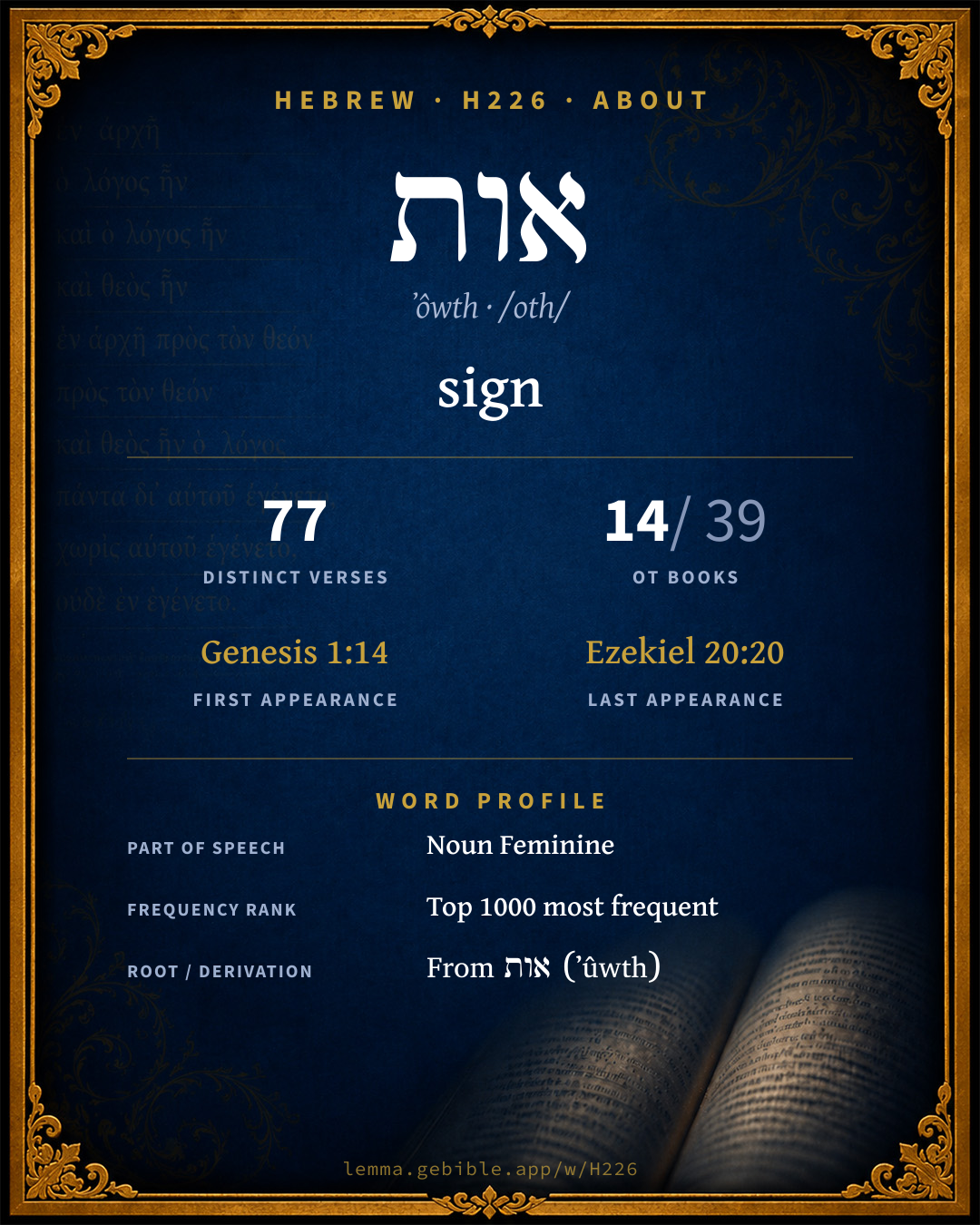
אוֹת
sign
‘sign’ is one of 2 main senses fuller range ↓
Full lexicon entry — Brown-Driver-Briggs (BDB)
From Brown-Driver-Briggs (BDB)
Where this word appears
See every Absolute-state word in the Hebrew Bible →
Grammar key — what these labels mean
Part of speech
- Noun
- A naming word — a person, place, thing, or idea.
Noun type
- Common
- A common noun — a general class of person, place, or thing (“king,” “city,” “water”), not a specific name.
State
- Absolute
- The independent form of a noun, not bound to a following word.
- Construct
- A noun bound to a following noun in a possessive / “of” relationship (the construct chain).
Gender
- Both
- Attested as both masculine and feminine.
Number
- Singular
- One.
- Plural
- More than one (in Hebrew, generally three or more).
Grammatical forms
- Noun, Common, Both, Singular, Absolute 38 times (48%)
- Noun, Common, Both, Plural, Absolute 22 times (28%)
- Noun, Common, Both, Plural, Construct 13 times (16%)
- Noun, Common, Both, Singular, Construct 6 times (8%)
Parsed forms decoded from the imported morphology (morphhb / Westminster Leningrad Codex — WLC text public domain, morphhb tagging CC BY 4.0), counted across 79 parsed occurrences — not distinct verses.
Every verse where H226 appears — 77 distinct verses across 14 books. Click any verse to open its interlinear word-by-word view. Verse text shown in the World English Bible for context — . Each verse’s Hebrew form is shown with its reference; the English is not keyword-highlighted, since the data carries no word-level English alignment. Use “Compare translations” on any verse to read it across multiple English versions. This concordance covers the Hebrew Bible; Septuagint (Greek Old Testament) occurrences are not indexed here.
Genesis 6 verses
- Genesis 1:14 לְ/אֹתֹת֙ prep + n c bp God said, "Let there be lights in the expanse of sky to divide the day from the night; and let them be for signs, and for seasons, and for days and years;
- Genesis 4:15 א֔וֹת n c bs Yahweh said to him, "Therefore whoever slays Cain, vengeance will be taken on him sevenfold." Yahweh appointed a sign for Cain, lest any finding him should strike him.
- Genesis 9:12 אֽוֹת n c bs cs God said, "This is the token of the covenant which I make between me and you and every living creature that is with you, for perpetual generations:
- Genesis 9:13 לְ/א֣וֹת prep + n c bs cs I set my rainbow in the cloud, and it will be for a sign of a covenant between me and the earth.
- Genesis 9:17 אֽוֹת n c bs cs God said to Noah, "This is the token of the covenant which I have established between me and all flesh that is on the earth."
- Genesis 17:11 לְ/א֣וֹת prep + n c bs cs You shall be circumcised in the flesh of your foreskin. It will be a token of a covenant between me and you.
Exodus 15 verses
- Exodus 3:12 הָ/א֔וֹת ptcl def.art + n c bs He said, "Certainly I will be with you. This will be the token to you, that I have sent you: when you have brought forth the people out of Egypt, you shall serve God on this mountain."
- Exodus 4:8 הָ/אֹ֣ת הָ/אֹ֥ת ptcl def.art + n c bs ptcl def.art + n c bs "It will happen, if they will neither believe you nor listen to the voice of the first sign, that they will believe the voice of the latter sign.
- Exodus 4:9 הָ/אֹת֜וֹת ptcl def.art + n c bp It will happen, if they will not believe even these two signs, neither listen to your voice, that you shall take of the water of the river, and pour it on the dry land. The water which you take out of the river will become blood on the dry land."
- Exodus 4:17 הָ/אֹתֹֽת ptcl def.art + n c bp You shall take this rod in your hand, with which you shall do the signs."
- Exodus 4:28 הָ/אֹתֹ֖ת ptcl def.art + n c bp Moses told Aaron all the words of Yahweh with which he had sent him, and all the signs with which he had charged him.
- Exodus 4:30 הָ/אֹתֹ֖ת ptcl def.art + n c bp Aaron spoke all the words which Yahweh had spoken to Moses, and did the signs in the sight of the people.
- Exodus 7:3 אֹתֹתַ֛/י n c bp cs + sfx pers 1cs I will harden Pharaoh's heart, and multiply my signs and my wonders in the land of Egypt.
- Exodus 8:23 הָ/אֹ֥ת ptcl def.art + n c bs I will put a division between my people and your people: by tomorrow shall this sign be."'"
- Exodus 10:1 אֹתֹתַ֥/י n c bp cs + sfx pers 1cs Yahweh said to Moses, "Go in to Pharaoh, for I have hardened his heart, and the heart of his servants, that I may show these my signs in the midst of them,
- Exodus 10:2 אֹתֹתַ֖/י n c bp cs + sfx pers 1cs and that you may tell in the hearing of your son, and of your son's son, what things I have done to Egypt, and my signs which I have done among them; that you may know that I am Yahweh."
- Exodus 12:13 לְ/אֹ֗ת prep + n c bs The blood shall be to you for a token on the houses where you are: and when I see the blood, I will pass over you, and there shall no plague be on you to destroy you, when I strike the land of Egypt.
- Exodus 13:9 לְ/א֜וֹת prep + n c bs It shall be for a sign to you on your hand, and for a memorial between your eyes, that the law of Yahweh may be in your mouth; for with a strong hand Yahweh has brought you out of Egypt.
- Exodus 13:16 לְ/אוֹת֙ prep + n c bs It shall be for a sign on your hand, and for symbols between your eyes: for by strength of hand Yahweh brought us forth out of Egypt."
- Exodus 31:13 א֨וֹת n c bs "Speak also to the children of Israel, saying, 'Most assuredly you shall keep my Sabbaths: for it is a sign between me and you throughout your generations; that you may know that I am Yahweh who sanctifies you.
- Exodus 31:17 א֥וֹת n c bs It is a sign between me and the children of Israel forever; for in six days Yahweh made heaven and earth, and on the seventh day he rested, and was refreshed.'"
Numbers 5 verses
- Numbers 2:2 בְ/אֹתֹת֙ prep + n c bp "The children of Israel shall encamp every man by his own standard, with the ensigns of their fathers' houses: at a distance from the tent of meeting shall they encamp around it."
- Numbers 14:11 הָֽ/אֹת֔וֹת ptcl def.art + n c bp Yahweh said to Moses, How long will this people despise me? and how long will they not believe in me, for all the signs which I have worked among them?
- Numbers 14:22 אֹ֣תֹתַ֔/י n c bp cs + sfx pers 1cs because all those men who have seen my glory, and my signs, which I worked in Egypt and in the wilderness, yet have tempted me these ten times, and have not listened to my voice;
- Numbers 16:38 לְ/א֖וֹת prep + n c bs even the censers of these sinners against their own lives; and let them be made beaten plates for a covering of the altar: for they offered them before Yahweh; therefore they are holy; and they shall be a sign to the children of Israel.
- Numbers 17:10 לְ/א֖וֹת prep + n c bs Yahweh said to Moses, Put back the rod of Aaron before the testimony, to be kept for a token against the children of rebellion; that you may make an end of their murmurings against me, that they not die.
Deuteronomy 12 verses
- Deuteronomy 4:34 בְּ/אֹתֹ֨ת prep + n c bp Or has God tried to go and take him a nation from the midst of [another] nation, by trials, by signs, and by wonders, and by war, and by a mighty hand, and by an outstretched arm, and by great terrors, according to all that Yahweh your God did for you in Egypt before your eyes?
- Deuteronomy 6:8 לְ/א֖וֹת prep + n c bs You shall bind them for a sign on your hand, and they shall be for symbols between your eyes.
- Deuteronomy 6:22 אוֹתֹ֣ת n c bp and Yahweh shown signs and wonders, great and sore, on Egypt, on Pharaoh, and on all his house, before our eyes;
- Deuteronomy 7:19 וְ/הָ/אֹתֹ֤ת conj + ptcl def.art + n c bp the great trials which your eyes saw, and the signs, and the wonders, and the mighty hand, and the outstretched arm, by which Yahweh your God brought you out: so shall Yahweh your God do to all the peoples of whom you are afraid.
- Deuteronomy 11:3 אֹֽתֹתָי/ו֙ n c bp cs + sfx pers 3ms and his signs, and his works, which he did in the midst of Egypt to Pharaoh the king of Egypt, and to all his land;
- Deuteronomy 11:18 לְ/אוֹת֙ prep + n c bs Therefore shall you lay up these my words in your heart and in your soul; and you shall bind them for a sign on your hand, and they shall be for symbols between your eyes.
- Deuteronomy 13:1 א֖וֹת n c bs If there arise in the midst of you a prophet, or a dreamer of dreams, and he give you a sign or a wonder,
- Deuteronomy 13:2 הָ/אוֹת֙ ptcl def.art + n c bs and the sign or the wonder come to pass, of which he spoke to you, saying, Let us go after other gods, which you have not known, and let us serve them;
- Deuteronomy 26:8 וּ/בְ/אֹת֖וֹת conj + prep + n c bp and Yahweh brought us forth out of Egypt with a mighty hand, and with an outstretched arm, and with great terror, and with signs, and with wonders;
- Deuteronomy 28:46 לְ/א֖וֹת prep + n c bs and they shall be on you for a sign and for a wonder, and on your seed forever.
- Deuteronomy 29:3 הָ/אֹתֹ֧ת ptcl def.art + n c bp the great trials which your eyes saw, the signs, and those great wonders:
- Deuteronomy 34:11 הָ֨/אֹת֜וֹת ptcl def.art + n c bp in all the signs and the wonders, which Yahweh sent him to do in the land of Egypt, to Pharaoh, and to all his servants, and to all his land,
Joshua 3 verses
- Joshua 2:12 א֥וֹת n c bs cs Now therefore, please swear to me by Yahweh, since I have dealt kindly with you, that you also will deal kindly with my father's house, and give me a true token;
- Joshua 4:6 א֖וֹת n c bs that this may be a sign among you, that when your children ask in time to come, saying, What do you mean by these stones?
- Joshua 24:17 הָ/אֹת֤וֹת ptcl def.art + n c bp for Yahweh our God, he it is who brought us and our fathers up out of the land of Egypt, from the house of bondage, and who did those great signs in our sight, and preserved us in all the way in which we went, and among all the peoples through the midst of whom we passed;
Judges 1 verse
1 Samuel 4 verses
- 1 Samuel 2:34 הָ/א֗וֹת ptcl def.art + n c bs This shall be the sign to you, that shall come on your two sons, on Hophni and Phinehas: in one day they shall die both of them.
- 1 Samuel 10:7 הָ/אֹת֥וֹת ptcl def.art + n c bp Let it be, when these signs are come to you, that you do as occasion shall serve you; for God is with you.
- 1 Samuel 10:9 הָ/אֹת֥וֹת ptcl def.art + n c bp It was so, that when he had turned his back to go from Samuel, God gave him another heart: and all those signs happened that day.
- 1 Samuel 14:10 הָ/אֽוֹת ptcl def.art + n c bs But if they say thus, Come up to us; then we will go up; for Yahweh has delivered them into our hand: and this shall be the sign to us.
2 Kings 3 verses
- 2 Kings 19:29 הָ/א֔וֹת ptcl def.art + n c bs This shall be the sign to you: You shall eat this year that which grows of itself, and in the second year that which springs of the same; and in the third year sow you, and reap, and plant vineyards, and eat the fruit of it.
- 2 Kings 20:8 א֔וֹת n c bs Hezekiah said to Isaiah, What shall be the sign that Yahweh will heal me, and that I shall go up to the house of Yahweh the third day?
- 2 Kings 20:9 הָ/אוֹת֙ ptcl def.art + n c bs Isaiah said, This shall be the sign to you from Yahweh, that Yahweh will do the thing that he has spoken: shall the shadow go forward ten steps, or go back ten steps?
Nehemiah 1 verse
Job 1 verse
Psalms 7 verses
- Psalms 65:8 מֵ/אוֹתֹתֶ֑י/ךָ prep + n c bp cs + sfx pers 2ms They also who dwell in far-away places are afraid at your wonders. You call the morning's dawn and the evening with songs of joy.
- Psalms 74:4 אוֹתֹתָ֣/ם אֹתֽוֹת n c bp cs + sfx pers 3mp n c bp Your adversaries have roared in the midst of your assembly. They have set up their standards as signs.
- Psalms 74:9 אֽוֹתֹתֵ֗י/נוּ n c bp cs + sfx pers 1cp We see no miraculous signs. There is no longer any prophet, Neither is there among us anyone who knows how long.
- Psalms 78:43 אֹֽתוֹתָ֑י/ו n c bp cs + sfx pers 3ms How he set his signs in Egypt, His wonders in the field of Zoan,
- Psalms 86:17 א֗וֹת n c bs Show me a sign of your goodness, That those who hate me may see it, and be shamed, Because you, Yahweh, have helped me, and comforted me.
- Psalms 105:27 אֹתוֹתָ֑י/ו n c bp cs + sfx pers 3ms They performed miracles among them, And wonders in the land of Ham.
- Psalms 135:9 אֹת֣וֹת n c bp Who sent signs and wonders into the midst of you, Egypt, On Pharaoh, and on all his servants;
Isaiah 11 verses
- Isaiah 7:11 א֔וֹת n c bs "Ask a sign of Yahweh your God; ask it either in the depth, or in the height above."
- Isaiah 7:14 א֑וֹת n c bs Therefore the Lord himself will give you a sign. Behold, the virgin will conceive, and bear a son, and shall call his name Immanuel.
- Isaiah 8:18 לְ/אֹת֥וֹת prep + n c bp Behold, I and the children whom Yahweh has given me are for signs and for wonders in Israel from Yahweh of Hosts, who dwells in Mount Zion.
- Isaiah 19:20 לְ/א֥וֹת prep + n c bs It shall be for a sign and for a witness to Yahweh of Hosts in the land of Egypt; for they shall cry to Yahweh because of oppressors, and he will send them a savior, and a defender, and he will deliver them.
- Isaiah 20:3 א֣וֹת n c bs Yahweh said, Like as my servant Isaiah has walked naked and barefoot three years for a sign and a wonder concerning Egypt and concerning Ethiopia;
- Isaiah 37:30 הָ/א֔וֹת ptcl def.art + n c bs This shall be the sign to you: you shall eat this year that which grows of itself, and in the second year that which springs of the same; and in the third year sow you, and reap, and plant vineyards, and eat the fruit of it.
- Isaiah 38:7 הָ/א֖וֹת ptcl def.art + n c bs This shall be the sign to you from Yahweh, that Yahweh will do this thing that he has spoken:
- Isaiah 38:22 א֑וֹת n c bs Hezekiah also had said, What is the sign that I shall go up to the house of Yahweh?
- Isaiah 44:25 אֹת֣וֹת n c bp cs who frustrates the signs of the liars, and makes diviners mad; who turns wise men backward, and makes their knowledge foolish;
- Isaiah 55:13 לְ/א֥וֹת prep + n c bs cs Instead of the thorn shall come up the fir tree; and instead of the brier shall come up the myrtle tree: and it shall be to Yahweh for a name, for an everlasting sign that shall not be cut off.
- Isaiah 66:19 א֗וֹת n c bs I will set a sign among them, and I will send such as escape of them to the nations, to Tarshish, Pul, and Lud, who draw the bow, to Tubal and Javan, to the isles afar off, who have not heard my fame, neither have seen my glory; and they shall declare my glory among the nations.
Jeremiah 4 verses
- Jeremiah 10:2 וּ/מֵ/אֹת֥וֹת conj + prep + n c bp cs Thus says Yahweh, "Don't learn the way of the nations, and don't be dismayed at the signs of the sky; for the nations are dismayed at them.
- Jeremiah 32:20 אֹת֨וֹת n c bp who performed signs and wonders in the land of Egypt, even to this day, both in Israel and among [other] men; and made you a name, as in this day;
- Jeremiah 32:21 בְּ/אֹת֣וֹת prep + n c bp and brought forth your people Israel out of the land of Egypt with signs, and with wonders, and with a strong hand, and with an outstretched arm, and with great terror;
- Jeremiah 44:29 הָ/אוֹת֙ ptcl def.art + n c bs This shall be the sign to you, says Yahweh, that I will punish you in this place, that you may know that my words shall surely stand against you for evil:
Ezekiel 4 verses
- Ezekiel 4:3 א֥וֹת n c bs Take for yourself an iron pan, and set it for a wall of iron between you and the city: and set your face toward it, and it shall be besieged, and you shall lay siege against it. This shall be a sign to the house of Israel.
- Ezekiel 14:8 לְ/א֣וֹת prep + n c bs and I will set my face against that man, and will make him an astonishment, for a sign and a proverb, and I will cut him off from the midst of my people; and you shall know that I am Yahweh.
- Ezekiel 20:12 לְ/א֔וֹת prep + n c bs Moreover also I gave them my Sabbaths, to be a sign between me and them, that they might know that I am Yahweh who sanctifies them.
- Ezekiel 20:20 לְ/אוֹת֙ prep + n c bs and make my Sabbaths holy; and they shall be a sign between me and you, that you may know that I am Yahweh your God.
About this entry
At a glance — auto-summarized from this page’s data, not written by a person. Every figure links to its source below. This summary describes the numbers; it doesn’t interpret them.
At its core, אות (ʼôwth) means “sign.” Scripture first uses it in Genesis 1:14. It turns up in 77 verses across 14 books, a moderately common footprint. Carrying more than one sense, it rewards its full sense range. It shares a root with אות, אתה and את. Each statement above links to its evidence; the full detail follows below.
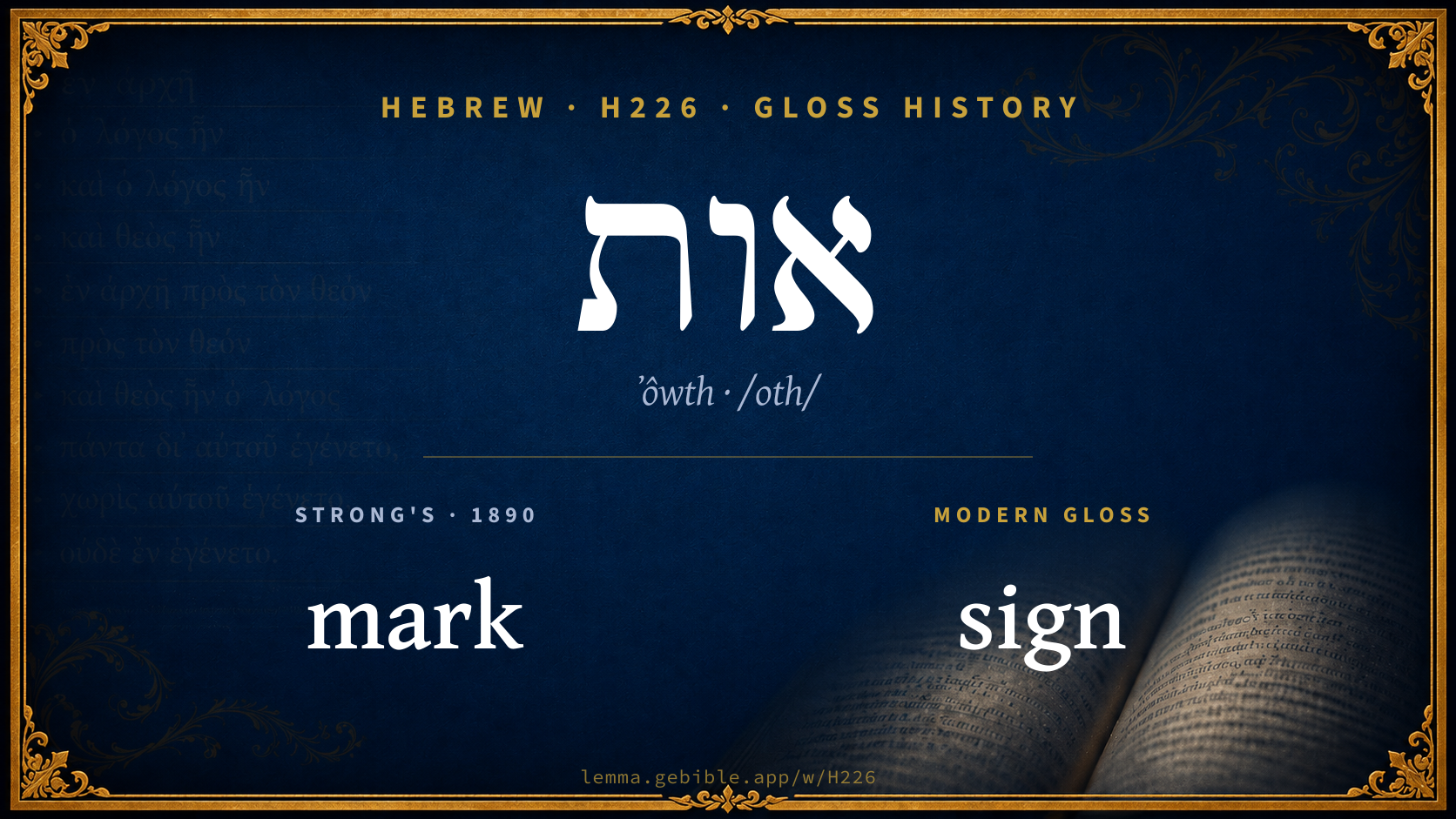
Gloss history
Strong's 1890 vs modern scholarship
About this word
Strong's H226 catalogs a Hebrew word from the Hebrew Old Testament.
These counts are not copied from any lexicon or concordance. They are computed here, from the morphology-tagged Hebrew Old Testament. What Lemma adds →
- 77
- distinct verses
- The word appears in 77 distinct verses.
- 14 / 39
- OT books
- The word appears in 14 of 39 Old Testament books.
- #506
- by frequency
- Top 1000 most frequent Hebrew words (rank 506 of 8,640 Hebrew words by occurrence).
View all 77 occurrences in the concordance →
Most concentrated in
- Exodus 15 verses 19%
- Deuteronomy 12 verses 16%
- Isaiah 11 verses 14%
By section of the Old Testament
By traditional corpus
Conventional, traditional groupings — biblical authorship is debated, so this is a traditional corpus grouping, not an authorship claim. Each share is this word’s portion of its verses in that division of the Hebrew canon. Each figure is a share of the word’s 77 distinct verses.
- Torah (Pentateuch) 38 verses · 49%
- Prophets (Nevi'im) 30 verses · 39%
- Writings (Ketuvim) 9 verses · 12%
How translations render this word
Counts come from each version’s own published word-to-Strong’s tagging or interlinear alignment — an approximate guide to how each version renders this word, not a word-level alignment the data otherwise carries. Because each total is that version’s own tagged count, the per-version totals vary from one another and need not match the appearance or distinct-verse counts above. These counts may also differ from a printed concordance because Lemma counts each distinctly tagged rendering and does not collapse phrase taggings into a single head-word total. This is a fixed set of word-tagged versions (KJV, ASV, BSB, ULT) and does not change with the reading translation you choose elsewhere. Each version’s license is shown beside its name below (and on Sources).
- King James Version: Signs 20×, Sign 11×, Shall be a sign 6×
- American Standard Version: Signs 23×, Sign 10×, Shall be the sign 7×
- Berean Standard Bible: Sign 26×, Signs 26×, Will be a sign 7×
- unfoldingWord Literal Text: Signs 30×, Sign 26×, Sign of 6×
King James Version Public Domain
Renders H226 across 79 tagged occurrences — most commonly:
Plus other, less common renderings. Plus 18 renderings that appear only once — usually multi-word phrases or single function words the recovered tagging swept in, not distinct renderings.
American Standard Version Public Domain
Renders H226 across 80 tagged occurrences — most commonly:
Plus 24 renderings that appear only once — usually multi-word phrases or single function words the recovered tagging swept in, not distinct renderings.
Berean Standard Bible Public Domain
Renders H226 across 78 tagged occurrences — most commonly:
Plus 10 renderings that appear only once — usually multi-word phrases or single function words the recovered tagging swept in, not distinct renderings. Not rendered by a distinct English word in 1 further occurrence.
unfoldingWord Literal Text CC BY-SA 4.0
Renders H226 across 80 tagged occurrences — most commonly:
Plus 5 renderings that appear only once — usually multi-word phrases or single function words the recovered tagging swept in, not distinct renderings.
8 senses and sub-senses in the full BDB
What do BDB’s symbols mean?
BDB uses these scholarly abbreviations:
| Symbol | Meaning |
|---|---|
| 𝔊 | the Septuagint (the ancient Greek translation, LXX) |
| 𝔙 | the Vulgate (the Latin translation) |
| 𝔖 | the Syriac version (the Peshitta) |
| 𝔗 | the Targum (the Aramaic translation) |
| ψ | the Psalms |
| √ | root (the underlying root or stem) |
| ‖ | parallel passage (a synonymous or contrasted parallel) |
| † | the dagger: every passage where the word occurs is cited |
The 8 senses and sub-senses the full Brown-Driver-Briggs lexicon distinguishes for this word, in lexicon order (not ranked by frequency), with BDB’s own verbatim wording and sub-sense lettering. Shown in Hebrew script with BDB’s own scholarly abbreviations. The condensed entry is in the Lexicon Entry tab. See also the Forms in the corpus table below.
- 1. sign, pledge, token Gn 4:15 (J); אוֹת אֱמֶת true token Jos 2:12 (J); of blood of passover Ex 12:13 (P); אוֹת לְטוֹבָה token for good ψ 86:17; pledges, assurances of travellers Jb 21:29. e.g. Genesis 4:15
- 2. signs, omens promised by prophets as pledges of certain predicted events 1 S 10:7, 9 + v 1 where א׳ ins. 𝔊 𝔙, vid. We Dr; especially phr. זֶה הָאוֹת לְ Ex 3:12; 1 S 2:34; 14:10; 2 K 19:29; Je 44:29; Is 7:11, 14; prob. also Is 44:25 (of false proph.). e.g. 1 Samuel 10:7
- 3. sign, symbol of prophets Is 8:18 cf. Ez 4:3. e.g. Isaiah 8:18
- 4. signs, miracles, as pledges or attestations of divine presence & interposition Ex 4:8(×2), 9 (J) 7:3 (P) 8:19 (J) ψ 65:9; 74:9; 2 K 19:29; 20:8, 9 = Is 37:30; 38:7, 22; c. עָשָׂה Ex 4:17, 30; Nu 14:11, 22; Jos 24:17 (all JE) Dt 11:3; Ju 6:17; c. צִוָּה Ex 4:28 (J); c. שִׁית 10:1 (J); c. שִׂים Ex 10:2 (J) ψ 78:43; Is 66:19; הָאוֹת וְהַמּוֹפֵת (v. מוֹפֵת Dt 13:3 cf. 28:46 Is 20:3; א׳ אוֹ מ׳ Dt 13:2; אוֹתוֹת וּמוֹפְתִים Dt 4:34; 7:19; 26:8; 29:2; Je 32:21; c. נָתַן Dt 6:22; Ne 9:10; c. שִׂים Je 32:20 ψ 105:27; c. שָׁלַח Dt 34:11 ψ 135:9. e.g. Exodus 4:8
- 5. signs, memorials, stones from Jordan Jos 4:6 (J); metal of censers Nu 17:3 (P); Aaron’s rod Nu 17:25 (P); א׳ עוֹלָם Is 55:13 prob. also Ez 14:8 (‖ מָשָׁל); signs on hands, etc., Ex 13:9, 16 (J) = Dt 6:8; 11:18, prob. belong here; also memorial pillar in Egypt Is 19:20. e.g. Joshua 4:6
- 6. sign, pledge of covenant, א׳ הַבְּרִית (v. ברית) e.g. rainbow, of Noachian covenant Gn 9:12, 13, 17 (P); circumcision, of Abrahamic covenant Gn 17:11 (P); the sabbath Ex 31:13, 17 (P) Ez 20:12, 20. e.g. Genesis 9:12
- 7. ensigns, standards Nu 2:2 (P) ψ 74:4. e.g. Numbers 2:2
- 8. signs, tokens of changes of weather & times Gn 1:14 (P; of heavenly luminaries) אוֹתוֹת הַשָּׁמַיִם Je 10:2 (changes of the heavens as omens to frighten the nations) cf. ψ 65:9. e.g. Genesis 1:14
Senses from the full Brown-Driver-Briggs lexicon (Brown, Driver, Briggs; Oxford 1906 — public domain), digitized via Sefaria, supplemented by the OpenScriptures HebrewLexicon (CC BY 4.0). Full attribution on Sources.
Word origin
n.m.79 Ex 4:8 (f. Jos 24:17) sign (Arabic آيَة, pl. آىٌ, Aramaic אָתָא, ܐܳܬܳܐ )—א׳ Gn 4:15 +; cstr. 9:12 +; pl. אוֹתוֹת Ex 4:9 + etc.—
— Brown-Driver-Briggs (Oxford 1906, public domain), digitized via Sefaria, supplemented by the OpenScriptures HebrewLexicon (CC BY 4.0). See Sources.
Derived from אות (ʼûwth) (H225) — to agree.
Jastrow Dictionary
A second Hebrew/Aramaic lexicon for comparison, covering Aramaic and post-biblical (Talmudic, Targumic, Midrashic) usage that the biblical-Hebrew BDB does not. Matched by lemma rather than by Strong’s number, so a lemma may carry more than one Jastrow headword (shown separately below), and the entries cover usage well beyond the Bible.
אוֹת I
- to join, fit.
- (b. h.) to be suited, pleased, whence to be gratified, to enjoy. Y. Ber. III, 6ᶜ top ראה את עצמו נ׳ וכ׳ he dreamt he felt sexual gratification; Y. Yoma VII, 44ᵈ bot.; Y. Taan. I, 64ᶜ bot.—Y. Bets. I, 61ᵃ כל שנֵאותין בו בי"ט whatever you are permitted to make use of on Holy Days.—Fut. יֵאוֹת. Ber. VIII, 6 עד שיֵאוֹתוּ לאורו until being near enough to enjoy its light. Y. Ab. Zar. I, 39ᶜ top, a. e., differences as to spelling יֵאוֹתוּ or יֵעוּתוּ.—Denom. הֲנָאָה, נָאֶה, נָאוֶה, נוֹי.
אוֹת II
- c. (b. h.; v. אוי,
- 1. mark, sign, emblem; test, signal, military ensign. Ḥag. 16ᵃ (play on ואתה Deut. XXXIII, 2; cmp. foreg.) אות הוא וכ׳ He is the ensign among his myriad; v. דּוּגְמָא. M. Kat. 25ᵇ אל תזניחנו בא׳ וכ׳ forsake us not in the symbolic trial of bitter waters (in our trials). Pl. אוֹתוֹת. Kil. IX, 10 א׳ הגרדין וכ׳ the marks which the weavers &c. put on goods in their charge. B. Kam. 119ᵇ you must not buy from the dyer לא א׳ ולא דוגמות either tests (pieces cut off to test the color) or samples (as specimens of color). e.g. Deuteronomy 33:2
- 2. letter, writing, symbol. B. Bath. 15ᵃ אות אחת one letter. Sabb. 103ᵃ; a. fr.—Pl. אוֹתִיּוֹת (fr. אוֹתוּת or אוֹתִית). Kidd. 30ᵃ סופרים כל הא׳ recorded (or counted) all the letters of the Torah. Snh. X, 1 השם באוֹתִיוֹתָיו the Divine Name with the letters in which it is written (Jehovah). Kidd. 71ᵃ שם בן ארבע א׳ the quadriliteral Name; cmp. שֵׁם.—Lev. R. s. 26, beg. ח׳ א׳ eight letters. Sabb. XII, 3; a. fr.—Trnsf. notes, documents. Tosef. Kidd. I, 7; B. Bath. 75ᵇ; a. e.
אוֹת III
- v. אֵת) only with pronominal suffix
- 1. indicating the objective case, אוֹתִי me, אוֹתְךָ thee, &c.—2) with pronom., &c.
- 2. with pronom. suffix of third person, for emphasizing the subject, אוֹתוֹ he himself, this one, the same, he who &c. Gen. R. s. 2, beg. ישב לו א׳ וכ׳ the latter now sat there confounded &c. Y. Git. VI, 47ᵈ באותו ענין on this very subject (divorce). Sabb. 13ᵇ זכור אותו האיש וכ׳ may that man be remembered for good. Ber. V, 3 באוֹתָהּ שעה in that hour; a. fr.—אותו מקום euphem. for pudenda. Nidd. 47ᵇ. Git. 69ᵇ; a. e.—אותו ואת בנו the law concerning the killing of the young with its mother on the same day (Lev. XXII, 28). Ḥull. V, 1; a. fr.—Pl. אוֹתָן. Y. Meg. IV, 74ᵈ top א׳ שבפה those laws delivered orally. Keth. 4ᵃ כל א׳ הימים all those days; a. fr. [In later writings אותו האיש is freq. used for Jesus of Nazareth. e.g. Leviticus 22:28
A Dictionary of the Targumim, the Talmud Babli and Yerushalmi, and the Midrashic Literature (Marcus Jastrow; London, Luzac, 1903) — Public Domain. Digitized via Sefaria. Digitized via Sefaria. Full attribution on Sources.
Forms in the corpus
The 54 distinct written forms H226 takes in the Hebrew Bible, most frequent first — each parse links to that state’s occurrences in the concordance. Hebrew forms include their vowel points and cantillation, so a single lemma takes many written forms.
Same root — word family
Other BDB entries built from the same root as H226, grouped by Strong’s listed origin. These share a root / origin per the lexicon — not necessarily a shared meaning. Each links to that word’s own entry.
Derives from
Shares the same root
Derived from this word
Compare all same-root words → Showing 4 of 5 — not the complete family. They share a root, not necessarily a meaning.
Septuagint verse parallels
This word appears in 72 verses that also exist in the Greek Old Testament (Septuagint), out of the 77 Hebrew verses it occurs in. You can read those verses in Greek by switching the Old Testament edition to the Septuagint.
Read these verses in the Septuagint
- Genesis 1:14
- Exodus 3:12
- Numbers 2:2
- Deuteronomy 4:34
- Joshua 2:12
- Judges 6:17
- 1 Samuel 2:34
- 2 Kings 19:29
- Job 21:29
- Psalms 65:8
- Isaiah 7:11
- Jeremiah 10:2
This is a verse-level parallel only — the same verses exist in both the Hebrew and Greek Old Testaments. No word-level Hebrew↔Greek correspondence is claimed: the data carries no such alignment, so no Greek word is shown as this Hebrew word’s translation. Coverage is not total — the Septuagint omits the deuterocanon and renumbers the Psalms, so some Hebrew verses have no direct Greek parallel.