
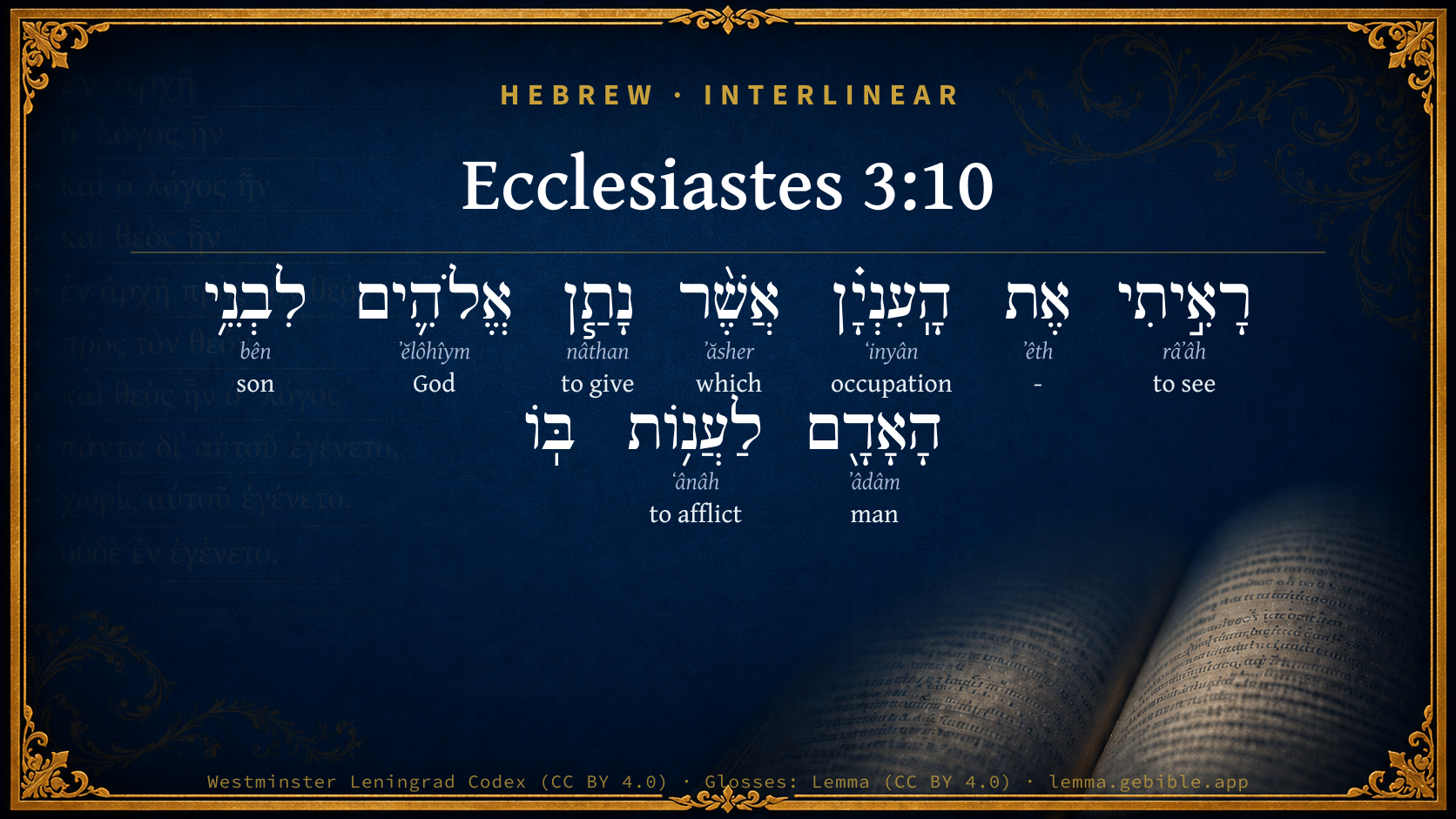
Ecclesiastes 3:10

Hebrew (Westminster Leningrad Codex) Ecclesiastes 3:10 appears in the Hebrew Old Testament. The text above is from the Westminster Leningrad Codex. Each word links to its Strong’s number, a concise gloss, and parsing drawn from the Open Scriptures Hebrew Bible morphology. Click any word for its full Brown-Driver-Briggs (BDB) entry.
Download image
Cite this verse

Ecclesiastes 3:10 (World English Bible). Public Domain. Lemma interlinear Bible study tool, https://lemma.gebible.app/v/ecclesiastes/3/10.

Show BibTeX & RIS
BibTeX
RIS
English Translation
I have seen the burden which God has given to the sons of men to be afflicted with.
World English Bible · Public Domain
Download a study sheet

One document with this verse’s original text, its word-by-word gloss line, the meaning frame, cross-references with their text, attributed commentary, and full source and license credits — printable, and it pastes into notes with its structure intact.

This verse Autodidact and up

Study sheet (.html) Plain text (.txt)

A passage Seminary Student

Up to 50 verses in one chapter. A passage sheet keeps up to 6 commentary sources and 12 cross-references per verse, in the order this page ranks them, and says so on the sheet whenever that leaves anything out. Ask for a single verse and you get the Autodidact verse sheet above.

Everything on this page stays free to read, with no account — the sheet is a download of what is already on screen, not access to it.

Want to remove ads? Support Godless Engineer
Compare translations 3

The same verse in 3 English versions, stacked beneath the original-language interlinear above. Click any original word for its lexicon entry.

Each is an independent rendering of the whole verse — the interlinear is not word-aligned to these translations.

Highlighted words mark where these versions differ — a whole-verse word diff, not a word-by-word alignment.

  • World English Bible Public Domain
    I have seen the burden which God has given to the sons of men to be afflicted with.
  • King James Version Public Domain
    I have seen the travail, which God hath given to the sons of men to be exercised in it.
  • unfoldingWord Literal Text CC BY-SA 4.0
    I saw the business that God gives to the sons of humanity to be busy with it.

unfoldingWord Literal Text — © unfoldingWord, licensed CC BY-SA 4.0. Word-aligned USFM3 via Door43 (git.door43.org/unfoldingWord/en_ult).

Versions to compare (up to 4)

3 of 4 selected

Show all 18 translations

Every available English version of this verse, each an independent rendering of the whole verse.

  • World English Bible Public Domain
    I have seen the burden which God has given to the sons of men to be afflicted with.
  • Berean Standard Bible Public Domain
    I have seen the burden that God has laid upon the sons of men to occupy them.
  • Majority Standard Bible Public Domain
    I have seen the burden that God has laid upon the sons of men to occupy them.
  • King James Version Public Domain
    I have seen the travail, which God hath given to the sons of men to be exercised in it.
  • American Standard Version (1901) Public Domain
    I have seen the travail which God hath given to the sons of men to be exercised therewith.
  • Revised Version (1885) Public Domain
    I have seen the travail which God hath given to the sons of men to be exercised therewith.
  • Geneva Bible (1599) Public Domain
    I haue seene the trauaile that God hath giuen to ye sonnes of men to humble them thereby.
  • Douay-Rheims (1899) Public Domain
    I have seen the trouble, which God hath given the sons of men to be exercised in it.
  • Young's Literal Translation Public Domain
    I have seen the travail that God hath given to the sons of man to be humbled by it.
  • Literal Standard Version CC BY-SA 4.0
    I have seen the travail that God has given to the sons of man to be humbled by it.
  • Unlocked Literal Bible CC BY-SA 4.0
    I have seen the work that God has given to human beings to complete.
  • unfoldingWord Literal Text CC BY-SA 4.0
    I saw the business that God gives to the sons of humanity to be busy with it.
  • Darby Bible Public Domain
    I have seen the travail that God hath given to the sons of men to toil in.
  • World Messianic Bible Public Domain
    I have seen the burden which God has given to the sons of men to be afflicted with.
  • Webster's Bible Public Domain
    I have seen the labor, which God hath given to the sons of men to be exercised in it.
  • Free Bible Version CC BY-SA 4.0
    I have examined what God gives us to do.
  • Bible in Basic English Public Domain
    I saw the work which God has put on the sons of man.
  • JPS Tanakh (1917) Public Domain
    I have seen the task which God hath given to the sons of men to be exercised therewith.

Literal Standard Version (2020), Covenant Press — licensed CC BY-SA 4.0. Text via the HelloAO Bible API (eBible.org). Unlocked Literal Bible (unfoldingWord) — licensed CC BY-SA 4.0. Text via the HelloAO Bible API (eBible.org). unfoldingWord Literal Text — © unfoldingWord, licensed CC BY-SA 4.0. Word-aligned USFM3 via Door43 (git.door43.org/unfoldingWord/en_ult). Free Bible Version, Dr. Jonathan Gallagher — licensed CC BY-SA 4.0. Text via the HelloAO Bible API (eBible.org).

Word by word

More ways to search: Search by grammar → Find every occurrence → Compare this word →

Practice this passage: Drill this verse → Learn its vocabulary →

הָֽעִנְיָ֗ן
ʻinyân
H6045
“the · occupation”
Particle, Definite Article + Noun, Common, Masculine, Singular, Absolute
Part of Speech
Particle + Noun
Type
Common
Gender
Masculine
Number
Singular
State
Absolute
Full BDB Definition

Origin: from H6031

TWOT: 1651a

occupation, task, job
  1. רָאִ֣יתִי râʼâh H7200 “to see” Verb, Qal, Perfect, 1st Person, Common, Singular
  2. אֶת ʼêth H853 “-” Particle, Direct Object
  3. אֲשֶׁ֨ר ʼăsher H834 “which” Particle, Relative
  4. נָתַ֧ן nâthan H5414 “to give” Verb, Qal, Perfect, 3rd Person, Masculine, Singular
  5. אֱלֹהִ֛ים ʼĕlôhîym H430 “God(s)” Noun, Common, Masculine, Plural, Absolute
  6. לִבְנֵ֥י bên H1121 “to/for · sons of” Preposition + Noun, Common, Masculine, Plural, Construct
  7. הָאָדָ֖ם ʼâdâm H120 “the · man” Particle, Definite Article + Noun, Common, Masculine, Singular, Absolute
  8. לַעֲנ֥וֹת ʻânâh H6031 “to afflict” Preposition + Verb, Qal, Infinitive Construct

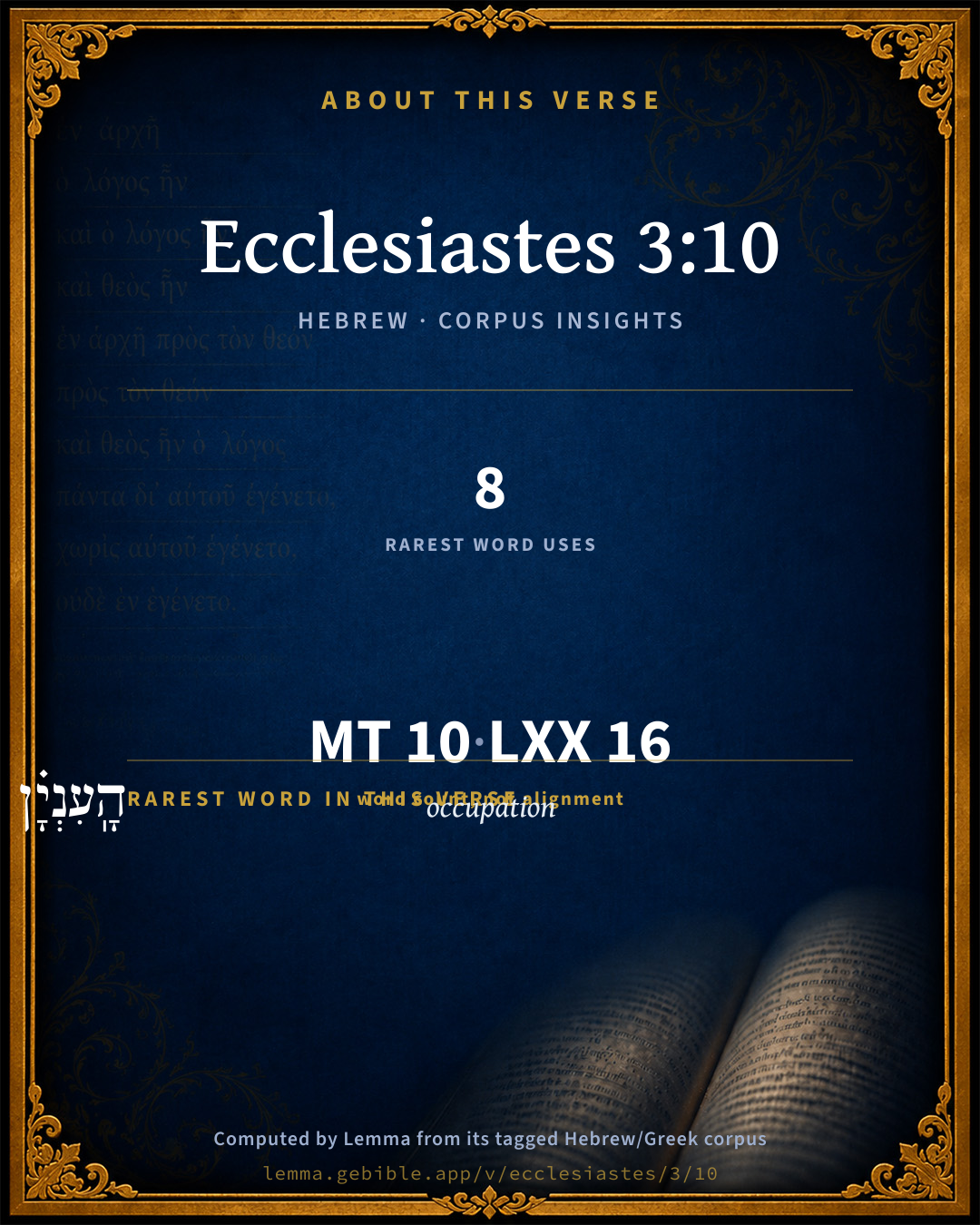
About this verse

These counts appear in no published source. They are computed here, from the morphology-tagged text and Lemma’s own curated glosses. What Lemma adds →

10
words
9
distinct lemmas
Wisdom
section

Notable vocabulary

The rarest word here is הָֽעִנְיָ֗ן occupation H6045 — appearing just 8 times in the whole Hebrew Bible.

Shared distinctive vocabulary

הָֽעִנְיָ֗ן occupation H6045 occurs in 8 verses of the Hebrew Bible. Also found in:

Grammatical profile

  • 3 verbs
  • 4 nouns
  • 1 preposition
  • 2 particles

Verb forms

  • רָאִ֣יתִי Qal · Perfect
  • נָתַ֧ן Qal · Perfect
  • לַעֲנ֥וֹת Qal · Infinitive Construct

Hebrew & Septuagint length

In English translation the verse runs 18 words from the Hebrew and 19 from the Septuagint (LXX English) — closely comparable.

A rough comparison of the two English renderings, which tokenize alike — not a word-level alignment.

Word counts can differ between the Hebrew and the Greek without any difference in meaning — e.g. the Hebrew direct-object marker אֵת has no separate Greek word, and Greek often adds the article ὁ.

In the original languages it is 10 Hebrew tokens and 16 Greek tokens — but the two are counted differently (Hebrew bundles its prefixes and suffixes into one token; the Greek is in lemma form), so that isn’t a like-for-like length.

Cross-references

5

Topical passages linked to Ecclesiastes 3:10 in the Treasury of Scripture Knowledge — connected by theme and wording, ordered by reader-vote popularity; previews shown in the World English Bible.

  • Ecclesiastes 1:13–14 I applied my heart to seek and to search out by wisdom concerning all that is done under the sky. It is a heavy burden that God has given to the sons of men to be afflicted with.
  • Genesis 3:19 By the sweat of your face will you eat bread until you return to the ground, for out of it you were taken. For you are dust, and to dust you shall return."
  • Ecclesiastes 2:26 For to the man who pleases him, God gives wisdom, knowledge, and joy; but to the sinner he gives travail, to gather and to heap up, that he may give to him who pleases God. This also is vanity and a chasing after wind.
  • 1 Thessalonians 2:9 For you remember, brothers, our labor and travail; for working night and day, that we might not burden any of you, we preached to you the Gospel of God.
  • 2 Thessalonians 3:8 neither did we eat bread from anyone's hand without paying for it, but in labor and travail worked night and day, that we might not burden any of you;

Cross-references courtesy of OpenBible.info (CC BY 4.0).

Hebrew and Greek witnesses Masoretic Hebrew ↔ Greek Septuagint

The same verse in the two great witnesses to the Old Testament, shown verse-for-verse.

These are two independent witnesses, not word-aligned to each other, and the Septuagint is shown in lemma (dictionary) form.

Hebrew Ecclesiastes 3:10 Masoretic · Westminster Leningrad Codex

רָאִ֣יתִי אֶת הָֽעִנְיָ֗ן אֲשֶׁ֨ר נָתַ֧ן אֱלֹהִ֛ים לִבְנֵ֥י הָאָדָ֖ם לַעֲנ֥וֹת בּֽוֹ

I have seen the burden which God has given to the sons of men to be afflicted with.

World English Bible · Public Domain

Greek LXX Ecclesiastes 3:10 Septuagint · lemma form

ὁράω σύν ὁ περισπασμός ὅς δίδωμι ὁ θεός ὁ υἱός ὁ ἄνθρωπος ὁ περισπάω ἐν αὐτός

I have seen all the trouble, which God has given to the sons of men to be troubled with.

LXX2012 (modern English Septuagint) · Public Domain

Hebrew: Westminster Leningrad Codex (CC BY 4.0). Greek: Septuagint (public domain); English from LXX2012 (modern English Septuagint) (Public Domain). How the Septuagint differs from the Hebrew →

Commentary

Notes on Ecclesiastes 3:10 from classic Christian and Jewish commentators (each source and its license shown beneath its notes). The classic Christian expositions comment on the surrounding passage and are grouped to its opening verse, so a note may address several verses; the Jewish commentaries on the Tanakh (Rashi and others) are per-verse, so they appear only where the commentator wrote on this verse.

Lemma curates 59 commentaries, every one of them public domain or Creative Commons licensed, each selected and text-cleaned for this edition rather than reprinted as found. About our sources →

Trapp's Complete Commentary

John Trapp

Ecc 3:10 I have seen the travail, which God hath given to the sons of men to be exercised in it.

Ver. 10. I have seen the travail that God, &c.] Not fortune, but Providence ordereth all cross occurrences; "a wheel" there is "within a wheel"; {Eze 1:1-28} then when men may think things run on wheels, at sixes and sevens, as they say. "Humble yourselves under the mighty hand of God." {1Pe 5:6} His holy hand hath a special stroke in all our travails. He both ordaineth {Act 2:1-47} and ordereth all, {Gen 1:20} altering the property, {Rom 8:28} and disposing them to good, raising profit from all. Thus men afflicted Job for covetousness, the devil for malice, {Ecc 1:15-16} God, for trial and exercise of his graces. "To be exercised therein," saith the text, or, as the word signifieth, to be "humbled therewith," to "hide pride from man," {Job 33:17} to tame and take him a link lower. "Their hearts are brought down," saith the prophet; "they speak out of the ground," {Isa 29:4} that erst set their mouths against heaven, and said, "I am, and besides me there is none."

John Trapp, A Commentary or Exposition upon All the Books of the Old and New Testament (1647–1656) — public domain. Text from a community e-Sword module.

Joseph Benson's Commentary

Ecc 3:10. I have seen the travail, &c. — I have diligently observed men’s various employments, and the different successes of them. Which God hath given, &c. — Which God hath imposed upon men as their duty; to which therefore men ought quietly to submit. To be exercised — That hereby they might have constant matter of exercise for their diligence, and patience, and submission to God’s will and providence.

Joseph Benson's Commentary on the Old and New Testaments (1811–1818) — public domain. Text from a community e-Sword module.

Keil & Delitzsch

C. F. Keil & F. Delitzsch

"I saw the travail, which God gave to the children of men to fatigue themselves with it - : He hath well arranged everything beautiful in its appointed time; He hath also put eternity in their heart, so that man cannot indeed wholly search through from beginning to end the work which God accomplisheth." As at Ecc 1:14, ראיתי is here seeing in the way of research, as elsewhere, e.g., at Ecc 2:24, it is as the result of research. In Ecc 3:10 the author says that he closely considered the labour of men, and in Ecc 3:11 he states the result. It is impossible to render the word ענין everywhere by the same German (or English) word: Ecc 1:13, wearisome trouble; Ecc 2:26, business; here: Geschftigkeit, the idea is in all the three places the same, viz., an occupation which causes trouble, costs effort. What presented itself to the beholder was (1) that He (viz., God, cf. Ecc 3:10 and Ecc 3:11) has made everything beautiful in its time. The author uses יפה as synon. of טוב (Ecc 3:17); also in other languages the idea of the beautiful is gradually more and more generalized. The suffix in בּעתּו does not refer to God, but to that which is in the time; this word is = ἐν καιρῷ ιδίῳ (Symm.), at its proper time (vid., Psa 1:3; Psa 104:27; Jer 5:24, etc.), since, as with יחדּו (together with) and כּלּו (every one), the suffix is no longer thought of as such. Like יפה, בעתו as pred. conception belongs to the verb: He has made everything beautiful; He has made everything (falling out) at its appointed time. - The beauty consists in this, that what is done is not done sooner or later than it ought to be, so as to connect itself as a constituent part to the whole of God's work. The pret. עשׂה is to be also interpreted as such: He "has made," viz., in His world-plan, all things beautiful, falling out at the appointed time; for that which acquires an actual form in the course of history has a previous ideal existence in the knowledge and will of God (vid., under Isa 22:11; Isa 37:26).

That which presented itself to the beholder was - (2) the fact that He (God) had put את־העלם in their hearts (i.e., the hearts of men). Gaab and Spohn interpret 'olam in the sense of the Arab. 'ilam, knowledge, understanding; and Hitz., pointing the word accordingly עלם, translates: "He has also placed understanding in their heart, without which man," etc. The translation of אשׁר אשׁלי is not to be objected to; מבּ is, however, only seldom a conjunction, and is then to be translated by eo quod, Exo 14:11; Kg2 1:3, Kg2 1:6, Kg2 1:16, which is not appropriate here; it will thus be here also a prep., and with asher following may mean "without which," as well as "without this, that" = "besides that" (Venet. ἄνευ τοῦ ὃτι, "except that"), as frequently כּי אפס, e.g., at Amo 9:8. But that Arab. 'ilam is quite foreign to the Heb., which has no word עלם in the sense of "to rise up, to be visible, knowable," which is now also referred

(Note: Vid., Fried. Delitzsch's Assyr. Stud. (1874), p. 39. Otherwise Fleischer, who connects 'alima, "to know," with 'alam, "to conceal," so that to know = to be concealed, sunk deep, initiated in something (with ba of the obj., as sh'ar, whence shâ'ir, the poet as "one who marks").)

to for the Assyr. as the stem-word of עילם = highland. It is true Hitzig believes that he has found the Heb. עלם = wisdom, in Sir. 6:21, where there is a play on the word with נעלם, "concealed:" σοφία γὰρ κατὰ τὸ ὄνομα αὐτῆς ἐστί, καὶοὐ πολλοῖς ἐστὶ φανερά. Drusius and Eichhorn have here already taken notice of the Arab. 'ilam; but Fritzsche with right asks, "Shall this word as Heb. be regarded as traceable only here and falsely pointed only at Ecc 3:11, and shall no trace of it whatever be found in the Chald., Syr., and Rabbin.?" We have also no need of it. That Ben-Sira has etymologically investigated the word חכמה as going back to חכם, R. chap, "to be firm, shut up, dark" (vid., at Psa 10:8), is certainly very improbable, but so much the more probable (as already suggested by Drusius) that he has introduced

(Note: Grtz translates eth-ha'olam by "ignorance" (vid., Orelli, p. 83). R. Achwa in the Midrash has added here the scriptio defectiva with the remark, שהועלם וגו, "for the mysterious name of God is concealed from them.")

into חכמה, after the Aram. אכם, nigrescere, the idea of making dark. Does eth-ha'olam in this passage before us then mean "the world" (Jerome, Luther, Ewald), or "desire after the knowledge of the world" (Rashi), or "worldly-mindedness" (Gesen., Knobel)? The answer to this has been already given in my Psychol. p. 406 (2nd ed.): "In post-bibl. Heb. 'olam denotes not only 'eternity' backwards and forwards as infinite duration, but also 'the world' as that which endures for ever (αἰών, seculum); the world in this latter sense is, however, not yet known

(Note: In the Phoen. also, 'olam, down to a late period, denotes not the world, but eternity: melek 'olam, βασιλεὺς αἰώνος (αἰώνιος), seculo frugifero on a coin = the fruit-bringing 'olam (Αἰών).)

to the bibl. language, and we will thus not be able to interpret the words of Koheleth of the impulse of man to reflect on the whole world." In itself, the thought that God has placed the whole world in man's heart is not untrue: man is, indeed, a micro-cosmos, in which the macrocosmos mirrors itself (Elster), but the connection does not favour it; for the discussion does not proceed from this, that man is only a member in the great universe, and that God has given to each being its appointed place, but that in all his experience he is conditioned by time, and that in the course of history all that comes to him, according to God's world-plan, happens at its appointed time. But the idea by which that of time, את (זמן), is surpassed is not the world, but eternity, to which time is related as part is to the whole (Cicero, Inv. i. 26. 39, tempus est pars quaedam aeternitatis). The Mishna language contains, along with the meaning of world, also this older meaning of 'olam, and has formed from it an adv. עולמית, aeterne. The author means to say that God has not only assigned to each individually his appointed place in history, thereby bringing to the consciousness of man the fact of his being conditioned, but that He has also established in man an impulse leading him beyond that which is temporal toward the eternal: it lies in his nature not to be contented with the temporal, but to break through the limits which it draws around him, to escape from the bondage and the disquietude within which he is held, and amid the ceaseless changes of time to console himself by directing his thoughts to eternity.

This saying regarding the desiderium aeternitatis being planted in the heart of man, is one of the profoundest utterances of Koheleth. In fact, the impulse of man shows that his innermost wants cannot be satisfied by that which is temporal. He is a being limited by time, but as to his innermost nature he is related to eternity. That which is transient yields him no support, it carries him on like a rushing stream, and constrains him to save himself by laying hold on eternity. But it is not so much the practical as the intellectual side of this endowment and this peculiar dignity of human nature which Koheleth brings her to view.

It is not enough for man to know that everything that happens has its divinely-ordained time. There is an instinct peculiar to his nature impelling him to pass beyond this fragmentary knowledge and to comprehend eternity; but his effort is in vain, for (3) "man is unable to reach unto the work which God accomplisheth from the beginning to the end." The work of God is that which is completing itself in the history of the world, of which the life of individual men is a fragment. Of this work he says, that God has wrought it עשׂה; because, before it is wrought out in its separate "time," it is already completed in God's plan. Eternity and this work are related to each other as the accomplished and the being accomplished, they are interchangeably the πλήρωμα to each other. ימצא is potential, and the same in conception as at Ecc 8:17; Job 11:7; Job 37:23; a knowledge is meant which reaches to the object, and lays hold of it. A laying hold of this work is an impossibility, because eternity, as its name 'olam denotes, is the concealed, i.e., is both forwards and backwards immeasurable. The desiderium aeternitatis inherent in man thus remains under the sun unappeased. He would raise himself above the limits within which he is confined, and instead of being under the necessity of limiting his attention to isolated matters, gain a view of the whole of God's work which becomes manifest in time; but this all-embracing view is for him unattainable.

If Koheleth had known of a future life - which proves that as no instinct in the natural world is an allusion, so also the impulse toward the eternal, which is natural to man, is no illusion-he would have reached a better ultimatum than the following: -

Keil & Delitzsch — Biblical Commentary on the Old Testament (1861–1891) — public domain (CC PDM 1.0). Text via the HelloAO Bible API. (Old Testament only.)

Tyndale Open Study Notes

Tyndale Open Resources

3:10 the burden God has placed on us all: God intensified the severity of our labor following humankind’s rebellion against him (Gen 3:17-19). This burden is not so great that we cannot enjoy our work and its fruits (Eccl 3:11-13).

Tyndale Open Study Notes — © Tyndale Open Resources, licensed CC BY-SA 4.0. Text via the HelloAO Bible API.

Geneva Bible (1599)

Geneva Bible translators

Read Eccl. 1:13.

Geneva Bible (1599) marginal notes — public domain. Text via Bolls.life.

Jamieson, Fausset & Brown

Robert Jamieson, A. R. Fausset & David Brown

(See on Ecc 1:13).

Jamieson, Fausset & Brown — Commentary Critical and Explanatory on the Whole Bible (1871) — public domain (CC PDM 1.0). Text via the HelloAO Bible API.

Adam Clarke's Commentary

Verse 10. I have seen the travail] Man is a sinner; and, because he is such, he suffers.

Adam Clarke's Commentary on the Bible (1810–1826) — public domain. Text from a community e-Sword/MySword module.

The Cambridge Bible for Schools and Colleges

gen. ed. J. J. S. Perowne

10. I have seen the travail, which God hath given] Better perhaps, I have seen the labour, or the business. As before, in the preceding verse, the thinker, once back in the old groove of thought, repeats himself, and we have the very words of ch. Ecc_1:13, but, as before, here also developed by a wider experience. In this feeling after the right “season” for each act, this craving for a harmony between man’s will and the divine order, he recognises a divinely implanted instinct which yet finds no full satisfaction.

The Cambridge Bible for Schools and Colleges (gen. ed. J. J. S. Perowne; Cambridge University Press, 1878–1918) — public domain. Text from a community e-Sword module.

John Gill's Exposition

I have seen the travail which God hath given to the sons of men,.... The pains and trouble they are at to get a little wisdom and knowledge, Ecc 1:13; and so to obtain riches and honour, peace and plenty, which sometimes they do obtain, and sometimes not; and when they do, do not keep them long, for there is a time for everything. This the wise man had observed, in a variety of instances; and he considered the end of God in it, which was for men

to be exercised in it, or "by it"; or "to afflict" or "humble them by it" (l); to let them see that all their toil and labour signified little; all depended on a divine blessing, and no happiness was to be had in the creatures; all was vanity and vexation of spirit; See Gill on Ecc 1:13.

(l) "ad affligendum se in ea", Montanus; "ut eos adfligat in ea, sc. per eam", Rambachius; "ut ea redderet humiles", Tigurine version.

John Gill's Exposition of the Whole Bible (1746–1763) — public domain (CC PDM 1.0). Text via the HelloAO Bible API.

Matthew Poole's English Annotations

I have seen, I have diligently observed and considered upon this occasion,

the travail, or the occupation or business, men’s various employments, and the differing successes of them,

which God hath given to the sons of men; either,

1. Which God hath imposed upon men as their duty; and therefore men must labour, although it brings them no profit, as was now said. Or,

2. Which God hath inflicted upon mankind as a just punishment for their sins; to which therefore men ought quietly to submit.

To be exercised in it; that hereby they might have constant matter of exercise for their diligence, and patience, and submission to God’s will and providence, and for all other graces. Or, that they might be afflicted or humbled therewith, as the same phrase is rendered by divers, Ecc 1:13.

Matthew Poole's English Annotations on the Holy Bible (1683–1685) — public domain. Text from a community e-Sword/MySword module.

Whedon's Commentary on the Bible

Daniel D. Whedon

10. I have seen the travail — This verse is preliminary to the next. Koheleth states his qualification to form the judgment there given. He has carefully scanned the various employments of men, the “travail “or business which it has pleased God to assign to each for his earthly occupation.

Daniel D. Whedon (gen. ed.), Commentary on the Old and New Testaments (1874–1909) — public domain. Text from a community e-Sword module.

The Pulpit Commentary

Vers. 10-15. There is a plan and system in all the circumstances of man"s life; he feels this instinctively, but he cannot comprehend it. His duty is to make the best of the present, and to recognize the immutability of the law that governs all things.

I have seen the travail which God hath given to the sons of men to be exercised in it; i.e. to busy themselves therewith. (Ecc_1:13) This travail, exercise, or business is the work that has to be done under the conditions prescribed of time and season in face of the difficulty of man"s free action and God"s ordering. We take infinite pains, we entertain ample desires, and strive restlessly to carry them out, but our efforts are controlled by a higher law, and results occur in the way and at the time arranged by Providence. Human labor, though it is appointed by God and is part of man"s heritage imposed upon him by the, (Gen_3:17, etc.) cannot bring contentment or satisfy the spirit"s cravings.

The Pulpit Commentary (1880–1919), ed. H.D.M. Spence-Jones & Joseph S. Exell — public domain. Text from a community e-Sword module.

John Wesley's Explanatory Notes

Seen - I have diligently observed mens various employments, and the different successes of them. Hath given - Which God hath imposed upon men as their duty; to which therefore men ought quickly to submit. Exercised - That hereby they might have constant matter of exercise for their diligence, and patience, and submission to God's will and providence.

John Wesley, Explanatory Notes Upon the Whole Bible (1754–1765) — public domain. Text via the GEBible commentary corpus.

Rashi

Rabbi Shlomo Yitzchaki (Rashi)

the occupation Heb. הָעִנְיָן, the behavior.

to occupy themselves Heb. לַעֲנוֹת, to behave.

Rashi on the Tanakh — English translations: “The Judaica Press complete Tanach with Rashi, translated by A. J. Rosenberg” (CC BY 4.0); “Pentateuch with Rashi's commentary by M. Rosenbaum and A.M. Silbermann, 1929-1934” (public domain); “The Metsudah Tanach series, Lakewood, N.J” (CC BY 4.0); and “The Book of Joshua, Metsudah Publications, 1997” (CC BY 4.0). Text via Sefaria.

Lesson kit

Teaching starters — assembled from the data on this page, not authored interpretation. Every prompt links to the verse data it draws on. Edit before teaching.

Ecclesiastes, in the Wisdom, opens this verse with 10 words (9 distinct Hebrew lemmas). Its most distinctive word is ʻinyân (“occupation”). A historical commentator’s framing appears above. Read the whole chapter for the surrounding context.

Discussion questions

  1. How does “occupation” (ʻinyân) shape what this verse is saying?
  2. Ecclesiastes 1:13 shares the word «occupation» with this verse. How do the two illuminate each other?
  3. These translations render this verse differently. What is at stake in choosing one wording over another?
  4. The verb «רָאִ֣יתִי» is Qal Perfect. How does its form color the action?
  5. Reading how Trapp's Complete Commentary and Joseph Benson's Commentary read this verse, where do the two commentators agree and where do they part?

Things to notice

Reading settings

Reading text

Shown beneath each verse's original-language words.

Old Testament
Old Testament edition

Read the OT as the Masoretic Hebrew (MT) or the Greek Septuagint (LXX).

English shown for the Greek Septuagint (in the Hebrew ↔ Greek comparison).

Comparing translations? Open the Compare panel on any verse page to stack up to four side by side.