Deuteronomy 3:6

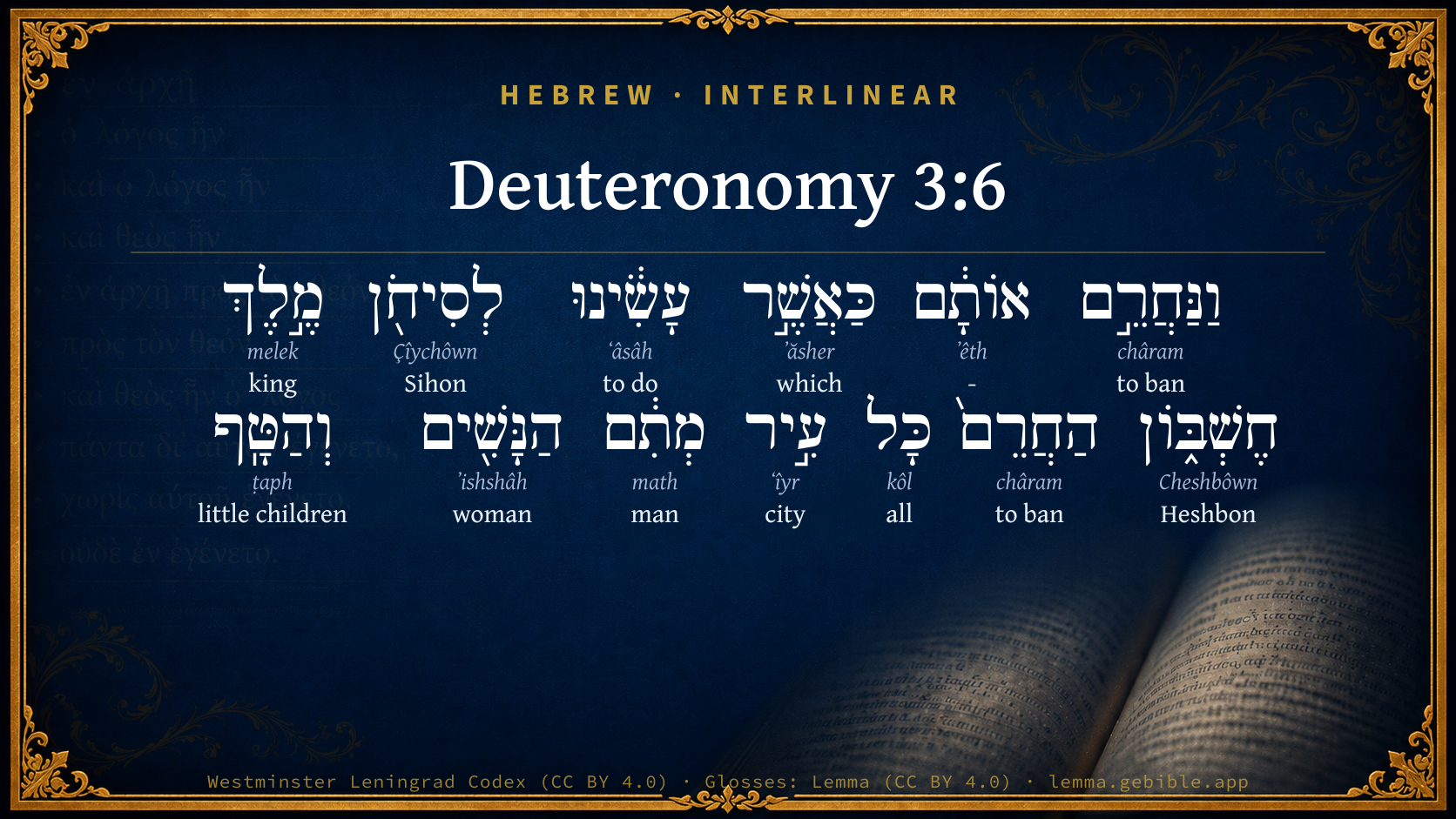
Hebrew (Westminster Leningrad Codex) Deuteronomy 3:6 appears in the Hebrew Old Testament. The text above is from the Westminster Leningrad Codex. Each word links to its Strong’s number, a concise gloss, and parsing drawn from the Open Scriptures Hebrew Bible morphology. Click any word for its full Brown-Driver-Briggs (BDB) entry.
Download image
Cite this verse

Deuteronomy 3:6 (World English Bible). Public Domain. Lemma interlinear Bible study tool, https://lemma.gebible.app/v/deuteronomy/3/6.

Show BibTeX & RIS
BibTeX
RIS
English Translation
We utterly destroyed them, as we did to Sihon king of Heshbon, utterly destroying every inhabited city, with the women and the little ones.
World English Bible · Public Domain
Download a study sheet

One document with this verse’s original text, its word-by-word gloss line, the meaning frame, cross-references with their text, attributed commentary, and full source and license credits — printable, and it pastes into notes with its structure intact.

This verse Autodidact and up

Study sheet (.html) Plain text (.txt)

A passage Seminary Student

Up to 50 verses in one chapter. A passage sheet keeps up to 6 commentary sources and 12 cross-references per verse, in the order this page ranks them, and says so on the sheet whenever that leaves anything out. Ask for a single verse and you get the Autodidact verse sheet above.

Everything on this page stays free to read, with no account — the sheet is a download of what is already on screen, not access to it.

Want to remove ads? Support Godless Engineer
Compare translations 3

The same verse in 3 English versions, stacked beneath the original-language interlinear above. Click any original word for its lexicon entry.

Each is an independent rendering of the whole verse — the interlinear is not word-aligned to these translations.

Highlighted words mark where these versions differ — a whole-verse word diff, not a word-by-word alignment.

  • World English Bible Public Domain
    We utterly destroyed them, as we did to Sihon king of Heshbon, utterly destroying every inhabited city, with the women and the little ones.
  • King James Version Public Domain
    And we utterly destroyed them, as we did unto Sihon king of Heshbon, utterly destroying the men, women, and children, of every city.
  • unfoldingWord Literal Text CC BY-SA 4.0
    And we devoted them, as we did to Sihon, king of Heshbon, devoting every city, men, the women, and the children.

unfoldingWord Literal Text — © unfoldingWord, licensed CC BY-SA 4.0. Word-aligned USFM3 via Door43 (git.door43.org/unfoldingWord/en_ult).

Versions to compare (up to 4)

3 of 4 selected

Show all 18 translations

Every available English version of this verse, each an independent rendering of the whole verse.

  • World English Bible Public Domain
    We utterly destroyed them, as we did to Sihon king of Heshbon, utterly destroying every inhabited city, with the women and the little ones.
  • Berean Standard Bible Public Domain
    We devoted them to destruction, as we had done to Sihon king of Heshbon, utterly destroying the men, women, and children of every city.
  • Majority Standard Bible Public Domain
    We devoted them to destruction, as we had done to Sihon king of Heshbon, utterly destroying the men, women, and children of every city.
  • King James Version Public Domain
    And we utterly destroyed them, as we did unto Sihon king of Heshbon, utterly destroying the men, women, and children, of every city.
  • American Standard Version (1901) Public Domain
    And we utterly destroyed them, as we did unto Sihon king of Heshbon, utterly destroying every inhabited city, with the women and the little ones.
  • Revised Version (1885) Public Domain
    And we utterly destroyed them, as we did unto Sihon king of Heshbon, utterly destroying every inhabited city, with the women and the little ones.
  • Geneva Bible (1599) Public Domain
    And we ouerthrewe them, as we did vnto Sihon King of Heshbon, destroying euery citie, with men, women, and children.
  • Douay-Rheims (1899) Public Domain
    And we utterly destroyed them, as we had done to Sehon the king of Hesebon, destroying every city, men and women and children:
  • Young's Literal Translation Public Domain
    and we devote them, as we have done to Sihon king of Heshbon, devoting every city, men, the women, and the infants;
  • Literal Standard Version CC BY-SA 4.0
    and we devote them, as we have done to Sihon king of Heshbon, devoting [the] men, the women, and the infants of every city;
  • Unlocked Literal Bible CC BY-SA 4.0
    We completely destroyed them, as we did to Sihon king of Heshbon, completely destroying every city—men and the women and the little ones.
  • unfoldingWord Literal Text CC BY-SA 4.0
    And we devoted them, as we did to Sihon, king of Heshbon, devoting every city, men, the women, and the children.
  • Darby Bible Public Domain
    And we utterly destroyed them, as we had done to Sihon the king of Heshbon, utterly destroying every city, men, women and little ones.
  • World Messianic Bible Public Domain
    We utterly destroyed them, as we did to Sihon king of Heshbon, utterly destroying every inhabited city, with the women and the little ones.
  • Webster's Bible Public Domain
    And we utterly destroyed them, as we did to Sihon king of Heshbon, utterly destroying the men, women, and children of every city.
  • Free Bible Version CC BY-SA 4.0
    We set them apart for destruction, just as we did to Sihon, king of Heshbon, killing all the men, women, and children of every city.
  • Bible in Basic English Public Domain
    And we put them to the curse, every town together with men, women, and children.
  • JPS Tanakh (1917) Public Domain
    And we utterly destroyed them, as we did unto Sihon king of Heshbon, utterly destroying every city, the men, and the women, and the little ones.

Literal Standard Version (2020), Covenant Press — licensed CC BY-SA 4.0. Text via the HelloAO Bible API (eBible.org). Unlocked Literal Bible (unfoldingWord) — licensed CC BY-SA 4.0. Text via the HelloAO Bible API (eBible.org). unfoldingWord Literal Text — © unfoldingWord, licensed CC BY-SA 4.0. Word-aligned USFM3 via Door43 (git.door43.org/unfoldingWord/en_ult). Free Bible Version, Dr. Jonathan Gallagher — licensed CC BY-SA 4.0. Text via the HelloAO Bible API (eBible.org).

Word by word

More ways to search: Search by grammar → Find every occurrence → Compare this word →

Practice this passage: Drill this verse → Learn its vocabulary →

מְתִ֔ם
math
H4962
“men”
Noun, Common, Masculine, Plural, Absolute
Part of Speech
Noun
Type
Common
Gender
Masculine
Number
Plural
State
Absolute
Full BDB Definition

Origin: from the same as H4970

TWOT: 1263

male, man - males, men - few men (in prose) - less emphasis on sex - men (poetic) - less emphasis on sex
  1. וַנַּחֲרֵ֣ם châram H2763 “and · to ban” Conjunction + Verb, Hiphil, Sequential Imperfect, 1st Person, Common, Plural
  2. אוֹתָ֔ם ʼêth H853 “- · them” Particle, Direct Object + Suffix, Personal, 3rd Person, Masculine, Plural
  3. כַּאֲשֶׁ֣ר ʼăsher H834 “like/as · which” Preposition + Particle, Relative
  4. עָשִׂ֔ינוּ ʻâsâh H6213 “to do” Verb, Qal, Perfect, 1st Person, Common, Plural
  5. לְסִיחֹ֖ן Çîychôwn H5511 “to/for · Sihon” Preposition + Noun, Proper
  6. מֶ֣לֶךְ melek H4428 “king of” Noun, Common, Masculine, Singular, Construct
  7. חֶשְׁבּ֑וֹן Cheshbôwn H2809 “Heshbon” Noun, Proper
  8. הַחֲרֵם֙ châram H2763 “to ban” Verb, Hiphil, Infinitive Absolute
  9. כָּל kôl H3605 “all of” Noun, Common, Masculine, Singular, Construct
  10. עִ֣יר ʻîyr H5892 “city” Noun, Common, Feminine, Singular, Absolute
  11. הַנָּשִׁ֖ים ʼishshâh H802 “the · women” Particle, Definite Article + Noun, Common, Feminine, Plural, Absolute
  12. וְהַטָּֽף ṭaph H2945 “and · the · little children” Conjunction + Particle, Definite Article + Noun, Common, Masculine, Singular, Absolute

About this verse

These counts appear in no published source. They are computed here, from the morphology-tagged text and Lemma’s own curated glosses. What Lemma adds →

13
words
12
distinct lemmas
Pentateuch
section

Notable vocabulary

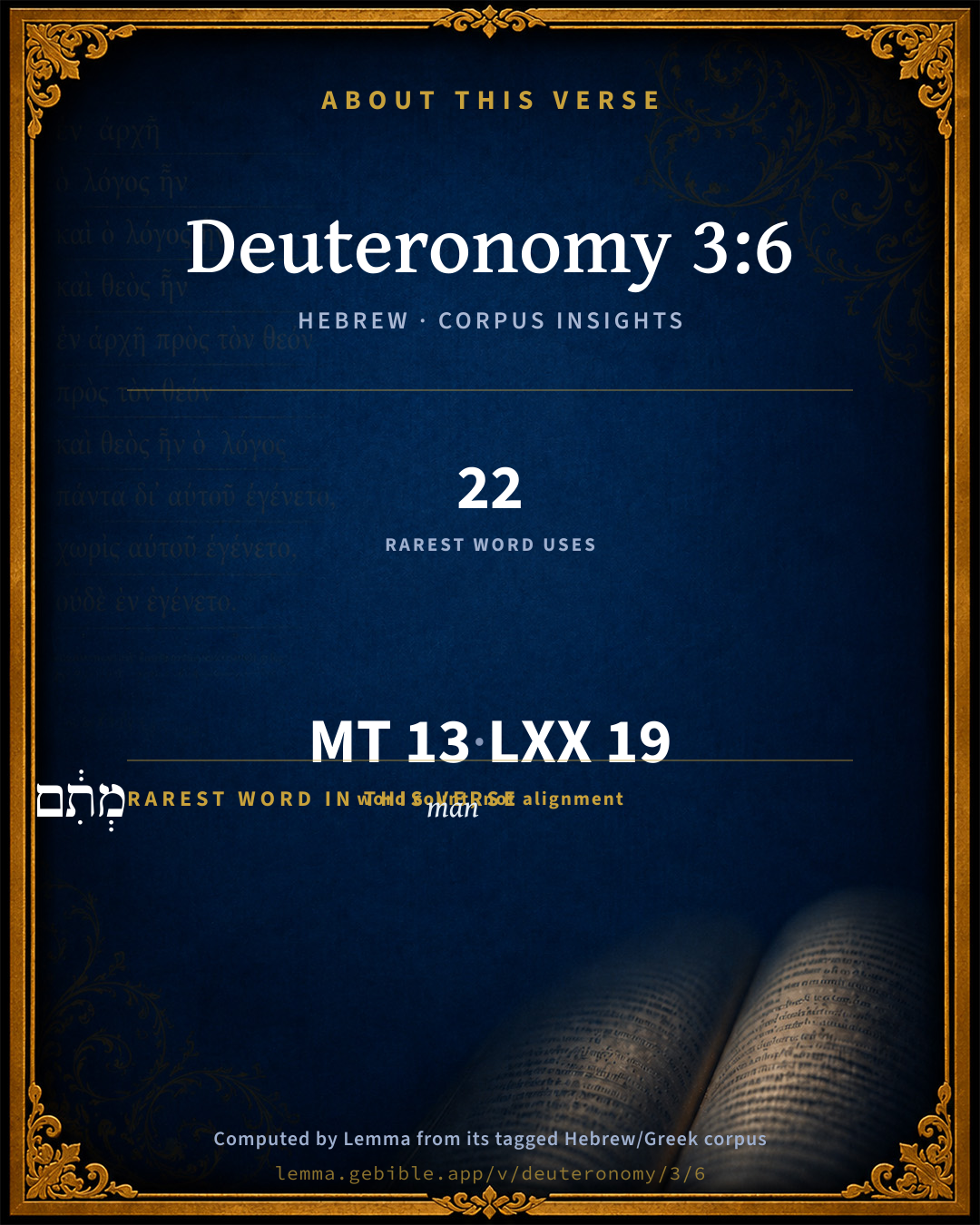
The rarest word here is מְתִ֔ם man H4962 — appearing just 22 times in the whole Hebrew Bible.

Shared distinctive vocabulary

מְתִ֔ם man H4962 occurs in 21 verses of the Hebrew Bible. Also found in:

Grammatical profile

  • 3 verbs
  • 8 nouns
  • 2 particles

Verb forms

  • וַנַּחֲרֵ֣ם Hiphil · Sequential Imperfect
  • עָשִׂ֔ינוּ Qal · Perfect
  • הַחֲרֵם֙ Hiphil · Infinitive Absolute

Repetition

A word recurs within this verse — often emphatic in Hebrew:

  • וַנַּחֲרֵ֣ם to ban H2763 ×2

Hebrew & Septuagint length

In English translation the verse runs 24 words from the Hebrew and 27 from the Septuagint (LXX English) — closely comparable.

A rough comparison of the two English renderings, which tokenize alike — not a word-level alignment.

Word counts can differ between the Hebrew and the Greek without any difference in meaning — e.g. the Hebrew direct-object marker אֵת has no separate Greek word, and Greek often adds the article ὁ.

In the original languages it is 13 Hebrew tokens and 19 Greek tokens — but the two are counted differently (Hebrew bundles its prefixes and suffixes into one token; the Greek is in lemma form), so that isn’t a like-for-like length.

Cross-references

9

Topical passages linked to Deuteronomy 3:6 in the Treasury of Scripture Knowledge — connected by theme and wording, ordered by reader-vote popularity; previews shown in the World English Bible.

  • Deuteronomy 2:34 We took all his cities at that time, and utterly destroyed every inhabited city, with the women and the little ones; we left none remaining:
  • Deuteronomy 2:24 Rise up, take your journey, and pass over the valley of the Arnon: behold, I have given into your hand Sihon the Amorite, king of Heshbon, and his land; begin to possess it, and contend with him in battle.
  • Psalms 135:10–12 Who struck many nations, And killed mighty kings,
  • Leviticus 27:28–29 "'Notwithstanding, no devoted thing, that a man shall devote to Yahweh of all that he has, whether of man or animal, or of the field of his possession, shall be sold or redeemed: every devoted thing is most holy to Yahweh.
  • Numbers 21:2 Israel vowed a vow to Yahweh, and said, If you will indeed deliver this people into my hand, then I will utterly destroy their cities.
  • Deuteronomy 3:2 Yahweh said to me, Don't fear him; for I have delivered him, and all his people, and his land, into your hand; and you shall do to him as you did to Sihon king of the Amorites, who lived at Heshbon.
  • Deuteronomy 20:16–18 But of the cities of these peoples, that Yahweh your God gives you for an inheritance, you shall save alive nothing that breathes;
  • Joshua 11:14 All the spoil of these cities, and the cattle, the children of Israel took for a prey to themselves; but every man they struck with the edge of the sword, until they had destroyed them, neither left they any who breathed.

Cross-references courtesy of OpenBible.info (CC BY 4.0).

Hebrew and Greek witnesses Masoretic Hebrew ↔ Greek Septuagint

The same verse in the two great witnesses to the Old Testament, shown verse-for-verse.

These are two independent witnesses, not word-aligned to each other, and the Septuagint is shown in lemma (dictionary) form.

Hebrew Deuteronomy 3:6 Masoretic · Westminster Leningrad Codex

וַנַּחֲרֵ֣ם אוֹתָ֔ם כַּאֲשֶׁ֣ר עָשִׂ֔ינוּ לְסִיחֹ֖ן מֶ֣לֶךְ חֶשְׁבּ֑וֹן הַחֲרֵם֙ כָּל עִ֣יר מְתִ֔ם הַנָּשִׁ֖ים וְהַטָּֽף

We utterly destroyed them, as we did to Sihon king of Heshbon, utterly destroying every inhabited city, with the women and the little ones.

World English Bible · Public Domain

Greek LXX Deuteronomy 3:6 Septuagint · lemma form

ἐκὀλεθρεύω αὐτός ὥσπερ ποιέω ὁ σηων βασιλεύς εσεβων καί ἐκὀλεθρεύω πᾶς πόλις ἑξῆς καί ὁ γυνή καί ὁ παιδίον

We utterly destroyed them as we dealt with Seon the king of Esebon, so we utterly destroyed every city in order, and the women and the children,

LXX2012 (modern English Septuagint) · Public Domain

Hebrew: Westminster Leningrad Codex (CC BY 4.0). Greek: Septuagint (public domain); English from LXX2012 (modern English Septuagint) (Public Domain). How the Septuagint differs from the Hebrew →

Targum (Aramaic paraphrase)

2

The Targum is the ancient Jewish Aramaic paraphrase of the Hebrew Scriptures — an interpretive translation, not the Hebrew text itself. Onkelos (literal) and Pseudo-Jonathan (expansive) render the Torah, and Jonathan the Prophets. Coverage is partial: where no permissively-licensed English translation exists for a verse, only the Aramaic is shown. This is verse-level text, not a word-by-word alignment to the Hebrew.

  1. Targum Onkelos Torah (Genesis–Deuteronomy)
    וְגַמַרְנָא יָתְהוֹן כְּמָא דִי עֲבַדְנָא לְסִיחוֹן מַלְכָּא דְחֶשְׁבּוֹן גַמַר כָּל קִרְוֵי גֻבְרַיָא נְשַׁיָא וְטַפְלָא

    (no public-domain English translation for this verse)

    Targum Onkelos — Aramaic: “Onkelos Genesis” (public domain); “Onkelos Exodus” (public domain); “Onkelos Leviticus” (public domain); “Onkelos Numbers” (public domain); “Onkelos Deuteronomy” (public domain). English: “Sefaria Community Translation” (CC0 1.0 (public-domain dedication)); “J.W. Etheridge. The Targums of Onkelos and Jonathan Ben Uzziel on the Pentateuch. London: Longmans, Green, 1862” (public domain). Text via Sefaria.

  2. Targum Pseudo-Jonathan Torah (Genesis–Deuteronomy)
    וּגְמַרְנָא יַת קִירְוֵיהוֹן הֵיכְמָא דַעֲבַדְנָא לְסִיחוֹן מַלְכָּא דְחֶשְׁבּוֹן הֵיכְדֵין גָּמַרְנָא יַת כָּל קִרְוֵוי גוּבְרַיָא נְשַׁיָא וְטַפְלָא

    And we utterly destroyed their cities: as we did to Sihon king of Heshbon, so destroyed we with every city the men, women, and children.

    Targum Pseudo-Jonathan — Aramaic: “Targum Jonathan on Genesis” (public domain); “Targum Jonathan on Exodus” (public domain); “Targum Jonathan on Leviticus” (public domain); “Targum Jonathan on Numbers” (public domain); “Targum Jonathan on Deuteronomy” (public domain). English: “The Targum of Jonathan ben Uzziel, trans. J. W. Etheridge, London, 1862” (public domain). Text via Sefaria.

Commentary

Notes on Deuteronomy 3:6 from classic Christian and Jewish commentators (each source and its license shown beneath its notes). The classic Christian expositions comment on the surrounding passage and are grouped to its opening verse, so a note may address several verses; the Jewish commentaries on the Tanakh (Rashi and others) are per-verse, so they appear only where the commentator wrote on this verse.

Lemma curates 59 commentaries, every one of them public domain or Creative Commons licensed, each selected and text-cleaned for this edition rather than reprinted as found. About our sources →

Trapp's Complete Commentary

John Trapp

Deu 3:6 And we utterly destroyed them, as we did unto Sihon king of Heshbon, utterly destroying the men, women, and children, of every city.

Ver. 6. The men, women, and children.] The Hebrew word מהים, here rendered men, written with tsere, signifieth dead men: Surely every man in his best estate, or when best underlaid, is altogether vanity, Selah. {Psa 39:5}

John Trapp, A Commentary or Exposition upon All the Books of the Old and New Testament (1647–1656) — public domain. Text from a community e-Sword module.

Geneva Bible (1599)

Geneva Bible translators

Because this was God’s appointment, therefore it may not be judged cruel.

Geneva Bible (1599) marginal notes — public domain. Text via Bolls.life.

Ellicott's Commentary for English Readers

(6) We utterly destroyed them.—Devoted them, made them chêrem, as above (Deu_2:34).

A Bible Commentary for English Readers, edited by Charles John Ellicott (1878–1897) — public domain. Text from a community e-Sword module.

The Cambridge Bible for Schools and Colleges

gen. ed. J. J. S. Perowne

6. and we utterly destroyed them, etc.] See Deu_2:34 f.

The Cambridge Bible for Schools and Colleges (gen. ed. J. J. S. Perowne; Cambridge University Press, 1878–1918) — public domain. Text from a community e-Sword module.

John Gill's Exposition

And we utterly destroyed them,.... Not the cities, but the inhabitants of them:

as we did to Sihon king of Heshbon; they did not destroy his cities, for they took them and dwelt in them; but the people that lived there, as follows here:

utterly destroying the men, women, and children, of every city; see Deu 2:34.

John Gill's Exposition of the Whole Bible (1746–1763) — public domain (CC PDM 1.0). Text via the HelloAO Bible API.

Haydock's Catholic Bible Commentary

Utterly. Yet out of the ruins they soon raised other strong cities, Numbers xxxii. 26. All the walls were not probably demolished, (ver. 19,) but only a part, so that they might be repaired with no great labour or expense. The inhabitants were all destroyed, that they might not pervert the Hebrews by their bad example; and because God had pronounced the sentence of death upon them, in punishment of their crimes. Hebrew seem to insinuate, that the cities were destroyed only by the death of the inhabitants. "We subjected them to anathema....utterly destroying the men," &c. (Haydock) --- We devoted to utter ruin the men, women, and children of the cities which we took. (Calmet)

George Leo Haydock (1774–1849), Haydock's Catholic Family Bible and Commentary, 1859 edition — public domain. Excludes Psalms (Douay-Rheims chapter numbering differs from Protestant) and Deuterocanonical books (Catholic canon only).

The Pulpit Commentary

See Deu_2:34.

The destruction of the populations.

The difficulty is often urged of the numerous cases of the destruction of entire populations recorded in Scripture, and said to be commanded by God. It is a difficulty which all have felt, and which deserves remark. It is not questioned that, as a matter of policy, it was wise to root out these populations from the lands in which they dwelt; but the justice and humanity of the measure are thought to be more doubtful. The believer, on the other hand, cannot take a condemnatory view of these transactions (so far as covered by express command); but must treat them as he would treat similar difficulties in the ordinary providence of God, as matters which appear to conflict with the Divine goodness and justice, while doubtless admitting of a perfect reconciliation with both. But it may be suggested

I THAT THE FINER METHODS OF MODERN WARFARE CANNOT REASONABLY BE LOOKED FOR IN RUDER AGES. War in any case is an evil of terrible magnitude. The sufferings it inflicts, even when conducted most humanely, are incalculable. It is not the men in arms alone who suffer, but the populations whose villages are burned, whose fields are devastated, whose aged and sickly are driven out to perish, whose wives and mothers mourn their dead thousands. Modern warfare has, however, its alleviations, the result of centuries of civilization anti of the growth of Christian feeling. These did not, and could not, exist at the time of the conquest. It is not in analogy with God"s method of operation to suppose that he should have miraculously anticipated the work of long ages of development, and grafted on these wars the military science of the nineteenth century a science equally unsuited to the intelligence of the invader and to the tactics of the enemy. It would be as reasonable to allege that God should have anticipated the discoveries and methods of modern surgery, or armed the Israelites with nineteenth-century weapons. What may reasonably be expected is that, adopting as a basis the methods of warfare then customary, the evils of these should as far as possible be mitigated, and any improvements be introduced which the rudeness of the times admitted of. How far this was accomplished will appear to any one who studies the accounts of ancient warfare, with their shocking barbarities, mutilations, tortures; scarcely a trace of which is to be found in the wars of the Israelites, and none in the Law.

II THAT THE EXTERMINATION OF WHOLE POPULATIONS WAS NOT THE RULE OF JEWISH WARFARE, BUT WAS INVARIABLY A PUNISHMENT INFLICTED FOR SIN. The proof of the former of these propositions will be found in Deu_20:10-16; and examination of the special cases will show the correctness of the latter. The destruction of the Canaanitish nations, in particular, is put expressly on the ground of their horrible and nameless iniquities. (Lev_18:24, Lev_18:25) It was the execution of a long-delayed and richly deserved judicial sentence. The Midianites and Amalekites incurred this doom through sins against Israel (Num_32:16; Exo_17:16) as also to some extent did Sihon and OR. But while we cannot speak absolutely as to the moral state of the nations under these kings, it may be inferred that the cup of their iniquity had, in the Divine estimation, become full like the others. Do we condemn the sentence as too severe? Or must we not leave the judgment on a point like that to the Judge of all the earth? The essential difficulty is not greater than in the judgments of the Deluge or the destruction of Sodom and Gomorrah, in which God claimed a like right to dispose of human life, and to vindicate his justice by the destruction of it. We ought rather to read in the severity of these punishments the awful lesson of sin"s evil and enormity, and of the abhorrence in which it is held by the holy Lawgiver. The emphasizing of guilt and its deserts was a necessary preliminary to the introduction of the gospel.

III THAT GOD IS AS SEVERE IN HIS DEALINGS WITH SIN IN HIS OWN PEOPLE AS IN HIS ENEMIES. This is a point which is surely of great moment. If severe in punishing these wicked nations, God is not less sparing of Israel when it follows in their ways, and does what is wrong. We think here of the destruction of thousands of their number for the sin of the golden calf, (Exo_32:28) and for the sin of Baal-peor; (Num_23:5) of the plagues, fiery serpents, etc., which chastised them for disobedience; of their defeat at Ai, (Jos_7:4) and of the threatenings recorded against them in this book. (De 28) We think of Moses himself excluded from the land of promise. Nor is sin made less of in the New Testament than in the Old. In the cross of Jesus, where the Holy One is made a curse for sinners, a far more affecting demonstration is given of the judicial sternness of God, than in the destruction of the nations of his foes. There is with God no respect of persons; and if one can believe in his love to Israel notwithstanding these inflictions, he may believe in his love and. justice notwithstanding the punishments inflicted on the sinful nations around. As regards the Canaanitish nations, their rooting out, so just otherwise, was plainly necessary for the preservation of Israel"s purity. J.O. (Deu_7:1-6)

The Pulpit Commentary (1880–1919), ed. H.D.M. Spence-Jones & Joseph S. Exell — public domain. Text from a community e-Sword module.

Rashi

Rabbi Shlomo Yitzchaki (Rashi)

החרם — This has a present frequentative meaning: going on and destroying (see Rashi on Numbers 25:17).

Rashi on the Tanakh — English translations: “The Judaica Press complete Tanach with Rashi, translated by A. J. Rosenberg” (CC BY 4.0); “Pentateuch with Rashi's commentary by M. Rosenbaum and A.M. Silbermann, 1929-1934” (public domain); “The Metsudah Tanach series, Lakewood, N.J” (CC BY 4.0); and “The Book of Joshua, Metsudah Publications, 1997” (CC BY 4.0). Text via Sefaria.

Lesson kit

Teaching starters — assembled from the data on this page, not authored interpretation. Every prompt links to the verse data it draws on. Edit before teaching.

Deuteronomy, in the Pentateuch, opens this verse with 13 words (12 distinct Hebrew lemmas). Its most distinctive word is math (“man”). A historical commentator’s framing appears above. Read the whole chapter for the surrounding context.

Discussion questions

  1. How does “man” (math) shape what this verse is saying?
  2. Genesis 34:30 shares the word «man» with this verse. How do the two illuminate each other?
  3. “to ban” occurs 2× in this one verse. What is the effect of the repetition?
  4. These translations render this verse differently; the difference is in the English rendering, not the original. What questions does that raise?
  5. The verb «וַנַּחֲרֵ֣ם» is Hiphil Sequential Imperfect. How does its form color the action?
  6. Reading how Trapp's Complete Commentary and Geneva Bible (1599) read this verse, where do the two commentators agree and where do they part?

Things to notice

Reading settings

Reading text

Shown beneath each verse's original-language words.

Old Testament
Old Testament edition

Read the OT as the Masoretic Hebrew (MT) or the Greek Septuagint (LXX).

English shown for the Greek Septuagint (in the Hebrew ↔ Greek comparison).

Comparing translations? Open the Compare panel on any verse page to stack up to four side by side.