Deuteronomy 11:12

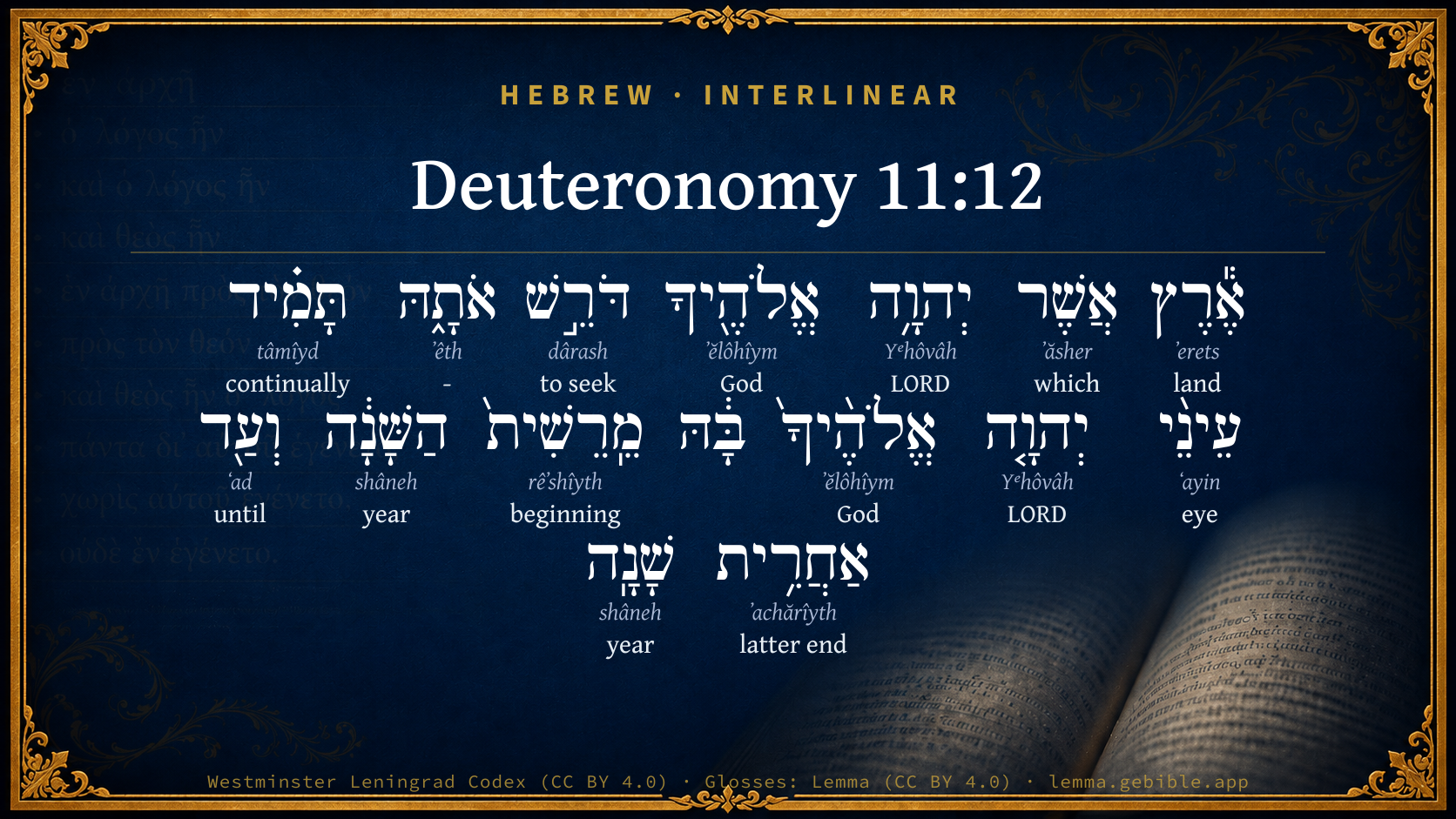
Hebrew (Westminster Leningrad Codex) Deuteronomy 11:12 appears in the Hebrew Old Testament. The text above is from the Westminster Leningrad Codex. Each word links to its Strong’s number, a concise gloss, and parsing drawn from the Open Scriptures Hebrew Bible morphology. Click any word for its full Brown-Driver-Briggs (BDB) entry.
Download image
Cite this verse

Deuteronomy 11:12 (World English Bible). Public Domain. Lemma interlinear Bible study tool, https://lemma.gebible.app/v/deuteronomy/11/12.

Show BibTeX & RIS
BibTeX
RIS
English Translation
a land which Yahweh your God cares for: the eyes of Yahweh your God are always on it, from the beginning of the year even to the end of the year.
World English Bible · Public Domain
Download a study sheet

One document with this verse’s original text, its word-by-word gloss line, the meaning frame, cross-references with their text, attributed commentary, and full source and license credits — printable, and it pastes into notes with its structure intact.

This verse Autodidact and up

Study sheet (.html) Plain text (.txt)

A passage Seminary Student

Up to 50 verses in one chapter. A passage sheet keeps up to 6 commentary sources and 12 cross-references per verse, in the order this page ranks them, and says so on the sheet whenever that leaves anything out. Ask for a single verse and you get the Autodidact verse sheet above.

Everything on this page stays free to read, with no account — the sheet is a download of what is already on screen, not access to it.

Want to remove ads? Support Godless Engineer
Compare translations 3

The same verse in 3 English versions, stacked beneath the original-language interlinear above. Click any original word for its lexicon entry.

Each is an independent rendering of the whole verse — the interlinear is not word-aligned to these translations.

Highlighted words mark where these versions differ — a whole-verse word diff, not a word-by-word alignment.

  • World English Bible Public Domain
    a land which Yahweh your God cares for: the eyes of Yahweh your God are always on it, from the beginning of the year even to the end of the year.
  • King James Version Public Domain
    A land which the LORD thy God careth for: the eyes of the LORD thy God are always upon it, from the beginning of the year even unto the end of the year.
  • unfoldingWord Literal Text CC BY-SA 4.0
    a land where Yahweh your God cares for it. The eyes of Yahweh your God always upon it, from the beginning of the year and to the end of the year.

unfoldingWord Literal Text — © unfoldingWord, licensed CC BY-SA 4.0. Word-aligned USFM3 via Door43 (git.door43.org/unfoldingWord/en_ult).

Versions to compare (up to 4)

3 of 4 selected

Show all 18 translations

Every available English version of this verse, each an independent rendering of the whole verse.

  • World English Bible Public Domain
    a land which Yahweh your God cares for: the eyes of Yahweh your God are always on it, from the beginning of the year even to the end of the year.
  • Berean Standard Bible Public Domain
    It is a land for which the LORD your God cares; the eyes of the LORD your God are always on it, from the beginning to the end of the year.
  • Majority Standard Bible Public Domain
    It is a land for which the LORD your God cares; the eyes of the LORD your God are always on it, from the beginning to the end of the year.
  • King James Version Public Domain
    A land which the LORD thy God careth for: the eyes of the LORD thy God are always upon it, from the beginning of the year even unto the end of the year.
  • American Standard Version (1901) Public Domain
    a land which Jehovah thy God careth for: the eyes of Jehovah thy God are always upon it, from the beginning of the year even unto the end of the year.
  • Revised Version (1885) Public Domain
    a land which the LORD thy God careth for; the eyes of the LORD thy God are always upon it, from the beginning of the year even unto the end of the year.
  • Geneva Bible (1599) Public Domain
    This land doth the Lord thy God care for: the eies of the Lord thy God are alwaies vpon it, from the beginning of the yeere, euen vnto the ende of the yeere.
  • Douay-Rheims (1899) Public Domain
    But it is a land of hills and plains, expecting rain from heaven.
  • Young's Literal Translation Public Domain
    a land which Jehovah thy God is searching; continually `are' the eyes of Jehovah thy God upon it, from the beginning of the year even unto the latter end of the year.
  • Literal Standard Version CC BY-SA 4.0
    a land which your God YHWH is searching; the eyes of your God YHWH [are] continually on it, from the beginning of the year even to the latter end of the year.
  • Unlocked Literal Bible CC BY-SA 4.0
    a land that Yahweh your God cares for; the eyes of Yahweh your God are always upon it, from the beginning of the year to the end of the year.
  • unfoldingWord Literal Text CC BY-SA 4.0
    a land where Yahweh your God cares for it. The eyes of Yahweh your God always upon it, from the beginning of the year and to the end of the year.
  • Darby Bible Public Domain
    a land which Jehovah thy God careth for; the eyes of Jehovah thy God are constantly upon it, from the beginning of the year even unto the end of the year.
  • World Messianic Bible Public Domain
    a land which the LORD your God cares for. The LORD your God’s eyes are always on it, from the beginning of the year even to the end of the year.
  • Webster's Bible Public Domain
    A land which the LORD thy God careth for: the eyes of the LORD thy God are always upon it, from the beginning of the year even to the end of the year.
  • Free Bible Version CC BY-SA 4.0
    It is a land that the Lord your God takes care of. The Lord your God is always watching over it, all year long.
  • Bible in Basic English Public Domain
    A land cared for by the Lord your God: the eyes of the Lord your God are on it at all times from one end of the year to the other.
  • JPS Tanakh (1917) Public Domain
    a land which the LORD thy God careth for; the eyes of the LORD thy God are always upon it, from the beginning of the year even unto the end of the year.

Literal Standard Version (2020), Covenant Press — licensed CC BY-SA 4.0. Text via the HelloAO Bible API (eBible.org). Unlocked Literal Bible (unfoldingWord) — licensed CC BY-SA 4.0. Text via the HelloAO Bible API (eBible.org). unfoldingWord Literal Text — © unfoldingWord, licensed CC BY-SA 4.0. Word-aligned USFM3 via Door43 (git.door43.org/unfoldingWord/en_ult). Free Bible Version, Dr. Jonathan Gallagher — licensed CC BY-SA 4.0. Text via the HelloAO Bible API (eBible.org).

Word by word

More ways to search: Search by grammar → Find every occurrence → Compare this word →

Practice this passage: Drill this verse → Learn its vocabulary →

מֵֽרֵשִׁית֙
rêʼshîyth
H7225
“from · beginning of”
Preposition + Noun, Common, Feminine, Singular, Construct
Part of Speech
Preposition + Noun
Type
Common
Gender
Feminine
Number
Singular
State
Construct
Full BDB Definition

Origin: from the same as H7218

TWOT: 2097e

first, beginning, best, chief - beginning - first - chief - choice part
  1. אֶ֕רֶץ ʼerets H776 “land” Noun, Common, Both, Singular, Absolute
  2. אֲשֶׁר ʼăsher H834 “which” Particle, Relative
  3. יְהוָ֥ה Yᵉhôvâh H3068 “LORD” Noun, Proper
  4. אֱלֹהֶ֖יךָ ʼĕlôhîym H430 “God(s) · your” Noun, Common, Masculine, Plural, Construct + Suffix, Personal, 2nd Person, Masculine, Singular
  5. דֹּרֵ֣שׁ dârash H1875 “seeking” Verb, Qal, Participle Active, Masculine, Singular, Absolute
  6. אֹתָ֑הּ ʼêth H853 “- · her” Particle, Direct Object + Suffix, Personal, 3rd Person, Feminine, Singular
  7. תָּמִ֗יד tâmîyd H8548 “continually” Noun, Common, Masculine, Singular, Absolute
  8. עֵינֵ֨י ʻayin H5869 “eyes of” Noun, Common, Both, Dual, Construct
  9. יְהוָ֤ה Yᵉhôvâh H3068 “LORD” Noun, Proper
  10. אֱלֹהֶ֨יךָ֙ ʼĕlôhîym H430 “God(s) · your” Noun, Common, Masculine, Plural, Construct + Suffix, Personal, 2nd Person, Masculine, Singular
  11. הַשָּׁנָ֔ה shâneh H8141 “the · year” Particle, Definite Article + Noun, Common, Feminine, Singular, Absolute
  12. וְעַ֖ד ʻad H5704 “and · until” Conjunction + Preposition
  13. אַחֲרִ֥ית ʼachărîyth H319 “latter end of” Noun, Common, Feminine, Singular, Construct
  14. שָׁנָֽה shâneh H8141 “year” Noun, Common, Feminine, Singular, Absolute

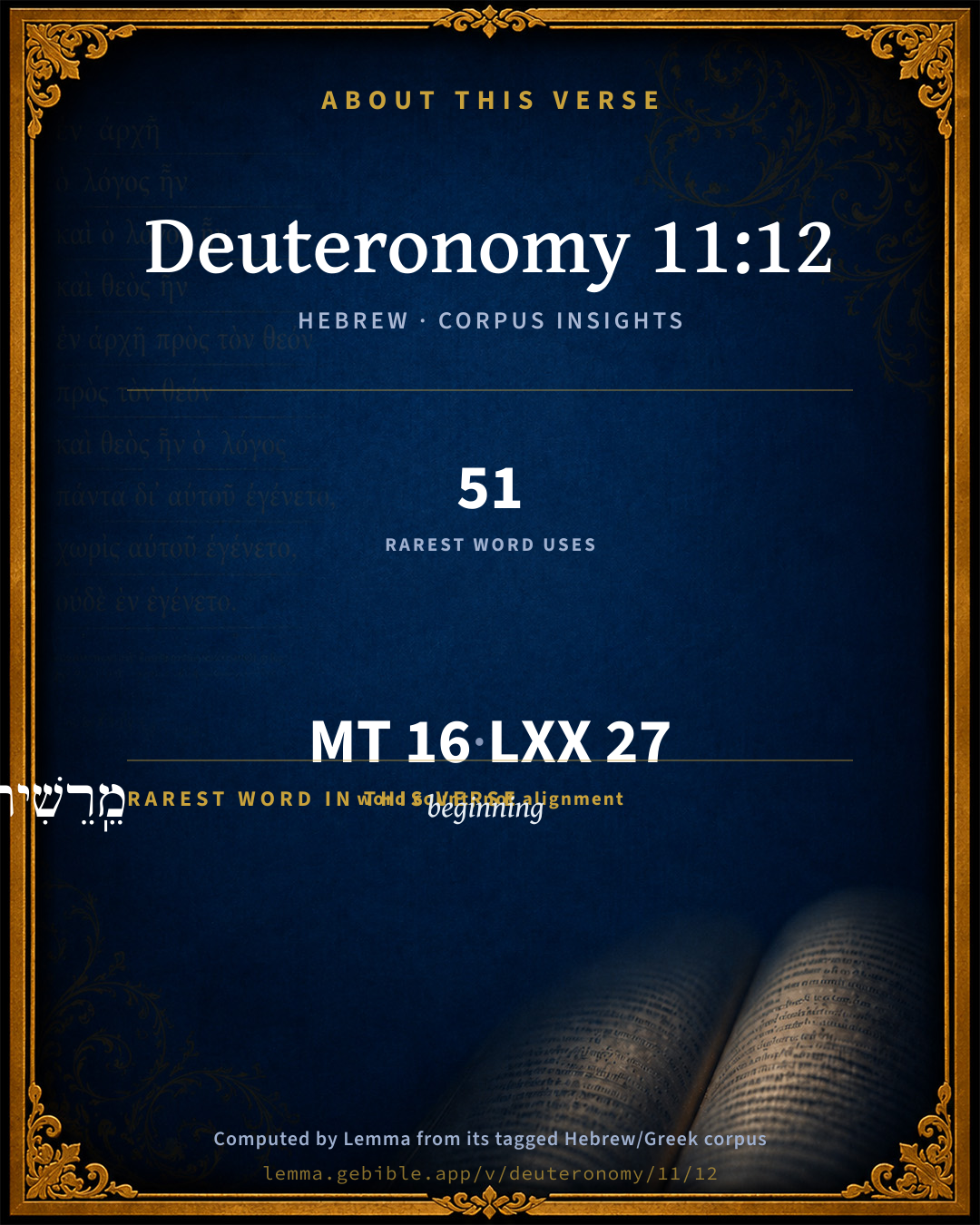
About this verse

These counts appear in no published source. They are computed here, from the morphology-tagged text and Lemma’s own curated glosses. What Lemma adds →

16
words
12
distinct lemmas
Pentateuch
section

Shared distinctive vocabulary

מֵֽרֵשִׁית֙ beginning H7225 occurs in 49 verses of the Hebrew Bible. Also found in:

Grammatical profile

  • 1 verb
  • 11 nouns
  • 2 prepositions
  • 2 particles

Verb forms

  • דֹּרֵ֣שׁ Qal · Participle Active

Repetition

Words recur within this verse — often emphatic in Hebrew:

  • יְהוָ֥ה LORD H3068 ×2
  • אֱלֹהֶ֖יךָ God H430 ×2
  • הַשָּׁנָ֔ה year H8141 ×2

Hebrew & Septuagint length

In English translation the verse runs 31 words from the Hebrew and 31 from the Septuagint (LXX English) — the same length.

A rough comparison of the two English renderings, which tokenize alike — not a word-level alignment.

Word counts can differ between the Hebrew and the Greek without any difference in meaning — e.g. the Hebrew direct-object marker אֵת has no separate Greek word, and Greek often adds the article ὁ.

In the original languages it is 16 Hebrew tokens and 27 Greek tokens — but the two are counted differently (Hebrew bundles its prefixes and suffixes into one token; the Greek is in lemma form), so that isn’t a like-for-like length.

Cross-references

5

Topical passages linked to Deuteronomy 11:12 in the Treasury of Scripture Knowledge — connected by theme and wording, ordered by reader-vote popularity; previews shown in the World English Bible.

  • Jeremiah 24:6 For I will set my eyes on them for good, and I will bring them again to this land: and I will build them, and not pull them down; and I will plant them, and not pluck them up.
  • Psalms 33:18 Behold, Yahweh's eye is on those who fear him, On those who hope in his loving kindness;
  • 1 Kings 9:3 Yahweh said to him, I have heard your prayer and your supplication, that you have made before me: I have made this house holy, which you have built, to put my name there forever; and my eyes and my heart shall be there perpetually.
  • Psalms 34:15 Yahweh's eyes are toward the righteous. His ears listen to their cry.
  • Ezra 5:5 But the eye of their God was on the elders of the Jews, and they did not make them cease, until the matter should come to Darius, and then answer should be returned by letter concerning it.

Cross-references courtesy of OpenBible.info (CC BY 4.0).

Hebrew and Greek witnesses Masoretic Hebrew ↔ Greek Septuagint

The same verse in the two great witnesses to the Old Testament, shown verse-for-verse.

These are two independent witnesses, not word-aligned to each other, and the Septuagint is shown in lemma (dictionary) form.

Hebrew Deuteronomy 11:12 Masoretic · Westminster Leningrad Codex

אֶ֕רֶץ אֲשֶׁר יְהוָ֥ה אֱלֹהֶ֖יךָ דֹּרֵ֣שׁ אֹתָ֑הּ תָּמִ֗יד עֵינֵ֨י יְהוָ֤ה אֱלֹהֶ֨יךָ֙ בָּ֔הּ מֵֽרֵשִׁית֙ הַשָּׁנָ֔ה וְעַ֖ד אַחֲרִ֥ית שָׁנָֽה

a land which Yahweh your God cares for: the eyes of Yahweh your God are always on it, from the beginning of the year even to the end of the year.

World English Bible · Public Domain

Greek LXX Deuteronomy 11:12 Septuagint · lemma form

γῆ ὅς κύριος ὁ θεός σύ ἐπισκοπέω αὐτός διά πᾶς ὁ ὀφθαλμός κύριος ὁ θεός σύ ἐπί αὐτός ἀπό ἀρχή ὁ ἐνιαυτός καί ἕως συντέλεια ὁ ἐνιαυτός

A land which the Lord your God surveys continually, the eyes of the Lord your God are upon it from the beginning of the year to the end of the year.

LXX2012 (modern English Septuagint) · Public Domain

On this verse, The Pulpit Commentary discusses the Septuagint’s reading. Read the note in Commentary ↓

Hebrew: Westminster Leningrad Codex (CC BY 4.0). Greek: Septuagint (public domain); English from LXX2012 (modern English Septuagint) (Public Domain). How the Septuagint differs from the Hebrew →

Targum (Aramaic paraphrase)

2

The Targum is the ancient Jewish Aramaic paraphrase of the Hebrew Scriptures — an interpretive translation, not the Hebrew text itself. Onkelos (literal) and Pseudo-Jonathan (expansive) render the Torah, and Jonathan the Prophets. Coverage is partial: where no permissively-licensed English translation exists for a verse, only the Aramaic is shown. This is verse-level text, not a word-by-word alignment to the Hebrew.

  1. Targum Onkelos Torah (Genesis–Deuteronomy)
    אַרְעָא דַיְיָ אֱלָהָךְ תָּבַע יָתַהּ תְּדִירָא עֵינֵי דַיְיָ אֱלָהָךְ בַּהּ מֵרֵישָׁא דְשַׁתָּא וְעַד סוֹפָא דְשַׁתָּא

    (no public-domain English translation for this verse)

    Targum Onkelos — Aramaic: “Onkelos Genesis” (public domain); “Onkelos Exodus” (public domain); “Onkelos Leviticus” (public domain); “Onkelos Numbers” (public domain); “Onkelos Deuteronomy” (public domain). English: “Sefaria Community Translation” (CC0 1.0 (public-domain dedication)); “J.W. Etheridge. The Targums of Onkelos and Jonathan Ben Uzziel on the Pentateuch. London: Longmans, Green, 1862” (public domain). Text via Sefaria.

  2. Targum Pseudo-Jonathan Torah (Genesis–Deuteronomy)
    אַרְעָא דַיְיָ אֱלָהָךְ תְּבַע יָתֵהּ בְּמֵימְרֵיהּ לְאוֹטָבוּתָא תְּדִירָא עֵינֵי יְיָ אֱלָהָךְ מִסְתַּכְּלִין בָּהּ מִן שִׁירוּיָא דְשַׁתָּא עַד סוֹפָא דְשַׁתָּא

    it is a land which the Lord your God inquireth after by His Word, that He may bless it evermore; the eyes of the Lord your God look upon it from the beginning of the year to the year’s end.

    Targum Pseudo-Jonathan — Aramaic: “Targum Jonathan on Genesis” (public domain); “Targum Jonathan on Exodus” (public domain); “Targum Jonathan on Leviticus” (public domain); “Targum Jonathan on Numbers” (public domain); “Targum Jonathan on Deuteronomy” (public domain). English: “The Targum of Jonathan ben Uzziel, trans. J. W. Etheridge, London, 1862” (public domain). Text via Sefaria.

Commentary

Notes on Deuteronomy 11:12 from classic Christian and Jewish commentators (each source and its license shown beneath its notes). The classic Christian expositions comment on the surrounding passage and are grouped to its opening verse, so a note may address several verses; the Jewish commentaries on the Tanakh (Rashi and others) are per-verse, so they appear only where the commentator wrote on this verse.

Lemma curates 59 commentaries, every one of them public domain or Creative Commons licensed, each selected and text-cleaned for this edition rather than reprinted as found. About our sources →

Trapp's Complete Commentary

John Trapp

Deu 11:12 A land which the LORD thy God careth for: the eyes of the LORD thy God [are] always upon it, from the beginning of the year even unto the end of the year.

Ver. 12. Which the Lord thy God careth for.] Deus sic curat universa, quasi singula; sic singula, quasi sola. {a}

From the beginning of the year.] How easy were it for God to starve us all, by denying us a harvest or two!

{a} August.

John Trapp, A Commentary or Exposition upon All the Books of the Old and New Testament (1647–1656) — public domain. Text from a community e-Sword module.

Joseph Benson's Commentary

Deu 11:12. Which the Lord careth for — In a special manner, watering it immediately, as it were, by his own hand, without man’s help, and giving peculiar blessings to it, which Egypt enjoyed not. To the end of the year — To give it the rain, and other blessings proper to the several seasons. But all these mercies, and the fruitfulness of the land consequent upon them, were suspended upon their disobedience. And therefore it is not at all strange that some later writers describe the land of Canaan as a barren soil; which is so far from affording ground to question the authority of the Scriptures, that it much more confirms it, this being an effect of that threatening, that God would turn a fruitful land into barrenness for the wickedness of those that dwelt in it, Psa 107:34.

Joseph Benson's Commentary on the Old and New Testaments (1811–1818) — public domain. Text from a community e-Sword module.

Tyndale Open Study Notes

Tyndale Open Resources

11:12 a land . . . your God cares for: God’s care included blessing the land with all the resources his people would need to survive and prosper there.

Tyndale Open Study Notes — © Tyndale Open Resources, licensed CC BY-SA 4.0. Text via the HelloAO Bible API.

Jamieson, Fausset & Brown

Robert Jamieson, A. R. Fausset & David Brown

A land which the Lord thy God careth for--that is, watering it, as it were, with His own hands, without human aid or mechanical means.

Jamieson, Fausset & Brown — Commentary Critical and Explanatory on the Whole Bible (1871) — public domain (CC PDM 1.0). Text via the HelloAO Bible API.

Ellicott's Commentary for English Readers

(12) A land which the Lord thy God careth for.—Literally, seeketh, as in the margin of our Bibles. Comp. Eze_20:6 : “A land that I had espied for them, flowing with milk and honey, which is the glory of all lands.” “To search out a resting-place for them” (Num_10:33). It is difficult not to think of the better land in this description, and of our Saviour’s promise, “I go to prepare a place for you.” There “the poor and needy” shall not “seek water,” for “He shall lead them to living fountains of water.” They shall “hunger no more, neither thirst any more.”

That something unusual is indicated here seems to have occurred to the old Jewish writer, who says—“And does He not seek out all lands? as it is said, ‘To cause it to rain on the earth where no man is’” (Job_38:26).

A Bible Commentary for English Readers, edited by Charles John Ellicott (1878–1897) — public domain. Text from a community e-Sword module.

The Cambridge Bible for Schools and Colleges

gen. ed. J. J. S. Perowne

12. a land which the Lord thy God careth for] lit. seeketh after. The verb is used both in the sense of resort to or frequent (Deu_12:5, with another construction, Amo_5:5), or investigate (Deu_13:14 (15), Deu_17:4, Deu_19:18), or to visit so as to care for (Jer_30:14; Jer_30:17; Job_3:4; Isa_62:12). The last is of course the meaning here: a land which is under the personal supervision and providence of God: constantly are the eyes of Jehovah thy God upon it from the beginning of the year and even to the end of the year. Such is the emphatic Heb. order.

The Cambridge Bible for Schools and Colleges (gen. ed. J. J. S. Perowne; Cambridge University Press, 1878–1918) — public domain. Text from a community e-Sword module.

John Gill's Exposition

And I will send grass in thy fields for thy cattle,.... By giving plentiful showers of rain at proper times, to cause it to spring up and grow, that so there might be food for the cattle of every sort, greater or lesser; see Psa 104:13,

that thou mayest eat and be full; which refers to the preceding verse as well as to this; and the sense is, that the Israelites might eat of and enjoy the fruits of the earth to satiety; namely, their corn, wine, and oil; and that their cattle might have grass enough to supply them with.

John Gill's Exposition of the Whole Bible (1746–1763) — public domain (CC PDM 1.0). Text via the HelloAO Bible API.

Matthew Poole's English Annotations

Land which the Lord careth for, to wit, in a special manner, watering it immediately as it were by his own hand, without man’s help, and giving peculiar blessings to it, which Egypt enjoys not.

The eyes of the Lord are always upon us, to give it the rain and other blessings proper to the several seasons. But all these mercies, and the fruitfulness of the land consequent; upon them, were suspended upon their disobedience, as it here follows. And therefore it is not at all strange that some later writers decry the land of Canaan as in great part a barren soil, which is so far from affording any ground to question the Divine authority of the Holy Scriptures, in which its fruitfulness is declared, that it doth much more confirm it, this being but an effect of that threatening that God would turn a fruitful land into barrenness for the wickedness of those that dwell in it, Psa 107:34, and elsewhere; and the wickedness of the Israelites in succeeding ages being notorious, it is but just and fit that the barrenness of their land should be as evident and infamous.

Matthew Poole's English Annotations on the Holy Bible (1683–1685) — public domain. Text from a community e-Sword/MySword module.

The Pulpit Commentary

Careth for; literally, searcheth or inquireth after, i.e. thinks about and cares for. (LXX, ejpiskopeitai, oversees; cf. Job_3:4; Psa_142:4; Jer_30:17; Eze_34:8; Isa_62:12) The eyes of the Lord thy God; i.e. his special watchful providence (cf. Psa_33:18 Psa_34:15; Eze_4:5) It was a land on which Jehovah"s regard was continually fixed, over which he watched with unceasing care, and which was sustained by his bounty; a land, therefore, wholly dependent on him, and so a fitting place for a people also wholly dependent on him, who owed to his grace all that they were and had.

The Pulpit Commentary (1880–1919), ed. H.D.M. Spence-Jones & Joseph S. Exell — public domain. Text from a community e-Sword module.

John Wesley's Explanatory Notes

Careth for - In a special manner watering it immediately as it were by his own hand, without man's help, and giving peculiar blessings to it, which Egypt enjoys not. To the end of the year - To give it the rain, and other blessings proper to the several seasons. But all these mercies, and the fruitfulness of the land consequent upon them, were suspended upon their disobedience. And therefore it is not at all strange that some later writers, describe the land of Canaan as a barren soil, which is, so far from affording ground to question the authority of the scriptures, that it doth much more confirm it, this, being an effect of that threatning that God would turn a fruitful land into barrenness for the wickedness of these that dwell in it, Psalm cvii, 34.

John Wesley, Explanatory Notes Upon the Whole Bible (1754–1765) — public domain. Text via the GEBible commentary corpus.

Keil & Delitzsch

C. F. Keil & F. Delitzsch

It was a land which Jehovah inquired after, i.e., for which He cared (דּרשׁ, as in Pro 31:13; Job 3:4); His eyes were always directed towards it from the beginning of the year to the end; a land, therefore, which was dependent upon God, and in this dependence upon God peculiarly adapted to Israel, which was to live entirely to its God, and upon His grace alone.

Keil & Delitzsch — Biblical Commentary on the Old Testament (1861–1891) — public domain (CC PDM 1.0). Text via the HelloAO Bible API. (Old Testament only.)

Rashi

Rabbi Shlomo Yitzchaki (Rashi)

אשר ה' אלהיך דרש אתה [A LAND] WHICH THE LORD THY GOD CARETH FOR — But does He not care for all lands, as it said, (Job 38:26) “[Who hath cleft a way for the lightning of the thunder …] to cause rain even on a land where no man is"? But, if one can say so of God, He cares for that land alone, but through the care which He bestows on it, He cares also for all other lands with it (Sifrei Devarim 40:1).

תמיד עיני ה' אלהיך בה THE EYES OF THE LORD THY GOD ARE ALWAYS UPON IT, to see what it requires, and to make new dispensations for it, sometimes for good and sometimes for bad, as is stated in Treatise Rosh Hashanah 17b.

מרשית השנה FROM THE BEGINNING OF THE YEAR [TO THE END OF THE YEAR] — At the beginning of the year it is decided by God what will be right up to the end of it (Rosh Hashanah 8a).

Rashi on the Tanakh — English translations: “The Judaica Press complete Tanach with Rashi, translated by A. J. Rosenberg” (CC BY 4.0); “Pentateuch with Rashi's commentary by M. Rosenbaum and A.M. Silbermann, 1929-1934” (public domain); “The Metsudah Tanach series, Lakewood, N.J” (CC BY 4.0); and “The Book of Joshua, Metsudah Publications, 1997” (CC BY 4.0). Text via Sefaria.

Lesson kit

Teaching starters — assembled from the data on this page, not authored interpretation. Every prompt links to the verse data it draws on. Edit before teaching.

Deuteronomy, in the Pentateuch, opens this verse with 16 words (12 distinct Hebrew lemmas). Its most distinctive word is rêʼshîyth (“beginning”). A historical commentator’s framing appears above. Read the whole chapter for the surrounding context.

Discussion questions

  1. How does “beginning” (rêʼshîyth) shape what this verse is saying?
  2. Genesis 1:1 shares the word «beginning» with this verse. How do the two illuminate each other?
  3. “LORD” occurs 2× in this one verse. What is the effect of the repetition?
  4. These translations render this verse differently; the difference is in the English rendering, not the original. What questions does that raise?
  5. The verb «דֹּרֵ֣שׁ» is Qal Participle Active. How does its form color the action?
  6. Reading how Trapp's Complete Commentary and Joseph Benson's Commentary read this verse, where do the two commentators agree and where do they part?

Things to notice

Reading settings

Reading text

Shown beneath each verse's original-language words.

Old Testament
Old Testament edition

Read the OT as the Masoretic Hebrew (MT) or the Greek Septuagint (LXX).

English shown for the Greek Septuagint (in the Hebrew ↔ Greek comparison).

Comparing translations? Open the Compare panel on any verse page to stack up to four side by side.