
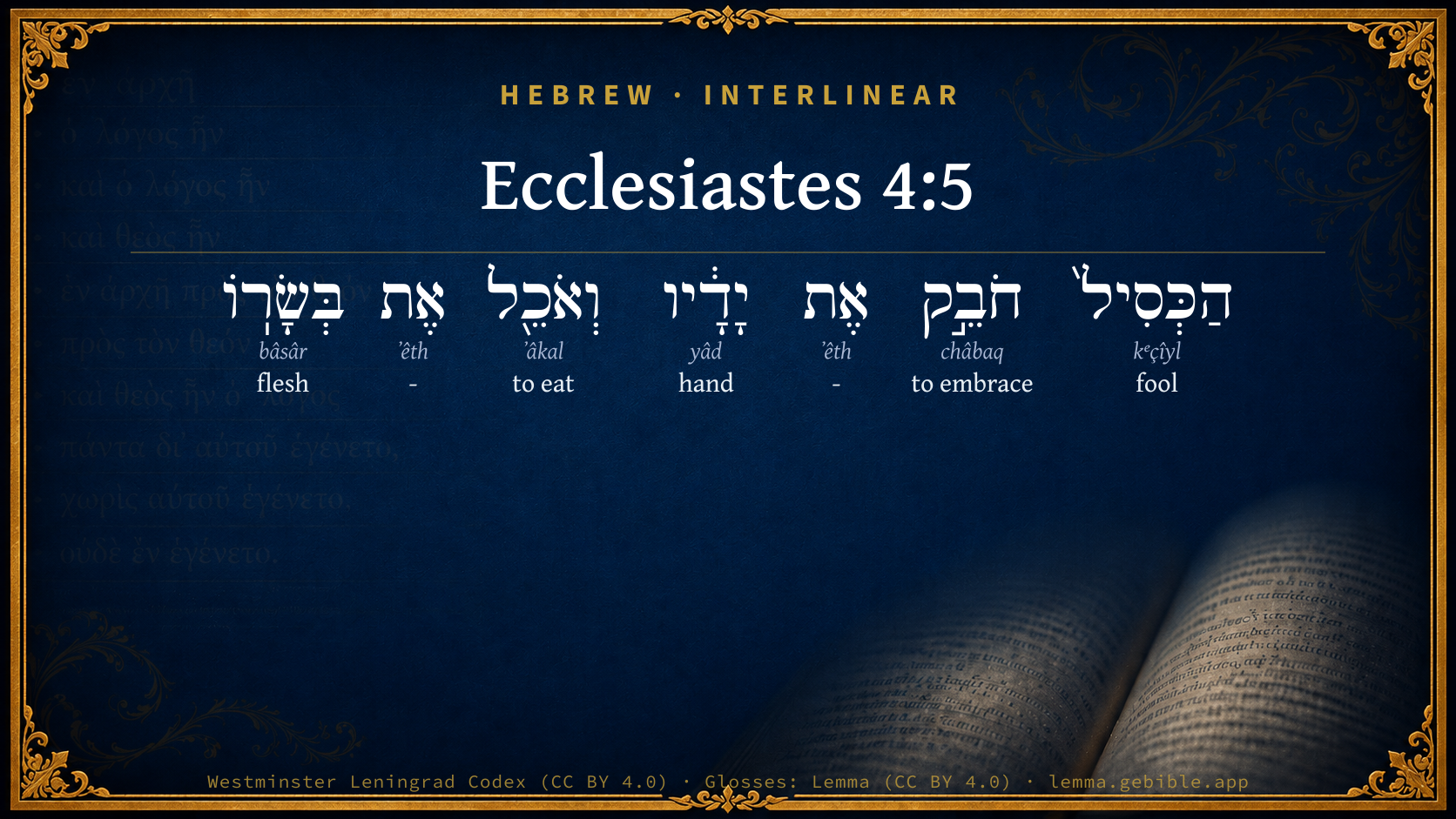
Ecclesiastes 4:5

Hebrew (Westminster Leningrad Codex) Ecclesiastes 4:5 appears in the Hebrew Old Testament. The text above is from the Westminster Leningrad Codex. Each word links to its Strong’s number, a concise gloss, and parsing drawn from the Open Scriptures Hebrew Bible morphology. Click any word for its full Brown-Driver-Briggs (BDB) entry.
Download image
Cite this verse

Ecclesiastes 4:5 (World English Bible). Public Domain. Lemma interlinear Bible study tool, https://lemma.gebible.app/v/ecclesiastes/4/5.

Show BibTeX & RIS
BibTeX
RIS
English Translation
The fool folds his hands together and ruins himself.
World English Bible · Public Domain
Download a study sheet

One document with this verse’s original text, its word-by-word gloss line, the meaning frame, cross-references with their text, attributed commentary, and full source and license credits — printable, and it pastes into notes with its structure intact.

This verse Autodidact and up

Study sheet (.html) Plain text (.txt)

A passage Seminary Student

Up to 50 verses in one chapter. A passage sheet keeps up to 6 commentary sources and 12 cross-references per verse, in the order this page ranks them, and says so on the sheet whenever that leaves anything out. Ask for a single verse and you get the Autodidact verse sheet above.

Everything on this page stays free to read, with no account — the sheet is a download of what is already on screen, not access to it.

Want to remove ads? Support Godless Engineer
Compare translations 3

The same verse in 3 English versions, stacked beneath the original-language interlinear above. Click any original word for its lexicon entry.

Each is an independent rendering of the whole verse — the interlinear is not word-aligned to these translations.

Highlighted words mark where these versions differ — a whole-verse word diff, not a word-by-word alignment.

  • World English Bible Public Domain
    The fool folds his hands together and ruins himself.
  • King James Version Public Domain
    The fool foldeth his hands together, and eateth his own flesh.
  • unfoldingWord Literal Text CC BY-SA 4.0
    The fool is folding his hands and is eating his flesh.

unfoldingWord Literal Text — © unfoldingWord, licensed CC BY-SA 4.0. Word-aligned USFM3 via Door43 (git.door43.org/unfoldingWord/en_ult).

Versions to compare (up to 4)

3 of 4 selected

Show all 18 translations

Every available English version of this verse, each an independent rendering of the whole verse.

  • World English Bible Public Domain
    The fool folds his hands together and ruins himself.
  • Berean Standard Bible Public Domain
    The fool folds his hands and consumes his own flesh.
  • Majority Standard Bible Public Domain
    The fool folds his hands and consumes his own flesh.
  • King James Version Public Domain
    The fool foldeth his hands together, and eateth his own flesh.
  • American Standard Version (1901) Public Domain
    The fool foldeth his hands together, and eateth his own flesh.
  • Revised Version (1885) Public Domain
    The fool foldeth his hands together, and eateth his own flesh.
  • Geneva Bible (1599) Public Domain
    The foole foldeth his hands, and eateth vp his owne flesh.
  • Douay-Rheims (1899) Public Domain
    The fool foldeth his hands together, and eateth his own flesh, saying:
  • Young's Literal Translation Public Domain
    The fool is clasping his hands, and eating his own flesh:
  • Literal Standard Version CC BY-SA 4.0
    The fool is clasping his hands, and eating his own flesh:
  • Unlocked Literal Bible CC BY-SA 4.0
    The fool folds his hands and does not work, so his food is his own flesh.
  • unfoldingWord Literal Text CC BY-SA 4.0
    The fool is folding his hands and is eating his flesh.
  • Darby Bible Public Domain
    The fool foldeth his hands together, and eateth his own flesh.
  • World Messianic Bible Public Domain
    The fool folds his hands together and ruins himself.
  • Webster's Bible Public Domain
    The fool foldeth his hands together, and eateth his own flesh.
  • Free Bible Version CC BY-SA 4.0
    Fools fold their arms and do nothing—so in the end they're all used up.
  • Bible in Basic English Public Domain
    The foolish man, folding his hands, takes the flesh of his body for food.
  • JPS Tanakh (1917) Public Domain
    The fool foldeth his hands together, and eateth his own flesh.

Literal Standard Version (2020), Covenant Press — licensed CC BY-SA 4.0. Text via the HelloAO Bible API (eBible.org). Unlocked Literal Bible (unfoldingWord) — licensed CC BY-SA 4.0. Text via the HelloAO Bible API (eBible.org). unfoldingWord Literal Text — © unfoldingWord, licensed CC BY-SA 4.0. Word-aligned USFM3 via Door43 (git.door43.org/unfoldingWord/en_ult). Free Bible Version, Dr. Jonathan Gallagher — licensed CC BY-SA 4.0. Text via the HelloAO Bible API (eBible.org).

Word by word

More ways to search: Search by grammar → Find every occurrence → Compare this word →

Practice this passage: Drill this verse → Learn its vocabulary →

About this verse

These counts appear in no published source. They are computed here, from the morphology-tagged text and Lemma’s own curated glosses. What Lemma adds →

7
words
6
distinct lemmas
Wisdom
section

Notable vocabulary

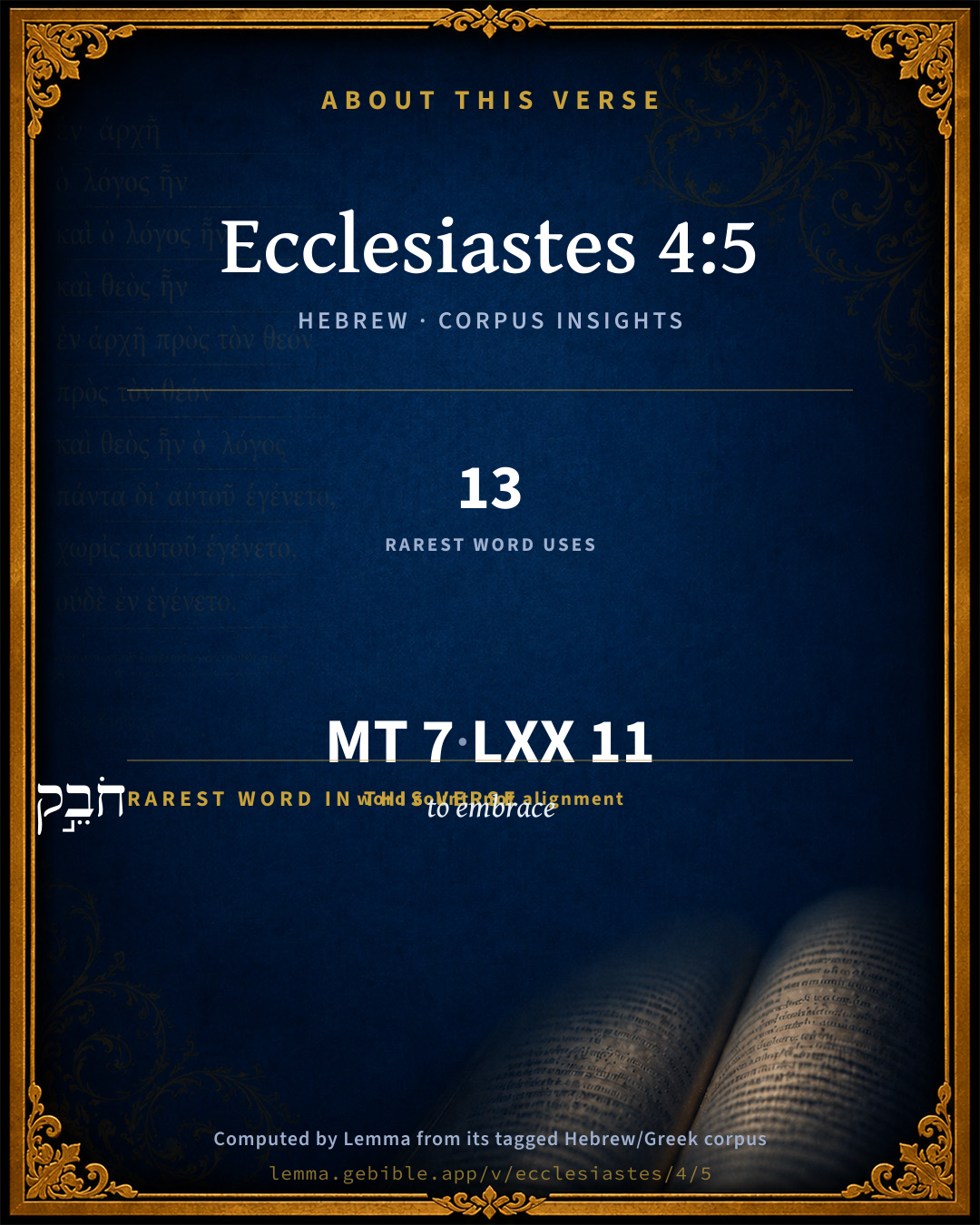
The rarest word here is חֹבֵ֣ק to embrace H2263 — appearing just 13 times in the whole Hebrew Bible.

Shared distinctive vocabulary

חֹבֵ֣ק to embrace H2263 occurs in 12 verses of the Hebrew Bible. Also found in:

Grammatical profile

  • 2 verbs
  • 2 nouns
  • 1 adjective
  • 2 particles

Verb forms

  • חֹבֵ֣ק Qal · Participle Active
  • וְאֹכֵ֖ל Qal · Participle Active

Hebrew & Septuagint length

In English translation the verse runs 9 words from the Hebrew and 11 from the Septuagint (LXX English) — closely comparable.

A rough comparison of the two English renderings, which tokenize alike — not a word-level alignment.

Word counts can differ between the Hebrew and the Greek without any difference in meaning — e.g. the Hebrew direct-object marker אֵת has no separate Greek word, and Greek often adds the article ὁ.

In the original languages it is 7 Hebrew tokens and 11 Greek tokens — but the two are counted differently (Hebrew bundles its prefixes and suffixes into one token; the Greek is in lemma form), so that isn’t a like-for-like length.

Cross-references

8

Topical passages linked to Ecclesiastes 4:5 in the Treasury of Scripture Knowledge — connected by theme and wording, ordered by reader-vote popularity; previews shown in the World English Bible.

  • Proverbs 6:10–11 A little sleep, a little slumber, A little folding of the hands to sleep:
  • Isaiah 9:20 One shall snatch on the right hand, and be hungry; and he shall eat on the left hand, and they shall not be satisfied: they shall eat every man the flesh of his own arm:
  • Proverbs 13:4 The soul of the sluggard desires, and has nothing, But the desire of the diligent shall be fully satisfied.
  • Job 13:14 Why should I take my flesh in my teeth, And put my life in my hand?
  • Proverbs 20:4 The sluggard will not plow by reason of the winter; Therefore he shall beg in harvest, and have nothing.
  • Proverbs 11:17 The merciful man does good to his own soul, But he who is cruel troubles his own flesh.
  • Proverbs 12:27 The slothful man doesn't roast his game, But the possessions of diligent men are prized.
  • Proverbs 24:33–34 A little sleep, a little slumber, A little folding of the hands to sleep;

Cross-references courtesy of OpenBible.info (CC BY 4.0).

Hebrew and Greek witnesses Masoretic Hebrew ↔ Greek Septuagint

The same verse in the two great witnesses to the Old Testament, shown verse-for-verse.

These are two independent witnesses, not word-aligned to each other, and the Septuagint is shown in lemma (dictionary) form.

Hebrew Ecclesiastes 4:5 Masoretic · Westminster Leningrad Codex

הַכְּסִיל֙ חֹבֵ֣ק אֶת יָדָ֔יו וְאֹכֵ֖ל אֶת בְּשָׂרֽוֹ

The fool folds his hands together and ruins himself.

World English Bible · Public Domain

Greek LXX Ecclesiastes 4:5 Septuagint · lemma form

ὁ ἄφρων περιλαμβάνω ὁ χείρ αὐτός καί ἐσθίω ὁ σάρξ αὐτός

The fool folds his hands together, and eats his own flesh.

LXX2012 (modern English Septuagint) · Public Domain

Hebrew: Westminster Leningrad Codex (CC BY 4.0). Greek: Septuagint (public domain); English from LXX2012 (modern English Septuagint) (Public Domain). How the Septuagint differs from the Hebrew →

Commentary

Notes on Ecclesiastes 4:5 from classic Christian and Jewish commentators (each source and its license shown beneath its notes). The classic Christian expositions comment on the surrounding passage and are grouped to its opening verse, so a note may address several verses; the Jewish commentaries on the Tanakh (Rashi and others) are per-verse, so they appear only where the commentator wrote on this verse.

Lemma curates 59 commentaries, every one of them public domain or Creative Commons licensed, each selected and text-cleaned for this edition rather than reprinted as found. About our sources →

The Cambridge Bible for Schools and Colleges

gen. ed. J. J. S. Perowne

5. The fool foldeth his hands together] Simple as the words seem they have received very different interpretations: (1) The fool (the word is the same as in ch. Ecc_2:14-16, and is that, the prominence of which in both Proverbs and Ecclesiastes serve as a connecting link between the two Books), the man without aim or insight, leading a half brutish life, “folds his hands” in the attitude of indolence (Pro_6:10; Pro_24:33), and yet even he, with his limited desires, attains to the fruition of those desires, “eats his meat” and rejoices more than the wise and far-sighted who finds his dexterous and successful work empty and unsatisfying. (So Ginsburg.) For this sense of the words “eateth his flesh,” we have the usage of Exo_16:8; Exo_21:28; Isa_22:13; Eze_39:17. So taken, this thought coheres with the context, and expresses the sense of contrast between the failure of aspiring activity and skill to attain the happiness they aim at, and the fact that those who do not even work for enjoyment get as full a share of it—perhaps, even a fuller—as those who do. (2) The last clause has been interpreted, as in the A.V., as meaning literally that the slothful man “consumes his own flesh,” i.e. reduces himself literally to the poverty and starvation which culminates in horrors such as this, as in Isa_9:20; Jer_19:9, or, figuratively, pines away under the corroding canker of envy and discontent. For the latter meaning, however, we have no authority in the language of the Old Testament, and so taken, the passage becomes only a warning, after the manner of the Proverbs, against the sin of sloth, and as such, is not in harmony with the dominant despondency of this stage of the writer’s experience. The view which sees in Ecc_4:5, the writer’s condemnation of sloth, and in Ecc_4:6 the answer of the slothful, seems out of keeping with the context.

The Cambridge Bible for Schools and Colleges (gen. ed. J. J. S. Perowne; Cambridge University Press, 1878–1918) — public domain. Text from a community e-Sword module.

Trapp's Complete Commentary

John Trapp

Ecc 4:5 The fool foldeth his hands together, and eateth his own flesh.

Ver. 5. The fool foldeth his hands together.] A graphical and lively description of a sluggard, fitly called a fool (φαυλος), a naughty person. "Thou idle and evil servant." {Mat 25:26} God puts no difference between nequaquam and nequam, a drone and a naughty pack, seem he never so "wise in his own eyes," {Pro 26:16} and have he never so much reason to allege for himself - as in the verse here next following; a fool he is, and so he will soon prove himself; for "he folds up his hands and hides them in his own bosom." {Pro 26:15} A great many chares he is likely to do the while: {See Trapp on "Pro 19:24"} And as ( Neque mola, neque farina - nothing do, nothing have) "he eateth his own flesh" - he maketh many a hungry meal, he hath a dog’s life, as we say. "Ease slayeth this fool"; {Pro 1:32, marg.} poverty comes upon him as an armed man; grief also slays him; {Pro 21:25} envy consumes his flesh, and he is vexed at the plenty of painful persons, and, because he cannot come at, or rather pull out their hearts, he feeds upon his own.

John Trapp, A Commentary or Exposition upon All the Books of the Old and New Testament (1647–1656) — public domain. Text from a community e-Sword module.

Joseph Benson's Commentary

Ecc 4:5. The fool foldeth his hands, &c. — Is careless and idle: perceiving that diligence is attended with envy, he runs into the other extreme. And eateth his own flesh — Wastes his substance, and brings himself to poverty, whereby his very flesh pines away for want of bread.

Joseph Benson's Commentary on the Old and New Testaments (1811–1818) — public domain. Text from a community e-Sword module.

Tyndale Open Study Notes

Tyndale Open Resources

4:5-6 Fools do not even try to succeed and end up impoverished. Others frantically devote two handfuls—all their time and effort—to hard work in pursuit of fleeting wealth that they will have no time to enjoy (cp. Prov 23:4-5). Wise people practice moderation and contentment (quietness).

Tyndale Open Study Notes — © Tyndale Open Resources, licensed CC BY-SA 4.0. Text via the HelloAO Bible API.

Geneva Bible (1599)

Geneva Bible translators

For idleness he is compelled to destroy himself.

Geneva Bible (1599) marginal notes — public domain. Text via Bolls.life.

Jamieson, Fausset & Brown

Robert Jamieson, A. R. Fausset & David Brown

Still the

fool (the wicked oppressor) is not to be envied even in this life, who "folds his hands together" in idleness (Pro 6:10; Pro 24:33), living on the means he wrongfully wrests from others; for such a one

eateth his own flesh--that is, is a self-tormentor, never satisfied, his spirit preying on itself (Isa 9:20; Isa 49:26).

Jamieson, Fausset & Brown — Commentary Critical and Explanatory on the Whole Bible (1871) — public domain (CC PDM 1.0). Text via the HelloAO Bible API.

Adam Clarke's Commentary

Verse 5. The fool foldeth his hands] After all, without labour and industry no man can get any comfort in life; and he who gives way to idleness is the veriest of fools.

Adam Clarke's Commentary on the Bible (1810–1826) — public domain. Text from a community e-Sword/MySword module.

Ellicott's Commentary for English Readers

(5) Eateth his own flesh.—Interpreters have usually taken these words metaphorically, as in Psa_27:2; Isa_49:26; Mic_3:3, and understood them as a condemnation of the sluggard’s conduct as suicidal. But it has been proposed, taking the verse in connection with that which precedes and those which follow, to understand them literally, “eats his meat;” the sense being that, considering the emulation and envy involved in all successful exertion, one is tempted to say that the sluggard does better who eats his meat in quiet. There is, however, no exact parallel to the phrase “eats his flesh;” and I think that if the latter were the meaning intended, it would have been formally introduced in some such way as, “Wherefore I praised the sluggard.” Adopting, then, the ancient interpretation, we understand the course of conduct recommended to be the golden mean between the ruinous sloth of the fool and the vexatious toil of the ambitious man.

A Bible Commentary for English Readers, edited by Charles John Ellicott (1878–1897) — public domain. Text from a community e-Sword module.

John Gill's Exposition

The fool foldeth his hands together,.... In order to get more sleep, or as unwilling to work; so the Targum adds,

"he folds his hands in summer, and will not labour;''

see Pro 6:10. Some persons, to escape the envy which diligence and industry bring on men, will not work at all, or do any right work, and think to sleep in a whole skin; this is great folly and madness indeed:

and eateth his own flesh; such a man is starved and famished for want of food, so that his flesh is wasted away; or he is so hungry bitten, that he is ready to eat his own flesh; or he hereby brings to ruin his family, his wife, and children, which are his own flesh, Isa 58:7. The Targum is,

"in winter he eats all he has, even the covering of the skin of his flesh.''

Some understand this of the envious man, who is a fool, traduces the diligent and industrious, and will not work himself; and not only whose idleness brings want and poverty on him as an armed man, but whose envy eats up his spirit, and is rottenness in his bones, Pro 6:11. Jarchi, out of a book of theirs called Siphri, interprets this of a wicked man in hell, when he sees the righteous in glory, and he himself judged and condemned.

John Gill's Exposition of the Whole Bible (1746–1763) — public domain (CC PDM 1.0). Text via the HelloAO Bible API.

Albert Barnes' Notes on the Bible

Foldeth his hands - The envious man is here exhibited in the attitude of the sluggard (marginal references).

Eateth his own flesh - i. e., “Destroys himself:” compare a similar expression in Isa 49:26; Psa 27:2; Mic 3:3.

Albert Barnes' Notes on the Bible (1834–1885) — public domain. Text from a community e-Sword/MySword module.

Haydock's Catholic Bible Commentary

Flesh, which he will not labour to sustain; (Haydock) or he repines at his own past misconduct, and at the affluence of others.

George Leo Haydock (1774–1849), Haydock's Catholic Family Bible and Commentary, 1859 edition — public domain. Excludes Psalms (Douay-Rheims chapter numbering differs from Protestant) and Deuterocanonical books (Catholic canon only).

Matthew Poole's English Annotations

Foldeth his hands together; is careless and idle, which is the signification of this gesture, Pro 6:10; 19:24; 26:15. Perceiving that diligence is attended with envy, Ecc 4:4, he, like a fool, runs into the other extreme.

Eateth his own flesh; wasteth his substance, and bringeth himself to poverty, whereby his very flesh pineth away for want of bread, and he is reduced to skin and bone; and if he have any flesh left, he is ready to eat it through extremity of hunger.

Matthew Poole's English Annotations on the Holy Bible (1683–1685) — public domain. Text from a community e-Sword/MySword module.

Whedon's Commentary on the Bible

Daniel D. Whedon

5. The fool… eateth his own flesh — The activity of the jealous is here contrasted with the quiet of the stupid, to the advantage of the latter: The stupid foldeth his hands, yet hath meat to eat. This can be said of him, that he enjoys the common blessings of life with small care or anxiety. Fool as he is, he shows something of philosophic calm and content.

Daniel D. Whedon (gen. ed.), Commentary on the Old and New Testaments (1874–1909) — public domain. Text from a community e-Sword module.

The Pulpit Commentary

The connection of this verse with the preceding is this: activity, diligence, and skill indeed bring success, but success is accompanied by sad results. Should we, then, sink into apathy, relinquish work, let things slide? Nay, none but the fool (kesil), the insensate, half-brutish man, doth this. The fool foldeth his hands together. The attitude expresses laziness and disinclination for active labor, like that of the sluggard in Pro_6:10. And eateth his own flesh. Ginsburg, Plumptre, and others take these words to mean "and yet eats his meat," i.e. gets that enjoyment from his sluggishness which is denied to active diligence. They refer, in proof of this interpretation, to Exo_16:8 Exo_21:28; Isa_22:13; Eze_39:17, in which passages, however, the phrase is never equivalent to "eating his food." The expression is really equivalent to "destroys himself," "brings ruin upon himself." Thus we have in Psa_27:2, "Evildoers came upon me to eat up my flesh;" and in Mic_3:3, "Who eat the flesh of my people". (comp. Isa_49:26) The sluggard is guilty ofmoral suicide; he takes no trouble to provide for his necessities, and suffers extremities in consequence. Some see in this verse and the following an objection and its answer. There is no occasion for this view, and it is not in keeping with the context; but it contains an intimation of the true exposition, which makes ver. 6 a proverbial statement of the sluggard"s position. The verbs in the text are participial in form, so that the Vulgate rendering, which supplies a verb, is quite admissible: Stultus complicat manna suas, et comedit carnes suas, dicens: Melior est, etc.

The Pulpit Commentary (1880–1919), ed. H.D.M. Spence-Jones & Joseph S. Exell — public domain. Text from a community e-Sword module.

John Wesley's Explanatory Notes

The fool - Is careless and idle: perceiving that diligence is attended with envy, he runs into the other extreme. Eateth - Wastes his substance, and brings himself to poverty, whereby his very flesh pines away for want of bread.

John Wesley, Explanatory Notes Upon the Whole Bible (1754–1765) — public domain. Text via the GEBible commentary corpus.

Keil & Delitzsch

C. F. Keil & F. Delitzsch

There ought certainly to be activity according to our calling; indolence is self-destruction: "The fool foldeth his hands, and eateth his own flesh." He layeth his hands together (Prov 6:10-24:33), - placeth them in his bosom, instead of using them in working, - and thereby he eateth himself up, i.e., bringeth ruin upon himself (Psa 27:2; Mic 3:3; Isa 49:26); for instead of nourishing himself by the labour of his hands, he feeds on his own flesh, and thus wasteth away. The emphasis does not lie on the subject (the fool, and only the fool), but on the pred.

Keil & Delitzsch — Biblical Commentary on the Old Testament (1861–1891) — public domain (CC PDM 1.0). Text via the HelloAO Bible API. (Old Testament only.)

unfoldingWord translationNotes

Door43 World Missions Community

The fool folds his hands and does not work

To fold the hands is a gesture of laziness and is another way of saying that the person refuses to work. AT: "The fool refuses to work" (See: Symbolic Action and Parallelism)

so his food is his own flesh

This speaks of a person destroying himself as if he were eating his own body. AT: "as a result, he causes his own ruin" or "and as a result, he destroys himself" (See: Metaphor)

a handful

"a small amount"

two handfuls

"a large amount." It is understood that this refer to profit gained. AT: "two handfuls of profit" or "a large amount of profit" (See: Ellipsis)

that tries to shepherd the wind

The author speaks of everything that people do as being useless as if they were trying to control the wind. See how you translated a similar phrase in Ecclesiastes 1:14. AT: "that is as useless as trying to control the wind" (See: Metaphor)

translationWords

fool

works

flesh

profit

unfoldingWord translationNotes — © Distant Shores Media and the Door43 World Missions Community, licensed CC BY-SA 4.0. Source: git.door43.org/Door43/en_tn.

Rashi

Rabbi Shlomo Yitzchaki (Rashi)

The fool The wicked man

folds his hands and does not toil, and he does not eat except from robbery.

and eats his own flesh on the Day of Judgment, when he sees righteous men experiencing honor, while he is being judged. It is explained in this manner in Sifrei (Deut. 11:26).

Rashi on the Tanakh — English translations: “The Judaica Press complete Tanach with Rashi, translated by A. J. Rosenberg” (CC BY 4.0); “Pentateuch with Rashi's commentary by M. Rosenbaum and A.M. Silbermann, 1929-1934” (public domain); “The Metsudah Tanach series, Lakewood, N.J” (CC BY 4.0); and “The Book of Joshua, Metsudah Publications, 1997” (CC BY 4.0). Text via Sefaria.

Lesson kit

Teaching starters — assembled from the data on this page, not authored interpretation. Every prompt links to the verse data it draws on. Edit before teaching.

Ecclesiastes, in the Wisdom, opens this verse with 7 words (6 distinct Hebrew lemmas). Its most distinctive word is châbaq (“to embrace”). A historical commentator’s framing appears above. Read the whole chapter for the surrounding context.

Discussion questions

  1. How does “to embrace” (châbaq) shape what this verse is saying?
  2. How does Genesis 29:13, which shares the word «to embrace», read alongside this verse?
  3. These translations render this verse differently; the difference is in the English rendering, not the original. What questions does that raise?
  4. «חֹבֵ֣ק» is a Qal Participle Active verb. How does that grammatical form shape the action described?
  5. Compare how The Cambridge Bible for Schools and Colleges and Trapp's Complete Commentary read this verse. Where do they agree or differ?

Things to notice

Reading settings

Reading text

Shown beneath each verse's original-language words.

Old Testament
Old Testament edition

Read the OT as the Masoretic Hebrew (MT) or the Greek Septuagint (LXX).

English shown for the Greek Septuagint (in the Hebrew ↔ Greek comparison).

Comparing translations? Open the Compare panel on any verse page to stack up to four side by side.