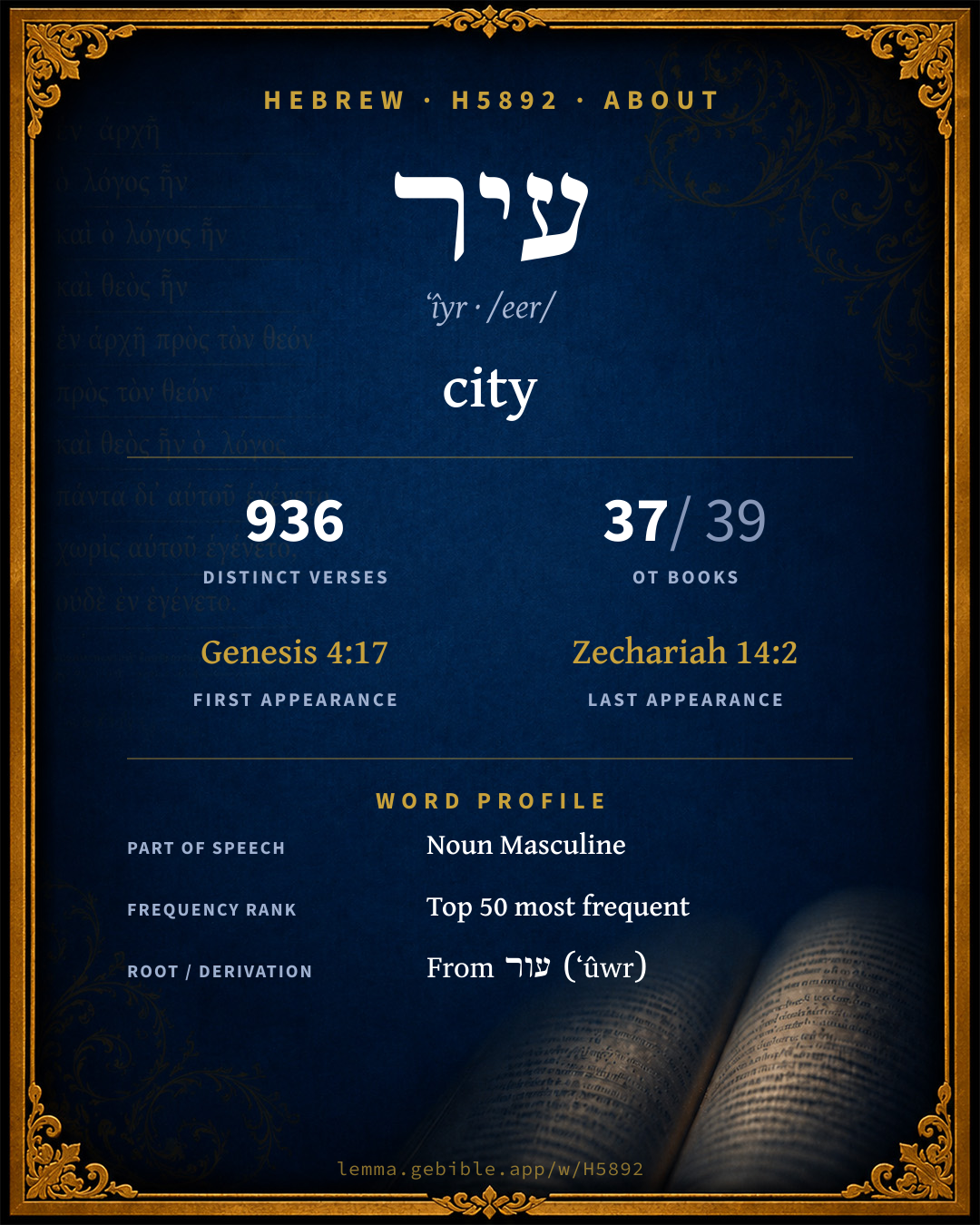
עִיר
city
‘city’ is one of 2 main senses fuller range ↓
Full lexicon entry — Brown-Driver-Briggs (BDB)
From Brown-Driver-Briggs (BDB)
Where this word appears
See every Absolute-state word in the Hebrew Bible →
Grammar key — what these labels mean
Part of speech
- Noun
- A naming word — a person, place, thing, or idea.
Noun type
- Common
- A common noun — a general class of person, place, or thing (“king,” “city,” “water”), not a specific name.
- Proper
- A name of a specific person, place, or people (e.g. Abraham, Zion, Israel).
State
- Absolute
- The independent form of a noun, not bound to a following word.
- Construct
- A noun bound to a following noun in a possessive / “of” relationship (the construct chain).
Gender
- Feminine
- Grammatically feminine.
- Masculine
- Grammatically masculine.
Number
- Singular
- One.
- Plural
- More than one (in Hebrew, generally three or more).
Every verse where H5892 appears in the Book of 1 Kings — 47 distinct verses. Click any verse to open its interlinear word-by-word view. Verse text shown in the World English Bible for context — . Each verse’s Hebrew form is shown with its reference; the English is not keyword-highlighted, since the data carries no word-level English alignment. Use “Compare translations” on any verse to read it across multiple English versions. This concordance covers the Hebrew Bible; Septuagint (Greek Old Testament) occurrences are not indexed here.
1 Kings
- 1 Kings 2:10 בְּ/עִ֥יר prep + n c fs cs David slept with his fathers, and was buried in the city of David.
- 1 Kings 3:1 עִ֣יר n c fs cs Solomon made affinity with Pharaoh king of Egypt, and took Pharaoh's daughter, and brought her into the city of David, until he had made an end of building his own house, and the house of Yahweh, and the wall of Jerusalem round about.
- 1 Kings 4:13 עָרִ֣ים n c fp Ben Geber, in Ramoth-gilead (to him [pertained] the towns of Jair the son of Manasseh, which are in Gilead; [even] to him [pertained] the region of Argob, which is in Bashan, sixty great cities with walls and brazen bars);
- 1 Kings 8:1 מֵ/עִ֥יר prep + n c fs cs Then Solomon assembled the elders of Israel, and all the heads of the tribes, the princes of the fathers' [houses] of the children of Israel, to king Solomon in Jerusalem, to bring up the ark of the covenant of Yahweh out of the city of David, which is Zion.
- 1 Kings 8:16 בְ/עִ֗יר prep + n c fs Since the day that I brought forth my people Israel out of Egypt, I chose no city out of all the tribes of Israel to build a house, that my name might be there; but I chose David to be over my people Israel.
- 1 Kings 8:44 הָ/עִיר֙ ptcl def.art + n c fs If your people go out to battle against their enemy, by whatever way you shall send them, and they pray to Yahweh toward the city which you have chosen, and toward the house which I have built for your name;
- 1 Kings 8:48 הָ/עִיר֙ ptcl def.art + n c fs if they return to you with all their heart and with all their soul in the land of their enemies, who carried them captive, and pray to you toward their land, which you gave to their fathers, the city which you have chosen, and the house which I have built for your name:
- 1 Kings 9:11 עִ֔יר n c fs (now Hiram the king of Tyre had furnished Solomon with cedar trees and fir trees, and with gold, according to all his desire), that then king Solomon gave Hiram twenty cities in the land of Galilee.
- 1 Kings 9:12 הֶ֣/עָרִ֔ים ptcl def.art + n c fp Hiram came out from Tyre to see the cities which Solomon had given him; and they didn't please him.
- 1 Kings 9:13 הֶ/עָרִ֣ים ptcl def.art + n c fp He said, What cities are these which you have given me, my brother? He called them the land of Cabul to this day.
- 1 Kings 9:16 בָּ/עִ֖יר prep det + n c fs Pharaoh king of Egypt had gone up, and taken Gezer, and burnt it with fire, and slain the Canaanites who lived in the city, and given it for a portion to his daughter, Solomon's wife.
- 1 Kings 9:19 עָרֵ֤י עָרֵ֣י עָרֵ֣י n c fp cs n c fp cs n c fp cs and all the store-cities that Solomon had, and the cities for his chariots, and the cities for his horsemen, and that which Solomon desired to build for his pleasure in Jerusalem, and in Lebanon, and in all the land of his dominion.
- 1 Kings 9:24 מֵ/עִ֣יר prep + n c fs cs But Pharaoh's daughter came up out of the city of David to her house which [Solomon] had built for her: then did he build Millo.
- 1 Kings 10:26 בְּ/עָרֵ֣י prep + n c fp cs Solomon gathered together chariots and horsemen: and he had a thousand and four hundred chariots, and twelve thousand horsemen, that he bestowed in the chariot cities, and with the king at Jerusalem.
- 1 Kings 11:27 עִ֖יר n c fs cs This was the reason why he lifted up his hand against the king: Solomon built Millo, and repaired the breach of the city of David his father.
- 1 Kings 11:32 הָ/עִיר֙ ptcl def.art + n c fs (but he shall have one tribe, for my servant David's sake and for Jerusalem's sake, the city which I have chosen out of all the tribes of Israel);
- 1 Kings 11:36 הָ/עִיר֙ ptcl def.art + n c fs To his son will I give one tribe, that David my servant may have a lamp always before me in Jerusalem, the city which I have chosen me to put my name there.
- 1 Kings 11:43 בְּ/עִ֖יר prep + n c fs cs Solomon slept with his fathers, and was buried in the city of David his father: and Rehoboam his son reigned in his place.
- 1 Kings 12:17 בְּ/עָרֵ֣י prep + n c fp cs But as for the children of Israel who lived in the cities of Judah, Rehoboam reigned over them.
- 1 Kings 13:25 בָ/עִ֔יר prep det + n c fs Behold, men passed by, and saw the body cast in the way, and the lion standing by the body; and they came and told it in the city where the old prophet lived.
- 1 Kings 13:29 עִיר֙ n c fs cs The prophet took up the body of the man of God, and laid it on the donkey, and brought it back; and he came to the city of the old prophet, to mourn, and to bury him.
- 1 Kings 13:32 בְּ/עָרֵ֥י prep + n c fp cs For the saying which he cried by the word of Yahweh against the altar in Bethel, and against all the houses of the high places which are in the cities of Samaria, shall surely happen.
- 1 Kings 14:11 בָּ/עִיר֙ prep det + n c fs Him who dies of Jeroboam in the city shall the dogs eat; and him who dies in the field shall the birds of the sky eat: for Yahweh has spoken it.
- 1 Kings 14:12 הָ/עִ֖ירָ/ה ptcl def.art + n c fs + sfx dem Arise you therefore, get you to your house: [and] when your feet enter into the city, the child shall die.
- 1 Kings 14:21 הָ֠/עִיר ptcl def.art + n c fs Rehoboam the son of Solomon reigned in Judah. Rehoboam was forty-one years old when he began to reign, and he reigned seventeen years in Jerusalem, the city which Yahweh had chosen out of all the tribes of Israel, to put his name there: and his mother's name was Naamah the Ammonitess.
- 1 Kings 14:31 בְּ/עִ֣יר prep + n c fs cs Rehoboam slept with his fathers, and was buried with his fathers in the city of David: and his mother's name was Naamah the Ammonitess. Abijam his son reigned in his place.
- 1 Kings 15:8 בְּ/עִ֣יר prep + n c fs cs Abijam slept with his fathers; and they buried him in the city of David: and Asa his son reigned in his place.
- 1 Kings 15:20 עָרֵ֣י n c fp cs Ben Hadad listened to king Asa, and sent the captains of his armies against the cities of Israel, and struck Ijon, and Dan, and Abel Beth Maacah, and all Chinneroth, with all the land of Naphtali.
- 1 Kings 15:23 וְ/הֶֽ/עָרִים֙ conj + ptcl def.art + n c fp Now the rest of all the acts of Asa, and all his might, and all that he did, and the cities which he built, aren't they written in the book of the chronicles of the kings of Judah? But in the time of his old age he was diseased in his feet.
- 1 Kings 15:24 בְּ/עִ֖יר prep + n c fs cs Asa slept with his fathers, and was buried with his fathers in the city of David his father; and Jehoshaphat his son reigned in his place.
- 1 Kings 16:4 בָּ/עִ֔יר prep det + n c fs Him who dies of Baasha in the city shall the dogs eat; and him who dies of his in the field shall the birds of the sky eat.
- 1 Kings 16:18 הָ/עִ֔יר ptcl def.art + n c fs It happened, when Zimri saw that the city was taken, that he went into the castle of the king's house, and burnt the king's house over him with fire, and died,
- 1 Kings 16:24 הָ/עִיר֙ ptcl def.art + n c fs He bought the hill Samaria of Shemer for two talents of silver; and he built on the hill, and called the name of the city which he built, after the name of Shemer, the owner of the hill, Samaria.
- 1 Kings 17:10 הָ/עִ֔יר ptcl def.art + n c fs So he arose and went to Zarephath; and when he came to the gate of the city, behold, a widow was there gathering sticks: and he called to her, and said, Please get me a little water in a vessel, that I may drink.
- 1 Kings 20:2 הָ/עִֽירָ/ה ptcl def.art + n c fs + sfx dem He sent messengers to Ahab king of Israel, into the city, and said to him, Thus says Ben Hadad,
- 1 Kings 20:12 הָ/עִֽיר ptcl def.art + n c fs It happened, when [Ben Hadad] heard this message, as he was drinking, he and the kings, in the pavilions, that he said to his servants, Set [yourselves in array]. They set [themselves in array] against the city.
- 1 Kings 20:19 הָ/עִ֔יר ptcl def.art + n c fs So these went out of the city, the young men of the princes of the provinces, and the army which followed them.
- 1 Kings 20:30 הָ/עִיר֒ הָ/עִ֖יר ptcl def.art + n c fs ptcl def.art + n c fs But the rest fled to Aphek, into the city; and the wall fell on twenty-seven thousand men who were left. Ben Hadad fled, and came into the city, into an inner chamber.
- 1 Kings 20:34 הֶ/עָרִ֣ים ptcl def.art + n c fp [Ben Hadad] said to him, The cities which my father took from your father I will restore; and you shall make streets for you in Damascus, as my father made in Samaria. I, [said Ahab], will let you go with this covenant. So he made a covenant with him, and let him go.
- 1 Kings 21:8 בְּ/עִיר֔/וֹ prep + n c fs cs + sfx pers 3ms So she wrote letters in Ahab's name, and sealed them with his seal, and sent the letters to the elders and to the nobles who were in his city, [and] who lived with Naboth.
- 1 Kings 21:11 עִיר֜/וֹ בְּ/עִיר֔/וֹ n c fs cs + sfx pers 3ms prep + n c fs cs + sfx pers 3ms The men of his city, even the elders and the nobles who lived in his city, did as Jezebel had sent to them, according as it was written in the letters which she had sent to them.
- 1 Kings 21:13 לָ/עִ֔יר prep det + n c fs The two men, the base fellows, came in and sat before him: and the base fellows bore witness against him, even against Naboth, in the presence of the people, saying, Naboth did curse God and the king. Then they carried him forth out of the city, and stoned him to death with stones.
- 1 Kings 21:24 בָּ/עִ֔יר prep det + n c fs Him who dies of Ahab in the city the dogs shall eat; and him who dies in the field shall the birds of the sky eat.
- 1 Kings 22:26 הָ/עִ֑יר ptcl def.art + n c fs The king of Israel said, Take Micaiah, and carry him back to Amon the governor of the city, and to Joash the king's son;
- 1 Kings 22:36 עִיר֖/וֹ n c fs cs + sfx pers 3ms There went a cry throughout the host about the going down of the sun, saying, Every man to his city, and every man to his country.
- 1 Kings 22:39 הֶ/עָרִ֖ים ptcl def.art + n c fp Now the rest of the acts of Ahab, and all that he did, and the ivory house which he built, and all the cities that he built, aren't they written in the book of the chronicles of the kings of Israel?
- 1 Kings 22:50 בְּ/עִ֖יר prep + n c fs cs Jehoshaphat slept with his fathers, and was buried with his fathers in the city of David his father; Jehoram his son reigned in his place.
About this entry
At a glance — auto-summarized from this page’s data, not written by a person. Every figure links to its source below. This summary describes the numbers; it doesn’t interpret them.
The Hebrew noun עיר centers on the idea of “city.” Its earliest occurrence is Genesis 4:17. It turns up in 936 verses across 37 books, one of the most common footprint. The lexicon spreads it across several senses; see its full sense range. It shares a root with עור, עיר and עיר. For the data behind this summary, explore the sense tree and the renderings breakdown below.
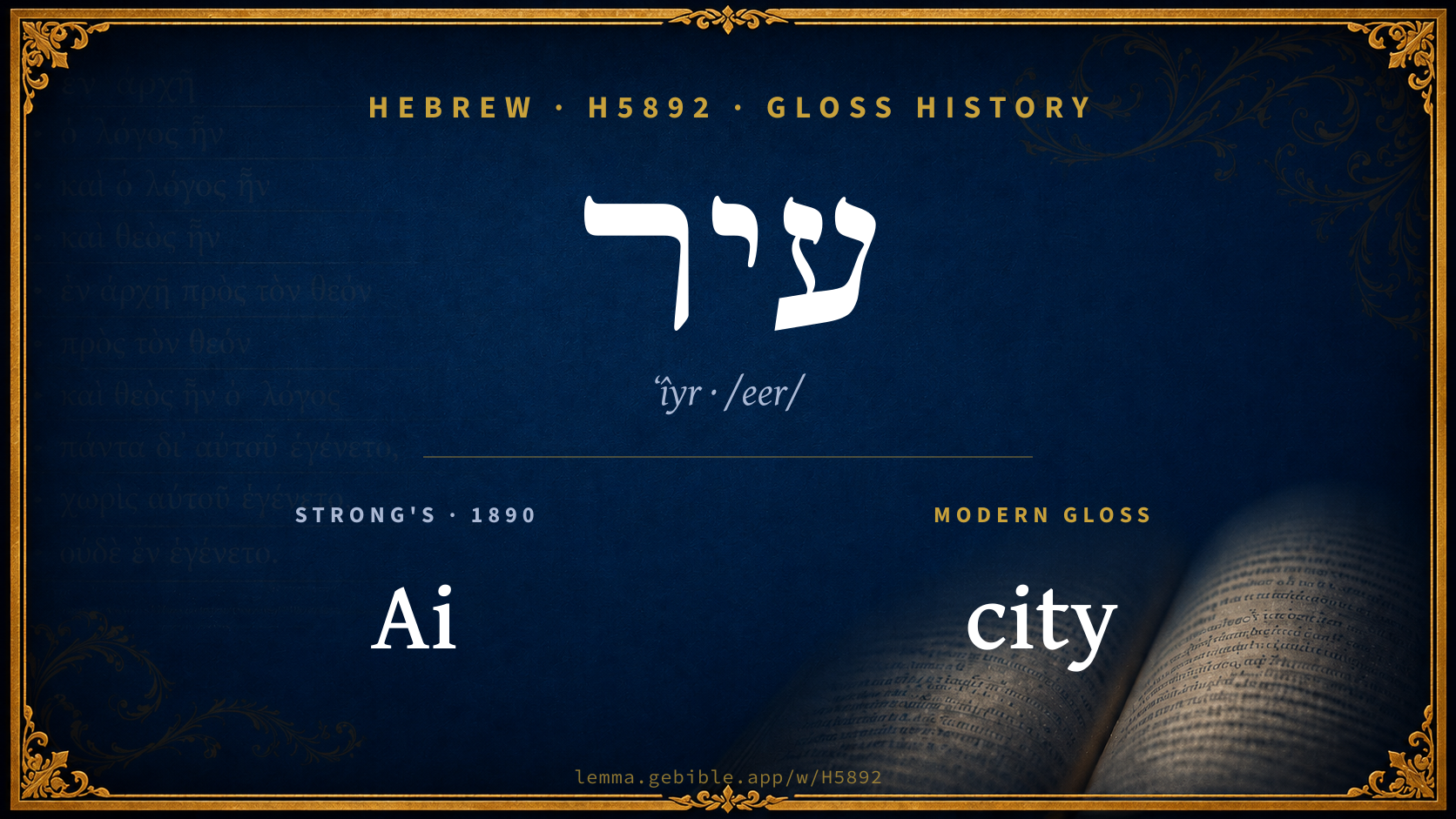
Gloss history
Strong's 1890 vs modern scholarship
About this word
Strong's H5892 catalogs a Hebrew word from the Hebrew Old Testament.
These counts are not copied from any lexicon or concordance. They are computed here, from the morphology-tagged Hebrew Old Testament. What Lemma adds →
- 936
- distinct verses
- The word appears in 936 distinct verses.
- 37 / 39
- OT books
- The word appears in 37 of 39 Old Testament books.
- #35
- by frequency
- Top 50 most frequent Hebrew words (rank 35 of 8,640 Hebrew words by occurrence).
View all 936 occurrences in the concordance →
Most concentrated in
- Joshua 128 verses 14%
- Jeremiah 118 verses 13%
- 2 Chronicles 74 verses 8%
By section of the Old Testament
By traditional corpus
Conventional, traditional groupings — biblical authorship is debated, so this is a traditional corpus grouping, not an authorship claim. Each share is this word’s portion of its verses in that division of the Hebrew canon. Each figure is a share of the word’s 936 distinct verses.
- Prophets (Nevi'im) 602 verses · 64%
- Writings (Ketuvim) 191 verses · 20%
- Torah (Pentateuch) 143 verses · 15%
How translations render this word
Counts come from each version’s own published word-to-Strong’s tagging or interlinear alignment — an approximate guide to how each version renders this word, not a word-level alignment the data otherwise carries. Because each total is that version’s own tagged count, the per-version totals vary from one another and need not match the appearance or distinct-verse counts above. These counts may also differ from a printed concordance because Lemma counts each distinctly tagged rendering and does not collapse phrase taggings into a single head-word total. This is a fixed set of word-tagged versions (KJV, ASV, BSB, ULT) and does not change with the reading translation you choose elsewhere. Each version’s license is shown beside its name below (and on Sources).
BDB lists this Strong’s number as 4 distinct words (homographs). Each count above pools all of them and is not split by sense — see the Senses section below. A low-frequency rendering may belong to a different one of those words, not the primary meaning.
- King James Version†: City 554×, Cities 316×, All the cities 34×
- American Standard Version†: City 504×, Cities 294×, All the cities 32×
- Berean Standard Bible†: City 567×, Cities 332×, Towns 20×
- unfoldingWord Literal Text†: City 486×, Cities 246×, Cities of 115×
King James Version Public Domain
Renders H5892 across 1,081† tagged occurrences — most commonly:
Plus other, less common renderings. Plus 100 renderings that appear only once — usually multi-word phrases or single function words the recovered tagging swept in, not distinct renderings. Not rendered by a distinct English word in 8 further occurrences.
American Standard Version Public Domain
Renders H5892 across 1,079† tagged occurrences — most commonly:
Plus other, less common renderings. Plus 157 renderings that appear only once — usually multi-word phrases or single function words the recovered tagging swept in, not distinct renderings.
Berean Standard Bible Public Domain
Renders H5892 across 1,034† tagged occurrences — most commonly:
Plus other, less common renderings. Plus 56 renderings that appear only once — usually multi-word phrases or single function words the recovered tagging swept in, not distinct renderings. Not rendered by a distinct English word in 58 further occurrences.
unfoldingWord Literal Text CC BY-SA 4.0
Renders H5892 across 1,092† tagged occurrences — most commonly:
Plus other, less common renderings. Plus 48 renderings that appear only once — usually multi-word phrases or single function words the recovered tagging swept in, not distinct renderings.
12 senses and sub-senses in the full BDB
What do BDB’s symbols mean?
BDB uses these scholarly abbreviations:
| Symbol | Meaning |
|---|---|
| 𝔊 | the Septuagint (the ancient Greek translation, LXX) |
| 𝔙 | the Vulgate (the Latin translation) |
| 𝔖 | the Syriac version (the Peshitta) |
| 𝔗 | the Targum (the Aramaic translation) |
| ψ | the Psalms |
| √ | root (the underlying root or stem) |
| ‖ | parallel passage (a synonymous or contrasted parallel) |
| † | the dagger: every passage where the word occurs is cited |
The 12 senses and sub-senses the full Brown-Driver-Briggs lexicon distinguishes for this word, in lexicon order (not ranked by frequency), with BDB’s own verbatim wording and sub-sense lettering. Shown in Hebrew script with BDB’s own scholarly abbreviations. The condensed entry is in the Lexicon Entry tab. See also the Forms in the corpus table below.
עיר I [m.] agitation
עיר II
- 1. city, town, abode of men Gn 4:17 (J) and often; גְּדֹלָה 10:12 (J), +, or קְטַנָּה Ec 9:14 (cf. Gn 19:20); especially e.g. Genesis 4:17
- a. fortified: עָרִים בְּצֻרוֹת 2 S 20:6 +, etc., v. בָּצַר, מִבְצָר; עִיר מִבְצַר־צֹר Jos 19:29 (P) fortified city (of) Tyre, ע׳ מָצוֹר ψ 31:22 +, etc., v. מָצוֹר, מְצוּרָה sub צוּר (Mi 7:12 v. מָצוֹר p. 596 a); ע׳ עָז־לָנוּ Is 26:1, עָרֵי מָעוּזּוֹ 17:9; ע׳ דְּלָתַים וּבְרִיחַ 1 S 23:7; ע׳ חוֹמָה Lv 25:29, cf. v 30 (P), 1 K 4:13; on Ho 10:14 v. i. עַם 2 b (1 S 9:14 read הַשַּׁעַר 𝔊 We Dr al.). e.g. 2 Samuel 20:6
- b. opp. כֹּפֶר הַפְּרָוִי 1 S 6:18, עָרֵי הַפּ׳ Dt 3:5, ע׳ הַפְּרָזוֹת Est 9:19; disting. from dependencies חֲצֵרִים Jos 13:23 + often P e.g. 1 Samuel 6:18
- c. עָרֶיהָ are dependent towns Jos 13:17 (P), Je 19:15. e.g. Joshua 13:17
- d. עָרֵי הַמַּמְלָכָה Jos 10:2 (JE) royal cities (i.e. with a king, cf. Tel Am. al šarri;), so sg. 1 S 27:5, opp. עָרֵי הַשָּׂדֶה v 5 rural towns; ע׳ הַמְּלוּכָה 2 S 12:26 (but read ע׳ הַמַּיִם We Bu Kit Löhr HPS, v. 2 infr.). e.g. Joshua 10:2
- e. עָרֵי מִסְכְּנוֹת Ex 1:11 storage-cities, so 1 K 9:19 = 2 Ch 8:6; 2 Ch 8:4; 17:12; for מ׳ ע׳ נַפְתָּלִי 16:4 read prob. כִּנְרוֹת עַל־וגו׳ (as 1 K 15:20; Be Kit Buhl); cf. ע׳ הָרֶכֶב 1 K 9:19; 10:26 = 2 Ch 8:6; 9:25; 2 Ch 1:14; ע׳ הַפָּרָשִׁים 1 K 9:19 = 2 Ch 8:6. e.g. Exodus 1:11
- f. ע׳ (הַ)מִקְלָט (P) asylum-cities Nu 35:11, 13, 14; Jos 20:2, cf. Nu 35:25, 26, 27, 28, 32, ע׳ לְמִקְלָט v 12; ע׳ מִקְלַט הָרֹצֵחַ Jos 21:13 + 4 times 21. e.g. Numbers 35:11
- g. ע׳ (הָ)אֱלֹהִים = Jerus.: ψ 46:5; 87:3, cf. 48:2, 9; ע׳ י׳ Is 60:14 ψ 101:8; ע׳ י׳ צְבָאוֹת 48:9. e.g. Psalms 46:5
- h. city = inhabitants 1 S 4:13; 5:12; Is 22:2 Ru 1:19, so 2 S 20:22 (reading הָעִיר for MT הָעָם) 𝔊 We Dr al. (cf. also foll.). e.g. 1 Samuel 4:13
- i. combinations are: ע׳ רֹכְלִים Ez 17:4 city of merchants; ע׳ מוֹשָׁב ψ 107:4, 7, 36 city for dwelling; especially of character or condition: †ע׳ הַצֶּדֶק Is 1:26, †ע׳ הָאֱמֶת Zc 8:3; †ע׳ הַקֹּדֶשׁ Is 48:2; 52:1 Ne 11:1, 18, cf. Dn 9:24, all of Jerus.; עָרֵי קָדְשֶׁ֑ךָ Je 5:17 of Judaean cities; of foreign cities, ע׳ תְּהִלָּה Je 49:25, הַהֻלָּלָה הָע׳ Ez 26:17, הָע׳ הָעַלִּיזָה Zp 2:15; of Jerus. also הָע׳ הַיּוֹנָה Zp 3:1 oppressive city, ע׳ (הַ)דָּמִים bloody city Ez 22:2; 24:6, 9 and (of Nineveh) Na 3:1. e.g. Ezekiel 17:4
- 2. of fortress in a city especially עִיר דָּוִד 2 S 5:7, 9; 6:10 + often (v. דָּוִד); ע׳ בֵּית הַבָּ֑עַל 2 K 10:25 (crpt.; Klo proposes דְּבִיר for ע׳, cf. Kmp Benz Kit); ע׳ הַמַּיִם 2 S 12:27 (so read also v 26, see 1 d). e.g. 2 Samuel 5:7
- 3. appar. fortified place, of any size, בְּכָל־עָרֵיהֶם מִמִּגְדַּל נוֹצְרִים עַד־ עִיר מִבְצָר 2 K 17:9 = 18:8; cf. Nu 13:9 (P; but on comp. of ver. see Di); perhaps also ע׳ עֲמָלֵק 1 S 15:5 (HPS).—Ho 7:4 v. I. עור Hiph. e.g. 2 Kings 17:9
עיר III m. in בְּנֵי ע׳ 1 Ch 7
Senses from the full Brown-Driver-Briggs lexicon (Brown, Driver, Briggs; Oxford 1906 — public domain), digitized via Sefaria, supplemented by the OpenScriptures HebrewLexicon (CC BY 4.0). Full attribution on Sources.
Word origin
I. n.[m.] agitation;—of terror, ע׳ וּבֶהָלוֹת Je 15:8; of rage (si vera l.), לֹא אָבוֹא בְּעִיר Ho 11:9, but St proposes לְבָעֵר cf. We Oort Now GASm.—בָּעִיר ψ 73:20 v. עור Hiph.—ii, iii. עִיר v. p. 746 infr.
III. n.f. Gn 10:12 (AlbrechtZAW xvi. 49 f.) city, town (√ unkn.; NH id.;? Ph. ער Lzb345; Sab. ער fortified height (cf. 3) PräZMG xxvi (1872), 437, ערן, עהרן city CISiv. pp. 94, 95, 173);—ע׳ abs. Gn 4:17 +, cstr. 24:10 +; הָעִ֫ירָה 1 K 14:12 + 7 times; sf. עִירִי 2 S 19:38 + 2 times, etc.; pl. עָרִים Is 6:11 +, עֲיָרִים Ju 10:4 (textual error, or word-play, cf. GFM); cstr. עָרֵי Gn 19:29 +; sf. עָרַי Zc 1:17, עָרֵיכֶם Is 1:7 +, etc.;—
IV. n.pr.m. in בְּנֵי ע׳ 1 Ch 7:12, text dub., v. Be Kau.
— Brown-Driver-Briggs (Oxford 1906, public domain), digitized via Sefaria, supplemented by the OpenScriptures HebrewLexicon (CC BY 4.0). See Sources.
Derived from עור (ʻûwr) (H5782) — to awake.
Jastrow Dictionary
A second Hebrew/Aramaic lexicon for comparison, covering Aramaic and post-biblical (Talmudic, Targumic, Midrashic) usage that the biblical-Hebrew BDB does not. Matched by lemma rather than by Strong’s number, so a lemma may carry more than one Jastrow headword (shown separately below), and the entries cover usage well beyond the Bible.
עֲיָירוֹת
- , pl. of עִיר.
*עַיִר
- (= h. עַיִר; v. עוּר; cmp. נַעַר) foal. Targ. Zech. IX, 9.—Pl. עַיְרִין. Targ. Jud. X, 4; v. עִיל.
עִיר I
- (עוּר) guardian, angel. Midr. Till. to Ps. CXVIII, 8 ולא ירד עמו לא ע׳ ולא שרף וכ׳ ed. Bub. (oth. ed. לא ע׳ ולא קדיש, borrowed from Dan. IV, 10) nor went down with him (Abraham) a guardian, or Seraph, or angel. Ib. to Ps. 1 (play on עיר, Gen. XI, 4) ואין ע׳ אלא אלוה ʿir means a deity (ref. to Dan. l. c.).—Pl. עִירִין. Pes. 33ᵃ (quot. fr. Dan. IV, 14) בגזירת ע׳ וכ׳ by the decree of the guardians (scholars) the word (is established) &c., i.e. they have so decided at college.—[עִיר awake, v. עוּר ch.] e.g. Daniel 4:10
עִיר II
- [watch-tower, fort,] town, city. B. Kam. 80ᵇ הלוקח ע׳ בארץ וכ׳ he who buys a township in Palestine, is bound by law to buy also the accesses to it on four sides. Snh. 17ᵇ כל ע׳ שאין בה עשרה וכ׳ in a town in which there are not the following ten things (institutions), a scholar is not permitted to live. Snh. I, 6 וכמה יהא בע׳ וכ׳ and how large must the population of a town be, to be fit as a seat for a Sanhedrin? Yoma 20ᵇ הָעִ׳ (Ms. M. רומי) the City of Rome; Pes. 119ᵃ בָּעִ׳ (Ms. M. ברומי) in Rome; a. v. fr.—Pl. עָרִים, עֲיָירוֹת. Tosef. Macc. III (II), 1; Macc. 9ᵇ שלש ע׳ הבדיל וכ׳ Moses set apart three towns (of refuge). Ib. II, 4, a. fr. עָרֵי מקלט, v. מִקְלָט. Meg. I, 1, sq.; a. fr.
A Dictionary of the Targumim, the Talmud Babli and Yerushalmi, and the Midrashic Literature (Marcus Jastrow; London, Luzac, 1903) — Public Domain. Digitized via Sefaria. Digitized via Sefaria. Full attribution on Sources.
Forms in the corpus
The 276 distinct written forms H5892 takes in the Hebrew Bible, most frequent first — each parse links to that state’s occurrences in the concordance. Hebrew forms include their vowel points and cantillation, so a single lemma takes many written forms.
The 60 most common forms are shown; 216 rarer forms follow in the full concordance.
Same root — word family
Other BDB entries built from the same root as H5892, grouped by Strong’s listed origin. These share a root / origin per the lexicon — not necessarily a shared meaning. Each links to that word’s own entry.
Derives from
Shares the same root
Proper names from this root
People and places named from this root — a name, not an additional meaning of the word.
- עירא ʻÎyrâʼ H5896 Ira
- ער ʻÊr H6147 Er
- ערי ʻÊrîy H6179 Eri
- ערן ʻÊrân H6197 Eran
- עיר ʻÎyr H5893 Ir
- עיר המלח ʻÎyr ham-Melach H5898 Ir-hammelech
- עיר התמרים ʻÎyr hat-Tᵉmârîym H5899 the city of palmtrees
- עירו ʻÎyrûw H5900 Iru
- עירי ʻÎyrîy H5901 Iri
- עירם ʻÎyrâm H5902 Iram
- עיר נחש ʻÎyr Nâchâsh H5904 Ir-nahash
- עיר שמש ʻÎyr Shemesh H5905 Ir-shemesh
- ער ʻÂr H6144 Ar
Compare all same-root words → Showing 4 of 18 — not the complete family. 13 of the same-root words are proper names (people or places). They share a root, not necessarily a meaning.
Septuagint verse parallels
This word appears in 879 verses that also exist in the Greek Old Testament (Septuagint), out of the 936 Hebrew verses it occurs in. You can read those verses in Greek by switching the Old Testament edition to the Septuagint.
Read these verses in the Septuagint
- Genesis 4:17
- Exodus 1:11
- Leviticus 14:40
- Numbers 13:19
- Deuteronomy 1:22
- Joshua 3:16
- Judges 1:8
- Ruth 1:19
- 1 Samuel 1:3
- 2 Samuel 2:1
- 1 Kings 2:10
- 2 Kings 2:19
This is a verse-level parallel only — the same verses exist in both the Hebrew and Greek Old Testaments. No word-level Hebrew↔Greek correspondence is claimed: the data carries no such alignment, so no Greek word is shown as this Hebrew word’s translation. Coverage is not total — the Septuagint omits the deuterocanon and renumbers the Psalms, so some Hebrew verses have no direct Greek parallel.