
Ezekiel 45:6

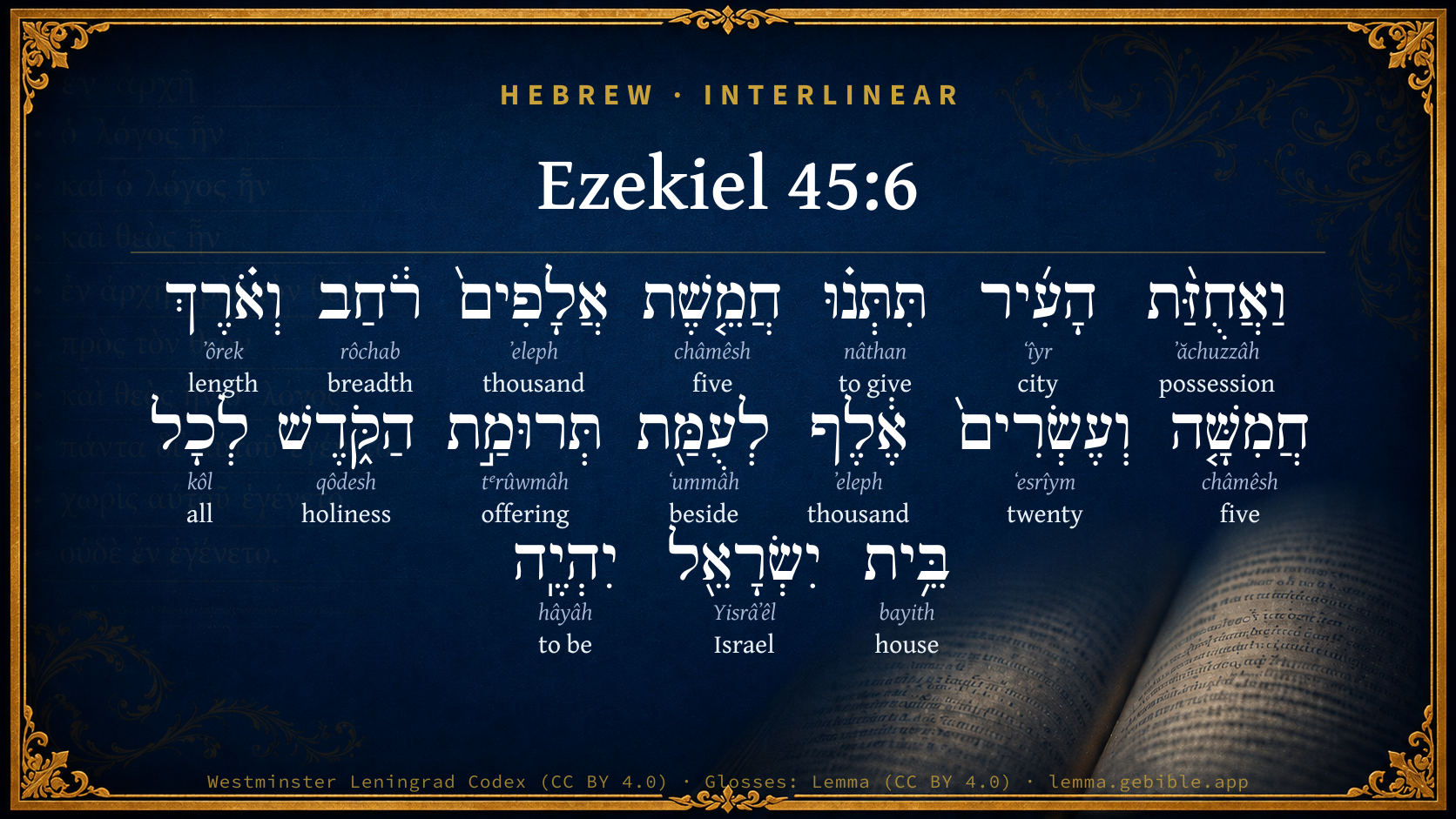
Hebrew (Westminster Leningrad Codex) Ezekiel 45:6 appears in the Hebrew Old Testament. The text above is from the Westminster Leningrad Codex. Each word links to its Strong’s number, a concise gloss, and parsing drawn from the Open Scriptures Hebrew Bible morphology. Click any word for its full Brown-Driver-Briggs (BDB) entry.
Download image
Cite this verse

Ezekiel 45:6 (World English Bible). Public Domain. Lemma interlinear Bible study tool, https://lemma.gebible.app/v/ezekiel/45/6.

Show BibTeX & RIS
BibTeX
RIS
English Translation
You shall appoint the possession of the city five thousand broad, and twenty-five thousand long, side by side with the offering of the holy portion: it shall be for the whole house of Israel.
World English Bible · Public Domain
Download a study sheet

One document with this verse’s original text, its word-by-word gloss line, the meaning frame, cross-references with their text, attributed commentary, and full source and license credits — printable, and it pastes into notes with its structure intact.

This verse Autodidact and up

Study sheet (.html) Plain text (.txt)

A passage Seminary Student

Up to 50 verses in one chapter. A passage sheet keeps up to 6 commentary sources and 12 cross-references per verse, in the order this page ranks them, and says so on the sheet whenever that leaves anything out. Ask for a single verse and you get the Autodidact verse sheet above.

Everything on this page stays free to read, with no account — the sheet is a download of what is already on screen, not access to it.

Want to remove ads? Support Godless Engineer
Compare translations 3

The same verse in 3 English versions, stacked beneath the original-language interlinear above. Click any original word for its lexicon entry.

Each is an independent rendering of the whole verse — the interlinear is not word-aligned to these translations.

Highlighted words mark where these versions differ — a whole-verse word diff, not a word-by-word alignment.

  • World English Bible Public Domain
    You shall appoint the possession of the city five thousand broad, and twenty-five thousand long, side by side with the offering of the holy portion: it shall be for the whole house of Israel.
  • King James Version Public Domain
    And ye shall appoint the possession of the city five thousand broad, and five and twenty thousand long, over against the oblation of the holy portion: it shall be for the whole house of Israel.
  • unfoldingWord Literal Text CC BY-SA 4.0
    You will designate an area for the city, five thousand cubits in width and twenty-five thousand in length, that will be next to the area reserved for the holy place; this city will belong to all the house of Israel.

unfoldingWord Literal Text — © unfoldingWord, licensed CC BY-SA 4.0. Word-aligned USFM3 via Door43 (git.door43.org/unfoldingWord/en_ult).

Versions to compare (up to 4)

3 of 4 selected

Show all 18 translations

Every available English version of this verse, each an independent rendering of the whole verse.

  • World English Bible Public Domain
    You shall appoint the possession of the city five thousand broad, and twenty-five thousand long, side by side with the offering of the holy portion: it shall be for the whole house of Israel.
  • Berean Standard Bible Public Domain
    As the property of the city, you are to set aside an area 5,000 cubits wide and 25,000 cubits long, adjacent to the holy district. It will belong to the whole house of Israel.
  • Majority Standard Bible Public Domain
    As the property of the city, you are to set aside an area 5,000 cubits wide and 25,000 cubits long, adjacent to the holy district. It will belong to the whole house of Israel.
  • King James Version Public Domain
    And ye shall appoint the possession of the city five thousand broad, and five and twenty thousand long, over against the oblation of the holy portion: it shall be for the whole house of Israel.
  • American Standard Version (1901) Public Domain
    And ye shall appoint the possession of the city five thousand broad, and five and twenty thousand long, side by side with the oblation of the holy portion: it shall be for the whole house of Israel.
  • Revised Version (1885) Public Domain
    And ye shall appoint the possession of the city five thousand broad, and five and twenty thousand long, side by side with the oblation of the holy portion: it shall be for the whole house of Israel.
  • Geneva Bible (1599) Public Domain
    Also ye shall appoynt the possession of the citie, fiue thousand broad, and fiue and twentie thousand log ouer against the oblation of ye holy portion: it shalbe for the whole house of Israel.
  • Douay-Rheims (1899) Public Domain
    And you shall appoint the possession of the city five thousand broad, and five and twenty thousand long, according to the separation of the sanctuary, for the whole house of Israel.
  • Young's Literal Translation Public Domain
    `And of the possession of the city ye give five thousand of breadth, and of length five and twenty thousand, over-against the heave-offering of the holy `portion': to all the house of Israel it is.
  • Literal Standard Version CC BY-SA 4.0
    And of the possession of the city you set [an area] of five thousand breadth, and twenty-five thousand length, alongside the raised-offering of the holy [portion]; it is for all the house of Israel.
  • Unlocked Literal Bible CC BY-SA 4.0
    You will designate an area for the city, five thousand cubits in width and twenty-five thousand in length, that will be next to the area reserved for the holy place; this city will belong to all the house of Israel.
  • unfoldingWord Literal Text CC BY-SA 4.0
    You will designate an area for the city, five thousand cubits in width and twenty-five thousand in length, that will be next to the area reserved for the holy place; this city will belong to all the house of Israel.
  • Darby Bible Public Domain
    And ye shall appoint the possession of the city five thousand in breadth, and five and twenty thousand in length, alongside of the holy heave-offering: it shall be for the whole house of Israel.
  • World Messianic Bible Public Domain
    “‘“You shall appoint the possession of the city five thousand cubits wide and twenty-five thousand long, side by side with the offering of the holy portion. It shall be for the whole house of Israel.
  • Webster's Bible Public Domain
    And ye shall appoint the possession of the city five thousand broad, and five and twenty thousand long, over against the oblation of the holy portion: it shall be for the whole house of Israel.
  • Free Bible Version CC BY-SA 4.0
    Allocate to the city an area 5,000 cubits wide and 25,000 cubits long beside the sanctuary section. It is for the all the people of Israel.
  • Bible in Basic English Public Domain
    And as the property for the town you are to have a part five thousand wide and twenty-five thousand long, by the side of the offering of the holy part of the land: this is to be for all the children of Israel.
  • JPS Tanakh (1917) Public Domain
    And ye shall appoint the possession of the city five thousand broad, and five and twenty thousand long, side by side with the offering of the holy portion; it shall be for the whole house of Israel.

Literal Standard Version (2020), Covenant Press — licensed CC BY-SA 4.0. Text via the HelloAO Bible API (eBible.org). Unlocked Literal Bible (unfoldingWord) — licensed CC BY-SA 4.0. Text via the HelloAO Bible API (eBible.org). unfoldingWord Literal Text — © unfoldingWord, licensed CC BY-SA 4.0. Word-aligned USFM3 via Door43 (git.door43.org/unfoldingWord/en_ult). Free Bible Version, Dr. Jonathan Gallagher — licensed CC BY-SA 4.0. Text via the HelloAO Bible API (eBible.org).

Word by word

More ways to search: Search by grammar → Find every occurrence → Compare this word →

Practice this passage: Drill this verse → Learn its vocabulary →

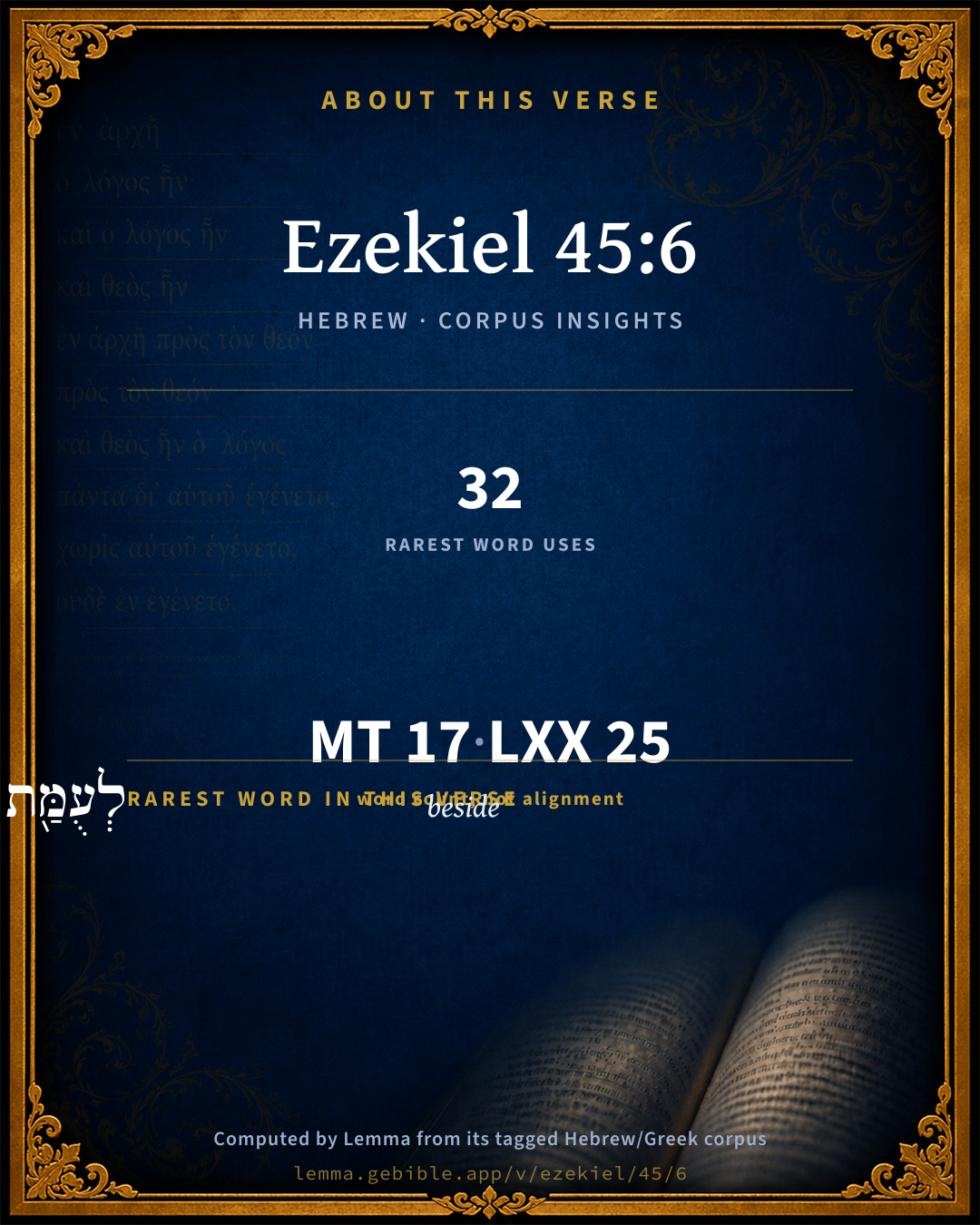
לְעֻמַּ֖ת
ʻummâh
H5980
“to/for · beside of”
Preposition + Noun, Common, Feminine, Singular, Construct
Part of Speech
Preposition + Noun
Type
Common
Gender
Feminine
Number
Singular
State
Construct
Full BDB Definition

Origin: from H6004

TWOT: 1640f

juxtaposition - used only as a preposition - close by, side by side with, alongside of, parallel with - agreeing with, corresponding to, exactly as, close beside - correspondingly to
  1. וַאֲחֻזַּ֨ת ʼăchuzzâh H272 “and · possession of” Conjunction + Noun, Common, Feminine, Singular, Construct
  2. הָעִ֜יר ʻîyr H5892 “the · city” Particle, Definite Article + Noun, Common, Feminine, Singular, Absolute
  3. תִּתְּנ֗וּ nâthan H5414 “to give” Verb, Qal, Imperfect, 2nd Person, Masculine, Plural
  4. חֲמֵ֤שֶׁת châmêsh H2568 “five” Adjective, Cardinal number, Masculine, Singular, Construct
  5. אֲלָפִים֙ ʼeleph H505 “thousand” Adjective, Cardinal number, Both, Plural, Absolute
  6. רֹ֔חַב rôchab H7341 “breadth” Noun, Common, Masculine, Singular, Absolute
  7. וְאֹ֗רֶךְ ʼôrek H753 “and · length of” Conjunction + Noun, Common, Masculine, Singular, Construct
  8. חֲמִשָּׁ֤ה châmêsh H2568 “five” Adjective, Cardinal number, Masculine, Singular, Absolute
  9. וְעֶשְׂרִים֙ ʻesrîym H6242 “and · twenty” Conjunction + Adjective, Cardinal number, Both, Plural, Absolute
  10. אֶ֔לֶף ʼeleph H505 “thousand” Adjective, Cardinal number, Both, Singular, Absolute
  11. תְּרוּמַ֣ת tᵉrûwmâh H8641 “offering of” Noun, Common, Feminine, Singular, Construct
  12. הַקֹּ֑דֶשׁ qôdesh H6944 “the · holiness” Particle, Definite Article + Noun, Common, Masculine, Singular, Absolute
  13. לְכָל kôl H3605 “to/for · all of” Preposition + Noun, Common, Masculine, Singular, Construct
  14. בֵּ֥ית bayith H1004 “house of” Noun, Common, Masculine, Singular, Construct
  15. יִשְׂרָאֵ֖ל Yisrâʼêl H3478 “Israel” Noun, Proper
  16. יִהְיֶֽה hâyâh H1961 “to be” Verb, Qal, Imperfect, 3rd Person, Masculine, Singular

About this verse

These counts appear in no published source. They are computed here, from the morphology-tagged text and Lemma’s own curated glosses. What Lemma adds →

17
words
15
distinct lemmas
Prophets
section

Shared distinctive vocabulary

לְעֻמַּ֖ת beside H5980 occurs in 28 verses of the Hebrew Bible. Also found in:

Grammatical profile

  • 2 verbs
  • 10 nouns
  • 5 adjectives

Verb forms

  • תִּתְּנ֗וּ Qal · Imperfect
  • יִהְיֶֽה Qal · Imperfect

Repetition

Words recur within this verse — often emphatic in Hebrew:

  • חֲמֵ֤שֶׁת five H2568 ×2
  • אֲלָפִים֙ thousand H505 ×2

Hebrew & Septuagint length

In English translation the verse runs 34 words from the Hebrew and 39 from the Septuagint (LXX English) — closely comparable.

A rough comparison of the two English renderings, which tokenize alike — not a word-level alignment.

Word counts can differ between the Hebrew and the Greek without any difference in meaning — e.g. the Hebrew direct-object marker אֵת has no separate Greek word, and Greek often adds the article ὁ.

In the original languages it is 17 Hebrew tokens and 25 Greek tokens — but the two are counted differently (Hebrew bundles its prefixes and suffixes into one token; the Greek is in lemma form), so that isn’t a like-for-like length.

Cross-references

2

Topical passages linked to Ezekiel 45:6 in the Treasury of Scripture Knowledge — connected by theme and wording, ordered by reader-vote popularity; previews shown in the World English Bible.

  • Ezekiel 48:15–18 The five thousand that are left in the breadth, in front of the twenty-five thousand, shall be for common use, for the city, for dwelling and for suburbs; and the city shall be in the midst of it.
  • Ezekiel 48:30–35 These are the exits of the city: On the north side four thousand and five hundred [reeds] by measure;

Cross-references courtesy of OpenBible.info (CC BY 4.0).

Hebrew and Greek witnesses Masoretic Hebrew ↔ Greek Septuagint

The same verse in the two great witnesses to the Old Testament, shown verse-for-verse.

These are two independent witnesses, not word-aligned to each other, and the Septuagint is shown in lemma (dictionary) form.

Hebrew Ezekiel 45:6 Masoretic · Westminster Leningrad Codex

וַאֲחֻזַּ֨ת הָעִ֜יר תִּתְּנ֗וּ חֲמֵ֤שֶׁת אֲלָפִים֙ רֹ֔חַב וְאֹ֗רֶךְ חֲמִשָּׁ֤ה וְעֶשְׂרִים֙ אֶ֔לֶף לְעֻמַּ֖ת תְּרוּמַ֣ת הַקֹּ֑דֶשׁ לְכָל בֵּ֥ית יִשְׂרָאֵ֖ל יִהְיֶֽה

You shall appoint the possession of the city five thousand broad, and twenty-five thousand long, side by side with the offering of the holy portion: it shall be for the whole house of Israel.

World English Bible · Public Domain

Greek LXX Ezekiel 45:6 Septuagint · lemma form

καί ὁ κατάσχεσις ὁ πόλις δίδωμι πέντε χιλιάς εὖρος καί μῆκος πέντε καί εἴκοσι χιλιάς ὅς τρόπος ὁ ἀπαρχή ὁ ἅγιος πᾶς οἶκος ἰσραήλ εἰμί

And you⌃ shall appoint for the possession of the city five thousand in breadth, and in length twenty-five thousand: after the manner of the first fruits of the holy portion, they shall be for all the house of Israel.

LXX2012 (modern English Septuagint) · Public Domain

Hebrew: Westminster Leningrad Codex (CC BY 4.0). Greek: Septuagint (public domain); English from LXX2012 (modern English Septuagint) (Public Domain). How the Septuagint differs from the Hebrew →

Targum (Aramaic paraphrase)

1

The Targum is the ancient Jewish Aramaic paraphrase of the Hebrew Scriptures — an interpretive translation, not the Hebrew text itself. Onkelos (literal) and Pseudo-Jonathan (expansive) render the Torah, and Jonathan the Prophets. Coverage is partial: where no permissively-licensed English translation exists for a verse, only the Aramaic is shown. This is verse-level text, not a word-by-word alignment to the Hebrew.

  1. Targum Jonathan Prophets (Joshua–Malachi)
    וְאַחֲסָנַת קַרְתָּא תִּתְּנוּן חַמְשָׁא אַלְפִין פּוּתְיָא וְאוּרְכָּא עַסְרִין וְחַמְשָׁא אַלְפִין לָקֳבֵיל אַפְרָשׁוּת קוּדְשָׁא לְכָל בֵּית יִשְׂרָאֵל יְהֵי:

    (no public-domain English translation for this verse)

    Targum Jonathan — Aramaic: “Mikraot Gedolot” (public domain). English: “Sefaria Community Translation” (CC0 1.0 (public-domain dedication)); “London "Chaldee Paraphrase," 1871” (public domain). Text via Sefaria.

Commentary

Notes on Ezekiel 45:6 from classic Christian and Jewish commentators (each source and its license shown beneath its notes). The classic Christian expositions comment on the surrounding passage and are grouped to its opening verse, so a note may address several verses; the Jewish commentaries on the Tanakh (Rashi and others) are per-verse, so they appear only where the commentator wrote on this verse.

Lemma curates 59 commentaries, every one of them public domain or Creative Commons licensed, each selected and text-cleaned for this edition rather than reprinted as found. About our sources →

Trapp's Complete Commentary

John Trapp

Eze 45:6 And ye shall appoint the possession of the city five thousand broad, and five and twenty thousand long, over against the oblation of the holy [portion]: it shall be for the whole house of Israel.

Ver. 6. And ye shall appoint the possession of the city.] After the church service settled, and the ministry provided for. Aristotle’s {a} advice is πρωτον περι θειων επιμελει, first take care of divine things - that is the best policy.

It shall be for the whole house of Israel.] A rendezvous for them at festival times.

{a} Polit., lib. vii. cap. 8.

John Trapp, A Commentary or Exposition upon All the Books of the Old and New Testament (1647–1656) — public domain. Text from a community e-Sword module.

Joseph Benson's Commentary

Eze 45:6. And ye shall appoint the possession of the city, five thousand broad, &c., over against (or by the side of, see Eze 48:14) the oblation of the holy portion — This must run parallel in length with the holy portion, though but half its breadth, by which means these three portions made an exact square. It shall be for the whole house of Israel — The capital city, to which all the tribes shall resort upon the solemn festivals, and shall have twelve gates, according to the number of the tribes of Israel, Eze 48:31. This portion appointed for the city, considered separate from the other portions, was a rectangle, containing an area of about seventeen miles in circuit; which, according to Josephus, was more than four times the circuit of Jerusalem: see Bell. Jud., 5. 4:3, where that city is stated to be thirty-three stadia in circumference.

Joseph Benson's Commentary on the Old and New Testaments (1811–1818) — public domain. Text from a community e-Sword module.

Adam Clarke's Commentary

Verse 6. Ye shall appoint] See the plan, FF. See Clarke on Eze 48:35.

Adam Clarke's Commentary on the Bible (1810–1826) — public domain. Text from a community e-Sword/MySword module.

Ellicott's Commentary for English Readers

(6) The possession of the city.—This portion, more particularly described in Eze_48:15-20, is there called “a profane place,” though still constituting a part of the oblation. It was the same length and half the width of either of the other portions, and was for the city, and for a common possession of the nation, to supply food for those who “serve the city” “out of all the tribes of Israel” (Eze_48:18-19). Nothing is anywhere said to identify this city with Jerusalem, and, indeed, it is described as in a different position geographically (see map). Jerusalem, like the ark, appears to have faded from the prophet’s sight in this vision of the future Church.

A Bible Commentary for English Readers, edited by Charles John Ellicott (1878–1897) — public domain. Text from a community e-Sword module.

The Cambridge Bible for Schools and Colleges

gen. ed. J. J. S. Perowne

6. The city possesses a strip of land 5000 cubits broad and 25,000 long, running parallel to the portion of the priests, cf. Eze_48:15. The city shall stand in the midst of this tract, which it entirely covers N. to S., cf. Eze_48:16-17.

The Cambridge Bible for Schools and Colleges (gen. ed. J. J. S. Perowne; Cambridge University Press, 1878–1918) — public domain. Text from a community e-Sword module.

John Gill's Exposition

And ye shall appoint the possession of the city, Which is something distinct from the house or temple, which was as the frame of a city, being so large, and consisting of so many parts, Eze 40:2 and seems also different from the city in Eze 48:30, the measures of the one and of the other not agreeing. Starckius thinks that this city prefigures the academies that should be among Christians, in which the priests or ministers of the word should teach those that came out of all parts unto them; but I am rather of opinion that the civil state of the people of God is here meant, as it will be in the spiritual reign of Christ; when all civil power and authority will not as yet be put down, only it will come into the hands of the saints, and be administered by Christian kings and princes.

Five thousand broad, and five and twenty thousand long, over against the oblation of the holy portion; five thousand reeds in breadth are allowed less for the civil than the church state; and though they are contiguous, and there is a connection between them, yet are separate from each other; the material temple was in the city of Jerusalem; but the holy portion, in which the sanctuary shall be, is without the city, and the city over against that; hence John seems, to have borrowed his idea and language, "I saw no temple therein", Rev 21:22, though speaking of another city: the church and the world shall be no more mixed together; Christ's kingdom is not of this world, nor to be fixed on a civil establishment:

it shall be for the whole house of Israel; they shall all be under one and the same form of government; I do not say they shall be all under one temporal king or prince; but all Christian kings and princes shall exercise the same kind of rule and government; so that, as their church state will be uniform, their civil state or polity will be alike.

John Gill's Exposition of the Whole Bible (1746–1763) — public domain (CC PDM 1.0). Text via the HelloAO Bible API.

Albert Barnes' Notes on the Bible

This portion is to belong to the whole people, not to be subject to the encroachments made by the later kings of Judah Jer 22:13. The Levites’ portion 10,000 reeds, the priests’ portion 10,000 reeds, and the city portion 5,000 reeds. make in all 25,000 reeds from north to south. The measure of each of these portions from east to west has been defined to be 25,000 reeds (Eze 45:1 note), and thus we have a square of 25,000 in all.

Albert Barnes' Notes on the Bible (1834–1885) — public domain. Text from a community e-Sword/MySword module.

Haydock's Catholic Bible Commentary

According. Hebrew, "along or (Calmet) over-against the oblation of the holy portion." (Protestants) --- Israel, destined to serve the priests. (Haydock)

George Leo Haydock (1774–1849), Haydock's Catholic Family Bible and Commentary, 1859 edition — public domain. Excludes Psalms (Douay-Rheims chapter numbering differs from Protestant) and Deuterocanonical books (Catholic canon only).

Matthew Poole's English Annotations

Appoint; order and measure out.

The possession; land to be a possession to the citizens of Jerusalem, and to be the contents of the city.

Five thousand broad, and five and twenty thousand long; about two miles and half broad, and twelve miles and half long, measured by the cubit, as Eze 45:3 directs.

Over against the oblation of the holy portion: this must run along parallel in length with the holy portion, though but half its breadth.

For the whole house of Israel: as the chief and capital city, to which the tribes resort, it must be large enough to entertain them too; and was to be framed with twelve gates to twelve streets, for the twelve tribes, as Eze 48:31. as Eze 48:31; Eze 48:31.

Matthew Poole's English Annotations on the Holy Bible (1683–1685) — public domain. Text from a community e-Sword/MySword module.

The Pulpit Commentary

In addition to the holy terumah for the priests and the portion for the Levites, should be marked off as the possession of the city a third tract of territory, five thousand (reeds) broad, and five and twenty thousand long, over against rather, side by side with (Revised Version), "parallel to" (Keil)the oblation of the holy portion. That is to say, it should lie upon the south, as the Levites" territory lay upon the north of the priests" portion. Adding the 10, 000 reeds of breadth for the Levites" domain, the 10, 000 for the priests" land, and the 5000 for the city quarter, makes a total breadth of 25, 000 reeds; so that the tract in which all these were included was a square. That the portion for the city should be for the whole house of Israel implied that it should be communal property, belonging to no tribe in particular, but to all the tribes together in modern phrase should be "common good, ein Volksgut (Kliefoth), which should neither be confiscated by kingly rapacity (comp. Jer_22:13) nor invaded by individual and private appropriation, but retained for the use of the inhabitants generally. (see Eze_48:18, Eze_48:19)

The Pulpit Commentary (1880–1919), ed. H.D.M. Spence-Jones & Joseph S. Exell — public domain. Text from a community e-Sword module.

John Wesley's Explanatory Notes

The possession - Land to be a possession to the citizens of Jerusalem, and to be the content of the city. Broad - About two miles and half broad, and twelve miles and half long. Long - This must run along parallel in length with the holy portion, though but half its breadth. For the whole house - As the capital city, to which the tribe's resort, it must be large enough to entertain them.

John Wesley, Explanatory Notes Upon the Whole Bible (1754–1765) — public domain. Text via the GEBible commentary corpus.

unfoldingWord translationNotes

Door43 World Missions Community

General Information:

Yahweh continues giving Ezekiel his message to the house of Israel.

five thousand cubits ... twenty-five thousand

Each long cubit was about 54 centimeters. See how you translated this in Ezekiel 40:5. AT: "5,000 cubits ... 25,000 cubits" or "about 2.7 kilometers ... about 13.5 kilometers" (See: Biblical Distance)

reserved for the holy place

This can be translated in active form. AT: "that you gave for the holy place" (See: Active or Passive)

The length will correspond to the length of one of those portions

It is implied that Ezekiel is comparing the prince's land with the size of the land given to each of the tribes. AT: "The length will be the same as the length of one of the portions given to the tribes" (See: Assumed Knowledge and Implicit Information)

from the west to the east

It is implied that these are the western and eastern borders of the land of Israel. "from the western border of Israel at the sea to the eastern border at the Jordan River"

translationWords

Israel

prince

unfoldingWord translationNotes — © Distant Shores Media and the Door43 World Missions Community, licensed CC BY-SA 4.0. Source: git.door43.org/Door43/en_tn.

Rashi

Rabbi Shlomo Yitzchaki (Rashi)

And, [for] the property of the city The environs of the city; its properties meant for ordinary dwelling, in which the Israelites may build houses.

you shall give a width of five thousand in the south of the second one, and a length equal to the measurement of the two strips. It is found that the entire offering is square, twenty-five [thousand] by twenty-five thousand.

corresponding to the offering of the holy portion in the measurement of the length of the strips of the offering of the holy portion.

for the entire House of Israel it shall be That third strip shall be the dwelling place for non priests.

Rashi on the Tanakh — English translations: “The Judaica Press complete Tanach with Rashi, translated by A. J. Rosenberg” (CC BY 4.0); “Pentateuch with Rashi's commentary by M. Rosenbaum and A.M. Silbermann, 1929-1934” (public domain); “The Metsudah Tanach series, Lakewood, N.J” (CC BY 4.0); and “The Book of Joshua, Metsudah Publications, 1997” (CC BY 4.0). Text via Sefaria.

Lesson kit

Teaching starters — assembled from the data on this page, not authored interpretation. Every prompt links to the verse data it draws on. Edit before teaching.

Ezekiel, in the Prophets, opens this verse with 17 words (15 distinct Hebrew lemmas). Its most distinctive word is ʻummâh (“beside”). A historical commentator’s framing appears above. Read the whole chapter for the surrounding context.

Discussion questions

  1. What does “beside” (ʻummâh) contribute to the verse as a whole?
  2. Exodus 25:27 shares the word «beside» with this verse. How do the two illuminate each other?
  3. “five” occurs 2× in this one verse. What is the effect of the repetition?
  4. These translations render this verse differently. What is at stake in choosing one wording over another?
  5. The verb «תִּתְּנ֗וּ» is Qal Imperfect. How does its form color the action?
  6. Reading how Trapp's Complete Commentary and Joseph Benson's Commentary read this verse, where do the two commentators agree and where do they part?

Things to notice

Reading settings

Reading text

Shown beneath each verse's original-language words.

Old Testament
Old Testament edition

Read the OT as the Masoretic Hebrew (MT) or the Greek Septuagint (LXX).

English shown for the Greek Septuagint (in the Hebrew ↔ Greek comparison).

Comparing translations? Open the Compare panel on any verse page to stack up to four side by side.