1 Kings 9:13

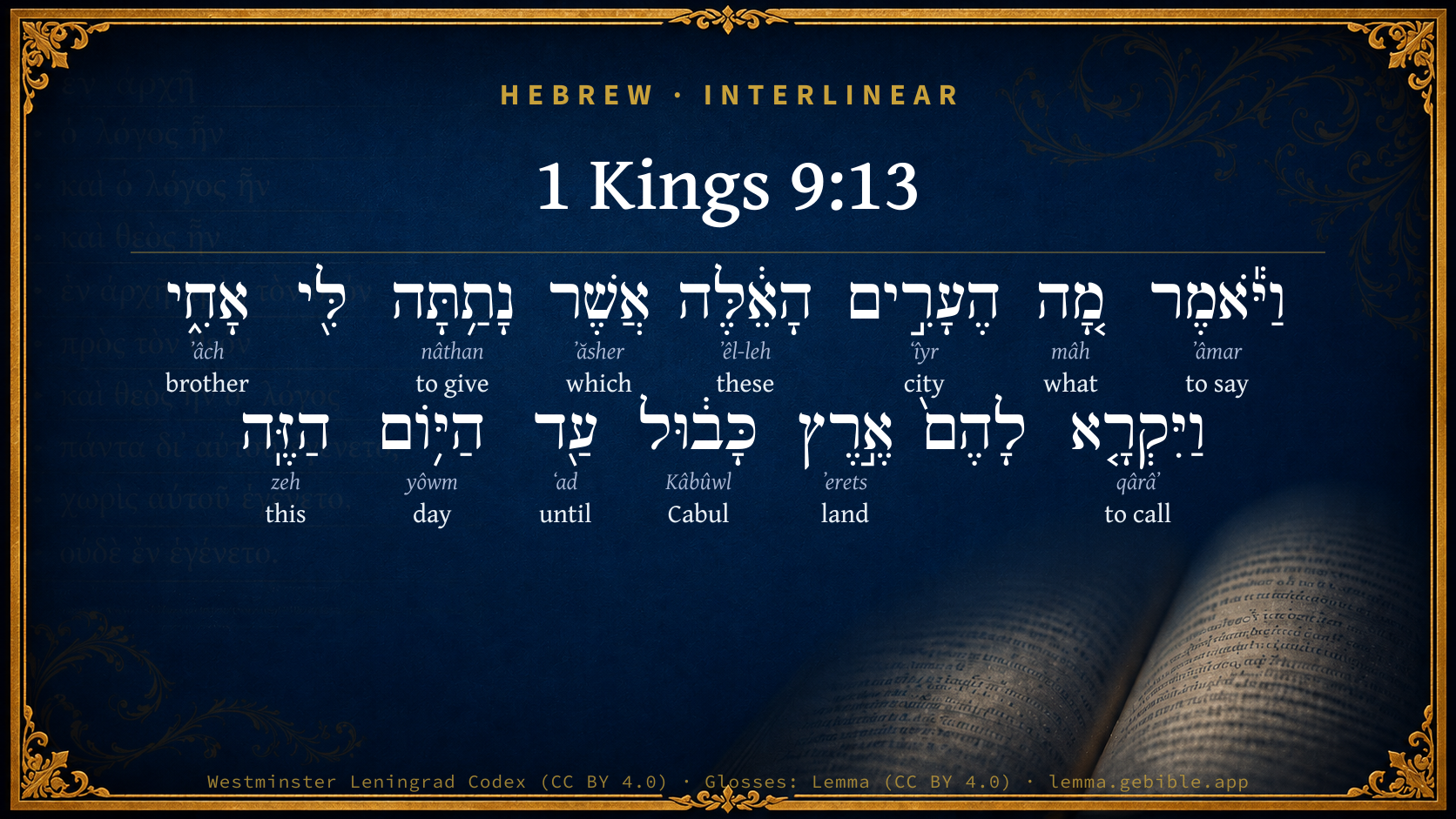
Hebrew (Westminster Leningrad Codex) 1 Kings 9:13 appears in the Hebrew Old Testament. The text above is from the Westminster Leningrad Codex. Each word links to its Strong’s number, a concise gloss, and parsing drawn from the Open Scriptures Hebrew Bible morphology. Click any word for its full Brown-Driver-Briggs (BDB) entry.
Download image
Cite this verse

1 Kings 9:13 (World English Bible). Public Domain. Lemma interlinear Bible study tool, https://lemma.gebible.app/v/1-kings/9/13.

Show BibTeX & RIS
BibTeX
RIS
English Translation
He said, What cities are these which you have given me, my brother? He called them the land of Cabul to this day.
World English Bible · Public Domain
Download a study sheet

One document with this verse’s original text, its word-by-word gloss line, the meaning frame, cross-references with their text, attributed commentary, and full source and license credits — printable, and it pastes into notes with its structure intact.

This verse Autodidact and up

Study sheet (.html) Plain text (.txt)

A passage Seminary Student

Up to 50 verses in one chapter. A passage sheet keeps up to 6 commentary sources and 12 cross-references per verse, in the order this page ranks them, and says so on the sheet whenever that leaves anything out. Ask for a single verse and you get the Autodidact verse sheet above.

Everything on this page stays free to read, with no account — the sheet is a download of what is already on screen, not access to it.

Want to remove ads? Support Godless Engineer
Compare translations 3

The same verse in 3 English versions, stacked beneath the original-language interlinear above. Click any original word for its lexicon entry.

Each is an independent rendering of the whole verse — the interlinear is not word-aligned to these translations.

Highlighted words mark where these versions differ — a whole-verse word diff, not a word-by-word alignment.

  • World English Bible Public Domain
    He said, What cities are these which you have given me, my brother? He called them the land of Cabul to this day.
  • King James Version Public Domain
    And he said, What cities are these which thou hast given me, my brother? And he called them the land of Cabul unto this day.
  • unfoldingWord Literal Text CC BY-SA 4.0
    And he said, “What are these cities that you have given to me, my brother?” And he called them the land of Cabul, to this day.

unfoldingWord Literal Text — © unfoldingWord, licensed CC BY-SA 4.0. Word-aligned USFM3 via Door43 (git.door43.org/unfoldingWord/en_ult).

Versions to compare (up to 4)

3 of 4 selected

Show all 18 translations

Every available English version of this verse, each an independent rendering of the whole verse.

  • World English Bible Public Domain
    He said, What cities are these which you have given me, my brother? He called them the land of Cabul to this day.
  • Berean Standard Bible Public Domain
    “What are these towns you have given me, my brother?” asked Hiram, and he called them the Land of Cabul, as they are called to this day.
  • Majority Standard Bible Public Domain
    “What are these towns you have given me, my brother?” asked Hiram, and he called them the Land of Cabul, as they are called to this day.
  • King James Version Public Domain
    And he said, What cities are these which thou hast given me, my brother? And he called them the land of Cabul unto this day.
  • American Standard Version (1901) Public Domain
    And he said, What cities are these which thou hast given me, my brother? And he called them the land of Cabul unto this day.
  • Revised Version (1885) Public Domain
    And he said, What cities are these which thou hast given me, my brother? And he called them the land of Cabul, unto this day.
  • Geneva Bible (1599) Public Domain
    Therefore hee sayde, What cities are these which thou hast giuen me, my brother? And hee called them the land of Cabul vnto this day.
  • Douay-Rheims (1899) Public Domain
    And he said: Are these the cities which thou hast given me, brother? And he called them the land of Chabul, unto this day.
  • Young's Literal Translation Public Domain
    and he saith, `What `are' these cities that thou hast given to me, my brother?' and one calleth them the land of Cabul unto this day.
  • Literal Standard Version CC BY-SA 4.0
    and he says, “What [are] these cities that you have given to me, my brother?” And one calls them the land of Cabul to this day.
  • Unlocked Literal Bible CC BY-SA 4.0
    So Hiram said, “What cities are these which you have given me, my brother?” Hiram called them the Land of Kabul, which they are still called today.
  • unfoldingWord Literal Text CC BY-SA 4.0
    And he said, “What are these cities that you have given to me, my brother?” And he called them the land of Cabul, to this day.
  • Darby Bible Public Domain
    And he said, What cities are these which thou hast given me, my brother? And he called them the land of Cabul to this day.
  • World Messianic Bible Public Domain
    He said, “What cities are these which you have given me, my brother?” He called them the land of Cabul to this day.
  • Webster's Bible Public Domain
    And he said, What cities are these which thou hast given me, my brother? And he called them the land of Cabul to this day.
  • Free Bible Version CC BY-SA 4.0
    “What are these towns you have given me, my brother?” asked Hiram. He called them the land of Cabul, the name they are known by to this day.
  • Bible in Basic English Public Domain
    And he said, What sort of towns are these which you have given me, my brother? So they were named the land of Cabul, to this day.
  • JPS Tanakh (1917) Public Domain
    And he said: 'What cities are these which thou hast given me, my brother?' And they were called the land of Cabul, unto this day.

Literal Standard Version (2020), Covenant Press — licensed CC BY-SA 4.0. Text via the HelloAO Bible API (eBible.org). Unlocked Literal Bible (unfoldingWord) — licensed CC BY-SA 4.0. Text via the HelloAO Bible API (eBible.org). unfoldingWord Literal Text — © unfoldingWord, licensed CC BY-SA 4.0. Word-aligned USFM3 via Door43 (git.door43.org/unfoldingWord/en_ult). Free Bible Version, Dr. Jonathan Gallagher — licensed CC BY-SA 4.0. Text via the HelloAO Bible API (eBible.org).

Word by word

More ways to search: Search by grammar → Find every occurrence → Compare this word →

Practice this passage: Drill this verse → Learn its vocabulary →

כָּב֔וּל
Kâbûwl
H3521
“Cabul”
Noun, Proper
Part of Speech
Noun
Type
Proper
Full BDB Definition

Origin: from the same as H3525 in the sense of limitation

TWOT: None

Cabul = "binding" - a city on the border of Asher and located approx 10 miles (16 kilometers) east of Akko; modern 'Kabul' - a district in Galilee given by Solomon to Hiram and contemptuously called 'Cabul' by Hiram
  1. וַיֹּ֕אמֶר ʼâmar H559 “and · to say” Conjunction + Verb, Qal, Sequential Imperfect, 3rd Person, Masculine, Singular
  2. מָ֚ה mâh H4100 “what” Particle, Interrogative
  3. הֶעָרִ֣ים ʻîyr H5892 “the · cities” Particle, Definite Article + Noun, Common, Feminine, Plural, Absolute
  4. הָאֵ֔לֶּה ʼêl-leh H428 “the · these” Particle, Definite Article + Pronoun, Demonstrative, Common, Plural
  5. אֲשֶׁר ʼăsher H834 “which” Particle, Relative
  6. נָתַ֥תָּה nâthan H5414 “to give” Verb, Qal, Perfect, 2nd Person, Masculine, Singular
  7. אָחִ֑י ʼâch H251 “brother · my” Noun, Common, Masculine, Singular, Construct + Suffix, Personal, 1st Person, Common, Singular
  8. וַיִּקְרָ֤א qârâʼ H7121 “and · to call” Conjunction + Verb, Qal, Sequential Imperfect, 3rd Person, Masculine, Singular
  9. אֶ֣רֶץ ʼerets H776 “land of” Noun, Common, Both, Singular, Construct
  10. עַ֖ד ʻad H5704 “until” Preposition
  11. הַיּ֥וֹם yôwm H3117 “the · day” Particle, Definite Article + Noun, Common, Masculine, Singular, Absolute
  12. הַזֶּֽה zeh H2088 “the · this” Particle, Definite Article + Pronoun, Demonstrative, Masculine, Singular

About this verse

These counts appear in no published source. They are computed here, from the morphology-tagged text and Lemma’s own curated glosses. What Lemma adds →

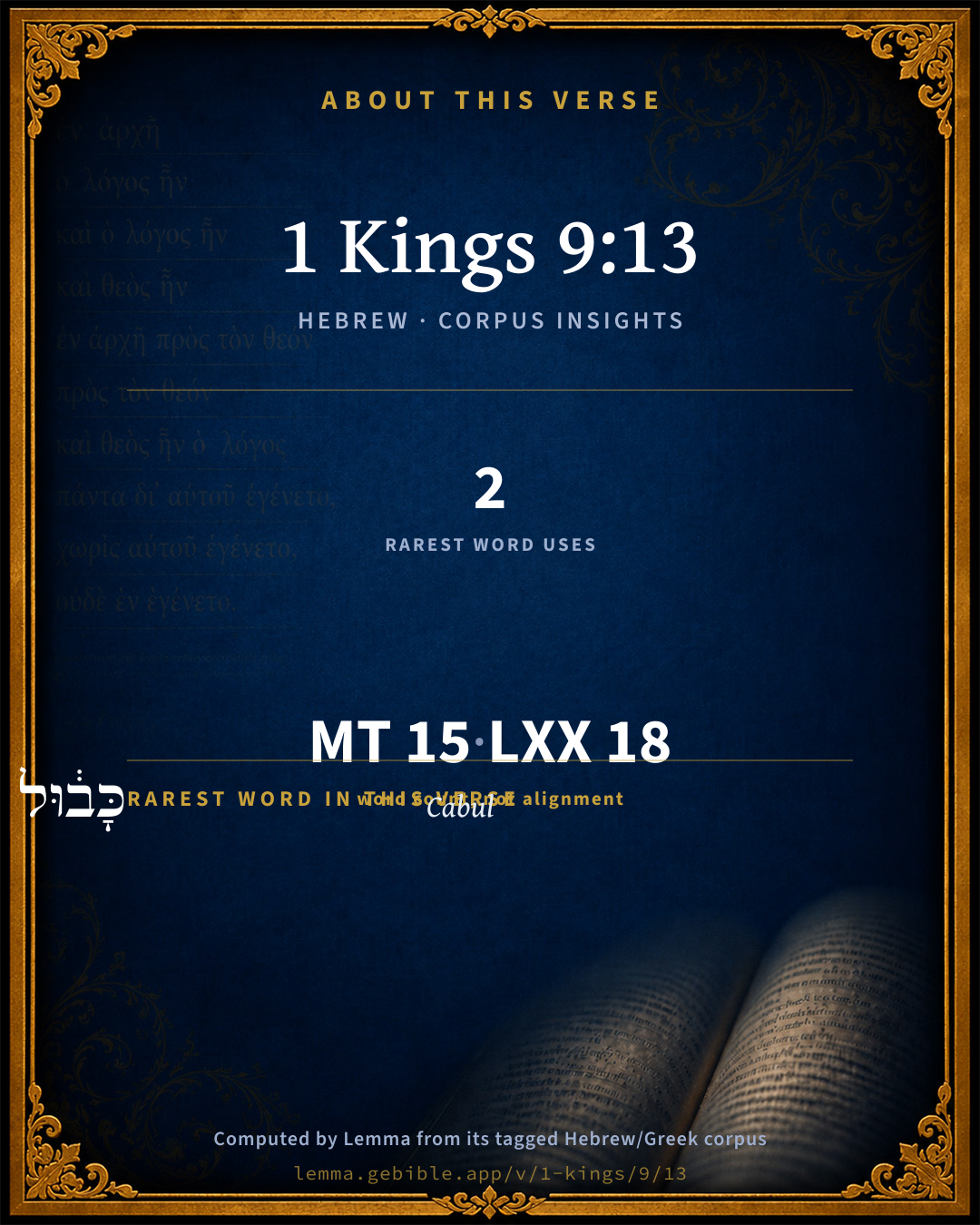
15
words
13
distinct lemmas
Historical
section

Notable vocabulary

The rarest word here is כָּב֔וּל Cabul H3521 — appearing just 2 times in the whole Hebrew Bible.

Shared distinctive vocabulary

כָּב֔וּל Cabul H3521 occurs in 2 verses of the Hebrew Bible. Also found in:

Grammatical profile

  • 3 verbs
  • 5 nouns
  • 2 pronouns
  • 3 prepositions
  • 2 particles

Verb forms

  • וַיֹּ֕אמֶר Qal · Sequential Imperfect
  • נָתַ֥תָּה Qal · Perfect
  • וַיִּקְרָ֤א Qal · Sequential Imperfect

Hebrew & Septuagint length

In English translation the verse runs 23 words from the Hebrew and 18 from the Septuagint (LXX English) — closely comparable.

A rough comparison of the two English renderings, which tokenize alike — not a word-level alignment.

Word counts can differ between the Hebrew and the Greek without any difference in meaning — e.g. the Hebrew direct-object marker אֵת has no separate Greek word, and Greek often adds the article ὁ.

In the original languages it is 15 Hebrew tokens and 18 Greek tokens — but the two are counted differently (Hebrew bundles its prefixes and suffixes into one token; the Greek is in lemma form), so that isn’t a like-for-like length.

Cross-references

3

Topical passages linked to 1 Kings 9:13 in the Treasury of Scripture Knowledge — connected by theme and wording, ordered by reader-vote popularity; previews shown in the World English Bible.

  • Joshua 19:27 and it turned toward the sunrise to Beth Dagon, and reached to Zebulun, and to the valley of Iphtah El northward to Beth Emek and Neiel; and it went out to Cabul on the left hand,
  • Amos 1:9 Thus says Yahweh: "For three transgressions of Tyre, yes, for four, I will not turn away its punishment; Because they delivered up the whole community to Edom, And didn't remember the brotherly covenant;
  • 1 Kings 5:1–2 Hiram king of Tyre sent his servants to Solomon; for he had heard that they had anointed him king in the room of his father: for Hiram was ever a lover of David.

Cross-references courtesy of OpenBible.info (CC BY 4.0).

Hebrew and Greek witnesses Masoretic Hebrew ↔ Greek Septuagint

The same verse in the two great witnesses to the Old Testament, shown verse-for-verse.

These are two independent witnesses, not word-aligned to each other, and the Septuagint is shown in lemma (dictionary) form.

Hebrew 1 Kings 9:13 Masoretic · Westminster Leningrad Codex

וַיֹּ֕אמֶר מָ֚ה הֶעָרִ֣ים הָאֵ֔לֶּה אֲשֶׁר נָתַ֥תָּה לִּ֖י אָחִ֑י וַיִּקְרָ֤א לָהֶם֙ אֶ֣רֶץ כָּב֔וּל עַ֖ד הַיּ֥וֹם הַזֶּֽה

He said, What cities are these which you have given me, my brother? He called them the land of Cabul to this day.

World English Bible · Public Domain

Greek LXX 1 Kings 9:13 Septuagint · lemma form

καί εἶπον τίς ὁ πόλις οὗτος ὅς δίδωμι ἐγώ ἀδελφός καί καλέω αὐτός ὅριον ἕως ὁ ἡμέρα οὗτος

What are these cities which you have given me, brother? And he called them Boundary until this day.

LXX2012 (modern English Septuagint) · Public Domain

On this verse, Adam Clarke's Commentary discusses the Septuagint’s reading. Read the note in Commentary ↓

Hebrew: Westminster Leningrad Codex (CC BY 4.0). Greek: Septuagint (public domain); English from LXX2012 (modern English Septuagint) (Public Domain). How the Septuagint differs from the Hebrew →

Targum (Aramaic paraphrase)

1

The Targum is the ancient Jewish Aramaic paraphrase of the Hebrew Scriptures — an interpretive translation, not the Hebrew text itself. Onkelos (literal) and Pseudo-Jonathan (expansive) render the Torah, and Jonathan the Prophets. Coverage is partial: where no permissively-licensed English translation exists for a verse, only the Aramaic is shown. This is verse-level text, not a word-by-word alignment to the Hebrew.

  1. Targum Jonathan Prophets (Joshua–Malachi)
    וַאֲמַר מַה קִרְוַיָא הָאִלֵין דִי יְהַבְתְּ לִי אֲחִי וּקְרָא לְהוֹן אַרְעָא כָּבוּל עַד יוֹמָא הָדֵין:

    (no public-domain English translation for this verse)

    Targum Jonathan — Aramaic: “Mikraot Gedolot” (public domain). English: “Sefaria Community Translation” (CC0 1.0 (public-domain dedication)); “London "Chaldee Paraphrase," 1871” (public domain). Text via Sefaria.

Commentary

Notes on 1 Kings 9:13 from classic Christian and Jewish commentators (each source and its license shown beneath its notes). The classic Christian expositions comment on the surrounding passage and are grouped to its opening verse, so a note may address several verses; the Jewish commentaries on the Tanakh (Rashi and others) are per-verse, so they appear only where the commentator wrote on this verse.

Lemma curates 59 commentaries, every one of them public domain or Creative Commons licensed, each selected and text-cleaned for this edition rather than reprinted as found. About our sources →

Trapp's Complete Commentary

John Trapp

1Ki 9:13 And he said, What cities [are] these which thou hast given me, my brother? And he called them the land of Cabul unto this day.

Ver. 13. What cities are these?] i.e., Quanti putas esse? {a} How much dost thou hold them worth?

And he called them the land of Cabul,] i.e., Displeasing or dirty; or, by transposition of a letter, terra canina, a land for my dogs. Oh that we could have as light an esteem of all things here below, looking upon this world as a great dunghill!

{a} Vatab.

John Trapp, A Commentary or Exposition upon All the Books of the Old and New Testament (1647–1656) — public domain. Text from a community e-Sword module.

Geneva Bible (1599)

Geneva Bible translators

Or, dirty, or barren.

Geneva Bible (1599) marginal notes — public domain. Text via Bolls.life.

Adam Clarke's Commentary

Verse 13. Called them the land of Cabul] Whether this epithet was given to this land by Hiram as a mark of disapprobation, or what is its proper meaning, the learned are not agreed. That there was a country of this name in the promised land in the time of Joshua, is evident enough from Jos 19:27, as it was one part of the boundary of the tribe of Asher; hence some interpret the word border or boundary, and so, the Septuagint understood it, for they have translated the Hebrew word οριον, which signifies the same. The margin gives another meaning.

Adam Clarke's Commentary on the Bible (1810–1826) — public domain. Text from a community e-Sword/MySword module.

Ellicott's Commentary for English Readers

(13) Cabul.—The derivation of this word is uncertain. Josephus evidently did not know it as a Hebrew word; for he expressly says, that in the Phænician language it signifies “what is unpleasing.” (Ant. viii. 100:5, sect. 3). A city Cabul is mentioned in Jos_19:27, in the territory of Asher, evidently on the Tyrian frontier, and in the neighbourhood in question. Hiram, it is thought, takes up this name, and applies it to the whole territory, and by a play of words on it signifies his discontent with Solomon’s gift. Ewald supposes a Hebrew derivation for the word (“as nought”); others take it to be “like that which vanishes.” Either would suit the sense indicated in the text well; but unless these derivations represent something cognate in the Tyrian language, they hardly accord with the requirements of this passage, which (as Josephus says) implies a Phoenician origin for the word.

A Bible Commentary for English Readers, edited by Charles John Ellicott (1878–1897) — public domain. Text from a community e-Sword module.

The Cambridge Bible for Schools and Colleges

gen. ed. J. J. S. Perowne

13. What cities are these which thou hast given me?] No doubt spoken with a tone of reproach and disappointment. The language of Josephus is ‘he said to Solomon that he did not want the cities.’ They are just alluded to in Chronicles (2Ch_8:2) as ‘the cities which Huram restored to Solomon.’

my brother] This form of address between persons of royal rank has been always common. Cf. 1Ki_20:32-33; 1Ma_10:18; 1Ma_11:30; 2Ma_11:22. It need not necessarily imply friendly feeling.

And he called them] Or the Hebrew may mean ‘and one called them’ which was a common form to signify ‘they were called.’ We need not therefore of necessity impute the contemptuous name to Hiram. Josephus gives προσηγορεύθησαν

the land of Cabul] This appellation was given to indicate, what is stated in the text, that they were unsatisfactory. But it is not easy to know whence the name comes. There is a town so called in Joshua (Jos_19:27) which was situated in the tribe of Asher. This tribe was in North Galilee but there would be no significance in the name, if it were already that of one of the twenty cities given to Hiram. The LXX. appears to have taken כבול (Cabul) to be the same as נבול (gebul) for they render the name Ὅριον, a boundary. Josephus transliterates by Χαβαλών, and adds that this word in Phœnician means ‘not pleasing,’ an interpretation, as it seems, which he evolved from the context. Some of the Hebrew commentators have connected the name with a verb which in Aramaic signifies ‘to bind,’ and have explained that the district was sandy or muddy, and that the feet were always deep sunk in the mire. A later derivation has taken the word to mean ‘worth nothing,’ as if from כ = as, and בול = בל = nothing. There are many other attempts at explanation but none that can be pronounced satisfactory.

The Cambridge Bible for Schools and Colleges (gen. ed. J. J. S. Perowne; Cambridge University Press, 1878–1918) — public domain. Text from a community e-Sword module.

John Gill's Exposition

And Hiram sent to the king one hundred and twenty talents of gold. Not after the cities had been given him, but before; and it may be rendered "had sent" (m), and is the sum of the gold he furnished him with for the temple, Kg1 9:11 which, according to Brerewood (n), was 540,000 pounds of our money; and, according to another (o) writer, it amounted to 1,466,400 ducats of gold, taking a talent at 12,220 ducats.

(m) "miserat", Junius & Tremellius, Piscator. (n) De Ponderibus & Pretiis, Vet. Num. c. 5. (o) Scheuchzer. Physic. Sacr. vol. 3. p. 571.

John Gill's Exposition of the Whole Bible (1746–1763) — public domain (CC PDM 1.0). Text via the HelloAO Bible API.

Albert Barnes' Notes on the Bible

Cabul is said to be a Phoenician word, and signified “displeasing” (see margin). There is some reason to believe that the cities thus despised by Hiram were restored to Solomon 2Ch 8:2, and that Solomon rebuilt them and colonized them with Israelites.

Albert Barnes' Notes on the Bible (1834–1885) — public domain. Text from a community e-Sword/MySword module.

Haydock's Catholic Bible Commentary

Brother. By this title the eastern kings addressed each other, chap. xx. 32., and 1 Machabees x. 18., and xi. 30. Solomon and Hiram always lived on good terms. (Calmet) --- Chabul: that is, dirty or displeasing. (Challoner) --- The latter signification is given by Josephus, from the Phœnician language. (Haydock) --- The real meaning is uncertain. Some with the last mentioned author, place these cities in the vicinity of Tyre, south of Ptolemais, which is most probable; though St. Jerome says they were in the land of Basan, beyond the Jordan. (Calmet)

George Leo Haydock (1774–1849), Haydock's Catholic Family Bible and Commentary, 1859 edition — public domain. Excludes Psalms (Douay-Rheims chapter numbering differs from Protestant) and Deuterocanonical books (Catholic canon only).

Matthew Poole's English Annotations

The land of Cabul, i.e. of dirt, as most interpret it. Not that it was a barren soil, as some imagine; for they who describe those parts commend them as fruitful; nor would Solomon have made him so unworthy a return: but because it was not pleasant, nor agreeable to his nor to his people’s humour; because, though the land was very good, yet being a thick and stiff clay, and therefore requiring great pains to manure and improve it, it was very unsuitable to the disposition of the Tyrians, who were delicate, and lazy, and luxurious, and wholly given to merchandise.

Matthew Poole's English Annotations on the Holy Bible (1683–1685) — public domain. Text from a community e-Sword/MySword module.

Whedon's Commentary on the Bible

Daniel D. Whedon

13. My brother — Used here and in 1Ki_20:33, as often at the present day in the East, as a term of friendly intercourse. Compare 1 Macc.

1Ki_10:18; 1Ki_11:30; 2Ma_11:22.

Cabul — “Which name,” says Josephus, “if it be interpreted according to the language of the Phenicians, denotes what does not please.” The Cabul of Jos_19:27 may have been one of the twenty cities, and to show his dissatisfaction he may have applied the name of that little insignificant town to the whole district. After Hiram restored the cities, Solomon built them more nobly and peopled them with Israelites. 2Ch_8:2. But notwithstanding this displeasure on the part of Hiram, the friendly relations of these two monarchs seem to have lasted as long as they lived.

Unto this day — The day when this document was written.

Daniel D. Whedon (gen. ed.), Commentary on the Old and New Testaments (1874–1909) — public domain. Text from a community e-Sword module.

The Pulpit Commentary

And he said, What cities are these which thou hast given me, my brother? Cf. 1Ki_20:32. It would seem, at first sight, as if this form of speech was then, as now, the usage of courts. But the Fellahin of Palestine, the "modern Canaanites," still address each other as "my father" or "my brother." See Conder, "Tent-work," p. 332 And he called them the land of Cabul The meaning of this word is quite uncertain. The LXX reads Orion, which shows that they must have read lwbg instead of lwbk; indeed, it is possible that the words have the same meaning (Gesen.) Stanley (S. and P. p. 364) thinks these cities formed the boundary between the two kingdoms, and refers to the use of oria in Mat_15:21; Luk_6:17, etc. According to Josephus, Cabalwn, is a Phoenician word, meaning displeasing; but his etymologies are to be received with caution, and Gesenius justly pronounces this a mere conjecture from the context. Thenius and Ewald regard the word as compounded of k and lb =as nothing; Keil connects it with the root lbj, which would yield the meaning pawned or pledged, and hence concludes that, this strip of territory was merely given to Hiram as a security for the repayment of a loan (see below on ver. 14); while Bahr derives it from lbk, an unused root, akin to the precedingvinxit, constrinxit, and would see in it a name bestowed on the region because of its confined geographical position. He does not understand the word, however, as a term of contempt. "How," he asks, "could Hiram give the district a permanent name which contained a mockery of himself rather than of the land?" But the word was obviously an expression of disparagement, if not disgust, which, falling from Hiram"s lips, was caught up and repeated with a view to mark not so much his displeasure as Solomon"s meanness. But it is not necessary to find a meaning for the word, for it is to be considered that a city Bearing this name existed at that time and in this neighbourhood, (Jos_19:27) the site of which, in all probability, is marked by the modern Kabul, eight miles east of Accho (Robinson, 3:87, 88; Dict. Bib. 1:237; Thomson, "Land and Book," 1:281, 511). It is possible, indeed, that it may have been one of the "twenty cities" (ver. 11) given to Hiram. And if this city, whether within or without the district of Galilee, were notorious for its poverty or meanness, or conspicuous by its bleak situation, we can at once understand why Hiram should transfer the name to the adjoining region, even if that name, in itself, had no special significance unto this day. (See on 1Ki_8:8)

The Pulpit Commentary (1880–1919), ed. H.D.M. Spence-Jones & Joseph S. Exell — public domain. Text from a community e-Sword module.

John Wesley's Explanatory Notes

Cabul - That is, of dirt, as most interpret it. Because, though the land was very good, yet being a thick and stiff clay, and therefore requiring great pains to manure it, it was very unsuitable to the disposition of the Tyrians, who were delicate, and lazy, and luxurious, and wholly given to merchandise. And on his returning them, there is no doubt but Solomon gave him an equivalent more to his taste.

John Wesley, Explanatory Notes Upon the Whole Bible (1754–1765) — public domain. Text via the GEBible commentary corpus.

Rashi

Rabbi Shlomo Yitzchaki (Rashi)

The land of Kovul. A land of chains, [i.e.,] a marshland into which the foot sinks and is entrapped.

Rashi on the Tanakh — English translations: “The Judaica Press complete Tanach with Rashi, translated by A. J. Rosenberg” (CC BY 4.0); “Pentateuch with Rashi's commentary by M. Rosenbaum and A.M. Silbermann, 1929-1934” (public domain); “The Metsudah Tanach series, Lakewood, N.J” (CC BY 4.0); and “The Book of Joshua, Metsudah Publications, 1997” (CC BY 4.0). Text via Sefaria.

Lesson kit

Teaching starters — assembled from the data on this page, not authored interpretation. Every prompt links to the verse data it draws on. Edit before teaching.

1 Kings, in the Historical, opens this verse with 15 words (13 distinct Hebrew lemmas). Its most distinctive word is Kâbûwl (“Cabul”). A historical commentator’s framing appears above. Read the whole chapter for the surrounding context.

Discussion questions

  1. What does “Cabul” (Kâbûwl) contribute to the verse as a whole?
  2. Joshua 19:27 shares the word «Cabul» with this verse. How do the two illuminate each other?
  3. The translations on this page render this verse differently — a whole-verse word diff, not a word-by-word alignment. What might account for the different wordings?
  4. The verb «וַיֹּ֕אמֶר» is Qal Sequential Imperfect. How does its form color the action?
  5. Reading how Trapp's Complete Commentary and Geneva Bible (1599) read this verse, where do the two commentators agree and where do they part?

Things to notice

Reading settings

Reading text

Shown beneath each verse's original-language words.

Old Testament
Old Testament edition

Read the OT as the Masoretic Hebrew (MT) or the Greek Septuagint (LXX).

English shown for the Greek Septuagint (in the Hebrew ↔ Greek comparison).

Comparing translations? Open the Compare panel on any verse page to stack up to four side by side.