
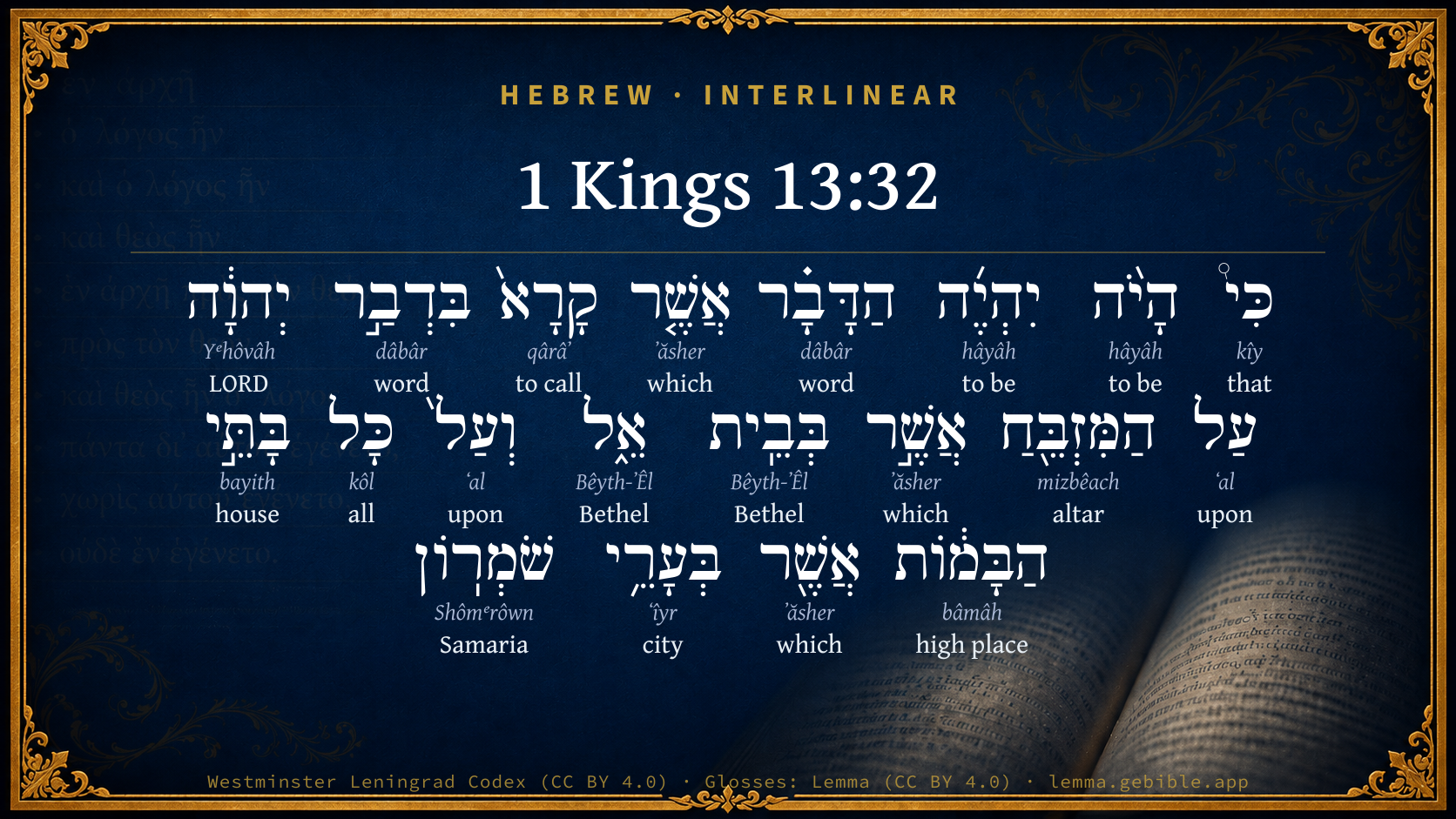
1 Kings 13:32

Hebrew (Westminster Leningrad Codex) 1 Kings 13:32 appears in the Hebrew Old Testament. The text above is from the Westminster Leningrad Codex. Each word links to its Strong’s number, a concise gloss, and parsing drawn from the Open Scriptures Hebrew Bible morphology. Click any word for its full Brown-Driver-Briggs (BDB) entry.
Download image
Cite this verse

1 Kings 13:32 (World English Bible). Public Domain. Lemma interlinear Bible study tool, https://lemma.gebible.app/v/1-kings/13/32.

Show BibTeX & RIS
BibTeX
RIS
English Translation
For the saying which he cried by the word of Yahweh against the altar in Bethel, and against all the houses of the high places which are in the cities of Samaria, shall surely happen.
World English Bible · Public Domain
Highlights
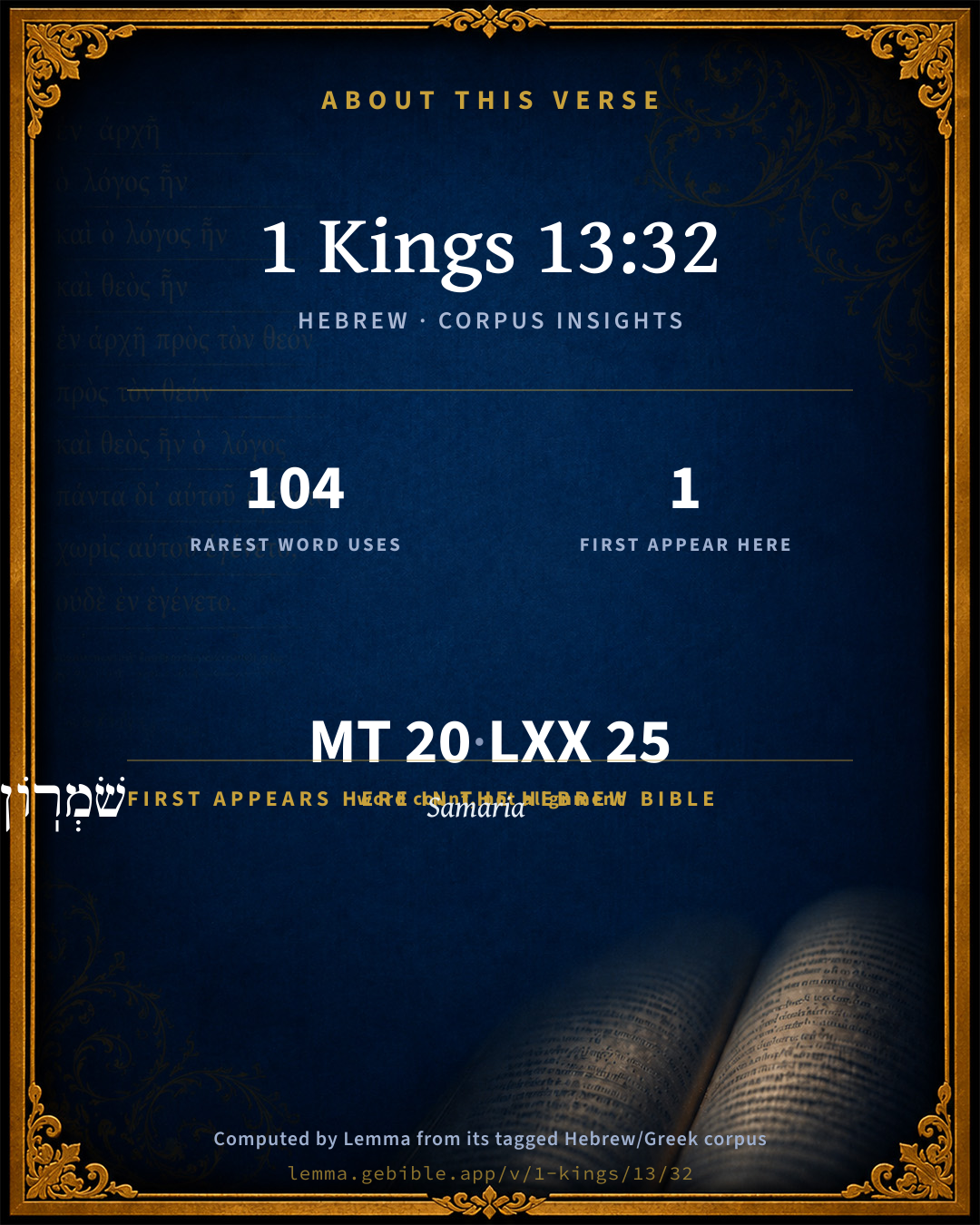
  • 1 first appearance in the Hebrew Bible
Full analysis ↓
Download a study sheet

One document with this verse’s original text, its word-by-word gloss line, the meaning frame, cross-references with their text, attributed commentary, and full source and license credits — printable, and it pastes into notes with its structure intact.

This verse Autodidact and up

Study sheet (.html) Plain text (.txt)

A passage Seminary Student

Up to 50 verses in one chapter. A passage sheet keeps up to 6 commentary sources and 12 cross-references per verse, in the order this page ranks them, and says so on the sheet whenever that leaves anything out. Ask for a single verse and you get the Autodidact verse sheet above.

Everything on this page stays free to read, with no account — the sheet is a download of what is already on screen, not access to it.

Want to remove ads? Support Godless Engineer
Compare translations 3

The same verse in 3 English versions, stacked beneath the original-language interlinear above. Click any original word for its lexicon entry.

Each is an independent rendering of the whole verse — the interlinear is not word-aligned to these translations.

Highlighted words mark where these versions differ — a whole-verse word diff, not a word-by-word alignment.

  • World English Bible Public Domain
    For the saying which he cried by the word of Yahweh against the altar in Bethel, and against all the houses of the high places which are in the cities of Samaria, shall surely happen.
  • King James Version Public Domain
    For the saying which he cried by the word of the LORD against the altar in Bethel, and against all the houses of the high places which are in the cities of Samaria, shall surely come to pass.
  • unfoldingWord Literal Text CC BY-SA 4.0
    For the word that he cried out by the word of Yahweh against the altar that in Bethel and against all of the houses of the high places that in the cities of Samaria, happening, it will happen.”

unfoldingWord Literal Text — © unfoldingWord, licensed CC BY-SA 4.0. Word-aligned USFM3 via Door43 (git.door43.org/unfoldingWord/en_ult).

Versions to compare (up to 4)

3 of 4 selected

Show all 18 translations

Every available English version of this verse, each an independent rendering of the whole verse.

  • World English Bible Public Domain
    For the saying which he cried by the word of Yahweh against the altar in Bethel, and against all the houses of the high places which are in the cities of Samaria, shall surely happen.
  • Berean Standard Bible Public Domain
    for the message that he cried out by the word of the LORD against the altar in Bethel and against all the shrines on the high places in the cities of Samaria will surely come to pass.”
  • Majority Standard Bible Public Domain
    for the message that he cried out by the word of the LORD against the altar in Bethel and against all the shrines on the high places in the cities of Samaria will surely come to pass.”
  • King James Version Public Domain
    For the saying which he cried by the word of the LORD against the altar in Bethel, and against all the houses of the high places which are in the cities of Samaria, shall surely come to pass.
  • American Standard Version (1901) Public Domain
    For the saying which he cried by the word of Jehovah against the altar in Beth-el, and against all the houses of the high places which are in the cities of Samaria, shall surely come to pass.
  • Revised Version (1885) Public Domain
    For the saying which he cried by the word of the LORD against the altar in Beth-el, and against all the houses of the high places which are in the cities of Samaria, shall surely come to pass.
  • Geneva Bible (1599) Public Domain
    For that thing which he cried by the word of the Lord against the altar that is in Beth-el, and against all the houses of the hie places, which are in the cities of Samaria, shall surely come to passe.
  • Douay-Rheims (1899) Public Domain
    For assuredly the word shall come to pass which he hath foretold in the word of the Lord against the altar that is in Bethel: and against all the temples of the high places, that are in the cities of Samaria.
  • Young's Literal Translation Public Domain
    for the word certainly cometh to pass that he called by the word of Jehovah concerning the altar which `is' Beth-El, and concerning all the houses of the high places that `are' in cities of Samaria.'
  • Literal Standard Version CC BY-SA 4.0
    for the word certainly comes to pass that he called by the word of YHWH concerning the altar which [is in] Beth-El, and concerning all the houses of the high places that [are] in cities of Samaria.”
  • Unlocked Literal Bible CC BY-SA 4.0
    For the message he declared by the word of Yahweh, against the altar in Bethel and against all the houses on the high places in the cities of Samaria, will certainly happen.”
  • unfoldingWord Literal Text CC BY-SA 4.0
    For the word that he cried out by the word of Yahweh against the altar that in Bethel and against all of the houses of the high places that in the cities of Samaria, happening, it will happen.”
  • Darby Bible Public Domain
    For the word that he cried by the word of Jehovah against the altar in Bethel, and against all the houses of the high places that are in the cities of Samaria, shall certainly come to pass.
  • World Messianic Bible Public Domain
    For the saying which he cried by the LORD’s word against the altar in Bethel, and against all the houses of the high places which are in the cities of Samaria, will surely happen.”
  • Webster's Bible Public Domain
    For the saying which he cried by the word of the LORD against the altar in Beth-el, and against all the houses of the high places which are in the cities of Samaria, shall surely come to pass.
  • Free Bible Version CC BY-SA 4.0
    For the message from the Lord that he gave in condemnation against the altar in Bethel, and against all the shrines on the high places in the towns of Samaria, will definitely happen.”
  • Bible in Basic English Public Domain
    For the outcry he made by the word of the Lord against the altar in Beth-el and against all the houses of the high places in the towns of Samaria, will certainly come about.
  • JPS Tanakh (1917) Public Domain
    For the saying which he cried by the word of the LORD against the altar in Beth-el, and against all the houses of the high places which are in the cities of Samaria, shall surely come to pass.'

Literal Standard Version (2020), Covenant Press — licensed CC BY-SA 4.0. Text via the HelloAO Bible API (eBible.org). Unlocked Literal Bible (unfoldingWord) — licensed CC BY-SA 4.0. Text via the HelloAO Bible API (eBible.org). unfoldingWord Literal Text — © unfoldingWord, licensed CC BY-SA 4.0. Word-aligned USFM3 via Door43 (git.door43.org/unfoldingWord/en_ult). Free Bible Version, Dr. Jonathan Gallagher — licensed CC BY-SA 4.0. Text via the HelloAO Bible API (eBible.org).

Word by word

More ways to search: Search by grammar → Find every occurrence → Compare this word →

Practice this passage: Drill this verse → Learn its vocabulary →

הַבָּמ֔וֹת
bâmâh
H1116
“the · high places”
Particle, Definite Article + Noun, Common, Feminine, Plural, Absolute
Part of Speech
Particle + Noun
Type
Common
Gender
Feminine
Number
Plural
State
Absolute
Full BDB Definition

Origin: from an unused root (meaning to be high)

TWOT: 253

high place, ridge, height, bamah (technical name for cultic platform) - high place, mountain - high places, battlefields - high places (as places of worship) - funeral mound?
  1. כִּי֩ kîy H3588 “that” Conjunction
  2. הָיֹ֨ה hâyâh H1961 “to be” Verb, Qal, Infinitive Absolute
  3. יִהְיֶ֜ה hâyâh H1961 “to be” Verb, Qal, Imperfect, 3rd Person, Masculine, Singular
  4. הַדָּבָ֗ר dâbâr H1697 “the · word” Particle, Definite Article + Noun, Common, Masculine, Singular, Absolute
  5. אֲשֶׁ֤ר ʼăsher H834 “which” Particle, Relative
  6. קָרָא֙ qârâʼ H7121 “to call” Verb, Qal, Perfect, 3rd Person, Masculine, Singular
  7. בִּדְבַ֣ר dâbâr H1697 “in/at · word of” Preposition + Noun, Common, Masculine, Singular, Construct
  8. יְהוָ֔ה Yᵉhôvâh H3068 “LORD” Noun, Proper
  9. עַל ʻal H5921 “upon” Preposition
  10. הַמִּזְבֵּ֖חַ mizbêach H4196 “the · altar” Particle, Definite Article + Noun, Common, Masculine, Singular, Absolute
  11. אֲשֶׁ֣ר ʼăsher H834 “which” Particle, Relative
  12. בְּבֵֽית Bêyth-ʼÊl H1008 “in/at · Bethel” Preposition + Noun, Proper
  13. אֵ֑ל Bêyth-ʼÊl H1008 “Bethel” Noun, Proper
  14. וְעַל֙ ʻal H5921 “and · upon” Conjunction + Preposition
  15. כָּל kôl H3605 “all of” Noun, Common, Masculine, Singular, Construct
  16. בָּתֵּ֣י bayith H1004 “houses of” Noun, Common, Masculine, Plural, Construct
  17. אֲשֶׁ֖ר ʼăsher H834 “which” Particle, Relative
  18. בְּעָרֵ֥י ʻîyr H5892 “in/at · cities of” Preposition + Noun, Common, Feminine, Plural, Construct
  19. שֹׁמְרֽוֹן Shômᵉrôwn H8111 “Samaria” Noun, Proper

About this verse

These counts appear in no published source. They are computed here, from the morphology-tagged text and Lemma’s own curated glosses. What Lemma adds →

20
words
14
distinct lemmas
Historical
section

First appearance in Scripture

This word makes its first canonical appearance in the Hebrew Bible here:

  • שֹׁמְרֽוֹן Samaria H8111

Grammatical profile

  • 3 verbs
  • 11 nouns
  • 2 prepositions
  • 1 conjunction
  • 3 particles

Verb forms

  • הָיֹ֨ה Qal · Infinitive Absolute
  • יִהְיֶ֜ה Qal · Imperfect
  • קָרָא֙ Qal · Perfect

Repetition

Words recur within this verse — often emphatic in Hebrew:

  • הָיֹ֨ה to be H1961 ×2
  • הַדָּבָ֗ר word H1697 ×2
  • עַל upon H5921 ×2
  • בְּבֵֽית Bethel H1008 ×2
  • אֲשֶׁ֤ר which H834 ×3

Hebrew & Septuagint length

In English translation the verse runs 35 words from the Hebrew and 29 from the Septuagint (LXX English) — closely comparable.

A rough comparison of the two English renderings, which tokenize alike — not a word-level alignment.

Word counts can differ between the Hebrew and the Greek without any difference in meaning — e.g. the Hebrew direct-object marker אֵת has no separate Greek word, and Greek often adds the article ὁ.

In the original languages it is 20 Hebrew tokens and 25 Greek tokens — but the two are counted differently (Hebrew bundles its prefixes and suffixes into one token; the Greek is in lemma form), so that isn’t a like-for-like length.

Cross-references

9

Topical passages linked to 1 Kings 13:32 in the Treasury of Scripture Knowledge — connected by theme and wording, ordered by reader-vote popularity; previews shown in the World English Bible.

  • 1 Kings 16:24 He bought the hill Samaria of Shemer for two talents of silver; and he built on the hill, and called the name of the city which he built, after the name of Shemer, the owner of the hill, Samaria.
  • 1 Kings 13:2 He cried against the altar by the word of Yahweh, and said, altar, altar, thus says Yahweh: Behold, a son shall be born to the house of David, Josiah by name; and on you shall he sacrifice the priests of the high places who burn incense on you, and men's bones shall they burn on you.
  • Leviticus 26:30 I will destroy your high places, and cut down your incense altars, and cast your dead bodies upon the bodies of your idols; and my soul will abhor you.
  • 1 Kings 12:31 He made houses of high places, and made priests from among all the people, who were not of the sons of Levi.
  • 2 Kings 23:16–19 As Josiah turned himself, he spied the tombs that were there in the mountain; and he sent, and took the bones out of the tombs, and burned them on the altar, and defiled it, according to the word of Yahweh which the man of God proclaimed, who proclaimed these things.
  • 1 Kings 12:29 He set the one in Bethel, and the other put he in Dan.
  • 2 Chronicles 25:13 But the men of the army whom Amaziah sent back, that they should not go with him to battle, fell on the cities of Judah, from Samaria even to Beth Horon, and struck of them three thousand, and took much spoil.
  • Ezra 4:10 and the rest of the nations whom the great and noble Osnappar brought over, and set in the city of Samaria, and in the rest [of the country] beyond the River, and so forth.

Cross-references courtesy of OpenBible.info (CC BY 4.0).

Hebrew and Greek witnesses Masoretic Hebrew ↔ Greek Septuagint

The same verse in the two great witnesses to the Old Testament, shown verse-for-verse.

These are two independent witnesses, not word-aligned to each other, and the Septuagint is shown in lemma (dictionary) form.

Hebrew 1 Kings 13:32 Masoretic · Westminster Leningrad Codex

כִּי֩ הָיֹ֨ה יִהְיֶ֜ה הַדָּבָ֗ר אֲשֶׁ֤ר קָרָא֙ בִּדְבַ֣ר יְהוָ֔ה עַל הַמִּזְבֵּ֖חַ אֲשֶׁ֣ר בְּבֵֽית אֵ֑ל וְעַל֙ כָּל בָּתֵּ֣י הַבָּמ֔וֹת אֲשֶׁ֖ר בְּעָרֵ֥י שֹׁמְרֽוֹן

For the saying which he cried by the word of Yahweh against the altar in Bethel, and against all the houses of the high places which are in the cities of Samaria, shall surely happen.

World English Bible · Public Domain

Greek LXX 1 Kings 13:32 Septuagint · lemma form

ὅτι γίγνομαι εἰμί ὁ ῥῆμα ὅς λαλέω ἐν λόγος κύριος ἐπί ὁ θυσιαστήριον ὁ ἐν βαιθηλ καί ἐπί ὁ οἶκος ὁ ὑψηλός ὁ ἐν σαμαρεία

For the word will surely come to pass which he spoke by the word of the Lord against the altar in Baethel, and against the high houses in Samaria.

LXX2012 (modern English Septuagint) · Public Domain

Hebrew: Westminster Leningrad Codex (CC BY 4.0). Greek: Septuagint (public domain); English from LXX2012 (modern English Septuagint) (Public Domain). How the Septuagint differs from the Hebrew →

Targum (Aramaic paraphrase)

1

The Targum is the ancient Jewish Aramaic paraphrase of the Hebrew Scriptures — an interpretive translation, not the Hebrew text itself. Onkelos (literal) and Pseudo-Jonathan (expansive) render the Torah, and Jonathan the Prophets. Coverage is partial: where no permissively-licensed English translation exists for a verse, only the Aramaic is shown. This is verse-level text, not a word-by-word alignment to the Hebrew.

  1. Targum Jonathan Prophets (Joshua–Malachi)
    אֲרֵי אִתְקַיָמָא יִתְקַיָם פִּתְגָמָא דְאִתְנַבֵּי בְּפִתְגָמָא דַייָ עַל אֱגוֹרָא דִי בְּבֵית אֵל וְעַל כָּל בָּתֵּי בָמָתָא דִי בְקִירְוֵי שֹׁמְרוֹן:

    (no public-domain English translation for this verse)

    Targum Jonathan — Aramaic: “Mikraot Gedolot” (public domain). English: “Sefaria Community Translation” (CC0 1.0 (public-domain dedication)); “London "Chaldee Paraphrase," 1871” (public domain). Text via Sefaria.

Commentary

Notes on 1 Kings 13:32 from classic Christian and Jewish commentators (each source and its license shown beneath its notes). The classic Christian expositions comment on the surrounding passage and are grouped to its opening verse, so a note may address several verses; the Jewish commentaries on the Tanakh (Rashi and others) are per-verse, so they appear only where the commentator wrote on this verse.

Lemma curates 59 commentaries, every one of them public domain or Creative Commons licensed, each selected and text-cleaned for this edition rather than reprinted as found. About our sources →

Trapp's Complete Commentary

John Trapp

1Ki 13:32 For the saying which he cried by the word of the LORD against the altar in Bethel, and against all the houses of the high places which [are] in the cities of Samaria, shall surely come to pass.

Ver. 32. Which are in the cities of Samaria.] So called here by anticipation. It seemeth of old to be called and belong to Shimronmeron. {Jos 11:1; Jos 11:3; Jos 12:20}

Shall surely come to pass.] Heb., Being, shall be. Jehovah, the great essentiator, shall give being to his word assuredly. "Every morning doth he bring his judgments to light, he faileth not." {Zep 3:5}

John Trapp, A Commentary or Exposition upon All the Books of the Old and New Testament (1647–1656) — public domain. Text from a community e-Sword module.

Tyndale Open Study Notes

Tyndale Open Resources

13:32 the message . . . will certainly come true: The Lord’s swift judgment convinced the old prophet that the oracle of judgment pronounced by the man of God against Jeroboam’s altar would be fulfilled. The prophecy came true years later during Josiah’s reforms (2 Kgs 23:15-18). • Samaria was established as the capital city of Israel during the reign of Omri, first king of Israel’s third dynasty (1 Kgs 16:24, 29-33). The name Samaria sometimes refers to the capital city and sometimes to the northern kingdom in general (2 Kgs 17:24; Amos 6:1). Samaria’s mention here reflects the perspective of an author living at a later time. Similar uses of location names elsewhere reflect editorial updating (cp. Gen 23:2 with Josh 14:15; Judg 1:10).

Tyndale Open Study Notes — © Tyndale Open Resources, licensed CC BY-SA 4.0. Text via the HelloAO Bible API.

Adam Clarke's Commentary

Verse 32. In the cities of Samaria] It is most certain that Samaria, or as it is called in Hebrew Shomeron, was not built at this time. We are expressly told that Omri, king of Israel, founded this city on the hill which he bought for two talents of silver, from a person of the name of Shemer, after whom he called the city Samaria or Shomeron; (see 1Kg 16:24); and this was fifty years after the death of Jeroboam. How then could the old prophet speak of Samaria, not then in existence, unless he did it by the spirit of prophecy, calling things that are not as though they were; as the man of God called Josiah by name three hundred years before he was born? Some suppose that the historian adds these words because Samaria existed in his time, and he well knew that it did not exist in the time of the old prophet; for himself, in the sixteenth chapter, gives us the account of its foundation by Omri. After all, it is possible that God might have given this revelation to the old prophet; and thus by anticipation which is the language of prophecy, spoke of Samaria as then existing. This is the solution of Houbigant, and is thought sound by many good critics.

Adam Clarke's Commentary on the Bible (1810–1826) — public domain. Text from a community e-Sword/MySword module.

The Cambridge Bible for Schools and Colleges

gen. ed. J. J. S. Perowne

32. high places which are in the cities of Samaria] On the building of Samaria, see 1Ki_16:24. The occurrence of these words in the narrative seems clear evidence that the story in its present form is not contemporary with the events, and may therefore have been written down even later than Josiah’s time. See above on 1Ki_13:2.

The Cambridge Bible for Schools and Colleges (gen. ed. J. J. S. Perowne; Cambridge University Press, 1878–1918) — public domain. Text from a community e-Sword module.

Albert Barnes' Notes on the Bible

Against all the houses of the high places - i. e., more than the two high places at Dan and Bethel. There were many lesser high places in the land, several of which would be likely to be in Israel 1Ki 3:4.

In the cities of Samaria - The word Samaria cannot have been employed by the old prophet, in whose days Samaria did not exist 1Ki 16:24. The writer of Kings has substituted for the term used by him that whereby the country was known in his own day.

Albert Barnes' Notes on the Bible (1834–1885) — public domain. Text from a community e-Sword/MySword module.

Haydock's Catholic Bible Commentary

Samaria. The city was built by Amri, fifty years after the death of Jeroboam, chap. xvi. 24. But the sacred writer speaks of places by the names which they bore in his time. (Calmet) --- If this man was a prophet, he might easily mention Samaria, which would give its name to the kingdom of Israel. There was also probably a village of this name long before, on the mountain Samir, where one of the judges was buried, Judges x. 2. (Haydock)

George Leo Haydock (1774–1849), Haydock's Catholic Family Bible and Commentary, 1859 edition — public domain. Excludes Psalms (Douay-Rheims chapter numbering differs from Protestant) and Deuterocanonical books (Catholic canon only).

Matthew Poole's English Annotations

Of Samaria, i.e. of the kingdom of Samaria, as it was called, though not when this fact was done, yet before these books were written. Samaria was properly the name of one city, 1Ki 20:1; but from hence the whole kingdom of Israel was so called, Jer 31:5; Hos 7:1; Hos 8:5; Amo 3:9; and the king of Israel is called the king of Samaria, 2Ki 1:3; Hos 10:7; and (as here) we read of the cities of Samaria, Ezr 4:10.

Matthew Poole's English Annotations on the Holy Bible (1683–1685) — public domain. Text from a community e-Sword/MySword module.

Whedon's Commentary on the Bible

Daniel D. Whedon

32. And against all the houses of the high places which are in the cities of Samaria — This passage is probably an interpolation, taken from 2Ki_23:19, for Samaria was not built till the time of Omri, (1Ki_16:24,) and from that capital city the surrounding country took its name. Omri named his capital after the owner of the hill on which he built the city, from which it appears that only the hill, and not the surrounding province, bore up to that time the name Samaria, or Shomeron. Hence it would have been a singular anachronism for a person of Jeroboam’s time to speak of the cities of Samaria. It is possible, indeed, that a prophet divinely illuminated might have been enabled thus to speak of things that were not as though they were, but the peculiar manner of his doing it here is unlike any other instance of revelation on record.

Shall surely come to pass — By this positive word of the old prophet, as well as by all the memorable circumstances of his brother-prophet’s disobedience and death, Jehovah’s oracles against the altar at Beth-el received additional weight and fearfulness.

Daniel D. Whedon (gen. ed.), Commentary on the Old and New Testaments (1874–1909) — public domain. Text from a community e-Sword module.

The Pulpit Commentary

For the saying which he cried by the word of the Lord against the altar in Bethel., and against all the houses of the high places At that time there would seem to have been but two "high places." Keil sees "a prophetic element in these words." He thinks the old prophet foresaw that such sanctuaries would be multiplied. Rawlinson gathers, "from the mention of the great high place in 1Ki_3:4, that there were many lesser high places in the land," which, no doubt, was the case at the date of Solomon"s accession. It is probable, however, that many of these, if not all, would be deserted when the temple was built. And it is most reasonable to suppose that in these, as in the following words, the historian has represented the prediction or affirmation of the old prophet in the language of his own time which are in the cities of Samaria. Obviously, these exact words cannot have been used by the prophet of Bethel, for Samaria dates its existence and name from the reign of Omri. (1Ki_16:24) The compiler of the Kings probably found the term in the documents which he used, or possibly, as already suggested, translated the prophet"s meaning into the language of a later day shall surely come to pass.

The Pulpit Commentary (1880–1919), ed. H.D.M. Spence-Jones & Joseph S. Exell — public domain. Text from a community e-Sword module.

John Wesley's Explanatory Notes

Samaria - That is, of the kingdom of Samaria; as it was called, though not when this fact was done, yet before these books were written. Samaria was properly this name of one city, chap. xxi, 1, but from hence the whole kingdom of Israel was so called.

John Wesley, Explanatory Notes Upon the Whole Bible (1754–1765) — public domain. Text via the GEBible commentary corpus.

Rashi

Rabbi Shlomo Yitzchaki (Rashi)

For [the message] will certainly come to pass, etc. Perhaps his bones will rescue my bones.

Rashi on the Tanakh — English translations: “The Judaica Press complete Tanach with Rashi, translated by A. J. Rosenberg” (CC BY 4.0); “Pentateuch with Rashi's commentary by M. Rosenbaum and A.M. Silbermann, 1929-1934” (public domain); “The Metsudah Tanach series, Lakewood, N.J” (CC BY 4.0); and “The Book of Joshua, Metsudah Publications, 1997” (CC BY 4.0). Text via Sefaria.

Lesson kit

Teaching starters — assembled from the data on this page, not authored interpretation. Every prompt links to the verse data it draws on. Edit before teaching.

1 Kings, in the Historical, opens this verse with 20 words (14 distinct Hebrew lemmas). Its most distinctive word is bâmâh (“high place”). A historical commentator’s framing appears above. Read the whole chapter for the surrounding context.

Discussion questions

  1. How does “high place” (bâmâh) shape what this verse is saying?
  2. The word “Samaria” first appears here in Scripture. What is being introduced at this debut?
  3. 1 Kings 16:24 shares this passage’s theme. How do the two illuminate each other?
  4. “to be” occurs 2× in this one verse. What is the effect of the repetition?
  5. These translations render this verse differently. What is at stake in choosing one wording over another?
  6. The verb «הָיֹ֨ה» is Qal Infinitive Absolute. How does its form color the action?
  7. Reading how Trapp's Complete Commentary and Tyndale Open Study Notes read this verse, where do the two commentators agree and where do they part?

Things to notice

Reading settings

Reading text

Shown beneath each verse's original-language words.

Old Testament
Old Testament edition

Read the OT as the Masoretic Hebrew (MT) or the Greek Septuagint (LXX).

English shown for the Greek Septuagint (in the Hebrew ↔ Greek comparison).

Comparing translations? Open the Compare panel on any verse page to stack up to four side by side.