
Numbers 13:19

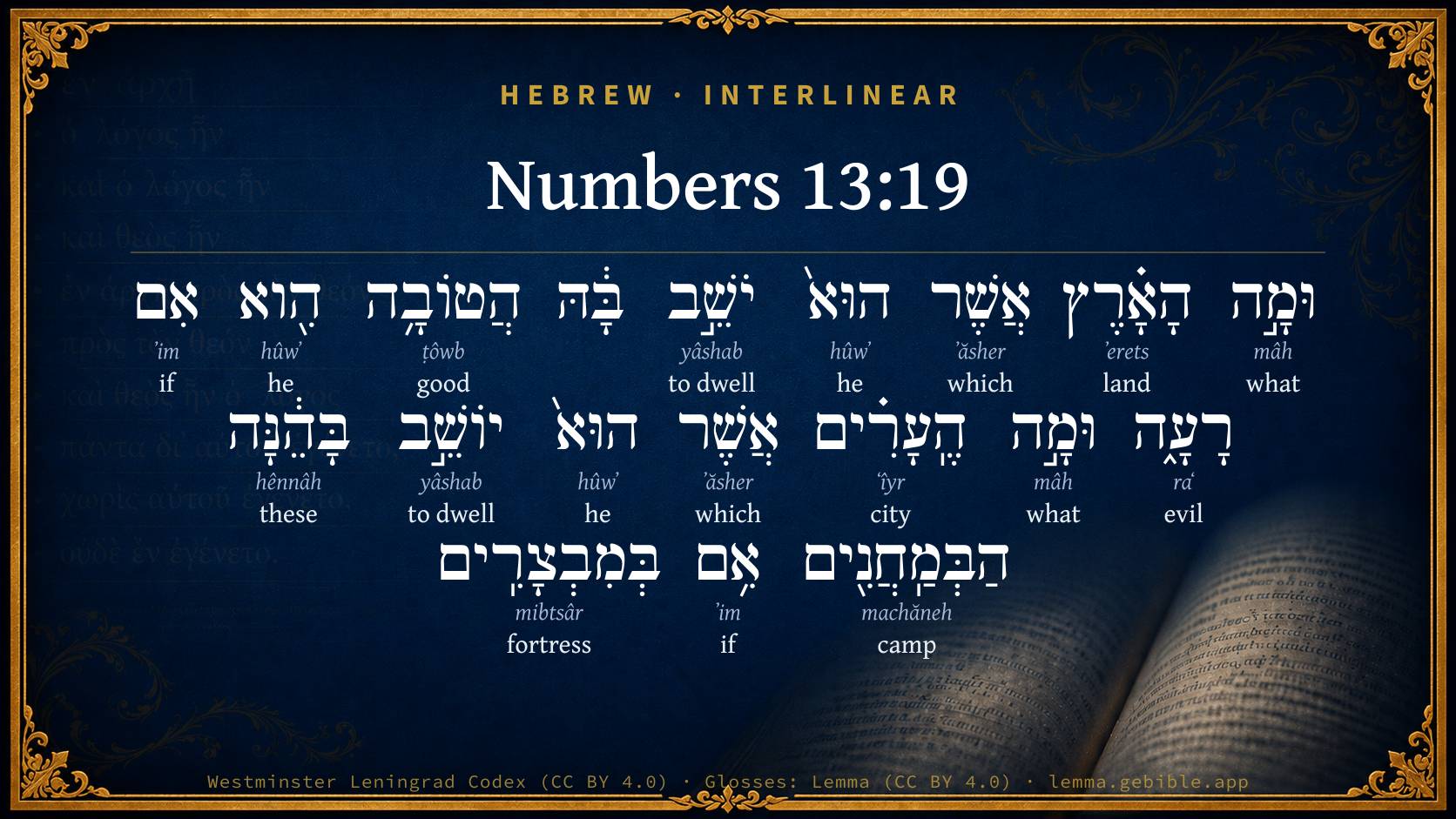
Hebrew (Westminster Leningrad Codex) Numbers 13:19 appears in the Hebrew Old Testament. The text above is from the Westminster Leningrad Codex. Each word links to its Strong’s number, a concise gloss, and parsing drawn from the Open Scriptures Hebrew Bible morphology. Click any word for its full Brown-Driver-Briggs (BDB) entry.
Download image
Cite this verse

Numbers 13:19 (World English Bible). Public Domain. Lemma interlinear Bible study tool, https://lemma.gebible.app/v/numbers/13/19.

Show BibTeX & RIS
BibTeX
RIS
English Translation
and what the land is that they dwell in, whether it is good or bad; and what cities they are that they dwell in, whether in camps, or in strongholds;
World English Bible · Public Domain
Highlights
  • 1 first appearance in the Hebrew Bible
Full analysis ↓
Download a study sheet

One document with this verse’s original text, its word-by-word gloss line, the meaning frame, cross-references with their text, attributed commentary, and full source and license credits — printable, and it pastes into notes with its structure intact.

This verse Autodidact and up

Study sheet (.html) Plain text (.txt)

A passage Seminary Student

Up to 50 verses in one chapter. A passage sheet keeps up to 6 commentary sources and 12 cross-references per verse, in the order this page ranks them, and says so on the sheet whenever that leaves anything out. Ask for a single verse and you get the Autodidact verse sheet above.

Everything on this page stays free to read, with no account — the sheet is a download of what is already on screen, not access to it.

Want to remove ads? Support Godless Engineer
Compare translations 3

The same verse in 3 English versions, stacked beneath the original-language interlinear above. Click any original word for its lexicon entry.

Each is an independent rendering of the whole verse — the interlinear is not word-aligned to these translations.

Highlighted words mark where these versions differ — a whole-verse word diff, not a word-by-word alignment.

  • World English Bible Public Domain
    and what the land is that they dwell in, whether it is good or bad; and what cities they are that they dwell in, whether in camps, or in strongholds;
  • King James Version Public Domain
    And what the land is that they dwell in, whether it be good or bad; and what cities they be that they dwell in, whether in tents, or in strong holds;
  • unfoldingWord Literal Text CC BY-SA 4.0
    and what the land in which it is dwelling, whether it good or evil; and what the cities in which it is dwelling, whether in camps or in fortresses;

unfoldingWord Literal Text — © unfoldingWord, licensed CC BY-SA 4.0. Word-aligned USFM3 via Door43 (git.door43.org/unfoldingWord/en_ult).

Versions to compare (up to 4)

3 of 4 selected

Show all 18 translations

Every available English version of this verse, each an independent rendering of the whole verse.

  • World English Bible Public Domain
    and what the land is that they dwell in, whether it is good or bad; and what cities they are that they dwell in, whether in camps, or in strongholds;
  • Berean Standard Bible Public Domain
    Is the land where they live good or bad? Are the cities where they dwell open camps or fortifications?
  • Majority Standard Bible Public Domain
    Is the land where they live good or bad? Are the cities where they dwell open camps or fortifications?
  • King James Version Public Domain
    And what the land is that they dwell in, whether it be good or bad; and what cities they be that they dwell in, whether in tents, or in strong holds;
  • American Standard Version (1901) Public Domain
    and what the land is that they dwell in, whether it is good or bad; and what cities they are that they dwell in, whether in camps, or in strongholds;
  • Revised Version (1885) Public Domain
    and what the land is that they dwell in, whether it be good or bad; and what cities they be that they dwell in, whether in camps, or in strong holds;
  • Geneva Bible (1599) Public Domain
    And consider the land what it is, and the people that dwel therein, whether they be strong or weake, either fewe or many,
  • Douay-Rheims (1899) Public Domain
    View the land, of what sort it is: and the people that are the inhabitants thereof, whether they be strong or weak: few in number or many:
  • Young's Literal Translation Public Domain
    and what the land `is' in which it is dwelling, whether it `is' good or bad; and what `are' the cities in which it is dwelling, whether in camps or in fortresses;
  • Literal Standard Version CC BY-SA 4.0
    and what the land [is] in which it is dwelling, whether it [is] good or bad; and what [are] the cities in which it is dwelling, whether in camps or in fortresses.
  • Unlocked Literal Bible CC BY-SA 4.0
    See what the land is like where they live. Is it good or bad? What cities are there? Are they like camps, or are they fortified cities?
  • unfoldingWord Literal Text CC BY-SA 4.0
    and what the land in which it is dwelling, whether it good or evil; and what the cities in which it is dwelling, whether in camps or in fortresses;
  • Darby Bible Public Domain
    and what the land is that they dwell in, whether it is good or bad; and what cities they are that they dwell in, whether in camps, or in strongholds;
  • World Messianic Bible Public Domain
    and what the land is that they dwell in, whether it is good or bad; and what cities they are that they dwell in, whether in camps, or in strongholds;
  • Webster's Bible Public Domain
    And what the land is that they dwell in, whether it is good or bad; and what cities they are that they dwell in, whether in tents, or in strong holds;
  • Free Bible Version CC BY-SA 4.0
    Is the land where they're living good or bad? Are their towns like open camps, or do they have defensive walls?
  • Bible in Basic English Public Domain
    And what sort of land they are living in, if it is good or bad; and what their living-places are, tent-circles or walled towns;
  • JPS Tanakh (1917) Public Domain
    and what the land is that they dwell in, whether it is good or bad; and what cities they are that they dwell in, whether in camps, or in strongholds;

Literal Standard Version (2020), Covenant Press — licensed CC BY-SA 4.0. Text via the HelloAO Bible API (eBible.org). Unlocked Literal Bible (unfoldingWord) — licensed CC BY-SA 4.0. Text via the HelloAO Bible API (eBible.org). unfoldingWord Literal Text — © unfoldingWord, licensed CC BY-SA 4.0. Word-aligned USFM3 via Door43 (git.door43.org/unfoldingWord/en_ult). Free Bible Version, Dr. Jonathan Gallagher — licensed CC BY-SA 4.0. Text via the HelloAO Bible API (eBible.org).

Word by word

More ways to search: Search by grammar → Find every occurrence → Compare this word →

Practice this passage: Drill this verse → Learn its vocabulary →

בְּמִבְצָרִֽים
mibtsâr
H4013
“in/at · fortresses”
Preposition + Noun, Common, Masculine, Plural, Absolute
Part of Speech
Preposition + Noun
Type
Common
Gender
Masculine
Number
Plural
State
Absolute
Full BDB Definition

Origin: from H1219

TWOT: 270g

fortification, fortress, fortified city, stronghold
  1. וּמָ֣ה mâh H4100 “and · what” Conjunction + Particle, Interrogative
  2. הָאָ֗רֶץ ʼerets H776 “the · land” Particle, Definite Article + Noun, Common, Both, Singular, Absolute
  3. אֲשֶׁר ʼăsher H834 “which” Particle, Relative
  4. הוּא֙ hûwʼ H1931 “he” Pronoun, Personal, 3rd Person, Masculine, Singular
  5. יֹשֵׁ֣ב yâshab H3427 “dwelling” Verb, Qal, Participle Active, Masculine, Singular, Absolute
  6. הֲטוֹבָ֥ה ṭôwb H2896 “good” Particle, Interrogative + Adjective, Adjective, Feminine, Singular, Absolute
  7. הִ֖וא hûwʼ H1931 “he” Pronoun, Personal, 3rd Person, Feminine, Singular
  8. אִם ʼim H518 “if” Conjunction
  9. רָעָ֑ה raʻ H7451 “evil” Adjective, Adjective, Feminine, Singular, Absolute
  10. וּמָ֣ה mâh H4100 “and · what” Conjunction + Particle, Interrogative
  11. הֶֽעָרִ֗ים ʻîyr H5892 “the · cities” Particle, Definite Article + Noun, Common, Feminine, Plural, Absolute
  12. אֲשֶׁר ʼăsher H834 “which” Particle, Relative
  13. הוּא֙ hûwʼ H1931 “he” Pronoun, Personal, 3rd Person, Masculine, Singular
  14. יוֹשֵׁ֣ב yâshab H3427 “dwelling” Verb, Qal, Participle Active, Masculine, Singular, Absolute
  15. בָּהֵ֔נָּה hênnâh H2007 “in/at · these” Preposition + Pronoun, Personal, 3rd Person, Feminine, Plural
  16. הַבְּמַֽחֲנִ֖ים machăneh H4264 “in/at · camps” Particle, Interrogative + Preposition + Noun, Common, Both, Plural, Absolute
  17. אִ֥ם ʼim H518 “if” Conjunction

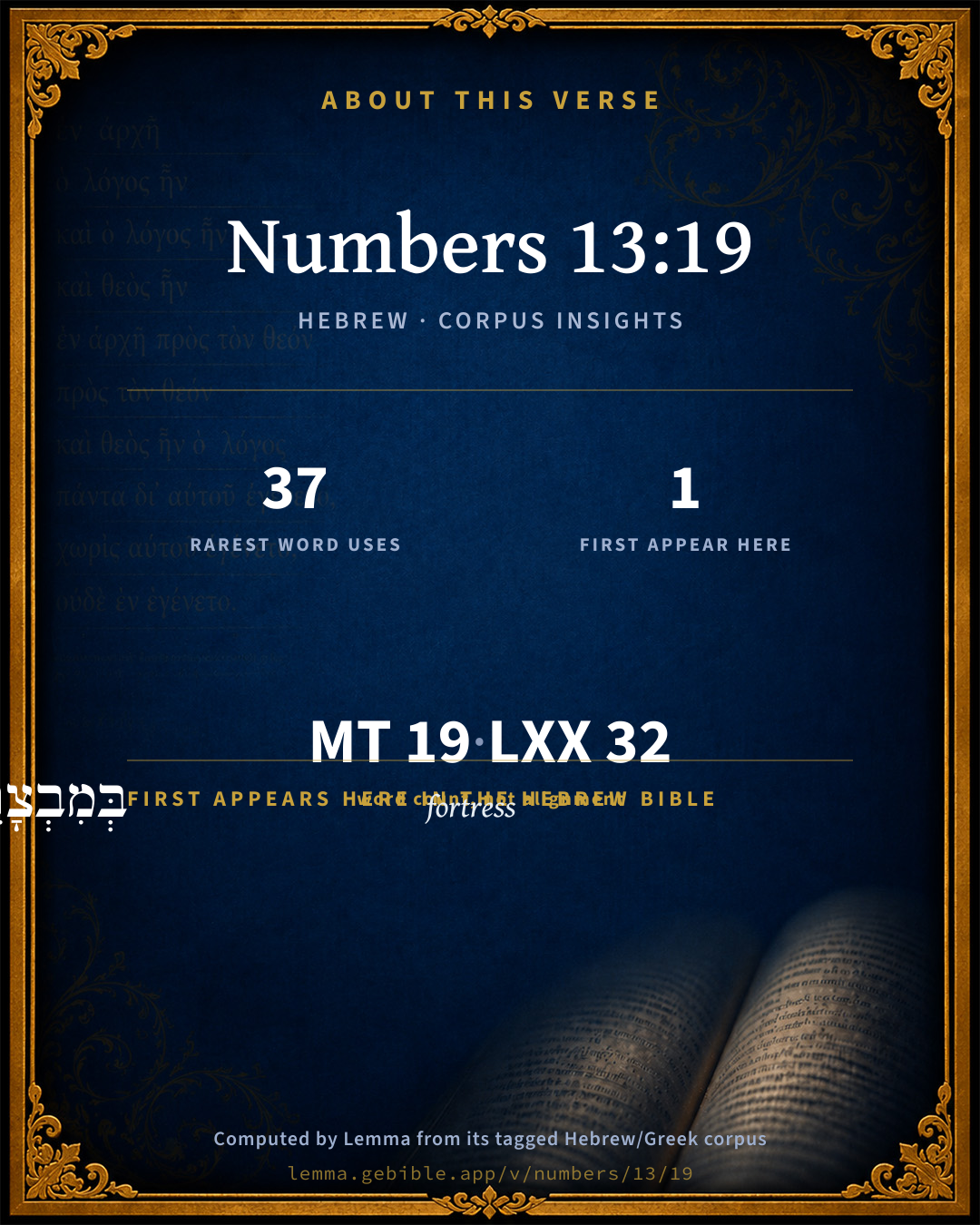
About this verse

These counts appear in no published source. They are computed here, from the morphology-tagged text and Lemma’s own curated glosses. What Lemma adds →

19
words
12
distinct lemmas
Pentateuch
section

First appearance in Scripture

This word makes its first canonical appearance in the Hebrew Bible here:

  • בְּמִבְצָרִֽים fortress H4013

Shared distinctive vocabulary

בְּמִבְצָרִֽים fortress H4013 occurs in 37 verses of the Hebrew Bible. Also found in:

Grammatical profile

  • 2 verbs
  • 4 nouns
  • 2 adjectives
  • 4 pronouns
  • 1 preposition
  • 2 conjunctions
  • 4 particles

Verb forms

  • יֹשֵׁ֣ב Qal · Participle Active
  • יוֹשֵׁ֣ב Qal · Participle Active

Repetition

Words recur within this verse — often emphatic in Hebrew:

  • יֹשֵׁ֣ב to dwell H3427 ×2
  • הוּא֙ he H1931 ×3
  • וּמָ֣ה what H4100 ×2
  • אֲשֶׁר which H834 ×2
  • אִם if H518 ×2

Hebrew & Septuagint length

In English translation the verse runs 30 words from the Hebrew and 29 from the Septuagint (LXX English) — closely comparable.

A rough comparison of the two English renderings, which tokenize alike — not a word-level alignment.

Word counts can differ between the Hebrew and the Greek without any difference in meaning — e.g. the Hebrew direct-object marker אֵת has no separate Greek word, and Greek often adds the article ὁ.

In the original languages it is 19 Hebrew tokens and 32 Greek tokens — but the two are counted differently (Hebrew bundles its prefixes and suffixes into one token; the Greek is in lemma form), so that isn’t a like-for-like length.

Hebrew and Greek witnesses Masoretic Hebrew ↔ Greek Septuagint

The same verse in the two great witnesses to the Old Testament, shown verse-for-verse.

These are two independent witnesses, not word-aligned to each other, and the Septuagint is shown in lemma (dictionary) form.

Hebrew Numbers 13:19 Masoretic · Westminster Leningrad Codex

וּמָ֣ה הָאָ֗רֶץ אֲשֶׁר הוּא֙ יֹשֵׁ֣ב בָּ֔הּ הֲטוֹבָ֥ה הִ֖וא אִם רָעָ֑ה וּמָ֣ה הֶֽעָרִ֗ים אֲשֶׁר הוּא֙ יוֹשֵׁ֣ב בָּהֵ֔נָּה הַבְּמַֽחֲנִ֖ים אִ֥ם בְּמִבְצָרִֽים

and what the land is that they dwell in, whether it is good or bad; and what cities they are that they dwell in, whether in camps, or in strongholds;

World English Bible · Public Domain

Greek LXX Numbers 13:19 Septuagint · lemma form

καί τίς ὁ γῆ εἰς ὅς οὗτος ἐν καταἧμαι ἐπί αὐτός εἰ καλός εἰμί ἤ πονηρός καί τίς ὁ πόλις εἰς ὅς οὗτος καταοἰκέω ἐν αὐτός εἰ ἐν τειχήρης ἤ ἐν ἀτείχιστος

and you⌃ shall see the land, what it is, and the people that dwells on it, whether it is strong or weak, or whether they are few or many.

LXX2012 (modern English Septuagint) · Public Domain

On this verse, Whedon's Commentary on the Bible discusses the Septuagint’s reading. Read the note in Commentary ↓

Hebrew: Westminster Leningrad Codex (CC BY 4.0). Greek: Septuagint (public domain); English from LXX2012 (modern English Septuagint) (Public Domain). How the Septuagint differs from the Hebrew →

Targum (Aramaic paraphrase)

2

The Targum is the ancient Jewish Aramaic paraphrase of the Hebrew Scriptures — an interpretive translation, not the Hebrew text itself. Onkelos (literal) and Pseudo-Jonathan (expansive) render the Torah, and Jonathan the Prophets. Coverage is partial: where no permissively-licensed English translation exists for a verse, only the Aramaic is shown. This is verse-level text, not a word-by-word alignment to the Hebrew.

  1. Targum Onkelos Torah (Genesis–Deuteronomy)
    וּמָה אַרְעָא דִי הוּא יָתֵב בָּהּ הֲטָבָא הִיא אִם בִּישָׁא וּמָה קִרְוַיָא דִי הוּא יָתֵב בְהוֹן הַבְּפַצְחִין אִם בִּכְרַכִּין

    (no public-domain English translation for this verse)

    Targum Onkelos — Aramaic: “Onkelos Genesis” (public domain); “Onkelos Exodus” (public domain); “Onkelos Leviticus” (public domain); “Onkelos Numbers” (public domain); “Onkelos Deuteronomy” (public domain). English: “Sefaria Community Translation” (CC0 1.0 (public-domain dedication)); “J.W. Etheridge. The Targums of Onkelos and Jonathan Ben Uzziel on the Pentateuch. London: Longmans, Green, 1862” (public domain). Text via Sefaria.

  2. Targum Pseudo-Jonathan Torah (Genesis–Deuteronomy)
    וּמָה אַרְעָא דְהוּא יָתֵיב בָּהּ הֲטַבְתָּא הִיא אִין בִּישְׁתָּא וּמָה קִרְוַיָא דְהוּא יָתֵיב בְּהוֹן הַבִכְּרַכֵּי פַּצִיחֵי חַנְיָן אִין בְּחַקְרִין

    what the land is in which they dwell, whether good or bad; what cities they inhabit, whether they live in towns that are open or walled;

    Targum Pseudo-Jonathan — Aramaic: “Targum Jonathan on Genesis” (public domain); “Targum Jonathan on Exodus” (public domain); “Targum Jonathan on Leviticus” (public domain); “Targum Jonathan on Numbers” (public domain); “Targum Jonathan on Deuteronomy” (public domain). English: “The Targum of Jonathan ben Uzziel, trans. J. W. Etheridge, London, 1862” (public domain). Text via Sefaria.

Commentary

Notes on Numbers 13:19 from classic Christian and Jewish commentators (each source and its license shown beneath its notes). The classic Christian expositions comment on the surrounding passage and are grouped to its opening verse, so a note may address several verses; the Jewish commentaries on the Tanakh (Rashi and others) are per-verse, so they appear only where the commentator wrote on this verse.

Lemma curates 59 commentaries, every one of them public domain or Creative Commons licensed, each selected and text-cleaned for this edition rather than reprinted as found. About our sources →

Joseph Benson's Commentary

Num 13:19-20. In tents — As the Arabians did; or in unwalled villages, which, like tents, are exposed to an enemy. Fat — Rich and fertile.

Joseph Benson's Commentary on the Old and New Testaments (1811–1818) — public domain. Text from a community e-Sword module.

Ellicott's Commentary for English Readers

(19) Whether in tents.—Better, in camps, i.e., in open villages and hamlets, as contrasted with strongholds or fortified places.

A Bible Commentary for English Readers, edited by Charles John Ellicott (1878–1897) — public domain. Text from a community e-Sword module.

John Gill's Exposition

And they returned from searching the land after forty days. The Targum of Jonathan adds, on the eighth day of the month Ab, which answers to part of July and part of August; so that this must be towards the latter end of July: some Jewish writers (k) say it was the ninth of Ab; hence the tradition, that it was decreed on the ninth of Ab concerning their fathers, that they should not enter into the land (l).

(k) Seder Olam Rabba, c. 8. p. 24. (l) Misn. Taanith, c. 4. sect. 7.

John Gill's Exposition of the Whole Bible (1746–1763) — public domain (CC PDM 1.0). Text via the HelloAO Bible API.

Albert Barnes' Notes on the Bible

In tents - i. e. in open unwalled villages.

Albert Barnes' Notes on the Bible (1834–1885) — public domain. Text from a community e-Sword/MySword module.

Matthew Poole's English Annotations

Good or bad, healthful or unwholesome, fruitful or barren.

In tents, as the Arabians did; or in unwalled villages, which, like tents, are exposed to an enemy.

Matthew Poole's English Annotations on the Holy Bible (1683–1685) — public domain. Text from a community e-Sword/MySword module.

Whedon's Commentary on the Bible

Daniel D. Whedon

19. What the land is — Fertile or barren; cultivable or necessarily waste.

Tents, or in strong holds — The inquiry whether the Canaanites dwelling in cities lived in tents or in strong holds presents a difficulty, for a city of tents is something unheard of. Here the Chaldee, the Septuagint, the Vulgate, and the Targums all read, “whether they live in cities that are walled or open.”

Daniel D. Whedon (gen. ed.), Commentary on the Old and New Testaments (1874–1909) — public domain. Text from a community e-Sword module.

John Wesley's Explanatory Notes

In tents - As the Arabians did; or in unwalled villages, which, like tents, are exposed to an enemy.

John Wesley, Explanatory Notes Upon the Whole Bible (1754–1765) — public domain. Text via the GEBible commentary corpus.

Rashi

Rabbi Shlomo Yitzchaki (Rashi)

הבמחנים — The Targum rendering is: “whether in open places” i.e. in cities open and exposed — without a wall.

הטובה הוא WHETHER IT IS GOOD, through possessing springs and other good and healthy supplies of water.

Rashi on the Tanakh — English translations: “The Judaica Press complete Tanach with Rashi, translated by A. J. Rosenberg” (CC BY 4.0); “Pentateuch with Rashi's commentary by M. Rosenbaum and A.M. Silbermann, 1929-1934” (public domain); “The Metsudah Tanach series, Lakewood, N.J” (CC BY 4.0); and “The Book of Joshua, Metsudah Publications, 1997” (CC BY 4.0). Text via Sefaria.

Ramban (Nachmanides)

Rabbi Moshe ben Nachman (Ramban / Nachmanides)

WHETHER IT IS GOOD OR BAD. Rabbi Abraham ibn Ezra commented [that the meaning thereof is that they are to see] “if the Land is good, namely that its air is good, and its waters are good.” Then Moses continued, whether it is fat, meaning “capable of producing wheat” and many fruits.The correct interpretation is that whether it is ‘good’ includes all good things, and in the word ra’ah [or ‘bad’] are included all evils. [If so, the question arises why Moses continued with the apparently superfluous command to find out whether the Land is fat or lean, since it is already included in the phrases good and bad?] It is possible, however, that a good land is fruitful and its fruits are fat, and it produces fat products such as balsam and oil, dates and figs and similar things. But [it is also possible] that it is good and yet lean, and always needs rain, and must be hoed and fertilized very much, and its fruits have a tendency to be dry although they are better and last longer than the fat ones. In such a land are to be found very many “lean” fruits, such as nuts, almonds, apples, carobs and fruits of the forests. Thus [by saying that the spies are to ascertain whether the Land is fat or lean Moses] meant “whether it is a fat land, as valleys are, or a lean land like the mountains.” Onkelos, however, translated [whether it is fat or lean as] “whether it is rich or poor,” for there are countries whose inhabitants are rich because of the low prices prevalent among them, and their neighbors trade with them in all the good things found among them, and there are some countries whose inhabitants are dependent upon their neighbors and their inhabitants are of small power, although they are good [lands] and not at all bad.‘And be ye of good courage’, and bring [of the fruit of the Land]. This means that they are not to be afraid when taking of the fruit of the Land that they might be recognized by the people as spies.

Ramban (Nachmanides) on the Tanakh — English translation: “Commentary on the Torah by Ramban (Nachmanides). Translated and annotated by Charles B. Chavel. New York, Shilo Pub. House, 1971-1976” (CC BY 4.0). Text via Sefaria.

Lesson kit

Teaching starters — assembled from the data on this page, not authored interpretation. Every prompt links to the verse data it draws on. Edit before teaching.

Numbers, in the Pentateuch, opens this verse with 19 words (12 distinct Hebrew lemmas). Its most distinctive word is mibtsâr (“fortress”). A historical commentator’s framing appears above. Read the whole chapter for the surrounding context.

Discussion questions

  1. The word mibtsâr carries the sense “fortress.” How does it shape the verse?
  2. The word “fortress” first appears here in Scripture. What is being introduced at this debut?
  3. Numbers 32:17 shares the word «fortress» with this verse. How do the two illuminate each other?
  4. “to dwell” occurs 2× in this one verse. What is the effect of the repetition?
  5. These translations render this verse differently; the difference is in the English rendering, not the original. What questions does that raise?
  6. The verb «יֹשֵׁ֣ב» is Qal Participle Active. How does its form color the action?
  7. Reading how Joseph Benson's Commentary and Ellicott's Commentary for English Readers read this verse, where do the two commentators agree and where do they part?

Things to notice

Reading settings

Reading text

Shown beneath each verse's original-language words.

Old Testament
Old Testament edition

Read the OT as the Masoretic Hebrew (MT) or the Greek Septuagint (LXX).

English shown for the Greek Septuagint (in the Hebrew ↔ Greek comparison).

Comparing translations? Open the Compare panel on any verse page to stack up to four side by side.