Ezekiel 17:4

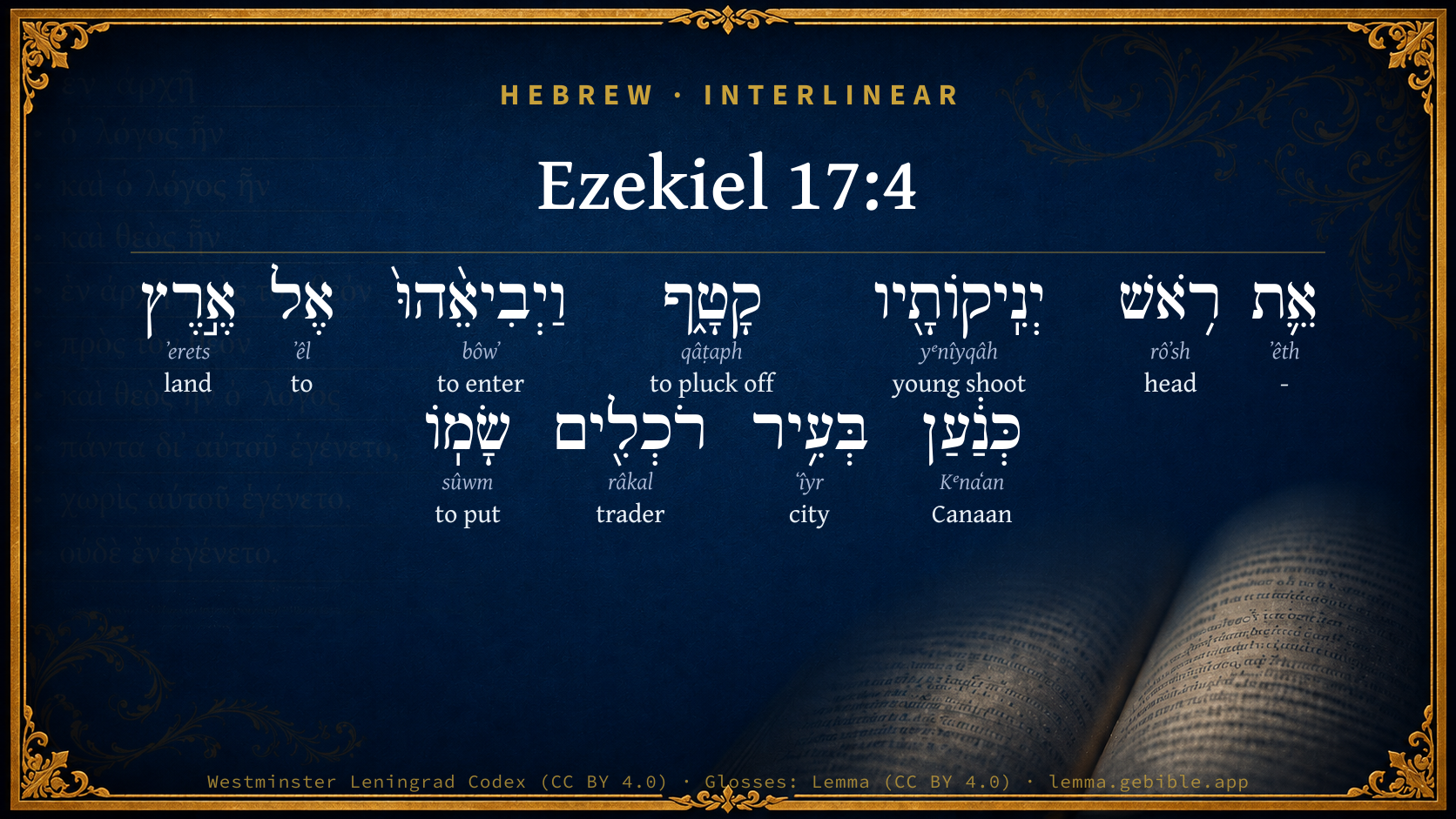
Hebrew (Westminster Leningrad Codex) Ezekiel 17:4 appears in the Hebrew Old Testament. The text above is from the Westminster Leningrad Codex. Each word links to its Strong’s number, a concise gloss, and parsing drawn from the Open Scriptures Hebrew Bible morphology. Click any word for its full Brown-Driver-Briggs (BDB) entry.
Download image
Cite this verse

Ezekiel 17:4 (World English Bible). Public Domain. Lemma interlinear Bible study tool, https://lemma.gebible.app/v/ezekiel/17/4.

Show BibTeX & RIS
BibTeX
RIS
English Translation
he cropped off the topmost of the young twigs of it, and carried it to a land of traffic; he set it in a city of merchants.
World English Bible · Public Domain
Highlights
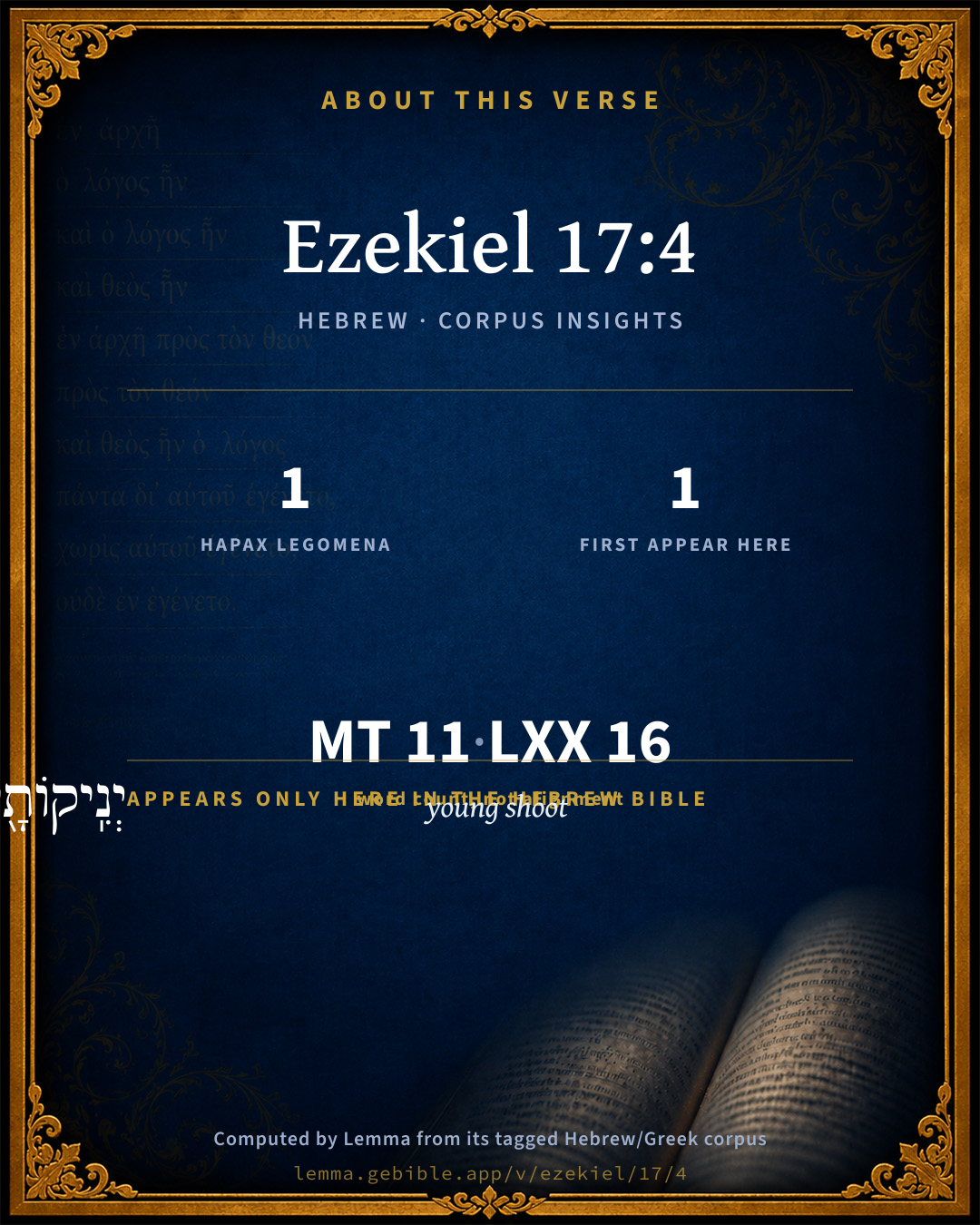
  • 1 hapax legomenon — only here in the Hebrew Bible
  • 1 first appearance in the Hebrew Bible
Full analysis ↓
Download a study sheet

One document with this verse’s original text, its word-by-word gloss line, the meaning frame, cross-references with their text, attributed commentary, and full source and license credits — printable, and it pastes into notes with its structure intact.

This verse Autodidact and up

Study sheet (.html) Plain text (.txt)

A passage Seminary Student

Up to 50 verses in one chapter. A passage sheet keeps up to 6 commentary sources and 12 cross-references per verse, in the order this page ranks them, and says so on the sheet whenever that leaves anything out. Ask for a single verse and you get the Autodidact verse sheet above.

Everything on this page stays free to read, with no account — the sheet is a download of what is already on screen, not access to it.

Want to remove ads? Support Godless Engineer
Compare translations 3

The same verse in 3 English versions, stacked beneath the original-language interlinear above. Click any original word for its lexicon entry.

Each is an independent rendering of the whole verse — the interlinear is not word-aligned to these translations.

Highlighted words mark where these versions differ — a whole-verse word diff, not a word-by-word alignment.

  • World English Bible Public Domain
    he cropped off the topmost of the young twigs of it, and carried it to a land of traffic; he set it in a city of merchants.
  • King James Version Public Domain
    He cropped off the top of his young twigs, and carried it into a land of traffick; he set it in a city of merchants.
  • unfoldingWord Literal Text CC BY-SA 4.0
    It broke off the tips of the branches and took them to the land of Canaan; he planted it in a city of merchants.

unfoldingWord Literal Text — © unfoldingWord, licensed CC BY-SA 4.0. Word-aligned USFM3 via Door43 (git.door43.org/unfoldingWord/en_ult).

Versions to compare (up to 4)

3 of 4 selected

Show all 18 translations

Every available English version of this verse, each an independent rendering of the whole verse.

  • World English Bible Public Domain
    he cropped off the topmost of the young twigs of it, and carried it to a land of traffic; he set it in a city of merchants.
  • Berean Standard Bible Public Domain
    He plucked off its topmost shoot, carried it to the land of merchants, and planted it in a city of traders.
  • Majority Standard Bible Public Domain
    He plucked off its topmost shoot, carried it to the land of merchants, and planted it in a city of traders.
  • King James Version Public Domain
    He cropped off the top of his young twigs, and carried it into a land of traffick; he set it in a city of merchants.
  • American Standard Version (1901) Public Domain
    he cropped off the topmost of the young twigs thereof, and carried it unto a land of traffic; he set it in a city of merchants.
  • Revised Version (1885) Public Domain
    he cropped off the topmost of the young twigs thereof, and carried it into a land of traffic; he set it in a city of merchants.
  • Geneva Bible (1599) Public Domain
    And brake off the toppe of his twigge, and caried it into the land of marchants, and set it in a citie of marchants.
  • Douay-Rheims (1899) Public Domain
    He cropped off the top of the twigs thereof: and carried it away into the land of Chanaan, and he set it in a city of merchants.
  • Young's Literal Translation Public Domain
    The top of its tender twigs it hath cropped, And it bringeth it in to the land of Canaan. In a city of merchants it hath placed it.
  • Literal Standard Version CC BY-SA 4.0
    He has cropped the top of its tender twigs, || And he brings it to the land of Canaan. He has placed it in a city of merchants.
  • Unlocked Literal Bible CC BY-SA 4.0
    It broke off the tips of the branches and took them to the land of Canaan; he planted it in a city of merchants.
  • unfoldingWord Literal Text CC BY-SA 4.0
    It broke off the tips of the branches and took them to the land of Canaan; he planted it in a city of merchants.
  • Darby Bible Public Domain
    He cropped off the top of its young shoots, and carried it into a merchants' land; he set it in a city of traders.
  • World Messianic Bible Public Domain
    He cropped off the topmost of its young twigs, and carried it to a land of traffic. He planted it in a city of merchants.
  • Webster's Bible Public Domain
    He cropped off the top of its young twigs, and carried it into a land of traffick; he set it in a city of merchants.
  • Free Bible Version CC BY-SA 4.0
    He broke off its highest branch and took it to a country of merchants, and planted it in a city of traders.
  • Bible in Basic English Public Domain
    Biting off the highest of its young branches, he took it to the land of Canaan, and put it in a town of traders.
  • JPS Tanakh (1917) Public Domain
    He cropped off the topmost of the young twigs thereof, and carried it into a land of traffic; he set it in a city of merchants.

Literal Standard Version (2020), Covenant Press — licensed CC BY-SA 4.0. Text via the HelloAO Bible API (eBible.org). Unlocked Literal Bible (unfoldingWord) — licensed CC BY-SA 4.0. Text via the HelloAO Bible API (eBible.org). unfoldingWord Literal Text — © unfoldingWord, licensed CC BY-SA 4.0. Word-aligned USFM3 via Door43 (git.door43.org/unfoldingWord/en_ult). Free Bible Version, Dr. Jonathan Gallagher — licensed CC BY-SA 4.0. Text via the HelloAO Bible API (eBible.org).

Word by word

More ways to search: Search by grammar → Find every occurrence → Compare this word →

Practice this passage: Drill this verse → Learn its vocabulary →

יְנִֽיקוֹתָ֖יו
yᵉnîyqâh
H3242
“young shoots · his”
Noun, Common, Feminine, Plural, Construct + Suffix, Personal, 3rd Person, Masculine, Singular
Part of Speech
Noun
Type
Common
Gender
Feminine
Number
Plural
State
Construct
Full BDB Definition

Origin: from H3243

TWOT: 874c

young plant, twig, young shoot
  1. אֵ֛ת ʼêth H853 “-” Particle, Direct Object
  2. רֹ֥אשׁ rôʼsh H7218 “head of” Noun, Common, Masculine, Singular, Construct
  3. קָטָ֑ף qâṭaph H6998 “to pluck off” Verb, Qal, Perfect, 3rd Person, Masculine, Singular
  4. וַיְבִיאֵ֨הוּ֙ bôwʼ H935 “and · to enter · him” Conjunction + Verb, Hiphil, Sequential Imperfect, 3rd Person, Masculine, Singular + Suffix, Personal, 3rd Person, Masculine, Singular
  5. אֶל ʼêl H413 “to” Preposition
  6. אֶ֣רֶץ ʼerets H776 “land of” Noun, Common, Both, Singular, Construct
  7. כְּנַ֔עַן Kᵉnaʻan H3667 “Canaan” Noun, Proper
  8. בְּעִ֥יר ʻîyr H5892 “in/at · city of” Preposition + Noun, Common, Feminine, Singular, Construct
  9. רֹכְלִ֖ים râkal H7402 “trader” Verb, Qal, Participle Active, Masculine, Plural, Absolute
  10. שָׂמֽוֹ sûwm H7760 “to put · him” Verb, Qal, Perfect, 3rd Person, Masculine, Singular + Suffix, Personal, 3rd Person, Masculine, Singular

About this verse

These counts appear in no published source. They are computed here, from the morphology-tagged text and Lemma’s own curated glosses. What Lemma adds →

11
words
11
distinct lemmas
Prophets
section

Notable vocabulary

1 hapax legomenon — a word that appears only here in the entire Hebrew Bible:

  • יְנִֽיקוֹתָ֖יו young shoot H3242

First appearance in Scripture

This word makes its first canonical appearance in the Hebrew Bible here:

  • יְנִֽיקוֹתָ֖יו young shoot H3242

Shared distinctive vocabulary

קָטָ֑ף to pluck off H6998 occurs in 5 verses of the Hebrew Bible. Also found in:

Grammatical profile

  • 4 verbs
  • 5 nouns
  • 1 preposition
  • 1 particle

Verb forms

  • קָטָ֑ף Qal · Perfect
  • וַיְבִיאֵ֨הוּ֙ Hiphil · Sequential Imperfect
  • רֹכְלִ֖ים Qal · Participle Active
  • שָׂמֽוֹ Qal · Perfect

Hebrew & Septuagint length

In English translation the verse runs 27 words from the Hebrew and 25 from the Septuagint (LXX English) — closely comparable.

A rough comparison of the two English renderings, which tokenize alike — not a word-level alignment.

Word counts can differ between the Hebrew and the Greek without any difference in meaning — e.g. the Hebrew direct-object marker אֵת has no separate Greek word, and Greek often adds the article ὁ.

In the original languages it is 11 Hebrew tokens and 16 Greek tokens — but the two are counted differently (Hebrew bundles its prefixes and suffixes into one token; the Greek is in lemma form), so that isn’t a like-for-like length.

Cross-references

5

Topical passages linked to Ezekiel 17:4 in the Treasury of Scripture Knowledge — connected by theme and wording, ordered by reader-vote popularity; previews shown in the World English Bible.

  • Isaiah 43:14 Thus says Yahweh, your Redeemer, the Holy One of Israel: For your sake I have sent to Babylon, and I will bring down all of them as fugitives, even the Chaldeans, in the ships of their rejoicing.
  • Isaiah 47:15 Thus shall the things be to you in which you have labored: those who have trafficked with you from your youth shall wander everyone to his quarter; there shall be none to save you.
  • Jeremiah 51:13 You who dwell on many waters, abundant in treasures, your end is come, the measure of your covetousness.
  • Revelation 18:3 For all the nations have drunk of the wine of the wrath of her sexual immorality, the kings of the earth committed sexual immorality with her, and the merchants of the earth grew rich from the abundance of her luxury."
  • Revelation 18:11–19 The merchants of the earth weep and mourn over her, for no one buys their merchandise any more;

Cross-references courtesy of OpenBible.info (CC BY 4.0).

Hebrew and Greek witnesses Masoretic Hebrew ↔ Greek Septuagint

The same verse in the two great witnesses to the Old Testament, shown verse-for-verse.

These are two independent witnesses, not word-aligned to each other, and the Septuagint is shown in lemma (dictionary) form.

Hebrew Ezekiel 17:4 Masoretic · Westminster Leningrad Codex

אֵ֛ת רֹ֥אשׁ יְנִֽיקוֹתָ֖יו קָטָ֑ף וַיְבִיאֵ֨הוּ֙ אֶל אֶ֣רֶץ כְּנַ֔עַן בְּעִ֥יר רֹכְלִ֖ים שָׂמֽוֹ

he cropped off the topmost of the young twigs of it, and carried it to a land of traffic; he set it in a city of merchants.

World English Bible · Public Domain

Greek LXX Ezekiel 17:4 Septuagint · lemma form

ὁ ἄκρος ὁ ἁπαλότης ἀποκνίζω καί φέρω αὐτός εἰς γῆ χανααν εἰς πόλις τειχίζω τίθημι αὐτός

he cropped off the ends of the tender twigs, and brought them into the land of Chanaan; he laid them up in a walled city.

LXX2012 (modern English Septuagint) · Public Domain

Hebrew: Westminster Leningrad Codex (CC BY 4.0). Greek: Septuagint (public domain); English from LXX2012 (modern English Septuagint) (Public Domain). How the Septuagint differs from the Hebrew →

Targum (Aramaic paraphrase)

1

The Targum is the ancient Jewish Aramaic paraphrase of the Hebrew Scriptures — an interpretive translation, not the Hebrew text itself. Onkelos (literal) and Pseudo-Jonathan (expansive) render the Torah, and Jonathan the Prophets. Coverage is partial: where no permissively-licensed English translation exists for a verse, only the Aramaic is shown. This is verse-level text, not a word-by-word alignment to the Hebrew.

  1. Targum Jonathan Prophets (Joshua–Malachi)
    יַת רֵישׁ שַׁבִּשְׁתֵּהּ נְסִיב וְאוֹבְלֵיהּ לְאַרְעָא דְבָטְלָא מִפּוּלְחָנָא בְאַרְעָא דִכְנַעַן וְעַד לָא יַעֲלוּן לָהּ בֵּית יִשְׂרָאֵל בְּקִרְיַת תַּגָרִין שַׁוְיֵיהּ:

    (no public-domain English translation for this verse)

    Targum Jonathan — Aramaic: “Mikraot Gedolot” (public domain). English: “Sefaria Community Translation” (CC0 1.0 (public-domain dedication)); “London "Chaldee Paraphrase," 1871” (public domain). Text via Sefaria.

Commentary

Notes on Ezekiel 17:4 from classic Christian and Jewish commentators (each source and its license shown beneath its notes). The classic Christian expositions comment on the surrounding passage and are grouped to its opening verse, so a note may address several verses; the Jewish commentaries on the Tanakh (Rashi and others) are per-verse, so they appear only where the commentator wrote on this verse.

Lemma curates 59 commentaries, every one of them public domain or Creative Commons licensed, each selected and text-cleaned for this edition rather than reprinted as found. About our sources →

Trapp's Complete Commentary

John Trapp

Eze 17:4 He cropped off the top of his young twigs, and carried it into a land of traffick; he set it in a city of merchants.

Ver. 4. He cropped off the top of his young twigs,] i.e., The nobles carried into captivity with their king, as is to be seen Eze 17:12. So true is that saying of the Rabbis, Nulla est obiectio in lege quae non habet solutionem in latere, There is no riddle in the law that hath not a solution by the sides of it; and so little cause had that Jesuit, Barradius, to borrow an argument from this text to prove the Scriptures to be a riddle and obscure.

And carried it into a land of traffic.] Babylonia was so. See Rev 18:11. Rome is so, where all things are saleable and soluble. Omnia Romae vaenalia; as was long since complained.

He set it in a city of merchants.] Some city of Babylon, saith Diodat, assigned to the Jews, which was commodious for traffic, to keep them from all thoughts of war and state policy.

John Trapp, A Commentary or Exposition upon All the Books of the Old and New Testament (1647–1656) — public domain. Text from a community e-Sword module.

Geneva Bible (1599)

Geneva Bible translators

Meaning, to Babylon.

Geneva Bible (1599) marginal notes — public domain. Text via Bolls.life.

Jamieson, Fausset & Brown

Robert Jamieson, A. R. Fausset & David Brown

land of traffic . . . merchants--Babylon (Kg2 24:15-16), famous for its transport traffic on the Tigris and Euphrates. Also, by its connection with the Persian Gulf, it carried on much commerce with India.

Jamieson, Fausset & Brown — Commentary Critical and Explanatory on the Whole Bible (1871) — public domain (CC PDM 1.0). Text via the HelloAO Bible API.

Adam Clarke's Commentary

Verse 4. The top of his young twigs] The princes of Judah.

A land of traffic] Chaldea.

A city of merchants] Babylon; for which this city was the most celebrated of all the cities of the east. Its situation procured it innumerable advantages; its two rivers, the Tigris and Euphrates, and the Persian Gulf, gave it communication with the richest and the most distant nations.

Adam Clarke's Commentary on the Bible (1810–1826) — public domain. Text from a community e-Sword/MySword module.

John Calvin's Commentaries

WE began yesterday to explain the saying of the Prophet, that an eagle came to mount Lebanon, and there cropped off the top of a cedar, that is, the highest bough. Some interpreters seem to me to labor in vain about the word Lebanon. They think it means Jerusalem, and cite the passage in Zechariah where it is said, Open thy gates, O Lebanon. (Zechariah 11:1.) But Zecharia does not speak of the city here, but of the temple, because it was built of a great mass of cedar. But here Ezekiel means the land, and names Lebanon rather than other places, not only because that mountain was the remarkable ornament of the region on account of its lofty cedars, and balsam and aromatic trees, but because this was needful to complete his allegory. If he had said that an eagle had come to a city, it would have been absurd. Hence we see that the word Lebanon is taken for that part of Judea in which the most beautiful trees spring up and flourish. But he says, that it plucked off a bough, from the top of the cedars, because Nebuchadnezzar, who is intended by the eagle took away King Jeconiah as we said yesterday. Hence King Jeconiah is compared to a very lofty bough of a cedar, because at that time all thought that the kingdom was superior to every danger; for the Jews boasted that they were under God’s protection, and that the city was impregnable: hence that occurrence was incredible. Now the Prophet adds, that the eagle plucked off the head or summit of the boughs, as the Hebrews call the tender shoots; and here the word means the tender branches: and it means, as we shall afterwards see, the elders who were dragged away into exile. It took away the head into the land of the merchant We said that this was a mere appellative here, chnaan, because it follows a little afterwards in the plural number: בציר רכלימ שמו, begnir-reklim shemo, in the city of merchants he set it: he says, then, that the boughs were placed in a city of merchants. This name was given to Babylon, not only because it was a celebrated mart of trade, but because it was a firm and strong place of custody through the multitude of inhabitants, so that it was not easy to draw captives from it. For any one could easily be rescued from a solitude without resistance; but in a great concourse it is not so easy to plan or attempt anything. I do not doubt, therefore, that the Prophet means that the higher classes of the kingdom, together with Jeconiah, were shut up in firm custody that they should not escape. It follows —

John Calvin's Commentaries (1540-1563) — public domain. Text from the Calvin Translation Society English edition (1840s-50s) via the Christian Classics Ethereal Library (ccel.org). Calvin's coverage is partial (roughly two-thirds of the Bible); uncommented books and verses are honest gaps, never fabricated. The 19th-century editor's footnotes and remarks are omitted so the notes are faithfully Calvin's own voice.

Ellicott's Commentary for English Readers

(4) Into a land of traffick.—Literally, a land of Canaan, the word being sometimes used for merchant or merchandise, as in Hos_12:8 (Engl. 7); Isa_23:8; Zep_1:11. The parallelism of the next clause shows that this is its meaning here. Babylon has already been called Canaan in Eze_16:29, probably from its commercial character.

A Bible Commentary for English Readers, edited by Charles John Ellicott (1878–1897) — public domain. Text from a community e-Sword module.

John Gill's Exposition

He took also of the seed of the land,.... Of the land of Judea, a native of it, not a stranger; not one of another country, a Babylonian; not one of his own nobles or princes, did Nebuchadnezzar, the eagle, take and set upon the throne of Judea, but one of their own, even one of the king's seed, of the blood royal, as it is explained, Eze 17:13, Mattaniah, the uncle of Jeconiah, whom the king of Babylon called Zedekiah, and made him king in his room:

and planted it in a fruitful field; in the land of Judea, and in Jerusalem the royal city:

he placed it by great waters; many people, Rev 17:15; over whom he ruled, and by whom he was supported in his royal dignity:

and set it as a willow tree; which loves moist places, and grows up thick: unless it should be rendered, "he set it with great circumspection" (s); took a great deal of care and caution in placing him upon the throne; he made a covenant with him, took an oath of him, and hostages for the performance of it, Eze 17:13. The Targum is,

"a planted vine he set it,''

to make it agree with what follows; but the word in the Chaldee and Arabic languages signifies a kind of willow, as we render it, as Ben Melech observes (t).

(s) "circumspectissime posuit illud, Junins & Tremellius, Polanus; "cum magna circumspectione", Piscator; "circumspecte, Cocceius, Starckius. (t) And so it does; see Castel, col. 3220, 3221. and in this way Jarchi and Kimchi interpret the word, in which they are followed by many; so R. Sol. Urbin. Ohel Moed, fol. 73. 1. nevertheless, the sense of it here is disapproved of by Castel, who observes, what has a willow to do with a vine? col. 3222. and commends the Greek version, which renders it, "conspicuous", to be seen; and so others translate it, "in superficie", V. L. Grotius; yet the "safsaf" of the Arabs is a tree by which they understood the "abeile" or poplar tree; see Shaw's Travels, p. 432. Ed. 2.

John Gill's Exposition of the Whole Bible (1746–1763) — public domain (CC PDM 1.0). Text via the HelloAO Bible API.

Albert Barnes' Notes on the Bible

A land of traffick - The land of Babylon.

Albert Barnes' Notes on the Bible (1834–1885) — public domain. Text from a community e-Sword/MySword module.

Haydock's Catholic Bible Commentary

Twigs. The young king and his officers, who had scarcely got established. (Calmet) --- Chanaan. This name, which signifies traffic, is not taken here for Palestine, but for Chaldea; and the city of merchants here mentioned is Babylon. (Challoner) --- It was so corrupt as to deserve this appellation, as Rome was afterwards styled Babylon. Its situation was very favourable to traffic, and its dominions were very extensive. (Calmet)

George Leo Haydock (1774–1849), Haydock's Catholic Family Bible and Commentary, 1859 edition — public domain. Excludes Psalms (Douay-Rheims chapter numbering differs from Protestant) and Deuterocanonical books (Catholic canon only).

Matthew Poole's English Annotations

Cropped off; as a gardener that crops off the goodliest scions, and carrieth them away to graft on some other stock. The top; both the king of Judah, now eighteen years old, and the nobles and chief of the land.

Into a land of traffic; into Babylon, which was a city of mighty trade, explained timber by being a city of merchants, and peculiarly of merchants that traded in sweet spices and odoriferous gums.

Matthew Poole's English Annotations on the Holy Bible (1683–1685) — public domain. Text from a community e-Sword/MySword module.

Whedon's Commentary on the Bible

Daniel D. Whedon

4. Land of traffic — Compare Eze_16:29, where Chaldea is called “the merchants’ land.” Modern discoveries in Babylon have emphasized the appropriateness of the title, for literally tons of clay tablets have been digged up containing bills and deeds and business contracts of all sorts.

Daniel D. Whedon (gen. ed.), Commentary on the Old and New Testaments (1874–1909) — public domain. Text from a community e-Sword module.

The Pulpit Commentary

HOMILIES BY J.R. THOMSON Ver. 4. A city of merchants.

An apt designation this of Babylon the great, the very centre and emporium of commerce in the East. The deportation of the chief men among the Jews from their own land to Mesopotamia is pictorially described under the similitude of the highest branch of the cedar of Lebanon carried by the great Assyrian eagle away Eastward "into a land of traffic" and set in "a city of merchants." The description of Babylon is applicable to the great centres of population in our own and other lands, which serve both to concentrate and to diffuse the products which constitute so large a part of the wealth of the world, and which minister to human convenience and luxury. As an important factor in civilization, such cities should be considered in the light of reflection and religion.

I COMMERCIAL CITIES ARE AN EXPRESSION OF A DEEPSEATED TENDENCY OF HUMAN NATURE. There are, indeed, impulses which estrange and isolate men; but there are others which draw them together. We are by nature social; we have natural sympathies; we depend one upon another; we only live intellectually and morally in virtue of our mutual intercourse. Not only so; men find their interest and pleasure in close associations of various kinds. It is to their mutual advantage to gather together for the interchange of services. Thus it is in accordance with laws imposed upon our constitution by the Maker of all that men gather together in cities. In such populous centres the busy and active, the laborious and the influential, find scope for the exercise of their powers. Craftsmen and tradespeople, the bees of the social hive, spend in town life almost the whole of their earthly existence. And even those whose vocation is more distinctively intellectual, and who prefer retirement and quiet, still do not allow themselves to be cut off from the busy haunts of men; but ever and anon plunge, if but for a brief season, into the rapid, whirling tide of humanity that sweeps through their country"s capital.

II COMMERCIAL CITIES ARE THE SCENE OF VERY VARIED EXPERIENCES AND OF REMARKABLE FRICTION OF MIND WITH MIND. As compared with those engaged in rural pursuits, the dwellers in cities are quick and enterprising. They are brought more frequently into contact with one another, and each man meets daily a far richer variety of character. They are more ready to take in new ideas and to form new habits. In cities there are great contrasts. The life of the farm labourer and that of the country gentleman are not so contrasted as the life of the artisan and that of the merchant. In civics wealth and luxury are side by side with poverty and wretchedness. The poor have fewer to care for them, and the rich have fewer natural claims and responsibilities There is a rush and scramble for wealth and position, which renders a great city the natural theme of the cynic"s sniper and the satirist"s invective. Yet beneath all this there is much in city life which cannot but be regarded with interest and admiration; and the contempt which is felt for townspeople is often superficial prejudice.

III COMMERCIAL CITIES ABOUND WITH TEMPTATIONS TO SIN. There is a bad as well as a good side to city life. In the race for riches there are many opportunities for theft, peculation, embezzlement, and forgery, and the widespread desire for rapid enrichment furnishes motives to which too many sooner or later yield. In a vast population provision is made for amusement and excitement, and for vicious gratification, and in this whirlpool multitudes of the young and heedless and pleasure seeking go down, never to emerge. There is in great cities a possibility of concealment, by which many are encouraged to form habits of self-indulgence and dissipation, from which they might in more favourable circumstances have been restrained by the gentle pressure of home influence and wholesome public opinion. No wonder that, when parents send a son to the metropolis to earn a living or to seek a fortune, their minds are distressed and anxious at the thought of the manifold temptations to which the child of many prayers is to be exposed.

IV COMMERCIAL CITIES ARE THE CENTRES AND SOURCES OF GREAT INFLUENCE FOR BOTH GOOD AND EVIL. A great capital, the seat of government, of literature, of manufacture, of commerce, is often compared to the heart in the body, whence the streams of life flow constantly and regularly to reach the remotest extremity. In the great monarchies, empires, and republics of the world, how great a part has been played by the cities in which wealth and power have been concentrated, and by which national policy has been so largely shaped! How could the history of mankind be written without reference to Memphis, to Nineveh, to Babylon, to Rome, to Constantinople, to Paris, to London? Intelligence and wealth, luxury and vice, patriotism and public spirit, law and religion, spread from the great centres of population, industry, and prosperity, and affect the remotest regions.

V COMMERCIAL CITIES AFFORD ESPECIAL OPPORTUNITIES FOR WORKS OF BENEVOLENCE AND EVANGELIZATION. They abound in enterprise and public spirit, and these may be employed as truly in the enlightenment and improvement of men as in the acquisition of wealth. They abound in population, and furnish persons of every grade of natural and acquired qualification for the several departments of Christian usefulness. They abound in wealth; and material means are necessary for the conduct of educational, philanthropic, and missionary plans. They have abundant means of communicating with localities near and far, which it may be desired to reach and affect for good; from them roads radiate to every part of the land, and ships sail to every port. These and other circumstances lead to the belief that our great cities will become in the future, even more than in the past, centres and ministers of blessing to mankind. T.

The Pulpit Commentary (1880–1919), ed. H.D.M. Spence-Jones & Joseph S. Exell — public domain. Text from a community e-Sword module.

John Wesley's Explanatory Notes

The top - Both the king of Judah, now eighteen years old, and the nobles and chief of the land. Into a land - Babylon, which was a city of mighty trade.

John Wesley, Explanatory Notes Upon the Whole Bible (1754–1765) — public domain. Text via the GEBible commentary corpus.

Rashi

Rabbi Shlomo Yitzchaki (Rashi)

He plucked the top of its branches Heb. יְנִיקוֹתָיו. He humbled his [Jehoiakim’s] greatness and his monarchy. יְנִיקוֹתָיו is like עַנָפָיו, its branches.

and brought to a land of merchants Heb. כְּנַעַן, to a land of merchants; that is Babylon.

Rashi on the Tanakh — English translations: “The Judaica Press complete Tanach with Rashi, translated by A. J. Rosenberg” (CC BY 4.0); “Pentateuch with Rashi's commentary by M. Rosenbaum and A.M. Silbermann, 1929-1934” (public domain); “The Metsudah Tanach series, Lakewood, N.J” (CC BY 4.0); and “The Book of Joshua, Metsudah Publications, 1997” (CC BY 4.0). Text via Sefaria.

Lesson kit

Teaching starters — assembled from the data on this page, not authored interpretation. Every prompt links to the verse data it draws on. Edit before teaching.

Ezekiel, in the Prophets, opens this verse with 11 words (11 distinct Hebrew lemmas). Its most distinctive word is yᵉnîyqâh (“young shoot”). A historical commentator’s framing appears above. Read the whole chapter for the surrounding context.

Discussion questions

  1. How does “young shoot” (yᵉnîyqâh) shape what this verse is saying?
  2. 1 word here appears nowhere else in the Hebrew Bible. Why might the author reach for such rare wording?
  3. This is the first place “young shoot” appears in Scripture (first appears here). What does its debut here establish?
  4. How does Deuteronomy 23:25, which shares the word «to pluck off», read alongside this verse?
  5. The translations on this page render this verse differently — a whole-verse word diff, not a word-by-word alignment. What might account for the different wordings?
  6. «קָטָ֑ף» is a Qal Perfect verb. How does that grammatical form shape the action described?
  7. Compare how Trapp's Complete Commentary and Geneva Bible (1599) read this verse. Where do they agree or differ?

Things to notice

Reading settings

Reading text

Shown beneath each verse's original-language words.

Old Testament
Old Testament edition

Read the OT as the Masoretic Hebrew (MT) or the Greek Septuagint (LXX).

English shown for the Greek Septuagint (in the Hebrew ↔ Greek comparison).

Comparing translations? Open the Compare panel on any verse page to stack up to four side by side.