
1 Kings 9:19

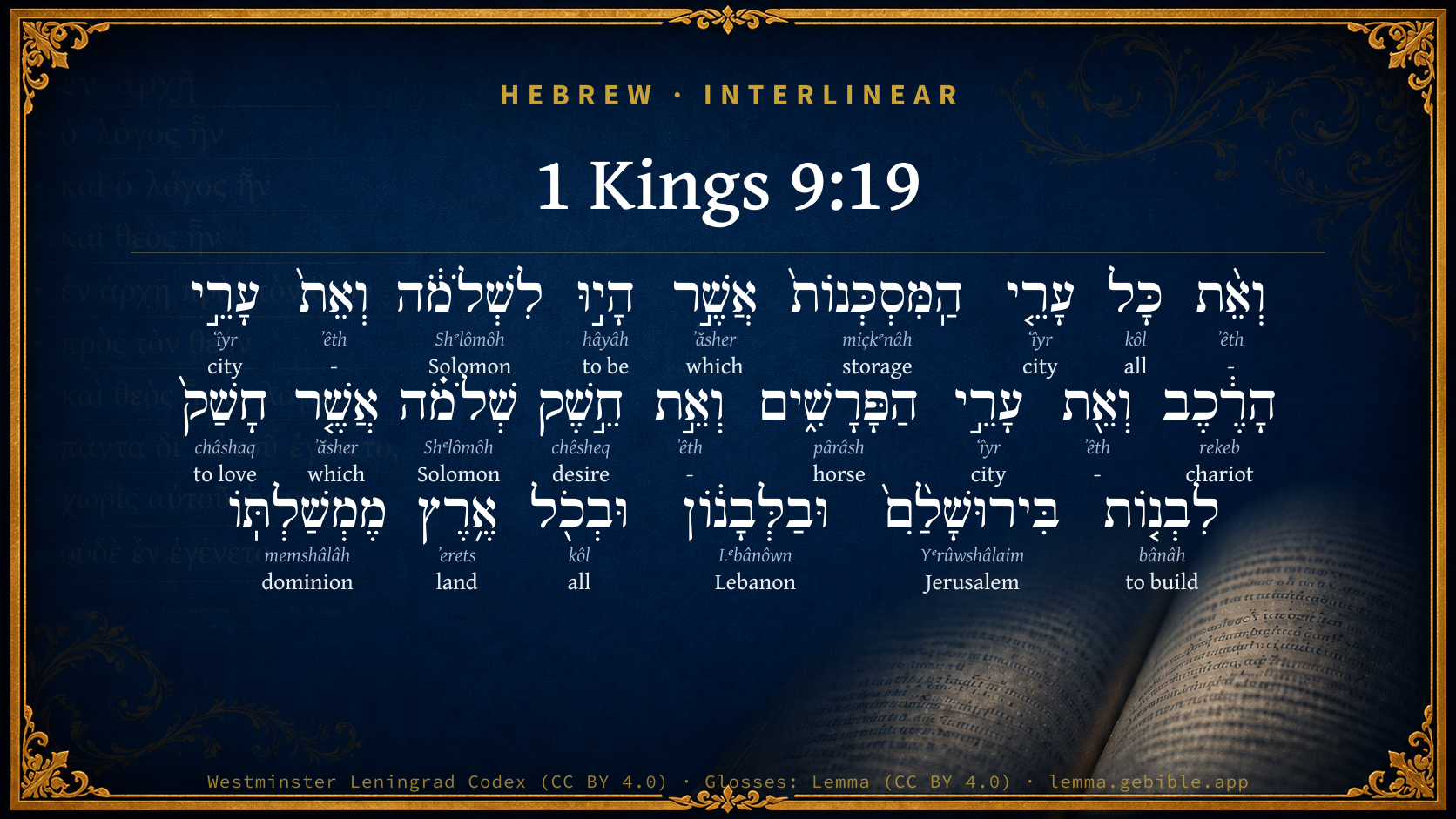
Hebrew (Westminster Leningrad Codex) 1 Kings 9:19 appears in the Hebrew Old Testament. The text above is from the Westminster Leningrad Codex. Each word links to its Strong’s number, a concise gloss, and parsing drawn from the Open Scriptures Hebrew Bible morphology. Click any word for its full Brown-Driver-Briggs (BDB) entry.
Download image
Cite this verse

1 Kings 9:19 (World English Bible). Public Domain. Lemma interlinear Bible study tool, https://lemma.gebible.app/v/1-kings/9/19.

Show BibTeX & RIS
BibTeX
RIS
English Translation
and all the store-cities that Solomon had, and the cities for his chariots, and the cities for his horsemen, and that which Solomon desired to build for his pleasure in Jerusalem, and in Lebanon, and in all the land of his dominion.
World English Bible · Public Domain
Download a study sheet

One document with this verse’s original text, its word-by-word gloss line, the meaning frame, cross-references with their text, attributed commentary, and full source and license credits — printable, and it pastes into notes with its structure intact.

This verse Autodidact and up

Study sheet (.html) Plain text (.txt)

A passage Seminary Student

Up to 50 verses in one chapter. A passage sheet keeps up to 6 commentary sources and 12 cross-references per verse, in the order this page ranks them, and says so on the sheet whenever that leaves anything out. Ask for a single verse and you get the Autodidact verse sheet above.

Everything on this page stays free to read, with no account — the sheet is a download of what is already on screen, not access to it.

Want to remove ads? Support Godless Engineer
Compare translations 3

The same verse in 3 English versions, stacked beneath the original-language interlinear above. Click any original word for its lexicon entry.

Each is an independent rendering of the whole verse — the interlinear is not word-aligned to these translations.

Highlighted words mark where these versions differ — a whole-verse word diff, not a word-by-word alignment.

  • World English Bible Public Domain
    and all the store-cities that Solomon had, and the cities for his chariots, and the cities for his horsemen, and that which Solomon desired to build for his pleasure in Jerusalem, and in Lebanon, and in all the land of his dominion.
  • King James Version Public Domain
    And all the cities of store that Solomon had, and cities for his chariots, and cities for his horsemen, and that which Solomon desired to build in Jerusalem, and in Lebanon, and in all the land of his dominion.
  • unfoldingWord Literal Text CC BY-SA 4.0
    and all of the cities of the storehouses that were to Solomon and the cities of the chariotry and the cities of the horsemen and the desire of Solomon, whatever he desired to build in Jerusalem and in Lebanon and in all of the land of his dominion.

unfoldingWord Literal Text — © unfoldingWord, licensed CC BY-SA 4.0. Word-aligned USFM3 via Door43 (git.door43.org/unfoldingWord/en_ult).

Versions to compare (up to 4)

3 of 4 selected

Show all 18 translations

Every available English version of this verse, each an independent rendering of the whole verse.

  • World English Bible Public Domain
    and all the store-cities that Solomon had, and the cities for his chariots, and the cities for his horsemen, and that which Solomon desired to build for his pleasure in Jerusalem, and in Lebanon, and in all the land of his dominion.
  • Berean Standard Bible Public Domain
    as well as all the store cities that Solomon had for his chariots and horses—whatever he desired to build in Jerusalem, Lebanon, and throughout the land of his dominion.
  • Majority Standard Bible Public Domain
    as well as all the store cities that Solomon had for his chariots and horses—whatever he desired to build in Jerusalem, Lebanon, and throughout the land of his dominion.
  • King James Version Public Domain
    And all the cities of store that Solomon had, and cities for his chariots, and cities for his horsemen, and that which Solomon desired to build in Jerusalem, and in Lebanon, and in all the land of his dominion.
  • American Standard Version (1901) Public Domain
    and all the store-cities that Solomon had, and the cities for his chariots, and the cities for his horsemen, and that which Solomon desired to build for his pleasure in Jerusalem, and in Lebanon, and in all the land of his dominion.
  • Revised Version (1885) Public Domain
    and all the store cities that Solomon had, and the cities for his chariots, and the cities for his horsemen, and that which Solomon desired to build for his pleasure in Jerusalem, and in Lebanon, and in all the land of his dominion.
  • Geneva Bible (1599) Public Domain
    And all the cities of store, that Salomon had, euen cities for charets, and cities for horsemen, and all that Salomon desired and woulde build in Ierusalem, and in Lebanon and in all the land of his dominion)
  • Douay-Rheims (1899) Public Domain
    And all the towns that belonged to himself, and were not walled, he fortified, the cities also of the chariots, and the cities of the horsemen, and whatsoever he had a mind to build in Jerusalem, and in Libanus, and in all the land of his dominion.
  • Young's Literal Translation Public Domain
    and all the cities of stores that king Solomon hath, and the cities of the chariots, and the cities of the horsemen, and the desire of Solomon that he desired to build in Jerusalem, and in Lebanon, and in all the land of his dominion.
  • Literal Standard Version CC BY-SA 4.0
    and all the cities of stores that King Solomon has, and the cities of the chariots, and the cities of the horsemen, and the desire of Solomon that he desired to build in Jerusalem, and in Lebanon, and in all the land of his dominion.
  • Unlocked Literal Bible CC BY-SA 4.0
    and all the store cities that he possessed, and the cities for his chariots and the cities for his horsemen, and whatever he wished to build for his pleasure in Jerusalem, in Lebanon, and in all the lands under his rule.
  • unfoldingWord Literal Text CC BY-SA 4.0
    and all of the cities of the storehouses that were to Solomon and the cities of the chariotry and the cities of the horsemen and the desire of Solomon, whatever he desired to build in Jerusalem and in Lebanon and in all of the land of his dominion.
  • Darby Bible Public Domain
    and all the store-cities that Solomon had, and cities for chariots, and cities for the horsemen, and that which Solomon desired to build in Jerusalem, and on Lebanon, and in all the land of his dominion.
  • World Messianic Bible Public Domain
    all the storage cities that Solomon had, the cities for his chariots, the cities for his horsemen, and that which Solomon desired to build for his pleasure in Jerusalem, and in Lebanon, and in all the land of his dominion.
  • Webster's Bible Public Domain
    And all the cities of store that Solomon had, and cities for his chariots, and cities for his horsemen, and that which Solomon desired to build in Jerusalem, and in Lebanon, and in all the land of his dominion.
  • Free Bible Version CC BY-SA 4.0
    and all of Solomon's towns for storage, and the towns for his chariots and for his horsemen, plus whatever Solomon wanted to build in Jerusalem, in Lebanon, and throughout his entire kingdom.
  • Bible in Basic English Public Domain
    And all the store-towns and the towns which Solomon had for his war-carriages and for his horsemen, and everything which it was his pleasure to put up in Jerusalem and in Lebanon and in all the land under his rule.
  • JPS Tanakh (1917) Public Domain
    and all the store-cities that Solomon had, and the cities for his chariots, and the cities for his horsemen, and that which Solomon desired to build for his pleasure in Jerusalem, and in Lebanon, and in all the land of his dominion.

Literal Standard Version (2020), Covenant Press — licensed CC BY-SA 4.0. Text via the HelloAO Bible API (eBible.org). Unlocked Literal Bible (unfoldingWord) — licensed CC BY-SA 4.0. Text via the HelloAO Bible API (eBible.org). unfoldingWord Literal Text — © unfoldingWord, licensed CC BY-SA 4.0. Word-aligned USFM3 via Door43 (git.door43.org/unfoldingWord/en_ult). Free Bible Version, Dr. Jonathan Gallagher — licensed CC BY-SA 4.0. Text via the HelloAO Bible API (eBible.org).

Word by word

More ways to search: Search by grammar → Find every occurrence → Compare this word →

Practice this passage: Drill this verse → Learn its vocabulary →

חֵ֣שֶׁק
chêsheq
H2837
“desire of”
Noun, Common, Masculine, Singular, Construct
Part of Speech
Noun
Type
Common
Gender
Masculine
Number
Singular
State
Construct
Full BDB Definition

Origin: from H2836

TWOT: 773a

desire, thing desired
  1. וְאֵ֨ת ʼêth H853 “and · -” Conjunction + Particle, Direct Object
  2. כָּל kôl H3605 “all of” Noun, Common, Masculine, Singular, Construct
  3. עָרֵ֤י ʻîyr H5892 “cities of” Noun, Common, Feminine, Plural, Construct
  4. הַֽמִּסְכְּנוֹת֙ miçkᵉnâh H4543 “the · storehouses” Particle, Definite Article + Noun, Common, Feminine, Plural, Absolute
  5. אֲשֶׁ֣ר ʼăsher H834 “which” Particle, Relative
  6. הָי֣וּ hâyâh H1961 “to be” Verb, Qal, Perfect, 3rd Person, Common, Plural
  7. לִשְׁלֹמֹ֔ה Shᵉlômôh H8010 “to/for · Solomon” Preposition + Noun, Proper
  8. וְאֵת֙ ʼêth H853 “and · -” Conjunction + Particle, Direct Object
  9. עָרֵ֣י ʻîyr H5892 “cities of” Noun, Common, Feminine, Plural, Construct
  10. הָרֶ֔כֶב rekeb H7393 “the · chariot” Particle, Definite Article + Noun, Common, Masculine, Singular, Absolute
  11. וְאֵ֖ת ʼêth H853 “and · -” Conjunction + Particle, Direct Object
  12. עָרֵ֣י ʻîyr H5892 “cities of” Noun, Common, Feminine, Plural, Construct
  13. הַפָּרָשִׁ֑ים pârâsh H6571 “the · horses” Particle, Definite Article + Noun, Common, Masculine, Plural, Absolute
  14. וְאֵ֣ת ʼêth H853 “and · -” Conjunction + Particle, Direct Object
  15. שְׁלֹמֹ֗ה Shᵉlômôh H8010 “Solomon” Noun, Proper
  16. אֲשֶׁ֤ר ʼăsher H834 “which” Particle, Relative
  17. חָשַׁק֙ châshaq H2836 “to love” Verb, Qal, Perfect, 3rd Person, Masculine, Singular
  18. לִבְנ֤וֹת bânâh H1129 “to build” Preposition + Verb, Qal, Infinitive Construct
  19. בִּירוּשָׁלִַ֨ם֙ Yᵉrûwshâlaim H3389 “in/at · Jerusalem” Preposition + Noun, Proper
  20. וּבַלְּבָנ֔וֹן Lᵉbânôwn H3844 “and · in/at the · Lebanon” Conjunction + Preposition, Determined + Noun, Proper
  21. וּבְכֹ֖ל kôl H3605 “and · in/at · all of” Conjunction + Preposition + Noun, Common, Masculine, Singular, Construct
  22. אֶ֥רֶץ ʼerets H776 “land of” Noun, Common, Both, Singular, Construct
  23. מֶמְשַׁלְתּֽוֹ memshâlâh H4475 “dominion · his” Noun, Common, Both, Singular, Construct + Suffix, Personal, 3rd Person, Masculine, Singular

About this verse

These counts appear in no published source. They are computed here, from the morphology-tagged text and Lemma’s own curated glosses. What Lemma adds →

24
words
16
distinct lemmas
Historical
section

Notable vocabulary

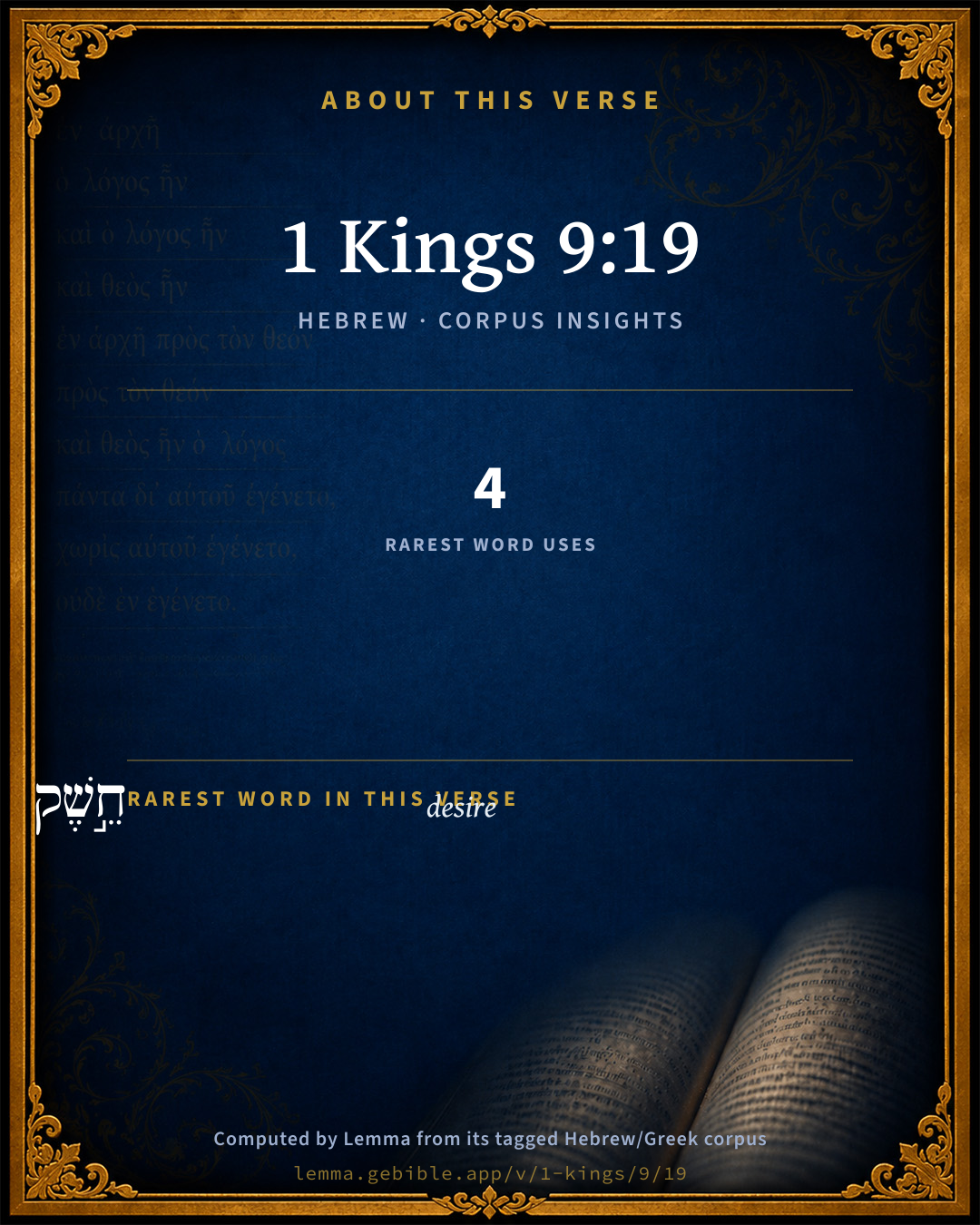
The rarest word here is חֵ֣שֶׁק desire H2837 — appearing just 4 times in the whole Hebrew Bible.

Shared distinctive vocabulary

חֵ֣שֶׁק desire H2837 occurs in 4 verses of the Hebrew Bible. Also found in:

Grammatical profile

  • 3 verbs
  • 15 nouns
  • 6 particles

Verb forms

  • הָי֣וּ Qal · Perfect
  • חָשַׁק֙ Qal · Perfect
  • לִבְנ֤וֹת Qal · Infinitive Construct

Repetition

Words recur within this verse — often emphatic in Hebrew:

  • עָרֵ֤י city H5892 ×3
  • כָּל all H3605 ×2
  • לִשְׁלֹמֹ֔ה Solomon H8010 ×2
  • אֲשֶׁ֣ר which H834 ×2

Cross-references

7

Topical passages linked to 1 Kings 9:19 in the Treasury of Scripture Knowledge — connected by theme and wording, ordered by reader-vote popularity; previews shown in the World English Bible.

  • 1 Kings 9:1 It happened, when Solomon had finished the building of the house of Yahweh, and the king's house, and all Solomon's desire which he was pleased to do,
  • Exodus 1:11 Therefore they set taskmasters over them to afflict them with their burdens. They built storage cities for Pharaoh: Pithom and Raamses.
  • 1 Kings 4:26–28 Solomon had forty thousand stalls of horses for his chariots, and twelve thousand horsemen.
  • 1 Kings 10:26 Solomon gathered together chariots and horsemen: and he had a thousand and four hundred chariots, and twelve thousand horsemen, that he bestowed in the chariot cities, and with the king at Jerusalem.
  • 2 Chronicles 1:14 Solomon gathered chariots and horsemen: and he had one thousand four hundred chariots, and twelve thousand horsemen, that he placed in the chariot cities, and with the king at Jerusalem.
  • Ecclesiastes 2:10 Whatever my eyes desired, I didn't keep from them. I didn't withhold my heart from any joy, for my heart rejoiced because of all my labor, and this was my portion from all my labor.
  • Ecclesiastes 6:9 Better is the sight of the eyes than the wandering of the desire. This also is vanity and a chasing after wind.

Cross-references courtesy of OpenBible.info (CC BY 4.0).

Hebrew and Greek witnesses Masoretic Hebrew ↔ Greek Septuagint

The same verse in the two great witnesses to the Old Testament, shown verse-for-verse.

These are two independent witnesses, not word-aligned to each other, and the Septuagint is shown in lemma (dictionary) form.

Hebrew 1 Kings 9:19 Masoretic · Westminster Leningrad Codex

וְאֵ֨ת כָּל עָרֵ֤י הַֽמִּסְכְּנוֹת֙ אֲשֶׁ֣ר הָי֣וּ לִשְׁלֹמֹ֔ה וְאֵת֙ עָרֵ֣י הָרֶ֔כֶב וְאֵ֖ת עָרֵ֣י הַפָּרָשִׁ֑ים וְאֵ֣ת חֵ֣שֶׁק שְׁלֹמֹ֗ה אֲשֶׁ֤ר חָשַׁק֙ לִבְנ֤וֹת בִּירוּשָׁלִַ֨ם֙ וּבַלְּבָנ֔וֹן וּבְכֹ֖ל אֶ֥רֶץ מֶמְשַׁלְתּֽוֹ

and all the store-cities that Solomon had, and the cities for his chariots, and the cities for his horsemen, and that which Solomon desired to build for his pleasure in Jerusalem, and in Lebanon, and in all the land of his dominion.

World English Bible · Public Domain

Hebrew: Westminster Leningrad Codex (CC BY 4.0). Greek: Septuagint (public domain); English from a public-domain English Septuagint. How the Septuagint differs from the Hebrew →

Targum (Aramaic paraphrase)

1

The Targum is the ancient Jewish Aramaic paraphrase of the Hebrew Scriptures — an interpretive translation, not the Hebrew text itself. Onkelos (literal) and Pseudo-Jonathan (expansive) render the Torah, and Jonathan the Prophets. Coverage is partial: where no permissively-licensed English translation exists for a verse, only the Aramaic is shown. This is verse-level text, not a word-by-word alignment to the Hebrew.

  1. Targum Jonathan Prophets (Joshua–Malachi)
    וְיַת כָל קִירְוֵי אוֹצָרַיָא דִי הֲוָאָה לִשְׁלֹמֹה וְיַת קִירְוֵי רְתִיכַיָא וְיַת קִירְוֵי פָּרָשַׁיָא וְיַת כָּל רְעוּת שְׁלֹמֹה דְאִתְרְעֵי לְמִבְנֵי בִירוּשְׁלֵם וּבְלִיבְנָן וּבְכָל אַרַע שׁוּלְטָנֵיהּ:

    (no public-domain English translation for this verse)

    Targum Jonathan — Aramaic: “Mikraot Gedolot” (public domain). English: “Sefaria Community Translation” (CC0 1.0 (public-domain dedication)); “London "Chaldee Paraphrase," 1871” (public domain). Text via Sefaria.

Commentary

Notes on 1 Kings 9:19 from classic Christian and Jewish commentators (each source and its license shown beneath its notes). The classic Christian expositions comment on the surrounding passage and are grouped to its opening verse, so a note may address several verses; the Jewish commentaries on the Tanakh (Rashi and others) are per-verse, so they appear only where the commentator wrote on this verse.

Lemma curates 59 commentaries, every one of them public domain or Creative Commons licensed, each selected and text-cleaned for this edition rather than reprinted as found. About our sources →

Trapp's Complete Commentary

John Trapp

1Ki 9:19 And all the cities of store that Solomon had, and cities for his chariots, and cities for his horsemen, and that which Solomon desired to build in Jerusalem, and in Lebanon, and in all the land of his dominion.

Ver. 19. And cities for his chariots.] Which he had ready, in case war should fall out. Queen Elizabeth likewise provided for war, when she was at perfect peace with all men. {a}

And that which Solomon desired.] Heb., The desire of Solomon, which he desired. See on 1Ki 9:1. God alloweth his servants all lawful delights, only they must see to it that they exceed not.

{a} Camden.

John Trapp, A Commentary or Exposition upon All the Books of the Old and New Testament (1647–1656) — public domain. Text from a community e-Sword module.

Geneva Bible (1599)

Geneva Bible translators

Cities for his munitions of war.

Geneva Bible (1599) marginal notes — public domain. Text via Bolls.life.

Adam Clarke's Commentary

Verse 19. And all the cities of store] Though, by the multitude and splendour of his buildings, Solomon must have added greatly to the magnificence of his reign; yet, however plenteous silver and gold were in his times, his subjects must have been greatly oppressed with the taxation necessary to defray such a vast public expenditure.

Adam Clarke's Commentary on the Bible (1810–1826) — public domain. Text from a community e-Sword/MySword module.

Ellicott's Commentary for English Readers

(19) That which Solomon desired to build.—See, in Ecc_2:4-10, the description of the vineyards, and gardens, and orchards, in Jerusalem, with trees of all manner of fruits and pools of water, “whatsoever mine eyes desired;” and in Son_2:10-13; Son_4:8; Son_7:11-13, the vivid pictures of the pleasure-gardens of Lebanon. The text seems evidently to refer to these, in contradistinction from the cities of commercial and military importance previously mentioned.

A Bible Commentary for English Readers, edited by Charles John Ellicott (1878–1897) — public domain. Text from a community e-Sword module.

The Cambridge Bible for Schools and Colleges

gen. ed. J. J. S. Perowne

19. and all the cities of store] In 2Ch_8:4 the expression is store-cities, which reads better here, and is clearer in sense. These places would be provided so that surplus produce which could be preserved, as corn, oil, wine, &c. might be stored in times of plenty to be ready when need should require. We read that Hezekiah made some similar provision (2Ch_32:28).

and cities for his chariots, and cities for his horsemen] Special places must have been needed for these, when we consider the great number of them (see below 1Ki_10:26). In 1Ch_4:31 there is a place called ‘town-of-chariots’ Beth-marcaboth, and another ‘court-of-horses’ Hazar-susim. The injunction of Deu_17:16 against the multiplication of horses by the king was apparently forgotten or disregarded. But the absence of any allusion to the command has been made by some an argument for the later date of Deuteronomy.

and that which Solomon desired to build] The force of the literal rendering on the margin of A. V. ‘the desire of Solomon which he desired to build’ is better brought out in the text of R.V. ‘that which Solomon desired to build for his pleasure.’ The noun is the same as in 1Ki_9:1 of this chapter, and the writer here is evidently distinguishing these later-named works from the former. The first in the list were either fortifications, or strongholds, or store-cities, but the others are for the king’s own pleasure and enjoyment. (Cf. on the whole subject, Ecc_2:4-8.)

and in Lebanon] The place of all others to which for relaxation the king would retire. The scorching heat of the lower plains could there be escaped, while the fragrance of the vegetation made a residence there most enjoyable. The writer of Solomon’s Song paints for us the loveliness of the spot, ‘a fountain of gardens, a well of living waters and streams from Lebanon’ (1Ki_4:15), and again, ‘his countenance is as Lebanon, excellent as the cedars’ (1Ki_5:15), and ‘the smell of thy garments is like the smell of Lebanon’ (1Ki_4:11). But it has been supposed by some that Lebanon is mentioned here as being an important military post.

The Cambridge Bible for Schools and Colleges (gen. ed. J. J. S. Perowne; Cambridge University Press, 1878–1918) — public domain. Text from a community e-Sword module.

John Gill's Exposition

And all the people that were left of the Amorites, Hittites, Perizzites, Hivites, and Jebusites,.... Who were not destroyed in the times of Joshua, or since, but dwelt in several cities of the land of Israel from those times; see Jdg 1:1, which were not of the children of Israel; not natives of the land of Israel, though they might be proselytes, at least some of them.

, which were not of the children of Israel; not natives of the land of Israel, though they might be proselytes, at least some of them.

1 Kings 9:21

kg1 9:21

kg1 9:21

kg1 9:21Their children that were left after them in the land,.... The posterity of those left unsubdued in the times of Joshua:

whom the children of Israel also were not able utterly to destroy; in later times, though now it is thought by some it was not for want of power, but because they had made a covenant with them, as the Gibeonites did, and therefore they could not, because it would have been a breach of covenant to have destroyed them; see Ch2 8:8,

upon these did Solomon levy a tribute of bond service unto this day; not a tribute of money, which being poor they were not able to pay, but of service, and which being once laid on was continued, and even to the time of the writing of this book.

John Gill's Exposition of the Whole Bible (1746–1763) — public domain (CC PDM 1.0). Text via the HelloAO Bible API.

Albert Barnes' Notes on the Bible

“The cities of store” contained provisions stored up for the troops (compare 2Ch 32:28). They seem to have been chiefly in the north - in Hamath 2Ch 8:4 and Naphtali 2Ch 16:4. On the “cities for his chariots,” see 1Ki 10:26 note.

By “that which Solomon desired to build” (see the margin) seem to be intended “pleasaunces” in or near the capital, and in the Lebanon range, built especially for the enjoyment of the king.

Albert Barnes' Notes on the Bible (1834–1885) — public domain. Text from a community e-Sword/MySword module.

Haydock's Catholic Bible Commentary

That....himself. Hebrew, "of store;" or to keep his treasures. (Haydock) --- Literally, "of indigence," designed to counteract the effects of famine. Pharao obliged the Israelites to build such cities for him, (Exodus i. 11.) which are called cities of tabernacles. The word miscenoth is here rendered, were not walled. --- Chariots. See chap. iv. 26. (Calmet) --- Libanus, the temple, (St. Jerome, Trad.) or the palace. (Sa) --- But these were both in Jerusalem. (Haydock) --- Solomon built a great deal at the foot of Libanus, (Salien) as the defile was of great importance. We read of the tower of Libanus, Canticle of Canticles vii. 4. Travellers mention its ruins. (Gabriel. Sionita. p. 6.)

George Leo Haydock (1774–1849), Haydock's Catholic Family Bible and Commentary, 1859 edition — public domain. Excludes Psalms (Douay-Rheims chapter numbering differs from Protestant) and Deuterocanonical books (Catholic canon only).

Matthew Poole's English Annotations

The cities of store; to lay up arms and ammunition for war, and corn or other provisions against a time of scarcity. See Exo 1:11.

In Lebanon; either in the mountain of Lebanon, which being the border of his land, he might build some forts or a frontier city in it; or in the house of the forest of Lebanon; of which see 1Ki 7:2.

Matthew Poole's English Annotations on the Holy Bible (1683–1685) — public domain. Text from a community e-Sword/MySword module.

Whedon's Commentary on the Bible

Daniel D. Whedon

19. Cities of store — In which were deposited corn, wine, and oil, (2Ch_32:28,) and probably wares for purposes of trade, and provisions for the army.

Cities for his chariots, and cities for his horsemen — Rather, for his cavalry. See note on 1Ki_4:26. These cities for his chariots and his horses were probably “identical in part with the magazine-cities, and several of them situated on the northern boundary of his kingdom in the region of Hamath and on Lebanon, as must be inferred partly from the importance of the northern border to the security of the whole kingdom, partly from the consideration that Solomon had an adversary in Rezon of Damascus, (1Ki_11:23,) who might easily excite to rebellion the northern provinces which were first incorporated into the kingdom by David, and partly from the express statement of 2Ch_16:4, according to which there were magazine-cities in the land of Naphtali.” — Keil.

That which Solomon desired to build — That is, whatever in the way of buildings, gardens, or parks he desired. Compare Ecc_2:1-9.

Daniel D. Whedon (gen. ed.), Commentary on the Old and New Testaments (1874–1909) — public domain. Text from a community e-Sword module.

The Pulpit Commentary

And all the cities of store that Solomon had cities where the produce of the land was stored for the use of the troops or household, or against a season of scarcity (Gen_41:35; Exo_1:11) or possibly (Ewald) they were emporiums for the development of trade. The fact that these store cities are mentioned in the same breath with Tadmor, is an argument for the identification of that place with Palmyra, which Solomon could only have built as a means of gaining or retaining control over the caravan trade between the East and the Mediterranean. Cf. 2Ch_17:12 2Ch_32:28, and Gen_41:48. They would seem to have been chiefly on the northern frontier, 2Ch_8:4 ("in Hamath" 2Ch_16:4) speaks of "the store cities of Napthali." It should be remembered that Solomon had an adversary in Damascus and cities for his chariots, and cities for his horsemen. (Cf. 1Ki_4:26) These were not so much fortresses (vers. 15-18) as places adapted to accommodate his cavalry, etc. For horsemen we should perhaps read horses, See note on 1Ki_5:6 and that which Solomon desired to build Heb. and the desire of Solomon which he desired; cf. ver. 1.

The use of the cognate verb refutes the idea that Solomon"s "desire" isanother name for pleasure buildings or pleasaunces, as does also "desire" in ver. 11. It is certain, however, that such buildings were erected, and it is probable that they are referred to here in Jerusalem and in Lebanon It is highly probable that pleasure houses were built in Lebanon, (Son_7:4, passim) for which Solomon may well have had a strong affection, and pleasure gardens in Jerusalem. (Ecc_2:4-7) See Stanley, pp. 197-199); and we may reasonably imagine (with Ewald) that in these latter he sought to grow specimens of the plants, etc., about which he "spoke" (ch. 4:33; cf. Ecc_2:5) "It is a curious fact that in the ground hard by the "fountains of Solomon" near Bethlehem, which exhibit manifest traces of an ancient garden, and where the intimations of Josephus would lead us to suppose that Solomon had a rural retreat, are still to be found a number of plants self sown from age to age, which do not exist in any other part of the Holy Land" (Kitto, "Bib. Illus." vol. 4. p. 101). Some of Solomon"s journeys to these favourite resorts, we can hardly doubt, are referred to in Son_3:6-10 Son_4:8 Son_6:11 and in all the land of his dominion.

The Pulpit Commentary (1880–1919), ed. H.D.M. Spence-Jones & Joseph S. Exell — public domain. Text from a community e-Sword module.

Rashi

Rabbi Shlomo Yitzchaki (Rashi)

The store cities. [Targum Yonoson rendered,] “cities used for storage.”

Rashi on the Tanakh — English translations: “The Judaica Press complete Tanach with Rashi, translated by A. J. Rosenberg” (CC BY 4.0); “Pentateuch with Rashi's commentary by M. Rosenbaum and A.M. Silbermann, 1929-1934” (public domain); “The Metsudah Tanach series, Lakewood, N.J” (CC BY 4.0); and “The Book of Joshua, Metsudah Publications, 1997” (CC BY 4.0). Text via Sefaria.

Lesson kit

Teaching starters — assembled from the data on this page, not authored interpretation. Every prompt links to the verse data it draws on. Edit before teaching.

1 Kings, in the Historical, opens this verse with 24 words (16 distinct Hebrew lemmas). Its most distinctive word is chêsheq (“desire”). A historical commentator’s framing appears above. Read the whole chapter for the surrounding context.

Discussion questions

  1. What does “desire” (chêsheq) contribute to the verse as a whole?
  2. 1 Kings 9:1 shares the word «desire» with this verse. How do the two illuminate each other?
  3. “city” occurs 3× in this one verse. What is the effect of the repetition?
  4. These translations render this verse differently. What is at stake in choosing one wording over another?
  5. The verb «הָי֣וּ» is Qal Perfect. How does its form color the action?
  6. Reading how Trapp's Complete Commentary and Geneva Bible (1599) read this verse, where do the two commentators agree and where do they part?

Things to notice

Reading settings

Reading text

Shown beneath each verse's original-language words.

Old Testament
Old Testament edition

Read the OT as the Masoretic Hebrew (MT) or the Greek Septuagint (LXX).

English shown for the Greek Septuagint (in the Hebrew ↔ Greek comparison).

Comparing translations? Open the Compare panel on any verse page to stack up to four side by side.