Ezekiel 30:7

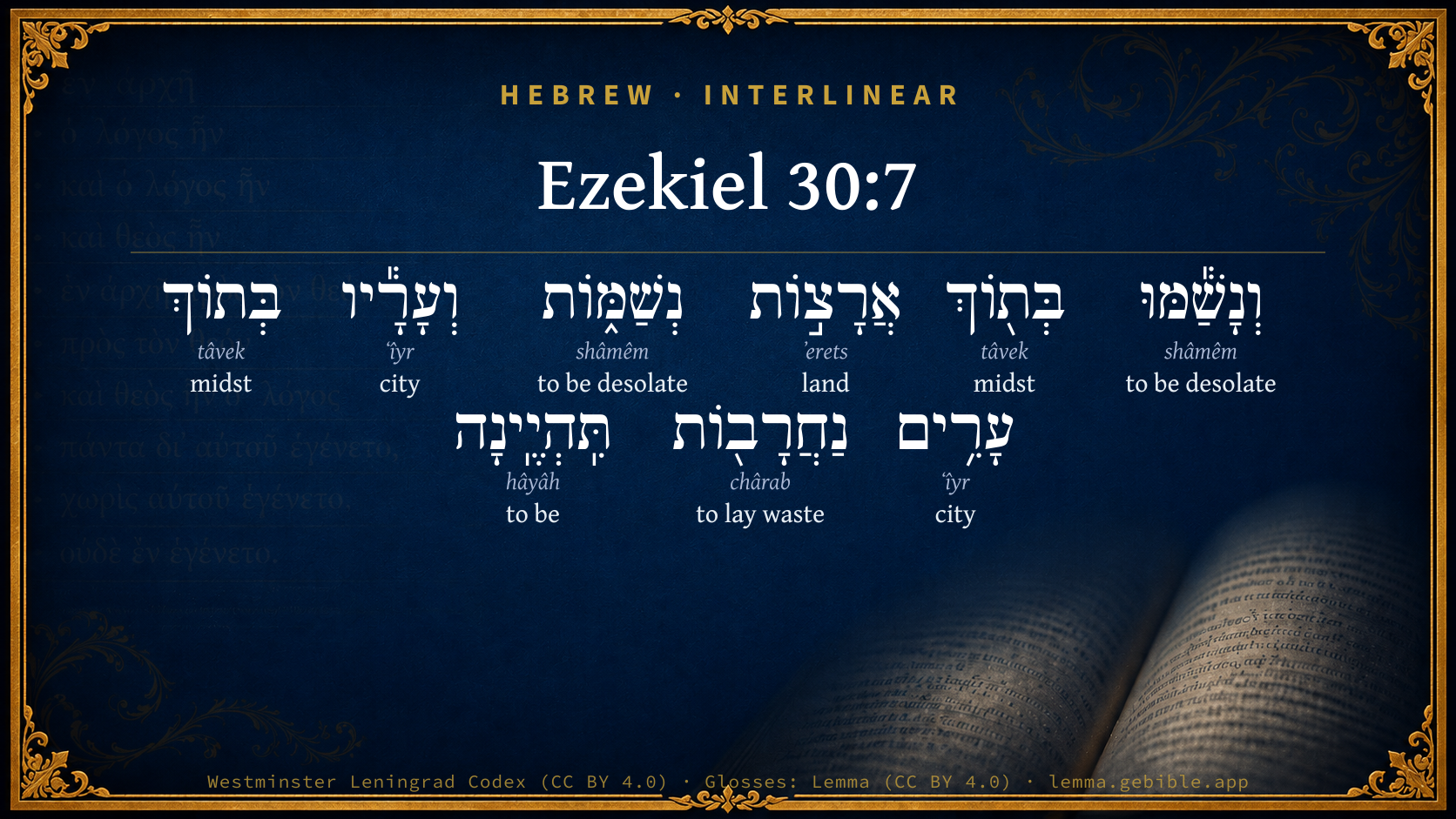
Hebrew (Westminster Leningrad Codex) Ezekiel 30:7 appears in the Hebrew Old Testament. The text above is from the Westminster Leningrad Codex. Each word links to its Strong’s number, a concise gloss, and parsing drawn from the Open Scriptures Hebrew Bible morphology. Click any word for its full Brown-Driver-Briggs (BDB) entry.
Download image
Cite this verse

Ezekiel 30:7 (World English Bible). Public Domain. Lemma interlinear Bible study tool, https://lemma.gebible.app/v/ezekiel/30/7.

Show BibTeX & RIS
BibTeX
RIS
English Translation
They shall be desolate in the midst of the countries that are desolate; and her cities shall be in the midst of the cities that are wasted.
World English Bible · Public Domain
Download a study sheet

One document with this verse’s original text, its word-by-word gloss line, the meaning frame, cross-references with their text, attributed commentary, and full source and license credits — printable, and it pastes into notes with its structure intact.

This verse Autodidact and up

Study sheet (.html) Plain text (.txt)

A passage Seminary Student

Up to 50 verses in one chapter. A passage sheet keeps up to 6 commentary sources and 12 cross-references per verse, in the order this page ranks them, and says so on the sheet whenever that leaves anything out. Ask for a single verse and you get the Autodidact verse sheet above.

Everything on this page stays free to read, with no account — the sheet is a download of what is already on screen, not access to it.

Want to remove ads? Support Godless Engineer
Compare translations 3

The same verse in 3 English versions, stacked beneath the original-language interlinear above. Click any original word for its lexicon entry.

Each is an independent rendering of the whole verse — the interlinear is not word-aligned to these translations.

Highlighted words mark where these versions differ — a whole-verse word diff, not a word-by-word alignment.

  • World English Bible Public Domain
    They shall be desolate in the midst of the countries that are desolate; and her cities shall be in the midst of the cities that are wasted.
  • King James Version Public Domain
    And they shall be desolate in the midst of the countries that are desolate, and her cities shall be in the midst of the cities that are wasted.
  • unfoldingWord Literal Text CC BY-SA 4.0
    They will be appalled in the midst of the abandoned lands, and their cities will be among all the ruined cities.

unfoldingWord Literal Text — © unfoldingWord, licensed CC BY-SA 4.0. Word-aligned USFM3 via Door43 (git.door43.org/unfoldingWord/en_ult).

Versions to compare (up to 4)

3 of 4 selected

Show all 18 translations

Every available English version of this verse, each an independent rendering of the whole verse.

  • World English Bible Public Domain
    They shall be desolate in the midst of the countries that are desolate; and her cities shall be in the midst of the cities that are wasted.
  • Berean Standard Bible Public Domain
    They will be desolate among desolate lands, and their cities will lie among ruined cities.
  • Majority Standard Bible Public Domain
    They will be desolate among desolate lands, and their cities will lie among ruined cities.
  • King James Version Public Domain
    And they shall be desolate in the midst of the countries that are desolate, and her cities shall be in the midst of the cities that are wasted.
  • American Standard Version (1901) Public Domain
    And they shall be desolate in the midst of the countries that are desolate; and her cities shall be in the midst of the cities that are wasted.
  • Revised Version (1885) Public Domain
    And they shall be desolate in the midst of the countries that are desolate, and her cities shall be in the midst of the cities that are wasted.
  • Geneva Bible (1599) Public Domain
    And they shall be desolate in the middes of the countries that are desolate, and her cities shall be in the middes of the cities that are wasted.
  • Douay-Rheims (1899) Public Domain
    And they shall be desolate in the midst of the lands that are desolate, and the cities thereof shall be in the midst of the cities that are wasted.
  • Young's Literal Translation Public Domain
    And they have been desolated in the midst of desolate lands, And its cities are in the midst of wasted cities.
  • Literal Standard Version CC BY-SA 4.0
    And they have been desolated in the midst of desolate lands, || And its cities are in the midst of cities [that are] laid waste.
  • Unlocked Literal Bible CC BY-SA 4.0
    They will be appalled in the midst of the abandoned lands, and their cities will be among all the ruined cities.
  • unfoldingWord Literal Text CC BY-SA 4.0
    They will be appalled in the midst of the abandoned lands, and their cities will be among all the ruined cities.
  • Darby Bible Public Domain
    And they shall be desolated in the midst of the countries that are desolated, and her cities shall be in the midst of the cities that are wasted.
  • World Messianic Bible Public Domain
    “They will be desolate in the middle of the countries that are desolate. Her cities will be among the cities that are wasted.
  • Webster's Bible Public Domain
    And they shall be desolate in the midst of the countries that are desolate, and her cities shall be in the midst of the cities that are wasted.
  • Free Bible Version CC BY-SA 4.0
    Egypt will become more of a wasteland than any other country, and its towns will be left in ruins.
  • Bible in Basic English Public Domain
    And she will be made waste among the countries which have been made waste, and her towns will be among the towns which are unpeopled.
  • JPS Tanakh (1917) Public Domain
    And they shall be desolate in the midst of the countries that are desolate, and her cities shall be in the midst of the cities that are wasted.

Literal Standard Version (2020), Covenant Press — licensed CC BY-SA 4.0. Text via the HelloAO Bible API (eBible.org). Unlocked Literal Bible (unfoldingWord) — licensed CC BY-SA 4.0. Text via the HelloAO Bible API (eBible.org). unfoldingWord Literal Text — © unfoldingWord, licensed CC BY-SA 4.0. Word-aligned USFM3 via Door43 (git.door43.org/unfoldingWord/en_ult). Free Bible Version, Dr. Jonathan Gallagher — licensed CC BY-SA 4.0. Text via the HelloAO Bible API (eBible.org).

Word by word

More ways to search: Search by grammar → Find every occurrence → Compare this word →

Practice this passage: Drill this verse → Learn its vocabulary →

נַחֲרָב֖וֹת
chârab
H2717
“laid waste”
Verb, Niphal, Participle Passive, Feminine, Plural, Absolute
Part of Speech
Verb
Stem
Niphal
Form
Participle Passive
Gender
Feminine
Number
Plural
State
Absolute
Full BDB Definition

Origin: a primitive root

TWOT: 731 , 732

to be waste, lay waste, make desolate, be desolate, be in ruins - (Qal) to be waste, be desolate - (Niphal) - to be made desolate - desolate (participle) - (Hiphil) to lay waste, make desolate - (Hophal) to be laid waste - to be dry, be dried up - (Qal) to be dried, be dried up - (Pual) to be dried - (Hiphil) to dry up - (Hophal) to be dried up - to attack, smite down, slay, fight
  1. וְנָשַׁ֕מּוּ shâmêm H8074 “and · to be desolate” Conjunction + Verb, Niphal, Sequential Perfect, 3rd Person, Common, Plural
  2. בְּת֖וֹךְ tâvek H8432 “in/at · midst of” Preposition + Noun, Common, Masculine, Singular, Construct
  3. אֲרָצ֣וֹת ʼerets H776 “lands” Noun, Common, Both, Plural, Absolute
  4. נְשַׁמּ֑וֹת shâmêm H8074 “being desolate” Verb, Niphal, Participle Active, Feminine, Plural, Absolute
  5. וְעָרָ֕יו ʻîyr H5892 “and · cities · his” Conjunction + Noun, Common, Feminine, Plural, Construct + Suffix, Personal, 3rd Person, Masculine, Singular
  6. בְּתוֹךְ tâvek H8432 “in/at · midst of” Preposition + Noun, Common, Masculine, Singular, Construct
  7. עָרִ֥ים ʻîyr H5892 “cities” Noun, Common, Feminine, Plural, Absolute
  8. תִּֽהְיֶֽינָה hâyâh H1961 “to be” Verb, Qal, Imperfect, 3rd Person, Feminine, Plural

About this verse

These counts appear in no published source. They are computed here, from the morphology-tagged text and Lemma’s own curated glosses. What Lemma adds →

9
words
6
distinct lemmas
Prophets
section

Shared distinctive vocabulary

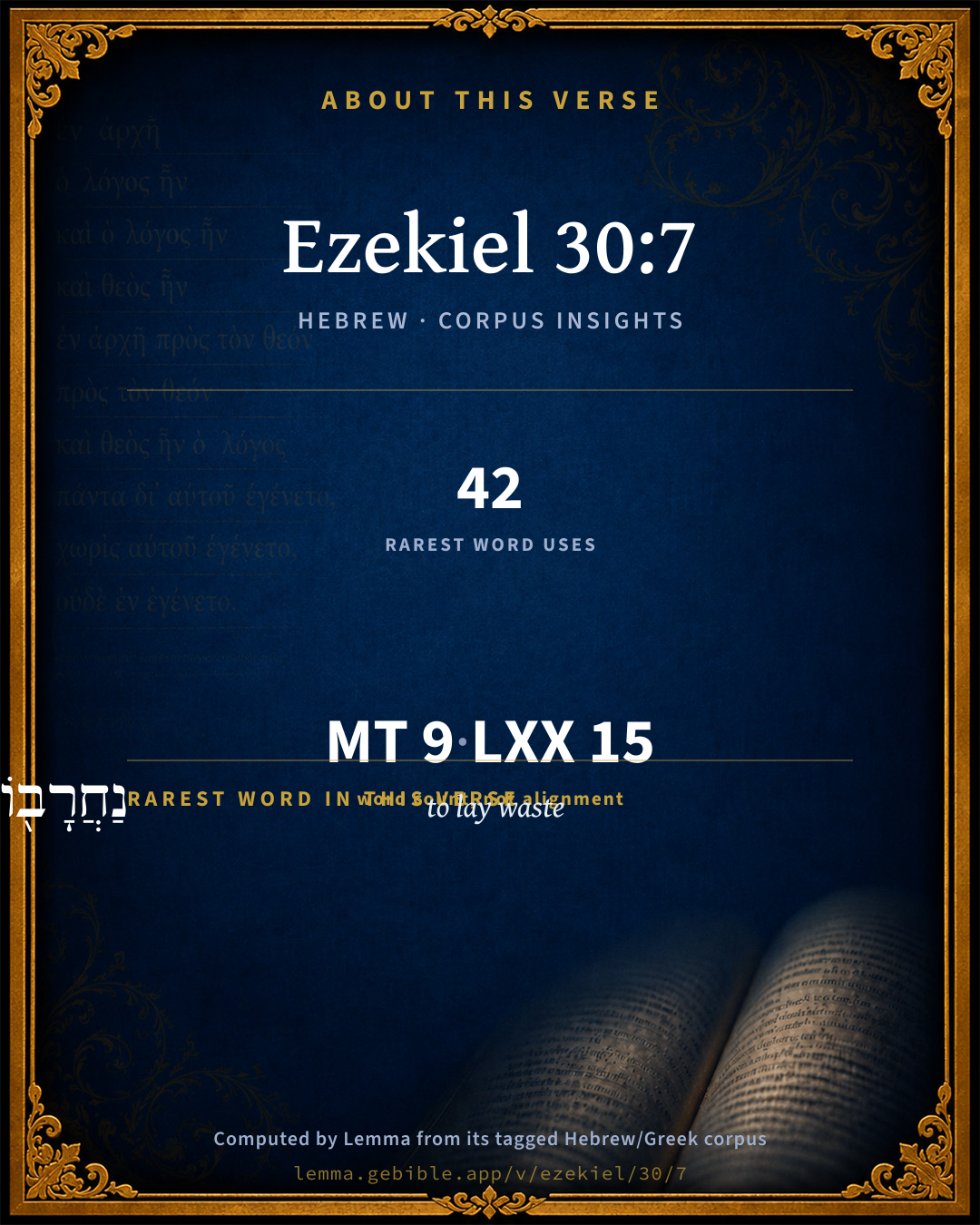
נַחֲרָב֖וֹת to lay waste H2717 occurs in 38 verses of the Hebrew Bible. Also found in:

Grammatical profile

  • 4 verbs
  • 5 nouns

Verb forms

  • וְנָשַׁ֕מּוּ Niphal · Sequential Perfect
  • נְשַׁמּ֑וֹת Niphal · Participle Active
  • נַחֲרָב֖וֹת Niphal · Participle Passive
  • תִּֽהְיֶֽינָה Qal · Imperfect

Repetition

Words recur within this verse — often emphatic in Hebrew:

  • וְנָשַׁ֕מּוּ to be desolate H8074 ×2
  • בְּת֖וֹךְ midst H8432 ×2
  • וְעָרָ֕יו city H5892 ×2

Hebrew & Septuagint length

In English translation the verse runs 27 words from the Hebrew and 24 from the Septuagint (LXX English) — closely comparable.

A rough comparison of the two English renderings, which tokenize alike — not a word-level alignment.

Word counts can differ between the Hebrew and the Greek without any difference in meaning — e.g. the Hebrew direct-object marker אֵת has no separate Greek word, and Greek often adds the article ὁ.

In the original languages it is 9 Hebrew tokens and 15 Greek tokens — but the two are counted differently (Hebrew bundles its prefixes and suffixes into one token; the Greek is in lemma form), so that isn’t a like-for-like length.

Cross-references

4

Topical passages linked to Ezekiel 30:7 in the Treasury of Scripture Knowledge — connected by theme and wording, ordered by reader-vote popularity; previews shown in the World English Bible.

  • Ezekiel 29:12 I will make the land of Egypt a desolation in the midst of the countries that are desolate; and her cities among the cities that are laid waste shall be a desolation forty years; and I will scatter the Egyptians among the nations, and will disperse them through the countries.
  • Jeremiah 25:18–26 [to wit], Jerusalem, and the cities of Judah, and the kings of it, and the princes of it, to make them a desolation, an astonishment, a hissing, and a curse, as it is this day;
  • Jeremiah 46:1–28 The word of Yahweh which came to Jeremiah the prophet concerning the nations.
  • Ezekiel 32:18–32 Son of man, wail for the multitude of Egypt, and cast them down, even her, and the daughters of the famous nations, to the lower parts of the earth, with those who go down into the pit.

Cross-references courtesy of OpenBible.info (CC BY 4.0).

Hebrew and Greek witnesses Masoretic Hebrew ↔ Greek Septuagint

The same verse in the two great witnesses to the Old Testament, shown verse-for-verse.

These are two independent witnesses, not word-aligned to each other, and the Septuagint is shown in lemma (dictionary) form.

Hebrew Ezekiel 30:7 Masoretic · Westminster Leningrad Codex

וְנָשַׁ֕מּוּ בְּת֖וֹךְ אֲרָצ֣וֹת נְשַׁמּ֑וֹת וְעָרָ֕יו בְּתוֹךְ עָרִ֥ים נַחֲרָב֖וֹת תִּֽהְיֶֽינָה

They shall be desolate in the midst of the countries that are desolate; and her cities shall be in the midst of the cities that are wasted.

World English Bible · Public Domain

Greek LXX Ezekiel 30:7 Septuagint · lemma form

καί ἐρημόω ἐν μέσος χώρα ἐρημόω καί ὁ πόλις αὐτός ἐν μέσος πόλις ἐρημόω εἰμί

And it shall be made desolate in the midst of desolate countries, and their cities shall be desolate in the midst of desolate cities:

LXX2012 (modern English Septuagint) · Public Domain

Hebrew: Westminster Leningrad Codex (CC BY 4.0). Greek: Septuagint (public domain); English from LXX2012 (modern English Septuagint) (Public Domain). How the Septuagint differs from the Hebrew →

Targum (Aramaic paraphrase)

1

The Targum is the ancient Jewish Aramaic paraphrase of the Hebrew Scriptures — an interpretive translation, not the Hebrew text itself. Onkelos (literal) and Pseudo-Jonathan (expansive) render the Torah, and Jonathan the Prophets. Coverage is partial: where no permissively-licensed English translation exists for a verse, only the Aramaic is shown. This is verse-level text, not a word-by-word alignment to the Hebrew.

  1. Targum Jonathan Prophets (Joshua–Malachi)
    וְיִצְדוּן בְּגוֹ מְדִינָן דְצַדְיָן וְקִרְווֹהִי בְּגוֹ קִרְוֵין דַהֲוָאָה חָרְבָן יֶהֱוְיָן:

    (no public-domain English translation for this verse)

    Targum Jonathan — Aramaic: “Mikraot Gedolot” (public domain). English: “Sefaria Community Translation” (CC0 1.0 (public-domain dedication)); “London "Chaldee Paraphrase," 1871” (public domain). Text via Sefaria.

Commentary

Notes on Ezekiel 30:7 from classic Christian and Jewish commentators (each source and its license shown beneath its notes). The classic Christian expositions comment on the surrounding passage and are grouped to its opening verse, so a note may address several verses; the Jewish commentaries on the Tanakh (Rashi and others) are per-verse, so they appear only where the commentator wrote on this verse.

Lemma curates 59 commentaries, every one of them public domain or Creative Commons licensed, each selected and text-cleaned for this edition rather than reprinted as found. About our sources →

Trapp's Complete Commentary

John Trapp

Eze 30:7 And they shall be desolate in the midst of the countries [that are] desolate, and her cities shall be in the midst of the cities [that are] wasted.

Ver. 7. And they shall be desolate.] See Eze 29:10.

John Trapp, A Commentary or Exposition upon All the Books of the Old and New Testament (1647–1656) — public domain. Text from a community e-Sword module.

Jamieson, Fausset & Brown

Robert Jamieson, A. R. Fausset & David Brown

in the midst of . . . countries . . . desolate--Egypt shall fare no better than they (Eze 29:10).

Jamieson, Fausset & Brown — Commentary Critical and Explanatory on the Whole Bible (1871) — public domain (CC PDM 1.0). Text via the HelloAO Bible API.

Adam Clarke's Commentary

Verse 7. Shall be desolate] All these countries shall be desolated, and the places named shall be chief in these desolations.

Adam Clarke's Commentary on the Bible (1810–1826) — public domain. Text from a community e-Sword/MySword module.

Ellicott's Commentary for English Readers

(7) Shall be desolate.—This verse is almost an exact repetition of Eze_29:12.

A Bible Commentary for English Readers, edited by Charles John Ellicott (1878–1897) — public domain. Text from a community e-Sword module.

The Cambridge Bible for Schools and Colleges

gen. ed. J. J. S. Perowne

7. A frequently recurring expression; cf. Eze_29:12.

The Cambridge Bible for Schools and Colleges (gen. ed. J. J. S. Perowne; Cambridge University Press, 1878–1918) — public domain. Text from a community e-Sword module.

John Gill's Exposition

And they shall be desolate in the midst of the countries that are desolate,.... Or among them, shall be ranked with them, and be as desolate as they are; as Judea and other countries, ravaged by the same enemy:

and her cities shall be in the midst of the cities that are wasted; undergo the same fate as they have done, as Jerusalem and others. The cities of Egypt were very numerous; Diodorus Siculus (n) says, that in ancient times Egypt had cities and villages of note, more than 18,000. Herodotus (o) writes, that it was said, that under King Amasis there were 20,000 cities in it; and the first mentioned writer (p) says, under Ptolemy Lagus they were reckoned more than 30,000; and, according to Theocritus (q), under Ptolemy Philadelphus they were 33,339.

(n) Bibl. l. 1. p. 19. (o) Euterpe, sive l. 2. c. 177. (p) Bibl. l. 1. p. 19. (q) Idyll. 17. v. 82.

John Gill's Exposition of the Whole Bible (1746–1763) — public domain (CC PDM 1.0). Text via the HelloAO Bible API.

Matthew Poole's English Annotations

They, all those before mentioned,

shall be desolate; as much wasted as any of them that are most wasted. Her cities, of Egypt, equally wasted with other cities that have been sacked, as Jerusalem, Tyre, Zidon, Rabbath, &c.

Matthew Poole's English Annotations on the Holy Bible (1683–1685) — public domain. Text from a community e-Sword/MySword module.

The Pulpit Commentary

Desolation.

Egypt is to be desolate in the midst of countries that are desolate, and her cities laid waste in the midst of other ruined cities. A picture of widespread and general desolation.

I THERE IS A DESOLATION OF LANDS AND CITIES. Having lived free from the ravages of an invader ever since the Norman conquest, we find it impossible to imagine the agonies of war among the people who suffer from them. The excitement of battle may drown those horrors for a season. But when that excitement is over, the consequent distress is deep and hitter, widespread and lasting. War is a demon of destruction. It literally ravages a country. No incursion of wild beasts from the forest, no pestilence or famine, can bring about evils equal to those of war. It is the duty of all Christian people to band themselves together into a league of peace. The war-mongers often raise cries of "British interests in danger!" The country should learn that the greatest British interest is peace.

II THERE IS A DESOLATION OF HOMES.

1. This happens in bankruptcy, which is often brought about by wicked devices of cunning men. The successful promoter of a company entraps unwary people, pockets a rich premium, escapes before the crash, and leave his victims to ruin and misery. Gambling ruins multitudes of homes. If a man considered his duty to his wife and children, he would see that this terribly prevalent national vice is selfish and cruel.

2. This happens in external prosperity. Drunkenness makes a home desolate even before it has brought poverty, and no home can be more wretched for the children than that of drunken parents. Therefore the self-indulgence of intemperance is brutally cruel. Quarrelling desolates a home. Many a house that is envied by the ignorant for its affluence and luxury is a very prison of misery. When love departs, the best-appointed home is desolate. Dreary souls then drag out a beclouded existence among the melancholy ruins of wasted affection.

III THERE IS A DESOLATION OF CHURCHES.

1. This may be physical. The Mohammedans simply stamped out the relics of a decaying and quarrelsome Christianity in North Africa the home of Tertullian, Cyprian, and Augustine, The seven Churches of Asia have nearly all disappeared. If we are not true and strong in the Christian life, our candlestick will at length be taken away from us.

2. It may be spiritual. The ruined abbeys of England are famed for their beauty, and few may regret their present condition when admiring the relies of architectural splendor. But there is a worse desolation for Churches than roofless naves and crumbling walls. A Church is indeed desolate when the Spirit of Christ has forsaken her. She may seem to flourish in numbers, finance, and mechanical enterprise. But in the sight of Heaven she is a moldering ruin.

IV THERE IS A DESOLATION OF SOULS.

1. This may come in great sorrow. When "the desire of his eyes" is taken from a man, how can he be other than desolate? Job was desolate indeed when his children were killed. Rizpah was desolate when she sat by the corpses of her two sons to drive off the foul birds of prey, (2Sa_21:10) and Naomi when she returned to Bethlehem a childless widow. But God can comfort this desolation and fill its victim with heavenly peace.

2. The worst desolation is in sin. The soul is a wreck. Its very constitution is a ruin. God is driven from his seat in conscience. Here is the most dire and dreadful desolation that of the prodigal, who feeds swine in a far country, and who would fain fill himself with the husks that the swine cat! It reaches its climax in pitiless solitude no man gave unto him". (Luk_15:16)

The Pulpit Commentary (1880–1919), ed. H.D.M. Spence-Jones & Joseph S. Exell — public domain. Text from a community e-Sword module.

John Wesley's Explanatory Notes

They - All those before mentioned.

John Wesley, Explanatory Notes Upon the Whole Bible (1754–1765) — public domain. Text via the GEBible commentary corpus.

Lesson kit

Teaching starters — assembled from the data on this page, not authored interpretation. Every prompt links to the verse data it draws on. Edit before teaching.

Ezekiel, in the Prophets, opens this verse with 9 words (6 distinct Hebrew lemmas). Its most distinctive word is chârab (“to lay waste”). A historical commentator’s framing appears above. Read the whole chapter for the surrounding context.

Discussion questions

  1. The word chârab carries the sense “to lay waste.” How does it shape the verse?
  2. How does Genesis 8:13, which shares the word «to lay waste», read alongside this verse?
  3. What does the repetition of “to be desolate” (2× in this one verse) do in this verse?
  4. These translations render this verse differently; the difference is in the English rendering, not the original. What questions does that raise?
  5. «וְנָשַׁ֕מּוּ» is a Niphal Sequential Perfect verb. How does that grammatical form shape the action described?
  6. Compare how Trapp's Complete Commentary and Jamieson, Fausset & Brown read this verse. Where do they agree or differ?

Things to notice

Reading settings

Reading text

Shown beneath each verse's original-language words.

Old Testament
Old Testament edition

Read the OT as the Masoretic Hebrew (MT) or the Greek Septuagint (LXX).

English shown for the Greek Septuagint (in the Hebrew ↔ Greek comparison).

Comparing translations? Open the Compare panel on any verse page to stack up to four side by side.