
1 Kings 16:24

Hebrew (Westminster Leningrad Codex) 1 Kings 16:24 appears in the Hebrew Old Testament. The text above is from the Westminster Leningrad Codex. Each word links to its Strong’s number, a concise gloss, and parsing drawn from the Open Scriptures Hebrew Bible morphology. Click any word for its full Brown-Driver-Briggs (BDB) entry.
Download image
Cite this verse

1 Kings 16:24 (World English Bible). Public Domain. Lemma interlinear Bible study tool, https://lemma.gebible.app/v/1-kings/16/24.

Show BibTeX & RIS
BibTeX
RIS
English Translation
He bought the hill Samaria of Shemer for two talents of silver; and he built on the hill, and called the name of the city which he built, after the name of Shemer, the owner of the hill, Samaria.
World English Bible · Public Domain
Highlights
  • 1 first appearance in the Hebrew Bible
Full analysis ↓
Download a study sheet

One document with this verse’s original text, its word-by-word gloss line, the meaning frame, cross-references with their text, attributed commentary, and full source and license credits — printable, and it pastes into notes with its structure intact.

This verse Autodidact and up

Study sheet (.html) Plain text (.txt)

A passage Seminary Student

Up to 50 verses in one chapter. A passage sheet keeps up to 6 commentary sources and 12 cross-references per verse, in the order this page ranks them, and says so on the sheet whenever that leaves anything out. Ask for a single verse and you get the Autodidact verse sheet above.

Everything on this page stays free to read, with no account — the sheet is a download of what is already on screen, not access to it.

Want to remove ads? Support Godless Engineer
Compare translations 3

The same verse in 3 English versions, stacked beneath the original-language interlinear above. Click any original word for its lexicon entry.

Each is an independent rendering of the whole verse — the interlinear is not word-aligned to these translations.

Highlighted words mark where these versions differ — a whole-verse word diff, not a word-by-word alignment.

  • World English Bible Public Domain
    He bought the hill Samaria of Shemer for two talents of silver; and he built on the hill, and called the name of the city which he built, after the name of Shemer, the owner of the hill, Samaria.
  • King James Version Public Domain
    And he bought the hill Samaria of Shemer for two talents of silver, and built on the hill, and called the name of the city which he built, after the name of Shemer, owner of the hill, Samaria.
  • unfoldingWord Literal Text CC BY-SA 4.0
    Then he bought the hill Samaria from Shemer for two silver kikkars. And he built on the hill, and he called the name of the city that he built Samaria, after the name of Shemer, the owner of the hill.

unfoldingWord Literal Text — © unfoldingWord, licensed CC BY-SA 4.0. Word-aligned USFM3 via Door43 (git.door43.org/unfoldingWord/en_ult).

Versions to compare (up to 4)

3 of 4 selected

Show all 18 translations

Every available English version of this verse, each an independent rendering of the whole verse.

  • World English Bible Public Domain
    He bought the hill Samaria of Shemer for two talents of silver; and he built on the hill, and called the name of the city which he built, after the name of Shemer, the owner of the hill, Samaria.
  • Berean Standard Bible Public Domain
    He bought the hill of Samaria from Shemer for two talents of silver and built a city there, calling it Samaria after the name of Shemer, who had owned the hill.
  • Majority Standard Bible Public Domain
    He bought the hill of Samaria from Shemer for two talents of silver and built a city there, calling it Samaria after the name of Shemer, who had owned the hill.
  • King James Version Public Domain
    And he bought the hill Samaria of Shemer for two talents of silver, and built on the hill, and called the name of the city which he built, after the name of Shemer, owner of the hill, Samaria.
  • American Standard Version (1901) Public Domain
    And he bought the hill Samaria of Shemer for two talents of silver; and he built on the hill, and called the name of the city which he built, after the name of Shemer, the owner of the hill, Samaria.
  • Revised Version (1885) Public Domain
    And he bought the hill Samaria of Shemer for two talents of silver; and he built on the hill, and called the name of the city which he built, after the name of Shemer, the owner of the hill, Samaria.
  • Geneva Bible (1599) Public Domain
    And he bought the mountaine Samaria of one Shemer for two talents of siluer, and buylt in the mountaine, and called the name of the citie, which he buylt, after the name of Shemer lord of the mountaine, Samaria.
  • Douay-Rheims (1899) Public Domain
    And he bought the hill of Samaria of Semer for two talents of silver: and he built upon it, and he called the city which he built Samaria, after the name of Semer the owner of the hill.
  • Young's Literal Translation Public Domain
    and he buyeth the mount Samaria from Shemer, with two talents of silver, and buildeth `on' the mount, and calleth the name of the city that he hath built by the name of Shemer, lord of the hill -- Samaria.
  • Literal Standard Version CC BY-SA 4.0
    and he buys the Mount of Samaria from Shemer with two talents of silver, and builds [on] the mountain, and calls the name of the city that he has built by the name of Shemer, lord of the hill—Samaria.
  • Unlocked Literal Bible CC BY-SA 4.0
    He bought the hill of Samaria from Shemer for two talents of silver. He built a city on the hill and called the name of the city Samaria, after the name of Shemer, the past owner of the hill.
  • unfoldingWord Literal Text CC BY-SA 4.0
    Then he bought the hill Samaria from Shemer for two silver kikkars. And he built on the hill, and he called the name of the city that he built Samaria, after the name of Shemer, the owner of the hill.
  • Darby Bible Public Domain
    And he bought the hill Samaria of Shemer for two talents of silver; and built on the hill, and called the name of the city that he built, after the name of Shemer, owner of the hill, Samaria.
  • World Messianic Bible Public Domain
    He bought the hill Samaria of Shemer for two talents of silver; and he built on the hill, and called the name of the city which he built, Samaria, after the name of Shemer, the owner of the hill.
  • Webster's Bible Public Domain
    And he bought the hill Samaria of Shemer for two talents of silver, and built on the hill, and called the name of the city which he built, after the name of Shemer, owner of the hill, Samaria.
  • Free Bible Version CC BY-SA 4.0
    He purchased the hill of Samaria from Shemer for two talents of silver. He fortified the hill, and named the city that he built Samaria, after Shemer, the previous owner of the hill.
  • Bible in Basic English Public Domain
    He got the hill Samaria from Shemer for the price of two talents of silver, and he made a town there, building it on the hill and naming it Samaria, after Shemer the owner of the hill.
  • JPS Tanakh (1917) Public Domain
    And he bought the hill Samaria of Shemer for two talents of silver; and he built on the hill, and called the name of the city which he built, after the name of Shemer, the owner of the hill, Samaria.

Literal Standard Version (2020), Covenant Press — licensed CC BY-SA 4.0. Text via the HelloAO Bible API (eBible.org). Unlocked Literal Bible (unfoldingWord) — licensed CC BY-SA 4.0. Text via the HelloAO Bible API (eBible.org). unfoldingWord Literal Text — © unfoldingWord, licensed CC BY-SA 4.0. Word-aligned USFM3 via Door43 (git.door43.org/unfoldingWord/en_ult). Free Bible Version, Dr. Jonathan Gallagher — licensed CC BY-SA 4.0. Text via the HelloAO Bible API (eBible.org).

Word by word

More ways to search: Search by grammar → Find every occurrence → Compare this word →

Practice this passage: Drill this verse → Learn its vocabulary →

שֶׁ֖מֶר
Shemer
H8106
“Shemer”
Noun, Proper
Part of Speech
Noun
Type
Proper
Full BDB Definition

Origin: the same as H8105

TWOT: None

Shemer or Shamer or Shamed = "preserved" - the owner of the hill where the city of Samaria was built - a Merarite Levite, son of Mahli and father of Bani - an Asherite, son of Heber and father of Ahi, Rohgah, Jehubbah, and Aram. Also 'Shomer' - a Benjamite, son of Elpaal and builder of the towns of Ono and Lod
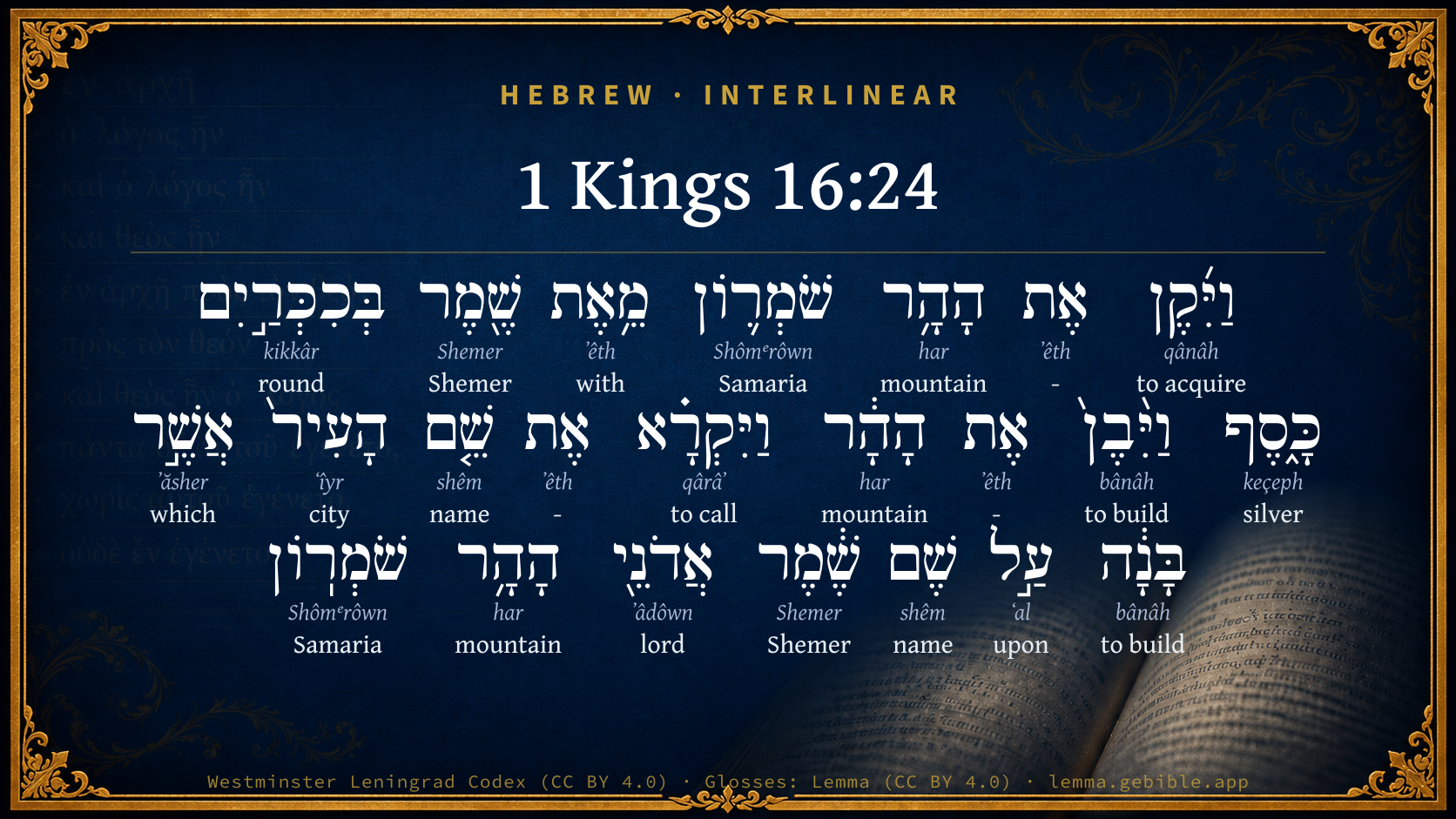
  1. וַיִּ֜קֶן qânâh H7069 “and · to acquire” Conjunction + Verb, Qal, Sequential Imperfect, 3rd Person, Masculine, Singular
  2. אֶת ʼêth H853 “-” Particle, Direct Object
  3. הָהָ֥ר har H2022 “the · mountain” Particle, Definite Article + Noun, Common, Masculine, Singular, Absolute
  4. שֹׁמְר֛וֹן Shômᵉrôwn H8111 “Samaria” Noun, Proper
  5. מֵ֥אֶת ʼêth H854 “from · with” Preposition + Preposition
  6. בְּכִכְּרַ֣יִם kikkâr H3603 “in/at · talents” Preposition + Noun, Common, Both, Dual, Absolute
  7. כָּ֑סֶף keçeph H3701 “silver” Noun, Common, Masculine, Singular, Absolute
  8. וַיִּ֨בֶן֙ bânâh H1129 “and · to build” Conjunction + Verb, Qal, Sequential Imperfect, 3rd Person, Masculine, Singular
  9. אֶת ʼêth H853 “-” Particle, Direct Object
  10. הָהָ֔ר har H2022 “the · mountain” Particle, Definite Article + Noun, Common, Masculine, Singular, Absolute
  11. וַיִּקְרָ֗א qârâʼ H7121 “and · to call” Conjunction + Verb, Qal, Sequential Imperfect, 3rd Person, Masculine, Singular
  12. אֶת ʼêth H853 “-” Particle, Direct Object
  13. שֵׁ֤ם shêm H8034 “name of” Noun, Common, Masculine, Singular, Construct
  14. הָעִיר֙ ʻîyr H5892 “the · city” Particle, Definite Article + Noun, Common, Feminine, Singular, Absolute
  15. אֲשֶׁ֣ר ʼăsher H834 “which” Particle, Relative
  16. בָּנָ֔ה bânâh H1129 “to build” Verb, Qal, Perfect, 3rd Person, Masculine, Singular
  17. עַ֣ל ʻal H5921 “upon” Preposition
  18. שֶׁם shêm H8034 “name of” Noun, Common, Masculine, Singular, Construct
  19. שֶׁ֔מֶר Shemer H8106 “Shemer” Noun, Proper
  20. אֲדֹנֵ֖י ʼâdôwn H113 “lords of” Noun, Common, Masculine, Plural, Construct
  21. הָהָ֥ר har H2022 “the · mountain” Particle, Definite Article + Noun, Common, Masculine, Singular, Absolute
  22. שֹׁמְרֽוֹן Shômᵉrôwn H8111 “Samaria” Noun, Proper

About this verse

These counts appear in no published source. They are computed here, from the morphology-tagged text and Lemma’s own curated glosses. What Lemma adds →

23
words
15
distinct lemmas
Historical
section

Notable vocabulary

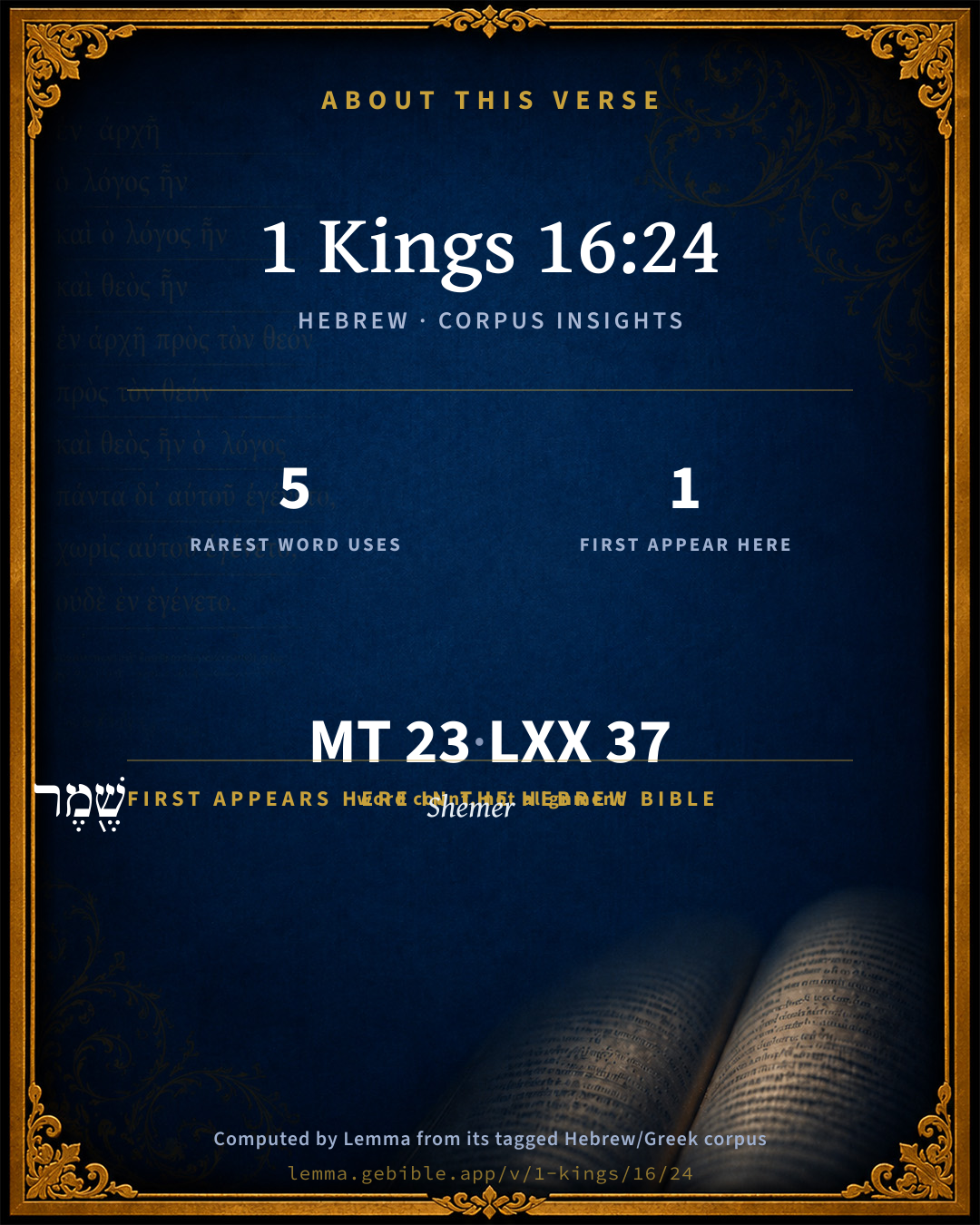
The rarest word here is שֶׁ֖מֶר Shemer H8106 — appearing just 5 times in the whole Hebrew Bible.

First appearance in Scripture

This word makes its first canonical appearance in the Hebrew Bible here:

  • שֶׁ֖מֶר Shemer H8106

Shared distinctive vocabulary

שֶׁ֖מֶר Shemer H8106 occurs in 4 verses of the Hebrew Bible. Also found in:

Grammatical profile

  • 4 verbs
  • 13 nouns
  • 2 prepositions
  • 4 particles

Verb forms

  • וַיִּ֜קֶן Qal · Sequential Imperfect
  • וַיִּ֨בֶן֙ Qal · Sequential Imperfect
  • וַיִּקְרָ֗א Qal · Sequential Imperfect
  • בָּנָ֔ה Qal · Perfect

Repetition

Words recur within this verse — often emphatic in Hebrew:

  • הָהָ֥ר mountain H2022 ×3
  • שֹׁמְר֛וֹן Samaria H8111 ×2
  • שֶׁ֖מֶר Shemer H8106 ×2
  • וַיִּ֨בֶן֙ to build H1129 ×2
  • שֵׁ֤ם name H8034 ×2

Hebrew & Septuagint length

In English translation the verse runs 39 words from the Hebrew and 47 from the Septuagint (LXX English) — closely comparable.

A rough comparison of the two English renderings, which tokenize alike — not a word-level alignment.

Word counts can differ between the Hebrew and the Greek without any difference in meaning — e.g. the Hebrew direct-object marker אֵת has no separate Greek word, and Greek often adds the article ὁ.

In the original languages it is 23 Hebrew tokens and 37 Greek tokens — but the two are counted differently (Hebrew bundles its prefixes and suffixes into one token; the Greek is in lemma form), so that isn’t a like-for-like length.

Cross-references

11

Topical passages linked to 1 Kings 16:24 in the Treasury of Scripture Knowledge — connected by theme and wording, ordered by reader-vote popularity; previews shown in the World English Bible.

  • 1 Kings 13:32 For the saying which he cried by the word of Yahweh against the altar in Bethel, and against all the houses of the high places which are in the cities of Samaria, shall surely happen.
  • 1 Kings 16:28–29 So Omri slept with his fathers, and was buried in Samaria; and Ahab his son reigned in his place.
  • 1 Kings 16:32 He reared up an altar for Baal in the house of Baal, which he had built in Samaria.
  • 1 Kings 18:2 Elijah went to show himself to Ahab. The famine was sore in Samaria.
  • 1 Kings 20:1 Ben Hadad the king of Syria gathered all his host together; and there were thirty-two kings with him, and horses and chariots: and he went up and besieged Samaria, and fought against it.
  • 1 Kings 22:37 So the king died, and was brought to Samaria; and they buried the king in Samaria.
  • 2 Kings 17:1 In the twelfth year of Ahaz king of Judah began Hoshea the son of Elah to reign in Samaria over Israel, [and reigned] nine years.
  • 2 Kings 17:6 In the ninth year of Hoshea the king of Assyria took Samaria, and carried Israel away to Assyria, and placed them in Halah, and on the Habor, the river of Gozan, and in the cities of the Medes.
  • 2 Kings 17:24 The king of Assyria brought men from Babylon, and from Cuthah, and from Avva, and from Hamath and Sepharvaim, and placed them in the cities of Samaria instead of the children of Israel; and they possessed Samaria, and lived in the cities of it.
  • John 4:4–5 He needed to pass through Samaria.
  • Acts 8:5–8 Philip went down to the city of Samaria, and proclaimed to them the Christ.

Cross-references courtesy of OpenBible.info (CC BY 4.0).

Hebrew and Greek witnesses Masoretic Hebrew ↔ Greek Septuagint

The same verse in the two great witnesses to the Old Testament, shown verse-for-verse.

These are two independent witnesses, not word-aligned to each other, and the Septuagint is shown in lemma (dictionary) form.

Hebrew 1 Kings 16:24 Masoretic · Westminster Leningrad Codex

וַיִּ֜קֶן אֶת הָהָ֥ר שֹׁמְר֛וֹן מֵ֥אֶת שֶׁ֖מֶר בְּכִכְּרַ֣יִם כָּ֑סֶף וַיִּ֨בֶן֙ אֶת הָהָ֔ר וַיִּקְרָ֗א אֶת שֵׁ֤ם הָעִיר֙ אֲשֶׁ֣ר בָּנָ֔ה עַ֣ל שֶׁם שֶׁ֔מֶר אֲדֹנֵ֖י הָהָ֥ר שֹׁמְרֽוֹן

He bought the hill Samaria of Shemer for two talents of silver; and he built on the hill, and called the name of the city which he built, after the name of Shemer, the owner of the hill, Samaria.

World English Bible · Public Domain

Greek LXX 1 Kings 16:24 Septuagint · lemma form

καί κτάομαι αμβρι ὁ ὄρος ὁ σεμερων παρά σεμηρ ὁ κύριος ὁ ὄρος δύο τάλαντον ἀργύριον καί οἰκοδομέω ὁ ὄρος καί ἐπικαλέω ὁ ὄνομα ὁ ὄρος ὅς οἰκοδομέω ἐπί ὁ ὄνομα σεμηρ ὁ κύριος ὁ ὄρος σαεμηρων

And Ambri bought the mount Semeron of Semer the lord of the mountain for two talents of silver; and he built upon the mountain, and they called the name of the mountain on which he built, after the name of Semer the lord of the mount, Semeron.

LXX2012 (modern English Septuagint) · Public Domain

On this verse, The Cambridge Bible for Schools and Colleges discusses the Septuagint’s reading. Read the note in Commentary ↓

Hebrew: Westminster Leningrad Codex (CC BY 4.0). Greek: Septuagint (public domain); English from LXX2012 (modern English Septuagint) (Public Domain). How the Septuagint differs from the Hebrew →

Targum (Aramaic paraphrase)

1

The Targum is the ancient Jewish Aramaic paraphrase of the Hebrew Scriptures — an interpretive translation, not the Hebrew text itself. Onkelos (literal) and Pseudo-Jonathan (expansive) render the Torah, and Jonathan the Prophets. Coverage is partial: where no permissively-licensed English translation exists for a verse, only the Aramaic is shown. This is verse-level text, not a word-by-word alignment to the Hebrew.

  1. Targum Jonathan Prophets (Joshua–Malachi)
    וּזְבַן יַת כְּרַכָּא דִלְשׁוֹמְרוֹן מִן שֶׁמֶר בְּתַרְתֵּין כִּכְרִין דִכְסַף וּבְנָא יַת כְּרַכָּא וּקְרָא יַת שְׁמָא דְקַרְתָּא דִבְנָא עַל שׁוּם שֶׁמֶר מָרֵיהּ דְטוּרָא שׁוֹמְרוֹן:

    (no public-domain English translation for this verse)

    Targum Jonathan — Aramaic: “Mikraot Gedolot” (public domain). English: “Sefaria Community Translation” (CC0 1.0 (public-domain dedication)); “London "Chaldee Paraphrase," 1871” (public domain). Text via Sefaria.

Commentary

Notes on 1 Kings 16:24 from classic Christian and Jewish commentators (each source and its license shown beneath its notes). The classic Christian expositions comment on the surrounding passage and are grouped to its opening verse, so a note may address several verses; the Jewish commentaries on the Tanakh (Rashi and others) are per-verse, so they appear only where the commentator wrote on this verse.

Lemma curates 59 commentaries, every one of them public domain or Creative Commons licensed, each selected and text-cleaned for this edition rather than reprinted as found. About our sources →

Trapp's Complete Commentary

John Trapp

1Ki 16:24 And he bought the hill Samaria of Shemer for two talents of silver, and built on the hill, and called the name of the city which he built, after the name of Shemer, owner of the hill, Samaria.

Ver. 24. And built on the hill.] A city, with a palace royal: for Tirzah was burnt by Zimri. {1Ki 16:18}

John Trapp, A Commentary or Exposition upon All the Books of the Old and New Testament (1647–1656) — public domain. Text from a community e-Sword module.

Joseph Benson's Commentary

1Ki 16:24. He bought the hill Samaria of Shemer — Where he built the noted city of that name, which ever after was the royal city of the kings of Israel, the palace of Tirzah being burned. This city, in process of time, became so considerable, that it gave name to the middle part of Canaan, which lay between Galilee on the north, and Judea on the south, and to the inhabitants of that country, who were called Samaritans. For two talents of silver — Something more than seven hundred pounds sterling. “Perhaps,” says Henry, “Shemer let him have the ground cheaper, on condition that it should be called after his name: for it was called Samaria, or Shemeren, as it is in the Hebrew, from Shemer, the former owner of the land.” Thus the kings of Israel often changed the seat of their government, which was Shechem first then Tirzah, now Samaria. But the kings of Judah were constant to Jerusalem, the city of God.

Joseph Benson's Commentary on the Old and New Testaments (1811–1818) — public domain. Text from a community e-Sword module.

Tyndale Open Study Notes

Tyndale Open Resources

16:24 Omri founded the city of Samaria and relocated the capital there from Tirzah. Samaria was the capital of Israel until its fall in 722 BC. This site provided Israel with a centrally located and militarily defensible hill in the northern kingdom, and allowed oversight of the trade routes below. Omri enjoyed his new capital for only six years before his death (16:28).

Tyndale Open Study Notes — © Tyndale Open Resources, licensed CC BY-SA 4.0. Text via the HelloAO Bible API.

Geneva Bible (1599)

Geneva Bible translators

Or, Shomeron.

Geneva Bible (1599) marginal notes — public domain. Text via Bolls.life.

Jamieson, Fausset & Brown

Robert Jamieson, A. R. Fausset & David Brown

he bought the hill Samaria of Shemer--The palace of Tirzah being in ruins, Omri, in selecting the site of his royal residence, was naturally influenced by considerations both of pleasure and advantage. In the center of a wide amphitheatre of mountains, about six miles from Shechem, rises an oblong hill with steep, yet accessible sides, and a long flat top extending east and west, and rising five hundred or six hundred feet above the valley. What Omri in all probability built as a mere palatial residence, became the capital of the kingdom instead of Shechem. It was as though Versailles had taken the place of Paris, or Windsor of London. The choice of Omri was admirable, in selecting a position which combined in a union not elsewhere found in Palestine: strength, beauty, and fertility [STANLEY].

two talents of silver--£684. Shemer had probably made it a condition of the sale, that the name should be retained. But as city and palace were built there by Omri, it was in accordance with Eastern custom to call it after the founder. The Assyrians did so, and on a tablet dug out of the ruins of Nineveh, an inscription was found relating to Samaria, which is called Beth-khumri--the house of Omri [LAYARD]. (See Kg2 17:5).

Jamieson, Fausset & Brown — Commentary Critical and Explanatory on the Whole Bible (1871) — public domain (CC PDM 1.0). Text via the HelloAO Bible API.

Adam Clarke's Commentary

Verse 24. He bought the hill Samaria of Shemer] This should be read, "He bought the hill of Shomeron from Shomer, and called it Shomeron, (i.e., Little Shomer,) after the name of Shomer, owner of the hill." At first the kings of Israel dwelt at Shechem, and then at Tirzah; but this place having suffered much in the civil broils, and the place having been burnt down by Zimri, Omri purposed to found a new city, to which he might transfer the seat of government. He fixed on a hill that belonged to a person of the name of Shomer; and bought it from him for two talents of silver, about £707 3s. 9d. Though this was a large sum in those days, yet we cannot suppose that the hill was very large which was purchased for so little; and probably no other building upon it than Shomer's house, if indeed he had one there. Shomeron, or, as it is corruptly written, Samaria, is situated in the midst of the tribe of Ephraim, not very far from the coast of the Mediterranean Sea, and about midway between Dan and Beer-sheba: thus Samaria became the capital of the ten tribes, the metropolis of the kingdom of Israel, and the residence of its kings. The kings of Israel adorned and fortified it; Ahab built a house of ivory in it, 1Kg 22:39; the kings of Syria had magazines or storehouses in it, for the purpose of commerce; see 1Kg 20:34. And it appears to have been a place of considerable importance and great strength.

Samaria endured several sieges; Ben-hadad king of Syria, besieged it twice, 1Kg 20:1, c. and it cost Shalmaneser a siege of three years to reduce it, 2Kg 17:6, c. After the death of Alexander the Great, it became the property of the kings of Egypt but Antiochus the Great took it from the Egyptians; and it continued in the possession of the kings of Syria till the Asmoneans took and razed it to the very foundation. Gabinius, pro-consul of Syria, partially rebuilt it, and called it Gabiniana. Herod the Great restored it to its ancient splendour, and placed in it a colony of six thousand men, and gave it the name of Sebaste, in honour of Augustus. It is now a place of little consequence.

Adam Clarke's Commentary on the Bible (1810–1826) — public domain. Text from a community e-Sword/MySword module.

Ellicott's Commentary for English Readers

(24) Built on the hill.—Omri only followed the usual practice of a new dynasty in the East, of which Jeroboam had set an example at Shechem, and probably Baasha at Tirzah. Possibly the seeds of disaffection may have still lurked in Tirzah, the place of Zimri’s conspiracy, and (as has been conjectured) of Tibni’s rival power. But the site of Samaria must have been chosen by a soldier’s eye. Its Hebrew name (Shomerôn) means a “watch-tower,” and may well have had a double derivation, from its natural position, as well as from its owner’s name. Its position was one of great beauty, and, in the warfare of those days, of singular strength, as is shown by the long sieges which it withstood (1Ki_20:1; 2Ki_6:24; 2Ki_17:5; 2Ki_18:9-10). It lay north-west of Shechem, on an isolated hill with precipitous sides, rising in the middle of a basin of the hills of Ephraim, not far from the edge of the maritime plain, and commanding a view of the sea. Its history vindicated the sagacity of its founder. Even after its destruction and depopulation by the Assyrians, it seems to have revived, for Alexander took it on his invasion of Palestine, and placed a Greek colony there. Again destroyed by John Hyrcanus, it was rebuilt by Herod, and called Sebaste, in honour of Augustus. In the Assyrian inscriptions it is known as Beth-Khumri (“the house of Omri”).

A Bible Commentary for English Readers, edited by Charles John Ellicott (1878–1897) — public domain. Text from a community e-Sword module.

The Cambridge Bible for Schools and Colleges

gen. ed. J. J. S. Perowne

24. the hill Samaria] This is the first historic mention of the place which subsequently became famous, as the chief city in Israel, and gave name to a people and a district. Where the word occurs in 1Ki_13:32, it is a later writer who is using, before its proper date, a name which to him and his readers was perfectly familiar. (See note there.) Samaria is the Greek form of the name, but the derivation from ‘Shemer,’ the former owner, becomes apparent if the word be written in its Hebrew form ‘Shomeron.’

The LXX. inserts ‘the owner of the hill’ after the first mention of Shemer in this verse, as well as after the second; also it reads ‘and he called the name of the mountain where he built’ instead of the exact rendering of the Hebrew as in A. V.

The Cambridge Bible for Schools and Colleges (gen. ed. J. J. S. Perowne; Cambridge University Press, 1878–1918) — public domain. Text from a community e-Sword module.

John Gill's Exposition

And Ahab the son of Omri did evil in the sight of the Lord, above all that were before him. Adding other idols to the calves, and those more abominable than they; since the other kings pretended to worship God in them, but he worshipped other gods besides him, as the following verses show.

And Ahab the son of Omri did evil in the sight of the Lord, above all that were before him. Adding other idols to the calves, and those more abominable than they; since the other kings pretended to worship God in them, but he worshipped other gods besides him, as the following verses show.

1 Kings 16:31

kg1 16:31

kg1 16:31

kg1 16:31And it came to pass, as if it had been a light thing for him to walk in the sin of Jeroboam the son of Nebat,.... To worship the golden calves he set up:

that he took to wife Jezebel the daughter of Ethbaal king of the Zidonians; who is called Ithobalus and Itobalus king of the Tyrians, by Heathen historians (h); and, by Theophilus of Antioch (i), Juthobalus, priest of Astarte; for Tyre and Zidon were under one king. This woman was not only of another nation, and an idolater, but a very filthy woman, and is made the emblem of the whore of Rome, Rev 2:20.

and went and served Baal, and worshipped him that is, went to Zidon and Tyre, and worshipped his wife's gods, which were either Jupiter Thalassius, the god of the Zidoaians, or Hercules, whom the Tyrians worshipped.

(h) Menander apud Joseph. Antiqu. l. 8. c. 13. sect. 1, 2. & contr. Apion. l. 1. c. 21. Diodor. Sicul. apud Junium in loc. (i) Ad Autolye. l. 3. p. 132.

John Gill's Exposition of the Whole Bible (1746–1763) — public domain (CC PDM 1.0). Text via the HelloAO Bible API.

Albert Barnes' Notes on the Bible

“Samaria” represents the Greek form of the name Σαμάρεια Samareia; the original is שׁמרון shômerôn (margin). The site is marked by the modern “Sebustiyeh,” an Arabic corruption of Sebaste, the name given by Herod to Samaria when he rebuilt it. Sebustiyeh is situated on a very remarkable “hill.” In the heart of the mountains of Israel occurs a deep basin-shaped depression, in the midst of which rises an oblong hill, with steep but not inaccessible sides, and a long flat top. This was the site which Omri chose for his new capital. Politically it was rather more central than Shechem, and probably than Tirzah. In a military point of view it was admirably calculated for defense. The country round it was especially productive. The hill itself possessed abundant springs of water. The result is that we find no further change. Shechem and Tirzah were each tried and abandoned; but through all the later alterations of dynasty Samaria continued uninterruptedly, to the very close of the independence, to be the capital of the northern kingdom.

Omri purchased the right of property in the hill, just as David purchased the threshing-floor (2Sa 24:24; compare 1Ki 21:2). Two talents, or 6,000 shekels (Exo 38:24 note) - about 500 British pounds (or perhaps 800 pounds) of our money - may well have been the full value of the ground. And while naming his city after Shemer, Omri may also have had in view the appropriateness of such a name to the situation of the place. Shomeron, to a Hebrew ear, would have necessarily conveyed the idea of a “watch-tower.” This name, however, appears not to have been at first accepted by the surrounding nations. The earlier Assyrian kings knew the Israelite capital, not as Samaria, but as Beth-Khumri, i. e., “the city (house) of Omri.” It is not until the time of Tiglath-pileser that they exchange this designation for that of “Sammirin.”

Albert Barnes' Notes on the Bible (1834–1885) — public domain. Text from a community e-Sword/MySword module.

Haydock's Catholic Bible Commentary

Silver: 684l. 7s. 6d. sterling. (Arbuthnot) --- The place was sold so cheap, on condition that it should be called after the original owner. (Salien) --- Somer dwelt there; and several houses had been already erected, (chap. xiii. 32.) and even streets, by the king of Syria, for the convenience of his merchants, chap. xx. 34. (Haydock) --- Thersa had lately been so much ruined by civil wars, that Amri thought proper to choose a new seat of government. Samaria was greatly adorned by succeeding kings, chap. xxii. 39. It stood in a delightful and commanding situation, and gave its name to the adjacent territory, and to the whole kingdom of Israel. Benadad besieged it twice; and Salmanasar took it. The kings of Egypt laid claim to it, after the death of Alexander: but Antiochus, of Syria, took it from them. Hyrcanus levelled it with the ground. Herod the Great rebuilt the city, and called it Sebaste, in honour of Augustus.

George Leo Haydock (1774–1849), Haydock's Catholic Family Bible and Commentary, 1859 edition — public domain. Excludes Psalms (Douay-Rheims chapter numbering differs from Protestant) and Deuterocanonical books (Catholic canon only).

Matthew Poole's English Annotations

Built on the hill, to wit, the city; and especially, a royal palace, because that at Tirzah was burnt, 1Ki 16:18.

Matthew Poole's English Annotations on the Holy Bible (1683–1685) — public domain. Text from a community e-Sword/MySword module.

Whedon's Commentary on the Bible

Daniel D. Whedon

24. Samaria — “As Constantine’s sagacity is fixed by his choice of Constantinople, so is that of Omri by his choice of Samaria. It was the only great city of Palestine created by the sovereigns. All the others had been already consecrated by patriarchal tradition or previous possession. But Samaria was the choice of Omri alone, and in Assyrian inscriptions it bears the name of Beth-Khumri — the house, or palace, of Omri. Six miles from Shechem, in the same well-watered valley, here opening into a wide basin, rises an oblong hill, with steep yet accessible sides, and a long level top. This was the mountain of Samaria, or, as it is called in the original, Shomeron, so named after its owner Shemer, who there lived in state, and who sold it to the king for the great sum of two talents of silver. [About $3,320.] It combined in a union not elsewhere found in Palestine, strength, beauty, and fertility. It commanded a full view of the sea and the plain of Sharon on the one hand, and of the vale of Shechem on the other. The town sloped down from the summit of the bill; a broad wall with a terraced top ran round it. 2Ki_6:26; 2Ki_6:30. Outside the gate lived a colony of unhappy lepers, (2Ki_7:3,) such as are still to be seen under the walls of Jerusalem. In front of the gates was a wide, open space, or threshingfloor, where the kings of Samaria sat on great occasions. 1Ki_22:10. The inferior houses were built of white brick, with rafters of sycamore; the grander, of hewn stone and cedar. Isa_9:9-10. It stood amidst a circle of hills, commanding a view of its streets and slopes, itself the crown and glory of the whole scene. Isa_28:1. Its soft, rounded, oblong platform was, as it were, a vast luxurious couch, in which its nobles rested securely, propped and cushioned up on both sides, as in the cherished corner of a rich divan.” — Stanley. It continued to be the capital city of the northern kingdom, and sustained many sieges, until Shalmaneser carried away Israel into Assyrian captivity. 2Ki_17:6.

Daniel D. Whedon (gen. ed.), Commentary on the Old and New Testaments (1874–1909) — public domain. Text from a community e-Sword module.

The Pulpit Commentary

And he bought i.e., after the six years just mentioned. During the four years of anarchy Omri would seem to have retained possession of the capital which he had taken (ver. 18) on Zimri"s death. But the palace being burnt and the defences perhaps weakened by the siege, he determined, rather than rebuild it, to found a capital elsewhere the hill Samaria Heb. Shomeron, called by Herod Sebaste, whence its modern name Sebustieh. In his selection of Samaria for the seat of government, Omri acted with singular judgment. It has been said that "Shechem is the natural capital of Palestine," and no doubt it enjoys a commanding position and great advantages, but Samaria has even superior recommendations. It is a site with which no traveller can fail to be deeply impressed. Even Van de Velde, who says, "I do not agree with Dr. Robinson and other writers who follow him that the mountain of Samaria presents so admirable a combination of strength, fertility, and beauty, that the like is hardly to be found in Palestine" (vol. 1. pp. 374, 375), nevertheless readily allows its superiority to Tirzah, and remarks on the strength of its position. "Many travellers have expressed a conviction that the spot was in most respects much preferable to the site of Jerusalem" (Kitto). It is a large oval or oblong mound, with a level surface, adapted for buildings, with steep sides to make its position impregnable, and surrounded by an amphitheatre of hills. "Samaria is in a position of great strength., and must before the invention of gunpowder have been almost impregnable. It stands some 400 feet above the valley, the sides of the hill being steep and terraced in every direction for cultivation, or perhaps for defensive purposes.. broad and open valleys stretch north and south, and the hill is thus almost isolated," Conder, p. 47, who adds, "Strategical reasons may be supposed to have dictated the choice of the capital of Omri, for on the north the hill commands the main road to Jezreel over a steep pass, on the west it dominates the road to the coast, and on the east that to the Jordan" (p. 49). Grove (Dict. Bib. 3:1099) speaks of "the singular beauty of the spot," and Stanley ("Jewish Church" it. p. 284) justly sees in the selection of this spot a proof of Omri"s sagacity. But perhaps the best proof is that which the subsequent history supplies. Shechem and Tirzah had each been tried, and each in turn had been abandoned. But Samaria continued to be the capital so long as the kingdom lasted of Shemer for two talents of silver variously estimated at and This purchase, obviously of the freehold, i.e. , in perpetuity, was in contravention of the law of Lev_25:23. David had bought the threshing floor of Ornan, but that was

(1) from a Jebusite, and

(2) for a high religious purpose. (2Sa_24:24)

It has been suggested that this purchase may have inspired Ahab with the idea of buying the vineyard of Naboth, and built on Heb. built the hill and called the name of the city which he built, after the name of Shemer, owner of the hill, Samaria. It is not improbable that the vendor bargained that the land should retain his name (cf. Psa_49:11) The reluctance of the Israelite to part with his patrimony, even to the king, is brought out very strikingly in ch. 21. Shemer, in selling his choice parcel of land for a capital, might well wish to connect his name with it. The fact that wOrmvo means watch mountain (Gesen.), and that we should have expected a name formed from Shemer to take the form Shimron Shomeron would strictly imply an original Shomer is not by any means a proof that our historian is at fault in his derivation. For, in the first place, the names Shomer and Shemer are used of the same person in 1Ch_7:32, 1Ch_7:34. And secondly, nothing would be more in accordance with Jewish ideasthan that Omri, in naming the hill after its owner, should give a turn to the word which would also express at the same time its characteristic feature. A pun, or play upon word, was the form which wit assumed amongst the Semitic races (as, indeed, is the case still, see Conder, p. 801), and the form Shomeron would at once perpetuate the memory of Shemer, and express the hope and purpose of Omri. It is a curious fact that the later Samaritans did play upon this very word, representing themselves as guardians ( of the law (Ewald). The Greek form of the name, Samareia, would seem to have been derived through the Chaldee yirmvi as found in Ezr_4:10, Ezr_4:17.

The Pulpit Commentary (1880–1919), ed. H.D.M. Spence-Jones & Joseph S. Exell — public domain. Text from a community e-Sword module.

John Wesley's Explanatory Notes

Two talents - Two talents is something more than seven hundred pounds.

John Wesley, Explanatory Notes Upon the Whole Bible (1754–1765) — public domain. Text via the GEBible commentary corpus.

Lesson kit

Teaching starters — assembled from the data on this page, not authored interpretation. Every prompt links to the verse data it draws on. Edit before teaching.

1 Kings, in the Historical, opens this verse with 23 words (15 distinct Hebrew lemmas). Its most distinctive word is Shemer (“Shemer”). A historical commentator’s framing appears above. Read the whole chapter for the surrounding context.

Discussion questions

  1. How does “Shemer” (Shemer) shape what this verse is saying?
  2. The word “Shemer” first appears here in Scripture. What is being introduced at this debut?
  3. 1 Chronicles 6:46 shares the word «Shemer» with this verse. How do the two illuminate each other?
  4. “mountain” occurs 3× in this one verse. What is the effect of the repetition?
  5. These translations render this verse differently. What is at stake in choosing one wording over another?
  6. The verb «וַיִּ֜קֶן» is Qal Sequential Imperfect. How does its form color the action?
  7. Reading how Trapp's Complete Commentary and Joseph Benson's Commentary read this verse, where do the two commentators agree and where do they part?

Things to notice

Reading settings

Reading text

Shown beneath each verse's original-language words.

Old Testament
Old Testament edition

Read the OT as the Masoretic Hebrew (MT) or the Greek Septuagint (LXX).

English shown for the Greek Septuagint (in the Hebrew ↔ Greek comparison).

Comparing translations? Open the Compare panel on any verse page to stack up to four side by side.