1 Kings 9:12

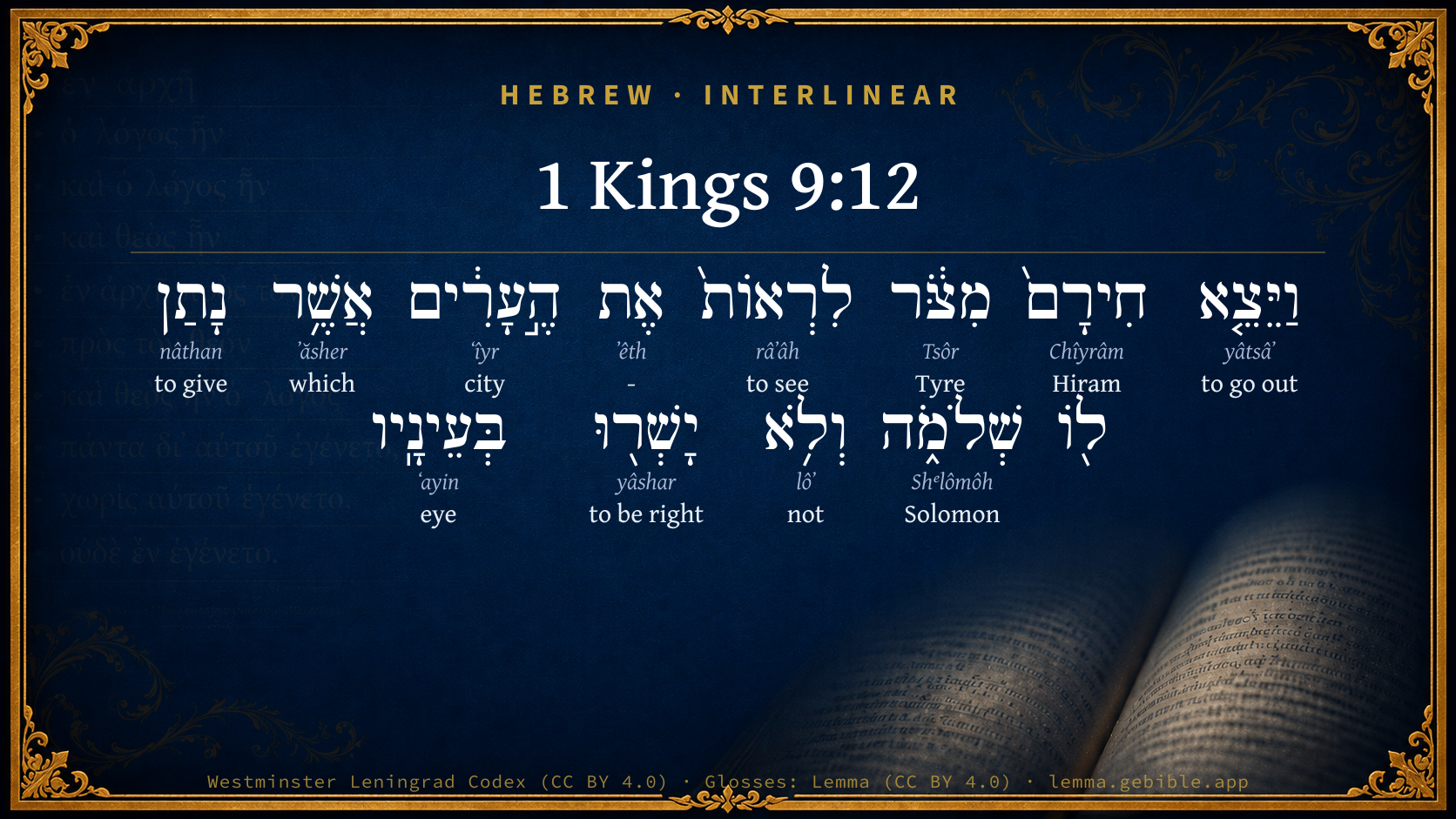
Hebrew (Westminster Leningrad Codex) 1 Kings 9:12 appears in the Hebrew Old Testament. The text above is from the Westminster Leningrad Codex. Each word links to its Strong’s number, a concise gloss, and parsing drawn from the Open Scriptures Hebrew Bible morphology. Click any word for its full Brown-Driver-Briggs (BDB) entry.
Download image
Cite this verse

1 Kings 9:12 (World English Bible). Public Domain. Lemma interlinear Bible study tool, https://lemma.gebible.app/v/1-kings/9/12.

Show BibTeX & RIS
BibTeX
RIS
English Translation
Hiram came out from Tyre to see the cities which Solomon had given him; and they didn't please him.
World English Bible · Public Domain
Download a study sheet

One document with this verse’s original text, its word-by-word gloss line, the meaning frame, cross-references with their text, attributed commentary, and full source and license credits — printable, and it pastes into notes with its structure intact.

This verse Autodidact and up

Study sheet (.html) Plain text (.txt)

A passage Seminary Student

Up to 50 verses in one chapter. A passage sheet keeps up to 6 commentary sources and 12 cross-references per verse, in the order this page ranks them, and says so on the sheet whenever that leaves anything out. Ask for a single verse and you get the Autodidact verse sheet above.

Everything on this page stays free to read, with no account — the sheet is a download of what is already on screen, not access to it.

Want to remove ads? Support Godless Engineer
Compare translations 3

The same verse in 3 English versions, stacked beneath the original-language interlinear above. Click any original word for its lexicon entry.

Each is an independent rendering of the whole verse — the interlinear is not word-aligned to these translations.

Highlighted words mark where these versions differ — a whole-verse word diff, not a word-by-word alignment.

  • World English Bible Public Domain
    Hiram came out from Tyre to see the cities which Solomon had given him; and they didn't please him.
  • King James Version Public Domain
    And Hiram came out from Tyre to see the cities which Solomon had given him; and they pleased him not.
  • unfoldingWord Literal Text CC BY-SA 4.0
    And Hiram came out from Tyre to see the cities that Solomon had given to him, but they were not right in his eyes.

unfoldingWord Literal Text — © unfoldingWord, licensed CC BY-SA 4.0. Word-aligned USFM3 via Door43 (git.door43.org/unfoldingWord/en_ult).

Versions to compare (up to 4)

3 of 4 selected

Show all 18 translations

Every available English version of this verse, each an independent rendering of the whole verse.

  • World English Bible Public Domain
    Hiram came out from Tyre to see the cities which Solomon had given him; and they didn't please him.
  • Berean Standard Bible Public Domain
    So Hiram went out from Tyre to inspect the towns that Solomon had given him, but he was not pleased with them.
  • Majority Standard Bible Public Domain
    So Hiram went out from Tyre to inspect the towns that Solomon had given him, but he was not pleased with them.
  • King James Version Public Domain
    And Hiram came out from Tyre to see the cities which Solomon had given him; and they pleased him not.
  • American Standard Version (1901) Public Domain
    And Hiram came out from Tyre to see the cities which Solomon had given him; and they pleased him not.
  • Revised Version (1885) Public Domain
    And Hiram came out from Tyre to see the cities which Solomon had given him; and they pleased him not.
  • Geneva Bible (1599) Public Domain
    And Hiram came out from Tyrus to see the cities which Salomon had giuen him, and they pleased him not.
  • Douay-Rheims (1899) Public Domain
    And Hiram came out of Tyre, to see the towns which Solomon had given him, and they pleased him not,
  • Young's Literal Translation Public Domain
    And Hiram cometh out from Tyre to see the cities that Solomon hath given to him, and they have not been right in his eyes,
  • Literal Standard Version CC BY-SA 4.0
    And Hiram comes out from Tyre to see the cities that Solomon has given to him, and they have not been right in his eyes,
  • Unlocked Literal Bible CC BY-SA 4.0
    Hiram came out from Tyre to see the cities that Solomon had given him, but they did not please him.
  • unfoldingWord Literal Text CC BY-SA 4.0
    And Hiram came out from Tyre to see the cities that Solomon had given to him, but they were not right in his eyes.
  • Darby Bible Public Domain
    And Hiram came out from Tyre to see the cities that Solomon had given him; and they did not please him.
  • World Messianic Bible Public Domain
    Hiram came out of Tyre to see the cities which Solomon had given him; and they didn’t please him.
  • Webster's Bible Public Domain
    And Hiram came out from Tyre to see the cities which Solomon had given him; and they pleased him not.
  • Free Bible Version CC BY-SA 4.0
    But when Hiram went from Tyre to see the cities that Solomon had given him, he was not happy with them.
  • Bible in Basic English Public Domain
    But when Hiram came from Tyre to see the towns which Solomon had given him, he was not pleased with them.
  • JPS Tanakh (1917) Public Domain
    And Hiram came out from Tyre to see the cities which Solomon had given him: and they pleased him not.

Literal Standard Version (2020), Covenant Press — licensed CC BY-SA 4.0. Text via the HelloAO Bible API (eBible.org). Unlocked Literal Bible (unfoldingWord) — licensed CC BY-SA 4.0. Text via the HelloAO Bible API (eBible.org). unfoldingWord Literal Text — © unfoldingWord, licensed CC BY-SA 4.0. Word-aligned USFM3 via Door43 (git.door43.org/unfoldingWord/en_ult). Free Bible Version, Dr. Jonathan Gallagher — licensed CC BY-SA 4.0. Text via the HelloAO Bible API (eBible.org).

Word by word

More ways to search: Search by grammar → Find every occurrence → Compare this word →

Practice this passage: Drill this verse → Learn its vocabulary →

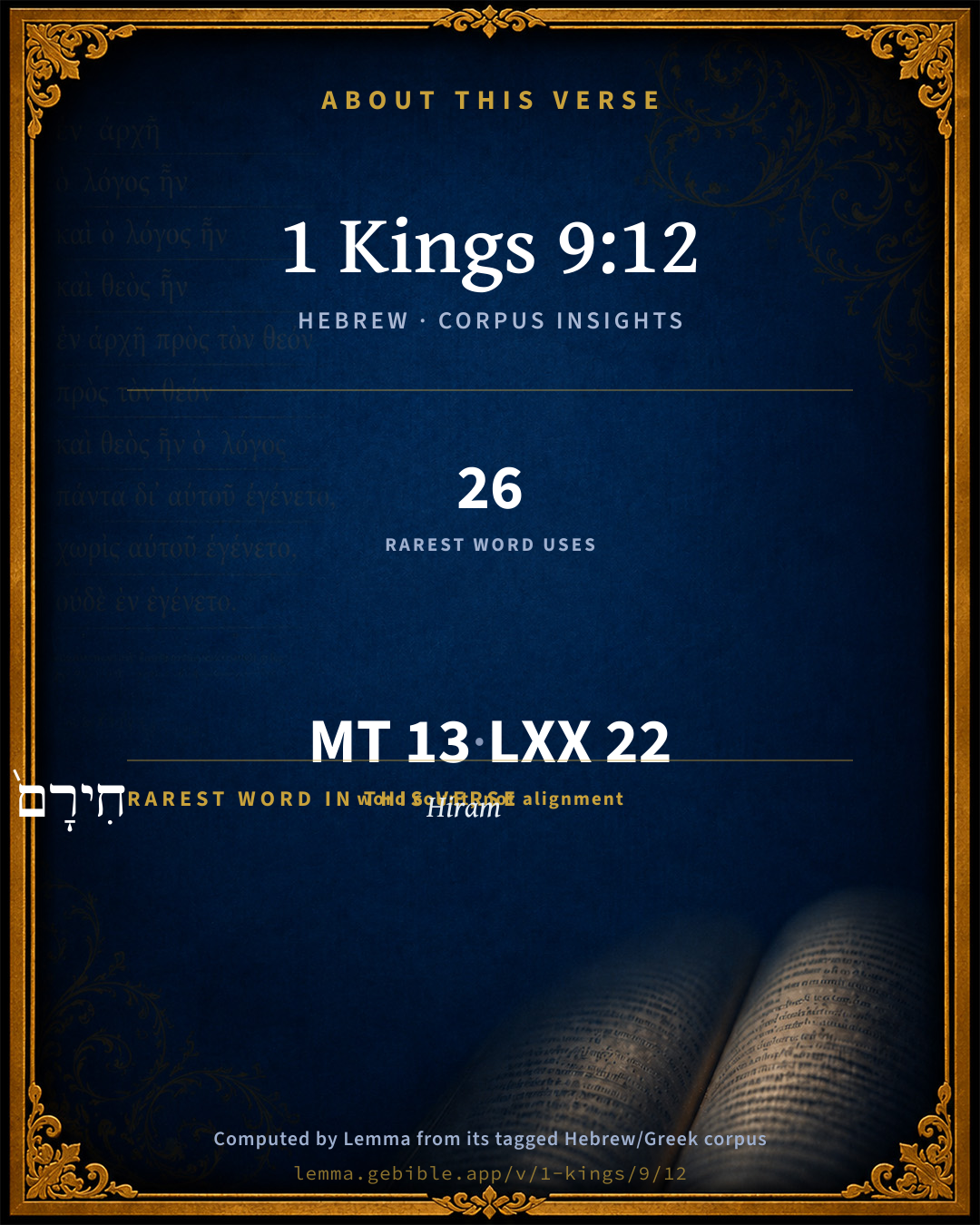
חִירָם֙
Chîyrâm
H2438
“Hiram”
Noun, Proper
Part of Speech
Noun
Type
Proper
Full BDB Definition

Origin: another form of H2361

TWOT: None

Hiram, Huram = "noble" - the king of Tyre who sent workmen and materials to Jerusalem to build both the palace for David and the temple for Solomon - the chief architect and engineer of Solomon's temple sent by King Hiram to Solomon
  1. וַיֵּצֵ֤א yâtsâʼ H3318 “and · to go out” Conjunction + Verb, Qal, Sequential Imperfect, 3rd Person, Masculine, Singular
  2. מִצֹּ֔ר Tsôr H6865 “from · Tyre” Preposition + Noun, Proper
  3. לִרְאוֹת֙ râʼâh H7200 “to see” Preposition + Verb, Qal, Infinitive Construct
  4. אֶת ʼêth H853 “-” Particle, Direct Object
  5. הֶ֣עָרִ֔ים ʻîyr H5892 “the · cities” Particle, Definite Article + Noun, Common, Feminine, Plural, Absolute
  6. אֲשֶׁ֥ר ʼăsher H834 “which” Particle, Relative
  7. נָתַן nâthan H5414 “to give” Verb, Qal, Perfect, 3rd Person, Masculine, Singular
  8. שְׁלֹמֹ֑ה Shᵉlômôh H8010 “Solomon” Noun, Proper
  9. וְלֹ֥א lôʼ H3808 “and · not” Conjunction + Particle, Negative
  10. יָשְׁר֖וּ yâshar H3474 “to be right” Verb, Qal, Perfect, 3rd Person, Common, Plural
  11. בְּעֵינָֽיו ʻayin H5869 “in/at · eyes · his” Preposition + Noun, Common, Both, Dual, Construct + Suffix, Personal, 3rd Person, Masculine, Singular

About this verse

These counts appear in no published source. They are computed here, from the morphology-tagged text and Lemma’s own curated glosses. What Lemma adds →

13
words
12
distinct lemmas
Historical
section

Shared distinctive vocabulary

חִירָם֙ Hiram H2438 occurs in 21 verses of the Hebrew Bible. Also found in:

Grammatical profile

  • 4 verbs
  • 5 nouns
  • 1 preposition
  • 3 particles

Verb forms

  • וַיֵּצֵ֤א Qal · Sequential Imperfect
  • לִרְאוֹת֙ Qal · Infinitive Construct
  • נָתַן Qal · Perfect
  • יָשְׁר֖וּ Qal · Perfect

Hebrew & Septuagint length

In English translation the verse runs 19 words from the Hebrew and 26 from the Septuagint (LXX English) — closely comparable.

A rough comparison of the two English renderings, which tokenize alike — not a word-level alignment.

Word counts can differ between the Hebrew and the Greek without any difference in meaning — e.g. the Hebrew direct-object marker אֵת has no separate Greek word, and Greek often adds the article ὁ.

In the original languages it is 13 Hebrew tokens and 22 Greek tokens — but the two are counted differently (Hebrew bundles its prefixes and suffixes into one token; the Greek is in lemma form), so that isn’t a like-for-like length.

Cross-references

2

Topical passages linked to 1 Kings 9:12 in the Treasury of Scripture Knowledge — connected by theme and wording, ordered by reader-vote popularity; previews shown in the World English Bible.

  • Numbers 22:34 Balaam said to the angel of Yahweh, I have sinned; for I didn't know that you stood in the way against me: now therefore, if it displease you, I will get me back again.
  • Judges 14:3 Then his father and his mother said to him, Is there never a woman among the daughters of your brothers, or among all my people, that you go to take a wife of the uncircumcised Philistines? Samson said to his father, Get her for me; for she pleases me well.

Cross-references courtesy of OpenBible.info (CC BY 4.0).

Hebrew and Greek witnesses Masoretic Hebrew ↔ Greek Septuagint

The same verse in the two great witnesses to the Old Testament, shown verse-for-verse.

These are two independent witnesses, not word-aligned to each other, and the Septuagint is shown in lemma (dictionary) form.

Hebrew 1 Kings 9:12 Masoretic · Westminster Leningrad Codex

וַיֵּצֵ֤א חִירָם֙ מִצֹּ֔ר לִרְאוֹת֙ אֶת הֶ֣עָרִ֔ים אֲשֶׁ֥ר נָתַן ל֖וֹ שְׁלֹמֹ֑ה וְלֹ֥א יָשְׁר֖וּ בְּעֵינָֽיו

Hiram came out from Tyre to see the cities which Solomon had given him; and they didn't please him.

World English Bible · Public Domain

Greek LXX 1 Kings 9:12 Septuagint · lemma form

καί ἐκἔρχομαι χιραμ ἐκ τύρος καί πορεύομαι εἰς ὁ γαλιλαία ὁ ὁράω ὁ πόλις ὅς δίδωμι αὐτός σαλωμών καί οὐ ἀρέσκω αὐτός

So Chiram departed from Tyre, and went into Galilee to see the cities which Solomon gave to him; and they pleased him not. And he said,

LXX2012 (modern English Septuagint) · Public Domain

On this verse, The Cambridge Bible for Schools and Colleges discusses the Septuagint’s reading. Read the note in Commentary ↓

Hebrew: Westminster Leningrad Codex (CC BY 4.0). Greek: Septuagint (public domain); English from LXX2012 (modern English Septuagint) (Public Domain). How the Septuagint differs from the Hebrew →

Targum (Aramaic paraphrase)

1

The Targum is the ancient Jewish Aramaic paraphrase of the Hebrew Scriptures — an interpretive translation, not the Hebrew text itself. Onkelos (literal) and Pseudo-Jonathan (expansive) render the Torah, and Jonathan the Prophets. Coverage is partial: where no permissively-licensed English translation exists for a verse, only the Aramaic is shown. This is verse-level text, not a word-by-word alignment to the Hebrew.

  1. Targum Jonathan Prophets (Joshua–Malachi)
    וּנְפַק חִירָם מִצוֹר לְמִסְעַר יַת קִירְוַיָא דִיהַב לֵיהּ שְׁלֹמֹה וְלָא כַשְׁרִין בְּעֵינוֹהִי:

    (no public-domain English translation for this verse)

    Targum Jonathan — Aramaic: “Mikraot Gedolot” (public domain). English: “Sefaria Community Translation” (CC0 1.0 (public-domain dedication)); “London "Chaldee Paraphrase," 1871” (public domain). Text via Sefaria.

Commentary

Notes on 1 Kings 9:12 from classic Christian and Jewish commentators (each source and its license shown beneath its notes). The classic Christian expositions comment on the surrounding passage and are grouped to its opening verse, so a note may address several verses; the Jewish commentaries on the Tanakh (Rashi and others) are per-verse, so they appear only where the commentator wrote on this verse.

Lemma curates 59 commentaries, every one of them public domain or Creative Commons licensed, each selected and text-cleaned for this edition rather than reprinted as found. About our sources →

John Gill's Exposition

And he said,.... By letter to him:

what cities are these which thou hast given me, my brother? so he called him, being not only his neighbour, but his ally, in friendship and covenant with him; and this he said of them not by way of complaint, or contempt, as unworthy of his acceptance; for so munificent a prince as Solomon would never offer to a king to whom he was so much obliged anything mean and contemptible; but as being unsuitable to him, however valuable they might be in themselves, or of advantage to others:

and he called them the land of Cabul unto this day; or rather the words should be rendered impersonally, "they were called so"; for Hiram could not call them by this name to the times of the writer of this book; nor is there any reason to think he would give them any name at all, and much less a contemptible one, as this is thought to be, when he did not choose to accept of them. Some interpret (g) the word shut up, or unfruitful, sandy, dirty, clayey; so in the Talmud (h) it is said to be a sandy land, and called Cabul, because a man's foot was plunged in it up to his ankles, and is represented as unfruitful. Josephus (i) says, in the Phoenician tongue it signifies "not pleasing", which agrees with what Hiram says, Kg1 9:12. Hillerus (k) interprets it "as nothing", they being as nothing to Hiram, of no use to him, whatever they might be to others; and therefore he restored them to Solomon, Ch2 8:2, which seems to be the best sense of the word. They are the same with Decapolis, Mat 4:25 so called from ten cities therein (l).

(g) David de Pomis, Lexic fol. 58. 2. (h) T. Bab. Sabbat, fol. 54. 1. (i) Antiqu. l. 8. c. 5. sect. 3. (k) Onomastic. Sacr. p. 435. (l) Vid. Castel Lex Heptaglot. col. 1669. & Plin. Nat. Hist. l. 5. c. 18.

John Gill's Exposition of the Whole Bible (1746–1763) — public domain (CC PDM 1.0). Text via the HelloAO Bible API.

Trapp's Complete Commentary

John Trapp

1Ki 9:12 And Hiram came out from Tyre to see the cities which Solomon had given him; and they pleased him not.

Ver. 12. And they pleased him not.] Here some tax Hiram of covetousness, which he expressed by his lofty looks, and discontented expostulations.

John Trapp, A Commentary or Exposition upon All the Books of the Old and New Testament (1647–1656) — public domain. Text from a community e-Sword module.

Ellicott's Commentary for English Readers

(12) The cities are said to have been in “the land of Galilee.” The name Galilee, signifying properly a “circle” or “ring” of territory, is used twice in the Book of Joshua for a region round Kedesh-Naphtali (Jos_20:7; Jos_21:32), lying to the north-west of the Lake of Gennesareth, and extending to the Waters of Merom. (See also 2Ki_15:29.) The western portion of this territory would lie nearly on the frontiers of Tyre, and so would suit well the purpose both of Hiram and of Solomon. The discontent of Hiram probably referred to the condition of the cities (which afterwards had to be rebuilt), not to their geographical position.

A Bible Commentary for English Readers, edited by Charles John Ellicott (1878–1897) — public domain. Text from a community e-Sword module.

The Cambridge Bible for Schools and Colleges

gen. ed. J. J. S. Perowne

12. came out from Tyre] The LXX. adds ‘and went into Galilee.’

The Cambridge Bible for Schools and Colleges (gen. ed. J. J. S. Perowne; Cambridge University Press, 1878–1918) — public domain. Text from a community e-Sword module.

Albert Barnes' Notes on the Bible

They pleased him not - It is a reasonable conjecture that, when a question arose with respect to a cession of land, Hiram had cast his eyes on the bay or harbour of Acco, or Ptolemais, and was therefore the more disappointed when he received an inland tract of mountain territory.

Albert Barnes' Notes on the Bible (1834–1885) — public domain. Text from a community e-Sword/MySword module.

Matthew Poole's English Annotations

He did not accept them for satisfaction, because the cities were out of repair, as appears from 1Ki 9:13, and the soil not good in his eyes, and therefore he refused them, 2Ch 8:2, and expected, and doubtless had, satisfaction some other way, as may be gathered from the following story.

Matthew Poole's English Annotations on the Holy Bible (1683–1685) — public domain. Text from a community e-Sword/MySword module.

Whedon's Commentary on the Bible

Daniel D. Whedon

12. They pleased him not — “These twenty cities were mere villages, of course, and it is a genuine Eastern trick to dignify a small present with a pompous name.” — Thomson. The Phenicians being a maritime and commercial people, Hiram might naturally have coveted some of Solomon’s coast-towns, and was therefore displeased with the gift of a comparatively useless inland region, and so restored the cities to Solomon. 2Ch_8:2.

Daniel D. Whedon (gen. ed.), Commentary on the Old and New Testaments (1874–1909) — public domain. Text from a community e-Sword module.

The Pulpit Commentary

And Hiram came out from Tyre to see the cities which Solomon had given him; and they pleased him not. Heb. were not right in his eyes. It has been conjectured that Hiram had hoped for the noble bay of Acco or Ptolemais (Milman, Rawlinson), but surely he had seaboard enough already. It was rather corn lands he would most need and desire. His disappointment is amply accounted for by the fact that the country assigned him was a hungry and mountainous, and therefore comparatively useless, tract. "The region lay on the summit of a broad mountain ridge" (Porter).

The Pulpit Commentary (1880–1919), ed. H.D.M. Spence-Jones & Joseph S. Exell — public domain. Text from a community e-Sword module.

unfoldingWord translationNotes

Door43 World Missions Community

What cities are these which you have given me, my brother?

Hiram is rebuking Solomon. This questions can be translated as a statement. AT: "These cities that you have given me are good for nothing." (See: Rhetorical Question)

which they are still called today

This can be stated in active form. AT: "and people still call them that today" (See: Active or Passive)

120 talents of gold

"one hundred and twenty talents of gold." A talent is a unit of weight equal to about 33 kilograms. AT: "about 4,000 kilograms of gold" (See: Numbers and Biblical Weight)

translationWords

Tyre

brother

unfoldingWord translationNotes — © Distant Shores Media and the Door43 World Missions Community, licensed CC BY-SA 4.0. Source: git.door43.org/Door43/en_tn.

Lesson kit

Teaching starters — assembled from the data on this page, not authored interpretation. Every prompt links to the verse data it draws on. Edit before teaching.

1 Kings, in the Historical, opens this verse with 13 words (12 distinct Hebrew lemmas). Its most distinctive word is Chîyrâm (“Hiram”). A historical commentator’s framing appears above. Read the whole chapter for the surrounding context.

Discussion questions

  1. The word Chîyrâm carries the sense “Hiram.” How does it shape the verse?
  2. How does 2 Samuel 5:11, which shares the word «Hiram», read alongside this verse?
  3. These translations render this verse differently. What is at stake in choosing one wording over another?
  4. «וַיֵּצֵ֤א» is a Qal Sequential Imperfect verb. How does that grammatical form shape the action described?
  5. Compare how John Gill's Exposition and Trapp's Complete Commentary read this verse. Where do they agree or differ?

Things to notice

Reading settings

Reading text

Shown beneath each verse's original-language words.

Old Testament
Old Testament edition

Read the OT as the Masoretic Hebrew (MT) or the Greek Septuagint (LXX).

English shown for the Greek Septuagint (in the Hebrew ↔ Greek comparison).

Comparing translations? Open the Compare panel on any verse page to stack up to four side by side.