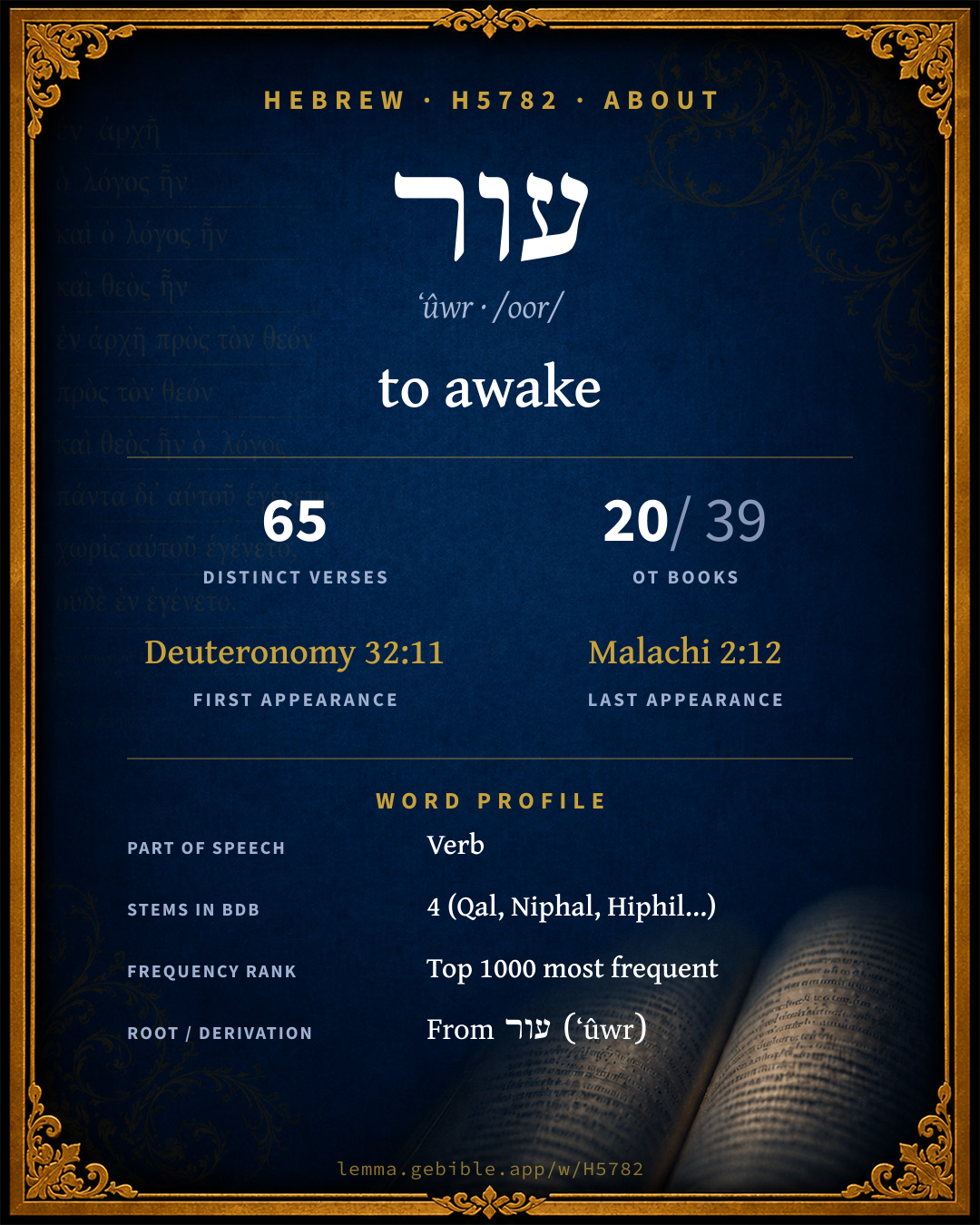
עוּר
to awake
‘to awake’ is one of 5 main senses fuller range ↓
Full lexicon entry — Brown-Driver-Briggs (BDB)
From Brown-Driver-Briggs (BDB)
Where this word appears
See every Hiphil verb in the Hebrew Bible →
Grammar key — what these labels mean
Part of speech
- Verb
- An action or state-of-being word.
Stem
- Qal
- The basic, simple active stem — the plain form of the verb (“he wrote”).
- Hiphil
- The causative active stem (“he caused / brought about”). Here: ‘rouse’
- Polel
- A stem of hollow/geminate roots functioning like the Piel — intensive active.
- Niphal
- Usually the simple passive or reflexive of the Qal (“he was written”).
- Hithpolel
- The reflexive counterpart of the Polel.
Form
- Imperative
- A direct command (“write!”).
- Imperfect
- An incomplete, ongoing, or future action (“he will / would write”).
- Perfect
- A completed action or state — Hebrew marks aspect (completeness) more than strict tense (“he wrote”).
- Participle Active
- A verbal adjective expressing ongoing or characteristic action (“writing / one who writes”).
- Sequential Imperfect
- An imperfect with prefixed waw — the standard past-narrative form (waw-consecutive imperfect).
- Cohortative
- A first-person volitional form expressing wish or resolve (“let me / let us write”).
- Jussive
- A third- or second-person volitional form expressing wish or command (“let him write”).
- Sequential Perfect
- A perfect with prefixed waw continuing a preceding imperfect or command (waw-consecutive perfect).
- Infinitive Construct
- A bound verbal noun, frequently with prepositions (“to write / in writing”).
State
- Absolute
- The independent form of a noun, not bound to a following word.
- Construct
- A noun bound to a following noun in a possessive / “of” relationship (the construct chain).
Person
- 2nd Person
- The one addressed (“you”).
- 3rd Person
- The one spoken about (“he / she / it / they”).
- 1st Person
- The speaker (“I / we”).
Gender
- Feminine
- Grammatically feminine.
- Masculine
- Grammatically masculine.
- Common
- Either gender — not distinguished for this form.
Number
- Singular
- One.
- Plural
- More than one (in Hebrew, generally three or more).
Grammatical forms 33 distinct
- Verb, Qal, Imperative, 2nd Person, Feminine, Singular 12 times (15%)
- Verb, Hiphil, Imperfect, 3rd Person, Masculine, Singular 7 times (9%)
- Verb, Qal, Imperative, 2nd Person, Masculine, Singular 6 times (8%)
- Verb, Hiphil, Perfect, 3rd Person, Masculine, Singular 5 times (6%)
- Verb, Hiphil, Participle Active, Masculine, Singular, Absolute 5 times (6%)
- Verb, Polel, Perfect, 3rd Person, Masculine, Singular 4 times (5%)
- Verb, Hiphil, Sequential Imperfect, 3rd Person, Masculine, Singular 4 times (5%)
- Verb, Niphal, Imperfect, 3rd Person, Masculine, Singular 3 times (4%)
+25 more forms (34 occurrences)
Parsed forms decoded from the imported morphology (morphhb / Westminster Leningrad Codex — WLC text public domain, morphhb tagging CC BY 4.0), counted across 80 parsed occurrences — not distinct verses.
Every verse where H5782 appears — 65 distinct verses across 20 books. Click any verse to open its interlinear word-by-word view. Verse text shown in the World English Bible for context — . Each verse’s Hebrew form is shown with its reference; the English is not keyword-highlighted, since the data carries no word-level English alignment. Use “Compare translations” on any verse to read it across multiple English versions. This concordance covers the Hebrew Bible; Septuagint (Greek Old Testament) occurrences are not indexed here.
Deuteronomy 1 verse
Judges 1 verse
2 Samuel 1 verse
1 Chronicles 3 verses
- 1 Chronicles 5:26 וַ/יָּעַר֩ conj + Hiphil wimpf 3ms The God of Israel stirred up the spirit of Pul king of Assyria, and the spirit of Tilgath Pilneser king of Assyria, and he carried them away, even the Reubenites, and the Gadites, and the half-tribe of Manasseh, and brought them to Halah, and Habor, and Hara, and to the river of Gozan, to this day.
- 1 Chronicles 11:11 עוֹרֵ֧ר Polel pf 3ms This is the number of the mighty men whom David had: Jashobeam, the son of a Hachmonite, the chief of the thirty; he lifted up his spear against three hundred and killed them at one time.
- 1 Chronicles 11:20 עוֹרֵ֣ר Polel pf 3ms Abishai, the brother of Joab, he was chief of the three; for he lifted up his spear against three hundred and killed them, and had a name among the three.
2 Chronicles 2 verses
- 2 Chronicles 21:16 וַ/יָּ֨עַר conj + Hiphil wimpf 3ms Yahweh stirred up against Jehoram the spirit of the Philistines, and of the Arabians who are beside the Ethiopians:
- 2 Chronicles 36:22 הֵעִ֣יר Hiphil pf 3ms Now in the first year of Cyrus king of Persia, that the word of Yahweh by the mouth of Jeremiah might be accomplished, Yahweh stirred up the spirit of Cyrus king of Persia, so that he made a proclamation throughout all his kingdom, and [put it] also in writing, saying,
Ezra 2 verses
- Ezra 1:1 הֵעִ֣יר Hiphil pf 3ms Now in the first year of Cyrus king of Persia, that the word of Yahweh by the mouth of Jeremiah might be accomplished, Yahweh stirred up the spirit of Cyrus king of Persia, so that he made a proclamation throughout all his kingdom, and [put it] also in writing, saying,
- Ezra 1:5 הֵעִ֤יר Hiphil pf 3ms Then rose up the heads of fathers' [houses] of Judah and Benjamin, and the priests, and the Levites, even all whose spirit God had stirred to go up to build the house of Yahweh which is in Jerusalem.
Job 6 verses
- Job 3:8 עֹרֵ֥ר Polel inf.cs Let them curse it who curse the day, Who are ready to rouse up leviathan.
- Job 8:6 יָעִ֣יר Hiphil impf 3ms If you were pure and upright, Surely now he would awaken for you, And make the habitation of your righteousness prosperous.
- Job 14:12 יֵ֝עֹ֗רוּ Niphal impf 3mp So man lies down and doesn't rise; Until the heavens are no more, they shall not awake, Nor be roused out of their sleep.
- Job 17:8 יִתְעֹרָֽר Hithpolel impf 3ms Upright men shall be astonished at this. The innocent shall stir up himself against the godless.
- Job 31:29 וְ֝/הִתְעֹרַ֗רְתִּי conj + Hithpolel wpf 1cs "If I have rejoiced at the destruction of him who hated me, Or lifted up myself when evil found him;
- Job 41:10 יְעוּרֶ֑/נּוּ Qal impf 3ms + sfx pers 3ms None is so fierce that he dare stir him up. Who then is he who can stand before me?
Psalms 9 verses
- Psalms 7:6 וְ/ע֥וּרָ/ה conj + Qal impv 2ms + sfx h Arise, Yahweh, in your anger. Lift up yourself against the rage of my adversaries. Awake for me. You have commanded judgment.
- Psalms 35:23 הָעִ֣ירָ/ה Hiphil impv 2ms + sfx h Wake up! Rise up to defend me, my God! My Lord, contend for me!
- Psalms 44:23 ע֤וּרָ/ה Qal impv 2ms + sfx h Wake up! Why do you sleep, Lord? Arise! Don't reject us forever.
- Psalms 57:8 ע֤וּרָ/ה ע֭וּרָֽ/ה אָעִ֥ירָה Qal impv 2ms + sfx h Qal impv 2ms + sfx h Hiphil coh 1cs Wake up, my glory! Wake up, psaltery and harp! I will wake up the dawn.
- Psalms 59:4 ע֖וּרָ/ה Qal impv 2ms + sfx h I have done no wrong, yet they are ready to attack me. Rise up, behold, and help me!
- Psalms 73:20 בָּ/עִ֤יר prep + Hiphil inf.cs As a dream when one wakes up, So, Lord, when you awake, you will despise their fantasies.
- Psalms 78:38 יָ֝עִיר Hiphil impf 3ms But he, being merciful, forgave iniquity, and didn't destroy them. Yes, many times he turned his anger away, And didn't stir up all his wrath.
- Psalms 80:2 עוֹרְרָ֥/ה Polel impv 2ms + sfx h Before Ephraim and Benjamin and Manasseh, stir up your might! Come to save us!
- Psalms 108:2 ע֭וּרָֽ/ה אָעִ֥ירָה Qal impv 2ms + sfx h Hiphil coh 1cs Wake up, harp and lyre! I will wake up the dawn.
Proverbs 1 verse
Song of Solomon 6 verses
- Song of Solomon 2:7 תָּעִ֧ירוּ תְּעֽוֹרְר֛וּ Hiphil impf 2mp Polel impf 2mp I adjure you, daughters of Jerusalem, By the roes, or by the hinds of the field, That you not stir up, nor awaken love, Until it so desires.
- Song of Solomon 3:5 תָּעִ֧ירוּ תְּעֽוֹרְר֛וּ Hiphil impf 2mp Polel impf 2mp I adjure you, daughters of Jerusalem, By the roes, or by the hinds of the field, That you not stir up, nor awaken love, Until it so desires.
- Song of Solomon 4:16 ע֤וּרִי Qal impv 2fs Awake, north wind; and come, you south; Blow on my garden, that its spices may flow out. Let my beloved come into his garden, And taste his precious fruits. Lover
- Song of Solomon 5:2 עֵ֑ר Qal ptcp.act ms I was asleep, but my heart was awake. It is the voice of my beloved who knocks: Open to me, my sister, my love, my dove, my undefiled; For my head is filled with dew, My hair with the dampness of the night.
- Song of Solomon 8:4 תָּעִ֧ירוּ תְּעֹֽרְר֛וּ Hiphil impf 2mp Polel impf 2mp I adjure you, daughters of Jerusalem, That you not stir up, nor awaken love, Until it so desires. Friends
- Song of Solomon 8:5 עֽוֹרַרְתִּ֔י/ךָ Polel pf 1cs + sfx pers 2ms Who is this who comes up from the wilderness, Leaning on her beloved? Under the apple tree I aroused you. There your mother conceived you. There she was in labor and bore you.
Isaiah 13 verses
- Isaiah 10:26 וְ/עוֹרֵ֨ר conj + Polel wpf 3ms Yahweh of Hosts will stir up against him a scourge, as in the slaughter of Midian at the rock of Oreb: and his rod will be over the sea, and he will lift it up after the manner of Egypt.
- Isaiah 13:17 מֵעִ֥יר Hiphil ptcp.act ms Behold, I will stir up the Medes against them, who shall not regard silver, and as for gold, they shall not delight in it.
- Isaiah 14:9 עוֹרֵ֨ר Polel pf 3ms Sheol from beneath is moved for you to meet you at your coming; it stirs up the dead for you, even all the chief ones of the earth; it has raised up from their thrones all the kings of the nations.
- Isaiah 15:5 יְעֹעֵֽרוּ Polel impf 3mp My heart cries out for Moab; her nobles [flee] to Zoar, to Eglath Shelishiyah: for by the ascent of Luhith with weeping they go up; for in the way of Horonaim they raise up a cry of destruction.
- Isaiah 41:2 הֵעִיר֙ Hiphil pf 3ms Who has raised up one from the east, whom he calls in righteousness to his foot? he gives nations before him, and makes him rule over kings; he gives them as the dust to his sword, as the driven stubble to his bow.
- Isaiah 41:25 הַעִיר֤וֹתִי Hiphil pf 1cs I have raised up one from the north, and he has come; from the rising of the sun one who calls on my name: and he shall come on rulers as on mortar, and as the potter treads clay.
- Isaiah 42:13 יָעִ֣יר Hiphil impf 3ms Yahweh will go forth as a mighty man; he will stir up [his] zeal like a man of war: he will cry, yes, he will shout aloud; he will do mightily against his enemies.
- Isaiah 45:13 הַעִירֹתִ֣/הֽוּ Hiphil pf 1cs + sfx pers 3ms I have raised him up in righteousness, and I will make straight all his ways: he shall build my city, and he shall let my exiles go free, not for price nor reward, says Yahweh of Hosts.
- Isaiah 50:4 יָעִ֣יר יָעִ֥יר Hiphil impf 3ms Hiphil impf 3ms The Lord Yahweh has given me the tongue of those who are taught, that I may know how to sustain with words him who is weary: he wakens morning by morning, he wakens my ear to hear as those who are taught.
- Isaiah 51:9 עוּרִ֨י עוּרִ֤י ע֚וּרִי Qal impv 2fs Qal impv 2fs Qal impv 2fs Awake, awake, put on strength, arm of Yahweh; awake, as in the days of old, the generations of ancient times. Isn't it you who did cut Rahab in pieces, who pierced the monster?
- Isaiah 51:17 הִתְעוֹרְרִ֣י הִֽתְעוֹרְרִ֗י Hithpolel impv 2fs Hithpolel impv 2fs Awake, awake, stand up, Jerusalem, that have drunk at the hand of Yahweh the cup of his wrath; you have drunken the bowl of the cup of staggering, and drained it.
- Isaiah 52:1 עוּרִ֥י עוּרִ֛י Qal impv 2fs Qal impv 2fs Awake, awake, put on your strength, Zion; put on your beautiful garments, Jerusalem, the holy city: for henceforth there shall no more come into you the uncircumcised and the unclean.
- Isaiah 64:7 מִתְעוֹרֵ֖ר Hithpolel ptcp.act ms There is none who calls on your name, who stirs up himself to take hold of you; for you have hid your face from us, and have consumed us by means of our iniquities.
Jeremiah 6 verses
- Jeremiah 6:22 יֵע֖וֹר Niphal impf 3ms Thus says Yahweh, Behold, a people comes from the north country; and a great nation shall be stirred up from the uttermost parts of the earth.
- Jeremiah 25:32 יֵע֖וֹר Niphal impf 3ms Thus says Yahweh of hosts, Behold, evil shall go forth from nation to nation, and a great tempest shall be raised up from the uttermost parts of the earth.
- Jeremiah 50:9 מֵעִיר֩ Hiphil ptcp.act ms For, behold, I will stir up and cause to come up against Babylon a company of great nations from the north country; and they shall set themselves in array against her; from there she shall be taken: their arrows shall be as of an expert mighty man; none shall return in vain.
- Jeremiah 50:41 יֵעֹ֖רוּ Niphal impf 3mp Behold, a people comes from the north; and a great nation and many kings shall be stirred up from the uttermost parts of the earth.
- Jeremiah 51:1 מֵעִ֣יר Hiphil ptcp.act ms Thus says Yahweh: Behold, I will raise up against Babylon, and against those who dwell in Lebkamai, a destroying wind.
- Jeremiah 51:11 הֵעִ֣יר Hiphil pf 3ms Make sharp the arrows; hold firm the shields: Yahweh has stirred up the spirit of the kings of the Medes; because his purpose is against Babylon, to destroy it: for it is the vengeance of Yahweh, the vengeance of his temple.
Ezekiel 1 verse
Daniel 2 verses
- Daniel 11:2 יָעִ֣יר Hiphil impf 3ms Now will I show you the truth. Behold, there shall stand up yet three kings in Persia; and the fourth shall be far richer than they all: and when he has grown strong through his riches, he shall stir up all against the realm of Greece.
- Daniel 11:25 וְ/יָעֵר֩ conj + Hiphil juss 3ms He shall stir up his power and his courage against the king of the south with a great army; and the king of the south shall war in battle with an exceeding great and mighty army; but he shall not stand; for they shall devise devices against him.
Hosea 1 verse
Joel 3 verses
- Joel 3:7 מְעִירָ֔/ם Hiphil ptcp.act ms cs + sfx pers 3mp Behold, I will stir them up out of the place where you have sold them, And will return your repayment on your own head;
- Joel 3:9 הָעִ֨ירוּ֙ Hiphil impv 2mp Proclaim this among the nations: Prepare war. Stir up the mighty men. Let all the warriors draw near. Let them come up.
- Joel 3:12 יֵע֨וֹרוּ֙ Niphal juss 3mp "Let the nations arouse themselves, And come up to the valley of Jehoshaphat; For there will I sit to judge all the surrounding nations.
Habakkuk 1 verse
Haggai 1 verse
Zechariah 4 verses
- Zechariah 2:13 נֵע֖וֹר Niphal pf 3ms Be silent, all flesh, before Yahweh; for he has roused himself from his holy habitation!"
- Zechariah 4:1 וַ/יְעִירֵ֕/נִי יֵע֥וֹר conj + Hiphil wimpf 3ms + sfx pers 1cs Niphal impf 3ms The angel who talked with me came again, and wakened me, as a man who is wakened out of his sleep.
- Zechariah 9:13 וְ/עוֹרַרְתִּ֤י conj + Polel wpf 1cs For indeed I bend Judah as a bow for me. I have filled the bow with Ephraim; And I will stir up your sons, Zion, Against your sons, Greece, And will make you like the sword of a mighty man.
- Zechariah 13:7 עוּרִ֤י Qal impv 2fs "Awake, sword, against my shepherd, And against the man who is close to me," says Yahweh of Hosts. Strike the shepherd, and the sheep will be scattered; And I will turn my hand against the little ones.
Malachi 1 verse
About this entry
At a glance — auto-summarized from this page’s data, not written by a person. Every figure links to its source below. This summary describes the numbers; it doesn’t interpret them.
עור — transliterated ʻûwr — is a Hebrew verb carrying the sense “to awake.” The verb spans 4 stems, from Qal to Niphal. It appears 65 verses across 20 books of the Hebrew Bible, among its moderately common vocabulary. Debuting at Deuteronomy 32:11, it then recurs through the corpus. Related forms include עור, מעור and מערה. See the sense tree, 65-verse concordance, and the renderings breakdown below.
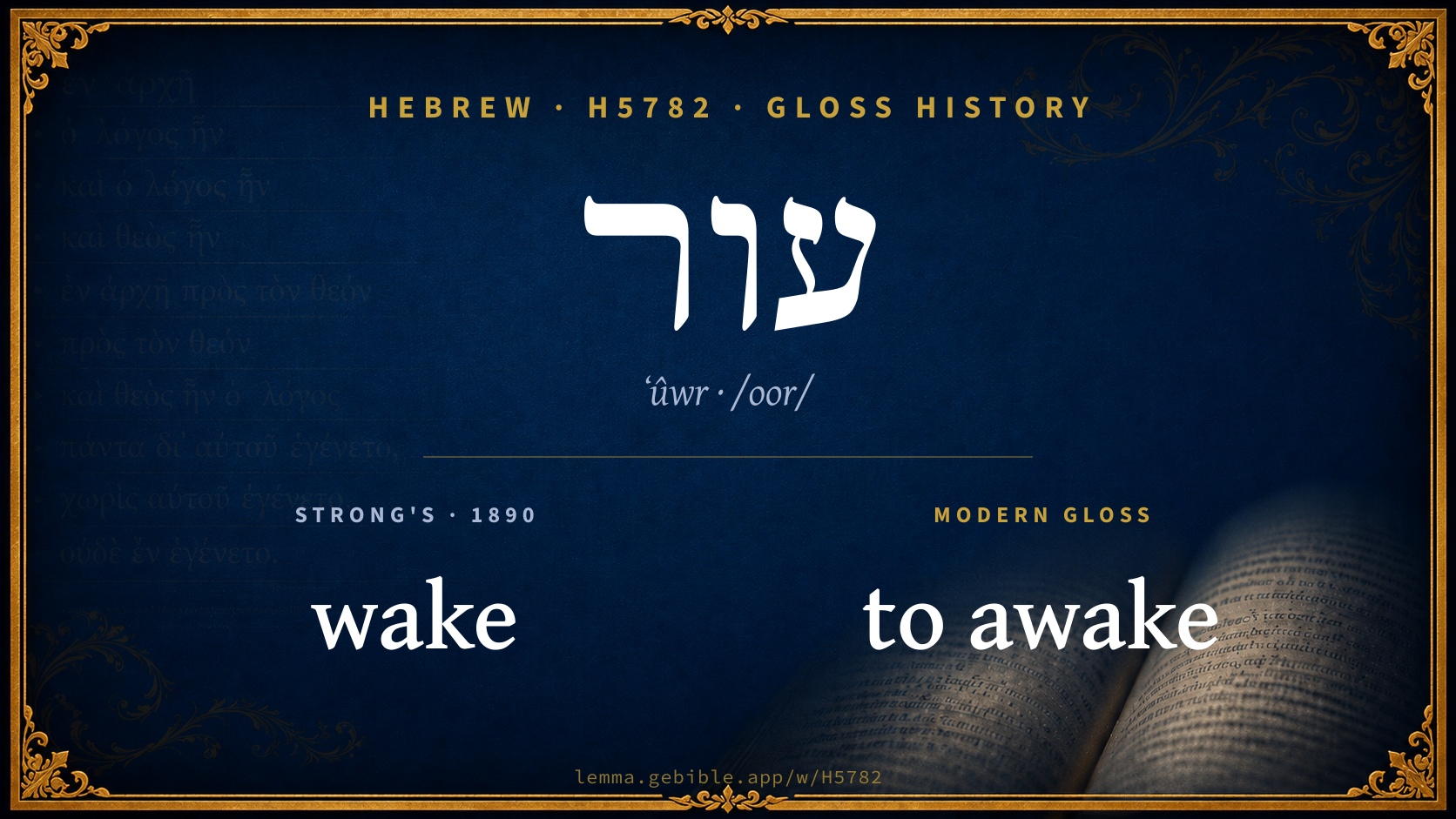
Gloss history
Strong's 1890 vs modern scholarship
About this word
Strong's H5782 catalogs a Hebrew word from the Hebrew Old Testament.
These counts are not copied from any lexicon or concordance. They are computed here, from the morphology-tagged Hebrew Old Testament. What Lemma adds →
- 65
- distinct verses
- The word appears in 65 distinct verses.
- 20 / 39
- OT books
- The word appears in 20 of 39 Old Testament books.
- #501
- by frequency
- Top 1000 most frequent Hebrew words (rank 501 of 8,640 Hebrew words by occurrence).
View all 65 occurrences in the concordance →
By section of the Old Testament
By traditional corpus
Conventional, traditional groupings — biblical authorship is debated, so this is a traditional corpus grouping, not an authorship claim. Each share is this word’s portion of its verses in that division of the Hebrew canon. Each figure is a share of the word’s 65 distinct verses.
- Prophets (Nevi'im) 33 verses · 51%
- Writings (Ketuvim) 31 verses · 48%
- Torah (Pentateuch) 1 verse · 2%
How translations render this word
Counts come from each version’s own published word-to-Strong’s tagging or interlinear alignment — an approximate guide to how each version renders this word, not a word-level alignment the data otherwise carries. Because each total is that version’s own tagged count, the per-version totals vary from one another and need not match the appearance or distinct-verse counts above. These counts may also differ from a printed concordance because Lemma counts each distinctly tagged rendering and does not collapse phrase taggings into a single head-word total. This is a fixed set of word-tagged versions (KJV, ASV, BSB, ULT) and does not change with the reading translation you choose elsewhere. Each version’s license is shown beside its name below (and on Sources).
BDB lists this Strong’s number as 2 distinct words (homographs). Each count above pools all of them and is not split by sense — see the Senses section below. A low-frequency rendering may belong to a different one of those words, not the primary meaning.
- King James Version†: Awake 21×, Stirred up 5×, Stirreth up 4×
- American Standard Version†: Awake 21×, Stirred up 5×, Behold 4×
- Berean Standard Bible†: Awake 18×, Stirred 4×, Awaken 3×
- unfoldingWord Literal Text†: Awake 16×, Awaken 6×, Do 4×
King James Version Public Domain
Renders H5782 across 80† tagged occurrences — most commonly:
Plus other, less common renderings. Plus 28 renderings that appear only once — usually multi-word phrases or single function words the recovered tagging swept in, not distinct renderings. Not rendered by a distinct English word in 1 further occurrence.
American Standard Version Public Domain
Renders H5782 across 78† tagged occurrences — most commonly:
Plus 27 renderings that appear only once — usually multi-word phrases or single function words the recovered tagging swept in, not distinct renderings.
Berean Standard Bible Public Domain
Renders H5782 across 80† tagged occurrences — most commonly:
Plus other, less common renderings. Plus 34 renderings that appear only once — usually multi-word phrases or single function words the recovered tagging swept in, not distinct renderings.
unfoldingWord Literal Text CC BY-SA 4.0
Renders H5782 across 91† tagged occurrences — most commonly:
Plus other, less common renderings. Plus 43 renderings that appear only once — usually multi-word phrases or single function words the recovered tagging swept in, not distinct renderings.
7 senses and sub-senses in the full BDB
Hebrew verbs can shift meaning by stem (binyan): Qal is the basic action, Niphal is often passive or reflexive, Piel often intensifies or makes it factitive, and Hiphil is typically causative. The senses below are grouped under the stem BDB assigns to each. This entry also uses one or more reduplicated stems (the Pōlēl/Pilpēl type), which for hollow or geminate roots behave much like Piel — often intensive or iterative.
What do BDB’s symbols mean?
BDB uses these scholarly abbreviations:
| Symbol | Meaning |
|---|---|
| 𝔊 | the Septuagint (the ancient Greek translation, LXX) |
| 𝔙 | the Vulgate (the Latin translation) |
| 𝔖 | the Syriac version (the Peshitta) |
| 𝔗 | the Targum (the Aramaic translation) |
| ψ | the Psalms |
| √ | root (the underlying root or stem) |
| ‖ | parallel passage (a synonymous or contrasted parallel) |
| † | the dagger: every passage where the word occurs is cited |
The 7 senses and sub-senses the full Brown-Driver-Briggs lexicon distinguishes for this word, in lexicon order (not ranked by frequency), with BDB’s own verbatim wording and sub-sense lettering. Shown in Hebrew script with BDB’s own scholarly abbreviations. The condensed entry is in the Lexicon Entry tab. See also the Forms in the corpus table below.
עור I rouse oneself, awake (NH id.
Qal
- Impf. 3 ms. sf. יְעוּרֶנּוּ Jb 41:2 Baer Ginsb, and Qr van d. H., but Kt יעירנו (Hiph.), Bab. Mass. (v. Baer p. 58), so Ginsbmargin van d. H.; read thus, or יְעוֹרְרֶנּוּ (Pōʿl.) Bu; > contr. form of Pōʿl. Ges§ 72 cc Di; cf. Sta§ 484 e; Imv. ms. ע֫וּרָה ψ 7:7 +, fs. ע֫וּרִי Ju 5:12(×2) + 3 times, עוּרִ֫י Ju 5:12(×2) + 5 times (for rhythm); Pt. עֵר Ct 5:2 + Mal 2:12 (read prob. עֵד We Now GASm, cf. 𝔊 ἓως = עַד);—rouse oneself to activity, of Deborah Ju 5:12(×4); of י׳ ψ 7:7 (‖ קוּמָה, הִנָּשֵׂא), 59:5 (sq. inf.), 44:24 (opp. יָשֵׁן), of י׳’s arm Is 51:9(×3), of oneself ψ 57:9, of Zion Is 52:1(×2), of stone (idol) Hb 2:19, sword Zc 13:7 (+ עַל against), wind Ct 4:16, harp and lyre ψ 57:9 = 108:3; לִבִּי עֵר Ct 5:2 my heart waketh (opp. יָשֵׁן).—Jb 41:2 Mal 2:12 v. supr. e.g. Job 41:2
Niphal
- Pf. 3 ms. נֵעוֹר Zc 2:17; Impf. 3 ms. יֵעוֹר Je 6:22 Zc 4:1; 3 mpl. יֵעֹרוּ Je 50:41 Jb 14:12, יֵעוֹרוּ Jo 4:12;—be roused Zc 4:1 (from [מִן] sleep, in sim.), so Jb 14:12 (sleep of death, ‖ יָקִיצוּ, יָקוּם); be incited to activity, c. מִן loc.: of י׳ Zc 2:17, of nation Je 6:22, kings 50:41, whirlwind 25:32; abs. of nation Jo 4:12. Pōʿl. Pf. 3 ms. עוֹרֵר 2 S 23:18 +, וְע׳ consec. Is 10:26, 1 s. וְעוֹרַרְתִּ֫י Zc 9:13, sf. עוֹרַרְתִּיךָ Ct 8:5; Impf. 3 fs. תְּעֹרֵר Pr 10:12, 2 mpl. תְּעוֹרְרוּ Ct 2:7; 3:5, תְּעֹרְרוּ 8:4 (fem. subj. Ges§ 144 a); Imv. ms. עוֹרְרָה ψ 80:3; Inf. עֹרֵר Jb 3:8;—rouse, incite to activity, c. acc. pers. Zc 9:13 (+ עַל against), acc. רְפָאִים Is 14:9 (subj. שְׁאוֹל v. Ges§ 145 t); ע׳ אֶת־גְּבוּרָתֶ֑ךָ ψ 80:3 (of י׳); הָעֲתִידִים עֹרֵר לִוְיָתָּן Jb 3:8; especially rouse, excite love Ct 2:7; 3:5; 8:4 (all ‖ תָּעִירוּ; fem. subj. v. Ges§ 144 a); עוֹרַרְתִּיךָ 8:5 is dubious, of exciting love De, arousing from slumber Bu, so, reading עוֹרַרְתִּיךְ, Siegf; שִׂנְאָה תְּע׳ מְדָנִים Pr 10:12 hatred stirreth up strifes; c. acc. of weapon 2 S 23:18 rouse, awaken, i.e. wield, brandish (+ עַל against), so read also v 8 (v. חֲנִית 1) = 1 Ch 11:11, 20, so Is 10:26.—Is 23:13 v. ערר. e.g. Zechariah 2:17
Pilp
- Impf. 3 mpl. זַעֲקַת־שֶׁבֶר יְעֹעֵ֑רוּ Is 15:5, usually expl. as = יְעַרְעֵ֑רוּ (wh. some read), rouse (i.e. raise?) a cry of destruction, GesComm. Thes. De Di Du Ges§ 72 cc Köi. 500; ii. 497; Phip. not elsewhere, very dub.; read perhaps יְעוֹרֵ֑רוּ; LagProph. Chald. IL Che GuKau SS read יְרֹעָ֑עוּ shout, but improb. with זַעֲקַת. Hithpōʿl. Pf. וְהִתְעֹרַ֫רְתִּי כִּי consec. Jb 31:29 and I was (joyfully) excited, triumphant, that (‖ אֶשְׂמַח), so perhaps Impf. 3 ms. Jb 17:8, reading וְחָנֵף עַל־נָקִי יִתְעֹרָ֑ר Me Di Beer (MT וְנָקִי עַל־חָנֵף יִתְע׳, i.e. be excited with displeasure); rouse oneself to activity, Pt. מִתְעוֹרֵר לְהַחֲזִיק בָּךְ Is 64:6; cf. 51:17. e.g. Isaiah 15:5
Hiphil
- Pf. 3 ms. הֵעִיר Is 41:2 +; 1 s. הַעִיר֫וֹתִי Is 41:25 (v. Köi. 500 Ges§ 72 x), sf. הַעִירֹתִהוּ 45:13; Impf. 3 ms. יָעִיר Dt 32:11 +, וְיָעֵר Dn 11:25, וַיָּ֫עַר Hg 1:14 +, sf. וַיְעִירֵנִי Zc 4:1, etc.; Imv. ms. הָעִירָה ψ 35:23; mpl. הָעִירוּ Jo 4:9; Inf. בָּעִיר (= בְּהָעִיר) ψ 73:20 (Ges§ 53 q); Pt. מֵעִיר Is 13:17 +, sf. מְעִירָם Jo 4:7;— e.g. Isaiah 41:2
- 1. rouse, c. sf. Zc 4:1 (as if from sleep, v. Qal); rouse, stir up, to activity, כְּנֶשֶׁר יָעִיר קִנּוֹ Dt 32:11; c. acc. pers., or equiv., expressed or implied, especially subj. י׳: Is 45:13; c. מִן loc. 41:2, 25; Jo 4:7; + עַל against Is 13:17, cf. Je 50:9; 51:1 Ez 23:22; הֵעִיר אֶת־רוּחַ פ׳ Je 51:11 Hg 1:14 1 Ch 5:26; 2 Ch 21:16 (+ עַל against), 36:22 = Ezr 1:1, cf. v 5; י׳ subj. also ψ 78:38 (חֵמָה) Is 42:13 (קִנְאָה) יָעִיר 50:4(×2) (+ לִי אֹזֶן); human subj., c. acc. pers. Jo 4:9, Dn 11:2 (+ אֵת in conflict with, 𝔙 de W Meinh Behrm, cf. Bev. who thinks יערך לקראת poss.); perhaps also, obj. crocodile Jb 41:2 (reading יְעִירֶנּוּ v. Qal); וְיָעֵר כֹּחוֹ וּלְבָבוֹ Dn 11:25 (+ עַל against); especially of rousing love Ct 2:7; 3:5; 8:4 (all ‖ Pōʿl. q.v.); fig. אָעִירָה שָׁ֑חַר ψ 57:9; 108:3 I will arouse the dawn (‖ Imv. Qal q.v.); pt. abs. = stirring up (a fire) Ho 7:4 (si vera l.; cf. Ges§ 120 b; but text dubious cf. We Now GASm). e.g. Zechariah 4:1
- 2. declarative or exhibitive sense, act in an aroused manner, awake, הָעִירָה וְהָקִיצָה לְמִשְׁפָּטִי ψ 35:23, cf. Jb 8:6 (+ עַל over = for; both subj. י׳); abs. ψ 73:20. e.g. Psalms 35:23
עור II be exposed, bare (akin to עָרָה, ערר
Niphal
- Impf. 3 fs. עֶרְיָה תֵעוֹר קַשְׁתֶּ֑ךְ Hb 3:9 into nakedness (i.e. utterly) is thy bow laid bare, made ready; We proposes עוֹרֵר תְּעוֹרֵר (cf. 2 S 23:18, I. עור Pōʿl.), and so Now [from √ ערר, lay bare] thou layest, etc. e.g. Habakkuk 3:9
Senses from the full Brown-Driver-Briggs lexicon (Brown, Driver, Briggs; Oxford 1906 — public domain), digitized via Sefaria, supplemented by the OpenScriptures HebrewLexicon (CC BY 4.0). Full attribution on Sources.
Word origin
I. vb. rouse oneself, awake (NH id.; Aramaic עוּר, ܥܳܪ; Arabic عير, عَارَ v. עיר, עַיִר; غير, غَارَ is be jealous, cf. Syriac ܥܝܳܪܳܐ hate, revenge);—
II. vb. be exposed, bare (akin to עָרָה, ערר; Arabic عَوْرَةٌ = pudenda);—
— Brown-Driver-Briggs (Oxford 1906, public domain), digitized via Sefaria, supplemented by the OpenScriptures HebrewLexicon (CC BY 4.0). See Sources.
Derived from עור (ʻûwr) (H5783) — to be laid bare.
Jastrow Dictionary
A second Hebrew/Aramaic lexicon for comparison, covering Aramaic and post-biblical (Talmudic, Targumic, Midrashic) usage that the biblical-Hebrew BDB does not. Matched by lemma rather than by Strong’s number, so a lemma may carry more than one Jastrow headword (shown separately below), and the entries cover usage well beyond the Bible.
עוּר I
- (b. h.) [to be stirred up, v. עָרַר,] to wake (act. a. neut.). [Y. B. Bath. III, 14ᵃ וצריך לעורו, read לעורר, v. infra.]—Part. עֵר; f. עֵרָה; pl. עֵרִים; עֵרוֹת, עֵי׳. B. Kam. II, 5 בין ער בין ישן whether awake or asleep. Nidd. 12ᵃ. Sabb. 55ᵇ; Snh. 82ᵃ (ref. to Mal. II, 12) שלא יהיה לו ער … ועונה וכ׳ he shall have none awakening (teaching) among the teachers and none responding among the scholars. Cant. R. to V, 2 אני ישנה מן המצות ולבי ער לגמילת חסדים I am asleep (negligent) in ceremonies, but my heart is awake for charity; אני ישנה מן הצדקות ולבי ער לעשותן I am asleep (careless) about righteous deeds, but my heart awakens me (stirs me up) to do them; ib. ולבו של הקב"ה ער לגאלני but the heart of the Lord, is awake (anxious) to redeem me; Pesik. Haḥod. p. 46ᵇ; Pesik. R. s. 15 ולבי ער להקב"ה לגאלני but my heart is awake (waiting) for the Lord to redeem me; Yalk. Cant. 988; Tanḥ. ed. Bub., Tol’doth 18. Der. Er. Zuta ch. V לא יהא אדם ער … בין העי׳ one must not be awake among those sleeping, nor asleep among those awake. Nidd. l. c. בין ישנות בין ע׳ whether they are asleep or awake; a. fr. e.g. Malachi 2:12
- to be awake, wake up; to be stirred up, become active. B. Bath. 74ᵇ והוה ר"א ישן ור"י נעור (not ניער) R. E. was asleep, and R. J. awake. Gitt. VIII, 2 (78ᵃ) (נֵי׳) נֵעוֹרָה קוראה וכ׳ when she woke up, she read and found it was her letter of divorce. Ab. III, 4 הנ׳ בלילה he who is awake by night. Sifré Deut. 314 כדי שיעֵוֹרוּ בניו (not שיעירו) that his young brood may wake up; Yalk. ib. 944. Cant. R. to IV, 8 (read:] בתחלה הוא נעור וכ׳ (or נִנְעַר, v. נָעַר II) first he bestirs himself (and proceeds) from the Temple &c.; a. fr.—Ab. Zar. 73ᵃ, a. fr. מצא מין את מינו וניעור kind found its kind and was stirred up, i.e. the two equal elements in the mixture join to become working agents.—V. נָעַר II.
- to wake up; to stir up, instigate. Gen. R. s. 43 מי הוא זה שה׳ לבם של מזרחיים וכ׳ who was he that stirred up the heart of the eastsrn nations that they should come and fall &c.?; Yalk. Is. 311 שה׳ בלבם של אזרחיים (corr. acc.). Ib. ישנים … ומי הֵעִירָן לבא וכ׳ the nations were too indifferent to come under the wings of the Lord, and who waked them up to come under his wings? Snh. 25ᵇ (expl. מפריחי יונים, ib. III, 3) אלו שמְעִירִין וכ׳ Ms. M. (ed. שממרין) those who stir up the pigeons (on which they bet), v. מָרָה II.
- to be stirred up, be removed. Gen. R. s. 85 שה׳ מן העולם, v. עֵר II; Yalk. ib. 145.
- 1. to wake up. Y. Ber. I, 2ᵈ (ref. to Ps. LVII, 9) דרכן … להיות השחר מְעוֹרְרָן it is usual with kings that the dawn wakes them up; Tanḥ. B’ha‘ăl. 10 דרך השחר מְעוֹרֵר … מעורר וכ׳ usually the dawn wakes the sons of man, but I wake the dawn up. Y. Ber. IX, 13ᵈ bot. היודע … הוא יְעוֹרֵר אתכם he that knows your numbers wake you (from death); a. fr.—Y. Ter. V, end, 43ᵈ מעורר את מינו ליאסר stirs up its kind (makes it an agent) to become forbidden, v. supra.—Maas. Sh. V, 15 בטל את המְעוֹרְרִים abolished the wakers; Sot. IX, 10, expl. ib. 48ᵃ; Tosef. ib. XIII, 9 מעוררין אילו הלוים וכ׳ the wakers are the Levites, who … sang, Awake &c. (Ps. XLIV, 24). Lev. R. s. 7, beg. שנאה … היא עוֹרְרָה עליהן דיני דינין hatred … stirred up against them judgment upon judgment; a. fr. e.g. Psalms 57:9
- 2. to excite to lamentation, arrange a memorial service, engage a travelling wailer. M. Kat. I, 5 לא יְעוֹרֵר וכ׳ one must not arrange a memorial service &c., v. סַפְדָּנָא; ib. 8ᵃ לא יערער, v. עִרְעֵר.
- 3. to raise an objection; to contest the legality of. Y. B. Bath. III, 14ᵃ (interch. with עָרַר) מכיון שערר … צריך לעוֹרֵר עליו since he contested the right of possession in three successive years, he need no longer contest. Ib. צריך לעורו (corr. acc.); v. עָרַר a. עִרְעֵר.
- , Nithpol. נִתְעוֹרֵר
- 1. to be waked up; to bestir one’s self. Lev. R. l. c. עד שנה שנִתְעוֹרְרָה עליהן וכ׳ up to the year when it (hatred) was stirred up against them &c. Lev. R. s. 9 (ref. to Cant. IV, 16) לכשיִתְעוֹרְרוּ הגליות וכ׳ when the exiled colonies in the north are waked up (to be redeemed), they will come &c.; ib. לכשיִתְעוֹרֵר גוג וכ׳ when Gog bestirs himself (to war) &c. Ib. דבר שהוא ישן ונתע׳ a thing (the daily offering) which was asleep (during the captivity) and has been reawakened (reinstated); a. e. e.g. Song of Solomon 4:16
- 2. to be lively; to enjoy one’s self. Midr. Till. to Ps. CXLIX הִתְעוֹרְרוּ עלי וכ׳ enjoy yourselves with me at your pleasure.
עוּר
- , to stir up, awaken; to awake. Targ. Job XLI, 2 יְעוּרִ׳ (ed. Lag. a. oth. יְעִרִ׳ Af.).—Taan. 4ᵃ עוּרוּ, v. עוּרְפִּילָא.—Part. עָיֵיר, עָיֵר; f. עָיְירָא, עָיְרָא. Targ. Cant. V, 2.—Part. pass. עִיר, pl. עִירִין, עִירֵי awake. Y. Ber. I, 2ᵈ עד כדון ברייתא ע׳ until then (the end of the first night-watch) men are awake. Snh. 29ᵇ ע׳ ושכבי ליהוי וכ׳ shall those awake and those asleep be witnesses against thee (i.e. wouldst thou say so within the hearing of &c.)?
- 1. to stir up, awaken. Targ. Is. XIV, 9 אֲעִירַת (ed. Lag. אעדת, read אֲעָרַת). Targ. Zech. IV, 1.
- 2. to wake, watch; to wake up. Targ. Y. II, Deut. XXXII, 11 (not מֵעִיד); a. e.—Midr. Till. to Ps. XXII (ref. to ib. LVII, 9) אֲעִיר יקרי וכ׳ wake up, my dignity (soul), before the dignity of my Maker (v. infra).
- to stir up, awaken. Targ. Ps. LXXX, 3. Targ. Y. I Deut. l. c.—Y. Ber. I, 2ᵈ (ref. to Ps. LVII, 9) אנא הוינא מְעוֹרֵר שחרה וכ׳ I am wont to wake up the dawn, the dawn never wakes me up; Pesik. Vayhi, p. 63ᵃ; Pesik. R. s. 17 ושחרה לא עוֹרְרַתְנִי; Midr. Till. l. c.; Lam. R. to II, 18; a. e. e.g. Psalms 57:9
- , Ittaf. אִתָּעַר to be stirred up; to awake; to bestir one’s self. Targ. Job XIV, 12. Targ. Gen. XLI, 4. Targ. Hab. II, 19; a. e.—Y. Ber. l. c. אִתְעִיר יקרי wake up, my dignity (v. supra); Pesik. l. c. אִיתְּעַר; Pesik. R. l. c.; Lam. R. l. c.; Yalk. Ps. 776 יִתָּעַר יקרי וכ׳ let my dignity wake up. Ber. 4ᵃ לאִתְעוּרֵי משנתיה (Ms. M. לאִתְעוּרֵיה) for the purpose of (his) being waked up from his sleep; Yalk. Ex. 186. Lev. R. s. 12, beg. א׳ משנתיה וכ׳ when he woke up from his sleep, he saw &c.; a. fr.—Koh. R. to I, 8 כיון דא׳ בך חמרא וכ׳ since that wicked man’s ass has been stirred up against thee (as it will be a constant reproach to thee that that man has caused thee to ride on the Sabbath), thou canst no longer stay &c.; [Matt. K.: since that wicked man’s ass has brayed at thee, as if from נער, v. נָעַר I.] e.g. Habakkuk 2:19
עוּר II
- (v. next w.) husk, chaff. Y. Sabb. XIV, 14ᵈ, v. אוּר II.
עוֹר
- skin, hide. Bets. I, 5, v. דּוֹרְסָן. Kel. XXVI, 5 (6), v. חַמָּר II. Ib. ע׳ הרופא the surgeon’s leather apron; ע׳ העריסה the leather sheet in the cradle; a. v. fr.—Pl. עוֹרוֹת. Ib. 8 ע׳ בעל הבית the skins in the possession of a private man, opp. של עבדן, v. עַבְּדָן. Ab. Zar. II, 3, v. לָבַב; a. v. fr.
עִוֵּר I
- [white, blank,] blind. Bekh. 44ᵃ (ref. to Lev. XXI, 18) ע׳ בין סומא וכ׳ ‘ivver means both blind of one eye as well as of both; a. e.—B. Mets. V, 11, a. fr. משום ולפני ע׳ וכ׳ it comes under the category of the law (Lev. XIX, 14), ‘place no stumbling block before the blind’ (cause no man to sin).—Pl. עִוְּרִים. Midr. Till. to Ps. CXLVI, 8 ומי הן הע׳ הדורות … כע׳ who are the blind? These latter generations that walk in the Law like blind men; a. e.—[Usually סוּמָא].—Denom. e.g. Leviticus 21:18
עִוֵּר II
- (b. h.) to blind; to cause perversion of judgment. Sifré Deut. 144 (ref. to Deut. XVI, 19) כי השוחד יְעַוֵּר שאומר על וכ׳ ‘bribe blindeth’, that means, that (in old age) he will declare unclean what is clean &c.; Yalk. ib. 907; Keth. 105ᵃ (v. Peah VIII, 9); Mekh. Mishp., s. 20 (ref. to Ex. XXIII, 8) יעור עיני חכמים בתורה blinds the judgment of scholars of the Law. e.g. Deuteronomy 16:19
- to be blinded. Tanḥ. Aḥăré 1 נִתְעַוִּרוּ עיניו his eyes were put out.
עַוֵּר
- Targ. II Kings XXV, 7. Targ. O. Ex. XXIII, 8 מְעַוֵּר (ed. Berl. מְעַוַר); a. e.
- to get blind. Sabb. 77ᵇ מִתְעַוְּרָא would get blind.
A Dictionary of the Targumim, the Talmud Babli and Yerushalmi, and the Midrashic Literature (Marcus Jastrow; London, Luzac, 1903) — Public Domain. Digitized via Sefaria. Digitized via Sefaria. Full attribution on Sources.
Forms in the corpus
The 63 distinct written forms H5782 takes in the Hebrew Bible, most frequent first — each parse links to that stem’s occurrences in the concordance. Hebrew forms include their vowel points and cantillation, so a single lemma takes many written forms.
The 60 most common forms are shown; 3 rarer forms follow in the full concordance.
Same root — word family
Other BDB entries built from the same root as H5782, grouped by Strong’s listed origin. These share a root / origin per the lexicon — not necessarily a shared meaning. Each links to that word’s own entry.
Derives from
Shares the same root
Derived from this word
Proper names from this root
People and places named from this root — a name, not an additional meaning of the word.
Compare all same-root words → Showing 4 of 13 — not the complete family. 4 of the same-root words are proper names (people or places). They share a root, not necessarily a meaning.
Septuagint verse parallels
This word appears in 57 verses that also exist in the Greek Old Testament (Septuagint), out of the 65 Hebrew verses it occurs in. You can read those verses in Greek by switching the Old Testament edition to the Septuagint.
Read these verses in the Septuagint
- Deuteronomy 32:11
- Judges 5:12
- 2 Samuel 23:18
- 1 Chronicles 5:26
- 2 Chronicles 21:16
- Ezra 1:1
- Job 3:8
- Psalms 7:6
- Proverbs 10:12
- Song of Solomon 2:7
- Isaiah 10:26
- Jeremiah 6:22
This is a verse-level parallel only — the same verses exist in both the Hebrew and Greek Old Testaments. No word-level Hebrew↔Greek correspondence is claimed: the data carries no such alignment, so no Greek word is shown as this Hebrew word’s translation. Coverage is not total — the Septuagint omits the deuterocanon and renumbers the Psalms, so some Hebrew verses have no direct Greek parallel.