
Deuteronomy 4:41

Hebrew (Westminster Leningrad Codex) Deuteronomy 4:41 appears in the Hebrew Old Testament. The text above is from the Westminster Leningrad Codex. Each word links to its Strong’s number, a concise gloss, and parsing drawn from the Open Scriptures Hebrew Bible morphology. Click any word for its full Brown-Driver-Briggs (BDB) entry.
Download image
Cite this verse

Deuteronomy 4:41 (World English Bible). Public Domain. Lemma interlinear Bible study tool, https://lemma.gebible.app/v/deuteronomy/4/41.

Show BibTeX & RIS
BibTeX
RIS
English Translation
Then Moses set apart three cities beyond the Jordan toward the sunrise;
World English Bible · Public Domain
Download a study sheet

One document with this verse’s original text, its word-by-word gloss line, the meaning frame, cross-references with their text, attributed commentary, and full source and license credits — printable, and it pastes into notes with its structure intact.

This verse Autodidact and up

Study sheet (.html) Plain text (.txt)

A passage Seminary Student

Up to 50 verses in one chapter. A passage sheet keeps up to 6 commentary sources and 12 cross-references per verse, in the order this page ranks them, and says so on the sheet whenever that leaves anything out. Ask for a single verse and you get the Autodidact verse sheet above.

Everything on this page stays free to read, with no account — the sheet is a download of what is already on screen, not access to it.

Want to remove ads? Support Godless Engineer
Compare translations 3

The same verse in 3 English versions, stacked beneath the original-language interlinear above. Click any original word for its lexicon entry.

Each is an independent rendering of the whole verse — the interlinear is not word-aligned to these translations.

Highlighted words mark where these versions differ — a whole-verse word diff, not a word-by-word alignment.

  • World English Bible Public Domain
    Then Moses set apart three cities beyond the Jordan toward the sunrise;
  • King James Version Public Domain
    Then Moses severed three cities on this side Jordan toward the sunrising;
  • unfoldingWord Literal Text CC BY-SA 4.0
    Then Moses selected three cities on the side of the Jordan toward the rising of sun,

unfoldingWord Literal Text — © unfoldingWord, licensed CC BY-SA 4.0. Word-aligned USFM3 via Door43 (git.door43.org/unfoldingWord/en_ult).

Versions to compare (up to 4)

3 of 4 selected

Show all 18 translations

Every available English version of this verse, each an independent rendering of the whole verse.

  • World English Bible Public Domain
    Then Moses set apart three cities beyond the Jordan toward the sunrise;
  • Berean Standard Bible Public Domain
    Then Moses set aside three cities across the Jordan to the east
  • Majority Standard Bible Public Domain
    Then Moses set aside three cities across the Jordan to the east
  • King James Version Public Domain
    Then Moses severed three cities on this side Jordan toward the sunrising;
  • American Standard Version (1901) Public Domain
    Then Moses set apart three cities beyond the Jordan toward the sunrising;
  • Revised Version (1885) Public Domain
    Then Moses separated three cities beyond Jordan toward the sunrising;
  • Geneva Bible (1599) Public Domain
    Then Moses separated three cities on this side of Iorden toward the sunne rising:
  • Douay-Rheims (1899) Public Domain
    Then Moses set aside three cities beyond the Jordan at the east side,
  • Young's Literal Translation Public Domain
    Then Moses separateth three cities beyond the Jordan, towards the sun-rising,
  • Literal Standard Version CC BY-SA 4.0
    Then Moses separates three cities beyond the Jordan, toward the sun-rising,
  • Unlocked Literal Bible CC BY-SA 4.0
    Then Moses selected three cities on the east side of the Jordan,
  • unfoldingWord Literal Text CC BY-SA 4.0
    Then Moses selected three cities on the side of the Jordan toward the rising of sun,
  • Darby Bible Public Domain
    Then Moses separated three cities on this side the Jordan toward the sun-rising,
  • World Messianic Bible Public Domain
    Then Moses set apart three cities beyond the Jordan toward the sunrise,
  • Webster's Bible Public Domain
    Then Moses set apart three cities on the side of Jordan, towards the sun-rising;
  • Free Bible Version CC BY-SA 4.0
    Then Moses assigned three sanctuary towns to the east of the Jordan
  • Bible in Basic English Public Domain
    Then Moses had three towns marked out on the far side of Jordan looking to the east;
  • JPS Tanakh (1917) Public Domain
    Then Moses separated three cities beyond the Jordan toward the sunrising;

Literal Standard Version (2020), Covenant Press — licensed CC BY-SA 4.0. Text via the HelloAO Bible API (eBible.org). Unlocked Literal Bible (unfoldingWord) — licensed CC BY-SA 4.0. Text via the HelloAO Bible API (eBible.org). unfoldingWord Literal Text — © unfoldingWord, licensed CC BY-SA 4.0. Word-aligned USFM3 via Door43 (git.door43.org/unfoldingWord/en_ult). Free Bible Version, Dr. Jonathan Gallagher — licensed CC BY-SA 4.0. Text via the HelloAO Bible API (eBible.org).

Word by word

More ways to search: Search by grammar → Find every occurrence → Compare this word →

Practice this passage: Drill this verse → Learn its vocabulary →

יַבְדִּ֤יל
bâdal
H914
“to separate”
Verb, Hiphil, Imperfect, 3rd Person, Masculine, Singular
Part of Speech
Verb
Stem
Hiphil
Form
Imperfect
Person
3rd Person
Gender
Masculine
Number
Singular
Full BDB Definition

Origin: a primitive root

TWOT: 203

to divide, separate - (Hiphil) - to divide, separate, sever - to separate, set apart - to make a distinction, difference - to divide into parts - (Niphal) - to separate oneself from (reflexive of 1a2) - to withdraw from - to separate oneself unto - to be separated - to be excluded - to be set apart
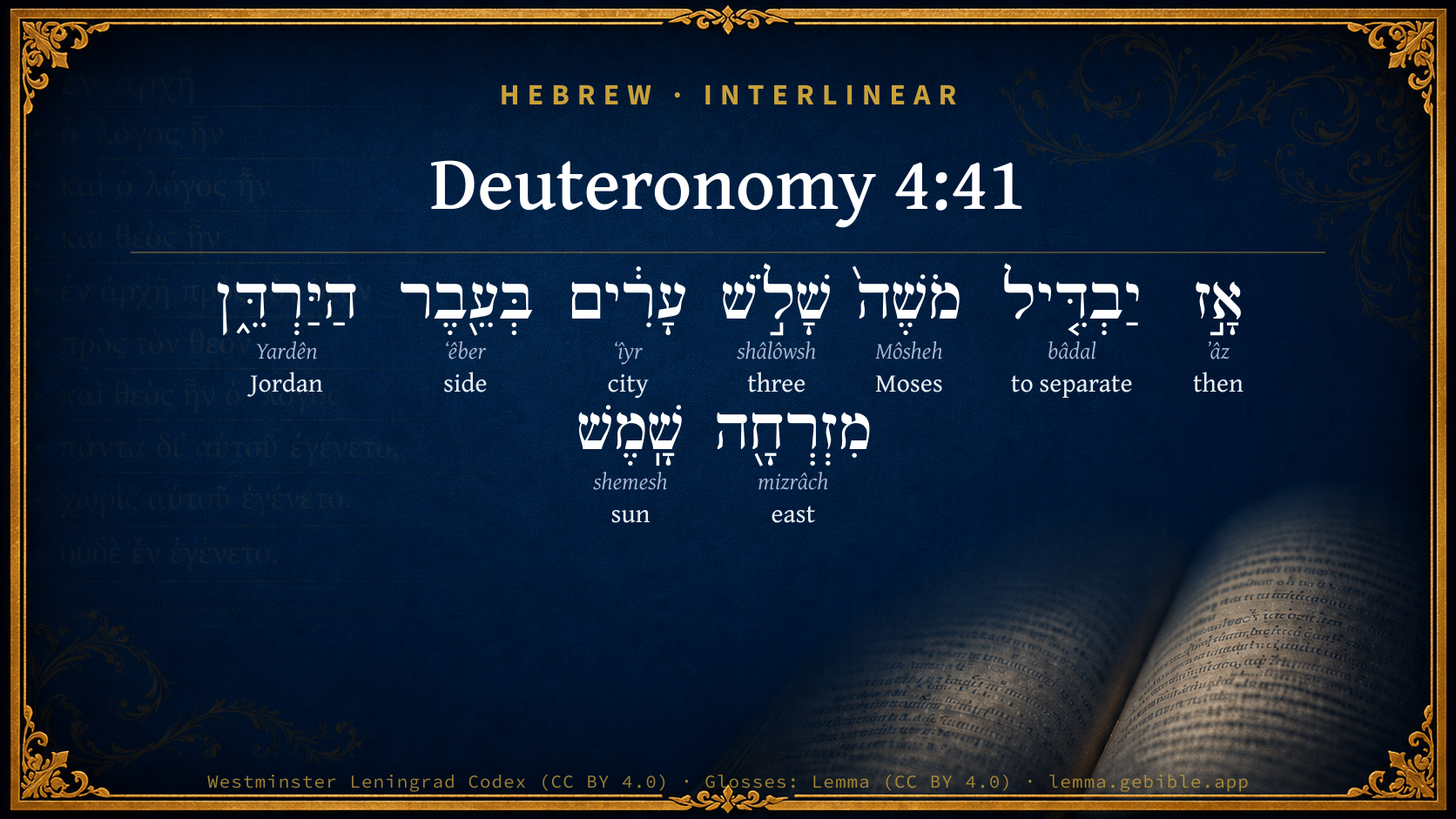
  1. אָ֣ז ʼâz H227 “then” Adverb
  2. מֹשֶׁה֙ Môsheh H4872 “Moses” Noun, Proper
  3. שָׁלֹ֣שׁ shâlôwsh H7969 “three” Adjective, Cardinal number, Feminine, Singular, Absolute
  4. עָרִ֔ים ʻîyr H5892 “cities” Noun, Common, Feminine, Plural, Absolute
  5. בְּעֵ֖בֶר ʻêber H5676 “in/at · side of” Preposition + Noun, Common, Masculine, Singular, Construct
  6. הַיַּרְדֵּ֑ן Yardên H3383 “the · Jordan” Particle, Definite Article + Noun, Proper
  7. מִזְרְחָ֖ה mizrâch H4217 “east · toward” Noun, Common, Masculine, Singular, Construct + Suffix, Demonstrative
  8. שָֽׁמֶשׁ shemesh H8121 “sun” Noun, Common, Both, Singular, Absolute

About this verse

These counts appear in no published source. They are computed here, from the morphology-tagged text and Lemma’s own curated glosses. What Lemma adds →

9
words
9
distinct lemmas
Pentateuch
section

Shared distinctive vocabulary

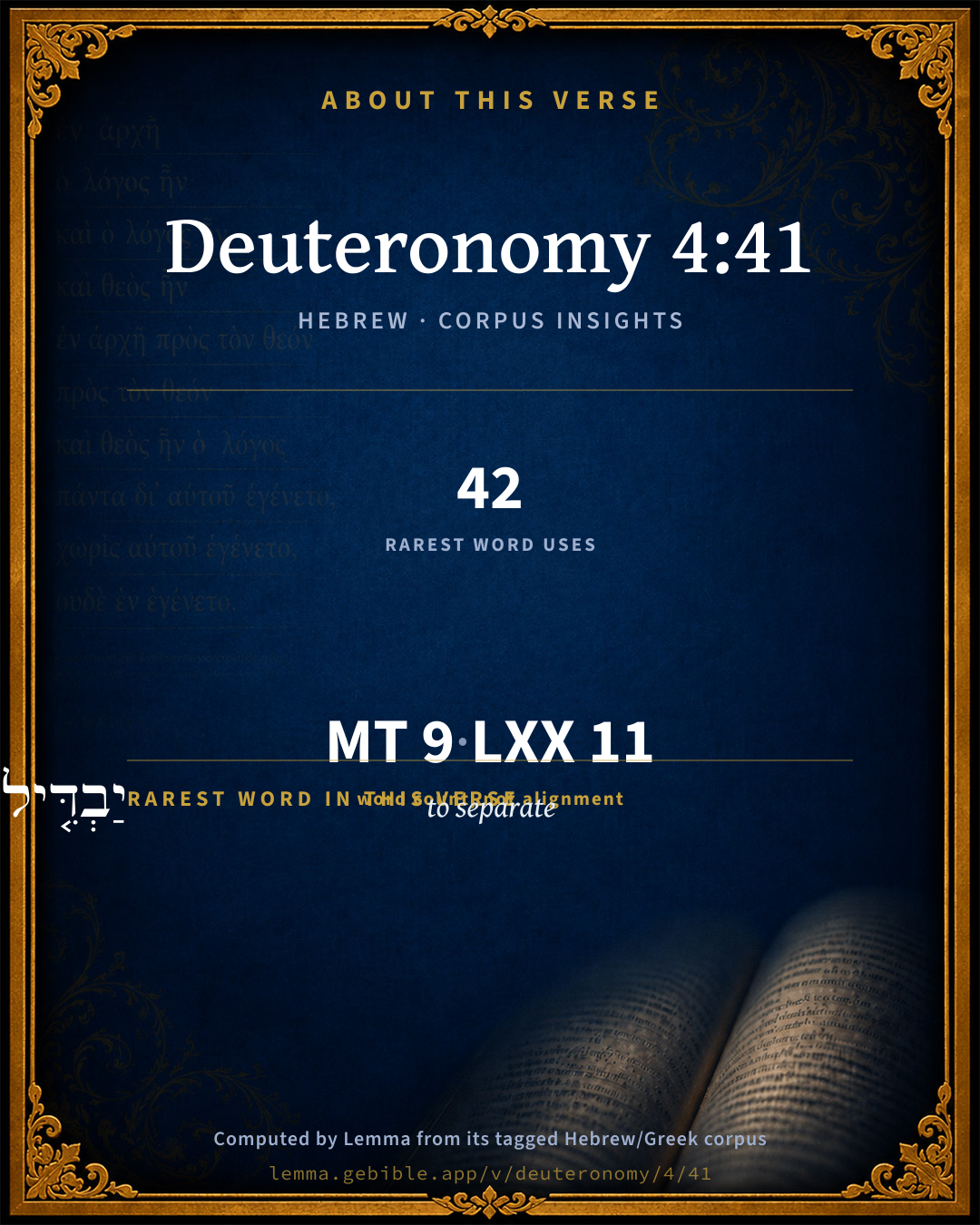
יַבְדִּ֤יל to separate H914 occurs in 40 verses of the Hebrew Bible. Also found in:

Grammatical profile

  • 1 verb
  • 6 nouns
  • 1 adjective
  • 1 adverb

Verb forms

  • יַבְדִּ֤יל Hiphil · Imperfect

Hebrew & Septuagint length

In English translation the verse runs 12 words from the Hebrew and 10 from the Septuagint (LXX English) — closely comparable.

A rough comparison of the two English renderings, which tokenize alike — not a word-level alignment.

Word counts can differ between the Hebrew and the Greek without any difference in meaning — e.g. the Hebrew direct-object marker אֵת has no separate Greek word, and Greek often adds the article ὁ.

In the original languages it is 9 Hebrew tokens and 11 Greek tokens — but the two are counted differently (Hebrew bundles its prefixes and suffixes into one token; the Greek is in lemma form), so that isn’t a like-for-like length.

Cross-references

3

Topical passages linked to Deuteronomy 4:41 in the Treasury of Scripture Knowledge — connected by theme and wording, ordered by reader-vote popularity; previews shown in the World English Bible.

  • Numbers 35:6 The cities which you shall give to the Levites, they shall be the six cities of refuge, which you shall give for the manslayer to flee to: and besides them you shall give forty-two cities.
  • Numbers 35:14–15 You shall give three cities beyond the Jordan, and three cities shall you give in the land of Canaan; they shall be cities of refuge.
  • Joshua 20:2–9 Speak to the children of Israel, saying, Assign you the cities of refuge, of which I spoke to you by Moses,

Cross-references courtesy of OpenBible.info (CC BY 4.0).

Hebrew and Greek witnesses Masoretic Hebrew ↔ Greek Septuagint

The same verse in the two great witnesses to the Old Testament, shown verse-for-verse.

These are two independent witnesses, not word-aligned to each other, and the Septuagint is shown in lemma (dictionary) form.

Hebrew Deuteronomy 4:41 Masoretic · Westminster Leningrad Codex

אָ֣ז יַבְדִּ֤יל מֹשֶׁה֙ שָׁלֹ֣שׁ עָרִ֔ים בְּעֵ֖בֶר הַיַּרְדֵּ֑ן מִזְרְחָ֖ה שָֽׁמֶשׁ

Then Moses set apart three cities beyond the Jordan toward the sunrise;

World English Bible · Public Domain

Greek LXX Deuteronomy 4:41 Septuagint · lemma form

τότε ἀποὁρίζω μωυσῆς τρεῖς πόλις πέραν ὁ ἰορδάνης ἀπό ἀνατολή ἥλιος

Then Moses separated three cities beyond Jordan on the east,

LXX2012 (modern English Septuagint) · Public Domain

Hebrew: Westminster Leningrad Codex (CC BY 4.0). Greek: Septuagint (public domain); English from LXX2012 (modern English Septuagint) (Public Domain). How the Septuagint differs from the Hebrew →

Targum (Aramaic paraphrase)

2

The Targum is the ancient Jewish Aramaic paraphrase of the Hebrew Scriptures — an interpretive translation, not the Hebrew text itself. Onkelos (literal) and Pseudo-Jonathan (expansive) render the Torah, and Jonathan the Prophets. Coverage is partial: where no permissively-licensed English translation exists for a verse, only the Aramaic is shown. This is verse-level text, not a word-by-word alignment to the Hebrew.

  1. Targum Onkelos Torah (Genesis–Deuteronomy)
    בְּכֵן יַפְרֵשׁ מֹשֶׁה תְּלַת קִרְוִין בְּעִבְרָא דְיַרְדְנָא מִדְנַח שִׁמְשָׁא

    (no public-domain English translation for this verse)

    Targum Onkelos — Aramaic: “Onkelos Genesis” (public domain); “Onkelos Exodus” (public domain); “Onkelos Leviticus” (public domain); “Onkelos Numbers” (public domain); “Onkelos Deuteronomy” (public domain). English: “Sefaria Community Translation” (CC0 1.0 (public-domain dedication)); “J.W. Etheridge. The Targums of Onkelos and Jonathan Ben Uzziel on the Pentateuch. London: Longmans, Green, 1862” (public domain). Text via Sefaria.

  2. Targum Pseudo-Jonathan Torah (Genesis–Deuteronomy)
    הָא בְּכֵן אַפְרֵשׁ משֶׁה תְּלַת קִרְוִין בְּעִבְרָא דְיוֹרְדְּנָא מַדְנַח שִׁמְשָׁא

    And now, behold, Mosheh set apart three cities beyond the Jordan toward the sunrise,

    Targum Pseudo-Jonathan — Aramaic: “Targum Jonathan on Genesis” (public domain); “Targum Jonathan on Exodus” (public domain); “Targum Jonathan on Leviticus” (public domain); “Targum Jonathan on Numbers” (public domain); “Targum Jonathan on Deuteronomy” (public domain). English: “The Targum of Jonathan ben Uzziel, trans. J. W. Etheridge, London, 1862” (public domain). Text via Sefaria.

Commentary

Notes on Deuteronomy 4:41 from classic Christian and Jewish commentators (each source and its license shown beneath its notes). The classic Christian expositions comment on the surrounding passage and are grouped to its opening verse, so a note may address several verses; the Jewish commentaries on the Tanakh (Rashi and others) are per-verse, so they appear only where the commentator wrote on this verse.

Lemma curates 59 commentaries, every one of them public domain or Creative Commons licensed, each selected and text-cleaned for this edition rather than reprinted as found. About our sources →

Matthew Henry's Commentary

Here is, 1. The nomination of the cities of refuge on that side Jordan where Israel now lay encamped. Three cities were appointed for that purpose, one in the lot of Reuben, another in that of Gad, and another in that of the half tribe of Manasseh, Deu 4:41-43. What Moses could do for that people while he was yet with them he did, to give example to the rulers who were settled that they might observe them the better when he was gone. 2. The introduction to another sermon that Moses preached to Israel, which we have in the following chapters. Probably it was preached the next sabbath day after, when the congregation attended to receive instruction. He had in general exhorted them to obedience in the former chapter; here he comes to repeat the law which they were to observe, for he demands a universal but not an implicit obedience. How can we do our duty if we do not know it? Here therefore he sets the law before them as the rule they were to work by, the way they were to walk in, sets it before them as the glass in which they were to see their natural face, that, looking into this perfect law of liberty, they might continue therein. These are the testimonies, the statutes, and the judgments, the moral, ceremonial, and judicial laws, which had been enacted before, when Israel had newly come out of Egypt, and were now repeated, on this side Jordan, Deu 4:44-46. The place where Moses gave them these laws in charge is here particularly described. (1.) It was over-against Beth-peor, an idol-temple of the Moabites, which perhaps Moses sometimes looked towards, with a particular caution to them against the infection of that and other such like dangerous places. (2.) It was upon their new conquests, in the very land which they had got out of the hands of Sihon and Og, and were now actually in possession of, Deu 4:47. Their present triumphs herein were a powerful argument for obedience.

Matthew Henry's Commentary on the Whole Bible (1708–1710) — public domain (CC PDM 1.0). Text via the HelloAO Bible API.

The Biblical Illustrator

Joseph S. Exell

Deu_4:41-42

Then Moses severed three cities on this side Jordan, that the slayer might flee thither.

The cities of refuge

The cities here mentioned were called the cities of refuge. They were appointed by the command of God Himself; and, after the Israelites had crossed the river Jordan and entered the land of Canaan, three more were set apart on the other side of the river for the same purpose.

I. What there was remarkable in their institution, in the circumstances that distinguished them. They were then so well chosen, with such attention to the design proposed, that no part of the country was more than half a days journey from some one of them.

II. Behold in these cities of refuge an emblem of the redemption provided in the Gospel. See in the fugitive a fitting likeness of those who flee for refuge to the hope set before them in Christ Jesus. The ancient city of refuge stood on high, easy to be seen of all, holding out safety to those who needed it. Even so hath Jesus Christ been lifted up on the Cross, that the eye of faith may be turned to Him, and the hope of salvation arise in the heart of the penitent believer. The road that led to the cities of refuge was broad, plain, and straight; there was nothing to hinder the feet of him who fled along it. And is the highway of Gods salvation less plain, less open, less direct? On the roads that led to the cities of refuge way marks were set up to guide the feet of the fugitive. Even so are the ministers of Jesus now commissioned to guide the ignorant, and warn the wandering, and to cry aloud to all, This is the way, walk ye in it. The gates of the city of refuge stood open day and night. And so do the gates of the city of our God, the New Jerusalem. Christ ever stands ready to embrace in the arms of His mercy the soul that seeketh Him. The city of refuge was bound to support those who fled to it for protection. And in the house of the living God there is bread enough and to spare. The city of refuge was for all, as well for the stranger as for one born in the land. And in Christ Jesus there is neither Jew nor Greek, bond nor free, male nor female.

III. The conditions on which he who fled to one of the cities of refuge was entitled to the privileges thereof. First, leaving all behind, be must flee for his life, nor ever stop till sheltered within the appointed walls. Again, when once received within the city, he must not leave it, no, not for a moment, lest the avenger of blood fall upon him, and he die. Have you fled to Christ? Abide, then, in Him: forsake not the safe shelter of His fold: go not from under the shadow of His wing. (C. Blencowe, M. A.)

The Biblical Illustrator, edited by Joseph S. Exell (c. 1880s–1900s) — public domain. Text from a community e-Sword module.

Whedon's Commentary on the Bible

Daniel D. Whedon

CHOICE OF THREE CITIES OF REFUGE ON THE EAST OF JORDAN, Deu_4:41-43.

According to Num_35:14, Moses had been commanded to select three cities on the east of Jordan and three in Canaan. The first three are here selected by Moses. The other three were not selected until the land was apportioned to the tribes in Canaan. See Jos_20:7.

Daniel D. Whedon (gen. ed.), Commentary on the Old and New Testaments (1874–1909) — public domain. Text from a community e-Sword module.

The Annotated Bible

Arno C. Gaebelein

4. The Three Cities of Refuge

CHAPTER 4:41-43

1. The cities set apart (Deu 4:41-42)

2. The cities named (Deu 4:43)

The first address being ended, an action of Moses takes place. To detect here the hand of an editor, who added these verses, as critics claim, cannot be sustained. The cities of refuge were mentioned in Numbers. Here the three on this side of Jordan are given. Then there were three more on the other side of which we read in chapter 19 and in the book of Joshua. As stated in our annotations in Numbers, the cities of refuge are typical of Christ, who is our shelter from the avenger. Scattered through the land for the gracious purpose of sheltering the slayer, they also bear a prophetic testimony. They speak of Israel’s hope.

“These cities of refuge, set at intervals through the land of Israel, are a garrison for it from God, which even still, in ruin, as the land is, watch over it, as ministers of unchanging grace, and prophets of now near-coming glory. This people of God, separated to Him in the wonderful way attested by their annals,--What, after all, has been their condition for many and long centuries of subjection to hostile races? They have been strangers and wanderers, Cain-like, and indestructible as Cain,--a nation surviving even in death, but as if to perpetuate only the memory of the doom under which they lie,--the doom of an awful fratricide. Such is, in fact, their conditions condition hopeless to most yet, though it may be now with a streak of gray dawn widening upon it. But these cities of refuge have all the time been watch-towers set to face eastward, ramparts round prostrate Zion, upon which the watchmen hold not their peace, and give Him no rest, till He establish it again,-- yea, till He make it a praise upon earth (Isa 62:6-7).

“They are His pledge, in view of what has in fact come to pass, that what He has foreseen cannot thwart His purposes, nor their sin His long-foreshown grace. Preach they may in sackcloth, but it is good tidings that they preach, of a place of security even for homicides,--for those for whom His plea shall yet avail, ‘They know not what they do.’“--F.W. Grant, Notes on Deuteronomy

The meaning of the three names are of equal interest. “Bezer” means “defence,” a fortified place. Such Christ is for all who trust in Him. In Him we have our shelter and blessing as well. “Ramoth” means “heights.” Our Lord occupies the exalted, the preeminent place and shelter in Him, we share His place as we read in the second chapter of Ephesians. “Golan” means “joy” or “their rejoicing.” Even so we have in Him, who is our refuge, our joy and He has His joy in us.

Arno C. Gaebelein, The Annotated Bible (1913–1922) — public domain. Text from a community e-Sword module.

Tyndale Open Study Notes

Tyndale Open Resources

4:41-49 Moses was ready to set forth the covenant in all its magisterial authority. This section bridges the review of the past (1:6–4:40) and the presentation of the covenant text proper (5:1–26:19).

4:41-43 When Israel settled in Canaan and adopted an urban lifestyle, crimes such as homicide would inevitably need judicial resolution. In order to protect alleged perpetrators from premature vengeance and to guarantee them a fair trial, they needed safe haven in accessible cities of refuge. These towns were first assigned east of the Jordan and later in Canaan (see Num 35:9-28). The laws governing these matters occur again in Deut 19:1-13, but they appear here because of the just-mentioned promise of a long and safe life in the land (4:40). Establishing places of refuge to protect the innocent from false accusations would help secure that promise.

Tyndale Open Study Notes — © Tyndale Open Resources, licensed CC BY-SA 4.0. Text via the HelloAO Bible API.

Jamieson, Fausset & Brown

Robert Jamieson, A. R. Fausset & David Brown

Then Moses severed three cities on this side Jordan--(See on Jos 20:7).

Jamieson, Fausset & Brown — Commentary Critical and Explanatory on the Whole Bible (1871) — public domain (CC PDM 1.0). Text via the HelloAO Bible API.

Adam Clarke's Commentary

Verse 41. Then Moses severed three cities] See the law relative to the cities of refuge explained, See Clarke on Nu 35:11, &c.

Adam Clarke's Commentary on the Bible (1810–1826) — public domain. Text from a community e-Sword/MySword module.

Ellicott's Commentary for English Readers

THE APPOINTMENT OF THREE CITIES OF REFUGE.

(41) Then Moses severed.—The word “then” appears to be a note of time. It would seem that the appointment of the three cities of refuge on the eastern side of Jordan actually followed this discourse.

On this side Jordan.—Heb., b’ ’êber hay-yardên. The expression is here defined by the words that follow, “toward the sun-rising,” and it need not, therefore, be taken to fix the writer’s point of view. By itself, the expression would naturally mean, on the other side of Jordan.

(43) Bezer is as yet unidentified.

Ramoth in Gilead, though famous in the history of Israel as the scene of Ahab’s death and of the anointing of Jehu (1 Kings 21 and 2 Kings 9), is also as yet unknown.

Golan has given a name to the district of Gaulonitis. But it is as yet also unknown. We may hope that when the survey of Eastern Palestine is concluded, these ancient sites will be recovered.

A Bible Commentary for English Readers, edited by Charles John Ellicott (1878–1897) — public domain. Text from a community e-Sword module.

The Cambridge Bible for Schools and Colleges

gen. ed. J. J. S. Perowne

41. Then Moses separated] Rather, set apart. In Deu_10:8 the verb is used of God’s solemn separation of Levi to bear the ark, etc., and in Deu_29:21 (20) of the idolater to evil. The form of the verb here has the force of began, or proceeded, to set apart.

three cities] On the number, and its contradiction of Deu_19:1 ff., see above, note introductory to this fragment.

beyond Jordan] As in Deu_1:1 the writer writes in W. Palestine. This is put past doubt by the additional clause, toward the sunrising, cf. Deu_4:47. P omits sun and writes towards the rising, Deu_4:49 and Num_32:19; Num_34:15.

41–43. Historical Note

Then, i.e. at the time of the preceding discourse in Moab, Moses set apart three cities E. of Jordan as asylums for men, who unwittingly and without previous hatred had slain their fellows: Beṣer, on the Plateau, Ramoth in Gilead, and Golan in Bashan.—The style of this fragment is deuteronomic (see notes below). But had it belonged to the previous historical discourse it would surely have appeared somewhere in Deu_3:18-29 (before the subsequent exhortations); and have been expressed in the 1st instead of the 3rd pers. sing. Nor is it alluded to, nor presupposed by, D’s law on the Cities of Refuge, Deu_19:1 ff.; indeed, it cannot have been known to the author of this law which directs Israel to set apart three cities in the midst of the land which God is going to give them, i.e. the whole land both E. and W. of Jordan1[116] (with the proviso that if God shall enlarge the land they may add three more). The fragment cannot have belonged, therefore, to the original D. P, in Num_35:9-34, records a law, as given to Moses in Moab, on the same subject; but states it (1) far mole elaborately, (2) in a different vocabulary, and (3) with some differences of substance (see for details, Intr. to Pent. 121 f.). The cities are to be six, three on either side Jordan, and to be appointed after the people have passed over Jordan. In another P passage, Jos_20:1 f., this is said (again with some difference of terms) to have been done by Joshua; and the three E. cities named by him are the same as here. From all these data the most reasonable inference is that this fragment is the work of a deuteronomic editor either employing a tradition unknown to P; or (more probably) with P before him1[117] and making from it the natural inference that Moses had himself named the three cities E. of Jordan.—If this be correct the fragment is an interesting illustration of the tendency (in many nations) to develop historical narrative out of law. In the earlier legislation (E, Exo_21:12-14; see Driver’s Ex. 215 f.) asylum is granted at every altar to him who has slain a man accidentally (but not to the wilful murderer). When all the altars were abolished by the deuteronomic legislation, except that of the Single Sanctuary, it became necessary to sanction asyla at a certain number of other places. This is done by D (Deu_19:1 ff.). The places were chosen partly (as is evident from the towns named W. of Jordan, Ḳedesh, Shechem, and Ḥebron) because they contained ancient sanctuaries and partly because of their convenience (evident equally from the towns chosen E. and W. of Jordan). From this arose the tradition2[118] that the selection had been made in the earliest times; but one form of the tradition assigns the naming of the three towns E. of Jordan to Moses; the other assigns the naming of all six to Joshua.—Why the deuteronomic editor should have put the former just here it is impossible to determine.

[116] This is the only fair interpretation; if the law Deu_19:1 ff. had meant three cities in W. Palestine in addition to the three already set apart by Moses on the E. of Jordan, it would surely have alluded to the latter. The law was obviously made in consequence of the institution of the single sanctuary and without regard to any historical tradition of what Moses or Joshua had done.

[117] The editor who compiled P with JED.

[118] The above data shew that the tradition (1) could not have been earlier than the deuteronomic legislation, for every altar before that provided an asylum; and (2) that it was later than the deuteronomic legislation.

The Cambridge Bible for Schools and Colleges (gen. ed. J. J. S. Perowne; Cambridge University Press, 1878–1918) — public domain. Text from a community e-Sword module.

John Gill's Exposition

Then Moses severed three cities,.... To be cities of refuge, according to the command of God, Num 35:14 this he did when he had conquered the two kingdoms of the Amorites, that God had given them for an inheritance to the tribes of Reuben and Gad, and the half tribe of Manasseh, Deu 4:38 though Jarchi says, and so other Jewish writers, that persons were not received into them until the three cities appointed in the land of Canaan were separated for the like use; See Gill on Num 35:14 and these were:

on this side Jordan, toward the rising sun; on that side of the river on which the plains of Moab lay, and the kingdoms of the Amorites, and to the east of Jordan: so Jarchi remarks,"on that side which is on the east of Jordan;''see Jos 20:8.

John Gill's Exposition of the Whole Bible (1746–1763) — public domain (CC PDM 1.0). Text via the HelloAO Bible API.

Albert Barnes' Notes on the Bible

These verses are inserted between two distinct and complete discourses for the reason to which they themselves call attention (“Then Moses severed three cities,” etc.); i. e., the fact narrated took place historically after Moses spoke the one discourse and before he delivered the other. In thus severing the three cities of refuge Moses carried out a previous command of God (see the marginal references); and so followed up his exhortations to obedience by setting a punctual example of it, as far as opportunity was given him.

Deu 4:43

In the plain country - literally, “in the land of the Mishor.” The word means a level tract of land; but when used (Deu 3:10; Jos 13:9, etc.) with the article, seems to be the proper name for the smooth downs of Moab, which reach from the Jordan eastward of Jericho far into the Desert of Arabia, and which form a striking contrast alike to the rugged country west of the river, and to the higher and remarkable districts belonging to Bashan northward.

Bezer is, with little certainty, identified with Bostra, or (1 Macc. 5:36) Bosor. Golan gave the name of Gaulonitis to a district of some extent east of the sea of Galilee and north of the Hieromax; but the exact site of the city if uncertain.

Albert Barnes' Notes on the Bible (1834–1885) — public domain. Text from a community e-Sword/MySword module.

Haydock's Catholic Bible Commentary

Then, &c. This piece of history seems to be placed out of its natural order, by another hand. (Calmet) --- Yet if we attend to the method of Moses, in his other works, we shall not hastily conclude that it is an interpolation. He frequently repeats what has already been specified. He had received and order from God to appoint these three cities of refuge, (Numbers xxxv. 14,) after he had given the land to the tribes of Ruben, &c., Numbers xxxii. This he executes at the conclusion of this discourse; and hence takes occasion to mention how they had taken possession of this country. (Haydock)

George Leo Haydock (1774–1849), Haydock's Catholic Family Bible and Commentary, 1859 edition — public domain. Excludes Psalms (Douay-Rheims chapter numbering differs from Protestant) and Deuterocanonical books (Catholic canon only).

Matthew Poole's English Annotations

As God had commanded him Num 35:6,14

Matthew Poole's English Annotations on the Holy Bible (1683–1685) — public domain. Text from a community e-Sword/MySword module.

The Pulpit Commentary

Vers. 41-43. APPOINTMENT OF THREE CITIES OF REFUGE BEYOND JORDAN. A short historical notice is here inserted, probably because it was during the interval between the first and second addresses of Moses that he carried into effect the Divine command to appoint cities of refuge for the manslayer (Num_35:9, etc.; cf. Exo_21:13) This notice, therefore, is here in its proper place in the order of the narrative. That Moses should, just at this stage, have made this appointment was fitting and proper, seeing he had been urging on the people obedience to the Divine statutes and commandments, and had represented their conquest of the territory of Sihon and Og as an earnest of their ultimate possession of the whole land of the Amorites. By appointing these cities, Moses gave an example of obedience to God"s injunction, and, at the same time, not only asserted on the part of Israel a right of proprietorship in this trans-Jordanic territory, but assumed as certain that, on the ether side of Jordan also, the same right of proprietorship should be possessed and exercised by Israel in the fulfilling of the whole law concerning cities of refuge (cf. Deu_19:1, etc.) That this section belongs properly to Nu 35 Nu 36, and has been interpolated here by some later hand, is a pure assumption, for which there is no ground. On this side Jordan; beyond Jordan, more expressly defined as toward the sun rising, viz. on the east of that river.

Vers. 41-43. The cities of refuge.

(See Homiletics, De 19)

Vers. 41-43. The cities of refuge.

Regard for human life is more important than regard for private property. With legislative prescience, Moses secured three cities on the east of Jordan as sanctuaries for fugitives, before the land was allocated to their several families. Still further security for the unwary manslayer was obtained by the decree that these cities should be occupied by families of the Levites.

I GOD"S HIGH REGARD FOR HUMAN LIFE. This Divine thoughtfulness for men is impressive. Not a life was to be wantonly wasted. Human life, it is plain, was counted inferior in value to the interests of public justice; but it was to be sacredly protected against private revenge. This humane provision was all the more required at that time when Israel had been commanded to slay such vast numbers of Canaanites. Inevitably, human sensibility would be blunted, and a grave peril arose that human life would be cheaply rated. The entire land, purchased at such great cost, was a temple a sacred enclosure which God had chosen for his abode, and the shedding of innocent blood would degrade and desecrate the hallowed soil. Human life, sustained by God with exquisite pains capable of eminent usefulness is appraised by God as of great value.

II THE JUDICIOUS ADJUSTMENT OF RIGHTEOUSNESS AND PITY. Both these are sentiments implanted in the breast by a Divine hand; both serve the interests of humanity; and both have a fitting sphere in which to move. For the nation"s good, the conscience of every man should be kept in healthful activity. It needs illumination, discipline, vigor. The moral sense is as liable to injury, disease, and decay, as any other faculty of mind. It may be deficient in wisdom; it may be overburdened with sensitiveness; it may magnify molehills into mountains; it may act with precipitate haste. Side by side with unrelenting hostility for sin, should dwell honest pity for the sinner. This provision of "sanctuaries" in Israel was in no wise an interference with the proper procedure of justice. By the decision of competent magistrates the fugitive might yet be handed over to the executioner. It gave full opportunity for investigation. It safeguarded a suspected man, if he were innocent of the greater crime. It taught men to draw a deep line between unintentional injury and premeditated murder. It shielded from needless death many a useful life.

III PROMPT AND SEVERE EXERTION WAS THE CONDITION OF ESCAPE. When a man was killed, his next of kin was expected to avenge his blood. This rough ministry of justice was needful in those early days. It strengthened family ties. It fostered a spirit of brotherhood. It was a shield for the weak and defenseless. If one man had slain another, the presumption was that it had been maliciously done, and prompt vengeance was preparing for him. He had placed himself (inadvertently, it may be) in a serious plight. He was exposed to a sudden reprisal. Before an hour his own life might be forfeited. If his conscience told him that he was innocent, there was a possibility of escape. But he must promptly flee. He must bid a hasty adieu, or none at all, to wife and children, and run at highest speed for the refuge city, for vengeance is swift-footed as an antelope. Every muscle must be strained to the utmost; his eye must be on every bush and rock, lest the foe should be lurking in ambush; his last resource of strength must be expended upon his flight; he must go direct as an arrow for the provided sanctuary. So for every guilty son of Adam there is a refuge provided on the hill called "Calvary;" and because Death rides apace upon our heels, we are charged to flee to flee for very life to this capacious Refuge. So run, that ye may be safe! D.

Vers. 41-43. The cities of refuge beyond the Jordan.

After the discourse contained in the preceding portion of this book, Moses seems to have taken a breathing time, during which he designated Bezer in the wilderness, Ramoth in Gilead, and Golan in Bashan, as cities of refuge. To these the manslayers were directed to flee, when they had been guilty, not of murder, but of manslaughter. In this way a distinction was introduced in the Mosaic code between manslaughter and murder, which did not obtain in the code of revenge among the other nations. And here let us observe

I RETALIATION CONSTITUTED THE RUDE JUSTICE OF THIS EARLY AGE. Vengeance seems dreadful to many because we live under an organized system of public justice. But if we were translated to some uncivilized country, where each one is forced to fight for his own hand, we should regard it less painfully. We should recognize it, in fact, as a necessary assertion of justice. "Vengeance is mine; I will repay, saith the Lord," seems dreadful only to those who have not appreciated the need of a perfect public justice. The Divine vengeance will be public and perfect, from which there will and can be no appeal.

II RETALIATION, SUCH AS THE MOSAIC CODE PRESCRIBED, DEMANDED COURAGE AND SELF-DENIAL. The kinsman was directed to pursue the manslayer, and to seek the payment of life for life. It was not one of those feats which would be lightly undertaken. In fact, it was one of those dangerous duties, which a person would shirk if he could. The command reinforced the courage and sustained the self-denial of the people (cf. Mozley"s "Ruling Ideas in Early Ages," pp. 180-221).

And in the Divine vengeance with reverence would we say it there is needed courage and self-denial. The infliction of it is forced upon him.

III THE CITIES OF REFUGE AFFORDED PROTECTION TO THE MANSLAYER WHO DID NOT DELIBERATELY TAKE AWAY LIFE. Here the manslayer lived in lonely exile till the death of the high priest. This milder sentence, however, was preferable to a violent death. The opportunity was afforded of examining himself and of being penitent for his sins. The sojourn in the city of refuge corresponds to the spiritual experience of those who have betaken themselves to Jesus under a sense of their sin and blood guiltiness, to find under his wings freedom from condemnation, (Rom_8:1) and the necessity of great watchfulness and circumspection. If the manslayer had left the city of refuge, he would still have been liable to the avenger.

IV BUT WHEN THE HIGH PRIEST DIED THE MANSLAYER REGAINED LIBERTY AS WELL AS LIFE. "Life in Christ" is indicated by the sojourn in the city of refuge. But liberty through the death of Christ is indicated by the release at the death of the high priest. It takes many relations to bring out the truth as it is in Jesus. He is our God, or Avenger, as we have seen where he says," Vengeance is mine." He is our City of Refuge; he is our High Priest, whose death secures the return of the exile. May Jesus be all in all to us! R.M.E.

The Pulpit Commentary (1880–1919), ed. H.D.M. Spence-Jones & Joseph S. Exell — public domain. Text from a community e-Sword module.

Keil & Delitzsch

C. F. Keil & F. Delitzsch

Selection of Three Cities of Refuge for Unintentional Manslayers on the East of the Jordan. - The account of this appointment of the cities of refuge in the conquered land on the east of the Jordan is inserted between the first and second addresses of Moses, in all probability for no other reason than because Moses set apart the cities at that time according to the command of God in Num 35:6, Num 35:14, not only to give the land on that side its full consecration, and thoroughly confirm the possession of the two Amoritish kingdoms on the other side of the Jordan, but also to give the people in this punctual observance of the duty devolving upon it an example for their imitation in the conscientious observance of the commandments of the Lord, which he was now about to lay before the nation. The assertion that this section neither stood after Num, nor really belongs there, has a little foundation as the statement that its contents are at variance with the precepts in Deut 19. "Toward the sunrising" is introduced as a more precise definition; היּרדּן עבר, like מזרחה in Num 32:19 and Num 34:15. On the contents of Deu 4:42, comp. Num 35:15. The three towns that were set apart were Bezer, Ramoth, and Golan. "Bezer in the steppe, (namely) in the land of the level" (The Amoritish table-land: Deu 3:10). The situation of this Levitical town and city of refuge, which is only mentioned again in Jos 20:8; Jos 21:36, and Ch1 6:63, has not yet been discovered. Bezer was probably the same as Bosor (1 Macc. 5:36), and is possibly to be seen in the Berza mentioned by Robinson (Pal. App. p. 170). Ramoth in Gilead, i.e., Ramoth-Mizpeh (comp. Jos 20:8 with Jos 13:26), was situated, according to the Onom., fifteen Roman miles, or six hours, to the west of Philadelphia (Rabbath-Ammon); probably, therefore, on the site of the modern Salt, which is six hours' journey from Ammn (cf. v. Raumer, Pal. pp. 265, 266). - Golan, in Bashan, according to Eusebius (s. v. Gaulon or Golan), was still a very large village in Batanaea even in his day, from which the district generally received the name of Gaulonitis or Joan; but it has not yet been discovered again.

Keil & Delitzsch — Biblical Commentary on the Old Testament (1861–1891) — public domain (CC PDM 1.0). Text via the HelloAO Bible API. (Old Testament only.)

Kretzmann's Popular Commentary

Paul E. Kretzmann

Conclusion of the First Address

v. 41. Then Moses severed, set apart, three cities on this side Jordan toward the sun-rising, in the territory of the two and one half tribes,

v. 42. that the slayer might flee thither, which should kill his neighbor unawares, without premeditation and intention, and hated him not in times past, and that, fleeing unto one of these cities, he might live, Deu 19:4-13; Num 35:9-34;

v. 43. namely, Bezer in the wilderness, in the plain country, in the steppes, of the Reubenites; and Ramoth in Gilead, of the Gadites; and Golan in Bashan, from which this region afterwards received the name Gaulanitis, of the Manassites.

v. 44. And this is the Law which Moses set before the children of Israel;

v. 45. these are the testimonies and the statutes and the judgments which Moses spake unto the children of Israel after they came forth out of Egypt,

v. 46. on this side Jordan, in the valley over against Beth-peor, in the land of Sihon, king of the Amorites, who dwelt at Heshbon, whom Moses and the children of Israel smote, Num 21:24, after they were, come forth out of Egypt;

v. 47. and they possessed his land and the land of Og, king of Bashan, two kings of the Amorites, which were on this side Jordan toward the sun-rising;

v. 48. from Aroer, which is by the bank of the river Arnon, even unto Mount Sion, which is Hermon,

v. 49. and all the plain on this side Jordan eastward, even unto the Sea of the Plain, the Dead Sea, under the springs of Pisgah, near the mouth of the Arnon. This detailed description of time and place serves as an introduction to the great exposition of the Law which follows in the next part of the Book of Deuteronomy.

Paul E. Kretzmann, Popular Commentary of the Bible (1921–1924) — public domain. Text from a community e-Sword module.

unfoldingWord translationNotes

Door43 World Missions Community

General Information:

Moses's speech, which began in Deuteronomy 1:6, has finished, and the writer continues the narrative that ended in Deuteronomy 1:5.

Bezer ... Ramoth ... Golan

These are names of cities. (See: How to Translate Names)

translationWords

Moses

Jordan River

desert

Reuben

Gilead

Gad

Bashan

Manasseh

unfoldingWord translationNotes — © Distant Shores Media and the Door43 World Missions Community, licensed CC BY-SA 4.0. Source: git.door43.org/Door43/en_tn.

Rashi

Rabbi Shlomo Yitzchaki (Rashi)

אז יבדיל — The imperfect form יבדיל instead of הבדיל is to be thus explained (cf. Rashi on Exodus 15:1): He set his attention to be zealous for the matter, — to set them apart. And although they were not to serve as cities of refuge until those of Canaan proper (the western side of the Jordan) were set apart for that purpose, Moses said, Any duty that it is possible for me to perform I will perform (Makkot 10a).

בעבר הירדן מזרחה שמש ON THE SIDE OF THE JORDAN TOWARDS THE SUN-RISING — i.e. on that side which is on the east of Jordan (not the side of the Jordan that is east of Canaan proper).

מזרחה שמש — Because it (the word מזרחה) is in the construct state the ר is vowelled with Chataph (vocal Sheva), the meaning being, “the rising of the sun", i.e., the place of the sun's rising.

Rashi on the Tanakh — English translations: “The Judaica Press complete Tanach with Rashi, translated by A. J. Rosenberg” (CC BY 4.0); “Pentateuch with Rashi's commentary by M. Rosenbaum and A.M. Silbermann, 1929-1934” (public domain); “The Metsudah Tanach series, Lakewood, N.J” (CC BY 4.0); and “The Book of Joshua, Metsudah Publications, 1997” (CC BY 4.0). Text via Sefaria.

Ramban (Nachmanides)

Rabbi Moshe ben Nachman (Ramban / Nachmanides)

THEN MOSES SEPARATED THREE CITIES. Rabbi Abraham ibn Ezra explained it to mean: “on the day that Moses separated three cities [to function as cities of refuge], he then said the words of the covenant [as stated in the following section].” But it is not correct. Rather, it is to be understood in its simple sense. Moses had gathered all Israel to explain to them the Torah and he began with words of reproof; after he uttered in their presence his words of reproof concerning what they had done, the admonishments about idolatry and the Unity of G-d, and completed [his statement] to them with the charge that they observe His statutes and His commandments so that it may be well with them — then he said in their presence before them: “Now we shall fulfill the commandment that G-d has commanded us, and Bezer in the wilderness, Ramoth in Gilead, and Golan in Bashan will be cities of refuge that every manslayer that kills any person through error may flee thither.” And although they would not legally provide refuge until [the cities of refuge] in the land of Canaan [on the western side of the Jordan] were set apart, Moses said, “‘If a commandment has come to our hands we shall fulfill it,’ so that it may be well with us.” Afterwards he called with a great voice to all Israel that were there and said to them, Hear, O Israel, the statutes and the ordinances etc., for now he commenced to speak of the commandments and the explanation of the Torah, as I have explained at the beginning of the section These are the words.

Ramban (Nachmanides) on the Tanakh — English translation: “Commentary on the Torah by Ramban (Nachmanides). Translated and annotated by Charles B. Chavel. New York, Shilo Pub. House, 1971-1976” (CC BY 4.0). Text via Sefaria.

Lesson kit

Teaching starters — assembled from the data on this page, not authored interpretation. Every prompt links to the verse data it draws on. Edit before teaching.

Deuteronomy, in the Pentateuch, opens this verse with 9 words (9 distinct Hebrew lemmas). Its most distinctive word is bâdal (“to separate”). A historical commentator’s framing appears above. Read the whole chapter for the surrounding context.

Discussion questions

  1. The word bâdal carries the sense “to separate.” How does it shape the verse?
  2. Genesis 1:4 shares the word «to separate» with this verse. How do the two illuminate each other?
  3. These translations render this verse differently. What is at stake in choosing one wording over another?
  4. The verb «יַבְדִּ֤יל» is Hiphil Imperfect. How does its form color the action?
  5. Reading how Matthew Henry's Commentary and The Biblical Illustrator read this verse, where do the two commentators agree and where do they part?

Things to notice

Reading settings

Reading text

Shown beneath each verse's original-language words.

Old Testament
Old Testament edition

Read the OT as the Masoretic Hebrew (MT) or the Greek Septuagint (LXX).

English shown for the Greek Septuagint (in the Hebrew ↔ Greek comparison).

Comparing translations? Open the Compare panel on any verse page to stack up to four side by side.