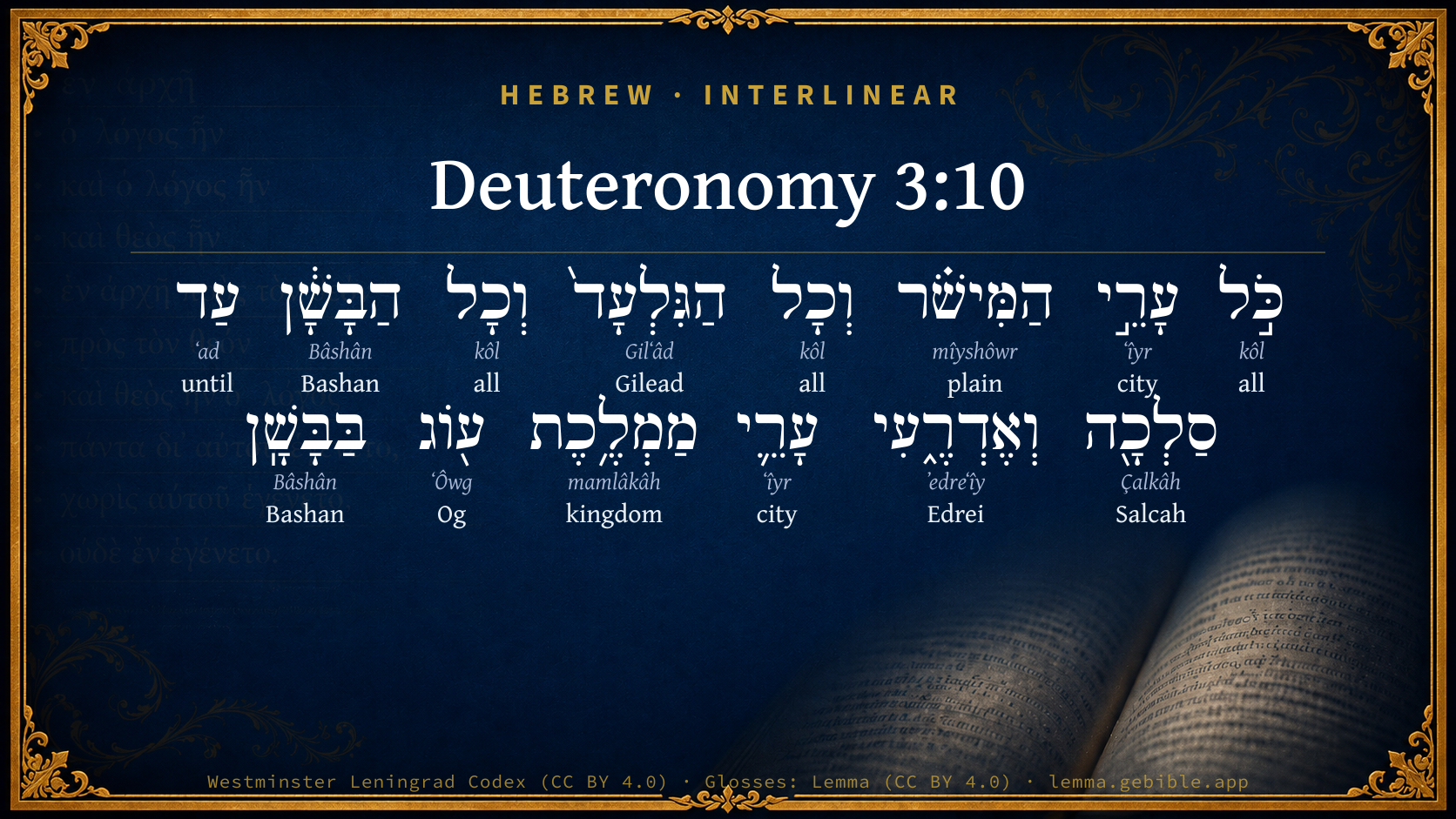
Deuteronomy 3:10

Hebrew (Westminster Leningrad Codex) Deuteronomy 3:10 appears in the Hebrew Old Testament. The text above is from the Westminster Leningrad Codex. Each word links to its Strong’s number, a concise gloss, and parsing drawn from the Open Scriptures Hebrew Bible morphology. Click any word for its full Brown-Driver-Briggs (BDB) entry.
Download image
Cite this verse

Deuteronomy 3:10 (World English Bible). Public Domain. Lemma interlinear Bible study tool, https://lemma.gebible.app/v/deuteronomy/3/10.

Show BibTeX & RIS
BibTeX
RIS
English Translation
all the cities of the plain, and all Gilead, and all Bashan, to Salecah and Edrei, cities of the kingdom of Og in Bashan.
World English Bible · Public Domain
Highlights
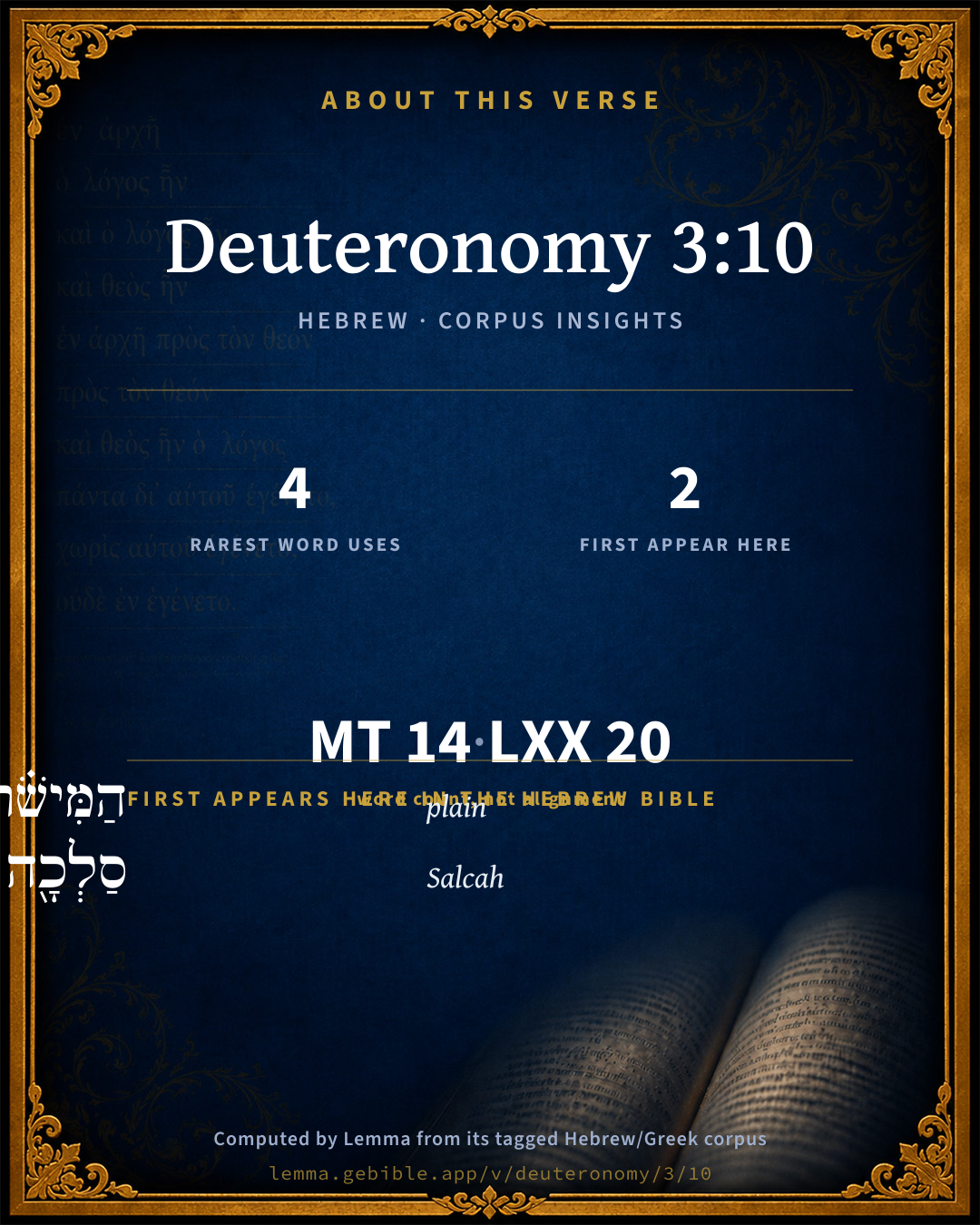
  • 2 first appearances in the Hebrew Bible
Full analysis ↓
Download a study sheet

One document with this verse’s original text, its word-by-word gloss line, the meaning frame, cross-references with their text, attributed commentary, and full source and license credits — printable, and it pastes into notes with its structure intact.

This verse Autodidact and up

Study sheet (.html) Plain text (.txt)

A passage Seminary Student

Up to 50 verses in one chapter. A passage sheet keeps up to 6 commentary sources and 12 cross-references per verse, in the order this page ranks them, and says so on the sheet whenever that leaves anything out. Ask for a single verse and you get the Autodidact verse sheet above.

Everything on this page stays free to read, with no account — the sheet is a download of what is already on screen, not access to it.

Want to remove ads? Support Godless Engineer
Compare translations 3

The same verse in 3 English versions, stacked beneath the original-language interlinear above. Click any original word for its lexicon entry.

Each is an independent rendering of the whole verse — the interlinear is not word-aligned to these translations.

Highlighted words mark where these versions differ — a whole-verse word diff, not a word-by-word alignment.

  • World English Bible Public Domain
    all the cities of the plain, and all Gilead, and all Bashan, to Salecah and Edrei, cities of the kingdom of Og in Bashan.
  • King James Version Public Domain
    All the cities of the plain, and all Gilead, and all Bashan, unto Salchah and Edrei, cities of the kingdom of Og in Bashan.
  • unfoldingWord Literal Text CC BY-SA 4.0
    “all the cities of the plain, and all Gilead, and all Bashan, as far as Salekah and Edrei, cities of the kingdom of Og in Bashan.”

unfoldingWord Literal Text — © unfoldingWord, licensed CC BY-SA 4.0. Word-aligned USFM3 via Door43 (git.door43.org/unfoldingWord/en_ult).

Versions to compare (up to 4)

3 of 4 selected

Show all 18 translations

Every available English version of this verse, each an independent rendering of the whole verse.

  • World English Bible Public Domain
    all the cities of the plain, and all Gilead, and all Bashan, to Salecah and Edrei, cities of the kingdom of Og in Bashan.
  • Berean Standard Bible Public Domain
    all the cities of the plateau, all of Gilead, and all of Bashan as far as the cities of Salecah and Edrei in the kingdom of Og.
  • Majority Standard Bible Public Domain
    all the cities of the plateau, all of Gilead, and all of Bashan as far as the cities of Salecah and Edrei in the kingdom of Og.
  • King James Version Public Domain
    All the cities of the plain, and all Gilead, and all Bashan, unto Salchah and Edrei, cities of the kingdom of Og in Bashan.
  • American Standard Version (1901) Public Domain
    all the cities of the plain, and all Gilead, and all Bashan, unto Salecah and Edrei, cities of the kingdom of Og in Bashan.
  • Revised Version (1885) Public Domain
    all the cities of the plain, and all Gilead, and all Bashan, unto Salecah and Edrei, cities of the kingdom of Og in Bashan.
  • Geneva Bible (1599) Public Domain
    All the cities of the plaine, and all Gilead, and all Bashan vnto Salchah, and Edrei, cities of the kingdome of Og in Bashan.
  • Douay-Rheims (1899) Public Domain
    All the cities that are situate in the plain, and all the land of Galaad and Basan as far as Selcha and Edrai, cities of the kingdom of Og in Basan.
  • Young's Literal Translation Public Domain
    all the cities of the plain, and all Gilead, and all Bashan, unto Salchah and Edrei, cities of the kingdom of Og in Bashan,
  • Literal Standard Version CC BY-SA 4.0
    all the cities of the plain, and all Gilead, and all Bashan, as far as Salchah and Edrei, cities of the kingdom of Og in Bashan.
  • Unlocked Literal Bible CC BY-SA 4.0
    and all the cities of the plain, all Gilead, and all Bashan, all the way to Salekah and Edrei, cities of the kingdom of Og in Bashan.”
  • unfoldingWord Literal Text CC BY-SA 4.0
    “all the cities of the plain, and all Gilead, and all Bashan, as far as Salekah and Edrei, cities of the kingdom of Og in Bashan.”
  • Darby Bible Public Domain
    all the cities of the plateau, and all Gilead, and all Bashan, as far as Salchah and Edrei, the cities of the kingdom of Og in Bashan.
  • World Messianic Bible Public Domain
    We took all the cities of the plain, and all Gilead, and all Bashan, to Salecah and Edrei, cities of the kingdom of Og in Bashan.
  • Webster's Bible Public Domain
    All the cities of the plain, and all Gilead, and all Bashan, to Salchah and Edrei, cities of the kingdom of Og in Bashan.
  • Free Bible Version CC BY-SA 4.0
    The area included all the towns of the plain, all of Gilead, and all of Bashan, up to and including the towns of Salecah and Edrei in the kingdom of Og.
  • Bible in Basic English Public Domain
    All the towns of the table-land and all Gilead and Bashan as far as Salecah and Edrei, towns of the kingdom of Og in Bashan.
  • JPS Tanakh (1917) Public Domain
    all the cities of the plain, and all Gilead, and all Bashan, unto Salcah and Edrei, cities of the kingdom of Og in Bashan. —

Literal Standard Version (2020), Covenant Press — licensed CC BY-SA 4.0. Text via the HelloAO Bible API (eBible.org). Unlocked Literal Bible (unfoldingWord) — licensed CC BY-SA 4.0. Text via the HelloAO Bible API (eBible.org). unfoldingWord Literal Text — © unfoldingWord, licensed CC BY-SA 4.0. Word-aligned USFM3 via Door43 (git.door43.org/unfoldingWord/en_ult). Free Bible Version, Dr. Jonathan Gallagher — licensed CC BY-SA 4.0. Text via the HelloAO Bible API (eBible.org).

Word by word

More ways to search: Search by grammar → Find every occurrence → Compare this word →

Practice this passage: Drill this verse → Learn its vocabulary →

סַלְכָ֖ה
Çalkâh
H5548
“Salcah”
Noun, Proper
Part of Speech
Noun
Type
Proper
Full BDB Definition

Origin: from an unused root meaning to walk

TWOT: None

Salcah or Salchah = "migration" - a town or district at the extreme eastern limit of Bashan and allocated to the tribe of Gad; modern 'Sulkhad' which is 56 miles
  1. כֹּ֣ל kôl H3605 “all of” Noun, Common, Masculine, Singular, Construct
  2. עָרֵ֣י ʻîyr H5892 “cities of” Noun, Common, Feminine, Plural, Construct
  3. הַמִּישֹׁ֗ר mîyshôwr H4334 “the · plain” Particle, Definite Article + Noun, Common, Masculine, Singular, Absolute
  4. וְכָל kôl H3605 “and · all of” Conjunction + Noun, Common, Masculine, Singular, Construct
  5. הַגִּלְעָד֙ Gilʻâd H1568 “the · Gilead” Particle, Definite Article + Noun, Proper
  6. וְכָל kôl H3605 “and · all of” Conjunction + Noun, Common, Masculine, Singular, Construct
  7. הַבָּשָׁ֔ן Bâshân H1316 “the · Bashan” Particle, Definite Article + Noun, Proper
  8. עַד ʻad H5704 “until” Preposition
  9. וְאֶדְרֶ֑עִי ʼedreʻîy H154 “and · Edrei” Conjunction + Noun, Proper
  10. עָרֵ֛י ʻîyr H5892 “cities of” Noun, Common, Feminine, Plural, Construct
  11. מַמְלֶ֥כֶת mamlâkâh H4467 “kingdom of” Noun, Common, Feminine, Singular, Construct
  12. ע֖וֹג ʻÔwg H5747 “Og” Noun, Proper
  13. בַּבָּשָֽׁן Bâshân H1316 “in/at the · Bashan” Preposition, Determined + Noun, Proper

About this verse

These counts appear in no published source. They are computed here, from the morphology-tagged text and Lemma’s own curated glosses. What Lemma adds →

14
words
10
distinct lemmas
Pentateuch
section

Notable vocabulary

The rarest word here is סַלְכָ֖ה Salcah H5548 — appearing just 4 times in the whole Hebrew Bible.

First appearance in Scripture

These words make their first canonical appearance in the Hebrew Bible here:

  • הַמִּישֹׁ֗ר plain H4334
  • סַלְכָ֖ה Salcah H5548

Shared distinctive vocabulary

סַלְכָ֖ה Salcah H5548 occurs in 4 verses of the Hebrew Bible. Also found in:

Grammatical profile

  • 13 nouns
  • 1 preposition

Repetition

Words recur within this verse — often emphatic in Hebrew:

  • כֹּ֣ל all H3605 ×3
  • עָרֵ֣י city H5892 ×2
  • הַבָּשָׁ֔ן Bashan H1316 ×2

Hebrew & Septuagint length

In English translation the verse runs 24 words from the Hebrew and 25 from the Septuagint (LXX English) — closely comparable.

A rough comparison of the two English renderings, which tokenize alike — not a word-level alignment.

Word counts can differ between the Hebrew and the Greek without any difference in meaning — e.g. the Hebrew direct-object marker אֵת has no separate Greek word, and Greek often adds the article ὁ.

In the original languages it is 14 Hebrew tokens and 20 Greek tokens — but the two are counted differently (Hebrew bundles its prefixes and suffixes into one token; the Greek is in lemma form), so that isn’t a like-for-like length.

Cross-references

5

Topical passages linked to Deuteronomy 3:10 in the Treasury of Scripture Knowledge — connected by theme and wording, ordered by reader-vote popularity; previews shown in the World English Bible.

  • Numbers 21:33 They turned and went up by the way of Bashan: and Og the king of Bashan went out against them, he and all his people, to battle at Edrei.
  • Deuteronomy 4:49 and all the Arabah beyond the Jordan eastward, even to the sea of the Arabah, under the slopes of Pisgah.
  • Joshua 12:4–5 and the border of Og king of Bashan, of the remnant of the Rephaim, who lived at Ashtaroth and at Edrei,
  • Joshua 13:11–12 and Gilead, and the border of the Geshurites and Maacathites, and all Mount Hermon, and all Bashan to Salecah;
  • Joshua 13:31 and half Gilead, and Ashtaroth, and Edrei, the cities of the kingdom of Og in Bashan, were for the children of Machir the son of Manasseh, even for the half of the children of Machir according to their families.

Cross-references courtesy of OpenBible.info (CC BY 4.0).

Hebrew and Greek witnesses Masoretic Hebrew ↔ Greek Septuagint

The same verse in the two great witnesses to the Old Testament, shown verse-for-verse.

These are two independent witnesses, not word-aligned to each other, and the Septuagint is shown in lemma (dictionary) form.

Hebrew Deuteronomy 3:10 Masoretic · Westminster Leningrad Codex

כֹּ֣ל עָרֵ֣י הַמִּישֹׁ֗ר וְכָל הַגִּלְעָד֙ וְכָל הַבָּשָׁ֔ן עַד סַלְכָ֖ה וְאֶדְרֶ֑עִי עָרֵ֛י מַמְלֶ֥כֶת ע֖וֹג בַּבָּשָֽׁן

all the cities of the plain, and all Gilead, and all Bashan, to Salecah and Edrei, cities of the kingdom of Og in Bashan.

World English Bible · Public Domain

Greek LXX Deuteronomy 3:10 Septuagint · lemma form

πᾶς πόλις μισωρ καί πᾶς γαλαάδ καί πᾶς βασαν ἕως σελχα καί εδραϊν πόλις βασιλεία ὁ ωγ ἐν ὁ βασαν

All the cities of Misor, and all Galaad, and all Basan as far as Elcha and Edraim, cities of the kingdom of Og in Basan.

LXX2012 (modern English Septuagint) · Public Domain

On this verse, The Cambridge Bible for Schools and Colleges discusses the Septuagint’s reading. Read the note in Commentary ↓

Hebrew: Westminster Leningrad Codex (CC BY 4.0). Greek: Septuagint (public domain); English from LXX2012 (modern English Septuagint) (Public Domain). How the Septuagint differs from the Hebrew →

Targum (Aramaic paraphrase)

2

The Targum is the ancient Jewish Aramaic paraphrase of the Hebrew Scriptures — an interpretive translation, not the Hebrew text itself. Onkelos (literal) and Pseudo-Jonathan (expansive) render the Torah, and Jonathan the Prophets. Coverage is partial: where no permissively-licensed English translation exists for a verse, only the Aramaic is shown. This is verse-level text, not a word-by-word alignment to the Hebrew.

  1. Targum Onkelos Torah (Genesis–Deuteronomy)
    כֹּל קִרְוֵי מֵישְׁרָא וְכָל גִלְעָד וְכָל מַתְנָן עַד סַלְכָה וְאֶדְרֶעִי קִרְוֵי מַלְכוּתָא דְעוֹג בְּמַתְנָן

    (no public-domain English translation for this verse)

    Targum Onkelos — Aramaic: “Onkelos Genesis” (public domain); “Onkelos Exodus” (public domain); “Onkelos Leviticus” (public domain); “Onkelos Numbers” (public domain); “Onkelos Deuteronomy” (public domain). English: “Sefaria Community Translation” (CC0 1.0 (public-domain dedication)); “J.W. Etheridge. The Targums of Onkelos and Jonathan Ben Uzziel on the Pentateuch. London: Longmans, Green, 1862” (public domain). Text via Sefaria.

  2. Targum Pseudo-Jonathan Torah (Genesis–Deuteronomy)
    כָּל קִירְוֵי מֵישְׁרָא וְכָל גִּלְעָד וְכָל מַתְנָן עַד סַלְוָוקִיא וְאֶדְרֶעָת קִרְוֵי מַמְלְכוּתָא דְעוֹג בְּמַתְנָן

    All the cities of the plain, and all Gilead, and all Mathnan, unto Selukia and Edrehi, cities of the kingdom of Og in Mathnan.

    Targum Pseudo-Jonathan — Aramaic: “Targum Jonathan on Genesis” (public domain); “Targum Jonathan on Exodus” (public domain); “Targum Jonathan on Leviticus” (public domain); “Targum Jonathan on Numbers” (public domain); “Targum Jonathan on Deuteronomy” (public domain). English: “The Targum of Jonathan ben Uzziel, trans. J. W. Etheridge, London, 1862” (public domain). Text via Sefaria.

Commentary

Notes on Deuteronomy 3:10 from classic Christian and Jewish commentators (each source and its license shown beneath its notes). The classic Christian expositions comment on the surrounding passage and are grouped to its opening verse, so a note may address several verses; the Jewish commentaries on the Tanakh (Rashi and others) are per-verse, so they appear only where the commentator wrote on this verse.

Lemma curates 59 commentaries, every one of them public domain or Creative Commons licensed, each selected and text-cleaned for this edition rather than reprinted as found. About our sources →

Joseph Benson's Commentary

Deu 3:10. All Gilead — Gilead is sometimes taken for all the Israelites’ possessions beyond Jordan, and so it comprehends Bashan; but here for that part of it which lies in and near mount Gilead, and so it is distinguished from Bashan and Argob.

Joseph Benson's Commentary on the Old and New Testaments (1811–1818) — public domain. Text from a community e-Sword module.

Ellicott's Commentary for English Readers

(10) Salchah.—“The present large town Salkhâd, east of Bashan” (Conder). (See also Giant Cities of Bashan, p. 75.)

A Bible Commentary for English Readers, edited by Charles John Ellicott (1878–1897) — public domain. Text from a community e-Sword module.

The Cambridge Bible for Schools and Colleges

gen. ed. J. J. S. Perowne

10. all the cities of, etc.] This follows immediately on Deu_3:8, showing that Deu_3:9 is an inserted gloss, and details the land summarised in 8, from S. to N.

the plain] Rather, Plateau (Heb. ham-Mishôr), i.e. of Mo‘ab; E, Num_21:10 : field of M.

all Gilead] From the N. end of the Plateau (exact frontier uncertain) up to the Yarmûk; divided into halves by the Jabboḳ.

all Bashan] All N. of the Yarmûk; see on Deu_3:1.

unto Salecah and Edrei] Salekah (with soft k) is the Arab. Ṣalkhad, the Ṣarkhad of the Arab. geographers, the present Ṣalkhad (Merrill, E. of Jordan, 50 ff.; Burckhardt, 100 f.), some 40 miles E.S.E. of Edre‘i on the S.W. slope of the Jebel Ḥauran or ed-Drûz. Cp. Jos_12:5; Jos_13:11. It would represent, therefore, the S.E. limit of ‘Ôg’s kingdom, while Edre‘i lay near the W. end of the same frontier. Why have two sites on the S. of Bashan been selected to define a conquest already described as extending N. to Ḥermôn? We should expect: from Edre‘i even to Salekah, or to some site further N. The text is confirmed, however, by Sam. and LXX. Some therefore take Edre‘i here, not as the mod. Dera‘at (Deu_3:1) but as Edhra‘ or Zor‘a near the S.W. corner of the Lejá. This, however, helps little.

The Cambridge Bible for Schools and Colleges (gen. ed. J. J. S. Perowne; Cambridge University Press, 1878–1918) — public domain. Text from a community e-Sword module.

John Gill's Exposition

All the cities of the plain,.... There was a plain by Medeba, and Heshbon and her cities were in a plain, with some others given to the tribe of Reuben, Jos 13:16.

and all Gilead; Mount Gilead, and the cities belonging to it, a very fruitful country, half of which fell to the share of the Reubenites, and the rest to the half tribe of Manasseh:

and all Bashan; of which Og was king, called Batanea, a very fertile country, as before observed:

unto Salcah and Edrei, cities of the kingdom of Og in Bashan; which seem to be frontier cities of the latter: see Deu 1:4. The former, Adrichomius (p) says, was situated by the city Geshur and Mount Hermon, and was the boundary of the country of Bashan to the north; and according to Benjamin of Tudela (q), it was half a day's journey from Gilead: as Edrei seems to be its boundary to the south.

(p) Thestrum Terrae Sanct. p. 94. (q) Itinerar. p. 57.

John Gill's Exposition of the Whole Bible (1746–1763) — public domain (CC PDM 1.0). Text via the HelloAO Bible API.

Albert Barnes' Notes on the Bible

Salchah - Compare Jos 12:5; 1Ch 5:11, where it is named as belonging to the tribe of Gad. It lies seven hours’ journey to the southeast of Bostra or Bozrah of Moab. As the eastern border city of the kingdom of Bashan it was no doubt strongly fortified.

Edrei - Compare Num 21:33 note.

Albert Barnes' Notes on the Bible (1834–1885) — public domain. Text from a community e-Sword/MySword module.

Haydock's Catholic Bible Commentary

Plain. Hebrew Mishor, which the Septuagint leave untranslated. It has perhaps the same meaning as Argob, ver. 4. (Calmet)

George Leo Haydock (1774–1849), Haydock's Catholic Family Bible and Commentary, 1859 edition — public domain. Excludes Psalms (Douay-Rheims chapter numbering differs from Protestant) and Deuterocanonical books (Catholic canon only).

Matthew Poole's English Annotations

Gilead is sometimes taken largely for all the Israelites’ possessions beyond Jordan, and so it comprehends Bashan, but here more strictly for that part of it which lies in and near Mount Gilead, and so it is distinguished from Bashan and Argob.

Matthew Poole's English Annotations on the Holy Bible (1683–1685) — public domain. Text from a community e-Sword/MySword module.

Whedon's Commentary on the Bible

Daniel D. Whedon

10. Salchah — In 1Ch_5:11, this place is mentioned in connexion with the tribe of Gad. This, it is thought, is identical with the modern town of Sulkhad, which is located at the southern extremity of the Argob of Scripture.

Edrei — Comp. Num_21:33.

Daniel D. Whedon (gen. ed.), Commentary on the Old and New Testaments (1874–1909) — public domain. Text from a community e-Sword module.

The Pulpit Commentary

The different portions of the conquered territory are here mentioned.

1. The plain (rwOvyMih, the level country); the table-land south of Mount Gilead, as far as the Arnon.

2. The whole of Gilead; the hilly country north of the Jabbok, between Heshbon and Bashan, between the northern and southern table-land.

3. All Bashan, as far eastward as Salchah, the modern Szal-khat or Szarkhad, about seven hours to the east of Busra, and northwards to Edrei, hod. Edra, Ezra or Edhra, an extensive ruin to the west of Busra, still partially inhabited.

The Pulpit Commentary (1880–1919), ed. H.D.M. Spence-Jones & Joseph S. Exell — public domain. Text from a community e-Sword module.

John Wesley's Explanatory Notes

All Gilead - Gilead is sometimes taken for all the Israelites possessions beyond Jordan, and so it comprehends Bashan; but here for that part of it which lies in and near mount Gilead, and so it is distinguished from Bashan and Argob.

John Wesley, Explanatory Notes Upon the Whole Bible (1754–1765) — public domain. Text via the GEBible commentary corpus.

Keil & Delitzsch

C. F. Keil & F. Delitzsch

The different portions of the conquered land were the following: המּישׁר, the plain, i.e., the Amoritish table-land, stretching from the Arnon to Heshbon, and in a north-easterly direction nearly as far as Rabbath-Ammon, with the towns of Heshbon, Bezer, Medeba, Jahza, and Dibon (Deu 4:43; Jos 13:9, Jos 13:16-17, Jos 13:21; Jos 20:8; Jer 48:21.), which originally belonged to the Moabites, and is therefore called "the field of Moab" in Num 21:20. "The whole of Gilead," i.e., the mountainous region on the southern and northern sides of the Jabbok, which was divided into two halves by this river. The southern half, which reached to Heshbon, belonged to the kingdom of Sihon (Jos 12:2), and was assigned by Moses to the Reubenites and Gadites (Deu 3:12); whilst the northern half, which is called "the rest of Gilead" in Deu 3:13, the modern Jebel Ajlun, extending as far as the land of Bashan (Hauran and Jaulan), belonged to the kingdom of Og (Jos 12:5), and was assigned to the Manassite family of Machir (Deu 3:15, and Jos 13:31; cf. v. Raumer, Pal. pp. 229, 230). "And all Bashan unto Salcah and Edrei." All Bashan included not only the country of Hauran (the plan and mountain), but unquestionably also the district of Jedur and Jaulan, to the west of the sea of Galilee and the upper Jordan, or the ancient Gaulonitis (Jos. Ant. xviii. 4, 6, etc.), as the kingdom of Og extended to the coasts of Geshuri and Maachathi (see at Deu 3:14). Og had not conquered the whole of the land of Hauran, however, but only the greater part of it. His territory extended eastwards to Salcah, i.e., the present Szalchat or Szarchad, about six hours to the east of Bozrah, south of Jebel Hauran, a town with 800 houses, and a castle upon a basaltic rock, but uninhabited (cf. v. Raumer, Pal. p. 255); and northwards to Edrei, i.e., the northern Edrei (see at Num 21:33), a considerable ruin on the northwest of Bozrah, three or four English miles in extent, in the old buildings of which there are 200 families living at present (Turks, Druses, and Christians). By the Arabian geographers (Abulfeda, Ibn Batuta) it is called Sora, by modern travellers Adra or Edra (v. Richter), or Oezraa (Seetzen), or Ezra (Burckhardt), and Edhra (Robinson, App. 155). Consequently nearly the whole of Jebel Hauran, and the northern portion of the plain, viz., the Leja, were outside the kingdom of Og and the land of Bashan, of which the Israelites took possession, although Burckhardt reckons Ezra as part of the Leja.

Keil & Delitzsch — Biblical Commentary on the Old Testament (1861–1891) — public domain (CC PDM 1.0). Text via the HelloAO Bible API. (Old Testament only.)

Lesson kit

Teaching starters — assembled from the data on this page, not authored interpretation. Every prompt links to the verse data it draws on. Edit before teaching.

Deuteronomy, in the Pentateuch, opens this verse with 14 words (10 distinct Hebrew lemmas). Its most distinctive word is Çalkâh (“Salcah”). A historical commentator’s framing appears above. Read the whole chapter for the surrounding context.

Discussion questions

  1. What does “Salcah” (Çalkâh) contribute to the verse as a whole?
  2. 2 words make their first appearance in Scripture here. What does this debut establish?
  3. How does Joshua 12:5, which shares the word «Salcah», read alongside this verse?
  4. What does the repetition of “all” (3× in this one verse) do in this verse?
  5. These translations render this verse differently. What is at stake in choosing one wording over another?
  6. Compare how Joseph Benson's Commentary and Ellicott's Commentary for English Readers read this verse. Where do they agree or differ?

Things to notice

Reading settings

Reading text

Shown beneath each verse's original-language words.

Old Testament
Old Testament edition

Read the OT as the Masoretic Hebrew (MT) or the Greek Septuagint (LXX).

English shown for the Greek Septuagint (in the Hebrew ↔ Greek comparison).

Comparing translations? Open the Compare panel on any verse page to stack up to four side by side.