Numbers 35:11

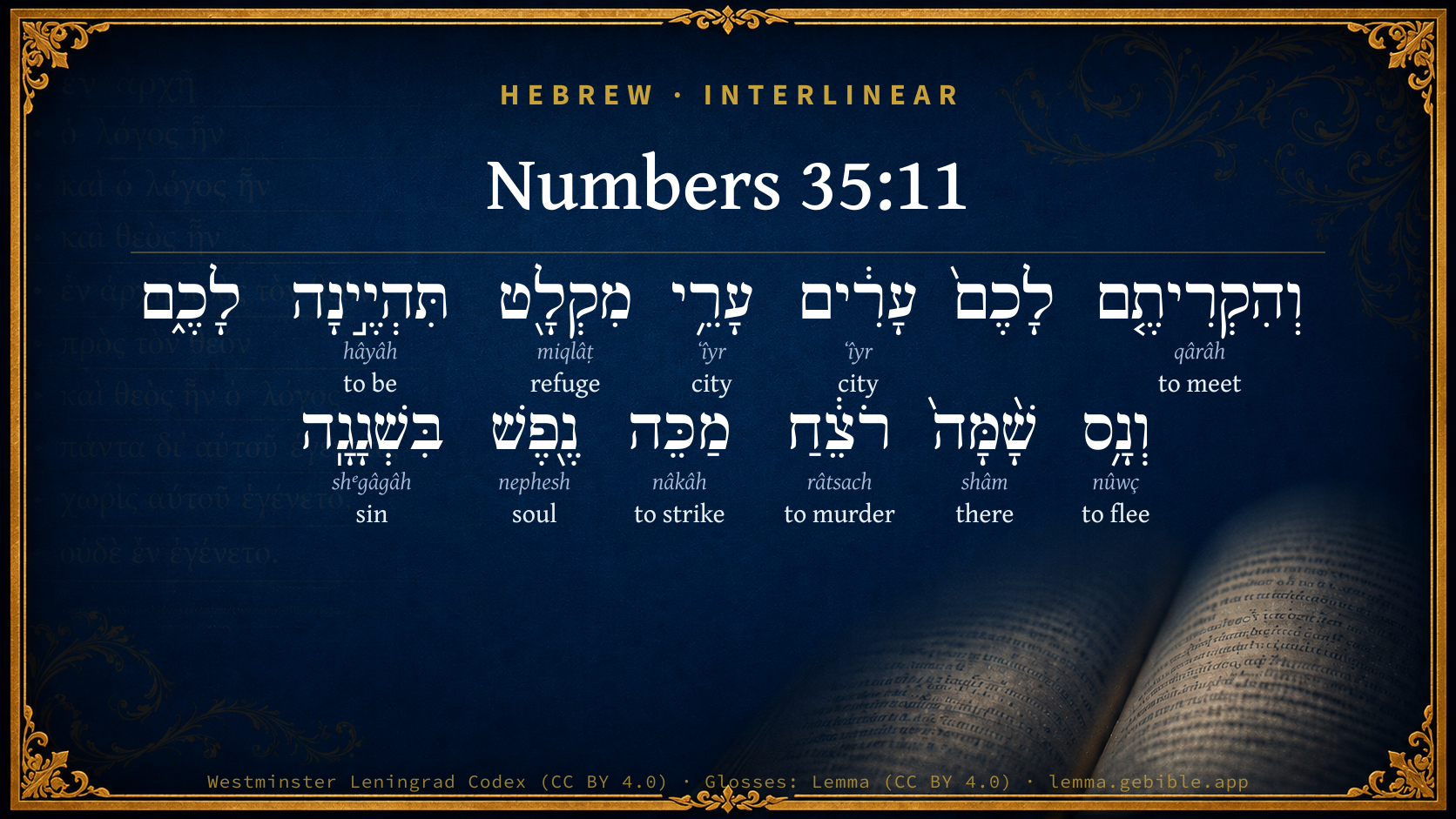
Hebrew (Westminster Leningrad Codex) Numbers 35:11 appears in the Hebrew Old Testament. The text above is from the Westminster Leningrad Codex. Each word links to its Strong’s number, a concise gloss, and parsing drawn from the Open Scriptures Hebrew Bible morphology. Click any word for its full Brown-Driver-Briggs (BDB) entry.
Download image
Cite this verse

Numbers 35:11 (World English Bible). Public Domain. Lemma interlinear Bible study tool, https://lemma.gebible.app/v/numbers/35/11.

Show BibTeX & RIS
BibTeX
RIS
English Translation
then you shall appoint you cities to be cities of refuge for you, that the manslayer who kills any person unwittingly may flee there.
World English Bible · Public Domain
Download a study sheet

One document with this verse’s original text, its word-by-word gloss line, the meaning frame, cross-references with their text, attributed commentary, and full source and license credits — printable, and it pastes into notes with its structure intact.

This verse Autodidact and up

Study sheet (.html) Plain text (.txt)

A passage Seminary Student

Up to 50 verses in one chapter. A passage sheet keeps up to 6 commentary sources and 12 cross-references per verse, in the order this page ranks them, and says so on the sheet whenever that leaves anything out. Ask for a single verse and you get the Autodidact verse sheet above.

Everything on this page stays free to read, with no account — the sheet is a download of what is already on screen, not access to it.

Want to remove ads? Support Godless Engineer
Compare translations 3

The same verse in 3 English versions, stacked beneath the original-language interlinear above. Click any original word for its lexicon entry.

Each is an independent rendering of the whole verse — the interlinear is not word-aligned to these translations.

Highlighted words mark where these versions differ — a whole-verse word diff, not a word-by-word alignment.

  • World English Bible Public Domain
    then you shall appoint you cities to be cities of refuge for you, that the manslayer who kills any person unwittingly may flee there.
  • King James Version Public Domain
    Then ye shall appoint you cities to be cities of refuge for you; that the slayer may flee thither, which killeth any person at unawares.
  • unfoldingWord Literal Text CC BY-SA 4.0
    then you shall choose for yourselves cities; they will be cities of refuge for you, and the one who kills, the one who struck down a person by mistake, shall flee to there.

unfoldingWord Literal Text — © unfoldingWord, licensed CC BY-SA 4.0. Word-aligned USFM3 via Door43 (git.door43.org/unfoldingWord/en_ult).

Versions to compare (up to 4)

3 of 4 selected

Show all 18 translations

Every available English version of this verse, each an independent rendering of the whole verse.

  • World English Bible Public Domain
    then you shall appoint you cities to be cities of refuge for you, that the manslayer who kills any person unwittingly may flee there.
  • Berean Standard Bible Public Domain
    designate cities to serve as your cities of refuge, so that a person who kills someone unintentionally may flee there.
  • Majority Standard Bible Public Domain
    designate cities to serve as your cities of refuge, so that a person who kills someone unintentionally may flee there.
  • King James Version Public Domain
    Then ye shall appoint you cities to be cities of refuge for you; that the slayer may flee thither, which killeth any person at unawares.
  • American Standard Version (1901) Public Domain
    then ye shall appoint you cities to be cities of refuge for you, that the manslayer that killeth any person unwittingly may flee thither.
  • Revised Version (1885) Public Domain
    then ye shall appoint you cities to be cities of refuge for you; that the manslayer which killeth any person unwittingly may flee thither.
  • Geneva Bible (1599) Public Domain
    Ye shall appoint you cities, to bee cities of refuge for you, that the slayer, which slayeth any person vnwares, may flee thither.
  • Douay-Rheims (1899) Public Domain
    Determine what cities shall be for the refuge of fugitives, who have shed blood against their will.
  • Young's Literal Translation Public Domain
    and have prepared to yourselves cities -- cities of refuge they are to you -- then fled thither hath a man-slayer, smiting a person unawares,
  • Literal Standard Version CC BY-SA 4.0
    and have prepared cities for yourselves—they are cities of refuge to you—then a manslayer, striking a person through ignorance, has fled there,
  • Unlocked Literal Bible CC BY-SA 4.0
    then you must choose cities to serve as cities of refuge for you, a place to which a person who has killed someone unintentionally may flee.
  • unfoldingWord Literal Text CC BY-SA 4.0
    then you shall choose for yourselves cities; they will be cities of refuge for you, and the one who kills, the one who struck down a person by mistake, shall flee to there.
  • Darby Bible Public Domain
    then ye shall appoint for yourselves cities: cities of refuge shall they be for you; that a manslayer may flee thither, who without intent smiteth a person mortally.
  • World Messianic Bible Public Domain
    then you shall appoint for yourselves cities to be cities of refuge for you, that the man slayer who kills any person unwittingly may flee there.
  • Webster's Bible Public Domain
    Then ye shall appoint for you cities to be cities of refuge for you; that the slayer may flee thither, who killeth any person at unawares.
  • Free Bible Version CC BY-SA 4.0
    choose towns as your sanctuary towns, so a person who kills someone by mistake may run there.
  • Bible in Basic English Public Domain
    Then let certain towns be marked out as safe places to which anyone who takes the life of another in error may go in flight.
  • JPS Tanakh (1917) Public Domain
    then ye shall appoint you cities to be cities of refuge for you, that the manslayer that killeth any person through error may flee thither.

Literal Standard Version (2020), Covenant Press — licensed CC BY-SA 4.0. Text via the HelloAO Bible API (eBible.org). Unlocked Literal Bible (unfoldingWord) — licensed CC BY-SA 4.0. Text via the HelloAO Bible API (eBible.org). unfoldingWord Literal Text — © unfoldingWord, licensed CC BY-SA 4.0. Word-aligned USFM3 via Door43 (git.door43.org/unfoldingWord/en_ult). Free Bible Version, Dr. Jonathan Gallagher — licensed CC BY-SA 4.0. Text via the HelloAO Bible API (eBible.org).

Word by word

More ways to search: Search by grammar → Find every occurrence → Compare this word →

Practice this passage: Drill this verse → Learn its vocabulary →

בִּשְׁגָגָֽה
shᵉgâgâh
H7684
“in/at · sin”
Preposition + Noun, Common, Feminine, Singular, Absolute
Part of Speech
Preposition + Noun
Type
Common
Gender
Feminine
Number
Singular
State
Absolute
Full BDB Definition

Origin: from H7683

TWOT: 2324a

sin, sin of error or inadvertence, inadvertent sin - error
  1. וְהִקְרִיתֶ֤ם qârâh H7136 “and · to meet” Conjunction + Verb, Hiphil, Sequential Perfect, 2nd Person, Masculine, Plural
  2. עָרִ֔ים ʻîyr H5892 “cities” Noun, Common, Feminine, Plural, Absolute
  3. עָרֵ֥י ʻîyr H5892 “cities of” Noun, Common, Feminine, Plural, Construct
  4. מִקְלָ֖ט miqlâṭ H4733 “refuge” Noun, Common, Masculine, Singular, Absolute
  5. תִּהְיֶ֣ינָה hâyâh H1961 “to be” Verb, Qal, Imperfect, 3rd Person, Feminine, Plural
  6. וְנָ֥ס nûwç H5127 “and · to flee” Conjunction + Verb, Qal, Sequential Perfect, 3rd Person, Masculine, Singular
  7. שָׁ֨מָּה֙ shâm H8033 “there · toward” Adverb + Suffix, Demonstrative
  8. רֹצֵ֔חַ râtsach H7523 “murdering” Verb, Qal, Participle Active, Masculine, Singular, Absolute
  9. מַכֵּה nâkâh H5221 “striking” Verb, Hiphil, Participle Active, Masculine, Singular, Construct
  10. נֶ֖פֶשׁ nephesh H5315 “soul” Noun, Common, Both, Singular, Absolute

About this verse

These counts appear in no published source. They are computed here, from the morphology-tagged text and Lemma’s own curated glosses. What Lemma adds →

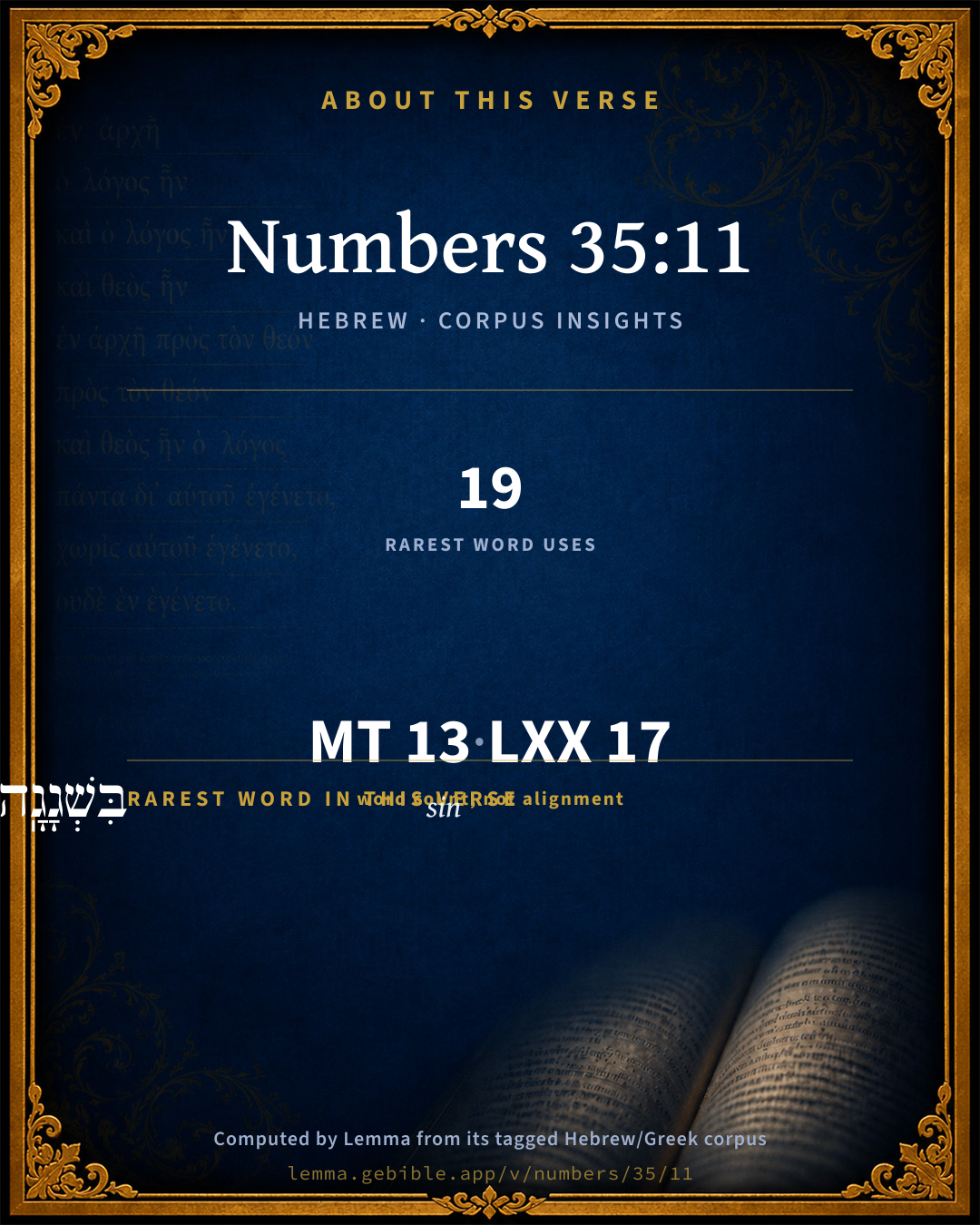
13
words
10
distinct lemmas
Pentateuch
section

Notable vocabulary

The rarest word here is בִּשְׁגָגָֽה sin H7684 — appearing just 19 times in the whole Hebrew Bible.

Shared distinctive vocabulary

בִּשְׁגָגָֽה sin H7684 occurs in 18 verses of the Hebrew Bible. Also found in:

Grammatical profile

  • 5 verbs
  • 5 nouns
  • 2 prepositions
  • 1 adverb

Verb forms

  • וְהִקְרִיתֶ֤ם Hiphil · Sequential Perfect
  • תִּהְיֶ֣ינָה Qal · Imperfect
  • וְנָ֥ס Qal · Sequential Perfect
  • רֹצֵ֔חַ Qal · Participle Active
  • מַכֵּה Hiphil · Participle Active

Repetition

A word recurs within this verse — often emphatic in Hebrew:

  • עָרִ֔ים city H5892 ×2

Hebrew & Septuagint length

In English translation the verse runs 24 words from the Hebrew and 28 from the Septuagint (LXX English) — closely comparable.

A rough comparison of the two English renderings, which tokenize alike — not a word-level alignment.

Word counts can differ between the Hebrew and the Greek without any difference in meaning — e.g. the Hebrew direct-object marker אֵת has no separate Greek word, and Greek often adds the article ὁ.

In the original languages it is 13 Hebrew tokens and 17 Greek tokens — but the two are counted differently (Hebrew bundles its prefixes and suffixes into one token; the Greek is in lemma form), so that isn’t a like-for-like length.

Cross-references

6

Topical passages linked to Numbers 35:11 in the Treasury of Scripture Knowledge — connected by theme and wording, ordered by reader-vote popularity; previews shown in the World English Bible.

  • Exodus 21:13 but not if it is unintentional, but God allows it to happen: then I will appoint you a place where he shall flee.
  • Numbers 35:6 The cities which you shall give to the Levites, they shall be the six cities of refuge, which you shall give for the manslayer to flee to: and besides them you shall give forty-two cities.
  • Joshua 20:2 Speak to the children of Israel, saying, Assign you the cities of refuge, of which I spoke to you by Moses,
  • Numbers 35:22–25 But if he thrust him suddenly without enmity, or hurled on him anything without lying in wait,
  • Deuteronomy 4:42 that the manslayer might flee there, who kills his neighbor unawares, and didn't hate him in time past; and that fleeing to one of these cities he might live:
  • Deuteronomy 19:1–13 When Yahweh your God shall cut off the nations, whose land Yahweh your God gives you, and you succeed them, and dwell in their cities, and in their houses;

Cross-references courtesy of OpenBible.info (CC BY 4.0).

Hebrew and Greek witnesses Masoretic Hebrew ↔ Greek Septuagint

The same verse in the two great witnesses to the Old Testament, shown verse-for-verse.

These are two independent witnesses, not word-aligned to each other, and the Septuagint is shown in lemma (dictionary) form.

Hebrew Numbers 35:11 Masoretic · Westminster Leningrad Codex

וְהִקְרִיתֶ֤ם לָכֶם֙ עָרִ֔ים עָרֵ֥י מִקְלָ֖ט תִּהְיֶ֣ינָה לָכֶ֑ם וְנָ֥ס שָׁ֨מָּה֙ רֹצֵ֔חַ מַכֵּה נֶ֖פֶשׁ בִּשְׁגָגָֽה

then you shall appoint you cities to be cities of refuge for you, that the manslayer who kills any person unwittingly may flee there.

World English Bible · Public Domain

Greek LXX Numbers 35:11 Septuagint · lemma form

καί διαστέλλω σύ αὐτός πόλις φυγαδευτήριον εἰμί σύ φεύγω ἐκεῖ ὁ φονευτής πᾶς ὁ πατάσσω ψυχή ἀκουσίως

And you⌃ shall appoint to yourselves cities: they shall be to you cities of refuge for the slayer to flee to, every one who has killed another unintentionally.

LXX2012 (modern English Septuagint) · Public Domain

Hebrew: Westminster Leningrad Codex (CC BY 4.0). Greek: Septuagint (public domain); English from LXX2012 (modern English Septuagint) (Public Domain). How the Septuagint differs from the Hebrew →

Targum (Aramaic paraphrase)

2

The Targum is the ancient Jewish Aramaic paraphrase of the Hebrew Scriptures — an interpretive translation, not the Hebrew text itself. Onkelos (literal) and Pseudo-Jonathan (expansive) render the Torah, and Jonathan the Prophets. Coverage is partial: where no permissively-licensed English translation exists for a verse, only the Aramaic is shown. This is verse-level text, not a word-by-word alignment to the Hebrew.

  1. Targum Onkelos Torah (Genesis–Deuteronomy)
    וּתְזַמְנוּן לְכוֹן קִרְוִין קִרְוֵי שֵׁזָבוּתָא יֶהֶוְיָן לְכוֹן וְיַעֲרוֹק לְתַמָן קָטוֹלָא דְיִקְטוֹל נַפְשָׁא בְּשָׁלוּ

    (no public-domain English translation for this verse)

    Targum Onkelos — Aramaic: “Onkelos Genesis” (public domain); “Onkelos Exodus” (public domain); “Onkelos Leviticus” (public domain); “Onkelos Numbers” (public domain); “Onkelos Deuteronomy” (public domain). English: “Sefaria Community Translation” (CC0 1.0 (public-domain dedication)); “J.W. Etheridge. The Targums of Onkelos and Jonathan Ben Uzziel on the Pentateuch. London: Longmans, Green, 1862” (public domain). Text via Sefaria.

  2. Targum Pseudo-Jonathan Torah (Genesis–Deuteronomy)
    וּתְזַמְנוּן לְכוֹן קוּרְיַין בְּשׁוּקִין וּבָתֵּי חִיזְוָתָא קִרְוִין קַלְטַן יֶהֱוְיַן לְכוֹן וְיֶעְרוֹק לְתַמָן קָטוֹלָא דְיִקְטוֹל בַּר נַשׁ בְּשָׁלוּ

    you shall provide you cities with streets and houses of living (boarding houses), cities of refuge shall they be to you, that thither the manslayer may flee who hath killed a man inadvertently.

    Targum Pseudo-Jonathan — Aramaic: “Targum Jonathan on Genesis” (public domain); “Targum Jonathan on Exodus” (public domain); “Targum Jonathan on Leviticus” (public domain); “Targum Jonathan on Numbers” (public domain); “Targum Jonathan on Deuteronomy” (public domain). English: “The Targum of Jonathan ben Uzziel, trans. J. W. Etheridge, London, 1862” (public domain). Text via Sefaria.

Commentary

Notes on Numbers 35:11 from classic Christian and Jewish commentators (each source and its license shown beneath its notes). The classic Christian expositions comment on the surrounding passage and are grouped to its opening verse, so a note may address several verses; the Jewish commentaries on the Tanakh (Rashi and others) are per-verse, so they appear only where the commentator wrote on this verse.

Lemma curates 59 commentaries, every one of them public domain or Creative Commons licensed, each selected and text-cleaned for this edition rather than reprinted as found. About our sources →

Joseph Benson's Commentary

Num 35:11. Unawares — Or ignorantly, as it is, Deu 19:4, and Jos 20:3; that is, besides his intention, having no such design, and no hatred to him, Num 35:22.

Joseph Benson's Commentary on the Old and New Testaments (1811–1818) — public domain. Text from a community e-Sword module.

Jamieson, Fausset & Brown

Robert Jamieson, A. R. Fausset & David Brown

THE BLOOD AVENGER. (Num. 35:9-34)

that the slayer may flee thither, which killeth any person at unawares--The practice of Goelism, that is, of the nearest relation of an individual who was killed being bound to demand satisfaction from the author of his death, existed from a very remote antiquity (Gen 4:14; Gen 27:45). It seems to have been an established usage in the age of Moses; and although in a rude and imperfect state of society, it is a natural and intelligible principle of criminal jurisprudence, it is liable to many great abuses; the chief of the evils inseparable from it is that the kinsman, who is bound in duty and honor to execute justice, will often be precipitate--little disposed, in the heat of passion or under the impulse of revenge, to examine into the circumstances of the case, to discriminate between the premeditated purpose of the assassin and the misfortune of the unintentional homicide. Moreover, it had a tendency, not only to foster a vindictive spirit, but in case of the Goel being unsuccessful in finding his victim, to transmit animosities and feuds against his descendants from one generation to another. This is exemplified among the Arabs in the present day. Should an Arab of one tribe happen to kill one of another tribe, there is "blood" between the tribes, and the stain can only be wiped out by the death of some individual of the tribe with which the offense originated. Sometimes the penalty is commuted by the payment of a stipulated number of sheep or camels. But such an equivalent, though offered, is as often refused, and blood has to be repaid only by blood. This practice of Goelism obtained among the Hebrews to such an extent that it was not perhaps expedient to abolish it; and Moses, while sanctioning its continuance, was directed, by divine authority, to make some special regulations, which tended both to prevent the unhappy consequences of sudden and personal vengeance, and, at the same time, to afford an accused person time and means of proving his innocence. This was the humane and equitable end contemplated in the institution of cities of refuge. There were to be six of these legalized asyla, three on the east of Jordan, both because the territory there was equal in length, though not in breadth, to Canaan, and because it might be more convenient for some to take refuge across the border. They were appointed for the benefit, not of the native Israelites only, but of all resident strangers.

Jamieson, Fausset & Brown — Commentary Critical and Explanatory on the Whole Bible (1871) — public domain (CC PDM 1.0). Text via the HelloAO Bible API.

Adam Clarke's Commentary

Verse 11. Ye shall appoint - cities of refuge] The cities of refuge among the Israelites were widely different from the asyla among the Greeks and Romans, as also from the privileged altars among the Roman Catholics. Those among the Hebrews were for the protection of such only as had slain a person involuntarily. The temples and altars among the latter often served for the protection of the most profligate characters. Cities of refuge among the Hebrews were necessary, because the old patriarchal law still remained in force, viz., that the nearest akin had a right to avenge the death of his relation by slaying the murderer; for the original law enacted that whosoever shed man's blood, by man should his blood be shed, Ge 9:6, and none was judged so proper to execute this law as the man who was nearest akin to the deceased. As many rash executions of this law might take place, from the very nature of the thing, it was deemed necessary to qualify its claims, and prevent injustice; and the cities of refuge were judged proper for this purpose. Nor do we ever read that they were ever found inefficient, or that they were ever abused.

Adam Clarke's Commentary on the Bible (1810–1826) — public domain. Text from a community e-Sword/MySword module.

The Cambridge Bible for Schools and Colleges

gen. ed. J. J. S. Perowne

11. ye shall appoint] Perhaps better ye shall select. The verb in this sense is not found elsewhere in the O.T.

cities of refuge] Perhaps cities of reception, a term which occurs only in this chapter, and in Joshua 20, 21. (P ), 1Ch_6:57; 1Ch_6:67. The word is used in Rabbinic Heb. of the collection or reception of rainwater.

unwittingly] lit. ‘in error.’ See Num_15:24 ff.

The Cambridge Bible for Schools and Colleges (gen. ed. J. J. S. Perowne; Cambridge University Press, 1878–1918) — public domain. Text from a community e-Sword module.

John Gill's Exposition

Then ye shall appoint your cities to be cities of refuge for you,.... And, according to the Jewish writers (i), these were neither to be made large nor little, but middling; and they appointed them where there were markets and fairs, at which goods were to be sold; and where there was plenty of water, and a multitude of people; and where there were but few, they fetched others from other places; and they neither made nets for hunting, nor twisted ropes in them, nor sold any warlike instruments, lest the avenger of blood should use himself to come thither, under pretence of buying such things, and kill the manslayer:

that the slayer may flee thither, which killeth any person at unawares; or through error (k), or mistake, not on purpose, with design, or through malice and enmity, as is afterwards more largely explained.

(i) Maimon. Rotzeach, c. 8. sect. 8. Vid. T. Bab. Maccot, fol. 10. 1. (k) "per errorem", Pagninus, Junius & Tremellius, Piscator; "per imprudentiam", Tigurine version: Vatablus; "in ignorantia", Montanus.

John Gill's Exposition of the Whole Bible (1746–1763) — public domain (CC PDM 1.0). Text via the HelloAO Bible API.

Haydock's Catholic Bible Commentary

CHAPTER XXXV.

George Leo Haydock (1774–1849), Haydock's Catholic Family Bible and Commentary, 1859 edition — public domain. Excludes Psalms (Douay-Rheims chapter numbering differs from Protestant) and Deuterocanonical books (Catholic canon only).

Matthew Poole's English Annotations

i.e. Not wilfully, designedly, or maliciously, but inconsiderately, through mistake, or indiscretion, or carelessness. See Lev 4:2.

Matthew Poole's English Annotations on the Holy Bible (1683–1685) — public domain. Text from a community e-Sword/MySword module.

Whedon's Commentary on the Bible

Daniel D. Whedon

11. Killeth… unawares — Joshua (Num_20:3) adds, “and unwittingly.” See note.

Daniel D. Whedon (gen. ed.), Commentary on the Old and New Testaments (1874–1909) — public domain. Text from a community e-Sword module.

The Pulpit Commentary

Ye shall appoint you cities to be cities of refuge for you. God had already announced that he would appoint a place whither one guilty of unpremeditated manslaughter might flee for safety. (Exo_21:18) The expression there used does not point to more than one "place," but it is not inconsistent with several. Probably the right of sanctuary has been recognized from the earliest times in which any local appropriation of places to sacred purposes has been made. It is an instinct of religion to look upon one who has escaped into a sacred enclosure as being under the personal protection of the presiding deity. It is certain that the right was largely recognized in Egypt, where the priestly caste was so powerful and ambitious; and this is no doubt the reason (humanly speaking) for the promise in Exo_21:13, and for the command in the following verse. Inasmuch as the whole of Canaan was the Lord"s, any places within it might he endowed with rights of sanctuary, but it was obviously suitable that they should be Levitical cities; the Divine prerogative of mercy could nowhere be better exercised, nor would any citizens be better qualified to pronounce and to uphold the rightful decision in each case.

The Pulpit Commentary (1880–1919), ed. H.D.M. Spence-Jones & Joseph S. Exell — public domain. Text from a community e-Sword module.

John Wesley's Explanatory Notes

Unawares - Not wilfully, designedly or maliciously, but through mistake or indiscretion.

John Wesley, Explanatory Notes Upon the Whole Bible (1754–1765) — public domain. Text via the GEBible commentary corpus.

Rashi

Rabbi Shlomo Yitzchaki (Rashi)

והקריתם — This verb קרה (in the Hiphil) denotes “preparing”. Similarly it says, (Genesis 27:20) “Because the Lord thy God made it ready (הקרה) before me”(Sifrei Bamidbar 159:4).

Rashi on the Tanakh — English translations: “The Judaica Press complete Tanach with Rashi, translated by A. J. Rosenberg” (CC BY 4.0); “Pentateuch with Rashi's commentary by M. Rosenbaum and A.M. Silbermann, 1929-1934” (public domain); “The Metsudah Tanach series, Lakewood, N.J” (CC BY 4.0); and “The Book of Joshua, Metsudah Publications, 1997” (CC BY 4.0). Text via Sefaria.

Lesson kit

Teaching starters — assembled from the data on this page, not authored interpretation. Every prompt links to the verse data it draws on. Edit before teaching.

Numbers, in the Pentateuch, opens this verse with 13 words (10 distinct Hebrew lemmas). Its most distinctive word is shᵉgâgâh (“sin”). A historical commentator’s framing appears above. Read the whole chapter for the surrounding context.

Discussion questions

  1. The word shᵉgâgâh carries the sense “sin.” How does it shape the verse?
  2. Leviticus 4:2 shares the word «sin» with this verse. How do the two illuminate each other?
  3. “city” occurs 2× in this one verse. What is the effect of the repetition?
  4. The translations on this page render this verse differently — a whole-verse word diff, not a word-by-word alignment. What might account for the different wordings?
  5. The verb «וְהִקְרִיתֶ֤ם» is Hiphil Sequential Perfect. How does its form color the action?
  6. Reading how Joseph Benson's Commentary and Jamieson, Fausset & Brown read this verse, where do the two commentators agree and where do they part?

Things to notice

Reading settings

Reading text

Shown beneath each verse's original-language words.

Old Testament
Old Testament edition

Read the OT as the Masoretic Hebrew (MT) or the Greek Septuagint (LXX).

English shown for the Greek Septuagint (in the Hebrew ↔ Greek comparison).

Comparing translations? Open the Compare panel on any verse page to stack up to four side by side.