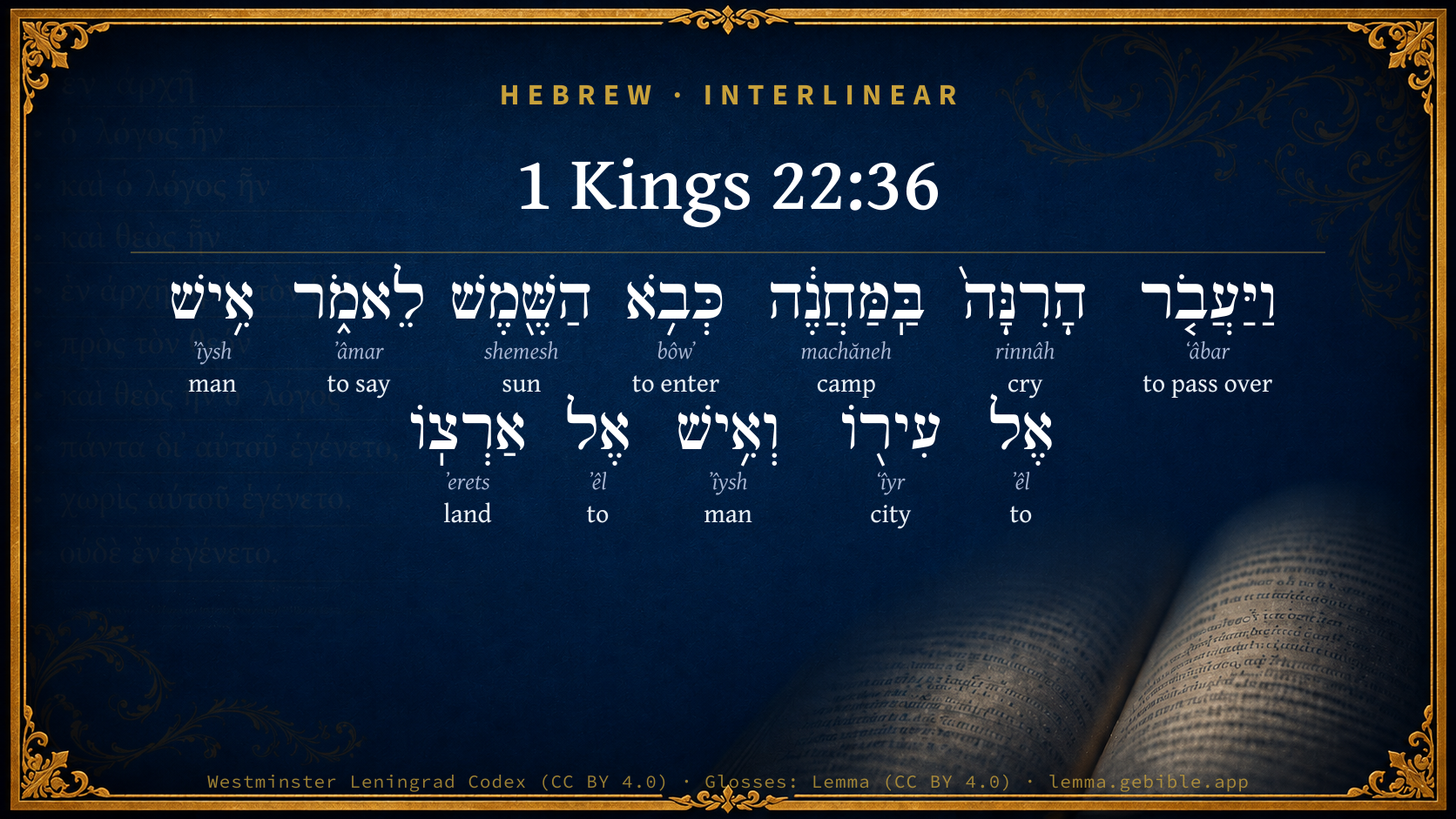
1 Kings 22:36

Hebrew (Westminster Leningrad Codex) 1 Kings 22:36 appears in the Hebrew Old Testament. The text above is from the Westminster Leningrad Codex. Each word links to its Strong’s number, a concise gloss, and parsing drawn from the Open Scriptures Hebrew Bible morphology. Click any word for its full Brown-Driver-Briggs (BDB) entry.
Download image
Cite this verse

1 Kings 22:36 (World English Bible). Public Domain. Lemma interlinear Bible study tool, https://lemma.gebible.app/v/1-kings/22/36.

Show BibTeX & RIS
BibTeX
RIS
English Translation
There went a cry throughout the host about the going down of the sun, saying, Every man to his city, and every man to his country.
World English Bible · Public Domain
Download a study sheet

One document with this verse’s original text, its word-by-word gloss line, the meaning frame, cross-references with their text, attributed commentary, and full source and license credits — printable, and it pastes into notes with its structure intact.

This verse Autodidact and up

Study sheet (.html) Plain text (.txt)

A passage Seminary Student

Up to 50 verses in one chapter. A passage sheet keeps up to 6 commentary sources and 12 cross-references per verse, in the order this page ranks them, and says so on the sheet whenever that leaves anything out. Ask for a single verse and you get the Autodidact verse sheet above.

Everything on this page stays free to read, with no account — the sheet is a download of what is already on screen, not access to it.

Want to remove ads? Support Godless Engineer
Compare translations 3

The same verse in 3 English versions, stacked beneath the original-language interlinear above. Click any original word for its lexicon entry.

Each is an independent rendering of the whole verse — the interlinear is not word-aligned to these translations.

Highlighted words mark where these versions differ — a whole-verse word diff, not a word-by-word alignment.

  • World English Bible Public Domain
    There went a cry throughout the host about the going down of the sun, saying, Every man to his city, and every man to his country.
  • King James Version Public Domain
    And there went a proclamation throughout the host about the going down of the sun, saying, Every man to his city, and every man to his own country.
  • unfoldingWord Literal Text CC BY-SA 4.0
    And a cry passed through in the camp about the going of the sun, saying, “A man to his city, and a man to his land!”

unfoldingWord Literal Text — © unfoldingWord, licensed CC BY-SA 4.0. Word-aligned USFM3 via Door43 (git.door43.org/unfoldingWord/en_ult).

Versions to compare (up to 4)

3 of 4 selected

Show all 18 translations

Every available English version of this verse, each an independent rendering of the whole verse.

  • World English Bible Public Domain
    There went a cry throughout the host about the going down of the sun, saying, Every man to his city, and every man to his country.
  • Berean Standard Bible Public Domain
    As the sun was setting, the cry rang out in the army: “Every man to his own city, and every man to his own land!”
  • Majority Standard Bible Public Domain
    As the sun was setting, the cry rang out in the army: “Every man to his own city, and every man to his own land!”
  • King James Version Public Domain
    And there went a proclamation throughout the host about the going down of the sun, saying, Every man to his city, and every man to his own country.
  • American Standard Version (1901) Public Domain
    And there went a cry throughout the host about the going down of the sun, saying, Every man to his city, and every man to his country.
  • Revised Version (1885) Public Domain
    And there went a cry throughout the host about the going down of the sun, saying, Every man to his city, and every man to his country.
  • Geneva Bible (1599) Public Domain
    And there went a proclamation thorowout the hoste about the going downe of the sunne, saying, Euery man to his citie, and euery man to his owne countrey.
  • Douay-Rheims (1899) Public Domain
    And the herald proclaimed through all the army before the sun set, saying: Let every man return to his own city, and to his own country.
  • Young's Literal Translation Public Domain
    and he causeth the cry to pass over through the camp, at the going in of the sun, saying, `Each unto his city, and each unto his land.'
  • Literal Standard Version CC BY-SA 4.0
    and he causes the cry to pass over through the camp, at the going in of the sun, saying, “Each to his city, and each to his land!”
  • Unlocked Literal Bible CC BY-SA 4.0
    Then about the time the sun was going down, a cry went up throughout the army, saying, “Every man should go back to his city; and every man should go back to his region!”
  • unfoldingWord Literal Text CC BY-SA 4.0
    And a cry passed through in the camp about the going of the sun, saying, “A man to his city, and a man to his land!”
  • Darby Bible Public Domain
    And there went the cry throughout the host at the going down of the sun, saying, Every man to his city, and every man to his own country!
  • World Messianic Bible Public Domain
    A cry went throughout the army about the going down of the sun, saying, “Every man to his city, and every man to his country!”
  • Webster's Bible Public Domain
    And there went a proclamation throughout the host about the setting of the sun, saying, Every man to his city, and every man to his own country.
  • Free Bible Version CC BY-SA 4.0
    At sunset, a shout went out from the lines: “Retreat! Every man back to his town, every man back to his own country!”
  • Bible in Basic English Public Domain
    And about sundown a cry went up from all parts of the army, saying, Let every man go back to his town and his country, for the king is dead.
  • JPS Tanakh (1917) Public Domain
    And there went a cry throughout the host about the going down of the sun, saying: 'Every man to his city, and every man to his country.'

Literal Standard Version (2020), Covenant Press — licensed CC BY-SA 4.0. Text via the HelloAO Bible API (eBible.org). Unlocked Literal Bible (unfoldingWord) — licensed CC BY-SA 4.0. Text via the HelloAO Bible API (eBible.org). unfoldingWord Literal Text — © unfoldingWord, licensed CC BY-SA 4.0. Word-aligned USFM3 via Door43 (git.door43.org/unfoldingWord/en_ult). Free Bible Version, Dr. Jonathan Gallagher — licensed CC BY-SA 4.0. Text via the HelloAO Bible API (eBible.org).

Word by word

More ways to search: Search by grammar → Find every occurrence → Compare this word →

Practice this passage: Drill this verse → Learn its vocabulary →

הָרִנָּה֙
rinnâh
H7440
“the · cry”
Particle, Definite Article + Noun, Common, Feminine, Singular, Absolute
Part of Speech
Particle + Noun
Type
Common
Gender
Feminine
Number
Singular
State
Absolute
Full BDB Definition

Origin: from H7442

TWOT: 2179c

ringing cry - of entreaty, supplication - in proclamation, joy, praise
  1. וַיַּעֲבֹ֤ר ʻâbar H5674 “and · to pass over” Conjunction + Verb, Qal, Sequential Imperfect, 3rd Person, Masculine, Singular
  2. בַּֽמַּחֲנֶ֔ה machăneh H4264 “in/at the · camp” Preposition, Determined + Noun, Common, Both, Singular, Absolute
  3. כְּבֹ֥א bôwʼ H935 “like/as · to enter” Preposition + Verb, Qal, Infinitive Construct
  4. הַשֶּׁ֖מֶשׁ shemesh H8121 “the · sun” Particle, Definite Article + Noun, Common, Both, Singular, Absolute
  5. לֵאמֹ֑ר ʼâmar H559 “to say” Preposition + Verb, Qal, Infinitive Construct
  6. אִ֥ישׁ ʼîysh H376 “man” Noun, Common, Masculine, Singular, Absolute
  7. אֶל ʼêl H413 “to” Preposition
  8. עִיר֖וֹ ʻîyr H5892 “city · his” Noun, Common, Feminine, Singular, Construct + Suffix, Personal, 3rd Person, Masculine, Singular
  9. וְאִ֥ישׁ ʼîysh H376 “and · man” Conjunction + Noun, Common, Masculine, Singular, Absolute
  10. אֶל ʼêl H413 “to” Preposition
  11. אַרְצֽוֹ ʼerets H776 “land · his” Noun, Common, Both, Singular, Construct + Suffix, Personal, 3rd Person, Masculine, Singular

About this verse

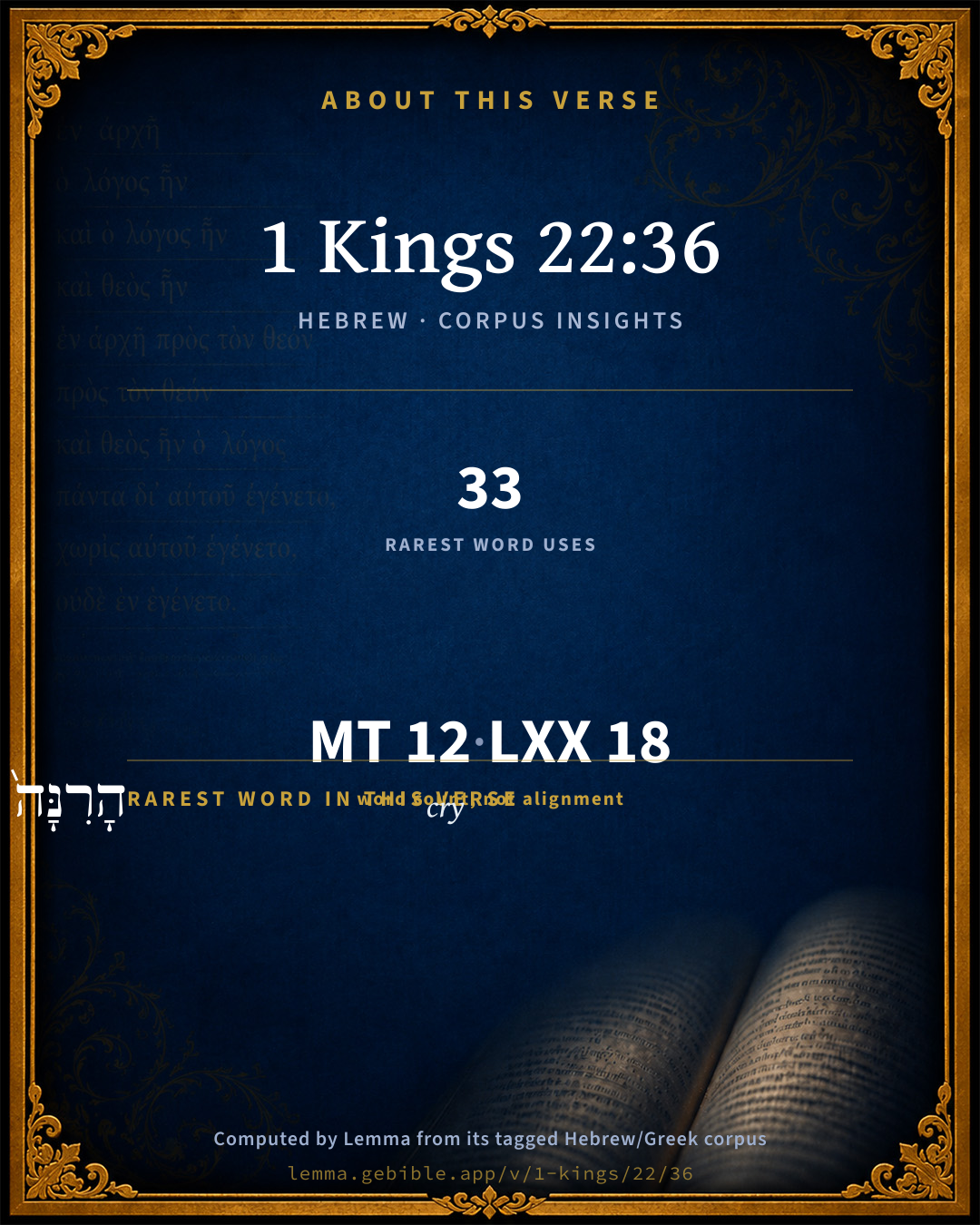
These counts appear in no published source. They are computed here, from the morphology-tagged text and Lemma’s own curated glosses. What Lemma adds →

12
words
10
distinct lemmas
Historical
section

Shared distinctive vocabulary

הָרִנָּה֙ cry H7440 occurs in 33 verses of the Hebrew Bible. Also found in:

Grammatical profile

  • 3 verbs
  • 7 nouns
  • 2 prepositions

Verb forms

  • וַיַּעֲבֹ֤ר Qal · Sequential Imperfect
  • כְּבֹ֥א Qal · Infinitive Construct
  • לֵאמֹ֑ר Qal · Infinitive Construct

Repetition

Words recur within this verse — often emphatic in Hebrew:

  • אִ֥ישׁ man H376 ×2
  • אֶל to H413 ×2

Hebrew & Septuagint length

In English translation the verse runs 26 words from the Hebrew and 22 from the Septuagint (LXX English) — closely comparable.

A rough comparison of the two English renderings, which tokenize alike — not a word-level alignment.

Word counts can differ between the Hebrew and the Greek without any difference in meaning — e.g. the Hebrew direct-object marker אֵת has no separate Greek word, and Greek often adds the article ὁ.

In the original languages it is 12 Hebrew tokens and 18 Greek tokens — but the two are counted differently (Hebrew bundles its prefixes and suffixes into one token; the Greek is in lemma form), so that isn’t a like-for-like length.

Cross-references

9

Topical passages linked to 1 Kings 22:36 in the Treasury of Scripture Knowledge — connected by theme and wording, ordered by reader-vote popularity; previews shown in the World English Bible.

  • 2 Kings 14:12 Judah was put to the worse before Israel; and they fled every man to his tent.
  • Judges 7:7–8 Yahweh said to Gideon, By the three hundred men who lapped will I save you, and deliver the Midianites into your hand; and let all the people go every man to his place.
  • Judges 21:24 The children of Israel departed there at that time, every man to his tribe and to his family, and they went out from there every man to his inheritance.
  • 1 Samuel 4:10 The Philistines fought, and Israel was struck, and they fled every man to his tent: and there was a very great slaughter; for there fell of Israel thirty thousand footmen.
  • 2 Samuel 19:8 Then the king arose, and sat in the gate. They told to all the people, saying, Behold, the king is sitting in the gate: and all the people came before the king. Now Israel had fled every man to his tent.
  • 1 Kings 12:16 When all Israel saw that the king didn't listen to them, the people answered the king, saying, What portion have we in David? neither have we inheritance in the son of Jesse: to your tents, Israel: now see to your own house, David. So Israel departed to their tents.
  • 1 Kings 12:24 Thus says Yahweh, You shall not go up, nor fight against your brothers the children of Israel: return every man to his house; for this thing is of me. So they listened to the word of Yahweh, and returned and went their way, according to the word of Yahweh.
  • 1 Kings 22:17 He said, I saw all Israel scattered on the mountains, as sheep that have no shepherd: and Yahweh said, These have no master; let them return every man to his house in peace.
  • 1 Kings 22:31 Now the king of Syria had commanded the thirty-two captains of his chariots, saying, Fight neither with small nor great, save only with the king of Israel.

Cross-references courtesy of OpenBible.info (CC BY 4.0).

Hebrew and Greek witnesses Masoretic Hebrew ↔ Greek Septuagint

The same verse in the two great witnesses to the Old Testament, shown verse-for-verse.

These are two independent witnesses, not word-aligned to each other, and the Septuagint is shown in lemma (dictionary) form.

Hebrew 1 Kings 22:36 Masoretic · Westminster Leningrad Codex

וַיַּעֲבֹ֤ר הָרִנָּה֙ בַּֽמַּחֲנֶ֔ה כְּבֹ֥א הַשֶּׁ֖מֶשׁ לֵאמֹ֑ר אִ֥ישׁ אֶל עִיר֖וֹ וְאִ֥ישׁ אֶל אַרְצֽוֹ

There went a cry throughout the host about the going down of the sun, saying, Every man to his city, and every man to his country.

World English Bible · Public Domain

Greek LXX 1 Kings 22:36 Septuagint · lemma form

καί ἵστημι ὁ στρατοκῆρυξ δύω ὁ ἥλιος λέγω ἕκαστος εἰς ὁ ἑαυτοῦ πόλις καί εἰς ὁ ἑαυτοῦ γῆ

And the herald of the army stood at sunset, saying, Let every man go to his own city and his own land,

LXX2012 (modern English Septuagint) · Public Domain

On this verse, Albert Barnes' Notes on the Bible discusses the Septuagint’s reading. Read the note in Commentary ↓

Hebrew: Westminster Leningrad Codex (CC BY 4.0). Greek: Septuagint (public domain); English from LXX2012 (modern English Septuagint) (Public Domain). How the Septuagint differs from the Hebrew →

Targum (Aramaic paraphrase)

1

The Targum is the ancient Jewish Aramaic paraphrase of the Hebrew Scriptures — an interpretive translation, not the Hebrew text itself. Onkelos (literal) and Pseudo-Jonathan (expansive) render the Torah, and Jonathan the Prophets. Coverage is partial: where no permissively-licensed English translation exists for a verse, only the Aramaic is shown. This is verse-level text, not a word-by-word alignment to the Hebrew.

  1. Targum Jonathan Prophets (Joshua–Malachi)
    וְאַעְבַרוּ כְּרוֹז בְּמַשְׁרִיתָא כְּמֵיעַל שִׁמְשָׁא לְמֵימַר גְבַר לְקַרְתֵּיהּ וּגְבַר לְאַרְעֵיהּ:

    (no public-domain English translation for this verse)

    Targum Jonathan — Aramaic: “Mikraot Gedolot” (public domain). English: “Sefaria Community Translation” (CC0 1.0 (public-domain dedication)); “London "Chaldee Paraphrase," 1871” (public domain). Text via Sefaria.

Commentary

Notes on 1 Kings 22:36 from classic Christian and Jewish commentators (each source and its license shown beneath its notes). The classic Christian expositions comment on the surrounding passage and are grouped to its opening verse, so a note may address several verses; the Jewish commentaries on the Tanakh (Rashi and others) are per-verse, so they appear only where the commentator wrote on this verse.

Lemma curates 59 commentaries, every one of them public domain or Creative Commons licensed, each selected and text-cleaned for this edition rather than reprinted as found. About our sources →

Trapp's Complete Commentary

John Trapp

1Ki 22:36 And there went a proclamation throughout the host about the going down of the sun, saying, Every man to his city, and every man to his own country.

Ver. 36. Saying, Every man to his city.] This was foretold by Micaiah. {1Ki 22:17} God will not suffer his faithfulness to fail, but will fulfil with his hand what he hath spoken with his mouth.

John Trapp, A Commentary or Exposition upon All the Books of the Old and New Testament (1647–1656) — public domain. Text from a community e-Sword module.

Albert Barnes' Notes on the Bible

About the going down of the sun - i. e. as soon as Ahab was dead. The abandonment of the expedition and dispersion of the army on the death of the king is thoroughly Oriental.

The Septuagint version reads 1Ki 22:36-37, “Every man to his city, and every man to his own country, for the king is dead: And they came to Samaria,” etc.

Albert Barnes' Notes on the Bible (1834–1885) — public domain. Text from a community e-Sword/MySword module.

Geneva Bible (1599)

Geneva Bible translators

Of the Israelites.

Geneva Bible (1599) marginal notes — public domain. Text via Bolls.life.

Adam Clarke's Commentary

Verse 36. Every man to his city] It appears that the Israelites and Jews maintained the fight the whole of the day; but when at evening the king died, and this was known, there was a proclamation made, probably with the consent of both Syrians and Israelites, that the war was over. Ahab being dead, his subjects did not choose to contend for Ramoth-gilead; so the Israelites went to their own cities, and the Syrians to their own country.

Adam Clarke's Commentary on the Bible (1810–1826) — public domain. Text from a community e-Sword/MySword module.

The Cambridge Bible for Schools and Colleges

gen. ed. J. J. S. Perowne

36. And there went a proclamation] R.V. a cry. The word is often rendered ‘cry’ and applied both to sorrowful and joyous utterances. Cf. Psa_17:1; Psa_30:5. Nowhere else is it rendered ‘proclamation.’ It indicates that word was passed round from troop to troop that some disaster made retreat necessary. The LXX. paraphrases ‘And the herald of the host at the setting of the sun stood and said,’ &c.

every man to his own country] The R.V. omits ‘own’, which has nothing to represent it in the original. The LXX. adds to the cry, ‘for the king is dead.’ But this is merely their version of the first words in 1Ki_22:37. For they continue, ‘And they came to Samaria,’ &c.

The Cambridge Bible for Schools and Colleges (gen. ed. J. J. S. Perowne; Cambridge University Press, 1878–1918) — public domain. Text from a community e-Sword module.

John Gill's Exposition

So Ahab slept with his fathers, and Ahaziah his son reigned in his stead, Of whom more is said in the latter part of this chapter, and in the following book.

So Ahab slept with his fathers, and Ahaziah his son reigned in his stead, Of whom more is said in the latter part of this chapter, and in the following book.

1 Kings 22:41

kg1 22:41

kg1 22:41

kg1 22:41And Jehoshaphat the son of Asa began to reign over Judah in the fourth year of Ahab king of Israel. And as Ahab reigned twenty two years, Kg1 16:29, Jehoshaphat must reign about eighteen years with him, and seven years after him.

John Gill's Exposition of the Whole Bible (1746–1763) — public domain (CC PDM 1.0). Text via the HelloAO Bible API.

Matthew Poole's English Annotations

There went a proclamation; probably by Jehoshaphat’s order, with the consent of the chief captains of Israel; and possibly with the permission of the king of Syria, upon notice of Ahab’s death, which was the only thing at which he aimed, 1Ki 22:31.

Every man to his own country: the king is dead, and the battle ended; and therefore every man hath liberty to return to his own house and private occasions.

Matthew Poole's English Annotations on the Holy Bible (1683–1685) — public domain. Text from a community e-Sword/MySword module.

The Pulpit Commentary

And there went a proclamation throughout the host Heb. And the shouting passed over in the camp. Gesenius will have it that hN; ri must mean a "joyful cry," and would see the cause of joy in the cessation of hostilities and the permission to return home about the going down of the sun According to the chronicler, (1Ki_18:34) it was at sunset that the king died. It seems natural, therefore, to connect this shout with his death. But the approach of night would of itself put an end to the battle. It does not appear that Israel had been utterly defeated, or had suffered great loss. But "they had no master", saying, Every man to his city, and every man to his own country or land.

The Pulpit Commentary (1880–1919), ed. H.D.M. Spence-Jones & Joseph S. Exell — public domain. Text from a community e-Sword module.

Lesson kit

Teaching starters — assembled from the data on this page, not authored interpretation. Every prompt links to the verse data it draws on. Edit before teaching.

1 Kings, in the Historical, opens this verse with 12 words (10 distinct Hebrew lemmas). Its most distinctive word is rinnâh (“cry”). A historical commentator’s framing appears above. Read the whole chapter for the surrounding context.

Discussion questions

  1. How does “cry” (rinnâh) shape what this verse is saying?
  2. 1 Kings 8:28 shares the word «cry» with this verse. How do the two illuminate each other?
  3. “man” occurs 2× in this one verse. What is the effect of the repetition?
  4. These translations render this verse differently. What is at stake in choosing one wording over another?
  5. The verb «וַיַּעֲבֹ֤ר» is Qal Sequential Imperfect. How does its form color the action?
  6. Reading how Trapp's Complete Commentary and Albert Barnes' Notes on the Bible read this verse, where do the two commentators agree and where do they part?

Things to notice

Reading settings

Reading text

Shown beneath each verse's original-language words.

Old Testament
Old Testament edition

Read the OT as the Masoretic Hebrew (MT) or the Greek Septuagint (LXX).

English shown for the Greek Septuagint (in the Hebrew ↔ Greek comparison).

Comparing translations? Open the Compare panel on any verse page to stack up to four side by side.