1 Kings 22:26

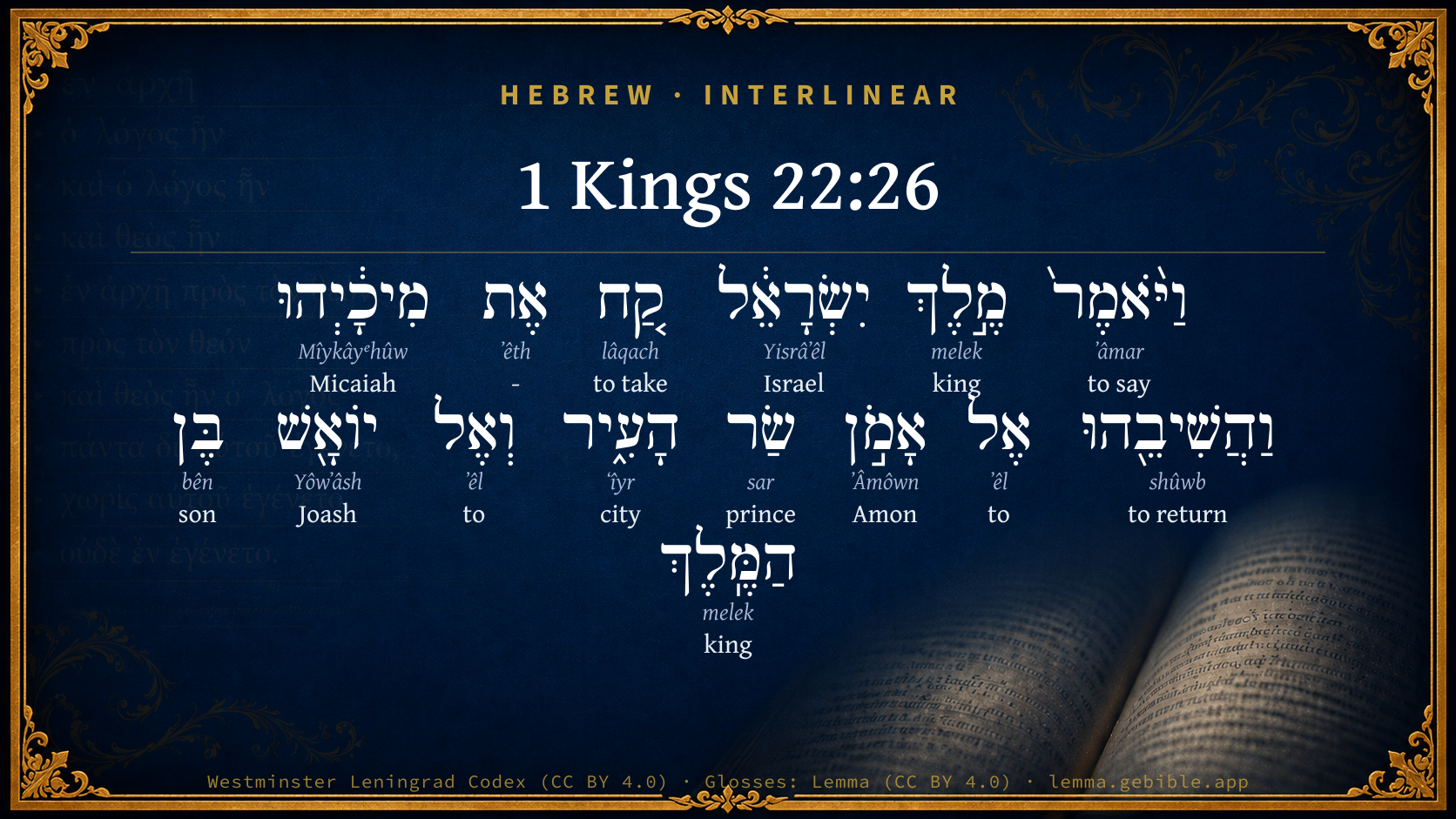
Hebrew (Westminster Leningrad Codex) 1 Kings 22:26 appears in the Hebrew Old Testament. The text above is from the Westminster Leningrad Codex. Each word links to its Strong’s number, a concise gloss, and parsing drawn from the Open Scriptures Hebrew Bible morphology. Click any word for its full Brown-Driver-Briggs (BDB) entry.
Download image
Cite this verse

1 Kings 22:26 (World English Bible). Public Domain. Lemma interlinear Bible study tool, https://lemma.gebible.app/v/1-kings/22/26.

Show BibTeX & RIS
BibTeX
RIS
English Translation
The king of Israel said, Take Micaiah, and carry him back to Amon the governor of the city, and to Joash the king's son;
World English Bible · Public Domain
Highlights
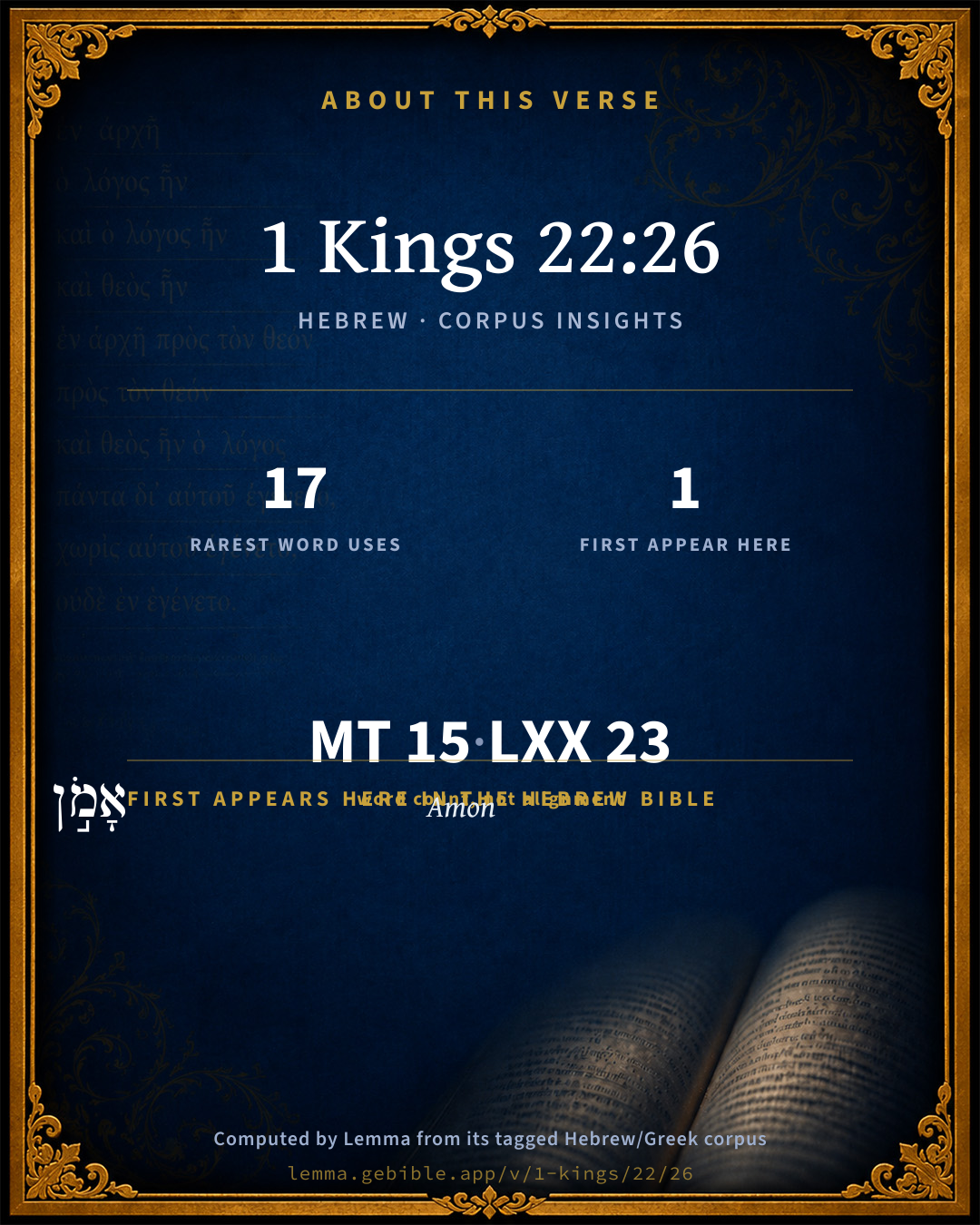
  • 1 first appearance in the Hebrew Bible
Full analysis ↓
Download a study sheet

One document with this verse’s original text, its word-by-word gloss line, the meaning frame, cross-references with their text, attributed commentary, and full source and license credits — printable, and it pastes into notes with its structure intact.

This verse Autodidact and up

Study sheet (.html) Plain text (.txt)

A passage Seminary Student

Up to 50 verses in one chapter. A passage sheet keeps up to 6 commentary sources and 12 cross-references per verse, in the order this page ranks them, and says so on the sheet whenever that leaves anything out. Ask for a single verse and you get the Autodidact verse sheet above.

Everything on this page stays free to read, with no account — the sheet is a download of what is already on screen, not access to it.

Want to remove ads? Support Godless Engineer
Compare translations 3

The same verse in 3 English versions, stacked beneath the original-language interlinear above. Click any original word for its lexicon entry.

Each is an independent rendering of the whole verse — the interlinear is not word-aligned to these translations.

Highlighted words mark where these versions differ — a whole-verse word diff, not a word-by-word alignment.

  • World English Bible Public Domain
    The king of Israel said, Take Micaiah, and carry him back to Amon the governor of the city, and to Joash the king's son;
  • King James Version Public Domain
    And the king of Israel said, Take Micaiah, and carry him back unto Amon the governor of the city, and to Joash the king's son;
  • unfoldingWord Literal Text CC BY-SA 4.0
    And the king of Israel said, “Take Micaiah and bring him back to Amon, the commander of the city, and to Joash, the son of the king.

unfoldingWord Literal Text — © unfoldingWord, licensed CC BY-SA 4.0. Word-aligned USFM3 via Door43 (git.door43.org/unfoldingWord/en_ult).

Versions to compare (up to 4)

3 of 4 selected

Show all 18 translations

Every available English version of this verse, each an independent rendering of the whole verse.

  • World English Bible Public Domain
    The king of Israel said, Take Micaiah, and carry him back to Amon the governor of the city, and to Joash the king's son;
  • Berean Standard Bible Public Domain
    And the king of Israel declared, “Take Micaiah and return him to Amon the governor of the city and to Joash the king’s son,
  • Majority Standard Bible Public Domain
    And the king of Israel declared, “Take Micaiah and return him to Amon the governor of the city and to Joash the king’s son,
  • King James Version Public Domain
    And the king of Israel said, Take Micaiah, and carry him back unto Amon the governor of the city, and to Joash the king's son;
  • American Standard Version (1901) Public Domain
    And the king of Israel said, Take Micaiah, and carry him back unto Amon the governor of the city, and to Joash the king's son;
  • Revised Version (1885) Public Domain
    And the king of Israel said, Take Micaiah, and carry him back unto Amon the governor of the city, and to Joash the king’s son;
  • Geneva Bible (1599) Public Domain
    And the King of Israel sayd, Take Michaiah, and cary him vnto Amon the gouernour of the citie, and vnto Ioash the Kings sonne,
  • Douay-Rheims (1899) Public Domain
    And the king of Israel said: Take Micheas, and let him abide with Ammon the governor of the city, and with Joas the son of Amalech.
  • Young's Literal Translation Public Domain
    And the king of Israel saith, `Take Micaiah, and turn him back unto Amon head of the city, and unto Joash son of the king,
  • Literal Standard Version CC BY-SA 4.0
    And the king of Israel says, “Take Micaiah, and turn him back to Amon head of the city, and to Joash son of the king,
  • Unlocked Literal Bible CC BY-SA 4.0
    The king of Israel said to his servant, “Seize Micaiah and take him to Amon, the governor of the city, and to Joash, my son.
  • unfoldingWord Literal Text CC BY-SA 4.0
    And the king of Israel said, “Take Micaiah and bring him back to Amon, the commander of the city, and to Joash, the son of the king.
  • Darby Bible Public Domain
    And the king of Israel said, Take Micah and carry him back to Amon the governor of the city, and to Joash the king's son;
  • World Messianic Bible Public Domain
    The king of Israel said, “Take Micaiah, and carry him back to Amon the governor of the city and to Joash the king’s son.
  • Webster's Bible Public Domain
    And the king of Israel said, Take Micaiah, and carry him back to Amon the governor of the city, and to Joash the king's son;
  • Free Bible Version CC BY-SA 4.0
    The king of Israel ordered, “Place Micaiah under arrest and take him back to Amon the governor of the city and to my son Joash.
  • Bible in Basic English Public Domain
    And the king of Israel said, Take Micaiah and send him back to Amon, the ruler of the town, and to Joash, the king's son;
  • JPS Tanakh (1917) Public Domain
    And the king of Israel said: 'Take Micaiah, and carry him back unto Amon the governor of the city, and to Joash the king's son;

Literal Standard Version (2020), Covenant Press — licensed CC BY-SA 4.0. Text via the HelloAO Bible API (eBible.org). Unlocked Literal Bible (unfoldingWord) — licensed CC BY-SA 4.0. Text via the HelloAO Bible API (eBible.org). unfoldingWord Literal Text — © unfoldingWord, licensed CC BY-SA 4.0. Word-aligned USFM3 via Door43 (git.door43.org/unfoldingWord/en_ult). Free Bible Version, Dr. Jonathan Gallagher — licensed CC BY-SA 4.0. Text via the HelloAO Bible API (eBible.org).

Word by word

More ways to search: Search by grammar → Find every occurrence → Compare this word →

Practice this passage: Drill this verse → Learn its vocabulary →

אָמֹ֣ן
ʼÂmôwn
H526
“Amon”
Noun, Proper
Part of Speech
Noun
Type
Proper
Full BDB Definition

Origin: the same as H525

TWOT: None

Amon = "skilled workman" or " master workman" - a king of Judah, son of Manasseh - a governor of Samaria - a descendant of a servant of Solomon
  1. וַיֹּ֨אמֶר֙ ʼâmar H559 “and · to say” Conjunction + Verb, Qal, Sequential Imperfect, 3rd Person, Masculine, Singular
  2. מֶ֣לֶךְ melek H4428 “king of” Noun, Common, Masculine, Singular, Construct
  3. יִשְׂרָאֵ֔ל Yisrâʼêl H3478 “Israel” Noun, Proper
  4. קַ֚ח lâqach H3947 “take” Verb, Qal, Imperative, 2nd Person, Masculine, Singular
  5. אֶת ʼêth H853 “-” Particle, Direct Object
  6. מִיכָ֔יְהוּ Mîykâyᵉhûw H4321 “Micaiah” Noun, Proper
  7. וַהֲשִׁיבֵ֖הוּ shûwb H7725 “and · return · him” Conjunction + Verb, Hiphil, Imperative, 2nd Person, Masculine, Singular + Suffix, Personal, 3rd Person, Masculine, Singular
  8. אֶל ʼêl H413 “to” Preposition
  9. שַׂר sar H8269 “prince of” Noun, Common, Masculine, Singular, Construct
  10. הָעִ֑יר ʻîyr H5892 “the · city” Particle, Definite Article + Noun, Common, Feminine, Singular, Absolute
  11. וְאֶל ʼêl H413 “and · to” Conjunction + Preposition
  12. יוֹאָ֖שׁ Yôwʼâsh H3101 “Joash” Noun, Proper
  13. בֶּן bên H1121 “son of” Noun, Common, Masculine, Singular, Construct
  14. הַמֶּֽלֶךְ melek H4428 “the · king” Particle, Definite Article + Noun, Common, Masculine, Singular, Absolute

About this verse

These counts appear in no published source. They are computed here, from the morphology-tagged text and Lemma’s own curated glosses. What Lemma adds →

15
words
13
distinct lemmas
Historical
section

Notable vocabulary

The rarest word here is אָמֹ֣ן Amon H526 — appearing just 17 times in the whole Hebrew Bible.

First appearance in Scripture

This word makes its first canonical appearance in the Hebrew Bible here:

  • אָמֹ֣ן Amon H526

Shared distinctive vocabulary

אָמֹ֣ן Amon H526 occurs in 17 verses of the Hebrew Bible. Also found in:

Grammatical profile

  • 3 verbs
  • 9 nouns
  • 2 prepositions
  • 1 particle

Verb forms

  • וַיֹּ֨אמֶר֙ Qal · Sequential Imperfect
  • קַ֚ח Qal · Imperative
  • וַהֲשִׁיבֵ֖הוּ Hiphil · Imperative

Repetition

Words recur within this verse — often emphatic in Hebrew:

  • מֶ֣לֶךְ king H4428 ×2
  • אֶל to H413 ×2

Hebrew & Septuagint length

In English translation the verse runs 24 words from the Hebrew and 19 from the Septuagint (LXX English) — closely comparable.

A rough comparison of the two English renderings, which tokenize alike — not a word-level alignment.

Word counts can differ between the Hebrew and the Greek without any difference in meaning — e.g. the Hebrew direct-object marker אֵת has no separate Greek word, and Greek often adds the article ὁ.

In the original languages it is 15 Hebrew tokens and 23 Greek tokens — but the two are counted differently (Hebrew bundles its prefixes and suffixes into one token; the Greek is in lemma form), so that isn’t a like-for-like length.

Hebrew and Greek witnesses Masoretic Hebrew ↔ Greek Septuagint

The same verse in the two great witnesses to the Old Testament, shown verse-for-verse.

These are two independent witnesses, not word-aligned to each other, and the Septuagint is shown in lemma (dictionary) form.

Hebrew 1 Kings 22:26 Masoretic · Westminster Leningrad Codex

וַיֹּ֨אמֶר֙ מֶ֣לֶךְ יִשְׂרָאֵ֔ל קַ֚ח אֶת מִיכָ֔יְהוּ וַהֲשִׁיבֵ֖הוּ אֶל אָמֹ֣ן שַׂר הָעִ֑יר וְאֶל יוֹאָ֖שׁ בֶּן הַמֶּֽלֶךְ

The king of Israel said, Take Micaiah, and carry him back to Amon the governor of the city, and to Joash the king's son;

World English Bible · Public Domain

Greek LXX 1 Kings 22:26 Septuagint · lemma form

καί εἶπον ὁ βασιλεύς ἰσραήλ λαμβάνω ὁ μιχαιας καί ἀποστρέφω αὐτός πρός εμηρ ὁ ἄρχων ὁ πόλις καί ὁ ιωας υἱός ὁ βασιλεύς

And the king of Israel said, Take Michaias, and convey him away to Semer the keeper of the city;

LXX2012 (modern English Septuagint) · Public Domain

On this verse, John Gill's Exposition discusses the Septuagint’s reading. Read the note in Commentary ↓

Hebrew: Westminster Leningrad Codex (CC BY 4.0). Greek: Septuagint (public domain); English from LXX2012 (modern English Septuagint) (Public Domain). How the Septuagint differs from the Hebrew →

Targum (Aramaic paraphrase)

1

The Targum is the ancient Jewish Aramaic paraphrase of the Hebrew Scriptures — an interpretive translation, not the Hebrew text itself. Onkelos (literal) and Pseudo-Jonathan (expansive) render the Torah, and Jonathan the Prophets. Coverage is partial: where no permissively-licensed English translation exists for a verse, only the Aramaic is shown. This is verse-level text, not a word-by-word alignment to the Hebrew.

  1. Targum Jonathan Prophets (Joshua–Malachi)
    וַאֲמַר מַלְכָּא דְיִשְׂרָאֵל דְבַר יַת מִיכָיְהוּ וַאֲתֵיבְהִי לְוַת אָמוֹן רַב קַרְתָּא וּלְוַת יוֹאָשׁ בַּר מַלְכָּא:

    (no public-domain English translation for this verse)

    Targum Jonathan — Aramaic: “Mikraot Gedolot” (public domain). English: “Sefaria Community Translation” (CC0 1.0 (public-domain dedication)); “London "Chaldee Paraphrase," 1871” (public domain). Text via Sefaria.

Commentary

Notes on 1 Kings 22:26 from classic Christian and Jewish commentators (each source and its license shown beneath its notes). The classic Christian expositions comment on the surrounding passage and are grouped to its opening verse, so a note may address several verses; the Jewish commentaries on the Tanakh (Rashi and others) are per-verse, so they appear only where the commentator wrote on this verse.

Lemma curates 59 commentaries, every one of them public domain or Creative Commons licensed, each selected and text-cleaned for this edition rather than reprinted as found. About our sources →

Trapp's Complete Commentary

John Trapp

1Ki 22:26 And the king of Israel said, Take Micaiah, and carry him back unto Amon the governor of the city, and to Joash the king’s son;

Ver. 26. And the king of Israel said.] In the heating of the king of Judah, who sat mute, and, loath to displease Ahab, had not a word to say for the good prophet. Ill company deadens one, casts a damp at least; "for the abundance of iniquity, the love of many shall wax cold."

Take Micaiah, and carry him back.] To prison, whence he was fetched likely; and whereof he might say, as that martyr did to the bishop who reviled and threatened him, Send me back to my frogs and toads, where I may be free to pray for your lordship.

John Trapp, A Commentary or Exposition upon All the Books of the Old and New Testament (1647–1656) — public domain. Text from a community e-Sword module.

Joseph Benson's Commentary

1Ki 22:26-27. Take Micaiah, and carry him back — Namely, into prison, where, it seems, he was before shut up; for so the Lord’s prophets were treated by Ahab. Feed him with bread of affliction, &c. — With very coarse and spare diet, whereby he may be only supported to endure his torment. Until I come in peace — Until I return in triumph, which I doubt not I shall, in spite of all his malicious suggestions to the contrary; and then I shall call him to an account for all his lies and impudence. Hard usage for one that would have prevented his ruin! We see here how confident Ahab was of success! He questions not but he should return in peace, forgetting what he himself had said to Ben-hadad, Let not him that girdeth on his harness boast: but there was little likelihood of his returning in peace when he left one of God’s prophets behind him in prison.

Joseph Benson's Commentary on the Old and New Testaments (1811–1818) — public domain. Text from a community e-Sword module.

Jamieson, Fausset & Brown

Robert Jamieson, A. R. Fausset & David Brown

Take Micaiah, . . . Put this fellow in prison--Ahab, under the impulse of vehement resentment, remands the prophet until his return.

Jamieson, Fausset & Brown — Commentary Critical and Explanatory on the Whole Bible (1871) — public domain (CC PDM 1.0). Text via the HelloAO Bible API.

Ellicott's Commentary for English Readers

(26) Joash the king’s son, of whom we know nothing hereafter, is apparently entrusted (like the seventy sons of 2Ki_10:1) to the charge of the governor of the city, perhaps in theory left in command of Samaria with him.

A Bible Commentary for English Readers, edited by Charles John Ellicott (1878–1897) — public domain. Text from a community e-Sword module.

The Cambridge Bible for Schools and Colleges

gen. ed. J. J. S. Perowne

26. carry him back unto Amon] As Ahab knew so well how to find Micaiah when he was wanted, it may be that he was already under the charge of Amon, in a sort of libera custodia. But the command in the next verse to put him into prison seems conclusive that he had not been a prisoner before.

Joash the king’s son] We have nothing to guide us in deciding how this man was related to Ahab, or whether he was so at all. His occupation, in conjunction with Amon the governor of the city, as superintendent of the prison-house renders it improbable that he was very closely connected with the reigning family. On the other hand we can hardly think that Joash would have this title if he were of one of the families which had preceded Omri on the throne of Israel. Each new dynasty would probably clear out of the way any who might be likely to lay claim to the throne.

The Cambridge Bible for Schools and Colleges (gen. ed. J. J. S. Perowne; Cambridge University Press, 1878–1918) — public domain. Text from a community e-Sword module.

John Gill's Exposition

And the king of Israel said unto Jehoshaphat, I will disguise myself, and enter into the battle,.... Change his clothes, his royal robes, and put on others, perhaps the habit of a common soldier; having, it may be, been informed by some deserters or spies, of the design of Benhadad against him. Abarbinel thinks the meaning is, that he would clothe himself with a coat of mail, and take to him the each of the instruments of war, and so go into the battle secure; this seems probable from Kg1 22:34 and this he might do to elude the prophecy of Micaiah:

but put thou on thy robes; his royal robes, or rather keep them on, that he might appear to be the chief commander of the army. There seems to be a good deal of insincerity and treachery in this conduct of Ahab's, whatever honour he might pretend to Jehoshaphat, or safety he might promise him in such a situation; his view seems to be to save himself at the hazard of the life of Jehoshaphat, especially if the Septuagint version could be established, "and put on my clothes"; which is natural enough, but would have been too barefaced:

and the king of Israel disguised himself, and went into the battle; as if he had been a common soldier.

John Gill's Exposition of the Whole Bible (1746–1763) — public domain (CC PDM 1.0). Text via the HelloAO Bible API.

Albert Barnes' Notes on the Bible

Carry him back - literally, “cause him to return.” Micaiah had been in custody before, and was brought by Ahab’s messenger from his prison.

The governor of the city - This is one out of several notices respecting what may be called the “constitution” of the Israelite kingdom. The king consulted on important matters a Council of elders 1Ki 20:7-8. The general administration was carried on by means of the governors of provinces 1Ki 20:14 and of cities 2Ki 10:5. The governors of cities, like the monarch, were assisted and checked by councils of elders, the wise men of the several towns 1Ki 21:8-12; 2Ki 10:5. Thus Samaria, as we see from the present passage, was under a special governor, who, among his other duties, had the control of the public prison, and directed the treatment of the prisoners.

The king’s son - The phrase seems to designate a state office, rather than relationship to the sovereign. Compare 2Ch 28:7.

Albert Barnes' Notes on the Bible (1834–1885) — public domain. Text from a community e-Sword/MySword module.

Matthew Poole's English Annotations

Carry him back, to wit, into prison; where it seems he was before shut up; for so the Lord’s prophets were used by Ahab. And some think he was the deliverer of that unwelcome message, 1Ki 20:41,42.

Matthew Poole's English Annotations on the Holy Bible (1683–1685) — public domain. Text from a community e-Sword/MySword module.

Whedon's Commentary on the Bible

Daniel D. Whedon

26. Carry him back — This expression, together with the following verse, clearly intimates that Micaiah had previously been incarcerated for prophesying contrary to the desires of the king.

Daniel D. Whedon (gen. ed.), Commentary on the Old and New Testaments (1874–1909) — public domain. Text from a community e-Sword module.

The Pulpit Commentary

And the king of Israel said, Take Sing. Take thou. This command was probably addressed to the eunuch mentioned in ver. 9 Micaiah and carry him back Heb. make him return. This shows clearly that he had come from prison unto Amon the governor rc chief; same word in 1Ki_4:2 1Ki_11:24 1Ki_16:9; Gen_37:36 Gen_40:9, Gen_40:22, etc. The "chief of the city" is also mentioned (2Ki_23:8; cf. Neh_11:9) of the city who would naturally have charge of the town prison. Probably the prison was in his house. (Cf. Gen_40:3; Jer_37:20) and to Joash the king"s son. Thenius supposes that this prince had been entrusted to Amon for his military education, and refers to 2Ki_10:1. But in that case he would hardly have been mentioned as associated with him in the charge of so important a prisoner. Whoever Joash was, he was a man in authority. It is curious that we find another prophet, Jeremiah, put into the prison of Malchiah, the son of the king (A.V the son of Hammelech; same expression as here), Jer_38:6 Jer_36:26. Some have seen in this designation a name of office, and Bahr thinks that "Joash was not probably a son of Ahab, but a prince of the blood." But when we remember what a number of sons Ahab had, (2Ki_10:1) no valid reason can be assigned why Joash should not have been one of them. He may have been billeted upon Amon, and yet associated with him in the government of the city.

The Pulpit Commentary (1880–1919), ed. H.D.M. Spence-Jones & Joseph S. Exell — public domain. Text from a community e-Sword module.

unfoldingWord translationNotes

Door43 World Missions Community

If you return safely

This describes something that would not happen. Yahweh had already told Micaiah that the king would not return safely. (See: Hypothetical Situations)

translationWords

king

kingdom of Israel

servant

seize

govern

prison

bread

save

Yahweh

unfoldingWord translationNotes — © Distant Shores Media and the Door43 World Missions Community, licensed CC BY-SA 4.0. Source: git.door43.org/Door43/en_tn.

Lesson kit

Teaching starters — assembled from the data on this page, not authored interpretation. Every prompt links to the verse data it draws on. Edit before teaching.

1 Kings, in the Historical, opens this verse with 15 words (13 distinct Hebrew lemmas). Its most distinctive word is ʼÂmôwn (“Amon”). A historical commentator’s framing appears above. Read the whole chapter for the surrounding context.

Discussion questions

  1. How does “Amon” (ʼÂmôwn) shape what this verse is saying?
  2. This is the first place “Amon” appears in Scripture (first appears here). What does its debut here establish?
  3. How does 2 Kings 21:18, which shares the word «Amon», read alongside this verse?
  4. What does the repetition of “king” (2× in this one verse) do in this verse?
  5. These translations render this verse differently. What is at stake in choosing one wording over another?
  6. «וַיֹּ֨אמֶר֙» is a Qal Sequential Imperfect verb. How does that grammatical form shape the action described?
  7. Compare how Trapp's Complete Commentary and Joseph Benson's Commentary read this verse. Where do they agree or differ?

Things to notice

Reading settings

Reading text

Shown beneath each verse's original-language words.

Old Testament
Old Testament edition

Read the OT as the Masoretic Hebrew (MT) or the Greek Septuagint (LXX).

English shown for the Greek Septuagint (in the Hebrew ↔ Greek comparison).

Comparing translations? Open the Compare panel on any verse page to stack up to four side by side.