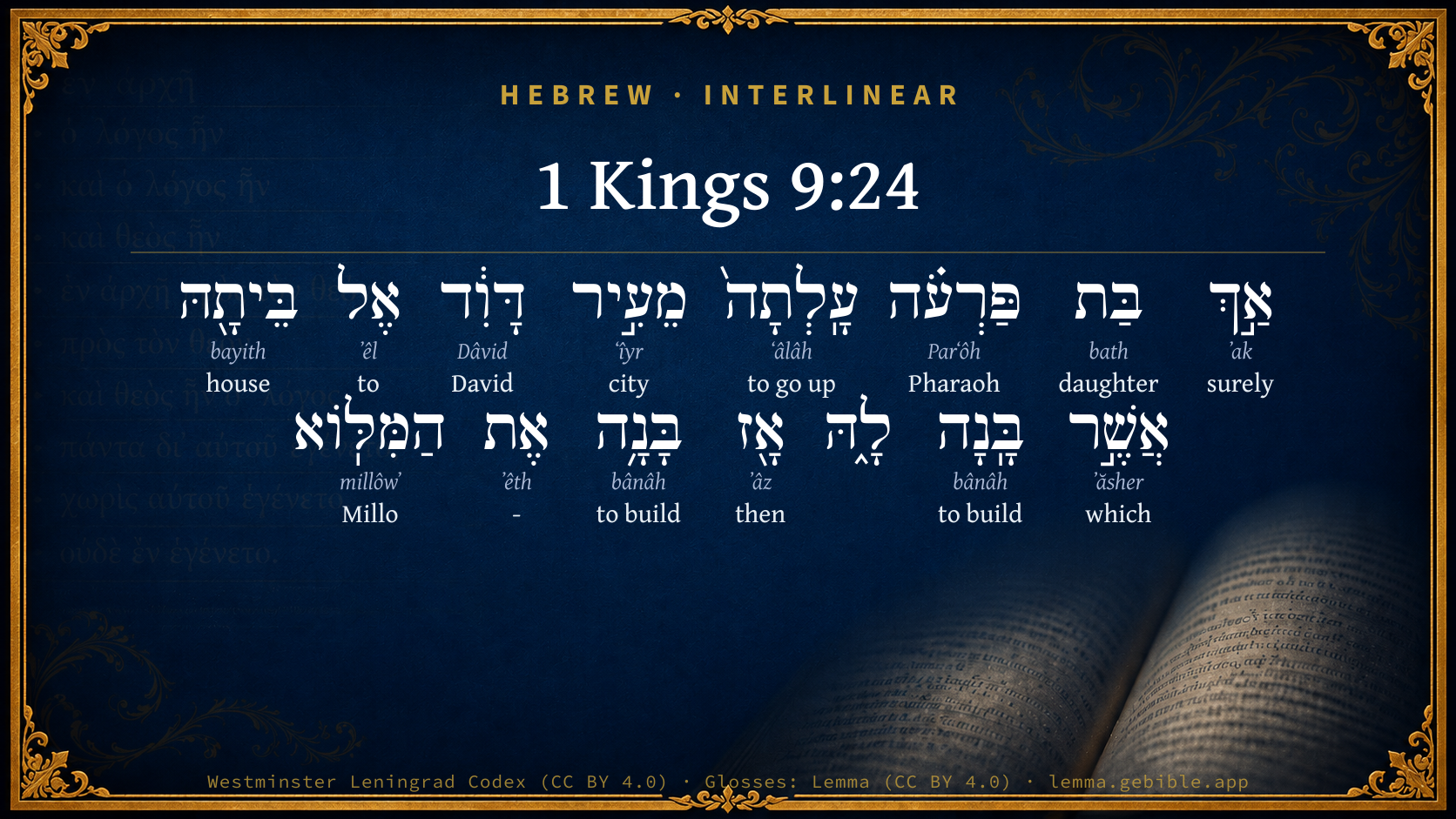
1 Kings 9:24

Hebrew (Westminster Leningrad Codex) 1 Kings 9:24 appears in the Hebrew Old Testament. The text above is from the Westminster Leningrad Codex. Each word links to its Strong’s number, a concise gloss, and parsing drawn from the Open Scriptures Hebrew Bible morphology. Click any word for its full Brown-Driver-Briggs (BDB) entry.
Download image
Cite this verse

1 Kings 9:24 (World English Bible). Public Domain. Lemma interlinear Bible study tool, https://lemma.gebible.app/v/1-kings/9/24.

Show BibTeX & RIS
BibTeX
RIS
English Translation
But Pharaoh's daughter came up out of the city of David to her house which [Solomon] had built for her: then did he build Millo.
World English Bible · Public Domain
Download a study sheet

One document with this verse’s original text, its word-by-word gloss line, the meaning frame, cross-references with their text, attributed commentary, and full source and license credits — printable, and it pastes into notes with its structure intact.

This verse Autodidact and up

Study sheet (.html) Plain text (.txt)

A passage Seminary Student

Up to 50 verses in one chapter. A passage sheet keeps up to 6 commentary sources and 12 cross-references per verse, in the order this page ranks them, and says so on the sheet whenever that leaves anything out. Ask for a single verse and you get the Autodidact verse sheet above.

Everything on this page stays free to read, with no account — the sheet is a download of what is already on screen, not access to it.

Want to remove ads? Support Godless Engineer
Compare translations 3

The same verse in 3 English versions, stacked beneath the original-language interlinear above. Click any original word for its lexicon entry.

Each is an independent rendering of the whole verse — the interlinear is not word-aligned to these translations.

Highlighted words mark where these versions differ — a whole-verse word diff, not a word-by-word alignment.

  • World English Bible Public Domain
    But Pharaoh's daughter came up out of the city of David to her house which [Solomon] had built for her: then did he build Millo.
  • King James Version Public Domain
    But Pharaoh's daughter came up out of the city of David unto her house which Solomon had built for her: then did he build Millo.
  • unfoldingWord Literal Text CC BY-SA 4.0
    Once the daughter of Pharoah had gone up from the City of David to her house that he had built for her, then he built the Millo.

unfoldingWord Literal Text — © unfoldingWord, licensed CC BY-SA 4.0. Word-aligned USFM3 via Door43 (git.door43.org/unfoldingWord/en_ult).

Versions to compare (up to 4)

3 of 4 selected

Show all 18 translations

Every available English version of this verse, each an independent rendering of the whole verse.

  • World English Bible Public Domain
    But Pharaoh's daughter came up out of the city of David to her house which [Solomon] had built for her: then did he build Millo.
  • Berean Standard Bible Public Domain
    As soon as Pharaoh’s daughter had come up from the City of David to the palace that Solomon had built for her, he built the supporting terraces.
  • Majority Standard Bible Public Domain
    As soon as Pharaoh’s daughter had come up from the City of David to the palace that Solomon had built for her, he built the supporting terraces.
  • King James Version Public Domain
    But Pharaoh's daughter came up out of the city of David unto her house which Solomon had built for her: then did he build Millo.
  • American Standard Version (1901) Public Domain
    But Pharaoh's daughter came up out of the city of David unto her house which `Solomon' had built for her: then did he build Millo.
  • Revised Version (1885) Public Domain
    But Pharaoh’s daughter came up out of the city of David unto her house which Solomon had built for her: then did he build Millo.
  • Geneva Bible (1599) Public Domain
    And Pharaohs daughter came vp from the citie of Dauid vnto the house which Salomon had built for her: then did he buylde Millo.
  • Douay-Rheims (1899) Public Domain
    And the daughter of Pharao came up out of the city of David to her house, which Solomon had built for her: then did he build Mello.
  • Young's Literal Translation Public Domain
    Only, the daughter of Pharaoh went up out of the city of David unto her house that `Solomon' built for her; then he built Millo.
  • Literal Standard Version CC BY-SA 4.0
    Only, the daughter of Pharaoh went up out of the City of David to her house that [Solomon] built for her; then he built Millo.
  • Unlocked Literal Bible CC BY-SA 4.0
    Pharaoh's daughter moved from the city of David to the house that Solomon had built for her. Later, Solomon built the Millo.
  • unfoldingWord Literal Text CC BY-SA 4.0
    Once the daughter of Pharoah had gone up from the City of David to her house that he had built for her, then he built the Millo.
  • Darby Bible Public Domain
    But Pharaoh's daughter came up out of the city of David to her house which he had built for her: then he built Millo.
  • World Messianic Bible Public Domain
    But Pharaoh’s daughter came up out of David’s city to her house which Solomon had built for her. Then he built Millo.
  • Webster's Bible Public Domain
    But Pharaoh's daughter came up from the city of David to her house which Solomon had built for her: then he built Millo.
  • Free Bible Version CC BY-SA 4.0
    Once Pharaoh's daughter had moved from the City of David to the palace that Solomon had built for her, he built the city terraces.
  • Bible in Basic English Public Domain
    At that time Solomon made Pharaoh's daughter come up from the town of David to the house which he had made for her: then he made the Millo.
  • JPS Tanakh (1917) Public Domain
    But Pharaoh's daughter came up out of the city of David unto her house which Solomon had built for her; then did he build Millo.

Literal Standard Version (2020), Covenant Press — licensed CC BY-SA 4.0. Text via the HelloAO Bible API (eBible.org). Unlocked Literal Bible (unfoldingWord) — licensed CC BY-SA 4.0. Text via the HelloAO Bible API (eBible.org). unfoldingWord Literal Text — © unfoldingWord, licensed CC BY-SA 4.0. Word-aligned USFM3 via Door43 (git.door43.org/unfoldingWord/en_ult). Free Bible Version, Dr. Jonathan Gallagher — licensed CC BY-SA 4.0. Text via the HelloAO Bible API (eBible.org).

Word by word

More ways to search: Search by grammar → Find every occurrence → Compare this word →

Practice this passage: Drill this verse → Learn its vocabulary →

הַמִּלּֽוֹא
millôwʼ
H4407
“the · Millo”
Particle, Definite Article + Noun, Proper
Part of Speech
Particle + Noun
Type
Proper
Full BDB Definition

Origin: from H4390

TWOT: None

Millo = "rampart" or " mound" - a place near Shechem; site unknown - a part of the fortifications of Jerusalem
  1. אַ֣ךְ ʼak H389 “surely” Particle, Accusative
  2. בַּת bath H1323 “daughter of” Noun, Common, Feminine, Singular, Construct
  3. פַּרְעֹ֗ה Parʻôh H6547 “Pharaoh” Noun, Proper
  4. עָֽלְתָה֙ ʻâlâh H5927 “to go up” Verb, Qal, Perfect, 3rd Person, Feminine, Singular
  5. מֵעִ֣יר ʻîyr H5892 “from · city of” Preposition + Noun, Common, Feminine, Singular, Construct
  6. דָּוִ֔ד Dâvid H1732 “David” Noun, Proper
  7. אֶל ʼêl H413 “to” Preposition
  8. בֵּיתָ֖הּ bayith H1004 “house · her” Noun, Common, Masculine, Singular, Construct + Suffix, Personal, 3rd Person, Feminine, Singular
  9. אֲשֶׁ֣ר ʼăsher H834 “which” Particle, Relative
  10. בָּֽנָה bânâh H1129 “to build” Verb, Qal, Perfect, 3rd Person, Masculine, Singular
  11. אָ֖ז ʼâz H227 “then” Adverb
  12. בָּנָ֥ה bânâh H1129 “to build” Verb, Qal, Perfect, 3rd Person, Masculine, Singular
  13. אֶת ʼêth H853 “-” Particle, Direct Object

About this verse

These counts appear in no published source. They are computed here, from the morphology-tagged text and Lemma’s own curated glosses. What Lemma adds →

15
words
13
distinct lemmas
Historical
section

Notable vocabulary

The rarest word here is הַמִּלּֽוֹא Millo H4407 — appearing just 10 times in the whole Hebrew Bible.

Shared distinctive vocabulary

הַמִּלּֽוֹא Millo H4407 occurs in 9 verses of the Hebrew Bible. Also found in:

Grammatical profile

  • 3 verbs
  • 6 nouns
  • 2 prepositions
  • 1 adverb
  • 3 particles

Verb forms

  • עָֽלְתָה֙ Qal · Perfect
  • בָּֽנָה Qal · Perfect
  • בָּנָ֥ה Qal · Perfect

Repetition

A word recurs within this verse — often emphatic in Hebrew:

  • בָּֽנָה to build H1129 ×2

Cross-references

7

Topical passages linked to 1 Kings 9:24 in the Treasury of Scripture Knowledge — connected by theme and wording, ordered by reader-vote popularity; previews shown in the World English Bible.

  • 1 Kings 7:8 His house where he was to dwell, the other court within the porch, was of the like work. He made also a house for Pharaoh's daughter (whom Solomon had taken as wife), like this porch.
  • 2 Samuel 5:9 David lived in the stronghold, and called it the city of David. David built round about from Millo and inward.
  • 1 Kings 11:27 This was the reason why he lifted up his hand against the king: Solomon built Millo, and repaired the breach of the city of David his father.
  • 2 Chronicles 32:5 He took courage, and built up all the wall that was broken down, and raised [it] up to the towers, and the other wall outside, and strengthened Millo [in] the city of David, and made weapons and shields in abundance.
  • 1 Kings 3:1 Solomon made affinity with Pharaoh king of Egypt, and took Pharaoh's daughter, and brought her into the city of David, until he had made an end of building his own house, and the house of Yahweh, and the wall of Jerusalem round about.
  • 1 Kings 9:15–16 This is the reason of the levy which king Solomon raised, to build the house of Yahweh, and his own house, and Millo, and the wall of Jerusalem, and Hazor, and Megiddo, and Gezer.
  • 2 Chronicles 8:11 Solomon brought up the daughter of Pharaoh out of the city of David to the house that he had built for her; for he said, My wife shall not dwell in the house of David king of Israel, because the places are holy, whereunto the ark of Yahweh has come.

Cross-references courtesy of OpenBible.info (CC BY 4.0).

Hebrew and Greek witnesses Masoretic Hebrew ↔ Greek Septuagint

The same verse in the two great witnesses to the Old Testament, shown verse-for-verse.

These are two independent witnesses, not word-aligned to each other, and the Septuagint is shown in lemma (dictionary) form.

Hebrew 1 Kings 9:24 Masoretic · Westminster Leningrad Codex

אַ֣ךְ בַּת פַּרְעֹ֗ה עָֽלְתָה֙ מֵעִ֣יר דָּוִ֔ד אֶל בֵּיתָ֖הּ אֲשֶׁ֣ר בָּֽנָה לָ֑הּ אָ֖ז בָּנָ֥ה אֶת הַמִּלּֽוֹא

But Pharaoh's daughter came up out of the city of David to her house which [Solomon] had built for her: then did he build Millo.

World English Bible · Public Domain

Hebrew: Westminster Leningrad Codex (CC BY 4.0). Greek: Septuagint (public domain); English from a public-domain English Septuagint. How the Septuagint differs from the Hebrew →

Targum (Aramaic paraphrase)

1

The Targum is the ancient Jewish Aramaic paraphrase of the Hebrew Scriptures — an interpretive translation, not the Hebrew text itself. Onkelos (literal) and Pseudo-Jonathan (expansive) render the Torah, and Jonathan the Prophets. Coverage is partial: where no permissively-licensed English translation exists for a verse, only the Aramaic is shown. This is verse-level text, not a word-by-word alignment to the Hebrew.

  1. Targum Jonathan Prophets (Joshua–Malachi)
    בְּרַם בַת פַּרְעֹה סְלֵיקַת מִקַרְתָּא דְדָוִד לְבֵיתָא דִי בְנָא לָהּ בְּכֵן בְּנָא יַת מַלֵיתָא:

    (no public-domain English translation for this verse)

    Targum Jonathan — Aramaic: “Mikraot Gedolot” (public domain). English: “Sefaria Community Translation” (CC0 1.0 (public-domain dedication)); “London "Chaldee Paraphrase," 1871” (public domain). Text via Sefaria.

Commentary

Notes on 1 Kings 9:24 from classic Christian and Jewish commentators (each source and its license shown beneath its notes). The classic Christian expositions comment on the surrounding passage and are grouped to its opening verse, so a note may address several verses; the Jewish commentaries on the Tanakh (Rashi and others) are per-verse, so they appear only where the commentator wrote on this verse.

Lemma curates 59 commentaries, every one of them public domain or Creative Commons licensed, each selected and text-cleaned for this edition rather than reprinted as found. About our sources →

Jamieson, Fausset & Brown

Robert Jamieson, A. R. Fausset & David Brown

SOLOMON'S YEARLY SACRIFICES. (Kg1 9:24-28)

three times in a year--namely, at the passover, pentecost, and feast of tabernacles (Ch2 8:13; Ch2 31:3). The circumstances mentioned in these two verses form a proper conclusion to the record of his buildings and show that his design in erecting those at Jerusalem was to remedy defects existing at the commencement of his reign (see Kg1 3:1-4).

Jamieson, Fausset & Brown — Commentary Critical and Explanatory on the Whole Bible (1871) — public domain (CC PDM 1.0). Text via the HelloAO Bible API.

Trapp's Complete Commentary

John Trapp

1Ki 9:24 But Pharaoh’s daughter came up out of the city of David unto her house which [Solomon] had built for her: then did he build Millo.

Ver. 24. But Pharaoh’s daughter came up.] See the reason of this remove. {2Ch 8:11}

John Trapp, A Commentary or Exposition upon All the Books of the Old and New Testament (1647–1656) — public domain. Text from a community e-Sword module.

Joseph Benson's Commentary

1Ki 9:24. Pharaoh’s daughter came up, &c. — In 2Ch 8:11, we learn the reason why she did not continue in the house where David had dwelt; which was because it was a kind of holy place, where it was not fit she should remain, the ark of God having dwelt there.

Joseph Benson's Commentary on the Old and New Testaments (1811–1818) — public domain. Text from a community e-Sword module.

Tyndale Open Study Notes

Tyndale Open Resources

9:24 The new palace Solomon built for . . . Pharaoh’s daughter was separate from Solomon’s own residence because his palace was deemed holy, “for the Ark of the Lord has been there” (2 Chr 8:11). The place where the Ark resided was considered sacred, since it embodied God’s presence and sanctified its surroundings (Exod 25:22; see also 2 Sam 6:7; 1 Chr 15:11-13).

Tyndale Open Study Notes — © Tyndale Open Resources, licensed CC BY-SA 4.0. Text via the HelloAO Bible API.

Ellicott's Commentary for English Readers

(24) Pharaoh’s daughter came up . . .—In 2Ch_8:11 a reason is assigned for this removal: “My wife shall not dwell in the house of David king of Israel, because the places are holy whereunto the ark of the Lord hath come.” In this passage the notice of her withdrawal is evidently connected with the building of “the Millo” described in 1Ki_9:15, which perhaps trenched on her former quarters in the city of David.

A Bible Commentary for English Readers, edited by Charles John Ellicott (1878–1897) — public domain. Text from a community e-Sword module.

The Cambridge Bible for Schools and Colleges

gen. ed. J. J. S. Perowne

24. But Pharaoh’s daughter came up] On her residence in the city of David, see in 1Ki_3:1.

Millo] See above, 1Ki_9:15.

The Cambridge Bible for Schools and Colleges (gen. ed. J. J. S. Perowne; Cambridge University Press, 1878–1918) — public domain. Text from a community e-Sword module.

John Gill's Exposition

And King Solomon made a navy of ships in Eziongeber,.... Which was one of the stations of the Israelites, near the wilderness of Sin, or Paran, Num 33:35, it signifies the backbone of a man; and it is said (w) the ridge of rocks before this port were in that form, covered by the sea at high water, and sticking up with various points in a line when it was low. Josephus says (x) in his time it was called Berenice, which is placed by Mela (y) between the Heroopolitic bay, and the promontory Strobilus, or Pharan. It is thought probable (z) to be the same with that which is called by the Arabs Meenah-el-Dsahab, the port of gold, called Dizahab, Deu 1:1, which stands upon the shore of the Arabic gulf, about two or three days' distance from Mount Sinai; though by others (a) thought to be the same the Arabs call Calzem, where was a great quantity of wood fit for building ships. It is further described,

which is beside Elath, on the shore of the Red sea, in the land of Edom; and when Edom was subdued by David, this port fell into his hands, and so was in the possession of Solomon; and there being plenty of timber in the parts adjacent, and this being a port in the Red sea, Solomon chose it as proper place to build ships in. Elath, near to which was, is the same the Elanitic bay had its name from; or which See Gill on Deu 2:8. Trajan, the Roman emperor, formed a navy in the Red sea (b), that by it he might ravage and waste the borders of India; and here it seems Solomon's navy went; see Kg1 9:28.

(w) Harris's Voyages, vol. 1. B. 1. ch. 2. sect. 3. p. 377. (x) Antiqu. l. 8. c. 6. sect. 4. (y) De Situ Orbis, l. 3. c. 8. (z) Clayton's Chronology, &c. p. 407. (a) Vossius in Melam ut supra, (Harris's Voyages, vol. 1. B. 1. ch. 2. sect. 3.) p. 386. (b) Eutrop. Rom. Hist. l. 8. Ruti Fest. Breviar.

John Gill's Exposition of the Whole Bible (1746–1763) — public domain (CC PDM 1.0). Text via the HelloAO Bible API.

Albert Barnes' Notes on the Bible

Compare the marginal reference. Solomon was not satisfied that Pharaoh’s daughter should remain in the palace of David, which was on Mount Zion, in the immediate vicinity of the temple, because he regarded the whole vicinity of the temple as made holy by the presence of the ark of God. His own palace was on the other (western) hill, probably directly opposite to the temple, the valley of the Tyropoeum running between them.

Albert Barnes' Notes on the Bible (1834–1885) — public domain. Text from a community e-Sword/MySword module.

Haydock's Catholic Bible Commentary

Mello, taking it from the public, and adorning it with the most beautiful structures, for the honour and convenience of his queen. (Tirinus)

George Leo Haydock (1774–1849), Haydock's Catholic Family Bible and Commentary, 1859 edition — public domain. Excludes Psalms (Douay-Rheims chapter numbering differs from Protestant) and Deuterocanonical books (Catholic canon only).

Whedon's Commentary on the Bible

Daniel D. Whedon

24. Pharaoh’s daughter… out of the city of David — Hence it is clear that Solomon’s palace was not in the city of David, or on Zion, but (as we have argued in note introductory to chap. vii) on the same mountain as the temple, but at a lower elevation. Her transfer to her new abode is spoken of, like that of the ark and the tabernacle, as a going up. See note on 1Ki_8:4.

Unto her house — A department of his own new palace. See on 1Ki_7:8.

Then did he build Millo — That is, after he had removed his Egyptian wife to her new home, he repaired this fortress. This passage merely specifies the time of the work referred to in 1Ki_9:15.

Daniel D. Whedon (gen. ed.), Commentary on the Old and New Testaments (1874–1909) — public domain. Text from a community e-Sword module.

The Pulpit Commentary

But lit. only. Keil rightly connects the word with za below. "So soon as.. then." Cf. Gen_27:30. This and ver. 25 are not interposed arbitrarily, as might at first sight appear, but refer to 1Ki_3:1-4. The completion of the palaces rendered it no longer necessary or proper that Solomon"s daughter should dwell in a separate house. The chronicler tells us that she had dwelt in David"s palace on Mount Zion, and that Solomon was constrained to remove her, because he looked upon all the precinct as now consecrated (2Ch_8:11) Pharaoh"s daughter came up htl Keil hence argues that the palace stood on higher ground than David"s house. But this conclusion is somewhat precarious. The approach to the palace involved an ascent, but Zion was certainly as high as Ophel out of the city of David unto her house which Solomon Heb. he had built for her: then did he build Millo. Thenius infers from these words that Mille was a fort or castle for the protection of the harem. But there is no warrant for any such conjecture. In the first place, this wife would seem to have been lodged in her own palace apart from the other wives.

1. We can offer a better explanation of the word Mille (see ver. 15).

2. The word "then" may mean either

(1), that when her palace was completed, Solomon then had workmen who were liberated and were employed on Mille (Keil), or

(2), that when she vacated David"s house, the building of Mille could be proceeded with.

The Pulpit Commentary (1880–1919), ed. H.D.M. Spence-Jones & Joseph S. Exell — public domain. Text from a community e-Sword module.

unfoldingWord translationNotes

Door43 World Missions Community

built the Millo

Possible meanings are 1) "built the terrace system" or 2) "built the landfill." See how you translated "the Millo" in 1 Kings 9:15.

translationWords

Pharaoh

city of David

unfoldingWord translationNotes — © Distant Shores Media and the Door43 World Missions Community, licensed CC BY-SA 4.0. Source: git.door43.org/Door43/en_tn.

Rashi

Rabbi Shlomo Yitzchaki (Rashi)

Only then did the daughter of Pharaoh. Who was originally in the city of Dovid, as it is stated in the beginning of the book, “and he brought her to the City of Dovid.”

Came up from the city of Dovid, etc. In Divrei Hayomim it explains, “for he said, ‘I should not have a wife live with me in [the City of] Dovid because they are holy [places], for the Ark of Adonoy was brought there.’” of Dovid.”

Then he built up. [I.e.,] Shlomo.

The Millo. To build within it houses for her menservants and maidservants. Concerning this Yerovom admonished him [saying], “Your father left it open for the festival pilgrims, and you closed it up to make a labor force for Pharaoh’s daughter.” And this “but” mentioned here [means,] but in this Shlomo sinned, that he had built for her the Millo. So have I heard, but I say, “But then did the daughter of Pharaoh, etc.,” I.e., the above mentioned cities were necessary to build for store cities, chariots, riders, and greatness; but, the Millo he did not build for any greatness, for his father had left it for the festival pilgrims to pitch their tents there, but since Pharaoh’s daughter had gone up to her house, and the Millo was adjacent to that house, then he built up the Millo.

Rashi on the Tanakh — English translations: “The Judaica Press complete Tanach with Rashi, translated by A. J. Rosenberg” (CC BY 4.0); “Pentateuch with Rashi's commentary by M. Rosenbaum and A.M. Silbermann, 1929-1934” (public domain); “The Metsudah Tanach series, Lakewood, N.J” (CC BY 4.0); and “The Book of Joshua, Metsudah Publications, 1997” (CC BY 4.0). Text via Sefaria.

Lesson kit

Teaching starters — assembled from the data on this page, not authored interpretation. Every prompt links to the verse data it draws on. Edit before teaching.

1 Kings, in the Historical, opens this verse with 15 words (13 distinct Hebrew lemmas). Its most distinctive word is millôwʼ (“Millo”). A historical commentator’s framing appears above. Read the whole chapter for the surrounding context.

Discussion questions

  1. How does “Millo” (millôwʼ) shape what this verse is saying?
  2. Judges 9:6 shares the word «Millo» with this verse. How do the two illuminate each other?
  3. “to build” occurs 2× in this one verse. What is the effect of the repetition?
  4. These translations render this verse differently; the difference is in the English rendering, not the original. What questions does that raise?
  5. The verb «עָֽלְתָה֙» is Qal Perfect. How does its form color the action?
  6. Reading how Jamieson, Fausset & Brown and Trapp's Complete Commentary read this verse, where do the two commentators agree and where do they part?

Things to notice

Reading settings

Reading text

Shown beneath each verse's original-language words.

Old Testament
Old Testament edition

Read the OT as the Masoretic Hebrew (MT) or the Greek Septuagint (LXX).

English shown for the Greek Septuagint (in the Hebrew ↔ Greek comparison).

Comparing translations? Open the Compare panel on any verse page to stack up to four side by side.