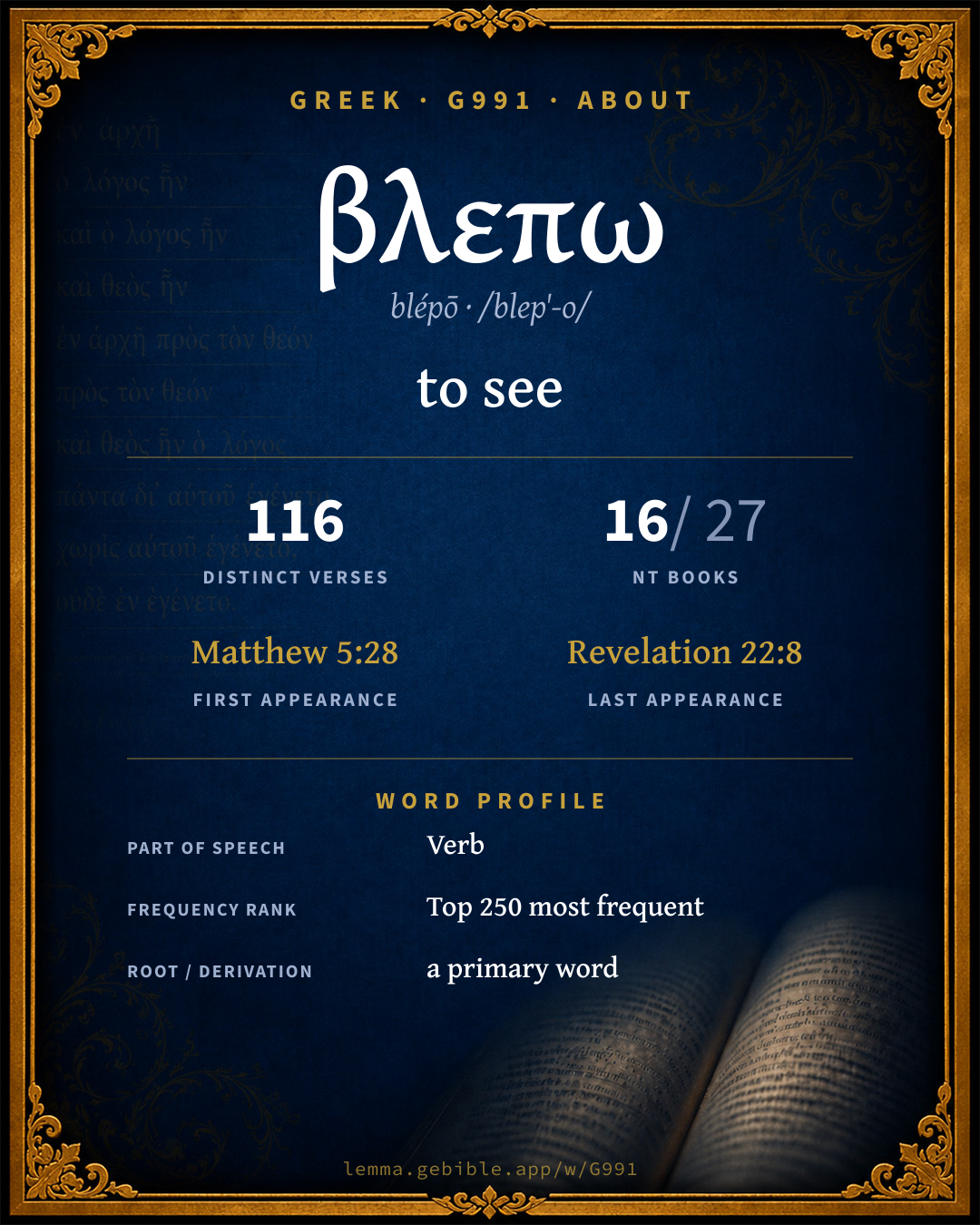
βλέπω
to see
‘to see’ is one of 3 main senses fuller range ↓
Full lexicon entry — Thayer's Greek Lexicon
From Thayer's Greek Lexicon
Where this word appears
See every Present-tense verb in the Greek New Testament →
Grammar key — what these labels mean
Part of speech
- Verb
- An action or state-of-being word.
Tense
- Present
- Ongoing or general action in present time (imperfective aspect).
- Future
- Action expected in future time.
- Aorist
- Action viewed as a simple whole, without regard to duration — often past (perfective aspect).
- Imperfect
- Continuous or repeated action in past time (“was writing”).
Voice
- Active
- The subject performs the action.
- Passive
- The subject receives the action.
Mood
- Imperative
- Expresses a command or request.
- Participle
- A verbal adjective (“writing,” “having written”).
- Indicative
- States a fact or asks a factual question (the mood of reality).
- Infinitive
- A verbal noun (“to write”), unmarked for person or number.
- Subjunctive
- Expresses probability, purpose, or possibility (the mood of contingency).
Case
- Nominative
- The case of the subject (and the predicate nominative).
- Accusative
- The case of the direct object and of extent.
- Genitive
- The case of source, possession, or “of” — answers “whose / from what.”
Person
- 2nd person
- The one addressed (“you”).
- 3rd person
- The one spoken about (“he / she / it / they”).
- 1st person
- The speaker (“I / we”).
Gender
- Masculine
- Grammatically masculine.
- Neuter
- Grammatically neuter.
- Feminine
- Grammatically feminine.
Number
- Plural
- More than one.
- Singular
- One.
Grammatical forms 28 distinct
- Verb, Present, Active, Imperative, 2nd person, Plural 23 times (17%)
- Verb, Present, Active, Participle, Nominative, Plural, Masculine 12 times (9%)
- Verb, Present, Active, Participle, Nominative, Singular, Masculine 12 times (9%)
- Verb, Present, Active, Indicative, 2nd person, Plural 10 times (8%)
- Verb, Present, Active, Indicative, 3rd person, Singular 10 times (8%)
- Verb, Present, Active, Infinitive 10 times (8%)
- Verb, Present, Active, Indicative, 2nd person, Singular 9 times (7%)
- Verb, Present, Active, Subjunctive, 3rd person, Plural 7 times (5%)
+20 more forms (39 occurrences)
Parsed forms decoded from the imported morphology (Robinson–Tischendorf, public domain), counted across 132 parsed occurrences — not distinct verses.
Every verse where G991 appears — 116 distinct verses across 16 books. Click any verse to open its interlinear word-by-word view. Verse text shown in the World English Bible for context — . Each verse’s Greek form is shown with its reference; the English is not keyword-highlighted, since the data carries no word-level English alignment. Use “Compare translations” on any verse to read it across multiple English versions. This concordance covers the Greek New Testament; Septuagint (Greek Old Testament) occurrences of this word are not indexed here.
Matthew 17 verses
- Matthew 5:28 βλέπων pres act ptcp nom sg masc but I tell you that everyone who gazes at a woman to lust after her has committed adultery with her already in his heart.
- Matthew 6:4 βλέπων pres act ptcp nom sg masc so that your merciful deeds may be in secret, then your Father who sees in secret will reward you openly.
- Matthew 6:6 βλέπων pres act ptcp nom sg masc But you, when you pray, enter into your inner chamber, and having shut your door, pray to your Father who is in secret, and your Father who sees in secret will reward you openly.
- Matthew 6:18 βλέπων pres act ptcp nom sg masc so that you are not seen by men to be fasting, but by your Father who is in secret, and your Father, who sees in secret, will reward you.
- Matthew 7:3 βλέπεις pres act ind 2sg Why do you see the speck that is in your brother's eye, but don't consider the beam that is in your own eye?
- Matthew 11:4 βλέπετε pres act ind 2pl Jesus answered them, "Go and tell John the things which you hear and see:
- Matthew 12:22 βλέπειν pres act inf Then one possessed by a demon, blind and mute, was brought to him and he healed him, so that the blind and mute man both spoke and saw.
- Matthew 13:13 βλέποντες βλέπουσιν pres act ptcp nom pl masc pres act ind 3pl Therefore I speak to them in parables, because seeing they don't see, and hearing, they don't hear, neither do they understand.
- Matthew 13:14 βλέποντες βλέψετε pres act ptcp nom pl masc fut act ind 2pl In them the prophecy of Isaiah is fulfilled, which says, 'By hearing you will hear, And will in no way understand; Seeing you will see, And will in no way perceive:
- Matthew 13:16 βλέπουσιν pres act ind 3pl "But blessed are your eyes, for they see; and your ears, for they hear.
- Matthew 13:17 βλέπετε pres act ind 2pl For most assuredly I tell you that many prophets and righteous men desired to see the things which you see, and didn't see them; and to hear the things which you hear, and didn't hear them.
- Matthew 14:30 βλέπων pres act ptcp nom sg masc But when he saw that the wind was strong, he was afraid, and beginning to sink, he cried out, saying, "Lord, save me!"
- Matthew 15:31 βλέποντας βλέποντας pres act ptcp acc pl masc pres act ptcp acc pl masc so that the multitude wondered when they saw the mute speaking, injured whole, lame walking, and blind seeing--and they glorified the God of Israel.
- Matthew 18:10 βλέπουσιν pres act ind 3pl See that you don't despise one of these little ones, for I tell you that in heaven their angels always see the face of my Father who is in heaven.
- Matthew 22:16 βλέπεις pres act ind 2sg They sent their disciples to him, along with the Herodians, saying, "Teacher, we know that you are honest, and teach the way of God in truth, no matter who you teach, for you aren't partial to anyone.
- Matthew 24:2 βλέπετε pres act ind 2pl But he answered them, "Don't you see all of these things? Most assuredly I tell you, there will not be left here one stone on another, that will not be thrown down."
- Matthew 24:4 βλέπετε pres act impv 2pl Jesus answered them, "Be careful that no one leads you astray.
Mark 14 verses
- Mark 4:12 βλέποντες βλέπωσιν pres act ptcp nom pl masc pres act subj 3pl that 'seeing they may see, and not perceive; and hearing they may hear, and not understand; lest perhaps they should turn again, and their sins should be forgiven them.'"
- Mark 4:24 βλέπετε pres act impv 2pl He said to them, "Take heed what you hear. With whatever measure you measure, it will be measured to you, and more will be given to you who hear.
- Mark 5:31 βλέπεις pres act ind 2sg His disciples said to him, "You see the multitude pressing against you, and you say, 'Who touched me?'"
- Mark 8:15 βλέπετε pres act impv 2pl He charged them, saying, "Take heed: beware of the yeast of the Pharisees and the yeast of Herod."
- Mark 8:18 βλέπετε pres act ind 2pl Having eyes, don't you see? Having ears, don't you hear? Don't you remember?
- Mark 8:23 βλέπει pres act ind 3sg He took hold of the blind man by the hand, and brought him out of the village. When he had spit on his eyes, and laid his hands on him, he asked him if he saw anything.
- Mark 8:24 βλέπω pres act ind 1sg He looked up, and said, "I see men; for I see them like trees walking."
- Mark 12:14 βλέπεις pres act ind 2sg When they had come, they asked him, "Teacher, we know that you are honest, and don't defer to anyone; for you aren't partial to anyone, but truly teach the way of God. Is it lawful to pay taxes to Caesar, or not?
- Mark 12:38 βλέπετε pres act impv 2pl In his teaching he said to them, "Beware of the scribes, who like to walk in long robes, and to get greetings in the marketplaces,
- Mark 13:2 βλέπεις pres act ind 2sg Jesus said to him, "Do you see these great buildings? There will not be left here one stone on another, which will not be thrown down."
- Mark 13:5 βλέπετε pres act impv 2pl Jesus, answering, began to tell them, "Be careful that no one leads you astray.
- Mark 13:9 Βλέπετε pres act impv 2pl But watch yourselves, for they will deliver you up to councils. You will be beaten in synagogues. You will stand before rulers and kings for my sake, for a testimony to them.
- Mark 13:23 βλέπετε pres act impv 2pl But you watch. "Behold, I have told you all things beforehand.
- Mark 13:33 βλέπετε pres act impv 2pl Watch, keep alert, and pray; for you don't know when the time is.
Luke 13 verses
- Luke 6:41 βλέπεις pres act ind 2sg Why do you see the speck of chaff that is in your brother's eye, but don't consider the beam that is in your own eye?
- Luke 6:42 βλέπων pres act ptcp nom sg masc Or how can you tell your brother, 'Brother, let me remove the speck of chaff that is in your eye,' when you yourself don't see the beam that is in your own eye? You hypocrite! First remove the beam from your own eye, and then you can see clearly to remove the speck of chaff that is in your brother's eye.
- Luke 7:21 βλέπειν pres act inf In that hour he cured many of diseases and plagues and evil spirits; and to many who were blind he gave sight.
- Luke 7:44 βλέπεις pres act ind 2sg Turning to the woman, he said to Simon, "Do you see this woman? I entered into your house, and you gave me no water for my feet, but she has wet my feet with her tears, and wiped them with the hair of her head.
- Luke 8:10 βλέποντες βλέπωσιν pres act ptcp nom pl masc pres act subj 3pl He said, "To you it is given to know the mysteries of the Kingdom of God, but to the rest in parables; that 'seeing they may not see, and hearing they may not understand.'
- Luke 8:16 βλέπωσιν pres act subj 3pl "No one, when he has lit a lamp, covers it with a container, or puts it under a bed; but puts it on a stand, that those who enter in may see the light.
- Luke 8:18 βλέπετε pres act impv 2pl Be careful therefore how you hear. For whoever has, to him will be given; and whoever doesn't have, from him will be taken away even that which he thinks he has."
- Luke 9:62 βλέπων pres act ptcp nom sg masc But Jesus said to him, "No one, having put his hand to the plow, and looking back, is fit for the Kingdom of God."
- Luke 10:23 βλέποντες βλέπετε pres act ptcp nom pl masc pres act ind 2pl Turning to the disciples, he said privately, "Blessed are the eyes which see the things that you see,
- Luke 10:24 βλέπετε pres act ind 2pl for I tell you that many prophets and kings desired to see the things which you see, and didn't see them, and to hear the things which you hear, and didn't hear them."
- Luke 11:33 βλέπωσιν pres act subj 3pl "No man, when he has lit a lamp, puts it in a cellar, nor under a basket, but on a stand, that those who enter in may see the light.
- Luke 21:8 βλέπετε pres act impv 2pl He said, "Watch out that you don't get led astray, for many will come in my name, saying, 'I AM,' and, 'The time is at hand.' Therefore don't follow them.
- Luke 21:30 βλέποντες pres act ptcp nom pl masc When they are already budding, you see it and know by your own selves that the summer is already near.
John 15 verses
- John 1:29 βλέπει pres act ind 3sg The next day, he saw Jesus coming to him, and said, "Behold, the Lamb of God, who takes away the sin of the world!
- John 5:19 βλέπῃ pres act subj 3sg Jesus therefore answered them, "Most assuredly, I tell you, the Son can do nothing of himself, but what he sees the Father doing. For whatever things he does, these the Son also does likewise.
- John 9:7 βλέπων pres act ptcp nom sg masc and said to him, "Go, wash in the pool of Siloam" (which means "Sent"). So he went away, washed, and came back seeing.
- John 9:15 βλέπω pres act ind 1sg Again therefore the Pharisees also asked him how he received his sight. He said to them, "He put mud on my eyes, I washed, and I see."
- John 9:19 βλέπει pres act ind 3sg and asked them, "Is this your son, who you say was born blind? How then does he now see?"
- John 9:21 βλέπει pres act ind 3sg but how he now sees, we don't know; or who opened his eyes, we don't know. He is of age. Ask him. He will speak for himself."
- John 9:25 βλέπω pres act ind 1sg He therefore answered, "I don't know if he is a sinner. One thing I do know: that though I was blind, now I see."
- John 9:39 βλέποντες βλέπωσιν βλέποντες pres act ptcp nom pl masc pres act subj 3pl pres act ptcp nom pl masc Jesus said, "I came into this world for judgment, that those who don't see may see; and that those who see may become blind."
- John 9:41 βλέπομεν pres act ind 1pl Jesus said to them, "If you were blind, you would have no sin; but now you say, 'We see.' Therefore your sin remains.
- John 11:9 βλέπει pres act ind 3sg Jesus answered, "Aren't there twelve hours of daylight? If a man walks in the day, he doesn't stumble, because he sees the light of this world.
- John 13:22 ἔβλεπον impf act ind 3pl The disciples looked at one another, perplexed about whom he spoke.
- John 20:1 βλέπει pres act ind 3sg Now on the first day of the week, Mary Magdalene went early, while it was still dark, to the tomb, and saw the stone taken away from the tomb.
- John 20:5 βλέπει pres act ind 3sg Stooping and looking in, he saw the linen cloths lying, yet he didn't enter in.
- John 21:9 βλέπουσιν pres act ind 3pl So when they got out on the land, they saw a fire of coals there, and fish laid on it, and bread.
- John 21:20 βλέπει pres act ind 3sg Then Peter, turning around, saw a disciple following. This was the disciple whom Jesus sincerely loved, the one who had also leaned on Jesus' breast at the supper and asked, "Lord, who is going to betray You?"
Acts 13 verses
- Acts 1:9 βλεπόντων pres act ptcp gen pl masc When he had said these things, as they were looking, he was taken up, and a cloud received him out of their sight.
- Acts 1:11 βλέποντες pres act ptcp nom pl masc who also said, "You men of Galilee, why do you stand looking into the sky? This Jesus, who was received up from you into the sky will come back in the same way as you saw him going into the sky."
- Acts 2:33 βλέπετε pres act ind 2pl Being therefore exalted by the right hand of God, and having received from the Father the promise of the Holy Spirit, he has poured out this, which you now see and hear.
- Acts 3:4 βλέψον aor act impv 2sg Peter, fastening his eyes on him, with John, said, "Look at us."
- Acts 4:14 βλέποντες pres act ptcp nom pl masc Seeing the man who was healed standing with them, they could say nothing against it.
- Acts 8:6 βλέπειν pres act inf The multitudes listened with one accord to the things that were spoken by Philip, when they heard and saw the signs which he did.
- Acts 9:8 ἔβλεπεν impf act ind 3sg Saul arose from the ground, and when his eyes were opened, he saw no one. They led him by the hand, and brought him into Damascus.
- Acts 9:9 βλέπων pres act ptcp nom sg masc He was without sight for three days, and neither ate nor drank.
- Acts 12:9 βλέπειν pres act inf And he went out and followed him. He didn't know that what was being done by the angel was real, but thought he saw a vision.
- Acts 13:11 βλέπων pres act ptcp nom sg masc Now, behold, the hand of the Lord is on you, and you will be blind, not seeing the sun for a season!" Immediately there fell on him a mist and darkness. He went around seeking someone to lead him by the hand.
- Acts 13:40 βλέπετε pres act impv 2pl Beware therefore, lest that come on you which is spoken in the prophets:
- Acts 27:12 βλέποντα pres act ptcp acc sg masc Because the haven was not suitable to winter in, the majority advised going to sea from there, if by any means they could reach Phoenix, and winter there, which is a port of Crete, looking northeast and southeast.
- Acts 28:26 βλέποντες βλέψετε pres act ptcp nom pl masc fut act ind 2pl saying, 'Go to this people, and say, In hearing, you will hear, But will in no way understand. In seeing, you will see, But will in no way perceive.
Romans 5 verses
- Romans 7:23 βλέπω pres act ind 1sg but I see a different law in my members, warring against the law of my mind, and bringing me into captivity under the law of sin which is in my members.
- Romans 8:24 βλεπομένη βλέπει pres pass ptcp nom sg fem pres act ind 3sg For we were saved in hope, but hope that is seen is not hope. For who hopes for that which he sees?
- Romans 8:25 βλέπομεν pres act ind 1pl But if we hope for that which we don't see, we wait for it with patience.
- Romans 11:8 βλέπειν pres act inf According as it is written, "God gave them a spirit of stupor, eyes that they should not see, and ears that they should not hear, to this very day."
- Romans 11:10 βλέπειν pres act inf Let their eyes be darkened, that they may not see. Bow down their back always."
1 Corinthians 7 verses
- 1 Corinthians 1:26 Βλέπετε pres act ind 2pl For you see your calling, brothers, that not many are wise according to the flesh, not many mighty, and not many noble;
- 1 Corinthians 3:10 βλεπέτω pres act impv 3sg According to the grace of God which was given to me, as a wise master builder I laid a foundation, and another builds on it. But let each man be careful how he builds on it.
- 1 Corinthians 8:9 βλέπετε pres act impv 2pl But be careful that by no means does this liberty of yours become a stumbling block to the weak.
- 1 Corinthians 10:12 βλεπέτω pres act impv 3sg Therefore let him who thinks he stands be careful that he doesn't fall.
- 1 Corinthians 10:18 βλέπετε pres act impv 2pl Consider Israel after the flesh. Don't those who eat the sacrifices have communion with the altar?
- 1 Corinthians 13:12 βλέπομεν pres act ind 1pl For now we see in a mirror, dimly, but then face to face. Now I know in part, but then I will know fully, even as I was also fully known.
- 1 Corinthians 16:10 βλέπετε pres act impv 2pl Now if Timothy comes, see that he is with you without fear, for he does the work of the Lord, as I also do.
2 Corinthians 4 verses
- 2 Corinthians 4:18 βλεπόμενα βλεπόμενα βλεπόμενα βλεπόμενα pres pass ptcp acc pl neut pres pass ptcp acc pl neut pres pass ptcp nom pl neut pres pass ptcp nom pl neut while we don't look at the things which are seen, but at the things which are not seen. For the things which are seen are temporal, but the things which are not seen are eternal.
- 2 Corinthians 7:8 βλέπω pres act ind 1sg For though I made you sorry with my letter, I do not regret it, though I did regret it. For I see that my letter made you sorry, though just for a while.
- 2 Corinthians 10:7 βλέπετε pres act ind 2pl Do you look at things only as they appear in front of your face? If anyone trusts in himself that he is Christ's, let him consider this again with himself, that, even as he is Christ's, so also we are Christ's.
- 2 Corinthians 12:6 βλέπει pres act ind 3sg For if I would desire to boast, I will not be foolish; for I will speak the truth. But I forbear, so that no man may account of me above that which he sees in me, or hears from me.
Galatians 1 verse
Ephesians 1 verse
Philippians 1 verse
Colossians 3 verses
- Colossians 2:5 βλέπων pres act ptcp nom sg masc For though I am absent in the flesh, yet am I with you in the spirit, rejoicing and seeing your order, and the steadfastness of your faith in Christ.
- Colossians 2:8 βλέπετε pres act impv 2pl Be careful that you don't let anyone rob you through his philosophy and vain deceit, after the tradition of men, after the elements of the world, and not after Christ.
- Colossians 4:17 βλέπε pres act impv 2sg Tell Archippus, "Take heed to the ministry which you have received in the Lord, that you fulfill it."
Hebrews 8 verses
- Hebrews 2:9 βλέπομεν pres act ind 1pl But we see him who has been made a little lower than the angels, Jesus, because of the suffering of death crowned with glory and honor, that by the grace of God he should taste of death for everyone.
- Hebrews 3:12 βλέπετε pres act impv 2pl Beware, brothers, lest perhaps there be in any one of you an evil heart of unbelief, in falling away from the living God;
- Hebrews 3:19 βλέπομεν pres act ind 1pl We see that they were not able to enter in because of unbelief.
- Hebrews 10:25 βλέπετε pres act ind 2pl not forsaking our own assembling together, as the custom of some is, but exhorting one another; and so much the more, as you see the Day approaching.
- Hebrews 11:1 βλεπομένων pres pass ptcp gen pl neut Now faith is assurance of things hoped for, proof of things not seen.
- Hebrews 11:3 βλεπόμενον pres pass ptcp acc sg neut By faith, we understand that the universe has been framed by the word of God, so that what is seen has not been made out of things which are visible.
- Hebrews 11:7 βλεπομένων pres pass ptcp gen pl neut By faith, Noah, being warned about things not yet seen, moved with godly fear, prepared an ark for the saving of his house, through which he condemned the world, and became heir of the righteousness which is according to faith.
- Hebrews 12:25 βλέπετε pres act impv 2pl See that you don't refuse him who speaks. For if they didn't escape when they refused him who warned on the Earth, how much more will we not escape who turn away from him who warns from heaven,
James 1 verse
2 John 1 verse
Revelation 12 verses
- Revelation 1:11 βλέπεις pres act ind 2sg saying, "What you see, write in a book and send to the seven assemblies: to Ephesus, Smyrna, Pergamum, Thyatira, Sardis, Philadelphia, and to Laodicea."
- Revelation 1:12 βλέπειν pres act inf I turned to see the voice that spoke with me. Having turned, I saw seven golden lampstands.
- Revelation 3:18 βλέπῃς pres act subj 2sg I counsel you to buy from me gold refined by fire, that you may become rich; and white garments, that you may clothe yourself, and that the shame of your nakedness may not be revealed; and eye salve to anoint your eyes, that you may see.
- Revelation 5:3 βλέπειν pres act inf No one in heaven above, or on the earth, or under the earth, was able to open the book, or to look in it.
- Revelation 5:4 βλέπειν pres act inf And I wept much, because no one was found worthy to open the book, or to look in it.
- Revelation 9:20 βλέπειν pres act inf The rest of mankind, who were not killed with these plagues, didn't repent of the works of their hands, that they wouldn't worship demons, and the idols of gold, and of silver, and of brass, and of stone, and of wood; which can neither see, nor hear, nor walk.
- Revelation 11:9 βλέπουσιν pres act ind 3pl From among the peoples, tribes, languages, and nations people will look at their dead bodies for three and a half days, and will not allow their dead bodies to be laid in a tomb.
- Revelation 16:15 βλέπωσιν pres act subj 3pl "Behold, I come like a thief. Blessed is he who watches, and keeps his clothes, so that he doesn't walk naked, and they see his shame."
- Revelation 17:8 βλεπόντων pres act ptcp gen pl masc The beast that you saw was, and is not; and is about to come up out of the abyss and to go into destruction. Those who dwell on the earth and whose names have not been written in the book of life from the foundation of the world will marvel when they see that the beast was, and is not, and shall be present.
- Revelation 18:9 βλέπωσιν pres act subj 3pl The kings of the earth, who committed sexual immorality and lived wantonly with her, will weep and wail over her, when they look at the smoke of her burning,
- Revelation 18:18 βλέποντες pres act ptcp nom pl masc and cried out as they looked at the smoke of her burning, saying, 'What is like the great city?'
- Revelation 22:8 βλέπων ἔβλεψα pres act ptcp nom sg masc aor act ind 1sg Now I, John, am the one who heard and saw these things. When I heard and saw, I fell down to worship before the feet of the angel who had shown me these things.
About this entry
At a glance — auto-summarized from this page’s data, not written by a person. Every figure links to its source below. This summary describes the numbers; it doesn’t interpret them.
βλεπω — transliterated blépō — is a Greek verb carrying the sense “to see.” Its English rendering has broadened — “see” classically, “seeing” (unfoldingWord Literal Text) in modern versions; see the renderings breakdown. Spanning 116 verses in 16 books, it ranks among the common words of the Greek New Testament. Its earliest occurrence is Matthew 5:28. Thayer's distinguishes 3 senses for it. Each statement above links to its evidence; the full detail follows below.
Gloss history
Strong's 1890 vs modern scholarship

About this word
Strong's G991 catalogs a Greek word from the Greek New Testament.
These counts are not copied from any lexicon or concordance. They are computed here, from the morphology-tagged Greek New Testament. What Lemma adds →
- 116
- distinct verses
- The word appears in 116 distinct verses.
- 16 / 27
- NT books
- The word appears in 16 of 27 New Testament books.
- #126
- by frequency
- Top 250 most frequent Greek words (rank 126 of 5,347 Greek words by occurrence).
View all 116 occurrences in the concordance →
By section of the New Testament
By traditional corpus
Conventional, traditional groupings — biblical authorship is debated, so this is a traditional corpus grouping, not an authorship claim. Some books belong to more than one corpus (Luke is in both the Gospels and the Lukan corpus, and so on), so these shares overlap and need not total 100%. Each figure is a share of the word’s 116 distinct verses.
- Gospels 59 verses · 51%
- Johannine 28 verses · 24%
- Lukan (Luke–Acts) 26 verses · 22%
- Pauline corpus 22 verses · 19%
- Revelation 12 verses · 10%
- Hebrews 8 verses · 7%
- General (Catholic) Epistles 2 verses · 2%
How translations render this word
Counts come from each version’s own published word-to-Strong’s tagging or interlinear alignment — an approximate guide to how each version renders this word, not a word-level alignment the data otherwise carries. Because each total is that version’s own tagged count, the per-version totals vary from one another and need not match the appearance or distinct-verse counts above. These counts may also differ from a printed concordance because Lemma counts each distinctly tagged rendering and does not collapse phrase taggings into a single head-word total. This is a fixed set of word-tagged versions (KJV, ASV, BSB, ULT) and does not change with the reading translation you choose elsewhere. Each version’s license is shown beside its name below (and on Sources).
- King James Version: See 19×, Take heed 11×, Seeth 8×
- American Standard Version: See 13×, Seeing 9×, Take heed 9×
- Berean Standard Bible: See 10×, See to it 7×, Seeing 6×
- unfoldingWord Literal Text: Seeing 21×, See 16×, Being seen 7×
King James Version Public Domain
Renders G991 across 146 tagged occurrences — most commonly:
Plus other, less common renderings. Plus 30 renderings that appear only once — usually multi-word phrases or single function words the recovered tagging swept in, not distinct renderings. Not rendered by a distinct English word in 1 further occurrence.
American Standard Version Public Domain
Renders G991 across 142 tagged occurrences — most commonly:
Plus other, less common renderings. Plus 29 renderings that appear only once — usually multi-word phrases or single function words the recovered tagging swept in, not distinct renderings.
Berean Standard Bible Public Domain
Renders G991 across 128 tagged occurrences — most commonly:
Plus other, less common renderings. Plus 43 renderings that appear only once — usually multi-word phrases or single function words the recovered tagging swept in, not distinct renderings. Not rendered by a distinct English word in 4 further occurrences.
unfoldingWord Literal Text CC BY-SA 4.0
Renders G991 across 147 tagged occurrences — most commonly:
Plus other, less common renderings. Plus 27 renderings that appear only once — usually multi-word phrases or single function words the recovered tagging swept in, not distinct renderings.
Senses in Thayer's
The 3 senses Thayer's distinguishes for this word, in lexicon order (not ranked by frequency or importance). The full entry — with sub-senses — is in the Lexicon Entry tab.
- to see, discern, of the bodily eye
- metaph. to see with the mind's eye
- in a geographical sense of places, mountains, buildings, etc. turning towards any quarter, as it were, facing it
Word origin
Origin: a primary word
A primary verb; to look at (literally or figuratively): - behold beware lie look (on to) perceive regard see sight take heed. Compare G3700 .
— Strong’s Exhaustive Concordance (1890), public domain.
Forms in the corpus
The 27 distinct written forms G991 takes in the Greek New Testament, most frequent first — each parse links to that tense’s occurrences in the concordance.
Same root — word family
Other Thayer's entries built from the same root as G991, grouped by Strong’s listed origin. These share a root / origin per the lexicon — not necessarily a shared meaning. Each links to that word’s own entry.
Derived from this word
Compare all same-root words → They share a root, not necessarily a meaning.
Septuagint usage
The same Greek word βλεπω appears 108 times in the Greek Old Testament (Septuagint), across 97 verses in 27 books.
- 108
- LXX occurrences
- Tagged occurrences of this Greek word in the Septuagint.
- 97
- verses
- Distinct Septuagint verses containing this word.
- 27 / 39
- OT books
- The word appears in 27 of the 39 Old Testament books.
Sample Septuagint occurrences
- Genesis 45:12 βλέπω
- Exodus 4:11 βλέπω
- Numbers 21:20 βλέπω
- Deuteronomy 4:34 βλέπω
- Joshua 18:14 βλέπω
- Judges 9:36 βλέπω
- 1 Samuel 3:2 βλέπω
- 2 Samuel 14:24 βλέπω
- 1 Kings 1:48 βλέπω
- 2 Kings 2:19 βλέπω
- 1 Chronicles 9:22 βλέπω
- 2 Chronicles 4:4 βλέπω
Septuagint occurrences (same lexeme)
Every verse where the same Strong’s number (G991) appears in the Greek Septuagint — showing the first 50 of 97. Verse text shown in the World English Bible for context; the Greek form is the matched word — the English is not keyword-highlighted.
- Genesis 45:12 βλέπω Behold, your eyes see, and the eyes of my brother Benjamin, that it is my mouth that speaks to you.
- Genesis 48:10 βλέπω Now the eyes of Israel were dim for age, so that he couldn't see. He brought them near to him; and he kissed them, and embraced them.
- Exodus 4:11 βλέπω Yahweh said to him, "Who made man's mouth? Or who makes one mute, or deaf, or seeing, or blind? Isn't it I, Yahweh?
- Exodus 23:8 βλέπω You shall take no bribe, for a bribe blinds those who have sight and perverts the words of the righteous.
- Numbers 21:20 βλέπω and from Bamoth to the valley that is in the field of Moab, to the top of Pisgah, which looks down on the desert.
- Deuteronomy 4:34 βλέπω Or has God tried to go and take him a nation from the midst of [another] nation, by trials, by signs, and by wonders, and by war, and by a mighty hand, and by an outstretched arm, and by great terrors, according to all that Yahweh your God did for you in Egypt before your eyes?
- Deuteronomy 28:32 βλέπω Your sons and your daughters shall be given to another people; and your eyes shall look, and fail with longing for them all the day: and there shall be nothing in the power of your hand.
- Deuteronomy 28:34 βλέπω so that you shall be mad for the sight of your eyes which you shall see.
- Deuteronomy 29:3 βλέπω the great trials which your eyes saw, the signs, and those great wonders:
- Joshua 18:14 βλέπω The border extended [there], and turned about on the west quarter southward, from the mountain that lies before Beth Horon southward; and the goings out of it were at Kiriath Baal (the same is Kiriath Jearim), a city of the children of Judah: this was the west quarter.
- Judges 9:36 βλέπω When Gaal saw the people, he said to Zebul, Behold, there come people down from the tops of the mountains. Zebul said to him, You see the shadow of the mountains as if they were men.
- Judges 13:19 βλέπω So Manoah took the kid with the meal-offering, and offered it on the rock to Yahweh: and [the angel] did wondrously, and Manoah and his wife looked on.
- Judges 13:20 βλέπω For it happened, when the flame went up toward the sky from off the altar, that the angel of Yahweh ascended in the flame of the altar: and Manoah and his wife looked on; and they fell on their faces to the ground.
- Judges 19:30 βλέπω It was so, that all who saw it said, There was no such deed done nor seen from the day that the children of Israel came up out of the land of Egypt to this day: consider it, take counsel, and speak.
- 1 Samuel 3:2 βλέπω It happened at that time, when Eli was laid down in his place (now his eyes had begun to grow dim, so that he could not see),
- 1 Samuel 4:15 βλέπω Now Eli was ninety-eight years old; and his eyes were set, so that he could not see.
- 1 Samuel 9:9 βλέπω (In earlier times in Israel, when a man went to inquire of God, thus he said, Come, and let us go to the seer; for he who is now called a Prophet was before called a Seer.)
- 1 Samuel 9:11 βλέπω As they went up the ascent to the city, they found young maidens going out to draw water, and said to them, Is the seer here?
- 1 Samuel 9:18 βλέπω Then Saul drew near to Samuel in the gate, and said, Tell me, Please, where the seer's house is.
- 1 Samuel 16:4 βλέπω Samuel did that which Yahweh spoke, and came to Bethlehem. The elders of the city came to meet him trembling, and said, Come you peaceably?
- 1 Samuel 25:35 βλέπω So David received of her hand that which she had brought him: and he said to her, Go up in peace to your house; behold, I have listened to your voice, and have accepted your person.
- 1 Samuel 26:12 βλέπω So David took the spear and the jar of water from Saul's head; and they got them away: and no man saw it, nor knew it, neither did any awake; for they were all asleep, because a deep sleep from Yahweh was fallen on them.
- 2 Samuel 14:24 βλέπω The king said, Let him turn to his own house, but let him not see my face. So Absalom turned to his own house, and didn't see the king's face.
- 1 Kings 1:48 βλέπω Also thus said the king, Blessed be Yahweh, the God of Israel, who has given one to sit on my throne this day, my eyes even seeing it.
- 1 Kings 12:24 βλέπω Thus says Yahweh, You shall not go up, nor fight against your brothers the children of Israel: return every man to his house; for this thing is of me. So they listened to the word of Yahweh, and returned and went their way, according to the word of Yahweh.
- 1 Kings 17:23 βλέπω Elijah took the child, and brought him down out of the chamber into the house, and delivered him to his mother; and Elijah said, Behold, your son lives.
- 2 Kings 2:19 βλέπω The men of the city said to Elisha, Behold, we pray you, the situation of this city is pleasant, as my lord sees: but the water is bad, and the land miscarries.
- 2 Kings 9:17 βλέπω Now the watchman was standing on the tower in Jezreel, and he spied the company of Jehu as he came, and said, I see a company. Joram said, Take a horseman, and send to meet them, and let him say, Is it peace?
- 1 Chronicles 9:22 βλέπω All these who were chosen to be porters in the thresholds were two hundred and twelve. These were reckoned by genealogy in their villages, whom David and Samuel the seer did ordain in their office of trust.
- 1 Chronicles 21:3 βλέπω Joab said, Yahweh make his people a hundred times as many as they are: but, my lord the king, aren't they all my lord's servants? why does my lord require this thing? why will he be a cause of guilt to Israel?
- 1 Chronicles 29:29 βλέπω Now the acts of David the king, first and last, behold, they are written in the history of Samuel the seer, and in the history of Nathan the prophet, and in the history of Gad the seer,
- 2 Chronicles 4:4 βλέπω It stood on twelve oxen, three looking toward the north, and three looking toward the west, and three looking toward the south, and three looking toward the east: and the sea was set on them above, and all their hinder parts were inward.
- 2 Chronicles 5:9 βλέπω The poles were so long that the ends of the poles were seen from the ark before the oracle; but they were not seen outside: and there it is to this day.
- 2 Chronicles 10:16 βλέπω When all Israel saw that the king didn't listen to them, the people answered the king, saying, What portion have we in David? neither have we inheritance in the son of Jesse: every man to your tents, Israel: now see to your own house, David. So all Israel departed to their tents.
- Ezra 12:17 βλέπω
- Esther 2:15 βλέπω Now when the turn of Esther, the daughter of Abihail the uncle of Mordecai, who had taken her for his daughter, was come to go in to the king, she required nothing but what Hegai the king's chamberlain, the keeper of the women, appointed. Esther obtained favor in the sight of all those who looked at her.
- Job 10:4 βλέπω Do you have eyes of flesh? Or do you see as man sees?
- Psalms 9:32 βλέπω
- Psalms 9:35 βλέπω
- Psalms 39:13 βλέπω Oh spare me, that I may recover strength, Before I go away, and be no more."
- Psalms 68:24 βλέπω They have seen your processions, God, Even the processions of my God, my King, into the sanctuary.
- Proverbs 4:25 βλέπω Let your eyes look straight ahead. Fix your gaze directly before you.
- Proverbs 12:13 βλέπω An evil man is trapped by sinfulness of lips, But the righteous shall come out of trouble.
- Proverbs 16:21 βλέπω The wise in heart shall be called prudent. Pleasantness of the lips promotes instruction.
- Ecclesiastes 8:16 βλέπω When I applied my heart to know wisdom, and to see the business that is done on the earth (for also there is that neither day nor night sees sleep with his eyes),
- Ecclesiastes 11:4 βλέπω He who observes the wind won't sow; And he who regards the clouds won't reap.
- Ecclesiastes 11:7 βλέπω Truly the light is sweet, And a pleasant thing it is for the eyes to see the sun.
- Ecclesiastes 12:3 βλέπω In the day when the keepers of the house shall tremble, And the strong men shall bow themselves, And the grinders cease because they are few, And those who look out of the windows are darkened,
- Song of Solomon 1:6 βλέπω Don't stare at me because I am dark, Because the sun has scorched me. My mother's sons were angry with me. They made me keeper of the vineyards. I haven't kept my own vineyard.
- Isaiah 6:9 βλέπω He said, "Go, and tell this people, 'You hear indeed, But don't understand; And you see indeed, But don't perceive.'
These are occurrences of the same Greek lexeme (G991) in the Septuagint — not a translation of any one Hebrew word. The store carries no word-level Hebrew↔Greek alignment, so no Hebrew original is asserted here. Counts come from the recovered LXX Strong's tagging — high-frequency vocabulary is well covered, while rare or late forms may be untagged — so they reflect tagged occurrences and may slightly undercount.