2 John 1:8

Greek (Tischendorf 8th ed.) 2 John 1:8 appears in the Greek New Testament. The text above is from the Tischendorf 8th edition. Each word links to its Strong’s number and a concise gloss. Click any word for its full Thayer’s Greek Lexicon entry.
Download image
Cite this verse

2 John 1:8 (World English Bible). Public Domain. Lemma interlinear Bible study tool, https://lemma.gebible.app/v/2-john/1/8.

Show BibTeX & RIS
BibTeX
RIS
English Translation
Watch yourselves, that we don't lose the things which we have accomplished, but that we receive a full reward.
World English Bible · Public Domain
Download a study sheet

One document with this verse’s original text, its word-by-word gloss line, the meaning frame, cross-references with their text, attributed commentary, and full source and license credits — printable, and it pastes into notes with its structure intact.

This verse Autodidact and up

Study sheet (.html) Plain text (.txt)

A passage Seminary Student

Up to 50 verses in one chapter. A passage sheet keeps up to 6 commentary sources and 12 cross-references per verse, in the order this page ranks them, and says so on the sheet whenever that leaves anything out. Ask for a single verse and you get the Autodidact verse sheet above.

Everything on this page stays free to read, with no account — the sheet is a download of what is already on screen, not access to it.

Want to remove ads? Support Godless Engineer
Compare translations 3

The same verse in 3 English versions, stacked beneath the original-language interlinear above. Click any original word for its lexicon entry.

Each is an independent rendering of the whole verse — the interlinear is not word-aligned to these translations.

Highlighted words mark where these versions differ — a whole-verse word diff, not a word-by-word alignment.

  • World English Bible Public Domain
    Watch yourselves, that we don't lose the things which we have accomplished, but that we receive a full reward.
  • King James Version Public Domain
    Look to yourselves, that we lose not those things which we have wrought, but that we receive a full reward.
  • unfoldingWord Literal Text CC BY-SA 4.0
    Watch yourselves, that you do not lose what we have worked for, but may receive a full reward.

unfoldingWord Literal Text — © unfoldingWord, licensed CC BY-SA 4.0. Word-aligned USFM3 via Door43 (git.door43.org/unfoldingWord/en_ult).

Versions to compare (up to 4)

3 of 4 selected

Show all 19 translations

Every available English version of this verse, each an independent rendering of the whole verse.

  • World English Bible Public Domain
    Watch yourselves, that we don't lose the things which we have accomplished, but that we receive a full reward.
  • Berean Standard Bible Public Domain
    Watch yourselves, so that you do not lose what we have worked for, but that you may be fully rewarded.
  • Majority Standard Bible Public Domain
    Watch yourselves, so that you do not lose what we have worked for, but that you may be fully rewarded.
  • King James Version Public Domain
    Look to yourselves, that we lose not those things which we have wrought, but that we receive a full reward.
  • American Standard Version (1901) Public Domain
    Look to yourselves, that ye lose not the things which we have wrought, but that ye receive a full reward.
  • Revised Version (1885) Public Domain
    Look to yourselves, that ye lose not the things which we have wrought, but that ye receive a full reward.
  • Geneva Bible (1599) Public Domain
    Looke to your selues, that we lose not the things which we haue done, but that we may receiue full reward.
  • Douay-Rheims (1899) Public Domain
    Look to yourselves, that you lose not the things which you have wrought: but that you may receive a full reward.
  • Young's Literal Translation Public Domain
    See to yourselves that ye may not lose the things that we wrought, but a full reward may receive;
  • Literal Standard Version CC BY-SA 4.0
    See to yourselves that you may not lose the things that we worked for, but may receive a full reward;
  • Unlocked Literal Bible CC BY-SA 4.0
    Look to yourselves, that you do not lose the things for which we all have worked, but so that you may receive a full reward.
  • unfoldingWord Literal Text CC BY-SA 4.0
    Watch yourselves, that you do not lose what we have worked for, but may receive a full reward.
  • Darby Bible Public Domain
    See to yourselves, that we may not lose what we have wrought, but may receive full wages.
  • World Messianic Bible Public Domain
    Watch yourselves, that we don’t lose the things which we have accomplished, but that we receive a full reward.
  • Webster's Bible Public Domain
    Look to yourselves, that we lose not those things which we have wrought, but that we receive a full reward.
  • Free Bible Version CC BY-SA 4.0
    Be careful that you don't lose what we've worked so hard for, and that you receive all that you should.
  • Bible in Basic English Public Domain
    Keep watch over yourselves, so that you do not make our work of no effect, but may get your full reward.
  • Text-Critical English NT CC BY 4.0
    Watch yourselves, so that we do not lose what we have worked for, but may receive a full reward.
  • Tyndale New Testament (1534) Public Domain
    Loke on youre selves that we loose not that we have wrought: but that we maye have a full rewarde.

Literal Standard Version (2020), Covenant Press — licensed CC BY-SA 4.0. Text via the HelloAO Bible API (eBible.org). Unlocked Literal Bible (unfoldingWord) — licensed CC BY-SA 4.0. Text via the HelloAO Bible API (eBible.org). unfoldingWord Literal Text — © unfoldingWord, licensed CC BY-SA 4.0. Word-aligned USFM3 via Door43 (git.door43.org/unfoldingWord/en_ult). Free Bible Version, Dr. Jonathan Gallagher — licensed CC BY-SA 4.0. Text via the HelloAO Bible API (eBible.org).

Word by word

More ways to search: Search by grammar → Find every occurrence → Compare this word →

Practice this passage: Drill this verse → Learn its vocabulary →

ἀπολάβητε
apolambánō
G618
“to receive”
Verb, Aorist, Active, Subjunctive, 2nd person, Plural
Part of Speech
Verb
Tense
Aorist
Voice
Active
Mood
Subjunctive
Person
2nd person
Number
Plural
Full Thayer's Definition

Origin: from G575 and G2983

TDNT: None

1. to receive a. of what is due or promised 2. to take again or back, to recover a. to receive by way of retribution 3. to take from others, take apart or aside 4. to receive any one hospitably
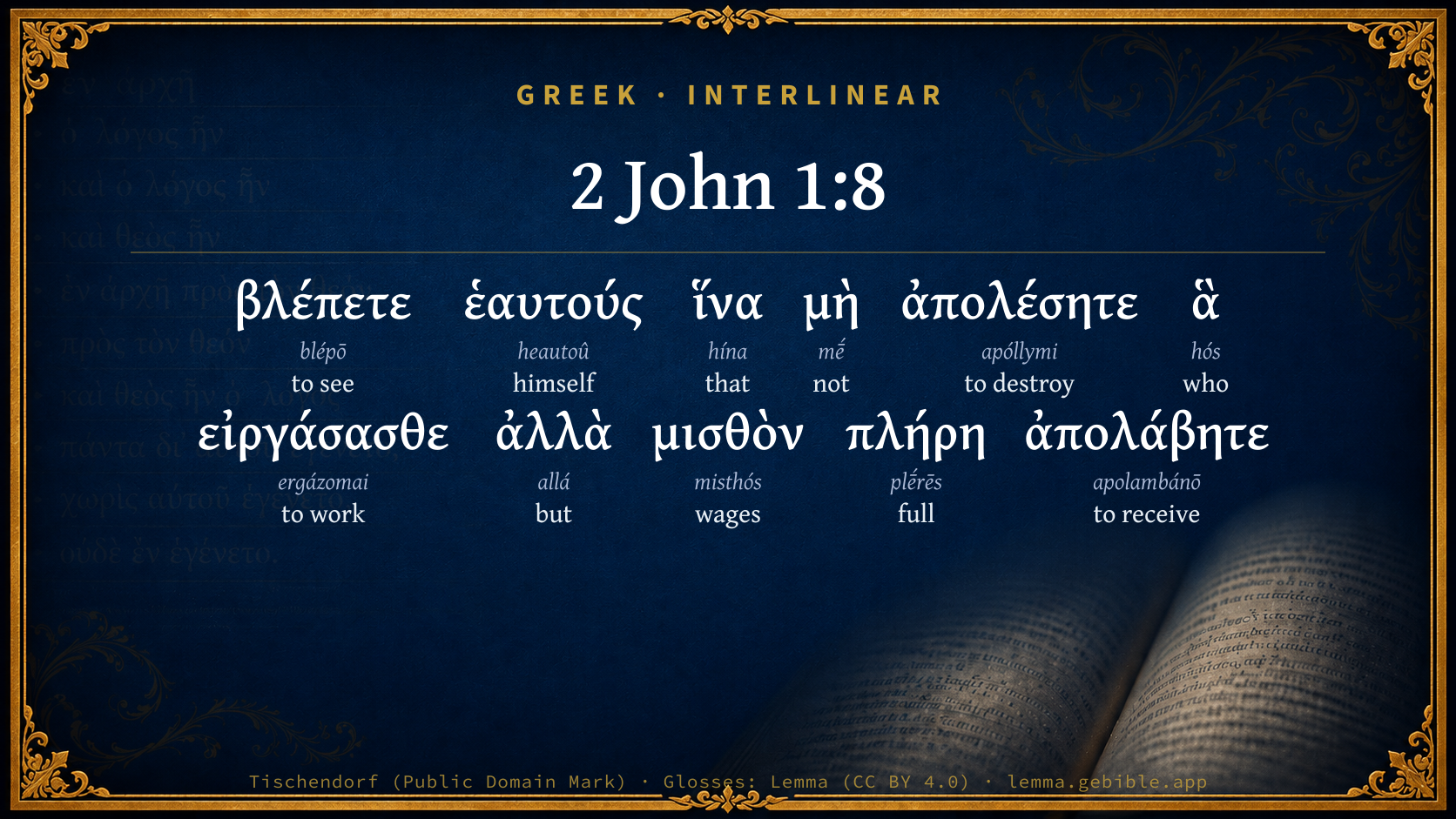
  1. βλέπετε blépō G991 “to see” Verb, Present, Active, Imperative, 2nd person, Plural
  2. ἑαυτούς heautoû G1438 “himself” Reflexive pronoun, 2nd person, Accusative, Plural, Masculine
  3. ἵνα hína G2443 “that” Conjunction
  4. μὴ mḗ G3361 “not” Particle, Negative
  5. ἀπολέσητε apóllymi G622 “to destroy” Verb, Aorist, Active, Subjunctive, 2nd person, Plural
  6. ἃ hós G3739 “who” Relative pronoun, Accusative, Plural, Neuter
  7. εἰργάσασθε ergázomai G2038 “to work” Verb, Aorist, Middle deponent, Indicative, 2nd person, Plural
  8. ἀλλὰ allá G235 “but” Conjunction
  9. μισθὸν misthós G3408 “wages” Noun, Accusative, Singular, Masculine
  10. πλήρη plḗrēs G4134 “full” Adjective, Accusative, Singular, Masculine

About this verse

These counts appear in no published source. They are computed here, from the morphology-tagged text and Lemma’s own curated glosses. What Lemma adds →

11
words
11
distinct lemmas
General Epistles
section

Notable vocabulary

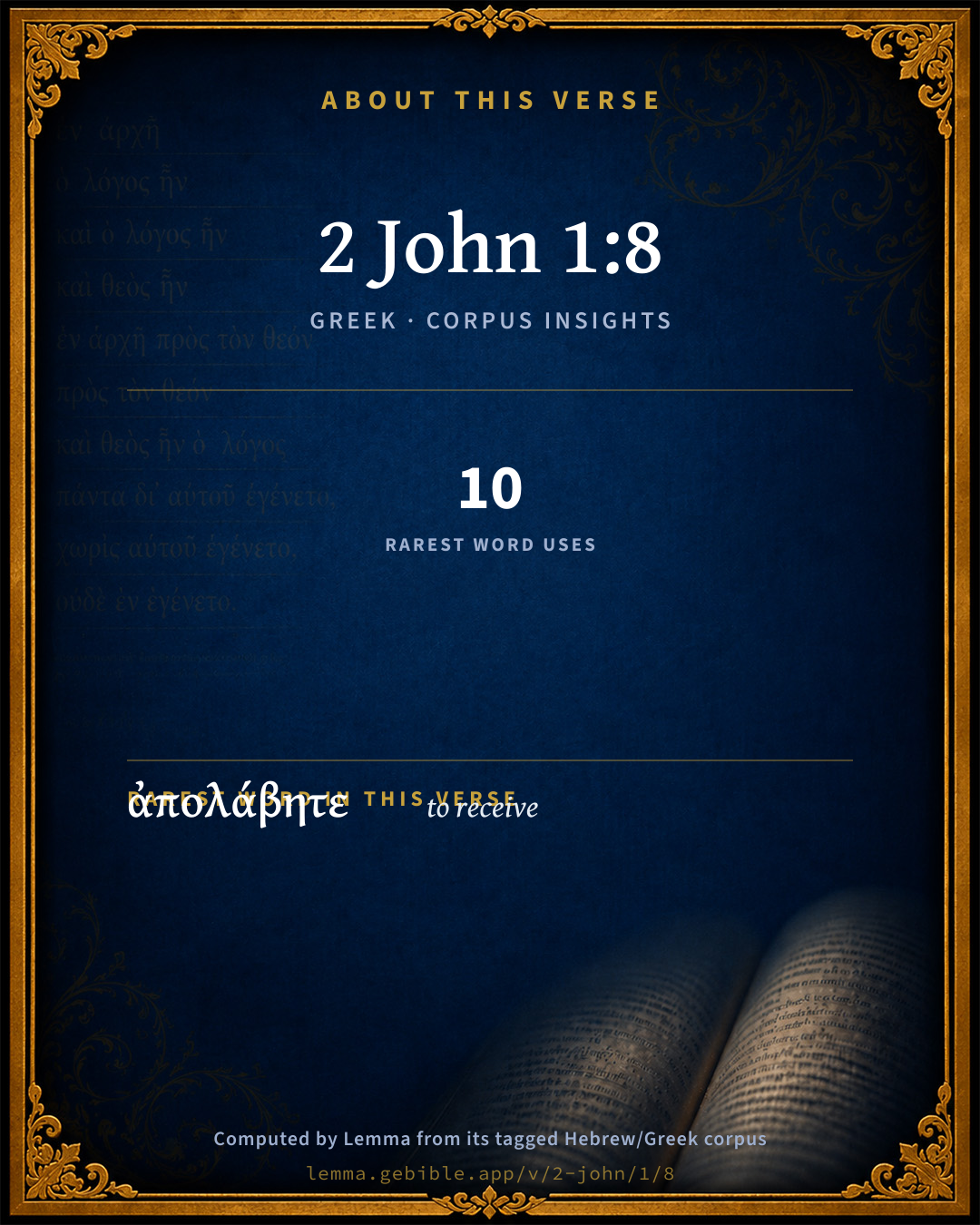
The rarest word here is ἀπολάβητε to receive G618 — appearing just 10 times in the whole Greek New Testament.

Shared distinctive vocabulary

ἀπολάβητε to receive G618 occurs in 10 verses of the Greek New Testament. Also found in:

Cross-references

19

Topical passages linked to 2 John 1:8 in the Treasury of Scripture Knowledge — connected by theme and wording, ordered by reader-vote popularity; previews shown in the World English Bible.

  • Hebrews 10:35 Therefore don't throw away your boldness, which has a great reward.
  • Revelation 3:11 I am coming quickly! Hold firmly that which you have, so that no one takes your crown.
  • 1 Corinthians 3:14 If any man's work remains which he built on it, he will receive a reward.
  • 1 Corinthians 3:8 Now he who plants and he who waters are the same, but each will receive his own reward according to his own labor.
  • Hebrews 12:15 looking carefully lest there be any man who falls short of the grace of God; lest any root of bitterness springing up trouble you, and thereby the many be defiled;
  • Galatians 3:4 Did you suffer so many things in vain, if it is indeed in vain?
  • Mark 13:9 But watch yourselves, for they will deliver you up to councils. You will be beaten in synagogues. You will stand before rulers and kings for my sake, for a testimony to them.
  • John 4:36 He who reaps receives wages, and gathers fruit to eternal life; that both he who sows and he who reaps may rejoice together.
  • Matthew 24:24–25 For there will arise false christs, and false prophets, and they will show great signs and wonders, so as to lead astray, if possible, even the chosen ones.
  • Luke 21:8 He said, "Watch out that you don't get led astray, for many will come in my name, saying, 'I AM,' and, 'The time is at hand.' Therefore don't follow them.
  • Galatians 4:11 I am afraid for you, that I might have wasted my labor for you.
  • Philippians 2:15–16 that you may become blameless and harmless, children of God without blemish in the midst of a crooked and perverse generation, among whom you are seen as lights in the world,
  • Matthew 24:4 Jesus answered them, "Be careful that no one leads you astray.
  • Mark 13:23 But you watch. "Behold, I have told you all things beforehand.
  • Philippians 3:16 Nevertheless, to the extent that we have already attained, let us walk by the same rule. Let us be of the same mind.
  • Hebrews 10:32 But remember the former days, in which, after you were enlightened, you endured a great struggle with sufferings;
  • Daniel 12:3 Those who are wise shall shine as the brightness of the expanse; and those who turn many to righteousness as the stars forever and ever.
  • Mark 13:5–6 Jesus, answering, began to tell them, "Be careful that no one leads you astray.
  • 1 Corinthians 15:8 and last of all, as to the child born at the wrong time, he appeared to me also.

Cross-references courtesy of OpenBible.info (CC BY 4.0).

Where the printed editions differ

3 variants

Places in this verse where the major printed Greek editions disagree on the wording in a way that affects the translation — a comparison of editions, not a manuscript-by-manuscript collation. The editions are the modern critical texts (Nestlé-Aland 28/27, SBL, Westcott-Hort, Tregelles, Tyndale House) and the traditional texts behind the KJV (the Textus Receptus and the Byzantine/Majority text). It is not a claim about which reading is original.

  1. Different wording
    ἀπολέσητε

    “you may lose”

    In NA28NA27TynSBLWHTreg Not in TRByz

    ἀπολέσωμεν (apolesōmen) 'we may lose' occurs in traditional manuscripts (TR+Byz) instead of ἀπολέσητε (apolesēte) 'you may lose' in older manuscripts (NA28+NA27+Tyn+SBL+WH+Treg)

  2. Different wording
    εἰργασάμεθα,

    “we have worked for,”

    In NA28NA27SBLWHTRByz Not in TynTreg

    εἰργάσασθε (eirgasasthe) 'you have worked for' occurs in a few manuscripts (Tyn+Treg) instead of εἰργασάμεθα, (eirgasametha) 'we have worked for,' in older manuscripts (NA28+NA27+SBL+WH+TR+Byz)

  3. Different wording
    ἀπολάβητε.

    “you may receive.”

    In NA28NA27TynSBLWHTreg Not in TRByz

    ἀπολάβωμεν (apolabōmen) 'we may receive' occurs in traditional manuscripts (TR+Byz) instead of ἀπολάβητε. (apolabēte) 'you may receive.' in older manuscripts (NA28+NA27+Tyn+SBL+WH+Treg)

Textual data: Translators Amalgamated Greek New Testament (STEPBible TAGNT) · CC BY 4.0.

Commentary

Notes on 2 John 1:8 from classic Christian and Jewish commentators (each source and its license shown beneath its notes). The classic Christian expositions comment on the surrounding passage and are grouped to its opening verse, so a note may address several verses; the Jewish commentaries on the Tanakh (Rashi and others) are per-verse, so they appear only where the commentator wrote on this verse.

Lemma curates 59 commentaries, every one of them public domain or Creative Commons licensed, each selected and text-cleaned for this edition rather than reprinted as found. About our sources →

The Biblical Illustrator

Joseph S. Exell

2Jn_1:8

Look to yourselves.

Self-inspection

I. look to your creed, whether it be scriptural. We know too well there may be a scriptural creed without real piety; but it does not appear how there can be the latter where faith in the gospel is entirely wanting. Every one that impartially reads the Scriptures must see how decidedly they speak of the really Divine character of our Lord Jesus Christ, and of the cause and design of those sufferings which He endured in our world; also the weight and value that are attached to those subjects, and our reception in a believing manner of those Divine representations.

II. Look to your state, whether it be one of conversion to God. However excellent religion is in theory, its theory is insufficient for your salvation. An artificial flower may strikingly resemble a natural one, but a nearer inspection will detect the difference. The delicate tints and scents of nature cannot be supplied by the most practised hand in art, so as long to deceive. The difference between a mere nominal and a real Christian is immense. But immense as it is, it cannot be detected but by examination; and that examination must be by yourself. What are you to examine? Look to yourselves, to see whether you are born again? If there be the new birth, there will be spiritual life in the soul. If there be life there will be spiritual feelings. You feel that you have a soul to be saved or lost for ever, and you arc anxious to be instructed in the will of God, to cease to be what is wrong, and to become all that is right. And do you feel sin to be a burden? Souls born again do. Look to yourselves and see whether you do. What thoughts and feelings have you concerning Christ? We read, To them that believe He is precious. And not less necessary is it that you look to your temper and walk. Everything in its proper place. The cause of our justification before God is not in our own goodness, but if grace does not infuse its goodness into us, we are not Christians.

III. In case you are compelled to come to a conclusion unfavourable to your present condition, look to yourselves with apprehension. Are you satisfied to be irreligious because others are? Will it be any palliation of your guilt, or diminution of your final misery, to be lost with the multitude? Begin at once to look to yourselves--to look to your souls. (T. Pinchback.)

Danger of inattention

Her pilot was asleep below is given as the simple and sufficient explanation of the disaster that happened to the steamer Montana, which was grounded and wrecked upon a rock off the English coast. Of how many shipwrecked souls might the same thing be said, The pilot was asleep below.

The duty of self-inspection

It will not do for the sailor, however many dangers he may have passed safely through, or however far he may have advanced upon the voyage, to become unwatchful. While he is upon the sea he is in peril. So is it with the Christian, who is called so to pass through the waves of this troublesome world. It will not do for him to furl his sails, to neglect his compass, or to drop his hold upon the helm.

I. Look to yourselves. There is a looking to ourselves that is wrong, which we are to be careful to avoid, and which we are bound to overcome. Selfishness--the looking to ourselves, keeping always in view what we think is for our own personal interest or advantage--is one of the surest signs of a worldly and unbelieving mind. There is also a looking to ourselves in carnal confidence--putting confidence in our own goodness. What, then, are we to understand by looking to ourselves? When a man is going upon a dangerous journey, in which he may be very apt to make a false step or a slip--and that slip may cost him his life--you would naturally say to him, Look to yourself. Do not, you would say, let your attention be distracted, or taken up by the things you see upon the road; do not let anything carry you out of your way, but look to yourself; see that you are going right, see that you do not get betrayed into an unexpected snare, where you may lose yourself. Pay perpetual attention to the motives by which you are governed--to the ends you have in view, to the plans you are laying--see that they are all in accordance with Gods truth and will; see that they are such as become the disciples of Christ; see that you are walking worthy of the vocation wherewith you are called. Do not suppose it is all right with you, because you are comfortable and at ease, but suspect yourselves. We look at others often when we are hearing Gods Word, and think how suitable the word is to such and such an individual, and how exactly it fits the case of another. But are we looking to ourselves?

II. Note how beautifully this venerable and ripened servant of God, who stood prominent among the twelve, and who was now, we have every reason to suppose, a hoary-headed soldier in the army of Christ; look how he, with all humility, brings in himself; how he slips out of the address to others into an address that includes himself. At first he says, Look to yourselves; but he adds, that we lose not the things which we have wrought. What are we to understand by the things which we have wrought? and what by losing those things which we have wrought ? By those things which we have wrought is meant that work which through Gods grace has been accomplished in us and by us, in the times that are gone past. Is there any Christian that has not a recollection of this? Yet all need to have their recollection revived and refreshed. To look back upon your high privileges: you have been taught from your earliest days that you ought to be born again; you can recollect when God led you to know and see the way of reconciliation for your sin, and to find your peace in the righteousness of Christ your Saviour. What holy thankfulness! What fervour of first love filled your hearts! You can recollect how careful and anxious you were not to offend--how you studied to know the will of God in all things. Consider the things that you wrought in former days. Where are they now? Are they still with you, or have they passed away? They may be lost. Can any man in a world like ours, with a mind like ours, and Satans machinations ever against him, declare he is not in danger of losing what he hath wrought?

III. And let us take heed for others, because if we lose the things which we have wrought we shall also fail in the recompense of the reward. That we receive a full reward. It is called a reward in this sense because, though it is the free gift of God, it pleased God to ordain that in this world and in the world to come it should be proportionate to a mans diligence, and to the fruits he brings forth. We are judged solely with regard to our works; and the measure of our fidelity will be the measure of our recompense of reward. And this is true in this present world. Every one that hath, says Christ, is to make more of the talent that is given to him, whether it be money or diligence, and he shall have more. He that is a righteous man shall hold on his way, and he that hath clean hands shall wax stronger and stronger. Such an one shall be as a shining light that shineth more and more unto the perfect day. What a sad thing to have laboured in vain! What a sad thing for the Christian to lose the ground he has gained! Just as in the Pilgrims Progress, where the traveller Zion-ward is toiling up the hill to reach the City of Life. With many a weary step and many a straining muscle he has reached high upon the hill; but becoming weary or languid, or amusing himself with the landscape around him, or beguiled by the conversation of his fellow-pilgrims, or looking anxiously back at something left behind at the bottom of the mountain, he begins to slip backwards--he slips backwards unawares, step by step, till he finds himself not midway but wholly down at the bottom where he started from. What a sad and bitter thought--I have lost all.! I had just got up high; I have to go through all the mire and dust again! I have to begin again! Wherefore the rather, give diligence to make your calling and election sure, and do not lose the things which you have wrought; but rather go on from grace to grace and from strength to strength. (H. Stowell, M. A.)

Look to self

In the text itself we have two general parts considerable, First, the caution propounded. Secondly, the argument whereupon the caution is urged, or the matter wherein to be exercised. We begin with the first, the caution in its general and indefinite proposition, Look to yourselves. This is that which belongs to all Christians. The ground hereof is this:--First, the danger which they are exposed to, and the assaults which are upon them. Those which are subject to very much hazard, they had need to take very much heed. St. John before said, that there were many deceivers entered into the world; adds presently, Look to yourselves, as a caution very fitly consequent upon that intimation; where there are cheaters and cutpurses in the crowd people have need to look to their pockets. Secondly, as there are assaults upon them, so themselves without better heed are too apt to be overtaken with them. There is not more deceitfulness and malice in Satan and his instruments than there is likewise naturally in our own hearts to yield and comply with them; therefore we had need to look to ourselves. As it is in matter of the body, where people are more apt to take such infection or contagion in them, they conceive it does more concern them to be more heedful and regardful of their health; even so it is here. We are ready ever to comply with every evil suggestion and temptation which is administered unto us; we are like dry tinder to these sparks which are struck upon us, which is the difference betwixt us and Christ. Thirdly, add also hereunto the grievousness of the miscarriage. The Apostle John does in this case with these believers as some physician would do with his patient; who, when he has done all for him that belongs to him and lies in his power, bids him now to beware and take care of his own health and to look to himself, and accordingly it behoves all Christians so to do. And that for this reason especially, forasmuch as they may not always have other helps near unto them. This caution here of the apostle was not a word of negligence, but rather of prudent forecast for them. He had done his part already with them, and now does but provoke them to make good use of what they heard from him and to put those his doctrines into practice. I might here also further seasonably observe, that God will make use of ourselves in our passage to heaven. The second is the argument or matter which it is conversant about, which is laid down two manner of ways:--First, in the negative, That ye love not, etc.; and secondly, in the affirmative, But that we receive a full reward. We begin with the first, the negative, That ye love not, etc. Some copies read, That we love not, etc. We may understand it of either. First, That ye love not, etc. People have cause to look to it that they do not frustrate the labours of the ministers by losing those doctrines and instructions which are tendered unto them. First, that we may not lose things out of our memory. Secondly, meditation, that is also a good conduce merit hereunto. Thirdly, conference and holy communion. This does imprint them more (Deu_6:7). Lastly, practice and conscientious improvement. There is no such way for us to remember any doctrine as to draw it forth into exercise, which is the truest memory of all. That is the first particular in which we are to take heed of losing, viz., in regard of memory. The second is in regard of judgment. Then we are said to lose any doctrine when we alter our opinion of it, and so let it go from us. Thirdly, in regard of affection. Take heed ye lose not herein neither. Now therefore let us be careful to put this caution in practise; losses are for the most part unacceptable. We see in matters of the world how men do not love to lose anything; if they do, it is very grievous to them. And how much more does it then concern them to avoid it, and shun it all they can in such things as these are, which are of such weighty importance. Like some young scholars that lose more in a breaking up than they get in many weeks schooling and learning besides. I would not it should be so with you; I warn you of it. There are divers ways of losing in other things, as well as this, which accordingly are now to be avoided by you. First, by fraud and circumvention. Secondly, there is loss also by force and open violence. Thirdly, by mere carelessness and neglect. There is many a jewel which is lost thus for want of due and proportionable care in him that has it. But then further, take it in reference to their own works, that ye lose not the things which ye have wrought. The apostle, as he would not have them to frustrate his labours towards them, so neither their own labours to themselves. And so it is an exhortation to constancy. First, they lose their labour, and there is a great matter in that. Secondly, they lose that expediteness and facility of doing good, or of resisting evil. Thirdly, take it as to the reward; they are losers of what they have wrought as to this likewise. If a man will watch his house, how much more should he watch his soul? Now further, secondly, take it in the first as it is here in our own textual translation, That we lose not what we have wrought. First, I say, the heedlessness of people frustrates the labours of their ministers; it makes them lose the things which they have wrought. Now secondly, for what also is expressed, that ministers are justly very tender of the frustrating of their labours. First, the Person they work from, and that is God Himself. The miscarriages of the ministry redound to the dishonour of God. Secondly, the persons they work for, and that is the church and people of God (Eph_4:12). They watch for your souls (Heb_13:17). They would not lose their work in reference to those they work for. Thirdly, for the work itself, and that in sundry respects. First, the labour of it; it is a painful work, and therefore is it so often in Scripture set forth by such an expression. The more pains that any man takes the less willing is he to lose it. Secondly, the dignity of it; there is somewhat also in that. Men may take pains in a thing of nought. To lose such a work as this is, the work of the ministry, this is no ordinary business, nor so to be accounted. Thirdly, add to this the extent of it, and that which goes along with it, for if we lose our work there is somewhat more lost besides that, as is implied afterwards; and that is of yourselves, it is unprofitable for you (Heb_13:17). And the rather upon this added still to it, that it is irrecoverable, for so it is. If the work of the ministry take not there is nothing hereafter to be expected. The second is the affirmative, But that ye, or we, receive a full reward. Here is another piece of a motive why believers should look to themselves, not only that they might not lose, but that moreover they might gain and their teachers gain with them. We will take notice of both. First, take it as to themselves, that ye may receive a full reward. It is true indeed we have other things to move us, even the excellency which is in goodness itself, and that example which we have of it in God and regard to Him, that requires it of us. But yet moreover we may take in this with it, that recompense which it brings in with it in a better world. Secondly, observe this, that perseverance in goodness hath its reward belonging to it (Gal_6:9). There is no man serves God for nought who is a free and bountiful pay-master. When we hear of reward we may not dream of merit. But, thirdly, here is the word of amplification, a full reward. First, take it denominatively as a description of heaven and the condition of glory to come, it is a full reward--it is that which will make sufficient recompense. First, a fulness of sufficiency. There is nothing which is in any way desirable but it is to be found in this reward. Take the best things of this life and they have an emptiness; they are not sufficient, there is a great deal wanting in them. Secondly, a fulness of expectation. Whatever can be looked for shall be enjoyed. Thirdly, a fulness of compensation. Here is in this reward that which makes amends for all which has been undergone in reference to it. The wages is not here short of the work, but infinitely transcendent. This shows the fondness and vanity of those therefore which will deprive themselves of it; seeing it is a full reward, who would then not be partaker of it, and especially lose it for the want of a little care and heedfulness about it? Secondly, it is called so emphatically, as implying that there is a reward which is not full belonging to those which are inconstant, and declining in religion. Now, further, secondly, as they refer to the apostles and other ministers, that we may receive a full reward. This reward was not temporal, and from them which he did not so much look at; but from God, a reward in heaven. The apostle did hereby imply that these Christians, if they were careless, would be apt to deprive him of this. What is that? namely, of joy and rejoicing. Ministers, when people miscarry under their hands, they will miss of this, though not of their glory. And this the apostle signifies there in that place (Heb_13:17). That we may do with joy and not with grief. (T. Horton, D. D.)

Self-preservation

1. Look to yourselves, that ye lose not those gracious principles which seemed to be planted in your hearts by the Holy Ghost (Heb_2:1; 1Co_15:1; 2Co_6:1).

2. Look to yourselves, that ye lose not those vivid and vigorous impressions of Divine truth, which marked the early part of your Christian career.

3. Look to yourselves, that ye lose not the spirit of secret prayer, and proper seasons for attending to it. The lifeless performance of this duty is generally the forerunner of open sin or absolute apostasy (Jud_1:20).

4. Look to yourselves, that ye lose not your taste for domestic duties, and your relish for the public ordinances of the gospel.

5. Look to yourselves that ye lose not the power and practical influence of the gospel upon your hearts and lives.

6. Look to your selves that ye lose not a good conscience, the favour of God, the affections of His people, the blessings of the gospel, and the eternal salvation of your souls. (The Christian Herald.)

Looking after ones own interest

This is a glorious subject! Looking after our own interest; looking after Number One! It is a motto most men believe in. Never mind about anybody else, at any rate till your own turn is served. Men will praise thee when thou doest well to thyself. What will God do? Lot was a man who believed in looking after himself. His uncle Abraham and himself were large farmers, their herds pasturing together. The grass and water supply was scarcely sufficient for all, and as a result there were frequent quarrels between their herdmen. What was the result of Lots self-care? It left him poor indeed; his property was burnt in Sodom; his wife became a pillar of salt upon the plain! Gehazi was another man who believed in looking after his own interest. A lie is soon framed, carried out; Gehazi is enriched, and his spoil safely under lock and key. What then? Judas also firmly believed in looking after Number One. The rich farmer held the same doctrine about self-care. They were his grounds that brought forth so plentifully. Dives quite believed in taking every care of himself. Listen to what Jesus Christ will one day say to men who have done nothing but study their own interest--I was hungry, ye gave Me no meat, etc. Remember Jesus Christ, our great Example, came not to study His own interest, but to minister, and to give His life a ransom for many.

1. Christian men, look to your selves. See that ye walk worthy of your high vocation, as becometh sons of God; that ye let your light shine before men; that ye obey Jesus Christs commandments.

2. Unconverted men, look to yourselves. You have a priceless treasure; your soul. What shall it profit a man if he shall gain the whole world, and lose his own soul? Your body and its interests, what you call Number One, is really Number Two: the soul is most important. It may be, you have insured your house, and your life, against fire, accident, or death. What have you done for your soul? Look to yourselves.

(1) You have tremendous responsibilities. God has given His Son to die for you. Look to yourselves.

(2) You are running terrible risk out of Christ. Life is uncertain; with it ends the day of grace. Look to yourselves.

(3) Dont expect that some day some extraordinary influence will be brought to bear upon you, and that you will be suddenly anxious for salvation. (G. B. Foster.)

Concerning spiritual property

Persecution had to a large extent ceased at the time when this Epistle was written, but a far more dangerous form was assumed, viz., the preaching of false doctrines. The difference is that between open violence and stealth. The banditti storm the dwelling, and if the tenant is able to show any resistance he is at liberty to do so; but the thief creeps in silently into the house, and while the inmates sleep peaceably he steals all their valuables.

I. Protect the good which is in you, That ye lose not the things which we wrought. The Churches--we seem much more anxious to make converts than to retain them. 1, Remember the services of others. In the mansion you will see some old pictures of no great artistic value, and others of value but not of a modern style. You say, These are old, valuable heirlooms of the family. Sacred memories cluster around them. They speak of old times. These old pictures look at you from their elevated stations on the wall and say, See that ye lose none of the inheritance which your noble ancestors have gained for you. The elect lady alone knew the significance of the words which we have wrought. Did he not use all the persuasion of his soul to lead her and her children to the truth?

2. Exercise, watchfulness, and prayer. Even the valuable old pictures will decay unless they are protected from the ravages of time. Hold the fort of truth, and defend the citadel of faith. Remember that there are enemies ready to despoil you of your precious experience.

3. Guard the entrances. There is danger within as well as without.

II. Expect the reward which is before you. There is a present reward in any Christian act. Full reward hereafter. (T. Davies, M. A.)

That we lose not those things which we have wrought.

The wrought work of the Divine Spirit within the soul

I. The wrought work of our spiritual state.

(1) The wrought work of God. That we are what we are is due to the working of the Eternal Father in all His providential ruling, and of the Divine Son in His special redemptive work in this world: but more particularly to the working of the Holy Spirit in His direct and immediate action on the heart. If there be lines of beauty, tracings of truth on the tablet of our soul, it is because we bear within the imprint of His gentle but mighty hand.

(2) The wrought work of the Christian minister. Probably John wrote, The things which we have wrought. So far as the truth which is held in their minds, and the convictions which stir their conscience, and the principles which rule their life, are due to the fidelity of the minister of Christ, to that extent their spiritual state is the wrought work of the Christian teacher.

(5) The wrought work of the soul itself. Paul speaks (Gal_6:3) of a mans character as being his own work. We have thought seriously, felt deeply, prayed earnestly, resolved strenuously, chosen deliberately, wrestled manfully, persisted patiently. Our spiritual condition is the outcome of much expenditure of our own vital energy.

II. Its possible effacement. Can these lines of heavenly beauty and Divine truth, traced by the finger of God, be so crossed and counter-marked as to present nothing but a mass of senseless hieroglyphs? To this question we give

(l) The answer of a very sensible philosophy. In theory it certainly may be so. The waters wear the stones--not only the lashings of the mighty and furious waves of the Atlantic flinging themselves on the rock, but the nearly noiseless drip of a single drop falling on the slab of stone below. And surely the powerful forces of evil companionship, of frivolous or sceptical literature, of unwise self-indulgence, of excessive pleasure-seeking, acting daily, hourly, on the sensitive responsive spirit, will wear the soul and disfigure it.

(2) The answer of a too common experience; in fact it often is so.

III. Our practical wisdom in regard to it. We had better

(1) own to ourselves how disastrous would be the entire loss of it. What other loss will compare with this?

(2) Count the cost of a partial loss of it. If we do not heed there will be those who will fail to attain a full reward. These may be the ministers who will miss something of the blessedness that would be theirs if their converts were presented complete in Him; or they may be our own spirits, for there will be those who will rule over a few cities that might have ruled over many, who will be saved as by fire instead of having the abundant entrance.

(3) Take the most vigorous measures against spiritual loss. (W. Clarkson, B. A.)

The Biblical Illustrator, edited by Joseph S. Exell (c. 1880s–1900s) — public domain. Text from a community e-Sword module.

Joseph Benson's Commentary

2Jn 1:8-9. Look to yourselves — Take heed, lest you grow remiss or negligent in the course of your obedience. That we lose not, &c. — Lest you lose the reward of what you have already done, which every apostate does; but that we receive — Which every one that is faithful unto death shall do; a full reward — That, having fully employed all our talents to the glory of him that gave them, we may receive the whole portion of felicity which God has promised to diligent, persevering Christians. Receive this as a certain rule; whosoever transgresseth — Any law of God; and abideth not — Does not persevere; in his belief of, and obedience to, the doctrine of Christ, hath not God — For his Father and his God. He that abideth in the doctrine of Christ — Believing and obeying it; hath both the Father and the Son — Who have confirmed that doctrine in the most ample manner.

Joseph Benson's Commentary on the Old and New Testaments (1811–1818) — public domain. Text from a community e-Sword module.

MacLaren's Expositions of Holy Scripture

Alexander MacLaren

2 John

GRACE, MERCY, AND PEACE

2Jn 1:8

We have here a very unusual form of the Apostolic salutation. ‘Grace, mercy, and peace’ are put together in this fashion only in Paul’s two Epistles to Timothy, and in this the present instance; and all reference to the Holy Spirit as an agent in the benediction is, as there, omitted.

The three main words, ‘Grace, mercy, and peace,’ stand related to each other in a very interesting manner. If you will think for a moment you will see, I presume that the Apostle starts, as it were, from the fountain-head, and slowly traces the course of the blessing down to its lodgment in the heart of man. There is the fountain, and the stream, and, if I may so say, the great still lake in the soul, into which its waters flow, and which the flowing waters make. There is the sun, and the beam, and the brightness grows deep in the heart of man. Grace, referring solely to the Divine attitude and thought: mercy, the manifestation of grace in act, referring to the workings of that great Godhead in its relation to humanity: and peace, which is the issue in the soul of the fluttering down upon it of the mercy which is the activity of the grace. So these three come down, as it were, a great, solemn, marble staircase from the heights of the Divine mind, one step at a time, down to the level of earth; and the blessings which are shed along the earth. Such is the order. All begins with grace; and the end and purpose of grace, when it flashes into deed, and becomes mercy, is to fill my soul with quiet repose, and shed across all the turbulent sea of human love a great calm, a beam of sunshine that gilds, and miraculously stills while it gilds, the waves.

If that be, then, the account of the relation of these three to one another, let me just dwell for a moment upon their respective characteristics, that we may get more fully the large significance and wide scope of this blessing. Let us begin at what may be regarded either as the highest point from which all the stream descends, or as the foundation upon which all the structure rests. ‘Grace from God the Father and from the Lord Jesus Christ, the Son of the Father.’ These two, blended and yet separate, to either of whom a Christian man has a distinct relation, these two are the sources, equally, of the whole of the grace.

The Scriptural idea of grace is love that stoops, and that pardons, and that communicates. I say nothing about that last characteristic, but I would like to dwell for a moment or two upon the other phases of this great word, a key-word to the understanding of so much of Scripture.

The first thing then that strikes me in it is how it exults in that great thought that there is no reason whatsoever for God’s love except God’s will The very foundation and notion of the word ‘grace’ is a free, undeserved, unsolicited, self-prompted, and altogether gratuitous bestowment, a love that is its own reason, as indeed the whole of the Divine acts are, just as we say of Him that He draws His being from Himself, so the whole motive for His action and the whole reason for His heart of tenderness to us lies in Himself. We have no power. We love one another because we apprehend something deserving of love, or fancy that we do. We love one another because there is something in the object on which our love falls; which, either by kindred or by character, or by visible form, draws it out. We are influenced so, and love a thing because the thing or the person is perceived by us as being worthy, for some reason or other, of the love. God loves because He cannot help it; God loves because He is God. Our love is drawn out-I was going to say pumped out-by an application of external causes.

God’s love is like an artesian well, whensoever you strike, up comes, self-impelled, gushing into light because there is such a central store of it beneath everything, the bright and flashing waters. Grace is love that is not drawn out, but that bursts out, self-originated, undeserved. ‘Not for your sakes, be it known unto you, O house of Israel, but for Mine own name’s sake, do I this.’ The grace of God is above that, comes spontaneously, driven by its own fullness, and welling up unasked, unprompted, undeserved, and therefore never to be turned away by our evil, never to be wearied by our indifference, never to be brushed aside by our negligence, never to be provoked by our transgression, the fixed, eternal, unalterable centre of the Divine nature. His love is grace.

And then, in like manner, let me remind you that there lies in this great word, which in itself is a gospel, the preaching that God’s love, though it be not turned away by, is made tender by our sin. Grace is love extended to a person that might reasonably expect, because he deserves, something very different; and when there is laid, as the foundation of everything, ‘the grace of our Father and of the Son of the Father,’ it is but packing into one word that great truth which we all of us, saints and sinners, need-a sign that God’s love is love that deals with our transgressions and shortcomings, flows forth perfectly conscious of them, and manifests itself in taking them away, both in their guilt, punishment, and peril. ‘The grace of our Father’ is a love to which sin-convinced consciences may certainly appeal; a love to which all sin-tyrannized souls may turn for emancipation and deliverance. Then, if we turn for a moment from that deep fountain, ‘Love’s ever-springing well,’ as one of our old hymns has it, to the stream, we get other blessed thoughts. The love, the grace, breaks into mercy. The fountain gathers itself into a river, the infinite, Divine love concentrates itself in act, and that act is described by this one word, mercy. As grace is love which forgives, so mercy is love which pities and helps. Mercy regards men, its object, as full of sorrows and miseries, and so robes itself in garb of compassion, and takes wine and oil into its hands to pour into the wound, and lays often a healing hand, very carefully and very gently, upon the creature, lest, like a clumsy surgeon, it should pain instead of heal, and hurt where it desires to console. God’s grace softens itself into mercy, and all His dealings with us men must be on the footing that we are not only sinful, but that we are weak and wretched, and so fit subjects for a compassion which is the strangest paradox of a perfect and divine heart. The mercy of God is the outcome of His grace.

And as is the fountain and the stream, so is the great lake into which it spreads itself when it is received into a human heart. Peace comes, the all-sufficient summing up of everything that God can give, and that men can need, from His loving-kindness, and from their needs. The world is too wide to be narrowed to any single aspect of the various discords and disharmonies which trouble men. Peace with God; peace in this anarchic kingdom within me, where conscience and will, hopes and fears, duty and passion, sorrows and joys, cares and confidence, are ever fighting one another; where we are torn asunder by conflicting aims and rival claims, and wherever any part of our nature asserting itself against another leads to intestine warfare, and troubles the poor soul. All that is harmonized and quieted down, and made concordant and co-operative to one great end, when the grace and the mercy have flowed silently into our spirits and harmonized aims and desires.

There is peace that comes from submission; tranquility of spirit, which is the crown and reward of obedience; repose, which is the very smile upon the face of faith, and all these things are given unto us along with the grace and mercy of our God. And as the man that possesses this is at peace with God, and at peace with himself, so he may bear in his heart that singular blessing of a perfect tranquility and quiet amidst the distractions of duty, of sorrows, of losses, and of cares. ‘In everything by prayer and supplication with thanksgiving let your requests be known unto God; and the peace of God which passeth all understanding shall keep your hearts and minds in Christ Jesus.’ And he who is thus at friendship with God, and in harmony with himself, and at rest from sorrows and cares, will surely find no enemies amongst men with whom he must needs be at war, but will be a son of peace, and walk the world, meeting in them all a friend and a brother. So all discords may be quieted; even though still we have to fight the good fight of faith, we may do, like Gideon of old, build an altar to ‘ Jehovah-shalom,’ the God of peace.

And now one word, as to what this great text tells us are the conditions for a Christian man, of preserving, vivid and full, these great gifts,’ Grace, mercy, and peace be unto you,’ or, as the Revised Version more accurately reads,’ shall be with us in truth and love.’ Truth and love are, as it were, the space within which the river flows, if I may so say, the banks of the stream. Or, to get away from the metaphor, these are set forth as being the conditions abiding in which, for our parts, we shall receive this benediction-’In truth and in love.’

I have no time to enlarge upon the great thoughts that these two words, thus looked at, suggest; let me put it into a sentence. To ‘abide in the truth’ is to keep ourselves conscientiously and habitually under the influence of the Gospel of Jesus Christ, and of the Christ who is Himself the Truth. They who, keeping in Him, realizing His presence, believing His word, founding their thinking about the unseen, about their relations to God, about sin and forgiveness, about righteousness and duty, and about a thousand other things, upon Christ and the revelation that He makes, these are those who shall receive ‘ Grace, mercy, and peace.’ Keep yourselves in Christ, and Christ coming to you, brings in His hands, and is, the ‘grace and the mercy and the peace’ of which my text speaks. And in love, if we want these blessings, we must keep ourselves consciously in the possession of and in the grateful response of our hearts to, the great love, the incarnate Love, which is given in Jesus Christ.

Here is, so to speak, the line of direction which these great mercies take. The man who stands in their path, they will come to him and fill his heart; the man that steps aside, they will run past him and not touch him. You keep yourselves id the love of G,6d,’by communion, by the exercise of mind and heart and faith upon Him; and then be sure-for my text is not only a wish, but a confident affirmation-be sure that the fountain of all blessing itself, and the stream of petty benedictions which flow from it, will open themselves out in your hearts into a quiet, deep sea, on whose calm surface no tempests shall ever rave, and on whose unruffled bosom God Himself will manifest and mirror His face.

Alexander MacLaren, Expositions of Holy Scripture (1904–1910) — public domain. Text from a community e-Sword module.

Tyndale Open Study Notes

Tyndale Open Resources

1:8 we: This word refers to the apostles and their co-workers. The apostles taught the truth and defended it against heresies, and believers (referred to as you) are admonished to protect their faith from teaching that could destroy them (1:9).

Tyndale Open Study Notes — © Tyndale Open Resources, licensed CC BY-SA 4.0. Text via the HelloAO Bible API.

Bengel's Gnomon

Johann Albrecht Bengel

2Jn 1:8. Ἑαυτοὺς, your own selves) in my absence.—ἵνα μὴ ἀπολέσητε, κ.τ.λ.) I think that the apostle wrote: ἵνα μὴ ἀπολέσητε ἅ εἰργάσασθε, ἀλλὰ μισθὸν πλήρη ἀπολάβωμεν, that ye lose not the things which ye have wrought, but that we receive a full reward.[6] Whence some have put the whole admonitory sentence in the second person, others again, afterwards, in the first person.—ἀλλὰ, but) There is no half reward of the saints; it is either lost altogether, or received in full. There is a direct opposition. We must however consider the different degrees in glory.—πλήρη, full) In full communion with God: 2Jn 1:9.

[6] The margin of the 2d Ed. and also the Germ. Vers. are in consonance. But in respect to the second member, the Germ. Version is at variance with the opinion here given, for it retains the second person; and in this very particular confirms the observation of the Gnomon, which presently follows, on the word ἀλλά.—E. B.

AB Vulg. Iren. Lucif. read ἀπολέσητε and ἀπολάβητε: Rec. Text, with inferior authorities, ἀπολέσωμεν and ἀπολάβωμεν.—E.

Bengel's Gnomon of the New Testament — English translation (T&T Clark, Edinburgh, 1860) — public domain. Text from a community e-Sword module.

Meyer's Critical & Exegetical Commentary

Heinrich August Wilhelm Meyer

2Jn_1:8. The warning against the deceivers.

βλέπετε ἑαυτούς] take heed to yourselves; βλέπειν with the refl. pron. besides here only in Mar_13:9.

The construction ἵνα after βλέπειν only in 1Co_16:10 besides; by ἵνα it is not the purpose (take heed to yourselves, sc. of them, so that), but the immediate object of their foresight that is stated (contrary to de Wette, Braune, and A. Buttm. p. 209).[10]

ἵνα κ.τ.λ.] Whatever be the correct reading, the thought remains essentially the same; the apostle warns his readers not to let themselves be deprived by the false teachers of the blessing, of which they became partakers through the evangelistic work. With the reading εἰργασάμεθα those who have worked are John and his associates; that ἐν ὑμῖν, or a similar phrase, must be put along with it for more particular definition (Lücke) is unfounded, as this more particular definition lies in the context itself; with the reading εἰργάσασθε, on the other hand, it is the work of the receivers of the Epistle themselves that is meant, who should just as little come short of the attainment of the blessing as the former.

The object of ἐργάζεσθαι, indicated by ἅ, is not exactly the μισθός, which is also spoken of, but the work directly effected by the labour, the result or the fruit of it. Fruit had been obtained in the Church by means of the work (fruit of knowledge, love, etc.); it was of importance that they should not again be deprived of this fruit; this is expressed by μὴ ἀπολέσητε; their loss may also, however, be considered as a loss to those who had worked among them by the preaching of the gospel, so that, as far as the sense is concerned, the Rec. ἀπολέσωμεν is perhaps justifiable; but the reading ἀπολέσηται: that they (ἅ) may not be lost, also gives good sense, so that no cause exists for regarding it, with Lücke, as a mere clerical error.

If, however, that which was directly obtained by the work be lost again, then the future reward (μισθός) promised to Christians also disappears; therefore the apostle antithetically adds: ἀλλὰ μισθὸν πλήρη ἀπολάβητε. With the reading ἀπολάβωμεν we might be disposed to understand by the reward the heavenly gift which the apostle himself had to expect on account of his work; but he could not he deprived of this by the conduct of those among whom he had laboured, as it depends not on the result, but on the faithfulness of the work; by μισθός, therefore, must certainly he understood the reward which those to whom John is writing have to expect; for this, however, the reading ἀπολάβητε is plainly more suitable than ἀπολάβωμεν (so also Brückner).

μισθὸν πλήρη is not = μισθὸν πόλυν (Carpzovius), but: full reward; by πλήρη it is not meant that if they did not exhibit faithfulness they would receive only an imperfect reward, nor even that up to the present they had only received a part of the reward (Grotius, Aretius, Ebrard), but that the reward which, if they exhibit faithfulness, they shall obtain is a quite full reward, in which there is nothinglacking (Düsterdieck, Brückner).

[10] Braune here adduces various passages of the N. T. in order to vindicate for the particle ἵνα the meaning of purpose (so that); but he has not paid attention to the distinction whether the verbal idea with which ἵνα is connected is absolute or relative (requiring supplement), and he has not reflected that if the clause beginning with ἵνα forms the supplement of the preceding verbal idea, ἵνα cannot be = so that.

Meyer — Critical and Exegetical Commentary on the New Testament — English translation by Peter Christie, edited by Frederick Crombie (T&T Clark, 1880) — public domain. Text from a community e-Sword module.

Expositor's Greek Testament

ed. W. Robertson Nicoll

2Jn 1:8 . μισθόν , cf. Mat 20:8 ; Jas 5:4 . St. John here addresses not only Kyria but her family and “the Church in her house”. He views them as his fellow-labourers in the Lord’s vineyard: “We have worked together ( ἠργασάμεθα ): see that you do not forfeit the reward of your labour. Get a full wage. Be not like workmen who toward the close of the day fall off, doing their work hadly or losing time, and get less than a full day’s pay.” ἀπολέσητε … ἠργασάμεθα … ἀπολάβητε : “We have been fellow-workers thus far, and I mean to be faithful to the last; see that you also be so”. Their danger lay in taking up with false teaching and losing the comfort of the Gospel in its simplicity and fulness.

The Expositor's Greek Testament, edited by W. Robertson Nicoll (1897–1910) — public domain. Text from a community e-Sword module.

Cambridge Greek Testament for Schools and Colleges

8. For ἀπολέσωμεν and ἀπολάβωμεν ([882][883]) read ἀπολέσητε and ἀπολάβητε ([884][885]), and for εἰργασάμεθα ([886][887][888]) read εἰργάσασθε ([889][890] and most Versions): the reading is doubtful.

[882] 9th century. All three Epistles.

[883] 9th century. All three Epistles.

[884] 5th century. Brought by Cyril Lucar, Patriarch of Constantinople, from Alexandria, and afterwards presented by him to Charles I. in 1628. In the British Museum. All three Epistles.

[885] 4th century. Brought to Rome about 1460. It is entered in the earliest catalogue of the Vatican Library, 1475. All three Epistles.

[886] 4th century. Brought to Rome about 1460. It is entered in the earliest catalogue of the Vatican Library, 1475. All three Epistles.

[887] 9th century. All three Epistles.

[888] 9th century. All three Epistles.

[889] 4th century. Discovered by Tischendorf in 1859 at the monastery of S. Catherine on Mount Sinai, and now at Petersburg. All three Epistles.

[890] 5th century. Brought by Cyril Lucar, Patriarch of Constantinople, from Alexandria, and afterwards presented by him to Charles I. in 1628. In the British Museum. All three Epistles.

8. βλέπετε ἑαυτούς. Comp. Mar 13:9. The use of ἑαυτούς κ.τ.λ. with the first (1Jn 1:8) and second person (1Jn 5:21; Joh 12:8) is not uncommon. It occurs in classical Greek, even in the singular: οὐδὲ γὰρ τὴν ἑαυτοῦ σύ γε ψυχὴν ὁρᾷς (Xen. Mem. I. iv. 9).

The persons of the three verbs that follow are much varied in MSS. and Versions. The original reading is probably preserved in [931] and the Thebaic; ἀπολέσητε ἃ ἠργασάμεθα … ἀπολάβητε. This the Revisers adopt. To make the sentence run more smoothly some ([932], Vulgate, Memphitic) changed ἠργασάμεθα to ἠργάσασθε, the reading adopted in the text, following Lachmann, Tischendorf and Tregelles: while others changed ἀπολέσητε and ἀπολάβητε to ἀπολέσαμεν and ἀπολάβωμεν. In 1Jn 2:14; 1Jn 2:20 there are other instances of [933] and the Thebaic preserving what may be the original reading. For the construction comp. 1Co 16:10. The meaning is, ‘Take heed that these deceivers do not undo the work which Apostles and Evangelists have wrought in you, but that ye receive the full fruit of it’. He warns them against loss in both worlds.

[931] 4th century. Brought to Rome about 1460. It is entered in the earliest catalogue of the Vatican Library, 1475. All three Epistles.

[932] 5th century. Brought by Cyril Lucar, Patriarch of Constantinople, from Alexandria, and afterwards presented by him to Charles I. in 1628. In the British Museum. All three Epistles.

[933] 4th century. Brought to Rome about 1460. It is entered in the earliest catalogue of the Vatican Library, 1475. All three Epistles.

μισθὸν πλήρη. Eternal life. The word ‘reward’ has reference to ‘have wrought’. Comp. ὁ μισθός μου μετʼ ἐμοῦ, ἀποδοῦναι ἑκάστῳ ὡς τὸ ἔργον ἐστὶν αὐτοῦ (Rev 22:12). ‘Apostles have done the work, and you, if you take heed, will have the reward’. Eternal life is called a full reward in contrast to real but incomplete rewards which true believers receive in this life; peace, joy, increase of grace, and the like. Comp. Mar 10:29-30.

Cambridge Greek Testament for Schools and Colleges (Cambridge University Press, 1896; 21 vols, various authors incl. Carr, Maclear, Plummer, Farrar, Lumby, Moule, M. R. James, Simcox) — public domain. Text from a community e-Sword module.

Geneva Bible (1599)

Geneva Bible translators

He that maketh shipwreck of doctrine, loseth all.

Beware and take good heed.

Geneva Bible (1599) marginal notes — public domain. Text via Bolls.life.

Jamieson, Fausset & Brown

Robert Jamieson, A. R. Fausset & David Brown

Look to yourselves--amidst the widespread prevalence of deception so many being led astray. So Christ's warning, Mat 24:4-5, Mat 24:24.

we lose not . . . we receive--The oldest manuscripts and versions read, "That YE lose not, but that YE receive."

which we have wrought--So one oldest manuscript reads. Other very old manuscripts, versions, and Fathers, read, "which YE have wrought." The we being seemingly the more difficult reading is less likely to have been a transcriber's alteration. Look that ye lose not the believing state of "truth and love," which WE (as God's workmen, Co2 6:1; Ti2 2:15) were the instruments of working in you.

a full reward--of grace not of debt. Fully consummated glory. If "which YE have wrought" be read with very old authorities, the reward meant is that of their "work (of faith) and labor of love." There are degrees of heavenly reward proportioned to the degrees of capability of receiving heavenly blessedness. Each vessel of glory hanging on Jesus shall be fully happy. But the larger the vessel, the greater will be its capacity for receiving heavenly bliss. He who with one pound made ten, received authority over ten cities. He who made five pounds received five cities; each according to his capacity of rule, and in proportion to his faithfulness. Compare Co1 15:41. "There is no half reward of the saints. It is either lost altogether, or received in full; in full communion with God" [BENGEL]. Still no service of minister or people shall fail to receive its reward.

Jamieson, Fausset & Brown — Commentary Critical and Explanatory on the Whole Bible (1871) — public domain (CC PDM 1.0). Text via the HelloAO Bible API.

Adam Clarke's Commentary

Verse 8. Look to yourselves] Be on your guard against these seducers; watch, pray, love God and each other, and walk in newness of life.

That we lose not those things which we have wrought] That we apostles, who have been the means of your conversion, may not be deprived of you as our crown of rejoicing in the day of the Lord Jesus.

Instead of the first person plural, απολεσωμεν, &c., WE lose, &c., many MSS., versions, and fathers, read the whole clause in the second person plural, απολεσητε, YE lose, &c. Take heed to yourselves that YE lose not the things which YE have wrought, but that YE receive a full reward. This reading is more consistent and likely, and is supported by at least as good evidence as the other. We find that if these persons did not keep on their guard they might lose their salvation, and the apostles their rejoicing in the day of the Lord Jesus. Even this intimation might put them on their guard. Had the apostle said ye cannot finally fall, what a different effect would it have produced! Griesbach has placed these readings in the margin as being very probable.

Adam Clarke's Commentary on the Bible (1810–1826) — public domain. Text from a community e-Sword/MySword module.

The Cambridge Bible for Schools and Colleges

gen. ed. J. J. S. Perowne

8. Look to yourselves] Exactly as in Mar_13:9, excepting the emphatic pronoun; ‘But look ye to yourselves’.

that we lose not] The persons of the three verbs are much varied in our authorities. The original reading probably was, as R. V., ye lose … we have wrought … ye receive. To make the sentence run more smoothly some have made all the verbs in the first person, others have made them all in the second. For the construction comp. 1Co_16:10. The meaning is, ‘Take heed that these deceivers do not undo the work which Apostles and Evangelists have wrought in you, but that ye receive the full fruit of it’.

a full reward] Eternal life. The word ‘reward’ has reference to ‘have wrought’. ‘Apostles have done the work, and you, if you take heed, will have the reward’. Eternal life is called a full reward in contrast to real but incomplete rewards which true believers receive in this life; peace, joy, increase of grace, and the like. Comp. Mar_10:29-30.

The Cambridge Bible for Schools and Colleges (gen. ed. J. J. S. Perowne; Cambridge University Press, 1878–1918) — public domain. Text from a community e-Sword module.

John Gill's Exposition

Look to yourselves,.... This is an exhortation to the elect lady, and her children, to look about them, and take care of themselves, and beware of these deceivers, and their doctrines:

that we lose not those things which we have wrought; or as the Alexandrian copy, and many other copies, and the Vulgate Latin, Syriac, and Ethiopic versions read, "that ye lose not those things which ye have wrought"; in embracing the Gospel, making a profession of it, walking in it, showing a zeal, and contending for it, expressing a love both by words and actions to the ministers of it, and suffering much reproach on the account of it; all which would be lost, and in vain, should they at last drop the Gospel, and embrace the errors of the wicked; see Gal 3:4. Moreover, such who do not go such lengths, as to let go the head, Christ, but retain him as the foundation, and the fundamental doctrines of the Gospel, yet, among many precious things, may lay much rubbish on this foundation; and therefore should take heed what they build upon it, since, though they themselves may be saved, their works may be destroyed, and so they suffer loss; see Co1 3:11; and if we read the words, "that we lose not--which we have wrought"; the sense is the same, it being only a figure which rhetoricians call communion, and it is frequently used when a common duty is exhorted to; see Jo1 2:28; unless it should be thought that this has a peculiar reference to the ministers of the Gospel, as it may: for though the Gospel preached by them can never be lost, being the everlasting Gospel, and the word which abides for ever; yet it may be received in vain, and persons may fall from it, and imbibe error, and so the labour of Christ's faithful ministers may be so far in vain, and lost; and likewise, many souls whom they have thought they have gained to Christ, and that they have been instruments of working upon them for good, and have hoped they would be their joy and crown of rejoicing another day; when such are carried away by deceivers, fall off from the truth, ministers of the word lose what they thought they had wrought, which must give them great concern; and this is improved by the apostle into a reason and argument why the persons he wrote to should beware of seducers and their errors:

but that we receive a full reward; in heaven, and which itself is called the recompense of reward, and the reward of the inheritance; not that this is a reward of debt due to the works of men, which are not rewardable in themselves; for they are such as are due to God before they are performed; and when they are done, they are not profitable to him, nothing is given to him, or received by him; when all is done that can be done, men are unprofitable servants; but this is a reward of grace, God has of his own grace promised it to those who love and serve him; and because it will be given them of his grace, after their work is over, as wages are given to a servant when he has done his work, it goes by this name: and whereas it is said to be a "full" one, the meaning is not as if it was different to different persons, for there is but one recompense of reward, or reward of the inheritance common to all the saints; or, as if it might be incomplete in some; it only signifies a large and exceeding great reward; see Gen 15:1; in which last place the same phrase is used as here; and where the Septuagint interpreters use the same words as here; and which is thus paraphrased by the Targumist,

"the Lord give thee a good recompence in this world for thy good work, and let thy reward be "full", or "perfect", in the world to come.''

And the Jews (g) often speak of a full reward, and an equal one, to be received hereafter. Perhaps regard is here had particularly to the ministers of the Gospel, who have their reward in part here, for the workman is worthy of his reward, and they will have it in full hereafter. Moreover, the apostle might here be concerned, that he, and every faithful minister, might have their full number, they expected, that none may be missing, and which he may call a full reward: though the above copies and versions read here, as before, "ye", and "not we".

(g) Targum on Eccl. i. 3. & ii. 11. & Midrash Kohelet, fol. 72. 4.

John Gill's Exposition of the Whole Bible (1746–1763) — public domain (CC PDM 1.0). Text via the HelloAO Bible API.

Trapp's Complete Commentary

John Trapp

8 Look to yourselves, that we lose not those things which we have wrought, but that we receive a full reward.

Ver. 8. That we lose not, &c.] The godly, when they fall into foul courses, or grow remiss and leave their first love, may lose what they have wrought, 1. In respect of the praise of men; 2. In respect of their own former feelings of God’s favour; 3. In respect of the fulness of their reward in heaven. The Nazarite that broke his vow was to begin all anew, Num 6:2-12.

John Trapp, A Commentary or Exposition upon All the Books of the Old and New Testament (1647–1656) — public domain. Text from a community e-Sword module.

Albert Barnes' Notes on the Bible

Look to yourselves - This seems to be addressed to the lady to whom he wrote, and to her children. The idea is, that they should be particularly on their guard, and that their first care should be to secure their own hearts, so that they should not be exposed to the dangerous attacks of error. When error abounds in the world, our first duty is not to attack it and make war upon it; it is to look to the citadel of our own souls, and see that all is well guarded there. When an enemy invades a land, the first thing will not be to go out against him, regardless of our own strength, or of the security of our own fortresses, but it will be to see that our forts are well manned, and that we are secure there from his assaults. If that is so, we may then go forth with confidence to meet him on the open field. In relation to an error that is in the world, the first thing for a Christian to do is to take care of his own heart.

That we lose not those things which we have wrought - Margin: “Or, gained.” Some copies read: “which ye have gained, but that ye.” The reading here referred to in the margin is found in several manuscripts and also in the Vulgate, the Syriac, and the Aethiopic versions. It is not, however, adopted in the late critical editions of the New Testament, and the common reading is probably genuine. The sense is not materially varied, and the common reading is not unnatural. John was exhorting the family to whom this Epistle was written to take good heed to themselves while so many artful errorists were around them, lest they should be drawn away from the truth, and lose a part of the full reward which they might hope to receive in heaven. In doing this, nothing was more natural than that he, as a Christian friend, should group himself with them, and speak of himself as having the same need of caution, and express the feeling that he ought to strive also to obtain the full reward, thus showing that he was not disposed to address an exhortation to them which he was not willing to regard as applicable to himself.

The truth which is taught here is one of interest to all Christians - that it is possible for even genuine Christians, by suffering themselves to be led into error, or by failure in duty, to lose a part of the reward which they might have obtained. The crown which they will wear in heaven will be less bright than that which they might have worn, and the throne which they will occupy will be less elevated. The rewards of heaven will be in accordance with the services rendered to the Redeemer; and it would not be right that they who turn aside, or falter in their course, should have the same exalted honours which they might have received if they had devoted themselves to God with ever-increasing fidelity. It is painful to think how many there are who begin the Christian career with burnings zeal, as if they would strike for the highest rewards in heaven, but who soon waver in their course, and fall into some paralyzing error, until at last they receive, perhaps, not half the reward which they might have obtained.

But that we receive a full reward - Such as will be granted to a life uniformly consistent and faithful; all that God has to bestow on his people when most faithful and true. But who can estimate the “full reward” of heaven, the unspeakable glory of those who make it the grand business of their lives to obtain all they can of its bliss. And who is there that does not feel that he ought to strive for a crown in which not one gem shall be missing that might have sparkled there forever?

Albert Barnes' Notes on the Bible (1834–1885) — public domain. Text from a community e-Sword/MySword module.

Haydock's Catholic Bible Commentary

We here see the reward for adhering to the Catholic faith, and the condemnation for revolting from the received truth. The apostles, and their lawful successors in the ministry, determine the true doctrine in points which innovators call into controversy, which being once done and declared to the faithful, they need no other mark to know a false teacher, but that he cometh with another doctrine than that which has been delivered.

George Leo Haydock (1774–1849), Haydock's Catholic Family Bible and Commentary, 1859 edition — public domain. Excludes Psalms (Douay-Rheims chapter numbering differs from Protestant) and Deuterocanonical books (Catholic canon only).

Matthew Poole's English Annotations

Such changes of the person, as we here find, are neither unusual, nor, in exhortation, inelegant; but some copies read in the two latter clauses

ye. He presses to constancy in the true, incorrupt Christian profession.

That we receive a full reward; that the expected recompence be not lost in the whole, or in any part, as Gal 3:3,4.

Matthew Poole's English Annotations on the Holy Bible (1683–1685) — public domain. Text from a community e-Sword/MySword module.

Whedon's Commentary on the Bible

Daniel D. Whedon

8. Look to yourselves—Words of solemn warning, warning against the deceptions of the deceivers. We—The apostles by whom the true doctrine was witnessed and the true Church established.

We have wrought—In your conversion and formation into genuine Christians.

A full reward— For the accomplishment of your full salvation. A reading preferred by Alford substitutes ye for we in both parts of the verse.

Daniel D. Whedon (gen. ed.), Commentary on the Old and New Testaments (1874–1909) — public domain. Text from a community e-Sword module.

The Pulpit Commentary

The authorities vary much as to the persons of the three verbs, "lose," "have wrought," "receive," some reading "we," and some "ye," in each case. The best reading seems to be, "That ye lose not the things which we have wrought, but that ye receive a full reward, i.e., beware of allowing our work in you to be undone to your grievous loss. Through not seeing the meaning of the passage, some scribes changed" ye" into "we," and others changed" we" into "ye," thus making all three verbs in the same person. There is a similar case in Joh_9:4, where the true reading seems to be, "We must work the works of him that sent me;" but in order to produce uniformity some scribes altered "we" into "I," while others turned "me" into "us." The next verse explains the nature of the "full reward" which the lady and some of her children are in danger of losing, it is nothing less than God himself.

A summons to self-guardianship.

to yourselves, that we lose not those things," etc. What is the first business of the Christian in relation to error? To oppose it? To denounce it? To expose it? Some at once rush to attack it, even before they are well acquainted with its character and tendency and power: an unwise and presumptuous course. Others examine error that they may understand it thoroughly, and then combat it successfully: this is sometimes perilous. When a contagious disease is prevalent, the prudent man shuns the habitations into which it has entered (unless duty summon him to them), and endeavours to maintain his own health and vigour. And when error, with its moral contagion, is abroad, the wise man will at once guard himself against it. Even when we are certain that certain opinions are false, and that the errors relate to a fundamental question or questions, the prudent course for the great majority of true believers is to look to their own faith and life, and leave it to the few competent champions of truth to expose and overthrow the error. Basing our remarks on the Revised Version of our text, let us notice

I THE DANGER TO BE GUARDED AGAINST. "That ye lose not the things which we have wrought." Whether the genuine reading is "we have wrought" or "ye have wrought" is uncertain. But adopting the former, the "we have wrought" signifies the work of the apostle and other Christian ministers, "through which those who were addressed had been brought to conversion, and furthered in their Christian course to the present time; and by "the things which we have wrought" we are to understand that stage of salvation to which, through those labours, the elect lady and her children had attained" (Ebrard). The text is a warning to the true Christian against loss. It somewhat corresponds with the words of the glorified Lord in Rev_2:25 and 3:11. What we have of Christian attainment of sound doctrine, of spiritual life, of holy conduct, and of faithful labour for Christ we must hold fast, that none should cause us to lose it, and so deprive us of our reward. The loss of which St. John wrote was one of which there was danger from errors of faith. And in his view, if faith lost its purity, Christian love would be imperiled and injured, and the whole tone and power of Christian life impaired. In our own day the peril of being led astray from truth is very great. We do not say that we are to rest satisfied with what we know, as though we had grasped all truth; or that we are to condemn an opinion as false because it is opposed to certain opinions of ours; or that we are to sit in judgment upon those who differ from us. That is the part of the bigot, not of the intelligent and devout Christian. But beware lest any one lead you from your faith in the great essential verities of Christianity revealed in the sacred Scriptures. As to the great facts of the incarnation, the atonement, and the resurrection of our Lord, "look to yourselves that" your faith in these be not shaken. As to the mode of these facts we may lawfully differ; but as to the facts themselves, he who believes in the Bible as the Word of God can admit neither doubt nor question. If there be loss in our faith, that loss will ere long manifest itself in our life. If belief be corrupted, the practice also will become corrupt. Injury to our religious convictions will soon show itself in the deterioration of our general actions. And even if faith be not corrupted, if it be only weakened, that weakened faith will result in a less intense love to God, in less hearty obedience to him, in less faithful service, and in a less brilliant crown in heaven. "Look to yourselves," then, that ye lose nothing of your true faith, your holy love, your fervent zeal, etc.

II THE OBJECT TO BE ATTAINED. "That ye receive a full reward." This exhortation implies that the rewards of heaven will correspond with the acquisitions made in Christian character, and the work accomplished for our Lord upon earth.

1. These rewards will be in proportion with our acquisitions in Divine grace. This is inevitable; for glory is the flower of which grace is the bud. The measure of grace must determine the measure of glory. Our fitness or capacity for reward must necessarily have much to do in determining the measure of our reward.

2. These rewards will also be in proportion with our true work for our Lord Jesus Christ. The sacred Scriptures do not teach the meritoriousness of good works, but they clearly teach that faithful service will be rewarded by God, and that there will be a proportion between the service and the reward, as the following portions show: Dan_12:3; Mat_10:41, 42 25:21, 23, 34-40; Luk_6:23 Luk_19:16-19; Joh_4:36; 1Co_3:14. But the rewards of fidelity and of service in Christ"s Name must be attributed, not to the merit of the servants, but to the grace of the great Master. That we get any reward at all is owing to the favour of our God. But the grace of God is opposed neither to those laws of the human mind which point towards this diversity in the degree of the rewards of the faithful, nor to that Divine righteousness which points in the same direction. "For God is not unrighteous to forget your work," etc. (Heb_6:10) The extent and quality of personal faith, character, and service are the measures of personal glory and reward. Therefore let us aim at the highest in personal character, and the best in personal service; let us labour that we may "receive a full reward

III THE MEANS TO BE EMPLOYED "Look to yourselves," etc. Be on your guard, that you are not led astray from the true faith of Christ by these deceivers; diligently use the means, so "that ye lose not the things which we have wrought," etc.

1. Guard against error in your religious faith. The things that we really and heartily believe are of the utmost importance to us. Avoid, on the one hand, bigotry, and on the other, laxity of religious belief. "Prove all things; hold fast that which is good." Let no one tamper with your faith in the grand verities of Christianity.

2. Seek to know more of Christian truth. "Search the Scriptures." By so doing you will become established in the true faith; and if in anything your faith be erroneous or defective, by bringing it to the touchstone of the Word of God you will discover the error or defect.

3. Maintain your spiritual vitality. In seasons of prevalent disease persons whose physical vitality is low are most likely to fall victims to it. So a low state of piety renders a man an easy prey to error. One of the most effective safeguards against the corruption of our faith is a healthy, vigorous, spiritual life.

4. The most effective way of looking to ourselves is looking earnestly to Christ. That will secure our safety, our progress, and our full reward. Some set out in Christian life and service with fervent zeal, and work earnestly for a time, and then grow lukewarm, and decline into almost useless servants. Great will be their loss, and eternal. Let it not be so with us. Let us be covetous of a rich reward, and ambitious of a splendid crown, and diligent both in the pursuit of holiness and of duties of the Divine Master"s service, that at last we may have a triumphal "entrance into the eternal kingdom of our Lord and Saviour Jesus Christ. W.J.

The Pulpit Commentary (1880–1919), ed. H.D.M. Spence-Jones & Joseph S. Exell — public domain. Text from a community e-Sword module.

John Wesley's Explanatory Notes

That we lose not the things which we have wrought - Which every apostate does. But receive a full reward - Having fully employed all our talents to the glory of him that gave them. Here again the apostle modestly transfers it to himself.

John Wesley, Explanatory Notes Upon the Whole Bible (1754–1765) — public domain. Text via the GEBible commentary corpus.

Burkitt's Expository Notes on the New Testament

William Burkitt

Here our apostle resumes his exhortation to them to constancy and perseverance in the faith and obedience of the gospel, from this argument, lest they should lose the fruit of their faith professed, the profit of their afflictions which for the sake of Christianity they had suffered, and their works of piety and charity which they have performed; but continuing faithful to the death, might receive a full reward, even a crown of life.

Learn hence, That it is both lawful and needful, even for the best of saints in what they do in the service of God, to have an eye to the promised reward, by way of encouragement to them in the course of their obedience. We may with Moses have respect to the recompence of reward, but not only or chiefly, yet as a spur to provoke us to duty.

Perseverence in goodness has its reward belonging to it; that reward has a fulness of compensation, and a fulness of satisfaction, and that it is both lawful and laudable to have an eye in our working to this full recompence of reward.

William Burkitt's Expository Notes on the New Testament (1700–1703) — public domain. Text from a community e-Sword module.

The People's New Testament

B. W. Johnson

8. Look to yourselves. Let not these deceivers lead you astray. The full reward. Belonging to all saints who continue to abide in Christ.

B. W. Johnson's The People's New Testament with Notes (1889–1891) — public domain. Electronic text from the Christian Classics Ethereal Library (CCEL) ThML edition.

Alford’s Greek Testament

Henry Alford

8.] The warning is suddenly introduced without any coupling particle, and becomes thereby so much the more solemn and forcible. Look to yourselves (the construction with the reflective pronoun is not usual, see reff. ἑαυτούς here probably implies not as Bengel, “me absente,” but “yourselves,” as contrasted with the deceivers, that ye too become not as they), that ye lose not the things which we wrought (i. e. that ye, Christian converts, lose not that your Christian state of truth and love which we, Apostles and Teachers, wrought in you. This not being understood, the verbs have been altered in the various texts to the first or to the second person to conform to one another. The Apostles were God’s ἐργάται, Mat 9:37, Mat 9:38; Luk 10:2, Luk 10:7; 2Ti 2:15: the ψευδαπόστολοι were ἐργάται δόλιοι, 2Co 11:13, κακοὶ ἐργάται, Php 3:2: the true ἔργον was to cause men to believe on Christ, Joh 6:29: and this ἔργον the false teachers put in peril of loss), but receive reward in full (what μισθός? The connexion of εἰργασάμεθα with μισθόν must not be broken. The idea is a complex one. Ye, our converts, are our μισθός in the day of the Lord: and this has suggested the use of the well-known word, even where it manifestly applies not to the teachers but to the taught, whose μισθός is the eternal life, which shall receive on that day its glorious completion: which is ἔχειν τὸν υἱόν, κ. τὸν πατέρα: see 1Jn 3:2.

If this reading be right, the use which Roman-Catholic expositors, as Bart.-Petrus, Mayer, al., have tried to make of this verse to establish the merit of human works (“opera bona per Spiritum Dei facta mercedem apud Deum mereri,” B.-Petrus), falls at once to the ground. Nor indeed does it fare much better if either of the other readings be taken. If the whole be in the first person, then the apostolic μισθός, the souls which are to be their hire, must be understood: if in the second, no human merit, but the reward laid up for faithfulness, and for every thing done in His name, must be understood, which is reckoned of grace, and not of debt).

Henry Alford, The Greek Testament (1849–1861) — public domain. Text from a community e-Sword module.

International Critical Commentary

8. βλέπετε ἑαυτούς] Cf. Mar 13:9, βλέπετε ὑμεῖς ἑαυτούς: 1Co 16:10, βλέπετε ἵνα ἀφόβως γένηται πρὸς ὑμᾶς: and for the form of expression, 1Jn 5:21, φυλάξατε ἑαυτά. “The use of the active with the reflexive pronoun … emphasizes the duty of personal effort.”

ἵνα μὴ ἀπολέσητε κ.τ.λ.] The reading of B, etc., ἀπολέσητε—ἠργασάμεθα—ἀπολάβητε, is almost certainly the true text. The other variants are easily explained as attempts to reduce this reading to uniformity, by using either the first or the second person throughout.

ἠργασάμεθα] Cf. Joh 6:27, Joh 6:28, ἐργάζεσθε … τὴν βρῶσιν τὴν μένουσαν: and for the thought of the reward, Joh 4:36, ἤδη ὁ θερίζων μισθὸν λαμβάνει καὶ συνάγει καρπὸν εἰς ζωὴν αἰώνιον, ἵνα ὁ σπείρων ὁμοῦ χαίρῃ καὶ ὁ θερίζων. Perhaps these passages offer a more probable source for the ideas of this verse than the quotation from Rth 2:12, ἀποτίσαι Κύριος τὴν ἐργασίαν σου· γένοιτο ὁ μισθός σου πλήρης παρὰ Κυρίου θεοῦ Ἰσραήλ, πρὸς ὅν ἦλθες πεποιθέναι ὑπὸ τὰς πτέρυγας αὐτοῦ, out of which Dr. Rendel Harris has elaborated his ingenious suggestion that the Lady to whom the Epistle is addressed was “a proselyte, a Gentile Christian, and a widow.” Holtzmann`s criticism of this suggestion as “allzu scharfsinnig” is not unmerited. It may be of interest to notice that the reference to Rth 2:12 is to be found in Wettstein, who has provided or anticipated far more of the best illustrative parallels than the acknowledgments of his work in later Commentaries would lead us to suppose. Wettstein also quotes the Targum, “retribuat tibi Deus retributionem bonam operum tuorum in hoc seculo et erit merces tua perfecta in seculo futuro a Deo Israelis,” and also Xen. Cyr. Exp. vii. ἧκες ἄν πλήρη φέρων τὸν μισθόν.

For ἀπολαμβάνειν, cf. Rom 1:27, ἀντιμισθίαν ἥν ἔδει … ἀπολαμβάνοντες: Oxyrh. Pap. ii. 298 (p. 299), ἐὰν δέ τι ἄλλο προσοφειληται … εὐθέως ἀπολήμψῃ.

εαυτους א A B P Dam. etc.] αυτους Κ Λ Dam. Ir. Lcif. | απολεσητε, απολαβητε א (απολησθε א) A B 5. 13 40, 66**. 68. 73. 137 dscr fscr jscr al. fere. 15 cat. vg. sah. cop. syrutr arm. aeth. Ir. Lcif. Ps. Chr. Isid. Dam. Thphyl com Oeccom] απολεσωμεν, απολαβωμεν K L P 31 al. plu. Thphyl txt Oectxt | ειργασμεθα B (ηργ-) K L P 31 al. plu. sah. syrp mg Thphyltxt Oectxt] ειργασασθε א A 5. 13. 40. 66**. 68. 73. 137 d f jscr cat. vg. cop. syrbodl et p txt arm. aeth. Ir. Lcif. Ps.-Chr. Isid. Dam. Thphylcom Oeccom: ειργασαμεθα καλα K 186 δ364 (223) | πληρη] πληρης L Dam. (? cf. Joh 1:14). According to Tischendorf’s note it would seem that what is probably the true text is supported by B sah. syrp mg only. See note above.

International Critical Commentary — older volumes (1896–1929), various authors — public domain. Text from a community e-Sword module.

Vincent's Word Studies in the New Testament

Marvin R. Vincent

Look to yourselves that [βλεπετε εαυτους ινα] . %Ina in order that, marks the intent of the caution. See on Joh 14:13.

We lose [απολεσωμεν] . The best texts read ajpoleshte, ye lose. So Rev, with destroy in margin. For the meanings of the verb see on Luk 9:25. We receive [απολαβωμεν] . The best texts read ajpolabhte ye receive. The compounded preposition ajpo, has the force of back : receive back from God.

Reward [μισθον] . See on 2Pe 2:13, and compare Mt 5:12; Joh 4:36; 1Co 3:8; Rev 11:18; Rev 22:12.

Marvin R. Vincent, Word Studies in the New Testament (1887–1900) — public domain. Text from a community e-Sword/MySword module.

Westcott on Hebrews & the Epistles of John

Brooke Foss Westcott

8. Βλέπετε ἑαυτ.] Videte vosmet ipsos V., Look to yourselves that... Mark xiii. 9; 1 Cor. xvi. Io.

ἵνα μὴ ἀπολ.... ne perdatis...V.,that ye may not lose (or destroy) what we wrought, the manifold results of our labours among you, which were as talents entrusted to your charge for use.

For the confidence of the apostle see 1 John iv. 6; but the word npyaσάμεθα appears to refer to the apostolic teachers generally. ᾿

ἀλλά.. ἀπολ.] accipiamusV .,butmay receive, receive back, from the Great Judge... Comp. Luke vi. 34; xv. 27; Xvi. 25; xxiii. 41; Rom. i. 27; Gal. iv. 5 (non accipiamus sed recipiamus,

μισθ. wr.| mercedem plenam V., a Jull reward, in which no one element is wanting (Ruth ii. 12, Luxx, &c.). XV. 17 καρδία mi. (poy), For the idea

τὸν w. A Vg.

John iv. 36; Matt. v. 12 and parallels; 1 Cor. iii. 8.

Brooke Foss Westcott (1825–1901), The Epistle to the Hebrews (1889) and The Epistles of St John (1883) — public domain (pre-1929). Text recovered from Internet Archive / Google Books OCR scans. Westcott’s Gospel of John commentary is not included (its OCR lost the chapter running-heads required for reliable verse-keying). Some Greek quoted in the Hebrews volume is imperfectly rendered by the OCR.

Lesson kit

Teaching starters — assembled from the data on this page, not authored interpretation. Every prompt links to the verse data it draws on. Edit before teaching.

2 John, in the General Epistles, opens this verse with 11 words (11 distinct Greek lemmas). Its most distinctive word is apolambánō (“to receive”). A historical commentator’s framing appears above. Read the whole chapter for the surrounding context.

Discussion questions

  1. What does “to receive” (apolambánō) contribute to the verse as a whole?
  2. Mark 7:33 shares the word «to receive» with this verse. How do the two illuminate each other?
  3. These translations render this verse differently. What is at stake in choosing one wording over another?
  4. Reading how The Biblical Illustrator and Joseph Benson's Commentary read this verse, where do the two commentators agree and where do they part?

Things to notice

Reading settings

Reading text

Shown beneath each verse's original-language words.

Old Testament
Old Testament edition

Read the OT as the Masoretic Hebrew (MT) or the Greek Septuagint (LXX).

English shown for the Greek Septuagint (in the Hebrew ↔ Greek comparison).

Comparing translations? Open the Compare panel on any verse page to stack up to four side by side.